

Submitted:
21 July 2026
Posted:
21 July 2026
You are already at the latest version
Abstract
Assessment of sagittal spinal alignment depends on the classification system applied, as different approaches use distinct category structures and normative thresholds. This study evaluated the differentiation of sagittal postural profiles in children using classical and nine-type posture classification systems based on three-dimensional surface topography and Shannon entropy analysis. A total of 952 children aged 10-12 years (478 girls and 474 boys) underwent body posture assessment using the DIERS Formetric III 4D rasterstereographic system. Thoracic kyphosis and lumbar lordosis angles were used for posture classification according to the classical five-type model and the nine-type Wilczyński typology. Category distributions were compared using the chi-square test, Cramér’s V coefficient, and Shannon entropy analysis. The classical classification concentrated the majority of participants in two categories (round back, 53.6%; normal posture, 40.5%), whereas the nine-type typology distributed participants more evenly across posture profiles. A strong association was observed between the classification systems (Cramér’s V = 0.69; p < 0.001). Entropy was higher for the nine-type typology (H = 1.86) than for the classical classification (H = 1.17), indicating greater differentiation of sagittal posture profiles. These findings demonstrate that the choice of classification system substantially influences posture profile distribution. Shannon entropy provides an objective quantitative measure of classification differentiation and may support the evaluation of posture classification systems based on three-dimensional surface topography.
Keywords:
rasterstereography
; DIERS Formetric III 4D
; surface topography
; Shannon entropy
; sagittal spinal alignment
; body posture classification
; pediatric posture assessment
1. Introduction
Accurate assessment of sagittal spinal alignment remains an important element of musculoskeletal evaluation in children and adolescents. The configuration of thoracic kyphosis and lumbar lordosis influences spinal biomechanics, load distribution, postural control and movement patterns, while also reflecting the ongoing processes of growth and maturation [1,2,3,4,5,6]. During childhood, sagittal spinal curvatures undergo dynamic changes associated with somatic development, biological maturation, physical activity and individual morphological characteristics [1,2,3,4,5,6,7,8,9]. Consequently, substantial variability in sagittal spinal alignment may be observed even among healthy children of comparable age.
To facilitate the assessment and interpretation of body posture, several classification systems have been developed. The most commonly applied approaches divide posture into a limited number of categories, including normal posture, round back, concave back, round-concave back, and flat back [10,11,12]. Due to their simplicity and clinical applicability, these classifications remain widely used in physiotherapy practice and school-based screening programs. However, the relatively broad reference ranges used for thoracic kyphosis and lumbar lordosis in these systems can group different spinal curvature patterns into the same postural category [10,11,12]. As a result, the detailed characterization of individual posture profiles is limited.
The development of modern optical measurement technologies has considerably expanded the possibilities for objective and quantitative assessment of body posture. Rasterstereography, in particular, enables non-invasive and radiation-free, three-dimensional evaluation of spinal alignment and back surface morphology [13,14,15,16,17]. Among currently available systems, the DIERS Formetric III 4D is one of the most frequently used technologies for quantitative posture assessment and it has demonstrated good reliability as well as reproducibility in clinical and research applications [14,15,16,17]. Previous studies have confirmed its usefulness in evaluating spinal curvatures, postural asymmetries and characteristics of body posture in children and adolescents [14,15,16,17,18,19,20,21].
The availability of precise three-dimensional measurements has also facilitated the development of more detailed approaches to posture classification. One such framework is the nine-type typology proposed by Wilczyński, which is based on combinations of reduced, normal and increased thoracic kyphosis and lumbar lordosis values obtained through rasterstereographic measurements [22]. Unlike traditional posture classifications, this model uses clearly defined angular thresholds and allows a more detailed description of sagittal spinal curvature configurations. A significant methodological difference between the classical posture classification and Wilczyński’s typology is the application of various normative thresholds for thoracic kyphosis and lumbar lordosis [10,11,12,22]. Consequently, the same child may be assigned to different posture categories depending on the classification system used. This raises an important methodological question regarding the extent to which classification structure and diagnostic thresholds influence the distribution and interpretation of sagittal posture profiles in pediatric populations.
The majority of previous studies have focused on the prevalence of postural abnormalities, normative values of spinal curvatures, or relationships between posture and developmental, anthropometric and environmental factors [1,2,3,7,8,9,18,19,20,21]. In contrast, relatively limited attention has been given to the classification systems themselves and their capacity to differentiate sagittal posture profiles in children. Understanding how effectively a classification model distinguishes between different configurations of thoracic kyphosis and lumbar lordosis may be relevant both for scientific analyses and for the interpretation of posture assessment findings in clinical practice.
One possible approach to evaluating the differentiation capacity of classification systems is Shannon entropy analysis. Entropy quantifies the distribution of observations across categories and provides information regarding the degree of heterogeneity within a classification structure. In the context of posture assessment, higher entropy values indicate a broader distribution of participants among available categories and may therefore reflect greater differentiation of sagittal posture profiles. However, higher entropy should not be interpreted as evidence of superior clinical validity, but rather as an indicator of the ability of a classification system to distinguish between different postural configurations.
The ability to objectively compare classification systems is particularly relevant when different models are applied to the same population using identical measurement parameters. Variances in category structure and threshold definitions may substantially affect the interpretation of posture prevalence and the identification of specific sagittal alignment patterns. Therefore, evaluation of the internal structure and differentiation capacity of classification systems provides important methodological information for both research and clinical applications.
Previous studies have demonstrated that sagittal spinal alignment in children represents a complex and continuously developing phenomenon influenced by growth, maturation and individual variability [1,2,3,23]. Population-based analyses have shown considerable differences in thoracic kyphosis and lumbar lordosis values among children and adolescents, emphasizing the need for objective and quantitative approaches to posture assessment [23,24,25,26,27]. In this context, classification systems based on precise angular measurements may provide additional information regarding the diversity of sagittal posture profiles within pediatric populations.
Several attempts have been made to describe sagittal spinal morphology using more detailed classification methodologies. The sagittal integral morphotype classification proposed by Santonja et al. incorporates the evaluation of spinal alignment in different functional positions, including standing, sitting and trunk flexion, and emphasizes the multidimensional nature of sagittal posture assessment [12,28]. Another widely recognized approach is the Roussouly typology, which identifies different sagittal spinal alignment patterns associated with biomechanical characteristics of the spine and pelvis [29]. Although primarily developed for adult populations, this model highlights the importance of considering individual variability in sagittal spinal configuration. In comparison, the Wilczyński typology represents a quantitative approach specifically focused on pediatric sagittal posture evaluation using objective measurements obtained through surface topography [13,22].
The increasing availability of three-dimensional measurement technologies creates new possibilities for the development and evaluation of posture classification systems. Unlike visual assessment methods, rasterstereography provides quantitative parameters describing spinal curvature and body surface morphology without exposure to ionizing radiation [14,15,16,17]. Consequently, combining objective measurements with advanced analytical methods may contribute to a more comprehensive understanding of posture profile distribution in children.
To the best of our knowledge, studies evaluating the differentiation capacity of sagittal posture classification systems using Shannon entropy analysis and three-dimensional rasterstereographic measurements in large pediatric populations are lacking. Therefore, the present study aimed to evaluate differences in the distribution and differentiation of sagittal postural profiles in children classified using a classical five-type posture classification system and the nine-type Wilczyński typology based on three-dimensional surface topography and entropy analysis. We hypothesized that the nine-type classification system would demonstrate greater differentiation capacity, reflected by higher entropy values, due to its more detailed category structure and narrower normative thresholds.
2. Materials and Methods
2.1. Study Group Characteristics
The study included 952 children aged 10-12 years, comprising 478 girls (50.2%) and 474 boys (49.8%) attending primary schools in the Świętokrzyskie region of Poland. Participants were recruited from schools that agreed to participate in the study. Written informed consent was obtained from the parents or legal guardians of all participants prior to enrollment.
Children were eligible for inclusion if they were between the age of 10 and 12 years and had no diagnosed neurological, orthopedic or congenital musculoskeletal disorders that could affect body posture. Exclusion criteria included diseases of the central nervous system, neuromuscular disorders, genetic syndromes, endocrine diseases, certified physical or intellectual disabilities, and any other condition potentially influencing sagittal spinal alignment. Additionally, children without written parental or guardian informed consent were excluded from the study.
The mean age of the participants was 10.91 ± 0.79 years. The mean thoracic kyphosis angle was 41.12 ± 11.53°, and the mean lumbar lordosis angle was 40.49 ± 10.12°. Detailed characteristics of the study population are presented in Table 1.
The study was conducted in accordance with the principles of the 1964 Declaration of Helsinki (and its later amendments) and was approved by the Bioethics Committee of Jan Kochanowski University in Kielce (approval No. 37/2018).
The aim of the study was to compare the differentiation capacity of two posture classification systems rather than to identify determinants of posture. For this reason, analyses of sex-related differences, anthropometric characteristics and other potential modifiers of sagittal alignment were not included in the study design.
2.2. Research Tools and Body Posture Assessment
Body posture was assessed using the DIERS Formetric III 4D system, which enables non-invasive, three-dimensional analysis of spinal alignment based on rasterstereography. The examinations were performed in a habitual standing position with barefoot participants and symmetrical weight distribution on both lower limbs. During the assessment, parallel light stripes were projected onto the back surface and recorded by the optical system. A sequence of images obtained within a short interval was automatically averaged by the DIERS software to generate representative values of postural parameters.
The analysis included thoracic kyphosis angle (ICT-ITL), lumbar lordosis angle (ITL-ILS), and the spatial configuration of sagittal spinal curvatures. Based on these parameters, posture profiles were classified using two different classification systems.
The first system was the classical five-type posture classification, including normal posture, round back, concave back, round-concave back, and flat back. This classification was based on commonly used reference ranges reported in the clinical literature, including approximately 20-40° for thoracic kyphosis and 30-50° for lumbar lordosis [10,11,12].
The second system was the nine-type Wilczyński typology based on combinations of reduced, normal, and increased thoracic kyphosis and lumbar lordosis values obtained using rasterstereographic measurements [22]. In this classification, the normative ranges were defined as 42-55° for thoracic kyphosis and 33-47° for lumbar lordosis (Figure 1) [22].
Due to the analyzed classification systems being based on different normative thresholds and different category structures, the study focused on their ability to differentiate sagittal posture profiles rather than on determining which classification was clinically superior.
2.3. Statistical Analysis
All data were verified for completeness and correctness before statistical analysis. Thoracic kyphosis and lumbar lordosis values obtained using the DIERS Formetric III 4D system were used to categorize participants according to both posture classification models.
The distribution of posture categories was expressed as frequencies and percentages. Differences in category distribution between classification systems were analyzed descriptively to evaluate their capacity to differentiate sagittal posture profiles within the studied population.
The relationship between the classical posture classification and Wilczyński’s typology was evaluated using the chi-square (χ²) test. Cramér’s V coefficient was applied to assess the association strength between the classifications.
Shannon entropy analysis was performed to evaluate the differentiation capacity of the analyzed classification systems. Entropy was used as a quantitative measure of participant distribution across posture categories. Higher entropy values indicate a greater dispersion of observations among categories, thereby reflecting a higher differentiation capacity of the classification system. Importantly, entropy quantifies heterogeneity of category allocation and should not be interpreted as a measure of clinical validity.
Shannon entropy (H) was calculated separately for each classification system with maximum (Hmax) and normalized entropy (H/Hmax) additionally computed to account for differing available category numbers. This normalized entropy index allowed comparison of classification systems with different numbers of categories by expressing observed entropy relative to the theoretical maximum value. Statistical significance was set at the level of p < 0.05.
3. Results
3.1. Distribution of Sagittal Posture Profiles According to Classical Classification
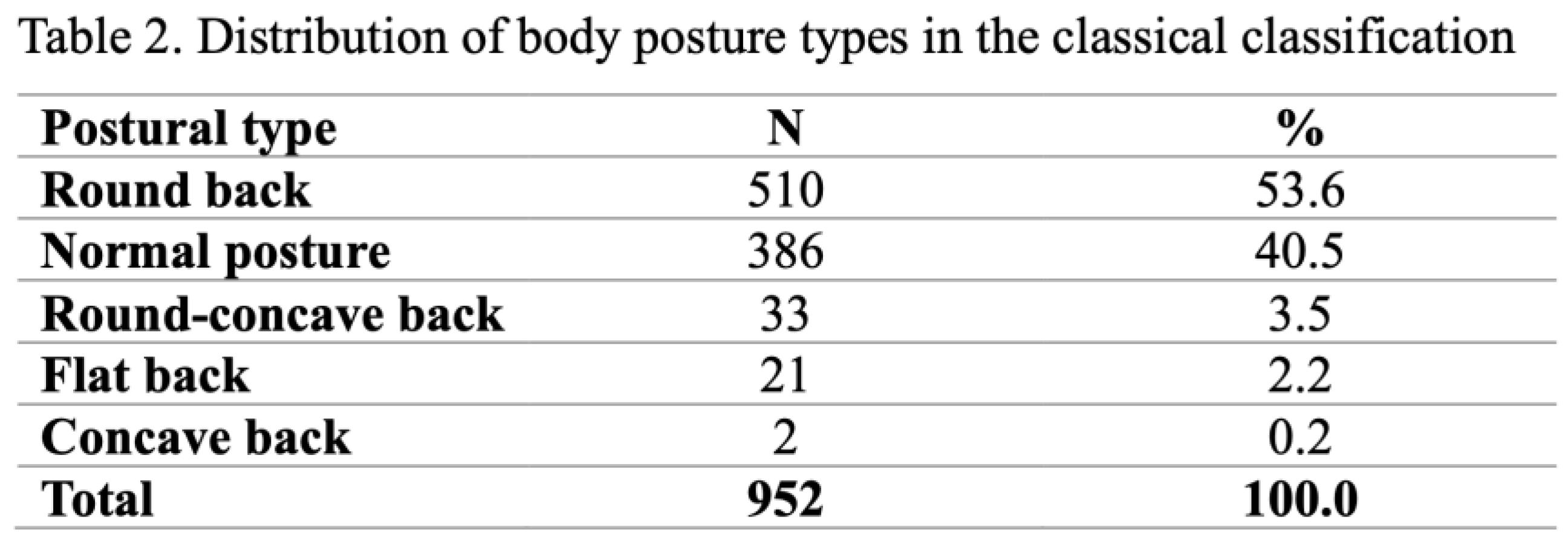
Analysis of the classical five-type classification showed that most children were assigned to two main posture categories. Round back and normal posture accounted for the vast majority of cases, whereas the remaining categories were rarely observed. This distribution indicates that the classical system produced a strongly concentrated category structure, with limited dispersion of participants across posture types (Table 2).
3.2. Distribution of Sagittal Posture Profiles According to Wilczyński’s Typology
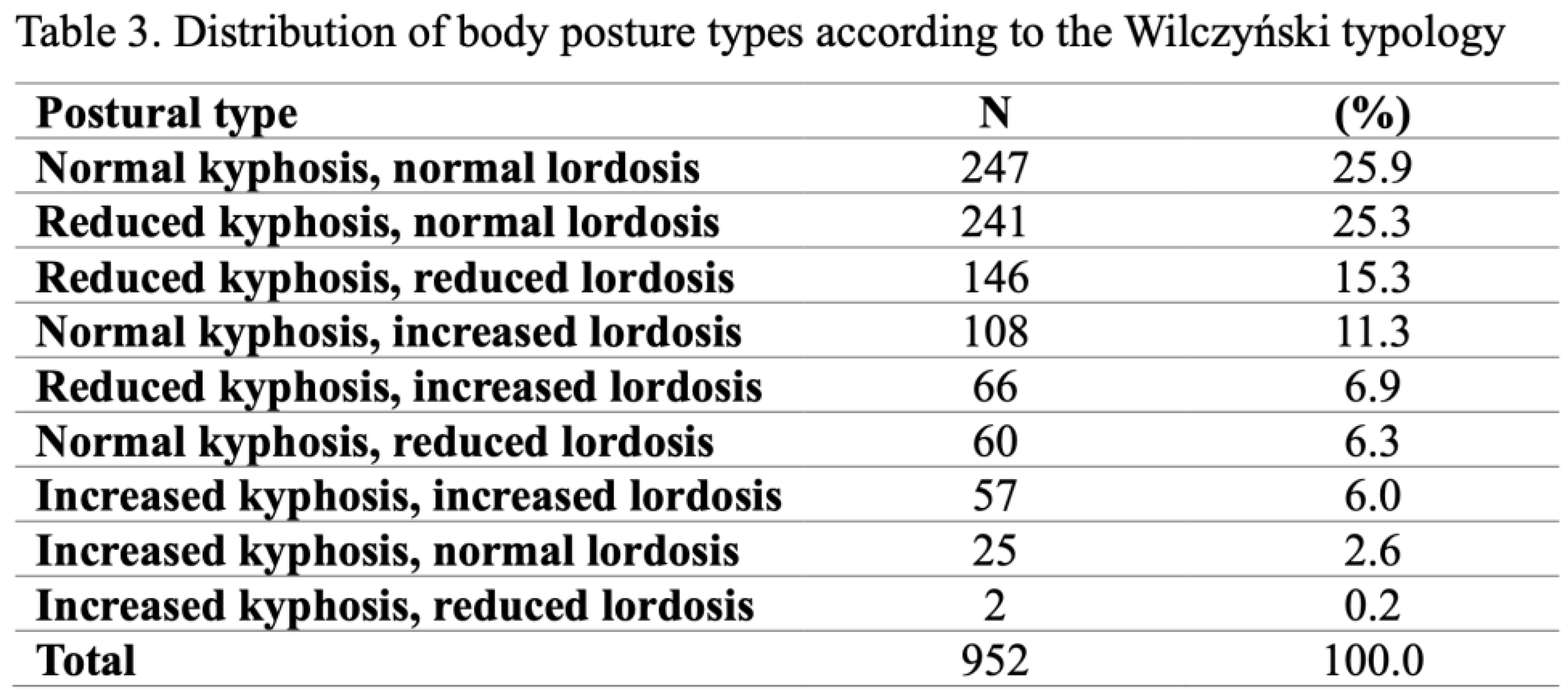
The application of the nine-type Wilczyński typology revealed a more heterogeneous distribution of sagittal postural profiles within the studied population. The largest groups included children presenting reduced thoracic kyphosis combined with normal lumbar lordosis as well as participants with normal values of both spinal curvatures. Notably, the classification distributed participants across a wider range of posture categories compared with the classical system, reflecting greater differentiation of sagittal spinal configurations (Table 3).
3.3. Comparison of Classification Systems
Cross-distribution analysis demonstrated a partial overlap between posture categories identified by the classical classification and the nine-type Wilczyński typology. However, individual categories of the classical system included multiple distinct sagittal spinal configurations when analyzed using the nine-type model.
This was particularly visible in children classified as presenting round back posture. In accordance with Wilczyński’s typology, these participants represented multiple combinations of thoracic kyphosis and lumbar lordosis values. Such distribution patterns are attributable to differences in category structure and normative thresholds applied in both systems. While the classical classification uses broader reference ranges for sagittal spinal curvatures, the Wilczyński typology applies narrower quantitative criteria derived from rasterstereographic measurements.
Therefore, obtained distribution indicates that the nine-type classification system produced greater differentiation of sagittal postural profiles within the studied pediatric population (Table 4).
Statistical analysis demonstrated a significant association correlation the classical posture classification and the nine-type Wilczyński typology (χ² = 1801.87; p < 0.001). The obtained Cramér’s V coefficient indicated a strong relationship between the two classification systems (V = 0.69). This finding suggests that both classifications describe related aspects of sagittal spinal alignment, although they differ in category structure and normative thresholds. Consequently, participants may be distributed differently across posture categories despite being classified on the basis of the same spinal curvature measurements (Table 5).
3.4. Entropy Analysis of Posture Classification Systems
Entropy analysis demonstrated clear differences in the distribution structure of posture categories between the analyzed classification systems. The nine-type Wilczyński typology showed higher entropy values compared with the classical five-type classification, indicating greater differentiation of sagittal postural profiles within the studied population.
Higher entropy reflected a more heterogeneous distribution of participants across posture categories, whereas lower entropy values indicated a stronger concentration of cases within a limited number of categories. These findings confirm that the structure and number of classification categories substantially influence the differentiation capacity of posture assessment systems (Table 6).
Entropy analysis demonstrated higher values for the Wilczyński typology than for the classical classification. Similar differences were observed for normalized entropy (H/Hmax), which reached 0.85 for the nine-type classification and 0.73 for the classical model. This indicates that the more detailed classification facilitated a more uniform dispersion of participants across the available categories. However, higher entropy should be interpreted as greater differentiation capacity rather than evidence of superior clinical validity.
4. Discussion
Assessment of body posture in the sagittal plane is one of the fundamental elements of musculoskeletal diagnostics in children. This results from the impact of spinal curvatures on biomechanics, load transmission and postural control [1,2,13]. In recent years, increasing attention has also been paid to the importance of precise sagittal parameter analysis in the context of musculoskeletal development and the prevention of postural abnormalities [23,24,25].
The results of the present study demonstrated that the choice of classification system substantially influenced the distribution of sagittal postural profiles in the studied population. In the classical five-type classification, the majority of participants were assigned to two dominant categories: round back and normal posture. Consequently, children presenting different combinations of thoracic kyphosis and lumbar lordosis values were frequently grouped within the same posture category. This finding suggests that the classical classification yields a generalized characterization of sagittal spinal alignment in school-aged children.
Similar observations have been reported in previous studies. Czaprowski et al. emphasized that sagittal postural abnormalities in children frequently represent a continuum of morphological variability rather than clearly separated clinical entities [10]. Concurrently, Santonja-Medina et al. noted that the assessment of sagittal spinal alignment may require consideration of a wider range of curvature patterns, as simplified classification systems do not always capture the full variability observed in pediatric populations [12].
A key methodological consideration of the present study is that the compared classification systems are based on different normative thresholds for thoracic kyphosis and lumbar lordosis. As a result, participant stratification to specific posture categories may vary despite considering identical baseline spinal curvature measurements. This should be taken into account when interpreting the observed differences between classifications.
The contingency matrix demonstrated that the use of different normative thresholds had substantial impact on the distribution of posture categories. In particular, many children classified as presenting normal thoracic kyphosis and normal lumbar lordosis according to the Wilczyński typology were assigned to the round back category within the classical classification. This observation suggests that the differences between the analyzed systems are related not only to the number of available categories but also to the manner in which normal sagittal spinal alignment is defined. Consequently, the present findings should be interpreted primarily as differences in classification structure and diagnostic criteria rather than evidence of superiority of one classification system over the other.
Population-based studies involving school-aged children demonstrate that thoracic kyphosis and lumbar lordosis values may vary depending on age, sex and biological maturation, as demonstrated in both cross-sectional and longitudinal analyses of sagittal spinal alignment during growth [23,26,27]. The present findings are consistent with these observations and indicate considerable variability in sagittal spinal curvature configurations among children aged 10-12 years. Such variability may contribute to differences in the distribution of posture categories depending on the classification criteria applied.
Attempts have also been made to provide a more differentiated description of sagittal morphotypes in other classification models. One such example is the sagittal integral morphotype concept proposed by Santonja et al., which includes assessment of spinal alignment in different functional positions, i.e. standing, sitting and trunk flexion [12,28]. Similarly, the widely recognized Roussouly model Roussouly describes several sagittal spinal alignment types associated with different biomechanical characteristics [29]. Although this system was developed primarily for adults, it underscores the critical role of variability in sagittal spinal curvature configuration for spinal biomechanics and load distribution. In contrast to these concepts, the Wilczyński typology represents a quantitative approach to the classification of sagittal posture profiles in children using modern surface topography techniques [13,30].
Implementing the nine-type Wilczyński typology yielded a broader distribution of participants across posture categories compared with the classical classification system. The most common configuration identified in the analyzed population was reduced thoracic kyphosis combined with normal lumbar lordosis. Entropy analysis revealed higher entropy values for the Wilczyński typology, indicating a more even distribution of participants among the available categories and a greater diversity of sagittal posture profiles represented within the classification structure. However, higher entropy should not be interpreted as evidence of greater clinical validity or diagnostic superiority. Rather, it reflects the differentiation capacity of the classification system and the manner in which observations are distributed across categories.
The observed distribution patterns indicate that variations in sagittal spinal alignment are relatively common among school-aged children. Similar observations have been reported in population-based studies analyzing the development of spinal curvatures during childhood and adolescence [1,2,3,31,32].
An important feature of the Wilczyński typology is its quantitative structure. This classification is based on explicitly defined angular ranges for thoracic kyphosis and lumbar lordosis, allowing direct allocation of individuals to specific posture categories [22]. In contrast, traditional posture classifications are frequently based on broader normative ranges and more descriptive approaches to posture evaluation [11,13]. Contemporary studies on sagittal spinal assessment have highlighted the growing role of quantitative measurements in the characterization of spinal alignment and in monitoring postural changes over time [31]. Within this context, the Wilczyński typology represents a quantitative method for describing sagittal posture profiles in pediatric populations.
A key methodological strength of the present study lies in the application of advanced modern surface topography techniques for posture assessment. Body posture was evaluated using the DIERS Formetric III 4D system, which enables radiation-free, three-dimensional analysis of spinal morphology based on rasterstereography. This method has been widely recognized as a reliable tool for posture assessment and analysis of spinal curvatures in both clinical and population-based studies [14,15,16]. Compared with visual assessment or simple clinical measurements, surface topography techniques provide high measurement repeatability and detailed quantitative information on spinal alignment [14,15]. Recent studies have also confirmed the usefulness of rasterstereographic methods in the assessment of posture parameters in children and adolescents [24,33].
Statistical analysis demonstrated a strong correlation between the classical posture classification and Wilczyński’s typology, as evidenced by a substantial Cramér’s V coefficient. This finding indicates that both classification systems describe related aspects of sagittal spinal alignment despite differences in category structure and normative thresholds. At the same time, the contingency matrix showed that participants were frequently assigned to different posture categories depending on the applied classification criteria. Consequently, the distribution of posture profiles should be interpreted in the context of the specific diagnostic thresholds used within each classification system.
To further explore the structure of the analyzed classifications, entropy analysis was performed, which provided information on the distribution of participants across posture categories and allowed us to evaluate the differentiation capacity of each classification model. From this perspective, higher entropy reflected greater heterogeneity and broader dispersion of observations among categories. The contingency matrix additionally demonstrated that a number of children classified within the traditional system as presenting “normal posture” or “round back” represented different combinations of thoracic kyphosis and lumbar lordosis values when analyzed using the Wilczyński typology.
From a clinical perspective, more detailed posture classification systems may be helpful in planning preventive and therapeutic interventions. Previous studies have shown that different sagittal spinal configurations are potentially associated with variations in spinal loading patterns and paraspinal muscle activity [13,20]. Consequently, a more detailed characterization of sagittal posture profiles may support individualized physiotherapeutic assessment, facilitate monitoring of postural changes over time, and assist in the identification of subtle deviations that may not be apparent within broader posture categories. In addition, biomechanical studies suggest that even relatively small changes in sagittal spinal parameters may influence postural balance and spinal biomechanics [26,34]. Nevertheless, further studies are needed to determine whether greater differentiation of posture profiles translates into clinically meaningful benefits in diagnosis, treatment planning or outcome prediction.
Several methodological limitations should be considered when interpreting the results of the present study. First, the cross-sectional design did not allow for the assessment of longitudinal changes in posture during growth or determination of causal relationships between sagittal spinal alignment and developmental factors. The development of thoracic kyphosis and lumbar lordosis during childhood is a dynamic process influenced by growth and biological maturation; therefore, longitudinal analyses may provide more detailed insight into the evolution of sagittal posture profiles over time [1,2,3].
Another limitation is the relatively narrow age range of the analyzed population (10-12 years). Although the studied age group permitted the assessment of a relatively homogeneous developmental group, the findings cannot be directly generalized to younger children or adolescents during the period of advanced pubertal development. Additionally, the analysis did not include environmental or functional factors such as physical activity level, prolonged sitting or postural habits, which may influence sagittal spinal alignment in children [3,11,32,35,36].
The present study focused on the structural characteristics and differentiation capacity of posture classification systems rather than their clinical validity. Consequently, Wilczyński’s typology was not evaluated against clinical outcomes, functional impairment, back pain or other external reference standards. Furthermore, the stability of posture classification over repeated measurements was not assessed. Future studies should investigate whether greater differentiation of sagittal posture profiles is associated with clinically meaningful outcomes and whether classification results remain stable over time.
Despite these limitations, the relatively large sample size and the use of objective three-dimensional rasterstereographic assessment strengthen the reliability of the obtained findings. The results may have implications for physiotherapy, posture screening programs, and research focused on sagittal spinal alignment in school-aged children. They indicate that the choice of posture classification system may substantially influence the distribution and interpretation of sagittal postural profiles within a population. Consequently, comparisons between studies and the interpretation of posture assessment outcomes should consider the applied classification criteria and normative thresholds.
More detailed posture classification models—such as the Wilczyński typology—are of potential value in scientific studies requiring a more comprehensive description of sagittal spinal alignment and posture profile distribution. At the same time, simpler posture classifications may remain useful in large-scale school screening programs, where rapid assessment of large pediatric populations is often required. Therefore, the choice of classification system should therefore depend on the purpose of the assessment and the level of detail required for data interpretation.
The present findings also highlight the importance of regular posture screening in children and adolescents, as well as preventive strategies aimed at promoting appropriate postural habits and adequate levels of physical activity.
In summary, the obtained results indicate that the nine-type Wilczyński typology distributes participants across a broader range of posture categories than the traditional five-type classification system. The combination of quantitative classification criteria and modern surface topography techniques allows for a more detailed description of sagittal spinal curvature patterns in school-aged children. At the same time, the observed differences should be interpreted primarily in relation to the classification structure and applied normative thresholds rather than as evidence of superior clinical performance. These findings may contribute to future research on sagittal posture assessment and the development of quantitative approaches to posture classification in pediatric populations.
5. Conclusions
The implemented posture classification system substantially influenced the distribution and differentiation of sagittal postural profiles in children aged 10-12 years. The classical five-type classification and the nine-type Wilczyński typology described related aspects of sagittal spinal alignment; however, they differed in category structure and the allocation of participants to specific posture profiles.
Wilczyński’s nine-type typology distributed participants across a broader range of sagittal posture categories, indicating greater differentiation capacity compared with the classical classification system. Higher entropy values observed for the nine-type classification reflected greater heterogeneity and dispersion of participants among categories.
The obtained findings reveal that classification criteria and normative thresholds are important methodological factors affecting the interpretation of sagittal posture assessment results. Shannon entropy may represent a useful quantitative approach to evaluating the differentiation capacity of posture classification systems based on three-dimensional surface topography. However, entropy values should be interpreted as indicators of category distribution characteristics rather than measures of clinical validity.
Author Contributions
Conceptualization, J.W. and P.S.; methodology, J.W., P.S., K.B. and N.H.-T.; validation, J.W., P.S., K.B. and N.H.-T.; formal analysis, P.S. and K.M.; investigation, J.W., M.G., P.S., K.M., W.Ś. and A.M.; resources, J.W.; data curation, P.S., M.G., K.M., W.Ś. and A.M.; writing—original draft preparation, J.W., P.S. and M.G.; writing—review and editing, J.W., M.G., K.B., P.S., N.H.-T., K.M., W.Ś. and A.M.; visualization, P.S. and M.G.; supervision, J.W.; project administration, J.W. and P.S. All authors have read and agreed to the published version of the manuscript.
Funding
This research received no external funding.
Institutional Review Board Statement
The study was conducted in accordance with the Declaration of Helsinki and approved by the Institutional Review Board (or Ethics Committee) of Jan Kochanowski University in Kielce, Poland (protocol code 37/2018).
Informed Consent Statement
Written informed consent was obtained from the parents or legal guardians of all participants involved in the study.
Data Availability Statement
The datasets generated and/or analyzed during the current study are not publicly available due to privacy and ethical restrictions related to the participation of minors but are available from the corresponding author on reasonable request.
Conflicts of Interest
The authors declare no conflict of interest.
Abbreviations
The following abbreviations are used in this manuscript:
| DIERS | Dynamic Infrared Rasterstereography |
| 3D | Three-dimensional |
| H | Shannon entropy |
| Hmax | Maximum entropy |
| H/Hmax | Normalized entropy index |
| ICT-ITL | Thoracic kyphosis angle |
| ITL-ILS | Lumbar lordosis angle |
| SD | Standard deviation |
References
- Pesenti, S.; Charles, Y.P.; Prost, S.; Solla, F.; Blondel, B.; Ilharreborde, B.; et al. Spinal sagittal alignment changes during childhood: Results of a national cohort analysis of 1,059 healthy children. J. Bone Jt. Surg. Am. 2023, 105, 676-686. [CrossRef]
- Hu, Z.; Xu, Y.; Fan, C.; Chen, C.; Li, D.; Liu, Q.; Wang, M.; Zhu, Z.; Qiu, Y.; Liu, Z. Evolution of sagittal spinal alignment during pubertal growth: A large-scale study in a Chinese pediatric population. J. Bone Jt. Surg. Am. 2025, 107, e16. [CrossRef]
- Annarumma, G.; Mazza, F.; Ambrosi, A.; Keeling, E.; Fernando, F.; Sirico, F.; et al. Sagittal spinal alignment in children and adolescents: Associations with age, weight status, and sports participation. Children 2025, 12, 659. [CrossRef]
- Johnson, C.; Hallemans, A.; Goetschalckx, M.; Meyns, P.; Rameckers, E.; Klingels, K.; Verbecque, E.; et al. Psychometric properties of functional postural control tests in children: A systematic review. Ann. Phys. Rehabil. Med. 2023, 66, 101729. [CrossRef]
- Gardinal, M.; Fiebrantz, A.L.D.S.; Viana, M.O.; Rodacki, A.L.F.; Pavão, S.L. Dynamic postural control in children with autism spectrum disorder: A systematic review. Phys. Occup. Ther. Pediatr. 2026, 46, 172-203. [CrossRef]
- Al-Allaf, O.; Mostafa, O.E.S.; Henegan, N.; Austin-Davies, H.; Gardner, A. Development of thoracic spine kyphosis and lumbar spine lordosis in the growing child from birth to adulthood: Protocol for a systematic review. BMJ Open 2025, 15, e095947. [CrossRef]
- Ziętek, M.; Machniak, M.; Wójtowicz, D.; Chwałczyńska, A. The incidence of body posture abnormalities in relation to the segmental body composition in early school-aged children. Int. J. Environ. Res. Public Health 2022, 19, 10815. [CrossRef]
- Bober, A.; Kopaczyńska, A.; Puk, A.; Chwałczyńska, A. Occurrence of body posture abnormalities in overweight and obese children aged 5-6 years: A pilot study. Children 2024, 11, 849. [CrossRef]
- Jorgić, B.M.; Đorđević, S.N.; Hadžović, M.M.; Milenković, S.; Stojiljković, N.Đ.; Olanescu, M.; Peris, M.; Suciu, A.; Popa, D.; Plesa, A. The influence of body composition on sagittal plane posture among elementary school-aged children. Children 2024, 11, 36. [CrossRef]
- Czaprowski, D.; Stoliński, Ł.; Tyrakowski, M.; Kozinoga, M.; Kotwicki, T. Non-structural misalignments of body posture in the sagittal plane. Scoliosis Spinal Disord. 2018, 13, 6. [CrossRef]
- Sainz de Baranda, P.; Andújar, P.; Collazo-Diéguez, M.; Pastor, A.; Santonja-Renedo, F.; Martínez-Romero, M.T.; et al. Sagittal standing spinal alignment and back pain in 8 to 12-year-old children from the Region of Murcia, Spain: The ISQUIOS Program. J. Back Musculoskelet. Rehabil. 2020, 33, 1003-1014. [CrossRef]
- Santonja-Medina, F.; Collazo-Diéguez, M.; Martínez-Romero, M.T.; Aparicio-Sarmiento, A.; Cejudo, A.; Rodríguez-Ferrán, O.; et al. Classification system of the sagittal integral morphotype in children from the ISQUIOS programme. Int. J. Environ. Res. Public Health 2020, 17, 2467. [CrossRef]
- Hey, H.W.D.; Lin, S.; Tay, H.W.; Tay, Y.J.; Liu, G.K.; Wong, H.K. Understanding “kyphosis” and “lordosis” for sagittal balancing in two common standing postures. Spine 2021, 46, 1603-1611. [CrossRef]
- Mehta, B.; Chockalingam, N.; Shannon, T.; Jevtic, N.; Lazic, F.; Jasani, V.; et al. Non-invasive assessment of back surface topography: Technologies, techniques and clinical utility. Sensors 2023, 23, 8485. [CrossRef]
- Weigel, S.; Dullien, S.; Grifka, J.; Jansen, P. Comparison of rasterstereography with orthopedic examination in posture assessment: An observational study. Front. Surg. 2024, 11, 1461569. [CrossRef]
- Liu, X.; Yang, X.S.; Wang, L.; Yu, M.; Liu, X.G.; Liu, Z.J. Utility of DIERS Formetric 4D® combined with gait analysis to assess motor function. J. Orthop. Sci. 2020, 25, 576-581. [CrossRef]
- Nguyen, T.N.N.; Pham, T.T.; Le, L.H.; Emery, D.J.; Stampe, K.; Southon Hryniuk, S.; Lou, E. Combining ultrasound and surface topography in assessment of spinal curves: A pilot study. Eur. Spine J. 2025, 34, 5211-5223. [CrossRef]
- Porsnok, D.; Mutlu, A.; Livanelioğlu, A. Assessment of spinal alignment in children with unilateral cerebral palsy. Clin. Biomech. 2022, 100, 105800. [CrossRef]
- Wilczyński, J. Relationship between muscle tone of the erector spinae and the concave and convex sides of spinal curvature in low-grade scoliosis among children. Children 2021, 8, 1168. [CrossRef]
- Żurawski, A.Ł.; Kiebzak, W.P.; Kowalski, I.M.; Śliwiński, G.; Śliwiński, Z. Association between postural control and sagittal spinal curvature. PLoS ONE 2020, 15, e0241228. [CrossRef]
- Zmyślna, A.; Żurawski, A.Ł.; Śliwiński, G.; Śliwiński, Z.W.; Kiebzak, W.P. Assessment of body posture of children with chest pain. Front. Pediatr. 2021, 9, 704087. [CrossRef]
- Wilczyński, J. Own typology of body posture based on research using the DIERS Formetric III 4D system. J. Clin. Med. 2025, 14, 501. [CrossRef]
- Đorđević, S.; Stanković, M.; Jorgić, B.; Milenković, S.; Smailović, S.; Katanić, B.; et al. Association of sagittal spinal posture among elementary school pupils with sex and grade. Children 2024, 11, 446. [CrossRef]
- Ludwig, O.; Dindorf, C.; Kelm, J.; Simon, S.; Nimmrichter, F.; Fröhlich, M. Reference values for sagittal clinical posture assessment in people aged 10 to 69 years. Int. J. Environ. Res. Public Health 2023, 20, 4131. [CrossRef]
- Hijazo-Larrosa, S.; Lucha-López, M.O.; Monti-Ballano, S.; Barrio-Ollero, E.; Hidalgo-García, C.; Martínez-Jarreta, B.; Vicente-Pina, L.; Tricas-Moreno, J. Sagittal posture parameters of the spine and exposure to awkward postures in mattress manufacture workers: An analytical cross-sectional study. J. Funct. Morphol. Kinesiol. 2026, 11, 87. [CrossRef]
- Gardner, A.; Barryman, F.; Pynsent, P. The kyphosis-lordosis difference parameter and its utility in understanding the pathogenesis of adolescent idiopathic scoliosis. BMC Res. Notes 2022, 15, 178. [CrossRef]
- Mac-Thiong, J.M.; Labelle, H.; Roussouly, P. Pediatric sagittal alignment. Eur. Spine J. 2011, 20, 586-590. [CrossRef]
- Paolucci, T.; Agostini, F.; Mangone, M.; Bernetti, A.; et al. Sagittal spine alignment and postural balance in pre-puberty age: A multidisciplinary rehabilitative perspective. Eur. J. Phys. Rehabil. Med. 2021, 57, 413-420.
- Roussouly, P.; Gollogly, S.; Berthonnaud, E.; Dimnet, J. Classification of the normal variation in the sagittal alignment of the human lumbar spine and pelvis in the standing position. Spine 2005, 30, 346-353. [CrossRef]
- Fang, J.J.; Shen, L.M. Analysis of sagittal spinal alignment at the adolescent age: For furniture design. Ergonomics 2023, 66, 1477-1493. [CrossRef]
- Li, C.; Zhao, Y.; Yu, Z.; et al. Sagittal imbalance of the spine is associated with poor sitting posture among primary and secondary school students in China: A cross-sectional study. BMC Musculoskelet. Disord. 2022, 23, 98. [CrossRef]
- Adami Sedrez, J.; Zaniratti de Rosa, M.I.; Noll, M.; Medeiros, F.; et al. Risk factors associated with structural postural changes in the spinal column of children and adolescents. Rev. Paul. Pediatr. 2015, 33, 72-81. [CrossRef]
- Su, X.; Dong, R.; Wen, Z.; Liu, Y. Reliability and validity of scoliosis measurements obtained with surface topography techniques: A systematic review. J. Clin. Med. 2022, 11, 6998. [CrossRef]
- Park, Y.J.; Kim, W.M.; Yu, J.H.; Moon, H.H.; Seo, Y.G. Effects of combined exercise program on spinal curvature and balance ability in adolescents with kyphosis. Children 2022, 9, 1999. [CrossRef]
- Koedijk, J.B.; Rijswijk, J.; Oranje, W.A.; et al. Sedentary behaviour and bone health in children, adolescents and young adults: A systematic review. Osteoporos. Int. 2017, 28, 2507-2519. [CrossRef]
- Barczyk, K.; Hawrylak, A.; Wojna, D.; Giemza, C. Application of photogrammetry for evaluation of selected body posture parameters in children of early school age. Acta Bioopt. Inform. Med. 2008, 14, 217-222.
Figure 1.
Wilczyński’s classification of sagittal body posture types [22].
Figure 1.
Wilczyński’s classification of sagittal body posture types [22].
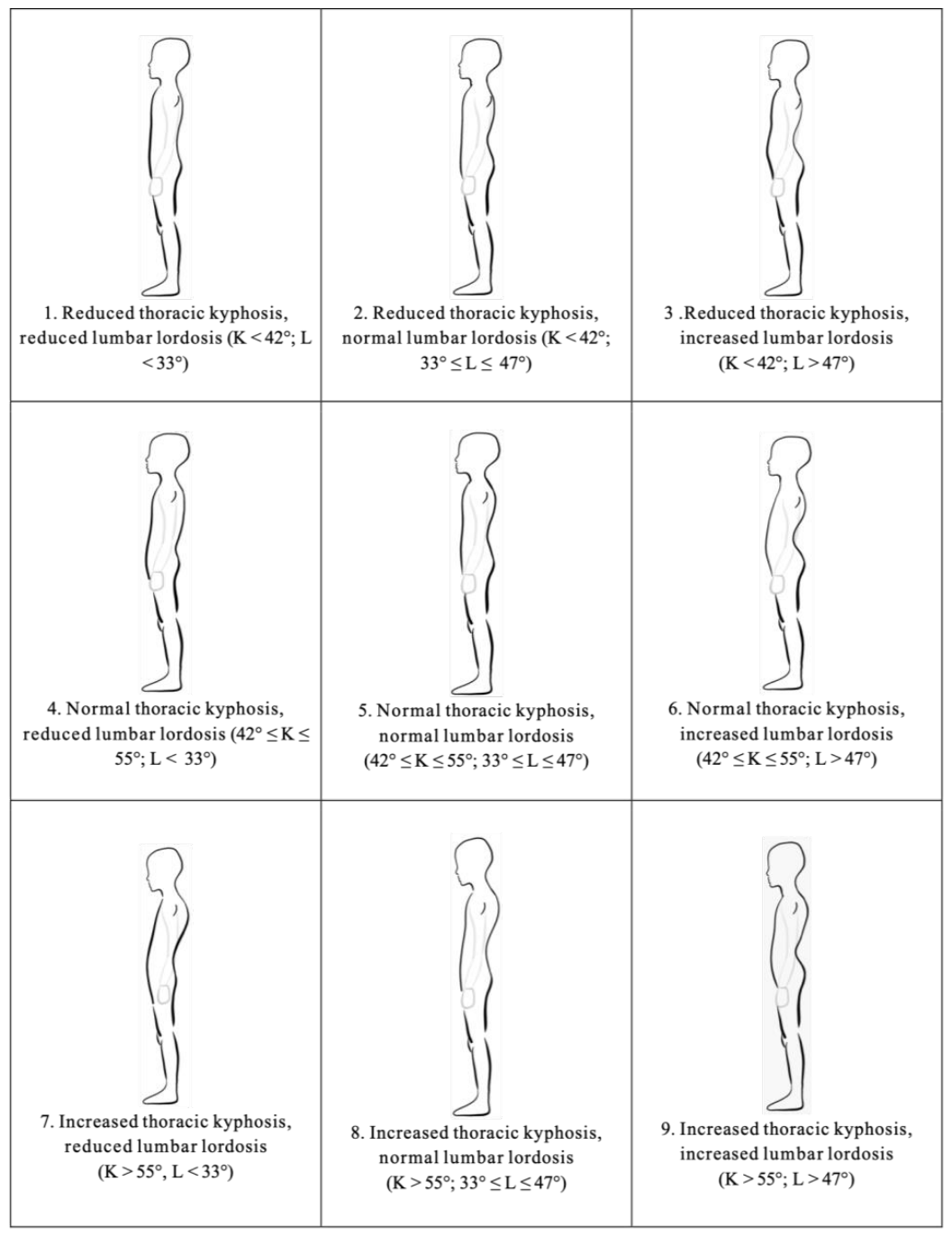

Table 1.
Study population characteristics (N = 952).
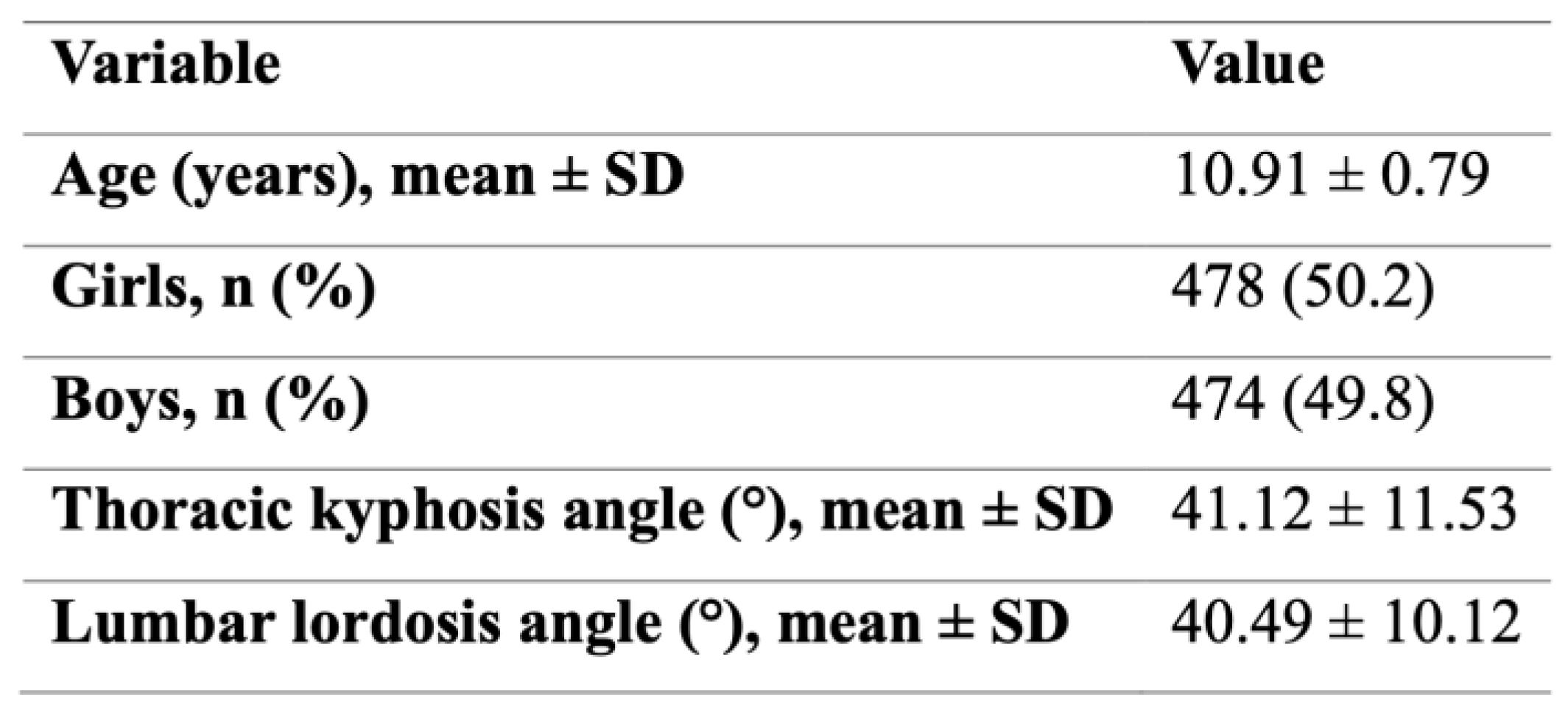 |
Table 4.
Cross-distribution of sagittal postural profiles between classical classification and Wilczyński’s typology.
Table 4.
Cross-distribution of sagittal postural profiles between classical classification and Wilczyński’s typology.
| Wilczyński’s postural type | Round back | Round-concave back | Flat back | Concave back | Normal posture | Total |
|---|---|---|---|---|---|---|
| Reduced kyphosis, reduced lordosis | 15 | 0 | 21 | 0 | 110 | 146 |
| Reduced kyphosis, normal lordosis | 20 | 0 | 0 | 0 | 221 | 241 |
| Reduced kyphosis, increased lordosis | 9 | 0 | 0 | 2 | 55 | 66 |
| Normal kyphosis, reduced lordosis | 60 | 0 | 0 | 0 | 0 | 60 |
| Normal kyphosis, normal lordosis | 247 | 0 | 0 | 0 | 0 | 247 |
| Normal kyphosis, increased lordosis | 97 | 11 | 0 | 0 | 0 | 108 |
| Increased kyphosis, reduced lordosis | 2 | 0 | 0 | 0 | 0 | 2 |
| Increased kyphosis, normal lordosis | 25 | 0 | 0 | 0 | 0 | 25 |
| Increased kyphosis, increased lordosis | 35 | 22 | 0 | 0 | 0 | 57 |
| Total | 510 | 33 | 21 | 2 | 386 | 952 |
Table 5.
Association between classical classification of body posture and Wilczyński’s typology.
| Statistic | Value |
|---|---|
| Sample size (N) | 952 |
| χ² | 1801.87 |
| Df | 32 |
| P | < 0.001 |
| Cramér’s V | 0.69 |
Table 6.
Entropy of distribution regarding body posture types depending on classification system.
| Classification system | Number of categories | Entropy (H) | Maximum entropy (Hmax) | H/Hmax |
|---|---|---|---|---|
| Classical posture classification | 5 | 1.17 | 1.61 | 0.73 |
| Wilczyński’s typology | 9 | 1.86 | 2.20 | 0.85 |
Disclaimer/Publisher’s Note: The statements, opinions and data contained in all publications are solely those of the individual author(s) and contributor(s) and not of MDPI and/or the editor(s). MDPI and/or the editor(s) disclaim responsibility for any injury to people or property resulting from any ideas, methods, instructions or products referred to in the content. |
© 2026 by the authors. Licensee MDPI, Basel, Switzerland. This article is an open access article distributed under the terms and conditions of the Creative Commons Attribution (CC BY) license (http://creativecommons.org/licenses/by/4.0/).
Copyright: This open access article is published under a Creative Commons CC BY 4.0 license, which permit the free download, distribution, and reuse, provided that the author and preprint are cited in any reuse.