

Submitted:
16 July 2026
Posted:
21 July 2026
You are already at the latest version
Abstract
Job satisfaction has become a significant factor in organizational performance, particularly in operational sectors such as port activities, where efficiency, coordination, and safety are essential. This study aimed to analyze the relationship between job satisfaction and perceived productivity among technical workers at port companies in Guayaquil, Ecuador. A mixed-methods approach with a convergent design was employed, integrating ordinal data obtained via surveys with qualitative data from semi-structured interviews. The survey, based on a 7-point Likert scale, was administered to 54 port technicians to measure job satisfaction and perceived productivity. The qualitative component consisted of semi-structured interviews with industry experts. Descriptive statistics and Spearman’s correlation coefficient were used to analyze the ordinal data, while the qualitative information was analyzed using thematic analysis. The findings revealed high levels of job satisfaction (59.3%) and perceived productivity (85.2%). Furthermore, a strong, statistically significant positive association was identified between the two variables (ρ = 0.770, p<0.001). Qualitative results reinforced these findings, highlighting motivation, recognition, and organizational climate as key elements influencing work performance. The study concludes that higher levels of job satisfaction are associated with higher levels of perceived productivity. The findings contribute to the social sustainability literature by showing how job satisfaction, recognition, motivation, and organizational climate are associated with perceived productivity in a highly demanding port context. The study highlights the importance of labor well-being and positive work environments as social sustainability dimensions that may support more sustainable and productive port operations.
Keywords:
social sustainability
; labor well-being
; job satisfaction
; perceived productivity
; sustainable port operations
; organizational climate
; decent work
; port technicians
1. Introduction
Seaports constitute a highly important pillar of global trade, and their operational efficiency is essential for the economic development of many countries. Port productivity, understood as the ability to handle cargo safely, quickly, and efficiently, depends on the proper coordination of human resources, technology, and logistics systems. This involves complying with established procedures within defined timeframes, optimizing costs, and maintaining standards of quality, safety, environmental sustainability, and social sustainability [1,2,3]. Various studies indicate that operational efficiency in maritime and port systems depends not only on technological and logistical factors, but also on the performance and satisfaction of human talent [3,4,5]. In this context, human talent management emerges as a determining factor for sustainable organizational performance, especially in work environments where there are high operational demands, such as the port sector.
From a sustainability perspective, port operations should not be evaluated only through economic, logistical, or environmental indicators, but also through their social dimension [2,6]. Labor well-being, decent work, occupational safety, recognition, and organizational climate are relevant components of social sustainability because they influence how workers experience their jobs and how organizations maintain stable and productive work environments [7,8]. In highly demanding sectors such as port operations and logistics, strengthening workers’ well-being can contribute to more sustainable organizational performance [9].
Port companies in the city of Guayaquil represent one of the most important logistics activities in Ecuador and concentrate a significant proportion of national maritime cargo movement, playing an essential role in terms of the competitiveness of foreign trade and the sustainability of national port operations [1,10]. Despite technological and organizational-management modernization processes implemented in recent years, the port sector constantly faces variations in its operational dynamics, such as the reduction in container throughput recorded in 2024, followed by an approximate recovery of 17% during the first quarter of 2025 [10]. These variations increase pressure on port workers, who perform their activities in highly demanding environments that require coordination, effective communication, compliance with safety standards, and constant adaptation to organizational changes.
The scientific literature has shown that job satisfaction is a relevant dimension of employees’ well-being and sustainable organizational performance. Factors such as working conditions, professional recognition, job stability, development opportunities, and organizational climate significantly influence employees’ perceptions of performance and individual productivity [11]. Furthermore, international studies have shown that employees with higher levels of job satisfaction tend to demonstrate greater organizational commitment, motivation, and productivity [12,13]. In the Ecuadorian context, it has also been observed that working conditions, quality of life, and employee motivation can be affected by organizational and regulatory changes, with implications for the work environment and perceived productivity [14]. However, the relationship between job satisfaction and productivity should be interpreted within a broader sustainability framework, since job resources, psychological demands, occupational safety, organizational support, and sustainable workplace conditions may shape how satisfaction is translated into perceived performance [7,8]. Moreover, some studies conducted across different time periods and operational settings have reported different or even inverse effects between job satisfaction and performance, depending on organizational characteristics and the work environment [15]. These discrepancies highlight the need for context-specific studies that provide a better understanding of the specific dynamics of this relationship in strategic sectors such as the port industry.
In the Latin American context, and particularly in Ecuador, empirical evidence on job satisfaction among technical workers in port companies remains limited. Recent international literature has shown that sustainable work environments, workplace conditions, social norms, organizational culture, and occupational safety conditions are associated with employee well-being, motivation, and performance in logistics and operational contexts [7,8,9]. Likewise, studies conducted in maritime and transportation contexts have confirmed that variables such as occupational stress, job rewards, and work design are associated with employees’ job satisfaction and performance [5]. Similarly, studies conducted in Asian port terminals have shown that the organizational climate and employee recognition systems are significantly associated with employees’ job satisfaction and operational efficiency [16]. It has also been reported that interpersonal trust, organizational commitment, and the quality of the work environment are associated with perceptions of efficiency and productivity [17]. Nevertheless, a gap remains in the empirical analysis of how these factors are specifically interconnected in port work and how they influence the subjective perception of job performance.
In this context, the present study aims to analyze the relationship between job satisfaction and perceived productivity among workers in port companies in Guayaquil, using a mixed-methods approach with a convergent design that combines descriptive and correlational data analysis. The research hypothesis states that there is a statistically significant relationship between the level of job satisfaction and the perceived productivity of technical workers in port companies. The study also seeks to describe the levels of both variables and generate empirical evidence that contributes to the design of strategies aimed at strengthening well-being and organizational efficiency in the sector.
This study contributes to the social sustainability and occupational well-being literature in three ways. First, it extends research on labor well-being and perceived productivity to the port sector, a highly demanding operational context that remains underexplored in Latin America. Second, it integrates ordinal survey data and expert interviews to examine not only whether job satisfaction is associated with perceived productivity, but also how social and organizational factors—such as recognition, motivation, organizational climate, and working conditions—help explain this association. Third, it provides evidence on the relevance of positive work environments as a social sustainability condition for supporting perceived performance among technical workers in port companies.
2. Theoretical Background and Hypothesis Development
2.1. Labor Well-Being and Social Sustainability
Job satisfaction is a central construct in social sustainability because it reflects employees’ evaluation of their work conditions, rewards, recognition, development opportunities, and organizational environment. From a social sustainability perspective, job satisfaction is not only an indicator of employee well-being, but also a psychological and work-related construct associated with motivation, commitment, perceived performance, and positive workplace experiences [11,12]. Sustainable HRM literature also emphasizes that organizations should reduce negative employee outcomes, such as work-related stress, burnout, and work-family conflict, while preserving human resources and supporting employee well-being [7].
In operational sectors such as port activities, job satisfaction becomes particularly relevant because employees perform their duties under conditions that require coordination, safety compliance, time efficiency, and adaptation to changing operational demands. Therefore, understanding job satisfaction in this context allows managers to identify organizational practices that may strengthen both employee well-being and operational performance.
2.2. Job Satisfaction, Organizational Climate, and Sustainable Work Environments
Sustainable work environments are shaped by organizational climate, workplace conditions, social norms, leadership, recognition, and occupational safety. These factors are relevant because they influence how employees experience their work and how they evaluate their own performance. In logistics and other operationally intensive sectors, workplace environment and social norms have been shown to support employee performance and sustainability-oriented outcomes [9].
Perceived productivity refers to workers’ subjective assessment of their ability to perform tasks efficiently, meet work goals, and contribute to organizational outcomes. Although objective productivity indicators are essential in port operations, perceived productivity provides useful information about how employees evaluate their performance and the organizational conditions that facilitate or constrain their work. Employees who perceive favorable working conditions and organizational recognition may report higher levels of perceived productivity, particularly in environments where task coordination, safety compliance, and operational discipline are critical.
2.3. Perceived Productivity in Sustainable Port Operations
Sustainable port operations require the integration of economic, environmental, technical, and social dimensions. Recent port sustainability literature emphasizes that port performance should be assessed not only through infrastructure, operational efficiency, and environmental impact, but also through social indicators related to employment conditions, training, diversity, occupational health and safety, and the working environment [1,2].
In this sense, perceived productivity can be understood as a worker-centered indicator that complements traditional operational metrics. While it does not replace objective indicators such as cargo handling time, safety incidents, shift efficiency, or error rates, it provides information about how employees perceive their own contribution to organizational performance within demanding port environments.
2.4. Job Demands–Resources Theory and Hypothesis Development
The Job Demands–Resources theory provides a useful framework for understanding the relationship between job satisfaction and perceived productivity. According to this perspective, demanding work environments may generate pressure and strain, but organizational resources such as recognition, leadership support, adequate working conditions, teamwork, and a positive organizational climate can strengthen motivation, well-being, and performance [8,18].
Based on the literature reviewed, job satisfaction is expected to be positively associated with perceived productivity among technical workers in port companies. Satisfied employees may be more motivated, more committed to organizational goals, and more willing to comply with operational procedures, which can be reflected in higher perceived productivity.
Therefore, the following hypothesis is proposed:
H1. Job satisfaction is positively and significantly associated with perceived productivity among technical workers in port companies.
3. Materials and Methods
3.1. Research Approach
This research adopted a mixed-methods approach using a convergent design, which allowed for the simultaneous collection and analysis of information obtained through surveys (see Appendix A) and interviews (see Appendix B), subsequently integrating the results to achieve a more comprehensive understanding of the study. The survey component, based on ordinal data, played a key role and made it possible to measure levels of job satisfaction and perceived productivity by administering a structured survey to port technicians. This component statistically determined the relationship between the variables.
The qualitative component, based on semi-structured interviews, played a complementary role and was developed with experts in the port sector to deepen the interpretation of the ordinal results and identify organizational factors that may influence the relationship between the study variables. The integration of both components was carried out through methodological triangulation, contrasting the statistical results obtained from the surveys with the perceptions and experiences expressed by the interviewed experts. This process made it possible to complement the ordinal data with qualitative explanations regarding labor and productivity dynamics in the port sector.
The mixed-methods design was used not only to corroborate the quantitative results but also to identify social and organizational factors associated with the relationship between job satisfaction and perceived productivity in port operations. In this sense, the qualitative component allowed the study to interpret the statistical association from a social sustainability perspective, considering factors such as recognition, motivation, organizational climate, labor well-being, and operational performance.
Integration was performed in the interpretation phase using a joint display, jointly comparing the results obtained from both sources of information.
3.2. Type and Research Design
The study was descriptive-correlational in nature, as it describes the levels of job satisfaction and perceived productivity. In addition, it analyzed the statistical relationship between both variables. The design was non-experimental since the variables were not manipulated and cross-sectional, as the data were collected at a single point in time during 2026.
3.3. Population and Sample
The survey participants consisted of 54 technicians working in port companies in the city of Guayaquil during 2026 (11 women and 43 men), representing the entire accessible target population of the study. The sociodemographic characterization of the participants is presented in Table 1.
For the qualitative component, five experts from the port sector were intentionally selected, considering as inclusion criteria holding positions of responsibility in strategic areas of the organization and having at least 10 years of professional experience in the sector. The sample consisted of an Engineering and Projects Manager, a General Manager, a Maintenance Manager, an Engineering Manager, and a Maintenance Department supervisor. The participants reported between 11 and 25 years of professional experience, with an average of 17.8 years. The selection of these profiles made it possible to obtain specialized perspectives related to the operational, technical, and administrative management of port companies, contributing to a broader understanding of the relationship between job satisfaction and productivity.
3.4. Operationalization of Variables
The operationalization of the variables guided the development of the data collection instruments used in both the survey and interview components. Table 2 presents the dimensions and indicators considered for the variables of job satisfaction and perceived productivity. This tool made it possible to break down the study variables and facilitate their measurement.
The operationalization of variables constituted the basis for the development of data collection instruments. The dimensions and indicators guided the formulation of the items in the structured survey applied to technicians working in the port sector; meanwhile, in the qualitative component, they served as a reference for the design of the expert interview guide.
3.5. Data Collection Techniques and Instruments
For data collection, a self-designed structured survey was developed specifically for this study (see Appendix A), considering the variables of job satisfaction and perceived productivity. The instrument was developed from the dimensions and indicators defined in the operationalization of variables and was structured using a seven-point Likert scale. The survey had an ordinal level of measurement, where: 1 = Strongly disagree; 2 = Disagree; 3 = Partially disagree; 4 = Neutral; 5 = Partially agree; 6 = Agree; and 7 = Strongly agree.
Scoring was carried out by summing and averaging responses by dimension and variable, so that higher scores represented higher levels of job satisfaction and a more favorable perception of productivity. For result interpretation, classification ranges were established into low, medium, and high levels. A self-designed semi-structured interview was also applied, based on the dimensions and indicators established in the operationalization of variables, with the purpose of analyzing the relationship between job satisfaction and perceived productivity from an expert perspective.
The interview guide was structured into three thematic axes: satisfaction-productivity relationship, recognition-efficiency, and work climate-performance (see Appendix B); the interviews were conducted individually, with an approximate duration of 20 to 30 minutes. The analysis was carried out using thematic analysis based on coding, grouping responses according to the defined axes to identify patterns and complement the interpretation of the ordinal results. The coding process followed a deductive–inductive logic. First, codes were organized according to the dimensions defined in the operationalization matrix. Subsequently, recurring themes emerging from the interviews were grouped into broader social and organizational categories related to motivation, recognition, organizational climate, labor well-being, and operational performance.
3.6. Validity and Reliability
Content validity was determined through expert judgment, consisting of a panel of six specialists who evaluated clarity and relevance. For the relevance assessment, a four-category ordinal scale was used: very relevant, relevant, slightly relevant, and not relevant. For the clarity criterion, the scale used was: very clear, clear, slightly clear, and not clear.
For the purposes of calculating the Content Validity Index (CVI), responses were dichotomized, considering favorable ratings as “very relevant” and “relevant” for the relevance criterion, and “very clear” and “clear” for the clarity criterion. The reliability of the instrument with ordinal measurement was assessed using Cronbach’s alpha coefficient for each variable and its dimensions. A value of was considered adequate, indicating acceptable internal consistency.
3.7. Data Analysis Techniques
For the analysis of the ordinal data obtained from the survey, descriptive statistics were used through absolute frequencies, percentages, and classification levels for the variables of job satisfaction and perceived productivity. Subsequently, Spearman’s correlation coefficient was applied to analyze the association between the two variables, using a significance level of . For data processing, Google Forms was used for data collection, Microsoft Excel for preliminary organization and table creation, and IBM SPSS Statistics version 26 or higher for correlation analysis. The qualitative information obtained through interviews was analyzed using thematic analysis based on coding.
4. Results
4.1. Descriptive Analysis
The descriptive results are presented in Table 3, corresponding to the levels of job satisfaction, and Table 4, corresponding to the levels of perceived productivity. Both tables show frequencies, percentages, and levels obtained from the average of individual scores achieved by each participant in the items corresponding to each variable, while maintaining the original seven-point Likert scale.
To facilitate the interpretation of the results, the obtained averages were grouped into three levels: low (1–3), medium (4), and high (5–7). This categorization was based on the ordinal structure of the scale, where the value 4 represents a neutral position (neither agree nor disagree), while values from 1 to 3 reflect unfavorable perceptions and values from 5 to 7 reflect favorable perceptions regarding the analyzed variables.
where represents the average job satisfaction score and corresponds to the score for each item of the variable.
where represents the average perceived productivity score and corresponds to the score for each item of the variable.
The results show that the majority of participants reported a high level of job satisfaction (59.3%), followed by a moderate level (35.2%), while only a small proportion (5.6%) indicated low satisfaction. This suggests that, in general, workers perceive favorable conditions in their work environment. Regarding perceived productivity, 85.2% of participants reported a high level, 9.3% a medium level, and only 5.6% a low level. Overall, the data suggest a positive trend in both variables, where high levels of job satisfaction are accompanied by high levels of perceived productivity.
4.2. Cronbach’s Alpha (Reliability)
Cronbach’s alpha coefficient was calculated for each of the variables under study. The results are presented in Table 5.
For the job satisfaction variable, composed of 15 items (items 5 to 19), Cronbach’s alpha coefficient of 0.93 was obtained, indicating a very good level of reliability. For the perceived productivity variable, consisting of 7 items (items 20 to 26), Cronbach’s alpha coefficient of 0.84 was obtained, demonstrating adequate reliability. In both cases, the values exceed the recommended minimum threshold of 0.70, which allows us to affirm that the instrument has adequate internal consistency.
4.3. Content Validity Index (CVI)
The Content Validity Index (I-CVI) was calculated based on the proportion of favorable responses provided by the experts relative to the total number of evaluators, using the expression , where corresponds to the number of experts who provided a favorable rating for the item and N to the total number of participating experts. Subsequently, the Scale Content Validity Index (S-CVI) was obtained by averaging the I-CVI values of all items in the instrument.
The acceptance criteria were established as for each item and for the overall scale, values considered appropriate for panels composed of six experts. The results are presented in Table 6. An S-CVI of 0.84 for relevance and 0.86 for clarity was evidenced, indicating adequate content validity of the instrument. The item-level analysis allowed the identification of elements with values below the acceptance criterion (), leading to wording adjustments in two questionnaire items. Item 15 was modified to “I perceive opportunities for growth and professional development within the company”; and Item 16 was adjusted to “The company promotes the development and strengthening of new work-related skills.” These changes aimed to improve the clarity of the statements without altering the conceptual content of the evaluated dimensions.
4.4. Spearman Correlation
In this analysis, the total scores obtained by each participant for the variables job satisfaction and perceived productivity were entered. These scores were calculated by summing the responses recorded in the items corresponding to each variable within the survey applied to 54 technicians working in port companies in the city of Guayaquil during 2026. These scores constituted the basis for the Spearman correlation analysis. The correlation matrix is presented in Table 7.
Figure 1 shows the distribution of job satisfaction and perceived productivity scores among participants. The results indicate a Spearman’s rho coefficient of , which represents a strong positive correlation between the variables. A two-tailed significance value of was also obtained, indicating that the correlation is statistically significant.
The analysis showed a positive, strong, and statistically significant association between both variables (, , ; 95% CI = [0.620–0.870]). The confidence interval indicates that the magnitude of the association remains within moderate to high positive values, reinforcing the stability of the obtained result. This suggests that higher levels of job satisfaction are associated with higher levels of perceived productivity among the participants.
4.5. Qualitative Results
The following section presents the qualitative data obtained from the interviews, identifying recurring patterns related to job satisfaction and perceived productivity. The results are presented in three categories based on the indicators from the operationalization of variables (Table 2): direct influence, recognition-efficiency, and work climate-performance. To strengthen methodological rigor, criteria of theoretical coherence, such as saturation, were applied. Saturation was considered to have been reached when the final interviews no longer provided new relevant patterns and the responses began to show recurrence.
4.5.1. Category 1: Perceived Relationship between Job Satisfaction and Productivity
Participants consistently perceived job satisfaction as a factor closely related to workers’ productivity. Most responses suggested that higher levels of job satisfaction may be associated with greater commitment, higher efficiency, and better performance.
“Job satisfaction goes hand in hand with productivity; if job satisfaction is low, productivity is also low.” (Participant 1)
“A satisfied worker demonstrates greater commitment, less resistance to change, and a stronger focus on safety and quality.” (Participant 4)
In addition, participants reported observable changes in productivity according to different levels of job satisfaction.
“If employees are unmotivated, operations take longer than usual, which increases costs.” (Participant 1)
“When job satisfaction improves, there is better coordination, fewer errors, and greater operational discipline.” (Participant 4)
4.5.2. Category 2: Recognition and Work Efficiency
Recognition was identified as a key factor influencing workers’ efficiency and motivation. Participants emphasized that both formal and informal recognition have a positive effect on performance.
“Recognition motivates workers and makes them feel part of the production chain.” (Participant 1)
“It improves self-esteem and contributes to a better work environment.” (Participant 2)
Furthermore, employees tend to respond positively when they feel valued.
“They demonstrate greater commitment and a stronger willingness to go beyond expectations.” (Participant 4)
“They feel more motivated and more committed to their work.” (Participant 5)
4.5.3. Category 3: Work Environment and Performance
The work environment was described as a fundamental factor influencing productivity. Participants emphasized that a positive organizational climate enhances teamwork, communication, and overall performance.
“A good work environment keeps employees highly committed and attracts new talent.” (Participant 2)
“If the organizational climate is optimal, employees are more productive.” (Participant 3)
“A positive work environment improves coordination, communication, and overall results.” (Participant 4)
4.6. Data Triangulation
The triangulation of ordinal and complementary qualitative findings is presented in Table 8, with the purpose of integrating both approaches and providing a comprehensive understanding of the relationship between job satisfaction and perceived productivity.
The triangulation revealed methodological convergence between the ordinal and complementary qualitative findings. The statistical analysis identified a strong positive association between job satisfaction and perceived productivity (; ), while the qualitative component explained the underlying mechanisms of this association through categories related to organizational commitment, recognition, motivation, and organizational climate.
The qualitative component complemented the ordinal data by providing contextual information that was not directly measured in the survey, particularly regarding the effects of employee recognition, perceived appreciation, and the impact of the organizational environment on performance. No significant contradictions were identified between the two data sources, indicating a high level of consistency across the findings. Specifically, the proposed research hypothesis was supported, confirming a statistically significant association between the level of job satisfaction and the perceived productivity of technical workers in port companies.
5. Discussion
This study investigated the strong, positive, and statistically significant association between job satisfaction and perceived productivity among technicians working in port companies in Guayaquil (; ). This finding confirms the proposed hypothesis and supports the idea that employee well-being constitutes a relevant factor associated with workers’ performance, especially in operational contexts where efficiency and coordination are essential. The results are consistent with recent studies showing that job satisfaction is positively associated with both individual and collective performance, especially when employees perceive organizational support and opportunities for professional development [11,19].
These findings are further supported by studies on employee well-being, sustainable workplace conditions, and performance. In logistics and operationally intensive sectors, workplace environment and social norms have been found to significantly improve employee performance, highlighting the importance of human and organizational factors for sustainable operations [9]. This interpretation is also consistent with Meneghel et al. [19], who concluded that job satisfaction is one of the most consistent predictors of job performance across different organizational contexts. Similarly, Iqbal et al. [20] argue that job satisfaction can operate as a key mechanism associated with productivity outcomes, which is consistent with the trend observed in the present study, where higher levels of satisfaction are associated with more favorable perceptions of performance.
Similarly, the descriptive analysis revealed noteworthy findings regarding the predominance of high levels of job satisfaction (59.3%) and perceived productivity (85.2%). Based on these findings, it can be inferred that, within the port context examined, a favorable environment for work performance coexists with high levels of perceived productivity. This may be linked to effective organizational practices, reducing the possibility of work-related stress, pressure to achieve results, and low motivation despite the demanding nature of the work environment. These findings are consistent with those reported by Pinheiro and Palma-Moreira [21], who argue that, despite high job demands, employees can respond positively when they feel motivated and satisfied, demonstrating higher levels of commitment and performance. Likewise, organizations that promote favorable working conditions achieve higher levels of sustainable performance and occupational well-being [22].
These findings can also be interpreted from the perspective of happiness management, understood as a research line that links well-being, job satisfaction, and productivity. Recent bibliometric evidence shows that studies on happiness management have grown during the last decade and are oriented toward understanding how workplace well-being can contribute to better organizational outcomes [23]. In this sense, the results of the present study are consistent with the idea that job satisfaction not only expresses an individual evaluation of the job position, but is also related to organizational conditions that may strengthen motivation, commitment, and perceived productivity.
The qualitative information obtained through the interviews complements the ordinal data. The experts perceived job satisfaction as a factor closely associated with productivity, highlighting motivation, commitment, and employees’ willingness to fulfill their assigned tasks. This finding is consistent with the work of Kosec et al. [24], who argues that employee well-being and job satisfaction are closely associated with workers’ performance. Likewise, the Job Demands-Resources theory proposed by Bakker and Demerouti [18] suggests that employees with greater organizational resources develop higher levels of motivation and performance.
It is also important to highlight that the interviews emphasized the relevance of employee recognition as a key factor in improving work efficiency. This finding is aligned with Azanza et al. [25], who indicate that job satisfaction, together with factors such as compensation and recognition, significantly influences employee productivity. These authors also indicate that a positive organizational climate favors coordination, communication, and error reduction, aspects that are essential in the port context, where operations require precision and safety. Similarly, Al Mehrzi and Singh [26] found that employee recognition and work motivation contribute significantly to improving organizational performance.
Jianchun [27] argues that organizational climate and workplace happiness significantly influence employee performance and reduce occupational accidents. This finding is consistent with the qualitative results of the present study, in which the experts reported that employees who are more satisfied are also more focused and committed, thereby contributing to a reduction in workplace accidents. The role of the organizational climate identified in this study is also consistent with evidence indicating that sustainable HRM principles, supportive workplace conditions, teamwork, fairness, and employee-employer relations can reduce negative employee outcomes and strengthen well-being and performance [7,8].
The data collected in this study confirm that job satisfaction is a key factor in the perceived productivity of technical workers in port companies. The significant level of correlation identified, together with the qualitative evidence, suggests that port companies should prioritize strategies aimed at promoting employee well-being and recognition. The findings provide relevant empirical evidence for the port sector and are consistent with the international literature. This result is particularly relevant in highly demanding work environments, where job satisfaction functions as a psychological resource that promotes adaptation and sustained performance [28].
6. Practical Implications for Social Sustainability in Port Companies
The findings have practical implications for strengthening social sustainability in port companies. First, job satisfaction should be considered not only as an individual perception, but also as a social sustainability condition associated with labor well-being, motivation, and perceived productivity. In port operations, where coordination, safety compliance, and sustained attention are essential, positive work environments may contribute to more stable and sustainable organizational performance.
Second, recognition practices should be integrated into organizational strategies for promoting decent work and employee well-being. Both formal and informal recognition may strengthen workers’ sense of value, commitment, and motivation, which are relevant elements for sustaining performance in demanding operational contexts.
Third, organizational climate should be monitored as a key component of sustainable work environments. A positive climate can facilitate communication, teamwork, trust, and coordination, reducing the likelihood of conflicts, errors, and operational delays.
Finally, port companies should complement subjective productivity assessments with objective operational and sustainability-related indicators, such as shift efficiency, safety incidents, error rates, task completion times, goal achievement, absenteeism, and turnover. This would allow organizations to design evidence-based interventions that connect labor well-being with sustainable port performance.
7. Limitations and Future Research
This study has some limitations that should be considered when interpreting the results. First, the descriptive-correlational and cross-sectional design allows for the identification of associations between job satisfaction and perceived productivity but does not establish causal relationships between the two variables. Second, the survey data are based on workers’ self-reports, which could be influenced by social desirability bias or by their subjective perception of the work environment.
Third, although the study included the entire accessible population of port technicians, the sample size was small and limited to port companies in Guayaquil; therefore, the findings should not be automatically generalized to other national or international port contexts. Fourth, productivity was analyzed from the workers’ perspective rather than through objective operational indicators, such as operating times, shift efficiency, goal achievement, error reduction, or safety indicators.
Finally, the qualitative component was conducted with five experts from the port sector, which helped to complement the interpretation of the results; however, future research could expand the number of interviewees, include other job profiles, and compare the findings with institutional productivity indicators. Subsequent studies could also employ longitudinal designs or explanatory models that allow for the analysis of possible mediating or moderating effects between job satisfaction, organizational climate, recognition, and performance.
Another limitation is that social sustainability was analyzed through labor well-being and perceived productivity indicators, without incorporating broader sustainability metrics such as absenteeism, turnover, occupational accident rates, environmental performance, or institutional sustainability policies. Future studies should integrate subjective worker perceptions with objective operational and sustainability indicators in order to provide a more comprehensive assessment of sustainable port performance.
8. Conclusions
The results of this study allow us to conclude that there is a strong, positive, and statistically significant relationship between job satisfaction and perceived productivity among technicians working in port companies in Guayaquil. The Spearman correlation coefficient (; ) indicates that as job satisfaction increases, perceived productivity also increases, thereby confirming the research hypothesis.
Regarding the descriptive analysis, it was found that the majority of the surveyed technicians reported high levels of job satisfaction (59.3%) and, to an even greater extent, high levels of perceived productivity (85.2%). These findings indicate that the work environment within the port sector is perceived favorably, contributing to employees’ efficient performance and the achievement of organizational objectives.
Finally, the complementary qualitative findings obtained through the interviews reinforced the ordinal data, suggesting that job satisfaction is perceived as being related to factors such as motivation, efficiency, and workplace safety. The experts emphasized that factors such as employee recognition, organizational climate, and performance appraisal can positively affect employee performance, thereby corroborating the relationship identified through the statistical analysis.
From a sustainability perspective, these findings suggest that labor well-being, recognition, and organizational climate should be considered relevant social dimensions of sustainable port operations. Strengthening these dimensions may help port companies promote more positive work environments while supporting perceived productivity and organizational continuity in a demanding operational sector.
Author Contributions
F.N.-J.: conceptualization, methodology, investigation, data collection, data curation, formal analysis, interpretation of results, and writing—original draft preparation. R.L.-C.: methodology, supervision, validation, writing—review and editing, critical revision of the manuscript, and final editing. All authors have read and agreed to the published version of the manuscript.
Funding
This research received no external funding, and the article processing charge (APC) was funded by Universidad Politécnica Salesiana.
Institutional Review Board Statement
This study was exempt from ethical review by the Ethics Committee of Universidad Politécnica Salesiana, as it did not involve physical or psychological risks to the participants, did not address sensitive topics, and did not include procedures that could compromise the participants’ integrity.
Informed Consent Statement
Informed consent was obtained from all participants involved in the study.
Data Availability Statement
The original contributions presented in this study are included in the article. Further inquiries can be directed to the corresponding author.
Conflicts of Interest
The authors declare no conflicts of interest.
Appendix A. Survey Questionnaire Administered to Technical Workers in Port Companies
I. Sociodemographic information
Sex: □ Male □ Female
Age: □ 18–25 □ 26–35 □ 36–45 □ 46–55 □ Over 55
Educational level: □ Secondary □ Undergraduate degree □ Graduate degree
Years of service in the company: □ <1 □ 1–5 □ 6–10 □ >10
Scale: 1 = Strongly disagree; 2 = Disagree; 3 = Partially disagree; 4 = Neutral; 5 = Partially agree; 6 = Agree; and 7 = Strongly agree.
II. Job satisfaction
5. I consider that my salary is fair in relation to the duties I perform.
6. The employment benefits I receive meet my personal and family needs.
7. The company pays salaries and benefits on time.
8. There is a respectful working environment among coworkers.
9. I feel comfortable working with my team.
10. Internal communication within the company is clear and effective.
11. The physical conditions of my workplace are adequate.
12. I have the equipment and tools necessary to perform my job.
13. The company is committed to employees’ occupational health and safety.
14. The company provides real opportunities for training.
15. I perceive opportunities for professional growth and career development within the company.
16. The company promotes the development and strengthening of new job-related skills.
17. My work is valued by my supervisors.
18. I receive recognition when I perform my duties well.
19. I feel motivated by the recognition provided by the company.
III. Perceived productivity
20. I consider my job performance to be productive.
21. I feel motivated to perform my daily tasks efficiently.
22. The work environment has a positive influence on my productivity.
23. When I am satisfied with my job, I perform better at work.
24. Work organization facilitates the achievement of objectives.
25. The leadership of my supervisors contributes to improving my performance.
26. I consider that the company achieves high levels of productivity.
Appendix B. Interview Guide for Experts in the Port Sector
Interviewee information
Position:
Company:
Years of professional experience:
Date:
Dimension: Relationship between job satisfaction and perceived productivity
Indicator 1: Direct influence
1. Based on your professional experience, how does job satisfaction influence the productivity of port workers?
2. Have you observed changes in workers’ productivity when job satisfaction improves or decreases? Please explain.
Indicator 2: Recognition and efficiency
3. In your opinion, how does employee recognition influence workers’ efficiency?
4. Based on your experience, how do employees respond when they feel that their work is valued?
Indicator 3: Organizational climate and performance
5. How would you describe the relationship between the organizational climate and employee performance in the port sector?
References
- Paulauskas, V.; Paulauskas, D.; Paulauskas, V. Achieving port sustainability by harnessing the potential of port operations, ships and tugboats. Sustainability 2026, 18(4), 1916. [Google Scholar] [CrossRef]
- Chlomoudis, C.; Pallis, P.; Platias, C.; Styliadis, T. Embedding social sustainability in port concession agreements: A structured indicator framework. Sustainability 2026, 18(7), 3347. [Google Scholar] [CrossRef]
- Peoples, C.; Moore, A.; Georgalas, N. Port sustainability as a service: The design of bespoke service level agreements (SLAs) to improve operational efficiency at harbours by prioritising social satisfaction. Front. Sustain. 2022, 3, 928994. [Google Scholar] [CrossRef]
- Medda, F.; Liu, Q. Determinants and strategies for the development of container terminals. J. Product. Anal. 2012, 40. [Google Scholar] [CrossRef]
- Yuen, K. F.; Loh, H. S.; Zhou, Q.; Wong, Y. Determinants of job satisfaction and performance of seafarers. Transp. Res. Part A Policy Pract. 2018, 110, 1–12. [Google Scholar] [CrossRef]
- Fasoulis, I. Advancing aspects of social sustainability dimension in shipping: Exploring the role of corporate social responsibility in supporting the Seafarer Human Sustainability Declaration framework. Aust. J. Marit. Ocean Aff. 2023, 15(4), 518–538. [Google Scholar] [CrossRef]
- Stankeviciute, Z.; Savaneviciene, A. Can sustainable HRM reduce work-related stress, work-family conflict, and burnout? Int. Stud. Manag. Organ. 2019, 49(1), 79–98. [Google Scholar] [CrossRef]
- Brokmeier, L. L.; Bosle, C.; Fischer, J. E.; Herr, R. M. Associations between work characteristics, engaged well-being at work, and job attitudes: Findings from a longitudinal German study. Saf. Health At. Work 2022, 13(2), 213–219. [Google Scholar] [CrossRef] [PubMed]
- Yoehanto, J.; Basaria, F. T.; Harito, C. Enabling sustainable logistics through workplace and social factors: Evidence from freight forwarding. E3S Web Conf. 2025, 664, 09007. [Google Scholar] [CrossRef]
- López, M. Contecon Guayaquil con buenos resultados globales de ICTSI 2025. Cámara Marítima del Ecuador. 8 May 2025. Available online: https://www.camae.org/contecon/contecon-guayaquil-con-buenos-resultados-globales-de-ictsi-2025/.
- Inayat, W.; Jahanzeb Khan, M. A study of job satisfaction and its effect on the performance of employees working in private sector organizations, Peshawar. Educ. Res. Int. 2021, 1–9. [Google Scholar] [CrossRef]
- Judge, T. A.; Thoresen, C. J.; Bono, J. E.; Patton, G. K. The job satisfaction–job performance relationship: A qualitative and quantitative review. Psychol. Bull. 2001, 127(3), 376–407. [Google Scholar] [CrossRef] [PubMed]
- Michailidis, E.; Banks, A. P. The relationship between burnout and risk-taking in workplace decision-making and decision-making style. Work Stress 2016, 30(3), 278–292. [Google Scholar] [CrossRef]
- Vallejo León, K.; López Chila, R.; Flores Bastidas, L. Impact of quality of life in Ecuadorian private sector workers: Humanitarian law 2020. Ágora De Heterodoxias 2024, 10(1), 66–86. [Google Scholar] [CrossRef]
- Goetz, N.; Wald, A. Similar but different? The influence of job satisfaction, organizational commitment and person-job fit on individual performance in the continuum between permanent and temporary organizations. Int. J. Proj. Manag. 2022, 40. [Google Scholar] [CrossRef]
- Tsai, C. The organizational climate and employees’ job satisfaction in the terminal operation context of Kaohsiung Port. Asian J. Shipp. Logist. 2014, 30(3), 373–392. [Google Scholar] [CrossRef]
- Vega, M. C.; Hidalgo-Ortiz, J. P.; Gómez-Fuentealba, N. Efecto de la satisfacción laboral y la confianza sobre el clima organizacional, mediante ecuaciones estructurales. Retos 2021, 11(22), 347–362. [Google Scholar] [CrossRef]
- Bakker, A. B.; Demerouti, E. Job demands–resources theory: Taking stock and looking forward. J. Occup. Health Psychol. 2017, 22(3), 273–285. [Google Scholar] [CrossRef] [PubMed]
- Meneghel, I.; Borgogni, L.; Miraglia, M.; Salanova, M.; Martínez, I. M. From social context and resilience to performance through job satisfaction: A multilevel study over time. Hum. Relat. 2016, 69(11), 2047–2067. [Google Scholar] [CrossRef]
- Iqbal, S.; Hanif, M.; Khan, S. Impact of staff training on university productivity through job satisfaction: A study of ISO 9001-certified institutions. PLoS ONE 2024, 19(7), e0306799. [Google Scholar] [CrossRef] [PubMed]
- Pinheiro, A.; Palma-Moreira, A. Job satisfaction, perceived performance and work regime: What is the relationship between these variables? Adm. Sci. 2025, 15(5), 175. [Google Scholar] [CrossRef]
- Imran, M. Y.; Elahi, N. S.; Abid, G.; Ashfaq, F.; Ilyas, S. Impact of perceived organizational support on work engagement: Mediating mechanism of thriving and flourishing. J. Open Innov. Technol. Mark. Complex. 2020, 6(3), 82. [Google Scholar] [CrossRef]
- Cueva-Estrada, J.-M.; Sánchez-Bayón, A. Gestión de la felicidad: bibliometría y tendencias. ANDULI Rev. Andal. De Cienc. Soc. 2024, 26, 1–19. [Google Scholar] [CrossRef]
- Kosec, Z.; Sekulic, S.; Wilson-Gahan, S.; Rostohar, K.; Tusak, M.; Bon, M. Correlation between employee performance, well-being, job satisfaction, and life satisfaction in sedentary jobs in Slovenian enterprises. Int. J. Environ. Res. Public Health 2022, 19(16), 10427. [Google Scholar] [CrossRef] [PubMed]
- Azanza, G.; Moriano, J. A.; Molero, F. Authentic leadership and organizational culture as drivers of employees’ job satisfaction. Rev. De Psicol. Del Trab. Y De Las Organ. 2013, 29(2), 45–50. [Google Scholar] [CrossRef]
- Al Mehrzi, N.; Singh, S. K. Competing through employee engagement: A proposed framework. Int. J. Product. Perform. Manag. 2016, 65(6), 831–843. [Google Scholar] [CrossRef]
- Jianchun, Y. Enhancing employee job satisfaction through organizational climate and employee happiness at work: A mediated–moderated model. BMC Psychol. 2024, 12(1), 744. [Google Scholar] [CrossRef] [PubMed]
- Nielsen, K.; Yarker, J.; Munir, F.; Bültmann, U. IGLOO: An integrated framework for sustainable return to work in workers with common mental disorders. Work Stress 2018, 32(4), 400–417. [Google Scholar] [CrossRef]
Figure 1.
Relationship between job satisfaction and perceived productivity.
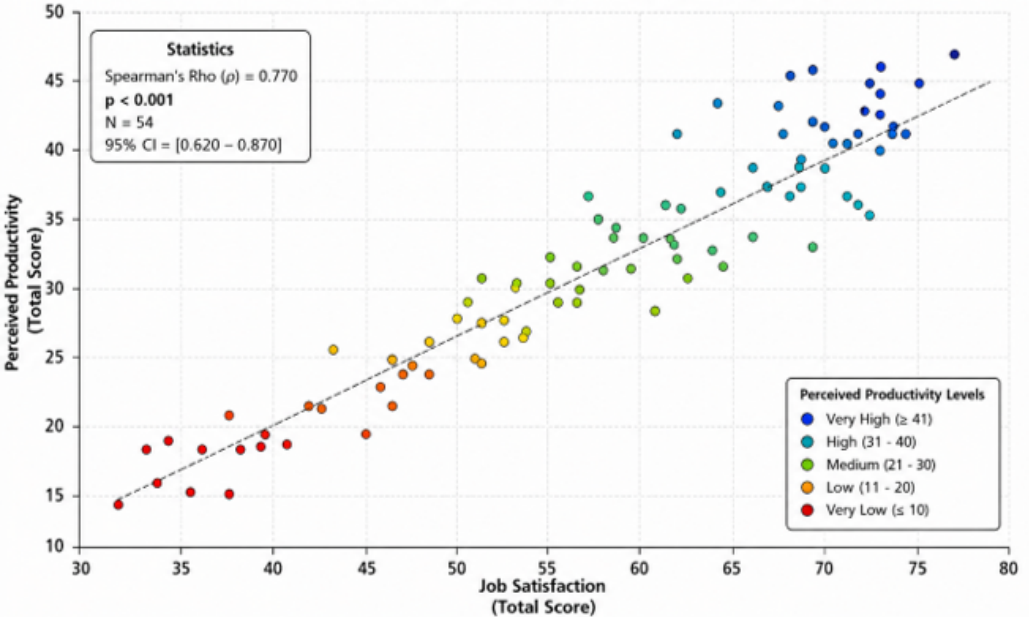

Table 1.
Sociodemographic characteristics of the participants.
| Sociodemographic data | Participants (n = 54) |
|---|---|
| Sex | |
| Female | 11 (20.4%) |
| Male | 43 (79.6%) |
| Age (years) | |
| 18–25 | 6 (11.1%) |
| 26–35 | 17 (31.5%) |
| 36–45 | 19 (35.2%) |
| 46–55 | 11 (20.4%) |
| >55 | 1 (1.9%) |
| Educational level | |
| Secondary | 21 (38.9%) |
| Undergraduate (third level) | 27 (50.0%) |
| Postgraduate (fourth level) | 6 (11.1%) |
| Work seniority | |
| <1 year | 10 (18.5%) |
| 1–5 years | 19 (35.2%) |
| 6–10 years | 11 (20.4%) |
| >10 years | 14 (25.9%) |
Table 2.
Operationalization of labor well-being and perceived productivity variables.
| Variable | Type | Dimensions | Indicators | Instrument | Items |
|---|---|---|---|---|---|
| Job satisfaction |
Ordinal survey variable |
Compensation and benefits | Salary satisfaction; labor benefits; payment timeliness | Survey | 5–7 |
| Organizational climate | Respect at work; teamwork; internal communication | Survey | 8–10 | ||
| Working conditions | Physical conditions; equipment and tools; occupational safety | Survey | 11–13 | ||
| Professional development opportunities |
Training; professional growth; skills development | Survey | 14–16 | ||
| Recognition and professional appreciation |
Work appreciation; performance recognition; motivation through recognition | Survey | 17–19 | ||
| Perceived productivity |
Ordinal survey variable |
Individual performance | Work performance; task completion | Survey | 20–21 |
| Work motivation | Environmental influence; satisfaction-performance relationship | Survey | 22–23 | ||
| Work organization | Task organization | Survey | 24 | ||
| Leadership and organizational support | Leadership; organizational productivity | Survey | 25–26 | ||
| Qualitative interview category | Satisfaction–productivity relationship | Relationship between satisfaction and productivity; recognition and efficiency; work climate and performance | Interview | 1–5 |
Table 3.
Job satisfaction levels.
| Level | Frequency (n) | Percentage (%) |
|---|---|---|
| Low | 3 | 5.6 |
| Medium | 19 | 35.2 |
| High | 32 | 59.3 |
| Total | 54 | 100.0 |
Table 4.
Perceived productivity levels.
| Level | Frequency (n) | Percentage (%) |
|---|---|---|
| Low | 3 | 5.6 |
| Medium | 5 | 9.3 |
| High | 46 | 85.2 |
| Total | 54 | 100.0 |
Table 5.
Reliability analysis of the study variables.
| Variable | Number of items | Cronbach’s alpha | Interpretation |
|---|---|---|---|
| Job satisfaction | 15 | 0.93 | Excellent reliability |
| Perceived productivity | 7 | 0.84 | Very good reliability |
Table 6.
Content Validity Index (CVI).
| Criterion | S-CVI |
|---|---|
| Relevance | 0.84 |
| Clarity | 0.86 |
Table 7.
Spearman correlation between job satisfaction and perceived productivity.
| Variable | 1 | 2 |
|---|---|---|
| 1. Job satisfaction | – | |
| 2. Perceived productivity | – |
Note: ** .
Table 8.
Data triangulation of findings.
| Aspect | Survey results | Interview findings | Interpretation |
|---|---|---|---|
| Relationship between variables | Strong positive correlation (, ) | Participants perceived job satisfaction as directly related to productivity. | The results are consistent. |
| Motivation | Measured as a dimension of perceived productivity in items 22–23, without independent analysis. | Workers indicated that motivation improves performance. | The qualitative findings complement the ordinal data. |
| Recognition | Included as a dimension of job satisfaction in items 17–19, without independent analysis. | Recognition enhances commitment and efficiency. | It reinforces the observed relationship. |
| Organizational climate | Included as a dimension of job satisfaction in items 8–10. | A positive work climate improves performance. | Convergent evidence. |
Disclaimer/Publisher’s Note: The statements, opinions and data contained in all publications are solely those of the individual author(s) and contributor(s) and not of MDPI and/or the editor(s). MDPI and/or the editor(s) disclaim responsibility for any injury to people or property resulting from any ideas, methods, instructions or products referred to in the content. |
© 2026 by the authors. Licensee MDPI, Basel, Switzerland. This article is an open access article distributed under the terms and conditions of the Creative Commons Attribution (CC BY) license (http://creativecommons.org/licenses/by/4.0/).
Copyright: This open access article is published under a Creative Commons CC BY 4.0 license, which permit the free download, distribution, and reuse, provided that the author and preprint are cited in any reuse.