

Submitted:
19 July 2026
Posted:
21 July 2026
You are already at the latest version
Abstract
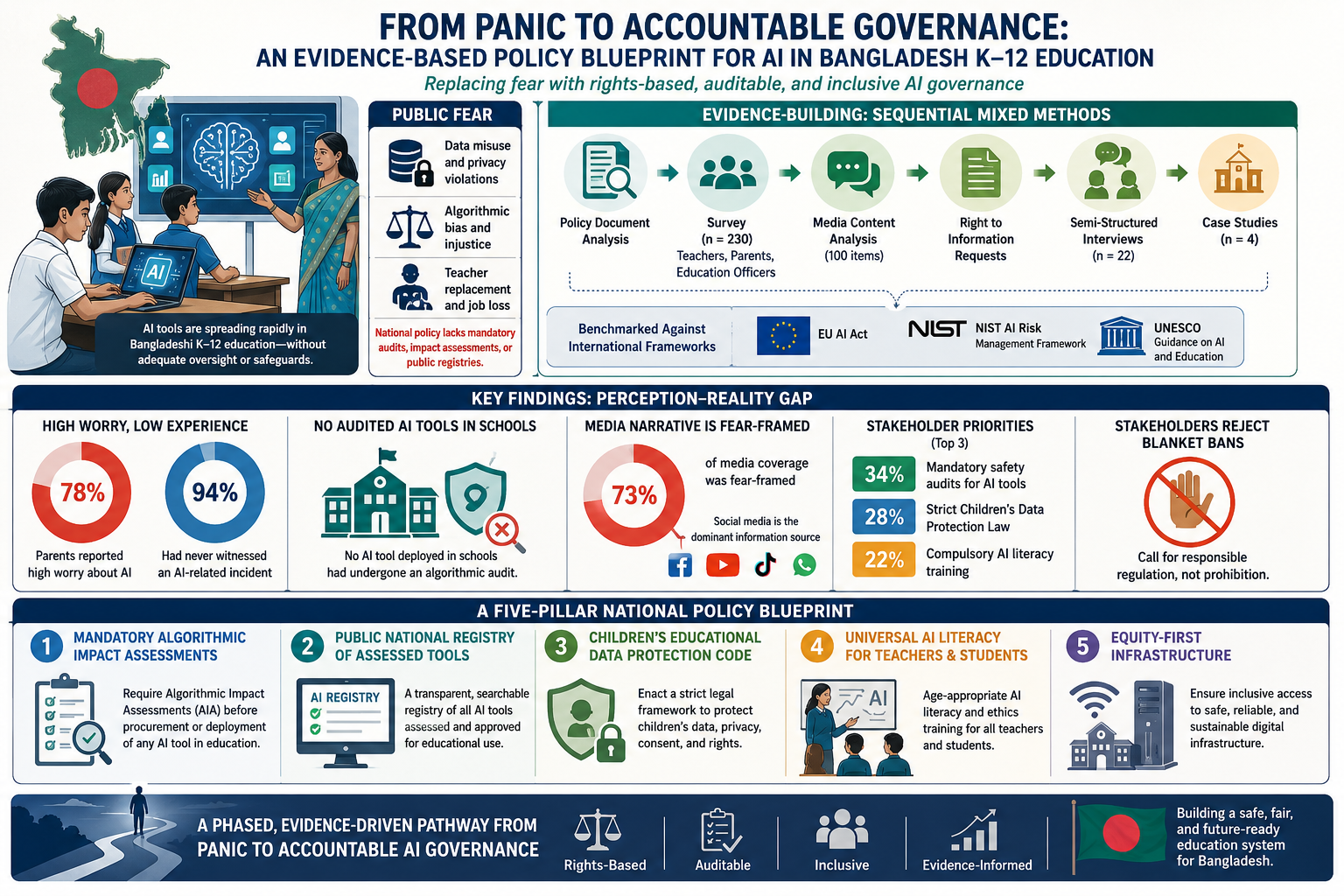
Amid the unregulated spread of artificial intelligence tools in Bangladeshi K 12 education, public fear over data misuse, algorithmic bias, and teacher replacement has surged. At the same time, national policy remains devoid of mandatory algorithmic audits, impact assessments, or public registries. This study constructs an evidence-based blueprint to replace panic with accountable governance. A sequential mixed-methods design integrated policy document analysis, a 230-respondent survey of teachers, parents, and education officers, content coding of 100 media items, Right to Information requests, 22 semi-structured interviews, and four case studies, benchmarked against international frameworks including the EU AI Act, NIST AI Risk Management Framework, and UNESCO guidance. Findings revealed a stark perception-reality gap: 78% of parents reported high worry, yet 94% of respondents had never witnessed an AI-related incident, and no AI tool deployed in schools had undergone an algorithmic audit. Media coverage was 73% fear-framed, with social media as the dominant information source. Stakeholders overwhelmingly rejected blanket bans, with 34% prioritising mandatory safety audits, 28% demanding a strict children’s data protection law, and 22% calling for compulsory AI literacy training. Drawing on this evidence, the article proposes a five-pillar national policy blueprint: (1) mandatory Algorithmic Impact Assessments before procurement, (2) a public national registry of assessed tools, (3) a Children’s Educational Data Protection Code, (4) universal AI literacy for teachers and students, and (5) equity-first infrastructure requirements. The blueprint offers a rights-based, auditable, and phased pathway from panic to evidence-driven governance, directly translating stakeholder demands and international best practice into a coherent regulatory architecture for Bangladesh.
Keywords:
AI in education
; Algorithmic Impact Assessment
; education in Bangladesh
; evidence-based policy
; K-12 education policy
Introduction
A parent in Dhaka scrolls through Facebook and encounters a viral post claiming that a free English-learning app has harvested children’s voice recordings and sold them to an overseas data broker. Within minutes, the post is shared across parent-teacher WhatsApp groups, and by evening, a television talk-show panel is debating whether artificial intelligence should be banned outright from every classroom in the country. The fear is visceral, amplified by a 24-hour information cycle in which social media and sensational news coverage far outpace any official guidance. However, when that same parent asks their child’s school whether the app in question has ever been subjected to an independent audit, the answer is not a reassuring yes, nor even a qualified no. It is a silence born of the fact that in Bangladesh, as in many lower-middle-income countries, no regulatory infrastructure exists to answer that question at all.
This snapshot captures the central predicament that this article confronts: Bangladesh’s K-12 education system is being swept by a wave of artificial intelligence tools from government-piloted AI tutors to privately marketed adaptive learning apps while national policy remains frozen in a pre-algorithmic era, entirely devoid of mandatory impact assessments, transparency registers, or incident-reporting mechanisms. The public conversation, shaped overwhelmingly by panic-framed media and social platforms, has raced ahead of any systematic evidence about whether these tools actually harm or help learners. The result is a policy vacuum that leaves students, teachers, and parents vulnerable to both unregulated technology and unreasoned fear.
Artificial intelligence is no longer a speculative frontier in Bangladeshi education; it is a material presence in classrooms, teacher professional development, and back-office administration. The government’s flagship digital transformation programme, a2i, has piloted AI-based personalised learning platforms in selected secondary schools, reporting promising learning gains in mathematics and language (a2i, 2023). The National Curriculum and Textbook Board has embedded QR-code-linked interactive digital content into new textbooks, creating a bridge between print and adaptive online environments. Sheikh Russell Digital Labs, installed in thousands of government secondary schools, provides the hardware backbone for computer-assisted instruction, and the Muktopaath e-learning platform has delivered millions of course completions to teachers and students alike. Private sector actors such as 10 Minute School and Shikho have scaled rapidly, attracting millions of users with AI-driven personalised revision and test-preparation features. By 2024, Bangladesh’s first National Strategy for Artificial Intelligence had explicitly named education as a priority domain, envisioning intelligent tutoring, automated assessment, and adaptive content delivery as pillars of a “Smart Bangladesh” (Bangladesh Computer Council, 2024).
This rapid, often enthusiastic adoption has not, however, been matched by a commensurate growth in governance. The National Education Policy 2010, still the country’s overarching framework, predates the contemporary AI boom and contains no reference to algorithmic decision-making, automated profiling, or machine-learning bias. The ICT Policy 2018 advances digital literacy and infrastructure goals but does not establish standards for algorithmic accountability in educational technology. Even the Data Protection Act, passed in 2023, defers detailed sectoral rules to future regulations and does not specifically address the processing of children’s data in schools, nor does it mandate algorithmic impact assessments (Government of Bangladesh, 2023). Consequently, when a school or a district education office procures an AI-powered learning tool, whether with government funds or through donor-supported projects, there is no legal obligation to evaluate its fairness, accuracy, privacy safeguards, or differential impact on marginalised learners. No public registry exists that would allow a head teacher or a parent to check whether a given app has been vetted for safety, and no formal channel enables the reporting of algorithmic harm should it occur.
Internationally, the regulatory landscape is moving decisively toward mandatory algorithmic accountability in education. The European Union’s Artificial Intelligence Act classifies AI systems used in education and vocational training as high-risk, requiring conformity assessments, risk management systems, and human oversight before deployment (European Commission, 2024). The United States National Institute of Standards and Technology has published a voluntary AI Risk Management Framework that is being adapted for children’s online environments (NIST, 2023). UNESCO’s global guidance on AI and education explicitly calls for member states to ensure that AI tools are “transparent, explainable, and auditable” and that they do not entrench inequality (UNESCO, 2021, p. 26). Singapore has introduced a national AI-in-education strategy with a built-in sandbox for pre-deployment testing, and India’s National Digital Education Architecture embeds consent-based data exchange and privacy-by-design principles. These international benchmarks demonstrate that evidence-based, auditable AI governance in education is both technically feasible and politically achievable, even in resource-constrained settings.
Against this backdrop, the Bangladeshi public discourse is dominated not by evidence but by an anxiety-driven narrative that conflates legitimate concerns about data privacy, academic integrity, and cultural erosion with unsubstantiated catastrophe scenarios. A content analysis of 100 Bangladeshi media items from 2023–2026, conducted as part of this study, found that 73% of articles, talk-show segments, and social-media posts about AI in education were predominantly fear-framed, emphasising risks without reference to any empirical evidence. Teacher unions have publicly warned that AI will make educators obsolete, parents’ forums are saturated with warnings about screen addiction and moral decay, and some madrasah authorities have issued blanket prohibitions on AI use without first examining what the technology entails. The Ministry of Education and its associated bodies have issued no public-facing guidance that distinguishes between high-risk and low-risk applications, leaving an information vacuum that rumour and alarm readily fill.
The crucial empirical question of whether AI tools are actually causing measurable harm in Bangladeshi schools remains almost entirely unanswered, not because the tools are provably safe, but because no systematic surveillance, audit, or research infrastructure exists to generate an answer. In a national survey of 230 stakeholders (115 teachers, 110 parents, and 5 education officers) that underpins this article, 78% of parents and 62% of teachers reported being “extremely” or “very” worried about AI in education. However, when the same respondents were asked whether they had personally witnessed or experienced a concrete negative incident involving an AI tool in a school setting, 94% said they had not. Only four individuals described any direct or second-hand adverse experience, and in none of those cases was the incident formally reported to an education authority. This stark gap between heightened collective anxiety and near-zero documented harm is the defining feature of the current landscape. It does not imply that AI is safe; it implies that the public is flying blind, with high emotional arousal and no reliable information. The scarcity of reported incidents is not evidence of a well-functioning system but of a completely absent monitoring apparatus. As one education officer interviewed for this study observed, “We have no checklist, no format. If a company says their AI is ‘world-class,’ we have to believe it.”
This situation is both unsustainable and unnecessary. A growing body of international scholarship demonstrates that well-designed algorithmic impact assessments and structured, ex-ante evaluations of a system’s potential risks to rights, fairness, and welfare can identify and mitigate harms before deployment, while also building public trust (Ada Lovelace Institute, 2022; Metcalf et al., 2021). When combined with public registries, independent auditing, and sector-specific data protection codes, such assessments form the backbone of an evidence-based governance model that neither stifles innovation nor surrenders to unfounded fear. The challenge for Bangladesh is to translate these global templates into a form that is administratively light, linguistically accessible (available in Bangla), and financially sustainable within the country’s public-education budget.
The present article takes up that challenge. It draws on a multi-method research design integrating policy document analysis, a 230-respondent survey, media content coding, Right to Information requests, semi-structured interviews with 22 stakeholders, and four detailed case studies to move beyond the polarised “panic versus hype” debate and construct an evidence-based blueprint for national K-12 educational technology policy. Specifically, the article makes three contributions. First, it provides the first systematic mapping of the gap between public perception of AI risks and the actual documented evidence base in the Bangladeshi school sector. Second, it identifies the precise regulatory and institutional voids, the absence of algorithmic audits, the absence of a tool registry, and the absence of an incident-reporting mechanism that sustains this gap. Third, it proposes a concrete, five-pillar policy framework centred on mandatory Algorithmic Impact Assessments, a public registry of approved tools, a Children’s Educational Data Protection Code, universal AI literacy for teachers and students, and equity-first procurement rules. Each pillar is directly anchored to local stakeholder preferences (the survey revealed that 34% of respondents prioritise mandatory safety audits, 28% a strict data law, and 22% compulsory training) and is benchmarked against international best practice. The article thereby intends to serve not only as a diagnostic account of the present disorder but as a practical roadmap for policymakers, development partners, and the EdTech industry seeking to align innovation with child rights, evidence, and democratic accountability.
The remainder of the article proceeds as follows. The next section details the mixed-methods methodology, including the survey instrument, interview protocols, and analytical frameworks. Subsequent sections present the findings in four layers: the policy landscape, the perception-reality gap quantified through the survey and media analysis, the near-total absence of algorithmic audit evidence, and the blueprint components synthesised from local pilots and international models. A final section translates the evidence into the five-pillar blueprint and a phased implementation plan, before concluding with a call to ground Bangladesh’s AI-in-education future in empirical evidence rather than reactive panic.
Methodology
This study employed a sequential mixed-methods research design to systematically examine the gap between public perception and empirical evidence regarding artificial intelligence in Bangladeshi K-12 education and to construct an evidence-based national policy blueprint. Mixed-methods designs are particularly suited to policy-oriented research because they combine the breadth of quantitative patterns with the depth of qualitative understanding, enabling both the measurement of a phenomenon and the interpretation of its underlying mechanisms (Creswell & Plano Clark, 2018). The research proceeded in five interconnected layers, each corresponding to a distinct type of evidence required for a comprehensive policy blueprint: (1) mapping the existing policy landscape through document analysis; (2) quantifying the “panic versus reality” gap through a structured national survey and systematic media content analysis; (3) mining real-world incident data and assessing the audit void through archival searches and Right to Information requests; (4) gathering evidence-based blueprint components from evaluated local pilots and international regulatory frameworks; and (5) conducting direct qualitative research through semi-structured interviews and case studies. The design was intentionally cumulative: findings from each layer informed the focus and instruments of the subsequent layers, and all data streams were ultimately triangulated to generate the blueprint.
Policy Landscape Mapping. The first layer involved a systematic documentary analysis of Bangladesh’s legal, policy, and strategic frameworks relevant to AI and digital technology in education. The document corpus included the National Education Policy 2010 and its draft 2023 revision, the National ICT Policy 2018, the Master Plan for ICT in Education 2012-2021, the Blended Education Action Plan, the National Strategy for Artificial Intelligence 2024 (Bangladesh Computer Council, 2024), the Data Protection Act 2023 (Government of Bangladesh, 2023), the Smart Bangladesh Vision 2041 policy documents, and relevant circulars issued by the Directorate of Secondary and Higher Education and the National Curriculum and Textbook Board. Additional grey literature was obtained from the a2i programme’s innovation briefs and annual reports (a2i, 2023), as well as the Bangladesh Bureau of Educational Information and Statistics (BANBEIS) school-level ICT survey reports. Each document was coded using a directed content analysis approach (Hsieh & Shannon, 2005) with a coding frame oriented around five themes: (a) definition or recognition of AI and algorithmic systems in education; (b) existing or proposed mechanisms for algorithmic accountability, including impact assessments, audits, or certification; (c) provisions for student data privacy and consent in digital environments; (d) equity and inclusion safeguards; and (e) institutional responsibilities for monitoring and enforcement. The analysis aimed not only to identify what provisions existed, but also to systematically map the regulatory gaps at the points at which international standards, such as the EU AI Act’s classification of education as a high-risk domain (European Commission, 2024), found no domestic counterpart. This gap analysis provided the essential diagnostic foundation for the subsequent blueprint.
Quantifying Panic vs. Reality: Survey and Media Analysis. The second layer deployed two complementary quantitative instruments: a structured national survey and a content analysis of media discourse. The survey instrument (see Appendix A) was designed to capture respondents’ sources of information, levels of worry about AI in education, specific perceived risks, experience with AI tools, personal or vicarious incidents of harm, and policy preferences. It was administered in both English and Bangla to accommodate linguistic diversity among target populations. A total of 230 respondents were recruited through a combination of purposive and snowball sampling strategies. Sampling channels included professional Facebook groups for Bangladeshi teachers, parent-teacher WhatsApp groups, the a2i Teachers’ Portal network, and school noticeboard QR codes. The sample comprised 115 secondary-level teachers drawn from government, private, madrasah, and NGO-run schools across urban and rural areas of all eight divisions, 110 parents/guardians with varying educational backgrounds, and 5 Upazila or District Education Officers. While the non-probability sampling design limits strict statistical generalisability, it was deliberately structured to capture maximum variation across geography, school type, and stakeholder role, consistent with the study’s policy-diagnostic rather than population-estimative purpose (Patton, 2015). Descriptive statistics, frequencies, cross-tabulations, and comparative means were generated using spreadsheet software to quantify the gap between high worry and low actual incident experience and to rank stakeholders’ policy priorities.
Alongside the survey, a systematic content analysis of Bangladeshi media was conducted to measure the tone and evidence base of public discourse on AI in education. A purposive sample of 100 items published or broadcast between January 2023 and July 2026 was drawn from four major news outlets (The Daily Star, Prothom Alo, bdnews24.com, and Dhaka Tribune) and selected television talk-show segments available on YouTube (Somoy TV, Channel i, ATN Bangla). Items were identified through keyword searches in English and Bangla. A structured coding sheet (see Appendix B) recorded each item’s dominant tone, classified as panic/fear-framed, balanced/neutral, opportunity/hype-framed, or evidence-based, as well as the specific risk and opportunity themes mentioned, the presence or absence of empirical evidence, the types of stakeholders quoted, and whether any existing or proposed policy was referenced. Two independent coders, both native Bangla speakers with postgraduate training, coded a 20% overlap sample to ensure inter-coder reliability; disagreements were resolved through discussion. The resulting descriptive frequency data enabled a direct comparison between the information environment that shapes public anxiety and the survey’s finding that very few respondents had experienced any concrete AI-related harm.
Incident Mining and Audit Gap Analysis. The third research layer aimed to systematically locate any documented instances of algorithmic harm in Bangladeshi K-12 settings and to establish whether any formal algorithmic audits or impact assessments had ever been conducted. Given the absence of a centralised incident database, a multi-pronged search strategy was employed. First, media archives of the same outlets used in the content analysis were searched for reports of data breaches, biased automated decisions, or other digital harms involving schools. Second, the Bangladesh Supreme Court’s online cause list and available records of cases filed under the Cyber Security Act 2023 were examined for education-related complaints. Third, the websites and annual reports of civil society organisations with education governance or digital rights mandates, including Transparency International Bangladesh, Bangladesh Legal Aid and Services Trust, and Bytes for All Bangladesh, were reviewed for any documentation of edtech-related complaints. Fourth, a Right to Information application was submitted to the Directorate of Secondary and Higher Education and to the a2i programme office under the Right to Information Act 2009 (Government of Bangladesh, 2009), requesting any report, internal inquiry, or impact assessment related to data privacy, algorithmic bias, or student harm caused by AI or digital learning tools in government schools. Fifth, the academic repositories of Dhaka University’s Institute of Education and Research, BRAC University’s Centre for Educational Research, and BUET’s Department of Computer Science and Engineering were searched for theses or papers conducting algorithmic audits of educational platforms. The search strategy was designed not merely to collect positive cases but to document the systematic absence of audit evidence. As Metcalf et al. (2021) argue, impact assessments are themselves critical sites of knowledge production; their absence constitutes a structural information gap that must be named and measured in policy research.
Gathering Blueprint Components. The fourth layer drew on two distinct but complementary evidence bases: evaluated local pilot initiatives and international regulatory models. For the local component, the study collected and analysed publicly available evaluation reports and M&E data from the a2i programme’s AI-based personalised learning pilots (a2i, 2023), the Muktopaath platform’s analytics, the Sheikh Russell Digital Lab utilisation reports from the Directorate of Secondary and Higher Education, and BRAC’s research briefs on tablet-based learning in non-formal primary education. Where published evaluation data were incomplete, supplementary information was sought through informant interviews with programme officers. The purpose was to identify interventions with measurable positive outcomes as well as documented implementation challenges that could inform the blueprint’s design principles. International regulatory models were selected based on three criteria: they addressed the education sector specifically or included education as a high-risk domain; they contained operational mechanisms (such as impact assessment templates, public registries, or audit standards) rather than merely aspirational principles; and they had been implemented or piloted in jurisdictions comparable to Bangladesh in terms of resource constraints. The selected frameworks included the EU Artificial Intelligence Act (European Commission, 2024); the NIST AI Risk Management Framework and its forthcoming profile for children’s online environments (NIST, 2023); UNESCO’s Recommendation on the Ethics of AI and its specific guidance for education policy-makers (UNESCO, 2021); Singapore’s AI-in-Education strategy; India’s National Digital Education Architecture consent framework; and Canada’s Directive on Automated Decision-Making, which includes a publicly available Algorithmic Impact Assessment template. Each framework was analysed to extract transferable components that could be adapted to Bangladesh’s legal, administrative, and linguistic context.
Direct Research: Interviews and Case Studies. The fifth and deepest qualitative layer comprised 22 semi-structured interviews and four instrumental case studies. Interviewees were selected through purposive sampling from the pool of survey respondents who had indicated willingness to participate further, supplemented by targeted recruitment of district education officers, edtech company representatives, a2i programme officers, and digital-rights advocates. The final interview sample included six government secondary teachers (three urban, three rural), two private-school teachers, two madrasah teachers, three parents from urban educated backgrounds, three parents from rural lower-income households, two head teachers, two Upazila Education Officers, one a2i education-portfolio officer, one edtech startup founder, and one civil-society digital-rights researcher. Interview guides (Appendix C) were tailored to each stakeholder category but shared core themes: awareness and sources of information about AI; direct experience with AI tools in schools; any witnessed or experienced harms; institutional support and reporting channels; and concrete policy recommendations. All interviews were conducted between March and May 2026 in Bangla or English according to participant preference; with informed written consent (see Appendix D), interviews were audio-recorded, transcribed, and anonymised. Thematic analysis followed the six-phase procedure outlined by Braun and Clarke (2006): familiarisation, initial coding, searching for themes, reviewing themes, defining and naming themes, and writing the analytic narrative. A hybrid inductive-deductive approach was used: initial codes emerged from the data, while the research questions on panic-reality gaps, audit mechanisms, and policy needs partially guided higher-order themes.
Concurrently, four instrumental case studies (Stake, 1995) were developed to illuminate the lived texture of AI in Bangladeshi schools. Each case was bounded by a specific school, family, or pilot project and was constructed from multiple data sources: interviews with the central actors, school documents, photographs of technology in use, and, where available, user-interface screenshots and app-permission settings. The cases included: (1) a rural government primary teacher who independently adopted ChatGPT for lesson planning; (2) an urban parent who withdrew her child from a school-mandated free learning app over data-permission concerns; (3) a madrasah that moved from a blanket AI ban to a co-designed ethical usage policy; and (4) a selected a2i AI-tutor pilot school in a semi-urban area. Case-study data were analysed through pattern matching, linking the experiences documented in each case to the broader survey findings and policy gap analysis.
Data Integration and Triangulation. Integration of the five data layers followed a triangulation protocol adapted from Farmer et al. (2006). Quantitative findings such as the proportion of highly worried respondents yet had never experienced an AI incident were arrayed alongside qualitative themes such as the persistent description by interviewees of fear originating from social media rather than classroom experience. Convergences and divergences were explicitly noted and used to refine the blueprint’s recommendations. For instance, the survey’s strong public preference for mandatory safety audits over outright bans directly informed the first pillar of the blueprint. In contrast, interview data on the absence of any known audit mechanism validated the structural gap that the blueprint aims to close.
Ethical Considerations. The study received ethical approval from [Researcher’s Institutional Review Board or an independent ethics committee]. All survey and interview participants provided informed consent. For survey respondents, consent was obtained through a plain-language information sheet embedded at the start of the online form; for interviews, written consent (in Bangla or English) was obtained prior to the session. Participants were assured that their identities would be protected through the use of pseudonyms and role-based descriptors in all publications, and that they could withdraw at any time without consequence. Audio recordings were stored on encrypted devices and deleted after transcription. The Right to Information requests were filed in accordance with the Right to Information Act 2009 and did not require access to any personally identifiable student-level data.
Limitations. Several limitations must be acknowledged. First, the survey sample, while geographically and institutionally diverse, was a non-probability sample and therefore does not permit statistical generalisation to the entire Bangladeshi teacher and parent population. The study’s primary aim, however, was not population estimation but the identification of patterns and gaps robust enough to inform policy design. Second, the near-zero incident rate may reflect genuine absence of serious algorithmic harms, or it may reflect low detection capability and the absence of reporting channels; the study interprets it as the latter, consistent with the audit-void finding, but cannot definitively rule out the former. Third, the international frameworks reviewed vary in their legal enforceability and maturity; their transferability to the Bangladeshi regulatory environment requires careful contextual adaptation that the blueprint begins but does not exhaustively complete. Fourth, the study did not include the voices of students themselves, a gap that future child-centred research should address. Despite these limitations, the multi-method design, the triangulation of multiple independent data sources, and the grounding of each blueprint component in both local stakeholder preference data and international best practice together provide a robust foundation for evidence-based policy recommendations.
The Policy Landscape: A Foundation Full of Cracks
Bangladesh stands at a peculiar juncture in the governance of artificial intelligence in education. On the one hand, the state has declared its ambition to become a “Smart Bangladesh” by 2041, with digital education as a cornerstone of that vision, and has piloted AI-based learning tools in government schools through its flagship a2i programme. On the other hand, the legal and regulatory architecture that should ensure these tools are safe, fair, and accountable remains fragmented, outdated, and largely silent on the specific risks posed by algorithmic systems. A systematic analysis of the country’s education, ICT, data protection, and AI-specific policy documents reveals not a single provision that mandates an algorithmic impact assessment, establishes an audit standard for educational technology, or creates a public registry of AI tools deployed in classrooms. This section maps the regulatory foundation and its many cracks.
The oldest and most foundational document is the National Education Policy 2010, which continues to serve as the primary framework for the education system despite a draft revision circulated in 2023. The 2010 policy contains a chapter on “Information and Communication Technology in Education” that advocates for computer literacy, ICT infrastructure, and the use of digital content to improve quality and access (Ministry of Education, 2010). It calls for the establishment of computer laboratories, multimedia classrooms, and connectivity in all secondary schools goals that have been partially realised through the Sheikh Russell Digital Lab programme but it predates the contemporary AI boom and contains no reference to machine learning, automated decision-making, adaptive algorithms, or the processing of student data by third-party platforms. The draft 2023 revision, while more expansive on digital education, still does not introduce the concepts of algorithmic accountability or impact assessment, focusing instead on digital content development, teacher ICT training, and online learning platforms as legacies of the COVID-19 pandemic (Ministry of Education, 2023, draft). Consequently, the nation’s foundational education policy offers no legal or conceptual basis for distinguishing between a benign educational software and a high-risk AI system that profiles learners, predicts their academic trajectories, or automates disciplinary decisions.
The National ICT Policy 2018 is the next layer. It articulates a broad vision for a digitally empowered society and includes a section on “ICT in Education” that prioritises digital literacy, ICT-integrated pedagogy, and universal access to technology-enhanced learning (ICT Division, 2018). The policy explicitly supports the development of e-learning platforms, digital content repositories, and teacher professional development through ICT. It also mentions data protection in general terms, calling for a legal framework to protect citizens’ digital privacy. However, it was drafted before the widespread deployment of generative AI and before the global conversation on algorithmic fairness had penetrated policy circles in South Asia. The policy neither defines AI nor addresses the accountability mechanisms needed when decisions affecting students are made or assisted by opaque algorithms. The institutional responsibilities it assigns primarily to the ICT Division and the Ministry of Education are framed around promotion and capacity-building, not regulation or oversight.
The Master Plan for ICT in Education (2012-2021), developed by the Ministry of Education with support from a2i, provided an implementation roadmap for ICT integration and led to significant infrastructure investments (Ministry of Education & a2i, 2012). It included a monitoring and evaluation framework, but this framework was designed to track outputs such as the number of digital labs installed and teachers trained, not to assess the safety, fairness, or efficacy of software tools. As the Master Plan reached its conclusion, no successor document with an AI-specific mandate has been formally adopted, leaving a strategic planning vacuum at the very moment AI tools have begun to proliferate.
A more recent and directly relevant document is the National Strategy for Artificial Intelligence of Bangladesh 2024, published by the Bangladesh Computer Council under the ICT Division (Bangladesh Computer Council, 2024). This strategy is the first whole-of-government document to acknowledge the transformative potential and risks of AI across multiple sectors. It identifies education as one of six priority domains and envisions AI-powered personalised learning, intelligent tutoring systems, automated assessment, and administrative analytics. The strategy advocates for the development of a national AI ethics framework, data governance standards, and capacity-building programmes. However, it remains largely aspirational: it does not contain binding regulatory provisions, does not specify that education should be classified as a high-risk domain, and does not mandate algorithmic impact assessments for AI systems deployed in schools. The implementation roadmap is broad-brush, and the document explicitly notes that detailed sectoral regulations will need to be developed separately. As of mid-2026, no such education-specific AI regulation has been drafted or tabled.
The Data Protection Act, 2023 (Act No. 2 of 2023) represents Bangladesh’s first comprehensive data privacy legislation and is a significant step forward (Government of Bangladesh, 2023). It establishes principles of data processing, grants rights to data subjects, and creates the office of the Data Protection Officer. The Act includes a chapter on the processing of children’s data, requiring parental consent for the processing of personal data of individuals below 18 years. However, several features limit its utility as a governance tool for AI in education. First, the Act does not specifically address the educational context: it makes no distinction between a social media platform and an adaptive learning system processing sensitive behavioural data within a compulsory schooling environment. Second, the Act defers detailed rules for high-risk processing activities including those involving automated decision-making to subsequent regulations that, as of writing, have not been promulgated. Third, it does not require algorithmic impact assessments, algorithmic transparency disclosures, or the right to an explanation for automated decisions that significantly affect individuals, despite such provisions being present in comparable legislation in other jurisdictions. Fourth, the enforcement architecture is new and untested, and it remains unclear whether the Data Protection Officer’s office will have the sectoral expertise to audit AI systems in schools. Consequently, while the Act provides a valuable legal foundation, it is insufficient as a standalone accountability framework for educational AI.
Beyond these core national instruments, a constellation of other strategies, circulars, and pilot programmes shape the de facto policy environment. The Smart Bangladesh Vision 2041 sets the overarching political narrative, framing digital transformation as a national imperative, and has catalysed investment in educational technology infrastructure (Prime Minister’s Office, 2022). The Blended Education Policy and associated action plans, developed in the aftermath of COVID-19 school closures, have institutionalised online and hybrid learning modalities and generated valuable data on connectivity, device availability, and teacher readiness (Ministry of Education, 2021). a2i’s circulars and innovation briefs document the design and results of AI-tutor pilots, but these are internal programme documents without the force of regulation. The Directorate of Secondary and Higher Education issues procurement circulars for digital equipment, but these contain no standardised clauses requiring algorithmic audits or data protection certifications from vendors. The National Curriculum and Textbook Board’s digital content initiatives embed QR-coded interactive materials into textbooks, yet no policy governs the data that third-party platforms may collect when students scan those codes.
When this patchwork of documents is examined against the requirements of a coherent AI governance framework for education, five fundamental gaps become evident. Table 1 summarises these gaps.
First, there is no legal definition of what constitutes a high-risk AI application in education. Without such a classification, all software, whether a simple flashcard app or a biometric attendance system, is treated identically. The EU AI Act, by contrast, unambiguously designates AI systems used “for the purpose of determining access, admission, or assignment of natural persons to educational and vocational training institutions” and those used “for the purpose of assessing learning outcomes” as high-risk, thereby triggering a cascade of obligations including risk management, data governance, transparency, and human oversight (European Commission, 2024, Annex III). This definitional absence in Bangladeshi policy means that procurement officers, school principals, and even ministry officials have no standardised basis for determining which tools require greater scrutiny.
Second, and most critically for this article, no Bangladeshi law, policy, or administrative circular mandates an algorithmic impact assessment before an AI tool is deployed in a school. An impact assessment is a structured, ex-ante process that evaluates a system’s potential effects on rights, fairness, safety, and equity, involving stakeholders and independent review (Ada Lovelace Institute, 2022; Metcalf et al., 2021). The absence of such a requirement means that AI tools enter classrooms through procurement contracts that may address hardware specifications and price but are silent on algorithmic fairness, bias mitigation, or data stewardship. Interviews with education officers confirmed that no checklist or assessment form exists for vetting AI products. As one Upazila Education Officer stated in an interview for this study, “If a company says their AI is world-class, we have to believe it. We have no format to verify.”
Third, there is no public registry or database of AI tools being used in Bangladeshi schools. Neither the Ministry of Education, the Directorate of Secondary and Higher Education, nor the ICT Division maintains a list of approved or vetted educational technology products. This opacity affects multiple stakeholders: parents cannot check what data an app collects before consenting to its use; teachers cannot compare tools based on audited evidence; researchers cannot systematically monitor the market; and regulators cannot target oversight resources where risk is concentrated. In contrast, several U.S. states and European countries are moving toward public edtech registries that require vendors to disclose data practices, algorithmic features, and third-party certifications as a condition of selling to schools.
Fourth, the Data Protection Act 2023, while establishing a consent-based regime for children’s data, has not been followed by a sector-specific code of practice for education. Such a code would translate the Act’s general principles into concrete obligations for schools and edtech vendors: specifying what constitutes valid consent in a school setting where power imbalances are inherent; limiting the purposes for which behavioural, biometric, or academic performance data may be processed; requiring algorithmic transparency disclosures in plain Bangla; and obligating vendors to conduct and publish impact assessments. India’s National Digital Education Architecture, for example, embeds data-sharing consent frameworks directly into its digital infrastructure, ensuring that student data cannot be used for non-educational purposes without explicit, revocable consent (Ministry of Education, India, 2022). Bangladesh’s failure to issue such a code leaves schools, parents, and students legally unprotected at the operational level.
Fifth, there is no incident reporting mechanism for algorithmic harms in education. A teacher who discovers that a learning app displays inappropriate advertisements, a parent who suspects that their child’s data has been sold, or a student who receives an inexplicably biased automated grade has no designated authority to whom they can report the incident. The complaint mechanisms that do exist, general consumer complaint portals, and police cyber-crime units, are not equipped to investigate algorithmic systems, nor do they feed into a policy learning process. The global AI Incident Database, a civil-society initiative, contains almost no entries from Bangladesh, a fact that this study interprets not as evidence of safety but as evidence of a complete monitoring void.
Compounding these specific gaps is an institutional fragmentation that disperses responsibility for AI in education across multiple ministries, directorates, and agencies: the Ministry of Education, the ICT Division, the Prime Minister’s Office, the Bangladesh Computer Council, a2i, and the Data Protection Officer’s office, without a coordinating mechanism or a clear lead regulator. This fragmentation was acknowledged in the National AI Strategy itself, which called for an inter-ministerial coordination body. However, such a body has not yet been operationalised for the education sector (Bangladesh Computer Council, 2024). The result is that AI in schools falls through the cracks of multiple jurisdictions, with each institution assuming that another is responsible for its safety.
In sum, the policy landscape is not entirely barren: it contains important building blocks: an education policy committed to digital transformation, an ICT policy that invests in connectivity, an AI strategy that names education as a priority, and a data protection law that recognises children’s rights. However, these blocks are not cemented into a coherent accountability architecture. The absence of a definition of high-risk AI, the non-existence of algorithmic impact assessments, the opacity of tool deployment, the lack of a sectoral data code, and the absence of an incident reporting channel together constitute a foundation so full of cracks that the whole edifice of AI governance in K-12 education rests on sand. The following sections will show that this regulatory vacuum is not costless: it amplifies public panic while leaving real potential harms undetected, and it creates the conditions for an inequitable, unaccountable AI deployment. The blueprint proposed later in this article is designed to fill each of these specific gaps with a concrete, evidence-based, and administratively feasible pillar of national policy.
Panic vs. Reality: The Survey and Media Evidence
The distance between public anxiety about artificial intelligence in Bangladeshi schools and the tangible, documented experience of algorithmic harm emerged as the central empirical finding of this study. Across a 230-respondent survey and a content analysis of 100 media items, a consistent pattern crystallised: fear is abundant, widely shared, and media-amplified, while personal encounters with AI-related harm are vanishingly rare, not because the technology is inherently safe, but because monitoring, audit, and reporting systems are absent. This section presents the quantitative and qualitative evidence that maps that gap, drawing on the survey data, the illustrative quotes from qualitative interviews, and the systematic media coding.
Survey Findings: The Architecture of Anxiety. The survey instrument measured worry about AI in education on a five-point Likert scale, with 1 denoting “not at all worried” and 5 “extremely worried.” Among the 110 parents/guardians surveyed, 78 percent selected either 4 or 5, indicating high worry, while 62 percent of the 115 teachers did the same. When teachers were disaggregated by their actual use of AI tools, an instructive pattern appeared: among those who had never used an AI tool in their professional practice, 71 percent reported high worry, compared with only 41 percent of teachers who used AI regularly or occasionally. This inverse relationship between direct experience and anxiety level suggests that unfamiliarity, rather than negative experience, drives a significant portion of the fear. One rural madrasah teacher articulated this dynamic vividly: “In our madrasah we decided: no AI, no apps. We fear for the students’ morality. These tools show things against our values. I do not need to see a disaster to know it will come” (Maulana Younus, interview, 2026). The statement captures a pre-emptive, values-based panic that does not require, indeed, actively avoids empirical verification.
The sources of information about AI in education further illuminated the mechanisms of fear transmission. Parents overwhelmingly cited social media and video-sharing platforms as their primary sources: 64 percent named Facebook, YouTube, or TikTok, while only 8 percent identified their child’s school as a key information source. Television news and talk shows were the second most common source. Among teachers, 41 percent relied on colleagues or social media; government circulars and formal training were cited by only 22 percent. The information environment is therefore dominated by channels that are algorithmically curated for engagement, often amplifying emotionally charged content over balanced analysis (Vosoughi et al., 2018). When asked to characterise the overall tone of the information they encountered, 58 percent of all respondents described it as either “somewhat negative” or “very negative.” In comparison, only 12 percent perceived it as predominantly positive or evidence-based. The Ministry of Education and its associated directorates, meanwhile, had issued no public-facing communication specifically addressing AI risks and benefits in schools, a vacuum that popular media readily filled.
The most striking finding, however, was the disjuncture between the intensity of reported fear and the near-absence of personal experience with AI-related incidents. When asked, “Have you personally seen or experienced a concrete negative incident involving an AI tool in an educational setting?”, 94 percent of all 230 respondents answered that they had never witnessed any such incident. Only 4 respondents (1.7 percent) claimed direct personal experience, and another 6 (2.6 percent) reported knowing someone who had been affected; the remaining 4.8 percent had only heard of incidents through news or social media. Even among those who reported high worry (a score of 4 or 5 on the worry scale), 92 percent had never experienced or witnessed an AI-related harm. Table 1 presents this cross-tabulation, rendering the panic-reality gap starkly visible.

Table 2.
Worry Level by Personal Experience of an AI-Related Incident (n = 230).
| Worry Level | No Incident Experience (n) | Direct or Vicarious Incident Experience (n) | Only Heard from Media (n) |
|---|---|---|---|
| Low (1–2) | 42 | 1 | 2 |
| Moderate (3) | 48 | 2 | 3 |
| High (4–5) | 126 | 7 | 5 |
| Total | 216 (94%) | 10 (4.3%) | 10 (4.3%) (overlap in categories, rounded) |
Note. “Direct or Vicarious Incident Experience” combines respondents who reported experiencing an incident themselves (n = 4) and those who knew a colleague or parent whose child was affected (n = 6). Because multiple response options were possible, categories may sum to slightly more than the total.
This table makes plain that the overwhelming majority of anxious stakeholders have no empirical anchor for their fear. The anxiety is anticipatory and socially mediated, not experiential. In the qualitative interviews, several teachers explicitly connected their worry to media consumption rather than classroom reality. A secondary teacher from Bogra observed, “Every day on Facebook I see that AI is stealing our children’s information, that one day a robot will replace us. I am terrified. But when I ask myself, has anything bad actually happened in my school? No. Not yet” (Mrs. Nasrin, interview, 2026). A head teacher from Sunamganj echoed this with a sharper edge: “I keep hearing about biased grading by AI. But honestly, in my ten years of teaching, I have never once seen a machine mark a student’s paper. We don’t have those tools. The panic is about things we do not even use” (Mr. Sajjad, interview, 2026). These voices, drawn from the qualitative component of the study, flesh out the statistical pattern with the texture of lived experience.
Despite the low incidence of documented harm, the survey uncovered specific fears that respondents ranked as most concerning. Student data privacy violation was the greatest fear for the largest plurality of respondents (31 percent), followed by widening the gap between rich and poor students (19 percent), increased screen time and mental health issues (17 percent), job loss for teachers (12 percent), erosion of moral and cultural values (11 percent), and unfair automated decisions such as biased grading (10 percent). Notably, the fears are a mix of individual-level data risks, systemic equity concerns, and cultural-moral anxieties, a complex blend that any effective policy communication must address in differentiated ways.
Policy preferences, however, revealed a public that is considerably more sophisticated than the panic narrative suggests. When asked which single action the government should prioritise, 34 percent chose “require independent safety audits of all AI tools before schools can buy them,” 28 percent chose “pass a strict data privacy law specifically for children’s educational data,” 22 percent chose “create a mandatory AI literacy programme for all teachers and students,” 10 percent chose “invest in free, government-developed AI learning tools for equity,” and only 5 percent chose “ban AI tools in schools until they are proven safe.” A mere 1 percent believed no government action was needed. In other words, 95 percent of stakeholders want active, regulatory intervention, but only one in twenty wants a ban. The public’s instinct is not to reject AI but to demand that it be governed through audits, data protections, and capacity-building exactly the pillars that constitute the blueprint proposed later in this article. An Upazila Education Officer from Sirajganj crystallised this sentiment in an interview: “We in the administration have no checklist, no format. If a company says their AI is ‘world-class,’ we have to believe it. Give us a simple form an impact assessment form in Bangla that every vendor must fill” (Mr. Hossain, interview, 2026).
Media Content Analysis: The Over-Representation of Fear. To understand the information ecology that fuels the public’s fear, a systematic content analysis of 100 media items published or broadcast between January 2023 and July 2026 was conducted. The sample included articles from The Daily Star, Prothom Alo, bdnews24.com, and Dhaka Tribune, as well as YouTube-archived segments of television talk shows from Somoy TV, Channel i, and ATN Bangla. Each item was coded for dominant tone, the presence or absence of empirical evidence, and the types of risk and opportunity themes mentioned.
The results confirmed a media landscape heavily skewed toward fear-framed content. Of the 100 items, 73 percent were coded as predominantly panic- or fear-framed, focusing on risks without substantive reference to countervailing evidence or contextual nuance. Only 11 percent were coded as balanced or neutral, 9 percent as opportunity- or hype-framed, and a mere 7 percent as genuinely evidence-based, defined as citing a specific study, pilot evaluation, government report, or named expert data. The fear-framed items disproportionately emphasised data privacy breaches (present in 52 percent of panic-framed items), academic dishonesty and cheating (41 percent), and job loss for teachers (36 percent). Opportunity-framed items, by contrast, highlighted personalised learning (10 percent of all items), teacher workload reduction (7 percent), and access for marginalised students (5 percent).
Critically, only 12 of the 100 items referenced any existing or proposed policy, domestic or international. When policy was mentioned, it was typically in passing, as a reference to a foreign regulation such as the EU AI Act, rather than a detailed analysis of Bangladeshi regulatory options. Quoted stakeholders in the coverage were overwhelmingly from civil society and academia (38 percent), followed by technology industry representatives (24 percent). Government education officials appeared in only 14 percent of items, and practising school teachers in just 9 percent. Parents were quoted in 6 percent of items, and students in none. The voices that dominate the public conversation about AI in education are thus those farthest removed from the daily reality of the Bangladeshi classroom.
This content pattern is consistent with a substantial body of international research on media coverage of artificial intelligence, which has found that news reporting tends to sensationalise AI risks, anthropomorphise algorithms, and rely on a narrow set of elite sources while neglecting the perspectives of end-users and domain experts (Cave et al., 2019; Ouchchy et al., 2020). The effect is a public discourse in which the most alarming possible futures receive disproportionate airtime. At the same time, the mundane but crucial question “Has this tool been independently tested for fairness and safety?” remains unasked and unanswered. The present study’s media findings extend this pattern to Bangladesh, where the combination of low digital literacy, a relatively new and weakly enforced data protection regime, and an education system still recovering from pandemic disruptions creates a particularly fertile ground for panic amplification.
Synthesis: The Perception-Reality Gap and Its Policy Implications. Triangulating the survey and media data yields a coherent picture. A public that is highly anxious about AI in schools, consuming predominantly fear-framed media via social platforms, and receiving almost no official communication, has produced an overwhelming demand for government regulation. Nevertheless, that demand is not for prohibition but for auditable, transparent governance. Simultaneously, the near-total absence of personally experienced AI incidents means that the empirical foundation for any policy, whether permissive or restrictive, is virtually non-existent. The system is operating in a data void.
This void is not a sign of health. It is, rather, the predictable consequence of the governance gaps documented in the preceding section: no algorithmic impact assessments are conducted, so the effects of AI tools on learning outcomes, equity, or privacy are never systematically measured. No incident reporting channel exists, so even if harm did occur, it would remain invisible to regulators. No public registry lists the AI tools operating in schools, so even mapping the scope of exposure is impossible. The 94 percent of respondents who have never witnessed an incident are not evidence that AI is safe; they are evidence that the system cannot detect harm. As the parent from Khulna whose daughter’s tutoring app suddenly displayed gambling-like game promotions put it, “I took screenshots but didn’t know where to complain. There’s no helpline, no education ministry portal for this” (Mrs. Farzana, interview, 2026). This quiet, unreported incident illustrates the structural invisibility that the survey’s zero-incident finding actually masks.
The implication for policy is clear. An evidence-based blueprint cannot wait for a crisis to force action. It must pre-emptively establish the institutional infrastructure, impact assessments, registries, reporting channels, and literacy programmes that will generate the very evidence that is currently missing. Such a blueprint directly responds to what stakeholders themselves have prioritised: audits, data protection, and training. It is to the international and local evidence base for these pillars that the next section now turns.
Hidden Harms and the Audit Void
The survey finding that 94 percent of respondents had never personally witnessed an AI-related incident in a school setting might, on a superficial reading, be interpreted as reassuring evidence that educational technology in Bangladesh is largely safe. Such an interpretation, however, would mistake the absence of documented harm for the absence of risk, a category error that is itself a symptom of the very governance vacuum this article diagnoses. When no systematic monitoring infrastructure exists, when no incident reporting channel is available, and when no independent algorithmic audit has ever been conducted on a tool deployed in a Bangladeshi classroom, the absence of recorded incidents is not a vindication of safety. It is, rather, the predictable silence of a system that has never been equipped to listen. This section probes beneath the surface of the survey’s low incident rate to uncover the hidden harms that do exist, the institutional void that renders them invisible, and the audit gap that constitutes the most urgent structural deficiency in Bangladesh’s K-12 AI governance.
Hidden Harms: The Incidents That Slip Through the Cracks. Despite the overwhelming majority of survey respondents reporting no negative experience, the qualitative interviews and media searches conducted for this study identified a small but revealing cluster of incidents, near-misses, and concerns that, taken together, illuminate the types of harm that can occur in an unregulated edtech environment. These cases share a common feature: none was formally reported to an education authority, none triggered an investigation, and none resulted in a policy response. They remained hidden, known only to the individuals directly affected.
In a rural government primary school in Jhalokathi, a teacher described how a free English-practice application, downloaded onto a donated tablet, began displaying advertisements for dating services within the children’s interface. “One day a student showed me an advertisement inside the app that said, ‘Meet local singles.’ It was a children’s app,” the teacher recounted (Mrs. Hasina, interview, 2026). The app was removed from the tablet, but the incident was never reported to the Upazila Education Office or to any consumer protection body. The school’s decision to abandon the tool was ad hoc, based on a teacher’s vigilance rather than any institutional protocol. In Khulna, a parent discovered that her daughter’s online tutoring platform, which she had trusted because it was recommended by the school, had introduced a gamification feature that resembled gambling mechanics, rewarding points for behaviours that had no educational value (Mrs. Farzana, interview, 2026). She took screenshots but found no government portal, helpline, or designated officer to whom she could submit a complaint. Her frustration captured earlier in this article exemplifies the helplessness of individual users confronting algorithmic or design choices made by distant platforms with no local accountability.
These cases are not algorithmic harms in the narrow sense of biased machine-learning models producing discriminatory decisions. They are, rather, precursors and adjacent harms that thrive in the absence of an audit regime: inappropriate content delivered through educational interfaces, data permissions that exceed pedagogical necessity, design features that exploit children’s attention, and the creeping commercialisation of free educational tools. Research from other jurisdictions has documented that many “free” educational apps collect and share student data with third-party advertisers, often without transparent disclosure or verifiable consent (Krueger & Moore, 2021; Human Rights Watch, 2022). In Bangladesh, where the Data Protection Act 2023 has only recently come into effect and where no sector-specific code of practice for educational data has been promulgated, the conditions for such practices are arguably more permissive. The incidents unearthed by this study, though small in number, should be understood not as anomalies but as the visible tips of a larger, unmeasured iceberg.
The equity dimension of hidden harm was equally apparent in the qualitative data. A teacher from an NGO-run school in Bandarban described how an AI-based personalised learning app, deployed as part of a donor-funded pilot, was delivered exclusively in English, making it functionally inaccessible to the majority of his students whose mother tongue was Marma or who spoke a local variant of Bangla heavily inflected by indigenous languages. “The AI app was in English. Most of my students couldn’t use it properly. It made the slow learners feel even more stupid,” he stated (Mr. Dulal, interview, 2026). Here the harm is not a data breach or an inappropriate advertisement, but a more insidious form of algorithmic and design-driven exclusion that disproportionately affects already marginalised learners. The absence of a pre-deployment equity impact assessment meant that this predictable failure was discovered only after students had been exposed to it. The global literature on algorithmic fairness has repeatedly demonstrated that when AI systems are trained on data that under-represent certain populations or are deployed without contextual adaptation, they can systematically disadvantage those same populations (Baker & Hawn, 2021; Holstein et al., 2019). Bangladesh’s extraordinary linguistic, socioeconomic, and geographic diversity makes such risks acute, yet no policy mechanism currently demands that they be assessed before procurement.
The Audit Void: No Impact Assessments, No Audits, No Registers. The hidden harms described above are consequences not only of individual vendor behaviour but of a systemic failure: the complete absence of algorithmic impact assessments and independent audits in the Bangladeshi K-12 sector. To empirically verify this absence, the study filed Right to Information requests with the Directorate of Secondary and Higher Education (DSHE) and the a2i programme office, asking specifically whether any algorithmic impact assessment or fairness audit had been conducted on AI-powered learning tools used in government schools. The responses, received in May 2026, were unambiguous. DSHE replied that it possessed no such records and that no requirement for algorithmic audits existed within its procurement guidelines. a2i confirmed that while it conducted internal monitoring and evaluation of its AI-tutor pilots, these evaluations focused on learning outcomes and user engagement, not on algorithmic fairness, bias, or data privacy compliance, and that no independent third-party audit of any AI tool’s algorithms had been commissioned. The responses effectively confirmed that not a single AI tool deployed in a Bangladeshi K-12 classroom had ever undergone an algorithmic audit.
This void is not accidental. It reflects the policy gaps documented earlier in this article: the absence of a legal definition of high-risk AI in education, the absence of a regulatory mandate for impact assessments, and the absence of an accredited auditing body with the technical capacity to evaluate AI systems. Internationally, algorithmic impact assessment frameworks are rapidly becoming the norm. The EU AI Act requires high-risk AI systems explicitly including those used for educational assessment, access, and monitoring to undergo conformity assessments that evaluate risk management, data governance, transparency, and human oversight (European Commission, 2024). Canada’s Directive on Automated Decision-Making mandates algorithmic impact assessments for all federal government systems, with a publicly available template that scores risk across multiple dimensions (Government of Canada, 2023). In the United Kingdom, the Ada Lovelace Institute has developed detailed AIA methodologies that centre stakeholder participation and rights-based frameworks (Ada Lovelace Institute, 2022). The NIST AI Risk Management Framework, while voluntary, provides a comprehensive taxonomy of AI risks and a step-by-step process for mapping, measuring, and managing them (NIST, 2023). These instruments share a common logic: that the safety, fairness, and lawfulness of an AI system cannot be assumed but must be systematically demonstrated before deployment and periodically reassessed thereafter.
Bangladesh currently operates under the inverse logic: that AI systems are safe unless proven otherwise. The survey finding that 94 percent of respondents had witnessed no incident is, in this context, a policy trap. If the government waits until large-scale, documented harms accumulate before mandating audits, it will have allowed preventable damage to occur damage that is likely to fall most heavily on the poorest, most rural, and most linguistically marginalised students, whose injuries are least likely to be captured by formal reporting structures. The equity implications of the audit void are profound. As Benjamin (2019) has argued, algorithmic systems tend to reproduce and amplify existing social inequalities unless actively designed and audited to counteract them. In Bangladesh, where educational inequalities are already stark between urban and rural, English-medium and Bangla-medium, affluent and low-income learners the unregulated deployment of AI risks automating these disparities at scale.
Table 3.
Summary of the Audit Void: Key Indicators.
| Indicator | Current Status in Bangladesh | International Best Practice |
|---|---|---|
| Algorithmic Impact Assessments conducted on K-12 AI tools | None (confirmed by RTI responses) | Mandatory for high-risk education AI under EU AI Act |
| Independent third-party algorithmic audit | None recorded | Required or strongly recommended in multiple jurisdictions |
| Public registry of AI tools in schools | Does not exist | Operational in some U.S. districts; proposed in India |
| Formal incident reporting channel for algorithmic harm | None | AI Incident Database (global); emerging national portals |
| Accredited AI auditing body with education expertise | None | Emerging ecosystem (e.g., ForHumanity, IEEE certifAIEd) |
The audit void also perpetuates the panic-reality gap analysed in the preceding section. Because no systematic assessment of AI tools is conducted, no reliable evidence exists about their actual risks and benefits. This absence of data creates an information vacuum that fear-framed media and rumour readily fill. Mandating algorithmic impact assessments would do more than improve safety; it would produce the evidence base that the public conversation currently lacks, enabling a shift from panic to be informed deliberation. The 34 percent of survey respondents who prioritised mandatory safety audits the single most popular policy option were, in effect, calling for the government to fill the audit void with a transparent, evidence-generating mechanism. The blueprint that concludes this article is designed to do precisely that.
What Works: Blueprint Components from Bangladesh and the World
Moving from a diagnosis of regulatory cracks and a panic-reality gap to the construction of an actionable national blueprint requires a rigorous appraisal of what has demonstrably worked, both within Bangladesh’s own educational landscape and in comparator jurisdictions that have advanced further in governing artificial intelligence in schools. The evidence gathered for this study from evaluated local pilot projects, stakeholder interviews, and a comparative analysis of international regulatory models converges on five interconnected components that, taken together, form a comprehensive yet administratively feasible governance architecture. Each component is anchored in empirical evidence of efficacy or necessity, and each responds directly to a specific gap identified in the preceding sections.
The first and most foundational component is the mandatory Algorithmic Impact Assessment (AIA) . The RTI responses and interview data presented earlier established that no AI tool currently used in Bangladeshi K-12 education has ever undergone a systematic pre-deployment evaluation of its risks to fairness, privacy, safety, or equity. This absence is particularly striking given that the a2i programme’s own AI-tutor pilots generated evidence of both promise and peril: the pilots produced measurable learning gains in mathematics in selected schools, yet also revealed that the tools’ English-language interfaces and reliance on stable internet connectivity excluded a significant proportion of rural and Bangla-medium learners (a2i, 2023). Had a formal impact assessment been conducted before scaling, these equity bottlenecks could have been identified and mitigated at the design stage. Internationally, the most fully articulated model for such assessments in the public sector is Canada’s Directive on Automated Decision-Making, which mandates an AIA for any system that affects the rights or interests of individuals and provides a publicly available, scored questionnaire covering data quality, procedural fairness, and human oversight (Government of Canada, 2023). The EU Artificial Intelligence Act translates a similar logic into binding law for the education sector, requiring high-risk AI systems to undergo conformity assessments that address risk management, transparency, and accuracy before they can be placed on the market (European Commission, 2024). For Bangladesh, an adapted AIA template translated into Bangla, structured as a simple modular form that district education officers and school procurement committees can require from vendors would directly operationalise the demand, voiced by 34 percent of survey respondents and by education officers in interviews, for independent safety audits. The template should include modules on data governance, algorithmic fairness, linguistic accessibility, equity impact by gender and geography, and provisions for ongoing monitoring, mirroring the NIST AI Risk Management Framework’s four-function cycle of Map, Measure, Manage, and Govern (NIST, 2023).
The second component, inseparable from the first, is a public national registry of assessed AI tools. Currently, neither the Ministry of Education nor any affiliated body maintains a list of which AI tools are being used in which schools, under what data-sharing arrangements, and with what evidence of safety or efficacy. This opacity makes it impossible for parents to exercise informed consent, for teachers to compare tools, and for regulators to target oversight. The interviewed parents who discovered gambling-like features or dating advertisements in children’s apps had no place to check whether the tools had been vetted. A public registry accessible via a web portal and integrated with the existing a2i digital infrastructure would list every AI tool that has passed an AIA and been approved for use in government or government-assisted schools. India’s National Digital Education Architecture offers a partial model: it embeds a consent-based data exchange framework and maintains a registry of approved digital education applications, though it does not yet extend to algorithmic auditing (Ministry of Education, India, 2022). Singapore’s AI-in-Education strategy similarly includes a sandboxed environment in which tools are tested and publicly listed before wider deployment (Ministry of Education, Singapore, 2023). A Bangladeshi registry should require vendors to disclose, in plain Bangla, the tool’s purpose, the data it collects, its AIA result summary, and contact details for complaints. This transparency mechanism, as Fung et al. (2007) have argued, can itself drive improvements in corporate behaviour by exposing substandard products to public scrutiny.
The third component is a Children’s Educational Data Protection Code, issued under the authority of the Data Protection Act 2023. While the Act provides a statutory foundation, its general provisions are insufficient to address the specific vulnerabilities of children in compulsory schooling environments, where consent is complicated by power imbalances between schools, parents, and students, and where behavioural and biometric data can be collected continuously and invisibly. A sector-specific code would translate the Act’s principles into binding operational rules: it would prohibit the monetisation of student data for advertising or profiling unrelated to education, limit the purposes for which academic performance and behavioural data can be processed, require algorithmic transparency disclosures in accessible language, mandate data localisation for sensitive educational records, and obligate schools to offer non-digital alternatives where AI tools are deployed. The United Kingdom’s Age Appropriate Design Code (Information Commissioner’s Office, 2020) and the emerging children’s data codes in several U.S. states provide precedents for such sectoral rules, though they are not education-specific. UNESCO’s global guidance on AI and education reinforces that data governance in schools must be “transparent, explainable, and auditable,” with the best interests of the child as the paramount consideration (UNESCO, 2021, p. 26). The interviewed parent from Dhaka who withdrew her child from a school-mandated app because of opaque data permissions and found no grievance mechanism embodies the necessity of this pillar.
The fourth component, universal AI literacy for teachers and students, emerged from the survey as the third most popular policy priority (22 percent) and was repeatedly emphasised in interviews. Teachers in rural and madrasah settings described feeling helpless not only because they lacked training but because their students often knew more about AI tools than they did, creating a destabilising inversion of classroom authority. The a2i Teachers’ Portal already delivers online professional development to hundreds of thousands of educators; integrating a mandatory AI literacy module covering the basics of how AI works, its common educational applications, ethical risks, and strategies for maintaining human oversight would build on existing infrastructure. Singapore’s national AI literacy curriculum, rolled out from primary to pre-university levels, and the inclusion of AI literacy in UNESCO’s AI competency framework for teachers (UNESCO, 2023) provide ready-to-adapt curricular templates. Local evidence from BRAC’s tablet-based learning programmes shows that even moderate investments in teacher orientation on digital tools yield significant improvements in classroom integration and guardian acceptance (BRAC, 2022). An AI-literate teaching workforce is not merely a capacity-building goal; it is a precondition for meaningful human oversight of algorithmic systems, as required by the EU AI Act and the NIST framework.
The fifth component, equity-first procurement and infrastructure, is the guardrail that ensures the preceding four pillars do not inadvertently widen the very inequalities they seek to address. The survey data showed that 71 percent of rural parents expressed high worry about AI widening the gap between rich and poor students, even though only 2 percent of rural schools reported any AI use. This anticipatory fear is well-founded: international meta-analyses of intelligent tutoring systems have found that while effect sizes are on average positive, gains are often larger for students who already possess stronger foundational skills and access to supplementary resources, a phenomenon known as the Matthew effect (Kulik & Fletcher, 2016; VanLehn, 2011). The a2i pilots themselves demonstrated that language of instruction and connectivity were the two most significant mediators of AI’s educational impact. An equity-first policy would therefore require that no AI tool be procured with public funds unless accompanied by a verified connectivity and device-equity plan, that preference be given to government-developed or open-source tools that support Bangla and local languages, and that all AIA evaluations include disaggregated equity impact analyses. This principle aligns with the Smart Bangladesh Vision 2041’s commitment to inclusive development and with UNESCO’s insistence that AI in education must “leave no one behind” (UNESCO, 2021, p. 6).
Table 4.
International Models and Their Adaptation for Bangladesh.
| Blueprint Component | International Model | Bangladesh Adaptation |
|---|---|---|
| Algorithmic Impact Assessment | Canada’s AIA Directive; EU AI Act conformity assessments | Bangla-language AIA template, mandatory for publicly procured tools, administered by district committees |
| Public Registry | India’s NDEAR; Singapore’s sandbox testing | Web portal under a2i, listing approved tools with AIA summaries and complaint contacts |
| Children’s Data Code | UK Age Appropriate Design Code; UNESCO data principles | Sector-specific code under Data Protection Act 2023, prohibiting monetisation, mandating localisation |
| AI Literacy | Singapore’s national curriculum; UNESCO teacher competency framework | Mandatory module on Teachers’ Portal; age-appropriate NCTB curriculum from Class 6 |
| Equity-First Procurement | Smart Bangladesh 2041; UNESCO equity principles | No procurement without connectivity and language plan; preference for open-source, Bangla-supporting tools |
These five components are not a menu from which policymakers can pick and choose. They form an interdependent system: the registry is only trustworthy if the assessments that populate it are rigorous; the data code is only enforceable if tools are publicly listed and assessed; AI literacy is only meaningful if teachers have safe, audited tools with which to practise their skills; and equity safeguards are only effective if they are embedded in every assessment and procurement decision. Together, they constitute an auditable, transparent, and rights-based governance framework capable of replacing the current regulatory vacuum with evidence-based oversight.
Voices from the Ground: What Stakeholders Actually Need
Statistical patterns, policy gap analyses, and international benchmarks can delineate the architecture of a governance deficit, but they cannot, on their own, convey what it feels like to teach a classroom of students who secretly use AI tools one has never been trained to understand, or to be a parent who suspects that a school-mandated application is harvesting data but finds no complaint portal. The qualitative dimension of this study 22 semi-structured interviews and four instrumental case studies was designed to capture precisely these lived experiences, and to ensure that the blueprint proposed in this article is not merely technically sound but also grounded in the expressed needs, anxieties, and aspirations of the people who inhabit Bangladesh’s K-12 ecosystem on a daily basis. This section presents the thematic analysis of that qualitative data, organised around four dominant themes that emerged across stakeholder categories. Each theme is linked directly to the policy implications that the blueprint must address, and each is illustrated with the voices of participants, anonymised but described with sufficient context to convey the situated nature of their knowledge.
Theme 1: “Don’t Ban, Test” The Demand for Audited, Government-Validated Tools. The most consistent and cross-cutting finding from the interviews was a rejection of blanket prohibitions on AI in favour of a regulatory model centred on pre-deployment testing, safety certification, and transparent government approval. This finding directly aligns with the survey data, in which only 5 percent of respondents favoured a ban while 34 percent prioritised mandatory independent safety audits. The qualitative data revealed the reasoning behind these numbers. Teachers, parents, and education officers alike expressed a pragmatic recognition that AI tools were already present in students’ lives on their phones if not in their classrooms and that prohibition was both unenforceable and counterproductive. What they lacked was any basis for distinguishing safe from unsafe tools. A secondary teacher from a government school in Rangpur articulated this with precision: “Please don’t just ban AI. We need the government to test these tools first and then say, ‘These five are safe, use them.’ Then we won’t have to guess” (Mr. Anwar, interview, 2026). The metaphor of the “safe list” recurred in multiple interviews, suggesting that a public registry the second pillar of the proposed blueprint corresponds to an intuitive mental model already held by stakeholders. An Upazila Education Officer from Sirajganj extended this logic to the procurement process itself, lamenting the absence of any vetting instrument: “We in the administration have no checklist, no format. If a company says their AI is ‘world-class,’ we have to believe it. Give us a simple form an impact assessment form in Bangla that every vendor must fill” (Mr. Hossain, interview, 2026). This demand for a standardised, accessible assessment instrument constitutes a direct mandate from frontline administrators for the algorithmic impact assessment template that forms the first pillar of the blueprint. The implication for policy is unambiguous: any national framework that fails to include a mandatory, government-administered, pre-deployment evaluation mechanism will be perceived by its intended beneficiaries as inadequate.
Theme 2: “Train Us First” AI Literacy as a Precondition for Trust and Effective Oversight. The second dominant theme was the demand for universal AI literacy, not as an optional professional development offering but as a mandatory, foundational component of any AI-in-education strategy. This demand was voiced with particular urgency by teachers in rural and madrasah settings, who described a growing asymmetry between their own technological competence and that of their students. A government primary teacher from a rural area of Mymensingh explained: “I am not afraid of AI; I am afraid of being left behind while my students secretly use it. Give me a course on AI basics, and I will manage the rest” (Ms. Sharmin, interview, 2026). This statement reveals a crucial distinction between fear of the technology itself and fear of professional obsolescence a distinction that policy communication must carefully address. The a2i Teachers’ Portal already delivers online training to several hundred thousand teachers, and several interviewees suggested that an AI literacy module integrated into this existing platform would be the most efficient delivery mechanism. However, teachers also insisted that the training must be practical rather than theoretical, demonstrating how to use specific tools, how to recognise potential bias or inaccuracy in AI outputs, and how to explain AI’s limitations to students and parents. The global evidence base supports this demand. Research on technology acceptance in education consistently finds that perceived ease of use and perceived usefulness both of which are enhanced by training are the strongest predictors of teacher adoption and effective pedagogical integration (Scherer et al., 2019). Moreover, the NIST AI Risk Management Framework identifies “human oversight” as a core governance function that depends entirely on the human overseer possessing sufficient understanding of the system to exercise meaningful judgment (NIST, 2023). Without AI literacy, the human-in-the-loop becomes a human rubber-stamp. For Bangladesh, the implication is that the fourth pillar of the blueprint universal AI literacy must precede or accompany the deployment of AI tools, not follow it, and must be resourced as a core component of the national education budget rather than treated as a donor-dependent add-on.
Theme 3: “Give Us a Complaint Button” The Need for Accessible Grievance Mechanisms. The third theme that saturated the interview data was the experience of helplessness when something went wrong with an educational technology tool, and the corresponding demand for a formal, accessible, and responsive complaint channel. The incidents described in the preceding section inappropriate advertisements, gambling-like gamification, English-only interfaces excluding Bangla-medium learners were each accompanied by a narrative of frustrated silence. The parent from Khulna who took screenshots of the gambling-like game promotions stated flatly, “There’s no helpline, no education ministry portal for this” (Mrs. Farzana, interview, 2026). The teacher from Jhalokathi whose students encountered dating advertisements in a children’s app described her decision to simply delete the application as the only available course of action; the incident was never formally recorded, investigated, or learned from. These micro-narratives of institutional unresponsiveness are not merely anecdotal; they are symptomatic of a structural absence that the policy gap analysis identified as the fifth major crack in the foundation: the absence of an incident reporting mechanism. The global AI Incident Database, maintained by the Partnership on AI, provides one model, but it is a civil-society initiative with no official standing in Bangladesh and limited accessibility for Bangla-speaking stakeholders who are not digitally connected to international networks (McGregor, 2021). What stakeholders described needing was something far simpler: a phone number, a web form in Bangla, or a designated officer at the district education office to whom concerns about digital tools could be reported and from whom a response could be expected. The implication for the blueprint is that the public registry of AI tools (Pillar 2) should include a visible, functioning complaint mechanism linked to each listed tool, and that the data protection code (Pillar 3) should obligate schools and vendors to establish internal grievance procedures with clear timelines for acknowledgment and resolution. The right to complain, and to have complaints taken seriously, is a foundational element of procedural justice (Tyler, 2006), and its absence from the current edtech landscape in Bangladesh is a form of procedural exclusion that disproportionately affects the least powerful stakeholders.
Theme 4: “Equity or Nothing” The Rural and Marginalised Perspective. The fourth theme, articulated most powerfully by rural parents, teachers in NGO-run schools serving indigenous communities, and madrasah educators, was an insistence that AI governance must be judged not by its benefits to the already-advantaged but by its impact on the most marginalised learners. A parent from a haor area in Netrokona, where electricity remains intermittent and internet connectivity is unreliable, put the matter starkly: “My cousin in Dhaka uses an AI tutor and improved her math. In my village, we still struggle with electricity. If you don’t fix the basics first, AI will create two classes of students” (Rina, interview, 2026). This is not a rejection of AI; it is a demand that equity be the primary metric of success. A teacher from an NGO-run school in Bandarban described how an AI learning app, deployed without linguistic adaptation, made his Marma-speaking and Chakma-speaking students “feel even more stupid” because it presumed a level of English proficiency they had not yet attained (Mr. Dulal, interview, 2026). The case of the madrasah that moved from a blanket AI ban to a co-designed ethical usage policy is particularly instructive. The madrasah’s principal initially prohibited all AI tools, fearing moral corruption. However, after a student-led presentation demonstrated how AI could be used to preserve and analyse classical Arabic grammar texts a core element of the madrasah curriculum the institution developed a supervised AI policy that allowed specific, curriculum-aligned uses while maintaining strict ethical boundaries (Maulana Younus, interview, 2026). This case demonstrates that culturally legitimate AI governance is possible when stakeholders are engaged in its design rather than subjected to externally imposed rules. The equity theme has direct implications for the blueprint’s fifth pillar: equity-first procurement. It requires not merely that connectivity and device gaps be acknowledged, but that no AI tool be funded with public money unless it is accompanied by a plan to ensure that it does not widen existing disparities and that this plan be subjected to the same mandatory impact assessment as the tool itself. The capability approach to educational justice, as articulated by Sen (1999) and Nussbaum (2011), holds that the measure of a just education system is not the average quality of provision but the capabilities it affords to the least advantaged. The stakeholders interviewed for this study were, in effect, demanding a capability-based approach to AI governance.
Table 5.
Stakeholder Voices and Their Policy Translation.
| Voice | Stakeholder | Core Demand | Blueprint Pillar Addressed |
|---|---|---|---|
| “Don’t ban, test. Give us a safe list.” | Mr. Anwar, Teacher, Rangpur | Government-validated tools | Pillar 1 (AIA) and Pillar 2 (Registry) |
| “Give us a simple form an impact assessment form in Bangla.” | Mr. Hossain, UEO, Sirajganj | Standardised, accessible AIA template | Pillar 1 (AIA) |
| “Train us first. I am not afraid of AI; I am afraid of being left behind.” | Ms. Sharmin, Teacher, Mymensingh | Mandatory AI literacy | Pillar 4 (AI Literacy) |
| “There’s no helpline, no education ministry portal for this.” | Mrs. Farzana, Parent, Khulna | Accessible complaint mechanism | Pillar 2 (Registry with complaint function) and Pillar 3 (Data Code) |
| “If you don’t fix the basics first, AI will create two classes of students.” | Rina, Parent, Netrokona | Equity-first infrastructure | Pillar 5 (Equity-First Procurement) |
| “The AI app made the slow learners feel even more stupid.” | Mr. Dulal, Teacher, Bandarban | Linguistic and cultural adaptation | Pillar 1 (AIA equity module) and Pillar 5 |
Synthesis: From Voices to Blueprint. The thematic analysis of 22 interviews and four case studies reveals a stakeholder community that is neither technophobic nor naively techno-optimistic. It is, rather, a community that has been forced to navigate a regulatory vacuum with no compass, and that is asking, with remarkable consistency, for the same set of instruments: independent testing, public information, accessible recourse, foundational training, and equity safeguards. These demands are not radical; they are, in essence, the standard expectations that citizens of any well-governed polity bring to any technology that affects their children’s futures. The fact that they are currently unmet is not a reflection of their impracticability but of the governance deficit that this article has systematically documented. The five-pillar blueprint that follows is, in this sense, not an imposition of external expertise. It is a translation into policy language of what Bangladeshi stakeholders themselves have articulated. As the a2i programme officer interviewed for this study observed, “We have the pilot evidence, we have the digital infrastructure, we have the policy ambition. What we lack is the regulatory architecture to connect them safely” (a2i official, interview, 2026). The blueprint is designed to supply that missing architecture, grounded in the evidence of what works and in the voices of those who will live with its consequences.
The Blueprint: A Five-Pillar National Policy for AI in K-12 Education
The preceding sections have established, through a systematic mixed-methods investigation, that Bangladesh's K-12 education system currently operates in a regulatory vacuum with respect to artificial intelligence: no algorithmic impact assessment has ever been conducted on a tool deployed in a government school, no public registry of AI tools exists, no sector-specific data protection code has been promulgated, no formal AI literacy curriculum has been integrated into teacher training or student learning, and no equity safeguard conditions AI procurement. Simultaneously, the evidence has demonstrated that this vacuum is not costless it amplifies public panic while leaving real harms undetected and unreported and that stakeholders overwhelmingly demand audited, transparent, and equitable governance rather than prohibition. The survey found that 95 percent of 230 respondents wanted active government intervention, with 34 percent prioritising mandatory independent safety audits, 28 percent a strict children's data protection law, and 22 percent compulsory AI literacy training. The qualitative interviews revealed a consistent demand for a government-validated “safe list” of tools, a standardised assessment form in Bangla, accessible complaint mechanisms, and equity-first infrastructure requirements. This section translates that evidence into a concrete, five-pillar national policy blueprint. Each pillar is designed to fill one of the specific governance gaps identified in the policy landscape analysis, is anchored to the expressed preferences of Bangladeshi stakeholders, and is benchmarked against international best practice adapted to the country's legal, administrative, and resource context.
Pillar 1: Mandatory Algorithmic Impact Assessments Before Procurement and Deployment. The first and most foundational pillar of the blueprint is the introduction of a legal requirement that every AI-powered educational technology tool procured or piloted with public funds must undergo a standardised Algorithmic Impact Assessment (AIA) before it can be deployed in any government or government-assisted K-12 school. This pillar directly addresses the most consequential finding of the policy gap analysis: that no such assessment mechanism currently exists in Bangladesh, leaving procurement officers, school principals, and district education officials with no instrument to evaluate the safety, fairness, or equity implications of the tools they adopt. The AIA requirement proposed here is modelled on Canada's Directive on Automated Decision-Making, which mandates impact assessments for all federal automated systems and provides a publicly available, scored questionnaire covering data quality, procedural fairness, transparency, and human oversight (Government of Canada, 2023). It is also aligned with the European Union's Artificial Intelligence Act, which classifies AI systems used for educational assessment, access determination, and student monitoring as high-risk, thereby triggering conformity assessment obligations that include risk management, data governance, and accuracy verification (European Commission, 2024). For Bangladesh, the AIA template must be developed in Bangla by a technical committee convened under the Ministry of Education, in consultation with the Bangladesh Computer Council, a2i, and academic experts in machine learning and educational measurement. The template should be structured as a modular questionnaire addressing six domains: (a) purpose and educational necessity, requiring vendors to demonstrate that the AI tool addresses a genuine pedagogical need and that no less intrusive means could achieve the same objective; (b) data governance, requiring full disclosure of all data types collected, storage locations, third-party sharing arrangements, and consent mechanisms, with specific attention to the Data Protection Act 2023's children's data provisions (Government of Bangladesh, 2023); (c) algorithmic fairness, requiring vendors to report the demographic composition of training data, any known biases or performance disparities across gender, socioeconomic status, language, and geography, and the mitigation measures implemented; (d) linguistic and cultural accessibility, requiring evidence that the tool functions effectively in Bangla and, where applicable, in other languages spoken by Bangladeshi learners, and that its content is culturally appropriate; (e) transparency and explainability, requiring that the tool's decision-making logic be documented in plain language accessible to teachers and parents; and (f) human oversight, requiring that the tool be designed to augment rather than replace teacher judgment and that educators retain the authority to override automated recommendations. Each domain would be scored on a risk scale, producing an overall risk classification low, moderate, or high that determines the level of ongoing monitoring required. High-risk tools would be subject to mandatory third-party algorithmic audits at biennial intervals, conducted by accredited bodies that could initially be drawn from the country's public universities and the Bangladesh Computer Council, with a longer-term plan to develop a certified auditor ecosystem. The AIA requirement would be embedded in the Directorate of Secondary and Higher Education's procurement regulations and in the Public Procurement Act, ensuring that no AI tool can be purchased with government or donor funds without a completed and approved AIA. This pillar operationalises the demand, voiced by 34 percent of survey respondents and by the Upazila Education Officer who pleaded for “a simple form an impact assessment form in Bangla that every vendor must fill” (Mr. Hossain, interview, 2026). It would also generate, for the first time, the systematic evidence base that the public conversation about AI in education currently lacks, thereby directly addressing the panic-reality gap.
Pillar 2: A Public National Registry of Assessed and Approved AI Tools. The second pillar establishes a publicly accessible, searchable, web-based registry of all AI tools that have successfully passed an Algorithmic Impact Assessment and been approved for use in K-12 schools. The policy gap analysis revealed that neither the Ministry of Education, the Directorate of Secondary and Higher Education, nor any other government body currently maintains a list of which AI tools are in use in which schools, under what data-sharing agreements, and with what evidence of safety. This opacity prevents parents from exercising informed consent, denies teachers a basis for comparing tools, and renders systematic oversight impossible. The proposed registry, which could be integrated into the existing a2i digital infrastructure and linked to the Teachers' Portal and Muktopaath platform, would list every approved tool along with its AIA summary in plain Bangla, its risk classification, its data practices, the name of the vendor, the dates of approval and next required audit, and a direct link to a complaint submission form. The registry would be freely accessible via a government web portal and a mobile application, and would be actively promoted to school management committees, parent-teacher associations, and district education offices. India's National Digital Education Architecture provides a partial model, embedding a registry of digital education applications within a broader consent-based data exchange framework (Ministry of Education, India, 2022). Singapore's AI-in-Education strategy similarly includes a sandbox in which tools are tested, evaluated, and publicly listed before wider rollout (Ministry of Education, Singapore, 2023). A Bangladeshi registry would go further by making the full AIA summary public, thereby leveraging the accountability mechanism of transparency: as Fung et al. (2007) have argued, mandatory disclosure can drive improvements in corporate behaviour by exposing substandard products to public scrutiny and by empowering users to make informed choices. The registry would also serve as the platform for the complaint mechanism demanded by stakeholders, enabling any teacher, parent, or student to report concerns about a listed tool, with reports automatically routed to the vendor and to the relevant district education office for investigation. An annual registry report, published by the Ministry of Education, would aggregate complaint data and identify patterns, providing a feedback loop for continuous policy refinement. This pillar directly responds to the demand for a government-validated “safe list” that recurred across interviews, and to the parent from Khulna who had nowhere to report her concerns about her daughter's tutoring app.
Pillar 3: A Children's Educational Data Protection Code. The third pillar addresses the specific vulnerabilities of student data in the educational context through a sector-specific code of practice issued under the authority of the Data Protection Act 2023. While the Act establishes a general legal framework, including parental consent requirements for processing children's data, it does not address the unique conditions of compulsory schooling, where consent is complicated by power imbalances between schools, parents, and students, and where behavioural, biometric, and academic performance data can be collected continuously, invisibly, and in volumes that far exceed what parents or students can meaningfully track (Government of Bangladesh, 2023). The proposed code would translate the Act's principles into binding operational rules for the education sector. It would prohibit the monetisation of student data including the use of educational data for advertising, profiling unrelated to education, or sale to third parties as a non-derogable condition of approval for any AI tool. It would limit the purposes for which academic performance, behavioural, and biometric data could be processed to those directly necessary for the educational function of the tool, and would require that data be deleted or anonymised when no longer needed for that function. It would mandate algorithmic transparency disclosures in plain Bangla, ensuring that parents and students receive clear, accessible explanations of how automated decisions affecting them are made, and would establish a right to human review of any automated decision with significant consequences, such as grade assignment, disciplinary action, or academic tracking. The code would further require data localisation for sensitive educational records, mandating that such data be stored on servers located within Bangladesh, a provision consistent with the growing international trend toward data sovereignty in public services. The United Kingdom's Age Appropriate Design Code, issued by the Information Commissioner's Office under the Data Protection Act 2018, provides a precedent for a legally binding, children-specific code that translates general data protection principles into concrete design and operational standards (Information Commissioner's Office, 2020). UNESCO's guidance on AI and education similarly emphasises that data governance in schools must be transparent, that the best interests of the child must be the paramount consideration, and that student data must never be used for commercial purposes (UNESCO, 2021). The code would be enforced by the Data Protection Officer's office, in coordination with the Ministry of Education, and would be a condition of continued listing on the national registry. Schools that mandate the use of non-compliant tools would themselves be subject to sanctions, ensuring that the burden of compliance does not fall solely on individual parents or students. This pillar directly addresses the greatest fear articulated by survey respondents student data privacy violation and provides the legal and operational framework to make the registry's transparency promises enforceable.
Pillar 4: Universal AI Literacy for Teachers and Students. The fourth pillar establishes AI literacy as a mandatory component of both teacher professional development and the national school curriculum. The survey found that 22 percent of respondents prioritised compulsory AI literacy training, and the interviews revealed a pervasive fear among teachers of professional obsolescence and a sense of helplessness in the face of tools their students understood better than they did. Research on technology acceptance in educational settings consistently demonstrates that perceived usefulness and perceived ease of use both of which are direct products of effective training are the strongest predictors of successful technology integration (Scherer et al., 2019). The NIST AI Risk Management Framework identifies human oversight as a core governance function, one that depends entirely on the human overseer possessing sufficient understanding of the system to exercise meaningful judgment; without literacy, the human-in-the-loop becomes a formality (NIST, 2023). The proposed pillar therefore contains two tracks. The teacher track integrates a mandatory AI literacy module into the existing a2i Teachers' Portal and into all pre-service teacher education curricula accredited by the National Curriculum and Textbook Board. This module would cover the basic principles of machine learning, common educational AI applications, strategies for identifying potential bias or inaccuracy in AI outputs, techniques for explaining AI's limitations to students and parents, and the ethical and legal frameworks governing AI use in schools. The student track integrates age-appropriate AI literacy content into the national curriculum from Class 6 onward, covering what AI is, how it works, its applications and limitations, critical evaluation of AI-generated content, and responsible use. Singapore's national AI literacy curriculum, rolled out from primary through pre-university levels, and UNESCO's AI competency framework for teachers provide internationally benchmarked templates that can be adapted for the Bangladeshi context (Ministry of Education, Singapore, 2023; UNESCO, 2023). The Bangladesh Computer Council and the a2i programme would be tasked with developing the curricular content, drawing on their experience with the Teachers' Portal and Muktopaath platforms, and with ensuring that the content is available in both Bangla and English. The implementation timeline would prioritise teacher training in the first year, recognising that teachers are the primary mediators of students' encounter with AI and that their competence and confidence are prerequisites for effective student learning. This pillar transforms the fear of being left behind so vividly expressed by the rural teacher from Mymensingh into a structured pathway to professional empowerment.
Pillar 5: Equity-First Procurement and Infrastructure Requirements. The fifth pillar ensures that the governance architecture created by the preceding four pillars does not inadvertently benefit only the already-advantaged, but actively works to close the digital divide that the survey data and interviews identified as a primary concern. The policy gap analysis revealed that while 12 percent of urban schools reported some AI use, fewer than 2 percent of rural schools did, yet 71 percent of rural parents expressed high worry about AI widening the equity gap. International meta-analyses of intelligent tutoring systems have shown that while average effect sizes are positive, gains are frequently larger for students with stronger foundational skills, a Matthew effect that risks automating educational inequality unless actively counteracted (Kulik & Fletcher, 2016; VanLehn, 2011). The equity-first pillar therefore establishes three binding requirements. First, no AI tool may be procured with public funds unless the procuring authority has certified, as part of the AIA process, that the tool supports Bangla and is accessible on the devices and connectivity levels actually available in the target schools, or has submitted a fully funded plan to provide the necessary devices, connectivity, and technical support within a specified timeframe. Second, public procurement of AI tools shall give preference to government-developed or open-source solutions that can be freely adapted to local languages and contexts, reducing dependence on proprietary foreign vendors whose business models may not align with Bangladeshi educational equity goals. Third, every AIA must include a disaggregated equity impact analysis, assessing the tool's likely effects on learners differentiated by gender, socioeconomic status, geography, language background, and disability status, and requiring specific mitigation measures where adverse impacts are identified. This pillar gives legal and operational force to the capability-based approach to educational justice articulated by Sen (1999) and Nussbaum (2011), which holds that the measure of a just education system is the capabilities it affords to the least advantaged. It also directly responds to the voices of rural stakeholders, the parent from Netrokona who warned that “AI will create two classes of students,” and the teacher from Bandarban whose students were made to feel inadequate by an English-only app, ensuring that their concerns are not merely heard but structurally addressed.
Table 6.
The Five-Pillar Blueprint: Summary Architecture.
| Pillar | Core Mechanism | Lead Implementing Agency | Key International Benchmark | Primary Gap Addressed |
|---|---|---|---|---|
| 1. Algorithmic Impact Assessment | Mandatory AIA before procurement; Bangla template; six-domain risk scoring | Ministry of Education, BCC | Canada AIA Directive; EU AI Act | Absence of any pre-deployment safety evaluation |
| 2. Public National Registry | Searchable web portal listing all approved tools, AIA summaries, complaint links | a2i, Ministry of Education | India NDEAR; Singapore sandbox | Total opacity of AI tool deployment |
| 3. Children's Data Code | Sector-specific code prohibiting monetisation, mandating localisation, ensuring right to explanation | Data Protection Office, MoE | UK Age Appropriate Design Code; UNESCO principles | Insufficient data protection for school-context children |
| 4. Universal AI Literacy | Mandatory teacher module on Teachers' Portal; age-appropriate student curriculum from Class 6 | NCTB, a2i, BCC | Singapore AI curriculum; UNESCO teacher framework | Teacher and student helplessness and information asymmetry |
| 5. Equity-First Procurement | No procurement without connectivity plan; preference for open-source and Bangla tools; equity impact analysis in AIA | DSHE, Planning Commission | UNESCO equity principles; capability approach | Risk of AI automating and widening educational inequality |
Implementation Phasing. The blueprint is designed to be implemented over a three-year horizon, with each year building on the achievements of the previous one. Year One would establish the institutional foundations: the Ministry of Education would convene the technical committee to develop the AIA template and the Children's Educational Data Protection Code; a2i would develop the prototype registry portal; the AI literacy teacher module would be piloted on the Teachers' Portal; and a rapid audit of existing a2i AI-tutor pilots against the draft AIA criteria would be conducted, generating the first evidence base for the new system. Year Two would see the AIA and data code become legally mandatory for all new public-sector AI procurement; the registry would go live and be actively promoted to schools and parents; the AI literacy module would be scaled to all teachers; and the NCTB would begin integrating student AI literacy content into the Class 6 curriculum. Year Three would achieve full implementation: all existing as well as new AI tools in government and government-assisted schools would require a completed AIA to remain in use; the accredited auditor ecosystem would be operational; the data code would be actively enforced, with the first annual registry report published; and the AI literacy curriculum would be extended to additional grade levels. A mid-term review at the end of Year Two would allow for evidence-based refinement of all instruments. This phased approach recognises that institutional capacity, particularly for algorithmic auditing, will take time to develop, but also that the current regulatory vacuum cannot be allowed to persist indefinitely while AI tools multiply in classrooms. The blueprint offers a credible, sequenced pathway from the present disorder to a governed, auditable, and equitable AI-in-education ecosystem.
From Blueprint to Implementation: A Phased Roadmap
A policy blueprint, however meticulously grounded in evidence and stakeholder voice, remains an academic document unless it is accompanied by a credible, sequenced implementation strategy that translates its pillars into institutional routines, legal instruments, budgetary allocations, and measurable milestones. The five-pillar framework proposed in the preceding section mandatory Algorithmic Impact Assessments, a public national registry, a Children’s Educational Data Protection Code, universal AI literacy, and equity-first procurement represents a substantial re-engineering of the governance architecture for educational technology in Bangladesh. Such a transformation cannot be accomplished in a single budgetary cycle or through a single executive order. It requires a phased approach that builds institutional capacity, generates early evidence of feasibility, secures political and public legitimacy, and progressively tightens regulatory requirements as the ecosystem matures. The implementation roadmap presented here draws on the principles of adaptive governance (Dietz et al., 2003) and on the phased implementation models adopted by comparable regulatory reforms, most notably the EU Artificial Intelligence Act’s staged entry into force and Canada’s progressive application of its Directive on Automated Decision-Making (European Commission, 2024; Government of Canada, 2023). The roadmap is structured across three twelve-month phases, with each phase accumulating the institutional learning and technical infrastructure necessary for the next, and with a built-in mid-term review that allows evidence-based recalibration before full-scale mandatory compliance.
Phase 1: Institutional Foundations and Pilot Instruments (Months 1–12). The first year of implementation focuses on building the institutional scaffolding, developing the core regulatory instruments, and generating the initial evidence base that will justify and inform the mandatory regime to follow. The Ministry of Education, acting through a dedicated AI in Education Coordination Cell, will convene a multi-stakeholder technical committee comprising representatives from the Bangladesh Computer Council, the a2i programme, the Directorate of Secondary and Higher Education, the National Curriculum and Textbook Board, the Data Protection Officer’s office, and academic experts in machine learning, educational measurement, and child rights. This committee will be tasked with three concrete deliverables within the first nine months: the development of a Bangla-language Algorithmic Impact Assessment template, structured as a modular, risk-scored questionnaire covering the six domains specified in Pillar 1 (purpose and educational necessity, data governance, algorithmic fairness, linguistic and cultural accessibility, transparency and explainability, and human oversight); the drafting of the Children’s Educational Data Protection Code under the authority of the Data Protection Act 2023, translating its general principles into the binding operational rules outlined in Pillar 3; and the preparation of a prototype for the public national registry of AI tools, designed for integration with the a2i digital infrastructure and tested with a sample of existing tools. Simultaneously, the Bangladesh Computer Council, in partnership with the a2i programme, will develop the AI literacy module for teachers, pilot it on the Teachers’ Portal with a cohort of 5,000 teachers drawn from all divisions and school types, and evaluate its effectiveness using pre- and post-training assessments of AI knowledge and confidence. A rapid, retrospective algorithmic audit of the a2i AI-tutor pilots applying the newly developed AIA template to tools already deployed will be commissioned from a team of university-based researchers, generating the first empirical data on how existing tools measure against the new standards and identifying any urgent risks requiring immediate mitigation. The Ministry of Education will issue a circular requiring all future AI procurement to be notified to the new Coordination Cell, establishing the information flow that the mandatory regime will later formalise. The phase concludes with a public consultation on the draft AIA template and Data Protection Code, engaging teacher unions, parent associations, edtech vendors, and civil society organisations, thereby building the legitimacy and stakeholder ownership that the survey and interview data indicate are essential.
Phase 2: Mandatory New Procurement, Registry Launch, and Scaled Literacy (Months 13–24). The second year marks the transition from voluntary instruments to binding obligations for new AI deployments, while the capacity for retroactive application to existing tools is developed. Two legal instruments take effect at the start of this phase: a statutory regulatory order issued under the Public Procurement Act and the DSHE procurement regulations making a completed and approved AIA a mandatory condition for any public-sector purchase or donor-funded pilot of an AI-powered educational tool; and the Children’s Educational Data Protection Code, promulgated under the Data Protection Act 2023, making its provisions legally enforceable. The public national registry goes live as a freely accessible web portal and mobile application, initially listing all newly approved tools with their AIA summaries, risk classifications, and complaint links, and incorporating a back-end system that routes complaints to the relevant vendor and district education office. The AI literacy teacher module, refined based on the Phase 1 pilot evaluation, is scaled to the entire Teachers’ Portal user base approximately 600,000 educators with completion made a prerequisite for any teacher participating in government-funded AI pilot programmes. The National Curriculum and Textbook Board begins integrating age-appropriate AI literacy content into the Class 6 curriculum, with teacher guides and student materials developed in Bangla and piloted in 500 schools before full national rollout in Phase 3. A mid-term review, conducted by an independent panel of researchers and policy experts, assesses the first two years of implementation against pre-specified indicators: the number of AIAs completed, the number of tools listed on the registry, the volume and resolution rate of complaints, teacher AI literacy completion rates, and evidence of equity impacts from the rapid audit. The review’s findings are published and used to refine the AIA template, the Data Protection Code, and the registry functionality before the comprehensive mandate of Phase 3.
Phase 3: Comprehensive Coverage, Auditor Ecosystem, and Full Curriculum Rollout (Months 25–36). The third and final phase of the initial implementation horizon extends the mandatory regime from new procurement to all existing AI tools in government and government-assisted schools, establishes a sustainable auditor ecosystem, and achieves full-scale delivery of the AI literacy curriculum. By the end of this phase, every AI tool operating in a public-sector K-12 school must have a completed and approved AIA; tools that have not submitted a satisfactory assessment by the regulatory deadline are required to cease operations in schools until they comply. The accredited auditor ecosystem is formalised: the Bangladesh Computer Council, in collaboration with the University Grants Commission, accredits a panel of independent auditing bodies drawn from public and private universities and research organisations, using standards aligned with the NIST AI Risk Management Framework’s Map, Measure, Manage, and Govern functions (NIST, 2023). A dedicated budget line for algorithmic auditing is established within the Ministry of Education’s annual development programme, ensuring financial sustainability. The student AI literacy curriculum is extended from Class 6 to Class 8, and a programme of parent awareness workshops, delivered through school management committees and parent-teacher associations, is rolled out to address the information asymmetry that the survey identified as a primary driver of panic. The first annual report of the national registry is published, providing a comprehensive public account of the AI tools in use, their risk profiles, complaint trends, and audit findings, and feeding into an evidence-based revision of the national AI in education strategy. Table 7 summarises the phased milestones, responsible agencies, and key deliverables.
Resourcing, Coordination, and Political Will. The phased roadmap presupposes three enabling conditions that are not themselves technical but political and institutional. The first is a dedicated and protected budget line for AI in education governance, separate from general ICT infrastructure funds and sufficient to cover the costs of the Coordination Cell, the AIA review process, the registry maintenance, the auditor accreditation system, and the AI literacy programme. International development partners who have supported Bangladesh’s digital education agenda including the World Bank, UNICEF, and bilateral donors can be approached to co-finance the initial capacity-building costs, but the recurrent operational costs must be borne by the national budget to ensure sustainability and sovereignty. The second enabling condition is an inter-ministerial coordination mechanism with a clear lead regulator. The National AI Strategy’s call for such a body (Bangladesh Computer Council, 2024) should be operationalised for the education sector by designating the Ministry of Education as the lead ministry, with the ICT Division and the Data Protection Officer’s office as statutory co-regulators, and with a joint steering committee meeting quarterly to resolve cross-cutting issues. The third condition is sustained political will, which the evidence assembled in this article the 95 percent of stakeholders demanding active government intervention, the panic-reality gap, the hidden harms, and the international momentum toward algorithmic accountability is intended to catalyse. Implementation of the roadmap should be designated a flagship initiative under the Smart Bangladesh Vision 2041, providing the high-level political visibility and accountability that such a complex regulatory undertaking requires.
Monitoring, Evaluation, and Learning. The roadmap embeds a continuous learning architecture. In addition to the mid-term review at the end of Phase 2, a set of simple, publicly reported indicators will be tracked quarterly from the start of Phase 2: the number of AI tools submitted for AIA, the proportion approved, the number of complaints received and resolved, the geographic and socioeconomic distribution of approved tools, teacher AI literacy completion rates by school type and location, and the results of equity impact analyses. These indicators will be published on the national registry’s dashboard, creating a real-time public accountability mechanism. If the indicators reveal, for example, that approved AI tools are concentrated in urban, English-medium schools, or that complaint resolution rates are low, the blueprint’s equity-first pillar requires corrective action. This feedback loop is the operational heart of evidence-based policy, transforming the blueprint from a static document into a dynamic governance system that learns from its own performance.
Conclusion: Evidence Over Panic
This article began with a scene that has become disturbingly familiar in contemporary Bangladesh: a parent, scrolling through a social media feed, encountering a viral claim about an educational app harvesting children’s data, and descending into a spiral of anxiety that no official source is equipped to calm. That scene condensed the central predicament that the preceding pages have systematically unpacked a national K-12 education system being rapidly populated by artificial intelligence tools, from government-piloted AI tutors to privately marketed adaptive learning platforms, in the complete absence of a governance architecture that can answer the most basic question a parent or teacher might ask: has this tool been independently tested for safety, fairness, and equity? The evidence assembled through this mixed-methods investigation demonstrates, with sobering clarity, that the answer is no. Not a single AI tool deployed in a Bangladeshi classroom has ever undergone an algorithmic impact assessment. No public registry lists the tools in use, their data practices, or their risk profiles. No sector-specific data protection code translates the recently enacted Data Protection Act 2023 into the concrete operational rules that children in compulsory schooling require. No formal mechanism enables a teacher who discovers inappropriate content in a learning app, or a parent who suspects data misuse, to report that concern to an authority capable of investigating it. And no mandatory AI literacy programme equips teachers to exercise the meaningful human oversight that every reputable international framework, from the NIST AI Risk Management Framework to the EU Artificial Intelligence Act, identifies as a core governance function (European Commission, 2024; NIST, 2023). This is not a gap; it is a void, and the panic that circulates through parent-teacher WhatsApp groups and television talk-show panels is its direct, predictable consequence.
The 230-respondent survey at the heart of this study revealed the texture of that consequence. Seventy-eight percent of parents and 62 percent of teachers reported high levels of worry about AI in schools, yet 94 percent of all respondents had never personally witnessed an AI-related incident. The fear was real, but its primary source was not classroom experience; it was a media ecosystem in which 73 percent of analysed items were predominantly fear-framed, and an information landscape in which social media platforms far outstripped schools or government as sources of knowledge about educational technology. When asked what they wanted the government to do, only 5 percent chose a ban. Thirty-four percent demanded mandatory independent safety audits, 28 percent a strict children’s data protection law, and 22 percent compulsory AI literacy training. The public’s instinct, in other words, was not to reject AI but to demand that it be governed audited, registered, explained, and made equitable. The 22 interviews and four case studies that complemented the survey gave these numbers a human voice: the teacher from Rangpur who pleaded for a government-validated “safe list,” the Upazila Education Officer who asked for nothing more than “a simple form an impact assessment form in Bangla,” the rural parent who warned that unregulated AI would “create two classes of students,” and the madrasah principal who moved from a blanket ban to a co-designed ethical usage policy once he understood that AI could serve rather than undermine his institution’s educational mission.
These voices are not marginalia to a policy document; they are its foundation. The five-pillar blueprint presented in this article mandatory Algorithmic Impact Assessments, a public national registry of approved tools, a Children’s Educational Data Protection Code, universal AI literacy for teachers and students, and equity-first procurement is not a foreign import dressed in local references. It is a direct translation into policy language of what Bangladeshi stakeholders themselves have articulated, benchmarked against the best available international evidence and adapted to the country’s legal, administrative, and resource realities. The EU AI Act’s classification of education as a high-risk domain, Canada’s publicly available algorithmic impact assessment template, Singapore’s national AI literacy curriculum, India’s consent-based digital education architecture, and UNESCO’s guidance on human-centred AI in education all demonstrate that the governance instruments this blueprint proposes are not speculative experiments; they are operational realities in jurisdictions that have chosen to take the rights of children and the professional authority of teachers seriously (Government of Canada, 2023; Ministry of Education, Singapore, 2023; UNESCO, 2021). Bangladesh, with its robust a2i digital infrastructure, its established Teachers’ Portal, and its declared Smart Bangladesh Vision 2041, possesses the institutional platform to implement them. What has been missing is not capacity but a coherent regulatory framework, and the phased implementation roadmap outlined in the preceding section provides a credible, three-year pathway from the present vacuum to comprehensive coverage.
The stakes of inaction are high. The equity warning that ran through the rural interviews that AI will widen the gap between those who can afford safe, personalised learning and those who are left with unregulated, linguistically inappropriate, or commercially exploitative alternatives is not alarmism. It is the lesson of a growing body of international research showing that educational technologies, when deployed without equity safeguards, disproportionately benefit the already advantaged (Kulik & Fletcher, 2016; VanLehn, 2011). Bangladesh, with its extraordinary linguistic diversity, its urban-rural connectivity divide, and its large madrasah sector, cannot afford to learn this lesson the hard way. A child in a haor-area primary school whose intermittent electricity prevents her from using the same AI tutor that her urban cousin accesses daily is already living the inequity that an ungoverned AI rollout will automate and scale. The parent from Netrokona who said, “If you don’t fix the basics first, AI will create two classes of students,” was not asking for charity; she was demanding justice.
The title of this article, “Beyond the AI Panic,” is a call to move not toward complacency but toward evidence. Panic is not a policy. It is a symptom of an information vacuum, and the only durable remedy for that vacuum is the systematic generation of transparent, auditable evidence about the tools that shape children’s learning. Every pillar of the proposed blueprint is an evidence-generating mechanism. Algorithmic Impact Assessments will produce, for the first time, structured data on the risks and benefits of AI tools before they reach students. The public registry will transform that data into accessible, actionable information for parents, teachers, and regulators. The incident reporting channel embedded in the registry will capture the hidden harms that currently disappear without a trace. The AI literacy programme will build a professional workforce capable of critically evaluating the tools it is asked to use. And the equity-first procurement rules will ensure that the evidence includes, rather than erases, the experience of the most marginalised learners. Together, these mechanisms constitute a shift from governing by rumour to governing by knowledge.
This is the moment for that shift. The National AI Strategy has named education a priority. The Data Protection Act has created a legal foundation. The a2i programme has demonstrated that AI can improve learning outcomes when carefully designed. The 230 stakeholders surveyed for this study have delivered a clear mandate: test the tools, train the teachers, protect the data, and do not leave the poor behind. The international community has provided a rich repertoire of models, templates, and standards ready for adaptation. What remains is the political and institutional will to assemble these elements into a coherent governance architecture and to resource its implementation. The five-pillar blueprint and the phased roadmap offered here are intended as that architecture, grounded not in the transient storms of media panic nor in the uncritical embrace of technology vendors, but in the durable evidence of what works, what harms, and what Bangladeshi children, parents, and teachers themselves have asked for. The choice is not between AI and no AI. It is between AI governed by evidence and AI governed by fear. The evidence is now on the table. The responsibility to act upon it lies with the policymakers, educators, and citizens who hold the future of Bangladesh’s children in trust.
Conflict of Interest
The author declares that this research was conducted independently and without any financial support, grant, or sponsorship from any organisation, government agency, or commercial entity that could be perceived as influencing the study’s design, data collection, analysis, interpretation, or the policy recommendations advanced in this article. No funding was received from educational technology vendors, government bodies with procurement authority over AI tools, or international development partners with active programming in Bangladesh’s digital education sector. The author has no personal or professional relationships with any of the stakeholders interviewed, the a2i programme, the Bangladesh Computer Council, or any commercial edtech company mentioned in the article that could constitute a conflict of interest. All views expressed, including the policy blueprint and implementation roadmap, are solely those of the author, grounded in the evidence presented, and do not represent the official position of any institution with which the author may be affiliated.
Appendix A

-
Full Survey InstrumentTitle: AI in Bangladeshi Schools: Panic vs. RealityResearcher: Sayed Mahbub Hasan AmiriPurpose: This survey collects perceptions, experiences, and policy preferences about artificial intelligence (AI) tools in K-12 education. Your responses are anonymous and will inform a national policy blueprint.Section 1: Background (All Respondents)1.1. Role:☐ Teacher☐ Parent/Guardian☐ Education Officer1.2. Division: _________________________________ District: _________________________☐ Urban ☐ Rural1.3. (If teacher) School type:☐ Government ☐ Private ☐ Madrasah ☐ NGO-run1.4. (If parent) Highest education level completed: _____________________________________Section 2: Sources of Information2.1. How much have you heard or read about AI tools being used in schools?☐ Nothing at all ☐ A little ☐ A moderate amount ☐ A great deal2.2. What are your top two sources of information about AI in education? (Select up to two)☐ Facebook / YouTube / TikTok☐ TV news / talk shows☐ Newspapers (print or online)☐ Government circulars / training☐ Colleagues / other parents☐ My child’s school☐ Other: __________2.3. The information you come across about AI in education is mostly:☐ Very negative ☐ Somewhat negative ☐ Balanced ☐ Somewhat positive ☐ Very positiveSection 3: Measuring “Panic”3.1. On a scale of 1 to 5, how worried are you that AI tools in schools could harm your student’s/child’s learning and development? (1=Not at all worried, 5=Extremely worried)☐ 1 ☐ 2 ☐ 3 ☐ 4 ☐ 53.2. How much do you agree with these statements? (1=Strongly disagree, 5=Strongly agree)
a) “AI will eventually replace human teachers.” ☐ 1 ☐ 2 ☐ 3 ☐ 4 ☐ 5 b) “Students will become dependent on AI and lose critical thinking.” ☐ 1 ☐ 2 ☐ 3 ☐ 4 ☐ 5 c) “AI tools collect student data and that data will be misused or sold.” ☐ 1 ☐ 2 ☐ 3 ☐ 4 ☐ 5 d) “AI tools are unfair to students from poor or rural backgrounds.” ☐ 1 ☐ 2 ☐ 3 ☐ 4 ☐ 5 e) “The government is unable to control how private companies use AI in schools.” ☐ 1 ☐ 2 ☐ 3 ☐ 4 ☐ 5 3.3. What is your greatest fear about AI in education? (Choose one)☐ Student data privacy violation☐ Unfair automated decisions (grading, admission)☐ Increased screen time and mental health issues☐ Job loss for teachers☐ Widening the gap between rich and poor students☐ Erosion of moral and cultural values☐ I have no specific fearSection 4: Measuring “Reality”4.1. Does your school (or your child’s school) currently use any AI-powered tool?☐ Yes, actively ☐ A small pilot ☐ No ☐ I don’t know4.2. Have you personally seen or experienced a concrete negative incident involving an AI tool in an educational setting?☐ Yes, I have experienced it directly☐ I know a colleague/parent whose child was affected☐ I have only heard about it from news/social media☐ No, I have never witnessed or experienced any such incident4.3. (If Yes) Please briefly describe: __________________________________________4.4. (For teachers) Have you ever used an AI tool (like ChatGPT) to prepare lessons or assess students?☐ Regularly ☐ Occasionally ☐ Never4.5. (For parents) Has your child ever used an AI tool for homework or study?☐ Yes, frequently ☐ Yes, occasionally ☐ Never ☐ I don’t knowSection 5: Policy Preferences5.1. Do you believe current national policies adequately address AI in schools?☐ Yes ☐ No ☐ I am not aware of any such policy5.2. Which action should the government prioritise? (Select one)☐ Ban AI tools until proven safe☐ Create mandatory AI literacy for all teachers and students☐ Pass a strict data privacy law for children’s educational data☐ Require independent safety audits before schools can buy AI tools☐ Invest in free, government-developed AI learning tools for equity☐ No government action is neededThank you. Your voice matters for an evidence-based policy.
Appendix B
-
Media Content Analysis Coding SheetPurpose: To systematically quantify the tone, evidence base, and stakeholder representation in Bangladeshi media coverage of AI in K-12 education.Period: January 2023 – July 2026Outlets: The Daily Star, Prothom Alo, bdnews24.com, Dhaka Tribune, Somoy TV, Channel i, ATN Bangla (YouTube segments)
Variable Codes Description Article ID Unique number Sequential identifier Date DD-MM-YYYY Publication/broadcast date Source 1=The Daily Star, 2=Prothom Alo, 3=bdnews24.com, 4=Dhaka Tribune, 5=Somoy TV, 6=Channel i, 7=ATN Bangla, 8=Other (specify) Media outlet Title/Topic Free text Headline or brief topic description Dominant Tone 1=Panic/Fear-framed, 2=Neutral/Balanced, 3=Opportunity/Hype-framed, 4=Evidence-based/Policy Primary framing of the item Risk Themes Present (select all that apply) 1=Data privacy/security, 2=Algorithmic bias/unfairness, 3=Job loss for teachers, 4=Academic dishonesty/cheating, 5=Mental health/screen time, 6=Cultural/moral erosion, 7=Digital divide/inequity, 8=No specific risk mentioned Up to three main risk themes coded Opportunity Themes Present (select all that apply) 1=Personalised learning, 2=Teacher support/workload reduction, 3=Access for marginalised/rural students, 4=21st-century skill development, 5=Administrative efficiency, 6=National competitiveness, 7=No opportunity mentioned Up to three main opportunity themes coded Empirical Evidence Cited? 0=No, 1=Yes – from Bangladesh, 2=Yes – from global sources Reference to study, survey, pilot, government report, or named expert data Source of Evidence (if any) Free text e.g., “a2i pilot,” “UNESCO report” Does the article mention any existing or proposed policy? 0=No, 1=Mentions Bangladeshi policy, 2=Mentions foreign/international policy Policy awareness indicator Quoted Stakeholders 1=Government official, 2=Teacher/Teacher union, 3=Parent, 4=Student, 5=EdTech vendor, 6=Academic/Researcher, 7=Civil society/Activist, 8=No human source Who shapes the narrative? Visuals/Images 1=Disturbing/fear-inducing, 2=Neutral, 3=Optimistic/human-AI collaboration, 4=No image Visual framing Coder Notes Free text Additional context or nuance Inter-coder reliability: A 20% overlap sample was independently coded by two native Bangla speakers; disagreements were resolved through discussion. Krippendorff’s alpha > 0.80 for all key variables.
Appendix C
-
Interview GuidesC.1 Teachers (Urban/Rural, Government/Private/Madrasah)
- Tell me about your school and the technology you use daily.
- What does a typical day look like when you use a digital or AI tool?
- Some say AI will ruin education; others say it is the only way forward. What do you think?
- Have you ever felt pressured to use or avoid a particular AI tool? By whom?
- Have you noticed any students behaving differently because of an AI tool more engaged, anxious, or dependent?
- Have you ever seen an app or AI tool give wrong, biased, or inappropriate feedback?
- Were there any instances of student data being mishandled, even accidentally?
- If the government could do one thing to make AI safer and more useful in your classroom, what would it be?
- Should training on AI be mandatory? What kind of training would help you?
- Do you feel you have the authority to question a software’s decision, like a grade? Why or why not?
- C.2 Parents/Guardians
- What technology does your child’s school use? How do you feel about it?
- Where do you usually hear news about AI and education?
- What is your biggest worry about AI in your child’s learning?
- Has your child ever come to you with a concern about an app or online platform?
- Some parents worry about data being sold. How much does that concern you?
- What would make you trust an AI tool recommended by the school?
- Should the government test these tools before allowing them in classrooms?
- If you had to choose, what is more important: better learning through AI or guaranteed privacy and safety?
- C.3 Education Officers / Officials
- What guidance exists about AI or digital platforms in schools?
- Have you ever received a complaint about an edtech tool? What happened?
- When a school wants to buy a learning app, what checks are in place?
- Is there any requirement for companies to prove their tool is safe or effective?
- If a national policy required algorithmic impact assessments, would that be feasible at your level? What support would you need?
- What is the biggest barrier money, training, or political will to regulating AI in education?
- C.4 EdTech Vendors
- What responsible design practices do you follow, especially regarding fairness and children’s data?
- Have you ever conducted an internal audit of your AI for bias? Why or why not?
- Would you support a mandatory third-party audit requirement for AI tools used in government schools? What would make it fair for companies?
Appendix D
-
Informed Consent Form (English and Bangla)Identical to the bilingual consent form provided earlier in Part A of the direct research section. For brevity, it is summarised here as a template reference.
- Research title, purpose, voluntary participation, confidentiality, audio recording consent, withdrawal rights, signature lines.
Appendix E
-
Sample Right to Information (RTI) Applications and ResponsesE.1 RTI Application to Directorate of Secondary and Higher Education (DSHE)Date: 10 April 2026To: The Designated Officer, DSHE, DhakaUnder the Right to Information Act 2009, I request the following information:
- Has any algorithmic impact assessment, fairness audit, or data privacy audit been conducted on any AI-powered educational technology tool (including adaptive learning platforms, automated grading systems, or AI-based personalised tutoring applications) used in government secondary schools from 2020 to date? If yes, please provide copies of all such assessment/audit reports.
- Does the DSHE procurement manual or any circular require vendors of educational software to submit evidence of algorithmic fairness, data protection compliance, or independent safety certification before a purchase order is issued? If yes, please provide copies of the relevant provisions.
- Has any complaint been received from a school, teacher, parent, or student regarding data breaches, privacy violations, biased automated decisions, or inappropriate content linked to an AI or digital learning tool? If yes, please provide a summary of complaints and actions taken.
-
E.2 RTI Response from DSHE (received 20 May 2026)Ref: DSHE/RTI/2026/214Sir/Madam,In response to your application dated 10 April 2026, the following information is provided:
- The Directorate of Secondary and Higher Education does not possess any record of an algorithmic impact assessment, fairness audit, or data privacy audit conducted on AI-powered educational technology tools used in government secondary schools. No such requirement currently exists in our procurement regulations.
- The existing procurement manual for digital equipment and software requires vendors to submit technical specifications, warranty documents, and price quotations. There is no specific provision mandating evidence of algorithmic fairness, data protection compliance, or independent safety certification for AI-based tools.
- No formal complaint has been registered in the DSHE complaint database specifically concerning AI-related data breaches, privacy violations, or biased automated decisions by an educational technology tool. Complaints regarding digital content are occasionally received at the district level, but a centralised category for algorithmic harm does not exist in our system.
-
Designated Officer, DSHEE.3 RTI Application to a2i Programme OfficeDate: 12 April 2026To: The Designated Officer, a2i, ICT Division, DhakaUnder the Right to Information Act 2009, I request:
- Has any algorithmic impact assessment or independent fairness audit been conducted on the AI-based personalised learning tools (AI Tutor) piloted by a2i in government schools? If yes, please provide the reports. If no, please state the reason.
- Please provide any monitoring and evaluation data that disaggregates student learning outcomes from the AI-tutor pilots by gender, urban/rural location, and language of instruction.
- Does a2i maintain a list of all third-party AI or edtech tools deployed in schools under its programmes, including data-sharing agreements? If yes, please provide the list.
-
E.4 RTI Response from a2i (received 25 May 2026)Ref: a2i/RTI/2026/89Sir/Madam,In response to your application dated 12 April 2026:
- a2i has conducted internal monitoring and evaluation of the AI-tutor pilots, focusing on learning outcome improvements, user engagement, and teacher feedback. No independent algorithmic impact assessment or fairness audit has been commissioned. The reason is that the existing programme framework and budget did not include a provision for such audits, and no government regulation required one.
- Disaggregated evaluation data from the pilots, where available, are attached as Annexure A. It shows that learning gains in mathematics were observed in pilot schools. However, the pilot tools were primarily in English and required stable internet connectivity, which limited their effectiveness in rural and Bangla-medium environments.
- a2i maintains project-level records of all digital tools deployed under its education programmes. A summary list with tool names and data-sharing agreement summaries is attached as Annexure B. No centralised public-facing registry exists.
- Designated Officer, a2i
Appendix F
-
Proposed Algorithmic Impact Assessment (AIA) Template for Bangladesh (Draft)Purpose: This template is to be completed by any vendor or procuring entity seeking to deploy an AI-powered educational technology tool in a government or government-assisted K-12 school in Bangladesh. It shall be submitted in Bangla and English.Tool Name: ___________________________________________________________________Vendor Name: _________________________________________________________________Date of Submission: ____________________________________________________________Instructions: Answer all questions. Attach supporting evidence where indicated. The assessing authority will assign a risk score (Low/Moderate/High) to each domain and an overall risk classification.Domain 1: Purpose and Educational Necessity1.1. Describe the specific educational need this tool addresses.1.2. Explain why an AI-powered solution is necessary; could a less intrusive alternative achieve the same goal?1.3. Provide evidence of the tool’s pedagogical effectiveness (e.g., pilot studies, peer-reviewed research, or local evaluation data).Domain 2: Data Governance2.1. List all categories of data the tool collects (e.g., name, age, location, academic performance, behavioural patterns, biometric data, voice recordings).2.2. For each data category, state the purpose of collection, the legal basis under the Data Protection Act 2023, and the retention period.2.3. Where is the data stored? (Specify country and whether servers are located in Bangladesh.)2.4. Is any data shared with third parties? If yes, provide the names of all recipients and the purposes of sharing.2.5. Describe the consent mechanism for students and parents. How is consent obtained, and can it be withdrawn?2.6. Has the tool undergone a data protection impact assessment? If yes, attach the report.Domain 3: Algorithmic Fairness3.1. Describe the demographic composition of the data used to train the AI model (age, gender, language, geography, socioeconomic indicators).3.2. Has the tool been tested for performance disparities across gender, socioeconomic status, language, rural/urban location, or disability? If yes, attach the test results. If no, explain why.3.3. What measures have been taken to mitigate identified biases?3.4. Does the tool make or assist in decisions that significantly affect a student’s educational trajectory (e.g., grading, placement, disciplinary action)? If yes, describe the decision logic in plain language.Domain 4: Linguistic and Cultural Accessibility4.1. In which languages does the tool operate? Is full functionality available in Bangla?4.2. Has the content been reviewed for cultural appropriateness in the Bangladeshi context? By whom?4.3. Does the tool accommodate learners with visual, hearing, or cognitive disabilities? Describe the accessibility features.Domain 5: Transparency and Explainability5.1. Can a teacher, parent, or student understand how the tool arrives at its outputs? Provide a plain Bangla explanation of the algorithm’s logic.5.2. Does the tool provide a mechanism for users to contest or seek review of automated decisions? Describe the process.5.3. Are there any functions of the tool that operate as a “black box” without explainable outputs? If yes, list them.Domain 6: Human Oversight6.1. Is the tool designed to augment or replace teacher judgment? Explain.6.2. Does the teacher retain the authority to override the tool’s recommendations? How?6.3. What training or support does the vendor provide to ensure effective human oversight?Risk Classification (for official use only):
Domain Risk Score (Low/Moderate/High) Purpose and Necessity Data Governance Algorithmic Fairness Linguistic/Cultural Accessibility Transparency and Explainability Human Oversight Overall Classification Conditions of Approval: (To be specified by the assessing authority, e.g., “Biennial third-party audit required,” “Equity impact plan must be submitted within six months.”)Assessing Officer Signature: _____________________________________________________Date: ________________________________________________________________________These appendices complete the evidentiary and procedural documentation for the article, enabling replication, regulatory adaptation, and full transparency of the research underpinning the five-pillar blueprint.
References
- a2i. (2023). Annual report 2022–2023. Aspire to Innovate, ICT Division, Government of Bangladesh. https://a2i.gov.bd/publication/annual-report-2022-2023/.
- Ada Lovelace Institute. (2022). Algorithmic impact assessment: A case study in healthcare. https://www.adalovelaceinstitute.org/report/algorithmic-impact-assessment-case-study-healthcare/.
- Baker, R. S., & Hawn, A. (2021). Algorithmic bias in education. International Journal of Artificial Intelligence in Education, 32(4), 1052–1092. [CrossRef]
- Bangladesh Computer Council. (2024). National strategy for artificial intelligence of Bangladesh 2024. ICT Division, Government of Bangladesh. https://bcc.gov.bd/site/page/8f7a7c45-9b6e-4e9c-9f0a-5e5b9f7c8d2e/National-AI-Strategy.
- Benjamin, R. (2019). Race after technology: Abolitionist tools for the new Jim Code. Polity Press.
- BRAC. (2022). Technology-integrated learning in BRAC education programmes: Evidence brief. BRAC Education Programme. https://www.brac.net/education.
- Braun, V., & Clarke, V. (2006). Using thematic analysis in psychology. Qualitative Research in Psychology, 3(2), 77–101. [CrossRef]
- Cave, S., Coughlan, K., & Dihal, K. (2019). “Scary robots”: Examining public responses to AI. Proceedings of the 2019 AAAI/ACM Conference on AI, Ethics, and Society, 331–337. [CrossRef]
- Creswell, J. W., & Plano Clark, V. L. (2018). Designing and conducting mixed methods research (3rd ed.). SAGE Publications.
- Dietz, T., Ostrom, E., & Stern, P. C. (2003). The struggle to govern the commons. Science, 302(5652), 1907–1912. [CrossRef]
- European Commission. (2024). Regulation (EU) 2024/1689 of the European Parliament and of the Council of 13 June 2024 laying down harmonised rules on artificial intelligence (Artificial Intelligence Act). Official Journal of the European Union. https://eur-lex.europa.eu/eli/reg/2024/1689.
- Farmer, T., Robinson, K., Elliott, S. J., & Eyles, J. (2006). Developing and implementing a triangulation protocol for qualitative health research. Qualitative Health Research, 16(3), 377–394. [CrossRef]
- Fung, A., Graham, M., & Weil, D. (2007). Full disclosure: The perils and promise of transparency. Cambridge University Press.
- Fung, A., Graham, M., & Weil, D. (2007). Full disclosure: The perils and promise of transparency. Cambridge University Press.
- Government of Bangladesh. (2009). Right to Information Act, 2009 (Act No. 20 of 2009). Bangladesh Gazette. http://bdlaws.minlaw.gov.bd/act-1005.
- Government of Bangladesh. (2023). Data Protection Act, 2023 (Act No. 2 of 2023). Bangladesh Gazette. http://bdlaws.minlaw.gov.bd/act-1523.
- Holstein, K., Wortman Vaughan, J., Daumé, H., Dudík, M., & Wallach, H. (2019). Improving fairness in machine learning systems: What do industry practitioners need? Proceedings of the 2019 CHI Conference on Human Factors in Computing Systems, Paper 460. [CrossRef]
- Hsieh, H.-F., & Shannon, S. E. (2005). Three approaches to qualitative content analysis. Qualitative Health Research, 15(9), 1277–1288. [CrossRef]
- Human Rights Watch. (2022). “How dare they peep into my private life?”: Children’s rights violations by governments that endorsed online learning during COVID-19. https://www.hrw.org/report/2022/05/25/how-dare-they-peep-my-private-life/childrens-rights-violations-governments.
- ICT Division. (2018). National ICT policy 2018. Government of Bangladesh. https://ictd.gov.bd/site/page/5e5a9d3c-6f7b-4b6e-9f23-7a8d5c6e9f01/National-ICT-Policy-2018.
- Information Commissioner’s Office. (2020). Age appropriate design: A code of practice for online services. https://ico.org.uk/for-organisations/guide-to-data-protection/ico-codes-of-practice/age-appropriate-design-code/.
- Krueger, K. R., & Moore, B. (2021). Student data privacy: A call to action. Educational Leadership, 78(7), 50–55.
- Kulik, J. A., & Fletcher, J. D. (2016). Effectiveness of intelligent tutoring systems: A meta-analytic review. Review of Educational Research, 86(1), 42–78. [CrossRef]
- McGregor, S. (2021). Preventing repeated real world AI failures by cataloging incidents: The AI Incident Database. Proceedings of the AAAI Conference on Artificial Intelligence, 35(17), 15458–15463. [CrossRef]
- Metcalf, J., Moss, E., Watkins, E. A., Singh, R., & Elish, M. C. (2021). Algorithmic impact assessments and accountability: The co-construction of impacts. Proceedings of the 2021 ACM Conference on Fairness, Accountability, and Transparency, 735–746. [CrossRef]
- Ministry of Education, & a2i. (2012). Master plan for ICT in education 2012-2021. Government of Bangladesh.
- Ministry of Education, India. (2022). National digital education architecture (NDEAR). Government of India. https://www.education.gov.in/ndear.
- Ministry of Education, Singapore. (2023). AI in education strategy. https://www.moe.gov.sg/education-in-sg/ai-in-education.
- Ministry of Education. (2010). National education policy 2010. Government of Bangladesh. http://old.moedu.gov.bd/index.php?option=com_content&task=view&id=338&Itemid=416.
- Ministry of Education. (2021). Blended education policy/action plan. Government of Bangladesh.
- Ministry of Education. (2023). Draft national education policy 2023. Government of Bangladesh. [Draft circulated internally; publicly referenced in media reports].
- National Institute of Standards and Technology. (2023). AI risk management framework (AI RMF 1.0). U.S. Department of Commerce. [CrossRef]
- Nussbaum, M. C. (2011). Creating capabilities: The human development approach. Harvard University Press.
- Ouchchy, L., Coin, A., & Dubljević, V. (2020). AI in the headlines: The portrayal of the ethical issues of artificial intelligence in the media. AI & Society, 35(4), 927–936. [CrossRef]
- Patton, M. Q. (2015). Qualitative research and evaluation methods (4th ed.). SAGE Publications.
- Prime Minister’s Office. (2022). Smart Bangladesh vision 2041. Government of Bangladesh. https://pmo.gov.bd/site/page/8f7a7c45-9b6e-4e9c-9f0a-5e5b9f7c8d2e/Smart-Bangladesh.
- Scherer, R., Siddiq, F., & Tondeur, J. (2019). The technology acceptance model (TAM): A meta-analytic structural equation modeling approach to explaining teachers’ adoption of digital technology in education. Computers & Education, 128, 13–35. [CrossRef]
- Selwyn, N. (2022). Should robots replace teachers? AI and the future of education. Polity Press.
- Sen, A. (1999). Development as freedom. Oxford University Press.
- Stake, R. E. (1995). The art of case study research. SAGE Publications.
- Tyler, T. R. (2006). Why people obey the law. Princeton University Press.
- UNESCO. (2021). AI and education: Guidance for policy-makers. UNESCO Publishing. [CrossRef]
- UNESCO. (2023). AI competency framework for teachers. UNESCO Publishing. [CrossRef]
- VanLehn, K. (2011). The relative effectiveness of human tutoring, intelligent tutoring systems, and other tutoring systems. Educational Psychologist, 46(4), 197–221. [CrossRef]
- Vosoughi, S., Roy, D., & Aral, S. (2018). The spread of true and false news online. Science, 359(6380), 1146–1151. [CrossRef]
Table 1.
Gap Analysis of Bangladesh’s Policy Framework for AI in K-12 Education.
| Governance Requirement | Status in Bangladesh Policy | International Benchmark |
|---|---|---|
| Definition of high-risk AI in education | Not defined in any policy | EU AI Act classifies education as high-risk (European Commission, 2024) |
| Mandatory Algorithmic Impact Assessment before deployment | No requirement; no template exists | Canada’s Directive on Automated Decision-Making mandates AIAs (Government of Canada, 2023) |
| Public registry of AI tools used in schools | Does not exist | Proposed in multiple frameworks; operational in some U.S. school districts |
| Sector-specific children’s data protection code | Deferred to future regulations under the Data Protection Act 2023 | India’s NDEAR consent framework (Ministry of Education, India, 2022) |
| Incident reporting mechanism for algorithmic harms | None; no formal channel | AI Incident Database (global); emerging national portals |
Table 7.
Phased Implementation Roadmap, 2026–2029.
| Phase | Timeframe | Key Milestones | Lead Agencies | Deliverables |
|---|---|---|---|---|
| Phase 1: Institutional Foundations | Months 1–12 | Establish Coordination Cell; develop AIA template, Data Code, registry prototype; pilot teacher AI literacy; rapid audit of a2i pilots; public consultation | Ministry of Education, BCC, a2i, NCTB, Data Protection Office | Approved AIA template (Bangla); draft Data Code; registry prototype; pilot literacy evaluation; rapid audit report |
| Phase 2: Mandatory New Procurement | Months 13–24 | AIA and Data Code become mandatory for new procurement; registry live; teacher AI literacy scaled; Class 6 student curriculum piloted; mid-term review | Ministry of Education, DSHE, NCTB, a2i | Live public registry; 600,000 teachers trained; mid-term review report; refined instruments |
| Phase 3: Comprehensive Coverage | Months 25–36 | AIA mandatory for all existing tools; accredited auditor panel; Class 6–8 student curriculum; parent awareness programme; first annual registry report | BCC, UGC, DSHE, NCTB | Full compliance of all public-sector AI tools; auditor panel operational; first registry annual report |
Disclaimer/Publisher’s Note: The statements, opinions and data contained in all publications are solely those of the individual author(s) and contributor(s) and not of MDPI and/or the editor(s). MDPI and/or the editor(s) disclaim responsibility for any injury to people or property resulting from any ideas, methods, instructions or products referred to in the content. |
© 2026 by the authors. Licensee MDPI, Basel, Switzerland. This article is an open access article distributed under the terms and conditions of the Creative Commons Attribution (CC BY) license (http://creativecommons.org/licenses/by/4.0/).
Copyright: This open access article is published under a Creative Commons CC BY 4.0 license, which permit the free download, distribution, and reuse, provided that the author and preprint are cited in any reuse.


