
Submitted:
18 July 2026
Posted:
21 July 2026
You are already at the latest version
Abstract
The technical evolution of Multimodal Large Language Models (MLLMs) has profoundly influenced the AI community, reshaping how intelligent systems understand, reason, and interact in both the digital and physical worlds. Through large-scale multimodal pretraining, MLLMs lay the foundation for general perception and alignment, while it remains unclear how such models can be transformed into human-grounded behaviors. Multimodal Post-Training, which further refines pretrained MLLMs to align their behaviors with human intent and real-world task demands, has become an important paradigm for advancing multimodal intelligence. Accordingly, both academia and industry have devoted increasing efforts to this direction, pushing the boundaries of multimodal general intelligence at an unprecedented pace. In this survey, we systematically review existing MMPoT research from a behavior-shaping perspective. Guided by this view, we introduce a unified framework that organizes existing MLLMs post-training methods into five major families: instruction following, preference calibration, reasoning enhancement, domain adaptation, and scalable training. Moreover, we revisit benchmarks and evaluation protocols to critically assess the capabilities and limitations of post-trained MLLMs. To conclude, we provide a synthesized outlook on broader open questions, and highlight future research directions toward more general and reliable multimodal capabilities. An updated paper list is available at: https://github.com/zchoi/Awesome-post-training-for-MLLMs.
Keywords:
Multimodal Large Language Models
; post-training
; human alignment
1. Introduction
In recent years, Multimodal Large Language Models (MLLMs) have emerged as a promising paradigm for advancing general-purpose artificial intelligence [1,2]. By integrating vision, language, and other modalities within a unified framework, these models enable a broad spectrum of applications, driving practical advances in vision-language assistants [3,4], autonomous driving [5,6], and embodied intelligence [7,8].
With Large Language Models (LLMs) [9,10] serving as their core reasoning and generation engine, MLLMs extend language-centric capabilities to multimodal inputs through multimodal pretraining [1,2,9]. This constitutes the prevailing paradigm for building modern MLLMs, in which a powerful LLM backbone is coupled with modality encoders and cross-modal connectors, and trained on large-scale corpora spanning images, videos, text, audio, and other modalities. By optimizing objectives such as next-token prediction, multimodal pretraining establishes basic cross-modal representations and alignment, supporting progress in various downstream tasks such as visual question answering[11,12], captioning[13,14], document understanding[15,16], and visual reasoning[17,18].
Despite these advances, most pretrained MLLMs primarily learn statistical patterns from large-scale data. Such pretraining alone does not ensure that model behaviors are aligned with human needs, ethical principles, or real-world requirements. To bridge this gap, recent research has increasingly shifted toward multimodal post-training (MMPoT), a stage after pretraining that transforms the learned capabilities of MLLMs into reliable and controllable behaviors. This emerging direction has attracted rapidly growing research interest, spanning diverse application scenarios [19,20,21] and optimization goals [22,23]. Prevalent multimodal post-training approaches typically follow a standard paradigm, i.e., multimodal supervised fine-tuning (SFT). It tunes pretrained MLLMs on instruction-formatted data (i.e., multimodal inputs paired with user instructions and target responses), learning to respond to multimodal instructions and interact with users in a task-oriented manner. This simple yet influential scheme has driven the success of early MLLMs post-training methods [1,2,24,25]. However, SFT mainly relies on imitation learning, its training objective cannot fully judge whether a response is preferred, faithful to evidence, safe, or robust under complex reasoning. Reinforcement Learning in MLLMs has made great progress in closing this gap between model’s output and human intention. It learns from feedback lists or preference pairs, encouraging the model to optimize model behavior that better matches human or AI judgments. This evolution spans from early reinforcement-based post-training approaches such as proximal policy optimization [26,27] to more scalable strategies like direct preference optimization [28,29,30]. Inspired by the success of reasoning-oriented models such as o1 [31] and DeepSeek-R1 [32] in the language domain, increasing research attention has been devoted to eliciting and enhancing the reasoning capabilities of MLLMs. Compared to early reinforcement learning methods, this scheme obviates the need for human-labeled trajectories via carefully designed reward mechanisms (e.g.,ORM and PRM) and RL strategies (e.g.,GRPO [32]), achieving impressive performance in complex problems.
Prior surveys have examined specific aspects of MLLMs post-training [33,34,35], yet a unified perspective remains lacking. An application-oriented survey [33] focuses on human alignment in specific domains, whereas technique-oriented surveys [34,35] concentrate on individual methodological paradigms. Our analysis reveals that existing MLLMs post-training methods differ substantially in their feedback sources, optimization objectives, updated model components, and evaluation protocols. Together, these variations expose a fragmented methodological landscape: methods may pursue similar behavioral goals using distinct feedback signals or apply similar training recipes to optimize different capabilities. These observations motivate the following fundamental question:
| What common process underlies MLLMs post-training, and how does it steer pretrained MLLMs toward desired multimodal behaviors? |
As the scope of MLLMs post-training continues to broaden, this survey addresses this question by advocating a behavior-shaping perspective: instead of treating multimodal post-training as isolated recipes, we examine them through the full behavior-shaping loop as shown in Figure 1, i.e., 1) Refine & Update: what algorithms are applied and which capabilities it aims to improve. 2) Source & Feedback: where supervision comes from and how the resulting behavior is evaluated. By synthesizing these perspectives, we seek to delineate the evolving methodological landscape of MLLMs post-training and shed light on the emerging frontiers that may shape future research.
The main contributions are summarized as follows:
- We conceptualize MLLMs post-training as a process of multimodal behavior shaping, offering a unified perspective on how pretrained MLLMs acquire reliable and versatile behavioral capabilities.
- We present a taxonomy that organizes MLLMs post-training methods into five major families: multimodal instruction following, preference calibration, reasoning enhancement, domain adaptation, and scalable training.
- We systematically examine the datasets and evaluations used in MLLMs post-training, revealing how benchmarks and metrics define and measure desirable multimodal behavior.
- We identify key challenges and outline promising research directions, offering a roadmap for advancing MLLMs post-training toward dependable multimodal intelligence.
Scope. This survey focuses on post-training for Multimodal Large Language Models (MLLMs), examining how pretrained models are adapted for human interaction and task-oriented use. Our scope centers on multimodal understanding over images, videos, audio, and text, while specialized sensor modalities such as infrared and LiDAR are beyond the main focus. Some methods span both pre-training and post-training, we include them when their post-training components are relevant to our analysis. Downstream domains, such as autonomous driving and healthcare, are discussed only to illustrate specific design choices; the primary focus remains on underlying post-training mechanisms.
Roadmap. The remainder of this survey is organized as follows. Section 2 introduces the basic definition of MLLMs post-training within our behavior-shaping framework. Moreover, Section 3, Section 4, Section 5, Section 6 and Section 7 review the five major families of post-training methods. Further, Section 8 surveys the mainstream benchmarks and evaluation protocols used to assess post-trained MLLMs. Finally, Section 9 discusses the key challenges facing MLLMs post-training and outlines future research directions.
2. Overview of Post-Training for MLLMs
This section provides a brief introduction of MLLMs post-training, covering its basic definition (Section 2.1), motivation (Section 2.2), and position within key AI fields (Section 2.3).
2.1. What Is MLLMs Post-Training?
MLLMs post-training refers to targeted adaptation and alignment procedures applied to pretrained MLLMs. Unlike pre-training, which builds broad multimodal representations, post-training uses task- and instruction-level supervision to align behavior with human intent, strengthen cross-modal reasoning, and improve downstream reliability.
Formally, let denote multimodal inputs (e.g.,images, videos, audio, documents, screenshots, or environment observations), denote textual instructions and dialogue history, and y denote outputs such as responses, tool calls, grounding predictions, or actions. Post-training optimizes:
Given supervision or feedback f (e.g.,demonstrations, preferences, rewards, teacher outputs, or grounding annotations), the general objective is:
where U captures helpfulness, faithfulness, reasoning success, safety, or task reward, while C encodes constraints such as latency, memory, annotation cost, privacy risk, and safety violations. This abstraction shows that post-training methods differ mainly in their supervision, feedback, and constraint design.
2.2. Why MLLMs Post-Training: Progressive Behavior Shaping
From a behavior-shaping perspective, the evolution of MLLMs post-training reflects a gradual shift from capability activation to policy refinement, as illustrated in Figure 2. Early supervised fine-tuning [1,2] teaches pretrained multimodal models to follow vision-language instructions, activating latent perceptual knowledge for task-oriented behavior. Subsequent methods based on feedback alignment [36,37] and preference learning [38] further refine model policies toward human-preferred responses, mitigating hallucinations and improving reliability. More recent advances in complex multimodal reasoning [39] and online policy distillation [40,41] extend this process from response-level correction to higher-level reasoning and decision making, enabling more consistent reasoning, interaction, and adaptation. Overall, post-training has emerged as a central mechanism for transforming pretrained MLLMs with broad multimodal representations into systems that exhibit aligned, reliable, and controllable behaviors.
2.3. Post-Training MLLMs as the Next Frontier
The rapid progress of foundation models has made multimodal intelligence a key pathway toward AGI. However, most MLLMs remain primarily digital systems: they can perceive and reason over multimodal inputs, but still lack reliable interaction, tool use, and action in open environments. Post-training is therefore a critical bridge. By leveraging instruction data, feedback signals, preference objectives, reasoning traces, and agentic experience, it equips MLLMs with aligned, goal-directed, and decision-making capabilities. In this sense, post-training is not merely a downstream optimization stage, but a bridge linking multimodal learning, digital AI, and physical AI, as illustrated in Figure 3. It moves MLLMs beyond passive understanding toward robust interaction, grounded reasoning, and safety-aware action. A chronological overview of MLLMs post-training research is provided in Figure 4.
3. MMPoT of Instruction Following
Multimodal instruction tuning is an early and foundational post-training technique for enabling instruction-following ability in MLLMs. It adapts pretrained multimodal models using vision-language instruction-response pairs, thereby transforming raw multimodal representations into task-oriented distributions for instruction-following behavior. As the first post-training step, it establishes the interface between user intent, multimodal input, and model response. This simple yet effective paradigm underpins early MLLMs such as InstructBLIP [2], LLaVA [1], and their variants. Representative methods are summarized in Table 1.
3.1. Preliminary
Given a pretrained MLLM with parameters , multimodal instruction tuning adapts the model using instruction-formatted visual-language examples. Each training instance can be represented as:
where denotes the multimodal input (e.g.,image, video, and speech), denotes the user instruction, and is the target response. The model generates the response conditioned on both the multimodal input and the user instruction:
The instruction-tuned model is obtained by minimizing the supervised next-token prediction loss:
Depending on the training recipe, may include only the connector, selected adapter modules, the LLM backbone, the modality encoder, or all trainable components. A basic diagram of the instruction tuning pipline is illustrated in Figure 5.
3.2. Visual Instruction Tuning
Visual instruction tuning adapts pretrained multimodal models to follow natural-language instructions grounded in images or videos. By learning from vision-language instruction-response pairs, it aligns user intent, visual context, and model responses within a unified generative interface. This process activates latent multimodal knowledge as task-oriented instruction-following behavior, enabling MLLMs to address diverse visual tasks with reduced reliance on task-specific heads.
•Visual Adaptation to LLMs. Early visual instruction tuning primarily focused on connecting pretrained visual encoders with LLMs to enable image-grounded instruction following. LLaVA [1] introduced a widely adopted two-stage recipe that first aligns CLIP [69] visual features with the embedding space of Vicuna [70], and then fine-tunes the model on visual instruction data for open-ended multimodal dialogue. Subsequent works explored lighter or more modular variants: MiniGPT-4 [24] uses a lightweight projection module to connect vision features to a mostly frozen LLM, mPLUG-Owl [42] adopts a modular image-conditioned design, MultiModal-GPT [71] studies parameter-efficient tuning, and InstructBLIP [2] uses an instruction-aware Q-Former [72]. Together, these works established the standard paradigm of bridging vision and language backbones, aligning their representations, and adapting the resulting model with instruction data.
•Instruction-Aware Visual Injection. Building on these foundations, subsequent studies improve visual instruction tuning through instruction-aware feature selection, stronger training recipes, and efficient adaptation. LLaVA-1.5 [25] improves the reproducibility and effectiveness of this recipe through a refined data mixture, higher image resolution, and optimized training configurations. LaVIN [57] introduces lightweight adaptation modules for efficient vision-language alignment, while LLaMA-Adapter V2 [43] demonstrates that adapter-based tuning can activate multimodal instruction-following capabilities at limited training cost. Together, these works show that effective visual instruction tuning depends not only on cross-modal alignment, but also on how visual information is selected, integrated, and optimized during adaptation.
•Fine-grained Instruction Tuning. Another direction extends visual instruction tuning from holistic image understanding to fine-grained grounding and region-aware interaction. GPT4RoI [73] introduces region-level visual information into instruction tuning. Shikra [74] and Ferret [75,76] combine referring expressions, grounding, and dialogue to support user-specified object or region understanding, while Kosmos-2 [77] links language generation with visual regions.
•Instruction Tuning Beyond Images. Visual instruction tuning has also been extended beyond single-image understanding to more complex inputs and scenarios. For temporal and multi-image reasoning, Video-LLaMA [78], VideoChat, Video-ChatGPT [79], and Valley [80] adapt instruction tuning to videos or multiple images, enabling event understanding, cross-image comparison, and visual information synthesis. LLaVA-OneVision[47], Qwen2.5-VL [81], and InternVL3 [82] represent this shift from image-chat post-training to full-stack multimodal post-training. Their recipes commonly combine high-quality instruction data, higher-resolution visual tokens, task-specific mixtures, and test-time strategies.
3.3. Instruction Data Mixtures
Instruction data mixtures refer to post-training datasets that combine instruction-response examples from multiple tasks, domains, modalities, and supervision sources.
•Text-Multimodal Balance. Text-only user-assistant conversations are often mixed with multimodal instruction data to preserve general language and conversational capabilities while extending instruction following to visual and other non-textual inputs. LaVIN [57] constructs minibatches by sampling both language-only and multimodal examples, whereas MultiInstruct [83] explores different strategies for combining single-modal and multimodal instructions, including mixed instruction tuning.
•Multimodal Data Composition. Beyond balancing text-only and multimodal examples, the internal composition of multimodal data is equally important. LLaVA-1.5 [25] shows that compact, carefully curated mixtures of captioning, VQA, and instruction data can yield strong open-source baselines. ShareGPT4V [68] highlights the value of high-quality captions, while Cambrian-1 [52] examines how data composition interacts with model architecture, image resolution, and evaluation performance. Overall, effective instruction mixtures depend not only on scale but also on careful source balancing, filtering, deduplication, and coverage analysis to preserve general language abilities while improving multimodal behavior.
4. MMPoT of Preference Calibration
Following instruction tuning, multimodal preference calibration further refines MLLMs using human- or model-generated feedback to satisfy desired behavioral criteria. It uses preference pairs, comparative judgments, or reward signals to distinguish desirable responses from weaker alternatives, thereby shaping preference-calibrated behavior that favors outputs with fewer hallucinations, stronger visual grounding, and closer alignment with user intent. Table 2 summarizes representative preference calibration methods.
4.1. Multimodal Reinforcement Learning with Human Feedback
Reinforcement Learning with Human Feedback (RLHF) aligns MLLMs with human preferences using feedback on responses grounded in multimodal inputs. It is typically applied after SFT. Human comparisons or ratings are first used to train a reward model. The learned reward then guides policy optimization, encouraging responses that are helpful, safe, and faithful to multimodal evidence. Figure 6 (top) illustrates the simplified pipeline of the RLHF.
4.1.1. Reward Mechanisms
In RLHF-based alignment, reward modeling is needed to turn preference supervision into an optimization signal for policy improvement. For multimodal tasks, this signal can be defined at different levels. The commonly used reward modeling strategies mainly fall into two categories: Outcome Reward Mechanisms (ORM) and Process Reward Mechanisms (PRM).
•Outcome Reward Mechanisms. Outcome reward mechanisms assign a scalar reward to the final response of a model. This reward typically reflects whether the answer is correct, helpful, and consistent with the visual input. ORM is simple and broadly applicable, since it only requires judging the final output. LLaVA-RLHF [36] extends this formulation by augmenting the reward model with factual signals, such as captions and ground-truth options, so that the reward is less dominated by fluent but visually unsupported answers. RLHF-V [37] further moves from coarse response ranking to fine-grained correctional feedback, where hallucinated segments are explicitly identified and corrected. However, it provides limited supervision for how the model reaches the answer, making it less effective when intermediate reasoning errors are hidden by a plausible final response.
•Process Reward Mechanisms. To address the coarse supervision of ORM, process reward mechanisms evaluate the intermediate steps that lead to the final response. Instead of only scoring the endpoint, PRM assigns feedback to reasoning traces, subgoals, or step-by-step decisions, encouraging the model to follow a grounded and reliable reasoning path. This is useful for complex multimodal tasks, where correct answers often depend on visual grounding, multi-step inference, and faithful use of evidence. VisualPRM [84], supervise intermediate reasoning steps rather than only the final answer, enabling finer credit assignment. This trajectory shifts reward modeling from holistic preference prediction toward visually grounded and step-aware evaluation.
4.1.2. Policy Learning of RLHF
In RLHF, an MLLM first generates candidate responses for each multimodal instruction. Human annotators evaluate these responses based on helpfulness, correctness, safety, and visual faithfulness, producing pairwise preferences or scalar ratings. These annotations train a reward model to approximate human judgments. The reward may be assigned to the final response by an ORM or to intermediate reasoning steps by a PRM. The policy is optimized against the learned reward, typically under a KL-divergence constraint that limits deviation from the reference policy:
where is the policy being optimized, is the fixed reference policy, usually the SFT model, and denotes the textual instruction and visual input. The response y is sampled from , and is the reward assigned by the reward model. The KL term keeps close to , with controlling its strength.
This paradigm has inspired broad explorations. As a well-known pioneering method, LLaVA-RLHF [36] adapts KL-regularized RLHF to MLLMs and uses factual rewards to mitigate reward hacking and hallucination. RLHF-V [37] instead applies dense preference optimization over corrected response spans, enabling more targeted and data-efficient updates. At the frontier scale, MM-RLHF [100] further introduces 120K fine-grained human preference pairs, critique-based reward modeling, and dynamic reward scaling. Recent methods increasingly combine reward sources: Seed1.5-VL [86] pairs RLHF with verifier-based rewards, while MiMo-VL [101] applies mixed on-policy RL with diverse rewards to improve visual understanding and multimodal reasoning.
4.2. Multimodal Reinforcement Learning with AI Feedback
Reinforcement Learning from AI Feedback (RLAIF) extends RLHF by supplementing or replacing human judgments with AI-generated feedback. AI evaluators score or rank candidate responses, and the resulting signals guide policy optimization. Unlike purely supervised post-training, RLAIF creates an iterative evaluation-and-refinement loop, offering a scalable approach to multimodal behavior shaping. RLAIF follows the same pipeline as RLHF, as shown in Figure 6 (top).
4.2.1. RLHF vs. RLAIF
A central limitation of RLHF is the high cost and limited scalability of collecting reliable human preferences. The burden is greater in multimodal settings, where annotators must inspect visual evidence, identify hallucinations, assess safety risks, and evaluate complex reasoning. This process is time-consuming and can produce inconsistent judgments. RLAIF reduces this dependence by employing capable AI models as evaluators or critics to generate preference labels, scalar scores, or textual critiques for MLLM responses.
4.2.2. RLAIF Training Pipeline
Like RLHF, RLAIF commonly uses preference-based optimization but obtains feedback from AI evaluators rather than relying solely on human annotators. VLM-RLAIF [88] uses an AI evaluator to score or compare candidate responses and then optimizes the model toward more helpful and visually faithful outputs. RLAIF-V [89] further targets visual alignment by assessing whether responses are supported by visual evidence, particularly in cases of hallucination or weak grounding. However, reward-model-based alignment can suffer from unstable optimization and reward hacking, while also requiring a separate reward model. To address these limitations, recent methods increasingly adopt direct preference objectives, such as DPO, which optimize pairwise preferences without explicit reward modeling or PPO. The next section reviews this line of work.
4.3. Multimodal Direct Preference Optimization
In this section, we introduce the definition of Multimodal Direct Preference Optimization (DPO) and examine its major variants in MLLMs post-training. The bottom panel of Figure 6 presents the DPO optimization scheme.
4.3.1. Preliminary
Although RLHF and RLAIF are effective, applying them to multimodal models remains challenging. Training a reliable reward model over high-dimensional vision-language inputs is costly and prone to bias. Direct Preference Optimization (DPO) [28], originally introduced for preference alignment in NLP, offers a simpler alternative. Rather than training an explicit reward model and then optimizing the policy through reinforcement learning, DPO learns directly from paired preference examples. In MLLMs post-training, let denote a multimodal instruction and denote two candidate responses, where is preferred over . DPO then optimizes:
where is the policy model, is a reference model, and controls the strength of the preference optimization. This formulation preserves the core objective of preference-based alignment while avoiding explicit reward modeling and reinforcement learning updates, making it more stable, efficient, and easier to scale to multimodal settings.
4.3.2. The Evolution of Multimodal DPO
•Response-level Multimodal DPO. The simplest multimodal extension of DPO conditions preference optimization on images or videos while treating the full response as the target. Examples include Silkie [129], which builds VLFeedback with GPT-4V evaluations, video-language DPO methods that use detailed captions as textual proxies for video content [91], and ISR-DPO [130], which iteratively generates and evaluates responses to ground preferences in informative video regions.
•Hallucination-aware DPO. Since hallucination is a central issue in MLLMs, visual-grounding DPO methods construct preference data to favor grounded responses over hallucinated ones. HA-DPO [92] pairs non-hallucinatory responses with hallucinated alternatives, while V-DPO [93], CLIP-DPO [38], and CHAIR-DPO [94] introduce visual contrast, image-response consistency, or object-aware signals to strengthen visual grounding and reduce hallucination.
•Modality-conditioned DPO. A key limitation of multimodal DPO is unconditional preference learning, where models may rely on language-only cues while ignoring visual or auditory evidence. Modality-conditioned methods address this by grounding preferences in multimodal inputs. mDPO [95] adds image-conditioned optimization with a reward anchor, MoD-DPO [96] separates modality-specific preference signals with modality-aware regularization, and OmniDPO [97] uses both textual and multimodal preference pairs to improve audio-video interaction understanding and sensitivity to multimodal evidence.
•Hard-negative DPO. Response-level preference labels are often too coarse for multimodal alignment, where errors may occur at specific tokens, objects, regions, or subtle visual distinctions. Hard-negative and fine-grained DPO methods provide more targeted supervision by emphasizing difficult pairs and visually sensitive outputs. DA-DPO [98] reweights examples by pair difficulty, UE-DPO [131] uses token-level uncertainty to correct visually unsupported tokens, and OPA-DPO [132] constructs more preference data to reduce distribution mismatch with the current model.
•Listwise Multimodal DPO. Standard DPO learns from binary chosen–rejected pairs, while listwise multimodal preference optimization ranks multiple candidates to provide richer supervision. LPOI [99] builds ranked visual preference samples by masking critical objects and interpolating affected regions, forming a progression from limited visibility to complete object evidence.
5. MMPoT of Reason Enhancement
Multimodal preference calibration improves human-preferred responses but remains insufficient for reasoning-intensive tasks such as multi-step inference, mathematical reasoning, and long-horizon decision making. Inspired by o1-style reasoning models [31] and DeepSeek-Math/R1 [29,32], recent work extends reward-based reinforcement learning to MLLMs. This section reviews how reasoning-oriented supervision shapes grounded, structured, and multi-step inference across modalities, with representative methods summarized in Table 3.
5.1. R1-Based Multimodal Reasoning
R1-based multimodal reasoning extends R1-style post-training to multimodal inputs, using verifiable rewards to elicit structured reasoning grounded in multimodal evidence. Its general paradigm is illustrated in Figure 7 (left).
5.1.1. From LLM-R1 to MLLM-R1
R1-style post-training [29,31,32] marks a shift in LLM reasoning optimization: from imitating annotated chain-of-thought (CoT) traces to learning reasoning behaviors through verifiable feedback. MLLM-R1 extends this principle by conditioning the reasoning process on multimodal evidence rather than text alone. Let denote a multimodal instruction, where represents the multimodal input and represents the textual instruction. An R1-style MLLM is then trained to generate a structured reasoning response:
where r is the intermediate reasoning trajectory and a is the final answer. The model defines:
A common training pipeline first performs cold-start supervised tuning on formatted reasoning data and then applies reinforcement learning with verifiable rewards:
where denotes a reward-derived learning signal, such as outcome reward, group-relative advantage, or verifier score, and is an optional regularization term that constrains the updated policy. Below, we outline how to adapt R1-style optimization to multimodal reasoning.
5.1.2. R1 Training Paradigm for MLLMs
R1-style training for MLLMs broadly follows two paradigms: R1-Zero and R1. R1-Zero directly applies rule-based reinforcement learning to elicit reasoning behavior. R1 first establishes a cold-start reasoning policy and then refines it through Reinforcement Learning with Verifiable Rewards (RLVR) [133], often using Group Relative Policy Optimization (GRPO) [29]. The key distinction is whether multimodal reasoning is elicited solely by reward signals or bootstrapped from curated reasoning data.
•R1-Zero-style Training. R1-Zero-style methods follow DeepSeek-R1-Zero [32] by omitting supervised CoT warm-up and directly optimizing a base or instruction-tuned MLLM with verifiable rewards:
The reward function is typically rule-based and outcome-verifiable, without relying on human-written CoT traces. For a multimodal problem and a generated response y, the reward can be decomposed into answer correctness and format validity:
where checks whether the response follows the required reasoning or answer format, and verifies the final answer:
Here, denotes the ground-truth answer for input x, and extracts the final answer from the model response. Since combines a multimodal input with a textual instruction, the answer reward encourages responses that are consistent with multimodal evidence rather than language priors alone.
This reward schema underpins early R1-Zero-style explorations for MLLMs. VisualThinker-R1-Zero [105] demonstrates that a small vision-language model without SFT warm-up can develop longer reasoning traces and self-reflection through rule-based RL. MM-Eureka [106] extends this idea to broader multimodal reasoning and reports visual “aha moments,” characterized by longer responses, higher accuracy rewards, and emergent reflection. ThinkLite-VL [134] performs pure reinforcement fine-tuning (RFT) without distillation and uses MCTS-guided difficulty filtering to select challenging but solvable visual reasoning samples.
•R1-style Training. Though effective, R1-Zero-style training can be unstable when the initial policy lacks reliable reasoning behavior. To reduce noisy exploration and sparse rewards, later methods add a cold-start SFT stage before RL refinement, i.e., a more stable two-stage recipe: cold-start reasoning initialization followed by reinforcement learning:
Along this direction, Vision-R1 [39] and Skywork-R1V [135] combine cold-start multimodal CoT supervision with GRPO to bootstrap visual reasoning. Vision-R1 uses format and outcome rewards, while Skywork-R1V further incorporates iterative SFT and adaptive-length CoT distillation. R1-Onevision [107] and Retrv-R1 [109] adapt R1-style optimization through task-specific reasoning structures. The former formalizes visual evidence into reasoning-friendly representations, whereas the latter combines retrieval-specific CoT activation with curriculum-guided RL. R1-Omni [108] and VLM-R1 [102] emphasize task-specific reward design. R1-Omni jointly rewards emotion prediction and explanation quality, while VLM-R1 targets stable optimization for visual grounding and reasoning.
5.2. Thinking with Images
Textual Chain-of-Thought (CoT) improves multimodal reasoning through stepwise language reasoning, but often treats images as static context. Thinking with images addresses this limitation by making visual information an active reasoning medium, allowing MLLMs to inspect, manipulate, and integrate images as intermediate evidence throughout reasoning, as shown in Figure 7 (right).
•Visual Evidence Grounding. A direct way to think with images is to make each reasoning step traceable to visual evidence. For example, GRIT [110] links reasoning steps to bounding-box regions through a “look–think–look” process. Point-RFT [111] uses point-level references for document and chart reasoning, showing that grounded rationales outperform text-only CoT under reinforcement fine-tuning. VisionReasoner [113] unifies detection, segmentation, counting, and VQA within a reasoning-integrated perception framework.
•Visual Tool Use and Manipulation. Beyond explicit references, another direction gives models actions over visual inputs. OpenThinkIMG [112] provides standardized interfaces for detection, segmentation, OCR, cropping, and drawing, and trains adaptive tool invocation through V-ToolRL. DeepEyes [114] and its follow-up variants [136] allow VLMs to zoom into and ground relevant visual regions, learning effective inspection strategies through end-to-end RL. VTool-R1 [115] interleaves textual reasoning with visual tool operations and uses outcome rewards to elicit strategic tool use for structured chart and table reasoning.
•Latent Visual Reasoning. A more implicit direction keeps visual thinking inside hidden states instead of exposing every step as boxes, points, or tool calls. Latent Visual Reasoning [137,138] generates latent states that reconstruct query-relevant visual tokens, enabling reasoning in the visual embedding space. LanteRn [116] combines language with compact latent visual representations, using SFT for grounding and RL for task-level utility. Although primarily designed for visual generation, GoT-R1 [139] further suggests that RL can induce semantic-spatial planning beyond fixed templates.
5.3. Self-Evolution for Multimodal Reasoning
Multimodal self-evolving methods improve reasoning through iterative self-improvement. The model generates candidate solutions, evaluates or revises its own reasoning traces, and uses the refined outputs as new training signals. This helps MLLMs strengthen visual-textual reasoning, correct unsupported steps, and improve problem-solving behavior with less reliance on human annotations. The overall workflow of self-evolving is shown in Figure 8 (left).
5.3.1. Self-Generated Data Learning
Self-generated data learning uses model-produced instructions, tasks, and examples to expand training coverage while reducing reliance on curated datasets. VIGC [117] generates visual instructions and iteratively corrects low-quality outputs to reduce hallucinated supervision. MM-Instruct [140] constructs large-scale data by pairing generated instructions with images and producing coherent answers. MindGYM [118] organizes self-generated challenging questions into a reasoning curriculum.
5.3.2. Reflection and Critique-Based Learning
Beyond generating data, another direction teaches models to inspect and revise their own reasoning. R3V [146] bootstraps positive and negative CoT rationales and trains models to refine flawed reasoning through reflection. SRPO [119] introduces reflection-aware reinforcement learning, encouraging concise self-reflection before final answers. LLaVA-Critic and MMEvol [120,147] provide a multimodal critic for evaluating responses across diverse tasks, supporting scalable self-critique. V-Reflection [148] further introduces a “think-then-look” mechanism, prompting models to re-examine visual evidence during reasoning.
5.3.3. Verifier-Guided Self-Improvement
A stronger form of self-evolution closes the training loop through automatic verification. MM-UPT [121] performs unsupervised GRPO using majority-vote self-rewards instead of manually annotated rewards. SelfJudge [149] evaluates sampled responses on unlabeled data to support unsupervised reasoning improvement. AGILE [150] converts executable code and environment outcomes into verifiable rewards for visual puzzles, while Jigsaw-R1 [151] derives rule-based rewards from jigsaw tasks. LLaVA-Critic-R1 [122] reformulates critic data as verifiable signals, allowing critique and generation to improve each other.
5.4. Efficient Reasoning
Efficient reasoning seeks to preserve multimodal reasoning capabilities while reducing post-training and deployment costs. Existing methods mainly follow two routes: offline knowledge distillation and on-policy distillation. The main stages of distillation are outlined in Figure 8 (right).
5.4.1. Knowledge Distillation
Knowledge distillation transfers capabilities from a strong teacher to a smaller or more efficient student. It reduces inference and deployment costs while preserving multimodal reasoning capabilities.
•Behavior Distillation. Behavior distillation transfers teacher responses, logits, features, or cross-modal relations to compact students. LLaVA-KD [123] compresses large MLLMs through output-distribution and relational distillation. LLAVADI [124] compares different distillation targets and highlights the importance of token-level alignment and feature transfer.
•Feedback Distillation. Feedback distillation transfers preference or quality signals beyond direct response imitation. Silkie [129] distills AI-generated multimodal preferences through DPO to improve helpfulness, visual faithfulness, and safety. LLaVA-MoD [125] combines mimic and preference distillation to train a compact MoE-based student.
5.4.2. On-Policy Distillation
On-policy distillation (OPD) combines policy optimization with teacher supervision using rollouts from the current student policy. Compared with offline distillation, OPD better matches supervision to student behavior. It also converts sparse sequence-level feedback into dense token-level guidance. Video-OPD [41] applies OPD to temporal video grounding, using token-level feedback and prioritizing informative samples. X-OPD [126] extends OPD to speech LLMs and uses text-based teachers to align speech and textual reasoning. Uni-OPD [40] generalizes the paradigm to LLMs and MLLMs through balanced student data and improved teacher feedback. Vision-OPD [127] performs self-distillation from crop-based to full-image policies, while VA-OPD [128] prioritizes visually important tokens for more effective supervision.
6. MMPoT of Domain Adaptation
Domain adaptation specializes pretrained MLLMs for settings with distinct data distributions, task protocols, and reliability requirements, as shown in Figure 9. Unlike general instruction tuning or alignment, it targets behavior specialization: models must handle domain-specific evidence formats, output structures, action spaces, and evaluation criteria. Representative methods (Table 4) adapt along different paths. GUI agents such as Mobile-Agent [141] integrate visual perception, planning, and stepwise actions, while GUI-R1 [142] uses R1-style RL with rule-based rewards for cross-platform execution. Document and high-resolution settings are addressed by mPLUG-DocOwl1.5 [143] and LLaVA-UHD [144], which improve structure awareness and visual granularity. In medicine, Med-Gemini [20] supports clinical reasoning and specialized modalities, while AdaMLLM [145] adapts inference under domain and resource constraints. Overall, domain adaptation requires joint consideration of data distribution, visual detail, task interfaces, and reliability.
7. MMPoT of Scalable Training
This section examines how MLLM behavior can be shaped at scale. As MLLMs grow in model size, modality coverage, and application scope, the challenge is no longer merely to improve their capabilities, but to induce reliable behavior without repeatedly updating the full model or relying on costly supervision.
7.1. Parameter-Efficient Post-Training
7.1.1. Low-Rank Adaptation
Low-rank adaptation (LoRA) is a widely used parameter-efficient strategy for MLLMs post-training, as shown in Figure 10 (left). Instead of updating the full pretrained backbone, LoRA freezes the original weights and inserts trainable low-rank update matrices into selected layers. During post-training, only these lightweight LoRA parameters are optimized, while the base model remains fixed. This makes LoRA especially suitable for adapting MLLMs to new instruction data, video tasks, or domain-specific datasets with limited computational cost. Building on this paradigm, MLLMs post-training has extended LoRA in several directions in Table 5. LLaVA-LoRA [1] applies LoRA to visual instruction tuning for efficient adaptation of LLaVA-style models. LLaVA-MoLE [152] and MixLoRA [153] augment LoRA with mixture-based routing to mitigate interference across heterogeneous instruction data. More recent methods, including MokA [154] and LiLoRA [155], tailor low-rank updates to multimodal and continual adaptation. Together, these studies position LoRA as both a parameter-efficient technique and a scalable mechanism for behavior shaping in MLLMs post-training.
7.1.2. Mixture-of-Experts Adaptation
Mixture-of-Experts (MoE) adaptation improves efficiency by routing each token or task to a subset of model parameters, as illustrated in the right panel of Figure 10. This sparse activation is well-suited to MLLMs, where different modalities, domains, and reasoning patterns may benefit from specialized experts. Existing methods follow two main directions. As demonstrated in Table 6, MoE-LLaVA [156] and large-scale systems such as Qwen3-Omni [158], Qwen3-VL [159], MiniMax-01 [160], and Seed1.5-VL [86] use sparse expert backbones to expand model capacity while limiting active computation. MoExtend [157] instead adds new experts to pretrained MoE models for new modalities or tasks while preserving the original backbone. Overall, MoE-based MLLMs post-training scales behavior shaping by selectively activating or extending specialized experts rather than uniformly updating dense parameters.
7.2. Compute-Efficient Post-Training
Compute-efficient post-training reduces the cost of adapting and deploying MLLMs while preserving task-relevant information. Existing methods (Table 7) mainly target high-resolution visual processing and excessive visual tokens. The mechanism underlying compute-efficient is visualized in Figure 11.
7.2.1. Efficient Visual Processing
Visual encoding is a major bottleneck because high-resolution inputs produce many visual tokens. Efficient methods preserve fine details while controlling training and inference costs. LLaVA-UHD [144] uses image modularization and token compression, while AdaMLLM/AdaLLaVA [161] dynamically adjusts inference computation. InternVL2 [60] improves high-resolution processing through dynamic tiling, adaptive cropping, and patch-wise processing, respectively.
7.2.2. Token Compression
Token compression lowers prefill and attention costs by removing redundant visual tokens while retaining task-relevant evidence. FastV [162] prunes tokens after early LLM layers, while VisionZip [163] selects informative image and video tokens. SparseVLM [164] uses text-guided sparsification and token recycling, whereas TRIM [170] relies on CLIP-based relevance. TokenPacker [165] adopts coarse-to-fine compression to preserve local details.
7.2.3. Long-Context Optimization
Long-context optimization reduces the cost of post-training MLLMs for long videos, multi-image inputs, and extended multimodal conversations. It manages spatial redundancy within frames and temporal redundancy across frames through compression, memory, sampling, and sequence parallelism. LongVU [166] adaptively removes redundant frames and query-irrelevant spatial tokens. LongVILA [167] combines context extension, long-video SFT, and multimodal sequence parallelism. LongVA [168] transfers extended context capabilities from language to vision, enabling long-video understanding without additional video training. VideoGrid-style methods arrange frames into temporal grids for denser coverage under fixed context budgets. VideoChat-Flash [169] combines hierarchical token compression with short-to-long training for long videos.
8. MLLMs Post-Training Benchmarks
This section reviews the datasets and benchmarks used for MLLMs post-training and evaluation. The discussion is organized into two parts. The first categorizes representative datasets, while the second reviews widely used metrics for general evaluation. A schematic overview is illustrated in Figure 12.
8.1. Datasets and Benchmarks
Datasets and benchmarks play a central role in MLLMs post-training by defining which behaviors are learned, calibrated, and evaluated. As summarized in Table 8, existing resources can be grouped by their behavior-shaping objectives: instruction following, preference alignment, reasoning enhancement, and domain adaptation.
•Instruction Following. Instruction-following resources establish basic MLLM interaction by teaching models to interpret multimodal prompts and produce task-appropriate responses. LLaVA-Instruct-150K [1] and ShareGPT4V [68] provide large-scale supervision for visual dialogue and general task completion. SEED-Bench [171], MM-Vet [172], MMBench [173], and MME [175] evaluate generalization across perception, cognition, OCR, spatial reasoning, and bilingual settings. MM-IFInstruct [174] and VC-IFInstruct [176] further target fine-grained compliance with explicit visual and textual constraints.
•Preference Calibration. Alignment resources provide feedback for training and criteria for evaluating faithfulness, safety, and human preference. POPE [177], MMHal-Bench [178], and HallusionBench [179] assess visual grounding and hallucination. Lingua-SafetyBench [180], MM-SafetyBench [192], FigStep [193], and JailBreakV-28K [194] examine unsafe instructions, cross-modal attacks, and visual jailbreaks. LLaVA-RLHF [36], and RLHF-V [37], provide preference and feedback data for alignment optimization.
•Reason Enhancement. Reasoning resources support and evaluate multi-step inference over visual and textual evidence. ScienceQA [181], AI2D [195], and CLEVR [196] cover scientific, compositional, and structured visual reasoning. More challenging benchmarks, including MMMU [182], MathVista [183], MathVision [197], OlympiadBench [198], PuzzleBench [184], MME-CoT [185], and MME-Reasoning [186], emphasize expert knowledge, mathematical reasoning, and multi-step problem solving.
•Domain Adaptation. Domain-specific resources extend evaluation from general visual dialogue to specialized inputs, evidence types, and task protocols. DocVQA [187], OCRBench [189], and ChartQA [199] assess document layouts, text recognition, tables, and numerical reasoning. Resources for medicine, GUI interaction, video, and high-resolution vision further evaluate adaptation to specialized evidence and action requirements. Compared with general instruction benchmarks, they place greater emphasis on robustness and deployability in specialized settings.
8.2. Evaluation Metrics
Evaluation metrics convert model outputs into comparable scores. Existing MLLMs benchmarks generally use reference-based or judge-based metrics, depending on whether outputs admit deterministic evaluation.
8.2.1. Reference-Based Metrics
Reference-based metrics compare predictions with ground-truth answers and are suited to closed-ended or objectively verifiable tasks. Common choices include exact match for short-answer QA, accuracy for multiple-choice and yes/no questions, F1 for classification, and mAP or IoU for visual grounding. MME [175], MMBench [173], SEED-Bench [171], and MMMU [182] mainly use accuracy-based scoring, whereas grounding tasks rely on localization metrics. Free-form generation is also evaluated using reference-similarity metrics such as BLEU, CIDEr, and ANLS. These metrics are common in captioning, VQA, and document understanding benchmarks, including ChartQA [199] and DocVQA [187]. However, they may overlook semantic correctness and reasoning quality. More robust designs include circular evaluation in MMBench [173], log-probability scoring in MMMU [182], and reasoning-aware evaluation in MathVista [183] and MME-CoT [185].
8.2.2. Judge-Based Metrics
Judge-based metrics are used for open-ended tasks with multiple valid responses. Human experts or capable LLM/MLLM judges typically assess responses in two ways. Score-based evaluation assigns numerical ratings for helpfulness, relevance, correctness, and detail. MM-Vet [172] and MMHal-Bench [178] use this approach for open-ended multimodal responses. Comparison-based evaluation ranks candidate responses and reports win rates or Elo-style scores. It is commonly used in preference and alignment settings, such as LLaVA-RLHF [36], RLHF-V [37], and VLFeedback/Silkie [129]. Although judge-based metrics better capture subjective quality and user preference, their reliability depends on judge capability, prompt design, and evaluation consistency.
9. Future Directions
In this section, we discuss key directions for advancing MLLMs post-training beyond current paradigms. Our discussion is organized around three complementary themes: grounding behavior shaping, reliability-aware evaluation, and scaling for generalization.
9.1. Grounded Behavior Shaping
•Native Multimodal Post-Training. Most current post-training pipelines still organize multimodal behavior around language supervision, where visual, video, or audio inputs are eventually aligned to text-style responses. A future direction is to develop native multimodal post-training signals that preserve modality-specific structures, such as spatial layout, temporal continuity, acoustic cues, and cross-modal correspondence. This would allow MLLMs to learn behaviors directly from multimodal evidence rather than treating non-text signals as auxiliary context.
•From Digital Understanding to Physical Interaction. Current MLLMs are mainly optimized for understanding digital content such as images, videos, documents, and screens. However, future multimodal agents must interact with the physical world, where perception is continuous, actions change the environment, and feedback is delayed or uncertain. Post-training should therefore connect visual understanding with action-oriented reasoning, enabling models to move from describing multimodal inputs to making grounded decisions in dynamic environments.
9.2. Reliability-Aware Evaluation
•Trustworthy Evaluation. Existing evaluations often emphasize benchmark accuracy, but high scores do not necessarily imply reliable behavior. Future evaluation should diagnose whether post-trained MLLMs are visually grounded, calibrated, consistent, safe, and robust under distribution shifts. This requires metrics that expose hallucination, overconfidence, shortcut reasoning, and unstable responses, rather than only rewarding final-answer correctness.
•Complex Real-world Scenarios. Many benchmarks are still built from static images, short videos, or closed-form QA tasks. Real applications involve ambiguous evidence, long-horizon context, changing environments, and interaction constraints. Future benchmarks should therefore simulate more complex real-world scenarios, where models must maintain state, handle uncertainty, and adapt their behavior across continuous multimodal inputs.
9.3. Scaling for Generalization
•Post-training Scaling toward Generalist MLLMs. Post-training scaling should go beyond simply increasing data volume or training compute, and instead improve behavioral transfer across tasks, domains, modalities, and interaction settings. A key challenge is to determine how diverse supervision signals, model capacity, and optimization strategies jointly contribute to generalization, rather than merely fitting a larger collection of post-training examples. The ultimate goal is to develop generalist post-trained MLLMs whose learned behaviors can be composed, reused, and adapted beyond the datasets, task formats, and reward functions encountered during optimization.
•Streaming Understanding of a Continuously Unfolding World. MLLMs must eventually operate in a world that evolves continuously rather than within a fixed collection of benchmark samples. This requires post-training mechanisms that support persistent memory, temporal event abstraction, selective retrieval, online feedback integration, and continual adaptation. Models should be able to accumulate multimodal experiences over extended interactions, update their knowledge and behaviors when the environment changes, and distinguish transient observations from durable information. A sustainable MLLM should therefore absorb new experiences over time while preserving previously acquired capabilities, maintaining behavioral consistency, and avoiding catastrophic forgetting or uncontrolled model drift.
10. Conclusion
This survey reviews the rapidly growing literature on MLLMs post-training through a unified behavior-shaping perspective. We examine how post-training methods steer pretrained MLLMs toward reliable, grounded, and task-oriented behavior. We further connect these methods to their supervision sources, feedback signals, benchmarks, and evaluation protocols, providing a structured view of the full behavior-shaping loop. By synthesizing current progress, limitations, and future directions, this survey charts the evolving landscape of MLLMs post-training and points toward dependable multimodal intelligence.
References
- Liu, H.; Li, C.; Wu, Q.; Lee, Y.J. Visual instruction tuning. NeurIPS 2023, 34892–34916. [Google Scholar] [CrossRef]
- Dai, W.; Li, J.; Li, D.; Tiong, A.; Zhao, J.; Wang, W.; Li, B.; Fung, P.N.; Hoi, S. Instructblip: Towards general-purpose vision-language models with instruction tuning. NeurIPS 2023, 49250–49267. [Google Scholar] [CrossRef]
- Zhang, H.; Zeng, P.; Gao, L.; Song, J.; Duan, Y.; Lyu, X.; Shen, H.T. Text-video retrieval with global-local semantic consistent learning. TIP; 2025. [Google Scholar]
- Liu, Y.; Zhang, Y.; Cai, J.; Jiang, X.; Hu, Y.; Yao, J.; Wang, Y.; Xie, W. Lamra: Large multimodal model as your advanced retrieval assistant. In Proceedings of the CVPR, 2025. [Google Scholar]
- Jia, F.; Mao, W.; Liu, Y.; Zhao, Y.; Wen, Y.; Zhang, C.; Zhang, X.; Wang, T. Adriver-i: A general world model for autonomous driving. arXiv 2023, arXiv:2311.13549. [Google Scholar]
- Xu, Z.; Zhang, Y.; Xie, E.; Zhao, Z.; Guo, Y.; Wong, K.Y.K.; Li, Z.; Zhao, H. Drivegpt4: Interpretable end-to-end autonomous driving via large language model. RA-L 2024, 8186–8193. [Google Scholar] [CrossRef]
- Driess, D.; Xia, F.; Sajjadi, M.S.; Lynch, C.; Chowdhery, A.; Ichter, B.; Wahid, A.; Tompson, J.; Vuong, Q.; Yu, T.; et al. PaLM-E: an embodied multimodal language model. In Proceedings of the ICML, 2023; pp. 8469–8488. [Google Scholar]
- Kim, M.J.; Pertsch, K.; Karamcheti, S.; Xiao, T.; Balakrishna, A.; Nair, S.; Rafailov, R.; Foster, E.P.; Sanketi, P.R.; Vuong, Q.; et al. OpenVLA: An Open-Source Vision-Language-Action Model. In Proceedings of the CoRL.
- Bai, J.; Bai, S.; Chu, Y.; Cui, Z.; Dang, K.; Deng, X.; Fan, Y.; Ge, W.; Han, Y.; Huang, F.; et al. Qwen technical report. arXiv 2023, arXiv:2309.16609. [Google Scholar]
- Touvron, H.; Lavril, T.; Izacard, G.; Martinet, X.; Lachaux, M.A.; Lacroix, T.; Rozière, B.; Goyal, N.; Hambro, E.; Azhar, F.; et al. Llama: Open and efficient foundation language models. arXiv 2023, arXiv:2302.13971. [Google Scholar]
- Khayatkhoei, M.; Chhikara, P.; Ilievski, F.; et al. Mllms know where to look: Training-free perception of small visual details with multimodal llms. In Proceedings of the ICLR, 2025. [Google Scholar]
- Marino, K.; Rastegari, M.; Farhadi, A.; Mottaghi, R. Ok-vqa: A visual question answering benchmark requiring external knowledge. In Proceedings of the CVPR, 2019. [Google Scholar]
- Sarto, S.; Cornia, M.; Cucchiara, R. Image captioning evaluation in the age of multimodal llms: Challenges and future perspectives. arXiv 2025, arXiv:2503.14604. [Google Scholar]
- Chen, X.; Shukla, S.N.; Azab, M.; Singh, A.; Wang, Q.; Yang, D.; Peng, S.; Yu, H.; Yan, S.; Zhang, X.; et al. Compcap: Improving multimodal large language models with composite captions. In Proceedings of the ICCV, 2025. [Google Scholar]
- Wang, H.; Hu, K.; Gao, L. Docvideoqa: Towards comprehensive understanding of document-centric videos through question answering. In Proceedings of the ICASSP, 2025. [Google Scholar]
- Zhang, J.; Fan, Q.; Zhang, Y. DocAssistant: Integrating Key-region Reading and Step-wise Reasoning for Robust Document Visual Question Answering. In Proceedings of the EMNLP, 2025; pp. 3496–3511. [Google Scholar]
- Dong, Y.; Liu, Z.; Sun, H.L.; Yang, J.; Hu, W.; Rao, Y.; Liu, Z. Insight-v: Exploring long-chain visual reasoning with multimodal large language models. In Proceedings of the CVPR, 2025; pp. 9062–9072. [Google Scholar]
- Yang, S.; Niu, Y.; Liu, Y.; Ye, Y.; Lin, B.; Yuan, L. Look-back: Implicit visual re-focusing in mllm reasoning. In Proceedings of the AAAI, 2026; pp. 11694–11702. [Google Scholar]
- Zhang, H.; Luo, R.; Liu, X.; Wu, Y.; Lin, T.E.; Zeng, P.; Qu, Q.; Fang, F.; Yang, M.; Gao, L.; et al. Omnicharacter: Towards immersive role-playing agents with seamless speech-language personality interaction. In Proceedings of the ACL, 2025; pp. 26318–26331. [Google Scholar]
- Saab, K.; Tu, T.; Weng, W.H.; Tanno, R.; Stutz, D.; Wulczyn, E.; Zhang, F.; Strother, T.; Park, C.; Vedadi, E.; et al. Capabilities of gemini models in medicine. arXiv 2024, arXiv:2404.18416. [Google Scholar]
- Zhang, H.; Zeng, P.; Zhang, J.; Song, J.; Sebe, N.; Shen, H.T.; Gao, L. OmniCharacter++: Towards Comprehensive Benchmark for Realistic Role-Playing Agents. TPAMI, 2026. [Google Scholar]
- Wang, P.; Yang, A.; Men, R.; Lin, J.; Bai, S.; Li, Z.; Ma, J.; Zhou, C.; Zhou, J.; Yang, H. Ofa: Unifying architectures, tasks, and modalities through a simple sequence-to-sequence learning framework. In Proceedings of the ICML, 2022; pp. 23318–23340. [Google Scholar]
- Li, J.; Jiang, L.; Zhang, H.; Sebe, N. Token reduction via local and global contexts optimization for efficient video large language models. In Proceedings of the CVPR, 2026; pp. 10451–10461. [Google Scholar]
- Zhu, D.; Shen, X.; Li, X.; Elhoseiny, M.; et al. Minigpt-4: Enhancing vision-language understanding with advanced large language models. In Proceedings of the ICLR, 2024. [Google Scholar]
- Liu, H.; Li, C.; Li, Y.; Lee, Y.J. Improved baselines with visual instruction tuning. In Proceedings of the CVPR, 2024. [Google Scholar]
- Stephan, M.; Khazatsky, A.; Mitchell, E.; Chen, A.S.; Hsu, S.; Sharma, A.; Finn, C. RLVF: learning from verbal feedback without overgeneralization. In Proceedings of the ICML, 2024; pp. 46625–46656. [Google Scholar]
- Luo, J.; Dong, P.; Zhai, Y.; Ma, Y.; Levine, S. Rlif: Interactive imitation learning as reinforcement learning. In Proceedings of the ICLR, 2024; pp. 36329–36351. [Google Scholar]
- Rafailov, R.; Sharma, A.; Mitchell, E.; Manning, C.D.; Ermon, S.; Finn, C. Direct preference optimization: Your language model is secretly a reward model. NeurIPS 2023, 53728–53741. [Google Scholar] [CrossRef]
- Shao, Z.; Wang, P.; Zhu, Q.; Xu, R.; Song, J.; Bi, X.; Zhang, H.; Zhang, M.; Li, Y.; Wu, Y.; et al. Deepseekmath: Pushing the limits of mathematical reasoning in open language models. arXiv 2024, arXiv:2402.03300. [Google Scholar]
- Yu, Q.; Zhang, Z.; Zhu, R.; Yuan, Y.; Zuo, X.; Yue, Y.; Dai, W.; Fan, T.; Liu, G.; Liu, L.; et al. Dapo: An open-source llm reinforcement learning system at scale. NeurIPS 2026, 113222–113244. [Google Scholar]
- Jaech, A.; Kalai, A.; Lerer, A.; Richardson, A.; El-Kishky, A.; Low, A.; Helyar, A.; Madry, A.; Beutel, A.; Carney, A.; et al. Openai o1 system card. arXiv 2024, arXiv:2412.16720. [Google Scholar]
- Guo, D.; Yang, D.; Zhang, H.; Song, J.; Wang, P.; Zhu, Q.; Xu, R.; Zhang, R.; Ma, S.; Bi, X.; et al. Deepseek-r1: Incentivizing reasoning capability in llms via reinforcement learning. arXiv 2025, arXiv:2501.12948. [Google Scholar]
- Yu, T.; Zhang, Y.F.; Fu, C.; Wu, J.; Lu, J.; Wang, K.; Lu, X.; Shen, Y.; Zhang, G.; Song, D.; et al. Aligning multimodal llm with human preference: A survey. arXiv 2025, arXiv:2503.14504. [Google Scholar]
- Zhou, G.; Qiu, P.; Chen, C.; Wang, J.; Yang, Z.; Xu, J.; Qiu, M. Reinforced mllm: A survey on rl-based reasoning in multimodal large language models. arXiv 2025, arXiv:2504.21277. [Google Scholar]
- Zhang, S.; Dong, L.; Li, X.; Zhang, S.; Sun, X.; Wang, S.; Li, J.; Hu, R.; Zhang, T.; Wang, G.; et al. Instruction tuning for large language models: A survey. ACM Comput. Surv. 2026, 1–36. [Google Scholar] [CrossRef]
- Sun, Z.; Shen, S.; Cao, S.; Liu, H.; Li, C.; Shen, Y.; Gan, C.; Gui, L.; Wang, Y.X.; Yang, Y.; et al. Aligning large multimodal models with factually augmented rlhf. In Proceedings of the ACL, Finding’g’s, 2024; pp. 13088–13110. [Google Scholar]
- Yu, T.; Yao, Y.; Zhang, H.; He, T.; Han, Y.; Cui, G.; Hu, J.; Liu, Z.; Zheng, H.T.; Sun, M.; et al. Rlhf-v: Towards trustworthy mllms via behavior alignment from fine-grained correctional human feedback. In Proceedings of the CVPR, 2024. [Google Scholar]
- Ouali, Y.; Bulat, A.; Martinez, B.; Tzimiropoulos, G. Clip-dpo: Vision-language models as a source of preference for fixing hallucinations in lvlms. In Proceedings of the ECCV, 2024; pp. 395–413. [Google Scholar]
- Huang, W.; Jia, B.; Zhai, Z.; Cao, S.; Ye, Z.; Zhao, F.; Xu, Z.; Tang, X.; Hu, Y.; Lin, S. Vision-r1: Incentivizing reasoning capability in multimodal large language models. arXiv 2025, arXiv:2503.06749. [Google Scholar]
- Hou, W.; Peng, S.; Wang, W.; Ruan, Z.; Zhang, Y.; Zhou, Z.; Gao, M.; Chen, Y.; Wang, K.; Yang, H.; et al. Uni-OPD: Unifying on-policy distillation with a dual-perspective recipe. arXiv 2026, arXiv:2605.03677. [Google Scholar]
- Li, J.; Yin, H.; Xu, H.; Xu, B.; Tan, W.; He, Z.; Ju, J.; Luo, Z.; Luan, J. Video-OPD: Efficient Post-Training of Multimodal Large Language Models for Temporal Video Grounding via On-Policy Distillation. arXiv 2026, arXiv:2602.02994. [Google Scholar]
- Ye, Q.; Xu, H.; Xu, G.; Ye, J.; Yan, M.; Zhou, Y.; Wang, J.; Hu, A.; Shi, P.; Shi, Y.; et al. mplug-owl: Modularization empowers large language models with multimodality. arXiv 2023, arXiv:2304.14178. [Google Scholar]
- Gao, P.; Han, J.; Zhang, R.; Lin, Z.; Geng, S.; Zhou, A.; Zhang, W.; Lu, P.; He, C.; Yue, X.; et al. Llama-adapter v2: Parameter-efficient visual instruction model. arXiv 2023, arXiv:2304.15010. [Google Scholar]
- Wang, W.; Lv, Q.; Yu, W.; Hong, W.; Qi, J.; Wang, Y.; Ji, J.; Yang, Z.; Zhao, L.; Song, X.; et al. Cogvlm: Visual expert for pretrained language models. NeurIPS 2024. [Google Scholar] [CrossRef]
- Liu, H.; Li, C.; Li, Y.; Li, B.; Zhang, Y.; Shen, S.; Lee, Y.J. Llavanext: Improved reasoning, ocr, and world knowledge; 2024. [Google Scholar]
- Wang, P.; Bai, S.; Tan, S.; Wang, S.; Fan, Z.; Bai, J.; Chen, K.; Liu, X.; Wang, J.; Ge, W.; et al. Qwen2-vl: Enhancing vision-language model’s perception of the world at any resolution. arXiv 2024, arXiv:2409.12191. [Google Scholar]
- Li, B.; Zhang, Y.; Guo, D.; Zhang, R.; Li, F.; Zhang, H.; Zhang, K.; Zhang, P.; Li, Y.; Liu, Z.; et al. Llava-onevision: Easy visual task transfer. arXiv 2024, arXiv:2408.03326. [Google Scholar]
- Chen, Z.; Wang, W.; Cao, Y.; Liu, Y.; Gao, Z.; Cui, E.; Zhu, J.; Ye, S.; Tian, H.; Liu, Z.; et al. Expanding performance boundaries of open-source multimodal models with model, data, and test-time scaling. arXiv 2024, arXiv:2412.05271. [Google Scholar]
- Lin, J.; Yin, H.; Ping, W.; Molchanov, P.; Shoeybi, M.; Han, S. Vila: On pre-training for visual language models. In Proceedings of the CVPR, 2024; pp. 26689–26699. [Google Scholar]
- Chu, X.; Qiao, L.; Lin, X.; Xu, S.; Yang, Y.; Hu, Y.; Wei, F.; Zhang, X.; Zhang, B.; Wei, X.; et al. Mobilevlm: A fast, strong and open vision language assistant for mobile devices. arXiv 2023, arXiv:2312.16886. [Google Scholar]
- Lu, H.; Liu, W.; Zhang, B.; Wang, B.; Dong, K.; Liu, B.; Sun, J.; Ren, T.; Li, Z.; Yang, H.; et al. Deepseek-vl: towards real-world vision-language understanding. arXiv 2024, arXiv:2403.05525. [Google Scholar]
- Tong, S.; Brown, E.; Wu, P.; Woo, S.; Middepogu, M.; Akula, S.C.; Yang, J.; Yang, S.; Iyer, A.; Pan, X.; et al. Cambrian-1: A fully open, vision-centric exploration of multimodal llms. NeurIPS 2024, 87310–87356. [Google Scholar] [CrossRef]
- Yao, Y.; Yu, T.; Zhang, A.; Wang, C.; Cui, J.; Zhu, H.; Cai, T.; Li, H.; Zhao, W.; He, Z.; et al. Minicpm-v: A gpt-4v level mllm on your phone. arXiv 2024, arXiv:2408.01800. [Google Scholar]
- Deitke, M.; Clark, C.; Lee, S.; Tripathi, R.; Yang, Y.; Park, J.S.; Salehi, M.; Muennighoff, N.; Lo, K.; Soldaini, L.; et al. Molmo and pixmo: Open weights and open data for state-of-the-art vision-language models. In Proceedings of the CVPR, 2025; pp. 91–104. [Google Scholar]
- Agrawal, P.; Antoniak, S.; Hanna, E.B.; Bout, B.; Chaplot, D.; Chudnovsky, J.; Costa, D.; De Monicault, B.; Garg, S.; Gervet, T.; et al. Pixtral 12B. arXiv 2024, arXiv:2410.07073. [Google Scholar]
- Li, B.; Zhang, Y.; Chen, L.; Wang, J.; Pu, F.; Cahyono, J.A.; Yang, J.; Li, C.; Liu, Z. Otter: A multi-modal model with in-context instruction tuning. TPAMI, 2025. [Google Scholar]
- Luo, G.; Zhou, Y.; Ren, T.; Chen, S.; Sun, X.; Ji, R. Cheap and quick: Efficient vision-language instruction tuning for large language models. NeurIPS 2023, 29615–29627. [Google Scholar] [CrossRef]
- Luo, R.; Zhao, Z.; Yang, M.; Yang, Z.; Qiu, M.; Wei, Z.; Wang, Y.; Chen, C. Valley: Video assistant with large language model enhanced ability. TOMM, 2026. [Google Scholar]
- Wu, S.; Fei, H.; Qu, L.; Ji, W.; Chua, T.S. Next-gpt: Any-to-any multimodal llm. arXiv 2023, arXiv:2309.05519. [Google Scholar]
- Chen, Z.; Wu, J.; Wang, W.; Su, W.; Chen, G.; Xing, S.; Zhong, M.; Zhang, Q.; Zhu, X.; Lu, L.; et al. Internvl: Scaling up vision foundation models and aligning for generic visual-linguistic tasks. In Proceedings of the CVPR, 2024. [Google Scholar]
- Hernandez, J.; Villegas, R.; Ordonez, V. Generative visual instruction tuning. arXiv 2024, arXiv:2406.11262. [Google Scholar]
- Tu, J.; Ni, Z.; Crispino, N.; Yu, Z.; Bendersky, M.; Gunel, B.; Jia, R.; Liu, X.; Lyu, L.; Song, D.; et al. MLAN: Language-Based Instruction Tuning Preserves and Transfers Knowledge in Multimodal Language Models. In Proceedings of the KnowFM, 2025; pp. 59–74. [Google Scholar]
- Peng, W.; Meng, L.; Chen, Y.; Xie, Y.; Liu, Y.; Gui, T.; Xu, H.; Qiu, X.; Wu, Z.; Jiang, Y.G. Inst-it: Boosting instance understanding via explicit visual prompt instruction tuning. NeurIPS 2026, 50062–50092. [Google Scholar]
- Oh, C.; Li, J.; Im, S.; Li, S. Visual instruction bottleneck tuning. NeurIPS 2026, 129164–129204. [Google Scholar]
- You, Z.; Nie, S.; Zhang, X.; ZHOU, J.; Lu, Z.; Wen, J.R.; Li, C. Llada-v: Large language diffusion models with visual instruction tuning. In Proceedings of the CVPR, 2026. [Google Scholar]
- Jiang, D.; He, X.; Zeng, H.; Wei, C.; Ku, M.; Liu, Q.; Chen, W. Mantis: Interleaved multi-image instruction tuning. arXiv 2024, arXiv:2405.01483. [Google Scholar]
- Han, J.; Zhang, R.; Shao, W.; Gao, P.; Xu, P.; Xiao, H.; Zhang, K.; Liu, C.; Wen, S.; Guo, Z.; et al. Imagebind-llm: Multi-modality instruction tuning. arXiv 2023, arXiv:2309.03905. [Google Scholar]
- Chen, L.; Li, J.; Dong, X.; Zhang, P.; He, C.; Wang, J.; Zhao, F.; Lin, D. Sharegpt4v: Improving large multi-modal models with better captions. In Proceedings of the ECCV, 2024; pp. 370–387. [Google Scholar]
- Radford, A.; Kim, J.W.; Hallacy, C.; Ramesh, A.; Goh, G.; Agarwal, S.; Sastry, G.; Askell, A.; Mishkin, P.; Clark, J.; et al. Learning transferable visual models from natural language supervision. In Proceedings of the ICML, 2021. [Google Scholar]
- Chiang, W.L.; Li, Z.; Lin, Z.; Sheng, Y.; Wu, Z.; Zhang, H.; Zheng, L.; Zhuang, S.; Zhuang, Y.; Gonzalez, J.E.; et al. Vicuna: An open-source chatbot impressing gpt-4 with 90%* chatgpt quality. 6, 2023). Available online: https://vicuna. (accessed on 14 April 2023). [PubMed]
- Gong, T.; Lyu, C.; Zhang, S.; Wang, Y.; Zheng, M.; Zhao, Q.; Liu, K.; Zhang, W.; Luo, P.; Chen, K. Multimodal-gpt: A vision and language model for dialogue with humans. arXiv 2023, arXiv:2305.04790. [Google Scholar]
- Li, J.; Li, D.; Xiong, C.; Hoi, S. Blip: Bootstrapping language-image pre-training for unified vision-language understanding and generation. In Proceedings of the ICML, 2022; pp. 12888–12900. [Google Scholar]
- Zhang, S.; Sun, P.; Chen, S.; Xiao, M.; Shao, W.; Zhang, W.; Liu, Y.; Chen, K.; Luo, P. Gpt4roi: Instruction tuning large language model on region-of-interest. In Proceedings of the ECCV, 2025; pp. 52–70. [Google Scholar]
- Chen, K.; Zhang, Z.; Zeng, W.; Zhang, R.; Zhu, F.; Zhao, R. Shikra: Unleashing multimodal llm’s referential dialogue magic. arXiv 2023, arXiv:2306.15195. [Google Scholar]
- You, H.; Zhang, H.; Gan, Z.; Du, X.; Zhang, B.; Wang, Z.; Cao, L.; Chang, S.F.; Yang, Y. Ferret: Refer and ground anything anywhere at any granularity. In Proceedings of the ICLR, 2024; pp. 57153–57180. [Google Scholar]
- Zhang, H.; You, H.; Dufter, P.; Zhang, B.; Chen, C.; Chen, H.Y.; Fu, T.J.; Wang, W.Y.; Chang, S.F.; Gan, Z.; et al. Ferret-v2: An improved baseline for referring and grounding with large language models. arXiv 2024, arXiv:2404.07973. [Google Scholar]
- Peng, Z.; Wang, W.; Dong, L.; Hao, Y.; Huang, S.; Ma, S.; Ye, Q.; Wei, F. Grounding multimodal large language models to the world. In Proceedings of the ICLR, 2024. [Google Scholar]
- Zhang, H.; Li, X.; Bing, L. Video-llama: An instruction-tuned audio-visual language model for video understanding. In Proceedings of the EMNLP, 2023; pp. 543–553. [Google Scholar]
- Li, K.; He, Y.; Wang, Y.; Li, Y.; Wang, W.; Luo, P.; Wang, Y.; Wang, L.; Qiao, Y. Videochat: Chat-centric video understanding. Sci. China Inf. Sci. 2025, 200102. [Google Scholar]
- Luo, R.; Zhao, Z.; Yang, M.; Yang, Z.; Qiu, M.; Wei, Z.; Wang, Y.; Chen, C. Valley: Video assistant with large language model enhanced ability. TOMM, 2023. [Google Scholar]
- Bai, S.; Chen, K.; Liu, X.; Wang, J.; Ge, W.; Song, S.; Dang, K.; Wang, P.; Wang, S.; Tang, J.; et al. Qwen2.5-VL Technical Report. arXiv 2025, arXiv:2502.13923. [Google Scholar]
- Zhu, J.; Wang, W.; Chen, Z.; Liu, Z.; Ye, S.; Gu, L.; Tian, H.; Duan, Y.; Su, W.; Shao, J.; et al. Internvl3: Exploring advanced training and test-time recipes for open-source multimodal models. arXiv 2025, arXiv:2504.10479. [Google Scholar]
- Xu, Z.; Shen, Y.; Huang, L. Multiinstruct: Improving multi-modal zero-shot learning via instruction tuning. In Proceedings of the ACL, 2023; pp. 11445–11465. [Google Scholar]
- Wang, W.; Gao, Z.; Chen, L.; Chen, Z.; Zhu, J.; Zhao, X.; Liu, Y.; Cao, Y.; Ye, S.; Zhu, X.; et al. Visualprm: An effective process reward model for multimodal reasoning. arXiv 2025, arXiv:2503.10291. [Google Scholar]
- Team, G.; Anil, R.; Borgeaud, S.; Alayrac, J.B.; Yu, J.; Soricut, R.; Schalkwyk, J.; Dai, A.M.; Hauth, A.; Millican, K.; et al. Gemini: a family of highly capable multimodal models. arXiv 2023, arXiv:2312.11805. [Google Scholar]
- Guo, D.; Wu, F.; Zhu, F.; Leng, F.; Shi, G.; Chen, H.; Fan, H.; Wang, J.; Jiang, J.; Wang, J.; et al. Seed1. 5-vl technical report. arXiv 2025, arXiv:2505.07062. [Google Scholar]
- Yue, Z.; Lin, Z.; Song, Y.; Wang, W.; Ren, S.; Gu, S.; Li, S.; Li, P.; Zhao, L.; Li, L.; et al. MiMo-VL technical report. arXiv 2025, arXiv:2506.03569. [Google Scholar]
- Ahn, D.; Choi, Y.; Yu, Y.; Kang, D.; Choi, J. Tuning large multimodal models for videos using reinforcement learning from ai feedback. In Proceedings of the ACL, 2024. [Google Scholar]
- Yu, T.; Zhang, H.; Li, Q.; Xu, Q.; Yao, Y.; Chen, D.; Lu, X.; Cui, G.; Dang, Y.; He, T.; et al. Rlaif-v: Open-source ai feedback leads to super gpt-4v trustworthiness. Proc. CVPR 2025, 19985–19995. [Google Scholar] [CrossRef]
- Shi, D.; Glatt, R.; Klymko, C.; Mohole, S.; Choi, H.; Kushwaha, S.; Sakla, S.; da Silva, F.L. Oracle-RLAIF: An Improved Fine-Tuning Framework for Multi-modal Video Models through Reinforcement Learning from Ranking Feedback. arXiv 2025, arXiv:2510.02561. [Google Scholar]
- Zhang, R.; Gui, L.; Sun, Z.; Feng, Y.; Xu, K.; Zhang, Y.; Fu, D.; Li, C.; Hauptmann, A.G.; Bisk, Y.; et al. Direct preference optimization of video large multimodal models from language model reward. In Proceedings of the ACL, 2025. [Google Scholar]
- Zhao, Z.; Wang, B.; Ouyang, L.; Dong, X.; Wang, J.; He, C. Beyond hallucinations: Enhancing lvlms through hallucination-aware direct preference optimization. arXiv 2023, arXiv:2311.16839. [Google Scholar]
- Xie, Y.; Li, G.; Xu, X.; Kan, M.Y. V-dpo: Mitigating hallucination in large vision language models via vision-guided direct preference optimization. In Proceedings of the EMNLP, 2024; pp. 13258–13273. [Google Scholar]
- Compagnoni, A.; Caffagni, D.; Moratelli, N.; Baraldi, L.; Cornia, M.; Cucchiara, R.; et al. Mitigating Hallucinations in Multimodal LLMs via Object-aware Preference Optimization. In Proceedings of the BMVC, 2025. [Google Scholar]
- Wang, F.; Zhou, W.; Huang, J.Y.; Xu, N.; Zhang, S.; Poon, H.; Chen, M. mdpo: Conditional preference optimization for multimodal large language models. In Proceedings of the EMNLP, 2024; pp. 8078–8088. [Google Scholar]
- Chaubey, A.; Pang, J.; Soleymani, M. MoD-DPO: Towards Mitigating Cross-modal Hallucinations in Omni LLMs using Modality Decoupled Preference Optimization. Proc. CVPR 2026, 18284–18294. [Google Scholar]
- Chen, J.; Zhang, T.; Huang, S.; Niu, Y.; Sun, C.; Zhang, R.; Zhou, G.; Wen, L. OmniDPO: A Preference Optimization Framework to Address Omni-Modal Hallucination. Proc. AAAI 2026, 24, 20172–20180. [Google Scholar] [CrossRef]
- Qiu, L.; Ning, S.; Zhang, C.; Sun, J.; He, X. DA-DPO: Cost-efficient Difficulty-aware Preference Optimization for Reducing MLLM Hallucinations. arXiv 2026, arXiv:2601.00623. [Google Scholar]
- Zadeh, F.P.; Oh, Y.; Kim, G. Lpoi: Listwise preference optimization for vision language models. In Proceedings of the ACL, 2025; pp. 26830–26844. [Google Scholar]
- Zhang, Y.; Yu, T.; Tian, H.; Fu, C.; Li, P.; Zeng, J.; Xie, W.; Shi, Y.; Zhang, H.; Wu, J.; et al. MM-RLHF: The Next Step Forward in Multimodal LLM Alignment. In Proceedings of the ICML, 2025. [Google Scholar]
- Xiaomi, L.C.T. MiMo-VL Technical Report. arXiv 2025, arXiv:cs. [Google Scholar]
- Shen, H.; Liu, P.; Li, J.; Fang, C.; Ma, Y.; Liao, J.; Shen, Q.; Zhang, Z.; Zhao, K.; Zhang, Q.; et al. Vlm-r1: A stable and generalizable r1-style large vision-language model. arXiv 2025, arXiv:2504.07615. [Google Scholar]
- Liu, Z.; Sun, Z.; Zang, Y.; Dong, X.; Cao, Y.; Duan, H.; Lin, D.; Wang, J. Visual-rft: Visual reinforcement fine-tuning. Proc. ICCV 2025, 2034–2044. [Google Scholar] [CrossRef]
- Feng, K.; Gong, K.; Li, B.; Guo, Z.; Wang, Y.; Peng, T.; Wu, J.; Zhang, X.; Wang, B.; Yue, X. Video-r1: Reinforcing video reasoning in mllms. NeurIPS 2026. [Google Scholar] [CrossRef]
- Zhou, H.; Li, X.; Wang, R.; Cheng, M.; Zhou, T.; Hsieh, C.J. R1-Zero’s" Aha Moment" in Visual Reasoning on a 2B Non-SFT Model. arXiv 2025, arXiv:2503.05132. [Google Scholar]
- Meng, F.; Du, L.; Liu, Z.; Zhou, Z.; Lu, Q.; Fu, D.; Han, T.; Shi, B.; Wang, W.; He, J.; et al. Mm-eureka: Exploring the frontiers of multimodal reasoning with rule-based reinforcement learning. arXiv 2025, arXiv:2503.07365. [Google Scholar]
- Yang, Y.; He, X.; Pan, H.; Jiang, X.; Deng, Y.; Yang, X.; Lu, H.; Yin, D.; Rao, F.; Zhu, M.; et al. R1-onevision: Advancing generalized multimodal reasoning through cross-modal formalization. In Proceedings of the ICCV, 2025. [Google Scholar]
- Zhao, J.; Wei, X.; Bo, L. R1-omni: Explainable omni-multimodal emotion recognition with reinforcement learning. arXiv 2025, arXiv:2503.05379. [Google Scholar]
- Zhu, L.; Ji, D.; Chen, T.; Wu, H.; Wang, S. Retrv-r1: A reasoning-driven mllm framework for universal and efficient multimodal retrieval. NeurIPS, 2026. [Google Scholar]
- Fan, Y.; He, X.; Yang, D.; Zheng, K.; Kuo, C.C.; Zheng, Y.; Guan, X.; Wang, X. Grit: Teaching mllms to think with images. NeurIPS 2026, 116522–116543. [Google Scholar]
- Ni, M.; Yang, Z.; Li, L.; Lin, C.C.; Lin, K.; Zuo, W.; Wang, L. Point-rft: Improving multimodal reasoning with visually grounded reinforcement finetuning. NeurIPS 2026, 20538–20559. [Google Scholar]
- Su, Z.; Li, L.; Song, M.; Hao, Y.; Yang, Z.; Zhang, J.; Chen, G.; Gu, J.; Li, J.; Qu, X.; et al. Openthinkimg: Learning to think with images via visual tool reinforcement learning. arXiv 2025, arXiv:2505.08617. [Google Scholar]
- Liu, Y.; Qu, T.; Zhong, Z.; Peng, B.; Liu, S.; Yu, B.; Jia, J. VisionReasoner: Unified reasoning-integrated visual perception via reinforcement learning. arXiv 2025, arXiv:2505.12081. [Google Scholar]
- Zheng, Z.; Yang, M.; Hong, J.; Zhao, C.; Xu, G.; Yang, L.; Shen, C.; Yu, X. Deepeyes: Incentivizing" thinking with images" via reinforcement learning. arXiv 2025, arXiv:2505.14362. [Google Scholar]
- Wu, M.; Yang, J.; Jiang, J.; Li, M.; Yan, K.; Yu, H.; Zhang, M.; Zhai, C.; Nahrstedt, K. Vtool-r1: Vlms learn to think with images via reinforcement learning on multimodal tool use. arXiv 2025, arXiv:2505.19255. [Google Scholar]
- Viveiros, A.G.; Gonçalves, N.; Lindemann, M.; Martins, A. LanteRn: Latent Visual Structured Reasoning. arXiv 2026, arXiv:2603.25629. [Google Scholar]
- Wang, B.; Wu, F.; Han, X.; Peng, J.; Zhong, H.; Zhang, P.; Dong, X.; Li, W.; Li, W.; Wang, J.; et al. Vigc: Visual instruction generation and correction. Proc. AAAI 2024, 6, 5309–5317. [Google Scholar] [CrossRef]
- Xu, Z.; Chen, D.; Ling, Z.; Li, Y.; Shen, Y. MindGYM: What Matters in Question Synthesis for Thinking-Centric Fine-Tuning? NeurIPS 2026. [Google Scholar] [CrossRef]
- Wan, Z.; Dou, Z.; Liu, C.; Zhang, Y.; Cui, D.; Zhao, Q.; Shen, H.; Xiong, J.; Xin, Y.; Jiang, Y.; et al. Srpo: Enhancing multimodal llm reasoning via reflection-aware reinforcement learning. NeurIPS 2026. [Google Scholar] [CrossRef]
- Xiong, T.; Wang, X.; Guo, D.; Ye, Q.; Fan, H.; Gu, Q.; Huang, H.; Li, C. Llava-critic: Learning to evaluate multimodal models. In Proceedings of the CVPR, 2025. [Google Scholar]
- Wei, L.; Li, Y.; Wang, C.; Wang, Y.; Kong, L.; Huang, W.; Sun, L. First SFT, Second RL, Third UPT: Continual Improving Multi-Modal LLM Reasoning via Unsupervised Post-Training. NeurIPS 2026, 62293–62318. [Google Scholar]
- Wang, X.; Li, C.; Yang, J.; Zhang, K.; Liu, B.; Xiong, T.; Huang, F. Llava-critic-r1: Your critic model is secretly a strong policy model. arXiv 2025, arXiv:2509.00676. [Google Scholar]
- Cai, Y.; Zhang, J.; He, H.; He, X.; Tong, A.; Gan, Z.; Wang, C.; Xue, Z.; Liu, Y.; Bai, X. Llava-kd: A framework of distilling multimodal large language models. In Proceedings of the ICCV, 2025; pp. 239–249. [Google Scholar]
- Xu, S.; Li, X.; Yuan, H.; Qi, L.; Tong, Y.; Yang, M.H. Llavadi: What matters for multimodal large language models distillation. arXiv 2024, arXiv:2407.19409. [Google Scholar]
- Shu, F.; Liao, Y.; Zhang, L.; Zhuo, L.; Xu, C.; Zhang, G.; Shi, H.; Dai, W.; Yu, Z.; He, W.; et al. Llava-mod: Making llava tiny via moe-knowledge distillation. In Proceedings of the ICLR, 2025; pp. 9386–9404. [Google Scholar]
- Cao, D.; Fu, D.; Yu, H.; Zheng, S.; Tan, X.; Jin, T. X-opd: Cross-modal on-policy distillation for capability alignment in speech llms. arXiv 2026, arXiv:2603.24596. [Google Scholar]
- Yuan, Q.; Lou, J.; Yu, X.; Lin, H.; Sun, L.; Han, X.; Lu, Y. Vision-OPD: Learning to See Fine Details for Multimodal LLMs via On-Policy Self-Distillation. arXiv 2026, arXiv:2605.18740. [Google Scholar]
- Liu, R.; Lv, X.; Li, G.; Zhu, X.; Wang, Z.; Zhang, Z.; Chen, J.; Li, Z.; Li, B.; Gao, J.; et al. Visual-Advantage On-Policy Distillation for Vision-Language Models. arXiv 2026, arXiv:2605.21924. [Google Scholar]
- Li, L.; Xie, Z.; Li, M.; Chen, S.; Wang, P.; Chen, L.; Yang, Y.; Wang, B.; Kong, L. Silkie: Preference distillation for large visual language models. arXiv 2023, arXiv:2312.10665. [Google Scholar]
- Ahn, D.; Choi, Y.; Kim, S.; Yu, Y.; Kang, D.; Choi, J. Isr-dpo: Aligning large multimodal models for videos by iterative self-retrospective dpo. In Proceedings of the AAAI, 2025; pp. 1728–1736. [Google Scholar]
- Zhang, H.; Mao, Z.; Zhang, L.; Zhang, Y. Uncertainty-Aware Exploratory Direct Preference Optimization for Multimodal Large Language Models. In Proceedings of the CVPR, 2026; pp. 37831–37841. [Google Scholar]
- Yang, Z.; Luo, X.; Han, D.; Xu, Y.; Li, D. Mitigating hallucinations in large vision-language models via dpo: On-policy data hold the key. In Proceedings of the CVPR, 2025. [Google Scholar]
- Lambert, N.; Morrison, J.; Pyatkin, V.; Huang, S.; Ivison, H.; Brahman, F.; Miranda, L.J.V.; Liu, A.; Dziri, N.; Lyu, S.; et al. Tulu 3: Pushing frontiers in open language model post-training. arXiv 2024, arXiv:2411.15124. [Google Scholar]
- Wang, X.; Yang, Z.; Feng, C.; Lu, H.; Li, L.; Lin, C.C.; Lin, K.; Huang, F.; Wang, L. Sota with less: Mcts-guided sample selection for data-efficient visual reasoning self-improvement. NeurIPS 2026. [Google Scholar] [CrossRef]
- Peng, Y.; Wang, P.; Wang, X.; Wei, Y.; Pei, J.; Qiu, W.; Jian, A.; Hao, Y.; Pan, J.; Xie, T.; et al. Skywork r1v: Pioneering multimodal reasoning with chain-of-thought. arXiv 2025, arXiv:2504.05599. [Google Scholar]
- Hong, J.; Zhao, C.; Zhu, C.; Lu, W.; Xu, G.; Yu, X. Deepeyesv2: Toward agentic multimodal model. arXiv 2025, arXiv:2511.05271. [Google Scholar]
- Li, B.; Sun, X.; Liu, J.; Wang, Z.; Wu, J.; Yu, X.; Chen, H.; Barsoum, E.; Chen, M.; Liu, Z. Latent visual reasoning. arXiv 2025, arXiv:2509.24251. [Google Scholar]
- Xu, Y.; Li, C.; Zhou, H.; Wan, X.; Zhang, C.; Korhonen, A.; Vulić, I. Visual Planning: Let’s Think Only with Images. arXiv 2025, arXiv:2505.11409. [Google Scholar]
- Duan, C.; Fang, R.; Wang, Y.; Wang, K.; Huang, L.; Zeng, X.; Li, H.; Liu, X. Got-r1: Unleashing reasoning capability of mllm for visual generation with reinforcement learning. arXiv 2025, arXiv:2505.17022. [Google Scholar]
- Liu, J.; Huang, X.; Zheng, J.; Liu, B.; Wang, J.; Yoshie, O.; Liu, Y.; Li, H. Mm-instruct: Generated visual instructions for large multimodal model alignment. arXiv 2024, arXiv:2406.19736. [Google Scholar]
- Wang, J.; Xu, H.; Ye, J.; Yan, M.; Shen, W.; Zhang, J.; Huang, F.; Sang, J. Mobile-agent: Autonomous multi-modal mobile device agent with visual perception. arXiv 2024, arXiv:2401.16158. [Google Scholar]
- Luo, R.; Wang, L.; He, W.; Chen, L.; Li, J.; Xia, X. Gui-r1: A generalist r1-style vision-language action model for gui agents. arXiv 2025, arXiv:2504.10458. [Google Scholar]
- Hu, A.; Xu, H.; Ye, J.; Yan, M.; Zhang, L.; Zhang, B.; Zhang, J.; Jin, Q.; Huang, F.; Zhou, J. mplug-docowl 1.5: Unified structure learning for ocr-free document understanding. In Proceedings of the EMNLP, 2024; pp. 3096–3120. [Google Scholar]
- Guo, Z.; Xu, R.; Yao, Y.; Cui, J.; Ni, Z.; Ge, C.; Chua, T.S.; Liu, Z.; Huang, G. Llava-uhd: an lmm perceiving any aspect ratio and high-resolution images. In Proceedings of the ECCV, 2024; pp. 390–406. [Google Scholar]
- Cheng, D.; Huang, S.; Zhu, Z.; Zhang, X.; Zhao, W.X.; Luan, Z.; Dai, B.; Zhang, Z. On domain-adaptive post-training for multimodal large language models. arXiv 2024, arXiv:2411.19930. [Google Scholar]
- Cheng, K.; YanTao, L.; Xu, F.; Zhang, J.; Zhou, H.; Liu, Y. Vision-language models can self-improve reasoning via reflection. In Proceedings of the ACL, 2025; pp. 8876–8892. [Google Scholar]
- Luo, R.; Zhang, H.; Chen, L.; Lin, T.E.; Liu, X.; Wu, Y.; Yang, M.; Li, Y.; Wang, M.; Zeng, P.; et al. Mmevol: Empowering multimodal large language models with evol-instruct. In Proceedings of the ACL, Findings; 2025, pp. 19655–19682.
- Zhou, J.; Chen, Y.; Li, H.; Jiang, Q.; Zhou, H.; Chen, Y.C.; Zhang, L. V-Reflection: Transforming MLLMs from Passive Observers to Active Interrogators. arXiv 2026, arXiv:2604.03307. [Google Scholar]
- Wu, Z.; Shi, K.; Zhang, C.; Liao, Z.; Yang, J.; Yang, N.; Peng, Q.; Zhang, L.; Xu, H.; Su, T.; et al. When Models Judge Themselves: Unsupervised Self-Evolution for Multimodal Reasoning. arXiv 2026, arXiv:2603.21289. [Google Scholar]
- Zeng, Y.; Huang, W.; Huang, S.; Bao, X.; Qi, Y.; Zhao, Y.; Wang, Q.; Chen, L.; Chen, Z.; Chen, H.; et al. Agentic Jigsaw Interaction Learning for Enhancing Visual Perception and Reasoning in Vision-Language Models. arXiv 2025, arXiv:2510.01304. [Google Scholar]
- Wang, Z.; Zhu, J.; Tang, B.; Li, Z.; Xiong, F.; Yu, J.; Blaschko, M.B. Jigsaw-r1: A study of rule-based visual reinforcement learning with jigsaw puzzles. arXiv 2025, arXiv:2505.23590. [Google Scholar]
- Chen, S.; Jie, Z.; Ma, L. Llava-mole: Sparse mixture of lora experts for mitigating data conflicts in instruction finetuning mllms. arXiv 2024, arXiv:2401.16160. [Google Scholar]
- Shen, Y.; Xu, Z.; Wang, Q.; Cheng, Y.; Yin, W.; Huang, L. Multimodal instruction tuning with conditional mixture of lora. In Proceedings of the ACL, 2024; pp. 637–648. [Google Scholar]
- Wei, Y.; Miao, Y.; Zhou, D.; Hu, D. Moka: Multimodal low-rank adaptation for mllms. NeurIPS 2026, 137470–137492. [Google Scholar]
- Che, C.; Wang, Z.; Yang, P.; Wang, C.; Ma, H.; Shi, Z. LoRA in LoRA: Towards parameter-efficient architecture expansion for continual visual instruction tuning. Proc. AAAI 2026, 19978–19986. [Google Scholar] [CrossRef]
- Lin, B.; Tang, Z.; Ye, Y.; Huang, J.; Zhang, J.; Pang, Y.; Jin, P.; Ning, M.; Luo, J.; Yuan, L. Moe-llava: Mixture of experts for large vision-language models. TMM, 2026. [Google Scholar]
- Zhong, S.; Gao, S.; Huang, Z.; Wen, W.; Žitnik, M.; Zhou, P. Moextend: Tuning new experts for modality and task extension. In Proceedings of the ACL, 2024; pp. 494–505. [Google Scholar]
- Xu, J.; Guo, Z.; Hu, H.; Chu, Y.; Wang, X.; He, J.; Wang, Y.; Shi, X.; He, T.; Zhu, X.; et al. Qwen3-omni technical report. arXiv 2025, arXiv:2509.17765. [Google Scholar]
- Team, Q. Qwen3-VL Technical Report. 2025. [Google Scholar] [CrossRef]
- MiniMax. MiniMax-01: Scaling Foundation Models with Lightning Attention. 2025. [Google Scholar] [CrossRef] [PubMed]
- Xu, Z.; Nguyen, K.D.; Mukherjee, P.; Bagchi, S.; Chaterji, S.; Liang, Y.; Li, Y. Learning to inference adaptively for multimodal large language models. In Proceedings of the ICCV, 2025; pp. 3552–3563. [Google Scholar]
- Chen, L.; Zhao, H.; Liu, T.; Bai, S.; Lin, J.; Zhou, C.; Chang, B. An image is worth 1/2 tokens after layer 2: Plug-and-play inference acceleration for large vision-language models. In Proceedings of the ECCV, 2024; pp. 19–35. [Google Scholar]
- Yang, S.; Chen, Y.; Tian, Z.; Wang, C.; Li, J.; Yu, B.; Jia, J. Visionzip: Longer is better but not necessary in vision language models. In Proceedings of the CVPR, 2025. [Google Scholar]
- Zhang, Y.; Fan, C.K.; Ma, J.; Zheng, W.; Huang, T.; Cheng, K.; Gudovskiy, D.; Okuno, T.; Nakata, Y.; Keutzer, K.; et al. Sparsevlm: Visual token sparsification for efficient vision-language model inference. arXiv 2024, arXiv:2410.04417. [Google Scholar]
- Li, W.; Yuan, Y.; Liu, J.; Tang, D.; Wang, S.; Qin, J.; Zhu, J.; Zhang, L. Tokenpacker: Efficient visual projector for multimodal llm. IJCV 2025, 6794–6812. [Google Scholar] [CrossRef]
- Shen, X.; Xiong, Y.; Zhao, C.; Wu, L.; Chen, J.; Zhu, C.; Liu, Z.; Xiao, F.; Varadarajan, B.; Bordes, F.; et al. Longvu: Spatiotemporal adaptive compression for long video-language understanding. arXiv 2024, arXiv:2410.17434. [Google Scholar]
- Chen, Y.; Xue, F.; Li, D.; Hu, Q.; Zhu, L.; Li, X.; Fang, Y.; Tang, H.; Yang, S.; Liu, Z.; et al. Longvila: Scaling long-context visual language models for long videos. Proc. ICLR 2025, 18227–18246. [Google Scholar]
- Zhang, P.; Zhang, K.; Li, B.; Zeng, G.; Yang, J.; Zhang, Y.; Wang, Z.; Tan, H.; Li, C.; Liu, Z. Long context transfer from language to vision. arXiv 2024, arXiv:2406.16852. [Google Scholar]
- Li, X.; Wang, Y.; Yu, J.; Zeng, X.; Zhu, Y.; Huang, H.; Gao, J.; Li, K.; He, Y.; Wang, C.; et al. Videochat-flash: Hierarchical compression for long-context video modeling. arXiv 2024, arXiv:2501.00574. [Google Scholar]
- Song, D.; Wang, W.; Chen, S.; Wang, X.; Guan, M.X.; Wang, B. Less is more: A simple yet effective token reduction method for efficient multi-modal llms. Proc. ACL 2025, 7614–7623. [Google Scholar]
- Li, B.; Wang, R.; Wang, G.; Ge, Y.; Ge, Y.; Shan, Y. Seed-bench: Benchmarking multimodal llms with generative comprehension. arXiv 2023, arXiv:2307.16125. [Google Scholar]
- Yu, W.; Yang, Z.; Li, L.; Wang, J.; Lin, K.; Liu, Z.; Wang, X.; Wang, L. Mm-vet: Evaluating large multimodal models for integrated capabilities. arXiv 2023, arXiv:2308.02490. [Google Scholar]
- Liu, Y.; Duan, H.; Zhang, Y.; Li, B.; Zhang, S.; Zhao, W.; Yuan, Y.; Wang, J.; He, C.; Liu, Z.; et al. Mmbench: Is your multi-modal model an all-around player? In Proceedings of the ECCV, 2024; pp. 216–233. [Google Scholar]
- Ding, S.; Wu, S.; Zhao, X.; Zang, Y.; Duan, H.; Dong, X.; Zhang, P.; Cao, Y.; Lin, D.; Wang, J. Mm-ifengine: Towards multimodal instruction following. In Proceedings of the ICCV, 2025; pp. 1099–1109. [Google Scholar]
- Fu, C.; Chen, P.; Shen, Y.; Qin, Y.; Zhang, M.; Lin, X.; Yang, J.; Zheng, X.; Li, K.; Sun, X.; et al. Mme: A comprehensive evaluation benchmark for multimodal large language models. NeurIPS, 2026. [Google Scholar]
- He, W.; Ju, F.; Fan, Z.; Min, R.; Cheng, M. Empowering reliable visual-centric instruction following in mllms. In Proceedings of the ACL, 2026; pp. 9460–9482. [Google Scholar]
- Li, Y.; Du, Y.; Zhou, K.; Wang, J.; Zhao, X.; Wen, J.R. Evaluating object hallucination in large vision-language models. In Proceedings of the EMNLP, 2023; pp. 292–305. [Google Scholar]
- Sun, Z.; Shen, S.; Cao, S.; Liu, H.; Li, C.; Shen, Y.; Gan, C.; Gui, L.; Wang, Y.X.; Yang, Y.; et al. Aligning large multimodal models with factually augmented rlhf. In Proceedings of the ACL, 2024; pp. 13088–13110. [Google Scholar]
- Guan, T.; Liu, F.; Wu, X.; Xian, R.; Li, Z.; Liu, X.; Wang, X.; Chen, L.; Huang, F.; Yacoob, Y.; et al. Hallusionbench: an advanced diagnostic suite for entangled language hallucination and visual illusion in large vision-language models. In Proceedings of the CVPR, 2024. [Google Scholar]
- Shi, E.; Shao, P.; Zhang, Y.; Cui, C.; Lyu, J.; Xia, X.; Shen, F.; Chua, T.S. Lingua-safetybench: A benchmark for safety evaluation of multilingual vision-language models. arXiv 2026, arXiv:2601.22737. [Google Scholar]
- Lu, P.; Mishra, S.; Xia, T.; Qiu, L.; Chang, K.W.; Zhu, S.C.; Tafjord, O.; Clark, P.; Kalyan, A. Learn to explain: Multimodal reasoning via thought chains for science question answering. NeurIPS 2022, 2507–2521. [Google Scholar] [CrossRef]
- Yue, X.; Ni, Y.; Zhang, K.; Zheng, T.; Liu, R.; Zhang, G.; Stevens, S.; Jiang, D.; Ren, W.; Sun, Y.; et al. Mmmu: A massive multi-discipline multimodal understanding and reasoning benchmark for expert agi. In Proceedings of the CVPR, 2024; pp. 9556–9567. [Google Scholar]
- Lu, P.; Bansal, H.; Xia, T.; Liu, J.; Li, C.; Hajishirzi, H.; Cheng, H.; Chang, K.W.; Galley, M.; Gao, J. Mathvista: Evaluating mathematical reasoning of foundation models in visual contexts. In Proceedings of the ICLR, 2024. [Google Scholar]
- Zhang, Z.; Chen, Z.; Zhang, Z.; Sun, Y.; Tian, Y.; Jia, Z.; Li, C.; Liu, X.; Min, X.; Zhai, G. PuzzleBench: A Fully Dynamic Evaluation Framework for Large Multimodal Models on Puzzle Solving. arXiv 2025, arXiv:2504.10885. [Google Scholar]
- Jiang, D.; Zhang, R.; Guo, Z.; Li, Y.; Qi, Y.; Chen, X.; Wang, L.; Jin, J.; Guo, C.; Yan, S.; et al. Mme-cot: Benchmarking chain-of-thought in large multimodal models for reasoning quality, robustness, and efficiency. arXiv 2025, arXiv:2502.09621. [Google Scholar]
- Yuan, J.; Peng, T.; Jiang, Y.; Lu, Y.; Zhang, R.; Feng, K.; Fu, C.; Chen, T.; Bai, L.; Zhang, B.; et al. Mme-reasoning: A comprehensive benchmark for logical reasoning in mllms. arXiv 2025, arXiv:2505.21327. [Google Scholar]
- Mathew, M.; Karatzas, D.; Jawahar, C. Docvqa: A dataset for vqa on document images. In Proceedings of the WACV, 2021; pp. 2200–2209. [Google Scholar]
- Deng, X.; Gu, Y.; Zheng, B.; Chen, S.; Stevens, S.; Wang, B.; Sun, H.; Su, Y. Mind2web: Towards a generalist agent for the web. NeurIPS 2023, 28091–28114. [Google Scholar] [CrossRef]
- Liu, Y.; Li, Z.; Huang, M.; Yang, B.; Yu, W.; Li, C.; Yin, X.C.; Liu, C.L.; Jin, L.; Bai, X. Ocrbench: on the hidden mystery of ocr in large multimodal models. Sci. China Inf. Sci. 2024, 220102. [Google Scholar]
- Xia, R.; Ye, H.; Yan, X.; Liu, Q.; Zhou, H.; Chen, Z.; Shi, B.; Yan, J.; Zhang, B. Chartx & chartvlm: A versatile benchmark and foundation model for complicated chart reasoning. TIP; 2025. [Google Scholar]
- Cheng, K.; Sun, Q.; Chu, Y.; Xu, F.; YanTao, L.; Zhang, J.; Wu, Z. Seeclick: Harnessing gui grounding for advanced visual gui agents. In Proceedings of the ACL, 2024; pp. 9313–9332. [Google Scholar]
- Liu, X.; Zhu, Y.; Gu, J.; Lan, Y.; Yang, C.; Qiao, Y. Mm-safetybench: A benchmark for safety evaluation of multimodal large language models. In Proceedings of the ECCV, 2024; pp. 386–403. [Google Scholar]
- Gong, Y.; Ran, D.; Liu, J.; Wang, C.; Cong, T.; Wang, A.; Duan, S.; Wang, X. Figstep: Jailbreaking large vision-language models via typographic visual prompts. In Proceedings of the AAAI, 2025; pp. 23951–23959. [Google Scholar]
- Luo, W.; Ma, S.; Liu, X.; Guo, X.; Xiao, C. Jailbreakv: A benchmark for assessing the robustness of multimodal large language models against jailbreak attacks. arXiv 2024, arXiv:2404.03027. [Google Scholar]
- Kembhavi, A.; Salvato, M.; Kolve, E.; Seo, M.; Hajishirzi, H.; Farhadi, A. A diagram is worth a dozen images. In Proceedings of the ECCV, 2016; pp. 235–251. [Google Scholar]
- Johnson, J.; Hariharan, B.; Van Der Maaten, L.; Fei-Fei, L.; Lawrence Zitnick, C.; Girshick, R. Clevr: A diagnostic dataset for compositional language and elementary visual reasoning. In Proceedings of the CVP, 2017; pp. 2901–2910. [Google Scholar]
- Wang, K.; Pan, J.; Shi, W.; Lu, Z.; Ren, H.; Zhou, A.; Zhan, M.; Li, H. Measuring multimodal mathematical reasoning with math-vision dataset. NeurIPS 2024, 95095–95169. [Google Scholar] [CrossRef]
- He, C.; Luo, R.; Bai, Y.; Hu, S.; Thai, Z.; Shen, J.; Hu, J.; Han, X.; Huang, Y.; Zhang, Y.; et al. Olympiadbench: A challenging benchmark for promoting agi with olympiad-level bilingual multimodal scientific problems. In Proceedings of the ACL, 2024; pp. 3828–3850. [Google Scholar]
- Masry, A.; Tan, J.Q.; Joty, S.; Hoque, E.; et al. Chartqa: A benchmark for question answering about charts with visual and logical reasoning. In Proceedings of the ACL, Findings, 2022; pp. 2263–2279. [Google Scholar]
Figure 1.
Overview of multimodal behavior shaping for MLLMs post-training. Post-training algorithms can be viewed as behavior-shaping mechanisms that steer pretrained MLLMs toward desired behaviors, while multimodal data and benchmarks provide learning signals and evaluative feedback for iterative refinement.
Figure 1.
Overview of multimodal behavior shaping for MLLMs post-training. Post-training algorithms can be viewed as behavior-shaping mechanisms that steer pretrained MLLMs toward desired behaviors, while multimodal data and benchmarks provide learning signals and evaluative feedback for iterative refinement.
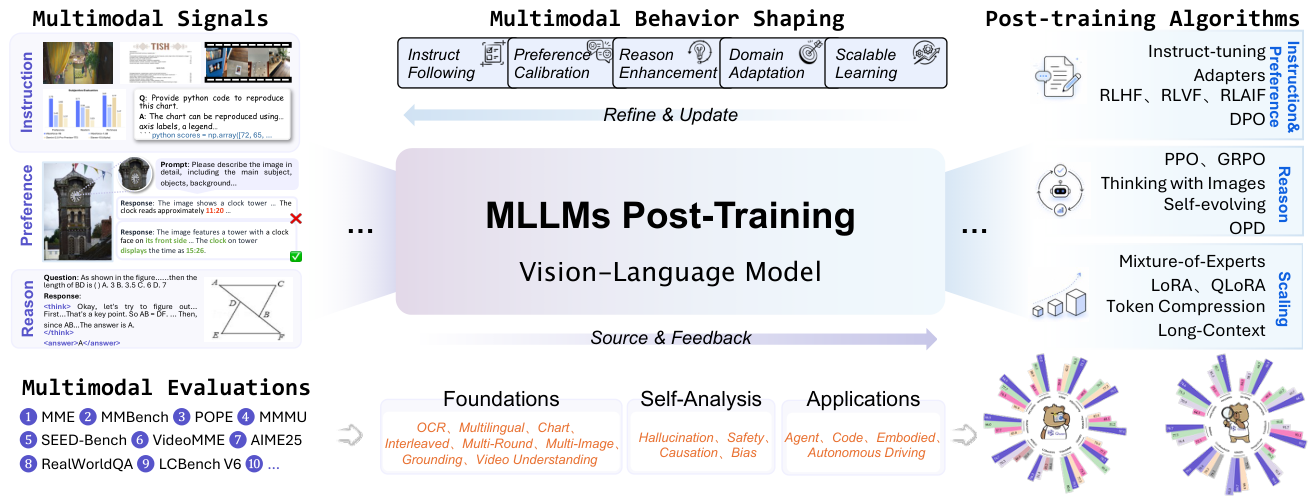
Figure 2.
Key milestones of MLLMs post-training. It has rapidly become a central mechanism for endowing pretrained MLLMs with the ability to exhibit more aligned and reliable behaviors, marking significant progress in multimodal intelligence.
Figure 2.
Key milestones of MLLMs post-training. It has rapidly become a central mechanism for endowing pretrained MLLMs with the ability to exhibit more aligned and reliable behaviors, marking significant progress in multimodal intelligence.
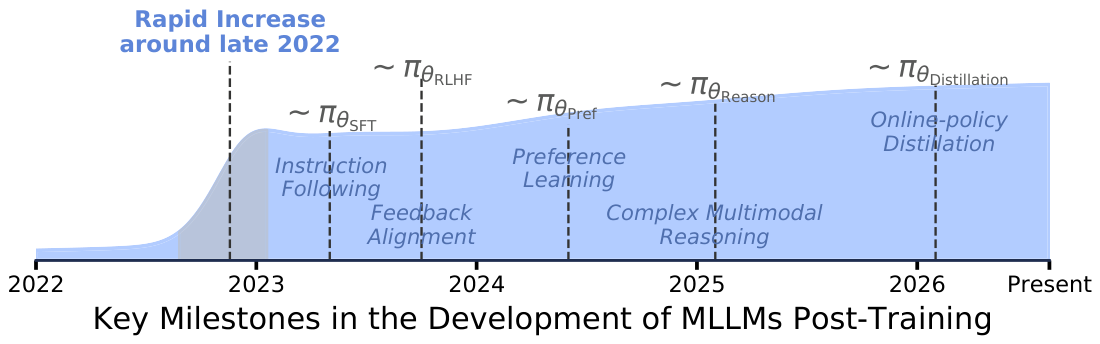
Figure 3.
A Venn diagram showing the interrelationships among key AI fields.MLLMs post-training connects multimodal learning with digital AI and physical AI, representing a core step in the progression towards Artificial General Intelligence (AGI).
Figure 3.
A Venn diagram showing the interrelationships among key AI fields.MLLMs post-training connects multimodal learning with digital AI and physical AI, representing a core step in the progression towards Artificial General Intelligence (AGI).
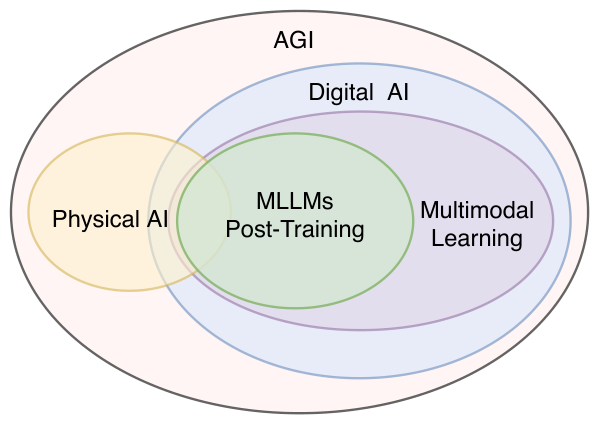
Figure 4.
A timeline of MLLMs post-training research.
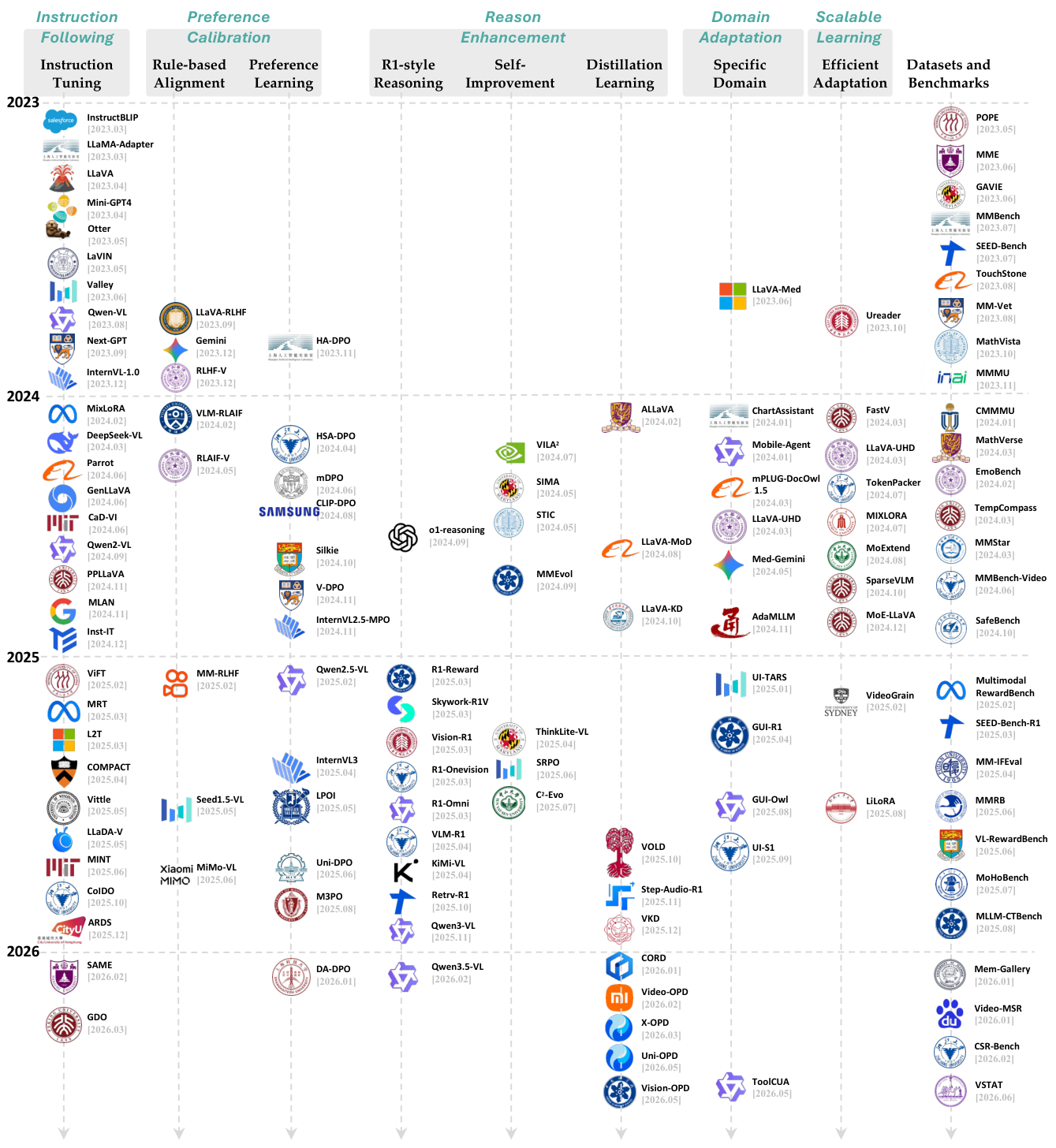
Figure 5.
A basic view of behavior shaping for instruction following. Left: A prompt template that organizes multimodal instruction data. We take the built-in Jinja template from HuggingFace llava-hf/llava-1.5-7b-hf as an example, which works for both training and inference. Right: The instruction-tuning paradigm used to train MLLMs. VL Inst. T: Vision-Language Instruction Tuning.
Figure 5.
A basic view of behavior shaping for instruction following. Left: A prompt template that organizes multimodal instruction data. We take the built-in Jinja template from HuggingFace llava-hf/llava-1.5-7b-hf as an example, which works for both training and inference. Right: The instruction-tuning paradigm used to train MLLMs. VL Inst. T: Vision-Language Instruction Tuning.
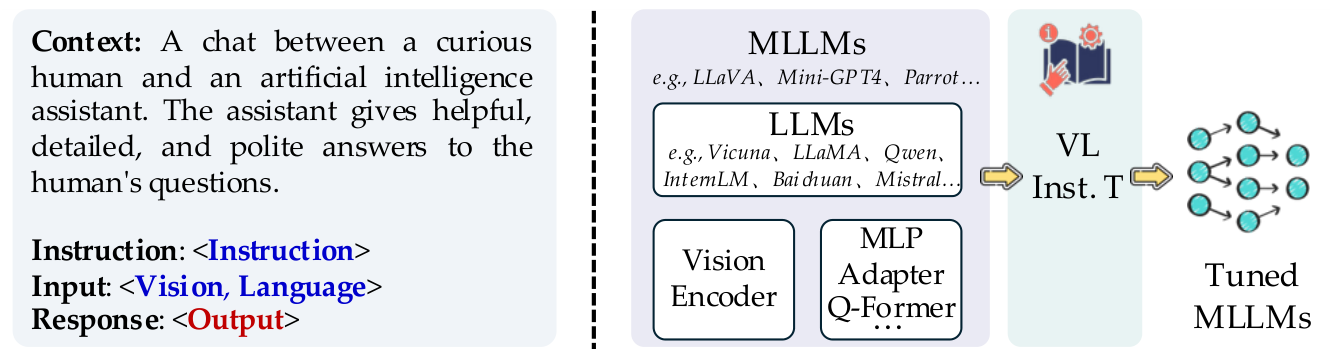
Figure 6.
A basic view of behavior shaping for preference calibration. Top: A pipeline of reinforcement learning from human/AI feedback (RLHF and RLAIF). Bottom: A pipeline of direct preference optimization (DPO).
Figure 6.
A basic view of behavior shaping for preference calibration. Top: A pipeline of reinforcement learning from human/AI feedback (RLHF and RLAIF). Bottom: A pipeline of direct preference optimization (DPO).
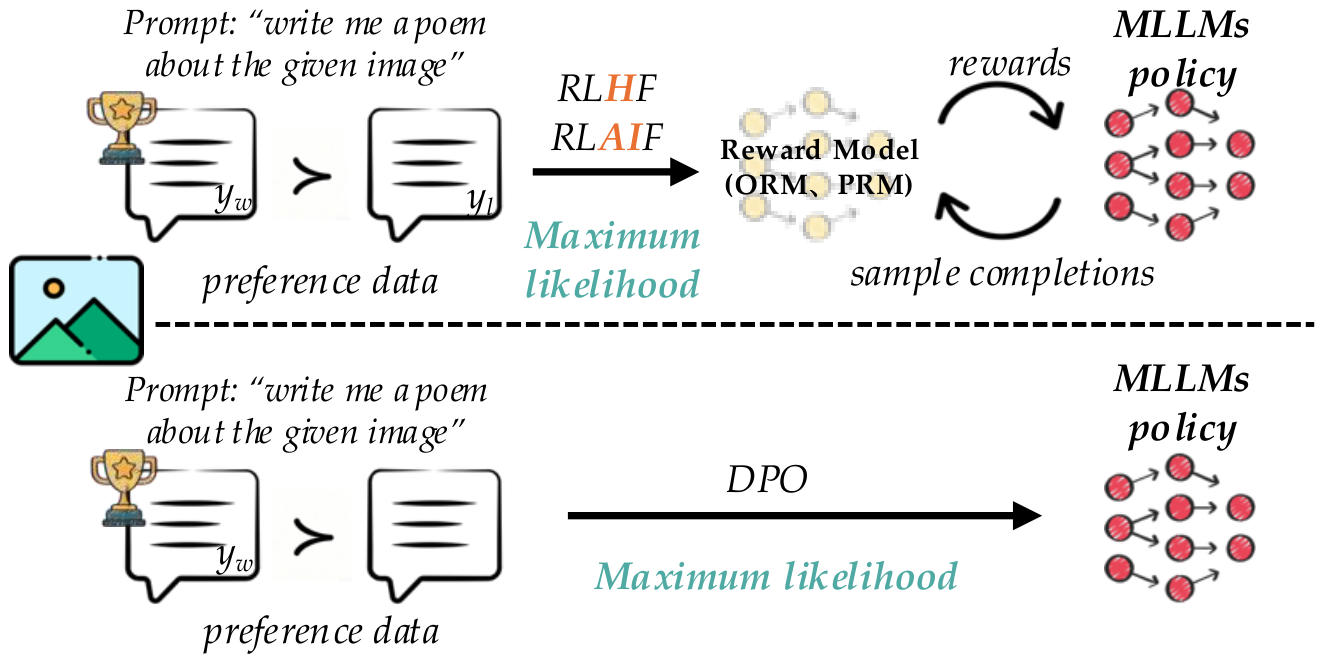
Figure 7.
A basic view of behavior shaping in R1-style reasoning and thinking with images for reason enhancement. The former (Left) reasons with pure natural language while the latter (Right) mixes explicit visual clues (e.g.,bbox, point, and Seg.) via a chain-of-thought manner.
Figure 7.
A basic view of behavior shaping in R1-style reasoning and thinking with images for reason enhancement. The former (Left) reasons with pure natural language while the latter (Right) mixes explicit visual clues (e.g.,bbox, point, and Seg.) via a chain-of-thought manner.
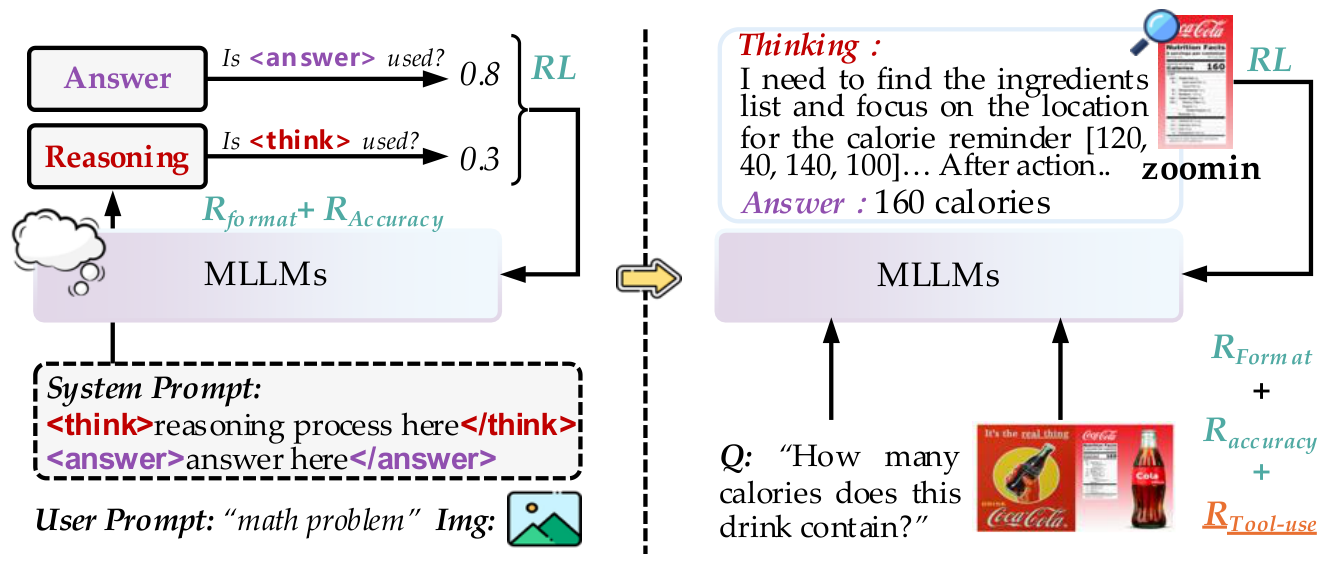
Figure 8.
A basic view of behavior shaping in self-evolving and distillation for reason enhancement.
Figure 8.
A basic view of behavior shaping in self-evolving and distillation for reason enhancement.
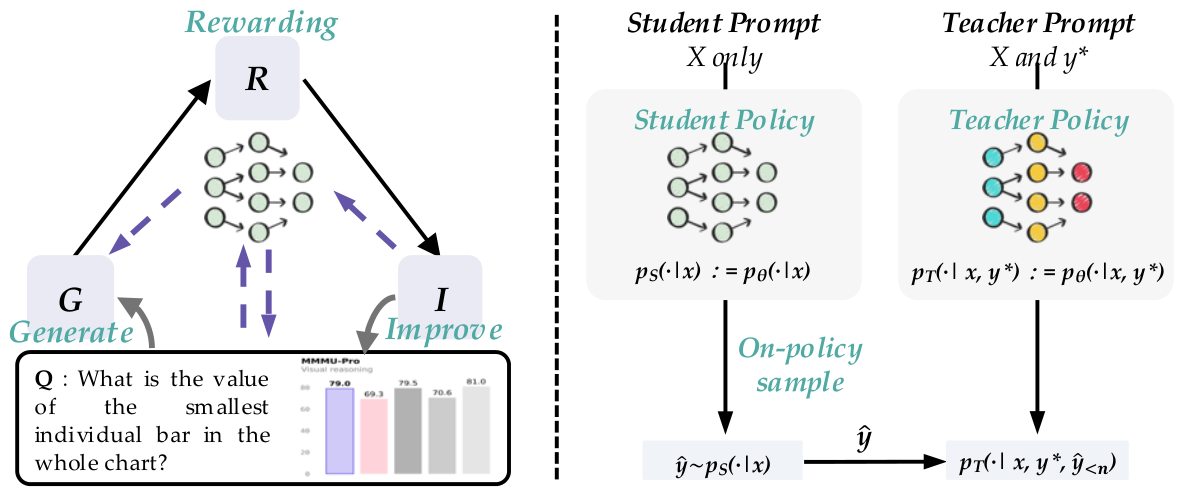
Figure 9.
A basic view of behavior shaping for domain adaptation. Ins. T: Instruction-tuning.
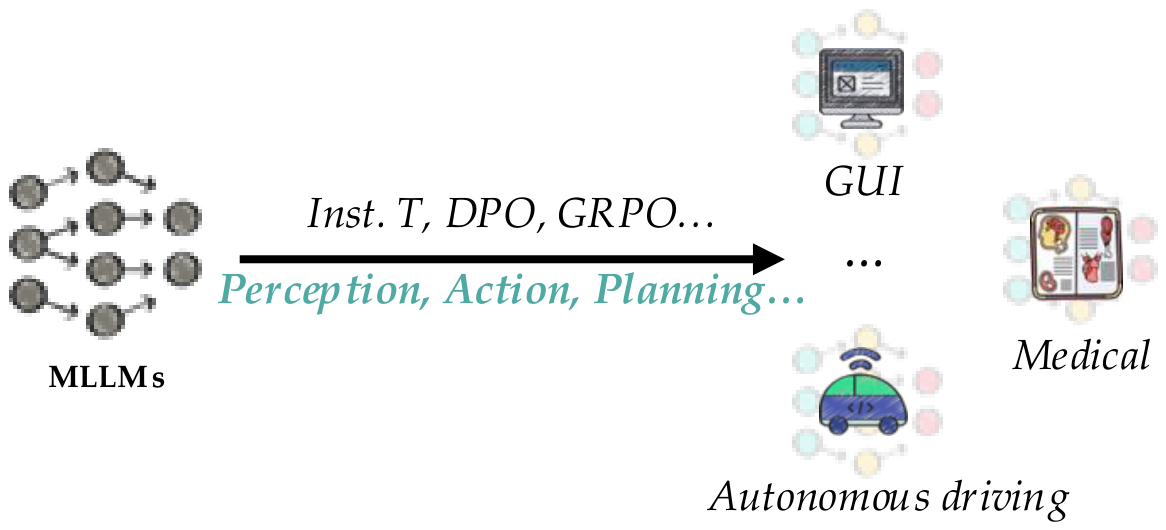
Figure 10.
A basic view of behavior shaping in parameter-efficient post-training for scalable learning.
Figure 10.
A basic view of behavior shaping in parameter-efficient post-training for scalable learning.
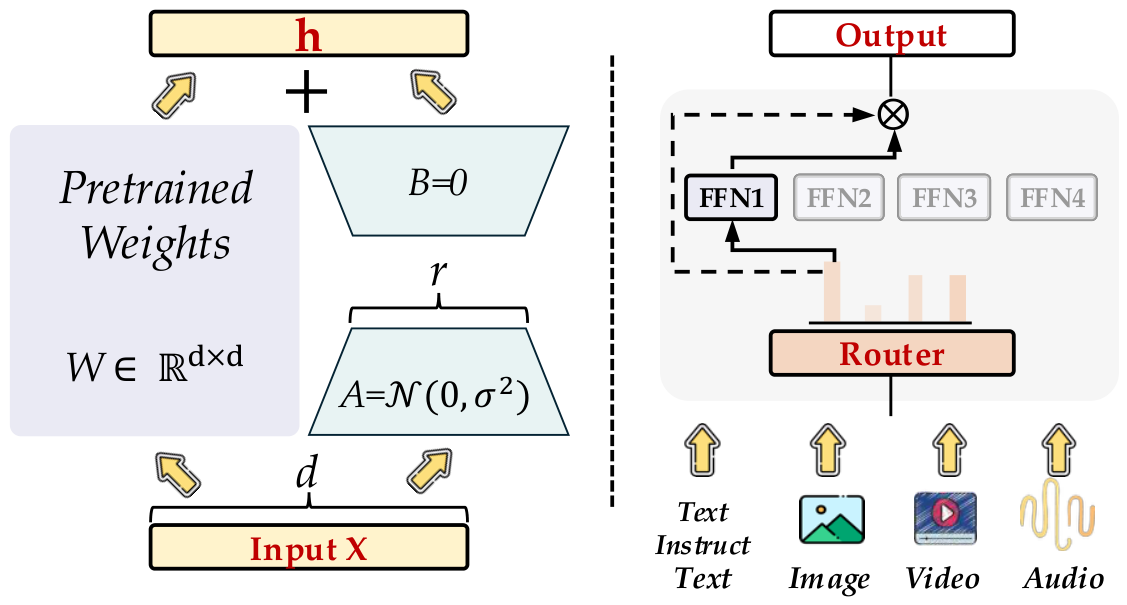
Figure 11.
A basic view of behavior shaping in compute-efficient post-training for scalable learning.
Figure 11.
A basic view of behavior shaping in compute-efficient post-training for scalable learning.
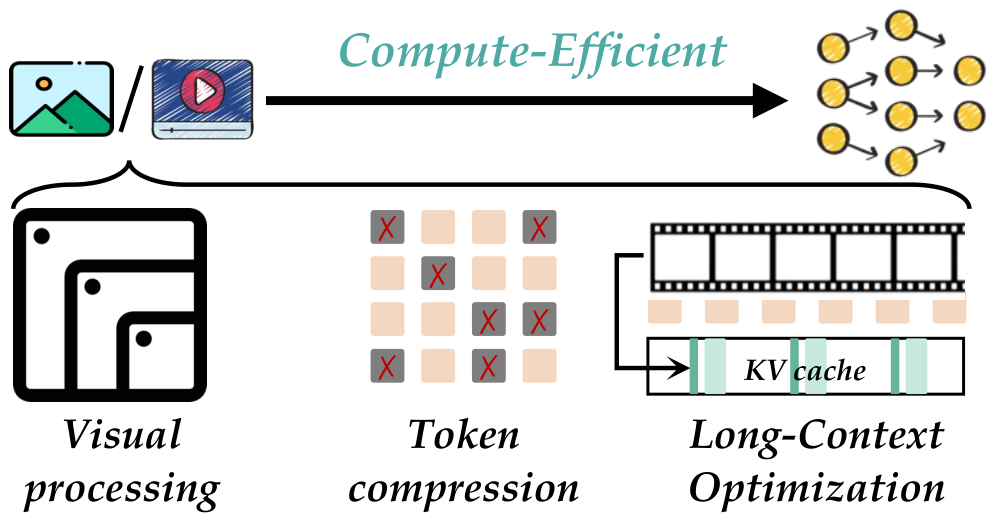
Figure 12.
Overview of the evaluation system of MMPoT.
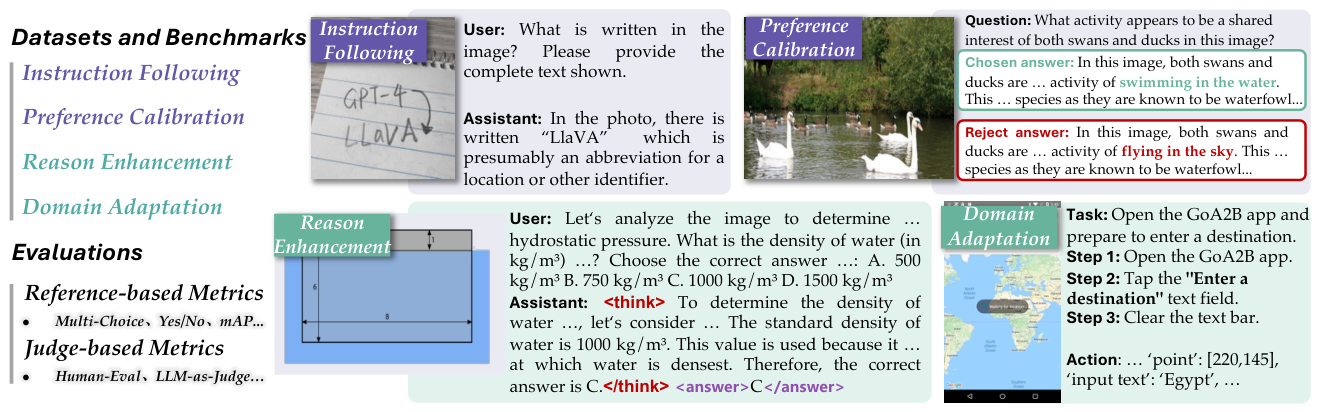

Table 1.
Representative multimodal instruction following methods inMMPoT. PD = pretraining data, ID = instruction-tuning data. I, T, V, A, and 3D mean image, text, video, audio, and 3D point cloud modalities, respectively. *: For methods with multiple visual encoders or backbone configurations, we report the best-performing or most representative variant.
Table 1.
Representative multimodal instruction following methods inMMPoT. PD = pretraining data, ID = instruction-tuning data. I, T, V, A, and 3D mean image, text, video, audio, and 3D point cloud modalities, respectively. *: For methods with multiple visual encoders or backbone configurations, we report the best-performing or most representative variant.
| Method | Base LLM | Visual Encoder | # Params. | Modality | Training Data Scale | Source |
|---|---|---|---|---|---|---|
| LLaVA [1] | Vicuna | CLIP ViT-L/14 | ∼7.3B / ∼13.3B | I+T→T | 595K PD + 158K ID | Paper / GitHub / Project |
| MiniGPT-4 [24] | Vicuna-7B / 13B | EVA-CLIP ViT-G/14 | ∼7B / 13B | I+T→T | ∼5M PD+ 3.5K ID | Paper / GitHub / Project |
| InstructBLIP [2] | Flan-T5 / Vicuna | EVA-CLIP ViT-g | 3B–13B variants | I+T→T | 129M PD | Paper / GitHub |
| mPLUG-Owl [42] | LLaMA-7B | CLIP ViT-L/14 | ∼7B | I+T→T | 392k ID | Paper / GitHub |
| LLaMA-Adapter V2 [43] | LLaMA-7B / 13B | CLIP ViT | 7B / 13B | I+T→T | 567K PD + 132K ID | Paper / GitHub |
| LLaVA-1.5 [25] | Vicuna-7B / 13B | CLIP ViT-L/14-336 | ∼7B / ∼13B | I+T→T | 558K PD + 665K ID | Paper / GitHub |
| CogVLM [44] | Vicuna-7B / LLaMA | EVA-CLIP ViT | ∼7B | I+T→T | 1.54B PD | Paper / GitHub |
| LLaVA-NeXT [45] | Vicuna / Mistral / Yi | CLIP ViT-L/14-336 | 7B / 13B / 34B variants | I+T→T | 558K PD + 760K ID | GitHub / Project |
| Qwen2-VL-Instruct [46] | Qwen2 | ViT | 2B / 7B / 72B | I+T+V→T | - | Paper / GitHub |
| LLaVA-OneVision [47] | Qwen2 | SigLIP | 0.5B / 7B / 72B | I+T+V→T | ∼4.8M PD + 4.8M ID | Paper / Project |
| InternVL2.5 [48] | InternLM2.5 / Qwen variants | InternViT | 1B–78B variants | I+T+V→T | ∼120B tokens + 16.3M ID | Paper / GitHub / Project |
| Qwen2.5-VL-Instruct | Qwen2.5 | ViT | 3B / 7B / 72B | I+T+V→T | ∼4.1T tokens + ∼2M ID | Paper / GitHub |
| VILA [49] | LLaMA-2 / Vicuna variants | CLIP ViT-L/14 | 2.7B / 7B / 13B / 40B | I+T+V→T | ∼50M PD | Paper / GitHub |
| MobileVLM [50] | MobileLLaMA-1.4B / 2.7B | CLIP ViT-L/14 | 1.7B / 3B | I+T→T | 558K PD + 665K ID | Paper / GitHub |
| DeepSeek-VL [51] | DeepSeek-LLM | SigLIP+SAM | 1.3B / 7B | I+T→T | - | Paper / GitHub |
| Cambrian-1 [52] | LLaMA-3 / Vicuna variants | ViT / ConvNeXT series | 8B / 13B / 34B variants | I+T→T | ∼7M ID | Paper / GitHub / Project |
| MiniCPM-V 2.6 [53] | Qwen2-7B | SigLIP-400M | ∼8B | I+T+V→T | 570M PD + ∼8.8M ID | Paper / GitHub / Model |
| Molmo [54] | OLMo | ViT | 1B / 7B / 72B variants | I+T→T | 712K PD + ∼31.6M ID | Paper / GitHub / Project |
| Pixtral-12B [55] | Mistral-based decoder | Pixtral-ViT | ∼12B | I+T→T | - | Paper / Project / Model |
| Otter [56] | OpenFlamingo / LLaMA-style LM | CLIP ViT-L/14 | ∼9B | I+T+V→T | 2.8M ID | Paper / GitHub |
| LaVIN [57] | LLaMA-7B / 13B | CLIP ViT | 7B / 13B | I+T→T | 210K ID | Paper / GitHub |
| Valley [58] | Stable-Vicuna | CLIP ViT-L/14 | 7B | I+T+V→T | 1.297M PD + 234K ID | Paper / GitHub |
| NExT-GPT [59] | Vicuna | ImageBind | 7B | I+T+V+A→I+T+V+A | 15K PD + 5K ID | Paper / GitHub / Project |
| InternVL-1.0 [60] | InternLM / Vicuna variants | InternViT | 6B–26B variants | I+T→T | 6.01B PD + ∼4M ID | Paper / GitHub |
| GenLLaVA [61] | Mistral-7B | SigLIP | 7B | I+T→I+T | 558K PD + ∼2.08M ID | Paper |
| MLAN [62] | LLaVA-style MLLMs | CLIP ViT-L/14 | 7B variants | I+T→T | 558K PD + 186K ID | Paper |
| Inst-IT [63] | Qwen2-7B* | SigLIP-SO400* | ∼7B | I+T+V→T | 558K PD + 243K ID | Paper / GitHub |
| Vittle [64] | LLaVA-style MLLMs | CLIP ViT-L/14-336px | Backbone-dependent | I+T→T | 558K PD + 665K ID | Paper |
| LLaDA-V [65] | LLaDA | SigLIP 2-so400m-patch14-384 | 8B | I+T→T | 558K PD + 12M ID | Paper / Project |
| LLaVA-NeXT-Interleave [47] | Vicuna / Mistral / Qwen variants | CLIP ViT-L/14-336 | 7B / 13B | I+T+V→T | 1.18M interleaved ID | Paper / Project |
| Mantis-Idefics2 [66] | LLaVA / Idefics-style backbones | SiGLIP | 7B / 8B | I+T→T | 143M PD + 721K ID | Paper / Project |
| ImageBind-LLM [67] | LLaMA | - | 7B | I+T+V+A+3D→T | 940M PD + 205.5K ID | Paper / GitHub |
| ShareGPT4V [68] | Vicuna-7B | CLIP ViT-L/14 | 7B | I+T→T | 1.2M PD + 665K ID | Paper / GitHub / Project |
Table 2.
Representative multimodal preference calibration methods in MMPoT. Here, I, V, A, and T denote image, video, audio, and text, respectively. RS: reject sampling, BoN: best-of-N, CFG: Classifier-Free Guidance.
Table 2.
Representative multimodal preference calibration methods in MMPoT. Here, I, V, A, and T denote image, video, audio, and text, respectively. RS: reject sampling, BoN: best-of-N, CFG: Classifier-Free Guidance.
| Method | Feedback Granularity | #Params. | Modality | Optimization Paradigm | Source |
|---|---|---|---|---|---|
| Multimodal RLHF | |||||
| LLaVA-RLHF [36] | Pair-level | 7B / 13B | I+T→T | PPO | Paper / GitHub / Project |
| RLHF-V [37] | Span-level | 13B | I+T→T | DDPO | Paper / GitHub / Project |
| VisualPRM [84] | Step-level | 8B | I+T→T | PRM + BoN | Paper / Project |
| Gemini [85] | Mixed-level | – | I+V+A+T→T | SFT + RLHF | Paper / Project |
| Seed1.5-VL [86] | Mixed-level | 20B | I/V+T→T | RLHF + RLVR + RS | Paper / GitHub / Project |
| MiMo-VL [87] | Mixed-level | 7B | I/V+T→T | MORL | Paper / GitHub |
| Multimodal RLAIF | |||||
| VLM-RLAIF [88] | Pair-level | 7B | V+T→T | Context-aware RM + PPO | Paper / GitHub / Project |
| RLAIF-V [89] | Mixed-level | 7B / 12B | I+T→T | Iterative DPO + BoN | Paper / GitHub |
| Oracle-RLAIF [90] | Listwise-level | 7B | V+T→T | Oracle ranker + rank-aware GRPO | Paper |
| Multimodal DPO | |||||
| Video-DPO [91] | Response-level | 7B | V+T→T | DPO | Paper / GitHub |
| HA-DPO [92] | Response-level | 7B / 13B | I+T→T | DPO | Paper / GitHub / Project |
| V-DPO [93] | Response-level | 7B | I+T→T | CFG + DPO | Paper / GitHub |
| CLIP-DPO [38] | Response-level | 1.7B / 3B / 7B | I+T→T | DPO + CLIP-ranked preferences | Paper |
| CHAIR-DPO [94] | Object-level | 7B / 8B | I+T→T | DPO + CHAIR-based preferences | Paper / GitHub |
| mDPO [95] | Response-level | 3B / 7B | I+T→T | conditional and anchored DPO | Paper / GitHub / Project |
| MoD-DPO [96] | Modality-level | – | A+V+T→T | DPO | Paper |
| OmniDPO [97] | Modality-level | – | A+V+T→T | DPO | Paper |
| DA-DPO [98] | Pair-level | 7B / 13B | I+T→T | DPO | Paper / GitHub / Project |
| LPOI [99] | Listwise-level | – | I+T→T | Anchored DPO | Paper / GitHub / Project |
Table 3.
Representative multimodal reason enhancement methods in MMPoT. Here, I, V, A, and T denote image, video, audio, and text, respectively.
Table 3.
Representative multimodal reason enhancement methods in MMPoT. Here, I, V, A, and T denote image, video, audio, and text, respectively.
| Method | Base Model | # Param. | Modality | SFT | Algorithm | Source |
|---|---|---|---|---|---|---|
| R1-based Multimodal Reasoning | ||||||
| VLM-R1 [102] | Qwen2.5-VL | ∼4B / 7B | I+T→T | ✗ | GRPO | Paper / GitHub |
| Visual-RFT [103] | Qwen2-VL | 2B | I+T→T | ✗ | GRPO | Paper |
| Vision-R1 [39] | Qwen2.5-VL | 7B / 32B / 72B | I+T→T | ✓ | GRPO | Paper / GitHub |
| Video-R1 [104] | Qwen2.5-VL-Instruct | 7B | I/V+T→T | ✓ | T-GRPO | Paper / GitHub |
| VisualPRM [84] | InternVL-style MLLMs | 8B | I+T→T | ✗ | – | Paper / Project |
| VisualThinker-R1-Zero [105] | Qwen2-VL | 2B | I+T→T | ✗ | GRPO | Paper / GitHub |
| MM-Eureka [106] | Qwen2.5-VL-Instruct | 7B / 32B | I+T→T | ✗ | GRPO | Paper / GitHub |
| R1-Onevision [107] | Qwen2.5-VL | 3B / 7B | I+T→T | ✓ | GRPO | Paper |
| R1-Omni [108] | HumanOmni | ∼0.5B | A+V+T→T | ✓ | GRPO | Paper |
| Retrv-R1 [109] | Qwen2.5-VL | 3B / 7B | I/T→I/T | ✓ | GRPO | Paper |
| Thinking with Images | ||||||
| GRIT [110] | Qwen2.5-VL / InternVL3 | 3B / 2B | I+T→T | ✗ | GRPO-GR | Paper |
| Point-RFT [111] | Qwen2.5-VL | 7B | I+T→T | ✓ | GRPO | Paper |
| OpenThinkIMG [112] | Qwen2-VL | 2B | I+T→T | ✓ | V-ToolRL | Paper |
| VisionReasoner [113] | Qwen2.5-VL | 7B | I+T→T | ✗ | GRPO | Paper |
| DeepEyes [114] | Qwen2.5-VL | 7B | I+T→T | ✗ | GRPO | Paper / GitHub |
| VTool-R1 [115] | Qwen2.5-VL | 3B / 7B / 32B | I+T→T | ✗ | GRPO | Paper / GitHub |
| LanteRn [116] | Qwen2.5-VL-Instruct | 3B | I+T→T | ✓ | Latent-aware GRPO | Paper |
| Multimodal Self-Evolving | ||||||
| VIGC [117] | Vicuna+ViT-G/14 | – | I+T→T | ✗ | – | Paper / Project |
| MindGYM [118] | Qwen2.5-VL / InternVL3 | 7B / 14B / 32B / 38B | I/T→T | ✗ | – | Paper |
| SRPO [119] | Qwen2.5-VL | 7B / 32B | I+T→T | ✓ | GRPO | Paper |
| LLaVA-Critic [120] | LLaVA-OneVision | 7B / 72B | I+T→T | ✗ | – | Paper |
| MM-UPT [121] | Qwen2.5-VL | 7B | I+T→T | ✓ | GRPO | Paper / GitHub |
| LLaVA-Critic-R1 [122] | Qwen2.5-VL / ThinkLite-VL | 7B | I/V+T→T | ✗ | GRPO | Paper |
| Multimodal Distillation | ||||||
| LLaVA-KD [123] | Qwen-series | 1B / 2B | I+T→T | ✗ | – | Paper / GitHub |
| LLAVADI [124] | LLaVA-v1.5 / MobileLLaMA | 13B / ∼2.7B | I+T→T | ✗ | – | Paper |
| LLaVA-MoD [125] | Qwen-1.5 | 7B / 2B | I+T→T | ✗ | – | Paper / GitHub |
| Video-OPD [41] | Qwen3-VL-Instruct | 32B / 8B | V+T→T | ✗ | OPD | Paper |
| X-OPD [126] | Qwen3-Omni / Qwen3 | ∼3B | A+T→T | ✗ | OPD | Paper |
| Uni-OPD [40] | Qwen3-VL-Instruct | 4B | I+T→T | ✗ | OPD | Paper |
| Vision-OPD [127] | Qwen3.5-VL | 4B / 9B | I+T→T | ✗ | OPD | Paper |
| VA-OPD [128] | Qwen3-VL | 2B / 4B / 8B / 32B | I+T→T | ✗ | OPD | Paper |
Table 4.
Representative multimodal domain adaptation methods in MMPoT. Doc. = document, EHR = electronic health record, HRV = high-resolution vision, Med. = medical, Inst. = instruction, Traj. = trajectory, RS = remote sensing.
Table 4.
Representative multimodal domain adaptation methods in MMPoT. Doc. = document, EHR = electronic health record, HRV = high-resolution vision, Med. = medical, Inst. = instruction, Traj. = trajectory, RS = remote sensing.
| Method | Domain | Input | Adapted Cap. | Source |
|---|---|---|---|---|
| Mobile-Agent [141] | GUI | Screenshot, Inst. | Perception+Action | Paper / GitHub |
| GUI-R1 [142] | GUI | Screenshot, Traj. | Reason+Action | Paper / GitHub |
| mPLUG-DocOwl1.5 [143] | Doc. | Doc., Chart | Layout+Reason | Paper / GitHub |
| LLaVA-UHD [144] | HRV | HRV | Perception | Paper / GitHub |
| Med-Gemini [20] | Med. | Med., EHR | Clinical Reason | Paper |
| AdaMLLM [145] | Med., Food, RS | Image | Efficiency | Paper |
Table 5.
Representative multimodal LoRA-based methods in MMPoT.† indicates that the GPU count was inferred from the official training script rather than explicitly reported in the paper.
Table 5.
Representative multimodal LoRA-based methods in MMPoT.† indicates that the GPU count was inferred from the official training script rather than explicitly reported in the paper.
| Method | Base | Trainable Params. | Rank | # GPUs | Source |
|---|---|---|---|---|---|
| LLaVA-MoLE [152] | Vicuna-7B-v1.5 | 0.3B/7B | 32 | 64*A100 | Paper/GitHub |
| MixLoRA [153] | Vicuna-7B v1.3 | ∼10M/7B | 4 | 4*A100 | Paper/GitHub |
| MokA [154] | LLaMA2 | ∼0.1B/7B | 4 | 8† | Paper/GitHub |
| LiLoRA [155] | LLaVA-1.5-7B | ∼0.25B/7B | 128 / 64 | 4† | Paper/GitHub |
Table 6.
Representative multimodal MoE-based methods in MMPoT. Exp. = experts; Act. = activated experts; FFN = feed-forward network. * For Qwen3-Omni, the expert configuration is inferred from the same-scale Qwen3-30B-A3B setting, as its report identifies the model as 30B-A3B without specifying the detailed expert configuration.
Table 6.
Representative multimodal MoE-based methods in MMPoT. Exp. = experts; Act. = activated experts; FFN = feed-forward network. * For Qwen3-Omni, the expert configuration is inferred from the same-scale Qwen3-30B-A3B setting, as its report identifies the model as 30B-A3B without specifying the detailed expert configuration.
| Method | #Exp./Act. | Act. Params | #Params. | Tuned | Source |
|---|---|---|---|---|---|
| MoE-LLaVA [156] | 4/2 | 3.6B | 5.3B | FFN-MoE | Paper/GitHub |
| MoExtend [157] | -/- | 13B | - | New Exp. | Paper/GitHub |
| Qwen3-Omni [158] | 128*/8* | 3B | 30B | T–T MoE | Paper/GitHub |
| Qwen3-VL [159] | -/- | 3B / 22B | 30B / 235B | VL MoE | Paper/GitHub |
| MiniMax-01 [160] | 32/- | 45.9B | 456B | MoE LLM | Paper/GitHub |
| Seed1.5-VL [86] | -/- | 20B | - | MoE LLM | Paper/GitHub |
Table 7.
Representative multimodal compute-efficient methods in MMPoT. EVP = efficient visual processing, TC = token compression, LCO = long-context optimization, HR = high resolution, OCR = optical character recognition.
Table 7.
Representative multimodal compute-efficient methods in MMPoT. EVP = efficient visual processing, TC = token compression, LCO = long-context optimization, HR = high resolution, OCR = optical character recognition.
| Type | Method | Input | Granularity | Core Technique | Main Goal | Source |
|---|---|---|---|---|---|---|
| EVP | LLaVA-UHD [144] | HR image | Region / Token | Image modularization, token compression, spatial schema | Fine-grained HR perception | Paper/GitHub |
| AdaMLLM/AdaLLaVA [161] | Image | Instance / Budget | Dynamic inference reconfiguration | Accuracy–latency trade-off | Paper/GitHub | |
| InternVL2 [60] | HR image | Tile | Dynamic image tiling | Dense visual perception | Project/GitHub | |
| TC | FastV [162] | Image / Video | Layer / Token | Attention-guided visual token pruning | Reduce prefilling and attention cost | Paper/GitHub |
| VisionZip [163] | Image / Video | Token | Informative token selection | Remove visual redundancy | Paper/GitHub | |
| SparseVLM [164] | Image / Video | Token / Layer | Text-guided sparsification, token recycling | Reduce visual FLOPs | Paper/GitHub | |
| TokenPacker [165] | Image | Projector / Token | Coarse-to-fine token packing | Compress while preserving details | Paper/GitHub | |
| LCO | LongVU [166] | Video | Frame / Token | Spatiotemporal adaptive compression | Long-video compression | Paper/GitHub |
| LongVILA [167] | Video | Sequence / System | Long-context extension, SFT, sequence parallelism | Scalable long-video training | Paper/GitHub | |
| LongVA [168] | Video | Context | Language-to-vision context transfer | Long-context video understanding | Paper/GitHub | |
| VideoChat-Flash [169] | Video | Hierarchical token | HiCo, short-to-long training | Extremely long-video modeling | Paper/GitHub |
Table 8.
Representative datasets and benchmarks for MMPoT. Each entry is annotated by its primary role:  for datasets mainly used in training,
  for benchmarks designed for evaluation, and + for resources containing both training and evaluation splits. The “Origin” column identifies the primary organization using common abbreviations.
for datasets mainly used in training, for benchmarks designed for evaluation, and + for resources containing both training and evaluation splits. The “Origin” column identifies the primary organization using common abbreviations.
Table 8.
Representative datasets and benchmarks for MMPoT. Each entry is annotated by its primary role: for datasets mainly used in training, for benchmarks designed for evaluation, and + for resources containing both training and evaluation splits. The “Origin” column identifies the primary organization using common abbreviations.
for datasets mainly used in training, for benchmarks designed for evaluation, and + for resources containing both training and evaluation splits. The “Origin” column identifies the primary organization using common abbreviations.| Name | Year | Scale | Role | Origin | Source |
|---|---|---|---|---|---|
| Instruction Following | |||||
| LLaVA-Instruct-150K [1] | 2023 | ∼80K images / 158K instruction samples | |
UW–Madison, Columbia | Paper/GitHub/Data |
| SEED-Bench [171] | 2023 | ∼19K samples | |
Tencent AI Lab, ARC Lab | Paper/GitHub/Data |
| MM-Vet [172] | 2023 | 200 images / 218 samples | |
NUS, Microsoft Azure AI | Paper/GitHub/Data |
| MMBench [173] | 2024 | 3,217 data samples | |
SHLAB, ZJU | Paper/GitHub/Data |
| ShareGPT4V [68] | 2024 | 1,346K samples | |
USTC, SHLAB | Paper/GitHub/Data |
| MM-IFInstruct [174] | 2025 | 23K samples | |
FDU, SII | Paper/GitHub/Data |
| MME [175] | 2026 | 1,187 images / 2,374 samples | |
SKL-NST, CASIA | Paper/GitHub/Data |
| VC-IFInstruct [176] | 2026 | 10k samples | |
HKUST, PSU | Paper |
| Preference Calibration | |||||
| POPE [177] | 2023 | ∼9K question samples | |
RUC, Meituan Group | Paper/GitHub/Data |
| MMHal-Bench [178] | 2023 | ∼96 image-question pairs | |
UCB, MIT-IBM AI Lab | Paper/GitHub/Data |
| HallusionBench [179] | 2024 | ∼346 images / ∼1.1K question samples | |
UMD | Paper/GitHub/Data |
| LLaVA-RLHF [36] | 2024 | 10K image-based conversations | |
UCB, MIT-IBM AI Lab | Paper/GitHub/Data |
| RLHF-V [37] | 2024 | 1.4K image-based conversations | |
THU, NUS | Paper/GitHub/Data |
| Lingua-SafetyBench [180] | 2026 | ∼100K image-question pairs | |
HKU, ZJU | Paper/GitHub/Data |
| Reason Enhancement | |||||
| ScienceQA [181] | 2022 | ∼10.3K image-question pairs / ∼21.2K questions |
+
|
UCLA | Paper/GitHub/Data |
| MMMU [182] | 2024 | ∼11.5K questions | |
Waterloo, OSU, CMU | Paper/GitHub/Data |
| MathVista [183] | 2024 | 6,141 samples | |
UCLA, MSR | Paper/GitHub/Data |
| PuzzleBench [184] | 2025 | 11,840 samples | |
SJTU | Paper |
| MME-CoT [185] | 2025 | 1,130 questions | |
CUHK, ByteDance, NEU | Paper/GitHub/Data |
| MME-Reasoning [186] | 2025 | 1,188 questions | |
Fudan, CUHK, Shanghai AI Lab | Paper/GitHub/Data |
| Domain Adaptation | |||||
| DocVQA [187] | 2020 | ∼12.8K images + ∼50K questions |
+
|
UB, CVC | Paper/Data |
| Mind2Web [188] | 2023 | ∼137 websites + ∼2.4K tasks + ∼137K annotated steps |
+
|
OSU, CMU | Paper/GitHub/Data |
| OCRBench [189] | 2023 | ∼1K questions | |
SAIL | Paper/GitHub |
| ChartX [190] | 2024 | ∼48K images / 6K validation+test samples |
+
|
Shanghai AI Lab, SJTU | Paper/GitHub |
| ScreenSpot [191] | 2024 | ∼610 screenshots + ∼1.3K GUI instructions | |
CUHK, SAIL | Paper/GitHub/Data |
Short Biography of Authors
Haonan Zhang is currently a joint Postdoctoral Researcher with Alibaba Group and the School of Computer Science and Technology, Tongji University, China. He obtained his Ph.D. degree from the University of Electronic Science and Technology of China in 2026. His research interests include multimodal learning, intelligent dialogue, and agent-based systems.
Pengpeng Zeng received the B.E. degree from Xi’an University of Technology in 2016, and the M.E. and Ph.D. degrees from University of Electronic Science and Technology of China in 2019 and 2023, respectively. He is now a researcher in Tongji University, China. His current research interests include visual understanding, machine learning, and reinforcement learning.
Libin Cao is a M.S. student in the School of Computer Science and Technology, Tongji University, China. Currently, he is working on multimodal learning and agent learning.
Wenrui Lai is a M.S. student in the School of Computer Science and Technology, Tongji University, China. Currently, he is working on multimodal understanding.
Jinlong Li is currently pursuing a Ph.D. degree with the Department of Information Engineering and Computer Science, University of Trento, Trento, Italy, and a visiting PhD student at the Department of Computer Science, ETH Zurich, Switzerland. He received the M.S. degree in computer science and the B.S. degree in physics and optoelectronic engineering, both from Shenzhen University, Shenzhen, China. His research interests include multimodal large language perception, reasoning, and planning, and spatial foundation models across 2D, 3D, and 4D representations. He has published in NeurIPS, CVPR, ECCV, TMM, and IJCV.
Duo Peng is a Tenured Associate Professor and Ph.D. Supervisor with the School of Computer Science and Technology, Tongji University, China. His research interests include computer vision, artificial intelligence, domain adaptation, embodied intelligence, and foundation models. He actively serves the research community as an area chair, program committee member, and reviewer for major international conferences and journals.
Yi Bin is a Research Professor with the School of Computer Science and Technology of Tongji University. Before this, he was a Research Fellow at National University of Singapore. He received the Ph.D degree at UESTC at the end of 2020. His research interests focus on multimodal analysis and reasoning. He has published several papers on top-tier conferences and journals, including CVPR, ICLR, AAAI, ACL, ACM MM, IEEE TIP, etc.
Xuanhan Wang received the B.E. and M.S. degrees from the University of Electronic Science and Technology of China, in 2014 and 2017, respectively. He received the Ph.D. degree in the School of Computer Science and Engineering, University of Electronic Science and Technology of China (UESTC) in 2023. He is now a researcher in Tongji University. His current research interests include Human-centric Embodied AI and Robotics.
Ji Zhang is an Assistant Professor with the School of Computing and Artificial Intelligence, Southwest Jiaotong University, China. He obtained his PhD degree from University of Electronic Science and Technology of China in 2024, under the supervision of Prof. Jingkuan Song. His research interests include few-shot learning, transfer learning and robotics. He has published over ten papers on top conferences/journals, such as TPAMI, IJCV, TIP, CVPR, ICCV, ICML.
Jingkuan Song is a professor with the School of Computer Science and Technology, Tongji University, China. He joined Columbia University as a Postdoc Research Scientist (2016-2017), and University of Trento as a Research Fellow (2014-2016). He obtained his PhD degree in 2014 from The University of Queensland (UQ), Australia. His research interest includes large-scale multimedia retrieval, LLMs and deep learning techniques. He was the winner of the Best Paper Award in ICPR (2016, Mexico), Best Student Paper Award in Australian Database Conference (2017, Australia), and Best Paper Honorable Mention Award (2017, Japan). He is an Associate Editor of IEEE TMM and ACM TOMM.
Nicu Sebe is a professor with the Department of Information Engineering and Computer Science, University of Trento, leading the research in the areas of multimedia information retrieval and human behavior understanding. He was the General CoChair of ACM Multimedia 2013 and 2022, and the Program Chair of ACM Multimedia 2007 and 2011, ECCV 2016, ICCV 2017 and ICPR 2020. He is a fellow of the International Association for Pattern Recognition (IAPr) and of the European Laboratory for Learning and Intelligent Systems (ELLIS).
Yuchuan Wu is currently a research scientist with Tongyi Lab, Alibaba Group. His research interests include conversational artificial intelligence, large language models, multimodal interaction, and social intelligence. He has published papers in major conferences and journals, including NeurIPS, KDD, ACL, and EMNLP.
Yongbin Li is currently a principal research scientist with Tongyi Lab, Alibaba Group, where he leads research and development in conversational and code intelligence. His research interests include large language models, post-training, conversational artificial intelligence, code intelligence, and intelligent agents. He has published extensively in major conferences and journals, including NeurIPS, ICML, ICLR, ACL, and EMNLP.
Heng Tao Shen is a professor with the School of Computer Science and Technology, Tongji University, China. He obtained his BSc with 1st class Honours and PhD from Department of Computer Science, National University of Singapore in 2000 and 2004 respectively. His current research interests include multimedia search, computer vision, artificial intelligence, and big data management. He has published 300+ peer-reviewed papers and received 7 best paper awards from international conferences, including the Best Paper Award from ACM Multimedia 2017 and Best Paper Award-Honourable Mention from ACM SIGIR 2017. He has served as General Co-chair for ACM Multimedia 2021 and TPC Co-Chair for ACM Multimedia 2015, and is an Associate Editor of ACM Trans. of Data Science (TDS), IEEE Trans. on Image Processing (TIP), IEEE Trans. on Multimedia (TMM), and IEEE Trans. on Knowledge and Data Engineering (TKDE). He is a Fellow of ACM/IEEE/OSA.
Jieping Ye received the PhD degree in computer science from the University of Minnesota, Twin Cities, MN, in 2005. He is currently a VP with Alibaba. He is also a professor with the University of Michigan, Ann Arbor, MI, USA. His research interests include Big Data, machine learning, and data mining with applications in transportation and biomedicine.
Disclaimer/Publisher’s Note: The statements, opinions and data contained in all publications are solely those of the individual author(s) and contributor(s) and not of MDPI and/or the editor(s). MDPI and/or the editor(s) disclaim responsibility for any injury to people or property resulting from any ideas, methods, instructions or products referred to in the content. |
© 2026 by the authors. Licensee MDPI, Basel, Switzerland. This article is an open access article distributed under the terms and conditions of the Creative Commons Attribution (CC BY) license.
Copyright: This open access article is published under a Creative Commons CC BY 4.0 license, which permit the free download, distribution, and reuse, provided that the author and preprint are cited in any reuse.


