

Submitted:
18 August 2026
Posted:
20 August 2026
You are already at the latest version
Abstract
Background: The aim of this in vitro study was to compare the cyclic fatigue resistance and fractured fragment length of three NiTi rotary systems of identical tip size and taper (25/.06). Nickel–titanium rotary instruments fracture unpredictably in curved canals, and no cyclic fatigue data have been published for either the Endo Magic All in One or the Denco Pro-Flexi system; this study provides the first independent fracture data for both, benchmarked against the established One Curve Mini.Methods: A total of 60 instruments (n = 20 per group) of One Curve Mini 25/.06, Denco Pro-Flexi 25/.06, and Endo Magic All in One 25/.06 were tested. Cyclic fatigue testing was performed in an artificial canal within a stainless-steel block (60° curvature angle, 5 mm radius of curvature, 1.5 mm internal diameter) in distilled water at 35 ± 1 °C. Instruments were rotated at 300 rpm until fracture. The number of cycles to failure (NCF) was calculated, fragment lengths were measured with a digital caliper, and cross-sectional geometry was evaluated by scanning electron microscopy (SEM). Data were analyzed using the Kruskal–Wallis and Dunn’s test (α = 0.05). Results: Significant differences were found among the groups for both NCF and fragment length (p < 0.001). The highest NCF was recorded for Endo Magic All in One (9165.50 ± 2049.58), followed by One Curve Mini (3007.50 ± 470.79) and Denco Pro-Flexi (2023.00 ± 1134.43); all pairwise comparisons were significant. Fragments in the Denco Pro-Flexi group were significantly longer (7.51 ± 1.05 mm). SEM revealed circular, triple-helix, and square cross-sections for Endo Magic All in One, One Curve Mini, and Denco Pro-Flexi, respectively. Conclusions: Instruments identical in tip size and taper differed up to 4.5-fold in cyclic fatigue resistance, so comparable fracture risk cannot be assumed from these specifications alone; fragment length data further indicate that the least resistant system also separates at a level that complicates retrieval. Cross-sectional geometry differed between the systems and offers a partial mechanical explanation; no metallurgical characterisation was performed, so the contribution of alloy behaviour was not established.
Keywords:
cross-sectional design
; cyclic fatigue
; endodontics
; fragment length
; instrument fracture
; nickel-titanium
1. Introduction
Nickel-titanium (NiTi) rotary instruments offer considerable advantages in root canal shaping owing to their superior flexibility and shape-memory properties compared with stainless-steel instruments. These properties contribute to the preservation of canal anatomy and improved shaping efficiency, particularly in curved canals [1,2]. Nevertheless, unexpected instrument fracture during clinical use is regarded as a significant complication that may adversely affect the prognosis of endodontic treatment [3].
Fracture of NiTi instruments occurs primarily through torsional and cyclic fatigue mechanisms. Cyclic fatigue is defined as the formation of microcracks resulting from the repeated tensile and compressive forces to which a rotary instrument is subjected within a curved canal, with these cracks propagating over time and ultimately leading to fracture [4]. The cyclic fatigue resistance of an instrument is influenced by numerous factors, including the metallurgical properties of the alloy, heat-treatment methods, cross-sectional geometry, taper, surface characteristics, and the operating parameters employed [4,5,6,7,8]. Heat treatments alter the phase transformation temperatures of the NiTi alloy, increasing the proportion of the martensitic phase at clinical working temperature and thereby enhancing flexibility and cyclic fatigue resistance. Instruments in the martensitic phase are more resistant to cyclic fatigue at both room and body temperature, and the austenite finish temperatures of new-generation instruments are higher than those of conventional NiTi instruments [9,10,11,12]. This increase in martensitic phase proportion has been suggested to improve fatigue resistance by reducing the stress concentration developing in curved canals [13,14].
Contemporary NiTi instruments differ not only in the alloy processing applied by the manufacturer but also in cross-sectional design, and recent evaluations indicate that mechanical response cannot be inferred from stated specifications alone. In comparisons of flexibility and torsional resistance of contemporary systems, the more flexible instrument also proved to be the more torsionally resistant one [15,16], and a file combining two heat-treated alloys within a single body showed cyclic fatigue behaviour that was file-specific rather than uniformly superior to that of a conventionally treated system [17].
The three systems evaluated in the present study represent different manufacturing approaches. Endo Magic All in One (All In Dental, Kocaeli, Türkiye) is described by its manufacturer as being produced by a proprietary heat-treatment protocol [18], the details of which originate from a patent application and have not been independently verified. One Curve Mini (Micro-Mega, Besançon, France) is produced using the C-Wire heat treatment, reported by its manufacturer to confer increased flexibility and controlled shape memory [19]. It is known that heat treatment and surface treatment parameters can significantly alter mechanical behavior, even in tools with identical geometry [20] Denco Pro-Flexi (Shenzhen Denco Medical Co., Shenzhen, China) is described by its manufacturer as a heat-treated system, but no technical detail regarding the treatment parameters is publicly available.
All three systems share the same ISO size and taper (25/.06) but differ in cross-sectional design and in the manufacturing processes reported by their manufacturers, allowing size and taper to be held constant while the influence of these differences on cyclic fatigue resistance is compared. To the best of our knowledge, no cyclic fatigue data have been published to date for either the Endo Magic All in One or the Denco Pro-Flexi system.
The aim of this in vitro study was to determine the extent to which cross-sectional design governs cyclic fatigue behaviour when instrument tip size and taper are held constant, and whether the level at which fracture occurs varies with these design parameters. Three rotary systems of identical ISO tip size and taper (25/.06) but differing in cross-sectional geometry and in the manufacturing processes reported by their manufacturers were compared under standardised artificial canal conditions. The null hypothesis was that there would be no significant difference among the tested instruments in either cyclic fatigue resistance or fractured fragment length.
2. Materials and Methods
This in vitro study was designed as a controlled bench-top comparison of three rotary systems sharing the same ISO tip size and taper (25/.06). Tip size, taper, canal geometry, immersion medium, temperature and kinematic settings were held constant across all groups, so that differences in the measured outcomes could be attributed to the instruments themselves rather than to the test conditions. Because the systems differ simultaneously in cross-sectional design and in the processing applied by their manufacturers, the comparison is made between complete commercial systems rather than between isolated design variables.
An a priori power analysis was performed using G*Power 3.1.5 (Universität Kiel, Kiel, Germany; F tests → ANOVA: fixed effects, omnibus, one-way). The effect size was derived from the number of cycles to failure reported by Surme et al. [21] for rotary instruments tested in an artificial canal of identical geometry (60° angle of curvature, 5 mm radius of curvature, 1.5 mm internal diameter, distilled water at 35 ± 1 °C). Assuming α = 0.05 and a power (1 − β) of 0.80 — the threshold conventionally adopted in biomedical sample size estimation — the minimum sample size required for one-way ANOVA with three groups was well below the number of instruments available. To ensure a margin for measurement error and data loss during fracture, and to remain consistent with the sample sizes adopted in comparable cyclic fatigue studies [21,22,23], 20 instruments per group were used, giving a total of 60 instruments.
Previously unused One Curve Mini 25/.06 (Micro-Mega, Besançon, France), Denco Pro-Flexi 25/.06 (Shenzhen Denco Medical Co, China), and Endo Magic All in One 25/.06 (All In Dental, Kocaeli, Türkiye) rotary instruments were used. The instruments were obtained from at least two different production batches to account for potential batch-related variability. Prior to testing, all instruments were examined under a stereomicroscope (Zumax OMS2380, Suzhou, China) at ×10 magnification to screen for visible deformation or manufacturing defects.
The testing apparatus was filled with distilled water maintained at 35 ± 1 °C using a heating device coupled with a temperature probe, which continuously monitored the water temperature and provided feedback control throughout the experiments. The instruments were then tested while held in a stainless-steel block featuring an artificial canal 17 mm in total length, with a 5 mm radius of curvature, a 60° angle of curvature, a 1.5 mm internal diameter, and the center of curvature located 5 mm from the tip (Figure 1). The artificial canal was covered with a transparent plate to prevent the instrument from slipping out of the canal during rotation in each test. The manufacturers’ recommended settings differed among the three systems (Table 1). To standardise the kinematic conditions and enable direct comparison, all instruments were operated at a fixed speed of 300 rpm and a torque of 2 N·cm using an X-Smart Plus endodontic motor (Dentsply Maillefer, Ballaigues, Switzerland). This value lies within the range routinely applied in cyclic fatigue testing. A static test model, in which the instrument rotates at a fixed working length without axial movement, was adopted in order to maximise standardisation across the three systems. Because the instrument was neither advanced nor withdrawn during testing, no axial compressive load was applied, and the loading was restricted to displacement-controlled bending imposed by the canal curvature.
A stopwatch was used to determine the time to fracture. For each instrument, the number of cycles to failure (NCF) was calculated by multiplying the time to fracture by the rotational speed (rpm). The length of each fractured fragment was measured using a digital caliper (Absolute Digimatic, Mitutoyo Corp, Kawasaki, Japan). To ensure standardization, all tests and measurements were performed by the same experienced operator. The artificial canal was inspected after every 10 tests under a stereomicroscope (Zumax OMS2380, Suzhou, China) at ×10 magnification: the transparent glass cover was removed and the canal was examined along its visible length for scoring of the canal walls, widening of the canal outline, or any deviation of the curved trajectory, using the unused portion of the block as a visual reference. The block was to be replaced if any such change was detected. To minimise the influence of any progressive change in the apparatus, instruments were selected at random for testing, so that the three systems were distributed across the testing period rather than tested in consecutive blocks. Blinding of the operator was not feasible because the instruments were visually distinguishable. Both outcome measures are objective and instrument-independent, which limits the scope for observer bias.
2.1. Scanning Electron Microscopy Analysis
Scanning electron microscopy (SEM) was used to evaluate the cross-sectional geometry and surface topography of the instruments. All fractured fragments were collected in safe-lock tubes. Prior to imaging, the instruments were ultrasonically cleaned in distilled water for 3 min. Images were obtained using an SEM unit (JSM-6060LV; JEOL Ltd., Tokyo, Japan) at ×100, ×150-300, and ×1500 magnifications.

Table 1.
Instruments used in the study.
| Groups | ISO Size | Taper | Cross Section | Manufacturer | Production Technology | Recommended Speed (rpm) | Recommended Torque (N·cm) |
|---|---|---|---|---|---|---|---|
| OCM | 25 | 0.06 | Variable (triple-helix at the tip / S-shaped towards the shaft) | Micro-Mega, Besançon, France | C-Wire technology | 300-450 | 2.5 |
| Denco | 25 | 0.06 | Not specified | Shenzhen Denco Medical Co., Shenzhen, China | Heat treatment reported by the manufacturer | 150-350 | 2-2.5 |
| EM | 25 | 0.06 | S-shaped | All In Dental, Kocaeli, Türkiye | Proprietary heat-treatment protocol reported by the manufacturer | 300-400 | 2 |
EM: Endo Magic All in One; OCM: One Curve Mini; Denco: Denco Pro-Flexi.
2.2. Statistical Analysis
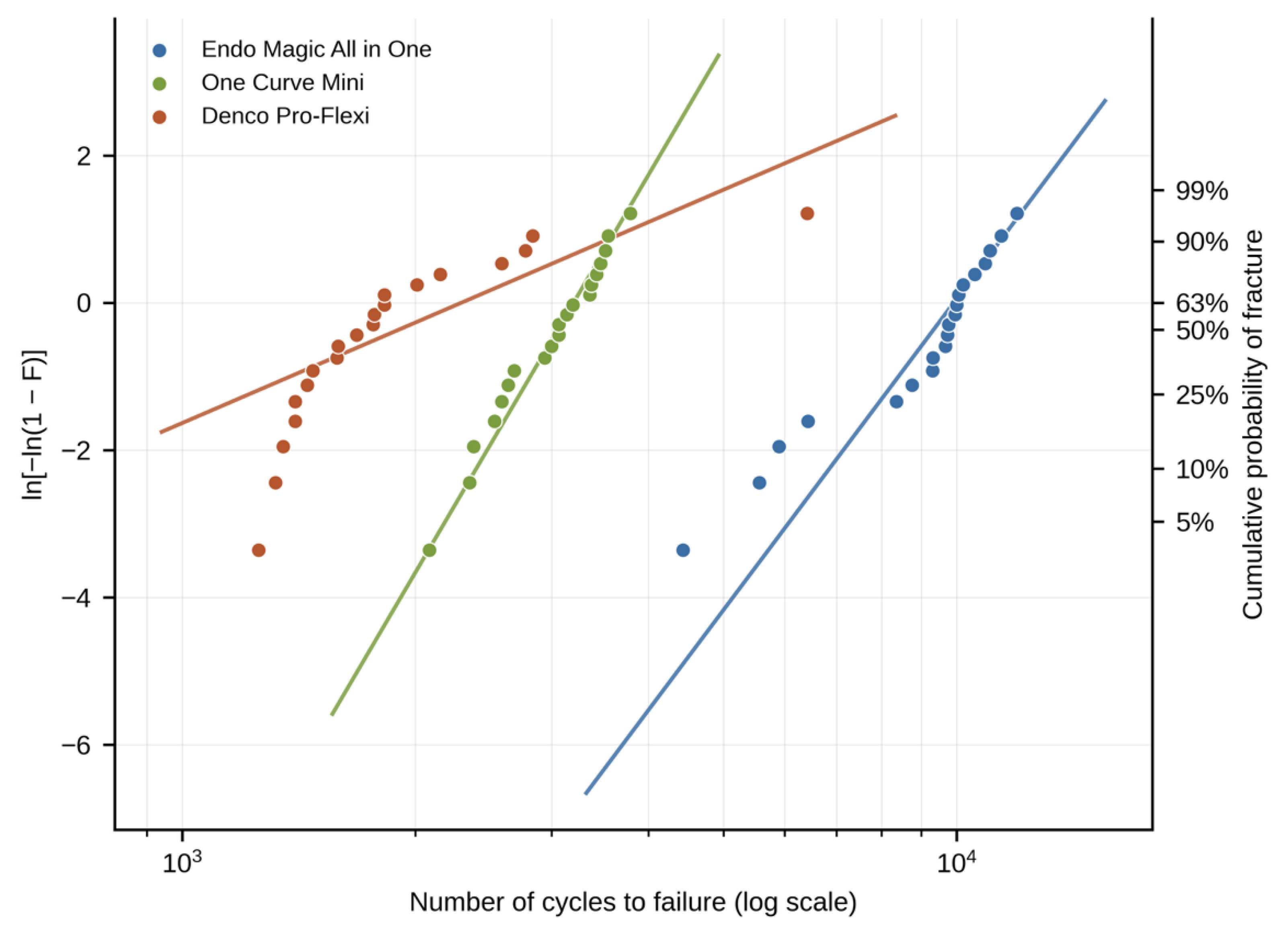
The unit of analysis was the individual instrument, each contributing one independent observation. Sixty instruments were analysed in three groups of 20 (Endo Magic All in One, One Curve Mini, Denco Pro-Flexi). Two outcome variables were assessed: the number of cycles to failure (NCF) and the fractured fragment length (mm). Data were analysed using IBM SPSS Statistics (v26.0; IBM Corp., Armonk, NY, USA). The normality of the data distribution within each group was assessed using the Shapiro–Wilk test. As the assumption of normality was not met in at least one group for each variable, the Kruskal–Wallis test was used for between-group comparisons of both outcomes. Where a significant difference was detected, pairwise comparisons were performed using Dunn’s test with Bonferroni correction for multiple comparisons. All tests were two-tailed and the level of statistical significance was set at α = 0.05. Results are presented as mean ± standard deviation, computed as descriptive statistics without any distributional assumption; the distribution of the fatigue life data is shown graphically in Figure 2, which was produced in Python 3.12 (SciPy 1.17).
3. Results
The NCF values differed significantly among the groups (p < 0.001). The highest cyclic fatigue resistance was observed in the Endo Magic All in One group, followed by the One Curve Mini and Denco Pro-Flexi groups. All pairwise comparisons were statistically significant. The distribution of the fatigue life data for each system is shown in Figure 2.
A significant difference was also found among the groups in terms of fractured fragment length (p < 0.001). The fragments produced in the Denco Pro-Flexi group were significantly longer than those in the One Curve Mini and Endo Magic All in One group, whereas no significant difference was detected between the One Curve Mini and Endo Magic All in One groups. All data are presented in Table 2.
Figure 2.
Weibull probability plot of the number of cycles to failure for the three rotary systems. Each point represents one instrument, plotted using median rank estimates; lines show the fitted two-parameter Weibull distributions. The shallower slope of Denco Pro-Flexi indicates greater scatter in fatigue life.
Figure 2.
Weibull probability plot of the number of cycles to failure for the three rotary systems. Each point represents one instrument, plotted using median rank estimates; lines show the fitted two-parameter Weibull distributions. The shallower slope of Denco Pro-Flexi indicates greater scatter in fatigue life.
Stereomicroscopic and SEM Findings
None of the 60 instruments showed deformation or manufacturing defects on stereomicroscopic examination before testing, and no wear or deformation of the artificial canal was detected at any inspection interval, so the stainless-steel block was not replaced during the study. SEM examination likewise revealed no manufacturing-related defects or burrs in any of the three systems. The cross-sectional geometry (Figure 3, middle row) was circular in the Endo Magic All in One instrument, triple-helix in the One Curve Mini instrument, and distinctly square (quadrangular) in the Denco Pro-Flexi instrument; the circular profile recorded for Endo Magic All in One differs from the S-shaped geometry stated in the manufacturer’s catalogue (Table 1). Examination of the surface topography revealed a granular texture with scattered surface pits in all three systems, with no marked difference detected among the groups (Figure 3).
4. Discussion
In this study, the cyclic fatigue resistance of three NiTi rotary instrument systems with different heat treatments and cross-sectional geometries was compared under standardized artificial canal conditions. The results demonstrated significant differences in cyclic fatigue resistance among the tested systems. The first null hypothesis was therefore rejected.
In our study, the Denco Pro-Flexi group exhibited the lowest cyclic fatigue resistance among the three systems compared (NCF: 2023.00 ± 1134.43), and also showed the widest dispersion in fatigue life, evident as the shallowest slope in the Weibull probability plot (Figure 3). SEM examination revealed no manufacturing-related defects, burrs or differences in surface roughness between this system and the other two, so the greater scatter cannot be attributed to surface features detectable at this level of magnification. Its distinct square cross section, however, incorporates sharper corners than the triple-helix and circular profiles of the other systems, and such corners act as stress concentration sites at which crack initiation may occur more variably from instrument to instrument. The manufacturer reports no verifiable processing parameters for this system, and its alloy behaviour was not characterised here.
The most striking finding of the present study was the markedly high cyclic fatigue resistance of the Endo Magic All in One group, with NCF values approximately 3.0 and 4.5 times higher than those of the One Curve Mini and Denco Pro-Flexi groups, respectively (9165.50/3007.50 = 3.04; 9165.50/2023.00 = 4.53). Under SEM this system presented a circular cross-sectional profile, which allows bending stress to be distributed more uniformly around the circumference than the angular profiles of the other two systems and presents no corner at which crack initiation is preferentially favoured. The magnitude of the difference nevertheless exceeds what cross-sectional geometry alone would be expected to produce, and the present data do not establish its origin.
All three studies in Table 3 used an artificial canal of the same geometry as the present study (60° angle of curvature, 5 mm radius, 1.5 mm internal diameter). Because loading in these tests is displacement-controlled, canal geometry determines the strain amplitude imposed at the point of maximum curvature, and the comparison is therefore made on a common mechanical basis. What differs between studies is the instrument: taper (25/.04 versus 25/.06), kinematics (rotary versus reciprocating), rotational speed and, in two cases, test temperature. Against this background, the values recorded for One Curve Mini (3007.50) and Denco Pro-Flexi (2023.00) fall within the range reported for rotary instruments under comparable conditions, whereas the value for Endo Magic All in One (9165.50) exceeds the highest previously reported value in Table 3 by a factor of approximately 2.7. The comparison is therefore used to establish that two of the systems perform within the expected range while the third does not, rather than to rank the instruments against one another. Reciprocating motion has generally been associated with higher numbers of cycles to failure than continuous rotation, since the unequal forward and reverse angles mean that a complete reversed bending cycle is not imposed at each oscillation; as no reciprocating instrument was tested here, the present data do not permit a comparison between the two kinematics. All of the studies in Table 3 are also based on static models, and higher NCF values may be obtained in dynamic (axially moving) models.
Nehme et al. [24] showed that, in instruments of identical geometry subjected to different heat treatments, the treatment applied is a determining factor in cyclic fatigue resistance. In the present study the three systems differed in cross-sectional geometry as well as in reported processing.
Cross-sectional design differed between the three systems and provides a mechanical account of part of the variation observed. In a static cyclic fatigue test the instrument is constrained to the curvature of the canal, so loading is displacement-controlled rather than load-controlled: the surface strain amplitude is governed by the ratio of the instrument radius to the radius of canal curvature (ε ≈ r/R) rather than by an applied moment. A smaller cross-section at the point of maximum curvature therefore experiences a lower strain amplitude and, correspondingly, a longer fatigue life. Consistent with this, the instrument with the smallest cross-sectional area has been reported to show significantly higher cyclic fatigue resistance than the systems compared with it [25]. In this context, the finding that the Denco Pro-Flexi system — which exhibited a distinct square cross section under SEM examination — showed the lowest cyclic fatigue resistance may be partly explained by its corner geometry: a square profile presents sharper corners than circular or rounded cross sections, and sharp corners act as stress concentration sites during cyclic loading, facilitating microcrack initiation.
By contrast, although the manufacturer’s catalogue describes the Endo Magic All in One system as having an S-shaped cross section, the cross-sectional images obtained at ×150–300 magnification (Figure 3, middle row) show a circular profile. This may be attributable to insufficiently pronounced blade flutes and to the fact that the SEM images were obtained from the fractured region, which displayed a circular cross section. Additional SEM sections taken proximal to the fracture site would be required to confirm whether the manufacturer’s stated S-shaped geometry is present along the coronal portion of the instrument. A circular cross section may have contributed to the high fatigue performance by allowing a more homogeneous circumferential distribution of stress. Cross-sectional geometry is nevertheless not the sole determinant of cyclic fatigue behaviour: instruments of similar cross-sectional design have been shown to differ markedly in fatigue and torsional resistance [26,27], so the differences recorded here cannot be attributed to geometry alone.
As a result of the cyclic fatigue tests, a significant difference was found among the groups in terms of fractured instrument fragment length. The second null hypothesis of our study was therefore also rejected. Surface cracks and deformations occurring at different levels of the active portion of the instruments may account for variations in fragment length. The longer fragments produced in the Denco Pro-Flexi group compared with the other groups may suggest that maximum stress was concentrated in more apical regions. By contrast, the similar fragment lengths obtained in the Endo Magic All in One and One Curve Mini groups may indicate that fracture occurred within a more restricted area of the curvature region. Fractured fragment length has been reported to be a clinically important parameter that may influence the process of removing or bypassing fractured instruments [28].
The use of artificial canal models is widely accepted in the literature for the standardization of cyclic fatigue testing. Pruett et al. [4] demonstrated that, with respect to cyclic fatigue, the radius and angle of curvature are more determinative parameters than the operating speed, and that the number of cycles to failure decreases significantly as the radius of curvature is reduced from 5 mm to 2 mm and as the angle of curvature exceeds 30°. The stainless-steel block apparatus used in the present study, with a 60° angle of curvature and a 5 mm radius of curvature, is consistent with these standardization principles and ensures the reproducibility of the test conditions.
Furthermore, conducting the experiments in an environment close to body temperature is critically important because temperature is a variable that influences the phase transformation behavior of the NiTi alloy. In their study comparing room temperature (20 °C) and body temperature (37 °C) conditions, de Vasconcelos et al. [29] reported that fatigue resistance decreased markedly—by up to 85%—in all rotary instruments tested at body temperature and related this finding to the martensitic transformation temperatures measured by DSC. Similarly, Huang et al. [30] demonstrated that the number of cycles to failure decreased as temperature increased in instruments tested at 22 °C, 37 °C, and 60 °C, and emphasized that the austenite finish temperature of an instrument is important in determining the risk of fracture at body temperature. Accordingly, maintaining the test environment at 35 ± 1 °C in the present study allows the results obtained to be more closely related to clinical conditions.
The static model adopted in the present study does not reproduce the axial motion applied clinically [31], and higher NCF values are generally reported in dynamic models [32]. This constitutes an important limitation of the study. The stainless-steel artificial canal used here was prepared in accordance with established standardisation principles [4]. Such standardised canals are advantageous for eliminating other factors that could influence the study results. In addition, the artificial canal model used may not fully reflect the elastic properties of dentine tissue. Caution is therefore warranted when generalizing the results obtained directly to clinical conditions. Future studies employing models with different curvature characteristics and dynamic test protocols are expected to provide more comprehensive information regarding the clinical performance of these systems.
No metallurgical characterisation was performed in the present study. The systems tested differ simultaneously in cross-sectional geometry and in the processing reported by their manufacturers, and the independent contribution of each cannot be resolved from mechanical data alone. Differential scanning calorimetry, X-ray diffraction and longitudinal microhardness profiling would be required to establish the metallurgical basis of the differences recorded here.
A further important limitation is that this in vitro study evaluated only cyclic fatigue resistance and fractured fragment length. The mechanical performance of a NiTi instrument is multifactorial, and cyclic fatigue resistance alone does not reflect overall clinical superiority. Notably, heat treatments that increase the martensitic phase proportion tend to enhance flexibility and cyclic fatigue resistance but may simultaneously reduce torsional resistance, which is equally relevant to intracanal instrument separation. Torsional strength, cutting efficiency, and shaping performance were not assessed in the present study and should be evaluated in future investigations before drawing conclusions regarding the overall clinical performance of these systems.
A further limitation concerns the standardization of kinematic settings. As the manufacturers’ recommended speeds differed among the systems, a fixed speed of 300 rpm was applied to all groups. This value corresponded to the lower end of the recommended range for Endo Magic All in One and One Curve Mini, but to the upper end for Denco Pro-Flexi. Since rotational speed may influence cyclic fatigue behavior, this standardization, although necessary for direct comparison, may have affected the relative performance of the systems and should be considered when interpreting the results.
5. Conclusions
Within the limitations of this in vitro study, which compared three NiTi rotary systems of identical tip size and taper (25/.06) under standardised static conditions (35 °C; 60° angle and 5 mm radius of curvature), cyclic fatigue resistance differed by up to 4.5-fold. Endo Magic All in One reached 9165.50 ± 2049.58 cycles, exceeding One Curve Mini (3007.50 ± 470.79) by a factor of 3.0 and Denco Pro-Flexi (2023.00 ± 1134.43) by a factor of 4.5. Denco Pro-Flexi, the only system with a square cross section, combined the lowest resistance with the widest dispersion in fatigue life and the most coronal fracture level (7.51 ± 1.05 mm), a combination of practical relevance because more coronal separation influences the feasibility of retrieval or bypass. These findings indicate that instruments identical in tip size and taper cannot be assumed to carry comparable fracture risk in curved canals, and that the cross-sectional geometry stated by a manufacturer may not correspond to that observed under SEM. Because no phase characterisation was performed, the metallurgical basis of these differences remains undetermined; future work combining differential scanning calorimetry and microhardness profiling with torsional, cutting-efficiency and shaping tests would be required before definitive clinical recommendations can be made.
Author Contributions
Conceptualization, B.K. and A.Ç.; methodology, B.K. and A.Ç.; software, B.K.; validation, A.Ç.; formal analysis, B.K.; investigation, A.Ç.; resources, H.B.Ö.; data curation, B.K.; writing—original draft preparation, B.K. and H.B.Ö.; writing—review and editing, B.K. and H.B.Ö.; visualization, B.K.; supervision, H.B.Ö.; project administration, H.B.Ö. All authors have read and agreed to the published version of the manuscript.
Funding
This research received no external funding. In-kind support (donation of instruments) is disclosed in the Acknowledgments.
Data Availability Statement
The data presented in this study are available on request from the corresponding author.
Institutional Review Board Statement
Not applicable.
Informed Consent Statement
Not applicable.
Acknowledgments
The authors thank Micro-Mega (Besançon, France) and All In Dental (Kocaeli, Türkiye) for donating the One Curve Mini and Endo Magic All in One instrument, respectively, used in this study. The Denco Pro-Flexi instruments were purchased by the authors. The donors had no role in the design of the study; in the collection, analysis, or interpretation of the data; in the writing of the manuscript; or in the decision to publish the results. During the preparation of this manuscript, the authors used Claude (Anthropic) for English-language editing and literature search assistance. The authors have reviewed and edited all AI-assisted content and take full responsibility for the accuracy, originality, and integrity of the publication.
Conflicts of Interest
The instruments tested in the One Curve Mini and Endo Magic All in One were provided free of charge by their respective manufacturers (Micro-Mega, Besançon, France; All In Dental, Kocaeli, Türkiye); the Denco Pro-Flexi instruments were purchased by the authors. The manufacturers had no involvement in the study design, data collection, statistical analysis, interpretation of the results, manuscript preparation, or the decision to submit the manuscript for publication.
References
- Walia, H.; Brantley, W.A.; Gerstein, H. An Initial Investigation of the Bending and Torsional Properties of Nitinol Root Canal Files. J. Endod. 1988, 14, 346–351. [Google Scholar] [CrossRef]
- Peters, O.A. Current Challenges and Concepts in the Preparation of Root Canal Systems: A Review. J. Endod. 2004, 30, 559–567. [Google Scholar] [CrossRef]
- Sattapan, B.; Nervo, G.J.; Palamara, J.E.; Messer, H.H. Defects in Rotary Nickel-Titanium Files after Clinical Use. J. Endod. 2000, 26, 161–165. [Google Scholar] [CrossRef]
- Pruett, J.P.; Clement, D.J.; Carnes, D.L. Cyclic Fatigue Testing of Nickel-Titanium Endodontic Instruments. J. Endod. 1997, 23, 77–85. [Google Scholar] [CrossRef]
- Tsujimoto, M.; Irifune, Y.; Tsujimoto, Y.; Yamada, S.; Watanabe, I.; Hayashi, Y. Comparison of Conventional and New-Generation Nickel-Titanium Files in Regard to Their Physical Properties. J. Endod. 2014, 40, 1824–1829. [Google Scholar] [CrossRef]
- Lopes, H.P.; Elias, C.N.; Vedovello, G.A.F.; Bueno, C.E.S.; Mangelli, M.; Siqueira, J.F. Torsional Resistance of Retreatment Instruments. J. Endod. 2011, 37, 1442–1445. [Google Scholar] [CrossRef]
- Shen, Y.; Cheung, G.S.P.; Bian, Z.; Peng, B. Comparison of Defects in ProFile and ProTaper Systems after Clinical Use. J. Endod. 2006, 32, 61–65. [Google Scholar] [CrossRef]
- Gao, Y.; Shotton, V.; Wilkinson, K.; Phillips, G.; Ben Johnson, W. Effects of Raw Material and Rotational Speed on the Cyclic Fatigue of ProFile Vortex Rotary Instruments. J. Endod. 2010, 36, 1205–1209. [Google Scholar] [CrossRef]
- Elsewify, T.; Elhalabi, H.; Eid, B. Dynamic Cyclic Fatigue and Differential Scanning Calorimetry Analysis of R-Motion. Int. Dent. J. 2023, 73, 680–684. [Google Scholar] [CrossRef]
- Staffoli, S.; Grande, N.M.; Plotino, G.; Özyürek, T.; Gündoğar, M.; Fortunato, L.; Polimeni, A. Influence of Environmental Temperature, Heat-Treatment and Design on the Cyclic Fatigue Resistance of Three Generations of a Single-File Nickel-Titanium Rotary Instrument. Odontology 2019, 107, 301–307. [Google Scholar] [CrossRef]
- Keskin, C.; Inan, U.; Demiral, M.; Keleş, A. Cyclic Fatigue Resistance of Reciproc Blue, Reciproc, and WaveOne Gold Reciprocating Instruments. J. Endod. 2017, 43, 1360–1363. [Google Scholar] [CrossRef]
- Adıgüzel, M.; Capar, I.D. Comparison of Cyclic Fatigue Resistance of WaveOne and WaveOne Gold Small, Primary, and Large Instruments. J. Endod. 2017, 43, 623–627. [Google Scholar] [CrossRef]
- Shen, Y.; Zhou, H.M.; Zheng, Y.F.; Campbell, L.; Peng, B.; Haapasalo, M. Metallurgical Characterization of Controlled Memory Wire Nickel-Titanium Rotary Instruments. J. Endod. 2011, 37, 1566–1571. [Google Scholar] [CrossRef]
- Zupanc, J.; Vahdat-Pajouh, N.; Schäfer, E. New Thermomechanically Treated NiTi Alloys - a Review. Int. Endod. J. 2018, 51, 1088–1103. [Google Scholar] [CrossRef]
- Di Nardo, D.; Martini, V.; Vincenzi, V.; Galli, M.; Bago, I.; Vidovic, I.; Testarelli, L.; Gambarini, G.; Grande, N.M. Experimental Evaluation of New Rotary Instruments with Innovative Manufacturing Treatments Potentially Affecting Clinical Performance. Part 2: Torsional Resistance. Ann. di Stomatol. 2026, 17, 730–735. [Google Scholar] [CrossRef]
- Galli, M.; Martini, V.; Vincenzi, V.; Di Nardo, D.; Bago, I.; Vidovic, I.; Testarelli, L.; Gambarini, G.; Grande, N.M. Experimental Evaluation of New Rotary Instruments with Innovative Manufacturing Treatments Potentially Affecting Clinical Performace. Part 1: Flexibility. Ann. di Stomatol. 2026, 17, 722–729. [Google Scholar] [CrossRef]
- Baran, M.; Lallier, T.E.; Edenfield, K.; Brooks, J.; Kee, E.; Arch, G.; Kazandag, M.K.; McMullen, A.F. A Comparative Study of Cyclic Fatigue of BlueShaper Pro and Pro Taper Gold Rotary Files. An In Vitro Study. SVOA Dent. 2026, 7, 134–143. [Google Scholar] [CrossRef]
- All In Dental Tıbbi Malzeme İthalat İhracat Sanayi ve Ticaret Ltd. Şti. Bir Endodontik Kök Kanal Aleti ve Bu Aletin Üretim Yöntemi [An Endodontic Root Canal Instrument and Its Manufacturing Method]. Turkish Patent Application TR 2026/002724, 23 February 2026. [PubMed]
- One Curve – NiTi Root Canal Shaping File | Micro-Mega. Available online: https://www.micro-mega.com/en/products/mechanized-files/one-curve-classic-mini/ (accessed on 13 July 2026).
- Vieira, V.T.L.; Silva, E.J.N.L.; Martins, J.N.R.; Jaime, A.; Puentes, C.G.; Torres, A.R.; Fernandes, F.M.B.; Versiani, M.A.; De-Deus, G.; Belladonna, F.G. Mechanical and Metallurgical In Vitro Evaluation of Electropolished Versus Non-Electropolished Rotary and Reciprocating Instruments. Int. Endod. J. 2025, 58, 1774–1782. [Google Scholar] [CrossRef]
- Surme, K.; Akman, H.; Özkan, H.B.; Er, K. Comparison of Cyclic Fatigue Resistance of Four Pediatric Rotary File Systems at Body Temperature: An in Vitro Study. BMC Oral Health 2024, 24. [Google Scholar] [CrossRef]
- Gündoğar, M.; Özyürek, T. Cyclic Fatigue Resistance of OneShape, HyFlex EDM, WaveOne Gold, and Reciproc Blue Nickel-Titanium Instruments. J. Endod. 2017, 43, 1192–1196. [Google Scholar] [CrossRef]
- Özyürek, T. Cyclic Fatigue Resistance of Reciproc, WaveOne, and WaveOne Gold Nickel-Titanium Instruments. J. Endod. 2016, 42, 1536–1539. [Google Scholar] [CrossRef]
- Nehme, W.; Naaman, A.; Diemer, F.; Leotta, M.L.; La Rosa, G.R.M.; Pedullà, E. Influence of Different Heat Treatments and Temperatures on the Cyclic Fatigue Resistance of Endodontic Instruments with the Same Design. Clin. Oral Investig. 2023, 27, 1793–1798. [Google Scholar] [CrossRef]
- Alcalde, M.P.; Duarte, M.A.H.; Bramante, C.M.; de Vasconselos, B.C.; Tanomaru-Filho, M.; Guerreiro-Tanomaru, J.M.; Pinto, J.C.; Só, M.V.R.; Vivan, R.R. Cyclic Fatigue and Torsional Strength of Three Different Thermally Treated Reciprocating Nickel-Titanium Instruments. Clin. Oral Investig. 2018, 22, 1865–1871. [Google Scholar] [CrossRef]
- Kaval, M.E.; Capar, I.D.; Ertas, H. Evaluation of the Cyclic Fatigue and Torsional Resistance of Novel Nickel-Titanium Rotary Files with Various Alloy Properties. J. Endod. 2016, 42, 1840–1843. [Google Scholar] [CrossRef]
- Park, S.Y.; Cheung, G.S.P.; Yum, J.; Hur, B.; Park, J.K.; Kim, H.C. Dynamic Torsional Resistance of Nickel-Titanium Rotary Instruments. J. Endod. 2010, 36, 1200–1204. [Google Scholar] [CrossRef]
- Shen, Y.; Peng, B.; Cheung, G.S.P. Factors Associated with the Removal of Fractured NiTi Instruments from Root Canal Systems. Oral Surgery, Oral Medicine, Oral Pathology, Oral Radiology and Endodontology 2004, 98, 605–610. [Google Scholar] [CrossRef]
- De Vasconcelos, R.A.; Murphy, S.; Carvalho, C.A.T.; Govindjee, R.G.; Govindjee, S.; Peters, O.A. Evidence for Reduced Fatigue Resistance of Contemporary Rotary Instruments Exposed to Body Temperature. J. Endod. 2016, 42, 782–787. [Google Scholar] [CrossRef]
- Huang, X.; Shen, Y.; Wei, X.; Haapasalo, M. Fatigue Resistance of Nickel-Titanium Instruments Exposed to High-Concentration Hypochlorite. J. Endod. 2017, 43, 1847–1851. [Google Scholar] [CrossRef]
- Plotino, G.; Grande, N.M.; Cordaro, M.; Testarelli, L.; Gambarini, G. A Review of Cyclic Fatigue Testing of Nickel-Titanium Rotary Instruments. J. Endod. 2009, 35, 1469–1476. [Google Scholar] [CrossRef]
- Lopes, H.P.; Elias, C.N.; Vieira, M.V.B.; Siqueira, J.F.; Mangelli, M.; Lopes, W.S.P.; Vieira, V.T.L.; Alves, F.R.F.; Oliveira, J.C.M.; Soares, T.G. Fatigue Life of Reciproc and Mtwo Instruments Subjected to Static and Dynamic Tests. J. Endod. 2013, 39, 693–696. [Google Scholar] [CrossRef]
Figure 1.
Experimental setup. (a) Stainless-steel block containing the artificial canal, immersed in a temperature-controlled distilled-water bath, with the instrument mounted in the handpiece. (b) Geometry of the artificial canal: 60° angle of curvature, 5 mm radius of curvature, 1.5 mm internal diameter and 17 mm total length.
Figure 1.
Experimental setup. (a) Stainless-steel block containing the artificial canal, immersed in a temperature-controlled distilled-water bath, with the instrument mounted in the handpiece. (b) Geometry of the artificial canal: 60° angle of curvature, 5 mm radius of curvature, 1.5 mm internal diameter and 17 mm total length.
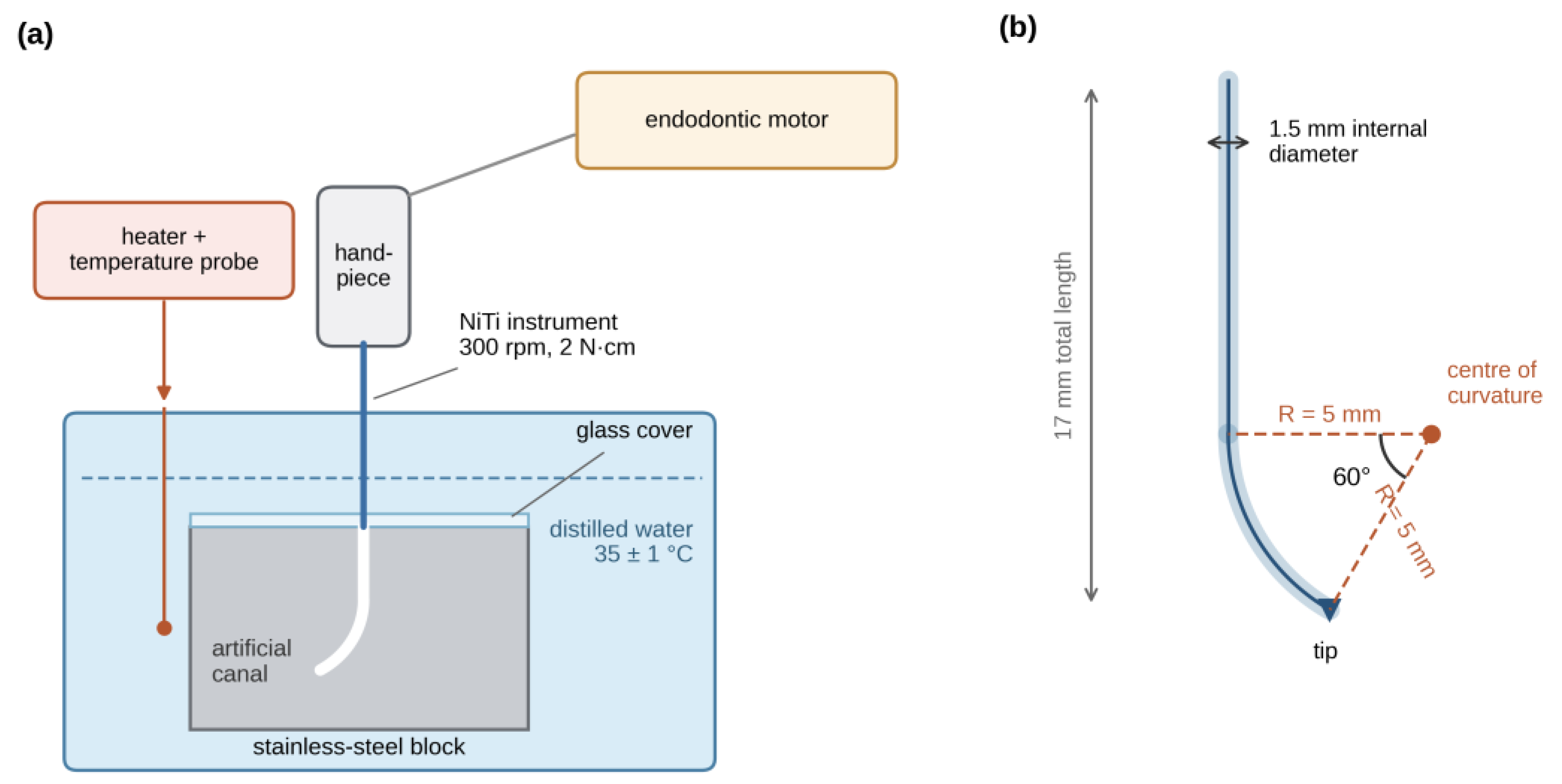
Figure 3.
SEM images of the rotary instruments. Top row (×100): flute configuration and surface appearance. Middle row (×150–300): cross-sectional geometry. Bottom row (×1500): surface topography.
Figure 3.
SEM images of the rotary instruments. Top row (×100): flute configuration and surface appearance. Middle row (×150–300): cross-sectional geometry. Bottom row (×1500): surface topography.
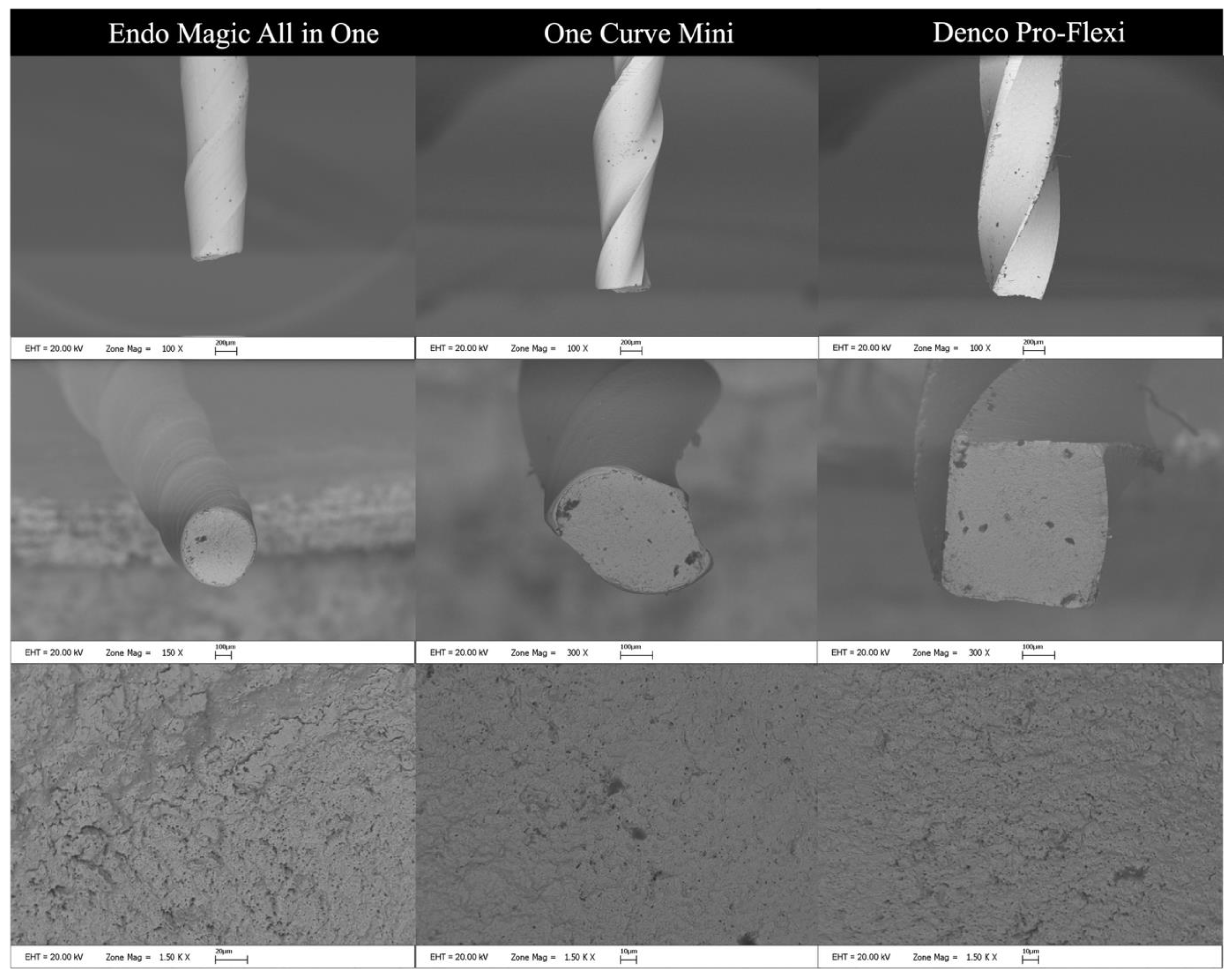
Table 2.
Means and standard deviations (SD) of the number of cycles to failure (NCF) and fragment lengths (mm) for the NiTi instruments.
Table 2.
Means and standard deviations (SD) of the number of cycles to failure (NCF) and fragment lengths (mm) for the NiTi instruments.
| Groups | NCF (Mean ± SD) | Fragment Length (mm) (Mean ± SD) |
|---|---|---|
| EM | 9165.50 ± 2049.58A | 6.45 ± 0.53a |
| OCM | 3007.50 ± 470.79B | 6.19 ± 1.37a |
| Denco | 2023.00 ± 1134.43C | 7.51 ± 1.05b |
* Different superscript letters within the same column indicate statistically significant differences between groups (Kruskal–Wallis test followed by Dunn’s test with Bonferroni correction, p < 0.05). Uppercase letters (A, B, C) denote pairwise differences for NCF, and lowercase letters (a, b) denote pairwise differences for fragment length; the two lettering schemes are independent and should not be compared across columns. EM: Endo Magic All in One; OCM: One Curve Mini; Denco: Denco Pro-Flexi.
Table 3.
Cyclic fatigue test conditions and NCF values reported in the present study and in previously published studies using comparable artificial canal geometry.
Table 3.
Cyclic fatigue test conditions and NCF values reported in the present study and in previously published studies using comparable artificial canal geometry.
| Study | Instrument (ISO/taper) | Canal geometry | Temp. | Kinematics / speed | NCF (mean ± SD) |
|---|---|---|---|---|---|
| Present study | Endo Magic All in One (25/.06) | 60°, r = 5 mm, Ø 1.5 mm | 35 ± 1 °C | Rotary, 300 rpm | 9165.50 ± 2049.58 |
| One Curve Mini (25/.06) | 60°, r = 5 mm, Ø 1.5 mm | 35 ± 1 °C | Rotary, 300 rpm | 3007.50 ± 470.79 | |
| Denco Pro-Flexi (25/.06) | 60°, r = 5 mm, Ø 1.5 mm | 35 ± 1 °C | Rotary, 300 rpm | 2023.00 ± 1134.43 | |
| Surme et al. [21] | Paediatric rotary systems (25/.04) | 60°, r = 5 mm, Ø 1.5 mm | 35 ± 1 °C | Rotary, per manufacturer | 453.65 ± 72.51 – 2668.10 ± 755.26 |
| Gündoğar and Özyürek [22] | HyFlex EDM (25/~) | 60°, r = 5 mm, Ø 1.5 mm | Room temperature | Rotary, 500 rpm | 3456.33 ± 633.37 |
| OneShape (25/.06) | 60°, r = 5 mm, Ø 1.5 mm | Room temperature | Rotary, 400 rpm | 1221.63 ± 812.40 | |
| Özyürek [23] | Reciprocating systems (25/.08) | 60°, r = 5 mm, Ø 1.5 mm | Room temperature | Reciprocating | 1153 ± 119.2 – 1628 ± 107 |
r: radius of curvature; Ø: internal diameter of the artificial canal; NCF: number of cycles to failure. Values are reproduced as reported in the original publications; differences in taper, kinematics and rotational speed preclude one-to-one comparison.
Disclaimer/Publisher’s Note: The statements, opinions and data contained in all publications are solely those of the individual author(s) and contributor(s) and not of MDPI and/or the editor(s). MDPI and/or the editor(s) disclaim responsibility for any injury to people or property resulting from any ideas, methods, instructions or products referred to in the content. |
© 2026 by the authors. Licensee MDPI, Basel, Switzerland. This article is an open access article distributed under the terms and conditions of the Creative Commons Attribution (CC BY) license (http://creativecommons.org/licenses/by/4.0/).
Copyright: This open access article is published under a Creative Commons CC BY 4.0 license, which permit the free download, distribution, and reuse, provided that the author and preprint are cited in any reuse.