

Submitted:
17 July 2026
Posted:
20 July 2026
You are already at the latest version
Abstract
Amusia, or tone deafness, is an auditory disorder affecting music processing. This study aimed to compare performance on a newly developed hearing screening test for amusia between typical students and students with learning difficulties. It also examined whether variables such as gender, age, and music education influence amusia detection. The screening tool, developed through laboratory evaluation, comprises seven acoustic subtests ("dissonant intervals", "out of tone", "contour", "memory", "rhythm", "integration", and "emotion") using piano timbre in a major mode. Participants included 100 typical students and 100 students with learning difficulties (aged 6–12 years) with normal hearing. The 15-minute test was administered via headphones. The results showed that while only 8% of typical students scored in the amusia range, 53% of students with learning difficulties failed the test, highlighting a high comorbidity between the two conditions. Furthermore, variables such as gender and music education did not significantly affect test performance, whereas age appeared to influence the results, although this finding is not widely validated by other research. Validation of the tool against the Montreal Battery of Evaluation of Amusia (MBEA) demonstrated high sensitivity and specificity. These findings support the link between amusia and learning difficulties, showcasing the screening tool's practical and scientific value for both pediatric and general populations.
Keywords:
amusia
; screening test
; melodies
; learning difficulties
Introduction
Musical and language perception are considered innate human capacities, with auditory processing of rhythm and melody beginning as early as the prenatal period [1,2]. While typical development leads to sophisticated musical awareness, a significant portion of the population exhibits congenital amusia—a neurological deficit in pitch processing that persists despite normal hearing and intelligence [3]. Congenital amusia is not merely a "musical" problem; it is linked to broader neurological functions and can significantly overlap with learning and language difficulties [4]. However, existing diagnostic tools, such as the Montreal Battery of Evaluation of Amusia (MBEA), although comprehensive, are often time-consuming and difficult to implement in large-scale screenings or school settings. There is a pressing need for shorter, more accessible screening tools that can reliably identify "at-risk" individuals within a limited timeframe.
The present research aims to bridge this gap by introducing a new, condensed screening tool (15-minute duration) based on the diagnostic principles of the Montreal protocol. By utilizing piano-timbred stimuli and focusing on seven key acoustic dimensions—including novel trials such as dissonant intervals and melodic completion, alongside contour, rhythm, and memory—this tool seeks to provide a practical solution for clinical and educational assessment. Specifically, this study addresses the following question: Can a shortened 15-minute acoustic battery effectively differentiate between typical students and those with learning difficulties, and to what extent do individual and demographic factors—such as age, gender, and prior music education—influence these screening outcomes?
The Amusic Profile: Characteristics, Diagnosis, and Identification
The term amusia was first coined in 1871 by Steinthal, who explored the disorder as an inability in musical processing [5]. Subsequently, in 1888, Knoblauch framed the disorder as an impairment in processing, understanding, producing, reading, or writing music [6]. Since then, significant research has been conducted to delineate this condition. Specifically, amusia is defined as a neurological disorder characterized by deficits in acoustic tone discrimination [7,8], the memory of familiar melodies, and frequently, the rhythmic perception of auditory stimuli [3,9].
Depending on its etiology, the onset of amusia is classified into two primary types: congenital and acquired [10]. Congenital amusia is present from birth, stemming from subtle neurodevelopmental anomalies in brain connectivity [11,12]. Conversely, acquired amusia results from brain damage sustained later in life, occurring in individuals who previously possessed a fully functional music processing system [10,13]. While both types occur despite normal cognitive functions and peripheral hearing, they manifest with highly similar core deficits, such as impaired harmonic sequence detection [14].
In daily life, this disorder manifests as a significant difficulty in musical perception and the acquisition of basic musical skills [15]. Those affected are typically unable to differentiate between melodies that differ by only a few notes or a semitone [7,8]. Beyond simple pitch discrimination, individuals with amusia often exhibit secondary deficits in emotional responses to music, as they struggle to capture the affective nuance of melodies [16]. Crucially, this musical disability occurs independently of peripheral auditory processing dysfunction, lack of music education, or general intellectual deficits [3].
From a cognitive perspective, this profile frequently exhibits a high comorbidity with learning challenges, particularly developmental dyslexia. Because music and language processing rely on overlapping neural resources, the deficits in phonology and reading found in dyslexia often share a common cognitive denominator with the pitch discrimination impairments seen in "tone deafness" [8].
Given this significant overlap between auditory processing deficits and learning difficulties, the early identification of such impairments is crucial within educational and clinical contexts. Consequently, instead of a full diagnostic assessment, the present study employs a targeted, rapid screening tool specifically designed for students. This screening process aims to efficiently detect potential indicators of amusia that may coexist with learning challenges, establishing the foundation for the methodological analysis and the comparative data presented in the following section.
Materials and Methods
The present study employs a novel, 15- minute[1] quantitative screening tool comprising 55 melodies and 12 pairs of notes. The battery evaluates seven acoustic dimensions: dissonant intervals, out-of-tone detection, contour, rhythm, memory, integration, and emotion. While the core trials are modeled after the globally validated Montreal Battery for the Evaluation of Amusia (MBEA), this tool introduces two specialized components: the recognition of dissonant intervals (unfamiliar sounds) and melodic completion, both of which address secondary deficits identified in recent literature. All stimuli feature piano timbre, were constructed in major mode according to Western tonal-harmonic conventions, and were recorded in wav format (Adobe Audition 3) at a standardized tempo of 80 bpm.
Participants
The sample consisted of 200 individuals, divided into two groups: 100 typical students and 100 students with learning difficulties. The analysis focuses on the subgroup of participants with learning disabilities (N=100). Within this sample, 70 individuals possess a formal clinical diagnosis, while the remaining 30 individuals were identified via the AMDE (a Greek standardized screening tool for learning difficulties). More specifically, this clinical group (N=100) comprised a heterogeneous population of students with learning difficulties. Within this group, 70% (n=70) had a formal clinical diagnosis, including dyslexia (10%), reading disorders (14%), spelling deficits (9%), and dyscalculia (2%). The remaining diagnosed participants (35%) presented with generalized learning difficulties (mixed disorders). As mentioned before, the remaining 30% (n=30) of the group consisted of undiagnosed students with low academic performance who failed the Greek learning difficulties screening tool (AMDE). All participants had normal hearing thresholds (\le 15 dBHL). Regarding music education, 77% of the clinical group had no formal training, while 23% had at least two years of music instruction.
Procedure and Scoring
The evaluation was conducted in a controlled laboratory environment to ensure focus and minimize external auditory factors. Each session lasted approximately 15 minutes. Following the statistical principles of the MBEA, a baseline score was established at 29.4 out of 42 (2 SD below the mean of typical peers). Scores below this threshold indicate a suspicion of tone deafness, for which further clinical diagnostic assessment via the full MBEA is recommended. Data were analyzed using SPSS, employing t-tests for group comparisons, ANOVA for multiple variables, and regression analysis to control for the effects of age, gender, and musical training. The level of statistical significance was set at 5%.
1. Dissonant Intervals
It is significant to note that individuals with amusia often fail to perceive dissonant musical intervals as unpleasant or unfamiliar [17,18]. Consequently, an innovative initial trial was designed using isolated dissonant intervals to determine if participants could identify which musical stimuli sounded discordant. From a mathematical perspective, the dissonant intervals examined date back to Pythagoras and include seconds, augmented fourths, whole tones, and semitones [18]. These specific stimuli are typically perceived as "discordant" or "incorrect" [19]. The experiment presents six examples, each consisting of two pairs of notes: one unfamiliar (dissonant) and one that is pleasing to the human ear (consonant). The selected "discordant" intervals include C# and F# (Figure 1), Re and Sol#, Sol b and LA, Do+ and Re#, Sol # and Do+, Fa # and Sol. The question is whether the listener is able to distinguish which example sounds unfamiliar.
2. Out of Tone
A primary diagnostic indicator of amusia is the profound difficulty in identifying notes that deviate from the distance of tone or semitone. In this phase of the study, subjects are required to compare melodic pairs that differ by only a single pitch [20]. Six pairs of melodies were composed based on Western classical harmonic principles, utilizing the scales of C major, Eb major, and F major. The critical pitch alteration is strategically positioned on a strong beat within either the final or penultimate measure of the sequence. These nearly identical melodies introduce a "foreign" or non-diatonic note, typically displaced by a single semitone (Figure 2) or whole tone from the original pitch—a nuance that amusic individuals generally fail to detect. To maintain participant engagement and ensure sustained auditory attention, one control pair consisting of perfectly identical melodies is included in the set.
3. Contour
The inability to distinguish between these highly similar melodies is primarily attributed to two factors: a deficit in precise pitch discrimination or an underlying mnemonic impairment [21]. While the former relates to the auditory system's failure to detect frequency differences, the latter involves the participant's inability to retain the melodic structure in memory long enough for comparison. Consequently, this experimental methodology aims to identify amusia by isolating whether the diagnostic failure stems from sensory pitch perception or cognitive remembrance of melodic shifts [22]. In both instances—regardless of whether the melodic variation is harmonically "correct" or "out of tone"—amusic individuals are unable to discern whether the presented melodies are identical or divergent (Figure 3).
4. Memory
This experimental trial is implemented to identify congenital amusia, a condition characterized by an inability to recognize familiar melodies. This failure in recognition stems from a fundamental deficit in melodic memory, which is largely representative of underlying difficulties in pitch perception. It is critical to note that amusic individuals struggle to differentiate between structurally similar musical sequences due to impaired acoustic pitch accuracy, a factor that subsequently hinders their long-term retrieval of musical information [23]. To assess these mnemonic functions, participants are presented with several culturally prominent melodies to determine if they can successfully identify well known melodies when they are presented without lyrics. The selection of stimuli for this assessment includes widely recognized pieces such as: "Twinkle Twinkle Little Star" (Figure 4), "Bella Ciao", "The Little Rooster", "Jingle Bells", "Rudolph the Red-Nosed Reindeer", "The Drummer".
5. Rhythmic Perception
Beyond tonal deficits, a subset of the amusic population exhibits significant impairments in the perception of musical rhythm. This condition is fundamentally linked to broader temporal processing mechanisms, specifically the listener's ability to differentiate the intensity and duration of auditory stimuli. Research suggests that diminished rhythmic perception serves as a clinical marker for deficits in rapid temporal auditory processing. Furthermore, this characteristic provides an indirect link to dyslexia, highlighting a notable comorbidity between amusia and various learning difficulties.
To evaluate rhythmic sensitivity, the study employs specific acoustic stimuli designed to test fine-grained temporal discrimination:
- In the initial three trials, the acoustic stimuli are differentiated rhythmically by the duration of only two notes within a single meter.
- The methodology continues with a fifth example involving pairs of melodies to further assess the subject's ability to identify rhythmic variances.
6. Integration
Research indicates that individuals diagnosed with amusia frequently exhibit a specialized deficit in perceiving musical completeness. The present study aims to investigate this impairment within a structured musical framework. In Western tonal music, compositions are organized into phrases characterized by specific endings and "breaths" that adhere to established harmonic conventions. Under normal conditions, listeners possessing typical acoustic processing—regardless of formal musical training—can instinctively identify the conclusion of a melodic phrase. This follows the work of Fiveash et al. [24], who assessed completion ability by truncating musical excerpts at strategic points to determine if participants could recognize the lack of resolution.
To evaluate this capacity in the current experimental design, participants are presented with six melodic phrases to determine their ability to distinguish between complete and incomplete structures. Initially, a pair of melodies is introduced, constructed strictly according to Western harmonic principles: the first provides full resolution, while the second terminates on the seventh degree (leading tone), intentionally evoking a sense of non-completion (Figure 5). The study further utilizes five excerpts from the standard repertoire. Three of these phrases provide tonal closure, such as the selections from Heller’s Etude op. 46 No. 7 (in E minor), the folk-inspired "Inside this boat," and Bach’s Concerto in D minor, all of which resolve to the tonic (first degree). Conversely, two excerpts—specifically a variation from Heller’s Etude and an arrangement of Linkin Park’s "Numb"—are prematurely interrupted at the third harmonic tier, leaving the listener without a sense of integration. This methodology is employed to isolate the music-specific integration deficit, as amusic individuals typically struggle to differentiate if a melody is complete or not.
7. Emotion
In addition to deficits in structural integration, congenital amusia is often associated with a secondary impairment in the perception of emotional qualities conveyed by musical melodies. This difficulty in decoding the expressive intent of a composition suggests a breakdown in the processing of affective auditory stimuli [25]. To evaluate this, the study utilizes a selection of six distinct melodies, requiring participants to categorize each according to its perceived emotional valence, specifically distinguishing between "happy" and "sad" characteristics.
The experimental stimuli are categorized as follows:
- Positive Emotional Valence (Happy): The selection includes Mozart's Sonata Allegro No. 279 and Carlos Gardel's waltz, Por una Cabeza.
- Negative Emotional Valence (Sad): For the evaluation of melancholic expressiveness, the study employs Beethoven's Moonlight Adagio sostenuto, L. Machairitsas' Notos, Yann Tiersen's The Piano, and The Train Leaves at Eight by Manos Eleftherios.
Results
The evaluation process began with a descriptive analysis to determine the prevalence of suspected amusia within the study sample. Out of the 200 participants, a significant discrepancy was observed between the two groups. Specifically, 53% of the students with learning difficulties scored below the established baseline of 29.4, whereas only 8% of typical students presented a similar suspicion of tone deafness. These findings, which illustrate the high co-occurrence of amusia and learning difficulties, are visually summarized in the comparative pie charts and bar graphs (see Figure 6).
Following the descriptive overview, an inferential statistical analysis was conducted to examine the strength of these associations. A chi-squared test confirmed that the presence of learning difficulties and performance on the amusia screening tool are significantly dependent variables, χ^2(1) = 47.765, p < 0.001. To further refine these results, a regression analysis was utilized to control for potential confounding factors. While musical training and gender were found to have no significant effect on the outcomes, age emerged as a significant factor, positively influencing test performance. However, the presence of learning difficulties remained the most robust predictor of the overall results. A detailed breakdown of how different types of learning difficulties correlate with test failure is presented in Table 1.
More specifically, as shown in Table 1, the prevalence of amusia was not uniform across all learning difficulty categories. Students with comorbid conditions (generalized learning difficulties) and those with reading disorders exhibited the highest frequency of amusia. This detailed breakdown clarifies the aggregate 53% prevalence rate observed within the clinical group (n=100). In Table 1, N represents the total number of students per category, while the 'Suspicion of amusia' column indicates the number of individuals who scored below the 29.4 cutoff point. These findings align with the overall data presented in Figure 6b.
Subsequently, a multiple regression analysis was conducted to examine which variables significantly predict performance on the screening tool (R^2 = 0.547, F(4, 195) = 20.766, p < 0.001). As shown in Table 2, gender and music education did not significantly affect the suspicion of amusia (p = 0.154 and p = 0.515, respectively). In contrast, age emerged as a significant predictor, with increasing age associated with better test performance (t(195) = 3.622, p < 0.001). Most importantly, the presence of learning difficulties was the strongest predictor of the disorder's appearance (t(195) = -7.291, p < 0.001).
The final stage of the analysis involved comparing the performance of the two groups across the last two acoustic trials: emotion and integration. As illustrated in the boxplots (Figure 7), students with suspected amusia demonstrated unexpectedly high scores in the emotional dimension of the test. Conversely, their performance on the integration test reached only moderate levels. This finding suggests that integration ability may constitute a secondary deficit in amusia, a hypothesis that warrants further investigation. In conclusion, while the present screening tool effectively identifies potential cases of this neurological disorder, a full diagnostic assessment remains the recommended next step to confirm a clinical diagnosis.
Discussion
The present study aimed to evaluate the effectiveness of a new, condensed 15-minute acoustic screening tool for identifying congenital amusia, a neurodevelopmental disorder characterized by deficits in pitch processing. By integrating traditional dimensions of the Montreal Battery of Evaluation of Amusia (MBEA) with novel trials, this research provides a practical and time-efficient alternative for large-scale clinical and educational assessments. Our findings align with international literature, suggesting that while congenital amusia affects a small portion of the general population—approximately 8%—its prevalence is significantly higher among individuals with learning disabilities. Specifically, 53% of the students with learning difficulties in our sample exhibited signs of amusia. This high rate of comorbidity supports the "shared-resource" hypothesis, suggesting that music and language processing rely on overlapping neural mechanisms. The observed deficits in phoneme decoding, reading, and spelling difficulties may be linked to the same underlying auditory processing dysfunction, often associated with structural variations in the arcuate fasciculus.
A key contribution of this study is the introduction of "dissonant intervals" and "melodic completion" as diagnostic indicators. The dissonant intervals trial highlighted the difficulty amusic individuals face in recognizing tonal violations within Western harmonic conventions, suggesting a lack of internalized tonal maps that typical listeners develop early in life. Furthermore, the melodic completion trial provided insight into deficits in auditory expectation. The inability to predict the resolution of a musical phrase indicates that amusia is not merely a perceptual deficit in pitch discrimination but a structural failure in processing musical syntax. These novel components, conducted in a specially configured laboratory space to ensure maximum concentration, allow for a more nuanced understanding of the musical deficit than traditional pitch-discrimination tasks alone.
Regarding the factors influencing test outcomes, our data indicate that variables such as gender and prior music education do not significantly affect performance on the screening test. Although congenital amusia is considered an innate neurodevelopmental condition and systematic musical training did not alter the screening outcomes in this specific sample, such training may still foster compensatory strategies that improve overall acoustic accuracy and rhythmic perception in broader contexts. Regarding age, older students exhibited significantly better performance (higher accuracy scores) on the test. However, because this developmental trend is not consistently documented in existing amusia literature, further investigation with a larger and more diverse population is recommended to validate this pattern.
Despite these promising results, it is important to acknowledge that the present tool is designed for screening rather than definitive clinical diagnosis. For this reason, after the application of this detection tool, the subsequent administration of the globally valid Montreal Battery of Evaluation of Amusia (MBEA) is suggested for participants who score below the baseline of the test to ensure a valid diagnosis. While these results provide valuable insights into the comorbidity of learning disabilities and musical deficits, it is important to note that the sample size is relatively small. This limitation suggests that patterns related to individual factors, such as age, should be interpreted with caution. Further research involving a larger and more diverse population is required to validate these patterns and allow for broader generalizations.
Conclusions
In conclusion, the integration of these findings into music pedagogy and audiology opens new windows for understanding the mechanisms of human cognition. By identifying the strong link between amusia and learning difficulties, educators and researchers can better inform new studies investigating the relationship between language and music. This screening tool serves as a foundation for future research that could lead to specialized pedagogical supports, ultimately improving the individual level of acoustic accuracy and rhythmic perception in both musical phrases and language sentences. Such advancements could significantly benefit individuals with learning difficulties, fostering a more holistic approach to their cognitive and educational development.
[1] To see the present screening tool and the corresponding responses click
Supplementary Materials
The following supporting information can be downloaded at the website of this paper posted on Preprints.org, Screening Tool of Amusia File S1 and the Questionnaire Responses File S2.
Author Contributions
Conceptualization, S.M. and N.T.; methodology, S.M., N.T. and I.P.; software, S.M.; validation, I.P.; formal analysis, S.M.; investigation, S.M.; resources, S.M.; data curation, S.M.; writing—original draft preparation, S.M.; writing—review and editing, N.T. and I.P.; visualization, S.M.; supervision, I.P.; project administration, S.M. All authors have read and agreed to the published version of the manuscript.
Funding
This research received no external funding.
Institutional Review Board Statement
The study was conducted in accordance with the Declaration of Helsinki, and approved by the Ethics Committee of the University of Patras (protocol code 1090518) and the Directorate of Primary Education of Achaia, Ministry of Education of Greece (protocol code 4888, 04-05-2022).
Informed Consent Statement
Informed consent was obtained from the parents or legal guardians of all subjects involved in the study.
Data Availability Statement
The screening tool developed as part of this study is available online as Supplementary Materials (File S1 and S2). The SPSS data supporting the findings of this study are available in Figshare at https://doi.org/10.6084/m9.figshare.29651258.v1. Moreover, all data and related materials can be provided by the first author on request.
Conflicts of Interest
The authors declare no conflicts of interest. .
References
- Hepper, P.G.; Scott, D.; Shahidullah, S. Newborn and fetal response to maternal voice. J. Reprod. Infant Psychol. 1993, 11, 147–153. [Google Scholar] [CrossRef]
- Kisilevsky, B.S.; Hains, S.M.; Lee, K.; Xie, X.; Huang, H.; Ye, H.H.; Zhang, K.; Wang, Z. Effects of experience on fetal voice recognition. Psychol. Sci. 2003, 14, 220–224. [Google Scholar] [CrossRef] [PubMed]
- Ayotte, J.; Peretz, I.; Hyde, K. Congenital amusia: A group study of adults afflicted with a music-specific disorder. Brain 2002, 125, 238–251. [Google Scholar] [CrossRef] [PubMed]
- Nan, Y.; Sun, Y.; Peretz, I. Congenital amusia in speakers of a tone language: Association with lexical tone agnosia. Brain 2010, 133, 2635–2642. [Google Scholar] [CrossRef] [PubMed]
- Garcia-Casares, N.; Berthier Torres, M.L.; Froudist Walsh, S.; González-Santos, P. Model of music cognition and amusia. Neurología 2013, 28, 179–186. [Google Scholar] [CrossRef] [PubMed]
- Casey, D.A. Aetiology of auditory dysfunction in amusia: A systematic review. Int. Arch. Med. 2013, 6, 16. [Google Scholar] [CrossRef] [PubMed]
- Peretz, I.; Ayotte, J.; Zatorre, R.J.; Mehler, J.; Ahad, P.; Penhune, V.B.; Jutras, B. Congenital amusia: A disorder of fine-grained pitch discrimination. Neuron 2002, 33, 185–191. [Google Scholar] [CrossRef] [PubMed]
- Couvignou, M.; Kolinsky, R. Comorbidity and cognitive overlap between developmental dyslexia and congenital amusia in children. Neuropsychologia 2021, 155, 107811. [Google Scholar] [CrossRef] [PubMed]
- Peretz, I.; Champod, A.S.; Hyde, K.L. Varieties of musical disorders: The Montreal Battery of Evaluation of Amusia. Ann. N.Y. Acad. Sci. 2003, 999, 58–75. [Google Scholar] [CrossRef] [PubMed]
- Sihvonen, A.J.; Särkämö, T.; Rodríguez-Fornells, A.; Ripollés, P.; Münte, T.F.; Soinila, S. Neural architectures of music—Insights from acquired amusia. Neurosci. Biobehav. Rev. 2019, 107, 104–114. [Google Scholar] [CrossRef] [PubMed]
- Hyde, K.L.; Zatorre, R.J.; Griffiths, T.D.; Lerch, J.P.; Peretz, I. Morphometry of the amusic brain: A two-site study. Brain 2006, 129, 2562–2570. [Google Scholar] [CrossRef] [PubMed]
- Peretz, I.; Cummings, S.; Dubé, M.-P. The genetics of congenital amusia (or tone-deafness): A family aggregation study. Am. J. Hum. Genet. 2007, 81, 582–588. [Google Scholar] [CrossRef] [PubMed]
- Stewart, L.; von Kriegstein, K.; Warren, J.D.; Griffiths, T.D. Music and the brain: Disorders of musical listening. Brain 2006, 129, 2533–2553. [Google Scholar] [CrossRef]
- Zhou, L.; Liu, F.; Jiang, J.; Jiang, H.; Jiang, C. Abnormal neural responses to harmonic syntactic structures in congenital amusia. Psychophysiology 2019, 56, e13344. [Google Scholar] [CrossRef] [PubMed]
- Peretz, I.; Gosselin, N.; Tillmann, B.; Cuddy, L.L.; Gagnon, B.; Trimmer, C.G.; Bouchard, B. Online identification of congenital amusia. Music Percept. 2008, 25, 331–333. [Google Scholar] [CrossRef]
- Jiang, C.; Liu, F.; Wong, P.C.M. Sensitivity to musical emotion is influenced by tonal structure in congenital amusia. Sci. Rep. 2017, 7, 7624. [Google Scholar] [CrossRef] [PubMed]
- Goswami, U. A temporal sampling framework for developmental dyslexia. Trends Cogn. Sci. 2011, 15, 3–10. [Google Scholar] [CrossRef] [PubMed]
- Anthony, T. Μουσικά Διαστήματα-Συμφωνία και Διαφωνία ΤΠ1. 2016. Available online: https://shorturl.at/mFTU9 (accessed on 15 July 2026).
- Tramo, M.J.; Cariani, P.A.; Delgutte, B.; Braida, L.D. Neurobiological foundations for the theory of harmony in Western tonal music. Ann. N. Y. Acad. Sci. 2001, 930, 92–116. [Google Scholar] [CrossRef] [PubMed]
- Vuvan, D.T.; Paquette, S.; Mignault Goulet, G.; Royal, I.; Felezeu, M.; Peretz, I. The Montreal Protocol for identification of amusia. Behav. Res. Methods 2018, 50, 662–672. [Google Scholar] [CrossRef] [PubMed]
- Lu, X.; Sun, Y.; Ho, H.T.; Thompson, W.F. Pitch contour impairment in congenital amusia: New insights from the Self-Paced Audio-Visual Contour Task (SACT). PLoS ONE 2017, 12, e0179252. [Google Scholar] [CrossRef] [PubMed]
- Liu, F.; Patel, A.D.; Fourcin, A.; Stewart, L. Intonation processing in congenital amusia: Discrimination, identification, and imitation. Brain 2010, 133, 1682–1693. [Google Scholar] [CrossRef] [PubMed]
- Graves, J.E.; Pralus, A.; Fornoni, L.; Oxenham, A.J.; Caclin, A.; Tillmann, B. Short- and long-term memory for pitch and non-pitch contours: Insights from congenital amusia. Brain Cogn. 2019, 136, 103614. [Google Scholar] [CrossRef] [PubMed]
- Fiveash, A.; Thompson, W.F.; Badcock, N.A.; McArthur, G. Syntactic processing in music and language: Effects of interrupting auditory streams with alternating timbres. Int. J. Psychophysiol. 2018, 129, 31–40. [Google Scholar] [CrossRef] [PubMed]
- Reed, C.L.; Cahn, S.J.; Cory, C.; Szaflarski, J.P. Impaired perception of harmonic complexity in congenital amusia: A case study. Cogn. Neuropsychol. 2011, 28, 305–321. [Google Scholar] [CrossRef]
Figure 1.
Visual representation of dissonant vs. consonant interval used in the screening test.
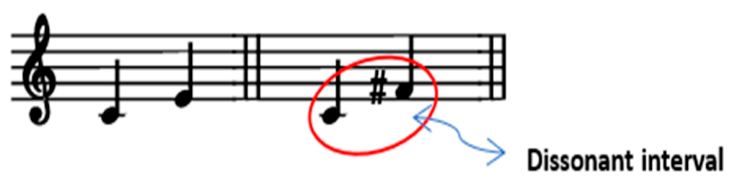
Figure 2.
Illustration of the “out of tone’’ task, where two melodies differ by a single note to assess auditory discrimination of proximal frequencies and tonal violations.
Figure 2.
Illustration of the “out of tone’’ task, where two melodies differ by a single note to assess auditory discrimination of proximal frequencies and tonal violations.
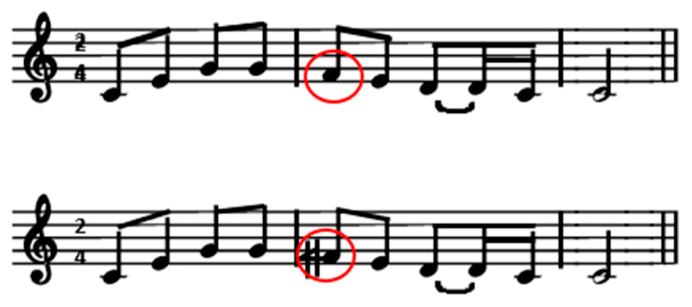
Figure 3.
Example of the contour subtest stimuli, featuring two melodies that differ in pitch direction.
Figure 3.
Example of the contour subtest stimuli, featuring two melodies that differ in pitch direction.
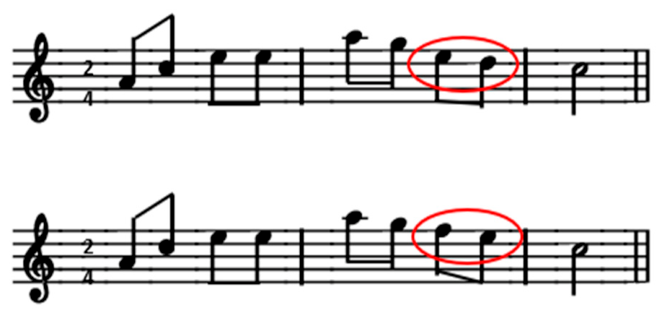
Figure 4.
Familiar instrumental melody to evaluate melodic recognition.
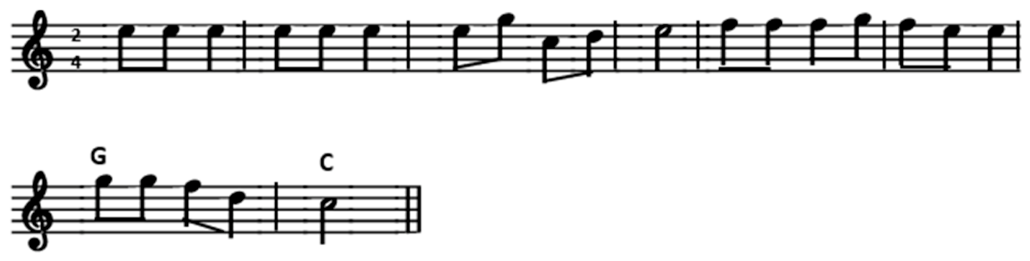
Figure 5.
Musical notation illustrating the Melodic Completion task.
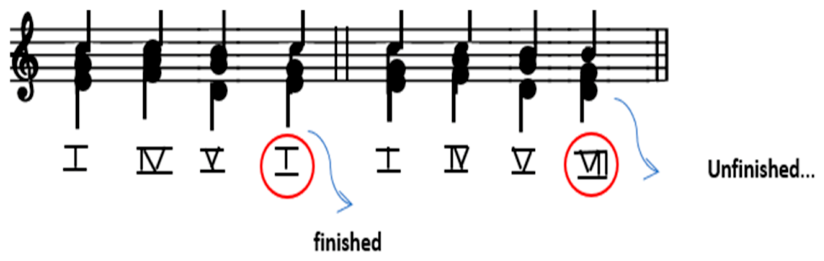
Figure 6.
Prevalence of suspected amusia: (a) Pie charts illustrating the prevalence of suspected amusia in students with learning difficulties vs. typical students; (b) Bar graph showing the distribution of scores across both groups.
Figure 6.
Prevalence of suspected amusia: (a) Pie charts illustrating the prevalence of suspected amusia in students with learning difficulties vs. typical students; (b) Bar graph showing the distribution of scores across both groups.
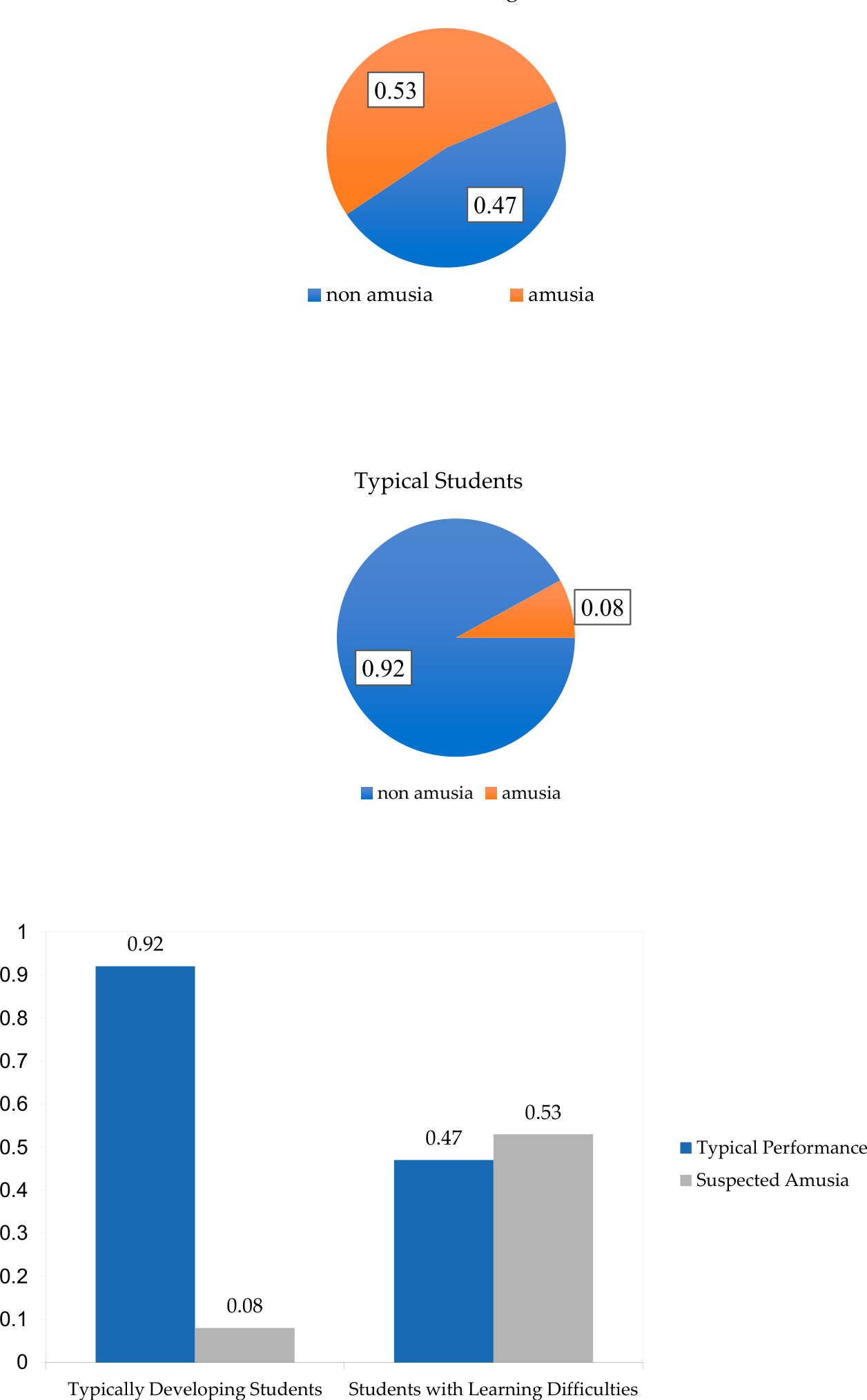
Figure 7.
Boxplot distribution for the Emotion and Integration subtests. The central line represents the median score, highlighting the performance variance between the two groups.
Figure 7.
Boxplot distribution for the Emotion and Integration subtests. The central line represents the median score, highlighting the performance variance between the two groups.
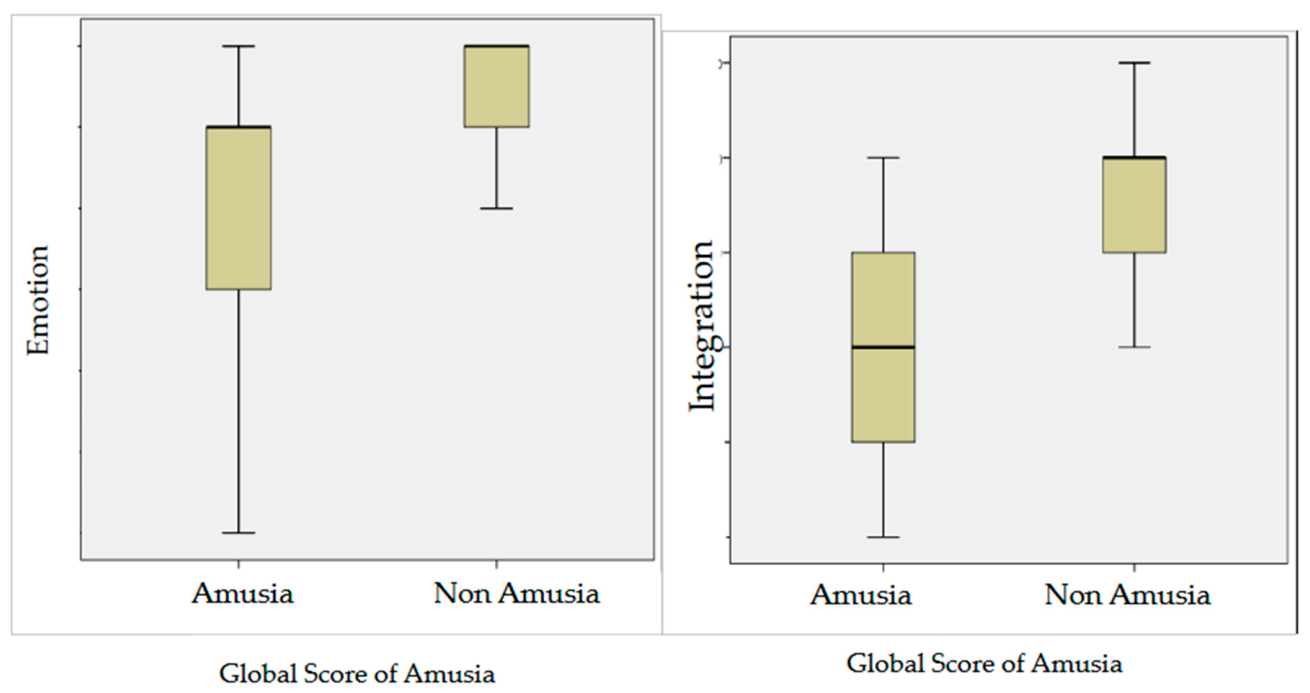

Table 1.
Prevalence of suspected amusia according to the type of learning difficulties.
| Individuals N = 100 |
Suspicion of Amusia Ν = 53 |
Non-Amusia N = 47 |
||
|---|---|---|---|---|
| Students with Diagnosis | ||||
| Dyslexia | 10 | 10 (10%) | 0 (0%) | |
| Reading Disorder | 14 | 14 (14%) | 0 (0%) | |
| Dysorthography | 9 | 9 (9%) | 0 (0%) | |
| Dyscalculia | 2 | 2 (2%) | 0 (0%) | |
| Generalized LD | 35 | 13 (37%) | 22 (62.9%) | |
| Students without Diagnosis | ||||
| LD without diagnosis | 30 | 5 (16.7%) | 25 (83.3%) | |
| Total | 100 | 53 | 47 | |
Note· N represents the total number of students in each category. The failure rate refers to scores below the 29.4 baseline. LD = Learning Difficulties. The 'LD without diagnosis' category includes students identified through the AMDE (Screening Tool for Performance Difficulties), a validated Greek screening instrument used in school settings.
Table 2.
Statistical analysis of regression about variables and score.
| Model | B | Std Error | t | Sig |
|---|---|---|---|---|
| Constant | 30.059 | 1.133 | 26.533 | 0.000 |
| Age | 0.887 | 0.245 | 3.622 | 0.000 |
| Gender | -1.200 | 0.839 | -1.430 | 0.154 |
| Learning difficulties | -6.336 | 0.869 | -7.291 | 0.000 |
| Music education | 0.421 | 0.645 | 0.653 | 0.515 |
Disclaimer/Publisher’s Note: The statements, opinions and data contained in all publications are solely those of the individual author(s) and contributor(s) and not of MDPI and/or the editor(s). MDPI and/or the editor(s) disclaim responsibility for any injury to people or property resulting from any ideas, methods, instructions or products referred to in the content. |
© 2026 by the authors. Licensee MDPI, Basel, Switzerland. This article is an open access article distributed under the terms and conditions of the Creative Commons Attribution (CC BY) license (http://creativecommons.org/licenses/by/4.0/).
Copyright: This open access article is published under a Creative Commons CC BY 4.0 license, which permit the free download, distribution, and reuse, provided that the author and preprint are cited in any reuse.


