
Submitted:
19 July 2026
Posted:
20 July 2026
You are already at the latest version
Abstract
Industry 4.0 quality control demands high-precision instance segmentation, yet such resource-intensive vision models require cost-prohibitive infrastructure, restricting adoption among Small and Medium Enterprises (SMEs). This study addresses this trade-off via a synchronized, three-layered Cyber-Physical System (CPS) optimized for low-cost edge nodes. In this cloud-to-edge framework, an ONNX-optimized YOLOv8s-seg model, trained on an augmented dataset of 1,331 industrial proxy images, is deployed onto an accessible $300 CPU-based edge computing node. To avert computational backlogs, the system decouples high-speed digital inference from an asynchronous n8n-powered IoT pipeline and an ESP32-actuated, 3D-printed mechanical sorting testbed. Results show the digital inference layer achieves peak bounding-box and mask accuracies of 93.8% and 93.7% mAP@0.5, with an average end-to-end latency of 605 ms. The physical actuation mechanism maintains a measured throughput of approximately 593 units per hour, consistent with the servo’s ~5,000 ms nominal recovery window, while the IoT layer records a 3.5 s cloud reporting latency. Built at a total hardware cost of approximately $1,543, this system offers a scalable blueprint for edge-AI deployment, showing that careful software-hardware orchestration can mitigate resource constraints and provide an accessible pathway for machine vision and digital traceability in resource-limited manufacturing under the tested proxy-based conditions.
Keywords:
cyber-physical system
; instance segmentation
; Edge AI optimization
; spatiotemporal Synchronization
; low-cost automation
; industry 4.0
1. Introduction
The operationalization of the Industry 4.0 paradigm in modern manufacturing fundamentally relies on embedding artificial intelligence (AI) and machine learning (ML) architectures to sustain stringent, real-time quality control standards [1,2,3,4]. Within automated production environments, vision-based defect inspection systems have emerged as a critical cornerstone for modernizing global supply chains, demonstrating exceptional maturity in processing high-volume components through real-time anomaly identification [5,6,7]. Central to this evolution is the advancement of Cyber-Physical Systems (CPS), which seamlessly bridge the spatiotemporal gap between digital monitoring infrastructure and physical execution mechanisms on the factory floor [8].
However, despite these technological milestones, a significant disparity remains in the accessibility of advanced automation for Small and Medium Enterprises (SMEs). Traditional industrial sorting machines—characterized by rigid programming and proprietary constraints—require prohibitive capital expenditures (CAPEX) exceeding tens of thousands of dollars, erecting formidable financial barriers for decentralized manufacturing facilities [9]. While the recent adoption of open-source microcontrollers and additive manufacturing (3D printing) has substantially reduced the physical hardware costs of bespoke robotic solutions, a critical cognitive bottleneck persists [10,11,12]. Conventional low-cost deployments typically rely on rigid trajectories or rudimentary bounding-box object detection, which lack the pixel-level geometric adaptability required to inspect non-uniform, arbitrary surface defects under dynamic factory environments [13]. Resolving this challenge introduces a significant architectural tension: embedding high-fidelity instance segmentation algorithms into low-cost, resource-constrained edge computing nodes routinely induces substantial computational latencies and backlogs, thereby disrupting the real-time spatiotemporal synchronization required for physical sorting execution. Consequently, a pressing research gap exists for an end-to-end CPS framework that reconciles this trade-off—demonstrating how advanced, high-precision AI performance can be computationally optimized to run harmoniously on economically viable, entry-level hardware infrastructures.
To address these challenges, this study proposes a comprehensive, low-cost Cyber-Physical System (CPS) specifically optimized for real-time industrial quality control and defect sorting. The proposed architecture reconciles the edge-AI computational trade-off by implementing a clean, three-layered functional zone that spatiotemporally decouples high-speed pixel-level inference from network logging demands and mechanical constraints. The primary contributions of this work are three-fold:
- The development of a cloud-to-edge architecture that enables high-precision ONNX-optimized YOLOv8s-seg inference on an affordable entry-level computing node, optimized to achieve an end-to-end cognitive latency of 605 ms;
- The empirical validation of a physical sorting testbed, utilizing an ESP32 microcontroller and custom 3D-printed actuators, capable of maintaining an empirically measured continuous throughput of approximately 593 units per hour, consistent with its ~5,000 ms nominal mechanical recovery window
- The integration of an n8n-powered IoT management layer that ensures operational transparency and real-time data persistence with a minimal 3.5-second cloud reporting latency.
Ultimately, this research provides a scalable, economically viable blueprint ($1,543 total hardware cost) for resource-limited manufacturing environments to transition toward Industry 4.0 adoption without sacrificing visual inspection granularity.
1.1. Related Works in Visual Inspection and Edge Computing
Bridging this technological gap requires a strategic selection of computational frameworks. The integration of Convolutional Neural Networks (CNNs), specifically the You Only Look Once (YOLO) framework, has significantly advanced the precision of automated visual inspection due to its balance of real-time processing speed and high mean Average Precision (mAP) [14,15,16]. Recent iterations, particularly instance segmentation models, have proven exceptionally capable of delineating complex geometric boundaries of surface anomalies under dynamic industrial lighting [17,18]. However, many existing deep learning implementations prioritize model depth over edge-deployment efficiency, leading to high-latency processing when executed on low-power hardware [19,20].
Recent literature suggests that the shift toward decentralized, edge-based AI provides a promising pathway for resource-limited sectors [21,22,23,24]. Despite academic milestones exploring the synergy between machine learning and Internet of Things (IoT) protocols [25], a critical synthesis of these parallel advancements reveals a fundamental engineering friction. The computational workloads required for pixel-level mask extraction are inherently resource-heavy, routinely inducing substantial processing latencies when executed on low-power edge hardware [19,20], whereas the temporal windows of physical industrial actuators demand strict, deterministic synchronization. Existing literature typically evades this integration bottleneck either by restricting edge-AI models to coarse bounding-box localized tracking [22] or by isolating the vision inference layer from physical deployment realities. Consequently, rather than merely addressing an unvalidated niche, there is a clear research need to challenge the assumption that resource-constrained edge CPUs cannot execute synchronized, high-precision industrial sorting. This study addresses this gap by introducing an explicit spatiotemporal software orchestration framework.
2. Proposed System Architecture
To overcome the latency and integration bottlenecks prevalent in decentralized manufacturing, this study proposes a holistic, three-layered Cyber-Physical System (CPS) architecture. As illustrated in Figure 1, the framework is engineered to closely synchronize high-speed digital defect detection with mechanical sorting actuation and real-time cloud reporting. The system architecture is fundamentally divided into three interconnected functional zones: the cognitive AI inference model (Digital Layer/Zone 1), the physical sorting execution (Physical Layer/Zone 2), and the IoT-based data logging pipeline (Management Layer/Zone 3).
To further detail the operational logic and data routing across these integrated layers, Figure 2 presents the sequential decision-making process, spanning from initial image acquisition to automated batch reporting. This operational flowchart establishes a clear architectural demarcation between the real-time sorting execution and the asynchronous data management tasks. By intentionally decoupling the critical path of cognitive inference (optimized to an average end-to-end latency of 605 ms) from the batch-reporting pipeline, the system averts computational backlogs and maintains maximum industrial throughput without sacrificing digital traceability. Consequently, this synchronized workflow ensures that every classified manufactured component is accurately logged and accounted for in the final analytical report generated by the n8n framework. The initiation of this synchronized workflow fundamentally relies on accurate visual perception; therefore, the first operational zone is dedicated entirely to algorithmic decision-making.
2.1. Digital Layer: Real-Time Defect Detection
The Digital Layer serves as the primary cognitive center of the CPS, executing high-speed automated classification and algorithmic decision-making. Unlike conventional binary sorting mechanisms, this architecture implements a comprehensive multi-class classification pipeline utilizing an ONNX-optimized YOLOv8s-seg model. As illustrated in the operational flowchart (Figure 2a), the digital pipeline is engineered to identify and process every component passing through the camera chamber to ensure 100% inspection traceability by instantly capturing and localizing high-resolution spatial data. The vision model executes pixel-level masking to map seven operational categories (Classes A through G) into five distinct industrial quality tiers: Optimal Quality (Class A), Moderate Quality (Class B), Unprocessed / Primer State (Class C), Severe Coating Failure (Classes D & E), and Critical Anomalies (Classes F & G).
This multi-class cognitive layer is dynamically synchronized with a targeted actuation logic. Upon identifying a specific quality tier, the edge node dispatches a unique alphanumeric command code via Serial (USB) at a 115,200 baud rate to the ESP32 microcontroller, which subsequently triggers the designated physical servo actuator. Despite the significant computational constraints of extracting pixel-level segmentation masks for multiple classes on an entry-level CPU (Acer Swift 1), empirical time-tracking validated that the end-to-end digital latency—spanning from visual frame acquisition and model inference to serial command dispatch—is successfully executed within a stable average of 605 ms. This sub-second processing speed helps ensure that the digital cognitive layer comfortably outpaces the physical constraints of the conveyor line, preventing software-induced computational backlogs and allowing the system to reset instantaneously for the subsequent manufactured component. However, sub-second digital intelligence is only industrially viable if its classifications are accurately translated into physical sorting motions, necessitating a robust mechanical execution interface.
2.2. Physical Layer: Hardware Integration
The Physical Layer is responsible for the mechanical execution of the classification decisions derived from the Digital Layer. The hardware testbed features an ESP32 microcontroller functioning as the critical bridge between the Python-based edge computing unit and the physical actuators. To ensure high-precision sorting at a constant conveyor velocity (v = 0.0467 m/s), the system implements a specialized Anticipatory Actuation Logic. Although the actual physical distance between the camera’s optical center and the first actuator (Servo 1) is 0.50 m, the system is calibrated to trigger the control signal when the object reaches a designated trigger threshold (dtrigger) of 0.20 m. This temporal acceleration is integrated to compensate for mechanical latency and ensure that the sorting arm—fabricated via 3D printing using Polylactic Acid (PLA) filament—reaches its optimal rotational strike position before the target object enters the physical contact zone. The synchronization parameters for each sequential stage are summarized in Table 1.
The waiting time (Ts) required for the nearest actuator, calculated based on the anticipatory trigger distance, is defined as follows:
With a total system cycle time comprising AI inference latency () and serial transmission time (), utilizing a 0.20 m trigger distance provides a substantial safety margin. This ensures the sorting mechanism completes its strike and returns to its neutral position within a 5,000 ms mechanical recovery window, maintaining stability and preventing hardware failure during continuous operations. The comprehensive technical specifications integrating both digital and physical components are summarized in Table 2 Interventionary studies involving animals or humans, and other studies that require ethical approval, must list the authority that provided approval and the corresponding ethical approval code.
The integration of these hardware and software specifications establishes a robust foundation for a low-cost yet high-performance Cyber-Physical System. By synchronizing the millisecond-level AI inference with calibrated mechanical actuation, the architecture achieves a seamless transition from digital perception to physical sorting. This technical configuration ensures that the testbed remains stable and reliable during continuous industrial grading operations. Once the physical sorting is successfully executed, maintaining Industry 4.0 compliance requires that all operational data is persistently logged and accessible for production auditing. This oversight is handled by the third architectural zone—the Management Layer
2.3. Management Layer: Real-Time Reporting
The Management Layer functions as the high-level supervisory unit of the CPS, responsible for data persistence, statistical analysis, and automated stakeholder communication. This layer bridges the operational gap between raw, edge-generated production data and actionable management insights through a cloud-integrated data pipeline.
2.3.1. Data Synchronization and Batch Processing
As outlined in the global operational framework, the finalized local CSV log is automatically synchronized and uploaded to Google Drive upon the termination of a sorting session. This cloud-based repository acts as the centralized data source for the n8n automation framework. By intentionally utilizing an asynchronous batch-processing approach, the architecture is designed to ensure that resource-intensive cloud-reporting tasks do not interfere with the critical, millisecond-level latency requirements (605 ms) of the real-time Digital Layer during active manufacturing cycles.
2.3.2. n8n Analytics and LLM-Based Statistical Summarization
The automated data-logging and reporting workflow is orchestrated within the n8n environment, as illustrated in Figure 3. The pipeline initiates by fetching the compiled sorting metadata via the Google Drive API, which is subsequently normalized through a data mapping node. A distinctive feature of this management layer is the deployment of an intelligent AI Agent via the OpenRouter API, providing a dynamic, non-linear interface for production data interpretation.
Rather than employing a rigid, hard-coded statistical reporting script, the system leverages generative Prompt Engineering to guide the Large Language Model (LLM) in synthesizing the batch logs. While the baseline validation focuses on the descriptive statistical summarization of quality distributions across all operational tiers (Classes A through G), this prompt-driven architecture offers high operational flexibility. It empowers plant managers to dynamically reconfigure reporting metrics—such as shifting from static item counts to predictive anomaly trend insights—without modifying the underlying system backend code. The finalized analytical narrative is converted into an industry-standard PDF document via an HTML-to-PDF engine and automatically dispatched to stakeholder end-nodes through the Gmail API.
3. Experimental Setup and Implementation
Having established the structural framework and theoretical synchronization of the three-layered CPS, empirical validation is necessary to assess its real-world industrial performance. To evaluate the feasibility and performance of the proposed Cyber-Physical System, a comprehensive experimental testbed was constructed. The implementation was divided into data preparation, model training, and the physical integration of the conveyor system. Because the foundation of the digital cognitive layer relies entirely on a robust visual dataset, the initial experimental phase focused on engineering appropriate standardized test objects.
3.1. Dataset Preparation
To rigorously evaluate the spatiotemporal synchronization and sorting capabilities of the proposed Cyber-Physical System (CPS) under continuous industrial stress, custom-designed physical proxies were manufactured. Rather than utilizing perishable biological samples or highly irregular test subjects that introduce unpredictable confounding variables, such as organic degradation or inconsistent morphology, these spherical proxies were engineered to serve as standardized manufactured components. This methodological choice deliberately isolates the mechanical and algorithmic performance of the system, ensuring that the validation process purely measures the CPS’s operational reliability and instance segmentation accuracy.
The proxies were carefully designed using color-coded surface markers to simulate non-uniform manufactured components exhibiting varying degrees of industrial surface defects, such as paint degradation, inconsistent coating, or molding anomalies. The initial dataset of high-resolution images was captured under controlled lighting conditions within the physical camera chamber of the testbed. To prevent model overfitting and to simulate dynamic, unpredictable factory environments—such as varying conveyor vibrations, arbitrary product rotations, and fluctuating illumination—extensive data augmentation pipelines were applied. This augmentation successfully expanded the dataset to a total of 1,331 robust images.
For the YOLOv8s-seg instance segmentation architecture, the dataset was rigorously annotated at the pixel level using precise polygonal masks. To ensure optimal learning across the intensive 150-epoch training cycle on the high-performance server, the curated dataset was strategically partitioned into three distinct subsets: 999 images for Training (to facilitate deep feature extraction), 173 images for Validation (for continuous hyperparameter tuning), and 159 images for Testing (to evaluate unseen generalization). The annotated objects were categorized into five quantitative quality tiers based on the precise percentage of their defective surface area, detailed as follows:
- Optimal Quality (Class A): Standard yellow base representing a passed component with minor acceptable surface variance (≤ 10% anomaly area).
- Moderate Defect (Class B): Standard yellow base with moderate coating errors or surface blemishes (11% - 50% anomaly area).
- Unprocessed / Primer State (Class C): Green base representing unpainted or primer-stage components (0% - 50% anomaly area).
- Severe Defect (Classes D & E): Standard or primer base with major surface degradation or severe coating failure (> 51% anomaly area).
- Critical Anomaly (Classes F & G): Pink or blue base representing incorrect material sorting or catastrophic molding failures (0% - 100% anomaly area).
Sample annotations and the physical proxy representations simulating these industrial components are illustrated in Figure 4. With the standardized proxies rigorously annotated, the subsequent phase focused on extracting complex spatial features from this dataset to train the core instance segmentation algorithm.
3.2. YOLOv8 Training Configuration
To facilitate deep feature extraction without hardware constraints, the training phase of the YOLOv8s-seg architecture was executed remotely via an online connection to the high-performance supercomputing infrastructure at the Graph@FIT lab, Brno University of Technology. The model training was governed by a strategically selected hyperparameter configuration, summarized in Table 3, balancing established empirical baselines with specific optimization constraints tailored to this study’s industrial setup.
The selection of a 640 X 640 pixel input resolution represents the optimal industry-standard baseline for the YOLOv8 architecture, providing sufficient spatial granularity to resolve sub-millimeter edge boundaries of surface anomalies without causing computational bottlenecks during subsequent edge execution. To optimize weight convergence on the custom proxy dataset, the training cycle was capped at 150 epochs using a fixed batch size of 32 driven by the AdamW optimizer (lr=0.001). The choice of 150 epochs was determined empirically as the definitive inflection point where the multi-task loss function (Ltotal) successfully plateaued and stabilized, avoiding the risk of overfitting that typically characterizes extended training cycles on highly uniform geometric shapes. Concurrently, the batch size of 32 was selected as a hardware-optimized threshold, maximizing the 24 GB VRAM efficiency of the NVIDIA GeForce RTX 4070 GPU on the training server while maintaining robust gradient estimation stability. Under this optimized configuration, the network achieved convergence in 0.50 hours (~30 minutes), outputting a highly compressed 45 MB ONNX engine engineered for rapid deployment. The comprehensive hyperparameter configurations are summarized in Table 3.
A critical consideration in this training phase was the mitigation of spatial bias induced by the controlled nature of the camera chamber. Because the spherical proxies exhibit geometric symmetry, a heavy data augmentation pipeline was mandatory to ensure robust model generalization under actual factory floor conditions. Mosaic augmentation was applied at full capacity to force the network to detect anomalies across varied object scales and simulated positional shifting, effectively compensating for any future camera alignment vibrations or variations in product positioning along the conveyor belt. Additionally, MixUp and spatial rotations were integrated to desensitize the model from absolute color uniformity and glare, ensuring the pixel-level mask segmentation remains highly accurate under fluctuating factory illumination. Standard evaluation metrics, including mean Average Precision (mAP), Precision, Recall, and F1-score, were continuously monitored to validate the model’s discriminative capacity before final edge migration.
3.3. Hardware Bill of Materials and Cost Distribution
To ensure structural replicability and validate the low-cost constraint targeted for SME applications, a comprehensive breakdown of the deployment expenditures is detailed in Table 4. The cumulative capital investment required to construct the end-to-end Cyber-Physical System testbed amounts to approximately $1,543, which significantly undercuts traditional proprietary industrial sorting systems that typically scale between $20,000 and $50,000. By leveraging an optimized, open-source ONNX execution pipeline on an entry-level edge computing node paired with an affordable micro-controller infrastructure, the architecture offers a substantially more accessible path to automated quality control without requiring premium hardware deployment overhead.
3.4. Experimental Scenarios
To rigorously assess the operational resilience and real-world viability of the three-layered CPS under continuous industrial stress, a high-density experimental sorting scenario was established. The physical testing environment utilized a motorized conveyor operating at a constant velocity of v = 0.0467 m/s, with physical object proxies introduced into the system at a highly dense average inter-object spacing of 10 cm. This tight spatial configuration dictates a rapid sequential arrival window of approximately 2.14 seconds between consecutive components, purposefully engineered to challenge the system’s real-time coordination capability.
A primary objective of this scenario was to validate whether the end-to-end digital cognitive latency (605 ms) could maintain precise spatiotemporal synchronization with the physical actuation layer without inducing mechanical backlogs or command execution overlap. Given that each individual MG995 high-torque servo motor requires a rigid mechanical recovery window of 5,000 ms to complete a sweeping trajectory and reset to its baseline 0o position, the 2.14-second arrival interval introduces a potential physical collision risk for consecutive defect occurrences. To mitigate this bottleneck, the experimental scenario validates the architectural decoupling of the multi-lane sorting testbed. By distributing the mechanical workload across four independent, class-specific servo actuators based on the designated quality tiers, the system theoretically disperses the recovery payload, allowing high-density continuous sorting without structural failures. The empirical evaluation comprised a total of 100 distinct operational runs to ensure the statistical significance of the sorting success rate and throughput metrics, with all real-time performance logs continuously routed to the n8n-powered management layer for data persistence and stakeholder reporting.
4. Results and Industrial Implication
The proposed Cyber-Physical System (CPS) was empirically evaluated to validate its end-to-end performance, from digital inference to mechanical sorting and cloud reporting. The analysis focuses on identifying systemic bottlenecks and determining the true industrial throughput of the prototype.
4.1. AI Model Performance
It is critical to emphasize that the primary objective of this evaluation is not the fundamental innovation of a novel deep learning architecture, nor a benchmarking race between competing vision algorithms. Instead, this study treats the established ONNX-optimized YOLOv8s-seg framework as a modular cognitive component within the wider CPS environment, aiming to establish a definitive Minimum Viable Performance Baseline required to validate end-to-end architectural feasibility. For an integrated industrial sorting setup, the AI model is not required to achieve absolute mathematical perfection, but rather to meet a stable, functional accuracy threshold that supports reliable downstream physical actuation and cloud-based management auditing without structural latency overflows.
To verify whether the algorithm satisfies this systemic feasibility standard, the network’s feature extraction performance was benchmarked against the unseen testing subset. Upon completing the 150-epoch training cycle, the quantitative convergence trajectories monitored via the server logs are illustrated in Figure 5. The model demonstrated highly stable learning behaviors across the bounding box, segmentation mask, and classification loss channels without indications of overfitting. Empirical validation showed that the framework achieved a peak mean Average Precision (mAP@0.5) of 93.80% for bounding box detection and 93.70% for instance segmentation masks. Under the highly stringent mAP@0.5-0.95 evaluation metric, the system sustained a localization accuracy of 89.0% for bounding boxes, while the pixel-level mask segmentation maintained a reliable accuracy of 86.8%. These metrics clear the targeted operational threshold, indicating that the out-of-the-box algorithm provides sufficient geometric precision to drive the automated testbed.
To evaluate the inter-class discriminative performance and ensure that minor algorithmic errors do not cause serious physical sorting failures, a normalized confusion matrix was generated, as shown in Figure 6. The system achieved perfect classification accuracy (1.000) for both the Critical Anomaly and Severe Defect categories, demonstrating zero leakage for high-severity defect tiers where structural mechanical damage could occur. However, minor boundary classification overlaps were observed near the strict parameter thresholds. Specifically, the model exhibited a 10.1% (0.101) error rate where actual Moderate Defect samples were misclassified as Optimal Quality, which occurs when the physical anomaly surface area hovers ambiguously around the boundary limit (≈10% to 11%). This localized variance is inherently linked to boundary pixelation under dynamic lighting, yet safely satisfies the tolerance thresholds required for SME industrial deployments.
Qualitative validation of the real-time segmentation performance during active conveyor operations is presented across the sub-panels of Figure 7. The model consistently achieved high confidence scoring (0.94 to 0.96) when delineating defect masks across all quality tiers. This includes resolving minimal defect areas in Optimal Quality components (Class A and Class C) in panel (a), tracking surface blemishes in Moderate Defects (Class B) in panel (b), and extracting severe structural anomalies (Classes D, E, F, and G) in panel (c) despite the introduction of fluctuating ambient illumination. By meeting these baseline standards, the algorithm serves as a validated, plug-and-play cognitive engine that can be readily upgraded or replaced with future iterations without restructuring the underlying physical and management layer frameworks.
Furthermore, the real-time operational inference was validated on the low-cost edge computing unit (Acer Swift 1). Despite relying exclusively on the CPU for segmentation processing, the system successfully sustained an average end-to-end processing latency of 605ms per object during initial sorting batches. However, empirical observations suggest that continuous, uninterrupted sorting operations exceeding several hours could induce thermal throttling on the entry-level laptop, temporarily increasing this latency. Thus, while this sub-second processing speed synchronizes well with the mechanical layer’s 5,000 ms recovery time for batch processing, upgrading to an actively cooled edge device (e.g., NVIDIA Jetson Nano or a heavily ventilated mini-PC) would be recommended for 24/7 continuous industrial deployment.
4.2. Physical and Systemic Analysis
The systemic throughput of the proposed Cyber-Physical System (CPS) is structurally bounded by the operating velocity of its slowest architectural element. While the digital cognitive layer processes data with a sub-second end-to-end inference latency averaging 605 ms per component, the physical actuation layer ultimately dictates the operational pacing of the sorting testbed. Each individual MG995 high-torque servo motor requires a strict 5,000 ms mechanical recovery window to complete its sweeping sorting trajectory and securely return to the calibrated 0° baseline. Because the processing velocity of the digital perception pipeline (605 ms) is significantly faster than this physical reset threshold (5,000 ms), the architecture is structurally designed to avoid internal computational queues. Consequently, the continuous sorting capability of the physical testbed is theoretically capped at 12 items per minute, establishing a nominal industrial operational ceiling of approximately 720 components per hour based on the servo’s rated 5,000 ms recovery specification—a theoretical benchmark against which the empirically measured throughput is evaluated below.
To evaluate the real-world performance of this hardware-software synchronization under continuous stress, the system was subjected to 100 distinct operational sorting runs, comprising 327 individual sorting events logged continuously over a 33-minute session, utilizing the high-density scenario (10 cm inter-object spacing at a 2.14-second theoretical arrival interval). Empirical timestamp analysis of the completed sorting cycles revealed an average mechanical cycle time of 6.07 s (SD = 0.81 s; 95% CI: 5.98–6.16 s), corresponding to a measured continuous throughput of approximately 593 units per hour (95% CI: 584.6–601.7)—modestly below the 720-units-per-hour theoretical ceiling derived from the servo’s nominal 5,000 ms recovery specification. This approximately one-second discrepancy per cycle is consistent with real-world mechanical overhead (frictional load, PWM response latency, and physical settling time at the 0° baseline) rather than an accumulating processing backlog: a trend analysis of cycle times across the full session showed no significant drift (first-half mean = 6.10 s vs. second-half mean = 6.04 s; time-index correlation = −0.03), indicating a stable, non-cumulative recovery process throughout continuous operation. The 327 sorted components spanned all seven operational categories in proportions of 16.8% (Class A, Optimal), 27.2% (Class B, Moderate), 20.5% (Class C, Unprocessed/Primer), 19.3% (Classes D&E, Severe), and 16.2% (Classes F&G, Critical). Under these conditions, the system demonstrated a physical sorting success rate of 91.44% (299 of 327 sorting events; 95% Wilson CI: 87.90–94.01%), confirming that the distributed spatiotemporal control logic remains largely sound under sustained high-density operation. To maintain strict academic rigor, a comprehensive failure mode analysis was conducted on the remaining 8.56% (28 of 327) of failed sorting events, which were fairly evenly distributed across all quality tiers (7.5%–13.0% failure rate per individual class), providing no evidence of a systematic, class-specific algorithmic bias. The investigation revealed that these anomalies were predominantly non-algorithmic; rather, they were largely attributable to transient electrical instability and localized voltage drops within the shared hardware power distribution bus. This electrical fluctuation occasionally degraded the integrity of the serial actuation signals transmitted from the edge computing node to the ESP32 microcontroller. Consequently, when the pre-calculated temporal window for physical sorting was reached, the designated servo actuator failed to register the incoming control pulse and remained stationary, leading to a missed sorting sequence.
This operational gap between the rapid digital inference speed (605 ms) and the rigid physical recovery window (5,000 ms) formally identifies the mechanical arm movement as the primary structural bottleneck of the prototype. While a measured throughput of approximately 593 units per hour provides a highly viable, cost-effective automation framework for SME manufacturing lines, scaling this arithmetical framework for high-volume industrial packaging infrastructures would necessitate a modular upgrade of the physical layer. Future iterations could eliminate this mechanical restriction by replacing the servo-driven sweeping arm with high-speed pneumatic air jets or continuous multi-lane diverters, thereby allowing the physical actuation layer to fully exploit the latent sub-second processing throughput of the ONNX-optimized YOLOv8s-seg model.
4.3. Cloud Automation and Management Layer Latency
To validate the Industry 4.0 compliance and decentralized accessibility of the proposed architecture, the communication efficiency of the Management Layer was empirically benchmarked. The critical evaluation metric was defined as the end-to-end temporal latency spanning from the physical termination of a sorting batch on the conveyor to the successful dispatch and delivery of the automated analytical report to managerial end-nodes.
Upon the conclusion of each batch sorting cycle, the local edge computing unit compiles the operational edge metrics into a structured JSON payload. This metadata packet is instantaneously transmitted via a secure HTTP webhook trigger to the cloud-based n8n orchestrator. Empirical network tracking showed that the initial webhook ingestion and centralized database logging (appending data into the persistent cloud-based CSV repository) are completed within 1.5 seconds without packet loss. Following this database ingestion, the asynchronous pipeline routes the raw batch figures to the OpenRouter API to initiate intelligent data synthesis leveraging the GPT-4o-mini large language model. The model dynamically processes the categorical quality tiers, computes proportional distributions, and applies temporal trend analysis over the active production timestamps. The generated narrative is then parsed into a professional document via an HTML-to-PDF node and delivered to stakeholders through the Gmail API.
Continuous operational testing demonstrated that the entire end-to-end cloud reporting pipeline—from the edge session termination to the final email inbox arrival—consistently achieved an average latency of approximately 3.5 seconds. To demonstrate the operational transparency of this automated pipeline, Figure 8 illustrates the generated analytical summary interface delivered to the plant manager. As shown in the report layout, the deployment of GPT-4o-mini bypasses the rigid limitations of standard hard-coded statistical scripts. The pipeline not only presents structured counts for quality levels (such as Optimal Quality, Moderate Defect, and Critical Rejection) but also delivers high-level operational intelligence. This is evidenced by the automated generation of temporal trend insights (identifying defect spikes between 19:08 and 19:20) and the provision of contextual “Recommended Actions” directly targeting quality control containment protocols. Because this 3.5-second cloud orchestration is executed entirely via an asynchronous processing loop, it is architecturally designed to ensure that heavy analytical automation tasks impose negligible computational overhead on the critical millisecond-level real-time sorting loops of the active physical conveyor.
4.4. Comparative Analysis and Research Positioning
To contextualize the practical and economic contributions of the proposed architecture, a comparative analysis was conducted against recent automated sorting frameworks in the literature (2024–2025). As summarized in Table 5, existing solutions typically force a strict trade-off between deployment expenditure, algorithmic precision, and systemic integration depth.
High-end industrial prototypes, such as those relying on heavy Convolutional Neural Networks executed on dedicated computing stations [19], achieve robust accuracy but at a capital expenditure (CAPEX) that remains prohibitive for small-scale operations. Conversely, ultra-low-cost edge solutions [22], successfully reduce hardware costs but frequently rely on basic bounding-box object detection, sacrificing the pixel-level geometric precision required for intricate surface defect evaluation.
The proposed system helps bridge this industrial application gap. By utilizing an ONNX-optimized YOLOv8s-seg architecture, it achieves a highly competitive segmentation accuracy of 93.80%—outperforming lightweight edge alternatives—while bypassing the requirement for expensive industrial GPU infrastructure through strategic inference deployment. Furthermore, unlike frameworks that exclusively isolate the AI inference layer without physical execution or cloud reporting [26], the proposed architecture delivers a closely synchronized, three-layered Cyber-Physical System. The structural inclusion of the ESP32 actuation logic and the asynchronous n8n cloud-reporting pipeline within an accessible $1,543 budget offers a well-balanced benchmark for affordable, Industry 4.0-compliant quality control.
5. Conclusions and Future Work
5.1. Conclusion
This research addresses a persistent trade-off in automated manufacturing literature, where high-precision quality inspection has traditionally required prohibitive capital investment, while affordable edge alternatives have often sacrificed either pixel-level geometric accuracy or end-to-end system integration. By developing and validating a three-layered Cyber-Physical System (CPS) architecture, this study provides evidence that industrial-grade automation can be made substantially more accessible for Small and Medium Enterprises (SMEs) under the controlled testbed conditions evaluated here. The strategic decoupling of the framework into digital, physical, and management zones demonstrates a practical pathway for bridging computer vision capability with low-cost, reproducible hardware. The experimental results show that optimizing an established instance segmentation model via ONNX allows an entry-level CPU computing node to meet sub-second inference requirements sufficient for the tested throughput target. Furthermore, the asynchronous cloud-automation loop for analytics and reporting was shown to operate without measurable interference on the real-time conveyor actuation loop, providing plant managers with operational transparency and digital traceability. Taken together, these results support this modular architecture as a promising, economically viable direction for localized manufacturing lines pursuing Industry 4.0 adoption, though further validation on real industrial components and under a broader range of operating conditions is needed before these findings can be generalized (see Limitations). This section is not mandatory but can be added to the manuscript if the discussion is unusually long or complex.
5.2. Limitations
This study has several limitations that should be considered when interpreting its results. First, the validation was conducted using custom-designed, color-coded spherical proxies rather than real industrial components with naturally occurring surface defects. This controlled design choice isolated the CPS’s mechanical and algorithmic performance from confounding variables such as irregular geometry or material degradation, but it also means that the reported accuracy and throughput figures should be interpreted as a controlled feasibility benchmark rather than a direct measure of performance on heterogeneous, real-world manufactured parts. Extending this validation to actual industrial components with naturally varying defect morphology is an important next step before the system can be considered ready for field deployment. Second, empirical testing was limited to a single experimental scenario constant conveyor velocity of 0.0467 m/s with a 10 cm inter-object spacing. While this scenario was intentionally designed to stress-test the spatiotemporal synchronization of the system, the robustness of the architecture under varying conveyor speeds, object spacings, and real ambient lighting conditions (as opposed to synthetic augmentation) remains to be empirically confirmed. Future work should incorporate a broader range of operating conditions to more comprehensively characterize the system’s operational envelope.
5.3. Future Work
While the digital edge node comfortably processes manufacturing components at sub-second intervals, empirical long-term evaluation identifies the mechanical sweeping motion of the servo-driven arm as the primary structural bottleneck limiting the system’s ultimate industrial throughput. To fully exploit the latent real-time computational velocity of the edge perception pipeline and mitigate potential physical collision risks under high-density product flows, future research iterations will prioritize two main technical upgrades:
- Pneumatic Actuation Integration: Replacing the high-torque servo motors with high-speed pneumatic air-jet ejectors to drastically compress the physical recovery window.
- Multi-Lane Kinematic Diverters: Implementing continuous physical multi-lane routing mechanics to distribute the mechanical workload evenly and allow continuous, uninterrupted material handling.
Author Contributions
Conceptualization, methodology, data curation, formal analysis, visualization: M.Y.I.B.; investigation: M.Y.I.B.; validation: M.Y.I.B. and B.E.; resources: M.Y.I.B. and B.E.; writing—original draft preparation: M.Y.I.B..; writing—review and editing: M.Y.I.B. and B.E.; supervision: B.E.; project administration: M.Y.I.B. and B.E.; funding acquisition: M.Y.I.B. All authors have read and agreed to the published version of the manuscript.
Funding
Please add: This work was funded and supported by Ondokuz Mayıs University under project number BAP04-A-2025-5678 and the authors.
Institutional Review Board Statement
Not applicable.
Informed Consent Statement
Not applicable.
Data Availability Statement
Dataset available at https://doi.org/10.5281/zenodo.19928743. Code and trained models at https://github.com/myuzrilib/IndustrialDefectCPS-YOLOv8.
Acknowledgments
The authors would like to acknowledge the computational resources (Sophie Server) provided by the Brno University of Technology, Czech Republic, which significantly facilitated the model training phase of this research.
Conflicts of Interest
The authors declare no conflicts of interest.
References
- Gorine, M. E. A.; Nechak, L.; Ichchou, M.; Pichenot, Y. A review of AI and machine learning applications in manufacturing processes. Journal of Intelligent Manufacturing 2026. [Springer]. [Google Scholar] [CrossRef]
- Ercoşkun, B. Integration of Image Processing Techniques into Automotive Quality Control Processes: Methods, Applications, and Future Perspectives. Gazi J. Eng. Sci. 2025, 11(3). [DergiPark]. [Google Scholar] [CrossRef]
- Wolf, E.; Windisch, T. A method to benchmark high-dimensional process drift detection. Journal of Intelligent Manufacturing 2025, 37(3), 1179–1195, [Springer]. [Google Scholar] [CrossRef]
- Kim, J.; Lee, S.; Bae, J. An augmented reality-based wearable system for handheld-free and intuitive robot programming. Journal of Intelligent Manufacturing 2025, 37(3), 1023–1032, [Springer]. [Google Scholar] [CrossRef]
- Maity, A.; Ghosh, T. Comparative analysis of object detection algorithms for surface defect detection. arXiv 2025. arXiv (Cornell University). [Google Scholar]
- Xie, G.; Wang, J.; Liu, J.; Lyu, J.; Liu, Y.; Wang, C.; Zheng, F.; Jin, Y. Im-iad: Industrial image anomaly detection benchmark in manufacturing. IEEE Transactions on Cybernetics 2024. [arXiv]. [Google Scholar] [CrossRef] [PubMed]
- Cui, Y.; Liu, Z.; Lian, S. A survey on unsupervised anomaly detection Algorithms for industrial images. IEEE Access. 2023, 11, 55297–55315, [IEEE]. [Google Scholar] [CrossRef]
- Adel, A. Future of industry 5.0 in society: human-centric solutions, challenges and prospective research areas. Journal of Cloud Computing Advances Systems and Applications 2022, 11(1), 40, [Springer]. [Google Scholar] [CrossRef] [PubMed]
- Kumar, S.; Raut, R. D.; Aktas, E.; Narkhede, B. E.; Gedam, V. V. Barriers to adoption of industry 4.0 and sustainability: a case study with SMEs. International Journal of Computer Integrated Manufacturing 2022, 36(5), 657–677, [Taylor&Francis]. [Google Scholar] [CrossRef]
- Habra, M. Y.; Cantürk, İ. Development Of A 4-Dof Low-Cost Robotic Arm With Integrated Control Systems And 3d-Printed Mechanical Design For Educational Purposes. Int. J. 3D Print. Technol. Digit. Ind. 2025, 9(3), 612–623, [DergiPark]. [Google Scholar] [CrossRef]
- Vega, J.; Pérez, V. G-ARM: An open-source and low-cost robotic arm integrated with ROS2 for educational purposes. Multimedia Tools and Applications 2025, 84(33), 40683–40705, [Springer]. [Google Scholar] [CrossRef]
- Mitre, T. L. TARA: a Low-Cost 3D-Printed robotic arm for accessible robotics education. arXiv 2025. [Google Scholar]
- Asayesh, S.; Darani, H. S.; Chen, M.; Mehrandezh, M.; Gupta, K. Toward scalable visual servoing using deep reinforcement learning and optimal control. arXiv 2023. arXiv (Cornell University). [Google Scholar]
- Li, Z.; Liu, F.; Yang, W.; Peng, S.; Zhou, J. A survey of convolutional neural networks: Analysis, applications, and prospects. IEEE Trans. Neural Netw. Learn. Syst. 2022, vol. 33(no. 12), 6999–7019, [PubMed]. [Google Scholar] [CrossRef]
- Sapkota, R.; Cheppally, R. H.; Sharda, A.; Karkee, M. YOLO26: Key Architectural Enhancements and Performance Benchmarking for Real-Time Object Detection. Open MIND 2025. [arXiv]. [Google Scholar] [CrossRef]
- Sapkota, R.; Karkee, M. YOLOE-26: Integrating YOLO26 with YOLOE for Real-Time Open-Vocabulary Instance Segmentation. Open MIND 2026. [arXiv]. [Google Scholar] [CrossRef]
- Jeoung, D. Y.; Jang, M. S.; Kim, Y. G.; Yeon, S.; Son, Y.; Choi, K.; Lee, H.; Kim, Y. W. Development of a synergistic framework combining preprocessing and CAD-guided segmentation with lightweight CNNs for L-PBF anomaly detection. The International Journal of Advanced Manufacturing Technology 2026. [Springer]. [Google Scholar] [CrossRef]
- Shi, C.; Wang, K.; Zhang, G.; Li, Z.; Zhu, C. Efficient and accurate semi-supervised semantic segmentation for industrial surface defects. Scientific Reports 2024, 14(1), 21874, [Nature]. [Google Scholar] [CrossRef] [PubMed]
- Zhu, X.; Zhang, Q.; Zhou, W.; Liu, L. Deep Learning Service for Efficient Data Distribution Aware Sorting. In 2024 IEEE International Conference on Big Data (BigData); IEEE, 2024; pp. 1508–1515. [Google Scholar]
- Benmeziane, H.; Maghraoui, K. E.; Ouarnoughi, H.; Niar, S.; Wistuba, M.; Wang, N. A comprehensive survey on Hardware-Aware Neural Architecture Search. arXiv 2023. arXiv (Cornell University). [Google Scholar]
- Agbaakin, O. Leveraging artificial intelligence as a strategic growth catalyst for small and medium-sized enterprises. arXiv 2025. [Google Scholar]
- Kunwar, S. DWaste: Greener AI for Waste Sorting using Mobile and Edge Devices. arXiv 2025. arXiv (Cornell University). [Google Scholar]
- Wang, Y.; Han, Y.; Wang, C.; Song, S.; Tian, Q.; Huang, G. Computation-efficient Deep Learning for Computer Vision: A survey. arXiv 2023. arXiv (Cornell University). [Google Scholar]
- Gill, S. S.; Golec, M.; Hu, J.; Xu, M.; Du, J.; Wu, H.; Walia, G. K.; Murugesan, S. S.; Ali, B.; Kumar, M.; Ye, K.; Verma, P.; Kumar, S.; Cuadrado, F.; Uhlig, S. Edge AI: A Taxonomy, Systematic review and Future Directions. Cluster Comput 28 2025, 18, [Springer]. [Google Scholar]
- Langås, E. F.; Zafar, M. H.; Sanfilippo, F. Exploring the synergy of human-robot teaming, digital twins, and machine learning in Industry 5.0: a step towards sustainable manufacturing. Journal of Intelligent Manufacturing 2025, 37(3), 999–1022, [Springer]. [Google Scholar] [CrossRef]
- Bellani, D.; Venanzi, V.; Andishmand, S.; Cinque, L.; Marini, M. An optimized and accelerated object instance segmentation model for Low-Power Edge devices. In Proceedings of the 14th International Conference on Pattern Recognition Applications and Methods; 2025; pp. 485–495, [ScitePress]. [Google Scholar]
Figure 1.
Zone 1 (Digital Layer) illustrates the product acquisition, dataset preparation, and the state-of-the-art YOLOv8-seg architecture utilized for real-time defect extraction. Zone 2 (Physical Layer) depicts the operational testbed, featuring the camera chamber, conveyor belt, and edge computing unit. Zone 3 (Management Layer) outlines the automated IoT analytics pipeline, utilizing n8n to route production data to cloud storage and designated plant managers. (Note: the detection mask label “kusur” denotes “defect”).
Figure 1.
Zone 1 (Digital Layer) illustrates the product acquisition, dataset preparation, and the state-of-the-art YOLOv8-seg architecture utilized for real-time defect extraction. Zone 2 (Physical Layer) depicts the operational testbed, featuring the camera chamber, conveyor belt, and edge computing unit. Zone 3 (Management Layer) outlines the automated IoT analytics pipeline, utilizing n8n to route production data to cloud storage and designated plant managers. (Note: the detection mask label “kusur” denotes “defect”).
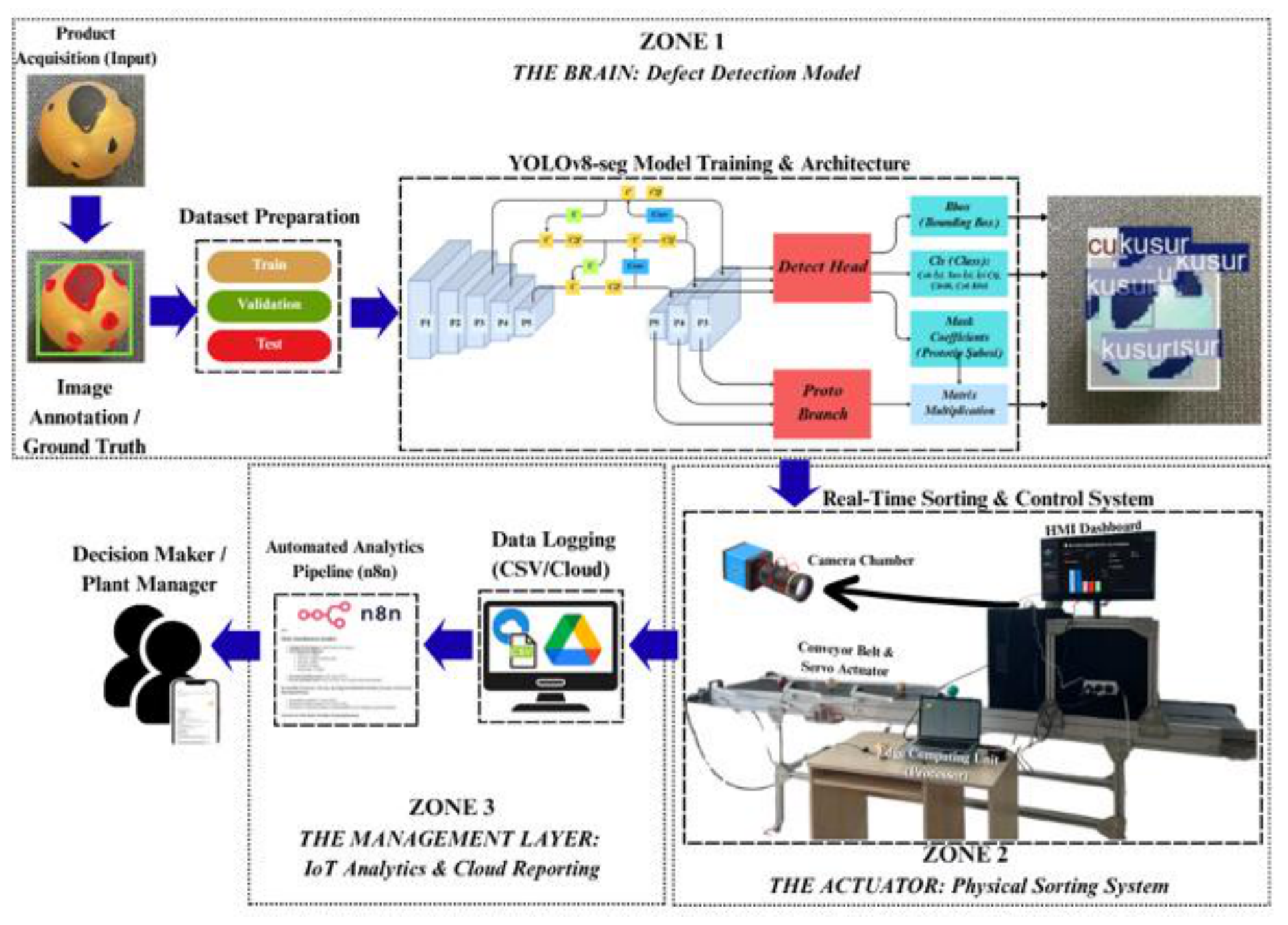
Figure 2.
Proposed Cyber-Physical System (CPS) architecture for automated industrial part sorting: Logical flowchart illustrating the end-to-end data pipeline from YOLOv8s-seg inference to spatiotemporal synchronization; Physical experimental setup consisting of the detection chamber, edge computing node, ESP32 microcontroller, and the multi-lane servo-actuated conveyor system.
Figure 2.
Proposed Cyber-Physical System (CPS) architecture for automated industrial part sorting: Logical flowchart illustrating the end-to-end data pipeline from YOLOv8s-seg inference to spatiotemporal synchronization; Physical experimental setup consisting of the detection chamber, edge computing node, ESP32 microcontroller, and the multi-lane servo-actuated conveyor system.
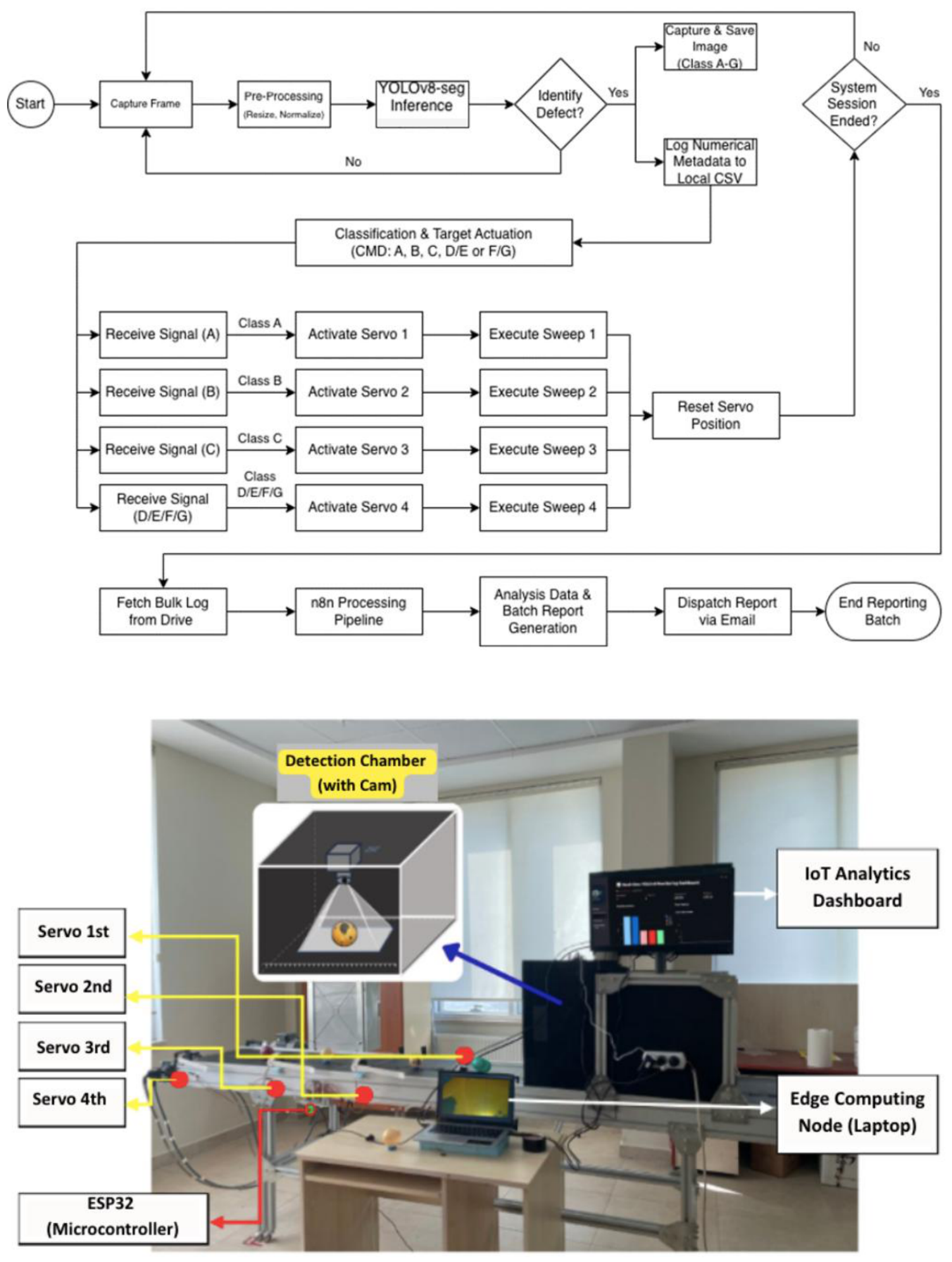
Figure 3.
Automated IoT Management Pipeline.
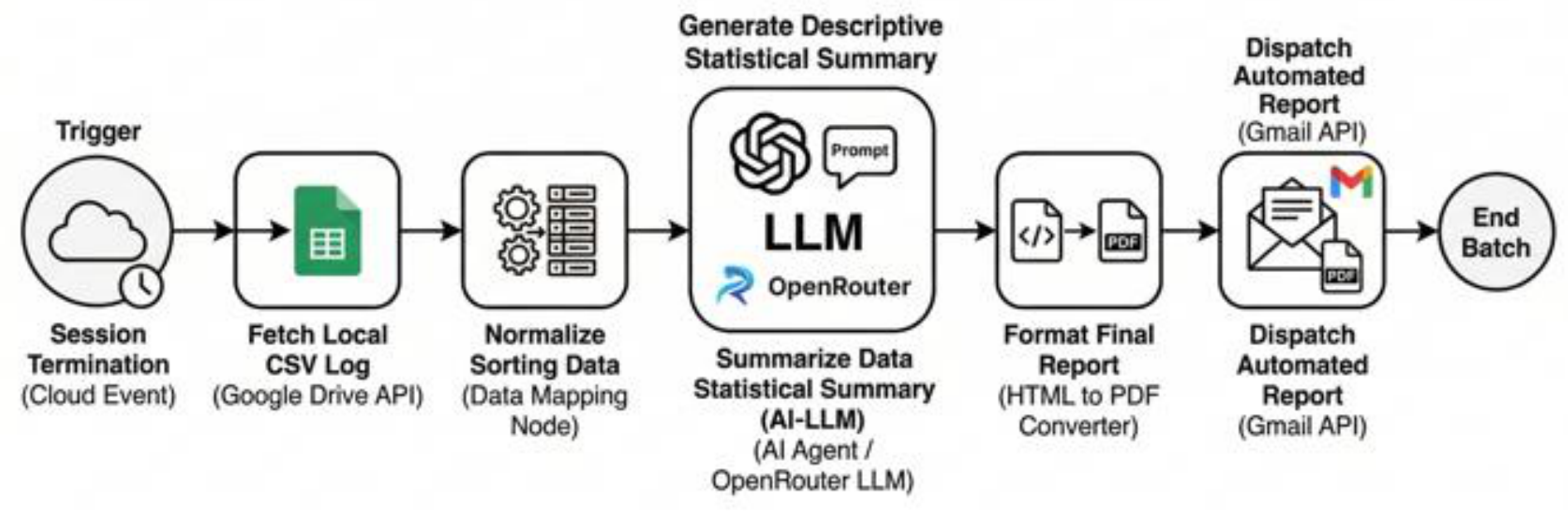
Figure 4.
Sample images of the custom-designed physical proxies and YOLOv8-seg polygonal annotations across different quality classes.
Figure 4.
Sample images of the custom-designed physical proxies and YOLOv8-seg polygonal annotations across different quality classes.
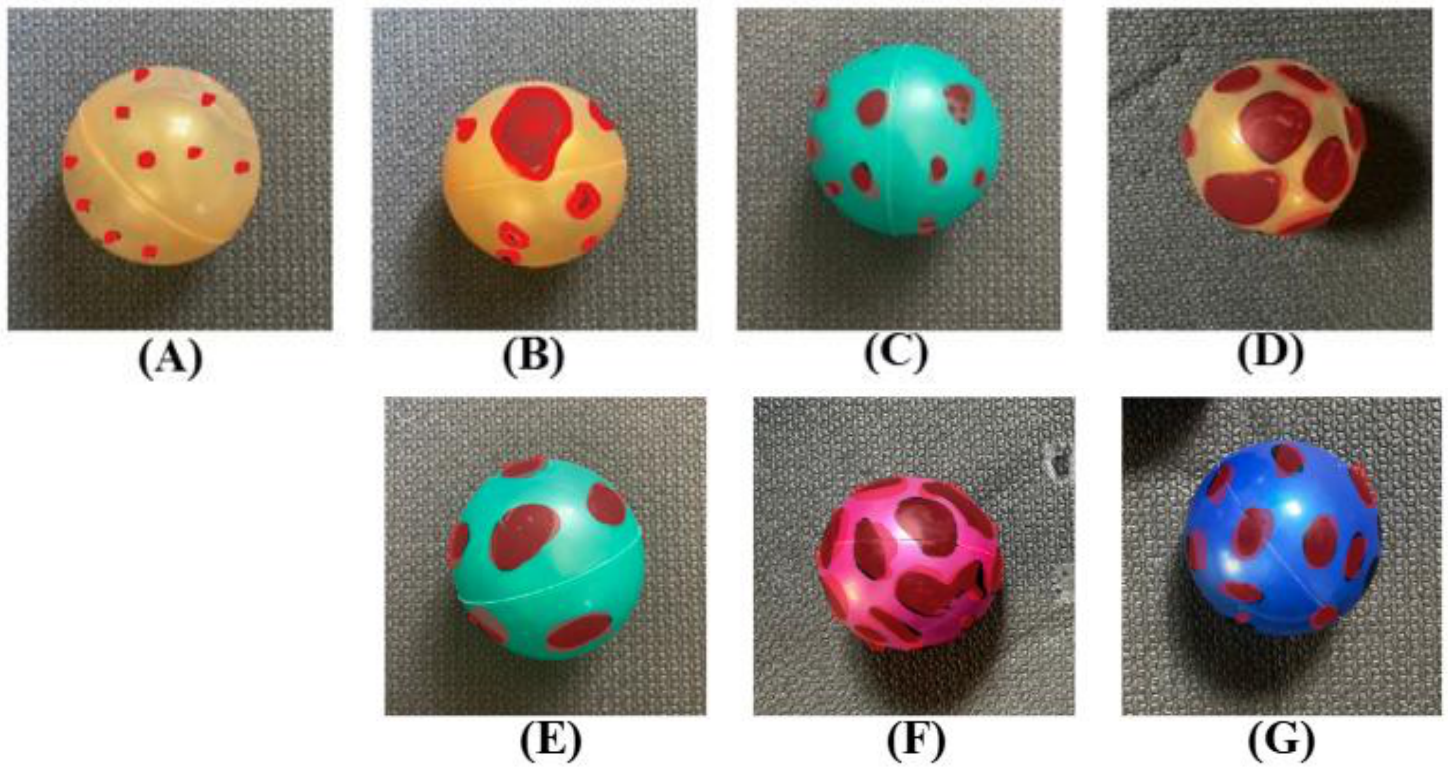
Figure 5.
Quantitative Training Curves (YOLOv8s-seg Performance Analysis).
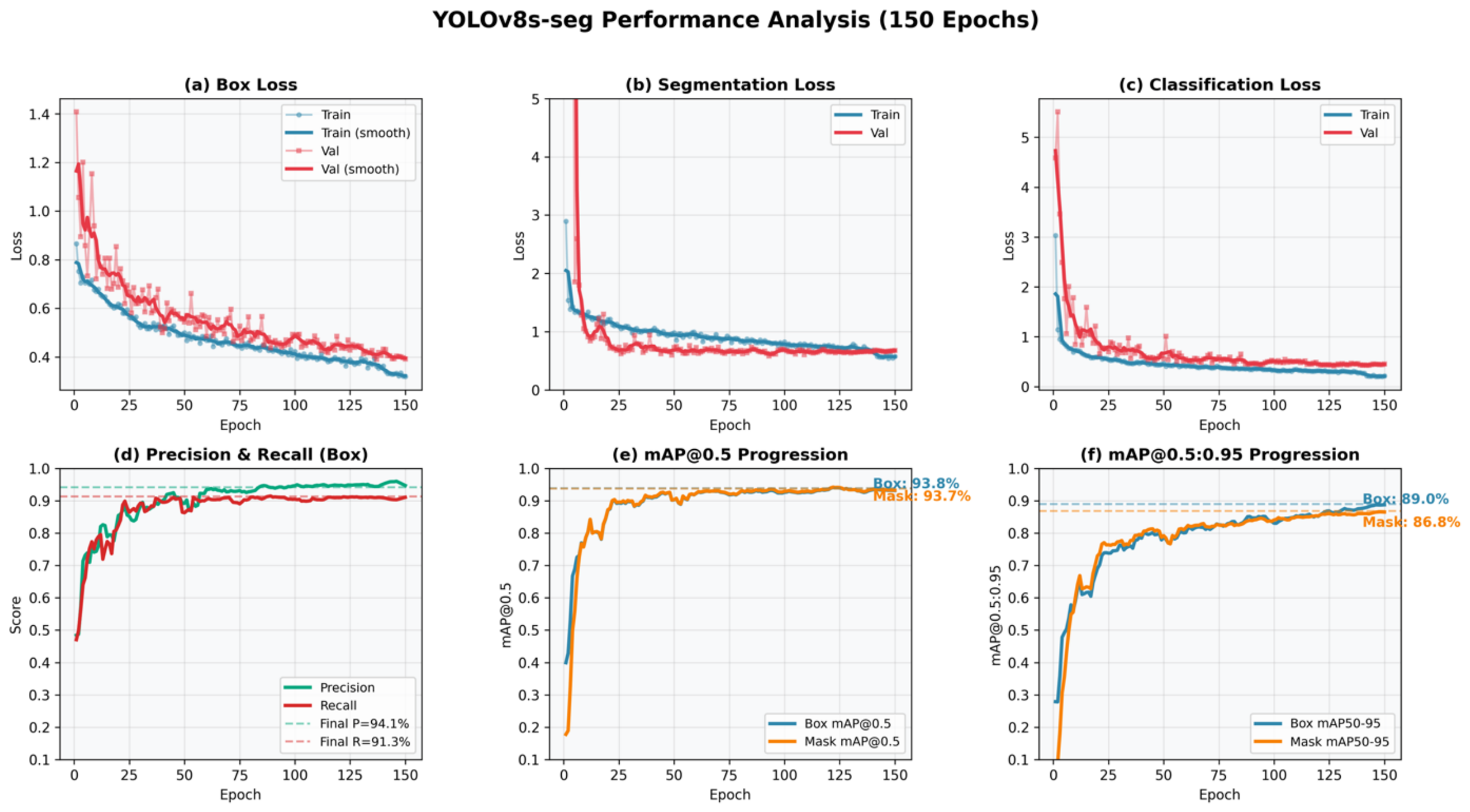
Figure 6.
Normalized Confusion Matrix.
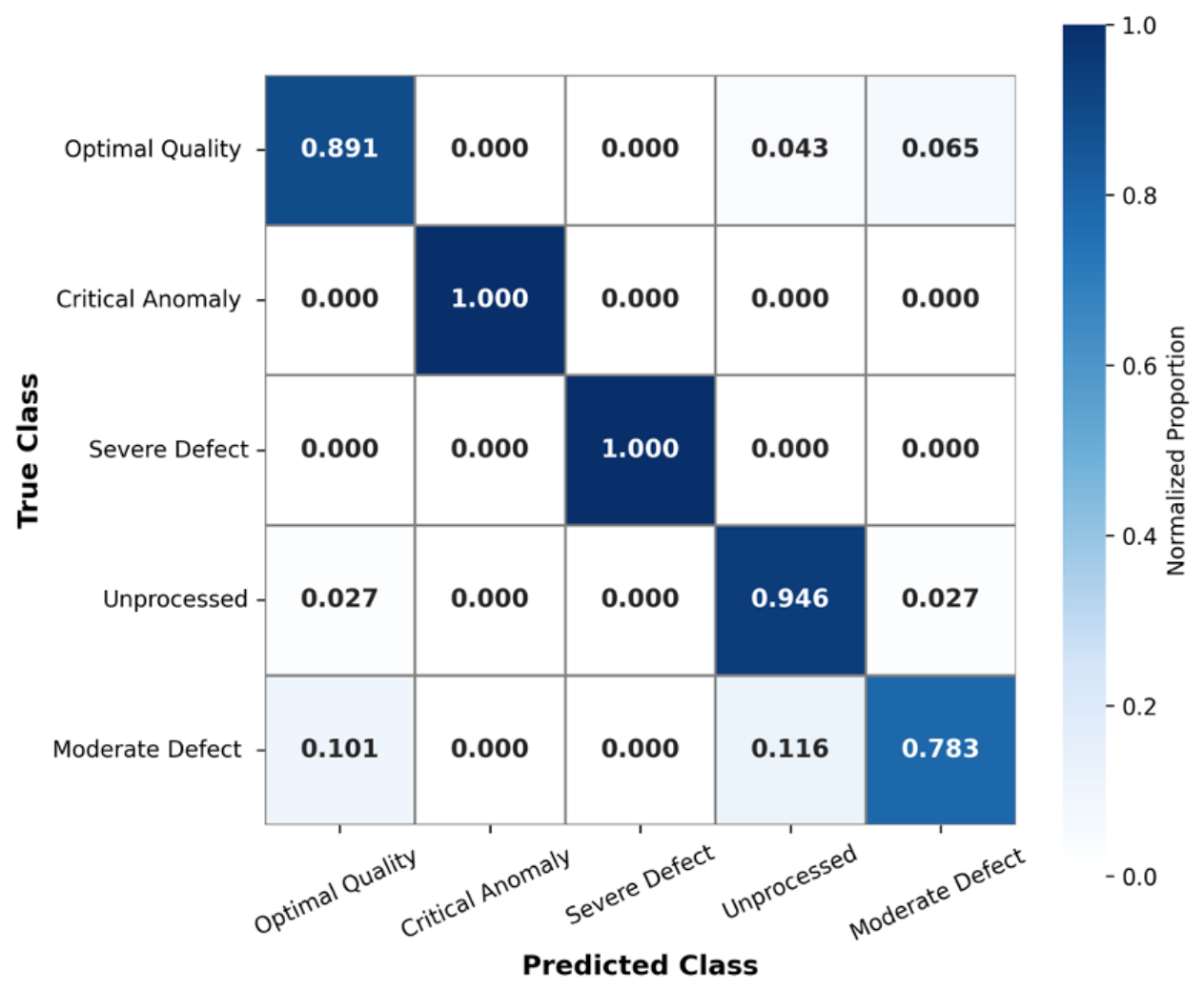
Figure 7.
The panels illustrate the model’s capability to delineate complex spatial boundaries across various severity tiers: (a) Optimal Quality proxy with minimal defect area (Class A&C) (b) Moderate Defect (Class B), and (c) Severe Defect/ Severe coating failure (Class D & E) and Critical Rejection/ Anomalies (Class F & G).
Figure 7.
The panels illustrate the model’s capability to delineate complex spatial boundaries across various severity tiers: (a) Optimal Quality proxy with minimal defect area (Class A&C) (b) Moderate Defect (Class B), and (c) Severe Defect/ Severe coating failure (Class D & E) and Critical Rejection/ Anomalies (Class F & G).
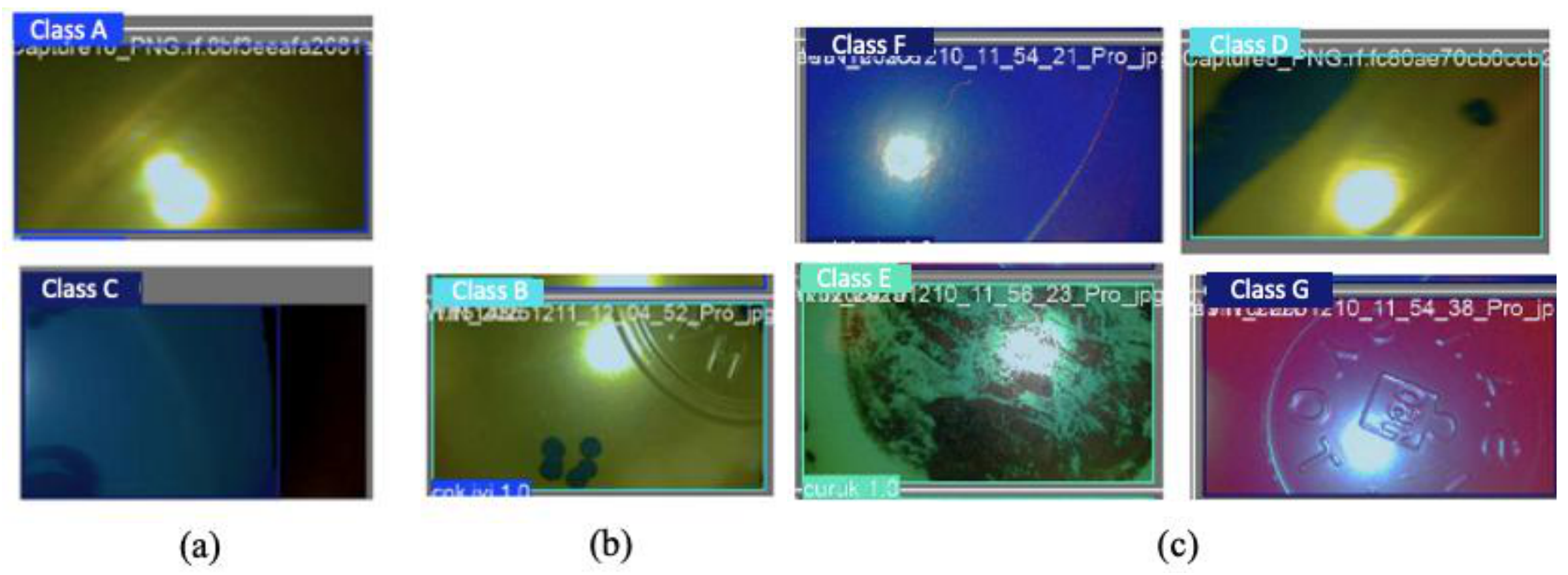
Figure 8.
Real-time IoT reporting and cloud data logging interface.
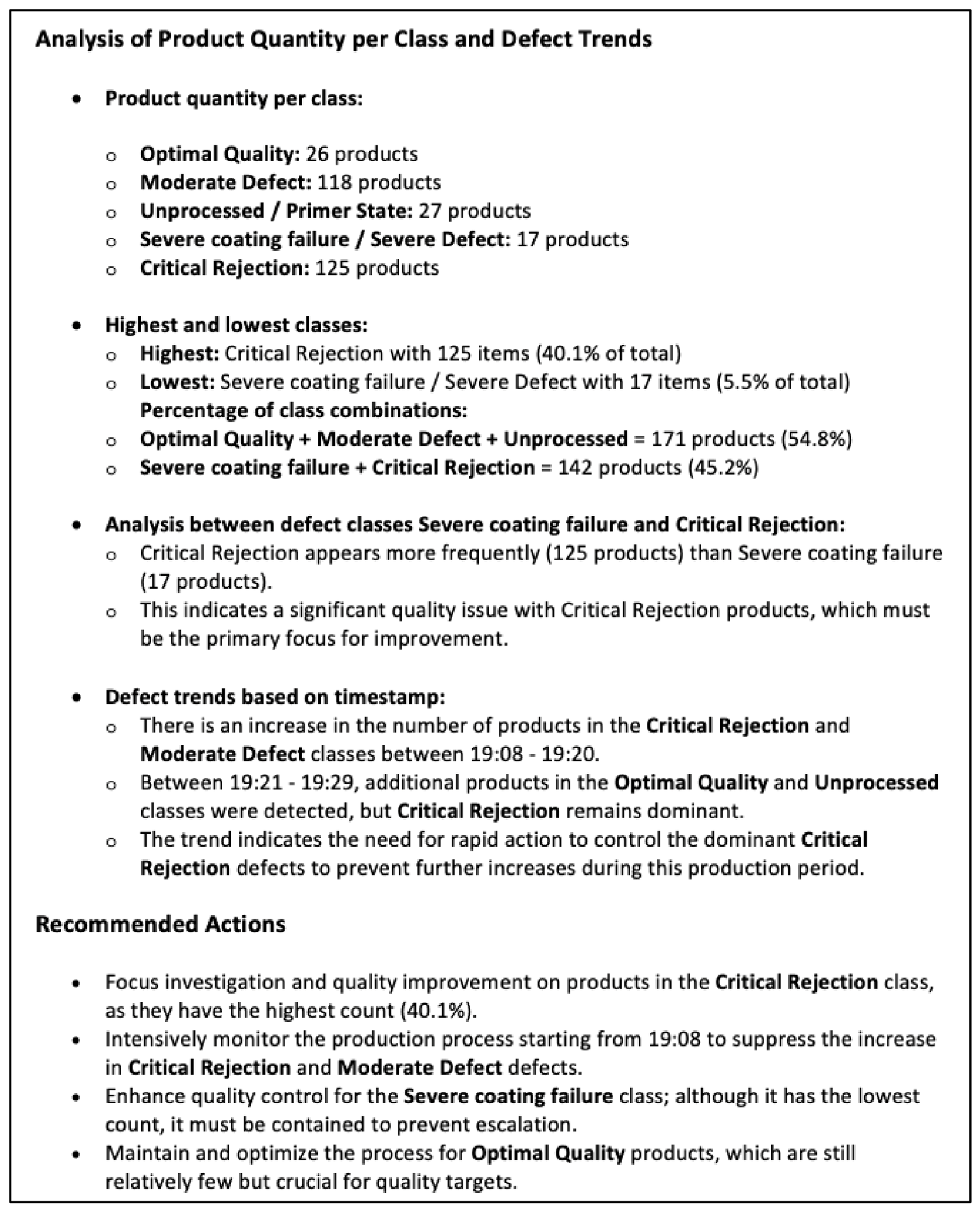

Table 1.
Sequential Servo Actuation and Waiting Time Parameters.
| Actuator ID | Targeted Quality Classes | Distance from Camera (m) | Trigger Distance (m) | Waiting Time (s) |
|---|---|---|---|---|
| Servo 1 | Class A | 0.50 | 0.20 | 4.28 |
| Servo 2 | Class B | 1.00 | 0.70 | 14.99 |
| Servo 3 | Class C | 1.50 | 1.20 | 25.70 |
| Servo 4 | Classes D/E & F/G | 2.00 | 1.70 | 36.40 |
Table 2.
Hardware and Software Specifications of the Proposed CPS.
| Component Layer | Parameter / Specification | Value / Description |
|---|---|---|
| Digital (Vision & AI) | Vision Sensor | Industrial-grade camera with macro lens |
| Edge Computing Unit | Acer Swift 1 (Low-cost inference validation) | |
| Object Detection Model | YOLOv8-seg (Instance Segmentation) | |
| Inference Speed | ~605 ms (Average end-to-end system latency per object, including image acquisition, AI inference, and serial dispatch) | |
| Physical (Hardware) | Microcontroller | ESP32 |
| Serial Communication | USB connection, 115200 Baud Rate | |
| Actuator | Servo motor with 3D-printed PLA sorting arm | |
| Conveyor Velocity | 0.0467 m/s (Constant) | |
| Actuation Recovery Time | 5,000 ms | |
| Minimum Sorting Margin | 23 cm between identical defect classes |
Table 3.
YOLOv8-seg Training Hyperparameters.
| Parameter | Value |
|---|---|
| Model | YOLOv8s-seg (11.8M params) |
| Hardware | NVIDIA RTX 4070, 24 GB |
| Input Size | 640 × 640 |
| Dataset Split | 999 Training/ 173 Validation/ 159 Testing |
| Epochs | 150 |
| Batch Size | 32 |
| Optimizer | AdamW (lr=0.001) |
| Duration | 0.50 hours |
| Augmentations | Mosaic (1.0), MixUp (0.1), HSV, Rotation (±10°), Flip (0.5) |
| Output | best.pt (23.9 MB), ONNX (45 MB) |
Table 4.
Hardware Bill of Materials (BOM) and Cost Analysis.
| Component Category | Specific Hardware / Material | Estimated Cost (USD) |
|---|---|---|
| Edge Computing Node | Acer Swift 1 (Entry-level Laptop) | ~$300.00 |
| Vision Sensor | High-definition industrial-grade webcam | ~$200.00 |
| Actuation Logic | ESP32 Microcontroller Board | ~$3.00 |
| Mechanical Actuator | MG995 High-Torque Servo Motor | ~$20.00 |
| Custom Sorting Arm | 3D-Printed Polylactic Acid (PLA) Filament | ~$10.00 |
| Physical Testbed | Motorized Industrial Mini Conveyor Belt | ~$1000.00 |
| Supporting Electronics | Power supply, wiring, enclosures, and circuitry | ~$10.00 |
| Total Estimated Prototype Cost | ~$1,543.00 | |
(Note: Costs are based on market prices from AliExpress/Amazon. Software components, including the YOLOv8s-seg framework, training environments, and the n8n automation pipeline, utilize open-source or academic-license tiers, incurring zero additional deployment costs.).
Table 5.
Cross-Framework Comparison of Systemic and Economic Metrics.
| Study / Framework | Primary Application |
Vision Architecture | Hardware / Edge Computing Node | Peak Accuracy (mAP) | System Integration Level | Est. Hardware Cost (USD) | |
|---|---|---|---|---|---|---|---|
| Zhu et al. (2024) [19] | Efficient Data Distribution Sorting | Standard CNN / YOLOv5 | High-End Industrial PC | ~95.0% | Vision + Software Pipeline | > $3,000 | |
| Bellani et al. (2025) [26] | Edge-Based Inspection | Optimized Instance Seg. | NVIDIA Jetson Series | ~92.4% | Vision Inference Only | ~ $800 | |
| Kunwar (2025) [22] | Greener AI Waste Sorting | Lightweight Mobile/Edge AI | Mobile ARM / Low-Power | ~88.5% | Vision + Basic Actuation | ~ $500 | |
| Proposed System | Industrial Quality Control | YOLOv8s-seg (ONNX) | Entry-Level CPU (Acer) + ESP32 | 93.80% | End-to-End (Vision + Actuation + n8n IoT) | ~ $1,543 | |
(Note: Estimated costs for literature benchmarks are derived from standard market hardware configurations cited in their respective methodologies).
Disclaimer/Publisher’s Note: The statements, opinions and data contained in all publications are solely those of the individual author(s) and contributor(s) and not of MDPI and/or the editor(s). MDPI and/or the editor(s) disclaim responsibility for any injury to people or property resulting from any ideas, methods, instructions or products referred to in the content. |
© 2026 by the authors. Licensee MDPI, Basel, Switzerland. This article is an open access article distributed under the terms and conditions of the Creative Commons Attribution (CC BY) license (http://creativecommons.org/licenses/by/4.0/).
Copyright: This open access article is published under a Creative Commons CC BY 4.0 license, which permit the free download, distribution, and reuse, provided that the author and preprint are cited in any reuse.


