
Submitted:
15 July 2026
Posted:
20 July 2026
You are already at the latest version
Abstract
Background/Objectives: Plexiform neurofibromas (PNs) associated with Neurofibromatosis type 1 (NF1) can lead to spinal cord compression and motor dysfunction. However, there is a paucity of literature detailing the effects of selumetinib on dystonia or spastic gait in these patients.
Methods: A retrospective analysis was conducted on a pediatric patient with NF1-associated PN, dystonia, and spastic gait who received selumetinib treatment. Additionally, two cases from Chinese-language literature were reviewed, sourced from the CNKI, Wanfang, and VIP databases.
Results: Three pediatric cases were identified. All patients presented with café-au-lait macules, superficial nodules, and either gait disturbance or dystonia; two exhibited scoliosis, and all demonstrated both intra- and extraspinal PN involvement. Following selumetinib therapy, there was a reduction in tumor burden and an improvement in gait-related motor symptoms. In the case under review, tiptoe walking and frequent falls showed significant improvement after 180 days of treatment, with no adverse events reported during the follow-up period.
Conclusions: Selumetinib appears to be a promising therapeutic option for children with symptomatic, unresectable NF1-associated PNs and compression-related dystonia or spastic gait. Nonetheless, further longitudinal studies and additional case reports are necessary to substantiate these findings.
Keywords:
selumetinib
; neurofibromatosis type 1
; plexiform neurofibroma
; dystonia
; pediatric neurology
; case report
1. Introduction
Neurofibromatosis type 1 (NF1) is an autosomal dominant neurocutaneous disorder resulting from pathogenic variants in the NF1 gene, with an estimated incidence of approximately 1 in 3,000 individuals [1]. The clinical manifestations of NF1 are heterogeneous and often evolve with age. Musculoskeletal and neurological complications, such as spinal deformity and paravertebral plexiform neurofibromas (PNs), are clinically significant due to their potential to cause pain, progressive neurological deficits, and functional impairment [2]. Surgical resection of NF1-associated PNs is frequently challenging because these tumors are infiltrative, may involve adjacent nerves and vessels, and pose a risk of recurrence and neurological injury. In patients presenting with spinal deformity and paravertebral tumors compressing the spinal cord, surgical intervention can be particularly demanding, even for experienced surgical teams [3]. Selumetinib, an oral MEK1/2 inhibitor, has demonstrated efficacy in reducing PN volume and improving tumor-related morbidity in pediatric patients with symptomatic, inoperable NF1-associated PNs [4,5,6]. However, evidence regarding its impact on dystonia, spastic gait, or other compression-related motor symptoms remains limited. Herein, we report a pediatric case.
2. Case Presentation
In March 2024, an 8-year-old female patient was admitted to a children’s hospital in Hangzhou, presenting with multiple café-au-lait macules persisting for over seven years and cervical subluxation observed for four months. The patient’s family reported that scattered café-au-lait macules had been present since birth and had been managed conservatively. Four months prior to admission, the patient experienced neck pain and discomfort following an accidental fall, prompting cervical computed tomography at a local hospital. The imaging revealed a large, irregular soft-tissue mass in the right shoulder and neck region, extending into the spinal canal, with resultant compression and thinning of the upper cervical spinal cord, accompanied by an abnormal cord signal. Additional findings included cervical kyphosis, left curvature, irregular morphology of the cervical vertebrae and posterior elements, and heterogeneous bone signal. Neurofibromatosis type 1 (NF1) complicated by cervical subluxation was suspected, leading to the prescription of a cervical collar and regular outpatient follow-up.
2.1. Medical and Family History
There was no reported history of significant trauma or surgical procedures. Regarding the patient’s personal history, the child had received standard vaccinations and had no documented allergies. In terms of family history, the parents were non-consanguineous, and there was no known familial history of Neurofibromatosis Type 1 (NF1) or related genetic disorders.
2.2. Clinical Findings
Numerous café-au-lait macules were observed across the body. Palpable subcutaneous masses were identified in the neck, right shoulder, and right cubital fossa, with palpation of the neck eliciting pain. Scoliosis was noted. Tendon reflexes in both knees were hyperactive, particularly on the right side; a right ankle clonus was markedly positive (+++), while the left ankle clonus was negative. The child exhibited walking fatigue, tiptoe gait, and a propensity to fall.
2.3. Diagnostic Assessment
Routine hematological assessments, biochemical indices, electrolyte levels, and coagulation parameters revealed no clinically significant abnormalities. Imaging studies indicated the following: X-ray imaging identified mild cervical kyphosis, abnormal morphology of the C3 and C4 vertebral bodies, and malalignment at the C2-C3 level. Additionally, mild scoliosis was observed, with a Cobb angle measuring approximately 14.5 degrees. Full-length radiographs of both lower limbs demonstrated no apparent osseous abnormalities, although a slight curvature of the distal right radius was noted [7]. Magnetic resonance imaging (MRI) revealed: (1) a large, irregular soft-tissue mass in the right shoulder and neck region extending into the spinal canal, causing compression and thinning of the upper cervical spinal cord, accompanied by an abnormal signal; (2) cervical kyphosis with leftward curvature, irregular morphology of the cervical vertebral bodies and posterior elements, and heterogeneous bone signal; (3) abnormal signal in the thoracolumbar intervertebral foraminal region; (4) abnormal signal foci in the right anterior abdominal wall; (5) masses located in the subcutaneous and intermuscular spaces surrounding the middle and distal right humerus and elbow; and (6) masses in the subcutaneous and intermuscular spaces around the middle and distal left humerus, ulna and radius.
2.4. Diagnosis
Utilizing the updated 2021 diagnostic criteria for Neurofibromatosis Type 1 (NF1) [8], in conjunction with the patient’s clinical manifestations and imaging results, a diagnosis was established indicating the presence of NF1-associated plexiform neurofibromas, intra- and extraspinal space-occupying lesions in the cervical region, dystonia accompanied by limb spasticity, and atlantoaxial subluxation.
2.5. Therapeutic Intervention
The patient presented with cervical malformation accompanied by spinal cord compression, alongside compression and displacement of the right internal jugular vein and common carotid artery. Due to the extensive nature of the mass and its involvement with multiple anatomical structures, complete surgical resection was deemed unfeasible. In alignment with the Multidisciplinary Diagnosis and Treatment Guidelines for Neurofibromatosis Type 1 (2023 edition) [7], and considering the indication for selumetinib in pediatric patients aged 3 years or older with symptomatic, unresectable NF1-associated plexiform neurofibromas (PNs), oral selumetinib was administered at a dosage of 20 mg every 12 hours, adjusted according to body surface area. Concurrently, a local resection of the right shoulder skin mass was undertaken during targeted therapy.
Surgical treatment: Surgical intervention involved a spindle-shaped incision approximately 3.0 cm in length over the right shoulder mass. The lesion was found to be closely adherent to the skin. Following subcutaneous dissection, a hard, solid mass measuring approximately 2.5 cm x 1.5 cm x 1.5 cm was exposed. The root of the mass extended deeply towards the axilla, precluding complete resection [9]. Upon achieving hemostasis, the subcutaneous tissue and skin were sutured using an intermittent technique.
2.6. Pathological Findings
Upon microscopic examination, the specimen from the right shoulder revealed nerve fascicles arranged in a plexiform pattern within the deep dermis, encased by EMA-positive perineurial cells. The tumor cells exhibited a spindle-shaped and wavy morphology, set within a loose myxoid stroma. Immunohistochemical analysis demonstrated positivity for S100, EMA (perineurium), CD34, and focal positivity for NSE, along with desmin indicating smooth muscle presence, and a Ki-67 proliferation index of less than 1% [7]. The pathological diagnosis was confirmed as plexiform neurofibroma.
2.7. Follow-Up and Outcomes
The pediatric patient was administered oral selumetinib at a dosage of 20 mg twice daily. Throughout the treatment period, no adverse reactions were documented. By the 30th day of treatment, there was a significant reduction in the masses located in the shoulder, neck, and elbow regions. Additionally, there was an improvement in scoliosis, a noticeable lightening and reduction in the extent of café-au-lait macules, and an amelioration of walking fatigue. By the 180th day, symptoms such as tiptoe walking and a propensity to fall had substantially improved. Routine monitoring, which included complete blood counts, biochemical assessments, electrocardiography, and echocardiography, revealed no abnormalities. Serial magnetic resonance imaging (MRI) of the neuraxis was conducted to assess the treatment response, with baseline imaging performed in March 2024 and follow-up imaging in July 2025 after 16 months of continuous therapy. The MRI results demonstrated a decreased tumor signal and a continued reduction in tumor burden, indicative of a positive response to the treatment (Figure 1). The patient remains on targeted therapy with regular outpatient follow-up.
3. Discussion
3.1. Literature Review
Due to the rarity of neurofibromatosis type 1 (NF1) and the recent introduction of selumetinib into clinical practice, there is a paucity of real-world data regarding its efficacy in treating NF1-associated plexiform neurofibromas (PNs). Specifically, reports detailing spinal deformity accompanied by dystonia or gait disturbances resulting from paravertebral PN compression are limited. A comprehensive literature search was conducted across Chinese databases, including the China National Knowledge Infrastructure (CNKI), Wanfang Medical Network, and the VIP Journal Full-text Database. The search employed the following keywords: (“neurofibromatosis type 1” OR “NF1”) AND (“plexiform neurofibroma” OR “PN”) AND “selumetinib” AND (“dystonia” OR “spinal deformity” OR “gait disturbance”). The search covered the period from the inception of each database up to December 2025. Upon screening, two published Chinese cases were identified that involved NF1-associated PN treated with selumetinib, presenting with either motor or compression-related symptoms. Including the current case, a total of three cases were analyzed [10,11]. The clinical presentations and responses to targeted therapy are detailed in Table 1.
In this study, the ages of onset for the three patients were 3, 5, and 8 years, with a male-to-female ratio of 1:2. All patients exhibited multiple café-au-lait macules, superficial nodules, and gait disturbances. Additionally, two patients had scoliosis, while one initially presented with abdominal distension and neurogenic bladder. Imaging revealed both intra- and extraspinal neurofibroma involvement in all cases. Each child experienced spinal deformities and neurological symptoms attributable to tumor invasion or compression. Following oral selumetinib therapy, improvements were observed in claudication, tiptoe walking, and incidences of falls at varying time points. In the case under discussion, symptoms related to spinal cord compression were significantly alleviated, with notable improvements in scoliosis, lower-limb weakness, tiptoe walking, and frequent falls.
3.2. Treatment Rationale, Safety and Surveillance
Neurofibromatosis type 1 (NF1) is attributed to pathogenic variations in the NF1 gene located on chromosome 17q11.2 [12,13]. This gene encodes neurofibromin, a multifunctional protein that serves as a negative regulator of the RAS/MAPK signaling pathway [12]. It is estimated that 30% to 50% of individuals with NF1 develop plexiform neurofibromas (PNs). These tumors proliferate along multiple nerve trunks and branches and can exhibit rapid progression. They frequently affect the paravertebral nerves, brachial plexus, lumbosacral plexus, sciatic nerve, chest wall, and cervical nerves, leading to symptoms such as pain, deformity, organ compression, or neurological dysfunction. Despite their histologically benign nature, complete surgical resection of PNs is often unfeasible due to their infiltrative growth, absence of a distinct capsule, proximity to nerves and blood vessels, local invasiveness, and high risk of recurrence [7]. Selumetinib, an inhibitor of MEK1/2, impedes downstream RAS/MAPK signaling, thereby suppressing the growth of PNs in individuals with NF1 [14].
Prior to the advent of targeted therapies, the management of paravertebral plexiform neurofibromas (PNs) predominantly involved maximal safe surgical resection with the aim of preserving neurological function. Nonetheless, achieving complete resection is frequently unfeasible, necessitating repeated surgical interventions to alleviate symptoms arising from nerve injury or tumor compression. In preclinical models of PNs treated with selumetinib, there were sustained reductions in phosphorylated ERK levels, which correlated with a decrease in tumor volume. In pediatric patients with neurofibromatosis type 1 (NF1)-associated inoperable PNs, selumetinib has demonstrated durable tumor reduction, achieving an objective response rate of up to 68% and progression-free survival extending to 6.7 years [15]. The SPRINT trial indicated that the majority of pediatric patients experienced measurable reductions in PN volume during selumetinib therapy [15], with some patients also exhibiting improvements in tumor-related morbidities [16]. A single-center real-world study corroborated these findings, reporting sustained clinical improvement in most NF1 patients treated with selumetinib, particularly those with lesions in the head and neck, thoracic, or pelvic regions, and associated deformities or pain.
Additional targeted strategies for the RAS signaling pathway, such as multi-tyrosine kinase inhibitors and various MEK inhibitors, are currently under investigation and hold the potential to offer alternative treatment options in the future [17,18]. Gene therapy and immunotherapy are also being explored, although they remain experimental for NF1-associated plexiform neurofibromas (PNs) [19,20]. Currently, no curative therapy exists for NF1, necessitating long-term, multidisciplinary follow-up. Surveillance efforts should prioritize the monitoring of multisystem complications, functional impairments, tumor progression, and the management of chronic disease [21].
Peripheral nerve sheath tumors (PNs) exhibit local invasiveness and can be intimately associated with major blood vessels and nerves. Malignant peripheral nerve sheath tumor (MPNST) represents a rare yet significant malignancy, which may develop de novo or result from the malignant transformation of a pre-existing neurofibroma. Notably, approximately one-third of MPNST cases occur in individuals with neurofibromatosis type 1 (NF1) [22]. Indicators such as rapid tumor growth, escalating pain, bleeding, ulceration, or rupture should prompt suspicion of malignant transformation [7]. These clinical warning signs necessitate immediate evaluation and proactive intervention.
4. Conclusions
For pediatric patients with NF1-associated plexiform neurofibromas that exert pressure on the spinal cord, resulting in dystonia, spastic gait, or related motor dysfunction, selumetinib may represent a clinically significant non-surgical treatment alternative when complete surgical resection is impractical. In the current case study, the administration of selumetinib in conjunction with limited local surgical intervention was correlated with a reduction in tumor size and improvements in symptoms such as pain, limb weakness, tiptoe walking, and falls. However, the evidence remains preliminary, necessitating larger-scale real-world studies with extended follow-up periods to elucidate the long-term efficacy, safety, and risk of relapse associated with this treatment approach.
Author Contributions
Conceptualization, J.D. and S.Z.; investigation, J.D. and F.L.; data curation, L.J.; writing—original draft preparation, J.D. and S.Z.; writing—review and editing, S.Z. and C.W.; supervision, S.Z. Jinyun Ding and Lili Jiang contributed equally to this work. All authors have read and agreed to the published version of the manuscript.
Funding
This research received no external funding.
Institutional Review Board Statement
The study was conducted in accordance with the Declaration of Helsinki and approved by the Ethics Committee of [institution blinded for peer review] (protocol code 2024-012-01).
Informed Consent Statement
Written informed consent for both treatment and the publication of this case report, including the use of de-identified clinical images, was obtained from the patient’s legal guardian.
Data Availability Statement
The data presented in this study can be accessed upon request from the corresponding author, subject to patient privacy considerations and institutional restrictions.
Conflicts of Interest
The authors declare no conflict of interest.
References
- Evans, D.G.; Howard, E.; Giblin, C.; Clancy, T.; Spencer, H.; Huson, S.M.; Lalloo, F. Birth incidence and prevalence of tumor-prone syndromes: Estimates from a UK family genetic register service. Am. J. Med. Genet. A 2010, 152A, 327–332. [Google Scholar] [CrossRef] [PubMed]
- Gross, A.M.; Singh, G.; Akshintala, S.; Baldwin, A.; Dombi, E.; Ukwuani, S.; et al. Association of plexiform neurofibroma volume changes and development of clinical morbidities in neurofibromatosis 1. Neuro-Oncology 2018, 20, 1643–1651. [Google Scholar] [CrossRef] [PubMed]
- Dombi, E.; Solomon, J.; Gillespie, A.J.; Fox, E.; Balis, F.M.; Patronas, N.; et al. NF1 plexiform neurofibroma growth rate by volumetric MRI: Relationship to age and body weight. Neurology 2007, 68, 643–647. [Google Scholar] [CrossRef] [PubMed]
- Armstrong, A.E.; Belzberg, A.J.; Crawford, J.R.; Hirbe, A.C.; Wang, Z.J.; et al. Treatment decisions and the use of MEK inhibitors for children with neurofibromatosis type 1-related plexiform neurofibromas. BMC Cancer 2023, 23. [Google Scholar] [CrossRef] [PubMed]
- Fisher, M.J.; Blakeley, J.O.; Weiss, B.D.; Dombi, E.; Ahlawat, S.; Akshintala, S.; et al. Management of neurofibromatosis type 1-associated plexiform neurofibromas. Neuro-Oncology 2022, 24, 1827–1844. [Google Scholar] [CrossRef] [PubMed]
- Pearson, A.D.; Allen, C.; Fangusaro, J.; et al. Paediatric Strategy Forum for medicinal product development in mitogen-activated protein kinase pathway inhibitors: ACCELERATE in collaboration with the European Medicines Agency with participation of the Food and Drug Administration. Eur. J. Cancer 2022, 177, 120–142. [Google Scholar] [CrossRef] [PubMed]
- Zhu, Y. Multidisciplinary diagnosis and treatment guidelines for neurofibromatosis type 1 (2023 edition). Rare Dis. Res. (In Chinese) 2023, 2, 210–230. [Google Scholar] [CrossRef]
- Kehrer-Sawatzki, H.; Farschtschi, S.; Mautner, V.F. Revised diagnostic criteria for neurofibromatosis type 1 (NF1) enable early accurate differential diagnostic distinction from other RASopathies and facilitate the diagnosis. In Monatsschr. Kinderheilkd.; 2021. [Google Scholar]
- Bernthal, N.M.; Putnam, A.; Jones, K.B.; et al. The effect of surgical margins on outcomes for low-grade MPNSTs and atypical neurofibroma. J. Surg. Oncol. 2014, 110, 813–816. [Google Scholar] [CrossRef] [PubMed]
- Li, B.; Zhang, G.; Pang, Q.; et al. Selumetinib treatment in a child with neurofibromatosis type 1: A case report. Chin. J. Pediatr. (In Chinese) 2023, 61, 938–940. [Google Scholar]
- Xu, J.; Guo, Y.; Wang, S.; et al. Neurofibromatosis type 1 in a child with urinary tract compression by plexiform neurofibroma. Rare Dis. Res. (In Chinese) 2023, 2, 186–190. [Google Scholar]
- Hirbe, A.C.; Gutmann, D.H. Neurofibromatosis type 1: A multidisciplinary approach to care. Lancet Neurol. 2014, 13, 834–843. [Google Scholar] [CrossRef] [PubMed]
- Legius, E.; Messiaen, L.; Wolkenstein, P.; Pancza, P.; Avery, R.A.; Berman, Y.; et al. Revised diagnostic criteria for neurofibromatosis type 1 and Legius syndrome: An international consensus recommendation. Genet. Med. 2021, 23, 1506–1513. [Google Scholar] [CrossRef] [PubMed]
- Petrini, I.; Giaccone, G. Developments of MEK inhibitors as future cancer therapies: What have we learned from preclinical and clinical studies? Expert Opin. Investig. Drugs 2025. [Google Scholar] [CrossRef]
- Gross, A.M.; Wolters, P.L.; Dombi, E.; Baldwin, A.; Whitcomb, P.; Fisher, M.J.; et al. Selumetinib in children with inoperable plexiform neurofibromas. N. Engl. J. Med. 2020, 382, 1430–1442. [Google Scholar] [CrossRef] [PubMed]
- Gross, A.M.; Dombi, E.; Wolters, P.L.; et al. Long-term safety and efficacy of selumetinib in children with neurofibromatosis type 1 on a phase 1/2 trial for inoperable plexiform neurofibromas. Neuro-Oncology 2023, 25, 1883–1894. [Google Scholar] [CrossRef] [PubMed]
- Wang, X.; Wu, J.; Xiao, A.; et al. Evolution of direct RAS inhibitors: From undruggable target to clinical breakthroughs. Mol. Cancer 2025, 24, 229. [Google Scholar] [CrossRef] [PubMed]
- Fisher, M.J.; Shih, C.S.; Rhodes, S.D.; et al. Cabozantinib for neurofibromatosis type 1-related plexiform neurofibromas: A phase 2 trial. Nat. Med. 2021, 27, 165–173. [Google Scholar] [CrossRef] [PubMed]
- Lu, Y.Q.; Xu, M.Z.; Chen, X.J.; et al. Neurofibromatosis type 1: Genetic mechanisms and advances in therapeutic innovation. Cancers 2025, 17. [Google Scholar] [CrossRef] [PubMed]
- Champiat, S.; Tselikas, L.; Farhane, S.; et al. Intratumoral immunotherapy: From trial design to clinical practice. Clin. Cancer Res. 2021, 27, 665–679. [Google Scholar] [CrossRef] [PubMed]
- Shin, M.R.; Brown, M.; Siegel, B.; et al. Neurofibromatosis review with focus on rehabilitation intervention. Curr. Probl. Pediatr. Adolesc. Health Care 2025, 55, 101886. [Google Scholar] [CrossRef] [PubMed]
- Wu, X.M.; Zhang, Y.; Liu, X.M.; et al. Five cases report and literature review of malignant peripheral nerve sheath tumor. Discov. Oncol. 2025, 16. [Google Scholar] [CrossRef] [PubMed]
Figure 1.
The preceding figure illustrates that the computed tomography (CT) scan identified a loss of cervical curvature, atlantoaxial subluxation, irregular morphology of the C1-4 vertebral bodies, and multiple cervical alterations, along with masses in the surrounding tissues and spinal canal. Subsequent magnetic resonance imaging (MRI) conducted on March 7, 2024, revealed a large, irregular soft tissue mass in the right neck and nape region, extending into the spinal canal and causing compression and thinning of the upper cervical spinal cord, accompanied by an abnormal signal. Follow-up MRI scans on June 13, 2024, and July 15, 2025, demonstrated tumor reduction following the administration of selumetinib.
Figure 1.
The preceding figure illustrates that the computed tomography (CT) scan identified a loss of cervical curvature, atlantoaxial subluxation, irregular morphology of the C1-4 vertebral bodies, and multiple cervical alterations, along with masses in the surrounding tissues and spinal canal. Subsequent magnetic resonance imaging (MRI) conducted on March 7, 2024, revealed a large, irregular soft tissue mass in the right neck and nape region, extending into the spinal canal and causing compression and thinning of the upper cervical spinal cord, accompanied by an abnormal signal. Follow-up MRI scans on June 13, 2024, and July 15, 2025, demonstrated tumor reduction following the administration of selumetinib.
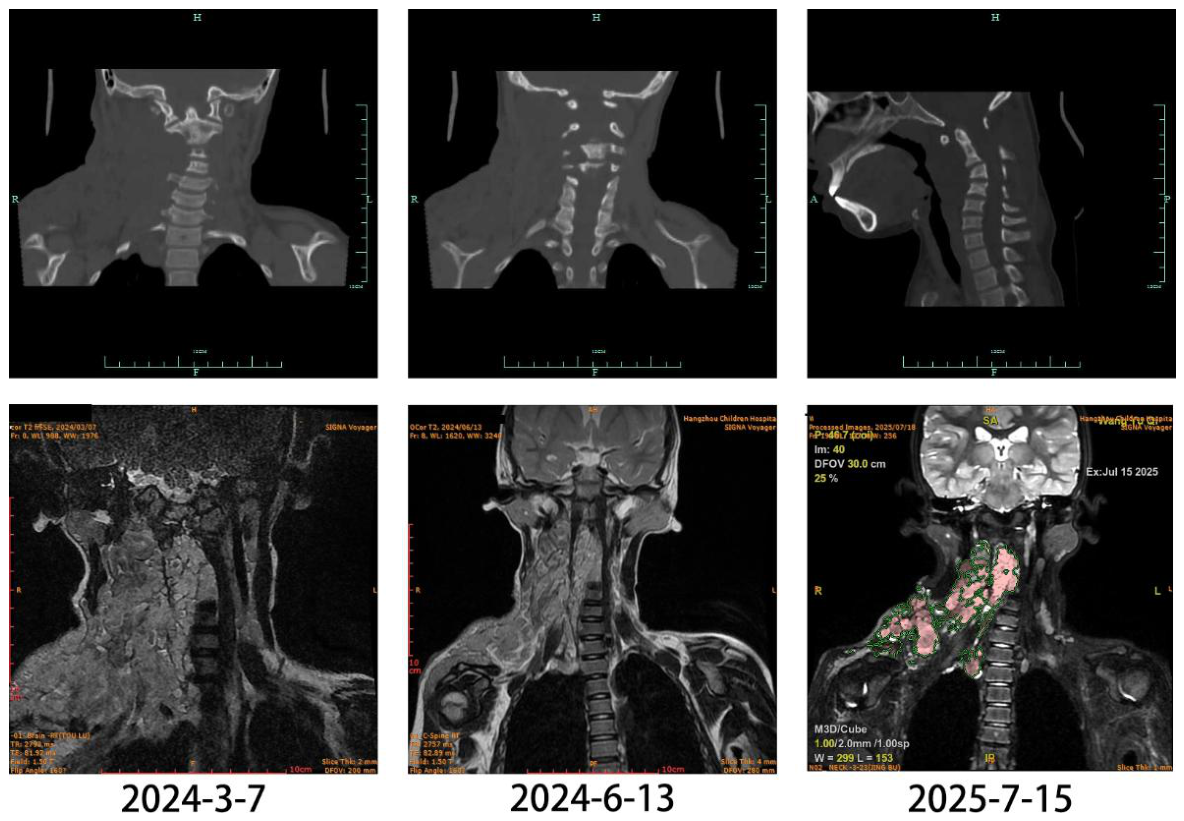

Table 1.
An analysis of the clinical characteristics and tumor response outcomes in pediatric patients with NF1-associated plexiform neurofibromas undergoing treatment with selumetinib.
Table 1.
An analysis of the clinical characteristics and tumor response outcomes in pediatric patients with NF1-associated plexiform neurofibromas undergoing treatment with selumetinib.
| Reference | Age (years)/sex | Key clinical features | Tumor location | Reported tumor-volume reduction | Motor/dystonic response |
| Li et al. [10] | 5/F | Cafe-au-lait macules, neck mass, gait disturbance, scoliosis (Cobb angle 18 degrees) | Intracranial, cervical and paravertebral regions | 42% at 37 days | Falls resolved after 57 days |
| Xu et al. [11] | 3/M | Cafe-au-lait macules, lower-limb nodules, gait disturbance, abdominal distension and neurogenic bladder | Retroperitoneum, bladder and spinal canal | 35% at 3 months | Falls resolved after 10 months |
| Present case | 8/F | Cafe-au-lait macules, shoulder/neck mass, scoliosis (Cobb angle 14.5 degrees) and atlantoaxial subluxation | Cervical intra-/extraspinal region and humerus | 58% at 10 months | Tiptoe walking and falls markedly improved by day 180 |
Disclaimer/Publisher’s Note: The statements, opinions and data contained in all publications are solely those of the individual author(s) and contributor(s) and not of MDPI and/or the editor(s). MDPI and/or the editor(s) disclaim responsibility for any injury to people or property resulting from any ideas, methods, instructions or products referred to in the content. |
© 2026 by the authors. Licensee MDPI, Basel, Switzerland. This article is an open access article distributed under the terms and conditions of the Creative Commons Attribution (CC BY) license (http://creativecommons.org/licenses/by/4.0/).
Copyright: This open access article is published under a Creative Commons CC BY 4.0 license, which permit the free download, distribution, and reuse, provided that the author and preprint are cited in any reuse.


