

Submitted:
17 July 2026
Posted:
20 July 2026
You are already at the latest version
Abstract
Objective: To assess gut and endometrial microbiota simultaneously in women with unexplained recurrent implantation failure (RIF) and explore the hypothesis of a gut-endometrium microbial axis. Study design: This monocentric observational pilot study included women aged 38 years or younger with RIF and a normal uterine cavity. Paired fecal and endometrial samples were collected on the same day and analyzed by 16S rRNA gene sequencing. Relative abundances of major phyla and alpha-diversity indices were compared between compartments. Results: Twenty-one women were included. Chronic endometritis was documented hysteroscopically in all cases. Gut dysbiosis was observed in 20/21 patients (95.2%), whereas endometrial dysbiosis was found in 16/21 (76.2%); crude agreement between compartments was 71.4%. The intestinal microbiota was dominated by Bacteroidetes (52.8% ± 14.9%) and Firmicutes (33.3% ± 11.0%), whereas the endometrial microbiota was enriched in Firmicutes (64.5% ± 33.5%) and Proteobacteria (30.9% ± 32.3%). Bacteroidetes were significantly more abundant in fecal than endometrial samples (p < 0.001), while Firmicutes were significantly enriched in the endometrium (p = 0.001). All alpha-diversity indices were significantly higher in feces, indicating greater microbial richness and complexity in the gut. Conclusions: In women with RIF, gut and endometrial dysbiosis frequently coexist and show relevant concordance. These data support the hypothesis that endometrial dysbiosis may reflect a broader systemic microbial imbalance rather than an isolated uterine disorder.
Keywords:
implantation failure
; microbiome
; endometrium
; gut
; dysbiosis
; infertility
1. Introduction
Infertility is an increasing global public health issue, affecting millions of individuals and couples worldwide [1,2,3]. In parallel, the use of assisted reproductive technologies (ART) continues to rise, including in Italy, where medically assisted reproduction has contributed substantially to reproductive care in recent years [4,5]. Despite major advances in embryo culture, preimplantation genetic testing and endometrial assessment, implantation remains the limiting step of ART. Even after transfer of morphologically high-quality euploid embryos, implantation rates rarely exceed 50-60%, leaving a substantial proportion of patients without a clear explanation for failure [6,7].
Recurrent implantation failure (RIF) is among the most challenging conditions in reproductive medicine. The ESHRE good practice recommendations emphasize that RIF should be individualized according to patient context, while acknowledging the limited evidence supporting many currently used diagnostic and therapeutic approaches [8]. Persistent implantation failure has been associated with uterine, embryonic, endocrine, immunologic and infectious factors, yet a relevant fraction of cases remains unexplained despite standard evaluation [6,8,9].
Recent work has focused on the reproductive tract microbiome as a possible determinant of receptivity. Endometrial dysbiosis, usually characterized by reduced Lactobacillus dominance and enrichment of opportunistic taxa, has been associated with chronic endometritis, altered cytokine signaling and impaired implantation [10,11,12,13,14]. At the same time, growing evidence supports a gut-reproductive axis in which intestinal microbiota influence reproductive physiology through immune, metabolic and endocrine pathways [15,16,17,18,19,20]. The gut microbiota contributes to epithelial integrity, systemic inflammatory tone, short-chain fatty acid production and steroid hormone metabolism, all of which may affect the endometrium indirectly [15,16,17,18,19,20].
However, most studies have evaluated the gut and endometrial compartments separately. The present pilot study was designed to assess both microbiota simultaneously in a highly selected cohort of young women with unexplained RIF, in order to explore their degree of concordance and to investigate whether endometrial dysbiosis may reflect a broader systemic microbial imbalance.
2. Materials and Methods
This monocentric observational pilot study was conducted at the IVF Unit of the Department of Gynecology and Obstetrics, University Federico II (Naples, Italy) between January and December 2025. Institutional Review Board and Ethics committee approval (University of Naples, Federico II, registration number: 129/2023, December 06, 2023) was obtained prior to the start of the research activities for this study, and all participants provided written informed consent before enrollment.
Patients referred to the hysteroscopy unit with RIF, meeting the following inclusion criteria, were enrolled: women aged 38 years or younger; diagnosis of RIF, defined according to the ESHRE good practice recommendations [8]; normal uterine cavity on hysteroscopic examination; positivity to the ROME IV framework for bowel disorders [21]. Any minor anatomic abnormalities identified during diagnostic workup were corrected before enrolment.
Exclusion criteria were as follows: antibiotic use within 30 days before sampling; active pelvic infection; untreated endometrial pathology; systemic inflammatory or autoimmune disease.
Relevant clinical information was recorded, including Body Mass Index (BMI), ART history, previous gastrointestinal, hormonal, anti-inflammatory and uterine treatments, and previous use of probiotics. All participants underwent a structured gastrointestinal assessment. Gastrointestinal symptoms were evaluated according to the Rome IV framework for bowel disorders [21], allowing classification into Irritable Bowel Syndrome (IBS) subtypes or severe constipation. Dietary patterns were assessed with specific attention to legume consumption and intake of ultra-processed foods, and lifestyle habits included regular physical activity.
Paired fecal and endometrial samples were obtained on the same day. Fecal material was collected in sterile containers and processed within two hours. Endometrial samples were obtained in the early proliferative phase (5th to 12th day of the menstrual cycle) using a sterile catheter introduced under aseptic conditions to minimize contamination.
Following the procedure, the patients underwent hysteroscopy to assess the presence of chronic endometritis by identifying characteristic visual markers. The examination was performed in an outpatient setting using a vaginoscopic approach with a 5-mm Bettocchi continuous-flow operative hysteroscope (Karl Storz, Germany), without analgesia or anesthesia, using saline as the distension medium.
Total DNA extraction was performed using standardized procedures validated for both high- and low-biomass samples. Taxonomic profiling was carried out by 16S rRNA gene sequencing. Relative abundances of the major phyla Firmicutes, Bacteroidetes, Proteobacteria and Actinobacteria were quantified. Alpha-diversity was assessed by the Shannon index, Chao1 richness estimator, Gini-Simpson index and Simpson dominance index.
Dysbiosis in both compartments was defined according to validated reference ranges derived from previous literature and internal laboratory standards. Each microbiota was classified as physiologically balanced or dysbiotic based on deviations in composition and diversity.
Continuous variables are reported as mean ± standard deviation (SD) and median with interquartile range (IQR). Categorical variables are reported as absolute frequencies and percentages. Paired comparisons between fecal and endometrial microbiota were performed using the Wilcoxon signed-rank test. A two-sided p value <0.05 was considered statistically significant. Statistical analyses were performed using Stata 19.0 (StataCorp, College Station, TX, USA).
3. Results
Twenty-one patients aged 38 years or younger were included. Chronic endometritis was documented in all the women (100%). Baseline clinical and gastrointestinal characteristics are summarized in Table 1.
Eighteen out of 21 patients (85.7%) were positive for Enterobacteriaceae. Disorders of gut-brain interaction were present in the entire cohort, including severe constipation in 12 out of 21 women (57.1%), IBS with predominant Constipation (IBS-C) in 5 (23.8%), IBS with predominant Diarrhea (IBS-D) in 3 (14.3%) and Mixed IBS (IBS-M) in 1 (4.8%). Lifestyle-related factors were also frequent: 100% of patients reported junk-food consumption, only 9 of 21 (42.9%) consumed legumes weekly, and only 2 of 21 (9.5%) reported regular physical activity. Previous antibiotic exposure was recorded in 18 of 21 women (85.7%), and 8 of 21 (38.1%) reported NSAID use.
Gut dysbiosis was identified in 20 of 21 patients (95.2%), whereas endometrial dysbiosis was found in 16 of 21 (76.2%) (Table 2). Crude agreement between the two compartments was 71.4%, with an expected agreement of 69.0%. Thus, most patients showed concomitant abnormalities in both ecosystems.
Marked compositional differences emerged between compartments (Table 3; Figure 1). In fecal samples, the dominant phylum was Bacteroidetes (mean 52.8% ± 14.9%), followed by Firmicutes (33.3% ± 11.0%), Proteobacteria (10.4% ± 8.2%) and Actinobacteria (1.5% ± 2.6%). In endometrial samples, Firmicutes predominated (64.5% ± 33.5%), followed by Proteobacteria (30.9% ± 32.3%); Bacteroidetes were nearly absent (1.3% ± 1.7%), and Actinobacteria remained low (2.3% ± 2.7%). Bacteroidetes were significantly more abundant in feces than in the endometrium (p < 0.001), while Firmicutes were significantly enriched in the endometrium (p = 0.001). Proteobacteria showed a borderline higher abundance in the endometrium (p = 0.053), whereas Actinobacteria did not differ significantly (p = 0.242).
Alpha-diversity indices confirmed the greater ecological complexity of the intestinal microbiota (Table 3). The Shannon index was 3.8 ± 0.3 in fecal samples and 2.5 ± 0.8 in endometrial samples; the Chao1 index was 528.2 ± 90.7 and 359.5 ± 165.6, respectively. Similar differences were observed for the Gini-Simpson index (0.9 ± 0.0 vs. 0.8 ± 0.2) and Simpson dominance index (22.5 ± 7.4 vs. 6.7 ± 5.2). All diversity comparisons were statistically significant (Shannon p < 0.001; Chao1 p = 0.004; Gini-Simpson p < 0.001; Simpson dominance p < 0.001). These findings indicate that the endometrium represents a lower-diversity niche than the gut and may be more vulnerable to dysbiotic perturbations.
4. Discussion
In this pilot study of young women with unexplained RIF, we found an almost universal prevalence of gut dysbiosis together with a high prevalence of endometrial dysbiosis and a relevant degree of concordance between the two compartments. This pattern supports the hypothesis that microbial alterations in RIF are not confined to the uterine environment, but may instead reflect an interconnected dysbiotic state involving both gut and endometrium.
The endometrial microbiota in our cohort showed a low-diversity profile dominated by Firmicutes and Proteobacteria, whereas the gut retained greater richness and was characterized mainly by Bacteroidetes and Firmicutes. These findings are consistent with prior studies showing that an altered endometrial microbiota is associated with inflammatory signaling, reduced receptivity and recurrent reproductive failure [10,11,12,13,14,22,23]. At the same time, the gut compartment in our patients showed a clinical and microbiological profile compatible with persistent intestinal dysbiosis, including frequent bowel disorders, high exposure to antibiotics and unfavorable lifestyle patterns.
Mechanistically, these observations are biologically plausible. The gut microbiota contributes to systemic immune regulation, epithelial barrier integrity, metabolite production and enterohepatic hormone recirculation [15,16,17,18,19,20]. Persistent intestinal dysbiosis may promote chronic low-grade inflammation, altered cytokine signaling and impaired immune tolerance, thereby influencing distal mucosal sites including the endometrium [15,17,19,20]. In this framework, endometrial dysbiosis may represent a downstream marker of broader host-microbiome disequilibrium rather than a purely local disorder.
This interpretation is clinically relevant because women with repeated ART failures often undergo repeated local or systemic interventions, including antibiotics, hormonal stimulation and intrauterine procedures. Although such treatments aim to improve receptivity, recurrent perturbations may also reduce microbiome resilience, particularly at the intestinal level [16,17,18,24]. If systemic dysbiosis persists, local correction of the endometrial microbiota alone may be insufficient. Our data therefore support a more integrated view of RIF, in which the uterus should be considered within a broader gut-endometrium axis rather than as an isolated target organ.
Several limitations should be acknowledged. The study was monocentric and cross-sectional, the sample size was small, and low-biomass endometrial sampling carries an inherent risk of contamination and limited taxonomic resolution [12,13,14]. In addition, our analysis was based on compositional and diversity metrics only; no functional, metabolomic or cytokine data were available to test mechanistic links directly. Nonetheless, paired assessment of gut and endometrial microbiota within the same women is a strength of the study and provides clinically relevant preliminary data in a difficult and understudied population.
5. Conclusions
In conclusion, women with RIF in this pilot cohort frequently showed both gut and endometrial dysbiosis, with relevant overlap between the two compartments. These findings support the concept of a gut-endometrium microbial axis and suggest that endometrial dysbiosis in RIF may reflect a wider systemic imbalance. Larger prospective studies integrating microbiome, immunologic and metabolic profiling are needed to determine whether restoring gut eubiosis can improve endometrial receptivity and implantation outcomes. Prospective studies are needed to clarify causality and therapeutic implications.
Author Contributions
Conceptualization, F.C. and L.V..; methodology, L.V, D.B., F.C. and M.R.F.; validation, G.S., I.S. and A.D.S.S.; formal analysis, F.C. and A.G.; investigation, L.V. and F.C.; resources, G.S.; writing—original draft preparation, F.C.; writing—review and editing, F.C, D.B. and A.G..; supervision, I.S. and A.D.S.S.; project administration, G.S. and A.D.S.S. All authors have read and agreed to the published version of the manuscript.
Funding
This research received no external funding.
Institutional Review Board Statement
The study was conducted in accordance with the Declaration of Helsinki, and approved by the Ethics Committee of COMITATO ETICO CAMPANIA 3 (protocol code 129/2023, date of approval 06/12/2023).
Informed Consent Statement
Informed consent was obtained from all subjects involved in the study.
Data Availability Statement
Data available on request to the corresponding author.
Conflicts of Interest
The authors declare no conflicts of interest.
References
- Phillips, K.; Olanrewaju, R.A.; Omole, F. Infertility: evaluation and management. Am. Fam. Physician 2023, 107(6), 623–30. [Google Scholar] [PubMed]
- Cheng, X.; Ma, J.; Wang, W.; Cai, X.; Li, B.; Chen, L.; et al. Global, regional, and national burden and trend of infertility and its subtypes from 1990 to 2021, with projections to 2035. J. Assist Reprod. Genet. 2025, 42(10), 3409–28. [Google Scholar] [CrossRef] [PubMed]
- Liang, Y.; Huang, J.; Zhao, Q.; Mo, H.; Su, Z.; Feng, S.; et al. Global, regional, and national prevalence and trends of infertility among individuals of reproductive age (15-49 years) from 1990 to 2021, with projections to 2040. Hum. Reprod. 2025, 40(3), 529–44. [Google Scholar] [CrossRef] [PubMed]
- Burgio, A.; Castagnaro, C.; Vignoli, D.; Vitali, A. The contribution of medically assisted reproduction to total, age-, and parity-specific fertility in Italy. Hum. Reprod. 2025, 40(10), 1972–9. [Google Scholar] [CrossRef] [PubMed]
- Vergallo, G.M.; Marinelli, S.; Napoletano, G.; De Paola, L.; Treglia, M.; Zaami, S.; et al. 20 years since the enactment of Italian Law No. 40/2004 on medically assisted procreation: how it has changed and how it could change. Int. J. Env. Res. Public Health 2025, 22(2), 296. [Google Scholar] [CrossRef]
- Franasiak, J.M.; Alecsandru, D.; Forman, E.J.; Gemmell, L.C.; Goldberg, J.M.; Llarena, N.; et al. A review of the pathophysiology of recurrent implantation failure. Fertil. Steril. 2021, 116(6), 1436–48. [Google Scholar] [CrossRef] [PubMed]
- Cimadomo, D.; Rienzi, L.; Conforti, A.; Forman, E.; Canosa, S.; Innocenti, F.; et al. Opening the black box: why do euploid blastocysts fail to implant? A systematic review and meta-analysis. Hum. Reprod. Update 2023, 29(5), 570–633. [Google Scholar] [CrossRef] [PubMed]
- ESHRE Working Group on Recurrent Implantation Failure. ESHRE good practice recommendations on recurrent implantation failure. Hum. Reprod. Open. 2023, 2023(3), hoad023. [CrossRef] [PubMed]
- Wang, C.; Lu, Y.; Ou, M.; Qian, L.; Zhang, Y.; Yang, Y.; et al. Risk factors for recurrent implantation failure as defined by the European Society for Human Reproduction and Embryology. Hum. Reprod. 2025, 40(6), 1138–47. [Google Scholar] [CrossRef] [PubMed]
- Balla, B.; Illes, A.; Tobias, B.; Piko, H.; Beke, A.; Sipos, M.; et al. The role of the vaginal and endometrial microbiomes in infertility and their impact on pregnancy outcomes in light of recent literature. Int. J. Mol. Sci. 2024, 25(23), 13227. [Google Scholar] [CrossRef] [PubMed]
- Cela, V.; Daniele, S.; Obino, M.E.R.; Ruggiero, M.; Zappelli, E.; Ceccarelli, L.; et al. Endometrial dysbiosis is related to inflammatory factors in women with repeated implantation failure: a pilot study. J. Clin. Med. 2022, 11(9), 2481. [Google Scholar] [CrossRef] [PubMed]
- Gao, X.; Louwers, Y.V.; Laven, J.S.E.; Schoenmakers, S. Clinical relevance of vaginal and endometrial microbiome investigation in women with repeated implantation failure and recurrent pregnancy loss. Int. J. Mol. Sci. 2024, 25(1), 622. [Google Scholar] [CrossRef] [PubMed]
- Kumar, M.; Yan, Y.; Jiang, L.; Sze, C.H.; Kodithuwakku, S.P.; Yeung, W.S.B.; et al. Microbiome-maternal tract interactions in women with recurrent implantation failure. Microorganisms 2025, 13(4), 844. [Google Scholar] [CrossRef] [PubMed]
- Stoyancheva, G.; Mihaylova, N.; Gerginova, M.; Krumova, E. Endometrial microbiome and reproductive receptivity: diverse perspectives. Int. J. Mol. Sci. 2025, 26(21), 10796. [Google Scholar] [CrossRef] [PubMed]
- Ashonibare, V.J.; Akorede, B.A.; Ashonibare, P.J.; Akhigbe, T.M.; Akhigbe, R.E. Gut microbiota-gonadal axis: the impact of gut microbiota on reproductive functions. Front Immunol. 2024, 15, 1346035. [Google Scholar] [CrossRef] [PubMed]
- Chadchan, S.B.; Singh, V.; Kommagani, R. Female reproductive dysfunctions and the gut microbiota. J. Mol. Endocrinol. 2022, 69(3), R81–94. [Google Scholar] [CrossRef] [PubMed]
- Qi, X.; Yun, C.; Pang, Y.; Qiao, J. The impact of the gut microbiota on the reproductive and metabolic endocrine system. Gut Microbes 2021, 13(1), 1–21. [Google Scholar] [CrossRef] [PubMed]
- Li, B.; Xiong, Y.; Guo, D.; Deng, G.; Wu, H. The gut-reproductive axis: bridging microbiota balances to reproductive health and fetal development. Int. Immunopharmacol. 2025, 144, 113627. [Google Scholar] [CrossRef] [PubMed]
- Amabebe, E.; Anumba, D.O.C. Female gut and genital tract microbiota-induced crosstalk and differential effects of short-chain fatty acids on immune sequelae. Front Immunol. 2020, 11, 2184. [Google Scholar] [CrossRef] [PubMed]
- Pérez-Prieto, I.; Rodríguez-Santisteban, A.; Altmäe, S. Beyond the reproductive tract: gut microbiome and its influence on gynecological health. Curr. Opin. Obstet. Gynecol. 2024, 36(6). [Google Scholar] [CrossRef] [PubMed]
- Lacy, B.E.; Mearin, F.; Chang, L.; Chey, W.D.; Lembo, A.J.; Simren, M.; et al. Bowel disorders. Gastroenterology 2016, 150(6), 1393–1407.e5. [Google Scholar] [CrossRef]
- Bellver, J.; Simón, C. Implantation failure of endometrial origin: what is new? Curr. Opin. Obstet. Gynecol. 2018, 30(4), 229–36. [Google Scholar] [CrossRef] [PubMed]
- Blazheva, S.; Pachkova, S.; Bodurska, T.; Ivanov, P.; Blazhev, A.; Lukanov, T.; et al. Unlocking the uterine code: microbiota, immune cells, and therapy for recurrent reproductive failure. Microorganisms 2024, 12(3), 547. [Google Scholar] [CrossRef] [PubMed]
- Maqsood, S.; Asif, M.; Shakoor, S.; Saddiqa, A. Modulating metabolism and reproductive health through microbiome-driven gut-brain axis therapies. Microb. Pathog. 2025, 209, 108113. [Google Scholar] [CrossRef] [PubMed]
Figure 1.
Relative abundance of major phyla in fecal and endometrial samples. Bars show mean values; error bars indicate standard deviations.
Figure 1.
Relative abundance of major phyla in fecal and endometrial samples. Bars show mean values; error bars indicate standard deviations.
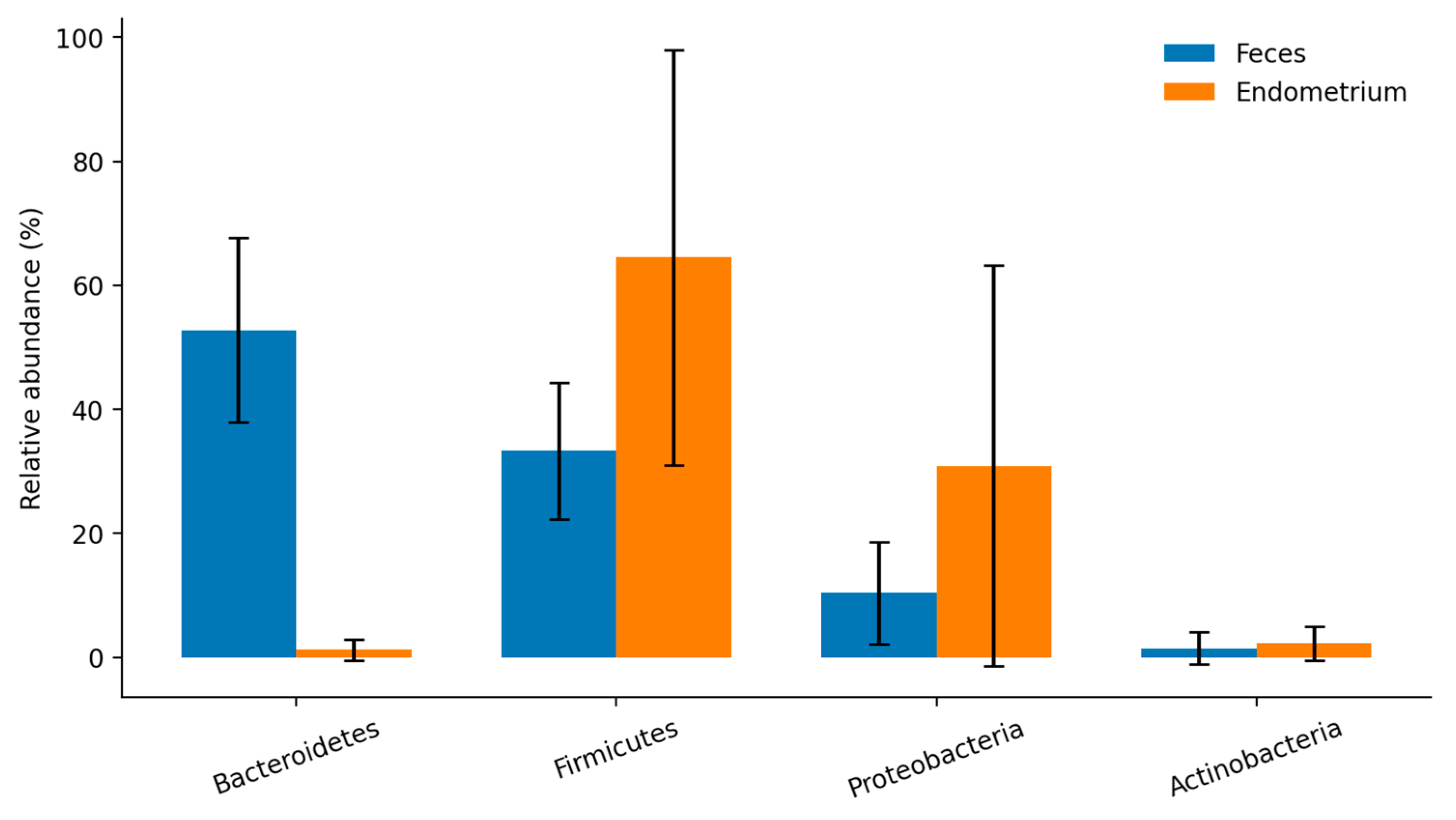

Table 1.
Baseline clinical and gastrointestinal characteristics.
| Variable | n (%) |
| Total sample | 21 |
| Chronic endometritis | 21 (100.0) |
| Microbiology examinations | |
| E. coli / Enterobacteriaceae | 18 (85.7) |
| Use of NSAIDs | 8 (38.1) |
| Previous antibiotic exposure | 18 (85.7) |
| Consumption of junk food | 21 (100.0) |
| Weekly consumption of legumes | 9 (42.9) |
| Regular physical activity | 2 (9.5) |
| Gastrointestinal diagnosis | |
| IBS-D | 3 (14.3) |
| IBS-C | 5 (23.8) |
| IBS-M | 1 (4.8) |
| Severe constipation | 12 (57.1) |
Values are reported as absolute frequencies and percentages.
Table 2.
Prevalence of intestinal and endometrial dysbiosis.
| Endometrial dysbiosis | |||
| Gut dysbiosis | No | Yes | |
| No | 0 | 1 | |
| Yes | 5 | 15 | |
Observed agreement: 71.4%. Expected agreement: 69.0%.
Table 3.
Microbial composition and alpha-diversity in paired fecal and endometrial samples.
| Variable | Feces | Endometrium | p-value |
|---|---|---|---|
| Bacteroidetes (%) | 52.8 (14.9) 58.2 [49.5–61.8] |
1.3 (1.7) 0.3 [0.2–2.7] |
<0.001 |
| Firmicutes (%) | 33.3 (11.0) 30.4 [28.4–32.9] |
64.5 (33.5) 69.9 [45.4–97.1] |
0.001 |
| Proteobacteria (%) | 10.4 (8.2) 9.0 [2.6–15.5] |
30.9 (32.3) 25.9 [1.6–50.6] |
0.053 |
| Actinobacteria (%) | 1.5 (2.6) 0.5 [0.3–1.6] |
2.3 (2.7) 1.0 [0.4–3.6] |
0.242 |
| Shannon Index | 3.8 (0.3) 3.9 [3.6–4.1] |
2.5 (0.8) 2.7 [1.9–3.2] |
<0.001 |
| Chao1 Index | 528.2 (90.7) 507.0 [453–606] |
359.5 (165.6) 275.0 [250–406] |
0.004 |
| Gini-Simpson Index | 0.9 (0.0) 1.0 [0.9–1.0] |
0.8 (0.2) 0.8 [0.7–0.9] |
<0.001 |
| Simpsons Dominance | 22.5 (7.4) 24.0 [16.3–27.4] |
6.7 (5.2) 4.7 [2.9–7.3] |
<0.001 |
Data are reported as mean (SD) and median [25th-75th percentile].
Disclaimer/Publisher’s Note: The statements, opinions and data contained in all publications are solely those of the individual author(s) and contributor(s) and not of MDPI and/or the editor(s). MDPI and/or the editor(s) disclaim responsibility for any injury to people or property resulting from any ideas, methods, instructions or products referred to in the content. |
© 2026 by the authors. Licensee MDPI, Basel, Switzerland. This article is an open access article distributed under the terms and conditions of the Creative Commons Attribution (CC BY) license.
Copyright: This open access article is published under a Creative Commons CC BY 4.0 license, which permit the free download, distribution, and reuse, provided that the author and preprint are cited in any reuse.