

Submitted:
15 July 2026
Posted:
20 July 2026
You are already at the latest version
Abstract
Scientific fields may fail in two opposing directions. Findings may be translated into stronger causal, clinical, or policy claims than the underlying evidence can support; alternatively, a research program may remain highly productive while repeatedly refining an established signal without addressing the uncertainty that matters most for decisions. This concept paper formalizes these complementary failures as Evidence Drift and Causal Maturation Drift. Evidence Drift is defined as unsupported movement of a finding into a stronger or different inferential domain. Causal Maturation Drift is defined as persistent lateral accumulation within an established or narrow evidentiary domain without proportionate progression toward temporality, mechanism, causal testing, comparative effectiveness, patient-important outcomes, or implementation. Inferential Fidelity is proposed as the governing principle linking claim calibration with purposeful research progression. Applications are illustrated using early childhood caries microbiome research, vitamin D and caries, silver diamine fluoride, biomarker discovery, and artificial-intelligence prediction studies. Two provisional instruments are introduced: an eight-item Evidence Drift Assessment Scale for claims, reviews, guidelines, and policies, and an eight-item Causal Maturation Drift Assessment Scale for literature trajectories and research portfolios. The scales use item-level ratings rather than validated diagnostic thresholds and are intended for structured appraisal, not for ranking researchers or journals. A phased validation program is proposed, involving content validation, cognitive testing, inter-rater reliability, construct testing, bibliometric trajectory mapping, and evaluation of practical utility. The Dual-Drift Framework offers a concise vocabulary for asking not only whether evidence is being carried too far, but also whether research activity is moving the field toward resolution of the questions that matter.
Keywords:
evidence drift
; causal maturation drift
; inferential fidelity
; causal inference
; translational research
; research waste
; meta-research
; assessment scale
; early childhood caries
1. Introduction
Translational frameworks describe how scientific observations can move from discovery to clinical application, evidence-based recommendations, implementation, and population benefit [1,2]. These pathways are neither automatic nor uniformly linear. Reviews of translational time lags show substantial variation in what is translated, how progression is measured, and the duration of different pathways [3]. The difficulty is therefore not simply that science moves slowly. More fundamentally, scientific activity may be poorly aligned with the inferential and clinical questions that remain unresolved.
Research-waste and meta-research literatures have documented preventable losses stemming from low-priority questions, avoidable design limitations, selective analysis, incomplete reporting, and weak placement of new studies within the existing evidence base [4,5,6,7,8]. Work on spin and inappropriate extrapolation has shown how statistically or clinically limited findings may be presented more favorably than warranted, while the surrogate-endpoint literature has long warned that improvement in an intermediate outcome does not automatically establish patient benefit [9,10,11]. These contributions identify major failures in the production and communication of evidence. However, they do not fully distinguish two opposing directional errors: moving a claim too far beyond the available evidence and failing to move a research trajectory toward resolution despite continued publication.
The first error is an inferential one. An association may be described as causal; a plausible mechanism may be treated as proof of effectiveness; a short-term therapeutic outcome may be presented as disease resolution; or uptake may be equated with equitable implementation. The second error is developmental. A field may generate additional cohorts, molecular profiles, predictive models, or short-term intervention estimates after the original signal has become sufficiently visible, yet devote comparatively little effort to the temporal, experimental, comparative, or implementation questions needed to reduce the most important remaining uncertainty.
This paper identifies these complementary failures, Evidence Drift and Causal Maturation Drift, and places both under the governing principle of Inferential Fidelity. An earlier field-specific preprint applied Evidence Drift to early childhood caries (ECC) using a causal-translation framework [17]. The present paper has a different purpose: to generalize these concepts beyond ECC, distinguish their units of analysis, propose a Dual-Drift Model, demonstrate applications across several research areas, and introduce preliminary assessment scales for empirical development.
The objectives are therefore to: (1) provide formal definitions and boundary conditions; (2) distinguish the constructs from spin, research waste, replication, and translational delay; (3) illustrate how the two drifts may occur independently or together; (4) propose scales at the claim and trajectory levels; and (5) outline a validation and implementation agenda.
2. Conceptual Positioning
2.1. Scientific Maturation Is Uncertainty Reduction, Not a Fixed Sequence
Causal inference requires explicit attention to temporality, confounding, selection, measurement, intervention contrasts, and the assumptions linking data to causal claims [12,13,14]. Triangulation strengthens inference when approaches with different, preferably unrelated, sources of bias address the same question [15,16]. Yet no universal study sequence is appropriate for every field. Ethical constraints may preclude randomization; rare outcomes may require observational designs; mechanisms may be investigated before or after population effects are observed; and implementation findings may generate reverse-translation questions.
Accordingly, maturation is defined here functionally rather than hierarchically: a research trajectory matures when successive studies reduce consequential uncertainty, clarify the conditions under which a claim is valid, or demonstrate that a hypothesis should be narrowed, redirected, or abandoned. Confirmation is not required. A null Mendelian-randomization analysis, a trial that weakens a plausible intervention claim, or an implementation study that reveals unacceptable inequity can all signal maturation because each improves decision-relevant understanding.
2.2. Different Units of Analysis
Evidence Drift is primarily assessed at the level of a claim: the conclusion of a study, the interpretation in a review, a recommendation in a guideline, or a policy statement. It may be identifiable within a single document. Causal Maturation Drift is assessed at the level of a trajectory: a body of literature, a research program, a technology pipeline, or a funding portfolio over time. An individual study may contribute to the pattern, but one study ordinarily cannot establish it.

Table 1.
Distinguishing the proposed constructs from adjacent concepts.
| Concept | Primary unit | What it describes | Key distinction |
| Evidence Drift | Claim, review, guideline, or policy statement | Unsupported movement into a stronger or different inferential domain | A directional error in interpretation or translation |
| Causal Maturation Drift | Literature trajectory, program, or portfolio | Persistent research activity without proportionate reduction of the principal causal or decision-relevant uncertainty | A longitudinal imbalance between evidence production and problem-resolving progression |
| Spin | Report or communication | Presentation that emphasizes favorable interpretations or minimizes unfavorable findings | Can occur without crossing evidentiary domains; Evidence Drift focuses specifically on inferential movement [9,10] |
| Research waste | Study, system, or research enterprise | Broad loss of value through irrelevant questions, poor design, non-publication, or unusable reporting | CMD may contribute to waste, but a technically sound study can still contribute to CMD if it repeatedly addresses a lower-priority uncertainty [4,5,6,7,8] |
| Translational gap or delay | Discovery-to-practice pathway | Failure or delay in moving sufficiently developed evidence into practice | CMD may occur before evidence is mature enough for translation and is not reducible to elapsed time [1,2,3] |
| Replication | Study or body of studies | Reassessment of a finding to establish robustness, generalizability, or effect modification | Necessary replication is not drift; CMD requires repetition after the signal is sufficiently characterized relative to the decision at hand |
| Hypothesis proliferation | Research field | Generation of many candidate explanations or signals | CMD concerns failure to mature consequential hypotheses, not the mere existence of multiple hypotheses |
3. Evidence Drift: Inferential Overextension
Evidence Drift (ED) is the movement of a finding toward a stronger or different causal, clinical, implementation, or policy claim without an adequate evidentiary bridge.
Crossing domains is not inherently problematic. Translation is essential. Drift occurs when the bridge is missing, inadequate, or hidden. Appropriate bridges may include temporal evidence, causal identification, experimental manipulation, a validated linkage between surrogate and patient-important outcomes, external validation, comparative effectiveness, implementation evaluation, or explicit retention of uncertainty and context.
Several recurring forms can be distinguished. Causal escalation occurs when an association is described as causation without an identification strategy. Mechanistic substitution occurs when biological plausibility is treated as proof that modifying the mechanism improves outcomes. Endpoint inflation occurs when an intermediate, short-term, or lesion-level outcome is expanded into a claim of disease resolution or comprehensive benefit. Contextual extrapolation occurs when findings from one population, setting, exposure range, or follow-up period are generalized without support. Implementation overreach occurs when efficacy, uptake, or reach is presented as proof of real-world effectiveness, sustainability, safety, or equity. These forms overlap with known categories of spin and surrogate misuse but are organized around the specific question of whether the conclusion has crossed an inferential boundary [9,10,11].
Evidence Drift can occur even when the underlying study is rigorous. A well-conducted cross-sectional study may support a robust association, yet a causal conclusion would still be inappropriate. A randomized trial may establish an effect on a narrow endpoint, yet a recommendation for long-term comprehensive care may still exceed the tested outcome. The construct therefore evaluates claim calibration rather than ranking study designs.
4. Causal Maturation Drift: Developmental Under-Resolution
Causal Maturation Drift is a persistent trajectory-level pattern in which a field continues to generate, replicate, or refine associative findings or narrow-domain outcomes after a signal has been sufficiently characterized, without proportional progress toward the temporal, mechanistic, causal, comparative, long-term, or implementation evidence required to resolve the principal decision-relevant uncertainty.
The defining movement is lateral rather than static. Publications, datasets, technologies, and analytic detail may increase, while the central question changes little. More precise descriptions of the same association, new subgroups using the same design, additional molecular signatures measured after disease onset, or repeated short-horizon estimates of the same therapeutic endpoint may all yield legitimate incremental knowledge. CMD is suspected only when these increments become persistently disproportionate to the unresolved bridge that matters most for causal understanding or patient care.
Four conditions should be considered before assigning the label. First, the trajectory and time window must be defined. Second, there must be a defensible basis for judging that the original signal is sufficiently characterized for the intended decision; this may rely on replication, systematic review, cumulative meta-analysis, or expert consensus. Third, the principal remaining uncertainty must be stated explicitly. Fourth, the lack of progression must not be adequately explained by scientific, ethical, feasibility, or resource constraints. CMD is therefore not a criticism of early discovery, necessary replication, understudied populations, or methodologically justified refinement.
Several manifestations are possible. Associative saturation refers to repeated exposure-outcome studies conducted after the signal is already stable. Mechanistic recursion refers to increasingly detailed laboratory or omics explanations that lack sufficient linkage to temporality or intervention. Technology-led refinement occurs when a new platform generates more granular versions of an established observation but does not answer the next clinical question. Endpoint confinement occurs when a therapeutic field repeatedly studies a narrow or short-term outcome while patient-important, comparative, or long-term outcomes remain underdeveloped. Implementation deferral occurs when evidence of efficacy continues to expand but delivery, safety, sustainability, and equity are repeatedly postponed.
The term causal is used deliberately but broadly. A causal program does not end when an exposure-effect estimate is obtained. Decision-relevant causal knowledge also requires understanding what happens when an exposure or intervention is modified, for whom, over what time, against which alternative, and under which delivery conditions. For this reason, CMD can be observed both upstream in etiological research and downstream when disease-control evidence fails to mature into comparative clinical and implementation knowledge.
Maturation should be judged by information gain rather than by confirmation. A research trajectory may mature by supporting a hypothesis, narrowing it to a subgroup, revealing effect modification, showing that a proposed mechanism is not clinically important, or determining that further investment is unjustified. The opposite of CMD is not a positive result; it is a disciplined reduction in the uncertainty that matters.
5. Inferential Fidelity and the Dual-Drift Model
Inferential Fidelity is the preservation of alignment among the question posed, the design used, the result obtained, the claim advanced, the uncertainty that remains, the next research step selected, and the safeguards maintained during implementation.
Inferential Fidelity has four linked dimensions. Question-design fidelity asks whether the method can answer the stated question. Result-claim fidelity asks whether the conclusion is proportional to the evidence. Uncertainty-next-study fidelity asks whether subsequent research targets the most consequential unresolved issue rather than merely reproducing the accessible one. Evidence-implementation fidelity asks whether real-world delivery preserves diagnosis, monitoring, safety, referral, patient-centered outcomes, and equity, when relevant.
The Dual-Drift Model therefore distinguishes two axes (Figure 1). A field may have low Evidence Drift but high CMD: authors describe associations cautiously, yet the literature remains trapped in repetitive descriptive work. It may have high Evidence Drift but low CMD: a rapidly maturing evidence base is nevertheless communicated with overconfident conclusions. The greatest concern arises when both are high—immature evidence is repeatedly generated and simultaneously translated beyond its limits.
Table 2.
Dual-Drift profiles and their interpretation.
| Evidence Drift risk | Causal Maturation Drift risk | Profile | Interpretation and response |
| Low | Low | Disciplined progression | Claims remain calibrated and the trajectory addresses consequential uncertainty. Preserve the balance and continue periodic reassessment. |
| High | Low | Inferential overextension | Evidence is progressing, but conclusions or recommendations exceed the available support. Tighten language, identify the missing bridge, and retain uncertainty. |
| Low | High | Cautious but under-resolving | Authors remain appropriately qualified, but the field repeatedly studies the established signal. Redirect part of the portfolio toward the unresolved bridge. |
| High | High | Dual drift | Evidence volume may be mistaken for maturity while conclusions move beyond support. Recalibrate claims and redesign the research portfolio. |
The Dual-Drift Model treats Evidence Drift and Causal Maturation Drift as independent dimensions. This yields four profiles, each with a distinct corrective response. The greatest concern arises when immature or under-resolving evidence is repeatedly generated and simultaneously translated beyond its limits (Figure 2).
6. Applications and Illustrative Examples
The examples below are analytical illustrations rather than accusations that every study or investigator in a field commits drift. A formal diagnosis of CMD would require systematic mapping of the trajectory and its unresolved uncertainties.
6.1. Oral Microbiome Research in Early Childhood Caries
Cross-sectional microbiome studies can identify ecological differences between children with and without severe ECC and generate biologically plausible hypotheses [18,19]. This pattern is not isolated. The Schroth group has produced a sustained line of cross-sectional and association-based ECC research spanning nearly two decades, examining determinants ranging from vitamin D status and feeding practices to oral microbiome composition and taste genetics [18,19,20,21,22,23,24]. While each study adds useful descriptive data, the cumulative trajectory has remained predominantly associative: repeated cross-sectional profiling of microbial taxa, nutritional markers, or behavioral factors in relation to ECC status, with comparatively limited progression toward longitudinal, interventional, or mechanistic testing. The recent work on Rothia and feeding practices [20] exemplifies this pattern—an interesting associative signal that awaits temporal and functional validation before it can inform causal understanding or clinical action. The summary of the argument established by association-based ECC research is below:
Summary of the Argument Established
| Timeframe | Study | Design | Association Tested |
| 2005 | Schroth & Moffatt | Cross-sectional pilot | Determinants of ECC in rural Manitoba |
| 2007 | Schroth & Cheba | Cross-sectional | Prevalence and risk factors in a community dental clinic |
| 2025 | Lee et al. | Cross-sectional | Nutritional status and Veillonella with caries |
| 2025 | Khan et al. | Case-control | Taste genetics and dental plaque microbiome |
| 2026 | Szeto et al. | Cross-sectional | Feeding practices, Rothia, and ECC |
Evidence Drift occurs when a microbial profile obtained after disease is established is presented as proof that certain organisms initiated the disease. The same profile may reflect cause, consequence, mediation by frequent sugar exposure, or ecological adaptation to the established lesion environment.
CMD would be suspected if successive studies primarily add taxonomic resolution, new sequencing platforms, or additional cross-sectional subgroups, while pre-lesion longitudinal sampling, functional studies, perturbation experiments, and interventions capable of testing whether modifying the microbial ecology changes lesion development remain persistently scarce. The inferentially faithful response is twofold: retain descriptive claims at the appropriate level and rebalance future work toward temporality and modifiability.
6.2. Vitamin D and Dental Caries as an Example of Maturation Through Constraint
Observational studies have reported associations between vitamin D status and childhood caries. A direct recommendation that supplementation prevents ECC would constitute Evidence Drift unless supported by causal and intervention evidence. In this trajectory, however, Mendelian-randomization analyses and a dose-comparison trial subsequently tested stronger versions of the hypothesis and did not support broad stand-alone preventive claims [25,26].
This example shows why maturation should not be equated with confirmation. The trajectory matured as the claim became more constrained and clinically precise. Continued work may still be justified for severely deficient or biologically distinct subgroups, but the next study should be selected to address a specified residual uncertainty—not merely because another observational dataset is available.
6.3. Silver Diamine Fluoride: Disease Control, Endpoint Inflation, and Downstream Maturation
Silver diamine fluoride (SDF) has evidence supporting the arrest of cavitated caries lesions, although certainty and applicability vary across comparisons and outcomes [28,29]. Evidence Drift occurs when lesion arrest is extended to claims of etiological prevention, restoration of form and function, completion of care, or proof that a simplified delivery pathway is equitable. These claims require additional diagnostic, restorative, longitudinal, and implementation evidence [30].
A downstream form of CMD may arise if the literature continues to refine short-term arrest percentages while longer-term recurrence, symptoms, pulpal outcomes, comparative effectiveness, definitive-care completion, caregiver-centered outcomes, and equity receive less attention. This is not associative drift; it is endpoint confinement within a disease-control domain. The correction is not to abandon SDF research but to mature the portfolio toward the outcomes needed to define its proper place within comprehensive care.
6.4. Biomarker and Omics Pipelines
Biomarker science offers a general example beyond dentistry. Large numbers of disease-associated markers may be reported, yet comparatively few achieve reliable clinical validation or demonstrate utility in routine care [31,32]. Evidence Drift occurs when statistical association, discrimination, or mechanistic plausibility is treated as proof of diagnostic benefit or improved outcomes. CMD occurs when discovery and internal validation continue to dominate, while external validation, incremental value over existing care, clinical utility, cost-effectiveness, and deimplementation of nonuseful markers remain underdeveloped.
6.5. Artificial-Intelligence Prediction Studies
Artificial-intelligence systems may show high accuracy on retrospective datasets or perform favorably compared with clinicians, but such performance does not establish benefit in live clinical workflows. Reviews have identified limited prospective and real-world evaluation in parts of the medical-imaging literature, and stage-specific guidance now emphasizes early clinical evaluation, safety, human factors, and actual use [33,34]. Evidence Drift occurs when model discrimination is translated directly into claims of improved care. CMD occurs when successive models, architectures, and internal validations accumulate while prospective impact, workflow integration, fairness, safety, and patient outcomes remain deferred.
Table 3.
Applications of the Dual-Drift Framework.
| Trajectory | Valid contribution | Evidence Drift | Causal Maturation Drift | Inferentially faithful correction |
| ECC microbiome | Describes microbial ecology and generates hypotheses | Post-disease profile is presented as proof of disease initiation | Repeated profiling outpaces pre-lesion longitudinal, functional, and perturbation research | Qualify causal language and direct the next studies toward temporality and modifiability |
| Vitamin D and caries | Identifies an observational signal and plausible pathways | Association is translated directly into supplementation advice | Would occur if association studies continued without causal tests | Use triangulation and trials; allow the hypothesis to be narrowed or weakened |
| SDF | Estimates lesion-arrest effects within disease control | Arrest is presented as prevention, restoration, or completion of care | Short-term arrest remains dominant while long-term pathway outcomes lag | Preserve the endpoint boundary and mature research toward comparative, patient-centered, and implementation outcomes |
| Biomarkers/omics | Discovers candidate markers and mechanisms | Association or discrimination is presented as a clinical utility | Discovery proliferates without external validation and impact assessment | Prioritize incremental value, utility, and implementation |
| Clinical AI | Develops and validates prediction or decision-support systems | Retrospective performance is presented as improved patient care | Model development accumulates while prospective clinical evaluation is delayed | Evaluate live workflow, safety, fairness, decisions, and outcomes |
7. Preliminary Dual-Drift Assessment Scales
7.1. Purpose and Scoring Principles
The following instruments are proposed as preliminary appraisal scales, not as validated diagnostic tools. Their immediate purpose is to make judgments explicit and sufficiently reproducible for empirical testing. Higher scores indicate greater concern. Each applicable item is scored 0 (no concern), 1 (partial, ambiguous, or emerging concern), or 2 (clear concern). Items that are genuinely not applicable may be omitted. A standardized score can be calculated as: 100 × observed item sum ÷ maximum possible sum for applicable items. Until validation establishes thresholds, scores should be reported continuously, along with the item profile; categorical labels should not be used as if they were validated cut points.
The two scales should not be collapsed into a single number because they measure different units. The Evidence Drift Assessment Scale (EDAS) evaluates a claim or recommendation, while the Causal Maturation Drift Assessment Scale (CMDAS) evaluates a defined trajectory over time. When a claim can be situated within a mapped trajectory, the two standardized scores may be displayed as a two-axis Inferential Fidelity Profile.
7.2. Evidence Drift Assessment Scale (EDAS)
Table 4.
Preliminary Evidence Drift Assessment Scale (EDAS).
| Item | Appraisal question | Scoring anchors |
| 1. Domain congruence | Does the conclusion answer the same inferential question that the study or evidence synthesis actually addressed? | 0 = Same domain 1 = Boundary is blurred 2 = Stronger or different domain |
| 2. Causal escalation | Is causal language proportionate to temporality, confounding control, identification assumptions, and the design? | 0 = Proportionate 1 = Partly overstated or unclear 2 = Association presented as causation |
| 3. Mechanism or surrogate substitution | Is plausibility a biomarker or an intermediate outcome used as evidence of clinical or population benefit? | 0 = No substitution 1 = Qualification incomplete 2 = Substitution is explicit or functionally implied |
| 4. Outcome-scope inflation | Is a narrow, lesion-level, short-term, or process outcome expanded to disease resolution, comprehensive care, or patient benefit? | 0 = Outcome boundary retained 1 = Some inflation 2 = Clear inflation |
| 5. Contextual extrapolation | Are population, setting, exposure range, comparator, follow-up, or delivery conditions generalized beyond the support? | 0 = Context retained 1 = Limited unsupported extrapolation 2 = Broad unsupported extrapolation |
| 6. Uncertainty retention | Does the conclusion preserve relevant uncertainty, alternative explanations, heterogeneity, and limitations? | 0 = Preserved 1 = Selectively attenuated 2 = Material uncertainty suppressed |
| 7. Implementation/policy proportionality | Are efficacy, uptake, or reach equated with real-world effectiveness, sustainability, safety, equity, or replacement of the standard of care? | 0 = No overreach 1 = Partial overreach 2 = Clear overreach |
| 8. Bridging-evidence transparency | Does the report identify what additional evidence would be required before advancing the stronger claim? | 0 = Bridge explicit 1 = Bridge vague 2 = Bridge absent while a stronger claim is advanced |
EDAS interpretation. Use the standardized score and the item-level pattern. At least six applicable items are recommended for a provisional total. A high score on a single critical item—such as unsupported causation or replacement of comprehensive care—should remain visible even when the overall score is modest.
7.3. Causal Maturation Drift Assessment Scale (CMDAS)
CMDAS begins with an eligibility gate. The assessor must define the research trajectory and time window, justify that the original signal is sufficiently characterized for the intended decision, and identify the principal unresolved uncertainty. If these conditions cannot be met, the trajectory should be mapped descriptively rather than labeled CMD. Cumulative review methods can help determine when additional same-design studies are likely to yield diminishing information value [35,36].
Table 5.
Preliminary Causal Maturation Drift Assessment Scale (CMDAS).
| Item | Trajectory-level appraisal question | Scoring anchors |
| Eligibility gate (not scored) | Are the trajectory, time window, maturity of the initial signal, and the principal unresolved uncertainty explicitly defined? | Proceed only when adequately specified. Otherwise, map the evidence without assigning a drift score. |
| 1. Same-domain accumulation | After signal establishment, do similar designs, exposures, populations, or outcomes continue to dominate? | 0 = Balanced progression 1 = Emerging concentration 2 = Persistent concentration |
| 2. Marginal uncertainty reduction | Do later studies add detail or precision but make little progress on the primary unresolved uncertainty? | 0 = Material reduction 1 = Mixed contribution 2 = Predominantly marginal |
| 3. Recurrent unresolved limitation | Does the same major limitation recur across publications without being directly addressed? | 0 = Limitation addressed 1 = Partial progress 2 = Persistent recurrence |
| 4. Missing temporal/causal bridge | Are designs capable of clarifying temporality, confounding, intervention effects, or counterfactual contrasts delayed or underrepresented? | 0 = Appropriate bridge evidence present 1 = Incomplete 2 = Persistently underrepresented |
| 5. Limited triangulation | Does the field rely heavily on methods that share similar biases rather than combining approaches with different bias structures? | 0 = Strong triangulation 1 = Limited triangulation 2 = Single-method dependence |
| 6. Endpoint confinement | Does research remain focused on surrogate, short-term, technical, or narrowly defined outcomes despite broader clinical questions? | 0 = Broader outcomes developed 1 = Partial confinement 2 = Persistent confinement |
| 7. Translation/implementation deferral | When evidence maturity warrants it, are comparative effectiveness, implementation, safety, sustainability, and equity repeatedly postponed? | 0 = Timely progression 1 = Partial deferral 2 = Persistent deferral |
| 8. Portfolio alignment | Do funding and publication patterns remain disproportionately aligned with an established signal or with available technology rather than with the highest-value uncertainty? | 0 = Aligned with key uncertainty 1 = Mixed alignment 2 = Clear imbalance |
CMDAS interpretation. Use the standardized score and item profile only after the eligibility gate is met. At least six scored items are recommended. Ethical constraints, low prevalence, the need for external replication, emerging measurement validity, and the lack of feasible interventions should be documented before interpreting a high score as avoidable drift.
7.4. Operational Guidance for Threshold Judgments
Explicit decision rules are needed for the CMDAS eligibility gate and for distinguishing between a score of 1 (emerging concern) and 2 (persistent concern). Without such guidance, the framework risks subjective overapplication. The following operational heuristics are proposed for empirical testing and refinement.
A. Judgment 1: Is the signal “sufficiently characterized” for the intended decision? (Eligibility Gate?)
A signal is sufficiently characterized when additional studies using the same design, exposure definition, outcome, and population are unlikely to materially alter the direction or approximate magnitude of the effect for the decision at hand. Assessors should consider:
- Cumulative meta-analysis: If the pooled estimate's 95% confidence interval is narrow enough to exclude clinically or practically meaningful effects (or to establish a stable association), the signal meets the characterization. For example, in the vitamin D–caries trajectory, Mendelian randomization and trials produced pooled estimates that, although not uniformly null, narrowed the plausible effect size, making broad population supplementation claims no longer tenable.
- Consistency across replications: If at least three high-quality, independent studies (using similar designs) show consistent direction and magnitude, and additional replications are unlikely to alter the qualitative interpretation, the signal may be deemed characterized.
- Expert or guideline consensus: Formal consensus statements, living systematic reviews, or guideline panels that explicitly state that the evidence is sufficient to inform a specific decision (e.g., “no further association studies are needed before moving to intervention testing”) can serve as a valid basis.
Example (passed gate): A field has five cross-sectional studies and three prospective cohort studies, all consistently showing that exposure X is associated with outcome Y (OR ~1.5, 95% CI 1.3–1.7). The principal unresolved uncertainty is whether modifying X changes Y. The signal is characterized; the gate is passed, and CMDAS may be applied.
Example (failed gate): A novel biomarker has only two small, heterogeneous case–control studies with conflicting results. The signal remains uncharacterized. CMDAS should not be applied; the trajectory is still in early discovery. The assessor should map the evidence descriptively without assigning a drift score.
B. Judgment 2: When does “emerging concentration” (score 1) become “persistent concentration” (score 2)?
The distinction hinges on time, proportion, and opportunity.
- Proportion rule: Over the most recent 3–5 years, if >60% of publications addressing the core question use the same design, exposure, and outcome without adding a new inferential bridge, score 2 (persistent concentration). If 30–60%, score 1 (emerging); if <30%, score 0 (balanced).
- Time rule: If the same major limitation (e.g., cross-sectional design, lack of long-term follow-up) has been explicitly acknowledged in the discussion sections of at least three consecutive review articles or guideline updates spanning more than three years, and no corresponding increase in studies addressing that limitation has occurred, score 2.
- Opportunity rule: If feasible methods to address residual uncertainty exist—and have been published in related fields—but are absent from the target trajectory despite repeated calls for them, score 2. If methods are not yet feasible, ethically constrained, or require substantial infrastructure, score 1 or 0, with documented justification.
Worked threshold example:
Trajectory: Ten-year portfolio focused on salivary miRNA biomarkers for early detection of oral squamous cell carcinoma.
- 45 cross-sectional case–control studies (discovery and validation).
- 2 prospective cohort studies (but both small, single-centre).
- 0 studies examining whether screening alters stage at diagnosis, treatment pathways, or survival.
- Reviews over the past four years repeatedly state: “Prospective, population-based validation and clinical utility studies are urgently needed.”
Threshold application:
- Signal characterization: Pooled AUCs are stable across 10+ studies (AUC ~0.85, narrow CI). The signal is characterized as associated.
- CMDAS item 1 (Same-domain accumulation): >70% of the recent portfolio is cross-sectional → score 2.
- Item 7 (Implementation deferral): Clinical utility studies are feasible (analogous studies exist in breast cancer) but are absent → score 2.
- The residual uncertainty (prospective clinical impact) is clearly stated and unchanged across reviews → the trajectory shows persistent CMD (score ≥2 on multiple items).
C. Handling ambiguous cases
When thresholds are not clearly met, assessors should:
- Score conservatively (i.e., 0 or 1) and document the ambiguity in a narrative annex.
- Seek a second independent scoring, especially for high-stakes applications (e.g., funding portfolio reallocation).
- Use the item profile rather than the total score as the primary diagnostic output; a score of 2 on a single critical item (e.g., persistent lack of temporality) may warrant action even if other items score 0–1
7.5. Worked Use of the Scales
The scales are intended to separate claim appraisal from trajectory appraisal. A cross-sectional ECC microbiome paper concluding that a microbial signature causes disease would raise EDAS concerns about domain incongruence, causal escalation, uncertainty attenuation, and missing bridging evidence. A ten-year microbiome portfolio dominated by post-disease cross-sectional profiling, with the same limitation of temporality repeatedly acknowledged, could raise CMDAS concerns about same-domain accumulation, recurrent limitation, missing temporal bridge, and limited triangulation.
By contrast, the vitamin D–caries trajectory illustrates how Mendelian randomization and intervention evidence can reduce CMDAS concerns, even when those studies weaken the original claim. An SDF policy that equates program reach with complete and equitable care could score highly on EDAS implementation overreach, while the associated research portfolio might show CMDAS endpoint confinement if long-term pathway outcomes remain insufficiently developed.
8. Uses in Research, Review, Funding, and Policy
For investigators, the Dual-Drift Framework adds a portfolio question to ordinary study design: what uncertainty will this study materially reduce? A technically rigorous study may still have low marginal value if it merely reproduces the established signal, while a more consequential bridge remains untouched. This does not imply that every project must be a trial or an implementation study. It requires an explicit explanation of why the selected design is the appropriate next step.
For peer reviewers and editors, EDAS provides a structured way to assess whether titles, abstracts, conclusions, and recommendations preserve inferential boundaries. Systematic reviewers can go further by mapping the distribution of designs and outcomes over time and noting whether the same unresolved limitation recurs. For funders and research networks, CMDAS may support portfolio mapping by identifying imbalances among discovery, causal testing, comparative effectiveness, and implementation. Such use should guide priorities rather than punish individual researchers.
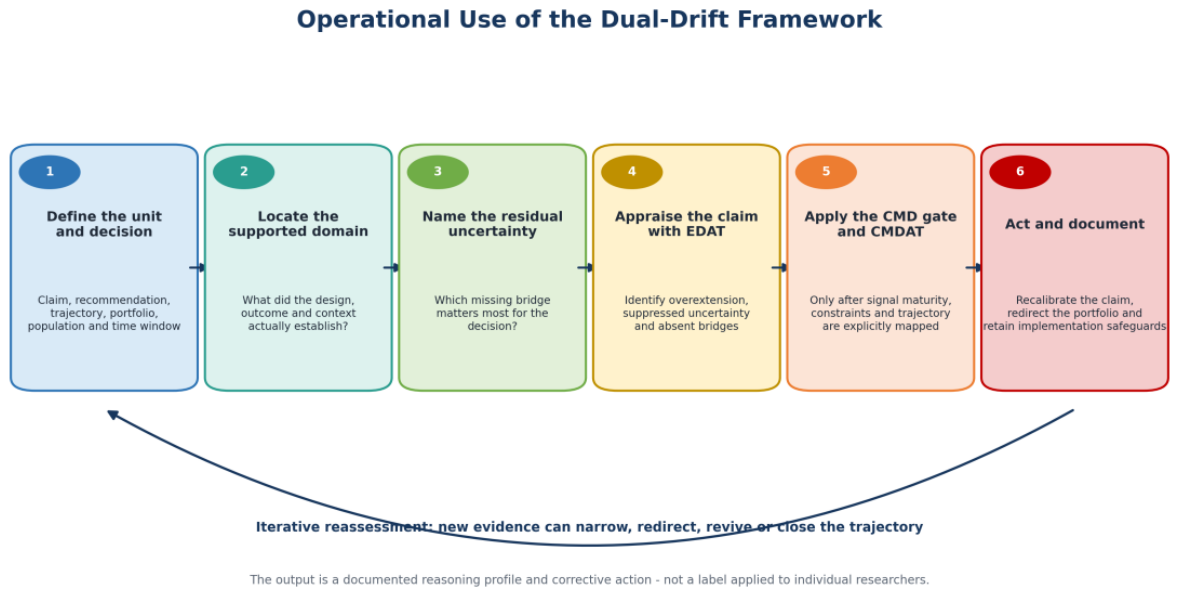
For guideline panels and policymakers, the framework separates intervention efficacy from delivery fidelity. Implementation frameworks such as RE-AIM and CFIR already emphasize reach, effectiveness, adoption, implementation, context, and maintenance [37,38]. The Dual-Drift contribution is earlier and complementary: before asking how an intervention should be scaled, decision-makers should verify that the clinical or policy claim being implemented is supported and that unresolved evidence has not been mistaken for maturity simply because the literature is large (Figure 3).
9. Validation Roadmap
The proposed scales require empirical development before they are used for formal judgments. Scale-development principles emphasize clear construct definition, item generation, expert review, cognitive testing, reliability assessment, and multiple forms of validity evidence [39,40]. A phased program is proposed.
Phase 1 should establish content validity and boundary conditions through a two- or three-round Delphi process with causal-inference researchers, clinicians, epidemiologists, implementation scientists, systematic reviewers, journal editors, funders, bibliometricians, and patient or public representatives. The panel should assess item relevance, clarity, and redundancy, and determine whether each item belongs to the claim-level or trajectory-level construct.
Phase 2 should use cognitive interviews and pilot scoring to assess whether users interpret the items consistently. Illustrative vignettes should include clearly calibrated claims, obvious overextensions, fields at an early stage of discovery, mature trajectories, and plausible cases of lateral accumulation. Item wording and scoring anchors should be revised before reliability testing.
Phase 3 should assess inter-rater reliability using purposive samples of articles, abstracts, guideline statements, and mapped research trajectories. Both overall and item-level agreement should be reported using appropriate chance-corrected statistics; continuous standardized scores may also be examined using intraclass correlation. Training requirements and time to completion should be measured.
Phase 4 should assess construct validity. Known-groups testing could compare intentionally overextended conclusions with evidence-calibrated conclusions and examine research fields selected by independent experts as differing in maturity. Convergent relationships with established spin classifications, research-waste indicators, and translational-stage mapping should be examined, while discriminant validity should confirm that EDAS and CMDAS remain related but nonidentical.
Phase 5 should map trajectories both bibliometrically and substantively. Candidate indicators include the distribution of designs over time, the time from signal recognition to the first temporally informative or experimental study, the ratio of same-domain to bridge studies, persistence of repeated limitations, movement from surrogate to patient-important outcomes, and funding distribution across stages. Predictive validity could assess whether higher CMDAS profiles are associated with slower resolution of the prespecified clinical question, while recognizing that no single gold standard exists.
Phase 6 should assess practical utility and responsiveness across manuscript review, postgraduate education, guideline development, and funding-priority exercises. The final instruments may require field-specific guidance, but the core constructs should remain stable.
10. Limitations and Safeguards Against Misuse
The framework is conceptual, and the scales are unvalidated. The threshold for a signal to be "sufficiently characterized" will vary by decision, population, expected effect size, measurement quality, and consequences of error. Some trajectories mature slowly for legitimate reasons, including ethical limits on experimentation, rare outcomes, long latency, inadequate measurement, and the absence of feasible interventions. The framework should not be used retrospectively to imply negligence or motive.
The examples are selective and do not constitute systematic reviews of the fields represented. Formal CMD assessment requires explicit trajectory mapping and should not be inferred merely from the perception that "many similar papers" exist. Moreover, research maturation is iterative: implementation may reveal new mechanisms, null trials may revive measurement questions, and subgroup findings may justify renewed association work. The model therefore rejects a rigid ladder while demanding clarity about the next consequential uncertainty.
Finally, scale scores should not be used to rank individual scientists, journals, or disciplines until validated. The appropriate target is the alignment of claims and portfolios, not blame. Item profiles may ultimately be more informative than total scores because a single severe inferential leap or a single persistently neglected bridge can be consequential even when other dimensions are strong.
11. Conclusion
Scientific progress can fail by moving too far or not far enough. Evidence Drift captures inferential overextension: a claim outpaces the evidence that supports it. Causal Maturation Drift captures developmental under-resolution: research activity expands, but the principal causal or clinical uncertainty does not mature in proportion. Inferential Fidelity requires both disciplined translation and purposeful progression.
The proposed Dual-Drift Framework and preliminary scales offer a testable starting point for evaluating claims, literature trajectories, and research portfolios. Their central question is simple yet demanding: does the evidence support the claim, and does the next study address the uncertainty that matters most? Scientific maturity should be judged not only by the number of findings produced but also by how effectively uncertainty is reduced and patient-relevant knowledge is advanced.
Author Contributions
Conceptualization, methodology, framework development, writing—original draft, and writing—review and editing: Z.D.B.
Funding
This research received no external funding.
Institutional Review Board Statement
Not applicable.
Informed Consent Statement
Not applicable.
Data Availability Statement
No new data were created or analyzed.
Conflicts of Interest
The author declares no conflicts of interest.
Related Work Statement
A field-specific manuscript applying Evidence Drift to early childhood caries is under editorial consideration, and a related preprint is publicly available [17]. The present article differs in purpose and content: it introduces Causal Maturation Drift as a general trajectory-level construct, develops the Dual-Drift Model, extends applications beyond early childhood caries, and proposes the EDAS and CMDAS. No tables or figures are reproduced from the related manuscript.
Glossary of Key Terms
Glossary
| Term | Definition |
| Associative saturation | Repeated exposure–outcome studies conducted after the association has already been characterized with sufficient stability for the decision at hand; a manifestation of Causal Maturation Drift. |
| Causal escalation | Describing an association as causation without an adequate identification strategy (e.g., no temporality, no control for confounding, no explicit assumptions). A form of Evidence Drift. |
| Causal Maturation Drift (CMD) | A persistent trajectory-level pattern in which a field continues to generate, replicate, or refine findings within an established narrow domain, without proportionate progress toward the temporal, mechanistic, causal, comparative, long-term, or implementation evidence needed to resolve the principal decision-relevant uncertainty. |
| Contextual extrapolation | Generalizing findings from one population, setting, exposure range, comparator, or follow-up period to another without empirical or theoretical support. This is a form of Evidence Drift. |
| Dual-Drift Framework | A conceptual model that distinguishes two complementary failures—Evidence Drift (inferential overextension) and Causal Maturation Drift (developmental under-resolution)—is unified under the principle of Inferential Fidelity. |
| Endpoint confinement | Persistent focus on a narrow, surrogate, short-term, or technical outcome, while patient-important, comparative, or long-term outcomes remain underdeveloped. A manifestation of Causal Maturation Drift. |
| Endpoint inflation | Expanding a narrow, lesion-level, short-term, or process outcome into a claim of disease resolution, comprehensive benefit, or patient-important outcome. This is a form of Evidence Drift. |
| Evidence Drift (ED) | The movement of a finding toward a stronger or different causal, clinical, implementation, or policy claim without an adequate evidentiary bridge. Assessed at the claim level. |
| Evidence-Implementation Fidelity | The preservation of diagnostic accuracy, monitoring, safety, referral pathways, patient-centered outcomes, and equity when translating evidence into real-world delivery. A dimension of Inferential Fidelity. |
| Implementation deferral | Repeated postponement of studies on delivery, safety, sustainability, equity, or comparative effectiveness after efficacy is established. A manifestation of Causal Maturation Drift. |
| Implementation overreach | Equating efficacy, uptake, or reach with proof of real-world effectiveness, sustainability, safety, equity, or replacement of the standard of care is a form of Evidence Drift. |
| Inferential Fidelity | The preservation of alignment among the question posed, the design used, the result obtained, the claim advanced, the uncertainty that remains, the next research step selected, and the safeguards maintained during implementation. |
| Lateral accumulation | Growth in publications, datasets, or analytical detail that does not proportionally improve the resolution of the central inferential or clinical question. The defining movement of Causal Maturation Drift. |
| Mechanistic recursion | Increasingly detailed laboratory or omics explanations that lack sufficient linkage to temporality, intervention, or clinically modifiable targets. This is a manifestation of Causal Maturation Drift. |
| Mechanistic substitution | Treating biological plausibility or a biomarker as proof that modifying a mechanism improves patient or population outcomes. A form of Evidence Drift. |
| Question-Design Fidelity | The extent to which the chosen study design can validly answer the stated research question. A dimension of Inferential Fidelity. |
| Result-Claim Fidelity | The proportionality between the evidence obtained (including its limitations) and the conclusion or recommendation advanced. A dimension of Inferential Fidelity. |
| Scientific maturation (functional definition) | Reducing consequential uncertainty, clarifying the conditions under which a claim is valid, or demonstrating that a hypothesis should be narrowed, redirected, or abandoned. Maturation is not equated with confirmation. |
| Technology-led refinement | Use of a new platform to generate more granular versions of an established observation without answering the next clinical or inferential question. This is a manifestation of Causal Maturation Drift. |
| Triangulation | The use of multiple approaches with different, preferably unrelated, sources of bias to address the same causal or clinical question strengthens inference when findings converge. |
| Uncertainty-Next-Study Fidelity | The alignment of subsequent research with the most consequential unresolved issue, rather than merely reproducing the most accessible finding. This is a dimension of Inferential Fidelity. |
List of Abbreviations and Acronyms
ED – Evidence Drift
CMD – Causal Maturation Drift
EDAS – Evidence Drift Assessment Scale
CMDAS – Causal Maturation Drift Assessment Scale
ECC – Early Childhood Caries
SDF – Silver Diamine Fluoride
AI – Artificial Intelligence
RE-AIM – Reach, Effectiveness, Adoption, Implementation, Maintenance
CFIR – Consolidated Framework for Implementation Research
References
- Woolf, S.H. The meaning of translational research and why it matters. JAMA 2008, 299(2), 211–213. [Google Scholar] [CrossRef] [PubMed]
- Khoury, M.J.; Gwinn, M.; Yoon, P.W.; Dowling, N.; Moore, C.A.; Bradley, L. The continuum of translation research in genomic medicine: how can we accelerate the appropriate integration of human genome discoveries into health care and disease prevention? Genet Med. 2007, 9(10), 665–674. [Google Scholar] [CrossRef] [PubMed]
- Morris, Z.S.; Wooding, S.; Grant, J. The answer is 17 years, what is the question: understanding time lags in translational research. J. R Soc. Med. 2011, 104(12), 510–520. [Google Scholar] [CrossRef] [PubMed]
- Chalmers, I.; Glasziou, P. Avoidable waste in the production and reporting of research evidence. Lancet 2009, 374(9683), 86–89. [Google Scholar] [CrossRef] [PubMed]
- Macleod, M.R.; Michie, S.; Roberts, I.; Dirnagl, U.; Chalmers, I.; Ioannidis, J.P.A.; et al. Biomedical research: increasing value, reducing waste. Lancet 2014, 383(9912), 101–104. [Google Scholar] [CrossRef] [PubMed]
- Ioannidis, J.P.A.; Greenland, S.; Hlatky, M.A.; Khoury, M.J.; Macleod, M.R.; Moher, D.; et al. Increasing value and reducing waste in research design, conduct, and analysis. Lancet 2014, 383(9912), 166–175. [Google Scholar] [CrossRef] [PubMed]
- Ioannidis, J.P.A.; Fanelli, D.; Dunne, D.D.; Goodman, S.N. Meta-research: evaluation and improvement of research methods and practices. PLoS Biol. 2015, 13(10), e1002264. [Google Scholar] [CrossRef] [PubMed]
- Ioannidis, J.P.A. Why most clinical research is not useful. PLoS Med. 2016, 13(6), e1002049. [Google Scholar] [CrossRef] [PubMed]
- Boutron, I.; Dutton, S.; Ravaud, P.; Altman, D.G. Reporting and interpretation of randomized controlled trials with statistically nonsignificant results for primary outcomes. JAMA 2010, 303(20), 2058–2064. [Google Scholar] [CrossRef] [PubMed]
- Yavchitz, A.; Ravaud, P.; Altman, D.G.; Moher, D.; Hrobjartsson, A.; Lasserson, T.; Boutron, I. A new classification of spin in systematic reviews and meta-analyses was developed and ranked according to severity. J. Clin. Epidemiol. 2016, 75, 56–65. [Google Scholar] [CrossRef] [PubMed]
- Fleming, T.R.; DeMets, D.L. Surrogate end points in clinical trials: are we being misled? Ann. Intern Med. 1996, 125(7), 605–613. [Google Scholar] [CrossRef] [PubMed]
- Rothman, K.J.; Greenland, S. Causation and causal inference in epidemiology. Am. J. Public Health 2005, 95 (Suppl 1), S144–S150. [Google Scholar] [CrossRef] [PubMed]
- Hernán, M.A.; Robins, J.M. Causal Inference: What If; Chapman & Hall/CRC: Boca Raton, FL, 2020. [Google Scholar]
- Pearl, J. Causality: Models, Reasoning, and Inference, 2nd ed.; Cambridge University Press: Cambridge, 2009. [Google Scholar]
- Lawlor, D.A.; Tilling, K.; Davey Smith, G. Triangulation in aetiological epidemiology. Int. J. Epidemiol. 2016, 45(6), 1866–1886. [Google Scholar] [CrossRef] [PubMed]
- Munafò, M.R.; Davey Smith, G. Robust research needs many lines of evidence. Nature 2018, 553(7689), 399–401. [Google Scholar] [CrossRef] [PubMed]
- Baghdadi, Z.D. Evidence Drift in Early Childhood Caries Research: A Six-Domain Causal-Translation Framework. Preprint 2026. [Google Scholar] [CrossRef]
- Agnello, M.; Marques, J.; Cen, L.; Mittermuller, B.; Huang, A.; Chaichanasakul Tran, N.; et al. Microbiome associated with severe caries in Canadian First Nations children. J. Dent. Res. 2017, 96(12), 1378–1385. [Google Scholar] [CrossRef] [PubMed]
- Tanner, A.C.R.; Kent, R.L.; Holgerson, P.L.; Hughes, C.V.; Loo, C.Y.; Kanasi, E.; et al. Microbiota of severe early childhood caries before and after therapy. J. Dent. Res. 2011, 90(11), 1298–1305. [Google Scholar] [CrossRef] [PubMed]
- Szeto, A.; Khan, M.W.; de Jesus, V.C.; Balshaw, R.; Menon, A.; Mittermuller, B.A.; Baltus, T.H.; Chelikani, P.; Schroth, R.J. The association between exclusive breastfeeding, bottle-feeding, and oral Rothia on early childhood caries. Pediatr. Dent. 2026, 48(3), 169–176. [Google Scholar] [PubMed]
- Schroth, R.J.; Moffatt, M.E. Determinants of early childhood caries in a rural Manitoba community: a pilot study. Pediatr. Dent. 2005, 27(2), 114–120. [Google Scholar] [PubMed]
- Schroth, R.J.; Cheba, V. Determining the prevalence and risk factors for early childhood caries in a community dental health clinic. Pediatr. Dent. 2007, 29(5), 387–396. [Google Scholar] [CrossRef] [PubMed]
- Lee, V.H.K.; de Jesus, V.C.; Mittermuller, B.A.; Nickel, N.A.; Chelikani, P.; Schroth, R.J. Association of nutritional status and oral Veillonella with caries status in preschool children in Manitoba. Pediatr. Dent. 2025, 47(1), 41–49. [Google Scholar] [CrossRef] [PubMed]
- Khan, M.W.; Cruz de Jesus, V.; Mittermuller, B.A.; Schroth, R.J.; Hu, P.; Chelikani, P. Integrative analysis of taste genetics and the dental plaque microbiome in early childhood caries. Cell Rep. 2025, 44(9), 116245. [Google Scholar] [CrossRef] [PubMed]
- Dudding, T.; Thomas, S.J.; Duncan, K.; Lawlor, D.A.; Timpson, N.J. Re-examining the association between vitamin D and childhood caries: a Mendelian randomization study. PLoS ONE 2015, 10(12), e0143769. [Google Scholar] [CrossRef] [PubMed]
- Dodhia, S.A.; West, N.X.; Thomas, S.J.; Timpson, N.J.; Johansson, I.; Holgerson, P.L.; et al. Examining the causal association between 25-hydroxyvitamin D and caries in children and adults: a two-sample Mendelian randomization approach. Wellcome Open Res. 2021, 5, 281. [Google Scholar] [CrossRef] [PubMed]
- Arponen, H.; Waltimo-Sirén, J.; Hauta-Alus, H.H.; Tuhkiainen, M.; Sorsa, T.; Tervahartiala, T.; et al. Effects of a 2-year early childhood vitamin D3 intervention on tooth enamel and oral health at age 6-7 years. Horm. Res. Paediatr. 2023, 96(4), 385–394. [Google Scholar] [CrossRef] [PubMed]
- Worthington, H.V.; Lewis, S.R.; Glenny, A.M.; Huang, S.S.; Innes, N.P.T.; O'Malley, L.; et al. Topical silver diamine fluoride for preventing and managing dental caries in children and adults. Cochrane Database Syst. Rev. 2024, 11, CD012718. [Google Scholar] [CrossRef] [PubMed]
- Crystal, Y.O.; Marghalani, A.A.; Ureles, S.D.; Wright, J.T.; Sulyanto, R.; Divaris, K.; et al. Use of silver diamine fluoride for dental caries management in children and adolescents, including those with special health care needs. Pediatr. Dent. 2017, 39(5), E135–E145. [Google Scholar]
- Baghdadi, Z.D. Equity or two-tier care? Guardrails for silver diamine fluoride and delegated early childhood caries pathways. Children 2026, 13(3), 386. [Google Scholar] [CrossRef] [PubMed]
- Poste, G. Bring on the biomarkers. Nature 2011, 469(7329), 156–157. [Google Scholar] [CrossRef] [PubMed]
- Ioannidis, J.P.A.; Bossuyt, P.M.M. Waste, leaks, and failures in the biomarker pipeline. Clin. Chem. 2017, 63(5), 963–972. [Google Scholar] [CrossRef] [PubMed]
- Nagendran, M.; Chen, Y.; Lovejoy, C.A.; Gordon, A.C.; Komorowski, M.; Harvey, H.; et al. Artificial intelligence versus clinicians: systematic review of design, reporting standards, and claims of deep learning studies. BMJ 2020, 368, m689. [Google Scholar] [CrossRef] [PubMed]
- Vasey, B.; Nagendran, M.; Campbell, B.; Clifton, D.A.; Collins, G.S.; Denaxas, S.; et al. Reporting guideline for the early-stage clinical evaluation of decision support systems driven by artificial intelligence: DECIDE-AI. BMJ 2022, 377, e070904. [Google Scholar] [CrossRef] [PubMed]
- Lau, J.; Antman, E.M.; Jimenez-Silva, J.; Kupelnick, B.; Mosteller, F.; Chalmers, T.C. Cumulative meta-analysis of therapeutic trials for myocardial infarction. N Engl. J. Med. 1992, 327(4), 248–254. [Google Scholar] [CrossRef] [PubMed]
- Clarke, M.; Alderson, P.; Chalmers, I. Reports of clinical trials should begin and end with up-to-date systematic reviews of other relevant evidence: a status report. Lancet 2007, 370(9591), 911–912. [Google Scholar]
- Glasgow, R.E.; Vogt, T.M.; Boles, S.M. Evaluating the public health impact of health promotion interventions: the RE-AIM framework. Am. J. Public Health 1999, 89(9), 1322–1327. [Google Scholar] [CrossRef] [PubMed]
- Damschroder, L.J.; Aron, D.C.; Keith, R.E.; Kirsh, S.R.; Alexander, J.A.; Lowery, J.C. Fostering implementation of health services research findings into practice: a consolidated framework for advancing implementation science. Implement Sci. 2009, 4, 50. [Google Scholar] [CrossRef] [PubMed]
- Boateng, G.O.; Neilands, T.B.; Frongillo, E.A.; Melgar-Quiñonez, H.R.; Young, S.L. Best practices for developing and validating scales for health, social, and behavioral research: a primer. Front Public Health 2018, 6, 149. [Google Scholar] [CrossRef] [PubMed]
- Mokkink, L.B.; Terwee, C.B.; Patrick, D.L.; Alonso, J.; Stratford, P.W.; Knol, D.L.; et al. The COSMIN checklist for assessing the methodological quality of studies on measurement properties of health status measurement instruments: an international Delphi study. Qual. Life Res. 2010, 19(4), 539–549. [Google Scholar] [CrossRef] [PubMed]
Figure 1.
The Dual-Drift Framework. Solid arrows represent guarded progression toward decision-relevant evidence. The dashed leap represents Evidence Drift; the looping arrow represents Causal Maturation Drift. Inferential Fidelity governs both claim calibration and selection of the next consequential research step.
Figure 1.
The Dual-Drift Framework. Solid arrows represent guarded progression toward decision-relevant evidence. The dashed leap represents Evidence Drift; the looping arrow represents Causal Maturation Drift. Inferential Fidelity governs both claim calibration and selection of the next consequential research step.
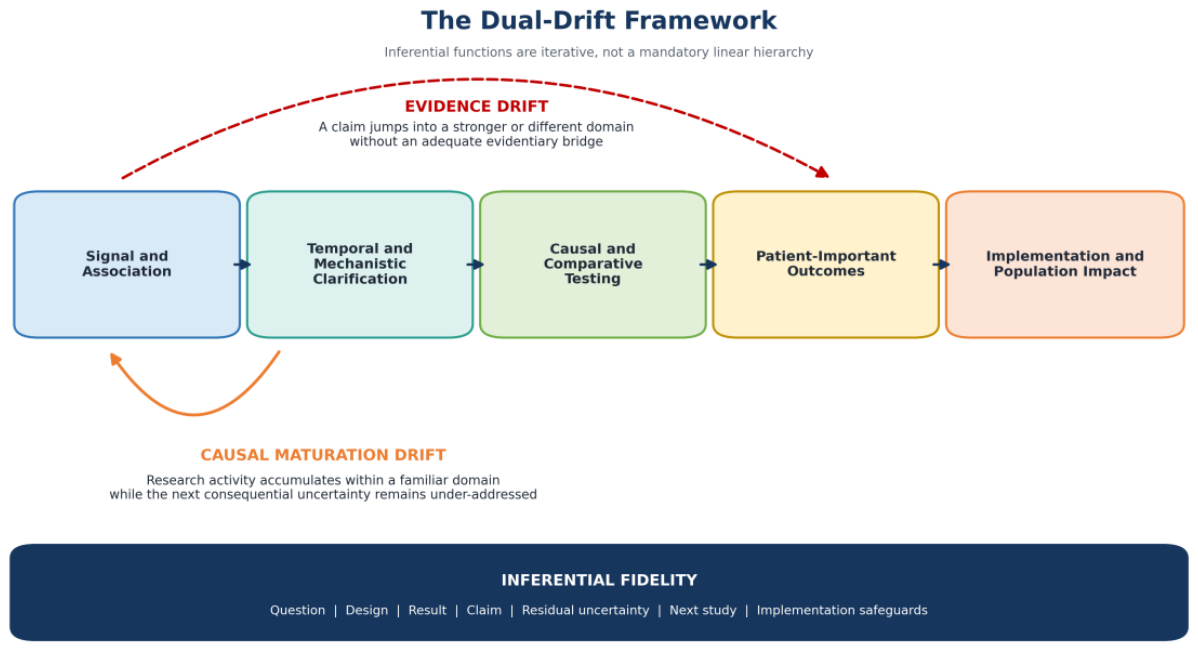
Figure 2.
Dual-Drift profiles. Evidence Drift and Causal Maturation Drift should be evaluated separately because each profile requires a different response.
Figure 2.
Dual-Drift profiles. Evidence Drift and Causal Maturation Drift should be evaluated separately because each profile requires a different response.
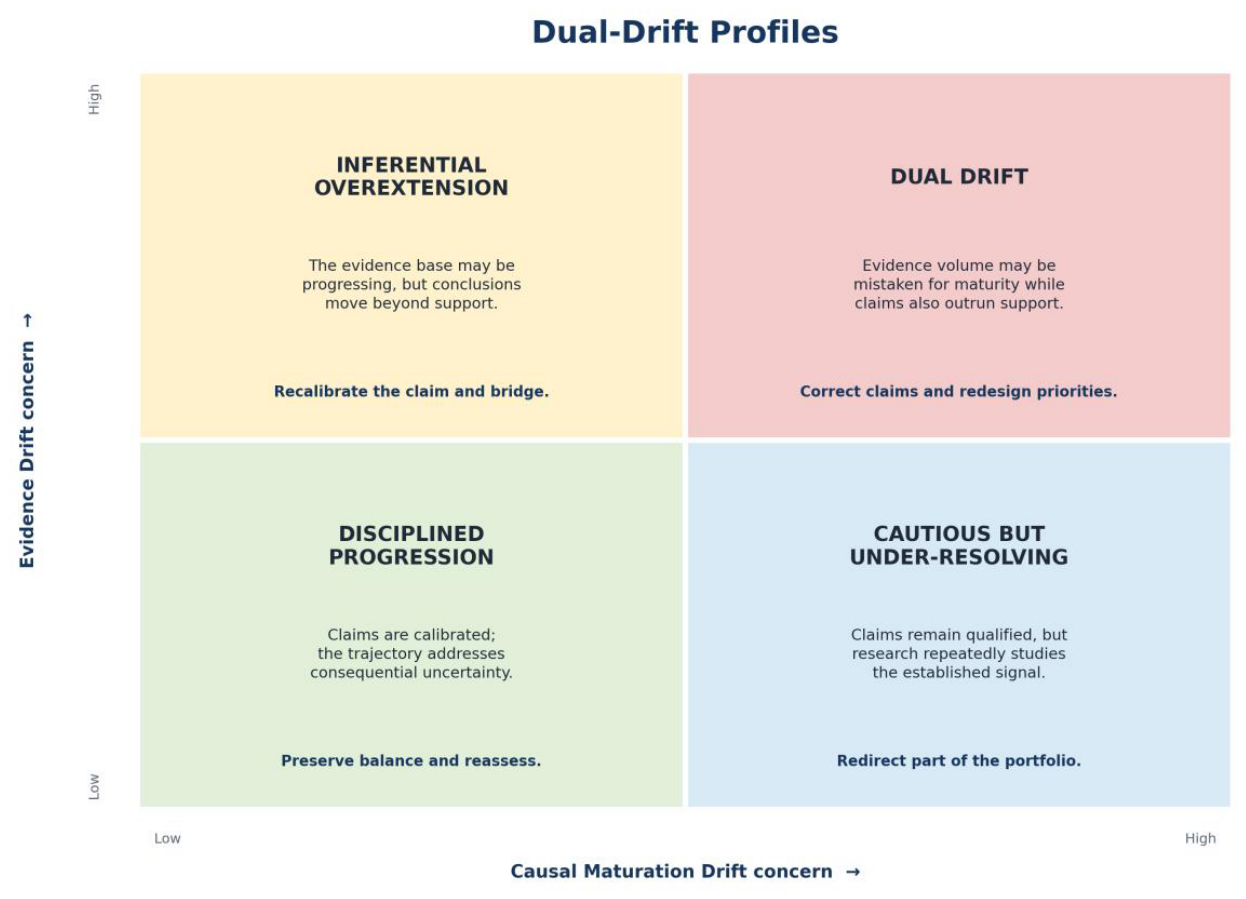
Figure 3.
Operational use of the Dual-Drift Framework. Appraisal begins by defining the decision and supported domain, then identifies the residual uncertainty, applies the appropriate claim-level or trajectory-level tool, and documents corrective action.
Figure 3.
Operational use of the Dual-Drift Framework. Appraisal begins by defining the decision and supported domain, then identifies the residual uncertainty, applies the appropriate claim-level or trajectory-level tool, and documents corrective action.
Disclaimer/Publisher’s Note: The statements, opinions and data contained in all publications are solely those of the individual author(s) and contributor(s) and not of MDPI and/or the editor(s). MDPI and/or the editor(s) disclaim responsibility for any injury to people or property resulting from any ideas, methods, instructions or products referred to in the content. |
© 2026 by the author. Licensee MDPI, Basel, Switzerland. This article is an open access article distributed under the terms and conditions of the Creative Commons Attribution (CC BY) license.
Copyright: This open access article is published under a Creative Commons CC BY 4.0 license, which permit the free download, distribution, and reuse, provided that the author and preprint are cited in any reuse.


