
Submitted:
17 July 2026
Posted:
17 July 2026
You are already at the latest version
Abstract
Pulmonary hypertension (PH) is a progressive and life-threatening disease characterised by elevated pulmonary arterial pressure, vascular remodelling and right ventricular dysfunction. Emerging evidence implicates circular RNAs (circRNAs) in the regulation of vascular remodelling and inflammation; however, their contribution to PH remains poorly understood. Here, we performed an in silico analysis using a multi-tool circRNA discovery pipeline across three publicly available transcriptomic datasets derived from experimental rat models of PH: H_PRN (PRJNA809145; pulmonary artery tissue from normoxic and hypoxia-induced PH rats; 21% vs 10% O2; n=7), H_GSE (GSE159668; right lung tissue from normoxic and hypoxia-induced PH rats; 21% vs 10% O2; n=6) and M_PRN (PRJNA732522; total lung tissue from control and monocrotaline-induced PH rats; n=6). CircRNAs were detected in all datasets; however, robust differentially expressed candidates were identified primarily in the hypoxia-exposed pulmonary artery dataset (H_PRN). In this dataset, three circRNAs—circCnot6l, circSmoc1 and circNtrk3—met the differential expression criteria (FDR q < 0.05, absolute log₂ fold change > 1). Downstream network analysis prioritised circCnot6l and circNtrk3 as potential regulators of circRNA–miRNA–mRNA axes involving miR-204-5p and miR-205, respectively. The predicted target networks were enriched for genes associated with key PH-related processes, including cell proliferation, adhesion, migration, angiogenesis and vascular development. Collectively, these findings identify circCnot6l and circNtrk3 as promising circRNA candidates involved in hypoxia-induced pulmonary artery remodelling and provide a foundation for future experimental studies investigating circRNA-mediated mechanisms underlying PH pathogenesis.
Keywords:
circular RNA
; hypertension
; rat
; pulmonary artery
; lung
1. Introduction
Cardiovascular disease (CVD) remains the leading cause of morbidity and mortality worldwide [1], encompassing a broad range of disorders affecting the heart and blood vessels, including coronary artery disease, stroke, heart failure, and hypertension [2,3,4,5]. Among the major modifiable risk factors for CVD, hypertension is particularly important due to its high prevalence and its role in driving vascular dysfunction, end-organ damage, and adverse cardiovascular outcomes [6,7].
While systemic hypertension affects the systemic circulation, pulmonary hypertension (PH) is a distinct and progressive vascular disorder characterised by elevated pressure within the pulmonary circulation, with an estimated global prevalence of 2.28 per 100,000 individuals [8]. PH is associated with progressive pulmonary vascular remodelling, increased pulmonary vascular resistance and, ultimately, right ventricular dysfunction. As no curative treatment currently exists, further research into the molecular mechanisms underlying PH and the identification of potential therapeutic targets remains critically needed.
Circular RNAs (circRNAs) are a class of non-coding RNA (ncRNA) generated through back-splicing of precursor messenger RNA (mRNA), whereby the 5′ and 3′ ends are joined to form a covalently closed loop [9]. Because they lack a polyadenylated tail, circRNAs are generally more stable than linear RNAs and resistant to exonuclease-mediated degradation. These properties, together with their tissue- and context-specific expression patterns, have led to growing interest in circRNAs as regulators of disease-associated transcriptional networks.
CircRNAs can influence gene regulation through several mechanisms. They may act as transcriptional regulators through interactions with RNA polymerase II, promoter regions or R-loop formation, and may also function indirectly as microRNA (miRNA) sponges, protein scaffolds or protein-binding decoys. In some contexts, circRNA may also undergo translation when they contain an open reading frame together with an internal ribosome entry site (IRES) or N6-methyladenosine (m6A) modification [10,11,12].
Despite growing evidence that circRNAs may contribute to PH pathobiology, their systematic identification remains technically challenging. Their unconventional sequence architecture, generally low expression levels and reliance on accurate back-splice junction detection mean that many circRNAs may be missed by single-tool approaches [13,14,15]. To address this, multi-tool computational pipelines have been developed to reduce false positives and improve sensitivity and reproducibility compared with individual circRNA detection tools [16]. For instance, the in-development Nextflow nf-core/circrna pipeline integrates multiple circRNA detection tools and supports downstream miRNA target prediction and differential expression analysis [17]. Similarly, CirComPara2 runs multiple tools in parallel to improve back-splice detection and aggregates count data into a unified output, reducing redundancy [18].
In this study, we performed a multi-dataset analysis of publicly available rat PH transcriptomic datasets to identify candidate circRNAs and associated regulatory networks. Three datasets were analysed, representing hypoxia-exposed pulmonary artery tissue (PRJNA809145/H_PRN; Sprague-Dawley rats; 21% vs 10% O2; n=7), hypoxia-exposed lung tissue (GSE159668/H_GSE; Sprague-Dawley rats; 21% vs 10% O2, n=6) and monocrotaline-induced PH lung tissue (PRJNA732522/M_PRN; Wistar rats, n=6) [19,20,21]. This design allowed us to screen for circRNA signals across related but biologically distinct PH contexts. Robust differentially expressed circRNA candidates were identified primarily in the hypoxia-exposed pulmonary artery dataset, leading us to prioritise circCnot6l and circNtrk3 for downstream miRNA, mRNA, co-expression and pathway analyses.
2. Results
The analysis was structured as a staged prioritisation workflow. First, circRNAs were detected across three rat PH-related datasets using multiple circRNA discovery tools. Second, candidate circRNAs were prioritised based on differential expression and cross-tool support. Third, because FDR-significant circRNA candidates were identified primarily in H_PRN, the hypoxia-exposed pulmonary artery dataset, downstream miRNA, mRNA, co-expression and pathway analyses focused on H_PRN.
2.1. Multi-Dataset circRNA Screening and H_PRN-Focused Transcriptomic Prioritisation
Across all datasets (H_GSE, H_PRN, M_PRN), greater than 12,000 unique circRNA variants were detected, with H_GSE showing the highest number of individually detected circRNAs (Figure S1A, n=19,340). In total, 2,841 circRNAs were common across all three datasets (Figure S1B). Detection profiles differed between circRNA quantification tools, with circRNA_finder identifying more circRNAs than CIRIquant, CIRI2 and find_circ across several comparisons (Figure S1C-E). However, broad circRNA detection did not translate into consistent differential expression across all datasets, so candidate prioritisation was based on differential expression together with cross-tool support.
In total, 718 circRNAs were nominally differentially expressed across the three datasets (Figure S2A, p < 0.05, absolute log2FC > 1), including candidates shared between datasets. However, only 31 nominally differentially expressed circRNAs were detected by more than one tool (Figure S2B), indicating limited cross-tool support for many candidates. The strongest differential circRNA signal was observed in H_PRN, whereas H_GSE and M_PRN contributed fewer candidates meeting the prioritization criteria. Among the detection tools, CIRI2, CIRIquant and circRNA_finder showed the greatest support for candidate circRNAs, while find_circ showed more limited discovery in some datasets.
After applying the prioritisation criteria, 12 circRNA candidates were retained: three FDR-significant differentially expressed circRNAs and seven nominally significant circRNAs (Table 1). All three FDR-significant candidates — circNtrk3_0005, circSmoc1_0009 and circCnot6l_0006 — were identified in H_PRN, the hypoxia-exposed pulmonary artery dataset. The remaining nominally significant candidates were distributed across H_PRN and M_PRN. Generalised linear mixed modelling indicated concordant inter-tool support for the prioritised circRNAs, with circSmoc1_0009 and circNtrk3_0005 showing particularly strong cross-tool similarity.
CircNtrk3_0005 (circNtrk3) was differentially expressed across all four tools (FDR q; CIRI2 = 1.60E-03, circRNA_finder = 2.61E-04, CIRIquant = 0.0371, find_circ = 1.52E-03) and had the strongest overall statistical support among the candidate circRNAs. CircSmoc1_0009 (circSmoc1) was differentially expressed according to CIRI2 (FDR q=0.002) and circRNA_finder (FDR q=2.71E-07) and nominally significant according to CIRIquant (p=0.0005) and find_circ (p=0.0005). CircCnot6l_0006 (circCnot6l) was differentially expressed according to CIRIquant (FDR q=0.02) and nominally significant according to circRNA_finder (p=0.005) and find_circ (p=0.02). Because all three FDR-significant candidates were identified in H_PRN, subsequent miRNA and mRNA analyses were performed using the corresponding H_PRN transcriptomic data. circCnot6l and circNtrk3 were prioritized for further network analysis because their predicted miRNA targets were also differentially expressed in H_PRN.
In H_PRN, 28,109 mRNA transcripts were quantified, of which 1,335 DE were differentially expressed between hypoxia-exposed and control pulmonary artery tissue samples (Figure 1A, 1,062 upregulated and 273 downregulated). In the corresponding miRNA data, 585 mature miRNA sequences were identified, of which 37 were differentially expressed (Figure 1B; 23 upregulated and 14 downregulated).
2.2. Functional Enrichment of H_PRN Differentially Expressed Genes
Enrichment analysis of 2510 upregulated and 2,040 downregulated statistically significant genes (FDR q < 0.05) from the H_PRN dataset revealed a host of networks termed by gene ontology. Several biological processes were significantly upregulated, including positive regulation of cell migration, cell adhesion mediated by integrin, positive regulation of vasculature development and positive regulation of angiogenesis (Table S1, FDR q<0.05). In addition, supramolecular fiber organization, response to cytokine, actin filament organization, signal transduction and anatomical structure development were found significantly downregulated (Table S2, p<0.05).
2.3. Target Prediction and Network Construction
The three FDR significant H_PRN circRNA candidates — circCnot6l, circNtrk3 and circSmoc1 — were assessed for predicted miRNA interactions. Across these candidates, 17 putative miRNA targets were identified (Figure 2). Integration with H_PRN miRNA differential expression data identified miR-204-5p as differentially expressed (FDR q<0.05, log2FC= -0.95) and a predicted target of circCnot6l and miR-205 as a differentially expressed (FDR q<0.05, log2FC=1.53) and predicted target of circNtrk3. No predicted circSmoc1-associated miRNA target met the differential expression criteria, so circSmoc1 was not taken forward for downstream mRNA network analysis.
Target prediction identified 628 putative mRNA targets downstream of the circCnot6l/miR-204-5p and circNtrk3/miR-205 axes (Figure S4). After integration with H_PRN mRNA differential expression and filtering for inverse miRNA-mRNA expression patterns, 24 differentially expressed mRNAs remained: 19 associated with the circCnot6l/miR-204-5p axis and five associated with the circNtrk3/miR-205 axis (Figure 3).
2.4. Co-Expression Analysis of Prioritised H_PRN circRNA–mRNA Candidate Networks
Co-expression analysis was used to assess whether the prioritised H_PRN circRNA candidates showed expression patterns consistent with their predicted mRNA target networks. CircCnot6l showed moderate-to-strong positive correlations with several predicted downstream mRNAs, including C1qtnf3 (r = 0.81), while circNtrk3 showed strong correlations with all five predicted mRNA targets (r>0.85; Figure 4A-B). rCCA analysis further supported coordinated expression between circNtrk3 and its predicted target set, while circCnot6l showed greater dispersion along the second component (Figure 4C). These findings provide co-expression support for the prioritised candidate networks, but do not establish direct regulatory interactions.
2.5. Exploratory Co-Expression Module Analysis of H_PRN Target Genes
To further contextualise the prioritised H_PRN mRNA targets, weighted gene correlation network analysis (WGCNA) was performed as an exploratory analysis of differentially expressed genes in the H_PRN dataset. This analysis was used to assess whether predicted circCnot6l- and circNtrk3-associated mRNA targets were located within highly connected co-expression modules related to the hypoxia-induced pulmonary hypertension (HPH) phenotype.
The WGCNA analysis identified multiple co-expression modules, with module eigengenes showing clear hierarchical clustering (Figure S5A-B). The largest module was MEturquoise, which contained 1,254 of 2,762 genes included in the analysis. Most modules showed moderate-to-strong internal connectivity, although MEpink showed weaker connectivity compared with the other modules (Figure S5C). These results indicate that the H_PRN differentially expressed genes could be organized into distinct co-expression modules.
Module–trait correlation analysis showed that each module was significantly associated with the HPH phenotype (Figure S6, p < 0.01). MEblack, MEyellow and MEbrown showed the strongest module–trait associations (p < 0.001), suggesting that genes within these modules may be particularly relevant to the H_PRN hypoxia response. However, because the analysis was based on a binary phenotype comparison and a small sample size, these module–trait associations should be interpreted as exploratory rather than as independent evidence of regulatory function.
The predicted circCnot6l- and circNtrk3-associated mRNA targets showed strong gene–trait correlations within the H_PRN dataset. circCnot6l-associated targets were positively correlated with the HPH phenotype, with all 19 targets showing HPH correlation coefficients greater than 0.8 (Figure S7B; Table 2). In contrast, circNtrk3-associated targets were negatively correlated with the HPH phenotype, with all five targets showing strong inverse correlations in Table 2. These results are consistent with the direction of differential expression observed for the two predicted circRNA–miRNA–mRNA axes.
Most circCnot6l-associated target genes were assigned to MEturquoise, with 18 of 19 targets falling within this module (Table 2). This partly reflects the large size of MEturquoise, but also indicates that the circCnot6l-associated target set occupies a coherent region of the H_PRN co-expression network. In contrast, circNtrk3-associated targets were distributed across MEbrown, MEgreen and MEpink, with three of five targets — Cgnl1, Lsamp and Angpt2 — assigned to MEbrown. Given the strong module–trait association observed for MEbrown, these genes may represent higher-priority downstream candidates for further investigation.
All predicted target genes listed in Table 2 showed high module membership values, suggesting that they were well connected within their assigned modules. Together, these results suggest that the predicted circCnot6l- and circNtrk3-associated mRNA targets occupy highly connected regions of the H_PRN co-expression network. However, given the small sample size and binary phenotype contrast, these findings should be interpreted as exploratory support for candidate prioritisation rather than definitive evidence that these genes act as regulatory hub genes.
2.6. Protein Interaction and Pathway Enrichment Analysis of Prioritised H_PRN mRNA Targets
Protein–protein interaction analysis was performed to identify pathways represented among the prioritised H_PRN mRNA targets and their interacting proteins. This analysis was used as a downstream exploratory step to contextualise the predicted circCnot6l- and circNtrk3-associated mRNA targets within broader protein interaction networks.
The resulting network highlighted interaction clusters involving Kit and Angpt2, additional interaction support around Rsad2, Epha4 and Lrp2 (Figure 5). In contrast, Trpm3, Fras1, and Spc25 showed limited interaction support under the applied confidence threshold. Mapped transcript-level log₂FC values indicated that several network-associated genes were upregulated in HPH relative to control tissue.
Functional enrichment analysis identified several signalling pathways associated with the prioritised H_PRN candidate target genes and their interacting proteins. Downregulation of Angpt2 and Fgf2, together with upregulation of Efna1, Flt4, Pdgfb, Angpt1, Pik3cb, Kitlg, Pik3cb and Tcn2, was associated with enrichment of Rap1, Ras, PI3K-Akt signaling pathways (Table 3). A similar set of genes, including Angpt2, Fgf2, Efna1, Fit4, Pdgfb, Angpt1, Kitlg, il1rap and Tcn2, was associated with MAPK signaling. Finally, upregulation of Tnc2 and Kitlg, together with downregulation of Ptpru, was associated with enrichment of SCF-KIT signaling.
Together, these findings suggest that the prioritised H_PRN mRNA targets are linked to protein interaction networks and pathways involved in cell adhesion, proliferation, migration, survival and angiogenesis. These pathway-level results provide additional biological context for the predicted circCnot6l- and circNtrk3-associated networks.
3. Discussion
CircRNAs are increasingly studied for their role in PH-associated vascular remodelling, particularly through regulation of miRNA/mRNA axes involved in cell proliferation, migration and apoptosis. For example, hsa_circ_0016070 has been shown to upregulate CCND1 through the miR-942/CCND1 axis, thereby promoting pulmonary artery smooth muscle cell (PASMC) proliferation [22]. Similarly, circST6GAL1 has been reported to upregulate MCTP2 via the miR-509-5p pathway, promoting cell proliferation and migration while inhibiting apoptosis [23]. In contrast, circALMS1 suppresses PASMC proliferation and migration through the miR-17-3p/YTHDF2 axis [24], while hsa_circ_0001402 shows comparable inhibitory effects during pulmonary hypertensive neointimal hyperplasia [25]. More recently, circNFXL1 was reported to attenuate right ventricular hypertrophy and pulmonary vascular remodelling in a mouse model of PH following intranasal liposome delivery [26].
In line with growing evidence, this study acts as a three-dataset exploratory circRNA screen. We found the strongest interpretable signal came from the H_PRN hypoxia-exposed pulmonary artery dataset, leading to prioritisation of circCnot6l and circNtrk3. Biologically, pulmonary artery tissue is more relevant to vascular remodelling than whole-lung tissue which may explain weighted findings. In addition, intrinsic change between hypoxia and monocrotaline induced rats, sequencing depth, sample size and circRNA detection sensitivity may explain limited overlap across datasets.
Results showed circCnot6l is associated in vascular remodelling of total pulmonary artery tissue (TPAT) in HPH model rats, predicted to sponge miR-204-5p and increase expression of 19 mRNA previously found to promote tumour growth or cardiovascular disease. Likewise, lower circNtrk3 expression in hypoxic TPAT may increase miR-205 expression, interruption of vessel formation and cellular homeostasis. Lastly, protein-protein interaction analysis revealed dysregulation of several major signalling pathways linked to cell growth, survival, migration, differentiation, metabolism, and apoptosis.
12713 circRNA were identified within TPAT of hypoxia induced rats, of which, circCnot6l, circNtrk3 and circSmoc1 were found DE. Interestingly circCnot6l, circNtrk3 and circSmoc1 were not detected as DE in lung tissue datasets under the current filtering criteria. Considering tissue specific expression of circRNA, limited discovery may reflect high heterogeneity of total lung tissue (n (cell types) > 40) [27], contrasting lesser cell deviation in TPAT (H_PRN), [28,29,30].
Literature shows hypoxia inducible factors (HIF) are activated to increase vascularisation and restore tissue oxygenation [31,32]. This is consistent with increased angiogenesis and regulation of vasculature as single rank biological process. Moreover, stimulation of HIF aligns with increased cell adhesion and migration, two strong indicators of vascular remodelling [33,34]. Further, downregulation of supramolecular fiber organisation may suggest loss of vascular integrity through reduction of collagen, actin and elastin [35,36,37], and decreased multicellular organismal development may align with impeded vascular growth in juvenile rats in response to low O2 exposure (8 – 11 weeks).
CircCnot6l and circNtrk3 were predicted to interact with miR-204-5p and miR-205, respectively. During our testings, expression of circSmoc1 target, miR-329-3p, was suggested to be elevated (log2FC = 1.75), however, only marginally significant (p = 0.071), likely due to small sample size [38]. Despite greater abundance of circCnot6l targets and close relation to c1qtnf3, circNtrk3 showed stronger association overall, suggesting greater influence of downstream target expression.
Weighted Gene Co-expression Analysis (WGCNA) was employed to cluster similarly expressed genes into modules (eigengenes) and serve as an exploratory support for circRNA targets. Upon inspection, most genes fell within MEturquoise, which is consistent with primary allocation in other study [39,40,41]. Further, module brown (MEbrown) represented strongest intra-modular/module-trait correlation alongside MEyellow and MEblack, supporting connectivity of Cgnl1, Lsamp and Angpt2. Conflictingly, all modules show at least high significance (p < 0.01), suggesting limited sensitivity brought about by low sample size (H_PRN,n = 7) and use of unsupervised binary trait data [42,43,44,45]. All circNtrk3 targets were found to group within upper percentile of all correlation inferring strongest associated with HPH phenotype relative to other genes. Similar trend was seen for all circCnot6l targets, falling within upper range of correlation.
We found miR-204-5p to be decreased in hypoxic TPAT. According to literature, limited expression of miR-204-5p if found to promote kidney disease [46,47], tumour growth [48,49,50] and arthritis [51,52]. Contrastively, expression of miR-205 was found to be increased, consistent with inhibition of tumour growth, cell proliferation, migration, invasion, apoptosis and epithelial-mesenchymal transition [53]. Further evidence suggests upregulation of miR-205 may promote cellular differentiation within the kidney, conflicting inhibitory role in cancer [54,55]. Taken together, our findings suggest that function of miR-204-5p and miR-205 may align with cellular process of vascular remodelling, although exact mechanisms remain unclear.
Interestingly, C1qtnf3 was significantly upregulated during testing, confirmatory with cellular hypertrophy and cardiac dysfunction [56]. However, earlier research revealed upregulation of C1qtnf3 attenuates inflammation and oxidative stress promoting cardiac function [57]. Subsequently, a bulk of literature supports cardiovascular benefit across varying tissue types. For example, C1qtnf3 is found to reduce inflammation in adipocytes [57,58,59,60] and attenuate endothelial cell injury through upregulation of FGFR1- Ras/PI3K/Akt [60]. Literature also supports C1qtnf3-mediated vascular protection by initiating anti-fibrotic mechanisms and reducing cell proliferation, migration and phenotypic transformation [59]. Taken together, C1qtnf3 is likely to play a significant role in the attenuation of tissue remodelling, however, involvement in TPAT hypertrophy is yet be elucidated.
Of circNtrk3 targets, Cgnl1 was ranked 6th amongst HPH associated genes and found potentially downregulated in H_PRN. Literature shows that loss of Cgnl1 expression in Dahl Salt sensitive rats may ameliorate hypertension and kidney injury by regulating angiotensin II-dependent kidney tubule sodium channels [61,62,63,64,65,66]. However, little has been done to investigate role in vascular tissue. Alternatively, literature had shown that limited expression of Cgnl1 destabilises endothelial adheren junctions and impairs angiogenesis through disruption of cell matrix adhesion [67]. Therefore, are also consistent with the potential interruption of vessel formation in TPAT and elevated vascular resistance by means of NO2 inhibition and micro vessel rarefication [68,69,70,71,72].
Interestingly, Angpt2 was inhibited and fell within MEbrown, alongside Cgnl1, suggesting a potential interactive relationship. This was unsurprising given both complex pro-angiogenic role in presence of vascular endothelial growth factors (VEGF)/Pyruvate kinase M2 (PK2M) and previous implication in vascular remodelling, inflammation, and cardiovascular/kidney disease [73,74]. Taken together, downregulation of Cgnl1 and Angpt2 may possibly play a role in vessel formation by both inhibiting and promoting angiogenesis, however, in presence of hypoxia induced VEGF, downregulation of Angpt2 may also function synergistically with Cgnl1 to limit vascularisation and promote blood pressure. This would explain upregulation of pro-angiogenetic Slc38a5 and Clec14a in effort to re-establish the VEGF pathway expression [75,76].
PPI networking and functional enrichment was done to serve as pathway-level biological context for the prioritization of H_PRN mRNA targets. Here we revealed an association between Angpt2, Tcn2 and process of vascular remodelling. Specifically, the interaction between Angpt2/Fgf2, Tcn2 and peripheral Efna1, Fit4, Pdgfb, Angpt1, Pik3cb, Kitlg, Pik3cb in HPH rats which could disrupt of Rap1, Ras (MAPK) and PI3K-Akt signalling. Given Rap1, Ras and PI3K-Akt signalling modulates cell proliferation, growth, invasion, metabolism and survival [77,78,79], a relationship may exist between Angpt2 and signal mediated vascular remodelling. This would also explain the association between Angpt2 and Extracellular Signal-Regulated Kinase (ERK), previously found to modulate vascular remodelling through smooth muscle cell proliferation and angiogenesis [80,81]. Further, inhibition of Fgf2 and Angpt2 in presence of VEGF may negatively influence ERK-MAPK signalling, whereas Efna1, Fit4, Pdgfb, Angpt1, Kitlg, il1rap and Tcn2 may promote proliferation and angiogenesis. Lastly SCF-KIT expression could be possibly increased alongside Tnc2 and Kitlg to promote cell survival, proliferation, differentiation, and migration [75,76]. This is supported by inhibition of Ptpru, which is previously found to promote right ventricular systolic pressure and increased vascular wall thickness in HPH model rats [82].
This study has some limitations. First, although data underwent stringent filtering and multi-tool quantification, in-vivo validation was not done, therefore results should only be interpreted as a computational prediction. Second, differing miRNA-seq and RNA-seq samples were used during the original study (PRJNA809145), introducing potential bias. Third, continuous variables, such as telemetric blood pressure or vascular wall thickness would have provided greater statistical certainty during eigengene modelling (WGCNA). Fourth, complexity of competitive endogenous RNA (ceRNA), particularly that of long non-coding RNA (lncRNA), was not explored and may have influenced target expression. Fifth, protein expression was based on indirect calculation of mRNA count and does not consider post transcriptional modification. To validate both function and expression, transcriptome wide analysis of ceRNA should be done alongside in vitro validation. Finally, the findings are H_PRN-focused, computational, based on small sample sizes, and require experimental validation of circRNA expression, back-splice junctions, miRNA interactions and downstream functional effects.
4. Conclusions
No DE circRNAs were identified in the lung tissue datasets (PRJNA809145 and PRJNA732522). However, analysis of TPAT from hypoxia-induced PH rats revealed significant DE of the circCnot6l/miR-204-5p and circNtrk3/miR-205 regulatory axes. Subsequent network and pathway analyses identified several downstream mRNA targets previously implicated in PH pathogenesis, including Cgnl1, Angpt2 and C1qtnf3, highlighting their potential relevance to the hypoxia-induced PH phenotype. Furthermore, gene ontology and protein–protein interaction analyses revealed enrichment of biological processes and signalling pathways associated with vascular remodelling.
Taken together, this study is the first to identify circCnot6l and circNtrk3 as putative biomarkers and regulatory molecules associated with key pathological processes in hypoxia-induced PH, including angiogenesis, cell proliferation, adhesion, migration and vascular remodelling. By leveraging the novel container-based Nextflow nf-core/circrna pipeline incorporating CIRI2, this work provides a robust framework for circRNA discovery in PH. Future studies should focus on experimental validation of the circCnot6l/miR-204-5p and circNtrk3/miR-205 regulatory axes in vitro and in vivo, as well as assessing their conservation and clinical relevance in human PH.
5. Materials and Methods
5.1. Data Collection
To investigate the role of circular RNA in PH a comprehensive search of publicly available datasets (NCBI) was conducted using the following searching terms:
“(PULMONARY[All Fields] AND HYPERTENSION[All Fields] AND (“Rattus”[Organism] OR RATTUS[All Fields])) AND (“bioproject sra”[Filter] AND “org mammals”[Filter]).”
CircRNAs are considered a subclass of lncRNA, therefor pair-end bulk RNA-seq data with depth of 25M+ and an RNA integrity number (RIN) of >8 were collected in accordance with CCR Collaborative Bioinformatics Resource (CCBR) for lncRNA analysis [83]. Further, Ribo-Zero depletion must be done to enrich circRNA detection and reduce ribosomal RNA (rRNA) noise [84,85,86]. In total, three datasets were revealed [19,20,21] (Table 4).
5.2. In Silico Quantification
Rat genome assembly 6.0 (Rnor_6.0) was retrieved from NCBI, then RNA-seq fastq files were validated with full quality base scores as part of the Nextflow pipeline (multiqc v1.27). After quantification of circRNA back splice junctions was done using CIRI2 Full (Version 2.1.1) and Nextflow (Version 24.10.2) container-based nfcore/circrna (dev) pipelines (CIRIquant v1.1.3, circRNA_finder v1.2 and find_circ v1.2) [17]. Next, manual adapter trimming was done for raw miRNA-seq data (n=5 control & n=5 (HPH)) and quantification was done using Nextflow nfcore/srmaseq (Version 2.3.1)[87]. Lastly, mRNA level expression was calculated during circRNA quantification (nfcore/circrna (dev) by psirc-quant.
5.3. Differential Expression Analysis
Differential expression analysis was conducted using edgeR (Version 4.0.16) with quasi-likelihood dispersion estimation and trimmed mean of M values (TMM) normalisation. Here dispersion parameters for each circRNA/miRNA and gene are estimated with the Cox-Reid common dispersion [88] and applied to a negative binomial generalized linear model. This ensures that differences in expression that are consistent between replicates are more highly weighted to ensure differential expression is not guided by outliers. P-values were adjusted for multiple testing using the Benjamini-Hochberg correction (FDR q-value). Count data for each tool was then filtered by GLMM (glmmTMB ver 1.1.11) using Count ~ Group + (1 | Tool) with negative binomial distribution and zero inflation. Finally, graphics were generated using ggplot2 (Version 3.5.1) in R (Version 4.3.2).
5.4. Candidate Selection Criteria
To be considered a hit, circRNA junctions required a minimum of 2 reads, otherwise, value was set to “0”. Moreover, each circRNA was required to show at least 5 counts per million (CPM) in ≥ 2 control/pulmonary hypertensive samples across ≥ 2 identification/quantification tools. Finally, glmmTMB was used to ensure circRNA with low read count and or poor inter-tool concordance were filtered out Pr(>|z|) ≥0.05.
DE, circRNA, miRNA and mRNA must have an FDR q value < 0.05 (1+ tool), and a log2FC > 1 (log2FC > 0.95 may be considered). If FDR q value > 0.05 and p value < 0.05 transcripts are considered NDE [89].
To ensure clinical relevancy, DE candidates must be translatable to human, this is determined by CircAtlas 3.0 which evaluates sequence and expression conservation by generating a multiple conservation Score (MCS).
5.5. CircRNA/miRNA/mRNA Target Prediction
To identify circRNA-miRNA interactions, integrated CircAtlas 3.0 webtools: PITA, miRanda (Version 3.3a) and Targetscan (7.0) were used. CircRNAs with at least 1 MRE binding region detected by ≥ 2/3 predictive software’s were considered a downstream target. To identify miRNA-miRNA interaction, miRTargetLink2.0 (Version 79.0.3945.88) was used to scan for mRNA targets validated by experiment (miRTarBase) or predicted by miRDIP and miRDB software.
5.6. Gene and Protein Ontology
Gene ontology was done to reveal enriched single ranked processes using Gene Ontology enRIchment anaLysis and visuaLizAtion tool (GOrilla, March. 8th 2013 release). Subsequently, protein ontology was done using stringApp (Version 2.1.1) with confidence threshold cutoff of 0.8/1 to ensure pathways maintain high certainty.
5.7. Multivariate/Covariate Analysis
Given samples used for miRNA-seq analysis differ from those used during circRNA and mRNA analysis (study PRJNA809145, n(miRNA-seq) = 10 (control, NC-5 – NC-9 ; experimental, HPH-10 – HPH-14), n(RNA-seq) = 7 (control, NC-1 – NC-4 ; experimental, HPH-17 – HPH- 19)) a covariate approach was taken to analyse the relationship between circRNA and mRNA level expression to reduce potential bias. Initially, circRNA and mRNA count data underwent normalisation by variance stabilisation transformation (VST) using DESeq2 (Version 1.42.1). Then, both count and sample phenotype were piped into MixOmics using standard correlation cutoff of ≥ 0.5 for components 1 & 2. Covariate analysis (circRNA-mRNA axis) was conducted using a Regularised Canonical Correlation Analysis model (rCCA) with ridge penalty (MixOmics (Version 6.1.1)) to handle high dimensional data [90]. Moreover, threshold cutoff was set (0.5/1) to ensure stringent correlation.
To investigate gene-trait association with phenotype of PH. Module eigengenes were generated with WGCNA (Version 1.72-1) using binary trait data. Here, regression scatterplots to determine how well genes cluster together within modules. This is calculated by plotting intramodular connectivity (kWithin; x-axis) against gene significance (SIG; y-axis). After, graphics for multivariate analysis, protein ontology and target prediction were generated using Cytoscape (Version 3.10.2).
Supplementary Materials
The following supporting information can be downloaded at the website of this paper posted on Preprints.org, Figure S1: Compressive detection of circRNA across tool and dataset ; Figure S2: Evaluating dataset integrity and crossover for nominally significant circRNA (p < 0.05); Figure S3: Heatmap series of nominally DE circRNA (p < 0.05, tool > 1) across tool and dataset; Figure S4: Clustered mRNA targets for miRNA candidates (miR-205 & miR-204-5p); Figure S5: Weighted gene expression analysis (n=2762, FDR q<0.05, log2FC>0.5); Table S1: Gene ontology for upregulated single rank biological processes filtered by pathogenesis (HPH) and significance (p-value); Figure S6: Binary module eigengene (ME) - trait association for all genes (HPH vs. Control, n= 2762, FDR q<0.05, log2FC>0.5); Figure S7. Binary module-trait association for all genes (HPH vs. Control, n= 2762, FDR q<0.05, log2FC > 0.5); Table S2: Gene ontology for downregulated single rank biological processes filtered by pathogenesis (HPH) and significance (p-value). .
Author Contributions
Conceptualization, F.J.C, and P.R.P.; methodology, B.A. and S.B.; formal analysis, B.A. and S.B.; data curation, B.A.; writing—original draft preparation, B.A. and Y.W.; writing—review and editing, B.A,, S.B, M.M., Y.W., F.J.C., P.R.P.; visualization, B.A.; supervision, S.B.,Y.W., F.J.C. and P.R.P.; funding acquisition, F.J.C. All authors have read and agreed to the published version of the manuscript.
Funding
This research was funded by a Research Training Program (RTP) Stipend Scholarship with Fee-offset provided by Federation University Australia.
Institutional Review Board Statement
This study did not require ethics approval because it involved only the analysis of publicly available datasets from rats. However, the original studies that generated these datasets were approved by the relevant Institutional Review Boards. Specifically, the PRJNA809145 experiments were approved by the Animal Care Committee of Shenzhen University (China); the GSE159668 study was approved by the Ethics Committee of Kunming Medical University (KMMU2020207); and the PRJNA732522 animal study was approved by the Institutional Animal Care and Use Committee of Fudan University (Shanghai, China).
Informed Consent Statement
Not applicable.
Data Availability Statement
All data included in this study are publicly available on the following three websites:.https://www.ncbi.nlm.nih.gov/bioproject/PRJNA809145/https://www.ncbi.nlm.nih.gov/geo/query/acc.cgi?acc=GSE159668https://www.ncbi.nlm.nih.gov/bioproject/PRJNA732522/
Acknowledgments
This research was supported by The University of Melbourne’s Research Computing Services and the Petascale Campus Initiative.
Conflicts of Interest
The author declares no conflicts of interest.
Abbreviations
The following abbreviations are used in this manuscript:
| CCBR | Centre for cancer research collaborative bioinformatics resource |
| CCND1 | Cyclin D1 |
| ceRNA | Competitive endogenous RNA |
| CircCnot6l_0006 | CircCnot6l |
| CircNtrk3_0005 | CircNtrk3 |
| CircRNA | Circular RNA |
| CircSmoc1_0009 | CircSmoc1 |
| CPM | Counts per million |
| CVD | Cardiovascular disease |
| DE | Differentially expressed |
| DOAJ | Directory of open access journals |
| DTC | Dynamic tree cut |
| FDR q | False Discovery Rate-adjusted p-value |
| GLMM | Generalised linear mixed model |
| GO | Gene Ontology |
| H_GSE | GSE159668 |
| H_PRN | PRJNA809145 |
| HPH | Hypoxia induced pulmonary hypertension |
| IRES | Internal ribosome entry site |
| Log2FC | Log2 fold-change |
| M_PRN | PRJNA732522 |
| m6A | N6-methyladenosine modification |
| MCS | Multiple conservation score |
| MCTP2 | Multiple C2 And Transmembrane Domain Containing 2 |
| MD | Merged Dynamic |
| MDPI | Multidisciplinary Digital Publishing Institute |
| ME | Module eigengene |
| miRNA | Micro RNA |
| MM | Module membership |
| mRNA | Messenger RNA |
| ncRNA | Non-coding RNA |
| NDE | Nominally differentially expressed |
| PAEC | Pulmonary artery endothelial cells |
| PASMC | Pulmonary artery smooth muscle cells |
| PCC | Pearson correlation coefficient (p) |
| PH | Pulmonary hypertension |
| Pr | Probability |
| rCCA | Regularised canonical correlation analysis |
| RIN | RNA integrity number |
| rRNA | Ribosomal RNA |
| SIG | Significance |
| TPAT | Total pulmonary artery tissue |
| TMM | Trimmed mean of M values |
| VST | Variance stabilization transformation |
| WGCNA | Weighted Gene Co-Expression Network Analysis |
References
- Wang, Y. Higher fasting triglyceride predicts higher risks of diabetes mortality in US adults. Lipids Health Dis. 2021, 20, 181. [CrossRef]
- Jackman, K.A.; Brait, V.H.; Wang, Y.; Maghzal, G.J.; Ball, H.J.; McKenzie, G.; De Silva, T.M.; Stocker, R.; Sobey, C.G. Vascular expression, activity and function of indoleamine 2,3-dioxygenase-1 following cerebral ischaemia-reperfusion in mice. Naunyn Schmiedebergs Arch. Pharmacol. 2011, 383, 471-81. [CrossRef]
- Wang, Y.; Magliano, D.J. Special Issue: “New Trends in Diabetes, Hypertension, and Cardiovascular Diseases”. Int. J. Mol. Sci. 2024, 25, 2711. [CrossRef]
- Wang, Y.; Magliano, D.J. Special Issue: “New Trends in Diabetes, Hypertension, and Cardiovascular Diseases—2nd Edition”. Int. J. Mol. Sci. 2025, 26, 449. [CrossRef]
- Wang, Y.; Magliano, D.J. Special Issue “New Trends in Diabetes, Hypertension and Cardiovascular Diseases: 3rd Edition”. Int. J. Mol. Sci. 2025, 26, 10536. [CrossRef]
- Qian, T.; Sun, H.; Xu, Q.; Hou, X.; Hu, W.; Zhang, G.; Drummond, G.R.; Sobey, C.G.; Charchar, F.J.; Golledge, J.; Wang, Y.; Yang, G. Hyperuricemia is independently associated with hypertension in men under 60 years in a general Chinese population. J. Hum. Hypertens. 2021, 35, 1020-1028. [CrossRef]
- Wang, Y. Stage 1 hypertension and risk of cardiovascular disease mortality in United States adults with or without diabetes. J. Hypertens. 2022, 40, 794–803. [CrossRef]
- Leary, P.J.; Lindstrom, M.; Johnson, C.O.; Emmons-Bell, S.; Rich, S.; Corris, P.A.; DuBrock, H.M.; Ventetuolo, C.E.; Abate, Y.H.; Abdelmasseh, M.; Aboagye, R.G.; Abualruz, H.; Abu-Gharbieh, E.; Aburuz, S.; Adamu, L.H.; Adão, R.; Addo, I.Y.; Adedoyin, R.A.; Adetunji, J.B.; Adzigbli, L.A.; Ahinkorah, B.O.; Ahmad, F.; Ahmadzade, A.M.; Ahmed, A.; Ahmed, H.; Ahmed, S.A.; Akhlaghi, S.; Akkaif, M.A.; Al Awaidy, S.; Alalalmeh, S.O.; Albakri, A.; Aldawsari, K.A.; Almahmeed, W.; Alshahrani, N.Z.; Altaf, A.; Aly, H.; Alzoubi, K.H.; Al-Zyoud, W.A.; Amani, R.; Amusa, G.A.; Andrei, C.L.; Anwar, S.; Anyasodor, A.E.; Aravkin, A.Y.; Areda, D.; Asmerom, H.A.; Aujayeb, A.; Azzam, A.Y.; Babu, A.S.; Bagherieh, S.; Baltatu, O.C.; Barqawi, H.J.; Bastan, M.-M.; Batra, K.; Bayleyegn, N.S.; Behnoush, A.H.; Bhalla, J.S.; Bhaskar, S.; Bhat, V.; Bitaraf, S.; Bitra, V.R.; Boloor, A.; Braithwaite, D.; Brauer, M.; Bulto, L.N.; Bustanji, Y.; Chattu, V.K.; Chi, G.; Chichagi, F.; Chong, B.; Chowdhury, R.; Cindi, Z.; Cruz-Martins, N.; Dadana, S.; Dadras, O.; Dahiru, T.; Dai, X.; Dashtkoohi, M.; DeAngelo, S.; Debopadhaya, S.; Demessa, B.H.; Desai, H.D.; Dhulipala, V.R.; Diaz, M.J.; Diress, M.; Do, T.C.; Do, T.H.P.; Doan, K.D.; dos Santos, W.M.; Doshi, R.P.; Dowou, R.K.; Dziedzic, A.M.; Elhadi, M.; Etaee, F.; Fabin, N.; Fagbamigbe, A.F.; Faris, P.S.; Feyisa, B.R.; Fortuna Rodrigues, C.; Gandhi, A.P.; Ganiyani, M.A.; Gela, Y.Y.; Getie, M.; Ghaffari Jolfayi, A.; Ghasemzadeh, A.; Goldust, M.; Golechha, M.; Guan, S.-Y.; Gudeta, M.D.; Gupta, M.; Gupta, R.; Hadei, M.; Hammoud, A.; Hasnain, M.S.; Hassan Zadeh Tabatabaei, M.S.; Hay, S.I.; Hegazi, O.E.; Hemmati, M.; Hiraike, Y.; Hoan, N.Q.; Hultström, M.; Huynh, H.-H.; Ibitoye, S.E.; Ilesanmi, O.S.; Ismail, N.E.; Iwu, C.D.; Jaggi, K.; Jain, A.; Jakovljevic, M.; Jee, S.H.; Jeswani, B.M.; Jha, A.K.; Jokar, M.; Joseph, N.; Jozwiak, J.J.; Kabir, H.; Kahe, F.; Kamireddy, A.; Kanmanthareddy, A.R.; Karimi, H.; Karimi Behnagh, A.; Kazemian, S.; Keshavarz, P.; Khalaji, A.; Khan, M.J.; Khidri, F.F.; Kim, M.S.; Kondlahalli, S.K.M.M.; Kothari, N.; Krishan, K.; Kulimbet, M.; Kumar, A.; Latifinaibin, K.; Le, T.T.T.; Ledda, C.; Lee, S.W.; Li, M.-C.; Lim, S.S.; Liu, S.; Mahmoudi, E.; Makram, O.M.; Malhotra, K.; Malik, A.A.; Malta, D.C.; Manla, Y.; Martorell, M.; Mehrabani-Zeinabad, K.; Merati, M.; Mestrovic, T.; Mirdamadi, N.; Misra, A.K.; Mokdad, A.H.; Moni, M.A.; Moodi Ghalibaf, A.; Moraga, P.; Morovatdar, N.; Motappa, R.; Mousavi-Aghdas, S.A.; Mustafa, A.; Naik, G.R.; Najafi, M.S.; Najdaghi, S.; Nanavaty, D.P.; Narimani Davani, D.; Natto, Z.S.; Nauman, J.; Nguyen, D.H.; Nguyen, P.T.; Niazi, R.K.; Oancea, B.; Olanipekun, T.O.; Oliveira, G.M.M.; Omar, H.A.; P A, M.P.; Pan, F.; Pandi-Perumal, S.R.; Pantazopoulos, I.; Parikh, R.R.; Petcu, I.-R.; Pham, H.N.; Pham, H.T.; Philip, A.K.; Prates, E.J.S.; Puvvula, J.; Qian, G.; Rafferty, Q.; Rahim, F.; Rahimi, M.; Rahman, M.; Rahman, M.A.; Rahmanian, M.; Rahmanian, N.; Rahmati, M.; Rahmati, R.; Ramadan, M.M.; Ramphul, K.; Rana, J.; Rao, I.R.; Rashedi, S.; Ravikumar, N.; Rawaf, S.; Ray, A.; Reddy, M.M.R.K.; Redwan, E.M.M.; Rezaei, N.; Roy, P.; Saad, A.M.A.; Saddik, B.A.; Sadeghi, M.; Saeb, M.R.; Saheb Sharif-Askari, F.; Saheb Sharif-Askari, N.; Saleh, M.A.; Sani, N.Y.; Saraswati, U.; Saravanan, A.; Saulam, J.; Schuermans, A.; Schumacher, A.E.; Semagn, B.E.; Sethi, Y.; Seylani, A.; Shafeghat, M.; Shahwan, M.J.; Shamim, M.A.; Shamsi, A.; Sharfaei, S.; Sharma, K.; Sharma, N.; Sherif, A.A.; Shiue, I.; Shorofi, S.A.; Siddig, E.E.; Singh, H.; Singh, J.A.; Singh, P.; Singh, S.; Sobia, F.; Solanki, R.; Solanki, S.; Spartalis, M.; Swain, C.K.; Szarpak, L.; Tabatabaei, S.M.; Tabche, C.; Tamuzi, J.L.; Tan, K.-K.; Teramoto, M.; Tharwat, S.; Thienemann, F.; Truyen, T.T.T.T.; Tsegay, G.M.; Udoakang, A.J.; Van den Eynde, J.; Varthya, S.B.; Verma, M.; Vervoort, D.; Vinayak, M.; Viskadourou, M.; Wang, F.; Wickramasinghe, N.D.; Wilandika, A.; Xu, S.; Yu, C.; Zare, I.; Zeineddine, M.A.; Zhang, Z.-J.; Zhu, L.; Zhumagaliuly, A.; Zielińska, M.; Zyoud, S.H.; Murray, C.J.L.; Roth, G.A. Global, regional, and national burden of pulmonary arterial hypertension, 1990–2021: a systematic analysis for the Global Burden of Disease Study 2021. The Lancet Respiratory Medicine 2025, 13, 69-79.
- Chen, L.L.; Yang, L. Regulation of circRNA biogenesis. RNA Biol 2015, 12, 381-8. [CrossRef]
- Huang, A.; Zheng, H.; Wu, Z.; Chen, M.; Huang, Y. Circular RNA-protein interactions: functions, mechanisms, and identification. Theranostics 2020, 10, 3503-3517.
- Sinha, T.; Panigrahi, C.; Das, D.; Chandra Panda, A. Circular RNA translation, a path to hidden proteome. Wiley Interdiscip Rev RNA 2022, 13, e1685. [CrossRef]
- Wen, S.-y.; Qadir, J.; Yang, B.B. Circular RNA translation: novel protein isoforms and clinical significance. Trends in Molecular Medicine 2022, 28, 405-420. [CrossRef]
- Rybak-Wolf, A.; Stottmeister, C.; Glažar, P.; Jens, M.; Pino, N.; Giusti, S.; Hanan, M.; Behm, M.; Bartok, O.; Ashwal-Fluss, R.; Herzog, M.; Schreyer, L.; Papavasileiou, P.; Ivanov, A.; Öhman, M.; Refojo, D.; Kadener, S.; Rajewsky, N. Circular RNAs in the Mammalian Brain Are Highly Abundant, Conserved, and Dynamically Expressed. Molecular Cell 2015, 58, 870-885. [CrossRef]
- Wang, Y.; Wang, J.; Gruninger, R.J.; McAllister, T.A.; Li, M.; Guan, L.L. Assessment of different enrichment methods revealed the optimal approach to identify bovine circRnas. RNA Biology 2024, 21, 621-633. [CrossRef]
- Zhang, J.; Chen, S.; Yang, J.; Zhao, F. Accurate quantification of circular RNAs identifies extensive circular isoform switching events. Nature Communications 2020, 11, 90. [CrossRef]
- Hansen, T.B. Improved circRNA Identification by Combining Prediction Algorithms. Front Cell Dev Biol 2018, 6, 20. [CrossRef]
- Digby, B.; Finn, S.P.; Ó Broin, P. nf-core/circrna: a portable workflow for the quantification, miRNA target prediction and differential expression analysis of circular RNAs. BMC Bioinformatics 2023, 24, 27. [CrossRef]
- Gaffo, E.; Buratin, A.; Dal Molin, A.; Bortoluzzi, S. Sensitive, reliable and robust circRNA detection from RNA-seq with CirComPara2. Brief. Bioinform. 2022, 23, bbab418. [CrossRef]
- Wang, J.; Niu, Y.; Luo, L.; Lu, Z.; Chen, Q.; Zhang, S.; Guo, Q.; Li, L.; Gou, D. Decoding ceRNA regulatory network in the pulmonary artery of hypoxia-induced pulmonary hypertension (HPH) rat model. Cell Biosci. 2022, 12, 27. [CrossRef]
- Liu, J.; Deng, Y.; Fan, Z.; Xu, S.; Wei, L.; Huang, X.; Xing, X.; Yang, J. Construction and analysis of the abnormal lncRNA-miRNA-mRNA network in hypoxic pulmonary hypertension. Biosci. Rep. 2021, 41, BSR20210021. [CrossRef]
- Hou, S.; Chen, D.; Liu, J.; Chen, S.; Zhang, X.; Zhang, Y.; Li, M.; Pan, W.; Zhou, D.; Guan, L.; Ge, J. Profiling and Molecular Mechanism Analysis of Long Non-Coding RNAs and mRNAs in Pulmonary Arterial Hypertension Rat Models. Front. Pharmacol. 2021, 12, 709816. [CrossRef]
- Zhou, S.; Jiang, H.; Li, M.; Wu, P.; Sun, L.; Liu, Y.; Zhu, K.; Zhang, B.; Sun, G.; Cao, C.; Wang, R. Circular RNA hsa_circ_0016070 Is Associated with Pulmonary Arterial Hypertension by Promoting PASMC Proliferation. Mol Ther Nucleic Acids 2019, 18, 275-284. [CrossRef]
- Zhang, X.; Qin, H.; Ma, Q.; Zhang, J.; Tian, H.; Meng, Y. CircST6GAL1 knockdown alleviates pulmonary arterial hypertension by regulating miR-509-5p/multiple C2 and transmembrane domain containing 2 axis. Clin Respir J 2024, 18, e13771. [CrossRef]
- Hu, X.; Sun, Y.; Wang, S.; Zhao, H.; Wei, Y.; Fu, J.; Huang, Y.; Wu, W.; Li, J.; Liu, J.; Gong, S.; Zhao, Q.; Wang, L.; Jiang, R.; Song, X.; Yuan, P. CircALMS1 Alleviates Pulmonary Microvascular Endothelial Cell Dysfunction in Pulmonary Hypertension. J Am Heart Assoc 2024, 13, e031867. [CrossRef]
- Lin, J.J.; Chen, R.; Yang, L.Y.; Gong, M.; Du, M.Y.; Mu, S.Q.; Jiang, Z.A.; Li, H.H.; Yang, Y.; Wang, X.H.; Wang, S.F.; Liu, K.X.; Cao, S.H.; Wang, Z.Y.; Zhao, A.Q.; Yang, S.Y.; Li, C.; Sun, S.G. Hsa_circ_0001402 alleviates vascular neointimal hyperplasia through a miR-183-5p-dependent regulation of vascular smooth muscle cell proliferation, migration, and autophagy. J Adv Res 2024, 60, 93-110. [CrossRef]
- Li, S.S.; Guo, M.; Zhao, Y.; Fan, F.; Huang, S.; Yang, H.; Chen, X.; Jin, X. Intranasal delivery of R8-modified circNFXL1 liposomes ameliorates Su5416-induced pulmonary arterial hypertension in C57BL/6 mice. Respir Res 2025, 26, 127. [CrossRef]
- Travaglini, K.J.; Nabhan, A.N.; Penland, L.; Sinha, R.; Gillich, A.; Sit, R.V.; Chang, S.; Conley, S.D.; Mori, Y.; Seita, J.; Berry, G.J.; Shrager, J.B.; Metzger, R.J.; Kuo, C.S.; Neff, N.; Weissman, I.L.; Quake, S.R.; Krasnow, M.A. A molecular cell atlas of the human lung from single-cell RNA sequencing. Nature 2020, 587, 619-625. [CrossRef]
- Townsley, M.I. Structure and composition of pulmonary arteries, capillaries, and veins. Compr Physiol 2012, 2, 675-709. [CrossRef]
- Duong, H.T.; Comhair, S.A.; Aldred, M.A.; Mavrakis, L.; Savasky, B.M.; Erzurum, S.C.; Asosingh, K. Pulmonary artery endothelium resident endothelial colony-forming cells in pulmonary arterial hypertension. Pulm Circ 2011, 1, 475-86.
- Humbert, M.; Morrell, N.W.; Archer, S.L.; Stenmark, K.R.; MacLean, M.R.; Lang, I.M.; Christman, B.W.; Weir, E.K.; Eickelberg, O.; Voelkel, N.F.; Rabinovitch, M. Cellular and molecular pathobiology of pulmonary arterial hypertension. Journal of the American College of Cardiology 2004, 43, S13-S24. [CrossRef]
- Rezania, S.; Puskarich, M.A.; Petrusca, D.N.; Neto-Neves, E.M.; Rondina, M.T.; Kline, J.A. Platelet hyperactivation, apoptosis and hypercoagulability in patients with acute pulmonary embolism. Thrombosis Research 2017, 155, 106-115. [CrossRef]
- Baker, S.R.; Halliday, G.; Ząbczyk, M.; Alkarithi, G.; Macrae, F.L.; Undas, A.; Hunt, B.J.; Ariëns, R.A.S. Plasma from patients with pulmonary embolism show aggregates that reduce after anticoagulation. Commun Med (Lond) 2023, 3, 12.
- Threadgill, R.; Bobb, K.; Ghosh, A. Regulation of dendritic growth and remodeling by Rho, Rac, and Cdc42. Neuron 1997, 19, 625-34.
- Parri, M.; Chiarugi, P. Rac and Rho GTPases in cancer cell motility control. Cell Commun Signal 2010, 8, 23. [CrossRef]
- Ishikawa, Y.; Asuwa, N.; Ishii, T.; Ito, K.; Akasaka, Y.; Masuda, T.; Zhang, L.; Kiguchi, H. Collagen alteration in vascular remodeling by hemodynamic factors. Virchows Arch 2000, 437, 138-48. [CrossRef]
- Kim, H.R.; Gallant, C.; Leavis, P.C.; Gunst, S.J.; Morgan, K.G. Cytoskeletal remodeling in differentiated vascular smooth muscle is actin isoform dependent and stimulus dependent. Am J Physiol Cell Physiol 2008, 295, C768-78. [CrossRef]
- Henninger, H.B.; Valdez, W.R.; Scott, S.A.; Weiss, J.A. Elastin governs the mechanical response of medial collateral ligament under shear and transverse tensile loading. Acta Biomaterialia 2015, 25, 304-312. [CrossRef]
- Lu, G.F.; Geng, F.; Deng, L.P.; Lin, D.C.; Huang, Y.Z.; Lai, S.M.; Lin, Y.C.; Gui, L.X.; Sham, J.S.K.; Lin, M.J. Reduced CircSMOC1 Level Promotes Metabolic Reprogramming via PTBP1 (Polypyrimidine Tract-Binding Protein) and miR-329-3p in Pulmonary Arterial Hypertension Rats. Hypertension 2022, 79, 2465-2479. [CrossRef]
- Farber, C.R. Systems-level analysis of genome-wide association data. G3 (Bethesda) 2013, 3, 119-29.
- Liu, C.; Dai, Q.; Ding, Q.; Wei, M.; Kong, X. Identification of key genes in hepatitis B associated hepatocellular carcinoma based on WGCNA. Infect Agent Cancer 2021, 16, 18. [CrossRef]
- Zhang, X.; Cui, Y.; Ding, X.; Liu, S.; Han, B.; Duan, X.; Zhang, H.; Sun, T. Analysis of mRNA-lncRNA and mRNA-lncRNA-pathway co-expression networks based on WGCNA in developing pediatric sepsis. Bioengineered 2021, 12, 1457-1470. [CrossRef]
- Langfelder, P.; Horvath, S. WGCNA: an R package for weighted correlation network analysis. BMC Bioinformatics 2008, 9, 559.
- Langfelder, P.; Luo, R.; Oldham, M.C.; Horvath, S. Is my network module preserved and reproducible? PLoS Comput Biol 2011, 7, e1001057. [CrossRef]
- Zhong, J.; Shi, S.; Peng, W.; Liu, B.; Yang, B.; Niu, W.; Zhang, B.; Qin, C.; Zhong, D.; Cui, H.; Zhang, Z.; Sun, X. Weighted Gene Co-Expression Network Analysis (WGCNA) Reveals the Functions of Syndecan-1 to Regulate Immune Infiltration by Influenced T Cells in Glioma. Front Genet 2022, 13, 792443.
- Tommasini, D.; Fogel, B.L. multiWGCNA: an R package for deep mining gene co-expression networks in multi-trait expression data. BMC Bioinformatics 2023, 24, 115.
- Cheng, Y.; Wang, D.; Wang, F.; Liu, J.; Huang, B.; Baker, M.A.; Yin, J.; Wu, R.; Liu, X.; Regner, K.R.; Usa, K.; Liu, Y.; Zhang, C.; Dong, L.; Geurts, A.M.; Wang, N.; Miller, S.S.; He, Y.; Liang, M. Endogenous miR-204 Protects the Kidney against Chronic Injury in Hypertension and Diabetes. J Am Soc Nephrol 2020, 31, 1539-1554. [CrossRef]
- Dong, J.; Liu, M.; Bian, Y.; Zhang, W.; Yuan, C.; Wang, D.; Zhou, Z.; Li, Y.; Shi, Y. MicroRNA-204-5p Ameliorates Renal Injury via Regulating Keap1/Nrf2 Pathway in Diabetic Kidney Disease. Diabetes Metab Syndr Obes 2024, 17, 75-92. [CrossRef]
- Wilhide, M.E.; Feller, J.D.; Li, B.; Mohamed, A.Z.; Becknell, B.; Jackson, A.R.; McHugh, K.M.; Ingraham, S.E. Renal epithelial miR-205 expression correlates with disease severity in a mouse model of congenital obstructive nephropathy. Pediatr Res 2016, 80, 602-9. [CrossRef]
- Matsuo, K.; Aibara, D.; Matsusue, K. miR-205-5p Promotes Hepatic Fat Accumulation as a Downstream Effector of PPARγ Signaling. Genes Cells 2026, 31, e70079.
- Hong, B.S.; Ryu, H.S.; Kim, N.; Kim, J.; Lee, E.; Moon, H.; Kim, K.H.; Jin, M.S.; Kwon, N.H.; Kim, S.; Kim, D.; Chung, D.H.; Jeong, K.; Kim, K.; Kim, K.Y.; Lee, H.B.; Han, W.; Yun, J.; Kim, J.I.; Noh, D.Y.; Moon, H.G. Tumor Suppressor miRNA-204-5p Regulates Growth, Metastasis, and Immune Microenvironment Remodeling in Breast Cancer. Cancer Res 2019, 79, 1520-1534. [CrossRef]
- He, X.; Deng, L. miR-204-5p inhibits inflammation of synovial fibroblasts in osteoarthritis by suppressing FOXC1. Journal of Orthopaedic Science 2022, 27, 921-928. [CrossRef]
- Wu, L.F.; Zhang, Q.; Mo, X.B.; Lin, J.; Wu, Y.L.; Lu, X.; He, P.; Wu, J.; Guo, Y.F.; Wang, M.J.; Ren, W.Y.; Deng, H.W.; Lei, S.F.; Deng, F.Y. Identification of novel rheumatoid arthritis-associated MiRNA-204-5p from plasma exosomes. Exp Mol Med 2022, 54, 334-345. [CrossRef]
- Lu, J.; Lin, Y.; Li, F.; Ye, H.; Zhou, R.; Jin, Y.; Li, B.; Xiong, X.; Cheng, N. MiR-205 suppresses tumor growth, invasion, and epithelial-mesenchymal transition by targeting SEMA4C in hepatocellular carcinoma. Faseb j 2018, fj201800113R. [CrossRef]
- Chiu, C.C.; Yeh, T.H.; Chen, R.S.; Chen, H.C.; Huang, Y.Z.; Weng, Y.H.; Cheng, Y.C.; Liu, Y.C.; Cheng, A.J.; Lu, Y.C.; Chen, Y.J.; Lin, Y.W.; Hsu, C.C.; Chen, Y.L.; Lu, C.S.; Wang, H.L. Upregulated Expression of MicroRNA-204-5p Leads to the Death of Dopaminergic Cells by Targeting DYRK1A-Mediated Apoptotic Signaling Cascade. Front Cell Neurosci 2019, 13, 399.
- Liu, H.; Wang, M.; Xu, L.; Li, M.; Zhao, M. Neuroprotective effect of miR-204-5p downregulation against isoflurane-induced learning and memory impairment via targeting EphB2 and inhibiting neuroinflammation. Human & Experimental Toxicology 2021, 40, 1746-1754. [CrossRef]
- Ma, Z.G.; Yuan, Y.P.; Zhang, X.; Xu, S.C.; Kong, C.Y.; Song, P.; Li, N.; Tang, Q.Z. C1q-tumour necrosis factor-related protein-3 exacerbates cardiac hypertrophy in mice. Cardiovasc Res 2019, 115, 1067-1077. [CrossRef]
- Ma, Z.-G.; Yuan, Y.-P.; Xu, S.-C.; Wei, W.-Y.; Xu, C.-R.; Zhang, X.; Wu, Q.-Q.; Liao, H.-H.; Ni, J.; Tang, Q.-Z. CTRP3 attenuates cardiac dysfunction, inflammation, oxidative stress and cell death in diabetic cardiomyopathy in rats. Diabetologia 2017, 60, 1126-1137. [CrossRef]
- Kopp, A.; Bala, M.; Buechler, C.; Falk, W.; Gross, P.; Neumeier, M.; Schölmerich, J.; Schäffler, A. C1q/TNF-related protein-3 represents a novel and endogenous lipopolysaccharide antagonist of the adipose tissue. Endocrinology 2010, 151, 5267-78.
- Lin, S.; Ma, S.; Lu, P.; Cai, W.; Chen, Y.; Sheng, J. Effect of CTRP3 on activation of adventitial fibroblasts induced by TGF-β1 from rat aorta in vitro. Int J Clin Exp Pathol 2014, 7, 2199-208.
- Huang, Y.; Wan, G.; Tao, J. C1q/TNF-related protein-3 exerts the chondroprotective effects in IL-1β-treated SW1353 cells by regulating the FGFR1 signaling. Biomed Pharmacother 2017, 85, 41-46. [CrossRef]
- Chrifi, I.; Hermkens, D.; Brandt, M.M.; van Dijk, C.G.M.; Bürgisser, P.E.; Haasdijk, R.; Pei, J.; van de Kamp, E.H.M.; Zhu, C.; Blonden, L.; Kros, J.M.; Duncker, D.J.; Duckers, H.J.; Cheng, C. Cgnl1, an endothelial junction complex protein, regulates GTPase mediated angiogenesis. Cardiovasc Res 2017, 113, 1776-1788. [CrossRef]
- Rouaud, F.; Meens, M.J.; Yvon, R.; Hautefort, A.; Legouis, D.; Mean, I.; Jond, L.; Maillard, M.; Kwak, B.R.; Moll, S.; Seigneux, S.; Feraille, E.; Citi, S. The knock-out of paracingulin attenuates hypertension through modulation of kidney ion transport. Am J Physiol Renal Physiol 2025, 328, F737-f751. [CrossRef]
- Levy, B.I.; Ambrosio, G.; Pries, A.R.; Struijker-Boudier, H.A.J. Microcirculation in Hypertension. Circulation 2001, 104, 735-740.
- Ridnour, L.A.; Isenberg, J.S.; Espey, M.G.; Thomas, D.D.; Roberts, D.D.; Wink, D.A. Nitric oxide regulates angiogenesis through a functional switch involving thrombospondin-1. Proc Natl Acad Sci U S A 2005, 102, 13147-52. [CrossRef]
- Mourad, J.J.; des Guetz, G.; Debbabi, H.; Levy, B.I. Blood pressure rise following angiogenesis inhibition by bevacizumab. A crucial role for microcirculation. Annals of Oncology 2008, 19, 927-934. [CrossRef]
- Humar, R.; Zimmerli, L.; Battegay, E. Angiogenesis and hypertension: an update. J Hum Hypertens 2009, 23, 773-82.
- Small, H.Y.; Montezano, A.C.; Rios, F.J.; Savoia, C.; Touyz, R.M. Hypertension due to antiangiogenic cancer therapy with vascular endothelial growth factor inhibitors: understanding and managing a new syndrome. Can J Cardiol 2014, 30, 534-43.
- Fiedler, U.; Reiss, Y.; Scharpfenecker, M.; Grunow, V.; Koidl, S.; Thurston, G.; Gale, N.W.; Witzenrath, M.; Rosseau, S.; Suttorp, N.; Sobke, A.; Herrmann, M.; Preissner, K.T.; Vajkoczy, P.; Augustin, H.G. Angiopoietin-2 sensitizes endothelial cells to TNF-α and has a crucial role in the induction of inflammation. Nature Medicine 2006, 12, 235-239.
- Patel, J.V.; Lim, H.S.; Varughese, G.I.; Hughes, E.A.; Lip, G.Y.H. Angiopoietin-2 levels as a biomarker of cardiovascular risk in patients with hypertension. Annals of Medicine 2008, 40, 215-222. [CrossRef]
- Li, Z.; Korhonen, E.A.; Merlini, A.; Strauss, J.; Wihuri, E.; Nurmi, H.; Antila, S.; Paech, J.; Deutsch, U.; Engelhardt, B.; Chintharlapalli, S.; Koh, G.Y.; Flügel, A.; Alitalo, K. Angiopoietin-2 blockade ameliorates autoimmune neuroinflammation by inhibiting leukocyte recruitment into the CNS. The Journal of Clinical Investigation 2020, 130, 1977-1990.
- Ren, L.; Zhang, S.; Shi, J.; Wang, X.; Qin, W.; Liu, Z.; Shi, S. Distinct effects of ANGPT2 on gene expression of glomerular podocytes and mesangial cells. Am J Transl Res 2021, 13, 12249-12263.
- Csengeri, D.; Engler, D.; Schlieker, P.; Ohlrogge, A.H.; Schofer, N.; Kalbacher, D.; Fabritz, L.; Ziegler, A.; Blankenberg, S.; Kirchhof, P.; Zeller, T.; Schnabel, R.B. Emerging biomarkers for vascular remodeling in volume and pressure overload in a cardiology cohort. IJC Heart & Vasculature 2025, 60, 101768. [CrossRef]
- Liao, Y.; Wu, N.; Guo, L.; Yang, D. CLEC14A facilitates angiogenesis and alleviates inflammation in diabetic wound healing. Life Sci 2024, 358, 123176.
- Zhu, L.; Xia, X.; Li, G.; Zhu, C.; Li, Q.; Wang, B.; Shi, N.X.; Lei, Z.; Yang, S.; Zhang, Z.; Li, H.; Tan, J.; Liu, Z.; Wen, Q.; Zhong, H.; Lin, X.J.; Sun, G.; Bao, X.; Wang, Q.; Deng, L.; Bin, L.; Cao, G.; Yin, Z. SLC38A5 aggravates DC-mediated psoriasiform skin inflammation via potentiating lysosomal acidification. Cell Rep 2023, 42, 112910. [CrossRef]
- Liu, H.; Chen, X.; Focia, P.J.; He, X. Structural basis for stem cell factor-KIT signaling and activation of class III receptor tyrosine kinases. Embo j 2007, 26, 891-901. [CrossRef]
- Rönnstrand, L. Signal transduction via the stem cell factor receptor/c-Kit. Cell Mol Life Sci 2004, 61, 2535-48. [CrossRef]
- Drosten, M.; Dhawahir, A.; Sum, E.Y.; Urosevic, J.; Lechuga, C.G.; Esteban, L.M.; Castellano, E.; Guerra, C.; Santos, E.; Barbacid, M. Genetic analysis of Ras signalling pathways in cell proliferation, migration and survival. Embo j 2010, 29, 1091-104.
- Zhang, Y.L.; Wang, R.C.; Cheng, K.; Ring, B.Z.; Su, L. Roles of Rap1 signaling in tumor cell migration and invasion. Cancer Biol Med 2017, 14, 90-99.
- Klein-Goldberg, A.; Voloshin, T.; Zemer Tov, E.; Paz, R.; Somri-Gannam, L.; Volodin, A.; Koren, L.; Lifshitz, L.; Meir, A.; Shabtay-Orbach, A.; Blatt, R.; Cahal, S.; Tempel-Brami, C.; Wainer-Katsir, K.; Kan, T.; Koltun, B.; Brant, B.; Barsheshet, Y.; Haber, A.; Giladi, M.; Weinberg, U.; Palti, Y. Role of the PI3K/AKT signaling pathway in the cellular response to Tumor Treating Fields (TTFields). Cell Death Dis 2025, 16, 210. [CrossRef]
- Kim, Y.; Nam, H.J.; Lee, J.; Park, D.Y.; Kim, C.; Yu, Y.S.; Kim, D.; Park, S.W.; Bhin, J.; Hwang, D.; Lee, H.; Koh, G.Y.; Baek, S.H. Methylation-dependent regulation of HIF-1α stability restricts retinal and tumour angiogenesis. Nat Commun 2016, 7, 10347. [CrossRef]
- Majmundar, A.J.; Wong, W.J.; Simon, M.C. Hypoxia-inducible factors and the response to hypoxic stress. Mol Cell 2010, 40, 294-309. [CrossRef]
- Xu, J.; Zhong, Y.; Yin, H.; Linneman, J.; Luo, Y.; Xia, S.; Xia, Q.; Yang, L.; Huang, X.; Kang, K.; Wang, J.; Niu, Y.; Li, L.; Gou, D. Methylation-mediated silencing of PTPRD induces pulmonary hypertension by promoting pulmonary arterial smooth muscle cell migration via the PDGFRB/PLCγ1 axis. Journal of Hypertension 2022, 40. [CrossRef]
- CCR Collaborative Bioinformatics Resource. Experimental Design: Best Practices. Available from https://bioinformatics.ccr.cancer.gov/ccbr/project-support/experimental-design-best-practices/. Accessed on 26 January 2026.
- Chung, B.Y.; Hardcastle, T.J.; Jones, J.D.; Irigoyen, N.; Firth, A.E.; Baulcombe, D.C.; Brierley, I. The use of duplex-specific nuclease in ribosome profiling and a user-friendly software package for Ribo-seq data analysis. Rna 2015, 21, 1731-45. [CrossRef]
- Rahimi, K.; Færch Nielsen, A.; Venø, M.T.; Kjems, J. Nanopore long-read sequencing of circRNAs. Methods 2021, 196, 23-29.
- Lin, H.; Conn, V.M.; Conn, S.J. Past, present, and future strategies for detecting and quantifying circular RNA variants. Febs j 2025, 292, 4073-4085. [CrossRef]
- Ewels, P.A.; Peltzer, A.; Fillinger, S.; Patel, H.; Alneberg, J.; Wilm, A.; Garcia, M.U.; Di Tommaso, P.; Nahnsen, S. The nf-core framework for community-curated bioinformatics pipelines. Nat. Biotechnol. 2020, 38, 276-278. [CrossRef]
- McCarthy, D.J.; Chen, Y.; Smyth, G.K. Differential expression analysis of multifactor RNA-Seq experiments with respect to biological variation. Nucleic Acids Research 2012, 40, 4288-4297. [CrossRef]
- Storey, J.D. A Direct Approach to False Discovery Rates. Journal of the Royal Statistical Society Series B: Statistical Methodology 2002, 64, 479-498. [CrossRef]
- Tuzhilina, E.; Tozzi, L.; Hastie, T. Canonical correlation analysis in high dimensions with structured regularization. Statistical Modelling 2023, 23, 203-227. [CrossRef]
Figure 1.
Volcano plot series representing log2 fold-change (log2FC, x-axis) against significance (-log10(p), y-axis). A) mRNA (n(sample) = 7, n(mRNA) = 28109, n(DE mRNA) = 1335). B) miRNA (n(sample) = 10, n(miRNA) = 585, n(DE miRNA) = 37). Study, H_PRN (PRJNA809145, Total pulmonary artery tissue (TPAT), HPH vs control). mRNA, messenger RNA; miRNA, microRNA; HPH, hypoxia induced pulmonary hypertension; DE, differential expression. UP, significantly upregulated (FDR q < 0.05 & log2FC > 1). DOWN, significantly downregulated (FDR q < 0.05 & log2FC < -1). NO, not significantly DE. Plots generated in R. (Version 4.3.2) using ggplot2 (Version 3.5.1).
Figure 1.
Volcano plot series representing log2 fold-change (log2FC, x-axis) against significance (-log10(p), y-axis). A) mRNA (n(sample) = 7, n(mRNA) = 28109, n(DE mRNA) = 1335). B) miRNA (n(sample) = 10, n(miRNA) = 585, n(DE miRNA) = 37). Study, H_PRN (PRJNA809145, Total pulmonary artery tissue (TPAT), HPH vs control). mRNA, messenger RNA; miRNA, microRNA; HPH, hypoxia induced pulmonary hypertension; DE, differential expression. UP, significantly upregulated (FDR q < 0.05 & log2FC > 1). DOWN, significantly downregulated (FDR q < 0.05 & log2FC < -1). NO, not significantly DE. Plots generated in R. (Version 4.3.2) using ggplot2 (Version 3.5.1).
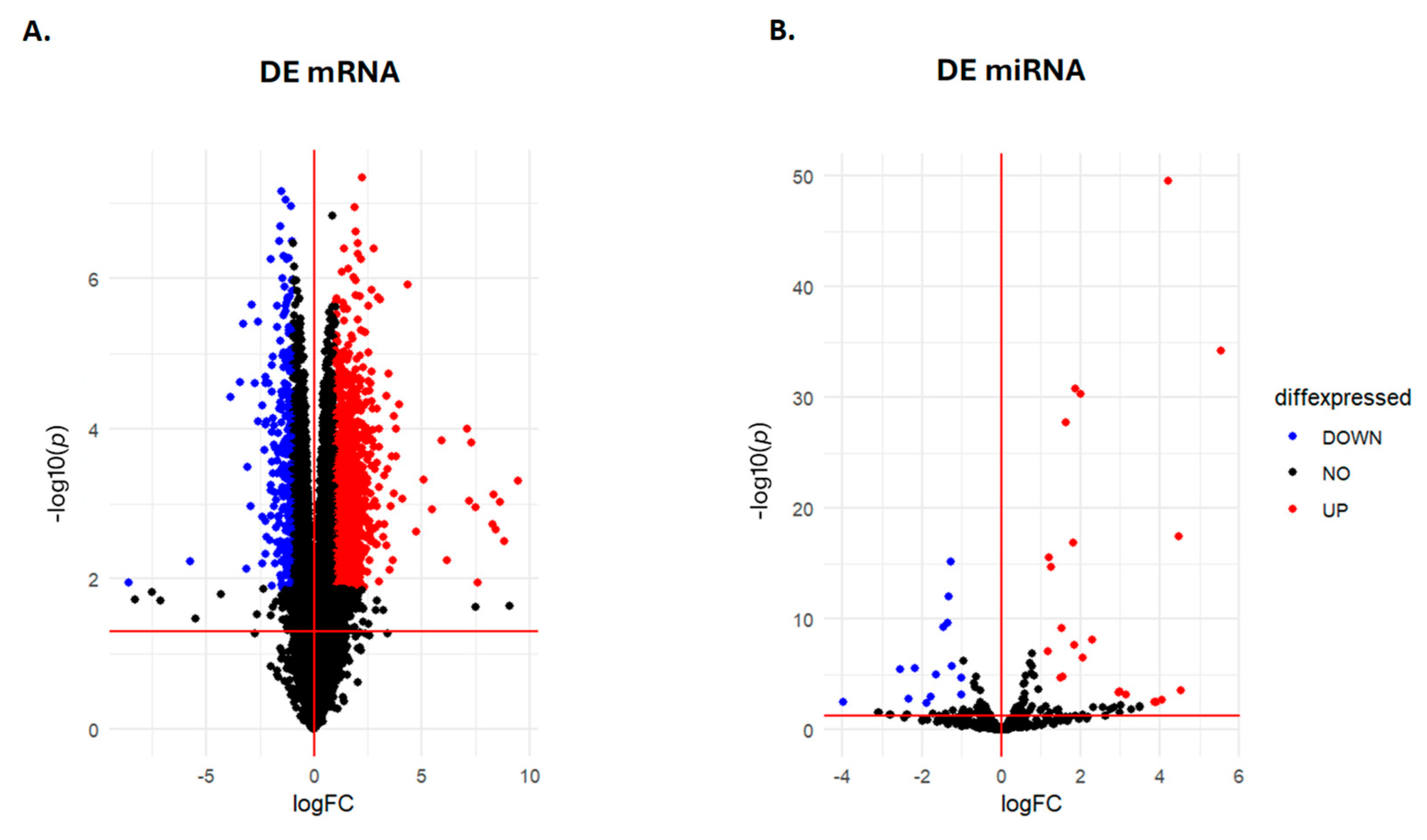
Figure 2.
Predicted competitive endogenous RNA regulatory network for candidate circular RNAs (circRNAs). Bold/enlarged miRNA nodes are DE (FDR q<0.05, log2FC>0.95). log2FC, log2 fold-change (control vs HPH phenotype); CircRNA, circular RNA; miRNA/miR, microRNA; HPH, hypoxia induced pulmonary hypertension. Expression data manipulated in R. environment (Version 4.3.2) and figure presented by Cytoscape (Version 3.10.2).
Figure 2.
Predicted competitive endogenous RNA regulatory network for candidate circular RNAs (circRNAs). Bold/enlarged miRNA nodes are DE (FDR q<0.05, log2FC>0.95). log2FC, log2 fold-change (control vs HPH phenotype); CircRNA, circular RNA; miRNA/miR, microRNA; HPH, hypoxia induced pulmonary hypertension. Expression data manipulated in R. environment (Version 4.3.2) and figure presented by Cytoscape (Version 3.10.2).
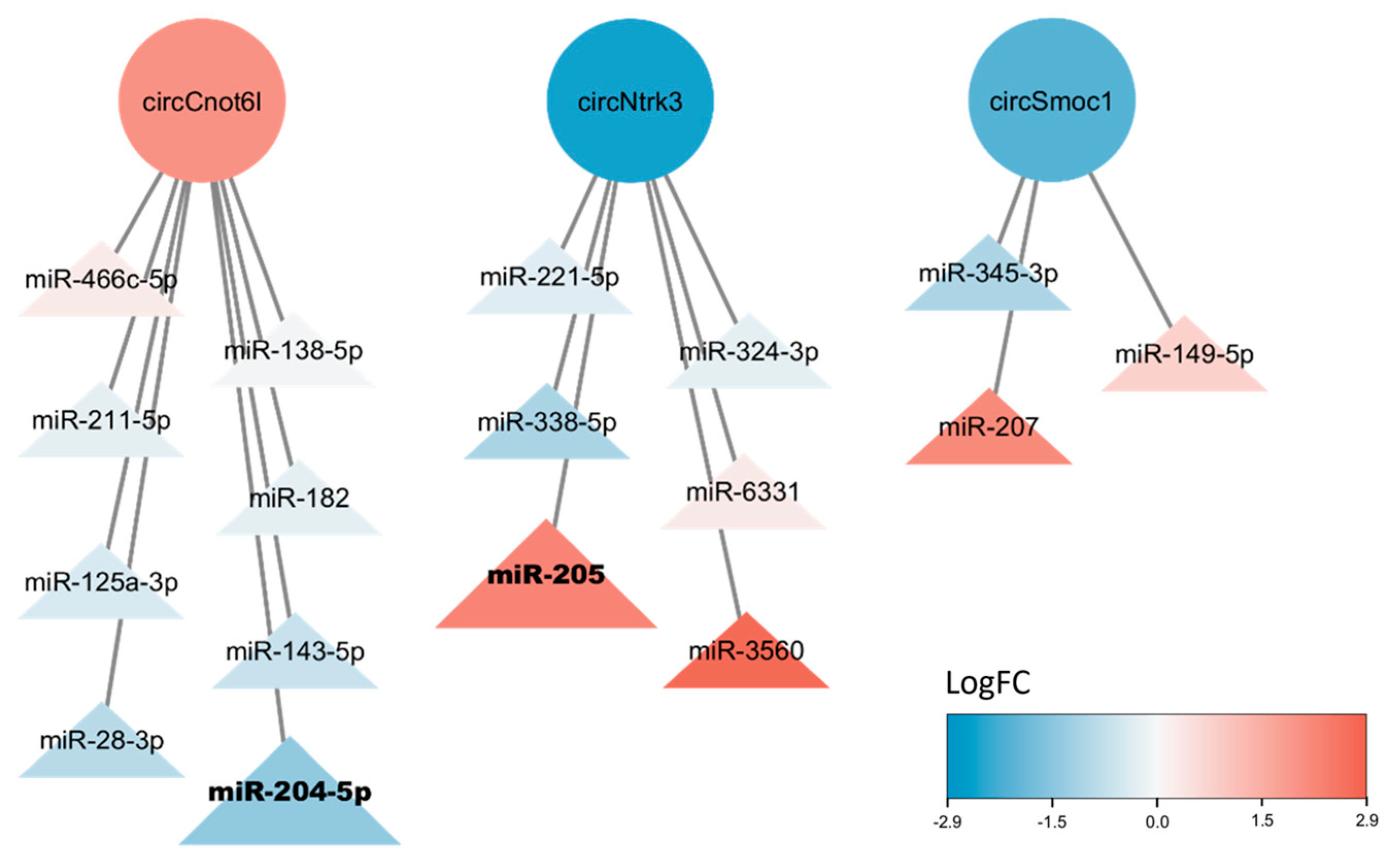
Figure 3.
Full endogenous regulatory network (log2FC>0.95, FDR q<0.05) for circRNA and downstream DE targets. CircCnot6l (n(miRNA) = 1, n(mRNA) = 19), CircNtrk3 (n(miRNA) =1, n(mRNA)=5). CircRNA, circular RNA; DE, differentially expressed; miRNA/miR, micro-RNA; HPH, hypoxia induced pulmonary hypertension; log2FC, Log2 fold-change (control vs. HPH phenotype). Downstream targets represent messenger RNA (mRNA)/target gene interaction. This network was generated using Cytoscape (Version 3.10.2). Abbreviations: Angpt2, Angiopoietin-2; Arap2, ArfGAP With RhoGAP Domain; Atp2b2, ATPase Plasma Membrane Ca2+ Transporting 2; C1qtnf3, C1q And TNF Related 3; Ccdc68, coiled-coil domain containing 68; Cgnl1, Cingulin Like 1; Clec14a, C-type lectin domain family 14 member A; Elavl2, Elav-like RNA-binding protein 2; Epha4, Ephrin type-A receptor 4; Fras1, Fraser extracellular matrix complex subunit 1; Gpsm3, G Protein Signalling Modulator 3 ; Kit, Proto oncogene c-KIT; Lrp2, low-density lipoprotein-related protein 2; Lsamp, Limbic System-Associated Membrane Protein; Plch1, Phospholipase C Eta 1; Rgs12, Regulator of G Protein Signalling 12; Ripk4, Receptor Interacting Serine/Threonine Kinase 4; Rsad2, Radical S-adenosyl methionine domain-containing protein 2; Rtkn2, Rhotekin 2; Slc38a5, Solute Carrier Family 38 Member 5; Spc25, SPC25 Component Of NDC80 Kinetochore Complex; Tmem71, Transmembrane Protein 71; Tox3, TOX High Mobility Group Box Family Member 3; Trpm3, Transient Receptor Potential Melastatin 3.
Figure 3.
Full endogenous regulatory network (log2FC>0.95, FDR q<0.05) for circRNA and downstream DE targets. CircCnot6l (n(miRNA) = 1, n(mRNA) = 19), CircNtrk3 (n(miRNA) =1, n(mRNA)=5). CircRNA, circular RNA; DE, differentially expressed; miRNA/miR, micro-RNA; HPH, hypoxia induced pulmonary hypertension; log2FC, Log2 fold-change (control vs. HPH phenotype). Downstream targets represent messenger RNA (mRNA)/target gene interaction. This network was generated using Cytoscape (Version 3.10.2). Abbreviations: Angpt2, Angiopoietin-2; Arap2, ArfGAP With RhoGAP Domain; Atp2b2, ATPase Plasma Membrane Ca2+ Transporting 2; C1qtnf3, C1q And TNF Related 3; Ccdc68, coiled-coil domain containing 68; Cgnl1, Cingulin Like 1; Clec14a, C-type lectin domain family 14 member A; Elavl2, Elav-like RNA-binding protein 2; Epha4, Ephrin type-A receptor 4; Fras1, Fraser extracellular matrix complex subunit 1; Gpsm3, G Protein Signalling Modulator 3 ; Kit, Proto oncogene c-KIT; Lrp2, low-density lipoprotein-related protein 2; Lsamp, Limbic System-Associated Membrane Protein; Plch1, Phospholipase C Eta 1; Rgs12, Regulator of G Protein Signalling 12; Ripk4, Receptor Interacting Serine/Threonine Kinase 4; Rsad2, Radical S-adenosyl methionine domain-containing protein 2; Rtkn2, Rhotekin 2; Slc38a5, Solute Carrier Family 38 Member 5; Spc25, SPC25 Component Of NDC80 Kinetochore Complex; Tmem71, Transmembrane Protein 71; Tox3, TOX High Mobility Group Box Family Member 3; Trpm3, Transient Receptor Potential Melastatin 3.
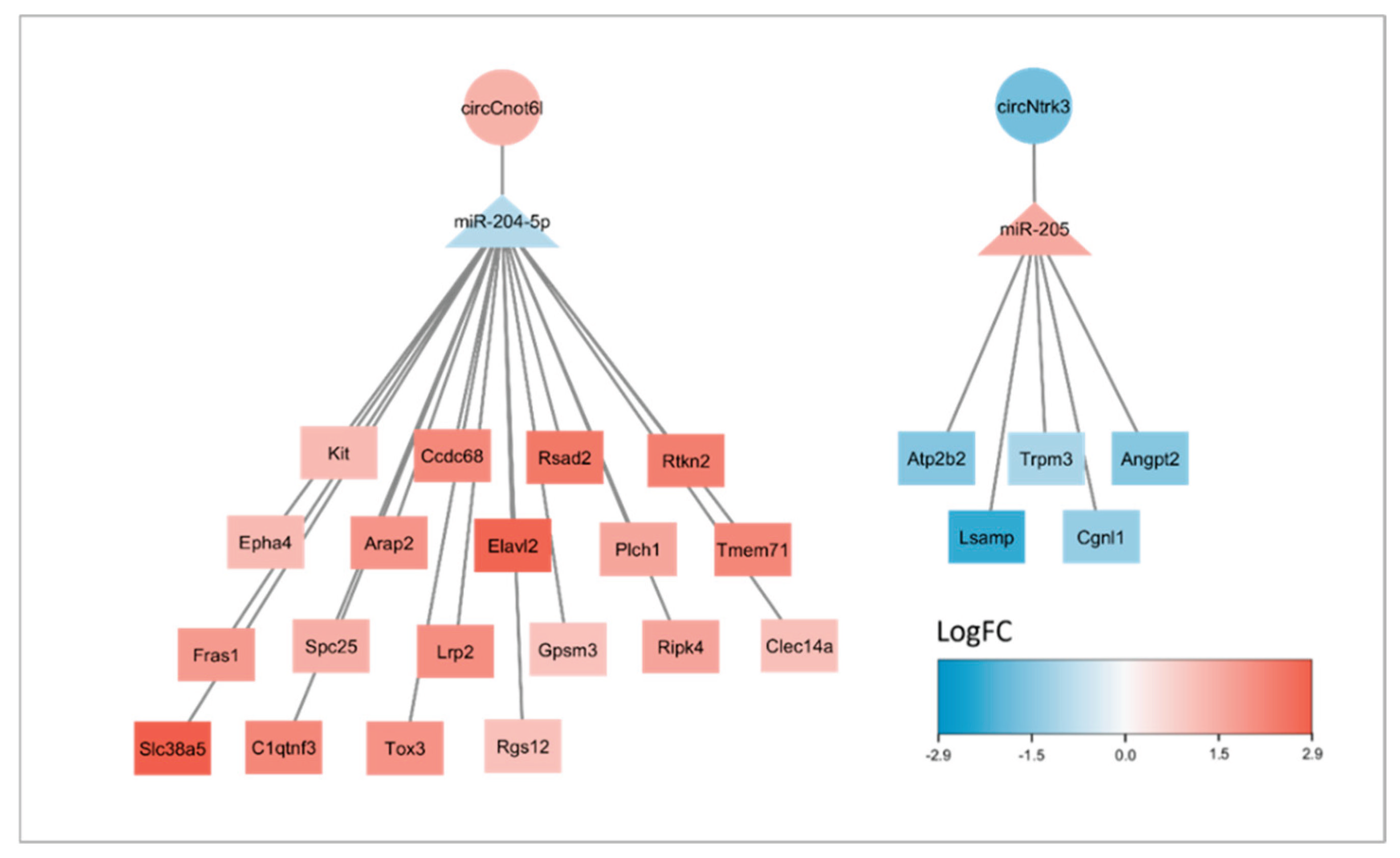
Figure 4.
Correlational analysis between circRNA candidates (circCnot6l, circNtrk3) and their respective downstream targets. A) Clustered heatmap. CircRNA (y-axis), mRNA (x-axis). Correlation of “1” (red) infers complete relationship, correlation of “-1” infers opposite relationship and correlation of “0” indicates no relationship. B) Covariate network of circCnot6l, circNtrk3 and downstream targets including log2FC expression. Shape legend: Circles, circRNA; rectangles, mRNA. Node colour gradients are proportional to log2FC. Edge length/colour gradients are proportional to correlation (shorter = greater correlation). C) Cross-validation model for circRNA-mRNA target interactions. Component 1 (greatest factor of variation) and component 2 (second greatest factor of variation). Abbreviations; CircRNA, circular RNA; r, correlation; rCCA, Regularized Canonical Correlation Analysis; CV, cross validation; HPH, Hypoxia induced hypertension; mRNAs, messenger RNA; log2FC, log2 fold-change. Log2FC (control vs. HPH rats). Correlation generated by mixOmics (Version 6.1.1) using rCCA method, network was generated using Cytoscape (Version 3.10.2).
Figure 4.
Correlational analysis between circRNA candidates (circCnot6l, circNtrk3) and their respective downstream targets. A) Clustered heatmap. CircRNA (y-axis), mRNA (x-axis). Correlation of “1” (red) infers complete relationship, correlation of “-1” infers opposite relationship and correlation of “0” indicates no relationship. B) Covariate network of circCnot6l, circNtrk3 and downstream targets including log2FC expression. Shape legend: Circles, circRNA; rectangles, mRNA. Node colour gradients are proportional to log2FC. Edge length/colour gradients are proportional to correlation (shorter = greater correlation). C) Cross-validation model for circRNA-mRNA target interactions. Component 1 (greatest factor of variation) and component 2 (second greatest factor of variation). Abbreviations; CircRNA, circular RNA; r, correlation; rCCA, Regularized Canonical Correlation Analysis; CV, cross validation; HPH, Hypoxia induced hypertension; mRNAs, messenger RNA; log2FC, log2 fold-change. Log2FC (control vs. HPH rats). Correlation generated by mixOmics (Version 6.1.1) using rCCA method, network was generated using Cytoscape (Version 3.10.2).
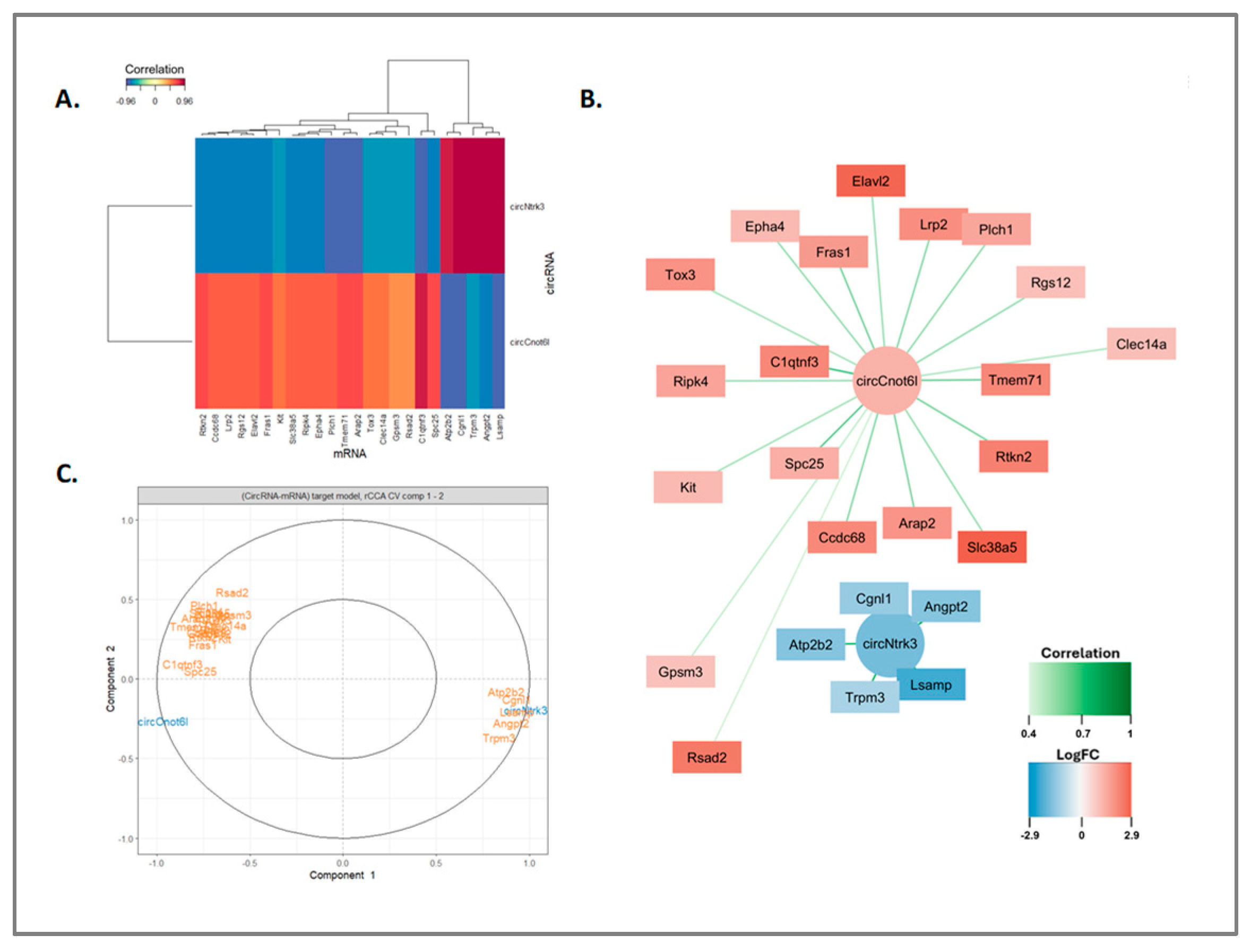
Figure 5.
Protein–protein interaction network of prioritised H_PRN mRNA targets and interacting proteins. Protein–protein interaction analysis was performed using stringAPP. Enlarged and bolded nodes indicate prioritised mRNA targets from the predicted circCnot6l- and circNtrk3-associated networks. Transcript-level log₂FC values from H_PRN were mapped onto the corresponding protein nodes to visualise mRNA expression direction and magnitude; these values do not represent measured protein abundance. Interactions were filtered using a confidence cutoff of 0.8 and FDR q < 0.05. The network was visualised in Cytoscape.
Figure 5.
Protein–protein interaction network of prioritised H_PRN mRNA targets and interacting proteins. Protein–protein interaction analysis was performed using stringAPP. Enlarged and bolded nodes indicate prioritised mRNA targets from the predicted circCnot6l- and circNtrk3-associated networks. Transcript-level log₂FC values from H_PRN were mapped onto the corresponding protein nodes to visualise mRNA expression direction and magnitude; these values do not represent measured protein abundance. Interactions were filtered using a confidence cutoff of 0.8 and FDR q < 0.05. The network was visualised in Cytoscape.
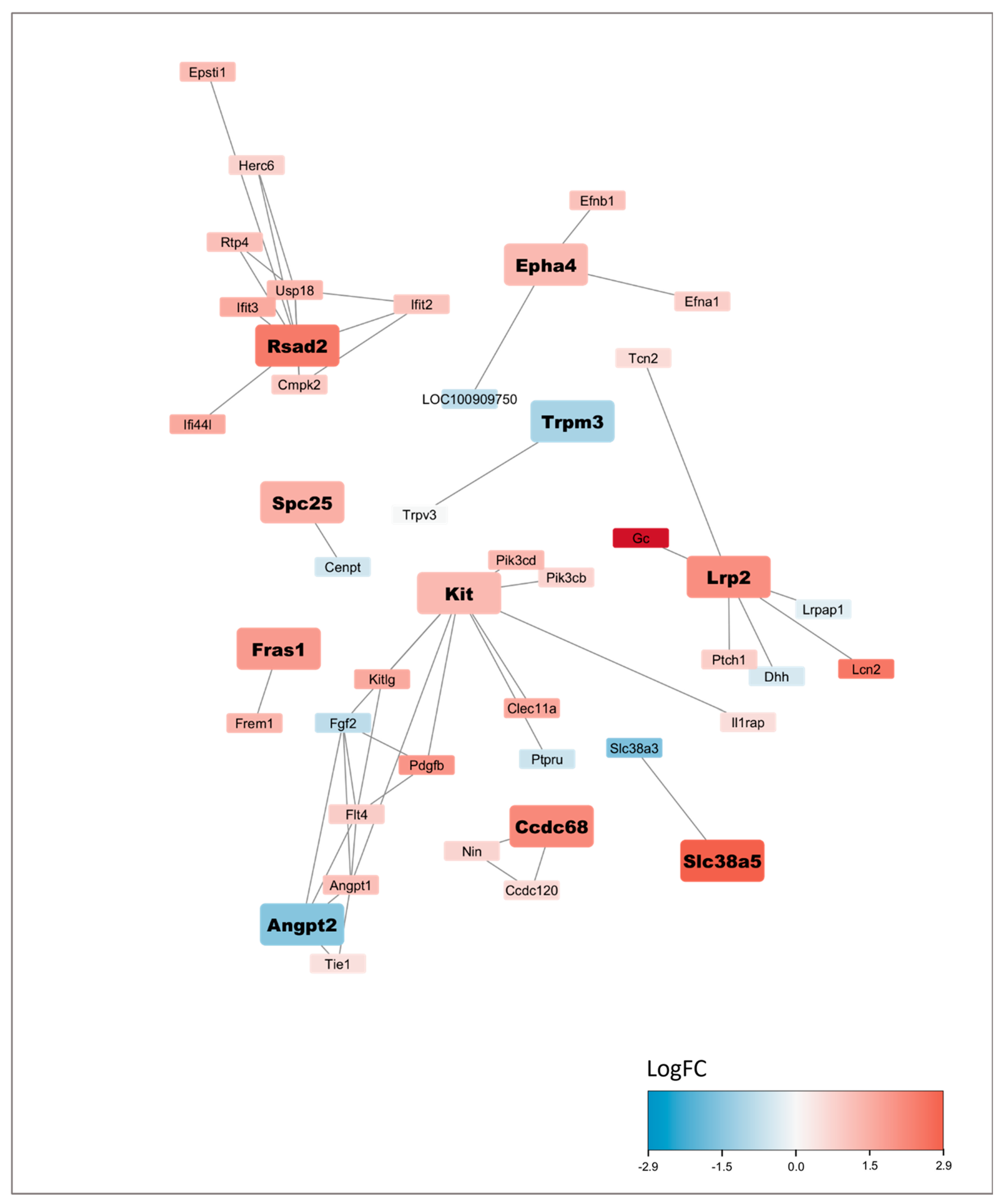

Table 1.
Prioritised circRNA candidates identified across rat PH datasets, with robust candidates detected primarily in H_PRN pulmonary artery tissue.
Table 1.
Prioritised circRNA candidates identified across rat PH datasets, with robust candidates detected primarily in H_PRN pulmonary artery tissue.
| CircAtlas 3.0 ID | Tools /4 | Dataset | Average log2FC |
Average P-value |
Lowest tool FDR | glmmTMB Pr(>|z|) |
| circSmoc1_0009 | 4 | H_PRN | -1.406 | 1.35E-03 | 2.71E-07 | 1.46E-16 |
| circNtrk3_0005 | 4 | H_PRN | -1.727 | 6.69E-05 | 2.61E-04 | 2.86E-32 |
| circCnot6l_0006 | 3 | H_PRN | 1.355 | 9.02E-03 | 0.0151 | 2.36E-06 |
| circMap3k5_0005 | 2 | H_PRN | 1.116 | 7.58E-03 | 0.269 | 3.72E-03 |
| circSmoc1_0002 | 2 | H_PRN | -1.417 | 0.0140 | 0.269 | 1.02E-08 |
| circINT_000237 | 4 | H_PRN | -1.490 | 0.0227 | 0.345 | 9.69E-07 |
| circSlc16a10_0003 | 4 | H_PRN | 2.374 | 0.0188 | 0.421 | 3.76E-10 |
| circZfp148_0001 | 2 | H_PRN | -1.606 | 0.0271 | 0.551 | 2.23E-03 |
| circNsd1_0007 | 2 | H_PRN | -1.235 | 0.0348 | 0.551 | 4.18E-05 |
| circMagi1_0007 | 2 | H_PRN | -1.694 | 0.0396 | 0.551 | 4.22E-06 |
Top-ranked circRNAs showing differential expression across multiple tools (lowest tool FDR). Tools, (CIRI2, CIRIquant, circRNA_finder, find_circ), 4/4 indicates complete detection. Dataset, study dataset (Materials and Methods: Data Collection). Average log2FC, sum of Log2 fold-change (log2FC) expression / number of detected tools. Average P-value, sum of p-value / number of detected tools. Lowest tool FDR, lowest singular FDR value across each tool. GlmmTMB, Generalized Linear Mixed Models using Template Model Builder. Pr(>|z|) < 0.05, significant alignment between tools. CircRNA, circular RNA; DE circRNA, differentially expressed circRNA (Bold; n = 3, q < 0.05, log2FC > 1, Tool 1+); NDE circRNA, nominally differentially expressed circRNA (n = 7, p < 0.05, log2FC > 1, Tool 1+); H_PRN, study PRJNA809145; M_PRN, study PRJNA732522. Log2FC (healthy control vs pulmonary hypertension phenotype).
Table 2.
Target expression and connectivity.
| Parent circRNA | Differential Expression | WGCNA | |||||
| Control vs. HPH | Module Connectivity | Gene-trait | |||||
| Gene | Log2 FC | qvalue | Module | MM | HPH(r) | pvalue | |
|
CircNtrk3 |
Cgnl1 | -1.316 | 0.0004 | brown | 0.982 | -0.993 | 7.090E-06 |
| Lsamp | -2.269 | 0.0016 | brown | 0.968 | -0.964 | 4.695E-04 | |
| Trpm3 | -1.085 | 0.0027 | green | 0.968 | -0.947 | 1.204E-03 | |
| Angpt2 | -1.502 | 0.0022 | brown | 0.975 | -0.941 | 1.570E-03 | |
| Atp2b2 | -1.530 | 0.0077 | pink | 0.953 | -0.909 | 4.613E-03 | |
|
CircCnot6l |
Arap2 | 1.930 | 0.0006 | turquoise | 0.981 | 0.978 | 1.393E-04 |
| Tmem71 | 2.178 | 0.0026 | turquoise | 0.952 | 0.966 | 3.990E-04 | |
| Epha4 | 1.226 | 0.0013 | turquoise | 0.986 | 0.955 | 7.963E-04 | |
| Slc38a5 | 2.921 | 0.0022 | turquoise | 0.998 | 0.939 | 1.676E-03 | |
| Plch1 | 1.597 | 0.0055 | turquoise | 0.936 | 0.930 | 2.365E-03 | |
| Ripk4 | 1.638 | 0.0049 | turquoise | 0.990 | 0.928 | 2.590E-03 | |
| Fras1 | 1.815 | 0.0039 | turquoise | 0.979 | 0.911 | 4.316E-03 | |
| Ccdc68 | 2.140 | 0.0069 | turquoise | 0.978 | 0.909 | 4.610E-03 | |
| Tox3 | 1.964 | 0.0033 | turquoise | 0.980 | 0.899 | 5.824E-03 | |
| Rsad2 | 2.440 | 0.0028 | turquoise | 0.944 | 0.896 | 6.362E-03 | |
| Elavl2 | 2.822 | 0.0090 | turquoise | 0.880 | 0.891 | 7.140E-03 | |
| Gpsm3 | 1.056 | 0.0090 | turquoise | 0.959 | 0.882 | 8.600E-03 | |
| Rtkn2 | 2.320 | 0.0087 | turquoise | 0.965 | 0.879 | 9.092E-03 | |
| Rgs12 | 1.105 | 0.0086 | turquoise | 0.962 | 0.870 | 1.097E-02 | |
| Lrp2 | 2.046 | 0.0129 | turquoise | 0.959 | 0.861 | 1.285E-02 | |
| C1qtnf3 | 2.176 | 0.0072 | blue | 0.930 | 0.856 | 1.393E-02 | |
| Kit | 1.216 | 0.0142 | turquoise | 0.962 | 0.826 | 2.204E-02 | |
| Spc25 | 1.425 | 0.0389 | turquoise | 0.899 | 0.814 | 2.588E-02 | |
| Clec14a | 1.118 | 0.0216 | turquoise | 0.945 | 0.803 | 2.981E-02 | |
This table represents a summary of target gene expression, module allocation, membership and gene-trait association. “Module” represents parent module generated by WGCNA (Figure S6) (“turquoise”, “blue”, “brown”, “green” or “pink”). Module membership (MM) = how well gene target connects within parent module 0-1. HPH(r) = gene-trait correlation for hypoxia induced hypertension (HPH, 1 = compete correlation with phenotype). p value = Pearsons test for gene-trait significance (p<0.05 = significant). Rank is based on HPH(r) value (1 = greatest correlation, -1 = greatest inverse correlation, 0 = no correlation). Log2FC (Control vs. HPH). “q value” = FDR adjusted p value (p <0.05 = significant). Log2FC = Log2 fold-change; FDR, false discovery rate; HPH, hypoxia induced hypertension; WGCNA, Weighted Gene Co-expression Network Analysis. WGCNA analysis conducted using R. (Version 4.3.2).
Table 3.
Enriched pathways associated with prioritised H_PRN mRNA targets and their interacting proteins. Pathways were identified from the protein–protein interaction network and ranked by enrichment p-value. The listed functions summarise major biological processes represented by each pathway. PPI, protein–protein interaction; MAPK, mitogen-activated protein kinase; PI3K-Akt, phosphoinositide 3-kinase/protein kinase B; SCF-KIT, stem cell factor–KIT signalling.
Table 3.
Enriched pathways associated with prioritised H_PRN mRNA targets and their interacting proteins. Pathways were identified from the protein–protein interaction network and ranked by enrichment p-value. The listed functions summarise major biological processes represented by each pathway. PPI, protein–protein interaction; MAPK, mitogen-activated protein kinase; PI3K-Akt, phosphoinositide 3-kinase/protein kinase B; SCF-KIT, stem cell factor–KIT signalling.
|
Candidate protein/cluster |
Pathway | Function | P-value |
| Angpt2 + 9 | Rap1 signalling pathway | Cell adhesion, proliferation and migration | 6.46E-09 |
| Angpt2 + 9 | Ras signalling pathway | Cell growth, proliferation, differentiation and survival | 1.69E-08 |
| Angpt2 + 9 | PI3K-Akt signalling pathway | Cell growth, survival, proliferation and metabolism | 7.42E-07 |
| Angpt2 + 8 | MAPK signalling pathway | Stress response, cell proliferation, differentiation and apoptosis | 4.18E-06 |
| Tcn2 + 2 | Signalling by SCF-KIT | Cell proliferation, migration and survival | 8.57E-03 |
Table 4.
Study metadata collected from NCBI on pulmonary hypertension in rats.
| Study | Rat Type | Age | Control | Experiment | Tissue/RNA | DE definition | Link |
| PRJNA809145/ H_PRN |
Male Sprague-Dawley rats | 8 weeks exposure begins, 12-week harvest | Normoxia 21% O2 (n=4) |
Hypoxia 10% O2 (n=3) |
Total RNA from pulmonary arteries | CircRNA/ LncRNA - p < 0.05, log2FC >1 |
Link1 |
| GSE159668/ H_GSE |
Male Sprague-Dawley rats | 6-8 weeks exposure begins, 9-11 week harvest | Normoxia 21% O2 (n=3) | Hypoxia 9.5-10.5% O2 (n=3) | Total RNA from right lung tissues | LncRNA - p < 0.05, log2FC >1 |
Link2 |
| PRJNA732522/ M_PRN |
Male Wistar Rats |
4 weeks inoculation. 12-week harvest | Single dose - Monocrotoline @ 60mg/kg (n=3) | Single dose - Monocrotoline @ 60mg/kg (n=3) | Total RNA from lung tissue | LncRNA – p < 0.05, log2FC >2 |
Link3 |
Each study follows RNA-Seq data collection guidelines (CCBR) for long non-coding RNA (lncRNA) analysis and uses ribo zero for ribosomal RNA (rRNA) depletion. Abbreviations: circular RNA, circRNA; log2FC, Log2 fold-change; DE, differentially expressed; mg, milligrams; kg, kilograms. P < 0.05 is significant. Link1: https://www.ncbi.nlm.nih.gov/bioproject/PRJNA809145/ from [19]; Link2, https://www.ncbi.nlm.nih.gov/geo/query/acc.cgi?acc=GSE159668 from [20]; Link3, https://www.ncbi.nlm.nih.gov/bioproject/PRJNA732522/ from [21].
Disclaimer/Publisher’s Note: The statements, opinions and data contained in all publications are solely those of the individual author(s) and contributor(s) and not of MDPI and/or the editor(s). MDPI and/or the editor(s) disclaim responsibility for any injury to people or property resulting from any ideas, methods, instructions or products referred to in the content. |
© 2026 by the authors. Licensee MDPI, Basel, Switzerland. This article is an open access article distributed under the terms and conditions of the Creative Commons Attribution (CC BY) license (http://creativecommons.org/licenses/by/4.0/).
Copyright: This open access article is published under a Creative Commons CC BY 4.0 license, which permit the free download, distribution, and reuse, provided that the author and preprint are cited in any reuse.


