
Submitted:
16 July 2026
Posted:
17 July 2026
You are already at the latest version
Abstract
Background. The American Heart Association (AHA) introduced “Life’s Essential 8” as a comprehensive framework to promote cardiovascular health (CVH) and prevent cardiovascular diseases (CVDs). Despite this, the prevalence of optimal CVH remains low in most developed populations. Molecular hydrogen (H₂) has shown therapeutic potential in CVD, obesity, type 2 diabetes mellitus (T2DM), and neuropsychological disorders, suggesting a possible integrative role in CVH promotion and disease prevention. Review of Data. The AHA’s 8 components include healthy diet, physical activity, nicotine avoidance, adequate sleep, optimal body weight, and regulation of blood lipids and glucose, as well as blood pressure. Accumulating evidence indicates that H₂ may beneficially modulate most of these domains. In a randomized controlled trial involving 60 patients with metabolic syndrome, hydrogen-rich water (HRW) significantly reduced body mass index (BMI), blood lipids, glucose, and HbA1c, and improved inflammatory and redox biomarkers compared to placebo. Additional studies suggest that H₂ can lower blood pressure and its variability, enhance physical performance, and favorably modulate gut microbiota, including increased production of short-chain fatty acids. Hydrogen therapy, administered as H₂-rich water or H₂–O2 inhalation, has also been associated with improved sleep quality, potentially through attenuation of oxidative stress and psychological distress. Overall, up to seven of the eight AHA CVH metrics may be influenced by H2 intervention. H₂ may function as a bioactive therapeutic agent and dietary adjunct that improves multiple determinants of CVH. Its integration into preventive and therapeutic strategies may facilitate attainment of AHA-defined CVH, particularly in populations at elevated risk of CVDs as well as pre-metabolic syndrome.
Keywords:
cardiovascular health
; risk factors
; protective factors
; heart health
Introduction
Eating appropriate diet, doing proper exercise, performing one’s own allocated duties properly and going to bed and getting up at appropriate time is yoga way of life which leads to perfect health. American Heart Association (AHA) also proposes similar Essentials 8 for cardiovascular health [1]. The global burden of diseases study has demonstrated a rapid increase in the burden of cardiovascular diseases (CVDs) and their risk factors, although there is decline in cardiovascular mortality [1,2]. AHA has developed a novel construct for promotion of CVH, for health preservation and prevention of CVDs [3,4]. The exact prevalence of CVH is low in most developed populations but relatively, it may be higher in Mediterranean countries and Japan. The “8 Essentials of life” proposed by the AHA, concern with diet and lifestyle factors and biological risk factors of CVDs [3,4], which can also provide improved brain health and which is more sustainable [5].
Recent studies indicate that hydrogen (H2) therapy in the form of H2-rich water (HRW) or H2 inhalation can significantly reduce cardiovascular risk factors and attenuated serum hemoglobin A1c, and improved biomarkers of inflammation and redox homeostasis [6,7,8]. Furthermore, H2 therapy has been found to promote a mild reduction in body mass index (BMI), waist circumference, blood pressure, blood glucose, and blood lipids, as well as enhance physical performance and sleep in other studies [6,7,8]. HRW can also provide benefits in the gut microbiota, by increased production of short chain fatty acids (SCFA) [9].
It is clear that out of the 8 Essentials of AHA, all can be modulated by H2 administration including adverse effects of tobacco. H2 therapy, whether given as H2-O2 gas inhalation or as HRW shows promise for improving sleep and mood disorders [7,8]. Since H2 therapy has been found to be beneficial in CVDs [10,11,12] and cardiovascular risk factors as obesity, metabolic syndrome [6], type 2 diabetes mellitus (T2DM) [13,14], hypertension [15,16], and neuropsychological diseases like dementia, sleep and mood disorders [7,8], it poses the possibility that this therapy can mitigate CVDs. It seems, that H2 can positively influence multiple components of the AHA’s “Life’s Essential 8,” [3], including metabolic [6,13,14], cardiovascular [10,11,12,15,16], and lifestyle-related factors [3,7,8,17,18]. It is scientifically plausible and promising, although stronger large-scale clinical trials are still needed to confirm its translational impact. H2 as therapeutic agent is highly sustainable therapy to achieve the sustainable development goals (SDGs) of the UNO. Therefore, this communication aims to highlight the role of H2 supplementation in the development of CVH.
Life’s Essential 8 of the American Heart Association
The AHA [4] proposed that health is a broader, more positive construct than merely the absence of disease, which is also well advocated by other health organizations in defining health [19]. The AHA leveraged available data and emerging concepts in CVD prevention to formulate a definition accessible to all and to focus efforts on improved CVH. The initial definition of CVH included 7 health behaviours and healthy biological factors, which when optimal, were associated with higher CVD-free survival and total longevity and better quality of life. The 7 components of CVH, included indicators of diet quality, participation in physical activity (PA), exposure to tobacco, and measures of body mass index, fasting blood glucose, total cholesterol, and blood pressure (BP) levels. The criteria for these metrics were classified as poor, intermediate, or ideal depending on the basis of accepted clinical thresholds. Ideal CVH was defined as having all 7 metrics at ideal levels. Ideal CVH also formed the basis of a new definition of optimal brain health [5], because these risk factors and protective factors can also influence brain health. There is now evidence to support new more powerful health construct over the past 15 years giving an opportunity to update the measurement of CVH in the current context. The AHA advisory has presented an updated and enhanced approach for measuring, monitoring, and modifying CVH, which may be called Life’s Essential 8 (Table 1), by inclusion of sleep as a new CVH component for promotion of CVH and prevention of CVDs in all the people and the population [3]. However, there are other protective factors, such as meditation and yoga, religious service attendance, optimism and intermittent fasting and time restricted eating which are known to have positive effects on CVH, have not been given any consideration by the AHA. It is proposed that several of the risk factors and protective factors can be modulated by use of H2 as adjuvant therapy in the promotion of CVH.
Role of Molecular Hydrogen in the Promotion of Cardiovascular Health (CVH)
CVDs are the major cause of poor CVH, therefore H2 therapy should be initiated in all individuals who are likely to develop CVDs in future. Atherosclerosis is the major cause of coronary artery disease (CAD), stroke, peripheral artery disease (PAD), and myocardial infarction, characterized by chronic inflammation and deposition of oxidized lipids and cholesterol in the walls of the arteries [20]. H2 is an effective anti-inflammatory agent and has potential to ameliorate glycolipid metabolism disorders, which is believed to exert beneficial effects on the prevention and treatment of CAD. It is suggested that H2 reduces inflammation in CAD and stroke by regulating multiple pathways, including nuclear factor kappa B (NF-κB) inflammatory pathway, pyroptosis, mitophagy, endoplasmic reticulum (ER) stress, and nuclear factor erythroid 2-related factor 2 (Nrf2) antioxidant pathway. In addition, H2 may improve glycolipid metabolism by mediation of phosphoinositide 3-kinase (PI3K) and adenosine monophosphate-activated protein kinase (AMPK) signalling pathways, contributing to inhibition of the occurrence and development of CAD. Recent studies highlight H₂ therapy as an emerging redox homeostasis modulator in CVDs.
Research emphasizes its role as a therapeutic gas that selectively neutralizes cytotoxic radicals, reduces systemic inflammation, and protects mitochondrial function to mitigate heart failure, ischemia-reperfusion injury, and atherosclerosis. H₂ therapy acts as a selective antioxidant, protecting mitochondria and improving endothelial function to mitigate CVD. Inhalation and HRW interventions are shown to limit infarct size and reduce ischemia-reperfusion injury.
The study included 36 participants (24 females; age 42.1 ± 13.2 years; BMI 30.8 ± 4.2 kg/m2) randomized to receive either 1.0 L of HRW (15 mg of H2) or 1.0 L of control water (0 mg of H2) daily for eight weeks. The results demonstrated that HRW significantly mitigated cravings (p = 0.05), improved subjective sleep quality (p = 0.05), reduced total cholesterol (p = 0.02) and low-density lipoprotein (LDL) cholesterol (p = 0.04), and increased plasma glucagon-like peptide-1 levels (p = 0.05) compared to the control. These findings suggest that HRW may serve as a safe and effective dietary strategy to address appetite regulation and related metabolic indices in individuals with obesity [7].
H₂ therapy administered via inhalation or drinking HRW acts as a selective antioxidant and anti-inflammatory agent [17]. It helps protect muscles, boosts mitochondrial energy, and accelerates recovery, making it a growing area of interest for optimizing overall wellness and athletic endurance, because it is generally well-known safety [21]. It works by reducing oxidative stress, alleviating psychological distress, and enhancing sleep efficiency [8]. H2 may be used as a nutrient to enhance the anti-inflammatory index of diet, with reference to health promotion and disease prevention [16,22]. Therefore, it is possible, that H2 supplementation can provide the 8 Essentials of CVH of the AHA, and it may be used in the population with high risk of CVDs to provide CVH. The study by Xun et al. [23] examined the effects of long term H2 supplementation on the body weight and 13 serum biochemical markers that were monitored during the H2 intervention. The findings revealed that all these parameters were significantly altered by oral intake of HRW or H2 inhalation. Among the 13 parameters, the most striking alterations induced by H2 treatment were observed in serum myocardial enzymes spectrum. The results also showed that the changes in these parameters occurred at different time points, and the alterations in most of the parameters were much more significant in H2 inhalation compared with HRW.
Effects of Molecular Hydrogen on Diet Quality
Mediterranean and Indo-Mediterranean style diets rich in vegetables, fruits, whole grains, and nuts are known to prevent CVDs and other chronic diseases, as well as maintain CVH. These foods can increase the anti-inflammatory potential of these diets. The effect of H2 as a nutrient on the inflammatory index of diet may cause an increased anti-inflammatory potential of the diet [22], with reference to CVH promotion and prevention of CVDs [24]. Lower DII scores reflect anti-inflammatory diets (which protect against CVDs), while higher scores indicate pro-inflammatory diets that increase the risk of heart attacks, stroke, and cardiovascular mortality [24]. Low dietary inflammatory index is characterized with increased Indo-Mediterraneanand Mediterranean foods, such as vegetables, fruits, whole grains, porridge, millets that are rich in dietary fibre and can produce more H2 in the gut.
HRW intake may also improve appetite [7]. HRW acts as a therapeutic agent and promotes the upregulation of beneficial, butyrate-producing bacteria and helps ameliorate clinical features of microbial disturbances that can modulate gut microbiota composition and improve intestinal barrier integrity [9]. It seems that HRW has emerged as a promising therapeutic intervention and the ingestion of HRW may alter gut microbiota composition, potentially influencing various health outcomes such as metabolic, inflammatory, and neurological conditions.
The findings from a recent review suggest that HRW may positively influence gut microbiota composition, promoting a balanced microbial environment that could contribute to various health benefits, including improved gastrointestinal function, enhanced immune response, and potential anti-inflammatory effects [9]. Future research should focus on identifying the optimal dosage, duration of administration, and specific microbial changes associated with intake of HRW. In the gut, H₂ gas is not produced directly by food itself, but rather as a byproduct of gut bacteria fermenting undigested carbohydrates. The primary dietary substrates driving this bacterial fermentation are complex carbohydrates, fibres, and specific sugars like lactose, fructose, lactulose, and resistant starches [25]. H2 generated by fermentation dietary fibre in the human gut microbiome can influence metabolic function and compete fitness of butyrate production in the gut. In a randomized trial among 10 patients with ulcerative colitis, the H2 group showed higher α-diversity (p = 0.19), and the variation in β-diversity was markedly different, compared to the control group, in intestinal microbiota analysis (p = 0.02) [26]. Functional gene analysis revealed 115 significant genetic changes in the H2 group following treatment without any observed beneficial effects in these patients. Larger-scale human studies are essential to evaluate its effects across diverse populations and clinical conditions. As this field of research progresses, it holds significant potential for the development of complementary therapeutic strategies aimed at promoting gut health and overall well-being.
Effects of Molecular Hydrogen on Physical Activity
Participation in moderate physical activity is the easiest way to achieve CVH. H₂ supplementation demonstrates potential in managing exercise-induced stress and fatigue, but there is limited and inconsistent evidence that it directly improves overall athletic performance or aerobic capacity in healthy adults [17,18]. A meta-analysis including 27 studies, involving 597 participants were included. The search finally included aerobic endurance, anaerobic endurance, muscular strength, lower limb explosive power, rating of perceived exertion (RPE), blood lactate (BLA), and average heart rate (HR) in the effect size (ES) synthesis. The findings indicated that H2 supplementation is favourable in healthy adults to improve lower limb explosive power, alleviate fatigue, and boost BLA clearance, but may not be effectively improving aerobic and anaerobic endurance and muscular strength [17].
In a clinical trial, HRW significantly outperformed the control water in reducing biomarkers of acute muscular damage caused by resistance exercise (p ≤ 0.05) and tended to outcompete placebo in improving sleep quality (p = 0.119) [18]. In another randomized trial among 18 trained men aged 19 years, the total power output (HRW: 50,866.7 ± 6,359.9W, Placebo: 46,431.0 ± 9,376.5W, p = 0.032) and the total number of repetitions (HRW:78.2 ± 9.5 repetitions, Placebo: 70.3 ± 9.5 repetitions, p = 0.019) in the H2 supplemented group were significantly higher than in the placebo group. However, there was no statistically significant difference (p< 0.05) between the H2 and placebo groups in countermovement jump (CMJ), total quality recovery scale (TQRS), and muscle soreness visual analog scale (VAS) [27]. It is possible that eight days of intermittent HRW intake can significantly improve muscular endurance performance in trained individuals, making it a promising strategy for athletes or fitness enthusiasts looking to boost muscular endurance during resistance training or competitions. HRW could be advanced as a risk-free and effective beverage for promoting training-specific adaptations in exercise-naïve men and women over 50 years of age. Further studies with more rigorous designs are thus needed to examine and confirm the effects of H2 on these important functionalities in humans.
Effects of Molecular Hydrogen on Exposure to Tobacco
Tobacco consumption in any form is a risk factor of CVD and other chronic diseases; therefore, cessation of tobacco intake is essential to achieve CVH. H2 inhalation acts as an effective therapeutic agent by mitigating cigarette smoke-induced lung damage, airway inflammation, and emphysema in mice. The gas alleviates chronic obstructive pulmonary disease (COPD) progression by inhibiting inflammatory responses and reducing oxidative stress through the suppression of the extracellular signal-regulated kinases 1 and 2 (ERK1/2) and NF-κB signalling pathways [28]. In an experimental study in rats, H2 ameliorated cigarette smoke-induced lung function decline, emphysema, inflammatory cell infiltration, small-airway remodelling, goblet-cell hyperplasia in tracheal epithelium and activated ERK1/2 and NF-κB in mouse lung. In 16HBE airway cells, H2O2 increased interleukin (IL)-6 and IL-8 secretion in conjunction with ERK1/2 and NF-κB activation. These changes were reduced by H2 treatment. These findings demonstrated that H2 inhalation could inhibit CS-induced COPD development in mice, which is associated with reduced ERK1/2 and NF-κB-dependent inflammatory responses.
Effects of Molecular Hydrogen on Sleep Quality
Sleep disorders are associated with various chronic diseases including CVDs and neuropsychological disorders; therefore, optimal sleep is crucial for achievement of CVH. While H2 has anti-inflammatory, antioxidant, and anti-fibrotic effects and has potential applications in disease management, its impact on sleep disorders remains unclear [7,8]. A single-blind, randomized controlled clinical trial examined the effect of H2-O2 among 66 patients with sleep disorders [8]. Participants with sleep disorders were randomly divided into a control group and a H2-O2 group that received nasal gas inhalation for seven days. The H2-O2 group revealed significant improvements in total sleep time and sleep efficiency on days 3, 5, and 7 and significant decreases in wake time on days 3 and 7. Compared with those in the control group, the total sleep time was greater, and the wake time was lower in the H2-O2 group. After 7 days, the scores of the Pittsburgh Sleep Quality Index and Self-Rating Depression Scale in the H2-O2 group were lower than those in the control group, whereas the Self-Rating Anxiety Scale scores did not differ significantly. H2-O2 therapy effectively improved sleep disorders by reducing wake time, relieving psychological stress, and enhancing sleep quality. The study demonstrates that inhaling a H2-O2 gas mixture can significantly reduce wake times, alleviate psychological stress, and improve overall sleep quality and depressive symptoms in patients with sleep disorders [8]. The more recent HYDRAPPET study [7], which is a randomized, controlled trial, among 36 patients with obesity, received HRW or placebo for 8 weeks, showing beneficial effects on sleep quality.
Sleep disorders and circadian dysfunction are major drivers of cardiovascular disease (CVD) risk [34]. They disrupt the body's natural 24-hour biological clock, leading to sustained high blood pressure, inflammation, and metabolic instability. Addressing these issues is essential for protecting heart health and preventing adverse events like strokes and heart attacks.
H2 may suppress overactive mast cells and preserve intracellular redox balance, creating a supportive environment for the sleep-wake cycle and melatonin interactions [29]. Sleep disorders may include chronic insomnia, obstructive sleep apnea (OSA), and sleep fragmentation which occurs due to sleep deprivation-related sleep disturbances, rather than an independent diagnostic sleep disorder entity [29]. The diagnostic criteria is closely associated with the dysregulated crosstalk among immune-inflammatory pathways, the circadian timing system, and the melatonin system, with mast cells serving as one of the key immune cell types involved in this network. This review explores the understanding of the sleep-wake rhythm-dependent dual-pathway regulation of mast cell activation, the oscillatory coupling between sleep-wake rhythm genes and mast cell functions, as well as the mediating role of the melatonin system [29]. In addition, by integrating the associations between inflammatory mediators and related pathological processes, such as iron metabolism disorders and mitochondrial dysfunction) with sleep disorders, it explores the potential indirect and non-specific mechanisms underlying hydrogen-induced sleep improvement.
There is lack of direct experimental evidence that H2 specifically targets the mast cell-sleep-wake rhythm-melatonin triad. The sleep-improving effects of H2 are currently hypothesized to be mediated by antioxidant, anti-inflammatory, and mitochondrial protective properties, which may permissively support the function of the circadian timing system and sleep homeostatic/arousal systems of the circadian clock system [30]. A chronobiotic is an agent that adjusts the timing of the body's internal biological clock, known as the circadian rhythm. Unlike traditional sleep aids that merely induce drowsiness, chronobiotics such as H2 may actively reset the biological clock to help synchronize physiological processes with environmental cues. H2 may exert indirect chronobiotic properties by optimizing intracellular redox balance and reducing oxidative stress which is essential for maintaining the robustness, amplitude, and stability of circadian clock function. It is also possible that H2 may alleviate sleep disturbances linked to oxidative stress and inflammation, such as insomnia secondary to chronic stress, OSA-associated sleep fragmentation such as a symptom secondary to multiple sleep disorders rather than an independent sleep disorder. There are several gaps in clinical trials, along with limitations including multi-target effects, species differences, and placebo effects, and the absence of direct molecular/cellular evidence for H2 targeting the mast cell-sleep-wake rhythm-melatonin system. More studies with large samples and technological innovations are needed to clarify its potential efficacy and the indirect regulatory pathways linking H2 to the mast cell-sleep-wake rhythm-melatonin network, thereby providing a scientific basis for the potential clinical application of H2 in the intervention of sleep disorders.
Effects of Molecular Hydrogen on Body Mass Index and Obesity
Obesity may be associated with oxidative stress and inflammation which is a risk factors of CVDs, therefore prevention of obesity can preserve CVH. A randomized, double-blinded, placebo-controlled trial was conducted in 60 subjects (30 men and 30 women) with metabolic syndrome [6]. The placebo group contained neutral identical tablets and intervention group was administered high-concentration HRW (> 5.5 milli moles of H2 per day) for 24 weeks. Supplementation with high-concentration HRW significantly promoted a mild reduction in body mass index and waist circumference [6]. The HYDRAPPET randomized controlled trial examined the effects of 8 weeks of daily intake of HRW on individuals with obesity (n=36). The study found that drinking 1.0 L of HRW (15 mg of H2) significantly decreased food cravings, increased glucagon-like peptide-1 (GLP-1) levels, improved sleep, and lowered total and LDL cholesterol and increased plasma GLP-1 levels (p = 0.05) compared to the control without directly altering overall body composition [7].
Effects of Molecular Hydrogen on Blood Glucose and Diabetes Mellitus
Hyperglycemia is a manifestation of diabetes mellitus which is considered like heart diseases due to its adverse effects on cardiovascular system. Therefore, prevention of higher blood glucose and T2DM are crucial to achieve CVH. In a recent randomized, controlled trial conducted in India, among 60 patients with metabolic syndrome, treatment with HRW was associated with significant decline in blood cholesterol and glucose levels, attenuated serum hemoglobin A1c, and improved biomarkers of inflammation and redox homeostasis as compared to placebo (P < 0.05) [6]. The finding indicated that HRW can prevent T2DM. Ming et al found that in an experiment in rats, H2 exerted therapeutic effects against T2DM by improving hyperglycemia and inhibiting oxidative stress through mechanisms that are associated with the Toll-like receptor 4 (TLR4)/ myeloid differentiation primary response 88 (MyD88)/NF-κB signaling pathway [13].
In a case study, including 431 patients, there was a significant decrease in HbA1c level (9.04±0.82% at baseline to 8.30±0.99% and 8.00±0.80% at the end, p<0.001) [14] of H2 inhalation, fasting blood glucose (165.6±40.2 mg/dL at baseline to 157.1±36.3 mg/dL and 143.6±32.3 mg/dL at the end, p<0.001), weight (74.7±7.1 kg at baseline to 74.8±10.0 kg and 73.6±8.1 kg at the end, p<0.001), insulin dose (49.3±10.8 U/d at baseline to 46.7±8.0 U/d and 45.2±8.7 U/d, p<0.001). The individuals in subgroup with higher baseline HbA1c and longer daily H2 inhalation time duration gain greater HbA1c decrease after 6 months. Linear regression shows that higher baseline HbA1c level and shorter diabetes duration are significantly in relation to greater HbA1c reduction. Logistics regression reveals that lower weight is associated with a higher possibility of reaching HbA1c<7%. H2 inhalation therapy significantly improves glycemic control, weight, insulin dose, lipid metabolism, β-cell function and insulin resistance of patients with T2DM after 6 months. Higher baseline HbA1c level and shorter diabetes duration is related to greater clinical response to H2.
Effects of Molecular Hydrogen on Blood Lipids
Increase in blood lipoproteins such as increased LDL cholesterol is a risk factor of atherosclerosis and CVDs, therefore improved lipid profile is essential in the achievement of CVH. In a randomized trial, treatment with HRW was associated with significant reduction in blood cholesterol without any significant changes in LDL cholesterol, very low-density lipoprotein (VLDL) cholesterol, high-density lipoprotein (HDL) cholesterol, and triglycerides with improved biomarkers of inflammation and redox homeostasis as compared to placebo (P < 0.05) [6]. The more recent HYDRAPPET randomized controlled trial examined the effects of 8 weeks of daily intake of HRW on patients with obesity (n=36). The study found that apart from improved sleep quality, drinking 1.0 L of HRW (15 mg of H2) significantly decreased food cravings, increased GLP-1 levels, and lowered total and LDL cholesterol [7]. In a randomized trial among 27 apparently healthy middle-aged adults (age 57.6 ± 6.7 years; 18 females), participants were allocated to receive either HRW (12 mg of dihydrogen per serving) or control water (<0.1 ppm of dihydrogen) administered two times per day for 6-week [18]. Treatment with HRW was associated with a significant increase in serum free testosterone and cortisol levels, along with decline in total cholesterol and LDL-cholesterol levels at the follow-up (p ≤ 0.05). A randomized, controlled trial found beneficial effects on several parameters of CVH (Table 2) [6].
Effects of Molecular Hydrogen on Blood Pressure
Hypertension is a risk factor of CVDs; therefore, decline in blood pressure is necessary to maintain CVH. In an experimental study by Sugai et al. inhaling H2 gas for 1 hour daily was associated with a significant decline in blood pressure in a rat models of hypertension [15]. There was a decrease in blood pressure along with improved autonomic nervous system balance, specifically by suppressing the sympathetic nerves and enhancing parasympathetic activity.
The anti-hypertensive effect of H2 was also confirmed in rats in a stable hypertensive state 3 weeks after nephrectomy. H2 exerted an anti-hypertensive effect during daytime rest, as well as during night-time activities. Spectral analysis of blood pressure variability revealed that H2 improved autonomic imbalance, namely by suppressing the overly active sympathetic nervous system and augmenting parasympathetic nervous system activity; indicating that 1-h daily exposure to H2 exerts an anti-hypertensive effect in an animal model of hypertension.
In another experiment, the results revealed that, H2 inhalation had no effect on the main markers of pulmonary hypertension. However, there was a reduction in systemic blood pressure due to its systolic component, and a decrease in TGF-β expression, as well as a reduction in tryptase-containing mast cells [31].
In a retrospective study, 2,364 patients were included into the analysis [16]. There was a significant decline in both mean systolic and diastolic blood pressures in the H2 inhalation group compared to control group at each follow-up visit. The between group difference of −4.63 mm Hg (95% CI, −6.51 to −2.74) at week 8, −6.69 mm Hg (95% CI, −8.54 to −4.85) at week 16, −7.81 mm Hg (95% CI, −9.57 to −6.04) at week 24 for SBP, and −1.83 mm Hg (95% CI, −3.21 to −0.45) at week 8, −2.57 mm Hg (95% CI, −3.97 to −1.17) at week 16, −2.89 mm Hg (95% CI, −4.24 to −1.54) at week 24 for DBP. Patients in the H2 inhalation group were more likely to attain controlled BP at the follow-up period with odds ratio of 1.44 (95% CI, 1.21–1.72) at week 8, 1.90 (95% CI, 1.59–2.27) at week 16, and 2.24 (95% CI, 1.87–2.68) at the end. The trends of subgroup and sensitivity analyses were mostly consistent with the main analysis. The incidences of adverse events were similar between the H2 group and control group with all p-value >0.05. It is clear that H2 inhalation therapy is related to significant amelioration in blood pressure levels with acceptable safety profile in adults after 24 weeks of treatment, building a clinical ground for further research to evaluate the antihypertensive effect of H2 [16].
In developed countries, the prevalence of ideal CVH measured by the American Heart Association is remarkably low, typically ranging from 0.5% to 12% among adults [3,4]. The overall prevalence of CVDs among Indian adults is approximately 11%. However, CVH metrics, such as ideal diet, cholesterol, and blood pressure, vary significantly, with nearly 60% to 68% of adults having poor to moderate CVH profiles largely due to lifestyle and metabolic factors. A comprehensive Indian study including 22,144 adults evaluating CVH, highlights striking regional and socioeconomic disparities, noting that the "ideal" heart-health metrics were paradoxically more prevalent in rural communities and lower asset tertiles [32], which may be due to more occupational physical activity, good sleep quality, less pollution and lower prevalence of CVDs and T2DM. Of the total 22,144 subjects, the prevalence of ideal CVH markers were; tobacco 76.7%, fruit and vegetable intake 4.2 %, high physical activity 67.5%, optimum bmi 59.6%, ideal Blood pressure 34.5%, normal blood glucose 65.8%, and total cholesterol 65.4%. The mean number of total ideal CVH was 3.7%; with variations; metropolitan cities 3.9%, smaller cities 7.8%, rural 10.4%
CVD remains the leading cause of death and disability in the European Union, despite major declines in mortality since the 1970s [33]. In 2022, CVD accounted for one in three deaths (1.7 million) and affected 62 million people, with significant gender, socio economic, and geographic disparities. The COVID 19 pandemic disrupted progress, causing mortality increases in countries with already high CVD burden and widening East – West inequalities. Beyond its health impact, CVD imposes a heavy economic cost – over EUR 282 billion annually – driven by healthcare expenditures, productivity losses, and informal care. Premature mortality shortens working lives, while survivors experience poorer physical, mental, and social well-being compared to those without CVD. H2 therapy has also been found to have neuroprotective effects [34].
Mechanisms how Hydrogen Therapy Causes Improvement in Cardiovascular Health
H2 is an emerging therapeutic molecule that acts as a powerful antioxidant, anti-inflammatory, and anti-apoptotic agent [35,36,37]. A relatively, small molecular size allows it to easily penetrate cellular membranes and target organelles, effectively neutralizing toxic free radicals like hydroxyl radicals and peroxynitrite radicals [35], while preserving essential reactive oxygen species (ROS) required for cell signalling. Once considered physiologically inert, H₂ is now recognized as a modulator of redox homeostasis, inflammation, cell survival, mitochondrial function, and tissue remodelling across experimental and early clinical cardiovascular settings [38,39,40,41]. H2 quickly spreads in the cells and may play a role in the treatment and prevention of a variety of acute and chronic inflammatory diseases, such as sepsis, respiratory disease, ischemia-reperfusion injury diseases, autoimmunity diseases, acute pancreatitis, as well as chronic conditions like diabetes, obesity atherosclerosis, and hypertension etc [20,38,42,43]. It may participate in the anti-inflammatory and antioxidant activity such as mitochondrial energy metabolism, regulation of immune system, and cell death (apoptosis, autophagy, and pyroptosis). However, an excess of production of ROS and modulating Nrf2 are crucial for cell signalling. The underlying mechanism of action of H2 has not yet been fully understood. Owing to its safety and potential efficacy, H2 has a promising potential for clinical use against many diseases including chronic diseases [44,45,46], and lung diseases (Figure 1) [38].
Its therapeutic appeal lies in its small molecular size, rapid diffusion across biomembranes, and ability to influence multiple pathogenic pathways without substantially disturbing essential physiological signalling [38,39,40,42]. CVDs are driven by oxidative stress, sterile and immune-mediated inflammation, endothelial dysfunction, mitochondrial injury, maladaptive remodelling, and progressive loss of viable cardiomyocytes. Current evidence indicates that H2 therapy attenuates several of these interrelated mechanisms simultaneously, conferring cardioprotection in ischemia-reperfusion injury, atherosclerosis, hypertrophy, fibrosis, and heart failure [38,39,43]. Although the precise primary molecular target remains incompletely defined, the literature supports a pleiotropic mechanism with convergent effects on cellular stress responses and tissue preservation [38,40,43]. Notably, Zelenka et al. (2026) identified a new mechanism whereby H₂ serves as an electron donor for heme proteins (cytochrome P450, catalase, hemoglobin), driving localized H₂O₂ generation that activates canonical redox signaling (NF-κB, HO-1, Nrf2-linked pathways) without oxidative damage-redefining H₂ from a simple antioxidant to a regulated redox-signalling molecule (Table 3) [43].
H2 has also demonstrated biological therapeutic properties. Experimental and clinical studies have reported the potential use of hydrogen nutrition therapy for ameliorating various diseases, including CVDs, respiratory disease, and metabolic disorders, gastrointestinal disorders, and brain disorders (Figure 2)
Physicochemical Basis for Biological Activity
H₂ is the smallest neutral molecule and diffuses rapidly through cell membranes, cytosol, mitochondria, and possibly the nucleus, accessing intracellular compartments critically involved in cardiovascular injury [39,40,41]. This high diffusibility distinguishes H₂ from many conventional antioxidants with limited tissue penetration and may partly explain its protective effects in acute ischemic and inflammatory states [20,39,41]. H2 can be administered by inhalation, HRW, H2-rich saline, and other delivery systems with different pharmacokinetic profiles [39,41,43]. Despite these differences, the biological response converges on common cytoprotective pathways, suggesting therapeutic effect depends less on formulation than on achieving sufficient tissue exposure to trigger redox-sensitive and stress-adaptive signalling networks [47].
Antioxidant and Redox-Modulating Effects
Excess ROS contribute directly to endothelial dysfunction, lipid peroxidation, mitochondrial injury, contractile impairment, inflammation, and progression of myocardial and vascular disease [40,48]. H2 acts as a selective antioxidant, reducing highly reactive cytotoxic oxidants, particularly hydroxyl radicals, while exerting less interference with physiological redox mediators required for cellular signalling. This selectivity is mechanistically important: unlike non-specific antioxidant strategies that may suppress beneficial signalling, H₂ shifts the cellular redox state away from damaging oxidative excess while preserving adaptive functions [40,41]. In the cardiovascular system, low-level ROS participate in vascular tone regulation, ischemic adaptation, and intracellular signalling, whereas excessive ROS drive injury and dysfunction [48,49]. Beyond direct radical scavenging, H₂ amplifies endogenous antioxidant defenses through regulation of redox-sensitive transcriptional programs, particularly the Nrf2 pathway and downstream antioxidant enzymes [40,41,48], functioning as a biological modulator of stress adaptation.
Anti-inflammatory Mechanisms
Inflammation is closely linked to oxidative stress in cardiovascular pathology, and H₂ influences both processes in parallel. In atherosclerosis, myocardial ischemia-reperfusion injury, ventricular remodelling, and heart failure, pro-inflammatory cytokines and signalling cascades drive endothelial activation, leukocyte recruitment, extracellular matrix disruption, and cell death [20,39,41,48]. H₂ suppresses inflammatory mediators and regulates pathways such as NF-κB, limiting sterile inflammatory injury [40,41,48]. This dual dampening is relevant because oxidative stress and inflammation reinforce each other: ROS activate inflammatory transcription factors and inflammasome-related processes, while inflammatory cells generate additional oxidants and proteolytic injury [40,41,48]. By targeting both arms, H₂ may reduce myocardial and vascular damage more effectively than approaches targeting isolated downstream mediators [20,39,40,41]. Recent reviews on coronary atherosclerotic disease further suggest H₂ influences pyroptosis, mitophagy, endoplasmic reticulum stress, and inflammatory-metabolic signalling relevant to plaque progression and vascular injury, extending the concept from general antioxidant intervention to broader regulator of inflammatory and metabolic homeostasis [48].
Mitochondrial Protection and Energetic Preservation
Mitochondria are central to cardiovascular injury pathogenesis, regulating ATP production, calcium handling, redox balance, apoptosis, and necrotic signalling. During ischemia-reperfusion injury and chronic cardiac stress, mitochondrial dysfunction leads to excessive ROS generation, bioenergetic failure, permeability transition pore opening, and cell death cascade activation [20,39,40]. H₂ preserves mitochondrial structure and function, reduces mitochondrial oxidative injury, and improves cellular metabolic stability under pathological conditions. These effects may unify several reported cardiovascular benefits: improved mitochondrial integrity preserves cardiomyocyte viability, sustains myocardial energy metabolism, reduces reperfusion-associated injury, and slows transition from acute injury to chronic ventricular dysfunction [20,39,40]. In heart failure models, literature increasingly links H₂ with mitigation of mitochondrial dysfunction and improvement of cell metabolism, supporting mitochondria as a major therapeutic target [43].
Anti-Apoptotic and Pro-Survival Signaling
Cardiomyocyte loss via apoptosis triggered by oxidative stress, inflammatory signalling, mitochondrial disruption, calcium overload, and kinase imbalance is pivotal in acute and chronic cardiovascular disease progression [20,39,40]. H₂ attenuates apoptosis through modulation of pro-survival pathways including PI3K/Akt, with downstream effects on mitochondrial stability and cell survival [40,48]. This anti-apoptotic action is integrated with antioxidant and anti-inflammatory effects: H₂ reduces upstream stimuli initiating apoptotic execution while favoring intracellular survival signalling [20,39,40,48], helping preserve viable myocardium after infarction/reperfusion and reducing progressive cardiomyocyte depletion during chronic remodelling and heart failure [20,39,40].
Modulation of Autophagy, Remodeling, and Fibrosis
Autophagy is essential for intracellular quality control, yet excessive or dysregulated autophagy contributes to myocardial injury under pathological conditions. H₂ modulates autophagic responses, potentially shifting them toward an adaptive rather than maladaptive profile [20,39], consistent with the broader concept that H2 regulates cellular stress responses rather than acting as a single-target intervention [40,48]. H₂ also attenuates adverse cardiac remodelling involving hypertrophic growth, fibroblast activation, collagen deposition, extracellular matrix reorganization, and chamber dilation [39,40]. By reducing oxidative and inflammatory stress, preserving mitochondrial function, and limiting cell death, H₂ indirectly suppresses molecular drivers of fibrosis and hypertrophy. Effects on matrix remodelling pathways and structural preservation may support long-term maintenance of ventricular geometry and function [40].
Endothelial and Vascular Effects
Vascular endothelium is highly sensitive to oxidative stress, inflammation, and metabolic disturbance; endothelial dysfunction is central to hypertension, diabetes-associated vascular injury, and atherosclerosis [39,41,48]. By lowering oxidative burden and inflammatory activation, H₂ preserves nitric oxide bioavailability and improves endothelial responsiveness, supporting vascular homeostasis. Clinical literature suggests HRW and related interventions may improve vascular function in humans, including flow-mediated dilation. Although preliminary and heterogeneous, these data are directionally consistent with preclinical evidence supporting endothelial protection as a mechanism for improved cardiovascular outcomes [41].
Relevance to Ischemia-Reperfusion Injury and Heart Failure
Myocardial ischemia-reperfusion injury remains the best characterized model for H₂ therapy. Reperfusion amplifies tissue injury through sudden oxidant generation, calcium dysregulation, endothelial activation, inflammatory influx, mitochondrial collapse, and apoptosis [20,39]. H₂ consistently reduces several of these processes simultaneously, decreasing reperfusion-related injury and preserving myocardial structure and function [20,39]. In heart failure, a syndrome driven by interacting molecular and structural abnormalities, H₂ benefits arise from combined attenuation of oxidative stress, inflammation, mitochondrial dysfunction, hypertrophy, fibrosis, and cardiomyocyte death. This multi-target profile may be particularly advantageous in this setting [39,40,43].
Used H₂ Concentrations in HRW and Inhalation
Inhalation of H₂ makes it possible to achieve relatively high and rapid H2 concentrations in blood and tissues, where the main limitation is not gas toxicity but its explosiveness at higher concentrations. The lower explosion limit of H₂ in air is above 4% by volume; therefore, therapeutic protocols focus on concentrations ≤ 4%, typically in the 1 - 4% range. In preclinical models, 1 - 4% H₂ in a mixture with air or oxygen is often used. In the study by Ohsawa et al. [50], inhalation of 1 - 4% gaseous H₂ markedly reduced the size of cerebral infarction in rats with ischemia reperfusion injury of the CNS, with H₂ selectively scavenging hydroxyl radicals and peroxynitrite, but not reacting with hydrogen peroxide or superoxide. These concentrations became a reference framework for later preclinical studies of ischemia reperfusion injury of the myocardium, liver, and other organs.
The article “Therapeutic possibilities of H2 in selected pathological conditions in critically ill patients” (Anesthesiology and Intensive Medicine) summarizes preclinical and initial clinical experience with adding H2 to gas mixtures in critically ill patients. The original studies are based on the 1 - 4% standard to maintain sub explosive concentrations. In pilot clinical settings in perioperative and intensive care medicine, according to this review, H₂ concentrations around 3 - 4% were used in the ventilator inhalation mixture, while arterial and venous blood H₂ levels were monitored and no toxic effects were recorded. The key requirement is adherence to technical safety rules due to the explosiveness of the gas [51].
Experimental results in a porcine heart transplantation model show that H₂ inhalation during and after surgery significantly improves the overall condition and postoperative course [52]. Clinical programs outside intensive care medicine (rehabilitation and spa studies) typically use certified H₂ generators producing hydrogen below 4%. Studies at Palacký University in Olomouc (Czech Republic) in post COVID patients, for example, are designed to operate within a safe range corresponding to the 1 - 4% H₂ framework [53]. The overall picture from preclinical and clinical literature therefore shows that medical inhalation protocols almost always operate in the range of 1 - 4% H₂ in a mixture with air or oxygen, with exposure times from tens of minutes (volunteers, chronic conditions) to hours (critically ill patients, post resuscitation syndrome), and days to weeks in long term rehabilitation programs [54].
Concentrations of H₂ in Hydrogen Rich Water (HRW)
HRW represents an oral route of H₂ administration that achieves lower peak H2 concentrations in blood than inhalation, but enables longer term and repeated dosing, for example in chronic cardiometabolic and neurological indications. In the review “Beneficial biological effects and basic mechanisms of action of molecular hydrogen” it is stated that HRW is usually administered ad libitum, with H₂ concentrations in water typically in the range of 0.6 - 1.6 ppm (mg/L), depending on the technology used (pressure saturation, electrolysis, Mg based generators) [44].
Most studies used HRW with an H₂ co ncentration of around 1 ppm. In preclinical models (mainly mice and rats) HRW was provided in drinking water ad libitum, whereas in clinical studies defined volumes of HRW (for example 1–2 liters per day) at approximately 0.8–1.2 ppm were often used. Many reports indicate that therapeutic effects are achieved even at low H₂ concentrations, given its ability to rapidly diffuse into tissues and selectively modulate redox and signalling processes [35].
A fundamental difference compared with inhalation lies in pharmacokinetics: oral HRW administration leads to gradual absorption of H₂ from the gastrointestinal tract into the circulation, with a lower peak blood concentration but the possibility of frequent dose repetition without the technical risks associated with gas explosiveness. Most studies report that HRW is safe at usual concentrations and volumes; H₂ is rapidly eliminated from the body via exhalation, and no toxic effects of H₂ itself have been described with this route of administration [55].
Comparison of Concentration Ranges – Inhalation vs HRW
Comparison of inhalation and HRW protocols shows that inhalation uses volume percentages of H₂ (1 - 4% in the gas mixture), whereas HRW uses concentrations in ppm (mg/L), typically around 1 ppm. Inhalation of 2 - 4% H₂ achieves high blood H₂ concentrations within minutes, which is suitable for acute conditions associated with pronounced oxidative stress (ischemia reperfusion injury, post resuscitation syndrome, acute organ failure). With HRW, peak concentrations are lower, but oral administration enables long term and convenient use in the context of prevention, chronic cardiometabolic and neurological diseases, and a lifestyle focused on healthy aging [55].
Conclusion
Current evidence supports that H2 improves cardiovascular health through a pleiotropic, interrelated set of mechanisms: selective attenuation of highly cytotoxic oxidants, activation of endogenous antioxidant defenses (Nrf2), suppression of inflammatory signalling (NF-κB, pyroptosis), preservation of mitochondrial integrity, inhibition of apoptosis (PI3K/Akt), modulation of autophagy, protection of endothelial function, and limitation of adverse remodelling. These effects collectively increase tissue resistance to ischemic, inflammatory, metabolic, and toxic injury. Mechanistic interpretation should remain cautious: although experimental evidence is substantial and early clinical findings encouraging, primary molecular targets and optimal therapeutic regimens for different cardiovascular phenotypes are not fully established. Larger translational and clinical studies are required to define dose-response relationships, route-specific efficacy, long-term safety, and cardiovascular contexts where hydrogen therapy provides meaningful benefit.
Author Contributions
The concept and hypothesis and the first draft was made by RBS, JS and AT, which was sent to all the authors for comments who read the article and made critical comments and agreed with contents.
Funding
This research received no external funding.
Institutional Review Board Statement
Not applicable.
Informed Consent Statement
Not applicable.
Acknowledgments
Sincere thanks are given to the International College of Nutrition, International College of Cardiology and the Tsim Tsoum Institute, Krakow, Poland for providing nonfinancial logistic support to write this article.
Conflicts of Interest
The authors declare no conflicts of interest.
Abbreviations
The following abbreviations are used in this manuscript:
| AHA | American Heart Association |
| AMPK | Adenosine monophosphate-activated protein kinase |
| BLA | Blood lactate |
| BMI | Body mass index |
| BP | Blood pressure |
| CAD | Coronary artery disease |
| CMJ | Countermovement jump |
| COPD | Chronic obstructive pulmonary disease |
| CVD/CVDs | Cardiovascular disease / Cardiovascular diseases |
| CVH | Cardiovascular health |
| DBP | Diastolic blood pressure |
| ER | Endoplasmic reticulum |
| ERK1/2 | Extracellular signal-regulated kinases 1 and 2 |
| GLP-1 | Glucagon-like peptide-1 |
| H2 | Molecular hydrogen |
| HbA1c | Hemoglobin A1c |
| HDL | High-density lipoprotein |
| HRW | Hydrogen-rich water |
| IL | Interleukin |
| LDL | Low-density lipoprotein |
| MyD88 | Myeloid differentiation primary response 88 |
| NF-κB | Nuclear factor kappa B |
| Nrf2 | Nuclear factor erythroid 2-related factor 2 |
| OSA | Obstructive sleep apnea |
| PA | Physical activity |
| PI3K | Phosphoinositide 3-kinase |
| ROS | Reactive oxygen species |
| RPE | Rating of perceived exertion |
| SBP | Systolic blood pressure |
| SCFA | Short chain fatty acids |
| SDGs | Sustainable development goals |
| T2DM | Type 2 diabetes mellitus |
| TLR4 | Toll-like receptor 4 |
| TQRS | Total quality recovery scale |
| VAS | Visual analog scale |
| VLDL | Very low-density lipoprotein |
References
- Stark, B.A.; DeCleene, N.K.; Desai, E.C.; Hsu, J.M.; Johnson, C.O.; Lara-Castor, L.; LeGrand, K.E.; A, P.B.; Aalipour, M.A.; Aalruz, H.; et al. Global, Regional, and National Burden of Cardiovascular Diseases and Risk Factors in 204 Countries and Territories, 1990-2023. JACC 2025, 86, 2167–2243. [CrossRef]
- GBD 2021 Causes of Death Collaborators Global Burden of 288 Causes of Death and Life Expectancy Decomposition in 204 Countries and Territories and 811 Subnational Locations, 1990-2021: A Systematic Analysis for the Global Burden of Disease Study 2021. Lancet (London, England) 2024, 403, 2100–2132. [CrossRef]
- Lloyd-Jones, D.M.; Allen, N.B.; Anderson, C.A.M.; Black, T.; Brewer, L.C.; Foraker, R.E.; Grandner, M.A.; Lavretsky, H.; Perak, A.M.; Sharma, G.; et al. Life’s Essential 8: Updating and Enhancing the American Heart Association’s Construct of Cardiovascular Health: A Presidential Advisory From the American Heart Association. Circulation 2022, 146. [CrossRef]
- Lloyd-Jones, D.M.; Hong, Y.; Labarthe, D.; Mozaffarian, D.; Appel, L.J.; Van Horn, L.; Greenlund, K.; Daniels, S.; Nichol, G.; Tomaselli, G.F.; et al. Defining and Setting National Goals for Cardiovascular Health Promotion and Disease Reduction: The American Heart Association’s Strategic Impact Goal through 2020 and Beyond. Circulation 2010, 121, 586–613. [CrossRef]
- Gorelick, P.B.; Furie, K.L.; Iadecola, C.; Smith, E.E.; Waddy, S.P.; Lloyd-Jones, D.M.; Bae, H.-J.; Bauman, M.A.; Dichgans, M.; Duncan, P.W.; et al. Defining Optimal Brain Health in Adults: A Presidential Advisory From the American Heart Association/American Stroke Association. Stroke 2017, 48. [CrossRef]
- LeBaron, T.W.; Singh, R.B.; Fatima, G.; Kartikey, K.; Sharma, J.P.; Ostojic, S.M.; Gvozdjakova, A.; Kura, B.; Noda, M.; Mojto, V.; et al. The Effects of 24-Week, High-Concentration Hydrogen-Rich Water on Body Composition, Blood Lipid Profiles and Inflammation Biomarkers in Men and Women with Metabolic Syndrome: A Randomized Controlled Trial. Diabetes. Metab. Syndr. Obes. 2020, 13, 889–896. [CrossRef]
- Todorovic, N.; Baltic, S.; Nedeljkovic, D.; Kuzmanovic, J.; Korovljev, D.; Javorac, D.; Bijelic, K.; Kladar, N.; Tarnava, A.; Ostojic, S.M. The Effects of 8-Week Hydrogen-Rich Water Consumption on Appetite, Body Composition, Sleep Quality, and Circulating Glucagon-like Peptide-1 in Obese Men and Women (HYDRAPPET): A Randomized Controlled Trial. Medicina (B. Aires). 2025, 61, 1299. [CrossRef]
- Gao, Y.H.; Chen, J.; Zhong, H.; Zhao, Q. Effect of Hydrogen-Oxygen Inhalation on Sleep Disorders and Abnormal Mood: A Single-Blind, Randomized Controlled Trial. Med. Gas Res. 2026, 16, 98–102. [CrossRef]
- Zaheer, M.; Tarnava, A.; Lebaron, T.W.; Asgharzadeh, F.; Saroughi, M.; Yaghoubi, A.; Khazaei, M. The Effects of Hydrogen-Rich Water on Gut Microbiota and Related Health Outcomes: A Systematic Review. Lett. Drug Des. Discov. 2025, 22, 100150. [CrossRef]
- Slezák, J.; Ravingerová, T.; Kura, B. New Possibilities of the Prevention and Treatment of Cardiovascular Pathologies. the Potential of Molecular Hydrogen in the Reduction of Oxidative Stress and Its Consequences. Physiol. Res. 2024, 73, S671–S684. [CrossRef]
- Kura, B.; Slezak, J. The Protective Role of Molecular Hydrogen in Ischemia/Reperfusion Injury. Int. J. Mol. Sci. 2024, 25, 7884. [CrossRef]
- Kornieieva, D.; Kalocayova, B.; Slezak, J.; Kura, B. Exploring the Potential of Molecular Hydrogen in Different Heart Failure Models: A Review. Int. J. Mol. Sci. 2025, 26, 11574. [CrossRef]
- Ming, Y.; Ma, Q.-H.; Han, X.-L.; Li, H.-Y. [Retracted] Molecular Hydrogen Improves Type 2 Diabetes through Inhibiting Oxidative Stress. Exp. Ther. Med. 2024, 28, 302. [CrossRef]
- Ji, H.; Zhao, Z.; Liu, Z.; Sun, R.; Li, Y.; Ding, X.; Ni, T. Real-World Effectiveness and Safety of Hydrogen Inhalation in Chinese Patients with Type 2 Diabetes: A Single-Arm, Retrospective Study. Diabetes, Metab. Syndr. Obes. 2023, Volume 16, 2039–2050. [CrossRef]
- Sugai, K.; Tamura, T.; Sano, M.; Uemura, S.; Fujisawa, M.; Katsumata, Y.; Endo, J.; Yoshizawa, J.; Homma, K.; Suzuki, M.; et al. Daily Inhalation of Hydrogen Gas Has a Blood Pressure-Lowering Effect in a Rat Model of Hypertension. Sci. Rep. 2020, 10, 20173. [CrossRef]
- Ji, H.; Sun, H.; Zhang, Y.; Zhao, Z.; Gao, X.; Wang, C.; Yang, Y.; Zhang, X.; Gao, J.; Man, D.; et al. Effectiveness and Safety of Hydrogen Inhalation Therapy as an Additional Treatment for Hypertension in Real-World Practice: A Retrospective, Observational Study in China. Front. Cardiovasc. Med. 2024, 11. [CrossRef]
- Zhou, K.; Shang, Z.; Yuan, C.; Guo, Z.; Wang, Y.; Bao, D.; Zhou, J. Can Molecular Hydrogen Supplementation Enhance Physical Performance in Healthy Adults? A Systematic Review and Meta-Analysis. Front. Nutr. 2024, 11. [CrossRef]
- Kuzmanovic, J.; Todorovic, N.; Ranisavljev, M.; Javorac, D.; Korovljev, D.; Tarnava, A.; Stajer, V.; Ostojic, S.M. The Effects of Drinking Hydrogen-Rich Water for Six Weeks on Exercise-Related Biomarkers in Exercise-Naïve Men and Women over 50 Years Following Resistance Training Program: A Randomized Controlled Pilot Trial. Res. Sport. Med. 2025, 33, 711–721. [CrossRef]
- Singh, R.B.; Fedacko, J.; Varga, G.; Fatima, G.; Group, I.-I.E. Noida Declaration for Prevention of Cardiovascular Diseases and Type 2 Diabetes Mellitus: A Scientific Statement of the International College of Cardiology and International College of Nutrition. World Heart J. 2024, 16, 197–222.
- Chen, Y.; Wei, Y.; Tang, W. The Role of Hydrogen in the Prevention and Treatment of Coronary Atherosclerotic Heart Disease. Eur. J. Pharmacol. 2024, 972, 176586. [CrossRef]
- Pozdnyakova, D.D.; Baranova, I.A.; Selemir, V.D.; Chuchalin, A.G. Combination Therapy with Medical Gases (Nitric Oxide and Molecular Hydrogen): Safety Assessment. PULMONOLOGIYA 2024, 34, 42–49. [CrossRef]
- Singh, R.; Alwazeer, D.; Ucarer, E.; Lisdwiyani, B.K. Effect of Molecular Hydrogen as a Nutrient on the Inflammatory Index of Diet, with Reference to Health Promotion and Disease Prevention. MOJ Public Heal. 2026, 15, 24–26. [CrossRef]
- Xun, Z.; Zhao, Q.; Zhang, Y.; Ju, F.; He, J.; Yao, T.; Zhang, X.; Yi, Y.; Ma, S.; Zhao, P.; et al. Effects of Long-Term Hydrogen Intervention on the Physiological Function of Rats. Sci. Rep. 2020, 10, 18509. [CrossRef]
- Ni, Y.; Yao, Q.; Xu, T.; Li, X. Dietary Inflammatory Index and Cardiovascular Risk and Mortality: An Updated Systematic Review and Meta-Analysis. Front. Cardiovasc. Med. 2025, 12. [CrossRef]
- Campbell, A.; Gdanetz, K.; Schmidt, A.W.; Schmidt, T.M. H2 Generated by Fermentation in the Human Gut Microbiome Influences Metabolism and Competitive Fitness of Gut Butyrate Producers. Microbiome 2023, 11, 133. [CrossRef]
- Maruyama, T.; Ishikawa, D.; Kurokawa, R.; Masuoka, H.; Nomura, K.; Haraikawa, M.; Orikasa, M.; Odakura, R.; Koma, M.; Omori, M.; et al. Hydrogen Gas Inhalation Improved Intestinal Microbiota in Ulcerative Colitis: A Randomised Double-Blind Placebo-Controlled Trial. Biomedicines 2025, 13. [CrossRef]
- Zhou, K.; Yuan, C.; Shang, Z.; Jiao, W.; Wang, Y. Effects of 8 Days Intake of Hydrogen-Rich Water on Muscular Endurance Performance and Fatigue Recovery during Resistance Training. Front. Physiol. 2024, 15. [CrossRef]
- Lu, W.; Li, D.; Hu, J.; Mei, H.; Shu, J.; Long, Z.; Yuan, L.; Li, D.; Guan, R.; Li, Y.; et al. Hydrogen Gas Inhalation Protects against Cigarette Smoke-Induced COPD Development in Mice. J. Thorac. Dis. 2018, 10, 3232–3243. [CrossRef]
- Cui, C.; Tang, W.; Guo, Y.; Shi, J.; Gao, Y.; Chen, H.; Wei, Y. Hydrogen as a Potential Modulator: Implications for Mast Cell-Sleep-Wake Rhythm-Melatonin Interactions in Sleep Disorders. Mol. Neurobiol. 2026, 63, 541. [CrossRef]
- Aggarwal, B.; Gao, Y.; Alfini, A.; Azarbarzin, A.; Anafi, R.C.; Glazer Baron, K.; Bautch, V.L.; Bowles, N.; Broussard, J.L.; Brown, M.; et al. Sleep and Circadian Rhythms in Cardiovascular Resilience: Mechanisms, Implications, and a Roadmap for Research and Interventions. Nat. Rev. Cardiol. 2026, 23, 116–130. [CrossRef]
- Kuropatkina, T.; Atiakshin, D.; Sychev, F.; Artemieva, M.; Samoilenko, T.; Gerasimova, O.; Shishkina, V.; Gufranov, K.; Medvedeva, N.; LeBaron, T.W.; et al. Hydrogen Inhalation Reduces Lung Inflammation and Blood Pressure in the Experimental Model of Pulmonary Hypertension in Rats. Biomedicines 2023, 11. [CrossRef]
- Shivashankar, R.; Singh, K.; Kondal, D.; Gupta, R.; Perel, P.; Kapoor, D.; Jindal, D.; Mohan, S.; Pradeepa, R.; Jarhyan, P.; et al. Cardiovascular Health in India - a Report Card from Three Urban and Rural Surveys of 22,144 Adults. Glob. Heart 2022, 17, 52. [CrossRef]
- OECD The State of Cardiovascular Health in the European Union; OECD Publishing, 2025; ISBN 9789264414792.
- Han, X.-C.; Ye, Z.-H.; Hu, H.-J.; Sun, Q.; Fan, D.-F. Hydrogen Exerts Neuroprotective Effects by Inhibiting Oxidative Stress in Experimental Diabetic Peripheral Neuropathy Rats. Med. Gas Res. 2023, 13, 72–77. [CrossRef]
- Yıldız, F.; LeBaron, T.W.; Alwazeer, D. A Comprehensive Review of Molecular Hydrogen as a Novel Nutrition Therapy in Relieving Oxidative Stress and Diseases: Mechanisms and Perspectives. Biochem. Biophys. Reports 2025, 41, 101933. [CrossRef]
- Lu, K.-C.; Shen, M.-C.; Wang, R.-L.; Chen, W.-W.; Chiu, S.-H.; Kao, Y.-H.; Liu, F.-C.; Hsiao, P.-J. Using Oral Molecular Hydrogen Supplements to Combat Microinflammation in Humans: A Pilot Observational Study. Int. J. Med. Sci. 2024, 21, 2390–2401. [CrossRef]
- Shinbo, T.; Kokubo, K.; Sato, Y.; Hagiri, S.; Hataishi, R.; Hirose, M.; Kobayashi, H. Breathing Nitric Oxide plus Hydrogen Gas Reduces Ischemia-Reperfusion Injury and Nitrotyrosine Production in Murine Heart. Am. J. Physiol. Heart Circ. Physiol. 2013, 305, H542-50. [CrossRef]
- Saengsin, K.; Sittiwangkul, R.; Chattipakorn, S.C.; Chattipakorn, N. Hydrogen Therapy as a Potential Therapeutic Intervention in Heart Disease: From the Past Evidence to Future Application. Cell. Mol. Life Sci. 2023, 80, 174. [CrossRef]
- Barancik, M.; Kura, B.; LeBaron, T.W.; Bolli, R.; Buday, J.; Slezak, J. Molecular and Cellular Mechanisms Associated with Effects of Molecular Hydrogen in Cardiovascular and Central Nervous Systems. Antioxidants 2020, 9, 1281. [CrossRef]
- LeBaron, T.W.T.W.; Kura, B.; Kalocayova, B.; Tribulova, N.; Slezak, J. A New Approach for the Prevention and Treatment of Cardiovascular Disorders. Molecular Hydrogen Significantly Reduces the Effects of Oxidative Stress. Molecules 2019, 24, 2076. [CrossRef]
- Li, L.; Li, X.; Zhang, Z.; Liu, L.; Zhou, Y.; Liu, F. Protective Mechanism and Clinical Application of Hydrogen in Myocardial Ischemia-Reperfusion Injury. Pakistan J. Biol. Sci. 2020, 23, 103–112. [CrossRef]
- Zhang, Y.; Tan, S.; Xu, J.; Wang, T. Hydrogen Therapy in Cardiovascular and Metabolic Diseases: From Bench to Bedside. Cell. Physiol. Biochem. 2018, 47, 1–10. [CrossRef]
- Zelenka, J.; Blaha, L.; Vernerová, T.; Strakh, O.; Strnad, O.; Krejčí, J.; Křížová, I.; Hancock, J.; Botek, M.; Ruml, T. Heme-Containing Enzymes Generate Hydrogen Peroxide from Molecular Hydrogen: Implications for Redox Signaling in Human Cells 2026.
- Singh, R.B.; Sumbalova, Z.; Fatima, G.; Mojto, V.; Fedacko, J.; Tarnava, A.; Pokotylo, O.; Gvozdjakova, A.; Ferenczyova, K.; Vlkovicova, J.; et al. Effects of Molecular Hydrogen in the Pathophysiology and Management of Cardiovascular and Metabolic Diseases. Rev. Cardiovasc. Med. 2024, 25, 33. [CrossRef]
- Singh, R.B.; Sumbalova, Z.; Fatima, G.; Mojto, V.; Fedacko, J.; Tarnava, A.; Pokotylo, O.; Gvozdjakova, A.; Ferenczyova, K.; Vlkovicova, J.; et al. Effects of Molecular Hydrogen in the Pathophysiology and Management of Cardiovascular and Metabolic Diseases. Rev. Cardiovasc. Med. 2024, 25, 33. [CrossRef]
- Mojto, V.; Singh, R.B.; Gvozdjakova, A.; Pella, D.; Fedacko, J.; Pella, D. Molecular Hydrogen: A New Approach for the Management of Cardiovascular Diseases. World Heart J. 2018, 10, 83–93.
- Zhang, Y.; Tan, S.; Xu, J.; Wang, T. Hydrogen Therapy in Cardiovascular and Metabolic Diseases: From Bench to Bedside. Cell. Physiol. Biochem. 2018, 47, 1–10. [CrossRef]
- Zhang, Y.; Tan, S.; Xu, J.; Wang, T. Hydrogen Therapy in Cardiovascular and Metabolic Diseases: From Bench to Bedside. Cell. Physiol. Biochem. 2018, 47, 1–10. [CrossRef]
- Chen, Y.; Wei, Y.; Tang, W. The Role of Hydrogen in the Prevention and Treatment of Coronary Atherosclerotic Heart Disease. Eur. J. Pharmacol. 2024, 972, 176586. [CrossRef]
- Ohsawa, I.; Ishikawa, M.; Takahashi, K.; Watanabe, M.; Nishimaki, K.; Yamagata, K.; Katsura, K.; Katayama, Y.; Asoh, S.; Ohta, S. Hydrogen Acts as a Therapeutic Antioxidant by Selectively Reducing Cytotoxic Oxygen Radicals. Nat. Med. 2007, 13, 688–694. [CrossRef]
- Kocan, L.; Vaskova, J.; Torok, P.; Donic, V.; Grendel, T.; Nosal, M.; Rybar, D.; Depta, F.; Firment, P.; Imrecze, S. Therapeutic Possibilities of Hydrogen in Selected Pathological Conditions in Critically Ill Patients. Anesthesiol. Intensive Med. 2022, 1.
- Kalocayova, B.; Kura, B.; Vlkovicova, J.; Snurikova, D.; Vrbjar, N.; Frimmel, K.; Hudec, V.; Ondrusek, M.; Gasparovic, I.; Sramaty, R.; et al. Molecular Hydrogen: Prospective Treatment Strategy of Kidney Damage after Cardiac Surgery. Can. J. Physiol. Pharmacol. 2023, 101, 502–508. [CrossRef]
- Botek, M.; Krejčí, J.; Valenta, M.; McKune, A.; Sládečková, B.; Konečný, P.; Klimešová, I.; Pastucha, D. Molecular Hydrogen Positively Affects Physical and Respiratory Function in Acute Post-COVID-19 Patients: A New Perspective in Rehabilitation. Int. J. Environ. Res. Public Health 2022, 19. [CrossRef]
- Johnsen, H.M.; Hiorth, M.; Klaveness, J. Molecular Hydrogen Therapy-A Review on Clinical Studies and Outcomes. Molecules 2023, 28. [CrossRef]
- Jin, J.; Yue, L.; Du, M.; Geng, F.; Gao, X.; Zhou, Y.; Lu, Q.; Pan, X. Molecular Hydrogen Therapy: Mechanisms, Delivery Methods, Preventive, and Therapeutic Application. MedComm 2025, 6. [CrossRef]
Figure 1.
Effects of molecular hydrogen (H2) on heart and its mechanisms.
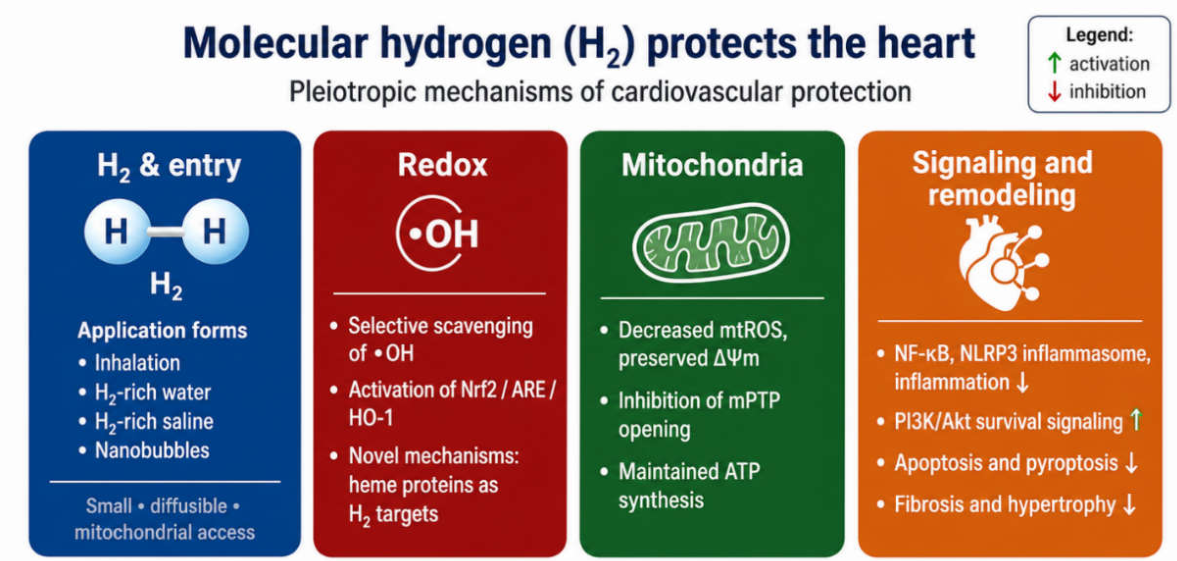
Figure 2.
Mechanisms of action of molecular hydrogen on various body systems concerned with cardiovascular health and total health (adapted from reference 42).
Figure 2.
Mechanisms of action of molecular hydrogen on various body systems concerned with cardiovascular health and total health (adapted from reference 42).
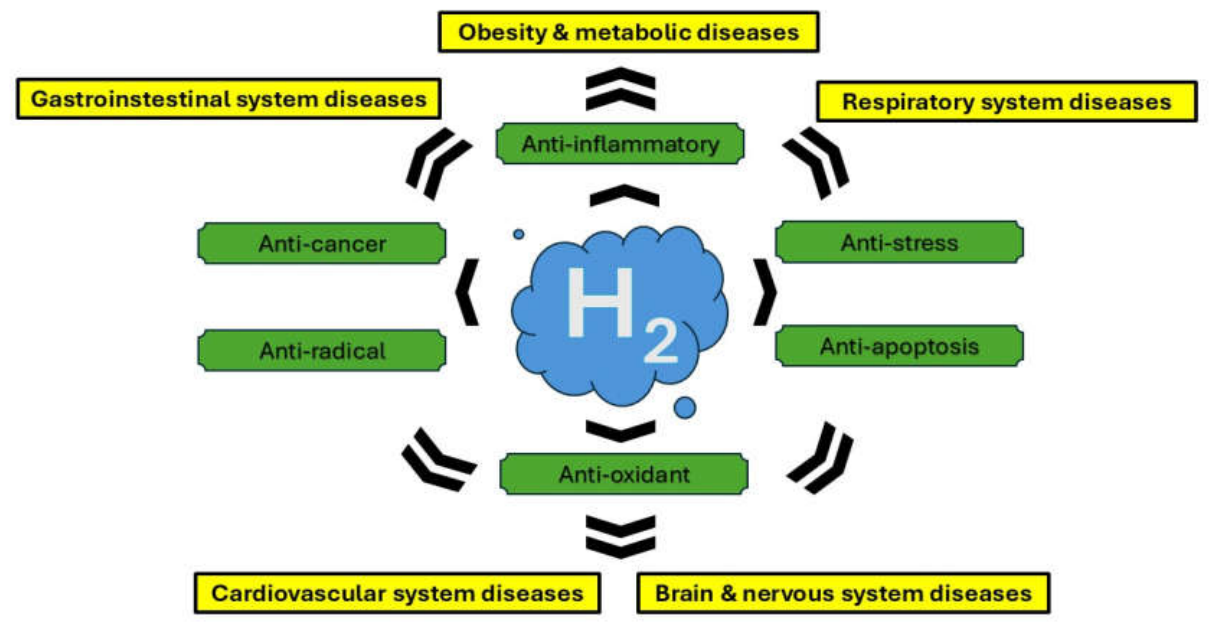

Table 1.
Life, s Essential 8, of the American Heart Association.
| Behavioral protective factors | Biological factors |
|---|---|
| 1.Diet quality. | 5.Body mass index. |
| 2.Participation in physical activity. | 6. Fasting blood glucose. |
| 3. Exposure to tobacco. | 7. Blood lipids |
| 4. Sleep quality. | 8. Blood pressure |
Table 2.
Changes in Body Composition and Biochemical Variables from Baseline to 24 Weeks. Values are Mean ± SD.
Table 2.
Changes in Body Composition and Biochemical Variables from Baseline to 24 Weeks. Values are Mean ± SD.
| HRW group | Control group | P value | |||
|---|---|---|---|---|---|
| Baseline | Follow up | Baseline | Follow up | ||
| Body mass index (kg/m2) Waist-hip circumference Total cholesterol (mg/dL) Low-density cholesterol (mg/dL) High-density cholesterol (mg/dL) Very low-density cholesterol (mg/dL) Triglycerides (mg/dL) C-reactive protein (mg/dL) Glucose (mg/dL) Hemoglobin A1c (%) Tumor necrosis factor alpha (μM) Interleukin 6 (μM) Thiobarbituric acid reactive substances (μM) Malondialdehyde (μM) Diene conjugates (μM) Vitamin E (μM) Vitamin C (μM) Nitrite (μM) Angiotensin-converting enzyme (μM) Heart rate (beat/min) |
28.9 ± 4.8 1.00 ± 0.08 187.7 ± 32.4 109.0 ± 34.4 41.7 ± 4.2 37.3 ± 17.9 189.8 ± 93.3 0.5 ± 0.2 121.5 ± 61.0 5.8 ± 0.9 4.8 ± 1.2 1.9 ± 0.7 2.5 ± 0.3 3.4 ± 0.2 27.8 ± 1.0 23.0 ± 2.3 20.7 ± 2.5 0.63 ± 0.06 85.2 ± 7.8 86 ± 7 |
28.2 ± 4.9† 0.99 ± 0.07† 169.2 ± 26.1† 102.5 ± 28.0 40.4 ± 1.8† 28.0 ± 11.3† 142.4 ± 65.0† 0.5 ± 0.1† 103.1 ± 33.0† 5.1 ± 0.2† 3.9 ± 0.6† 1.6 ± 0.2† 1.6 ± 0.3† 2.7 ± 0.2† 26.7 ± 0.5† 26.8 ± 1.9† 24.2 ± 1.8† 0.68 ± 0.06† 80.7 ± 5.8† 83 ± 5† |
31.1 ± 5.4 0.96 ± 0.05 184.3 ± 37.4 105.5 ± 42.0 41.8 ± 2.3 36.8 ± 20.6 184.4 ± 102.8 0.6 ± 0.5 123.9 ± 43.4 6.2 ± 1.2 4.8 ± 1.3 1.6 ± 0.6 2.5 ± 0.3 3.4 ± 0.2 28.3 ± 0.8 23.0 ± 1.5 20.7 ± 2.5 0.66 ± 0.04 84.5 ± 8.8 86 ± 7 |
31.3 ± 5.3 0.96 ± 0.05 184.4 ± 38.6 106.0 ± 43.3† 42.3 ± 2.4† 37.3 ± 20.5† 185.6 ± 101.3 0.6 ± 0.5 126.4 ± 42.3† 6.1 ± 1.2 4.8 ± 1.3 1.7 ± 0.6 2.5 ± 0.3 3.5 ± 0.2 28.3 ± 0.8 23.1 ± 1.1 20.8 ± 2.4 0.65 ± 0.03 83.8 ± 8.7† 85 ± 5 |
< 0.001 0.03 < 0.001 0.06 0.01 < 0.01 < 0.01 0.04 < 0.01 < 0.001 < 0.001 < 0.01 0.31 < 0.001 < 0.001 < 0.001 < 0.001 < 0.001 < 0.001 0.02 |
Notes: *P-value from two-way mixed ANOVA (treatment vs time interaction). †Indicates significant difference baseline vs follow-up at P ≤ 0.05 for each intervention (modified from reference [6]).
Table 3.
Mechanism of actions of Molecular hydrogen.
| No. | Mechanism of action |
|---|---|
| 1 | Anti-inflammatory, |
| 2 | Antioxidant, |
| 3 | Anti-cancer, and protection of the nervous system. |
| 4 | Anti-stress, |
| 5. | Anti-apoptotic, |
| 6 | Anti-allergic effects, |
| 7. | Signaling molecule functions, |
| 8. | Regulation of redox balance, |
| 9 | Modulation of antioxidant enzyme gene expression, |
| 10. | Improvement of vascular function. |
| 11. | Down-regulation of pro-inflammatory cytokines. |
| 12. | Stimulation of energy metabolism |
| 13. | Regulation of redox balance |
Disclaimer/Publisher’s Note: The statements, opinions and data contained in all publications are solely those of the individual author(s) and contributor(s) and not of MDPI and/or the editor(s). MDPI and/or the editor(s) disclaim responsibility for any injury to people or property resulting from any ideas, methods, instructions or products referred to in the content. |
© 2026 by the authors. Licensee MDPI, Basel, Switzerland. This article is an open access article distributed under the terms and conditions of the Creative Commons Attribution (CC BY) license (http://creativecommons.org/licenses/by/4.0/).
Copyright: This open access article is published under a Creative Commons CC BY 4.0 license, which permit the free download, distribution, and reuse, provided that the author and preprint are cited in any reuse.


