
Submitted:
14 July 2026
Posted:
17 July 2026
You are already at the latest version
Abstract
Digital technology has revolutionized the communication between suppliers and buyers in logistics and transportation. Previous studies focused on individual technolo-gies and their benefits but have not sufficiently explored how these technologies interact together as a communication interface, and what specific data they exchange. The review conducts a systematic literature analysis of 51 peer reviewed papers (2016-2026), screened from 711 records from Scopus and Web of Sciences.
The paper provides three contributions, first it identifies digital communication mechanism that enables supplier buyer coordination with documented outcomes from in-cluding reducing freight negotiations from weeks to hours and warehouse waiting time by 80%. Second the review consolidates exchange data parameters into the Digital Logistics Communication Architecture (DLCA), a four-layer taxonomy offering empirically grounded data specification. Moreover, third it finds that digital communication contrib-utes to sustainability primarily through environmental and economic outcomes, with so-cial outcomes remaining underrepresented.
The most significant finding is structural; across most 51 peer reviewed papers it is observed that each digital communication system depends on human initiation. Building on this structural gap, the study proposes agentic AI as a Tier 5 extension of the DLCA framework, positioned as the technology most capable of overcoming human-initiation dependence. A future research agenda is outlined.
Keywords:
communication between supplier and buyer
; digital technologies
; logistics integration
; DLCA taxonomy
; agentic AI
1. Introduction
Supply chain digitization involves deploying digital technologies to automate processes and facilitate information exchange among stakeholders. This development has received growing attention in academic literature, particularly as firms recognize that the quality of communication between suppliers and buyers directly determines logistics performance. Companies that use digital integration tools improve coordination across departments and supply chain tiers, reducing delays and improving responsiveness to market changes. [1].
It is important to clarify two related but distinct terms. Digitalization refers to converting analog information into digital forms, such as scanning paper invoices into digital files. Digitalization refers to using digital technologies to transform business processes and create value such as replacing manual order processing with automated Electronic Data Interchange (EDI) systems. This review focuses on digitalization how digital technologies reshape supplier buyer communication and coordination in logistics and transportation.
The supplier-buyer relationship in the supply chain is, at its core, an information relationship. Before physical goods move, information about demand, availability, timing, and commercial terms must be exchanged. Traditional communication depended on paper documents, the telephone, and the fax. The introduction of Electronic Data Interchange in the 1970s marked the first digital transformation of this interface, enabling the exchange of structured documents. However, EDI remained batch-oriented it process information in groups, and expensive to implement. Only large companies can afford EDI systems. Small and medium size enterprises (SMEs) faced barriers that includes high implementation cost, lack of IT infrastructure ad standardized data format requirements [2].
From approximately 2016 onwards, the convergence of the Internet of Things, cloud computing, blockchain, distributed ledger technology, artificial intelligence, machine learning, and mobile platforms has fundamentally reshaped supplier–buyer communication in logistics and transportation. These technologies enable continues, multi-party, and increasingly automated data exchange across multiple supply chain stakeholders. Ahead of the traditional supplier-buyer, digital communication now involves logistics service providers (carriers, freight forwarders), third party logistics provider (3PLs), custom authorities and end customers. Transportation, a critical subgroup of logistics encompasses multiple modes-road, rail, sea and air each with distinct documentation requirements (bill of lading, commercial invoices, customs declarations, certificate of origin) and data needs (shipment tracking, delivery ETAs and proof of delivery). Despite this significant technological progress, a critical structural characteristic persists: every supplier–buyer digital communication event still requires a human to initiate it. A procurement manager must approve the purchase order, a logistics coordinator must trigger the shipment alert, and a warehouse dispatcher must confirm the booking. Digital technologies have made communication faster, more structured, and more reliable, but they have not made it autonomous. This human-initiation dependence represents the structural maximum of current logistics digitization and, as this review demonstrates, has not been explicitly identified or discussed in any earlier systematic reviews of digital supply chain communication. To address this structural gap, along with questions about sustainability outcome and data parameters exchanged among stakeholders in collaborative transportation, the following three research questions have been developed.
RQ1: How does digitally enabled business communication influence supplier–buyer integration and coordination in transportation supply chain operations?
RQ2: How do digital communication practices between suppliers and buyers contribute to sustainability outcomes such as emission reduction and resource efficiency, and green logistics performance in logistics and transportation supply chain?
RQ3: What types of communication data and information exchange support integration among stakeholders in collaborative transportation?
Across all 51 reviewed papers, an organizational limitation emerged, that mostly digital communication system requires human intervention although for smaller decision or triggers. In considering this constraint Agentic AI emerged has potential topic to minimize human intervention, agentic AI identified via additional literature scan, which emerged as architecturally positioned to overcome this limitation. The analysis of agentic AI is presented as forward-looking research proposition, not as part of the systematic review findings.
2. Methodology
This study employs a systematic literature review to examine the role of digital technologies in integrated supplier–buyer communication within collaborative logistics transportation and supply chain. Scopus and Web of Science were selected to identify the peer-reviewed papers published between 2016 and 2026. The following table shows search query combined with keywords which have been used as the PEO framework. The inclusion criteria consist of following;
- Document type: Peer reviewed papers
- Language: English

Table 1.
Summary of Search Keywords Structured by PEO Framework.
| P | Population | Supply chain actors in logistics and transportation | “supplier” OR “buyer” OR “supply chain” |
| E | Exposure | Digital communication and data exchange technologies | “digital communication” OR “information sharing” OR “data exchange” OR “EDI” OR “blockchain” OR “IoT” OR “ERP” OR “cloud computing” |
| O | Outcome | Logistics, transportation, and sustainability performance | “logistics” OR “transportation” OR “freight” OR “supply chain management” OR “sustainability” OR “green logistics” |
| Final Boolean Search String | (“supplier” OR “buyer” OR “supply chain”) AND (“digital communication” OR “information sharing” OR “data exchange” OR “EDI” OR “blockchain” OR “IoT” OR “ERP” OR “cloud computing”) AND (“logistics” OR “transportation” OR “freight” OR “supply chain management” OR “sustainability” OR “green logistics”) | ||
Source: own Elaboration.
Figure 1.
Systematic Literature Review (PRISMA MODEL). Source: own Elaboration.
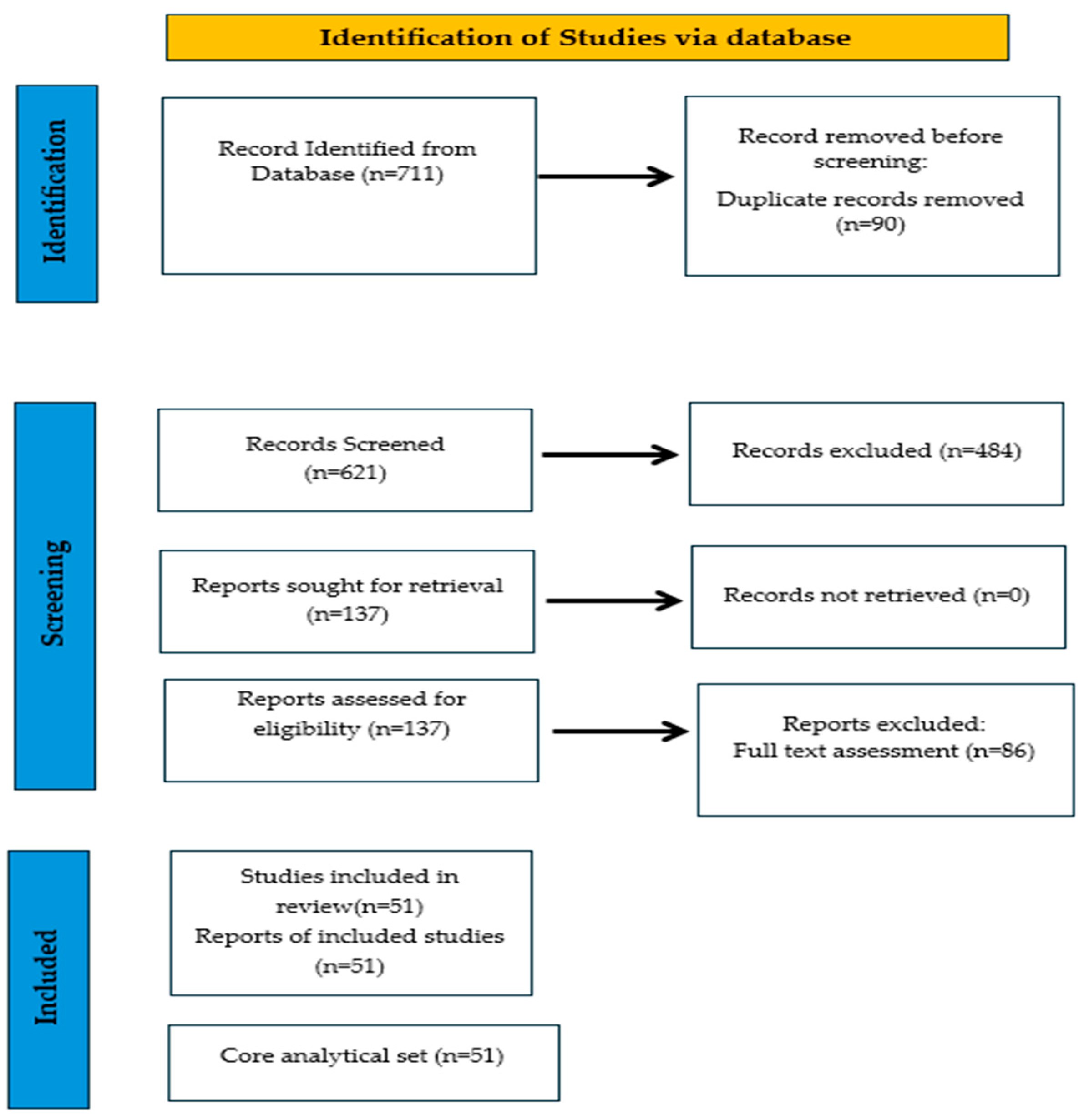
Table 2 summarizes the four sequential screening stages applied to reduce the initial 711 records to the final 51 included papers with the specific exclusion criteria applied at each stage.
All papers included were screened using a strict extraction protocol covering the technology used, integration mechanism, stakeholders involved, integration outcome, sustainability outcome, data types communicated, and data-sharing platform.
After completion of the primary systematic search, an additional literature scan was conducted specifically to identify research on the emerging topic of autonomous AI systems in supply chain management contexts. The additional scan was prompted by an observation that emerged during the primary extraction, every digital communication system in the 51 reviewed papers required a human actor to initiate it. This finding, derived from the data rather than assumed earlier, identified agentic AI as a potential resolution to the gap.
Search terms for the supplementary scan included ‘agentic AI supply chain’, ‘autonomous supply chain’, ‘multi-agent system logistics’, and ‘LLM supply chain communication’. The scan returned a limited number of results reflecting the novelty of this area, and three papers published in 2024–2025 (Xu et al., 2024; Jannelli et al., 2025) that directly addressed autonomous supplier–buyer coordination were identified and incorporated into section 5, Emerging frontier, agentic AI in B2B supply chain communication. These papers are not part of the main findings. They are included only to identify future research direction to agentic AI. The case studies from the empirical foundation for the proposed agentic AI model presented in section 6.
3. Literature Review
3.1. Digital Technologies in Supplier–Buyer Communication
Supply chain performance improves through digital information sharing and collaboration between the supplier and buyer [3]. [4] demonstrated that both RFID and ERP systems enable corresponding roles between suppliers and buyers, RFID captures physical measures, while ERP transmits and standardizes data to support overall supply chain integration. IoT technologies help businesses maintain constant connectivity and operations by integrating real-time information on transportation and inventory [5]. [6] drew that IoT sensors create real-time product visibility between multimodal transport and the supply chain.
Blockchain provides a platform for communication that not only facilitates the rapid exchange of documents such as purchase orders, bill of lading, commercial invoices, custom declarations and certificate of origin but also creates shared records, enabling parties to access secure, trusted records. Blockchain is a joint relationship in supply chain management that helps stakeholders (suppliers, buyers, logistics service providers, 3PL and customs authorities) build trust through data authenticity [7]. [8] stated that blockchain enhances traceability between partners due to its security, where transactions cannot be changed without the mutual parties’ coordination. [9] demonstrated that cloud helps companies share information between supply chain partners, such as buyers and suppliers; it also affects inter-organizational information-sharing trust as a crucial facilitator.
According to the papers in the systematic literature review, artificial intelligence and machine learning were mentioned in 18 of 51 papers, representing the highest mention frequency in the review indicating the most widely used and fastest-growing technologies in supply chain communication. [10] established through practical study that the initiation of big data supply chain analytics can significantly enhance the results of supplier management, procurement, and production management. Big data, cloud computing, and IoT enhance supply chain operations; these technologies greatly improve coordination between buyer and supplier [11].
During the pandemic disruption, ERP-integrated EDI emerged as the most significant digital tool among electronics manufacturers for its reliability in high-volume, standardized exchange environments [12]. [13] stated that the main barrier to EDI adoption, especially for small logistics providers, is the high implementation cost.
3.2. Digital Integration Mechanisms: Real Time Data, Automation, and Trust
Reviewed papers in the SLR highlighted that live data sharing, shared online platforms, direct peer-to-peer exchange, automated paperwork, and analytical coordination are the most persistent approaches through which digital technologies help buyers and suppliers integrate. Each approach takes a different technological route for coordinating the supplier-buyer relationship. Shared online platforms
[14] studied automotive logistics, where the company used RFID to track parts across three supplier sites. With this real-time tracking, the company prevented assembly-line stoppages caused by parts arriving out of sequence. Sharing of ETA real-time data in maritime logistics supports buyers in changing plans for purchasing and production to avoid circumstances such as delays [15].
Shared online platforms enables visibility across multiple stakeholders simultaneously. [9] demonstrated that cloud computing helps companies to share information between supply chain partners also affecting interorganizational information sharing trust as an important facilitator. [11] showed that big data, cloud computing and IoT enhance supply chain operations, significantly improving coordination between buyer and suppliers. Integrated EDI helps supply chain professionals to monitor visibility and to exchange structured business documents in high volume [12]. [16] determined that block chain-based platforms have helped coffee industry in negotiation of contracts from weeks to hours. Blockchain ease supplier buyer transactions by creating a verifiable decentralized infrastructure that exclude the need of trust on third parties [17].
3.3. Digital Communication and Sustainability
[18] stated that better information sharing between companies led to better use of vehicles. The author has studied urban freight delivery and found that with digital route optimization and joint procurement, companies can reduce the number of kilometers trucks travel. And vehicle fill rates can increase from 50% to 80%; this strategy will also impact the environment by reducing emissions.
Cloud-based appointment booking platforms help trucks to reduce waiting time at warehouses by 80%, and play an important role in reducing significant waste-related emissions [19].
Digital information sharing is a significant mechanism in a sustainable supply chain. Technologies such as blockchain, AI, cloud, and IoT each contribute differently to environmental, social, and economic sustainability outcomes [20].
[21] examined 12 large companies, such as H&M, Nestlé, and IKEA, and found that they use digital tools such as blockchain and IoT to track environmental and social data from their suppliers. They are using two approaches: some companies use digital tools to check compliance and monitor suppliers, and others use them to exchange information among suppliers and buyers and work together. Blockchain can support and contribute to social supply chain sustainability by building information process stable and absolute. Blockchain contributes to sustainability by assuring proper human rights and a clear record of product history [17].
4. Findings
The section provided a detailed analysis of the review, which included 51 papers published from 2016 to March 2026. Figure 2 presents publication volume by year, showing steady growth from 2016 to 2026, with the highest annual output in 2025, at 10 papers, confirming that the field is currently at peak scholarly activity. Figure 3 show that Germany has produced the most papers, followed by Sweden, the USA, and China. Table 3 identified the most productive journals and conference proceedings, IFAC-papers Online with mostly, followed by Transportation Research Procedia and Operations and Supply Chain Management.
Figure 3 maps the geographic distribution of the most reviewed papers across countries. Germany dominates with 7 papers followed by Sweden and the USA.
Table 3 lists the top ten most productive journals and conference proceedings. IFAC-PapersOnLine and Transportation Research Procedia lead the corpus, indicating the prominence of these venues in logistics digitalization research.
RQ1: How does digitally enabled business communication influence supplier-buyer integration and coordination in logistics and supply chain operations?
RQ1 examines how digitally enabled communication influences supplier-buyer integration and coordination in transportation. Evidence was extracted from all 51 papers and grey literature, grouped by technology type and its before and after impact on coordination in Table 4. Whereas Table 5 further contrasts current human dependent operations with potential agentic AI alternatives.
The 51 papers showed that digital communication has shortened freight contract negotiations from weeks to hours, increased vehicle fill rates from 50% to 80%, and reduced warehouse waiting time by up to 80%. Digital technologies facilitate supplier-buyer coordination in logistics and transportation not only as tools but also as structures that support communication and teamwork.
Based on a systematic extraction of 51 included papers, the technologies mentioned in this study drive three distinct coordination actors. IoT, RFID, and Cloud platforms present operational possibilities across supplier-buyer integration, demand planning, and forecasting, which include AI, machine learning, and blockchain. EDI and ERP systems systematize document exchange and record transactions. Table 4 exhibits the before-and-after coordination impact of technologies on supplier-buyer integration in logistics and transportation operations.
Table 4 shows that digital technologies have altered supply chain and logistics to be more structured, faster-reacting, and more reliable, but these technologies are still operated by humans or can be dependent on human capabilities.
Table 5 compares current human dependent technology operations with potential agentic AI, across six digital technologies. The first column shows the residual human role in each technology (manual data entry, bill approval, decision-making), while the second column demonstrates how agentic AI could autonomously perform these functions. This comparison identifies the specific points where human initiation currently occurs and where autonomous systems could replace it, directly addressing the structural gap identified in the corpus.
RQ2: How do digital communication practices between suppliers and buyers contribute to sustainability outcomes?
RQ2 investigates how digital communication contributes to sustainability outcomes across environmental, economic, and social pillars. Findings are presented in Table 6, Table 7, Table 8, Table 9 and Table 10.
In the included reviewed 26 papers it is identified that digital supplier buyer communication is clearly accompanying to a sustainability outcome. It is observed that a single paper has reported different sustainability factors and more than one outcome, the 26 papers reported more than one sustainability outcome, so the 26 papers gave 51 separate entries. Overall, each entry was placed under one of the three pillars of sustainability; environmental, economic, and social, further each sustainability measure has taken directly from the verifying sentence in the source paper. The tables below summarize what the evidence shows.
Table 6 reveals distinct technology outcome pairings. Blockchains dominate environmental outcomes, with IoT and big data analytics. These patterns reflect each technology’s core function.
Table 7 shows how 26 sustainability-related papers cover each sustainability dimension. Because individual papers often address multiple pillars, the total dimension-mentions (42) exceeds the paper count (26). Percentages are calculated against the 26-paper sustainability subset.
Table 7 shows that digital communications technologies are used mostly for environment and economic outcomes, social sustainability ranking last across the 26 papers.
Table 8 shows that blockchain and Internet of Things are the most common digital technologies applied to sustainability outcomes across 26 papers.
Blockchain appears in 61% of entries and IoT in 47%, every other technology is far less common. These two play different roles blockchain creates shared, tamper-proof records and is used where a claim must be trusted, while IoT senses operations in real time and is used where they must be measured and improved.
Table 9 shows how the 26 sustainability papers combine the three sustainability pillars (environmental, economic, and social). The table does not list individual sustainability outcomes, rather, it categorizes each paper by which pillars it addresses simultaneously, each paper is counted once.
Table 9 demonstrates that only four publications consider all three pillars together, while more than half remain inside a single pillar. Where two pillars come together it is frequently environmental and economical. Table 10 shows the details of each paper invented in corpus which are specifically related to sustainability.
Digital communication between suppliers and buyers does contribute to sustainability. Companies mostly support the environmental and economic sides by decreasing emissions, waste, fuel, inventory and lead time and considerably less on the social side where benefits are small and primarily limited to establishing that products are authentic and sourced.
The contribution is also technology specific, not general. Two technologies that do two different duties. Blockchain helps by building trust in information, with its distributed, immutable records allowing parties to verify environmental claims, prohibit counterfeits and endorse fair trade. IoT, with analytics and cloud platforms, helps by making information immediate: real-time information on shipments, routes and conditions helps partners eliminate waste and run leaner operations. Both leverage environmental outcomes, IoT and analytics mostly leverage economic outcomes, and blockchain nearly exclusively leverages social consequences. The biggest limitation is not technology, the means to disseminate sustainability data already exists and is widely utilized but the lack of a clear aim to apply them across all three pillars.
RQ3: What types of communication data and information exchange support integration among stakeholders in collaborative logistics and transportation?
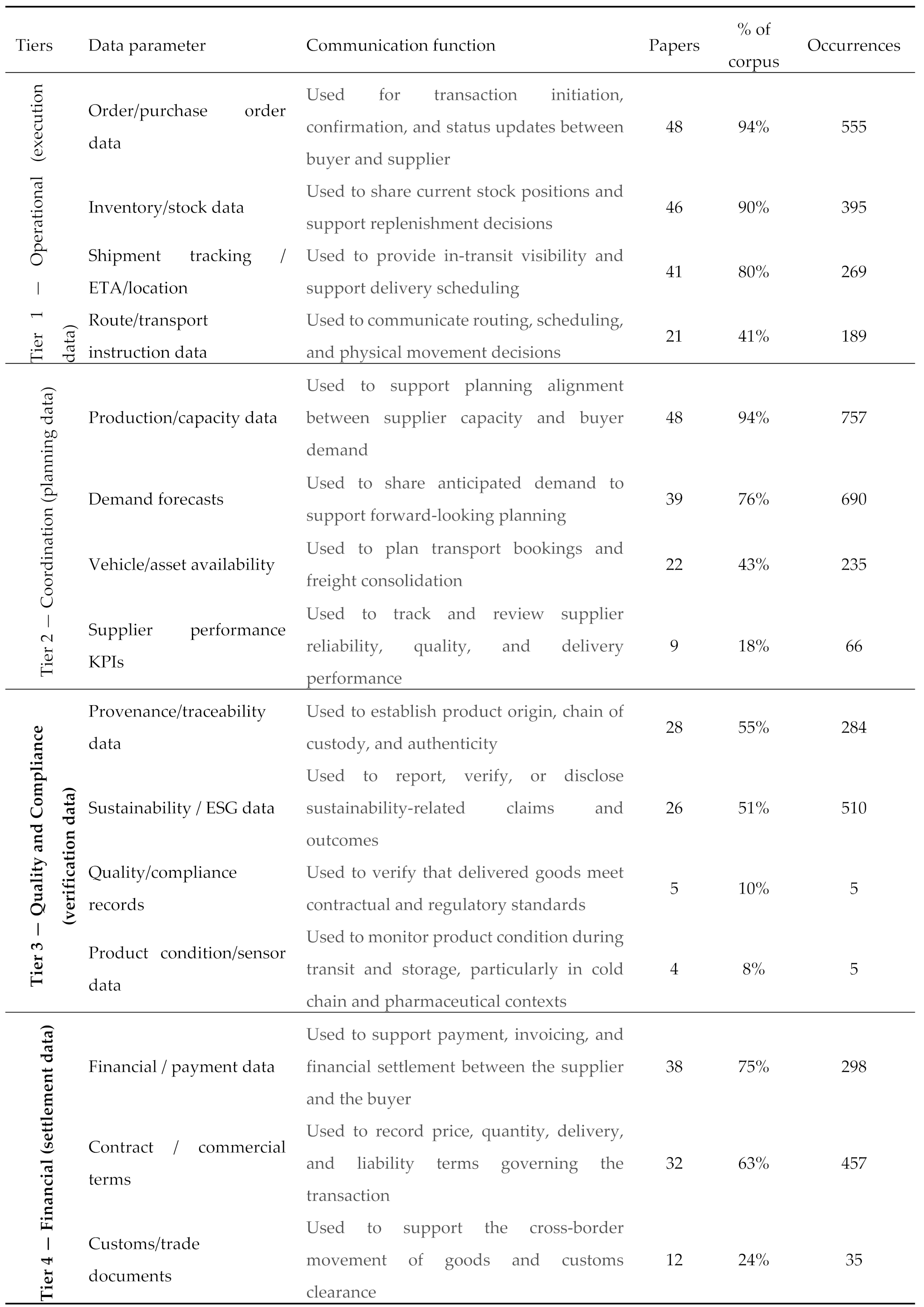
RQ3 identifies the data parameters exchanged between suppliers and buyers. Across 51 papers, 15 distinct parameters were identified and organized into a four tier framework, the Digital Logistics Communication Architecture (DLCA).
Across the included papers, different communication data parameters have been identified as regular exchanges between buyer and supplier within the framework of operations, supply chain, and transportation logistics. The functional roles of these parameters in the supply chain construct a four-tier framework, which is called the Digital Logistics Communication Architecture (DLCA). The DLCA comprises all parameters used across the different tiers: operational, coordination, Quality and compliance, and financial. With the DLCA, we can examine the predominant tier: tier 1 (operational execution), where Inventory and order terms appear on nearly every paper, followed by shipment and ETA. Tier 2 highlights the importance of coordination and planning that includes production and capacity data and demand forecasts, revealing the strong prominence of planning among partners. Tier 3 describes quality and compliance data, mostly emphasizing sustainability. Tier 4 covers the financial side of supplier-buyer transactions, including payment data, contract terms, and customs documents, with payment data being the most established
Table 11.
Digital Logistics Communication Architecture (DLCA).
 |
Source: Own Elaboration.
Overall, the DLCA shows that supplier–buyer communication relies on a set of mostly fifteen data parameters that can be organized into four functional tiers. The analysis shows that these parameters are not used equally. Operational and planning data, such as orders, inventory, production and capacity, and demand forecasts, are exchanged in most of the reviewed papers. In contrast, quality, compliance, and condition data are exchanged far less often. This indicates that current B2B digital communication is primarily used for day-to-day operations and planning. The main value of the DLCA is that it sets out these parameters and their communication roles in one clear structure.
The following section examines agentic AI as an emerging frontier in supply chain communication. This section is included because the structural finding from the systematic review human initiation dependence directly points to agentic AI as a potential solution. The literature examined here represents emerging research not captured in the primary corpus but relevant to future research directions.
5. Emerging Frontier: Agentic AI in B2B Supply Chain Communication
Supply chain management depends on human agreement in decision-making to avoid problems that build up over time, such as long waits, coordination issues, and delays in execution. Earlier autonomous solutions proposed for supply chains faced specific barriers including the requirement of highly structured data, the absence of standardized communication protocols across organizations, the high cost of special expertise, and the inability to interpret unstructured information, recent progress in generative AI, especially large language model agents (LLM agents), may help overcome these barriers. Further companies often lack accurate and timely information due to ineffective communication among supply chain stakeholders. In a supply chain, establishing end-to-end agreements is one of the most difficult tasks because it requires multiple actors to communicate until they reach an agreement. For over twenty years, researchers and practitioners have tried to automate small, routine supply chain operations using software agents. These agents gather information from sources such as ERP systems and use planning algorithms to make decisions and reach their goals. However, AI in supply chains has so far been applied mainly within individual companies, even though researchers and practitioners argue that AI tools should be extended to operate across entire supply chain networks. A recent development is agentic AI based on LLMs. These LLM agents can work with other agents or humans and use tools such as algorithms, databases, and web searches to serve as a coordination layer in the supply chain. A particular strength of LLM agents is that they can learn from unstructured data, which allows them to respond in real-time environments. Their ability to understand information in context also enables them to act more independently [46].
Companies in a traditional supply chain rely heavily on manual processes, which lead to delays in Lead time, communication errors, and sometimes high operational costs. The author emphasized that there are still limitations in current digitalization, and it is not fully deployed. AI and robotics help automate repetitive tasks, but they primarily focus on individual activities with limited integration. The autonomous supply chain model consists of four levels of analytical capabilities what happened, diagnostic why it happens, predictive what will happen and perspective what should be done together these capabilities enables the system to monitor events, identify causes, expect outcomes and recommend actions autonomously. A multi-agent system comprises software agents that interact with one another to solve complex problems. In multi-agent system (MAS), software agents act as entities in B2B communication. Each agent acts as a supplier, wholesaler, logistics provider (those who handle one or two specific logistics functions such as transportation or warehousing), or 3PL-third party logistics (those who handles multiple integrated logistics functions including transportation, warehousing, inventory management) these agents autonomously manage their internal interactions and then interact with external individuals. They operate on a clear, communicative structure, using standard protocols and communication language; agents exchange quotations, purchase orders, delivery status updates, and invoices [47].
6. Case Studies of Agentic AI in B2B Supply Chain and Transportation
The following two case studies illustrate practical implementation of agentic AI in supply chain contexts. The first examines a meat processing supply chain, while the second presents an autonomous consensus-seeking framework using LLM agents.
6.1. Autonomous Supply Chain Meat Processing Industry
The paper provides a case study of the practical implementation of an agent-based autonomous supply chain system. The authors have provided the proof-of-concept work here. Regardless of its limitations, this work establishes a promising approach for implementing an autonomous supply chain (ASC). This case study is based on a hypothetical company, the Cambridge Meat Company (CMC), which operates wholesale and procurement of meat and supplies meat to local restaurants. They aim to automate their entire supply chain using disruptive information and communication technologies. CMC aims to automate supplier bidding, monitor logistics processes, address unforeseen events, and evaluate logistics and supplied products. The agents comprise suppliers, wholesalers, retailers, logistics providers, 3PL providers, and a functional admin, all of whom serve as structural agents. These agents carry information among themselves, such as purchase orders, delivery statuses, and invoices. With 3PL agents exchanging real-time data during delivery, including the truck’s geolocation and surrounding environmental conditions, logistics companies can evaluate fulfillment service. The author demonstrates that an autonomous supply chain streamlines the entire integration process, including supplier-buyer communication, from the start of procurement through delivery monitoring, rather than automating a single role in the supply chain [47].
6.2. Autonomous Consensus Seeking
[46] Investigate the ability of large language model (LLM) agents to support agreement between buyers and suppliers in supply chains. This area has traditionally been slow and difficult due to the need for manual coordination. Reaching alignment across an end-to-end supply chain is often time-consuming and does not always lead to effective outcomes. Earlier attempts to automate such processes using agent-based systems were largely unsuccessful due to a lack of highly specialized expertise and a significant lack of structured data. LLM AI agents offer a more flexible approach, as they communicate using natural language rather than relying on fully integrated systems. This approach allows companies to use LLM-based tools to interact with other stakeholders who are still using traditional or hybrid supply chain methods, without requiring all parties to have the same technology. The authors developed five communication frameworks, ranging from independent agents to those that actively negotiate with neighboring agents before making decisions. Their results show that negotiation-based approaches significantly reduce the bullwhip effect, with reductions of 66.2% using Gemini Pro and 33.2% using Gemini Flash, compared to models that only share information.
The authors tested proof of concept with different types of agents, ranging from simple ones that work alone to more advanced ones that talk and negotiate with nearby agents before making decisions. They found that when agents negotiate, the results improve a lot. In particular, the bullwhip effect was reduced by 66.2% with Gemini Pro and by 33.2% with Gemini Flash, compared to systems in which agents shared information without discussing decisions. [46].
7. Proposed Agentic AI Model for Autonomous Supplier–Buyer Communication
This section presents a conceptual agentic AI model designed to address the structural gap identified across the 51 reviewed papers. The model integrates four sub-agents and an Orchestrator Agent within the existing DLCA framework
7.1. Conceptual Foundation
The three research questions addressed in this review together produce a finding that points beyond the current state of logistics digitalization. Digital communication between suppliers and buyers has improved substantially across identified mechanisms in review, yet every documented system still depends on a human actor to start the coordination process. In this review, 15 data parameter categories have been specified through the DLCA taxonomy; there are rarely any reviews that define what type of data an autonomous system would need to exchange without human initiation.
The following model is proposed as a conceptual framework that shows how agentic AI can operate within the existing digital logistics communication infrastructure identified in the 51 reviewed papers. It is not presented as an empirically tested system. It is offered as a structured research proposition grounded in the empirical findings of this review based on these [47] and [48] . We suggested this agentic AI-based solution, which incorporates the concept of a 4-tier DLCA taxonomy.
7.2. Architecture of the Proposed Model
The proposed model is built on a multimodal data environment derived directly from the DLCA taxonomy. The four tiers of the taxonomy operational, coordination, quality and compliance, and financial each correspond to a dedicated AI sub-agent. An orchestrator agent sits above the four sub-agents, receiving their outputs, synthesizing them into a unified logistics decision, and executing that decision through existing digital infrastructure. This orchestrator agent will act as brain of this proposed model. Figure 4 presents the proposed multi-level agentic AI architecture. The model maps four specialized sub-agents, Operational, Planning, Regulatory, and Financial onto the four DLCA tiers, with an Orchestrator Agent integrating their output into autonomous coordination decision.
7.3. Mathematical Representation of the Orchestration Architecture
Each sub-agent is designed around one tier of the DLCA taxonomy, operating on the specific data parameters identified empirically across the 51 reviewed papers.
Based on proposed architecture, the orchestrator reads from the multimodal data environment at the beginning stage. Now, consider the four DLCA tiers that produce data streams at the given time t, which is expressed as:
The orchestrator reads from the unified multimodal state:
Here, S(t) represents global logistic state at the given time t, which is updating continuously across all four tiers in parallel. The global logistics state S(t) is the complete, real-time snapshot of a supplier-buyer communication in collaborative logistics and transportation system.
At target 2 stage, each sub-agent processes its corresponding tier data and produces an output signal such as:
At this stage, the orchestrator generates a set of candidate actions in response to the event in the logistical scenario. This set of candidate actions is denoted by such as:
After creating this candidate action set, each sub-agent returns a binary output on every candidate action, such as:
To keep this architecture simple, we proposed a user-defined weighted acceptance score for each candidate, such as:
The value of ranges from 0, reflecting rejection by all agents, to 1, indicating acceptance by all agents in a given scenario. A candidate action enters the decision pool if its weighted score fulfills an acceptance threshold such as:
Here, is the decision pool and value of is configurable based on buyer’s risk tolerance during strategy formulation.
The orchestrator selects the candidate action with the highest weighted score, such as:
7.4. The Four Sub-Agents and Their Data Domains
The Operational Agent handles the highest-frequency, real-time data streams from Tier 1 of the DLCA including order /purchase data, inventory / stock data, shipment tracking and route data. This agent connects directly to IoT sensors, GPS tracking systems, ERP records, and EDI channels which are the dominant technologies found across the primary corpus. Its function is to monitor what is happening now and communicate deviations or triggers to the orchestrator in real time. In the traditional human-operated systems documented across the 51 reviewed papers, the coordination events including stock threshold breach, a shipment delay alert, and delivery confirmation will be managed by this agent. Inside the proposed system, the Operational Agent removes that dependency by sensing and reporting autonomously.
The Planning Agent works with Tier 2 coordination data including production/ capacity data, demand forecasts, vehicle and asset availability, Supplier performance KPIs. Technologies in this domain include AI and machine learning for forecasting, cloud platforms for shared access, and ecosystem standards such as Catena-X for structured KPI exchange. It identifies misalignments between planned and actual capacity, flags supplier performance deviations before they become critical, and surfaces rescheduling options. This capability directly addresses the predictive coordination mechanism identified in the RQ1 findings, where studies such as [49] demonstrated that early risk detection through standardized KPI data exchange reduces supply disruption impact in automotive supply chains.
The Regulatory Agent processes Tier 3 data: quality and compliance records, product condition sensor data, provenance and traceability data, and sustainability and ESG data. Blockchain is the dominant technology at this tier, reflecting the immutability and auditability requirements of compliance and traceability processes. The Regulatory Agent’s function is verification for example, whether the goods are safe, genuine, legally compliant, and sustainably sourced. This agent directly addresses the sustainability gap identified during decision process, because sustainability outcome appears only 51% of reviewed papers as mentioned in RQ2. The Regulatory Agent embeds social monitoring as a continuous and automated function of every supplier–buyer coordination cycle, addressing the design intent gap rather than the technology gap identified.
The Financial Agent manages Tier 4 data, which includes financial and payment information, customs and trade documentation, as well as contracts and commercial conditions. The Financial Agent’s role includes settlement activities, verifying transaction status, pricing, legal clearance, and preparation for payment disbursement. In the systems analyzed for RQ1, commercial settlement activities, including invoice validation and dispute resolution, were identified as the most time-consuming tasks reliant on human intervention. [16] mentioned that blockchain-based smart contract platforms can diminish contract negotiation time from weeks to hours.
7.5. The Orchestrator Agent
The orchestrator agent does not directly manage any individual data tier. The function of this agent involves coordination of the sub-agent coordinators, by receiving a decision signal from each of the four sub-agents, integrating these signals against a pre-defined high-level target established by human operators, and producing a cohesive logistics action. This orchestration capability immediately addresses the human-initiation gap indicated as the principal structural finding of RQ1.
8. Results and Discussion
This review examined how digital technologies act as the communication agent in supply chain B2B communication within collaboration logistics and transportation. Around corpus of 51 papers, it is demonstrated that digital technologies made B2B communication faster and more structured, but it’s also experienced that despite digital integration of technologies still human intervention is required though for smaller tasks.
The evidence shows that digital communication is an organizational enable of supply chain B2B coordination, not only a supporting tool. In this review as stated in Table 4, the technologies demonstrated as group into functional mechanisms such as freight contract negotiation compressed from weeks to hours, vehicle fill rates raised from 50% to 80% and warehouse waiting time cut by up to 80%. The before and after comparison in Table 4 shows that each group platform has a distinct coordination role, IOT and RFID provide real time operational visibility, cloud platforms provide shared access, AI and machine learning support planning and prediction, and EDI and ERP systemized document and transaction exchange.
The more crucial finding, however, is structural rather than quantitative, technology gathers speed and develop digital communication, but it does not endorse on its own. As Table 5 shows there is a residual human role even though there is use of technology, manual data entry despite EDI, bill approval in EPR, route decision in AI dashboards and manually complete check-in.
In the review, the 26 papers are reporting sustainability outcomes, environmental outcomes appear most frequently (19 papers, 73%), followed by economic outcomes (13 papers, 50%), and social outcomes least frequently (10 papers, 38%). Digital communication therefore serves sustainability mainly as an instrument of environmental improvement and operational efficiency, and only marginally towards advancing social goals. Blockchain contributes mostly to sustainability by making information trustworthy its immutable, shared records let partners verify environmental claims, and block counterfeiting. However, IoT together with analytics and cloud platforms, contributes by making information immediately, enabling firms to reduce waste, fuel, and inventory through real-time operational data.
Only four of the 26 papers address three pillars environmental, economic, and social out of sustainability together. Where two pillars combine, it is most often environmental and economically the familiar case where cost saving and emission reduction happen together. This pattern shows that the main limitation is not the availability of technology, since the tools to communicate sustainability data already exist and are widely used, but the lack of a planned intention to apply them across all three pillars.
In the review third research question revealed the data parameters exchanged between Supply chain B2B and has structured them into the Digital Logistics Communication Architecture (DLCA), a four-tier taxonomy covering operational, coordination, quality and compliance, and financial data. Operational and planning data orders, inventory, production and capacity, and demand forecasts appear in most papers, while quality and compliance, data appear less often. Current digital communication between suppliers and buyers is therefore used mainly for day-to-day execution. The value of the DLCA is that it brings these parameters and their communication roles together into a single empirically grounded structure that can guide both comparison across studies and future system design.
The three research questions identify three complimentary gaps, RQ1 shows that still digital communication system depends on human initiation. RQ2 shows that sustainability social implementation is missing from most systems, not for lack of technology but for lack of plan intent, RQ3 specifies the data parameters used for coordination. In context of research questions, the review highlights that rare papers define what data system needs to initiate actions without humans, what sustainability methods should be embedded in automated decision and how system should respond autonomously while supply chain B2B and logistics disruption. These three gaps are a human structural ceiling, a sustainability design absence, and a missing autonomous data specification point to a single frontier. The proposed agentic AI model, shown in Figure 4, addresses them by mapping four sub-agents on top of the four DLCA tiers, coordinated by an orchestrator agent that can close the coordination loop. The model is offered not as a tested system but as a structured research proposition grounded in the findings of this review.
9. Conclusion and Future Research
The review examined how digital communication improves supply chain B2B communication in logistics. Companies using these systems achieved measurable results 41% fewer vehicle kilometers and 86% less truck waiting time demonstrating that digital tools enhance operational performance. Beyond these outcomes the review established the DLCA a framework of 15 data parameters mostly exchanged in B2B digital communication. An important finding emerged that across included papers most digital systems still required human intervention. Someone must approve orders, trigger alerts, and confirm bookings. Technology improved speed and reliability but did not eliminate human intervention. The review also revealed that most systems prioritize environmental and economic sustainability outcomes while ignoring social outcomes.
The review proposes agentic AI model where artificial intelligence agents work together and make decisions within human defined boundaries. Each agent handles different types of information, and a coordinator agent synthesizes their decisions. This model remains theoretical and requires testing in logistics related big companies combined with interviews to understand how organizations would deploy such a system and what governance rule they required.
For future research, need to develop and test how agentic AI system combines data from different DLCA tiers to make real decisions. For example, when the operational agent detects a temperature breach in cold chain, how does it simultaneously receive signal from the planning agent, the compliance agent and the financial agent, what scenarios the model should handle and how should each agent prioritize signal. Further this framework must be validated through direct engagement with companies because this review is only limited to peer reviewed papers, interviews with large supply chain logistics and software services provider companies also required for understanding of how large enterprises would actually deploy such a model and what limitations they can tackle during implementation and integration of agentic AI.
References
- Alyasein, O.I.Y.; Ojha, D.; Sadeghi, R.K. Supply Chain Digitalization, Innovation Capability, and Organizational Agility: The Moderating Role of Institutionalization and Supply Chain Integration. Ind. Mark. Manag. 2025, 125, 215–225. [Google Scholar] [CrossRef]
- Janssens, G.K. ELECTRONIC DATA INTERCHANGE: FROM ITS BIRTH TO ITS NEW ROLE IN LOGISTICS INFORMATION SYSTEMS. 2011.
- Kache, F.; Seuring, S. Challenges and Opportunities of Digital Information at the Intersection of Big Data Analytics and Supply Chain Management. Int. J. Oper. Prod. Manag. 2017, 37, 10–36. [Google Scholar] [CrossRef]
- Oghazi, P.; Karlsson, S.; Hellström, D.; Hjort, K. Online Purchase Return Policy Leniency and Purchase Decision: Mediating Role of Consumer Trust. J. Retail. Consum. Serv. 2018, 41, 190–200. [Google Scholar] [CrossRef]
- Ben-Daya, M.; Hassini, E.; Bahroun, Z. Internet of Things and Supply Chain Management: A Literature Review. Int. J. Prod. Res. 2017, 57, 1–24. [Google Scholar] [CrossRef]
- Ganesan, A.N.; Louise, J.; Horsfall, M.; Bilsborough, S.A.; Hendriks, J.; McGavigan, A.D.; Selvanayagam, J.B.; Chew, D.P. International Mobile-Health Intervention on Physical Activity, Sitting, and Weight: The Stepathlon Cardiovascular Health Study. J. Am. Coll. Cardiol. 2016, 67, 2453–2463. [Google Scholar] [CrossRef] [PubMed]
- Batwa, A.; Norrman, A. Blockchain Technology and Trust in Supply Chain Management: A Literature Review and Research Agenda. Oper. Supply Chain Manag. Int. J. 2020, 14, 203–220. [Google Scholar] [CrossRef]
- Kshetri, N. Blockchain in Supply Chain Management; 2021; pp. 1–37. ISBN 978-0-323-89934-5. [Google Scholar]
- Cao, R.; Schniederjans, D.; Schniederjans, M. Establishing the Use of Cloud Computing in Supply Chain Management. Oper. Manag. Res. 2017, 10. [Google Scholar] [CrossRef]
- Mubarik, M.; Rasi, R.Z. Triad of Big Data Supply Chain Analytics, Supply Chain Integration and Supply Chain Performance: Evidences from Oil and Gas Sector. Humanit. Soc. Sci. Lett. 2019, 7. [Google Scholar] [CrossRef]
- Patrucco, A.S.; Moretto, A.; Trabucchi, D.; Golini, R. How Do Industry 4.0 Technologies Boost Collaborations in Buyer-Supplier Relationships? Res. Technol. Manag. 2022, 65, 48–58. [Google Scholar] [CrossRef]
- Khuan, L.; Shee, H.; Tan, S.S. Strategies to Mitigate Supply Chain Disruptions During COVID-19: The Lived Experience of SC Professionals. Oper. Supply Chain Manag. Int. J. 2023, 62–76. [Google Scholar] [CrossRef]
- Werner-Lewandowska, K.; Koliński, A.; Golinska-Dawson, P. Barriers to Electronic Data Exchange in the Supply Chain - Results from Empirical Study. Logforum 2023, 19, 127–139. [Google Scholar] [CrossRef]
- Kang, Y.-S.; Kim, H.; Lee, Y.-H. Implementation of an RFID-Based Sequencing-Error-Proofing System for Automotive Manufacturing Logistics. Appl. Sci. 2018, 8, 109. [Google Scholar] [CrossRef]
- Urciuoli, L. An Algorithm for Improved ETAs Estimations and Potential Impacts on Supply Chain Decision Making. Procedia Manuf. 2018, 25, 185–193. [Google Scholar] [CrossRef]
- Agnola, T.; Ambrosini, L.; Beretta, E.; Gremlich, G. Empowering Global Supply Chains Through Blockchain-Based Platforms: New Evidence from the Coffee Industry. FinTech 2025, 4, 3. [Google Scholar] [CrossRef]
- Saberi, S.; Kouhizadeh, M.; Sarkis, J.; Shen, L. Blockchain Technology and Its Relationships to Sustainable Supply Chain Management. Int. J. Prod. Res. 2019, 57, 2117–2135. [Google Scholar] [CrossRef]
- Moen, O. The Five-Step Model – Procurement to Increase Transport Efficiency for an Urban Distribution of Goods. Transp. Res. Procedia 2016, 12, 861–873. [Google Scholar] [CrossRef]
- Giuffrida, M.; Mangiaracina, R.; Burki, U. Cloud-Based Booking Platforms in Warehouse Operations. Sustainability 2021, 13, 11547. [Google Scholar] [CrossRef]
- Ebinger, F.; Omondi, B. Leveraging Digital Approaches for Transparency in Sustainable Supply Chains: A Conceptual Paper. Sustainability 2020, 12, 6129. [Google Scholar] [CrossRef]
- McGrath, P.; McCarthy, L.; Marshall, D.; Rehme, J. Tools and Technologies of Transparency in Sustainable Global Supply Chains. Calif. Manag. Rev. 2021, 64, 67–89. [Google Scholar] [CrossRef]
- Urciuoli, L. An Algorithm for Improved ETAs Estimations and Potential Impacts on Supply Chain Decision Making. Procedia Manuf. 2018, 25, 185–193. [Google Scholar] [CrossRef]
- Coimbatore, Balaprabunath; Ramalingam. Efficient Implementation of AI Agents in Enterprise Application Integration (EAI) and Electronic Data Interchange (EDI). Int. J. Sci. Res. Comput. Sci. Eng. Inf. Technol. 2025, 11, 150–170. [Google Scholar] [CrossRef]
- Kayikci, Y. Sustainability Impact of Digitization in Logistics. Procedia Manuf. 2018, 21, 782–789. [Google Scholar] [CrossRef]
- Gerhátová, Z.; Zitrický, V.; Klapita, V. Industry 4.0 Implementation Options in Railway Transport. Transp. Res. Procedia 2021, 53, 23–30. [Google Scholar] [CrossRef]
- Teodorescu, M.; Korchagina, E. Applying Blockchain in the Modern Supply Chain Management: Its Implication on Open Innovation. J. Open Innov. Technol. Mark. Complex. 2021, 7, 80. [Google Scholar] [CrossRef]
- Pesquera, M.A. Automation in Logistics Port and Freight Transport with Blockchain Technology. Transp. Res. Procedia 2024, 78, 394–401. [Google Scholar] [CrossRef]
- Rehman, M.; Petrillo, A.; Baffo, I.; Iovine, G.; De Felice, F. Optimizing Coffee Supply Chain Transparency and Traceability through Mobile Application. Procedia Comput. Sci. 2025, 253, 2116–2126. [Google Scholar] [CrossRef]
- Verma, P.; Kumar, V.; Verma, P.; Lai, K.-K.; Kaur, P. Leveraging Innovative Logistics for Strengthening Supply Chain Resilience in the Face of Disruptions. Asian J. Interdiscip. Res. 2025, 35–55. [Google Scholar] [CrossRef]
- Habtemichael, N.; Wicaksono, H.; Valilai, O.F. NFT Based Digital Twins for Tracing Value Added Creation in Manufacturing Supply Chains. Procedia Comput. Sci. 2024, 232, 2841–2846. [Google Scholar] [CrossRef]
- Batwa, A.; Norrman, A. Blockchain Technology and Trust in Supply Chain Management: A Literature Review and Research Agenda. Oper. Supply Chain Manag. Int. J. 2021, 203–220. [Google Scholar] [CrossRef]
- Colak, H.; Kagn?c?oglu, C.H. Acceptance of Blockchain Technology in Supply Chains: A Model Proposal. Oper. Supply Chain Manag. Int. J. 2022, 17–26. [Google Scholar] [CrossRef]
- Ebinger, F.; Omondi, B. Leveraging Digital Approaches for Transparency in Sustainable Supply Chains: A Conceptual Paper. Sustainability 2020, 12, 6129. [Google Scholar] [CrossRef]
- Ghoubach, S.; El Amine, B. Enhancing Supply Chain Performance through Digitalization: Insights from a Qualitative Study in an Emerging Market. Acta Logist. 2025, 12, 529–539. [Google Scholar] [CrossRef]
- Gupta, V.K.; Chaudhuri, A.; Tiwari, M.K. Modeling for Deployment of Digital Technologies in the Cold Chain. IFAC-Pap. 2019, 52, 1192–1197. [Google Scholar] [CrossRef]
- Salikhov, J.; Hayrutdinov, S.; Muminov, T.K. Blockchain-Enabled Sustainable Supply Chain under Information Sharing and Recovery Quality Efforts. Sustainability 2023, 15, 3929. [Google Scholar] [CrossRef]
- Abideen, A.Z.; Sorooshian, S.; Sundram, V.P.K.; Mohammed, A. Collaborative Insights on Horizontal Logistics to Integrate Supply Chain Planning and Transportation Logistics Planning – A Systematic Review and Thematic Mapping. J. Open Innov. Technol. Mark. Complex. 2023, 9, 100066. [Google Scholar] [CrossRef]
- Kunkel, S.; Matthess, M.; Xue, B.; Beier, G. Industry 4.0 in Sustainable Supply Chain Collaboration: Insights from an Interview Study with International Buying Firms and Chinese Suppliers in the Electronics Industry. Resour. Conserv. Recycl. 2022, 182, 106274. [Google Scholar] [CrossRef]
- Fazi, S.; Fransoo, J.C. Freight Mobility as a Service: Open Platforms for Synchromodal Transport. Transp. Res. Part E Logist. Transp. Rev. 2025, 204, 104368. [Google Scholar] [CrossRef]
- Ivanov, D.; Dolgui, A.; Sokolov, B. Cloud Supply Chain: Integrating Industry 4.0 and Digital Platforms in the “Supply Chain-as-a-Service.”. Transp. Res. Part E Logist. Transp. Rev. 2022, 160, 102676. [Google Scholar] [CrossRef]
- Mathu, K.M. The Information Technology Role in Supplier-Customer Information-Sharing in the Supply Chain Management of South African Small and Medium-Sized Enterprises. South Afr. J. Econ. Manag. Sci. 2019, 22. [Google Scholar] [CrossRef]
- Zhu, S.; Song, J.; Hazen, B.T.; Lee, K.; Cegielski, C. How Supply Chain Analytics Enables Operational Supply Chain Transparency: An Organizational Information Processing Theory Perspective. Int. J. Phys. Distrib. Logist. Manag. 2018, 48, 47–68. [Google Scholar] [CrossRef]
- Duan, K.; Pang, G.; Lin, Y.; Lonsdale, C. Unlocking Blockchain’s Potential in Collaborative Remanufacturing and Data Sharing: A Case Study on Electric Vehicle Batteries. Ind. Manag. Data Syst. 2025, 125, 2321–2347. [Google Scholar] [CrossRef]
- Li, Z.; Liu, G.; Liu, L.; Lai, X.; Xu, G. IoT-Based Tracking and Tracing Platform for Prepackaged Food Supply Chain. Ind. Manag. Data Syst. 2017, 117, 1906–1916. [Google Scholar] [CrossRef]
- Neumannová, R.; Štofková, K.R. Industry 4.0 in Transportation: Blockchain Technology. Transp. Res. Procedia 2026, 93, 884–890. [Google Scholar] [CrossRef]
- Jannelli, V.; Schöpf, S.; Bickel, M.; Netland, T.; Brintrup, A. Agentic LLMs in the Supply Chain: Towards Autonomous Multi-Agent Consensus-Seeking. Int. J. Prod. Res. 2025, 1–31. [Google Scholar] [CrossRef]
- Xu, L.; Mak, S.; Minaricova, M.; Brintrup, A. On Implementing Autonomous Supply Chains: A Multi-Agent System Approach. Comput. Ind. 2024, 161, 104120. [Google Scholar] [CrossRef]
- Xu, L.; Almahri, S.; Mak, S.; Brintrup, A. Multi-Agent Systems and Foundation Models Enable Autonomous Supply Chains: Opportunities and Challenges. IFAC-Pap. 2024, 58, 795–800. [Google Scholar] [CrossRef]
- Lindholm, N.; Zaeh, M.F. Enabling a Data-Driven Assessment of Operational Supply Risks in Automotive Supply Chains. IFAC-Pap. 2025, 59, 2224–2229. [Google Scholar] [CrossRef]
- Finio, M., & Downie, A. (2026, April 1). AI Agent Orchestration. IBM. Retrieved May 19, 2026, from https://www.ibm.com/think/topics/ai-agent-orchestration.
- Catena-X holds first open pitch session for all certified demand and capacity management solutions - Catena-X Catena-X. 9 April 2025. Available online: https://catena-x.net/news/catena-x-holds-first-open-pitch-session-for-all-certified-demand-and-capacity-management-solutions/.
Figure 2.
Publication volume of reviews from 2016 to 2026. Source: own Elaboration.
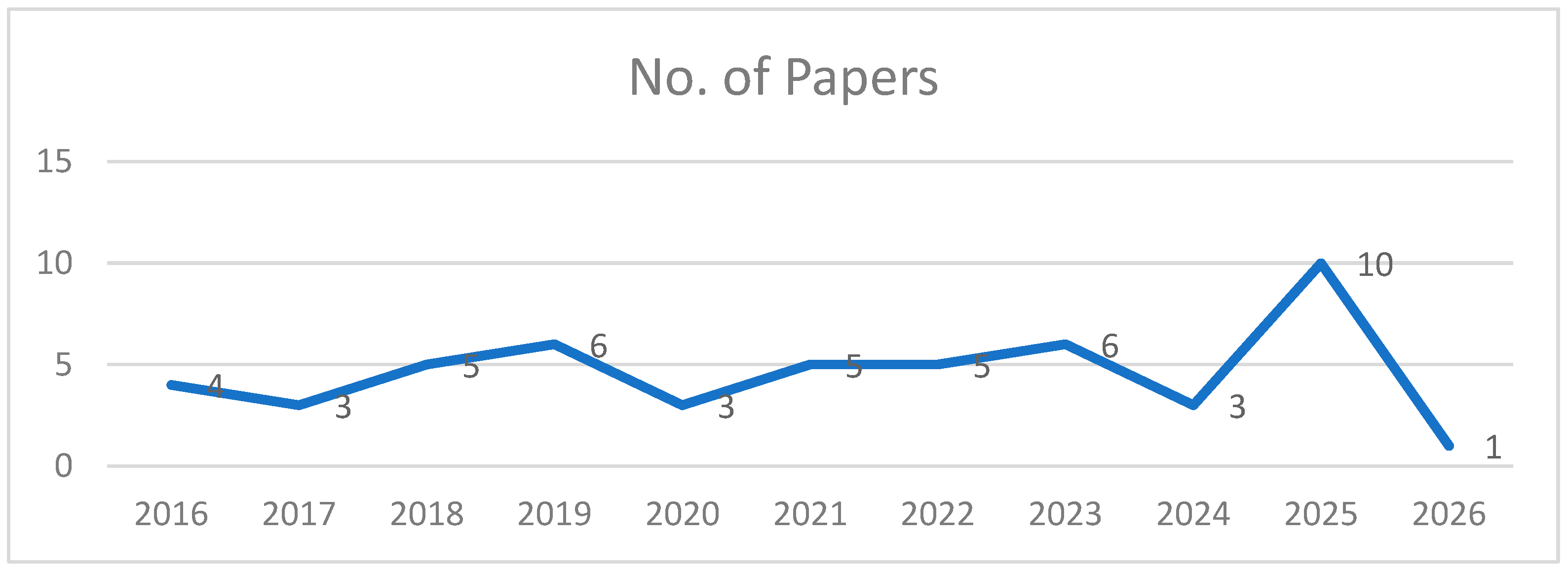
Figure 3.
Publication volume by country. Source: own Elaboration.
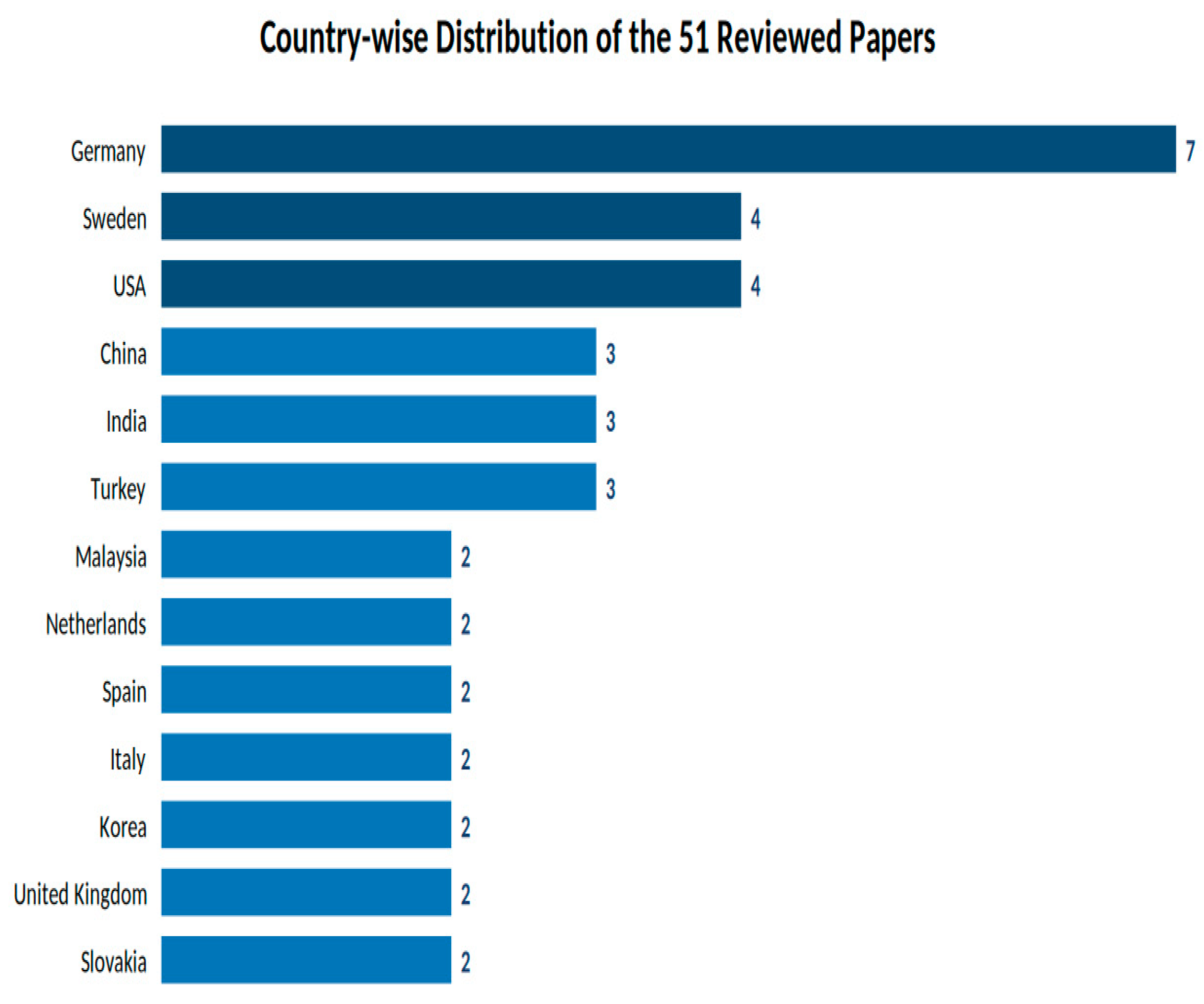
Figure 4.
Multi-Level Agentic AI system.
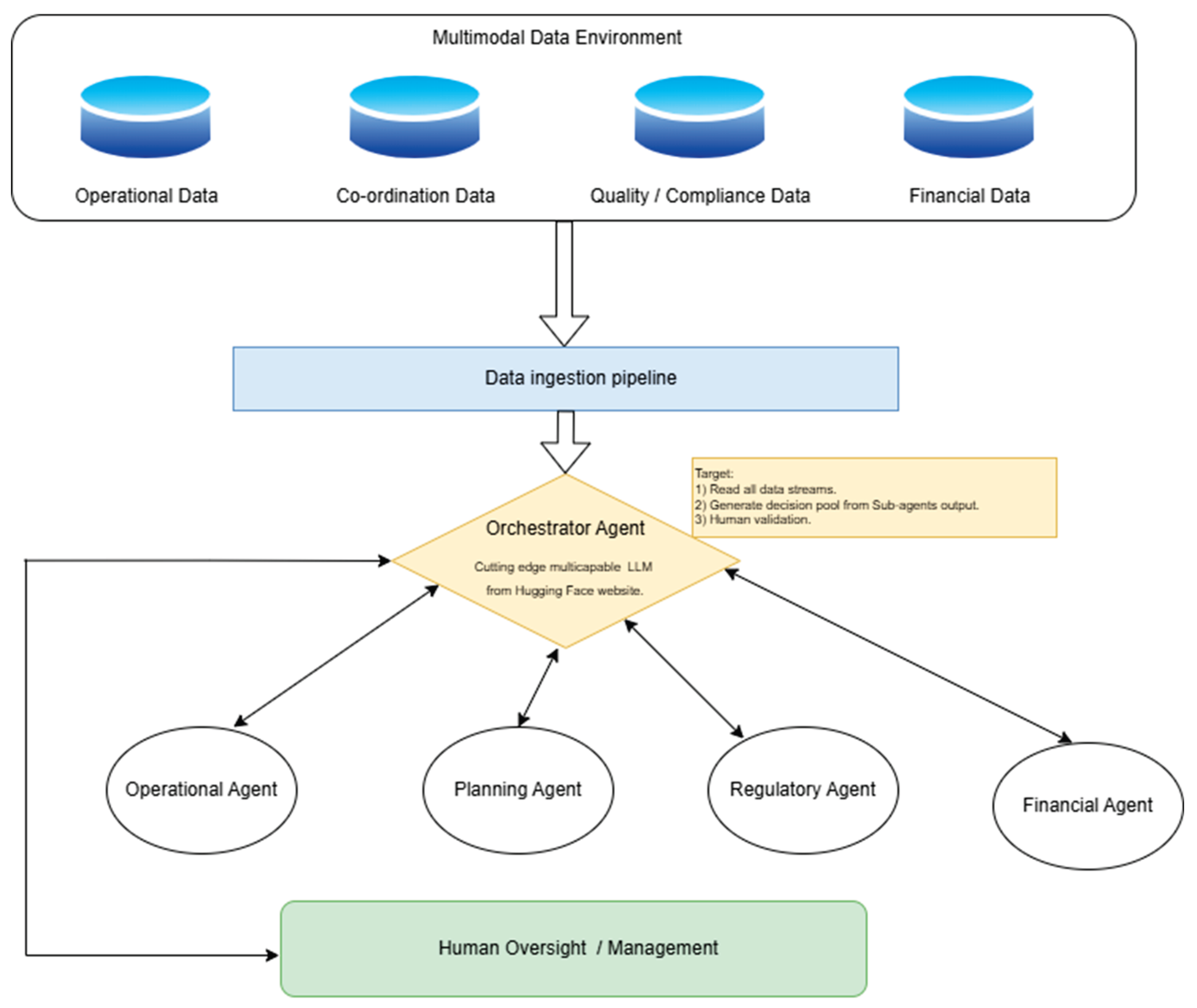
Table 2.
Summary of Extraction Steps for systematic literature review.
| Step | Screening Stage | Records Considered | Records Excluded | Records Retained | Primary Exclusion Criteria Applied |
| 1 | Database identification | 711 | — | 711 | Records retrieved from Scopus (n = 304) and Web of Science (n = 407) |
| 2 | Duplicate removal | 711 | 90 | 621 | Papers appearing in both Scopus and Web of Science results were identified and removed using title and DOI matching. |
| 3 | Title Screening and Abstract | 621 | 484 | 137 | Excluded based on titles and abstracts that were not in scope |
| 4 | Full-text assessment | 137 | 86 | 51 | Full text assessment |
| 5 | Final inclusion | 51 | All 51 included papers met the minimum inclusion threshold defined by the research questions. |
Source: own Elaboration.
Table 3.
Most Productive Peer Reviewed Papers.
| Sources | Count |
| IFAC-Papers On Line | 6 |
| Transportation Research Procedia | 5 |
| Operations and Supply Chain Management | 3 |
| Sustainability | 3 |
| Industrial Management and Data Systems | 2 |
| International Journal of Logistics Management | 2 |
| Journal of Open Innovation: Technology, Market, and Complexity | 2 |
| Procedia Computer Science | 2 |
| Procedia Manufacturing | 2 |
| Transportation Research Part E: Logistics and Transportation Review | 2 |
Source: own Elaboration.
Table 4.
Digital Technologies influence before and after.
| Functional Group | Technology | Before Digital Integration | After Digital Integration |
| Real Time Data Technologies | IoT (Internet of Things / RFID (Radio Frequency Identification) | Before IoT and RFID, logistics faced challenges involving limited visibility into shipments and inaccurate route planning, leaving managers with no real-time awareness. https://www.peerbits.com/blog/impact-of-iot-on-transport-and-logistics-industry.html |
With integration of real-time ETA data in logistics, buyers can easily adjust purchasing and production plans to avoid delays [22]. |
| Cloud Platforms |
Without cloud technology, companies face disconnected visibility and high logistics costs due to their dependence on traditional WMS, using spreadsheets for transportation and emails for carrier updates. https://community.sap.com/t5/supply-chain-management-blog-posts-by-members/reimagining-logistics-for-the-cloud-era-inside-sap-logistics-management/ba-p/14253026 |
With the integration of cloud technology booking platforms, warehouses are able to reduce the waiting time of trucks to 80%, accompanying the reduction in vehicle stop emissions [19]. | |
| Decision and Planning Technologies | AI(Artificial Intelligence) / ML (Machine Learning) | Before AI drives the route, planned urban routes manually, this effect vehicle fills rates averaged approximately [18]. |
By integration of AI, digital route optimization in urban freight delivery has increased vehicle fill rates from 50% to 80% and reduced truck kilometers traveled by 41% [18]. |
| Blockchain | Manual process in cross-border shipments checks, causing delays from days to weeks to complete. Paper-based bills of lading and custom bills of lading create fraud risks, which cause blockage of well-timed payment relief. https://www.wipro.com/travel-and-transportation/shipping-companies-must-prepare-for-the-blockchain-future/ / |
Blockchain helps companies negotiate freight contracts in hours rather than weeks [16]. | |
| Document and Process Technologies | EDI (Electronic Data Interchange) | Before the implementation of EDI, companies used paper, faxes, or telephones to share freight and advance shipment notices. This caused truck drivers to carry a lot of paperwork and clerks to type manually into the system [2]. | EDI emerged during COVID-19, facilitating users to exchange high-volume documents [12]. |
| ERP (Enterprise Resource Planning) Systems | Before the integration of ERP, fleet dispatch teams were unable to monitor warehouse updates on readiness. This caused trucks to arrive before loads were ready, and service also relied on phone calls for shipment confirmation. https://sysgenpro.com/industries/logistics-erp-systems-for-operational-visibility-across-inventory-fleet-and-warehouse-workflow |
Companies can improve planning and performance in logistics operations by implementing ERP and RFID [4]. |
Table 5.
Technologies based on Human and Agentic AI.
| Technology | Human Role Exists on Technologies | Agentic AI |
| EDI (Electronic Data Interchange) | Some companies use EDI, but employees still manually re-enter extracted data to verify accuracy, which is time consuming and prone to typing errors [13]. |
In traditional EDI, it takes 2 to 12 weeks to onboard new partners due to the configuration of mapping and testing interfaces. Whereas after agentic AI with its automated setup and testing, it takes only 1 to 3 weeks to onboard a new partner in EDI [23]. |
| ERP (Enterprise Resource Planning) | In ERP, discrepancies in bills are forwarded to a designated individual for further action, such as approval or rejection. https://docs.oracle.com/en/cloud/saas/netsuite/ns-online-help/section_4096454192.html |
An integration of agentic in ERP analyzes data, simulates scenarios, and makes decisions autonomously. https://provisionai.com/white-paper-agentic-ai-supply-chain/?utm |
| IoT (Internet of Things) | With IoT, plant inventory can be monitored automatically instead of being assigned workers at a consolidation center. Every morning, they verify the inventory and share its information with managers to plan the daily production schedule [14]. |
Agentic AI, in collaboration with IoT device shelf sensors, automatically generates a restocking order in case of stockout detection. https://medium.com/@rakesh.sruhad/agentic-ai-iot-the-future-of-intelligent-supply-chain-management-b26e68cf9369 |
| Blockchain | For secure immutability and accessibility, bills of lading and certificates of origin uploaded by individuals are securely stored in the ICP blockchain [16]. | Blockchain with AI agents plays a game-changing role not only in the improvement of supply chain transparency, efficiency, and security, but also provides the capability for intelligent, autonomous decision-making, secure, and optimized. https://www.auxiliobits.com/blog/blockchain-integration-with-ai-agents-for-supply-chain-transparency/ |
| AI (Artificial Intelligence / ML (Machine Learning) | The predictive algorithm helps managers compute improved ETAs and visualize them on a dashboard, but they still need to choose between building up delayed shipments and changing the route to faster means of transport. Based on computed risk data, purchasing managers can redesign contracts with suppliers [22]. | AI agents merge as task-specific intelligent assistants that facilitate humans. With the help of Agentic AI, procurement autonomously purchases supplies based on inventory stock levels, projected demand, and market conditions. https://www.gartner.com/en/newsroom/press-releases/2025-05-21-gartner-predicts-half-of-supply-chain-management-solutions-will-include-agentic-ai-capabilities-by-2030 |
| Cloud Platforms | Although the cloud provides automation in time slots by systematizing time slot apportionment to eradicate unscheduled waiting and also visibility of ETA service, drivers still need to manually complete check-in and complete the documentation of hazardous goods [19]. | Cloud platforms traditionally need human involvement to manage strategy, tools, and governance. However, with agentic AI, it becomes a platform that thinks, adapts, and makes judgment calls autonomously; it only needs human approval for critical and exceptional cases. https://aws.amazon.com/blogs/migration-and-modernization/when-software-thinks-and-acts-reimagining-cloud-platform-engineering-for-agentic-ai/ |
Table 6.
Sustainability criteria, related technology, and source papers.
| Sustainability Dimension | Sustainability Criteria | Digital Technologies appeared in each paper | Each Paper Reference number |
| Environmental | GHG / CO₂ emission reduction | Blockchain, IoT, Big-data analytics, Cloud platform, multi-agent systems | 1, 17, 18, 22, 26 |
| Waste reduction (material, food, paper) | Blockchain, IoT, Big-data analytics, RFID | 1, 5, 14, 15, 18 | |
| Green provenance & ecological compliance | Blockchain, RFID, Cloud platform, Smart contracts | 3, 7, 9, 10, 19 | |
| Modal shift & route optimization | Blockchain, IoT, Big-data analytics, RFID | 5, 18, 21 | |
| Circular economy / recycling / remanufacturing | Blockchain, IoT, RFID, AI analytics, Autonomous vehicles | 6, 16, 24 | |
| Resource efficiency (raw materials, vehicles) | IoT, Big-data analytics | 14 | |
| Economic | Inventory cost reduction | Blockchain, IoT, Big-data analytics, Cloud platform | 1, 3, 9, 11, 12 |
| Lead time / delivery time reduction | Blockchain, IoT, Big-data analytics, Cloud platform | 1, 2, 13, 23, 26 | |
| Productivity & efficiency gains | Blockchain, IoT, Big-data analytics | 4, 16, 18 | |
| Supply security & disruption avoidance | Cloud platform, Digital Twin | 6, 20 | |
| Forecast accuracy / bullwhip reduction | IoT, Big-data analytics, Cloud platform | 1 | |
| Society | Anti-fraud / anti-counterfeiting | Blockchain | 3, 6, 8, 9, 26 |
| Consumer trust & supply-chain transparency | Blockchain, IoT, RFID, Digital Twin | 7, 13, 20, 24, 25 | |
| Fair trade & smallholder inclusion | Blockchain, IoT, RFID | 3, 5, 13 |
Note. Related Technology lists every technology applied for that outcome across the source papers. Source numbers are the paper IDs in Table 10.
Table 7.
Count of papers touch each sustainability dimension.
| Dimension | Paper Mentioning | % of 26 Papers |
| Environmental | 19 | 73% |
| Economic | 13 | 50% |
| Social | 10 | 38% |
| Total Mentions | 42 | multiple sustainability mentions in 26 papers |
Table 8.
Technology frequency across the sustainability evidence.
| Technology | Mention in each Paper | Share |
| Blockchain | 31 | 61% |
| IoT | 24 | 47% |
| Big-data analytics | 12 | 24% |
| Cloud platform | 8 | 16% |
| RFID | 7 | 14% |
| ML | 4 | 8% |
| Digital Twin | 2 | 4% |
| Multi-agent systems | 2 | 4% |
| Other (Smart contracts, AI analytics, Autonomous vehicles) | 3 | 6% |
Note. Each of the 51 entries is one documented link between a paper and a sustainability outcome. The share is the proportion of the 51 entries in which a technology appears; because an entry can involve more than one technology, the shares do not sum to 100%.
Table 9.
How Papers Combine Environmental, Economic and Social Pillars.
| Pillar combination | Papers | Paper IDs |
| All three pillars | 4 | 3, 6, 9, 26 |
| Environmental + Economic only | 3 | 1, 16, 18 |
| Environmental + Social only | 3 | 5, 7, 24 |
| Economic + Social only | 2 | 13, 20 |
| Environmental only | 7 | 10, 14, 15, 17, 19, 21, 22 |
| Economic only | 5 | 2, 4, 11, 12, 23 |
| Social only | 2 | 8, 25 |
Table 10.
List of papers related to sustainability.
| ID | Title | Paper Reference | Year |
| 1 | Sustainability impact of digitization in logistics | [24] | 2018 |
| 2 | Industry 4.0 implementation options in railway transport | [25] | 2021 |
| 3 | Applying blockchain in the modern supply chain management: Its implication on open innovation | [26] | 2021 |
| 4 | Automation in logistics, port and freight transport with blockchain technology | [27] | 2024 |
| 5 | Optimizing coffee supply chain transparency and traceability through mobile application | [28] | 2025 |
| 6 | Leveraging innovative logistics for strengthening supply chain resilience in the face of disruptions | [29] | 2025 |
| 7 | NFT-based digital twins for tracing value-added creation in manufacturing supply chains | [30] | 2024 |
| 8 | Blockchain technology and trust in supply chain management: A literature review and research agenda | [31] | 2021 |
| 9 | Acceptance of blockchain technology in supply chains: A model proposal | [32] | 2022 |
| 10 | Leveraging digital approaches for transparency in sustainable supply chains: A conceptual paper | [33] | 2020 |
| 11 | An algorithm for improved ETAs estimations and potential impacts on supply chain decision making | [22] | 2018 |
| 12 | Triad of big data supply chain analytics, supply chain integration and supply chain performance: Evidences from oil and gas sector | [10] | 2019 |
| 13 | Empowering global supply chains through blockchain-based platforms: New evidence from the coffee industry | [16] | 2025 |
| 14 | Enhancing supply chain performance through digitalization: Insights from a qualitative study in an emerging market | [34] | 2025 |
| 15 | Modelling for deployment of digital technologies in the cold chain | [35] | 2019 |
| 16 | Blockchain-enabled sustainable supply chain under information sharing and recovery quality efforts | [36] | 2023 |
| 17 | Collaborative insights on horizontal logistics to integrate supply chain planning and transportation logistics planning: A systematic review and thematic mapping | [37] | 2023 |
| 18 | Industry 4.0 in sustainable supply chain collaboration: Insights from an interview study with international buying firms and Chinese suppliers in the electronics industry | [38] | 2022 |
| 19 | Freight mobility as a service: Open platforms for synchromodal transport | [39] | 2025 |
| 20 | Cloud supply chain: Integrating Industry 4.0 and digital platforms in the ‘Supply Chain-as-a-Service’ | [40]. | 2022 |
| 21 | The information technology role in supplier-customer information-sharing in the supply chain management of South African SMEs | [41] | 2019 |
| 22 | How supply chain analytics enables operational supply chain transparency: An organizational information processing theory perspective | [42] | 2018 |
| 23 | Cloud-based booking platforms in warehouse operations | [19] | 2021 |
| 24 | Unlocking blockchain’s potential in collaborative remanufacturing and data sharing: A case study on electric vehicle batteries | [43] | 2025 |
| 25 | IoT-based tracking and tracing platform for prepackaged food supply chain | [44] | 2017 |
| 26 | Industry 4.0 in transportation: Blockchain technology | [45] | 2026 |
Disclaimer/Publisher’s Note: The statements, opinions and data contained in all publications are solely those of the individual author(s) and contributor(s) and not of MDPI and/or the editor(s). MDPI and/or the editor(s) disclaim responsibility for any injury to people or property resulting from any ideas, methods, instructions or products referred to in the content. |
© 2026 by the authors. Licensee MDPI, Basel, Switzerland. This article is an open access article distributed under the terms and conditions of the Creative Commons Attribution (CC BY) license (http://creativecommons.org/licenses/by/4.0/).
Copyright: This open access article is published under a Creative Commons CC BY 4.0 license, which permit the free download, distribution, and reuse, provided that the author and preprint are cited in any reuse.


