

Submitted:
15 July 2026
Posted:
17 July 2026
You are already at the latest version
Abstract
Contemporary intensive care is operating in an environment with high complexity cases, large volumes of information, and vast physiological, biological and therapeutical data, collected from laboratory results, investigations, therapies for organ support, collected from systems that operate in parallel. The lack of interoperability contributes to infor-mation overload, alarm fatigue, and delayed decision-making. The Smart ICU concept has emerged to address these limitations by integrating medical devices, information systems and artificial intelligence into a unified system that allows interoperable data integration and predictive analytics.
Aim: The purpose of this article is to provide a narrative review of the Smart ICU concept, with a specific focus on the cardiac intensive care unit. It summarizes Smart ICU architec-ture, data integration, clinical support and applicability in monitoring perioperative in-flammation in cardiac surgery.
We describe the Smart ICU architecture, from data acquisition to storage and analytics, highlighting the difference between Smart ICU, Artificial Intelligence and Tele-ICU, and we underlie the predictive analytics as a supportive tool, and its influence on clinical out-come.
Cardiac ICU application: Cardiac ICUs offer a data-dense, temporally well-defined model following cardiac surgery with cardiopulmonary bypass, where data concerning patients hemodynamics, perfusion data, biological and inflammatory markers intertwine. Cardiac Smart ICU models could recognize early signs of hemodynamic compromise and low car-diac output states and identify early indicators of post-cardiac surgery complications. Neutrophil activation and complete blood count–derived indices may be used as dy-namic biological data for Smart Cardiac ICU models.
Conclusion: The Smart Cardiac ICU may support earlier risk stratification, therefore earlier diagnostic and therapeutic interventions, but its clinical value requires prospective, mul-ticentre validation. Cardiopulmonary bypass–induced inflammation may offer an ideal setting to integrate physiological, procedural, and immunological data into bedside pre-dictive models.
Keywords:
Smart ICU
; cardiac surgery
; cardiopulmonary bypass
; predictive analytics
; perioperative inflammation
; clinical decision support
; interoperability
1. Introduction
Contemporary intensive is operating in an environment with high complexity cases, large volumes of information, and vast physiological, biological and therapeutical data. These data arise from multimodal monitoring, laboratory results, therapies for organ support - mechanical ventilation, continous renal replacement therapy, extracorporeal membrane oxygenation (ECMO). Real-time integration of this immense amount of data is beyond human capacity, resulting in an increase interest in artificial intelligence–based clinical decision support systems [1].
Conventional intensive care encounters several limitations. First, the overwhelming amount of data leading to decision-fatigue and delaying prompt therapeutic interventions. The burden of information overload is amplified by the lack of interoperability between the systems that generate those data, operating in parallel, representing a major drawback in critical situations where rapid decision-making is mandatory. Third, alarm fatigue adds to the burden of healthcare workers: 72-99% of alarms are either false, or clinically irrelevant [1,2,3]. Because of the abundance of clinical parameters, predictive scores, and continuous monitoring, intensive care units are considered key settings for implementing data-driven medicine.
The Smart ICU concept is showing promising results by integrating medical devices, information systems, Internet of Things technologies, and artificial intelligence into a unified system that allows real-time monitoring of a critical patient, enables risk stratification and prediction, offers decision support and potentially tele-ICU–based care [4,5,6]. However, routine clinical implementation remains limited.
A recent systematic review of 1263 studies reported that 74% of artificial intelligence (AI) models are at a technology readiness level (TRL) of 4 or below, and only 2% is feasible for clinical integration (TRL ≥ 6). The field is experiencing an annual growth rate of 39% in publication volume, but dominated by retrospective studies [7].
Cardiac surgery provides a suitable model for the Smart ICU. It combines the surgical intervention with hemodynamic, perfusion, and biological and inflammatory data, leading to measurable postoperative outcomes [8].
The aim of this narrative review is to present current data of Smart Cardiac ICU with a focus on digital integration of perioperative data, predictive analytics for decision-making support and monitorization of postoperative inflammatory response to cardiopulmonary bypass (CPB). We describe the digital architecture of Smart-ICU, related concepts, AI-tools used for prediction, and discuss current limitations and future directions of this concept. A dedicated chapter on the post-CPB inflammatory response emphasizes the feasibility of AI tools integrated in clinical practice in such a complex field, and how cardiac ICUs represent a key setting for data-driven critical care.
2. Methodology
This article is a narrative review of the Smart ICU concept, focusing on the cardiac ICU and aiming to present current evidence and research future directions. We performed a database search on PubMed/MEDLINE, Web of Science, for articles published between 2015 to 2026, using the following key-words: „intensive care unit”, „Smart ICU”, „intelligent ICU”, „clinical decision support”, „patient data management system”, „alarm fatigue”, „Internet of Things”, „tele-ICU”, „tele-critical care”, „machine learning”, „artificial intelligence”, „cardiac surgery”, „cardiopulmonary bypass”, „systemic inflammatory response”.
We included original articles, observational studies, randomized trials, systematic reviews, meta-analyses and consensus documents published in English or Romanian, with relevance to at least one of the central themes of the review: Smart ICU architecture, IoT and alarm management, artificial intelligence in ICU, tele-ICU and perioperative inflammation in cardiac surgery. We excluded articles focused on non-critical fields and reports with no clinical implementation of the smart-ICU concept.
We chose a narrative rather than a systemic design because the aim of this review is conceptual - to collect evidence from clinical integration of this concept, highlight the knowledge gaps from the current literature. Therefore, we did not follow the PRISMA methodology and did not perform a quantitative synthesis.
3.1. The Smart ICU concept and its application in the Cardiac ICU
In the last six decades, continuous monitoring and specific organ support therapies have evolved, and conventional intensive care units are now relying on numerous sources that generate clinical and paraclinical data. The major disadvantage is represented by the lack of interoperability between monitors, ventilators, infusion pumps and laboratory findings [9]. Therefore, the clinician remains the „brain” behind this heterogenous information, high amounts of information creating cognitive burden and increasing the risk of errors [10]. Evolving digital technologies – electronic records, computerized prescribing systems, tele-ICU platforms, are focusing on limiting this issue, to reduce diagnostic time and reduce the information overload encounter by clinicians [11,12].
The Smart ICU represents a paradigm shift from a fragmented, reactive model of care to an integrated and predictive ecosystem. The conventional intensive care is evolving through incorporation of communication technologies, Internet of Things (IoT) networks, artificial intelligence, robotics, and big data analytics, with the purpose of improving real-time monitorization, enable risk stratification and prediction and improve diagnostic accuracy. Given the scale and complexity of modern critical care systems, digital integration and standardization allows monitorization and analysis as an interconnected system, linked through IoT and high-speed network infrastructures [5].
Several related terms are often used interchangeably in the literature. Table 1 distinguishes them to clarify the scope of this review.
Unlike conventional ICUs, smart ICUs integrates and analyses a large volume of data enabling prediction and decision support. AI models with AUC frequently >0.80 are capable of early warning and decision support, but only in the presence of robust integration with EHR; calibration and external validation of these models remain sub optimally reported [13]. Specifically, AI models dedicated to sepsis prediction can anticipate onset 6–12 hours before conventional clinical diagnosis, exceeding in accuracy established scores such as SOFA and qSOFA, and the prediction of acute kidney injury 12–48 hours in advance, intraoperative hypotension 15 minutes in advance, and the optimization of ventilator weaning — with a reduction in the duration of mechanical ventilation of about 21 hours — concretely illustrate the transformative potential of AI integration into clinical flow [14].
The Smart ICU requires three interdependent dimensions – infrastructural, including medical devices, high-speed networks and digital platforms; analytical dimension, including machine learning (ML), Internet of Things (IoT) and predictive algorithms, and the human-organizational dimension, that implies staff training and focuses on algorithm-assisted decision-making [5,10,11,12,13,14,15,16].
Digital integration of data carries significant benefits. Recent data from the literature shows that implementation of a patient data management system (PDMS) is associated with a reduction in ICU length of stay, lower mortality rates and lower rates of nosocomial infections, including elimination of Acinetobacter spp. infections [11]. Electronic prescribing has been proven to lead to earlier de-escalation of antimicrobial therapy and a reduction in antimicrobial resistance [11,17], and among other benefits of digitalization, it has been shown that by reducing the documentation errors and optimizing the resource allocation, smart-ICU enhances patient outcomes and clinical workflow. Telemedicine has become a component of the Smart ICU concept, developed and accelerated by the COVID-19 pandemic, where telerounds, telemonitoring and teleconsultations became a necessity [18].
Cardiac surgery can be a key setting for implementing these tools in clinical practice. Starting from the surgical procedure as a well-defined procedural event, with a defined inflammatory trigger – cardiopulmonary bypass, dynamic monitoring of postoperative data may predict postoperative outcomes. These features are underlie the feasibility of cardiac ICU to be used as a demonstrative model.
3.2. Digital Integration and Interoperability
The Smart ICU uses a layered digital architecture, that combines signals into clinical decisions.
The data acquisition layer, collecting data from specific monitoring systems – monitors, infusion pumps, ventilators, ECMO systems, point-of-care analyzers, and enables synchronization of EHR data in order to obtain information about trends and changes in the clinical course of the patient [19,20].
Interoperability layer, based on specific universal systems, like HL7, DICOM and FHIR that allows synchronization of collected data [21,22].
Data storage layer, that allow storage and transmission of patient information, including Patient Data Management Systems (PDMS) that improves data completeness and enable trend analysis over time [11,22].
Analytic layer, acting as the Smart ICU’s “brain” and integrating clinical decision support systems (CDSS), AI algorithms, and predictive models, in order to optimize the decision-making process by anticipating specific complications, such as acute kidney injury and delirium [19,23,24,25].
Clinical interface layer, that converts data to specific information targeting specific healthcare workers – physicians, nurses and pharmacists, while a specific command center provides guidance and coordination, leading to a better adherence to clinical protocol that are currently in use [25,26].
Governance and cybersecurity layer, managing access and security policies and limiting the risk of bias, ensuring ethical an legal requirements.
A recently published Romanian study concluded that automated PDMS documentation was associated with a reduction in length of stay in the hospital and improved mortality rates [11]. AI tools using multimodal data have shown better outcomes compared to conventional triage tools and predict specific infection – surgical site infections and urinary tract infections, but validation of these models and feasibility of implementing them into the clinical practice still remains a challenge [27,28,29].
Multimodal predictive models have shown better discrimination than conventional triage tools for specific infections, such as surgical site and urinary tract infections, although validation and clinical feasibility remain a challenge [27,28,29].
Table 2 summarizes the main data sources of the Smart Cardiac ICU and their potential predictive value.
3.3. Predictive Analytics and Clinical Decision Support
Predictive analytics can support clinical decision, making digitalization reshape clinical care and ICU a leading field. Continuous monitoring, laboratory data, and therapeutic interventions generate a large volume of data, exceeding human cognitive capacity [30,31]. Machine learning (ML) and deep learning can recognize patterns and predict severity scores and early deterioration. Models such as RNN-LSTM (Recurrent Neural Networks – Long Short-Term Memory) can collect data in a dynamic matter, decreasing the use of static scores and intermittent assessment [32,33]. AI applications in ICU care can be organized by outcome.
Concerning mortality, a systematic review compared scores commonly used in the ICUs – APACHE, SOFA and SAPS II scores, with XGBoost and Random Forest – models of machine learning algorithms, using data from the first 24 hours after admission. ML models showed better results compared with conventional scoring in predicting sepsis mortality and length of stay in the ICU [34,35,36].
Concerning length of stay - a meta-analysis of 33 studies reported a pooled AUROC of 0.9005 for the prediction of ICU or hospital length of stay [36].
Assessments of perioperative risk using AI-tools also shown promising results, by predicting severe complications, outperforming conventional risk scores. The MySurgeryRisk and POTTER systems have shown promising results regarding morbidity and mortality in over 380.000 patients [37,38]. In a large cohort of over 220000 patients, XGBoost achieved better results compared to EuroSCORE II for in-hospital mortality [39].
Concerning ventilation and pulmonary complication, boosting models may detect postoperative pneumonia earlier, and may support the need for mechanical ventilation or the weaning off the ventilator. ML may also predict prolonged ventilation in cardiac ICUs [40].
Among other syndromes encountered in the postoperative period, acute kidney injury can be detected earlier with the use of multimodal models acquiring preoperative and intraoperative data [38].
Predictive analytics using neuromonitoring and specific biomarkers can be used for postoperative delirium, by detecting the earliest alterations preceding cognitive dysfunction [41].
Perioperative inflammation will be discuses in the following sections.
Challenges encountered by ICU predictive models are the result of incomplete and irregular data. Model performance depends on preprocess capacity, missing values and clear definitions of the intended outcome [42,43]. Explainable AI tools such as SHAP and LIME, used to interpret the predictions of machine learning models, can improve the predictive accuracy [43,44].
However, AI implementation into clinical practice remains limited due to the bias risk (50%), data heterogeneity and ethical concerns. To overcome these challenges, smart ICUs require standardized data, with immediate availability to improve its effectiveness, and explainable AI frameworks [7,27,45,46]. In this context, cardiac surgery provides an ideal setting to integrate physiological, procedural, and immunological data into bedside predictive models.
3.4. Alarm Management, IoT, and Command-Centre Models
The Internet of Things (IoT) and the Internet of Medical Things (IoMT) are the technological foundation of the Smart ICU, collecting continuous data from different medical devices. One IoT architecture was design capable to collect and process approximately 22 TB of medical data per year [26].
Alarm overload remains a significant problem in ICUs, generating up to 152.5 alarms/bed/day, 72–99% of which are false positives [48,49,50], taking up to 35% of nursing time and therefore affecting clinical performance [51,52,53]. AI-based solutions implies filtering strategies and mobile notifications that may improve response times and reduce alarm fatigue [2,50,54]. Wearable smartwatches, by prioritizing alarms according to the urgency, are reported to reduce unnecessary notifications, increase response rates and support the concept of „Silent ICU” – replacing bedside alarms with targeted alerts [2,50,51,58].
Command-center models extend these functions by centralising monitoring and coordination, which may extend the access to critical care experts and improve adherence to protocols [26].
3.5. Tele-ICU and Distributed Cardiac Critical Care
Telemedicine in the intensive care unit (Tele-ICU) enables real-time remote monitoring and clinical support for patients in separated ICUs. Hub-and-spoke architecture allows a central hub to provide support and clinical guidance over smaller units. Other models have been developed for hybrid approaches and consultative interventions, showing promising results in different healthcare environments.
Recent literature emphasizes that Tele-ICU should be considered a system adaptable to local resources and organizational structures [56]. It may be particularly helpful in units with limited access to intensive care physicians, where remote support can improve the decision-making process and use of resource, facilitating treatment plans and shortening diagnostic times, with evidence showing benefits on critical care capacity, but no impact on reducing ICU transfers [57].
The TELESCOPE trial, the largest randomized trial evaluating Tele-ICU, tested the effectiveness of daily multidisciplinary rounds conducted by an intensivist through telemedicine in 30 ICUs, reporting no significant decrease in ICU length of stay and hospital mortality [58]. The result was attributed to the operational model and implementation protocol, rather than to a lack of value of tele-critical care in general [58]. Another systematic review including 26 studies reported low mortality rates reduction in ICU settings, highlighting the heterogeneity of data and lack of standardized methodological an clinical protocols. Future studies should compare different Tele-ICU models to determine which approaches are most effective in specific critical care settings [59].
Nevertheless, Tele-ICU has the potential of becoming a connectivity platform, once certain needs are met – international standards in definitions, specific protocols regarding training and implementation of tele-critical care models [60]. In cardiac ICU settings, it has been demonstrated that preoperative echocardiographic parameters are independent predictors of the need for inotropic and length of stay [61]. These findings emphasizes the need for structured data collection in order to proper integrate Smart-ICU systems in clinical practice, and obtain valuable information to support clinical decisions.
A recent systematic review found that hub-and-spoke and hybrid models provided the most consistent clinical and staffing benefits, tele-ICU nurses playing a major role in enhancing care quality [62]. The COVID-19 pandemic accelerated the need and implementation of tele-ICU technologies, emphasizing the benefits of telemonitoring, teleconsultation and leading to a major shift in infrastructure designs [63].
Overall, Tele-ICU has significant potential to expand access to expertise and standardize care, but challenges are still encountered mostly because of financial and infrastructure barriers [64].
3.6. Perioperative Inflammation after Cardiac Surgery
Cardiac surgery is a field with particular pathophysiological mechanisms, with perioperative inflammation secondary to cardiopulmonary bypass (CPB) being the main trigger of complications that affect patient course and outcome. Despite advances in understanding and managing the systemic inflammatory response to CPB, it remains a challenging, multifactorial reaction associated with significant complications, from mild organ disfunctions to severe multiple organ dysfunction syndrome (MODS), and contributing to an increase in mortality in cardiac ICU settings.
The inflammatory response is triggered by surgical trauma, ischemia-reperfusion injury, blood contact with the CPB circuit, coagulopathy and microcirculatory disfunctions. The release of inflammatory cytokines lead to an increase in vascular permeability, glycocalyx degradation and vasoplegia. Depending on the time of CPB and ischemia time, it may lead to organ injury requiring specific organ-support therapies [65].
3.6.1. Inflammatory Biomarkers
Inflammatory biomarkers have emerged as valuable tools for risk stratification in cardiac surgery. Elevated preoperative C-reactive protein (CRP) levels are associated with an increase in major cardiac events and all-cause mortality in cardiac ICUs, and elevated levels in the postoperative period have been shown to be an independent predictive factor for mortality [66]. Among the inflammatory markers, IL-6, IL-10, IFN- γ, and IL-2 are associated with prolonged mechanical ventilation, acute kidney injury, and 30-day mortality [67].These findings support a dynamic, multimarket approach to the assessment of postoperative inflammation.
Neutrophils and markers of their activation have gained particular interest as early indicators of postoperative inflammation. A 2025 study reported that neutrophil activation occurs intraoperatively during CPB period and can be used as an early marker of inflammatory response, preceding the elevation of CRP and IL-6 levels. The transient immune dysfunction caused by CPB and present in the postoperative period have been shown to contribute to the postoperative coagulopathy and infectious complications [68].
Complete blood count–derived inflammatory indices, particularly the neutrophil-to-lymphocyte ratio (NLR) and systemic immune-inflammation index (SII), have shown prognostic value in cardiac surgery, specifically for postoperative acute kidney injury, prolonged mechanical ventilation and atrial fibrillation. As independent risk factors for these complications, elevated levels of NLR and SII are associated with longer ICU-stays and an increase in mortality rates [69,70,71].
3.6.2. Relevance to the Smart Cardiac ICU
Rather than evaluating specific biomarkers in a static manner with isolated measurements, Smart ICU systems can analyze the trends in values and combine them with hemodynamic and other patient-related relevant data, supporting the concept of dynamic inflammatory profile. The interpretation of specific markers of inflammation require correlations with multiple data – procedure type, CPB and ischemia time, vasopressor requirement, patient`s comorbidities and hemodynamic status. Artificial intelligence can combine these data and generate predictive scores to identify patients at risk for CPB and inflammatory-related complications [65].
In this context, CPB-induced inflammation can be incorporated into a “smart immune-monitoring” framework that can lead to earlier identification of high-risk patients and influence the perioperative care, therefore enhancing the treatment plans and patients outcomes.
4. Smart Monitoring of the Inflammatory Response
The heterogeneous nature of the inflammatory response induced by extracorporeal circulation has encouraged the use of artificial intelligence and machine learning (ML) for risk stratification and prediction of postoperative complications. ML algorithms are able to integrate data generated from different devices (pump infusions, ventilators, monitors, invasive monitoring systems) simultaneously, generating dynamic real-time information that can influence clinical decision-making. The capacity of ML to identify complex patterns supports the concept of AI-based patient phenotyping, increasing the capacity of early detection of patients at risk for postoperative adverse outcomes.
Early applications of artificial intelligence in cardiac surgery focused on predicting postoperative systemic inflammatory response syndrome (SIRS). ML models like Random Forest and SHAP have shown good results in predicting and identifying modifiable factors such as anemia and elevated lactate levels as independent risk factors for SIRS [72] NLR and CRP have been reported as independent predictive factors for increased mortality rates associated with severe inflammatory response, and ML models have reportedly predict higher rates of myocardial dysfunction in patients with higher levels of NLR and CRP [73].
A major advantage of machine learning is its ability to identify distinct inflammatory phenotypes after extracorporeal circulation (ECC). Recent data is stratifying patients into different subgroups with specific biomarkers profiles related to specific clinical outcomes - α phenotype - older patients with multiple comorbidities, longer hospital stays, higher mortality; and β and γ phenotypes – more favorable outcomes [74]. This major breakdown in ML findings is confirming that inflammatory response to ECC is heterogenous, therefore suggesting that AI can improve risk stratification from dividing and phenotyping subgroups of patients according to their physiological response to inflammation.
Multimodal phenotyping that integrates intraoperative data has further expanded AI applications. In a large cohort, ML divided distinct phenotypes of patients with a severe impairment in metabolic and immunological response, hemodynamic instability and higher vasopressor requirements and higher rates of organ disfunctions post-CPB [75].
A further application of AI involves real-time integration of extracorporeal circulation data by monitoring different parameters – perfusion data, flows, pressures, oxygen delivery and consumption, hemoglobin and hematocrit levels, lactate levels, allowing risk assessment for the intraoperative and early postoperative period, with extending these applications to other mechanical circulatory support devices [76].
However, current models remain limited by retrospective validation (most performant models - XGBoost AUC > 0,92, GBM AUC > 0,85 validated on retrospective cohorts), variable standardization, and the lack of prospective real-time integration of inflammatory biomarkers with CEC data. Further multicenter validation and interoperable platforms are required before AI becomes a routine component of Smart ICU systems [72,73,74,75,76,77].
Figure 1 illustrates the proposed Smart Cardiac ICU data flow, in which perioperative and procedural data, immunomonitoring, predictive algorithms, and clinical decision support systems are integrated within a single digital infrastructure.
Table 3 contrasts conventional ICU tools with Smart Cardiac ICU analytics.
5. Implementation Barriers, Governance, and Future Directions
5.1. From concept to clinical practice
Implementation of a concept into clinical practice requires several conditions: standardization of data, external validation, model explainability, efficient training of healthcare workers, cybersecurity and cost efficiency. Table 4 summarizes the principal barriers currently encountered, and required solutions..
5.2. Governance and Data Ethics
Governance must address confidentiality concerns, risk of bias and traceability of decisions. It also requires transparent and sustainable development, accountability for the treating physician and monitoring of the results followed by implementation.
AI tools will not replace clinical judgment, therefore responsibility remains in the hands of the clinicians. Continuous monitoring of performance after implementing Smart-ICU designs will be required [79]. Future research should focus on implementation studies and explore and monitor patient safety and system efficiency after implementation in clinical practice of AI-tools [80].
5.3. Future Directions
The future of Smart ICU lies in the transition from predictive to actionable systems that can be integrated into clinical practice. Current technologies are focusing on AI-tools that address mechanical ventilation – measuring ventilatory parameters and predicting mechanical ventilation associated adverse effects, alarm prioritization – reducing the alarm fatigue and improving the reaction-time to emergency situations; and postoperative risk assessment – scoring systems and predictive factors that can influence the postoperative outcome of patients. The FIRST-ICU model, combining graph neural networks and LSTM that can process data sequentially, plays a crucial role for the future direction of AI into clinical practice, supporting AI-augmentation of decision-making process [81]
A key future direction is prospective, multicenter validation and standardization of AI assessment tools. Current literature is lacking prospective studies and is limited by the lack of evidence regarding clinical impact of AI implementation in ICUs. A meta-analysis of 54 ML models for predicting postoperative cardiac complications in 927,113 patients found better results over traditional scores, but is limited by inconsistency in calibration methods and clinical integration [82].
Risk stratification and predictive scores should involve multimodal data integration, combining several parameters – physiological monitorization, laboratory data and biomarkers and imaging. Hamza et al. proposed a neuroprotection framework in cardiac surgery integrating imaging, inflammatory and metabolic biomarkers, neuromonitoring (TCD, NIRS, EEG/BIS), and ML models for predicting postoperative delirium and cognitive dysfunction [41]. In cardiac surgical ICU, implementing ML models would allow a better understanding in inflammatory trends and complications, enabling “smart immune-monitoring”. Early identification of inflammatory phenotypes could support personalized perioperative immunomodulation strategies in the future.
Lastly, the future of Smart ICU will also be shaped by an interdisciplinary collaboration between clinicians, informaticians, statisticians, in order to achieve safe, transparent and sustainable Smart ICU development and implementation into clinical practice [79].
6. Limitations
This narrative review has several limitations. First, the literature selection was not exhaustive; rather than a predefined, reproducible search protocol, studies were identified and included on the basis of their conceptual relevance to the Smart Cardiac ICU framework, which introduces the possibility of selection bias and means that some pertinent reports may not have been captured. Second, no formal assessment of risk of bias or methodological quality was performed for the included studies, so the individual findings summarised here should be interpreted with caution and are not weighted according to their evidentiary strength. Third, the objective of this review is deliberately conceptual and translational rather than confirmatory: it aims to integrate heterogeneous evidence into a coherent architectural and mechanistic model and to identify translational opportunities for perioperative inflammation monitoring, not to provide pooled effect estimates or definitive clinical recommendations. Accordingly, the conclusions should be regarded as hypothesis-generating and require prospective, multicentre validation before clinical implementation.
7. Conclusions
The Smart Cardiac ICU has the potential to transform intensive care units from device-centered units into an integrated ecosystem, combining continuous monitoring, digital integration, predictive analytics, decision support, and tele-medicine. While the benefits are promising – early detection of specific changes in clinical behaviors and alterations, enhanced workflow and patient-centered care, real-time data analyzing and prediction of critical conditions; they require clinical validation by prospective future research.
This review links the Smart Cardiac ICU concept to perioperative inflammation in cardiac surgery with extracorporeal circulation and AI-based inflammatory phenotyping. We propose the cardiac surgical ICU as a model for data-driven monitoring of inflammatory and immunological changes, integrating the kinetics of specific inflammatory biomarkers among procedural data, to support the decision-making process. Post-CPB inflammatory syndrome may become a demonstrative case for data-driven critical care, and offer future directions for Smart-ICU models.
Author Contributions
Conceptualization, M.V. and L.A.; methodology, M.V.; investigation, M.V., S.B. and M.C.O.; resources, M.B., A.L. and J.SZ.; writing—original draft preparation, M.V.; writ-ing—review and editing, L.A., B.G. and A.L.; visualization, M.V.; supervision, L.A. All authors have read and agreed to the published version of the manuscript.
Funding
This work was supported by the project FOCUS: Training and Guidance for UMFST Researchers in Health, contract no. 100455/29.08.2025, project code SMIS 350717. The project is co-funded by the European Union under the Health Programme of the Ministry of Investments and European Projects and implemented through the Managing Authority for the Health Programme, PS/688/PS_P3/OP4/ESO4.7/PS_P3_ESO4.7_A6
Institutional Review Board Statement
Not applicable.
Informed Consent Statement
Not applicable.
Data Availability Statement
No new data were created or analyzed in this study. Data sharing is not applicable to this article.
Acknowledgments This work was supported by the project FOCUS: Training and Guidance for UMFST Researchers in Health, contract no. 100455/29.08.2025, project code SMIS 350717. The project is co-funded by the European Union under the Health Programme of the Ministry of Investments and European Projects and implemented through the Managing Authority for the Health Pro-gramme, PS/688/PS_P3/OP4/ESO4.7/PS_P3_ESO4.7_A6. During the preparation of this manuscript, the authors used ChatGPT (OpenAI) for structural re-finement, editorial suggestions, and assistance in preparing conceptual figure drafts. The authors reviewed and edited the output and take full responsibility for the content of this publication
Conflicts of Interest
The authors declare no conflicts of interest.
Abbreviations
The following abbreviations are used in this manuscript:
AI - artificial intelligence
AKI - acute kidney injury
APACHE - Acute Physiology and Chronic Health Evaluation
AUC - area under the curve
AUROC - area under the receiver operating characteristic curve
BIS - bispectral index
CDSS - clinical decision support system
CPB - cardiopulmonary bypass
CRP - C-reactive protein
DICOM - Digital Imaging and Communications in Medicine
ECC - extracorporeal circulation
ECMO - extracorporeal membrane oxygenation
EEG – electroencephalography
EHR - electronic health record
FHIR - Fast Healthcare Interoperability Resources
GBT - gradient boosting trees
HL7 - Health Level Seven
ICU - intensive care unit
IoMT - Internet of Medical Things
IoT - Internet of Things
LIME - Local Interpretable Model-agnostic Explanations
LOS - length of stay
LSTM - long short-term memory
ML - machine learning
NIRS - near-infrared spectroscopy
NLR - neutrophil-to-lymphocyte ratio
PDMS - patient data management system
qSOFA - quick SOFA
RF- Random Forest
RNN - recurrent neural network
SAPS II - Simplified Acute Physiology Score II
SHAP - SHapley Additive exPlanations
SII - systemic immune-inflammation index
SIRS - systemic inflammatory response syndrome
SOFA - Sequential Organ Failure Assessment
STS - Society of Thoracic Surgeons
TCD - transcranial Doppler
TRL - technology readiness level
XGBoost - extreme gradient boosting
References
- van de Sande, D.; van Genderen, M.E.; Huiskens, J.; Gommers, D.; van Bommel, J. Moving from bytes to bedside: a systematic review on the use of artificial intelligence in the intensive care unit. Intensive Care Med. 2021, 47(7), 750–760. [Google Scholar] [CrossRef] [PubMed]
- Chromik, J.; Klopfenstein, S.A.I.; Pfitzner, B.; Sinno, Z.-C.; Arnrich, B.; Balzer, F.; et al. Computational approaches to alleviate alarm fatigue in intensive care medicine: a systematic literature review. Front Digit Health 2022, 4, 843747. [Google Scholar] [CrossRef] [PubMed]
- Lewandowska, K.; Weisbrot, M.; Cieloszyk, A.; Mędrzycka-Dąbrowska, W.; Krupa, S.; Ozga, D. Impact of alarm fatigue on the work of nurses in an intensive care environment—a systematic review. Int. J. Env. Res. Public Health 2020, 17(22), 8409. [Google Scholar] [CrossRef] [PubMed]
- Zarantonello, F.; De Cassai, A.; Pettenuzzo, T.; Sella, N.; Mormando, G.; Bolzon, A.; et al. Artificial intelligence in intensive care units: a scoping review addressing the translational gap to clinical practice. Korean J. Anesthesiol. 2026, 79(3), 291–305. [Google Scholar] [CrossRef] [PubMed]
- Mao, Z.; Liu, C.; Li, Q.; Cui, Y.; Zhou, F. Intelligent intensive care unit: current and future trends. Intensive Care Res. 2023, 3, 182–188. [Google Scholar] [CrossRef] [PubMed]
- Biesheuvel, L.A.; Dongelmans, D.A.; Elbers, P.W.G. Artificial intelligence to advance acute and intensive care medicine. Curr. Opin. Crit. Care 2024, 30(3), 246–250. [Google Scholar] [CrossRef] [PubMed]
- Berkhout, W.E.M.; van Wijngaarden, J.J.; Workum, J.D.; van de Sande, D.; Hilling, D.E.; Jung, C.; et al. Operationalization of artificial intelligence applications in the intensive care unit: a systematic review. JAMA Netw. Open 2025, 8(7), e2522866. [Google Scholar] [CrossRef] [PubMed]
- Maisat, W.; Yuki, K. Narrative review of systemic inflammatory response mechanisms in cardiac surgery and immunomodulatory role of anesthetic agents. Ann. Card. Anaesth. 2023, 26(2), 133–142. [Google Scholar] [CrossRef] [PubMed]
- Moralez, G.M.; Amado, F.; Liu, V.X.; Tan, S.C.; Meyfroidt, G.; Stevens, R.D.; et al. Data-driven quality of care in the ICU: a concise review. Crit. Care Med. 2025, 53(12), e2720–e2728. [Google Scholar] [CrossRef] [PubMed]
- Kwon, H.; An, S.; Lee, H.Y.; Kwon, I.H.; Kim, D.K.; Jo, Y.H.; et al. Review of smart hospital services in real healthcare environments. Healthc. Inf. Res. 2022, 28(1), 3–15. [Google Scholar] [CrossRef] [PubMed]
- Toma, D.; Ghenciu, L.A.; Bedreag, O.H.; Băloi, A.; Gizea, C.A.; Rițiu, S.A.; et al. Digital transformation in critical care: implications for quality of care, infection control, and clinical outcomes. J. Clin. Med. 2025, 14(24), 8964. [Google Scholar] [CrossRef] [PubMed]
- Vernic, C.; Tamas, T.P.; Petre, I.; Ursoniu, S. Transforming critical care: the digital revolution's impact on intensive care units. Front Digit Health 2025, 7, 1664382. [Google Scholar] [CrossRef] [PubMed]
- Bi, A.; Li, T.; Cheng, G.; Hu, J. Artificial intelligence applications in intensive care unit nursing: a narrative review (2020–2025). Digit Health 2025, 11, 20552076251406302. [Google Scholar] [CrossRef] [PubMed]
- Singh, N. Smart ICUs: the role of artificial intelligence in modern intensive care units. Cureus 2026, 18(4), e106934. [Google Scholar] [CrossRef] [PubMed]
- Al Kuwaiti, A.; Nazer, K.; Al-Reedy, A.; Al-Shehri, S.; Al-Muhanna, A.; Subbarayalu, A.V.; et al. A review of the role of artificial intelligence in healthcare. J. Pers. Med. 2023, 13(6), 951. [Google Scholar] [CrossRef] [PubMed]
- Murillo-Cabezas, F.; Vigil-Martín, E.; Raimondi, N.; Pérez-Fernández, J. Covid-19 pandemic and digital transformation in critical care units. Med. Intensiv. 2020, 44(7), 457–458. [Google Scholar] [CrossRef] [PubMed]
- Kemp Van Ee, S.; McKelvey, H.; Williams, T.; Chawla, K.; Gilmore-Bykovskyi, A.; Johnson, H.M.; et al. Telemedicine intensive care unit (tele-ICU) implementation during COVID-19: a scoping review. Cureus 2022, 14(5), e25133. [Google Scholar] [CrossRef] [PubMed]
- Dullabh, P.M.; Shah, A.S.; Desai, P.J.; Abdulhay, L.; Das, S.; Zott, C.; et al. Clinical Decision Support Innovation Collaborative 2024–2025 (Year 4) Period of Performance Report. In AHRQ Publication No. 25; Agency for Healthcare Research and Quality: Rockville, MD, 2025. [Google Scholar]
- De Georgia, M.A.; Kaffashi, F.; Jacono, F.J.; Loparo, K.A. Information Technology in Critical Care: Review of Monitoring and Data Acquisition Systems for Patient Care and Research. In ScientificWorldJournal; PubMed Central, 2015; Volume 2015, p. 727694. [Google Scholar] [CrossRef] [PubMed] [PubMed Central]
- Alexandropoulou, C.A.; Panagiotopoulos, I.; Dimitrakopoulos, G. Adopting Integrated Health Information Systems in Intensive Care Units. In Proceedings of the 6th International Conference on Information and Communication Technologies for Ageing Well and e-Health [Internet]; SCITEPRESS - Science and Technology Publications: Prague, Czech Republic, 2020. [Google Scholar] [CrossRef]
- Plaza al, Bernando Chavez. Data sources (LLM) for a Clinical Decision Support Model (SSDC) using a Healthcare Interoperability Resources (HL7-FHIR) platform for an ICU Ecosystem. PSMPH 2024. [Google Scholar] [CrossRef]
- El Arab, R.A.; Almoosa, Z.; Alkhunaizi, M.; Abuadas, F.H.; Somerville, J. Artificial intelligence in hospital infection prevention: an integrative review. Front Public Health 2025, 13, 1547450. [Google Scholar] [CrossRef] [PubMed]
- Lehmann, C.U.; Subbian, V. Advances in clinical decision support systems: contributions from the 2023 literature. Yearb. Med. Inform. 2024, 33(1), 175–177. [Google Scholar] [CrossRef] [PubMed]
- Lyu, G. Data-driven decision making in patient management: a systematic review. BMC Med. Inf. Decis. Mak. 2025, 25, 239. [Google Scholar] [CrossRef] [PubMed]
- Porcellato, E.; Lanera, C.; Ocagli, H.; Danielis, M. Exploring applications of artificial intelligence in critical care nursing: a systematic review. Nurs. Rep. 2025, 15(2), 55. [Google Scholar] [CrossRef] [PubMed]
- Feng, W.S.; Chen, W.C.; Lin, J.Y.; Tseng, H.Y.; Chen, C.L.; Chou, C.Y.; et al. Design and implementation of an intensive care unit command center for medical data fusion. Sensors 2024, 24(12), 3929. [Google Scholar] [CrossRef] [PubMed]
- Cecconi, M.; Greco, M.; Shickel, B.; Angus, D.C.; Bailey, H.; Bignami, E.; et al. Implementing artificial intelligence in critical care medicine: a consensus of Crit Care. 2025, 29, 290. [Google Scholar] [CrossRef] [PubMed]
- Halpern, N.A. Innovative designs for the smart ICU: part 1: from initial thoughts to occupancy. Chest 2014, 145(2), 399–403. [Google Scholar] [CrossRef] [PubMed]
- Muñoz, J.; Muñoz-Visedo, L.; Moreno-Ortega, E.; Ribón-Liberal, R. ICU command centres in critical care: nursing workflows, organizational models, and implementation challenges. A narrative review. Intensive Crit. Care Nurs. 2025, 92, 104245. [Google Scholar] [CrossRef] [PubMed]
- Gao, T.; Fan, T.; Leng, W.; Yu, S.; Lyu, Q. Artificial intelligence in acute and critical care: current challenges and strategic solutions. Front Public Health 2026, 14, 1818726. [Google Scholar] [CrossRef] [PubMed]
- Lin, Y.W.; Zhou, Y.; Faghri, F.; Shaw, M.J.; Campbell, R.H. Analysis and prediction of unplanned intensive care unit readmission using recurrent neural networks with long short-term memory. PLoS ONE 2019, 14(7), e0218942. [Google Scholar] [CrossRef] [PubMed]
- Huang, X.; Shan, S.; Khan, Y.A.; Salem, S.; Mohamed, A.; Attia, E. Risk assessment of ICU patients through deep learning technique: a big data approach. J. Glob. Health 2022, 12, 04044. [Google Scholar] [CrossRef] [PubMed]
- Dhami, M.; Onyeukwu, K.A.; Sattar, S.; et al. The prognostic performance of artificial intelligence and machine learning models for mortality prediction in intensive care units: a systematic review. Cureus 2025, 17(8), e90465. [Google Scholar] [CrossRef] [PubMed]
- Xie, P.; Hu, Y.; Li, J.; Ma, Y.; Xiao, J. Unlocking the potential of real-time ICU mortality prediction: redefining risk assessment with continuous data recovery. npj Digit Med. 2025, 8, 733. [Google Scholar] [CrossRef] [PubMed]
- Kong, G.; Lin, K.; Hu, Y. Using machine learning methods to predict in-hospital mortality of sepsis patients in the ICU. BMC Med. Inf. Decis. Mak. 2020, 20, 251. [Google Scholar] [CrossRef] [PubMed]
- Zepeda-Lugo, C.A.; Insfran-Rivarola, A.; Sanchez-Lizarraga, M.; et al. Evaluating artificial intelligence models for ICU length of stay prediction. Healthcare 2026, 14(9), 1131. [Google Scholar] [CrossRef] [PubMed]
- Cascella, M. The complex task of modelling artificial intelligence workflows for forecasting postoperative risk. J. Anesth. Analg. Crit. Care 2025, 5, 82. [Google Scholar] [CrossRef] [PubMed]
- Xue, B.; Li, D.; Lu, C.; et al. Use of machine learning to develop and evaluate models using preoperative and intraoperative data to identify risks of postoperative complications. JAMA Netw. Open 2021, 4(3), e212240. [Google Scholar] [CrossRef] [PubMed]
- Sinha, S.; Dong, T.; Dimagli, A.; Vohra, H.A.; Holmes, C.; Benedetto, U.; et al. Comparison of machine learning techniques in prediction of mortality following cardiac surgery: analysis of over 220 000 patients from a large national database. Eur. J. Cardiothorac. Surg. 2023, 63(6), ezad183. [Google Scholar] [CrossRef] [PubMed]
- Bahrami, A.; Rakhshaninejad, M.; Ghousi, R.; Atashi, A. Enhancing machine learning performance in cardiac surgery ICU: hyperparameter optimization with metaheuristic algorithm. PLoS ONE 2025, 20(2), e0311250. [Google Scholar] [CrossRef] [PubMed]
- Hamza, M.; Zafarullah, M.; Mujtaba, M.; Javaid, M.H.; Butt, A.I.; Mahato, R.K.; Chaudhry, I.U.H. Precision neuroprotection in cardiac surgery: a structured narrative review of multimodal, data-driven perioperative care. J. Cardiothorac. Surg. 2026, 21. [Google Scholar] [CrossRef] [PubMed]
- Poette, M.; Mouysset, S.; Ruiz, D.; Pey, V.; Alliot, J.M.; Minville, V. Benchmarking imputation strategies for missing time-series data in critical care using real-world-inspired scenarios. Sci. Rep. 2026, 16, 8116. [Google Scholar] [CrossRef] [PubMed]
- Athukorala, V.S.; Ilmini, W.M.K.S. Explainable AI for critical care: a systematic review of interpretable models for sepsis and ICU mortality prediction. BMC Med. Inf. Decis. Mak. 2026, 26, 64. [Google Scholar] [CrossRef] [PubMed]
- Nguyen, A.; Hazard, S.W.; Bonavia, A.S. Impact of virtual ICU implementation on clinical outcomes across multiple critical care units: a before-and-after study. PLoS Digit Health 2026, 5(1), e0001186. [Google Scholar] [CrossRef] [PubMed]
- Jansson, M.; Rubio, J.; Gavalda, R.; Rello, J. Artificial intelligence for clinical decision support in critical care, required and accelerated by COVID-Anaesth Crit Care Pain Med. 2020, 39, 691–693. [Google Scholar] [CrossRef] [PubMed]
- Flint, A.R.; Schaller, S.J.; Balzer, F. How AI can help in error detection and prevention in the ICU. Intensive Care Med. 2025, 51, 590–592. [Google Scholar] [CrossRef] [PubMed]
- Mohamed, M.F.; Ahmed, A.A.; Hassan, M.M.R. An IoT-enabled decision support framework for smart ICU resource management in Egyptian hospitals. J. Alex. Univ. Adm. Sci. 2026, 63(5), 113–136. [Google Scholar] [CrossRef]
- Poncette, A.S.; Wunderlich, M.M.; Spies, C.; Heeren, P.; Vorderwülbecke, G.; Salgado, E.; et al. Patient monitoring alarms in an intensive care unit: observational study with do-it-yourself instructions. J. Med. Internet Res. 2021, 23(5), e26494. [Google Scholar] [CrossRef] [PubMed]
- Li, B.; Yue, L.; Nie, H.; Cao, Z.; Chai, X.; Peng, B.; et al. The effect of intelligent management interventions in intensive care units to reduce false alarms: an integrative review. Int. J. Nurs. Sci. 2024, 11(2), 133–142. [Google Scholar] [CrossRef] [PubMed]
- Xu, D.; Liu, F.; Ding, X.; Ma, J.; Suo, Y.; Peng, Y.Y.; et al. Exploring ICU nurses' response to alarm management and strategies for alleviating alarm fatigue: a meta-synthesis and systematic review. BMC Nurs. 2025, 24, 412. [Google Scholar] [CrossRef] [PubMed]
- Bani Hani, S.; Abu Aqoulah, E.A. Relationship between alarm fatigue and stress among acute care nurses: a cross-sectional study. SAGE Open Nurs. 2024, 10, 23779608241292584. [Google Scholar] [CrossRef] [PubMed]
- Wunderlich, M.M.; Amende-Wolf, S.; Krampe, H.; Kruppa, J.; Spies, C.; Weiß, B.; et al. A brief questionnaire for measuring alarm fatigue in nurses and physicians in intensive care units. Sci. Rep. 2023, 13, 13860. [Google Scholar] [CrossRef] [PubMed]
- Dee, S.A.; Tucciarone, J.; Plotkin, G.; Mallilo, C. Determining the impact of an alarm management program on alarm fatigue among ICU and telemetry RNs: an evidence based research project. SAGE Open Nurs. 2022, 8, 23779608221098713. [Google Scholar] [CrossRef] [PubMed]
- Ma, X.; Wang, L.; Meng, S.; Xu, R.; Chen, R.; Zhang, X.; et al. A retrospective cross-sectional study showing wearable smartwatches enhance patient safety and efficiency in the intensive care unit. Commun. Med. 2025, 5, 341. [Google Scholar] [CrossRef] [PubMed]
- Hadweh, P.; Niset, A.; Salvagno, M.; et al. Machine learning and artificial intelligence in intensive care medicine: critical recalibrations from rule-based systems to frontier models. J. Clin. Med. 2025, 14, 4026. [Google Scholar] [CrossRef] [PubMed]
- Merola, R.; Marra, A.; De Simone, S.; Vargas, M. Telemedicine in intensive care unit: current practice and future prospect. J. Intensive Care Med. 2025, 40(4), 456–463. [Google Scholar] [CrossRef] [PubMed]
- Guinemer, C.; Boeker, M.; Fürstenau, D.; Poncette, A.S.; Weiss, B.; Mörgeli, R.; Balzer, F. Telemedicine in intensive care units: scoping review. J. Med. Internet Res. 2021, 23(11), e32264. [Google Scholar] [CrossRef] [PubMed]
- Pereira, A.J.; Noritomi, D.T.; dos Santos, M.C.; Corrêa, T.D.; Ferraz, L.J.R.; Schettino, G.P.P.; et al. Effect of tele-ICU on clinical outcomes of critically ill patients: the TELESCOPE randomized clinical trial. JAMA 2024, 332(21), 1798–1807. [Google Scholar] [CrossRef] [PubMed]
- Pscheidl, T.; Benstoem, C.; Ansems, K.; Saal-Bauernschubert, L.; Ritter, A.; Zorger, A.M.; et al. Telemedicine in adult intensive care: a systematic review of patient-relevant outcomes and methodological considerations. PLoS Digit Health 2025, 4(12), e0001126. [Google Scholar] [CrossRef] [PubMed]
- Bryden, D.; Parry-Jones, J.; Gardiner, D.; Bevan, R.; Mahajan, R. Digitally-enabled remote critical care: the challenges of geography and history? Br. J. Anaesth. 2023, 131(2), 212–214. [Google Scholar] [CrossRef] [PubMed]
- Tankard, K.; Vasquez McTeigue, W.; Smith, M.; Mueller, A.; Houle, T.; Michel, E.; et al. Echocardiographic factors associated with prolonged duration of inotrope therapy and ICU length of stay in a retrospective study of cardiac surgery patients. J. Crit. Care Med. (Targu Mures) 2026, 12(2), 262–270. [Google Scholar] [CrossRef] [PubMed]
- Qtait, M.; Farajalla, F.; Alqaissi, N.; Jaradat, Y. Implementation and impact of tele-intensive care unit (tele-ICU) models on critical care outcomes: a systematic review. Nurs. Crit. Care 2026, 31(2), e70401. [Google Scholar] [CrossRef] [PubMed]
- Saifan, A.R.; Odeh, M.S.; Oleimat, B.; AbuRuz, M.E.; Ahmed, A.M.; Abdel Razeq, N.M.; et al. Exploring the impact and challenges of tele-ICU: a qualitative study on nursing perspectives. Appl. Nurs. Res. 2025, 82, 151914. [Google Scholar] [CrossRef] [PubMed]
- Hălmaciu, I.; Văsieșiu, A.M.; Manea, A.; Dragomir, A.; Tripon, I.; Vunvulea, V.; et al. Artificial intelligence algorithms based approach in evaluating COVID-19 patients and management. J. Crit. Care Med. (Targu Mures) 2025, 11(3), 247–256. [Google Scholar] [CrossRef] [PubMed]
- Banerjee, D.; Feng, J.; Sellke, F.W. Strategies to attenuate maladaptive inflammatory response associated with cardiopulmonary bypass. Front Surg. 2024, 11, 1224068. [Google Scholar] [CrossRef] [PubMed]
- Heo, R.H.; Wang, M.K.; Meyre, P.B.; et al. Associations of inflammatory biomarkers with the risk of morbidity and mortality after cardiac surgery: a systematic review and meta-analysis. Can. J. Cardiol. 2023, 39(11), 1686–1694. [Google Scholar] [CrossRef] [PubMed]
- Liu, Z.; Zhai, Q. Inflammatory biomarkers to predict clinical outcomes in adults after cardiac surgery in China: a prospective observational trial. Cytokine 2025, 193, 156987. [Google Scholar] [CrossRef] [PubMed]
- Jovanovski, D.; Wohlgemuth, L.; Lessing, P.M.L.; et al. Multimodal monitoring of neutrophil activity during cardiac surgery. Front Immunol. 2025, 16, 1504944. [Google Scholar] [CrossRef] [PubMed]
- Wheatley, J.; Liu, Z.; Loth, J.; et al. The prognostic value of elevated neutrophil–lymphocyte ratio for cardiac surgery-associated acute kidney injury: a systematic review and meta-analysis. Acta Anaesthesiol. Scand. 2023, 67(2), 131–141. [Google Scholar] [CrossRef] [PubMed]
- Chen, Y.C.; Liu, C.C.; Hsu, H.C.; et al. Systemic immune–inflammation index for predicting postoperative atrial fibrillation following cardiac surgery: a meta-analysis. Front Cardiovasc Med. 2024, 11, 1290610. [Google Scholar] [CrossRef] [PubMed]
- Zhou, W.; Wang, H.; Li, C.; et al. Alterations in novel inflammatory biomarkers during perioperative cardiovascular surgeries involving cardiopulmonary bypass: a retrospective propensity score matching study. Front Cardiovasc Med. 2024, 11, 1433011. [Google Scholar] [CrossRef] [PubMed]
- Squiccimarro, E.; Lorusso, R.; Consiglio, A.; et al. Impact of inflammation after cardiac surgery on 30-day mortality and machine learning risk prediction. J. Cardiothorac. Vasc. Anesth. 2025, 39(3), 683–691. [Google Scholar] [CrossRef] [PubMed]
- Du, W.; Zhan, F.; Chen, W.; et al. Multicenter machine learning prediction of postoperative heart failure in elderly patients highlighting inflammatory markers, metabolic comorbidities, and perioperative tachycardia. Front Med. 2026, 13, 1833776. [Google Scholar] [CrossRef] [PubMed]
- Milam, A.J.; Liang, C.; Mi, J.; et al. Derivation and validation of clinical phenotypes of the cardiopulmonary bypass-induced inflammatory response. Anesth. Analg. 2023, 136(3), 507–517. [Google Scholar] [CrossRef] [PubMed]
- Kong, S.; Ning, X.; Sun, J.; et al. Machine-learning approach uncovers hemodynamic-driven phenotypes in cardiac surgery by clustering multimodal, high-dimensional perioperative data. Int. J. Surg. 2025, 112(4), 9899–9910. [Google Scholar] [CrossRef] [PubMed]
- El Dsouki, Y.; Condello, I.; Lorusso, R. Rethinking cardiopulmonary bypass management in the digital health era. Mayo Clin. Proc. Digit Health 2026, 4(1), 100343. [Google Scholar] [CrossRef] [PubMed]
- Squiccimarro, E.; Lorusso, R.; Vetuschi, P.; Rauseo, M.; Paternoster, G.; Speziale, G.; et al. Unsupervised machine learning to explore inflammation following cardiopulmonary bypass. Perfusion 2025, 2676591251372507. [Google Scholar] [CrossRef] [PubMed]
- Abdelbaky, A.M.; Elmasry, W.G.; Awad, A.H.; Khan, S. Role of artificial intelligence in critical care medicine: a literature review. Cureus 2025, 17(8), e90149. [Google Scholar] [CrossRef] [PubMed]
- Zeng, W.; Wei, H.; Chen, Y.; Tang, J.; Ge, J.; Chen, H. Research integrity and data ethics in AI-driven integrated healthcare: a critical appraisal. Front Public Health 2026, 14, 1838551. [Google Scholar] [CrossRef] [PubMed]
- McLennan, S.; Fiske, A.; Celi, L.A. Building a house without foundations? A 24-country qualitative interview study on artificial intelligence in intensive care medicine. BMJ Health Care Inf. 2024, 31(1), e101052. [Google Scholar] [CrossRef] [PubMed]
- Aikodon, N.; Olier, I.; Johnston, B.W.; Welters, I.D.; Lip, G.Y.H.; Ortega-Martorell, S. FIRST-ICU: forecasting interventions and risk stratification in the ICU using graph neural network autoencoders. npj Digit Med. 2026, 9. [Google Scholar] [CrossRef] [PubMed]
- Dhaliwal, S.; Chen, S.; Papas, C.; Hughes, I.; Cavalucci, D.; O'Rourke, N. Machine learning vs. traditional methods for predicting postoperative cardiac complications after non-cardiac surgery: a systematic review and Bayesian network meta-analysis. Anaesthesia 2026, 81. [Google Scholar] [CrossRef] [PubMed]
Figure 1.
Smart Cardiac ICU Ecosystem: integration of perioperative data, immunomonitoring, artificial intelligence and clinical decision support for precision critical care.(CPB - cardiopulmonary bypass; ECC- extracorporeal circulation; EHR - electronic health record; PDMS - patient data management system).
Figure 1.
Smart Cardiac ICU Ecosystem: integration of perioperative data, immunomonitoring, artificial intelligence and clinical decision support for precision critical care.(CPB - cardiopulmonary bypass; ECC- extracorporeal circulation; EHR - electronic health record; PDMS - patient data management system).
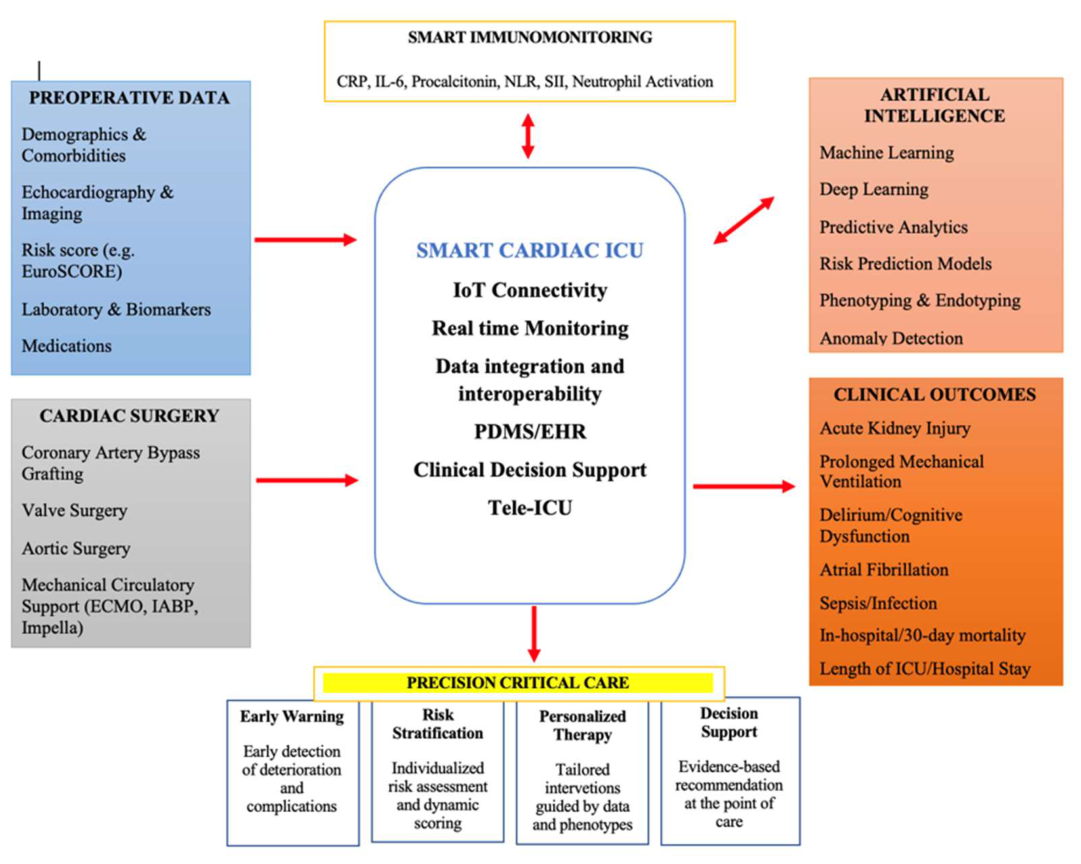

Table 1.
Related concepts in digital critical care.
| Concept | Core definition | Primary function | Concept |
| Digital ICU Intelligent ICU Tele-ICU |
An ICU that uses digital technology to continu-ously monitor, store and analyze data | Digitisation and documen-tation of data | Digital ICU |
| A Digital ICU that used machine learning models in order to generate predictive algorithms. | Analysis and prediction from collected data | Intelligent ICU | |
| A remote central hub used for monitoring and supporting distant ICUs. | Extend access to critical care expertise | Tele-ICU | |
| Smart ICU Concept |
An unified ecosystem collecting heterogenous data and creating and interoperable, analytic digi-tal support for clinical decision-making. | Integration of the above into a unified, interoperable system | Smart ICU |
| Core definition | Primary function | Concept | |
| Digital ICU Intelligent ICU Tele-ICU Smart ICU |
An ICU that uses digital technology to continu-ously monitor, store and analyze data | Digitisation and documen-tation of data | Digital ICU |
| A Digital ICU that used machine learning models in order to generate predictive algorithms. | Analysis and prediction from collected data | Intelligent ICU | |
| A remote central hub used for monitoring and supporting distant ICUs. | Extend access to critical care expertise | Tele-ICU | |
| An unified ecosystem collecting heterogenous data and creating and interoperable, analytic digi-tal support for clinical decision-making. | Integration of the above into a unified, interoperable system | Smart ICU | |
| Concept Digital ICU |
Core definition | Primary function | Concept |
| An ICU that uses digital technology to continu-ously monitor, store and analyze data | Digitisation and documen-tation of data | Digital ICU |
Table 2.
Data sources in the Smart Cardiac ICU and their predictive utility.
| Data source | Variables | Potential predictive utility | Data source |
| Hemodynamic moni-toring Mechanical ventila-tion Cardiopulmonary bypass and other ECC |
Heart rate, central venous pressure, car-diac output, invasive/ non-invasive arte-rial pressure | Hemodynamic instability, low cardiac output, vasoplegia | Hemodynamic moni-toring |
| Tidal volume, PEEP, pressure support, driving pressure, compliance | Prolonged ventilation, weaning param-eters, ventilation-associated complica-tions | Mechanical ventila-tion | |
| Pump flow, pressures, oxygen delivery and consumption, bypass and ischemia time | Inflammatory response, organ disfunc-tion requiring organ support therapies | Cardiopulmonary bypass and other ECC | |
| Laboratory parame-ters Inflammatory bi-omarkers |
Lactate, creatinine, hemoglobin, hemato-crit, platelets, arterial and venous oxy-genation saturation, PaO2/FiO2 | AKI, hypoperfusion, transfusion re-quirement, cardiac output, lung func-tion | Laboratory parame-ters |
| CRP, IL-6, neutrophil activation, NLR, SII | SIRS, prolonged ventilation, AKI, atrial fibrillation, low cardiac output syndrome, organ support therapy need, mortality | Inflammatory bi-omarkers | |
| Clinical scores Medication and fluids Vasopressors and in-otropes Urine output |
EuroSCORE II, STS score, SOFA | Baseline and evolving risk stratification | Clinical scores |
| Doses, pump infusion rates, fluid balance | Fluid overload, dosing safety, renal function | Medication and fluids | |
| Type, dose, duration | Vasoplegia, hemodynamic instability, low cardiac output syndrome, pro-longed ICU stay, mortality | Vasopressors and in-otropes | |
| Hourly measurement of urine output, fluid balance | AKI, need of continuous renal re-placement therapy | Urine output | |
| Data source Hemodynamic moni-toring |
Variables | Potential predictive utility | Data source |
| Heart rate, central venous pressure, car-diac output, invasive/ non-invasive arte-rial pressure | Hemodynamic instability, low cardiac output, vasoplegia | Hemodynamic moni-toring |
AKI - acute kidney injury; CRP - C-reactive protein; ECC - extracorporeal circulation; EuroSCORE II - European System for Cardiac Operative Risk Evaluation II; IL-6 - interleukin-6; NLR - neutrophil-to-lymphocyte ratio; SII - systemic immune-inflammation index; SIRS - systemic inflammatory response syndrome; SOFA - Sequential Organ Failure Assessment; STS - Society of Thoracic Surgeons.
Table 3.
Conventional ICU tools versus Smart Cardiac ICU analytics based on literature review.
| Domain | Conventional tool | Possible model | Outcome targeted | Current limitation |
| Mortality | APACHE, SOFA, SAPS II | RF, XGBoost, LSTM-RNN [34,35,36] | ICU mortality | Retrospective design, with limited external validation |
| Length of stay | - | Meta-analysis with AUROC ≈ 0.90 [36] | ICU/hospital LOS | Heterogeneous definitions |
| Perioperative risk | EuroSCORE II, STS score | MySurgeryRisk, POTTER, GBT [37,38] | Morbidity, mortality, postoperative AKI and pneumonia | Calibration and integration variable |
| Tele-ICU | Telemonitoring | integrated analytics platforms[58,78] | LOS, ventilation, vasopressor use | RCT evidence mixed (TELESCOPE neutral) |
| Perioperative inflammation | CRP and other biomarkers | RF, phenotyping [72,74] | SIRS, postoperative AKI, organ dysfunction | Retrospective design, no real-time integration |
(AKI - acute kidney injury; APACHE - Acute Physiology and Chronic Health Evaluation; AUROC - area under the receiver operating characteristic curve; CPB - cardiopulmonary bypass; CRP - C-reactive protein; ECC - extracorporeal circulation; GBT - gradient boosting trees; LOS - length of stay; LSTM-RNN - long short-term memory recurrent neural network; RF - Random Forest; SAPS II- Simplified Acute Physiology Score II; SIRS - systemic inflammatory response syndrome; SOFA - Sequential Organ Failure Assessment; STS - Society of Thoracic Surgeons; XGBoost - extreme gradient boosting).
Table 4.
Barriers to Smart Cardiac ICU implementation and proposed solutions.
| Barrier category | Main barrier | Proposed solutions |
| Technical | Lack of interoperability, heterogeneous data | Common standards, proper data integration |
| Clinical | Retrospective studies, workflow disruption | Prospective validation; integration into existing workflow |
| Organizational | Infrastructure cost, resistance to change | Training; command-centre models |
| Ethical and legal concerns | Data privacy, risk of bias, accountability | Governance frameworks; clear responsibility |
Disclaimer/Publisher’s Note: The statements, opinions and data contained in all publications are solely those of the individual author(s) and contributor(s) and not of MDPI and/or the editor(s). MDPI and/or the editor(s) disclaim responsibility for any injury to people or property resulting from any ideas, methods, instructions or products referred to in the content. |
© 2026 by the authors. Licensee MDPI, Basel, Switzerland. This article is an open access article distributed under the terms and conditions of the Creative Commons Attribution (CC BY) license (http://creativecommons.org/licenses/by/4.0/).
Copyright: This open access article is published under a Creative Commons CC BY 4.0 license, which permit the free download, distribution, and reuse, provided that the author and preprint are cited in any reuse.


