

Submitted:
15 July 2026
Posted:
17 July 2026
You are already at the latest version
Abstract
Coffee is one of the most widely consumed beverages worldwide. Coffee and its bioactive compounds, including caffeine, chlorogenic acid, and caffeic acid, have received increasing attention due to their potential contribution to coffee-associated health benefits. Evidence from pediatric and adult populations supports a positive association between fructose intake from sugar-sweetened beverages and the increasing prevalence of obesity and other non-communicable diseases. In this context, coffee consumption may represent a potential protective dietary factor against high fructose intake-induced metabolic alterations, including obesity, type 2 diabetes, liver disease, cardiovascular disease, and alterations in gut microbiota composition. However, human evidence on the effects of coffee consumption on fructose-related metabolic alterations remains limited, making it difficult to determine whether the benefits observed in animal models translate to humans. Therefore, this review summarizes current evidence on the potential role of coffee consumption and coffee-derived bioactive compounds in modulating fructose-induced metabolic alterations and discusses the mechanisms involved.
Keywords:
coffee consumption
; high-fructose intake
; caffeine
; chlorogenic acid
; caffeic acid
; non-communicable diseases
1. Introduction
Coffee is one of the most widely consumed beverages worldwide and has been valued since ancient times for its stimulant properties and distinctive flavor. Its chemical composition is highly complex, comprising more than 1000 phytochemicals, including methylxanthines, amino acids, phenolic acids, and other polyphenols [1]. This composition varies according to species, bean quality, roasting degree, and brewing method [1]. Roasting may reduce antioxidant polyphenols, whereas caffeine content is generally higher in Coffea robusta than in Coffea arabica [1]. Based on the brewing process, coffee can be broadly classified as boiled unfiltered, filtered, or decaffeinated coffee, with its final chemical profile influenced by grind size, water-to-coffee ratio, temperature, and extraction time [2].
Coffee consumption varies markedly across countries in terms of per-capita intake, total volume, and preferred coffee type, suggesting that exposure to coffee-derived bioactive compounds may differ according to population and consumption patterns [3,4].
In recent years, coffee and its bioactive compounds, including caffeine, chlorogenic acid (CGA), and caffeic acid, have received increasing attention due to their potential contribution to the health benefits associated with coffee intake [5]. In this context, coffee consumption may represent a potential protective dietary factor against metabolic alterations promoted by Western dietary patterns, particularly those associated with high fructose intake.
Excessive fructose intake, mainly through sugar-sweetened beverages (SSBs), has emerged as an important dietary factor associated with metabolic disturbances, including insulin resistance (IR), dyslipidemia, hepatic lipid accumulation, oxidative stress, and low-grade inflammation. Globally, the prevalence of high SSB consumption among young adults increased from 6.58% in 1990 to 11.13% in 2021 [6]. In the same year, high SSB consumption reached a global summary exposure value of 30.56%, with the highest levels observed in high-income countries and in Latin America and the Caribbean [7]. In Mexico, SSBs are the most frequently consumed beverage category across age groups, with reported consumption of 82.6% in preschool children, 93.6% in school-aged children, 90.3% in adolescents, and 76.3% in adults. Moreover, global SSB consumption is projected to increase by 9.54% by 2050, highlighting the growing relevance of sugar-related metabolic risk [7].
This review aims to summarize current evidence on whether coffee consumption and coffee-derived bioactive compounds can modulate fructose-induced metabolic alterations and to discuss the potential mechanisms involved.
2. Fructose intake from sugar-sweetened beverages and metabolic disease risk
Evidence from pediatric and adult populations supports a positive association between fructose intake from SSBs and the increasing prevalence of obesity and other non-communicable diseases, with the magnitude of these effects depending on the amount, frequency, and duration of exposure [8]. For instance, in children and adolescents, higher SSB consumption, represented by the highest quartile of intake with a median of 142 mL/day, was associated with an increased risk of incident metabolic syndrome, abdominal obesity, and hypertension compared with those in the lowest quartile, with a median intake of 9.3 mL/day [9]. This association has also been observed in adults, in whom consumption of ≥1 SSB/day was associated with higher diastolic blood pressure (DBP), while in women, it was positively associated with body mass index (BMI), DBP, triglycerides, and fasting glucose [10]. Furthermore, adults with high SSB consumption (>285 kcal/day) had a 2.83-fold higher risk of cardiovascular mortality compared with those with the lowest SSB intake (<128 kcal/day), whereas no associations were found with other dietary patterns [11]. Frequent SSB consumption (≥3/week) in adults has also been associated with higher odds of metabolic dysfunction-associated steatotic liver disease (MASLD) [12].
Evidence from intervention studies further supports these metabolic effects. In healthy volunteers, a three-week intervention with different SSBs (600 mL/day) showed that high-fructose beverages (80 g/day) reduced hepatic insulin sensitivity, as reflected by lower suppression of hepatic glucose production during the clamp, despite no changes in fasting glucose, insulin, or C-peptide compared with high-glucose beverages (80 g/day) [13]. In addition, moderate-fructose (40 g/day), high-fructose (80 g/day), and high-sucrose beverages (80 g/day) increased low-density lipoprotein cholesterol (LDL-C) and total cholesterol [13]. Similarly, in healthy men, daily consumption of moderate-fructose and sucrose-sweetened beverages (80 g/day) for seven weeks led to a 2-fold increase in basal hepatic fractional secretion rates of newly synthesized fatty acid compared with moderate glucose SSB [14]. Consistently, in healthy women, a fructose-rich single meal with an SSB providing approximately 18–25 g of fructose increased postprandial triglycerides (TG) and leukocyte concentrations at 240 minutes compared with sucrose- and glucose-rich meals [15]. In contrast, high-fructose intake (150 g/day) for eight weeks did not alter ectopic lipid deposition, hepatic glycogen storage, myocardial function, or myocardial mass in healthy individuals [16]. However, these alterations were evident in insulin-resistant patients with non-alcoholic fatty liver disease (NAFLD) [16], suggesting that the metabolic effects of fructose intake may depend on the underlying metabolic status.
In addition to hepatic and metabolic effects, high fructose intake may also influence metabolic risk through changes in the gut microbiota. In healthy women, a pilot study showed that a fruit-rich diet providing 100 g/day of fructose increased Firmicutes and butyrate-producing bacteria, whereas a high-fructose syrup diet reduced beneficial taxa such as Faecalibacterium and Erysipelatoclostridium [17]. However, these findings are not consistent across studies and may depend on the fructose source, fiber content, and food matrix [18,19]. In murine models, fructose-rich diets have been associated with intestinal dysbiosis, including reduced Bacteroidetes, increased Proteobacteria, and changes in taxa related to short-chain fatty acids (SCFA) production, intestinal barrier integrity, and inflammatory responses [20,21,22]. Therefore, alterations in the gut microbiota may be another mechanism by which high fructose intake contributes to metabolic alterations.
Taken together, current evidence supports fructose intake from SSBs as an important dietary contributor to obesity, metabolic alterations, liver disease, and cardiovascular risk.
3. Coffee Consumption
According to consolidated data from the International Coffee Organization, global coffee consumption is projected to reach a record 169.4–172.5 million 60-kg bags, equivalent to an approximate daily intake of 2.25 billion cups worldwide [3]. Northern Europe has the highest density of chronic coffee exposure. Finland ranks as the leading country in per-capita consumption, with an estimated per-capita consumption of approximately 12 kg/person/year. In contrast, the United States represents the largest critical mass in terms of total volume, consuming 1.43 million tons annually, while 66% of adults report daily coffee intake [4].
Although Mexico ranks among the world’s leading coffee-producing countries, its domestic per-capita consumption remains moderate to low compared with that of major importing nations. Average individual intake is estimated at only 0.3 cups/day (approximately 5 cups/week), corresponding to an annual per-capita consumption of roughly 1.3–1.7 kg/person/year [23]. Nevertheless, United States Department of Agriculture reports indicate that total domestic consumption reaches approximately 3.9 million 60-kg bags annually, underscoring the substantial size of the internal market despite relatively low individual intake [23]. In addition, instant coffee continues to dominate the Mexican market, accounting for 57% of total domestic consumption, whereas ground coffee represents the remaining 43% [23]. These differences in coffee consumption patterns are relevant because coffee type, preparation method, and additive use may influence the metabolic effects associated with coffee intake.
6. Future directions
- Conduct studies assessing the effects of coffee and/or coffee-derived bioactive compounds on the regulation of non-coding RNAs (microRNAs and long non-coding RNAs) associated with metabolic alterations induced by chronic fructose intake.
- Explore the molecular mechanisms underlying the effects of coffee in metabolically relevant tissues beyond the liver, such as adipose tissue and skeletal muscle.
- Investigate whether coffee intake modulates key molecular pathways involved in fructose-induced metabolic alterations, including oxidative stress, inflammation, insulin signaling, lipid metabolism, mitochondrial function, and gut microbiota-derived signaling.
- Investigate whether coffee intake modulates endocrine-like signaling mediated by extracellular vesicle-derived non-coding RNAs microRNAs and long non-coding RNAs), and whether these signals contribute to the systemic metabolic effects of coffee.
- Conduct well-controlled clinical trials to determine whether coffee intake can attenuate fructose-induced metabolic alterations in humans, considering coffee type, dose, roasting degree, brewing method, and additive use.
7. Conclusions
Current evidence suggests that coffee consumption and coffee-derived bioactive compounds may attenuate fructose-induced metabolic alterations, including insulin resistance, hepatic lipid accumulation, oxidative stress, inflammation, cardiovascular risk, and gut microbiota dysbiosis. These effects may be mediated by caffeine, chlorogenic acid, and caffeic acid through the regulation of glucose and lipid metabolism, inflammatory signaling, antioxidant defenses, and gut microbiota composition. However, human evidence remains limited and heterogeneous. Therefore, well-controlled clinical studies are needed to determine whether the protective effects observed in experimental models translate to humans.
Author Contributions
A.C.-L., F.S., F.H., M.C. and A.H.-D. All those mentioned contributed equally to the design and implementation of the review and to the analysis and writing of the manuscript. All authors have read and agreed to the published version of the manuscript.
Funding
This research received no external funding.
Institutional Review Board Statement
Not applicable.
Informed Consent Statement
Not applicable.
Data Availability Statement
Not applicable.
Acknowledgments
Not applicable.
Conflicts of Interest
The authors declare no conflicts of interest.
Abbreviations
The following abbreviations are used in this manuscript:
| AGEs | Advanced glycation end products |
| Akt | Protein kinase B |
| ALP | Alkaline phosphatase |
| ALT | Alanine aminotransferase |
| BMI | Body mass index |
| CGA | Chlorogenic acid |
| CHD | Coronary heart disease |
| CVD | Cardiovascular disease |
| DBP | Diastolic blood pressure |
| FFA | Free fatty acids |
| GPx | Glutathione peroxidase |
| IKK | IκB kinase |
| IL-1β | Interleukin-1 beta |
| IL-6 | Interleukin-6 |
| IL-8 | Interleukin-8 |
| IL-13 | Interleukin-13 |
| IR | Insulin resistance |
| IRS1 | Insulin receptor substrate 1 |
| LDL-C | Low-density lipoprotein cholesterol |
| MASLD | Metabolic dysfunction-associated steatotic liver disease |
| NADPH | Nicotinamide adenine dinucleotide phosphate |
| NAFLD | Non-alcoholic fatty liver disease |
| NF-κB | Nuclear factor kappa B |
| nNOS | Neuronal nitric oxide synthase |
| NO | Nitric oxide |
| PI3K | Phosphoinositide 3-kinase |
| RAGE | Receptor for advanced glycation end products |
| ROS | Reactive oxygen species |
| S1P | Sphingosine-1-phosphate |
| S1PR1 | Sphingosine-1-phosphate receptor 1 |
| S1PR3 | Sphingosine-1-phosphate receptor 3 |
| SOD | Superoxide dismutase |
| SphK1 | Sphingosine kinase 1 |
| SSB | Sugar-sweetened beverage |
| T2D | Type 2 diabetes |
| TG | Triglycerides |
| TIRAP | Toll/interleukin-1 receptor domain-containing adaptor protein |
| TLR4 | Toll-like receptor 4 |
| TNF-α | Tumor necrosis factor alpha |
References
- Saeed, M.; Naveed, M.; BiBi, J.; Ali Kamboh, A.; Phil, L.; Chao, S. Potential Nutraceutical and Food Additive Properties and Risks of Coffee: A Comprehensive Overview. Crit. Rev. Food Sci. Nutr. 2019, 59, 3293–3319. [Google Scholar] [CrossRef] [PubMed]
- Godos, J.; Pluchinotta, F.R.; Marventano, S.; Buscemi, S.; Volti, G.L.; Galvano, F.; Grosso, G. Coffee Components and Cardiovascular Risk: Beneficial and Detrimental Effects. Int. J. Food Sci. Nutr. 2014, 65, 925–936. [Google Scholar] [CrossRef] [PubMed]
- Consumer Insight Reports | National Coffee Association. Available online: https://www.ncausa.org/Market-Research/Consumer-Insight-Reports (accessed on 11 May 2026).
- Coffee Consumption by Country 2026. Available online: https://worldpopulationreview.com/country-rankings/coffee-consumption-by-country (accessed on 11 May 2026).
- Emadi, R.C.; Kamangar, F. Coffee’s Impact on Health and Well-Being. Nutrients 2025, 17, 2558. [Google Scholar] [CrossRef] [PubMed]
- Ge, C.; Xiong, J.; Zhu, R.; Hong, Z.; He, Y. Global Burden of High Sugar-Sweetened Beverage Consumption among Young Adults. Diabetol. Metab. Syndr. 2025, 17, 259. [Google Scholar] [CrossRef] [PubMed]
- Alves-Costa, S.; Nascimento, G.G.; de Souza, B.F.; Hugo, F.N.; Leite, F.R.M.; Ribeiro, C.C.C. Global, Regional, and National Burden of High Sugar-Sweetened Beverages Consumption, 1990–2021, with Projections up to 2050: A Systematic Analysis for the Global Burden of Disease Study 2021. Am. J. Clin. Nutr. 2025, 122, 1413–1422. [Google Scholar] [CrossRef] [PubMed]
- Shi, Y.N.; Liu, Y.J.; Xie, Z.; Zhang, W.J. Fructose and Metabolic Diseases: Too Much to Be Good. Chin. Med. J. (Engl) . 2021, 134, 1276–1285. [Google Scholar] [CrossRef] [PubMed]
- Mirmiran, P.; Yuzbashian, E.; Asghari, G.; Hosseinpour-Niazi, S.; Azizi, F. Consumption of Sugar Sweetened Beverage Is Associated with Incidence of Metabolic Syndrome in Tehranian Children and Adolescents. Nutr. Metab. (Lond) 2015, 12, 25. [Google Scholar] [CrossRef]
- Shin, S.; Kim, S.A.; Ha, J.; Lim, K. Sugar-Sweetened Beverage Consumption in Relation to Obesity and Metabolic Syndrome among Korean Adults: A Cross-Sectional Study from the 2012–2016 Korean National Health and Nutrition Examination Survey (KNHANES). Nutrients 2018, 10, 1467. [Google Scholar] [CrossRef] [PubMed]
- Zhou, J.; Liu, C.; Liu, L.; Li, L. Sugar-Sweetened Beverage Intake and Long-Term Mortality in Individuals with Metabolic Dysfunction-Associated Steatotic Liver Disease: A Longitudinal Analysis of the National Health and Nutrition Examination Survey Database. Eur. J. Gastroenterol. Hepatol. 2024, 36, 608–614. [Google Scholar] [CrossRef] [PubMed]
- Jeon, H.J.; Rou, W.S.; Kim, S.H.; Lee, B.S.; Kim, H.N.; Choi, H.G.; Seo, J.; Eun, H.S.; Jung, S. Sugar-Sweetened Beverage Consumption and Metabolic Dysfunction-Associated Steatotic Liver Disease: A Beverage Type-Specific Analysis Using Korea National Health and Nutrition Examination Survey. Epidemiol. Health 2025, 47, e2025038. [Google Scholar] [CrossRef] [PubMed]
- Aeberli, I.; Hochuli, M.; Gerber, P.A.; Sze, L.; Murer, S.B.; Tappy, L.; Spinas, G.A.; Berneis, K. Moderate Amounts of Fructose Consumption Impair Insulin Sensitivity in Healthy Young MenA Randomized Controlled Trial. Diabetes Care 2013, 36, 150–156. [Google Scholar] [CrossRef] [PubMed]
- Geidl-Flueck, B.; Hochuli, M.; Németh, Á.; Eberl, A.; Derron, N.; Köfeler, H.C.; Tappy, L.; Berneis, K.; Spinas, G.A.; Gerber, P.A. Fructose- and Sucrose- but Not Glucose-Sweetened Beverages Promote Hepatic de Novo Lipogenesis: A Randomized Controlled Trial. J. Hepatol. 2021, 75, 46–54. [Google Scholar] [CrossRef] [PubMed]
- Rodrigues, A.M. dos S.; Martins, L.B.; Fagundes, G.B.P.; Tibaes, J.R.B.; Amaral, M.H.A.; Vieira, É.L.M.; Oliveira, M.C.; Correia, M.I.T.D.; Ferreira, A.V.M. Acute Inflammatory and Metabolic Effect of High Fructose Intake in Normal-Weight Women: A Randomized, Double-Masked, Crossover Trial. Nutrition 2025, 129, 112602. [Google Scholar] [CrossRef] [PubMed]
- Smajis, S.; Gajdošík, M.; Pfleger, L.; Traussnigg, S.; Kienbacher, C.; Halilbasic, E.; Ranzenberger-Haider, T.; Stangl, A.; Beiglböck, H.; Wolf, P.; et al. Metabolic Effects of a Prolonged, Very-High-Dose Dietary Fructose Challenge in Healthy Subjects. Am. J. Clin. Nutr. 2020, 111, 369–377. [Google Scholar] [CrossRef] [PubMed]
- Beisner, J.; Gonzalez-Granda, A.; Basrai, M.; Damms-Machado, A.; Bischoff, S.C. Fructose-Induced Intestinal Microbiota Shift Following Two Types of Short-Term High-Fructose Dietary Phases. Nutrients 2020, 12, 1–21. [Google Scholar] [CrossRef] [PubMed]
- Alemán, J.O.; Henderson, W.A.; Walker, J.M.; Ronning, A.; Jones, D.R.; Walter, P.J.; Daniel, S.G.; Bittinger, K.; Vaughan, R.; MacArthur, R.; et al. Excess Dietary Fructose Does Not Alter Gut Microbiota or Permeability in Humans: A Pilot Randomized Controlled Study. J. Clin. Transl. Sci. 2021, 5. [Google Scholar] [CrossRef] [PubMed]
- Simões, C.D.; Sousa, A.S.; Fernandes, S.; Sarmento, A. Fructose Malabsorption, Gut Microbiota and Clinical Consequences: A Narrative Review of the Current Evidence. Life 2025, 15, 1720. [Google Scholar] [CrossRef] [PubMed]
- Do, M.H.; Lee, E.; Oh, M.J.; Kim, Y.; Park, H.Y. High-Glucose or -Fructose Diet Cause Changes of the Gut Microbiota and Metabolic Disorders in Mice without Body Weight Change. Nutrients 2018, 10, 761. [Google Scholar] [CrossRef] [PubMed]
- Li, J.M.; Yu, R.; Zhang, L.P.; Wen, S.Y.; Wang, S.J.; Zhang, X.Y.; Xu, Q.; Kong, L.D. Dietary Fructose-Induced Gut Dysbiosis Promotes Mouse Hippocampal Neuroinflammation: A Benefit of Short-Chain Fatty Acids. Microbiome 2019, 7. [Google Scholar] [CrossRef] [PubMed]
- Watanabe, Y.; Fujisaka, S.; Ikeda, K.; Ishikawa, M.; Yamada, T.; Nawaz, A.; Kado, T.; Kuwano, T.; Nishimura, A.; Bilal, M.; et al. Gut Microbiota, Determined by Dietary Nutrients, Drive Modification of the Plasma Lipid Profile and Insulin Resistance. iScience 2021, 24, 102445. [Google Scholar] [CrossRef] [PubMed]
- Adriana Otero Arnaiz Coffee Annual; 2025.
- Annunziata, G.; Frias-Toral, E.; Campa, F.; Antonieta Touriz Bonifaz, M.; Verde, L.; Galasso, M.; Savastano, S.; Colao, A.; Paoli, A.; Simancas-Racines, D.; et al. Differential Impact of Coffee Quantity and Sweetening on Body Composition Parameters and Inflammation. Front. Nutr. 2025, 12, 1673677. [Google Scholar] [CrossRef]
- Fernández-Cardero, Á.; Sierra-Cinos, J.L.; Bravo, L.; Sarriá, B. Consumption of a Coffee Rich in Phenolic Compounds May Improve the Body Composition of People with Overweight or Obesity: Preliminary Insights from a Randomized, Controlled and Blind Crossover Study. Nutrients 2024, 16, 2848. [Google Scholar] [CrossRef]
- da Costa, M.S.; Pontes, K.S. da S.; Guedes, M.R.; Barreto Silva, M.I.; Klein, M.R.S.T. Association of Habitual Coffee Consumption with Obesity, Sarcopenia, Bone Mineral Density and Cardiovascular Risk Factors: A Two-Year Follow-up Study in Kidney Transplant Recipients. Clin. Nutr. 2023, 42, 1889–1900. [Google Scholar] [CrossRef] [PubMed]
- Lee, A.; Lim, W.; Kim, S.; Khil, H.; Cheon, E.; An, S.; Hong, S.; Lee, D.H.; Kang, S.S.; Oh, H.; et al. Coffee Intake and Obesity: A Meta-Analysis. Nutrients 2019, 11, 1274. [Google Scholar] [CrossRef] [PubMed]
- Nemati, M.; Soltani, S.; Almasi, F.; Salari-Moghaddam, A.; Larijani, B.; Ebrahimzadeh, A.; Milajerdi, A.; Esmaillzadeh, A. Coffee Consumption, General Obesity and Abdominal Obesity in Adults: A Systematic Review and Meta-Analysis of Cross-Sectional Studies. Adv. Biomed. Res. 2024, 13. [Google Scholar] [CrossRef] [PubMed]
- Kim, J.H.; Park, Y.S. Light Coffee Consumption Is Protective against Sarcopenia, but Frequent Coffee Consumption Is Associated with Obesity in Korean Adults. 2017, 41, 97–102. [Google Scholar] [CrossRef] [PubMed]
- Hosseini, S.; Bahadoran, Z.; Mirmiran, P.; Azizi, F. Habitual Coffee Drinking and the Chance of Prediabetes Remission: Findings from a Population with Low Coffee Consumption. J. Diabetes Metab. Disord. 2024, 23, 817–824. [Google Scholar] [CrossRef]
- Ding, P.; Yue, W.; Wang, X.; Zhang, Y.; Liu, Y.; Guo, X. Effects of Sugary Drinks, Coffee, Tea and Fruit Juice on Incidence Rate, Mortality and Cardiovascular Complications of Type2 Diabetes Patients: A Systematic Review and Meta-Analysis. J. Diabetes Metab. Disord. 2024, 23, 1113–1123. [Google Scholar] [CrossRef]
- Henn, M.; Glenn, A.J.; Willett, W.C.; Martínez-González, M.A.; Sun, Q.; Hu, F.B. Coffee Consumption, Additive Use, and Risk of Type 2 Diabetes—Results from 3 Large Prospective United States Cohort Studies. Am. J. Clin. Nutr. 2025, 121, 695–702. [Google Scholar] [CrossRef] [PubMed]
- Ochoa-Rosales, C.; van der Schaft, N.; Braun, K.V.E.; Ho, F.K.; Petermann-Rocha, F.; Ahmadizar, F.; Kavousi, M.; Pell, J.P.; Ikram, M.A.; Celis-Morales, C.A.; et al. C-Reactive Protein Partially Mediates the Inverse Association between Coffee Consumption and Risk of Type 2 Diabetes: The UK Biobank and the Rotterdam Study Cohorts. Clin. Nutr. 2023, 42, 661–669. [Google Scholar] [CrossRef] [PubMed]
- Fattah, F. Moderate Coffee Consumption and Its Protective Role Against Type 2 Diabetes in Men: A Meta-Analysis Study. J. Sulaimani Med. Coll. 2025, 15, 44–56. [Google Scholar] [CrossRef]
- Su, X.; Hu, D.; Tan, J. Association of Coffee Consumption with Diabetes Mellitus and Gestational Diabetes Mellitus. Int. J. Cardiol. Cardiovasc. Risk Prev. 2026, 29, 200626. [Google Scholar] [CrossRef] [PubMed]
- Li, Y.; Zhang, P.; Deng, Y.; Yu, C.; Chen, X.; Liu, X.; Yang, Q.; Jiang, J.; Chen, X.; Xue, H. Association of Sugar-Sweetened, Artificially Sweetened, and Unsweetened Coffee Consumption with Chronic Liver Disease and Liver-Related Events: A Large Prospective Cohort Study. J. Nutr. 2025, 155, 975–984. [Google Scholar] [CrossRef] [PubMed]
- Chen, P.; Wang, S.; Zhang, T.; Chen, E.Q. Association between Coffee Consumption Habits and Non-Alcoholic Fatty Liver Disease in Community-Dwelling Populations: Data from the National Health and Nutrition Examination Survey 2013–2018. Public Health Nutr. 2026, 29, e35. [Google Scholar] [CrossRef] [PubMed]
- Román Calleja, B.M.; Salvador Zubirán, N.; Violeta Muñoz Torres, A.; Fernando Martínez-Cabrera, C.; Siani, M.; Bonfiglio, C.; Bonfrate, L.; Donghia, R.; Noemy Pastore, M. Italian Style Coffee Consumption and Metabolically Dysfunctional-Associated Steatotic Liver Disease (MASLD): A Cohort Population Study in Southern Italy. Front. Nutr. 2026, 13, 1797230. [Google Scholar] [CrossRef] [PubMed]
- Liu, W.; Xu, X.; Chang, Q.; Yang, H.; Ma, Z.; Zhang, T.; Zhao, Y.; Zhao, L.; Xia, Y. Different Types of Sweetened Coffee Consumption, Genetic Predictor of Gut Microbe, and the Risk of Metabolic Dysfunction-Associated Steatotic Liver Disease. Nutr. J. 2026, 25, 31. [Google Scholar] [CrossRef]
- Lee, J.H.; Park, J.Y.; Ahn, S.B. Different Associations of Coffee Consumption with the Risk of Incident Metabolic Dysfunction-Associated Steatotic Liver Disease and Advanced Liver Fibrosis. Nutrients 2024, 16, 140. [Google Scholar] [CrossRef]
- Linden-Torres, E.; Zambrano-Galván, G.; Sahebkar, A.; Ríos-Mier, M.; Simental-Mendía, L.E. Coffee Consumption Has No Effect on Circulating Markers of Liver Function but Increases Adiponectin Concentrations: A Systematic Review and Meta-Analysis of Randomized Controlled Trials. 2022, 106, 24–34. [Google Scholar] [CrossRef] [PubMed]
- Chieng, D.; Canovas, R.; Segan, L.; Sugumar, H.; Voskoboinik, A.; Prabhu, S.; Ling, L.H.; Lee, G.; Morton, J.B.; Kaye, D.M.; et al. The Impact of Coffee Subtypes on Incident Cardiovascular Disease, Arrhythmias, and Mortality: Long-Term Outcomes from the UK Biobank. Eur. J. Prev. Cardiol. 2022, 29, 2240–2249. [Google Scholar] [CrossRef] [PubMed]
- Liu, Y.J.; Miao, M.Y.; Wang, J.M.; Tang, Q.; Han, W.W.; Jia, Y.P.; Tao, H.W.; Zheng, Y.; van Dam, R.M.; Qin, L.Q.; et al. Coffee Consumption and Incidence of Cardiovascular and Microvascular Diseases in Never-Smoking Adults with Type 2 Diabetes Mellitus. Nutrients 2023, 15, 3910. [Google Scholar] [CrossRef]
- Park, Y.; Cho, H.; Myung, S.K. Effect of Coffee Consumption on Risk of Coronary Heart Disease in a Systematic Review and Meta-Analysis of Prospective Cohort Studies. Am. J. Cardiol. 2023, 186, 17–29. [Google Scholar] [CrossRef] [PubMed]
- Shahinfar, H.; Jayedi, A.; Khan, T.A.; Shab-Bidar, S. Coffee Consumption and Cardiovascular Diseases and Mortality in Patients with Type 2 Diabetes: A Systematic Review and Dose–Response Meta-Analysis of Cohort Studies. Nutr. Metab. Cardiovasc. Dis. 2021, 31, 2526–2538. [Google Scholar] [CrossRef] [PubMed]
- Zhou, H.; Nie, J.; Cao, Y.; Diao, L.; Zhang, X.; Li, J.; Chen, S.; Zhang, X.; Chen, G.; Zhang, Z.; et al. Association of Daily Sitting Time and Coffee Consumption with the Risk of All-Cause and Cardiovascular Disease Mortality among US Adults. BMC Public Health 2024, 24, 1069. [Google Scholar] [CrossRef]
- Lopez-Garcia, E.; Rodriguez-Artalejo, F.; Li, T.Y.; Mukamal, K.J.; Hu, F.B.; Van Dam, R.M. Coffee Consumption and Mortality in Women with Cardiovascular Disease. Am. J. Clin. Nutr. 2011, 94, 218–224. [Google Scholar] [CrossRef] [PubMed]
- Mills, C.E.; Tzounis, X.; Oruna-Concha, M.J.; Mottram, D.S.; Gibson, G.R.; Spencer, J.P.E. In Vitro Colonic Metabolism of Coffee and Chlorogenic Acid Results in Selective Changes in Human Faecal Microbiota Growth. Br. J. Nutr. 2015, 113, 1220–1227. [Google Scholar] [CrossRef] [PubMed]
- Jaquet, M.; Rochat, I.; Moulin, J.; Cavin, C.; Bibiloni, R. Impact of Coffee Consumption on the Gut Microbiota: A Human Volunteer Study. Int. J. Food Microbiol. 2009, 130, 117–121. [Google Scholar] [CrossRef] [PubMed]
- Zhang, Q.; Li, G.; Zhao, W.; Wang, X.; He, J.; Zhou, L.; Zhang, X.; An, P.; Liu, Y.; Zhang, C.; et al. Efficacy of Bifidobacterium Animalis Subsp. Lactis BL-99 in the Treatment of Functional Dyspepsia: A Randomized Placebo-Controlled Clinical Trial. Nat. Commun. 2024, 15, 227. [Google Scholar] [CrossRef] [PubMed]
- Manghi, P.; Bhosle, A.; Wang, K.; Marconi, R.; Selma-Royo, M.; Ricci, L.; Asnicar, F.; Golzato, D.; Ma, W.; Hang, D.; et al. Coffee Consumption Is Associated with Intestinal Lawsonibacter Asaccharolyticus Abundance and Prevalence across Multiple Cohorts. Nat. Microbiol. 2024, 9, 3120–3134. [Google Scholar] [CrossRef] [PubMed]
- Kim, M.B.; Lee, H.; Kang, J.; Kim, B.; Hwang, J.K. Protective Effects of Quinic Acid Against Disuse-Induced Skeletal Muscle Atrophy via Regulation of Inflammation and Oxidative Stress. Foods 2025, 14, 3833. [Google Scholar] [CrossRef] [PubMed]
- Martín, R.; Rios-Covian, D.; Huillet, E.; Auger, S.; Khazaal, S.; Bermúdez-Humarán, L.G.; Sokol, H.; Chatel, J.M.; Langella, P. Faecalibacterium: A Bacterial Genus with Promising Human Health Applications. FEMS Microbiol. Rev. 2023, 47. [Google Scholar] [CrossRef] [PubMed]
- Parker, B.J.; Wearsch, P.A.; Veloo, A.C.M.; Rodriguez-Palacios, A. The Genus Alistipes: Gut Bacteria With Emerging Implications to Inflammation, Cancer, and Mental Health. Front. Immunol. 2020, 11, 522172. [Google Scholar] [CrossRef]
- Machado, F.; Gómez-Domínguez, I.; Hurtado-Ribeira, R.; Martin, D.; Coimbra, M.A.; del Castillo, M.D.; Coreta-Gomes, F. In Vitro Human Colonic Fermentation of Coffee Arabinogalactan and Melanoidin-Rich Fractions. Int. J. Biol. Macromol. 2024, 275. [Google Scholar] [CrossRef] [PubMed]
- Martin-Gallausiaux, C.; Marinelli, L.; Blottière, H.M.; Larraufie, P.; Lapaque, N. SCFA: Mechanisms and Functional Importance in the Gut. Proc. Nutr. Soc. 2021, 80, 37–49. [Google Scholar] [CrossRef] [PubMed]
- Lecoultre, V.; Carrel, G.; Egli, L.; Binnert, C.; Boss, A.; MacMillan, E.L.; Kreis, R.; Boesch, C.; Darimont, C.; Tappy, L. Coffee Consumption Attenuates Short-Term Fructose-Induced Liver Insulin Resistance in Healthy Men. Am. J. Clin. Nutr. 2014, 99, 268–275. [Google Scholar] [CrossRef] [PubMed]
- Shokouh, P.; Jeppesen, P.B.; Hermansen, K.; Laustsen, C.; Stødkilde-Jørgensen, H.; Hamilton-Dutoit, S.J.; Schmedes, M.S.; Qi, H.; Nørlinger, T.S.; Gregersen, S. Effects of Unfiltered Coffee and Bioactive Coffee Compounds on the Development of Metabolic Syndrome Components in a High-Fat-/High-Fructose-Fed Rat Model. Nutrients 2018, 10, 1547. [Google Scholar] [CrossRef] [PubMed]
- Feyisa, T.O.; Melka, D.S.; Menon, M.; Labisso, W.L.; Habte, M.L. Investigation of the Effect of Coffee on Body Weight, Serum Glucose, Uric Acid and Lipid Profile Levels in Male Albino Wistar Rats Feeding on High-Fructose Diet. Lab. Anim. Res. 2019, 35, 29. [Google Scholar] [CrossRef]
- Benyelles, M.; Merzouk, H.; Merzouk, A.Z.; Imessaoudene, A.; Medjdoub, A.; Mebarki, A. Valorization of Encapsulated Coffee Parchment Extracts as Metabolic Control for High Fructose Diet-Induced Obesity, Using Wistar Rat as Animal Model. Waste Biomass Valorization 2024, 15, 265–281. [Google Scholar] [CrossRef]
- Anese, M.; Alongi, M.; Cervantes-Flores, M.; Simental-Mendía, L.E.; Martínez-Aguilar, G.; Valenzuela-Ramírez, A.A.; Rojas-Contreras, J.A.; Guerrero-Romero, F.; Gamboa-Gómez, C.I. Influence of Coffee Roasting Degree on Inflammatory and Oxidative Stress Markers in High-Fructose and Saturated Fat-Fed Rats. Food Res. Int. 2023, 165, 112530. [Google Scholar] [CrossRef] [PubMed]
- El-Kersh, D.M.; Kotob, S.E.; Ammar, N.M.; Mohawed, O.A.M.; Ahmed, H.H.; Farag, M.A. Unravelling the Anti-Inflammatory and Antioxidant Effects of Standardized Green and Black Caffeinated Coffee, Tea, and Their Mixtures in an Obese Male Rat Model: Insights from Biochemical, Metabolomic, and Histopathological Analyses. Food Chem. Toxicol. 2023, 179, 113971. [Google Scholar] [CrossRef] [PubMed]
- Panchal, S.K.; Poudyal, H.; Waanders, J.; Brown, L. Coffee Extract Attenuates Changes in Cardiovascular and Hepatic Structure and Function without Decreasing Obesity in High-Carbohydrate, High-Fat Diet-Fed Male Rats. J. Nutr. 2012, 142, 690–697. [Google Scholar] [CrossRef] [PubMed]
- Fukagawa, N.K.; Veirs, H.; Langeloh, G. Acute Effects of Fructose and Glucose Ingestion with and without Caffeine in Young and Old Humans. Metabolism 1995, 44, 630–638. [Google Scholar] [CrossRef] [PubMed]
- Yeh, T.C.; Liu, C.P.; Cheng, W.H.; Chen, B.R.; Lu, P.J.; Cheng, P.W.; Ho, W.Y.; Sun, G.C.; Liou, J.C.; Tseng, C.J. Caffeine Intake Improves Fructose-Induced Hypertension and Insulin Resistance by Enhancing Central Insulin Signaling. Hypertension 2014, 63, 535–541. [Google Scholar] [CrossRef]
- Cannizzaro, L.; Rossoni, G.; Savi, F.; Altomare, A.; Marinello, C.; Saethang, T.; Carini, M.; Payne, D.M.; Pisitkun, T.; Aldini, G.; et al. Regulatory Landscape of AGE-RAGE-Oxidative Stress Axis and Its Modulation by PPARγ Activation in High Fructose Diet-Induced Metabolic Syndrome. Nutr. Metab. (Lond) 2017, 14, 1–13. [Google Scholar] [CrossRef]
- Rai, A.K.; Jaiswal, N.; Maurya, C.K.; Sharma, A.; Ahmad, I.; Ahmad, S.; Gupta, A.P.; Gayen, J.R.; Tamrakar, A.K. Fructose-Induced AGEs-RAGE Signaling in Skeletal Muscle Contributes to Impairment of Glucose Homeostasis. J. Nutr. Biochem. 2019, 71, 35–44. [Google Scholar] [CrossRef] [PubMed]
- Ojima, A.; Matsui, T.; Nakamura, N.; Higashimoto, Y.; Ueda, S.; Fukami, K.; Okuda, S.; Yamagishi, S. DNA Aptamer Raised against Advanced Glycation End Products (AGEs) Improves Glycemic Control and Decreases Adipocyte Size in Fructose-Fed Rats by Suppressing Age-Rage Axis. Horm. Metab. Res. 2015, 47, 253–258. [Google Scholar] [CrossRef]
- Velázquez, A.M.; Roglans, N.; Bentanachs, R.; Gené, M.; Sala-Vila, A.; Lázaro, I.; Rodríguez-Morató, J.; Sánchez, R.M.; Laguna, J.C.; Alegret, M. Effects of a Low Dose of Caffeine Alone or as Part of a Green Coffee Extract, in a Rat Dietary Model of Lean Non-Alcoholic Fatty Liver Disease without Inflammation. Nutrients 2020, Vol. 12 12, 3240. [Google Scholar] [CrossRef] [PubMed]
- Alqarni, I.; Bassiouni, Y.A.; Badr, A.M.; Ali, R.A. Telmisartan and/or Chlorogenic Acid Attenuates Fructose-Induced Non-Alcoholic Fatty Liver Disease in Rats: Implications of Cross-Talk between Angiotensin, the Sphingosine Kinase/Sphingoine-1-Phosphate Pathway, and TLR4 Receptors. Biochem. Pharmacol. 2019, 164, 252–262. [Google Scholar] [CrossRef] [PubMed]
- Wang, X.; Zhang, D.M.; Gu, T.T.; Ding, X.Q.; Fan, C.Y.; Zhu, Q.; Shi, Y.W.; Hong, Y.; Kong, L.D. Morin Reduces Hepatic Inflammation-Associated Lipid Accumulation in High Fructose-Fed Rats via Inhibiting Sphingosine Kinase 1/Sphingosine 1-Phosphate Signaling Pathway. Biochem. Pharmacol. 2013, 86, 1791–1804. [Google Scholar] [CrossRef] [PubMed]
- Gu, T.T.; Song, L.; Chen, T.Y.; Wang, X.; Zhao, X.J.; Ding, X.Q.; Yang, Y.Z.; Pan, Y.; Zhang, D.M.; Kong, L.D. Fructose Downregulates MiR-330 to Induce Renal Inflammatory Response and Insulin Signaling Impairment: Attenuation by Morin. Mol. Nutr. Food Res. 2017, 61, 1600760. [Google Scholar] [CrossRef] [PubMed]
- Guo, X.; Wang, O.; Wang, Y.; Wang, K.; Ji, B.; Zhou, F. Phenolic Acids Alleviate High-Fat and High-Fructose Diet-Induced Metabolic Disorders in Rats. J. Food Biochem. 2017, 41, e12419. [Google Scholar] [CrossRef]
- Ibitoye, O.B.; Ajiboye, T.O. Dietary Phenolic Acids Reverse Insulin Resistance, Hyperglycaemia, Dyslipidaemia, Inflammation and Oxidative Stress in High-Fructose Diet-Induced Metabolic Syndrome Rats. Arch. Physiol. Biochem. 2018, 124, 410–417. [Google Scholar] [CrossRef] [PubMed]
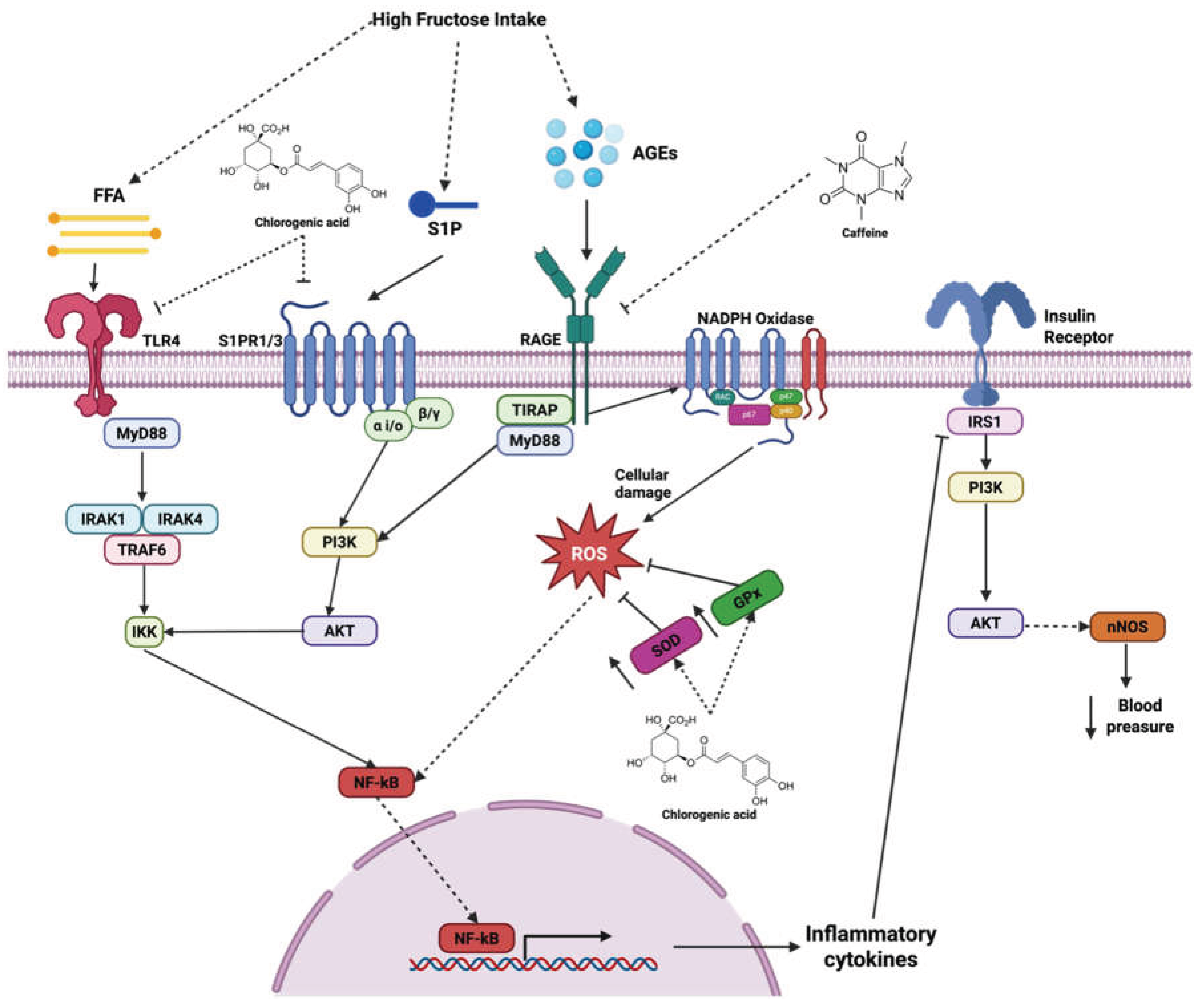
Figure 1.
Proposed molecular mechanisms underlying the protective effects of coffee-derived bioactive compounds against fructose-induced metabolic alterations.
Figure 1.
Proposed molecular mechanisms underlying the protective effects of coffee-derived bioactive compounds against fructose-induced metabolic alterations.
Disclaimer/Publisher’s Note: The statements, opinions and data contained in all publications are solely those of the individual author(s) and contributor(s) and not of MDPI and/or the editor(s). MDPI and/or the editor(s) disclaim responsibility for any injury to people or property resulting from any ideas, methods, instructions or products referred to in the content. |
© 2026 by the authors. Licensee MDPI, Basel, Switzerland. This article is an open access article distributed under the terms and conditions of the Creative Commons Attribution (CC BY) license (http://creativecommons.org/licenses/by/4.0/).
Copyright: This open access article is published under a Creative Commons CC BY 4.0 license, which permit the free download, distribution, and reuse, provided that the author and preprint are cited in any reuse.


