
Submitted:
16 July 2026
Posted:
16 July 2026
You are already at the latest version
Abstract
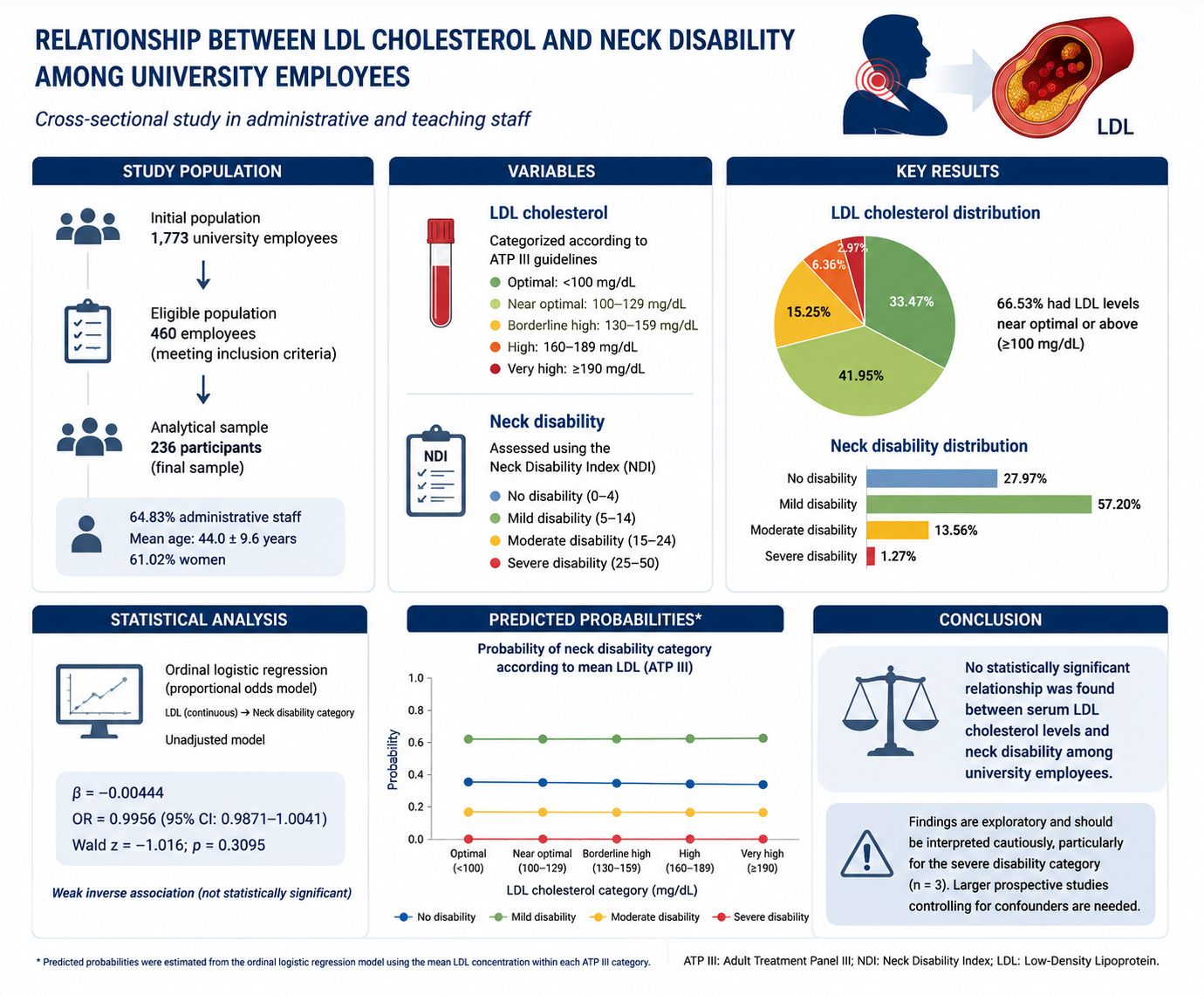
Neck pain is a prevalent condition that affects a significant proportion of the global population, particularly among university employees. This study analyzes the relationship between low-density lipoprotein (LDL) levels and neck disability (ND) in university administrative and teaching staff. A cross-sectional study was conducted on 236 administrative and teaching participants from a private university in Quito, Ecuador. Most of the participants held administrative positions (64.83%). LDL levels were categorized based on the Adult Treatment Panel III guidelines, and ND was assessed using the Neck Disability Index (NDI). The results showed that 66.53% of participants had LDL levels classified as higher than desirable (near optimal or above), while most of the individuals (57.20%) exhibited mild disability. Ordinal logistic regression analysis revealed a weak inverse trend (β = −0.00444). This suggests a non-significant trend where higher LDL levels slightly correspond to a lower probability of being in a higher ND category. The p-value of 0.3095 indicates that the association was not statistically significant. Furthermore, a quadratic regression model showed that ND had negligible explanatory power over LDL variability (R² = 0.02599, p = 0.2039). In conclusion, this study found no statistically significant relationship between serum LDL levels and neck disability in university employees.
Keywords:
disability
; LDL cholesterol
; low-density lipoprotein
; neck disability index
; neck pain
; university employees
Copyright: This open access article is published under a Creative Commons CC BY 4.0 license, which permit the free download, distribution, and reuse, provided that the author and preprint are cited in any reuse.


