
Submitted:
15 July 2026
Posted:
16 July 2026
You are already at the latest version
Abstract
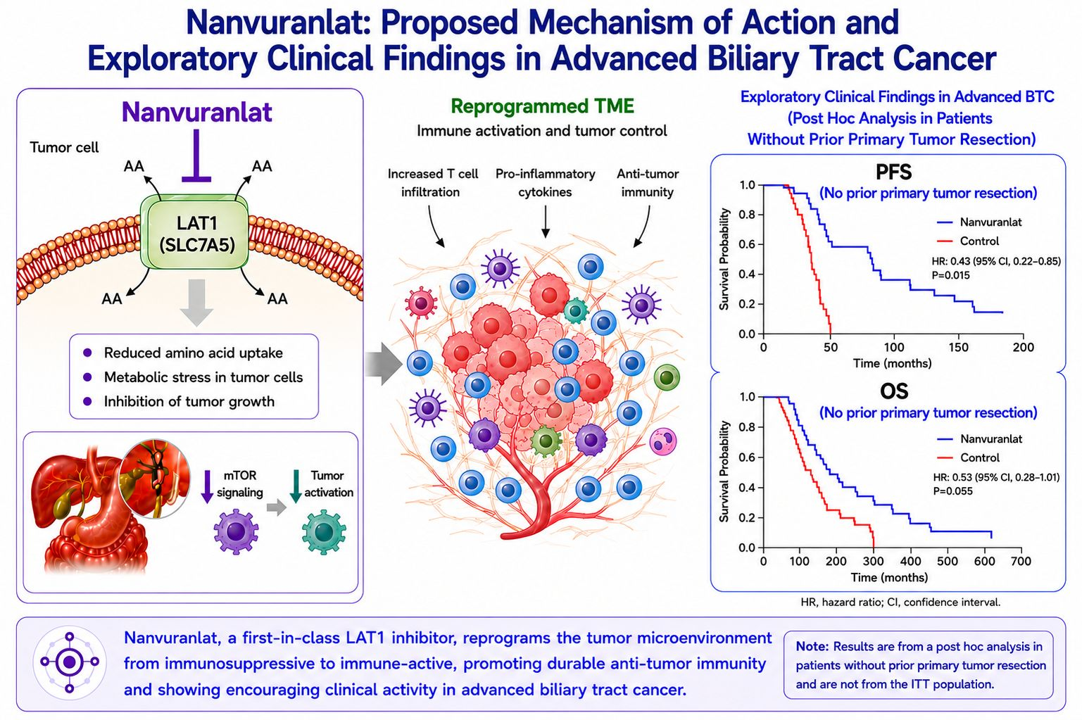
Background/Objectives: Nanvuranlat, a selective inhibitor of LAT1, has demonstrated clinical activity in advanced biliary tract cancer (BTC). We performed post hoc analyses to identify clinical and biomarker-defined populations that may derive greater benefit from LAT1 inhibition. Methods: Data from Phase 1 and Phase 2 studies were analyzed. Clinical outcomes were evaluated according to BTC subtype, prior primary tumor resection status, LAT1 expression, and accumulated drug exposure. Overall survival (OS), progression-free survival (PFS), and tumor size changes were assessed using Kaplan–Meier and Cox proportional hazards analyses. Results: In the Phase 2 study, nanvuranlat improved PFS versus placebo in the overall population (HR 0.56, 95% CI 0.34–0.90). Among the exploratory subgroups, lower hazard ratios were observed in patients without prior primary tumor resection (PFS HR 0.43, 95% CI 0.22–0.85; OS HR 0.53, 95% CI 0.28–1.01). Patients with high LAT1 expression demonstrated lower hazard ratios for PFS and OS than the overall population. Among patients with IHC, EHC, or GBC and high LAT1 2622551206500expression, PFS and OS hazard ratios were 0.31 (95% CI 0.15–0.64) and 0.50 (95% CI 0.25–1.00), respectively. Clinical outcomes also differed according to accumulated treatment exposure. Conclusions: These exploratory analyses suggest that BTC subtype, prior primary tumor resection status, and LAT1 expression may identify candidate populations for prospective evaluation in future nanvuranlat studies. The findings support further evaluation of biomarker-informed patient selection strategies in advanced BTC.
Keywords:
biliary tract cancer
; LAT1
; nanvuranlat
; precision oncology
; translational oncology
; biomarker-driven therapy
; patient selection
; cholangiocarcinoma
Copyright: This open access article is published under a Creative Commons CC BY 4.0 license, which permit the free download, distribution, and reuse, provided that the author and preprint are cited in any reuse.


