

Submitted:
15 July 2026
Posted:
16 July 2026
You are already at the latest version
Abstract
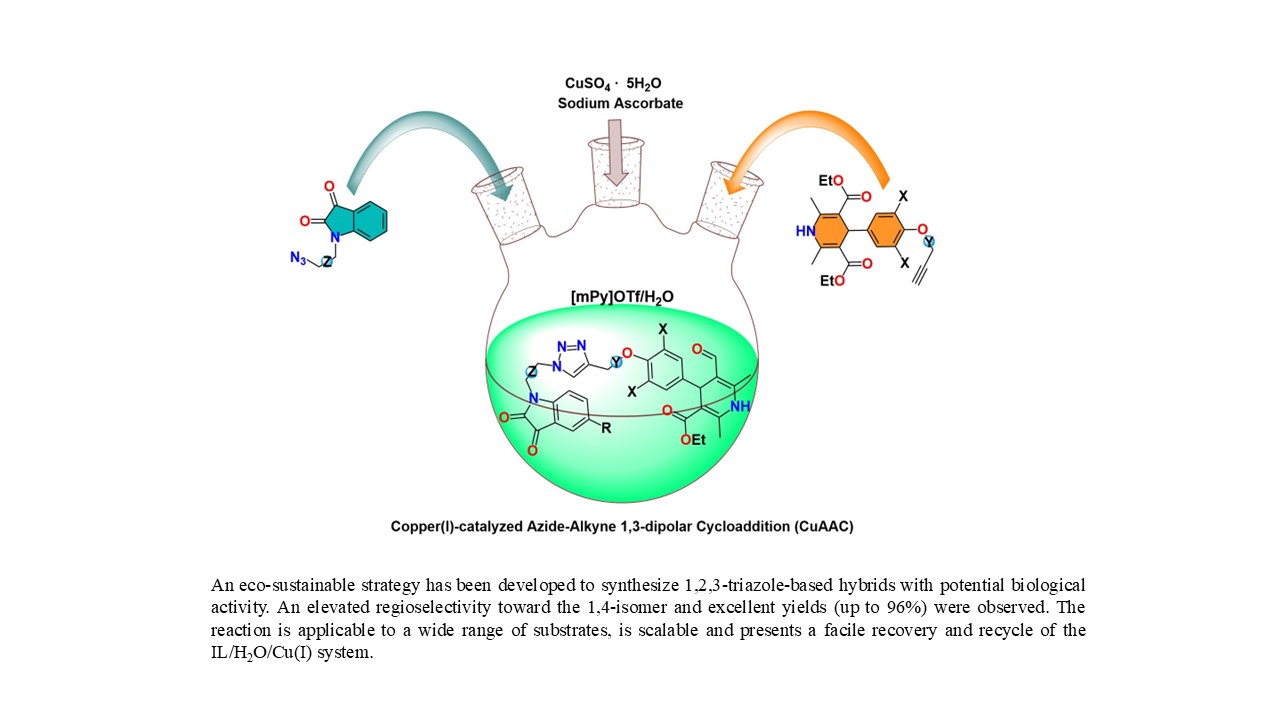
In the present work, we report the sustainable regioselective synthesis of a novel series of 1,2,3-triazole-based hybrid molecules containing isatins and 1,4-dihydropyridines by Copper(I)-catalyzed Azide-Alkyne 1,3-dipolar Cycloaddition (CuAAC). We designed and realized these hybrid molecules with the idea to produce multitarget agents with poten-tially improved bioactivity, enhanced pharmacokinetic properties and a reduced risk of drug resistance. Our synthetic strategy provides mild reaction conditions, high reaction yields, a simple recover procedure and a reusable catalytic system based on an environ-mentally benign solvent mixture of ionic liquid/water. The latter was recovered together with the Cu(I) catalyst generated in situ and Na-ascorbate and reused until six times, maintaining high efficacy in terms of regioselectivity and reaction yields. Finally, a mech-anism of the reaction was proposed, involving the key role of IL.
Keywords:
hybrid molecules
; CuAAC
; 1
; 2
; 3-triazoles
; isatins
; 4-dihydropyridines
1. Introduction
In modern medicinal chemistry, the development of a new generation of multifunctional therapeutic agents based on hybrid molecules has emerged as an innovative and sustainable strategy [1,2,3,4]. Although classical combination drug therapies have historically proven effective in treating complex diseases [5,6], they show several disadvantages, including increased risk of adverse drug reaction in the patient, complexity in drug formulation and delivery. Recently, a sustainable alternative that integrates two or more pharmacophoric units into a single chemical framework emerged to overcome these limitations [7,8]. Hybrid molecules aim to enhance therapeutic efficacy, minimize side effects, simplify pharmacokinetics, and offer potential multitarget activity [9,10,11]. Among the several heterocycles with acclaimed biological activity [12,13,14], 1,2,3-triazoles have emerged as privileged scaffolds in drug discovery, owing to their synthetic accessibility, chemical stability, low toxicity, high bioavailability and a broad-spectrum biological activity [15,16,17,18]. Furthermore, the triazole ring facilitates strong interactions with biological targets through hydrogen bonding and π-stacking, making it an ideal core in a design of hybrid molecules. Recent advances in hybrid drug development focused on combining 1,2,3-triazoles with other bioactive heterocycles, such as isatins or 1,4-dihydropyridines (1,4-DHPs) [19,20]. Isatin, a versatile oxindole derivative, has been extensively investigated for its anticancer, antibacterial, and antiviral properties [21,22,23], and the presence of functional groups suitable for chemical transformations. In particular, the combination of 1,2,3-triazoles and isatins developed hybrids with antibacterial, anticancer, antioxidant and free radical scavenging in a single molecular scaffold [24,25,26,27,28,29].
On the other hand, 1,4-DHPs, a class of nitrogen-containing heterocycles [30], are well known for their cardiovascular and antihypertensive properties, particularly as calcium channel blockers (i.e. nifedipine) [31] and are also used as antioxidant, anticancer, neuroprotective, and antibacterial [32,33]. 1,4-DHP groups in triazole-based hybrids offer several advantages in terms of pharmacological sustainability due to multitargeted action. Furthermore, the 1,4-DHP ring promotes redox modulation by scavenging reactive oxygen species (ROS) and counteracting oxidative stress [34,35,36]. In this contest, comes our idea to construct oxyndole-1,2,3-triazole-1,4-DHP hybrids that may represent promising multifunctional therapeutic agents with potential and versatile applications in antibacterial, anticancer, and neurodegenerative diseases. In particular, the hypothesis to realize hybrids based on a core of 1,2,3-triazole, and especially the most synthesized 1,4-disubstituted, has been greatly facilitated by Copper(I)-catalyzed Azide-Alkyne Cycloaddition (CuAAC) [37,38]. In particular, the 1,4-derivatives form a great number of secondary interactions with the active site of enzyme target (dipole-dipole interactions, hydrogen bonds, π–stacking, etc.), probably due to their near-linear spatial geometry.
This reaction is highly efficient, regioselective, and works very well under mild conditions and in presence of a broad range of functional groups without the use of protecting groups [39,40,41]. Some examples of 1,4-disubstitued-1,2,3-triazole-containing hybrids synthesized by CuAAC are reported in Fig. 1a [15,16]. Performing organic reactions in alternative and eco-friendly reaction media [42,43] such as ionic liquids (ILs) can represent an additional advantage in CuAAC [44,45,46,47,48]. In fact, their negligible vapor pressure, thermal stability and non-flammability permit simple post-reaction recycling and safe reaction conditions [49,50,51]. In addition, their ionic nature permits excellent solvation properties and promotes electrostatics-based intermolecular organization at medium range, improving reaction rates [52,53,54]. Considering our highly experience in the synthesis of biologically active heterocycle compounds [55,56,57] and use of eco-friendly conditions [58,59], in this study we report the sustainable synthesis of a novel series of 1,4-disubstituted-1,2,3-triazole-based hybrids that integrate triazoles, substituted isatins and 1,4-dihydropyridine motifs by CuAAC in presence of ionic liquid/water/Cu(I) as an efficient and reusable catalytic system (Fig.1b). This strategy permits to us to obtain excellent regioselectivity, elevated yields and a very good recover of catalytic system until six times without loss of efficiency. More in detail, after a screening between some ILs, the best performances were obtained with 1-methyl pyridinium trifluoromethanesulfonate [mpy]OTf, which was chosen for its easy halogen-free synthesis [58].
2. Results and Discussion
Generally, hybrid molecules are divided into three types: fused, merged and conjugated [60,61]. In particular, in the latter type, the different pharmacophoric groups are usually separated by a central core that can be constituted by an alkyl chain, an aryl system, a heterocycle or a combination of them. As already commented, 1,2,3-triazoles can represent a building block strategic for their chemical stability and their facile preparation by CuAAC reaction. With the goal to realize conjugated hybrids with potential biological activity, in this work, we present an innovative and eco-sustainable methodology to synthesize for the first time, to our knowledge, hybrid molecules with a central 1,4-disubstituted 1,2,3-triazole core linked to two important pharmacophoric groups, such as substituted isatins and 1,4-DHPs.
We innovatively decided to prepare these hybrid molecules with the additional purpose to improve the interactions with the different active sites of biological targets, selecting functional groups of different chemical nature on their skeleton (i.e. ester, carbonyl, amine, amide), and varying the spacers to make the final hybrids more adaptable to the enzymatic cavities.
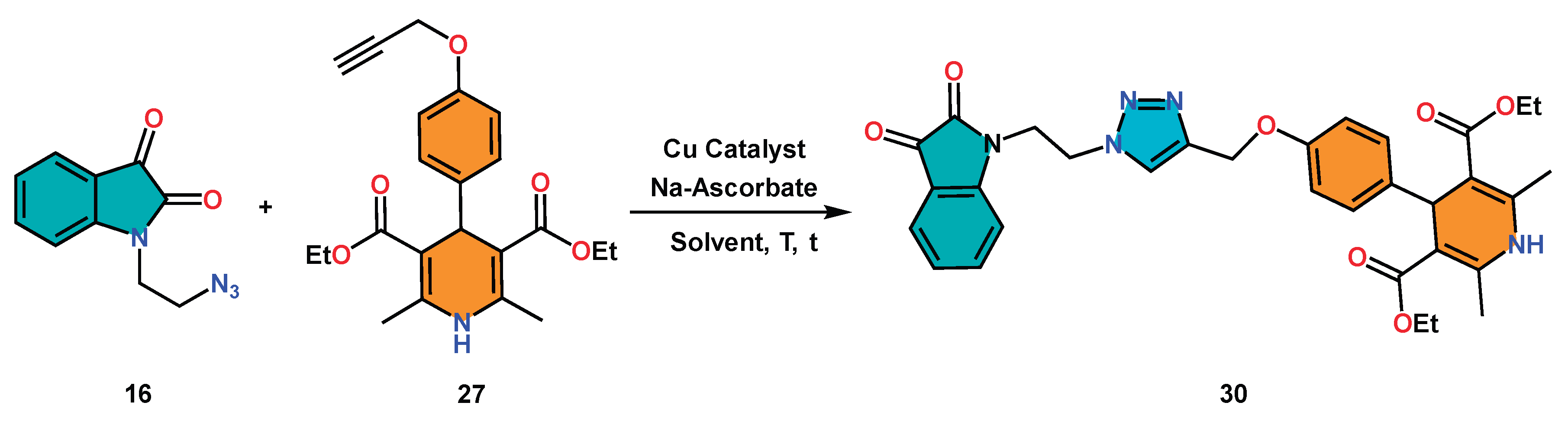
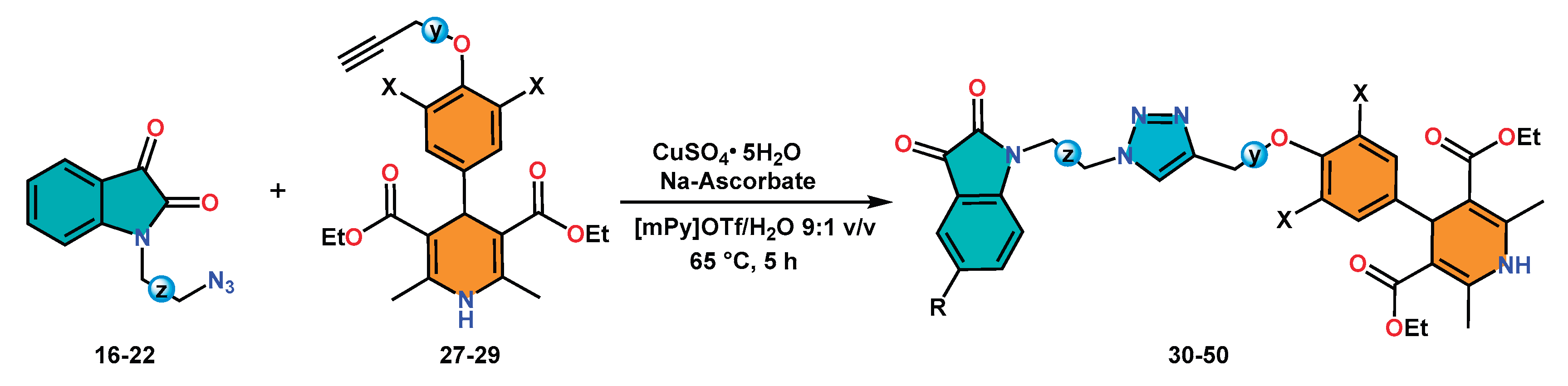
With such aimed objectives, the study commenced with the evaluation of the suitable synthetic strategy for the construction of the 1,4-disubstituted-1,2,3-triazole-based hybrids described in Figure 1b, and the choice fell on a CuAAC reaction between an azide as 1,3-dipole and a propargyl derivative as dipolarophile, to achieve in a simple manner the 1,2,3-triazole hybrid (Scheme 1).
2.1. Obtaining Precursors for Hybrid Molecules by CuAAC Reaction: Dipoles and Dipolarophiles
2.1.1. Synthesis of 1,3-dipoles: N-1-azidoalkyl-isatins 16-22
In this direction, we started by preparing the appropriate 1,3-dipoles, by changing the electronic effect through variation of the substituents. In Scheme 2 we report the synthetic procedure to prepare the N-1-azidoalkyl-isatins 16-22.
The procedure provided the synthesis of intermediate N-haloalkyl derivatives by a modified literature methodology [62]. Considering our elevated experience on syntheses in non-conventional solvents, we performed both reaction steps in an ionic liquid with the purpose to make more eco-sustainable the whole procedure of hybrid molecule synthesis. Moreover, we projected the variation of the linkers on this part of the hybrid skeleton for the highly performing alkylation reaction on isatin derivatives.
In detail, suitable isatins 1-3 were reacted with alkyl dihalide 4-8 and anhydrous potassium carbonate in [mPy]OTf at 60 °C to give the corresponding N-1-haloalkyl-isatins 9-15 with excellent yields. As observed in Scheme 2, the presence of different substituents on the C5-position does not seem to deeply affect the reactivity of the isatins 1-3 towards alkylation, considering that comparable yields were observed for all cases. Moreover, excess of dihalides was used to avoid products of double substitution. The isolated N-1-haloalkyl products 9-15 were subsequently reacted with NaN3 in [mPy]OTf at 60 °C to form corresponding N-1-azidoalkyl-isatins 16-22 in high yields [63].
2.1.2. Synthesis of Dipolarophiles: Propargyloxyphenyl-1,4-dihydropyridines 27-29
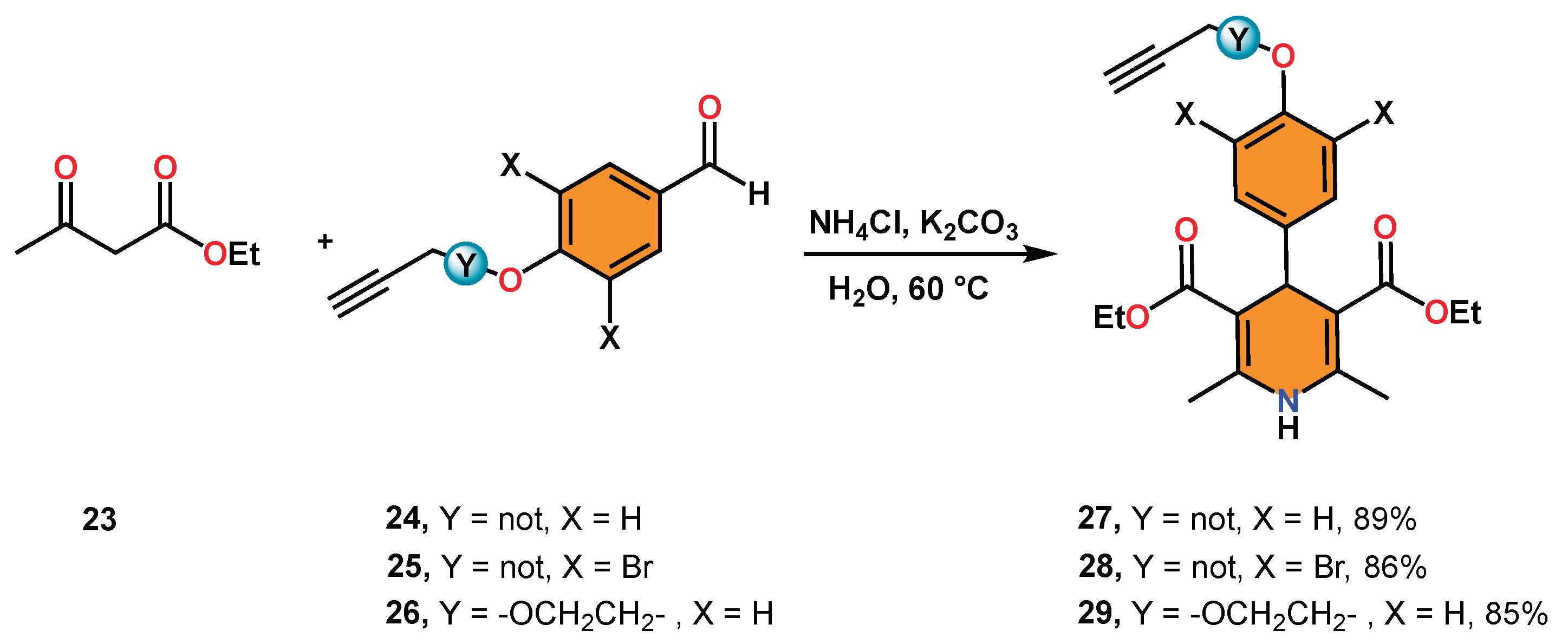
Successively, propargyloxyphenyl-1,4-dihydropyridines 27-29 were synthesized as dipolarophiles, and the results are illustrated in Scheme 3.
The synthesis of substituted propargyloxyphenyl-1,4-dihydropyridines 27-29 was conducted via the Hantzsch reaction between ethyl acetoacetate 23 and the prepared aldehydes 24-26, using ammonium chloride as N-source in aqueous basic media at 60 °C and different reaction times.
2.2. Synthesis of Hybrid Molecules 30-50 by CuAAC Reaction
With the precursors in our hands, we selected the 1,3-dipolar cycloaddition between 1-(2-azidoethyl)isatin 16 and propargyloxyphenyl-1,4-dihydropyridine 27 as a model system to optimize the reaction conditions. Generally, the solvent used in literature for these reactions is dimethylformamide (DMF) [20], but with the aim to enhance the sustainability and recyclability of our reaction, we explored ionic liquid (IL)/water mixtures as reaction media. In further detail, we investigated the variation of ILs, catalysts and catalyst molar ratios. Moreover, we applied 65 °C and 5 h for temperature and reaction time, respectively, considering that the increase of them did not furnish significative changes. The results are summarized in Table 1.
We initially employed various ILs as solvent and a catalytic system consisting of CuSO₄·5H₂O (as Cu(II) source) and sodium ascorbate to generate Cu(I) in situ [64].
As can be observed from Table 1 in entries 1-4, changes in anion of employed ionic liquid furnished the final compound 30 in good and encouraging yields (71-76%). When we used 1-n-butyl-2,3-dimethylimidazolium hexafluorophosphate ([bdmim]PF6) as solvent, we observed similar yield (Table 1, entry 5). To refine the optimal reaction conditions, we examined the system 1-methylpyridinium trifluoromethanesulfonate [mPy]OTf and H₂O 9:1 v/v (Table 1, entry 6) that yielded the desired product in excellent way (96%). Specifically, we selected 1-methyl pyridinium trifluoromethanesulfonate [mPy]OTf as ionic liquid also for its easy one-step preparation through halide-free direct synthesis, by adding directly methyltrifluoromethane sulfonate to dry pyridine (see Supplementary Materials). Attempts to lower the catalyst loading led to a significant reduction in yield (Table 1, entry 7). It is noteworthy that product 30, as expected, showed a complete regioselectivity toward the 1,4-disubstituted isomer.
Then, to fully explore the potential of our reaction protocol, we extended the investigation to all synthesized N-1-azidoalkylisatins 16-22 and propargyloxyphenyl-1,4-dihydropyridines 27-29, constructing 1,4-disubstituted 1,2,3-triazoles hybrid molecules 30-50, as summarized in Table 2. As you can see, the reaction worked very well in all cases, with a successful transformation of the reagents to yield the desired products in near-quantitative yields, even if with azides 21 and 22 as 1,3-dipole, a slight reduction in yields was observed, probably due to the increased degree of freedom of selected spacers. It is worth noting that only the 1,4-disubstituted 1,2,3-triazole regioisomer was obtained for all synthesized compounds, demonstrating an elevated regioselectivity.
Finally, with the aim to validate the scalability of our synthetic procedure, the reaction was successfully scaled from milligrams to 5 grams, starting from azide 16 and alkyne 27 and affording the product 30 in 96% yield (see Table 2), also without any compromise in the regioselectivity. These results confirmed the high quality, scalability and facile practicality of our developed method.
2.3. Hypothesis of Mechanism
At this stage, we turned our attention to hypothesize a plausible catalytic cycle for our reaction (Scheme 4), in analogy to the mechanism proposed by Fokin et al. for CuAAC reaction [65].
The developed reaction begins with in situ reduction of Cu(II) by sodium ascorbate, generating the catalytically active Cu(I) species (A). The catalytic cycle starts with π-coordination of the Cu(I) complex to the alkyne 27, followed by deprotonation and formation of a σ-bond copper acetylide (C). At this stage, it is plausible to think that the adduct C and azide 16 are completely solvated by the ionic liquid that plays a crucial role in this fundamental step of cycloaddition, providing for the alignment of the dipole and the dipolarophile on two parallel planes with a highly ordered system and a low degree of entropy. More in detail, the ionic liquids are characterized by a so-called ionic self-assembly (ISA) structure, in which the noncovalent electrostatic interactions act as the primary driving force and hydrophobic interactions, while the π-π interactions serve like secondary driving forces. Therefore, the combination of cations and anions of IL highly organized in hierarchical superstructures might hold firmly the reagents favouring their alignment and improving the HOMOdipole/LUMOdipolarophile interaction [66,67,68]. In the subsequent step, β-carbon of acetylide C attacks at N-3 of azide 16 to form the first C-N covalent bond and N-1 of azide coordinates Cu(I), producing the intermediate D. Then, nucleophilic attack of N-1 on α-C of acetylide generates the second C-N covalent bond, forming intermediate E. Final protonation of the copper-bound triazole furnishes the desired 1,4-disubstituted 1,2,3-triazole 30 and regenerates the active Cu(I) catalyst [69,70].
2.4. Recover and Reuse of Catalytic System
Lastly, the recyclability of the catalytic system [mPy]OTf/H2O/Cu(I) recovered with Na-ascorbate as insoluble fraction in extraction phase by diethyl ether, was assessed through successive reaction cycles using the model reaction between 1-(2-azidoethyl)isatin 16 and propargyloxyphenyl-1,4-dihydropyridine 27, and the results are reported in Figure 2.
As depicted in Figure 2, the catalytic system maintained high activity and selectivity over six consecutive cycles without appreciable loss in efficiency. Before any comment, it is necessary to illustrate the reaction workup. In fact, the use of [mPy]OTf, practically insoluble in organic solvents, permits to recover the final hybrid in the organic phase, while [mPy]OTf/H2O/Cu(I) system and sodium ascorbate remain in the polar phase. The latter, washed with diethyl ether, is reused by adding only fresh dipole and dipolarophile in each cycle. It is noteworthy that the Cu(I) remains active considering the presence of excess sodium ascorbate in the recovered polar phase, which prevents the oxidation of Cu(I) to Cu(II) for several consecutive reaction cycles.
These excellent recovery and reuse results, combined with high reaction yields, elevated regioselectivity, low catalyst loading, operational simplicity and good scalability, highlight the sustainability and practicality of our proposed synthetic method.
3. Materials and Methods
Commercial starting materials were purchased from Merck (Milano, Italy) or Alfa Aesar (Karlsruhe, Germany) and were used without further purification. Reactions were monitored by TLC using silica plates 60-F264, commercially available from Merck (Milano,Italy). Mono and bidimensional 1H and 13C NMR experiments were recorded at 500, and 125.7 MHz, respectively, in CDCl3 and DMSO-d6 as solvent using tetramethylsilane (TMS) as an internal standard (Bruker Avance 500 MHz with a 5 mm TBO probe, Rheinstetten, Germany). Chemical shifts are given in parts per million and coupling constants in Hertz. Regiochemistry was established by NMR technique. High-resolution mass spectra (HRMS) were recorded with a Bruker Compact QTOF instrument (Bruker, Billerica, MA, USA). HRMS spectra were acquired in positive ion mode, with a mass resolution of 30,000. Mass calibration was performed with a solution of sodium formate clusters and processed in HPC mode. Spectra acquisition was performed in flow injection, with a full scan mode in the range of 30 to 1000 m/z. N2 was the source of dry gas (V= 4 L/min, T = 180 °C). The ion formula of each compound was calculated with the Smart Formula tool of the Bruker software platform, analyzing the isotopic pattern ratio with 4 mDa mass confidence. All samples were dissolved in CH3CN. Synthesis and characterization of substituted haloalkylisatin 9-15 and azidoalkylisatin 16-22 were realized by modified literature procedures and reported in the Supplementary Materials [62,63]. Propargyloxyphenyl-1,4-dihydropyridines 27-29 and precursors were prepared according to procedures in the literature (see Supplementary Materials for procedures and characterization) [71,72]. [mPy]OTf was prepared according to procedures in the literature (see Supplementary Materials for the synthetic procedure) [73]. The gram-scale synthesis procedure of compound 30 is reported in Supplementary Materials.
3.1. General Procedure for Synthesis of 1,4-Disubstituted 1,2,3-Triazole Hybrid Molecules 30-50
In a 25 mL two-necked round-bottom flask, equipped with a bubble condenser and magnetic stir bar, CuSO4·5 H2O (0.033g, 0.13 mmol, 0.2 eq), sodium ascorbate (0.103 g, 0.522 mmol, 0.8 eq), propargyloxyphenyl-1,4-dihydropyridine 27-29 (1 eq) and azidoalkylisatin 16-22 (1 eq) were mixed with 10 mL of [mPy](OTf)/H2O (9:1 v:v). The reaction was heated at 65 °C for 5h. The mixture was extracted with ethyl acetate (3 x 20 mL) and the combined organic layer was washed with a brine solution (3 x 10 mL), dried with anhydrous Na2SO4, filtered, and evaporated under vacuum. The crude was purified by flash chromatography (CHCl3/MeOH 9:1 v:v), isolating products 30-50 (see Supplementary Materials for the characterization).
3.2. Recovery and Recycling Procedure for Catalytic System ([mPy]OTf/H2O/Cu(I))
The [mPy]OTf/H2O/Cu(I) mixture containing also sodium ascorbate, recovered as residue insoluble in the extraction phase, was washed with diethyl ether (2 x 5 mL) and dried at 50 °C under vacuum conditions for 15 min. Successive runs were performed in the recycled system after the addition only of fresh dipole and dipolarophile.
4. Conclusions
In this study, a novel library of hybrid molecules with potential biological activity, incorporating a 1,2,3-triazole linker between isatin derivatives and dihydropyridine scaffolds, was successfully designed and developed. Initially, seven N-1-azidoalkylisatins and three propargyl-substituted 1,4-dihydropyridines were synthesized in good to excellent yields. These building blocks were subsequently employed in copper(I)-catalyzed azide–alkyne cycloaddition (CuAAC) reactions to identify optimal, sustainable conditions for the regioselective synthesis of 1,4-disubstituted 1,2,3-triazole hybrids. After optimization of reaction conditions, twenty-one triazole-based hybrid compounds were obtained with high 1,4-regioselectivity and in excellent yields of up to 99%, except slight variation (84-88%) probably due to increased degree of freedom of employed spacers. Notably, the use of an ionic liquid/water medium proved critical for both reactivity and selectivity, likely due to its ability to stabilize reaction intermediates and facilitate 1,3-dipolar cycloaddition. Furthermore, the [mPy]OTf/H2O/catalyst system demonstrated a high recyclability, maintaining excellent efficiency after multiple cycles, thereby enhancing the sustainability of the reaction. Finally, we performed the gram-scale reaction to verify the potential of our proposed method for wider applications, obtaining the same excellent results as in the testing phase.
In conclusion, we developed a novel protocol to synthesize 1,4-disustituted-1,2,3-triazole hybrids containing isatins and 1,4-dihydropyridines that offers several advantages, including operational simplicity, short reaction times, elevated regioselectivity, negligible formation of by-products, as well as an eco-sustainable approach highly reproducible and efficient even on a larger scale.
Supplementary Materials
The following supporting information can be downloaded at the website of this paper posted on Preprints.org; S2: Synthesis of [mPy]OTf; S2-S7: Synthesis of azidoalkylisatins 16-22 and their precursors; S8-S13: Synthesis of 1,4-dihydropyridines 27-29 and their precursors; S14: gram-scale reaction; S15-S22: characterization data of hybrid molecules 30-50; S23-S54: characterization spectra of azidoalkylisatins 19-22 and their precursors (1H NMR, 13C NMR, COSY NMR and HRMS); S55-S78: characterization spectra of 1,4-dihydropyridines 27-29 and their precursors; S79-S163: characterization spectra of hybrid molecules 30-50 (data and spectra 1H NMR, 13C NMR, COSY NMR and HRMS). .
Author Contributions
Conceptualization, L.M, V.A. and A.D.N.; methodology, A.J., F.M. and V.A.; validation, L.M., P.C., V.A.; investigation, A.J., F.M. and V.A.; resources, L.M, P.C. and A.D.N.; data curation, G.F. and V.A.; writing—original draft preparation, V.A.; writing—review and editing, L.M., P.C. and A.D.N.; supervision, L.M., P.C., and A.D.N.; funding acquisition, L.M., P.C. and A.D.N. All authors have read and agreed to the published version of the manuscript.
Funding
This research received no external funding.
Institutional Review Board Statement
Not applicable.
Informed Consent Statement
Not applicable.
Data Availability Statement
The original contributions presented in this study are included in the article/Supplementary Materials. Further inquiries can be directed to the corresponding authors.
Acknowledgments
The authors would like to acknowledge the University of Calabria for financial support, the Italian Ministry of University and Research (MUR) for a doctoral grant and the European Union (UE)-Next Generation EU-PNRR M6C2-Investimento 2.1 “Valorizzazione e potenziamento della ricerca bio medica del SSN”, PNRR-MAD-2022-12376295, CUP: F33C22001010006.
Conflicts of Interest
The authors declare no conflicts of interest.
References
- Meunier, B. Hybrid Molecules with a Dual Mode of Action: Dream or Reality? Acc. Chem. Res. 2008, 41(1), 69–77. [Google Scholar] [PubMed]
- Morais, T.S. Recent Advances in the Development of Hybrid Drugs. Pharmaceutics 2024, 16, 889–893. [Google Scholar] [CrossRef] [PubMed]
- Mijoba, A.; Parra-Giménez, N.; Fernandez-Moreira, E.; Ramírez, H.; Serrano, X.; Blanco, Z.; Espinosa, S.; Charris, J.E. Synthesis of Hybrid Molecules with Imidazole-1,3,4-thiadiazole Core and Evaluation of Biological Activity on Trypanosoma cruzi and Leishmania donovani. Molecules 2024, 29, 4125–4138. [Google Scholar] [CrossRef] [PubMed]
- Cortés-García, C.J.; Mercado-Madrigal, A.I.; Alejandre-Castañeda, V.; Patiño-Medina, J.A.; Castro-Velázquez, V.; Rodríguez-González, V.; Ramírez-Díaz, M.I.; Islas-Jácome, A.; Rincón-Guevara, M.A.; Chacón-García, L.; Meza-Carmen, V.; Díaz-Cervantes, E. Synthesis of Benzofuran-Based Hybrid Molecules: Molecular Docking and Antibacterial Activity Against Pseudomonas aeruginosa. J. Heterocycl. Chem. 2024, 61(11), 1653–1667. [Google Scholar] [CrossRef]
- Huttner, A.; Bielicki, J.; Clements, M. N.; Frimodt-Møller, N.; Muller, A. E.; Paccaud, J.-P.; Mouton, J. W. Oral amoxicillin and amoxicillin-clavulanic acid: properties, indications and usage. Clin. Microbiol. Infect. 2020, 26, 871–879. [Google Scholar] [CrossRef] [PubMed]
- Shin, B.; Park, W. Antibiotic resistance of pathogenic Acinetobacter species and emerging combination therapy. J. Microbiol. 2017, 55(11), 837–849. [Google Scholar] [CrossRef] [PubMed]
- Guan, Q.; Gao, Z.; Chen, Y.; Guo, C.; Chen, Y.; Sun, H. Structural modification strategies of triazoles in anticancer drug development. Eur. J. Med. Chem. 2024, 275, 116578–116604. [Google Scholar] [CrossRef] [PubMed]
- Jiang, Y.; Ren, G.; Zhang, Y.; Liang, P.; Zhou, S. Biohybrids for sustainable chemical synthesis. Energy Environ. Nexus 2025, 1(e003), 1–16. [Google Scholar] [CrossRef]
- Alkhzem, A. H.; Woodman, T. J.; Blagbrough, I. S. Design and synthesis of hybrid compounds as novel drugs and medicines. RSC Adv. 2022, 12, 19470–19484. [Google Scholar] [CrossRef] [PubMed]
- Singh, H.; Agrawal, D.K. Recent advances in the development of active hybrid molecules in the treatment of cardiovascular diseases. Bioorg Med. Chem. 2022, 62, 116706–116733. [Google Scholar] [CrossRef] [PubMed]
- Khwaza, V.; Oyedeji, O.O.; Morifi, E.; Nwamadi, M.; Fonkui, T.Y.; Ndinteh, D.T.; Aderibigbe, B.A. Design and Synthesis of Hybrid Compounds for Potential Treatment of Bacterial Co-Infections: In Vitro Antibacterial and In Silico Studies. Antibiotics 2025, 14, 582–604. [Google Scholar] [CrossRef] [PubMed]
- Shaveta; Mishra, S.; Singh, P. Hybrid molecules: The privileged scaffolds for various pharmaceuticals. Eur. J. Med. Chem. 2016, 124, 500–536. [Google Scholar] [CrossRef] [PubMed]
- Heravi, M.M.; Zadsirjan, V. Prescribed drugs containing nitrogen heterocycles: an overview. RSC Adv. 2020, 10(72), 4247–44311. [Google Scholar] [CrossRef]
- Pibiri, I. Recent Advances: Heterocycles in Drugs and Drug Discovery. Int. J. Mol. Sci. 2024, 25, 9503–9504. [Google Scholar] [CrossRef] [PubMed]
- Saroha, B.; Kumar, G.; Kumar, R.; Kumari, M.; Kumar, S. A minireview of 1,2,3-triazole hybrids with O-heterocycles as leads in medicinal chemistry. Chem. Biol. Drug Des. 2022, 100(6), 843–869. [Google Scholar] [PubMed]
- Martis, G.J.; Maiya, S.; Gaonkar, S.L. Synthetic developments and biological insights of 1,2,3-triazoles: Unravelling scope for drug discovery. Eur. J. Med. Chem. Rep. 2026, 16, 100315–100366. [Google Scholar] [CrossRef]
- Rammohan, A.; Venkatesh, B.C.; Basha, N.M.; Zyryanov, G.V.; Nageswararao, M. Comprehensive review on natural pharmacophore tethered 1,2,3-triazoles as active pharmaceuticals. Chem. Biol. Drug Des. 2023, 101, 1181–1203. [Google Scholar] [PubMed]
- Algieri, V.; Algieri, C.; Maiuolo, L.; De Nino, A.; Pagliarani, A.; Tallarida, M. A.; Trombetti, F.; Nesci, S. 1,5-Disubstituted-1,2,3-triazoles as inhibitors of the mitochondrial Ca2+-activated F1Fo-ATP(hydrol)ase and the permeability transition pore. Ann. N. Y. Acad. Sci. 2021, 1485, 43–85. [Google Scholar] [PubMed]
- Rohila, Y.; Sebastian, S.; Ansari, A.; Kumar, D.; Mishra, D. K.; Gupta, M. K. A Comprehensive Review of the Diverse Spectrum Activity of 1,2,3-Triazole-linked Isatin Hybrids. Chem. Biodivers. 2024, 21(e202301612), 1–22. [Google Scholar] [CrossRef]
- Takkar, P.; Singh, B.; Pani, B.; Kumar, R. Design, synthesis and in silico evaluation of newer 1,4-dihydropyridine based amlodipine bioisosteres as promising antihypertensive agents. RSC Adv. 2023, 13, 34239–34248. [Google Scholar] [CrossRef] [PubMed]
- Ansari, M.; Ghandadi, M.; EMAMI, S. An overview of isatin-derived CDK2 inhibitors in developing anticancer agents. Eur. J. Med. Chem. 2025, 295, 117819–117841. [Google Scholar] [CrossRef] [PubMed]
- Hassan, F.; Azad, I.; Asif, M.; Shukla, D.; Husain, A.; Khan, A. R.; Saquib, M.; Nasibullah, M. Isatin Conjugates as Antibacterial Agents: A Brief Review. Med. Chem. 2023, 19, 413–430. [Google Scholar] [CrossRef] [PubMed]
- Elsaman, T.; Mohamed, M. S.; Eltayib, E. M.; Abdel-aziz, H. A.; Abdalla, A. E.; Munir, M. U.; Mohamed, M. A. Isatin derivatives as broad-spectrum antiviral agents: the current landscape. Med. Chem. Res. 2022, 31, 244–273. [Google Scholar] [CrossRef] [PubMed]
- Prakash, C. R.; Raja, S. Synthesis, characterization and in vitro antimicrobial activity of some novel 5-substituted Schiff and Mannich base of isatin derivatives. J. Saudi Chem. Soc. 2013, 17, 337–344. [Google Scholar] [CrossRef]
- Kumar, S.; Saha, S. T.; Gu, L.; Palma, G.; Perumal, S.; Singh-Pillay, A.; Sing, P.; Anand, A.; Kaur, M.; Kumar, V. 1H-1,2,3-Triazole Tethered Nitroimidazole−Isatin Conjugates: Synthesis, Docking, and Anti-Proliferative Evaluation against Breast Cancer. ACS Omega 2018, 3, 12106–12113. [Google Scholar] [CrossRef] [PubMed]
- Sharma, S.; Gupta, M. K.; Saxena, A. K.; Bedi, P. M. S. Triazole linked mono carbonyl curcumin-isatin bifunctional hybrids as novel anti tubulin agents: Design, synthesis, biological evaluation and molecular modeling studies. Bioorganic Med. Chem. 2015, 23, 7165–7180. [Google Scholar] [CrossRef]
- Onmez, F.; Gunesli, Z.; Kurt, B. Z.; Gazioglu, I.; Avci, D.; Kucukislamoglu, M. Synthesis, antioxidant activity and SAR study of novel spiro-isatin-based Schiff bases. Mol. Divers. 2019, 23, 829–844. [Google Scholar]
- Muglu, H.; Yakan, H.; Bakir, T. K. Synthesis, spectroscopic studies, and antioxidant activities of novel thio/carbohydrazones and bis-isatin derivatives from terephthalaldehyde. Turk. J. Chem. 2020, 44, 237–248. [Google Scholar] [PubMed]
- Maddela, S.; Mathew, G. E.; Parambi, D. G. T.; Aljoufi, F. Dual Acting Isatin-heterocyclic Hybrids: Recent Highlights as Promising Pharmacological Agents. Lett. Drug Des. Discov. 2019, 16, 220–236. [Google Scholar]
- Costanzo, P.; Calandruccio, C.; Di Gioia, M.L.; Nardi, M.; Oliverio, M.; Procopio, A. First multicomponent reaction exploiting glycerol carbonate synthesis. J. Clean. Prod. 2018, 202, 504–509. [Google Scholar] [CrossRef]
- Kumar, R.; Kumar, D.; Upadhyay, R. K.; Deswal, N.; Takka, P.; Kareem, A.; Kumar, V.; Kumar, L. S. Design, Synthesis, Antimicrobial Screening and Docking Studies of Newer 1,4-Dihydropyridine tethered Chalcone Hybrids. ChemistrySelect 2022, 7(e202202928), 1–11. [Google Scholar] [CrossRef]
- Sharma, V. K.; Singh, S. K. Synthesis, utility and medicinal importance of 1,2 and 1,4-dihydropyridines. RSC Adv. 2017, 7, 2682–2732. [Google Scholar] [CrossRef]
- Ninan, A.R.; Babbar, R.; Dhiman, S.; Singh, T.G.; Kaur, K.; Dhiwan, V. A Systematic Review on 1, 4-Dihydropyridines and its Analogues: An Elite Scaffold. Biointerface Res. Appl. Chem. 2022, 12(3), 3117–3134. [Google Scholar]
- Silva Lago, A. d. F.; Calvalho de Benedicto, D. F.; da Silva, L.; Thomasi, S. S. 1,4-Dihydropyridine Derivatives: An Overview of Synthesis Conditions and Biological Tests. Curr. Org. Chem. 2023, 27, 1567–1610. [Google Scholar] [CrossRef]
- Khedkar, S. A.; Auti, P. B. 1, 4-Dihydropyridines: A Class of Pharmacologically Important Molecules. Mini-Rev. Med. Chem. 2014, 14, 282–290. [Google Scholar] [CrossRef] [PubMed]
- Danne, A. B.; Lathi, K. V.; Sangshetti, J. N.; Khedkar, V. M.; Kalse, L. D.; Shingate, B. B. New 1,2,3-triazole tethered-1,4-dihydropyridines as potential antioxidant agents: Synthesis and molecular docking study. J. Mol. Struct. 2024, 1299, 137129–137140. [Google Scholar] [CrossRef]
- Tornoe, C. W.; Christensen, C.; Meldal, M. Peptidotriazoles on Solid Phase: [1,2,3]-Triazoles by Regiospecific Copper(I)-Catalyzed 1,3-Dipolar Cycloadditions of Terminal Alkynes to Azides. J. Org. Chem. 2002, 67, 3057–3064. [Google Scholar] [PubMed]
- Rostovtsev, V. V.; Green, L. G.; Fokin, V. V.; Sharpless, K. Barry. A Stepwise Huisgen Cycloaddition Process: Copper(I)-Catalyzed Regioselective “Ligation” of Azides and Terminal Alkynes. Angew. Chem. Int. Ed. 2002, 41, 2596–2599. [Google Scholar] [CrossRef]
- Haldòn, E.; Nicasio, M. C.; Pérez, P. J. Copper-catalysed azide–alkyne cycloadditions (CuAAC): an update. Org. Biomol. Chem. 2015, 13, 9528–9550. [Google Scholar] [PubMed]
- Xiong, X.; Cai, L.; Jiang, Y.; Han, Q. Eco-Efficient, Green, and Scalable Synthesis of 1,2,3-Triazoles Catalyzed by Cu(I) Catalyst on Waste Oyster Shell Powders. ACS Sustain. Chem. Eng. 2014, 2, 765−771. [Google Scholar] [CrossRef]
- Nebra, N.; García-Álvarez, J. Recent Progress of Cu-Catalyzed Azide-Alkyne Cycloaddition Reactions (CuAAC) in Sustainable Solvents: Glycerol, Deep Eutectic Solvents, and Aqueous Media. Molecules 2020, 25, 2015–2032. [Google Scholar] [CrossRef] [PubMed]
- Alqahtani, A.S.; Elbeltagi, S. Advancing chemistry sustainably: From synthesis to benefits and applications of green synthesis. J. Organomet. Chem. 2025, 1027, 123508–123520. [Google Scholar] [CrossRef]
- Gupta, S.S.; Kumari, S. Kumar, Inder; Sharma U.K. Eco-friendly and sustainable synthetic approaches to biologically significant fused N-heterocycles. Chemistry of Heterocyclic Compounds, 2020, 56, 433-444. [CrossRef]
- Martinho, L. A.; Andrade, C. K. Z. Sustainable click reactions: Use of greener reaction media in the synthesis of 1,2,3-triazoles. Tetrahedron 2024, 157, 133964–134008. [Google Scholar] [CrossRef]
- Sloboda, D.; Weber, C.C.; Bakis, E. A kinetics study of copper-catalysed click reactions in ionic liquids. Org. Biomol. Chem. 2023, 21, 7984–7993. [Google Scholar] [CrossRef] [PubMed]
- Mandoli, A. Recent Advances in Recoverable Systems for the Copper-Catalyzed Azide-Alkyne Cycloaddition Reaction (CuAAC). Molecules 2016, 21, 1174–1216. [Google Scholar] [CrossRef] [PubMed]
- Kumar; Kumar, V.; Singh, P.; Tittal, R. Kumar; Lal, K. Ionic liquids for the green synthesis of 1,2,3-triazoles: a systematic review. Green Chem. 2024, 26, 3565–3594. [Google Scholar] [CrossRef]
- Kumar, S.; Lal, B.; Tittal, R. Kumar. Green synthesis of 1,4-disubstituted 1,2,3-triazoles: a sustainable approach. Green Chem. 2024, 26, 1725–1769. [Google Scholar] [CrossRef]
- Ali, M.F.J.; Praveen, M.; Ghouse, A.; Fatima, F. A Brief Review of Ionic Liquids: Synthesis and Applications. Int. J. BioMed Res. 2021, 1(011), 1–8. [Google Scholar]
- Shahvelayati, S.S.; Tanha, A. A Review of Ionic Liquids: From Solvent Applications to Template-Assisted Synthesis of Metal Oxide Nanoparticles. Appl. Organomet. Chem. 2025, 39(e70026), 1–27. [Google Scholar] [CrossRef]
- Alreshidi, M.A.; Yadav, K.K.; Gunasekaran, S.; Gacem, A.; Sambandam, P.; Subbiah, G.; Bhutto, J.K.; Palanivel, S.; Fallatah, A.M.; Abo El-Khair, M.A.; Almalawi, J.F.; Alam, M.W.; Perumal, T.; Annadurai, S. A review on the evolution of ionic liquids: Sustainable synthesis, applications, and future prospects. Mater. Today Sustain. 2025, 31, 101160–101201. [Google Scholar] [CrossRef]
- Alcalde, S.; Porcar, R.; Martin, N.; Cirujano, F. G.; Altava, B.; Garcia-Verdugo, E. Shedding light on the path to multifunctional task-specific supported ionic liquids with enhanced catalyst stability and activity. Green Chem. 2025, 27, 4385–4394. [Google Scholar] [CrossRef]
- Sloboda, D.; Weber, C. C.; Bakis, E. A kinetics study of copper-catalysed click reactions in ionic liquids. Org. Biomol. Chem. 2023, 21, 7984–7993. [Google Scholar] [CrossRef] [PubMed]
- Turco Liveri, V.; Lombardo, D.; Pochylski, M.; Calandra, P. Molecular association of small amphiphiles: Origin of ionic liquid properties in dibutyl phosphate/propylamine binary mixtures. J. Mol. Liq. 2018, 263, 274–281. [Google Scholar] [CrossRef]
- Tallarida, M. A.; Olivito, F.; Navo, C. D.; Algieri, V.; Jiritano, A.; Costanzo, P.; Poveda, A.; Moure, M. J.; Jiménez-Barbero, J.; Maiuolo, L.; Jiménez-Osés, G.; De Nino, A. Highly Diastereoselective Multicomponent Synthesis of Spirocyclopropyl Oxindoles Enabled by Rare-Earth Metal Salts. Org. Lett. 2023, 25, 3001–3006. [Google Scholar] [CrossRef] [PubMed]
- Maiuolo, L.; Tallarida, M. A.; Meduri, A.; Fiorani, G.; Jiritano, A.; De Nino, A.; Algieri, V.; Costanzo, P. 1,2,3-Triazole Hybrids Containing Isatins and Phenolic Moieties: Regioselective Synthesis and Molecular Docking Studies. Molecules 2024, 29, 1556–1571. [Google Scholar] [CrossRef] [PubMed]
- De Nino, A.; Algieri, V.; Tallarida, M. A.; Costanzo, P.; Pedron, M.; Tejero, T.; Merino, P.; Maiuolo, L. Regioselective Synthesis of 1,4,5-Trisubstituted-1,2,3-Triazoles from Aryl Azides and Enaminones. Eur. J. Org. Chem. 2019, 33, 5725–5731. [Google Scholar] [CrossRef]
- Bortolini, O.; De Nino, A.; Garofalo, A.; Maiuolo, L.; Russo, B.; Procopio, A. Erbium triflate in ionic liquids: a recyclable system of improving selectivity in Diels-Alder reactions. Appl. Catal. A General. 2010, 372, 124–129. [Google Scholar] [CrossRef]
- De Nino, A.; Merino, P.; Algieri, V.; Nardi, M.; Di Gioia, M. L.; Russo, B.; Tallarida, M. A.; Maiuolo, L. Synthesis of 1,5-Functionalized 1,2,3-Triazoles Using Ionic Liquid/Iron (III) Chloride as an Efficient and Reusable Homogeneous Catalyst. Catalysts 2018, 8, 364–376. [Google Scholar] [CrossRef]
- Saadeh, H.A.; Mubarak, M.S. Hybrid Drugs as Potential Combatants Against Drug-Resistant Microbes: A Review. Curr. Top. Med. Chem. 2017, 17, 895–906. [Google Scholar] [CrossRef] [PubMed]
- Morphy, R.; Rankovic, Z. Designed Multiple Ligands. An Emerging Drug Discovery Paradigm. J. Med. Chem. 2005, 48, 6523–6543. [Google Scholar] [CrossRef] [PubMed]
- Shibinskaya, M.O.; Lyakhov, S.A.; Mazepa, A.V.; Andronati, S.A.; Turov, A.V.; Zholobak, N.M.; Spivak, N.Y. Synthesis, cytotoxicity, antiviral activity and interferon inducing ability of 6-(2-aminoethyl)-6H-indolo[2,3-b]quinoxalines. Eur. J. Med. Chem. 2010, 45, 1237–1243. [Google Scholar] [CrossRef] [PubMed]
- Kumar, K.; Sagar, S.; Esau, L.; Kaur, M.; Kumar, V. Synthesis of novel 1H-1,2,3-triazole tethered C-5 substituted uracil-isatin conjugates and their cytotoxic evaluation. Eur. J. Med. Chem. 2012, 58, 153–159. [Google Scholar] [CrossRef] [PubMed]
- Shama, A. R.; Savaliya, M. L. Indole-benzothiazole-1,2,3-triazole hybrids: Synthesis, characterization, antimicrobial evaluation and multi-faceted computational analysis. J. Mol. Struct. 2025, 1337, 142214–142228. [Google Scholar] [CrossRef]
- Worell, B.T.; Malik, J.A.; Fokin, V.V. Direct evidence of a dinuclear copper intermediate in Cu(I)-catalyzed azide-alkyne cycloadditions. Science 2013, 340, 457–460. [Google Scholar]
- Calandra, P.; Mandanici, A.; Turco Liveri, V. Self-assembly in surfactant-based mixtures driven by acid-base reactions: Bis(2-ethylhexyl) phosphoric acid-n-octylamine systems. RSC Adv. 2013, 3(15), 5148–5155. [Google Scholar] [CrossRef]
- Goossens, K.; Lava, K.; Bielawski, C.W.; Binnemans, K. Ionic Liquid Crystals: Versatile Materials. Chem. Rev. 2016, 116, 4643–480. [Google Scholar] [CrossRef] [PubMed]
- Bini, R.; Chiappe, C.; Mestre, V.L.; Pomelli, C.S.; Welton, T. A theoretical study of the solvent effect on Diels-Alder reaction in room temperature ionic liquids using a supermolecular approach. Theor. Chem. Acc. 2009, 123, 347–352. [Google Scholar] [CrossRef]
- Hein, J.E.; Fokin, V.V. Copper-catalyzed azide–alkyne cycloaddition (CuAAC) and beyond: New reactivity of copper(I) acetylides. Chem. Soc. Rev. 2010, 39, 1302–1315. [Google Scholar] [CrossRef] [PubMed]
- Liang, L.; Astruc, D. The copper(I)-catalyzed alkyne-azide cycloaddition (CuAAC) “click” reaction and its applications. An overview. Coord. Chem. Rev. 2011, 255, 2933–2945. [Google Scholar] [CrossRef]
- Tamaddon, F.; Razmi, Z.; Jafari, A. A. Synthesis of 3,4-dihydropyrimidin-2(1H)-ones and 1,4-dihydropyridines using ammonium carbonate in water. Tetrahedron Lett. 2010, 51, 1187–1189. [Google Scholar] [CrossRef]
- Vuorinen, A.; Wilkinson, I.V.L.; Chatzopoulou, M.; Edwards, B.; Squire, S. E.; Fairclough, R. J.; Bazan, N. A.; Milner, J. A.; Conole, D.; Donald, J. R.; Shah, N.; Willis, N. J.; Fernando Martínez, R.; Wilson, F. X.; Wynne, G. M.; Davies, S. G.; Davies, K. E.; Russell, A. J. Discovery and mechanism of action studies of 4,6-diphenylpyrimidine-2-carbohydrazides as utrophin modulators for the treatment of Duchenne muscular dystrophy. Eur. J. Med. Chem. 2021, 220, 113431–113438. [Google Scholar] [CrossRef] [PubMed]
- De Nino, A.; Maiuolo, L.; Merino, P.; Nardi, M.; Procopio, A.; Roca-López, D.; Russo, B.; Algieri, V. Efficient Organocatalyst Supported on a Simple Ionic Liquid as a Recoverable System for the Asymmetric Diels-Alder Reaction in the Presence of Water. ChemCatChem 2015, 7, 830–835. [Google Scholar] [CrossRef]
Figure 1.
a) Examples of bioactive 1,4-disubstitued-1,2,3-triazole-based hybrids obtained by Cu(I)- catalyzed azide-alkyne 1,3-dipolar cycloaddition. b) Generic structure of 1,4-disubstituted-1,2,3-triazole-based hybrids synthesized by CuAAC and possible interactions with biological targets.
Figure 1.
a) Examples of bioactive 1,4-disubstitued-1,2,3-triazole-based hybrids obtained by Cu(I)- catalyzed azide-alkyne 1,3-dipolar cycloaddition. b) Generic structure of 1,4-disubstituted-1,2,3-triazole-based hybrids synthesized by CuAAC and possible interactions with biological targets.
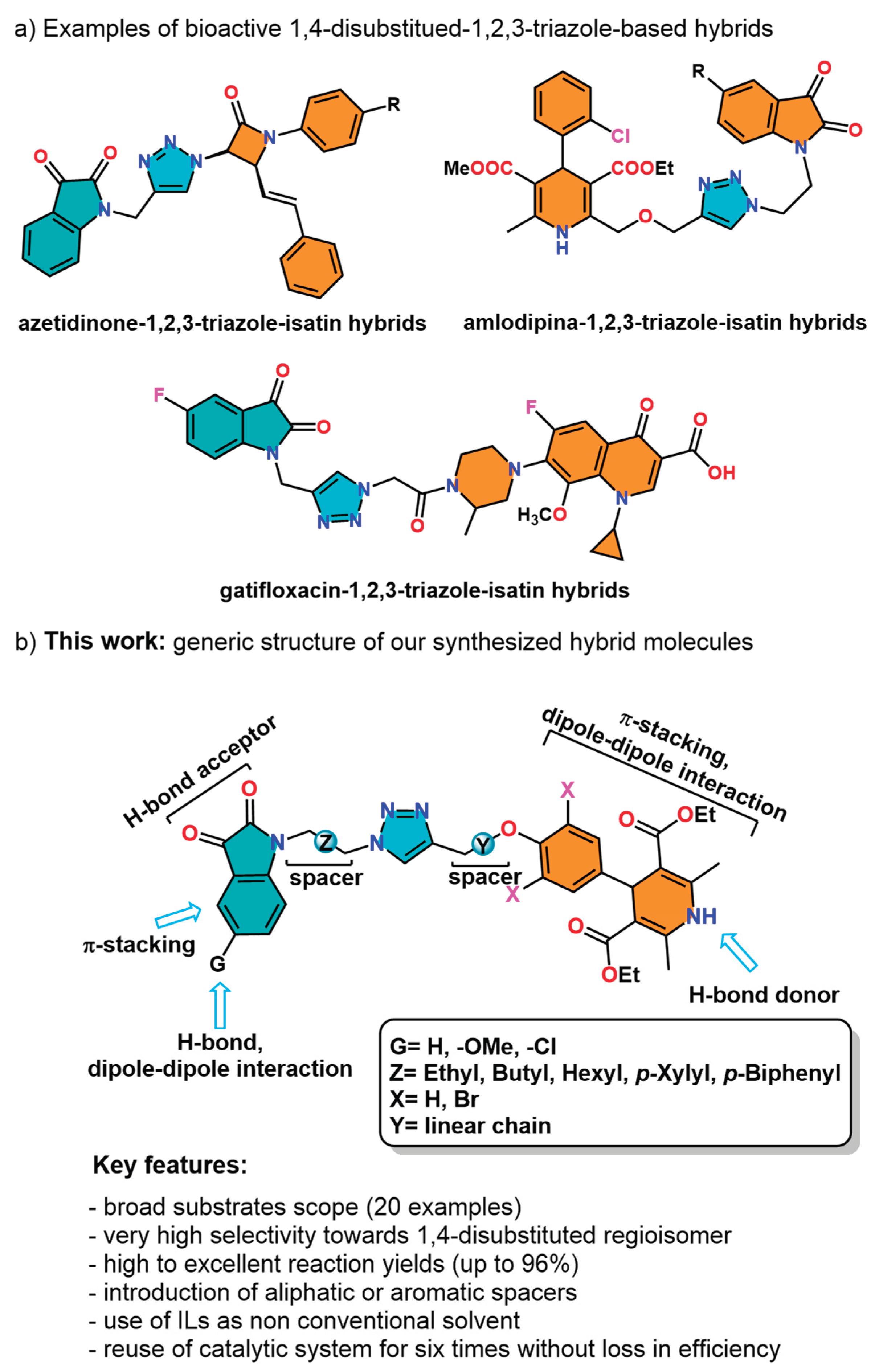
Scheme 1.
Generic CuAAC reaction to form 1,2,3-triazole-hybrids.
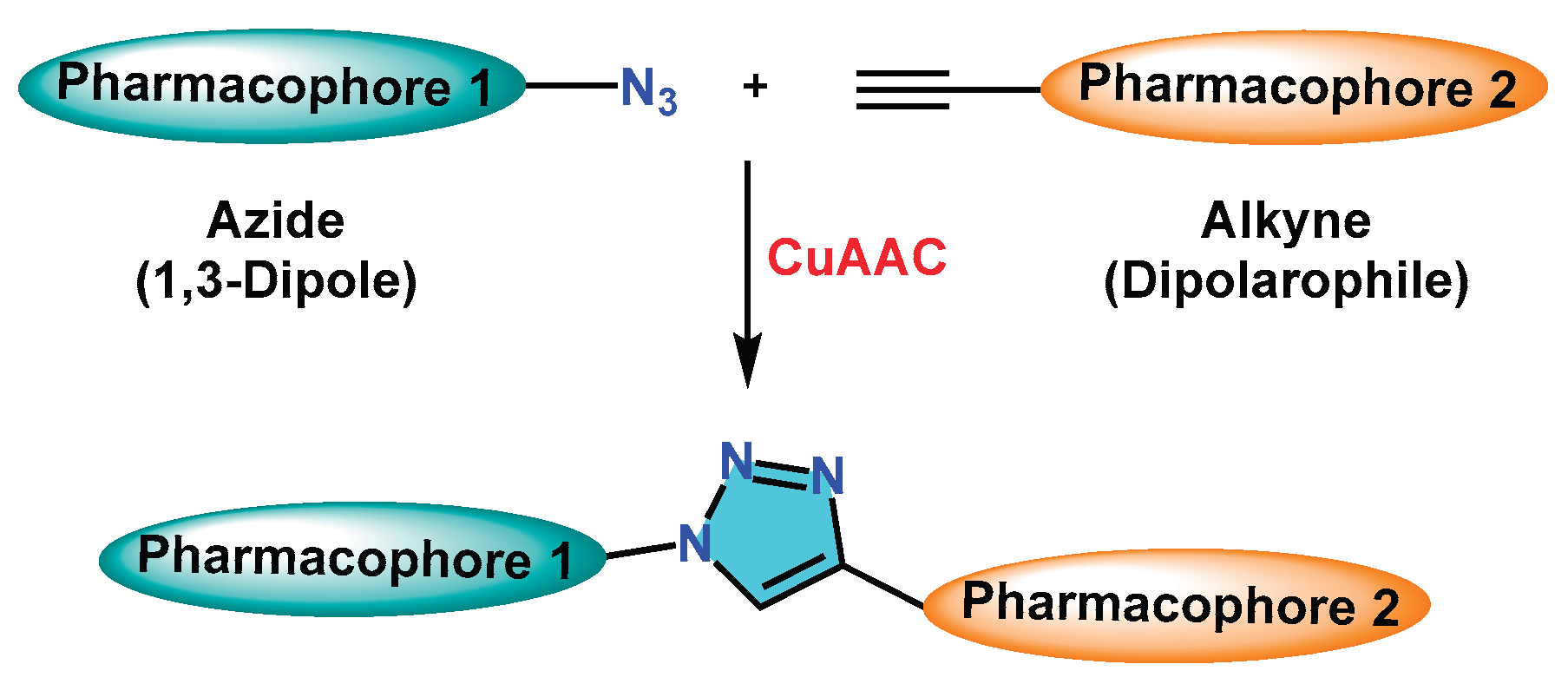
Scheme 2.
Synthesis of 1,3-dipoles: substituted N-1-azidoalkylisatins 16-22.
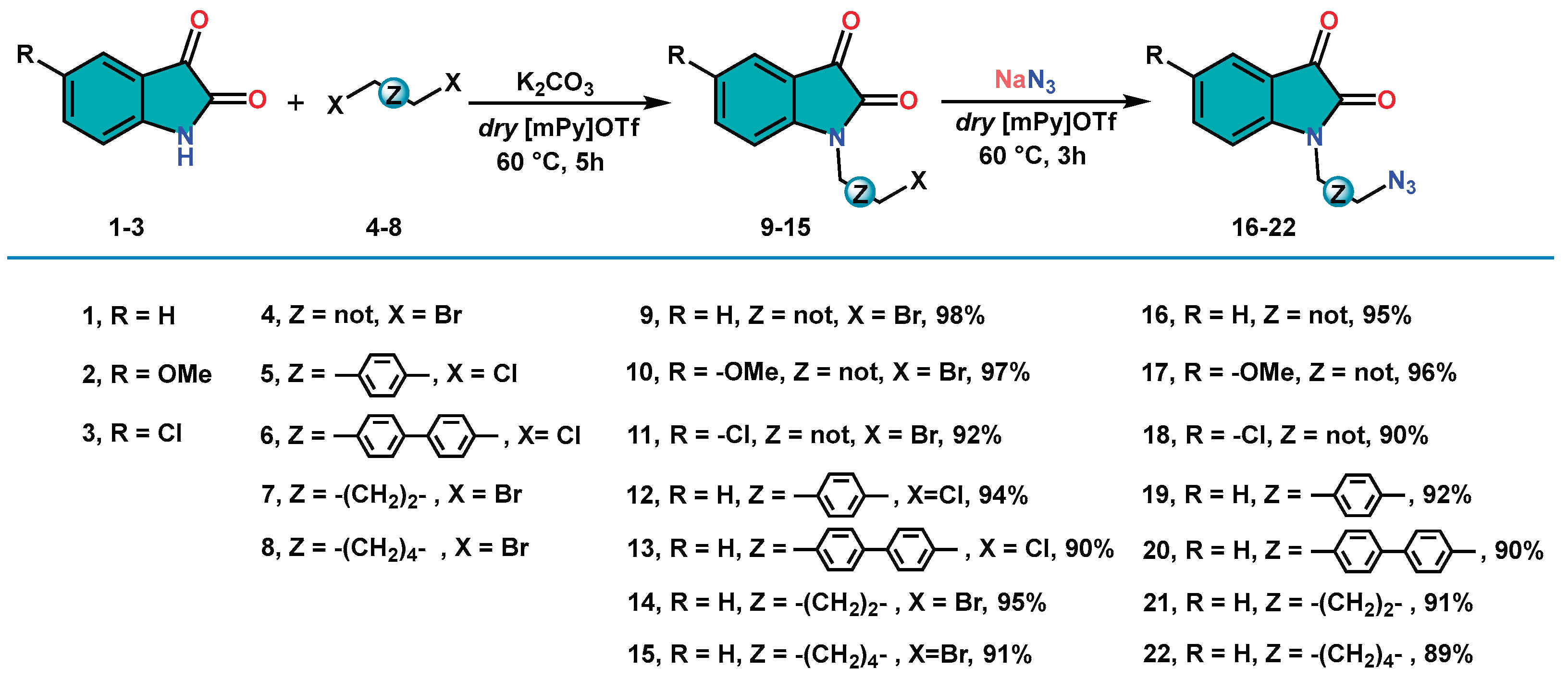
Scheme 3.
Synthesis of dipolarophiles: substituted propargyloxyphenyl-1,4-dihydropyridine 27-29.
Scheme 4.
Proposed reaction mechanism for regioselective synthesis of 1,4-disubstituted 1,2,3-triazole hybrid molecules by CuAAC in IL.
Scheme 4.
Proposed reaction mechanism for regioselective synthesis of 1,4-disubstituted 1,2,3-triazole hybrid molecules by CuAAC in IL.
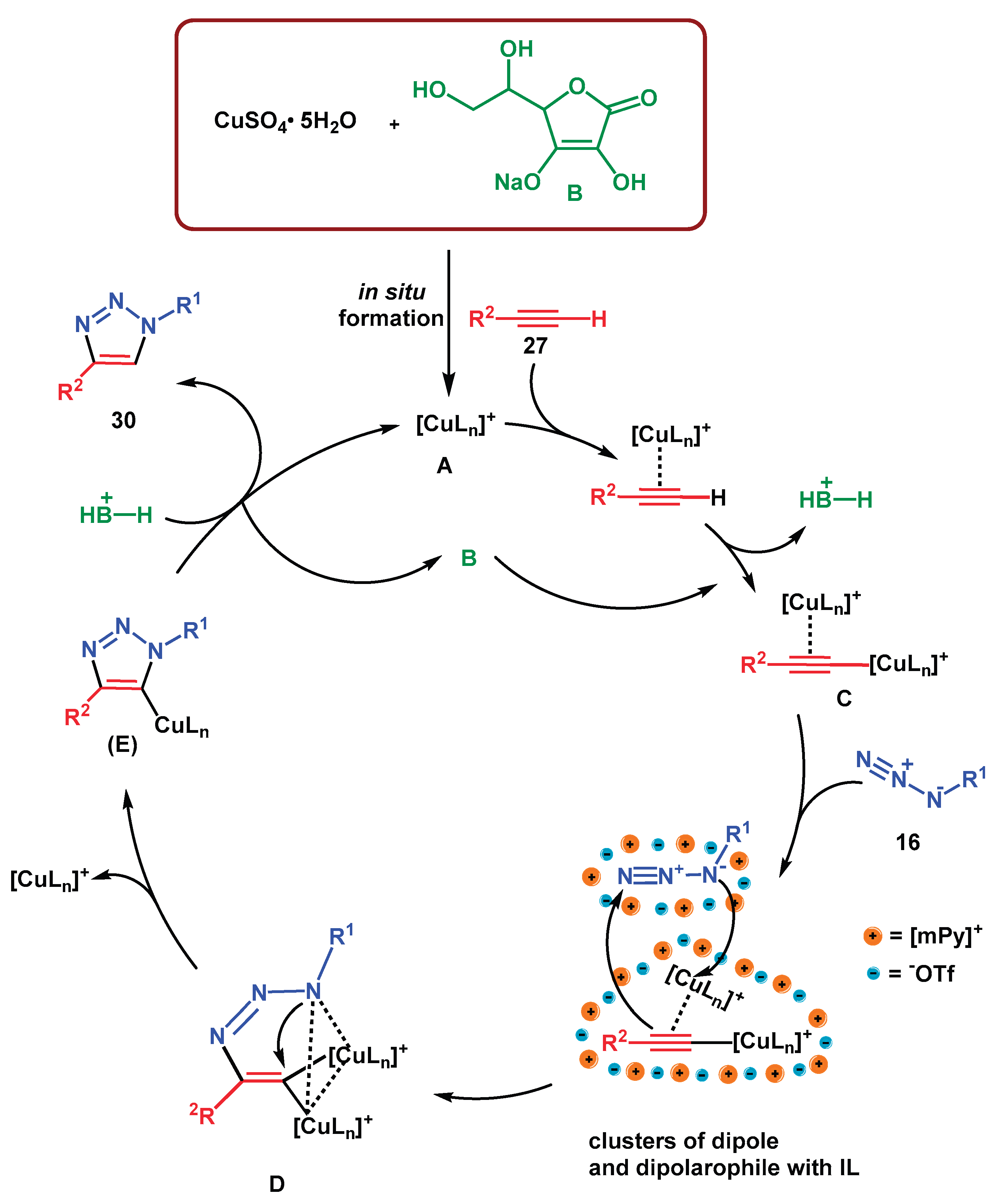
Figure 2.
Recovery and reuse of [mPy]OTf/H2O/Cu(I)/Na-ascorbate system until six cycles.
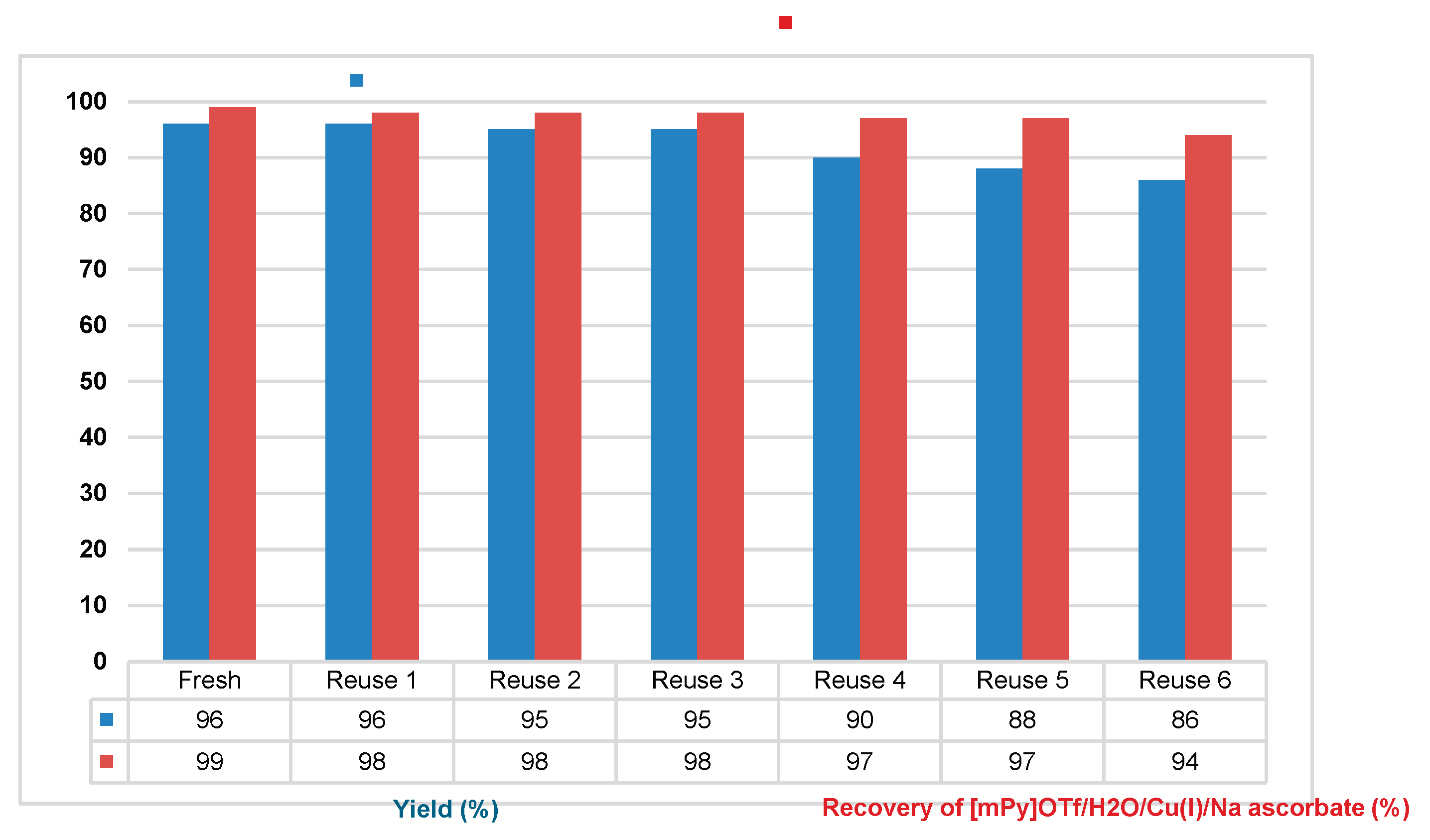

Table 1.
Optimization of reaction conditions for the synthesis of the hybrid 30.
 | ||||
| Entrya | Solvent | Catalytic System |
Yieldb (%) |
|
|
Copper Salt (eq) |
Na-ascorbate (eq) |
|||
| 1 | [bmim]OTf/H2O 9:1 |
CuSO4 · 5H2O (0.2) |
0.8 | 76 |
| 2 | [bmim]Cl/H2O 9:1 |
CuSO4 · 5H2O (0.2) |
0.8 | 71 |
| 3 | [bmim]BF4/H2O 9:1 |
CuSO4 · 5H2O (0.2) |
0.8 | 74 |
| 4 | [bmim]lactate/H2O 9:1 |
CuSO4 · 5H2O (0.2) |
0.8 | 73 |
| 5 | [bdmim]PF6/H2O 9:1 |
CuSO4 · 5H2O (0.2) |
0.8 | 70 |
| 6 |
[mPy]OTf/H2O 9:1 |
CuSO4 · 5H2O (0.2) |
0.8 | 96 |
| 7c | [mPy]OTf/H2O 9:1 |
CuSO4 · 5H2O (0.1) |
0.4 | 64 |
a Reaction conditions: alkyne 27 (0.25 g, 0.65 mmol, 1 eq), azide 16 (0.65 mmol, 1 eq), CuSO4 · 5 H2O (0.033 g, 0.13 mmol, 0.2 eq), Na-ascorbate (0.103 g, 0.52 mmol, 0.8 eq), in IL (10 mL), 65 °C, 5h. bIsolated yield. c Reaction conditions: alkyne 27 (0.25 g, 0.65 mmol, 1 eq), azide 16 (0.65 mmol, 1 eq), CuSO4 · 5 H2O (0.017 g, 0.07 mmol, 0.1 eq), Na-ascorbate (0.052 g, 0.26 mmol, 0.4 eq), in [mPy]OTf/H2O (10 mL), 65 °C, 5h.
Table 2.
Synthesis of hybrid molecules based on 1,4-disubstituted 1,2,3-triazoles by CuAAC a,b,c.
 |
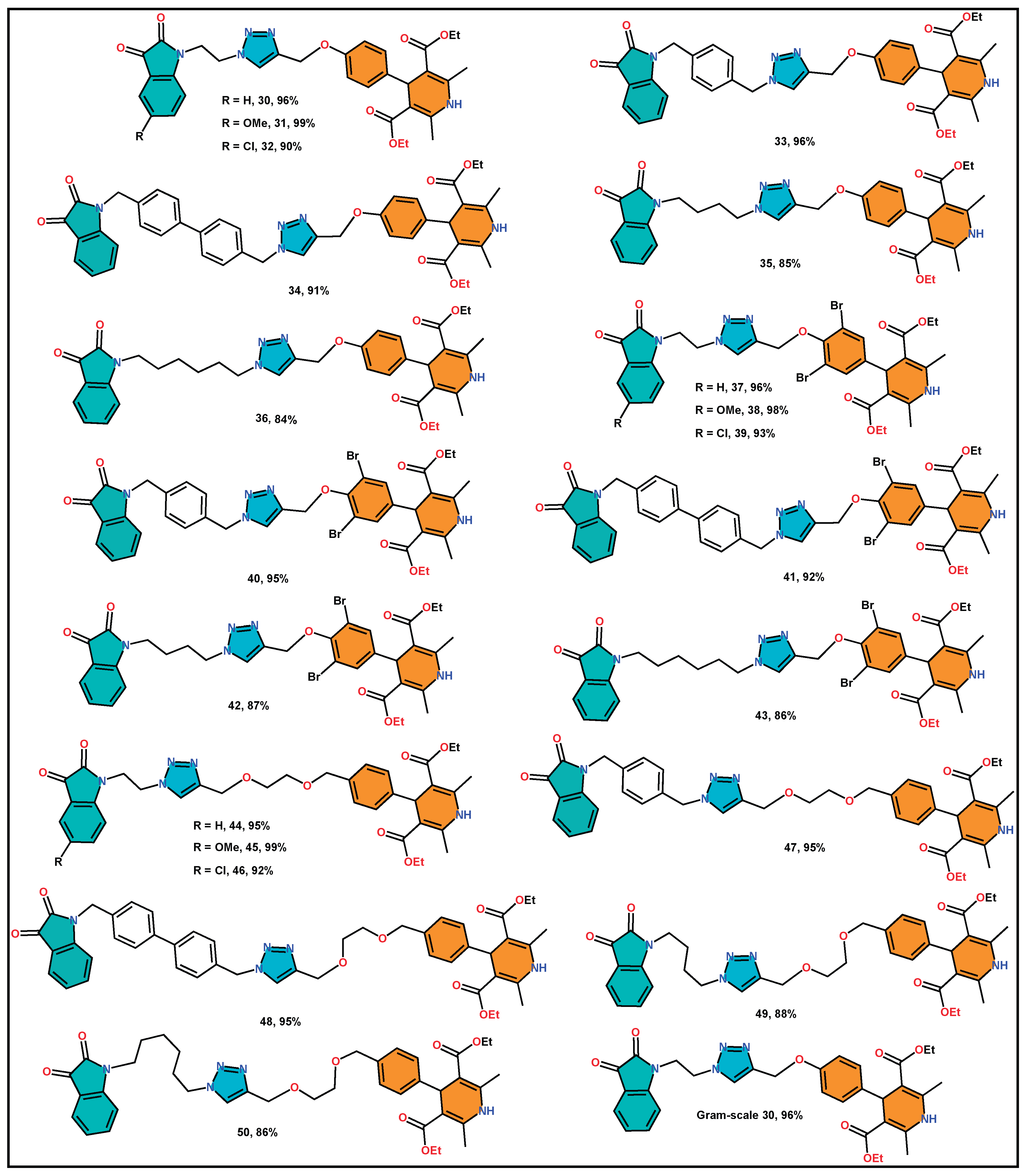 |
a Reaction conditions: alkyne 27-29 (0.65 mmol, 1 eq), azide 16-22 (0.65 mmol, 1 eq), CuSO4 · 5 H2O (0.033 g, 0.13 mmol, 0.2 eq), Na-ascorbate (0.103 g, 0.52 mmol, 0.8 eq), in [mPy]OTf/H2O 9:1 v/v (10 mL). b Isolated yield. c Gram-scale reaction conditions: alkyne 27 (5.0 g, 13.05 mmol, 1 eq), azide 16 (3.27 g, 13.05 mmol, 1 eq), CuSO4 · 5H2O (0.65 g, 2.6 mmol, 0.2 eq), Na-ascorbate (2.07 g, 10.45 mmol, 0.8 eq), in [mPy]OTf/H2O 9:1 v/v (250 mL).
Disclaimer/Publisher’s Note: The statements, opinions and data contained in all publications are solely those of the individual author(s) and contributor(s) and not of MDPI and/or the editor(s). MDPI and/or the editor(s) disclaim responsibility for any injury to people or property resulting from any ideas, methods, instructions or products referred to in the content. |
© 2026 by the authors. Licensee MDPI, Basel, Switzerland. This article is an open access article distributed under the terms and conditions of the Creative Commons Attribution (CC BY) license (http://creativecommons.org/licenses/by/4.0/).
Copyright: This open access article is published under a Creative Commons CC BY 4.0 license, which permit the free download, distribution, and reuse, provided that the author and preprint are cited in any reuse.