

Submitted:
15 July 2026
Posted:
16 July 2026
You are already at the latest version
Abstract
In the arid regions of southeastern Tunisia, international migration—often driven by declining agricultural yields under the effects of climate change—can strengthen agro system resilience when part of the remitted funds is invested in adaptation practices. However, its effect may become neutral or even negative when remittance volumes are low or when beneficiaries are reluctant to invest. This study aims to analyze the impact of migration on climate change adaptation practices and agricultural production in the coastal oases of southeastern Tunisia. The methodology relies on a literature review, a field survey of 212 households, and statistical and econometric analyses. Descriptive analysis by migration status reveals a slight predominance of migrant households in terms of adaptation practices and agricultural outputs. Furthermore, the econometric model shows decreasing returns to scale (0.52 + 0.45 = 0.97 < 1). Although capital and labor influence production in a less than proportional manner, migration plays a significant role in improving income and the share saved for productive self financing. For identical levels of capital and labor, migrant households produce on average 35.67% more than non migrant households. The study highlights gaps and opportunities for adaptation through migrant remittances. Policies should further mobilize migrants to engage in climate change adaptation processes, particularly in vulnerable regions, by relying on reforms in agricultural investment, awareness raising, extension services, and cooperative land management governance.
Keywords:
international migration
; climate change
; adaptation practices
; agricultural production
; southeastern Tunisia
1. Introduction
Small-scale agriculture in many arid regions of Africa has become an insufficient source of income and food security, partly due to climate-change impacts. Facing these challenges, agricultural households adopt various strategies to compensate for the fragility of their economic systems. Out-migration of at least one household member to high-income countries is among these strategies [1], generally decided collectively to diversify income sources for those remaining in the origin areas [2,3].
Although migration intensifies in contexts of environmental degradation and climate-related threats [4,5,6], it can also increase household income and thereby enhance the likelihood of investing in adaptation practices that support productivity. This suggests potential linkages between migration and climate-change adaptation. The African regions most threatened by climate risks are also those most affected by migration and remittance inflows [7,8,9,10].
Adaptation and migration are conceptually distinct, yet one may influence the other. Climate-risk management is an adjustment process aimed at reducing agricultural vulnerability and increasing resilience [11]. While this process often involves public and private institutions [12,13], the agricultural household remains the primary actor responsible for implementing adaptation practices [14]. Water-saving can be achieved through precision irrigation [15,16,17] ; soil fertilization and reduced tillage help optimize yields and mitigate environmental impacts [18] ; crop diversification has gained increasing interest among farmers in arid zones [19,20]. These practices are generally proportional to household income and financial capacity [21], forming the core of productive investment that can generate economic surplus through improved productivity and strengthened resilience.
Labor migration is an economic strategy intended to diversify income sources and reduce socio-economic risks for household members who remain in origin areas. As a response to low land productivity [22], migrants aim—through remittances—to reduce vulnerability in their home regions [2,23]. They act as financial intermediaries, providing capital that can be invested in the well-being of household members [3], although their contribution to productive investment remains debated.
Economic studies on the relationship between migration and climate-change adaptation remain limited. Much attention has been given to remittances in analyzing migration’s impact on household welfare. The New Economics of Labor Migration (NELM) considers remittances as a form of insurance against socio-economic risks for origin households [23]. Most remittances are spent on consumption and living-standard improvements, with limited allocation to productive investment [24,25,26].
In highly vulnerable arid zones, the impact of migration—particularly remittances—on adaptation practices and agricultural production remains a recurrent debate. The lack of a clear theoretical framework complicates the discussion [27], although existing case studies help fill this gap [27,28]. Results vary: in South Asia, remittances have supported climate-resilient technologies [14] ; in the Sahel, their impact on agro-system resilience and production appears limited or neutral in the absence of public policies promoting productive investment [29].
Tunisia, heavily affected by international migration, is vulnerable to climate extremes in North Africa [9]. Migration is widespread across the country, with migrant numbers increasing from 65,927 (2009–2014) to 156,497 (2019–2024). The diaspora counts 1.4 million people [30], and remittances reached USD 2.97 billion in 2025 (5.3% of GDP), exceeding foreign direct investment inflows [31].
Managing migration has thus become a major policy challenge, especially in arid oases with high added value and strong migration trends [32,33,34,35]. Although recent studies have addressed climate-change adaptation in these oases [20,36], the effects of migration—particularly remittances—remain understudied.
Migration may stimulate productive investment and enhance adaptation capacity through remittances, but this remains a hypothesis requiring empirical validation. This study analyzes the impact of migration on adaptation practices and agricultural production in the coastal oases of southeastern Tunisia using descriptive statistics and a Cobb-Douglas production function with a migration indicator variable, based on survey data from 212 households.
2. Methodological Approach
2.1. Site Description
The study area (Figure 1) covers approximately 2,874 ha, representing 40% of the coastal oasis surfaces in southeastern Tunisia [37]. The climate is arid, influenced by coastal conditions, with annual rainfall ranging between 100 and 220 mm [20]. The three-layered cropping system is dominated by date palms and pomegranates, associated with various fruit species and diverse vegetable crops. Farmers cultivate fodder crops, industrial crops (henna, tobacco), and condiments (parsley, mint, spinach). Agricultural activities take place on small plots, most under 1 ha per farmer [38].
These oases face environmental challenges, notably water scarcity due to climate change [20,39], and demographic pressures linked to migration [32,33,34,40,41]. In the Gabès Governorate, where the oases are located, the departure abroad, which appeared early in history with a stock of 23,680 people in 2008 [42], nevertheless shows a certain continuity over time. In 2024, the number of migrants from Gabès exceeded 6,000 people [43].
2.2. Methodology
2.2.1. Data Sources and Sampling
Data collection was carried out at the end of 2024 as part of the research activities of the Laboratory of Rural Economics and Societies at the Arid Regions Institute (IRA) of Tunisia. The survey was designed to gather information on households and on the agricultural production system. The collected data are both quantitative and qualitative and can be classified into the following two dimensions :
- demographic and socio-economic characteristics of agricultural households at the time of the survey (2024) ;
- agricultural production and operating costs. The information collected refers to the year of the survey (late 2024), except for data related to the construction of water basins and the installation of electric pumping and drip-irrigation systems, which were implemented in previous years. These assets are considered stock variables, as they continue to affect agricultural operations during 2024.
The survey covered 212 households, without prior sorting according to migration status (migrant vs. non-migrant households). The sample was selected using simple random sampling, based on Yamane’s formula (1967). The margin of error is identical to that used in the survey conducted under the “Jeffara of Southeastern Tunisia” project [44].
where:
: sample size
: number of farmers = 11,628 [37]
: margin of error = 6.8%
The data collected during the survey phase were subsequently subjected to statistical and econometric processing using Excel and EViews.
2.2.2. Analytical Method and Econometric Model Specification
Two embedded analytical approaches were employed in this study. The first consists of a descriptive analysis, by migration status, of households adoption of adaptation practices and their agricultural production. The second relies on an econometric regression of an agricultural Cobb–Douglas production function, incorporating an indicator variable to test the impact of migration.
For the purposes of this study, a household is defined as a group of individuals—biologically related, unrelated, or both—who live in the same dwelling, share meals, and sleep under the same roof. A household is classified as a migrant household if at least one of its members has migrated abroad to work outside the region of origin for a period of at least one year [45]. Within such households, some members may have returned from migration ; return migration is considered in this study to examine the effects of income from former migrants [24]. Conversely, a non-migrant household is composed of members who have never left their region of origin to work abroad for at least one year [46].
The econometric approach consists of estimating a Cobb–Douglas production function, commonly used in neoclassical economics to describe the relationship between output (Y) and production factors (capital and labor). The capital employed in production includes practices necessary for climate-change adaptation. As it is sometimes difficult to identify all such practices, we selected those reported by respondents and referenced in the literature (Table 1).
The adoption of adaptation practices generally contributes to optimizing productivity and reducing climate-related risks [51,52]. This process often requires farmers to invest part of their saved income in order to increase their production. Access to credit and government subsidy policies are not considered in this study. Household income alone is treated as the source of self-financing for production factors. Accordingly, the classical Cobb–Douglas production function can be written as follows:
where:
- Y: observed level of production (output)
- K: capital
- L: labor
- A: parameter of overall production efficiency
- α and β: elasticities
Transforming the function into a log-linear form yields the following model :
where:
: error term
- ln(A) : model constant
For this model, it is important to introduce an indicator variable equal to 1 if the household is a migrant household and 0 otherwise. This variable allows testing the impact of migration on agricultural production. Other sociodemographic variables (Table 2) may also influence production under climate constraints [53]. The selection of these variables follows similar empirical studies [54,55], even if conceptual differences may exist. The final form of the chosen model is :
where:
- α, β, δ, λ, , θ: coefficients to be estimated
The model was estimated using the Ordinary Least Squares (OLS) method. Durbin–Watson, Breusch–Pagan, and VIF tests were performed to verify, respectively, the presence of autocorrelation, heteroskedasticity, and multicollinearity in the regression.
3. Results & Discussion
This section begins with an analysis of household profiles, their adaptation practices, and their agricultural production. It then discusses the results of the econometric regression of the Cobb–Douglas production function, and finally provides an overall interpretation of the findings.
3.1. Profile of Surveyed Households
Table 3 summarizes the descriptive statistics related to several characteristics of the surveyed households. Migration, which is embedded in the traditional culture of the Tunisian population [56], concerned 42% of respondents, most of whom were male household heads (44.9%). The migration of other household members (sons, sisters, brothers) represents 23.6% of all migrant households. In addition, return migration is also observed in these oases, with a rate of 31.5%.
Female household heads are rarely observed, representing only 2.83% of the sample. The average age of household heads is 58.92 years, indicating an aging population that remains highly active in the agricultural sector. The average household size is 5.47 persons, exceeding the national average in Tunisia (3.45 persons per household) [43]. On average, each household includes 0.87 children under 15 and 1.90 educated persons beyond primary level. This demographic context reflects the rural nature of the population [57].
Agriculture is among the main occupations of households in the oases. The average cultivated area is 0.55 ha per household, with a predominance of smallholders cultivating less than 0.5 ha. Water management is ensured by a Collective Interest Group (GIC) responsible for water distribution. Only 29.25% of respondents expressed satisfaction with their ability to secure a minimum level of irrigation water access.
Household income sources are relatively diversified and depend on several sectors of activity. For migrant households, the average volume of remittances is estimated at 5,746 Tunisian Dinars (TND) per year. Income derived from the agricultural sector averages 2,664.445 TND per year, with higher values observed among migrant households. Conversely, non-agricultural activities, which generate an average of 2,783.03 TND per year, primarily concern non-migrant households (Figure 2).
Thus, it clearly appears that remittances have contributed significantly to improving household income in these oases. Migrant households receive an average total income almost twice as high as that of non-migrant households. This observation is consistent with the New Economics of Labor Migration (NELM), which posits that remittances constitute one of the most important externalities in terms of income generation and wealth circulation in migrants’ regions of origin [2,58].
3.2. Descriptive Analysis by Migration Status of Adaptation Practices and Agricultural Production
3.2.1. Adoption of Adaptation Practices
According to the investigation results, households used their own income to invest in adaptation practices without resorting to credit or government subsidies. Households receiving higher income were more likely to allocate financial resources to adopt these practices. In the oases, the proportion of migrant households practicing soil fertilization (organic and mineral fertilizers) is high (78.8%) compared with non-migrant households (60.5%). Furthermore, 30.5% of migrant households adopted drip irrigation—a technique with a direct effect on water savings—versus 17.1% among non-migrant households.
The construction of water basins with motor pumps for collecting accumulated irrigation water concerned 22.7% of migrant households, compared with 15.2% of households that have never migrated. Additionally, crop diversification is more frequently observed among migrant households (31.9%) than among non-migrant households (28.6%) (Figure 3). According to the survey, this technique mainly involved new varieties of fruit trees (orange, plum), high-value vegetable crops, fodder crops (barley, sorghum), and condiment crops (parsley, mint, spinach).
3.2.2. Agricultural Products
For all tree crops cultivated in the oases, modest differences in production quantities are observed (Figure 4). This cropping system, composed of an upper layer dominated by date palms and a middle layer consisting of olive trees and various fruit trees, remains widespread in the oases, with a slight predominance among migrant households. Indeed, the average quantity of date palm production is higher among migrant households, reaching 1.8 tons per farmer, compared with 1.1 tons for non-migrant households. Moreover, migrant households produce more pomegranates than households that have never migrated, with respective average quantities of 6.5 tons versus 3.3 tons. For other tree crops—such as olive, almond, fig, orange, plum, and apple—production levels are consistently higher among migrant households (Figure 4).
Forming the lower layer, vegetable and fodder crops are mainly cultivated by farmers producing onion, turnip, carrot, and alfalfa. Although production levels vary across households, the results clearly confirm a growing orientation toward the development of these crops [59]. A simple comparison between the two household categories reveals a slight predominance among migrant households. This lower layer also includes other crop varieties with varying production quantities. Farmers cultivate grapevine, parsley, celery, Swiss chard, spinach, cucumber, pepper, tomato, potato, henna (Lawsonia inermis), tobacco, and others (Figure 5).
Animal production in the oases, although the average livestock size per household is low (6 head per household), remains widespread among the local community. Thanks in particular to the development of alfalfa cultivation, livestock farming has been able to maintain its sustainability. Annual alfalfa production reaches 10.95 tons per migrant household, compared with 9.7 tons for non-migrant households.
3.3. Econometric Analysis of the Cobb–Douglas Production Function
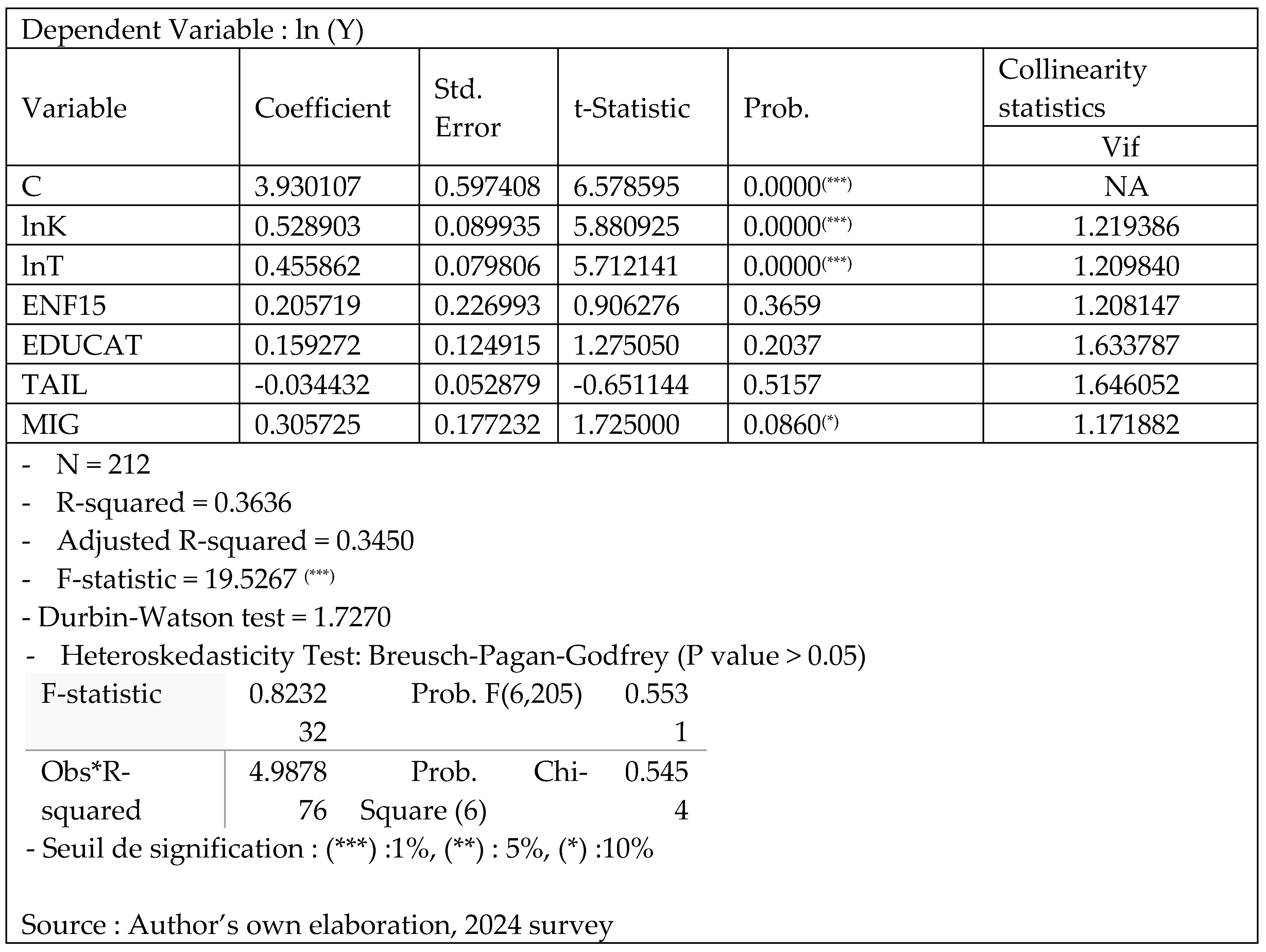
The results of the econometric regression and the statistical tests are presented in Table 4. The linear fit of the model (adjusted ) is 34.5%, with a generally significant F-statistic. The model also shows low multicollinearity among predictors, as VIF values are within acceptable ranges. The Durbin–Watson test and the Breusch–Pagan test respectively confirm the absence of autocorrelation in residuals and the absence of heteroskedasticity issues. Statistically, the model explains agricultural production in the oases to a certain extent. At the 1% significance level, the statistically significant variables are capital (K) and labor (L). In addition, the indicator variable capturing migration (MIG) shows a significance level of 10%. These variables positively affect agricultural production. Conversely, the variables related to the number of children under 15 (ENF15), the number of educated persons (EDUCAT), and household size (TAIL) do not have significant effects in this application. In what follows, we interpret the production elasticities with respect to their explanatory variables, in order to understand the degree of sensitivity of each variable in the model.
According to the model results, capital shows a positive and highly significant coefficient (1% level). A 1% increase in capital leads to a 0.52% change in production, all else being equal. The inelastic relationship (0.52) indicates that capital influences production, but in a less than proportional manner. An increase in capital generates only a modest gain in output. This finding does not necessarily reflect weak self-financing of adaptation practices ; rather, it may result from constraints such as resource under-utilization, misallocation, soil salinity, and water scarcity. This result is consistent with studies conducted in Latin America [60] and North Africa [36], which show that production remains non-proportional to capital under conditions of natural resource scarcity and ecosystem degradation intensified by climate change.
Furthermore, the coefficient associated with labor hours (L) is positive and highly significant (1% level). A 1% increase in labor hours raises production by 0.45%, all else being equal. The inelastic relationship (0.45) between these variables indicates that labor has a limited impact on production. Increasing labor hours is no longer proportional to output. This result appears to be influenced by land constraints in the oases, characterized by homogeneous and small cultivated areas [61], which limit labor requirements. It may also stem from poor organization and distribution of labor [62,63].
Additionally, the coefficient of the migration indicator (MIG) is statistically significant at the 10% level. The idea that migration can have a positive impact on agricultural production is confirmed. Since the dependent variable is in logarithmic form, the estimated coefficient is interpreted as:
Thus, for identical levels of capital and labor, migrant households produce on average 35.67% more than households that have never migrated. This result supports earlier findings showing a slight predominance of migrant households adopting adaptation practices that enhance productivity. It also aligns with studies demonstrating that migration contributes to the socio-economic well-being of household members who remain in the origin region through remittances [14,32].
The production function exhibits decreasing returns to scale (0.52 + 0.45 = 0.97 < 1), meaning that when inputs increase proportionally, output increases less than proportionally. Thus, despite households’ efforts to invest in production factors—particularly in climate-change adaptation practices—production remains non-proportional due to the complexity of adaptation and the degradation or depletion of water and soil quality [56].
3.4. Discussion
As an economic surplus contributing to the socio-economic well-being of households remaining in the origin region, remittances constitute an important source of self-financing for the agricultural sector in the face of climate change. The impact of remittances on agricultural production is far from negligible. Migrant households, which receive more money than non-migrant households, invest more in capital, including adaptation practices. These practices have direct positive effects on production. For all oasis crops, a simple comparison between the two household categories reveals a slight predominance of migrant households. Thus, increased income and savings have primarily led to greater productive self-financing. Even though capital and labor influence production in a less than proportional manner (decreasing returns to scale), migration remains a determining factor in the self-financing process.
Despite the vulnerability of these arid oases, households have managed to invest part of the income derived from migration. Although their primary concern is to improve the living conditions of family members who remain in place [24,26], part of this income is allocated to productive self-financing [59]. This result is consistent with studies showing that migration strengthens farmers’ financial capacity to improve their resilience and production systems [32,35,64].
Clearly, migration constitutes one of the adaptation strategies that can be particularly effective in the face of progressive environmental degradation and climate-related threats. Nevertheless, non-migrant households also contribute to this process, even if with smaller financial volumes. Benefiting from agricultural and non-agricultural income, non-migrant households also finance adaptation practices. This result is expected, as surplus income from permanent or temporary household activities increases the likelihood of self-financing adaptation practices and boosting production [20,36].
Finally, this study highlights certain limitations whose consideration could improve future results. Expanding the sample size and integrating new explanatory variables into the econometric model could enrich the findings. Variables that are difficult to quantify—such as extension services, local policy, and governance—could be valuable additions to the model.
4. Conclusion & Perspectives
The impact of migration on adaptation practices and agricultural production in the oases was tested using two complementary methods. The descriptive analysis shows that the highest proportion of households adopting practices to adapt and reduce their vulnerability to climate change effects belongs to migrant households. The most widespread practices include water-saving techniques, soil fertilization, and crop diversification. These practices have had positive impacts on agricultural yields, particularly among migrant households. This finding is confirmed by the econometric regression of the Cobb–Douglas production model : a migrant household produces on average 35.67% more than a non-migrant household, all else being equal.
However, international migration—sometimes triggered by declining agricultural yields due to climate change—has contributed to improving the resilience of the oasis agro-system. The role of migration, particularly remittances, remains crucial in self-financing capital, including adaptation practices. Despite these potential advantages, challenges persist regarding the management and efficiency of producers in allocating production factors within an agro-system facing environmental constraints, especially water scarcity under climate change.
Thus, the gains derived from migration should be further leveraged with the support of actors beyond migrants themselves. The role of local actors, including the participation of non-migrant populations, becomes essential in climate-change adaptation strategies. Migrants should be more actively engaged in this process. Alternative pathways must be identified, both in terms of strategy and agricultural policy. Strengthening links between the territory, local actors, and the diaspora abroad is necessary to inform migrants about climate challenges, local development plans, and new agricultural opportunities in the context of climate change. The objective is to establish an adaptation governance strategy based on reforms in agricultural investment, training, awareness-raising, extension services, and the management of local cooperatives.
Funding
This research was funded by the program contract of the Rural Economics and Societies Laboratory of the Institute of Arid Regions of Medenine.
Data Availability Statement
The data supporting the findings of this study are available from the corresponding author upon reasonable request.
Acknowledgments
The author would like to thank the investigators for their participation in the field study.
Conflicts of interest
The author declares no conflict of interest.
References
- Stark, O. The Migration of Labor ; Harvard University Press : Cambridge, MA, USA, 1991.
- Stark, O. ; Bloom, D.E. The New Economics of Labor Migration. American Economic Review 1985, 75, 173–178. Available online : https://www.jstor.org/stable/1805591 (accessed on 1 July 2025).
- Taylor, J.E. The New Economics of Labour Migration and the Role of Remittances in the Migration Process. International Migration 1999, 37, 63–88.
- International Organization for Migration (IOM). International Migration Law No. 34 : Glossary on Migration ; International Organization for Migration : Geneva, Switzerland, 2019. Available online : https://publications.iom.int/system/files/pdf/IML_34_Glossary.pdf.
- Martínez-Zarzoso, I. ; Nowak-Lehmann, F. ; Paschoaleto, R.D.L. Climate Change, Natural Disasters, and International Migration : A Country-Level Analysis Considering Climatic Zones. Frontiers in Climate 2023, 4, 986088. [CrossRef]
- Daoust, G. ; Selby, J. Climate Change and Migration : A Review and New Framework for Analysis. WIREs Climate Change 2024, 15, e886. [CrossRef]
- McLean, A. ; Ben Brahim, N. Is Climate Change a Driver of Mobility? A Mapping of Perceptions in Egypt, Morocco and Tunisia ; International Centre for Migration Policy Development Regional Office for the Mediterranean: Vienna, Austria, 2023.
- Ratha, D. ; Chandra, V. ; Kim, E.J. ; Plaza, S. ; Mahmood, A. Migration and Development Brief 40 : Remittances Slowed in 2023, Expected to Grow Faster en 2024 ; World Bank ; Global Knowledge Partnership on Migration and Development: Washington, DC, USA, 2023. Available online : https://documents.worldbank.org/en/publication/documentsreports/documentdetail/099714008132436612/idu1a9cf73b51fcad1425a1a0dd1cc8f2f3331ce.
- Zaidi, S. ; Dhehibi, B. ; Dhraief, M.Z. ; Abdeladhim, M.A. Résilience des ménages face à l’insécurité alimentaire et au changement climatique dans les régions du centre et du nord-est de la Tunisie : Une analyse empirique. New Medit 2023, 22, 19–34. [CrossRef]
- World Bank. Migration and Development Brief 40 : Remittances Remain Resilient but Are Slowing; World Bank Group : Washington, DC, USA, 2024.
- Smit, B.; Wandel, J. Adaptation, Adaptive Capacity and Vulnerability. Global Environmental Change 2006, 16, 282–292. [CrossRef]
- Stéphane, S. Adaptation au Changement Climatique dans le Secteur de l’Eau en Méditerranée : Situation et Perspectives ; Plan Bleu : Marseille, France, 2011. Available online : http://planbleu.org/sites/default/files/publications/cahier10_eaucc_fr.pdf.
- Muthelo, D. ; Owusu-Sekyere, E. ; Ogundeji, A.A. Smallholder Farmers’ Adaptation to Drought : Identifying Effective Adaptive Strategies and Measures. Water 2019, 11, 2069. [CrossRef]
- Maharjan, A. ; Sapkota, P. ; Khadka, K. Migration and Household Adaptation in Climate-Sensitive Hotspots in South Asia. Current Climate Change Reports 2020, 6, 1–15. [CrossRef]
- Velasco-Muñoz, J.F. ; Aznar-Sánchez, J.A. ; Belmonte-Ureña, L.J. ; López-Serrano, M.J. Advances in Water Use Efficiency in Agriculture : A Bibliometric Analysis. Water 2018, 10, 377. [CrossRef]
- Food and Agriculture Organization of the United Nations (FAO). Efficient Water Use in Agriculture ; Food and Agriculture Organization of the United Nations : Rome, Italy, 2023. Available online : https://www.fao.org.
- Al-Kilani, M.R. Agricultural Land Measures for Climate Change Adaptation in Arid Regions: Can the Farmers Do It Alone ? Journal of Aridland Agriculture 2024, 10, 82–93. [CrossRef]
- Sun, Z. ; Li, X. Technical Efficiency of Chemical Fertilizer Use and Its Influencing Factors in China’s Rice Production. Sustainability 2021, 13, 1155. [CrossRef]
- Antwi-Agyei, P. ; Nyantakyi-Frimpong, H. Evidence of Climate Change Coping and Adaptation Practices by Smallholder Farmers in Northern Ghana. Sustainability 2021, 13, 1308. [CrossRef]
- Mahdhi, N. ; Smida, Z. ; Chouikhi, F. Changement Climatique et Stratégies d’Adaptation des Exploitations Irriguées Privées dans le Sud-Est Tunisien : Cas de la Zone de Gabès-Nord Tunisia. New Medit 2022, 21, 1. [CrossRef]
- Olawuyi, T.O. ; Mushunje, A. Adaptation to Climate Change and Variability by Farming Households in North-Central Nigeria. Sustainability 2023, 15, 16309. [CrossRef]
- Harris, J. ; Todaro, M. Migration, Unemployment and Development: A Two-Sector Analysis. Am. Econ. Rev. 1970, 60, 126–142.
- Stark, O. On the Role of Urban-to-Rural Remittances in Rural Development. J. Dev. Stud. 1980, 16, 369–374.
- Domenach, H. ; Picouet, M. Les Migrations ; Presses Universitaires de France : Paris, France, 1995 ; 128 pp.
- Gammoudi, T. ; Omrani, M. Les transferts de fonds de la diaspora à l’étranger : Une source de développement économique de milieu aride tunisien ? Rev. Econ. Nord Afr. 2021, 17, 61–76.
- Guilmoto, C.Z. ; Sandron, F. Migration et Développement ; La Documentation Française : Paris, France, 2003 ; 142 pp.
- Musah-Surugu, J.I. ; Anuga, S.W. Remittances as a Game Changer for Climate Change Adaptation Financing for the Most Vulnerable: Empirical Evidence from Northern Ghana. In Remittances as Social Practices and Agents of Change ; Meyer, S. ; Ströhle, C., Eds.; Palgrave Macmillan : Cham, Switzerland, 2023 ; pp. 315–334. [CrossRef]
- Premand, P. ; Stoeffler, Q. Cash Transfers, Climatic Shocks and Resilience in the Sahel : Evidence from a Randomized Experiment in Niger. J. Environ. Econ. Manag. 2022, 116, 102744. [CrossRef]
- Gemenne, F. ; Blocher, J. How can migration serve adaptation to climate change ? Geographical Journal 2017, 183, 336–347. [CrossRef]
- Observatoire National de la Migration (ONM). Analyse du système de gestion de la migration de main d’œuvre en Tunisie ; Ministère des Affaires sociales : Tunisie, 2020 ; 78 pp.
- Banque Centrale de Tunisie (BCT). Rapport annuel ; Banque Centrale de Tunisie : Tunisie, 2025 ; 225 pp.
- De Haas, H. Migration and Agricultural Transformations in the Oases of Morocco and Tunisia ; KNAG : Utrecht, 2001 ; 42 pp.
- Ministère du Transport et de l’Équipement (MTE). Atlas du gouvernorat de Gabès ; Direction Générale de l’Aménagement du Territoire : Tunisie, 2011 ; 124 pp.
- Gesellschaft für Internationale Zusammenarbeit (GIZ). Les oasis de Tunisie à protéger contre la dégradation et les effets du changement climatique ; Convention cadre des Nations Unies sur le Changement Climatique en collaboration avec le Ministère de l’Environnement Tunisie et la Gesellschaft für Internationale Zusammenarbeit (GIZ): Tunisie, 2012 ; 34 pp.
- Gammoudi, T. Contribution des migrants au développement de l’agriculture oasienne : Une perspective économique. Revue des Régions Arides 2020, 46, 875–882.
- Jeder, H. ; Abdelhamid, A. ; Salah, A. Smallholder farmers’ perceptions and adaptation strategies to mitigate the effect of climate change in the oases of South-Eastern Tunisia. New Medit 2021, 20, 15–28. [CrossRef]
- Ministère de l’Environnement et du Développement Durable (MEDD). Rapport sur la caractérisation sommaire des oasis tunisiennes ; Ministère de l’Environnement et du Développement Durable : Tunisie, 2015 ; 318 pp.
- Carpentier, I. Diversité des dynamiques locales dans les oasis du Sud de la Tunisie. Cahiers Agricultures 2017, 26, 35001.
- Abdedayem, S. Raréfaction de l’eau dans les oasis : Crise de la ressource ou crise de gouvernance ? Cas des oasis du Sud-Est tunisien. In Eaux, pauvreté et crises sociales—Water, poverty and social crises ; Ayeb, H. ; Ruf, T., Eds. ; IRD Éditions : Marseille, 2009 ; pp. 409–422.
- Boubakri, H. ; Nouri, H. Migrations, transformations sociales et recompositions des territoires dans la Jeffara (Sud-Est de la Tunisie). In Développement rural, environnement et enjeux territoriaux : Regards croisés Oriental marocain et Sud-Est tunisien ; Bonte, P. ; Elloumi, M. ; Guillaume, H. ; Madhi, M., Eds. ; Cérès Éditions ; IRD Éditions : Tunis, 2009 ; pp. 113–142.
- Institut National de la Statistique (INS). Rapport de l’enquête nationale sur la migration internationale Tunisia-HIMS ; Institut National de la Statistique : Tunis, 2020 ; 89 pp.
- Office des Tunisiens à l’Étranger (OTE). Rapport annuel sur la migration et les Tunisiens résidant à l’étranger 2010 ; Office des Tunisiens à l’Étranger : Tunisie, 2010.
- Institut National de la Statistique (INS). Flash Migration—Bulletin, Septembre 2025 ; Institut National de la Statistique : Tunis, 2025. Available online : https://www.ins.tn/sites/default/files-ftp3/files/2025-09/PROD-Migration-BULLETIN%20FR.pdf.
- Gammoudi, T. Analyse socio-démographique de la population. In Structures démographiques, activités socio-économiques des ménages et évolutions foncières ; Sghaier, M. ; Picouët, M. ; Gammoudi, T. ; Fétoui, M. ; Issaoui, M., Eds. ; Rapport scientifique final de l’équipe du thème 3 du programme « Jeffara » ; IRD-IRA : Tunis, 2003 ; pp. 13–39.
- Ünalan, T. Definition of Household Membership in International Migration Surveys. Journal of Social Sciences 2005, 1, 220–225.
- De Haas, H. Migration and Development in Southern Morocco : The Disparate Socio-Economic Impact of Out-Migration on the Todgha Oasis Valley ; University of Amsterdam Press : Amsterdam, 2003 ; 430 pp.
- Assefa, T. ; Jha, M. ; Reyes, M. ; Tilahun, S. ; Worqlul, A.W. Experimental Evaluation of Conservation Agriculture with Drip Irrigation for Water Productivity in Sub-Saharan Africa. Water 2019, 11, 530. [CrossRef]
- Kiani, A.K. ; Sardar, A. ; Khan, W.U. ; He, Y. ; Bilgic, A. ; Kuslu, Y. ; Raja, M.A.Z. Role of Agricultural Diversification in Improving Resilience to Climate Change : An Empirical Analysis with Gaussian Paradigm. Sustainability 2021, 13, 9539. [CrossRef]
- Nor Diana, M.I. ; Zulkepli, N.A. ; Siwar, C. ; Zainol, M.R. Farmers’ Adaptation Strategies to Climate Change in Southeast Asia : A Systematic Literature Review. Sustainability 2022, 14, 3639. [CrossRef]
- Hamza, A. ; Shi, G. ; Hossain, B. Migration as an Adaptation Measure to Achieve Resilient Lifestyle in the Face of Climate-Induced Drought : Insight from the Thar Desert in Pakistan. Water 2024, 16, 2692. [CrossRef]
- Blanchard, O. Macroeconomics, 8th ed. ; Pearson : Harlow, UK, 2021.
- Food and Agriculture Organization. Climate-Smart Agriculture Sourcebook; FAO : Rome, Italy, 2013 ; 570 pp. Available online : https://www.fao.org/3/i3325e/i3325e.pdf (accessed on 20 March 2025).
- Thabane, V.N. ; Agholor, I.A. ; Sithole, M.Z. ; Morepje, M.T. ; Msweli, N.S. ; Mgwenya, L.I. Socio-Demographic Determinants of Climate-Smart Agriculture Adoption Among Smallholder Crop Producers in Bushbuckridge, Mpumalanga Province of South Africa. Climate 2024, 12, 202. [CrossRef]
- Food and Agriculture Organization (FAO). Caractéristiques, modèles et vecteurs de la migration rurale au Sénégal ; Rome, Italy, 2021. [CrossRef]
- Mahdhi, N. ; Mizouri, F. ; Romdhane, A. Climate Change and Adaptation Strategies of Oasis Agriculture : The Case of the Coastal Oasis of Gabès, South-Eastern Tunisia. Journal of Oasis Agriculture and Sustainable Development 2022, 4, 148–161. [CrossRef]
- Picouet, M. Formes de mobilité et dynamique de l’environnement en Tunisie. Revue Européenne des Migrations Internationales 2002, 18, 51–65.
- Sghaier, M. ; Picouet, M. ; Gammoudi, T. ; Fetoui, M. ; Issoui, M. La désertification dans la Jeffara Sud-Est Tunisien : Structure démographiques, activités socio-économiques des ménages et évolution foncières ; Rapport scientifique final du thème 3, Projet de Jeffara; CSFD ; SERST ; IRD ; Éd. IRA : Tunis, Tunisia, 2003 ; 86 pp.
- Taylor, J.E. Migration : New dimensions and characteristics, causes, consequences and implications for rural poverty. In Current and Emerging Issues for Economic Analysis and Policy Research; Stamoulis, K.G., Ed.; Food and Agriculture Organization: Rome, Italy, 2001 ; pp. 167–201.
- Aljane, F. ; Elbekkay, M. ; Neily, M.H. ; Hamza, H.; Benoune, A. ; Yahia, Y. Prospection et inventaire de l’agrodiversité dans les oasis traditionnelles de Zarat, Nouiel et El Guettar. Revue des Régions Arides 2017, 43, 65–80.
- Antle, J.M. Capital accumulation and the growth of aggregate agricultural production. Agric. Econ. 1991, 6, 129–157. [CrossRef]
- Romdhane, A. ; Abdeladhim, M. Evolution des systèmes oasiens et comportements des exploitants agricoles : Cas des oasis littorales, sud-est tunisien. New Medit 2008, 7, 17–22.
- Guesmi, B. ; Yangui, A. ; Taghouti, I. ; Gil, J.M. Trade-Off between Land Use Pattern and Technical Efficiency Performance : Evidence from Arable Crop Farming in Tunisia. Land 2023, 12, 94. [CrossRef]
- Razzouki, A. ; Ridaoui, M. ; Oudgou, M. ; Boudhar, A. Econometric Analysis of Climate Change Impacts on Agricultural Output in the MENA Region. Economies 2025, 13, 340. [CrossRef]
- Yeleliere, E. ; Antwi-Agyei, P. ; Guodaar, L. Farmers Response to Climate Variability and Change in Rainfed Farming Systems: Insight from Lived Experiences of Farmers. Heliyon 2023, 9, e19656. [CrossRef]
Figure 1.
Location of the study area.
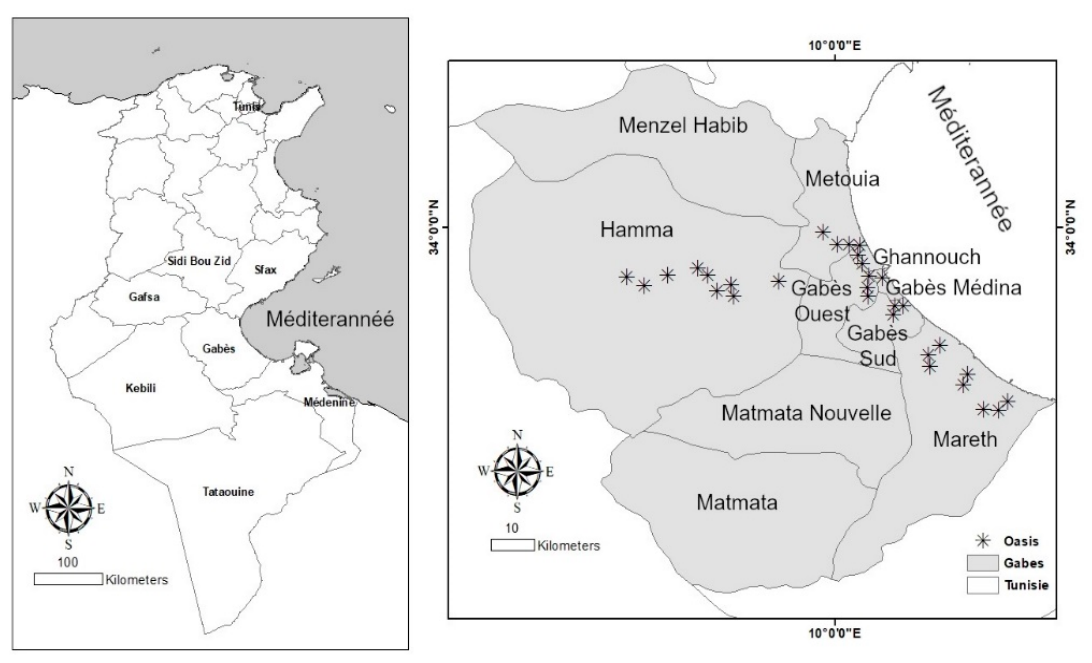
Figure 2.
Sources of household income by migration status (mean in TND). Source: Author’s own elaboration, 2024 survey.
Figure 2.
Sources of household income by migration status (mean in TND). Source: Author’s own elaboration, 2024 survey.
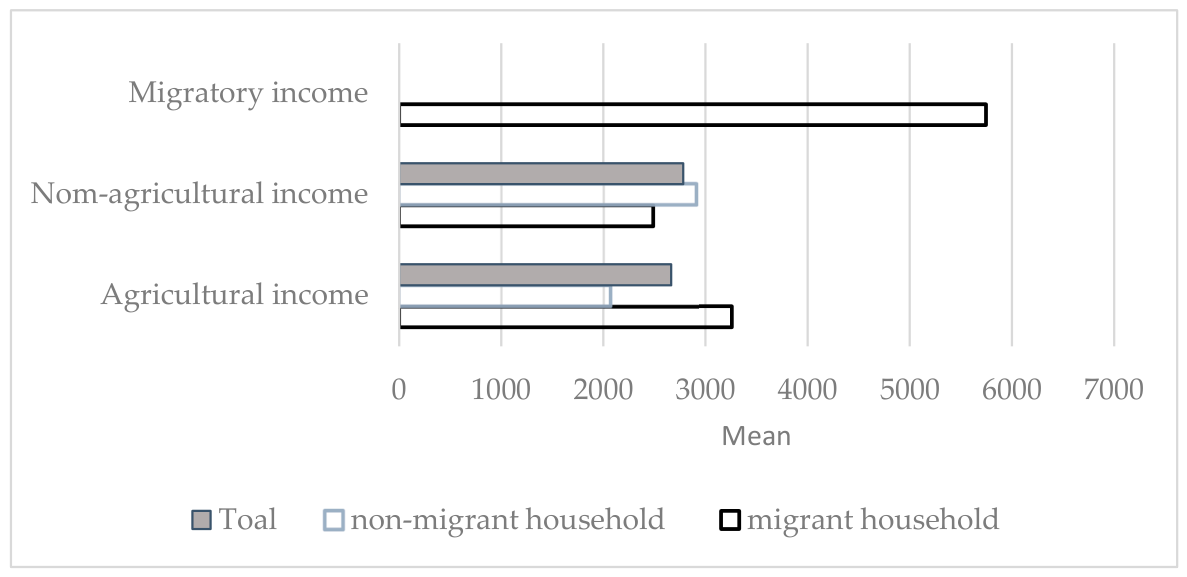
Figure 3.
Adoption of adaptation practices by migration status (%). Source : Author’s own elaboration, 2024 survey.
Figure 3.
Adoption of adaptation practices by migration status (%). Source : Author’s own elaboration, 2024 survey.
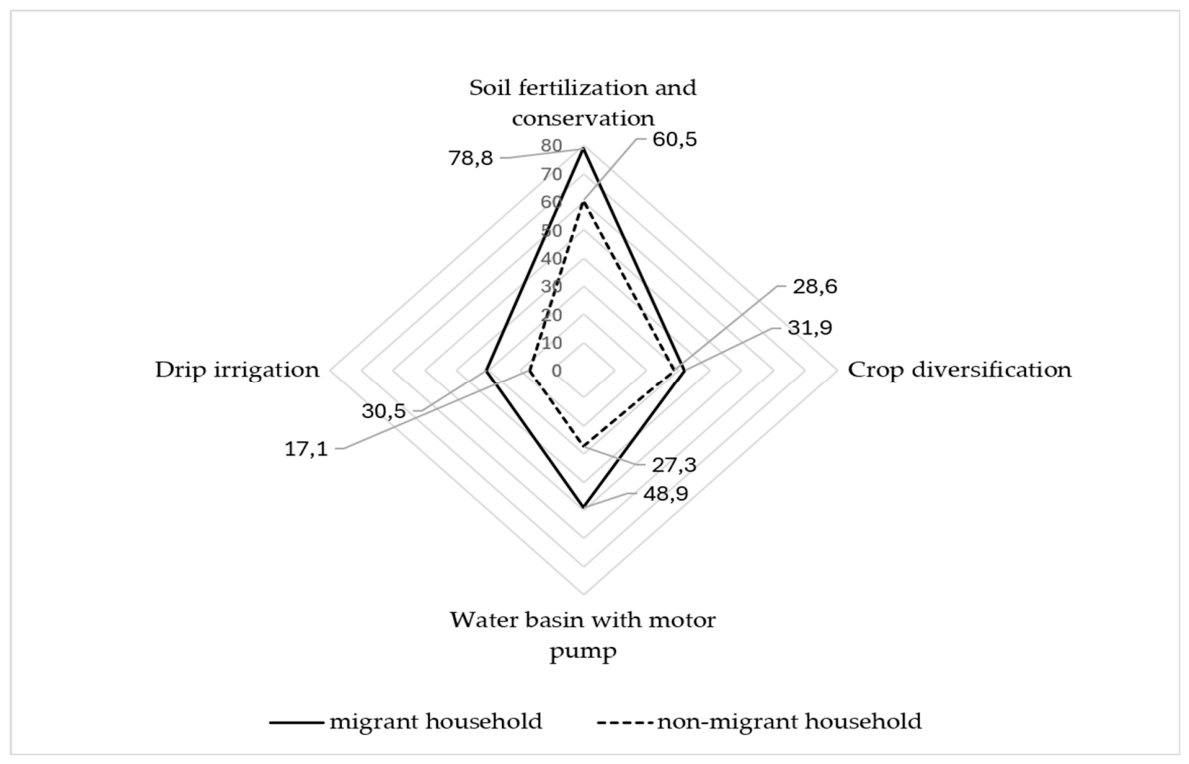
Figure 4.
Quantity produced in arboriculture by migratory status (in tons). Source : Author’s own elaboration, 2024 survey.
Figure 4.
Quantity produced in arboriculture by migratory status (in tons). Source : Author’s own elaboration, 2024 survey.
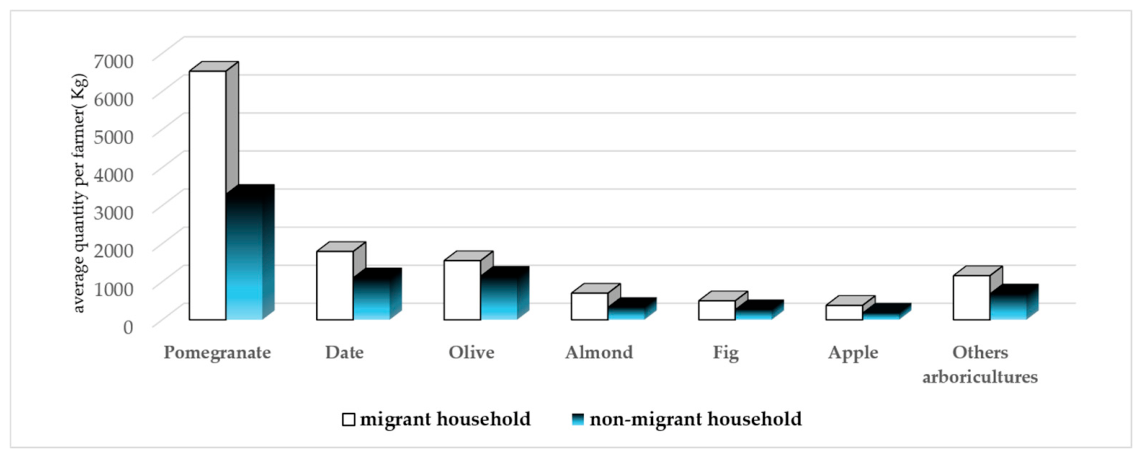
Figure 5.
Quantity produced in herbaceous crops by migratory status (in tons). Source: Author’s own elaboration, 2024 survey.
Figure 5.
Quantity produced in herbaceous crops by migratory status (in tons). Source: Author’s own elaboration, 2024 survey.
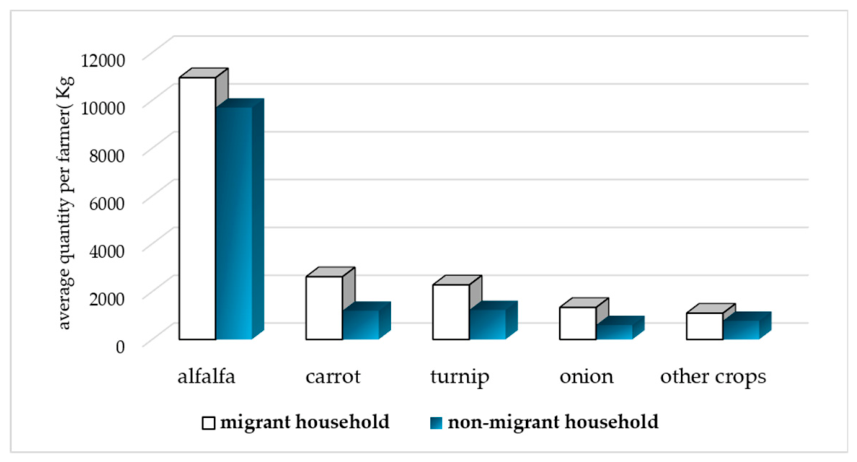

Table 1.
Climate change adaptation practices.
| Practices | Justification in the literature |
| Soil fertilization and conservation equipment(inputs, fertilizer spreader, micro tiller, hoe, disc plough, etc.) | Fertilizing the soil with organic and mineral inputs, combined with reduced tillage, helps optimize agricultural yields and reduce environmental impacts [18]. |
| Water basin with motor pump | Water accumulation from the irrigation network is collected through a water basin connected to a motor pump [20]. |
| Drip irrigation | Drip irrigation is a technique that helps save water and optimize production [14,16,47]. |
| Crop diversification (new varieties of fruit trees and high resilience, high value vegetable crops) | Crop diversification is an adaptation strategy that can strengthen the resilience of production systems [48,49,50]. |
Table 2.
Description of the Model Variables.
| Variables | Type of Variable | Codes |
| - Capital (in TND) | Continuous | K |
| - Labor (number of hours) | Continuous | L |
| - Children under 15 (number) | Continuous | ENF15 |
| - Educated persons (number) | Continuous | EDUCAT |
| - Household size | Continuous | TAIL |
| -Migration | Dummy variable : 1 if the household has at least one migrant ; 0 otherwise | MIG |
Table 3.
Descriptive Statistics of Selected Demographic and Socio-Economic Characteristics of Surveyed Households.
Table 3.
Descriptive Statistics of Selected Demographic and Socio-Economic Characteristics of Surveyed Households.
| Qualitative Variables | Frequency | Rate (%) |
| Migration status - migrant household - non migrant household |
89 123 |
42 58 |
| Gender of household head - male - female |
206 6 |
97.17 2.83 |
| Lack of irrigation water resources -yes -no |
150 62 |
70.75 29.25 |
| Quantitative Variables | Mean | Standard deviation |
| - Age of household head (AGE) | 58.92 | 13.60 |
| - Household size (TAIL) | 5.47 | 1.96 |
| - Children under 15 (ENF15) | 0.87 | 1.31 |
| - Cultivated area (SUP) | 0.55 | 0,35 |
| - Educated persons (EDUCAT) | 1.90 | 1.43 |
Source: Author’s own elaboration, 2024 survey.
Table 4.
Model regression results.
 |
Disclaimer/Publisher’s Note: The statements, opinions and data contained in all publications are solely those of the individual author(s) and contributor(s) and not of MDPI and/or the editor(s). MDPI and/or the editor(s) disclaim responsibility for any injury to people or property resulting from any ideas, methods, instructions or products referred to in the content. |
© 2026 by the authors. Licensee MDPI, Basel, Switzerland. This article is an open access article distributed under the terms and conditions of the Creative Commons Attribution (CC BY) license (http://creativecommons.org/licenses/by/4.0/).
Copyright: This open access article is published under a Creative Commons CC BY 4.0 license, which permit the free download, distribution, and reuse, provided that the author and preprint are cited in any reuse.


