

Submitted:
15 July 2026
Posted:
16 July 2026
You are already at the latest version
Abstract
Urban planetary health describes the dependence of human health on the ecological systems affected by urbanisation. Yet this relationship remains difficult to translate into planning and design, especially when human experience, ecological condition, biodiversity and environmental exposure must be assessed together. This conceptual framework article develops the Urban Planetary Health Experience-Ecology Framework (UPHEx-Eco) from a targeted critical synthesis spanning urban health, planetary health, One Health, healthy sustainable cities, urban ecology, environmental psychology, ergonomics, urban design and multimodal assessment. The framework is organised around the design relation: an evaluable link between a modifiable urban design variable, a human-experience response and an ecological-health response. By examining both responses in relation to the same design decision, UPHEx-Eco makes it possible to identify synergies, trade-offs and perceptual-ecological mismatches. It connects planetary pressures and urban living systems to design decisions, multispecies exposure, evidence, interpretation, actionable outputs and longer-term urban planetary health outcomes. A biodiverse urban park illustrates the framework's practical logic, and a methodological agenda identifies priorities for integrated assessment, ecological monitoring, interpretable decision support, ethical data governance and justice-oriented urban design.
Keywords:
urban planetary health
; sustainability
; urban design
; urban planning
; ecological health
; biodiversity
; human experience
; green infrastructure
; evidence-based design
; multimodal evidence
1. Introduction
Cities are critical to the future of planetary health. They concentrate population, infrastructure, economic activity, environmental exposure and social inequality, while shaping everyday relations between people, ecosystems and the built environment. Urbanisation can intensify heat, air pollution, noise, flooding, biodiversity loss, habitat fragmentation and unequal access to healthy environments. It also creates opportunities to reconsider mobility, public space, green-blue infrastructure, ecological connectivity and human-nature relations in ways that benefit both human wellbeing and ecological vitality.
Urban health research has long established that health is shaped not only by healthcare systems but also by housing, transport, land use, air quality, noise, heat, social conditions, green space and public policy [1,2,3,4]. Planetary health extends this argument by placing human health within the integrity of natural systems [1]. Urban planetary health brings the two perspectives together: cities are both sources of planetary pressure and places where those pressures are experienced, mediated and, potentially, transformed [5,6].
For planning and design, recognising this interdependence is only a starting point. The more difficult task is to translate it into decisions that can be examined and revised. Relevant indicators and methods already exist, but they are often organised by discipline. Healthy sustainable city research has developed spatial and policy indicators for walkability, transport, land-use mix and access to green space [7,8,9]. Urban ecology and biodiversity research assess habitat quality, vegetation structure, species richness, connectivity, soil and water. Environmental psychology, ergonomics and human-centred design examine perception, comfort, stress, restoration, safety, behaviour and embodied experience [10,11,12,13,14,15,16].
The problem, then, is not a shortage of indicators. It is that evidence from these domains is seldom brought together around the same design decision. An accessible green space may be ecologically poor. A biodiverse landscape may provide valuable habitat but be interpreted as unsafe or neglected. Lighting may improve orientation while disrupting nocturnal species. A walkable street may remain unused because it is hot, noisy or stressful. Isolated measures cannot explain these relations. Urban planetary health needs evidence that shows how specific design choices shape human and ecological outcomes at the same time.
Human-ecological design evidence is defined here as evidence linking a modifiable urban design variable to both a human-experience response and an ecological-health response. Ecological health refers here to the condition and capacity of urban living systems to sustain biodiversity, habitat functions, vegetation vitality, soil and water processes, and ecological connectivity over time. This evidence can show whether a decision produces a synergy, creates a trade-off or exposes a mismatch between human perception and ecological condition. Vegetation density, for example, may influence restoration, perceived safety and habitat complexity; tree canopy may affect thermal comfort, habitat value and tree vitality; and lighting may support orientation while altering conditions for nocturnal species.
The article's main contribution is the design relation: an evaluable connection between a modifiable urban design variable, a human-experience response and an ecological-health response. The design relation is an analytical and evaluative unit rather than an assumption of causality: the same modifiable variable is examined in relation to separately assessed human and ecological responses. Existing approaches provide valuable human, ecological, spatial and policy evidence, but these forms of evidence are not consistently organised around the same decision. Human and ecological outcomes can therefore be reported in parallel without showing where they reinforce one another, where they conflict or where perception diverges from ecological condition.
The aim is to develop the Urban Planetary Health Experience-Ecology Framework (UPHEx-Eco) as a conceptual structure for organising these relations. UPHEx-Eco connects planetary pressures, urban living systems, design decisions, multispecies exposure, human experience, ecological health, multimodal evidence, interpretation and actionable outputs. It is intended to support planning, design, maintenance and monitoring decisions that consider human wellbeing and ecological vitality together.
2. Materials and Methods: Targeted Critical Synthesis and Framework Development
This article was developed as a conceptual framework informed by a targeted critical synthesis. The synthesis was used to identify conceptual, methodological and translational gaps that hinder the use of urban planetary health in planning and design; it was not intended as an exhaustive evidence map. This approach reflects the article's purpose: to construct a framework that can guide subsequent operationalisation, rather than to provide a systematic review, meta-analysis or empirical case study.
The synthesis covered the fields most directly related to the translation of urban planetary health into design evidence. These included urban and planetary health, One Health, EcoHealth, healthy sustainable cities, green-space quality, urban biodiversity, environmental psychology, green infrastructure, artificial light at night, ecological legibility and environmental justice. Methodological literature on immersive simulation, eye tracking, biosensing, geographic information systems (GIS), remote sensing and computational urban assessment was also considered.
Selection was purposive. Foundational texts were used to establish the conceptual boundary of the framework; reviews were used to identify recurrent gaps; empirical studies were selected when they illustrated human-ecological synergies, trade-offs or mismatches; and methodological papers informed the integration of subjective, behavioural, physiological, spatial, environmental and ecological evidence. The objective was theory building, not comprehensive coverage.
The literature was compared iteratively rather than through a formal systematic-review protocol for searching, screening and quality appraisal. Three questions guided the comparison: whether human and ecological evidence was considered within the same urban design problem; whether that evidence was linked to variables that planners or designers can modify; and whether the findings could inform design, maintenance or monitoring. The synthesis therefore supports framework construction, but it cannot establish the completeness, prevalence or comparative strength of evidence across the fields examined.
OpenAI ChatGPT (GPT-5.6 Thinking; accessed in July 2026) was used during manuscript preparation to support literature organisation, conceptual synthesis, outline development, and language and structural refinement. It was not used to generate empirical data or conduct statistical analyses. All references, arguments, methodological claims and final wording were reviewed and approved by the author.
Framework development proceeded in four steps (Table 1). The first established the conceptual boundary by comparing how the selected fields describe relations between cities, human wellbeing and ecological systems. The second identified recurrent gaps in the connection between human experience, ecological health and urban design decisions. The third translated those gaps into framework layers and relational design questions. The fourth used a biodiverse urban park to illustrate how the framework can organise evidence and design responses. This example demonstrates the logic of application; it does not validate the framework empirically.
3. Conceptual Positioning: From Integrated Human-Ecological Approaches to Design-Actionable Urban Planetary Health
3.1. From Urban Health to Urban Planetary Health
Urban health examines how physical, social, environmental, economic and political features of cities affect human health. Its practical strength lies in population indicators, exposure assessment, spatial analysis and policy frameworks [2,3,4]. Ecological systems and biodiversity, however, are often treated primarily as determinants of human health rather than as dimensions whose condition must also be assessed.
Planetary health widens the frame by making human health dependent on ecological stability and the integrity of natural systems [1]. This is essential, but the scale of the concept can make it difficult to apply to particular design decisions. Streets, parks, lighting, materials, vegetation, water, density, mobility, maintenance and governance are decided locally. Urban planetary health therefore requires a bridge between planetary pressures and situated urban action.
3.2. One Health, EcoHealth and Multispecies Urban Systems
One Health and EcoHealth are important neighbouring frameworks because they challenge narrowly human-centred accounts of health and emphasise interdependence among humans, animals, plants and ecosystems [17,18]. This perspective is directly relevant to cities, which are not only built settings for people but also habitats, corridors, refuges and disturbance zones for other forms of life.
Their relational perspective does not, however, automatically produce urban design criteria. One Health may concentrate on zoonotic disease, biosecurity or veterinary-public-health interfaces, while EcoHealth may remain at a broad systems level. For urban design, the relation must be expressed through questions such as how lighting affects perceived safety and nocturnal species, how vegetation structure affects restoration and habitat, how maintenance shapes perceived care and biodiversity, or how water systems influence human experience and aquatic ecological condition.
3.3. Indicators Are Necessary but Insufficient
Healthy and sustainable city research has translated broad health and sustainability goals into measurable indicators. Walkability, accessibility, public transport, density, air quality, proximity to green space and policy indicators are indispensable for monitoring urban conditions and supporting public-health-oriented planning [7,8,9].
Their limitation appears when separate indicators are treated as sufficient accounts of a place. Access to green space does not show whether the space is safe, restorative, biodiverse, thermally comfortable or ecologically functional. Canopy cover says little by itself about tree health, habitat value or species diversity. Walkability does not establish that walking is pleasant, shaded, quiet or restorative. The indicators become more useful for urban planetary health when they are connected through a design relation.
3.4. Human Experience Is Essential but Partial
Urban environments are experienced through perception, attention, comfort, stress, memory, movement, safety, social interaction and bodily response. Environmental psychology, nature-health research and ergonomics are therefore central to urban planetary health because they provide ways to study lived and embodied experience [10,11,12,13,14,15,16]. An intervention may perform well technically or ecologically and still fail if people find it unsafe, illegible, uncomfortable or meaningless.
Experience remains only one part of the assessment. A preferred landscape may be ecologically simplified; a visually ordered green space may support little biodiversity; and high illumination may increase perceived safety while disturbing nocturnal species. Human-centred design is not discarded, but its evidential boundary is made explicit. Human experience must be examined alongside ecological condition rather than used as a substitute for it.
3.5. Integrated Human-Ecological Approaches and the Remaining Design-Translation Gap
Recent work has already moved beyond separate human and ecological assessments. Felappi et al. [19] proposed a One Health framework connecting green-space quality, mental health and wildlife support, with explicit attention to synergies and trade-offs. Prioreschi et al. [20] used systems thinking to map interdependencies between the use of urban natural spaces and biodiversity and to inform their design and management. Felappi et al. [21] then examined park qualities in relation to perceived restorativeness and wildlife support, providing empirical evidence of both convergence and conflict. These studies show that human use, wellbeing, biodiversity and wildlife support cannot be evaluated as independent domains.
More recent contributions extend this integration. Sargolini et al. [22] brought together urban design, healthy habits and socio-ecological networks within a One Health and well-being framework, linking thematic perspectives to urban-design levers and measurable indicators. Sulieman et al. [23] used the Resource Nexus to show that urban planetary health depends on coordinated environmental-resource management and multi-level governance capable of maximising synergies and limiting trade-offs. Miguez et al. [24] related the physical attributes and human utility of 639 urban greenspaces to relative species richness, finding that some amenities and landscape features can support both human use and biodiversity.
These advances strengthen the case for integration but leave a specific design-translation problem. UPHEx-Eco focuses on that problem. Its unit of analysis is neither the green space nor the indicator set in itself, but the relation between a modifiable design variable and paired human and ecological responses. The same variable - vegetation density, tree canopy, lighting, water or maintenance - is examined across both domains. The framework also separates mismatch from trade-off: a mismatch occurs when perception or preference does not correspond to measured ecological condition, whereas a trade-off arises when a design decision has divergent consequences. The contribution lies in organising existing forms of evidence for interpretation, action, monitoring and redesign.

Table 2.
Positioning of UPHEx-Eco in relation to existing approaches.
| Existing approach | Main contribution | Limitation for design-actionable urban planetary health | What UPHEx-Eco adds |
| Urban health | Identifies urban determinants of human health and supports policy-oriented indicators. | Ecological systems are often treated mainly as determinants of human health. | Integrates ecological health as an explicit dimension of urban design evidence. |
| Planetary health | Shows that human health depends on the integrity of natural systems. | Often operates at macro scales and can remain difficult to translate into situated design decisions. | Links planetary pressures to modifiable urban design variables. |
| One Health / EcoHealth | Foregrounds interdependence between human, animal, plant and ecosystem health. | May remain focused on disease interfaces or broad systems relations rather than spatial design criteria. | Converts human-ecological interdependence into design relations that can be evaluated. |
| Healthy sustainable cities | Provides measurable spatial and policy indicators for monitoring healthier urban development. | Indicators may remain parallel and insufficiently relational. | Organises indicators around synergies, trade-offs and mismatches between human and ecological outcomes. |
| Urban ecology | Measures biodiversity, habitat quality and ecological connectivity. | May not integrate perception, comfort, use, safety or acceptance. | Links ecological condition to human experience and design action. |
| Evidence-based design | Supports decisions informed by evidence. | Often remains human-centred and may underrepresent biodiversity and ecological vitality. | Expands design evidence toward human and ecological outcomes together. |
| One Health green-infrastructure frameworks [19] | Integrate green-space quality, mental health and wildlife support and identify synergies and trade-offs. | Primarily organised around green-infrastructure qualities and human-wildlife outcomes rather than a general unit linking each modifiable design decision to paired response domains. | Uses the design relation to structure human and ecological evidence around the same modifiable urban design variable. |
| Urban natural-space systems and park studies [20,21,24] | Map interdependencies between use and biodiversity and empirically examine park or greenspace attributes associated with human utility, restorativeness and wildlife support. | Provide systems-level or site-specific evidence without a general sequence for translating each relation into design, monitoring and redesign across urban contexts. | Extends these findings into a common pathway from design decision and multispecies exposure to evidence, interpretation and action. |
| One Health and socio-ecological urban-design frameworks [22] | Integrate urban design, healthy habits and socio-ecological networks and link design levers to human and environmental well-being indicators. | Organised around thematic and behavioural-health perspectives rather than a transferable analytical unit pairing each design variable with separately assessed human and ecological responses. | Defines the design relation as the organising unit and distinguishes trade-offs from perceptual-ecological mismatches. |
4. Results: The UPHEx-Eco Framework
The Urban Planetary Health Experience-Ecology Framework (UPHEx-Eco) is a conceptual structure for translating urban planetary health into human-ecological design evidence. As shown in Figure 1, it connects planetary pressures and urban living systems to design decisions, multispecies exposure, human experience, ecological health, evidence, interpretation, actionable outputs and longer-term urban planetary health outcomes. Computational support may be used during interpretation, but it is not a requirement of the framework.
At the centre of UPHEx-Eco is the design relation linking a modifiable urban design variable to a human-experience response and an ecological-health response. This relation provides a way to move from broad urban planetary health principles to evidence relevant to design. It may indicate a synergy, as when tree canopy supports thermal comfort and habitat value; a trade-off, as when lighting improves perceived safety but disrupts nocturnal species; or a mismatch, as when visually preferred greenness does not correspond to ecological quality.
UPHEx-Eco neither replaces established approaches nor claims to be the first to integrate human and ecological concerns. It develops prior work [19,20,21,22,23,24] by making the design relation the organising unit and by connecting evidence to planning, design, maintenance, monitoring and redesign. The resulting question is more specific than whether an environment is healthy, green or sustainable: which modifiable decisions support human wellbeing and ecological vitality, and under what conditions?
4.1. Framework Layers
Figure 1 represents a conceptual sequence, not a deterministic causal model. Its arrows show proposed pathways from planetary pressures and urban design decisions to multispecies exposure, evidence and design response. Human experience and ecological health are assessed against the same design variable; no direct causal relationship between them is assumed. Measures of experience are treated as proximal perceptual, behavioural or physiological responses, whereas urban planetary health outcomes are longer-term and context dependent. Interpretation remains a human responsibility, with computational methods used only as optional support.
Table 3.
Functional structure and rationale of the UPHEx-Eco Framework.
| Layer | Function | Design implication |
| Planetary pressures | Climate change, biodiversity loss, pollution, heat, water stress and resource depletion define the macro-level challenges that urban design must address. | Define the sustainability challenges that interventions should respond to. |
| Urban living systems | Cities are understood as systems involving humans, animals, plants, soils, water, microorganisms, infrastructures and governance arrangements. | Prevent the city from being treated only as a human setting. |
| Urban design decisions | Mobility, density, public space, lighting, materials, vegetation, water, maintenance and governance translate planetary pressures into spatial conditions. | Identify variables that designers and planners can modify. |
| Multispecies exposure | Heat, noise, air pollution, artificial light, habitat fragmentation, soil degradation and water stress affect humans and non-human life in different ways. | Analyse exposure as shared but differentiated across species and populations. |
| Human experience | Perceived safety, comfort, restoration, attention, behaviour, wayfinding and decision-making capture proximal ways in which people experience and use urban environments; they are not, by themselves, equivalent to health outcomes. | Identify whether interventions are usable, acceptable, legible and potentially supportive of wellbeing. |
| Ecological health | Biodiversity, habitat quality, vegetation vitality, pollinators, soil health, water quality and ecological connectivity capture the condition of urban living systems. | Move ecological data from background diagnosis to design criteria. |
| Multimodal evidence | Subjective, behavioural, physiological, visual, environmental, ecological and spatial data allow triangulation of urban experience and ecological performance. | Reveal convergence, divergence or uncertainty between evidence domains. |
| Interpretation and decision support | Human-led synthesis compares evidence, scenarios and trade-offs; computational or artificial intelligence (AI)-supported methods may assist when they remain interpretable and design-relevant. | Keep decision support traceable to evidence and design choices. |
| Design-actionable outputs | Evidence should be translated into design criteria, planning recommendations, monitoring protocols and intervention priorities. | Connect evidence to form, material, vegetation, lighting, governance and monitoring. |
| Urban planetary health outcomes | Longer-term and context-dependent outcomes include human wellbeing, ecological vitality, biodiversity, resilience, equity and regeneration. | Evaluate whether interventions support people and ecological systems together over time. |
5. Design Relations: Synergies, Trade-Offs and Mismatches
The framework is most useful in design problems where human and ecological responses may align, diverge or need to be negotiated. The following discussion focuses on four recurring domains: the relation between green-space quality, biodiversity and perception; artificial lighting and nocturnal disruption; urban meadows and ecological legibility; and the justice implications of urban greening.
Research on green-space quality shows that health benefits depend on more than presence or proximity. Vegetation, amenities, water, size, maintenance, accessibility and perceived quality all matter [25]. Evidence linking urban biodiversity and human health is promising but remains complex, particularly regarding which forms of biodiversity matter and how their effects vary across cultural and spatial contexts [26]. Recent empirical work also indicates that some physical attributes of urban greenspaces can support both human utility and relative species richness, although the overall relationship between the two domains may remain weak [24]. Visual greenness, perceived quality and ecological health should therefore not be treated as interchangeable.
Urban meadows, spontaneous vegetation and biodiverse planting make the issue of ecological legibility particularly visible. Biodiverse perennial meadows can have aesthetic value and improve residents' assessment of site quality [27], while replacing short-mown grass with meadow treatments can support distinctive invertebrate and microbial communities [28]. Ecological richness may nevertheless be read as disorder, neglect or danger when intentionality and care are not visible. Nassauer's cues to care show how edges, paths, signage, seasonal interpretation and visible maintenance can mediate between ecological function and public acceptance [29].
Artificial light at night presents a more direct trade-off. It can support orientation, perceived safety and night-time walking [30,31], but it can also disturb insects, birds, bats and wider ecosystem processes [32,33]. Within UPHEx-Eco, lighting is therefore considered a multispecies exposure as well as a technical and safety matter. Its design requires attention to intensity, shielding, timing and context.
Urban greening also has a distributive and procedural dimension. Green space may improve public health and environmental quality while contributing to exclusion, rising property values or displacement when equity is ignored [34,35,36]. Justice is therefore treated as a condition of design action, not as a topic added afterwards. The relevant questions are who receives the benefits of cooling, safety, access and restoration; which species, habitats and processes are protected or sacrificed; and who participates in design, monitoring, maintenance and evaluation.
Table 4.
Examples of design variables as relational human-ecological evidence.
| Design variable | Human dimension | Ecological dimension | Relation | Design implication |
| Tree canopy | Thermal comfort, walking intention, restoration. | Habitat, cooling, tree vitality, pollinators. | Potential synergy. | Species selection, shade planning, soil protection and long-term care. |
| Vegetation density | Restoration, shade, naturalness; possible safety concerns. | Habitat complexity, biodiversity, connectivity. | Synergy/trade-off. | Balance visibility, legibility and habitat complexity. |
| Artificial lighting | Perceived safety, orientation, night-time use. | Light pollution, nocturnal disruption. | Trade-off. | Adaptive, shielded, low-intensity and time-sensitive lighting. |
| Urban meadows | Aesthetic acceptance, perceived care, ecological understanding. | Pollinators, plant diversity, habitat value. | Synergy/trade-off. | Clear edges, signage, paths and maintenance cues. |
| Blue infrastructure | Restoration, cooling, sensory pleasure. | Water quality, aquatic habitat, drainage. | Potential synergy. | Water-sensitive design integrating human use and ecological function. |
| Urban greening | Health benefits, recreation, climate adaptation. | Habitat, biodiversity, cooling. | Justice trade-off. | Just-green-enough strategies, anti-displacement safeguards and participatory planning. |
6. Illustrative Application: Biodiverse Urban Park
The biodiverse urban park is used here to clarify how UPHEx-Eco could inform design or redesign. The example is deliberately illustrative rather than empirical. It shows how a single setting can be framed through design questions, human and ecological evidence, and outputs that can guide intervention.
A conventional assessment might focus on whether the park is accessible, attractive or well used; an ecological assessment might focus on species richness, habitat quality or pollinators. UPHEx-Eco combines these concerns in one question: under which spatial, sensory, ecological and management conditions can the park support restoration, perceived safety, inclusive use, biodiversity, habitat continuity and ecological legibility?
Relevant design variables include vegetation density, tree canopy, wildflower meadows, lighting, water features, paths, edges, seating, signage and maintenance. Human evidence may address perceived safety, restoration, comfort, visual preference, route choice, dwell time, ecological understanding and inclusive use. Ecological evidence may address pollinators, vegetation diversity, habitat continuity, soil condition, tree vitality, water quality and nocturnal disturbance. The intended output is not a composite score but a set of criteria through which safety, restoration, biodiversity, maintenance, accessibility and ecological function can be considered together.
The example also clarifies the practical significance of perceptual-ecological mismatch. An area with high biodiversity value may be read as neglected when paths, edges or other signs of care are absent. A highly manicured area may be perceived as safe and attractive while offering limited habitat value. The design task is to make ecological complexity legible without reducing it to conventional manicured aesthetics.
Table 5.
Illustrative application of UPHEx-Eco to a biodiverse urban park.
| Design issue | Human evidence | Ecological evidence | Potential tension | Design response |
| Dense vegetation | Restoration, shade, visual preference, perceived safety, route choice. | Habitat complexity, bird/insect presence, pollinator support, ecological connectivity. | High habitat value may reduce perceived visibility or safety. | Combine habitat zones with clear paths, sightlines, edges and cues to care. |
| Wildflower meadow | Perceived naturalness, care, aesthetic acceptance, ecological understanding. | Pollinators, plant diversity, reduced mowing, seasonal habitat. | Biodiverse planting may be interpreted as neglect. | Use signage, mown edges, seasonal interpretation and visible maintenance cues. |
| Lighting | Orientation, perceived safety, night-time use, visual comfort. | Light spill, insect disruption, bird/bat disturbance, dark corridor needs. | More light may improve perceived safety but harm nocturnal ecology. | Apply adaptive, shielded, low-intensity and time-sensitive lighting. |
| Water feature | Restoration, sensory pleasure, cooling, dwell time. | Aquatic habitat, water quality, drainage, microclimate. | High amenity value requires maintenance and water-quality control. | Integrate water-sensitive design, ecological planting and maintenance monitoring. |
| Maintenance regime | Perceived care, trust, usability, acceptance of wilder areas. | Habitat continuity, reduced mowing, vegetation vitality, soil protection. | Ecological management may conflict with conventional expectations of neatness. | Design maintenance as communication: edges, paths, interpretation, seasonal care and community involvement. |
7. Methods for Applying UPHEx-Eco
UPHEx-Eco does not prescribe a fixed method, and technology is not treated as a solution in itself. Methods are selected in relation to the design question. Multimodal evidence is justified only when it clarifies the relation among the design variable, human experience, ecological condition and environmental exposure.
Surveys, interviews and preference scales can document perceived safety, comfort, restoration, naturalness and ecological understanding. Observation can record route choice, dwell time, avoidance, use of shade, seating and social activity. Eye tracking can examine attention to vegetation, paths, signage, concealed areas, facades and safety cues. Biosensing may contribute evidence of arousal, stress or recovery, but physiological signals require triangulation and cannot be read as direct measures of emotion or wellbeing.
Virtual reality (VR) and other immersive virtual environments allow design variables such as vegetation density, lighting, traffic, materials, shade, soundscape and layout to be manipulated before implementation [37]. They should complement, not replace, field validation. Ecological monitoring - including vegetation surveys, species inventories, pollinator counts, habitat mapping, soil analysis and water-quality testing - is also necessary; otherwise, ecological health risks being reduced to perceived greenness.
Computational analysis may help interpret heterogeneous evidence across scales. Street-view imagery and deep learning, for example, have been used to estimate perceived psychological stress in built environments [38]. Such methods are optional within UPHEx-Eco and are justified only when their contribution is transparent, interpretable and relevant to design. They support judgement; they do not automate urbanism.
Table 6.
Method families for applying UPHEx-Eco.
| Method family | What it measures well | Main limitation | Contribution to UPHEx-Eco |
| Surveys/interviews | Perception, comfort, safety, restoration, ecological understanding. | Subjective and context-dependent. | Human-experience layer. |
| Behavioural observation | Use, dwell time, route choice, avoidance. | Sensitive to time, weather and social norms. | Behavioural evidence. |
| Eye tracking | Visual attention and spatial legibility. | Does not directly measure preference or meaning. | Visual-perceptual evidence. |
| Biosensing | Arousal, stress, recovery, embodied response. | Requires triangulation and ethical safeguards. | Physiological evidence. |
| VR/immersive simulation | Controlled scenario testing before implementation. | Requires field validation and ecological realism. | Pre-implementation design testing. |
| Ecological monitoring | Biodiversity, habitat, vegetation, soil, water. | May require long-term observation and specialist expertise. | Ecological-health layer. |
| GIS/remote sensing | Spatial exposure, canopy, accessibility and connectivity. | May miss lived experience and micro-scale quality. | Spatial evidence. |
| Computational/AI-supported analysis | Large-scale classification, prediction and scenario comparison. | Risk of opacity, bias and weak design translation. | Optional interpretation and decision support. |
8. Discussion
8.1. Theoretical Implications
UPHEx-Eco treats urban planetary health as a problem of relational design evidence rather than only as a systems-level health concept. The distinction is consequential for urban design. Green-space presence, canopy cover, park accessibility or biodiversity indicators do not, in isolation, explain how a place is produced through design, maintenance, governance and everyday use. The framework draws attention to these relations.
This position extends human-centred design without treating human preference as the final criterion. Safety, usability, restoration and meaning remain essential because they influence whether an intervention is accepted and used. They are nevertheless proximal experiential and behavioural measures, not direct proxies for longer-term health outcomes. Ecological condition is assessed alongside them and retains its own evidential status.
8.2. Methodological Implications
Methodologically, human experience and ecological health are assessed within the same design problem. The rationale for multimodal evidence is therefore relational, not technological. A study of vegetation density might combine perceived safety, route choice, visual attention and restoration with habitat complexity and species presence. A lighting study might examine perceived safety, visual comfort and night-time behaviour together with ecological disruption. The relevant methods follow from the relation being tested.
Interpretation remains human-led. Computational methods may assist classification, prediction, image analysis or scenario comparison, but only when their assumptions and outputs can be understood in relation to the design problem. Technical sophistication is not a substitute for design relevance.
8.3. Implications for Urbanism and Sustainable Urban Design
From an urbanism perspective, UPHEx-Eco treats spatial, material, infrastructural and management decisions as mechanisms through which planetary pressures become situated multispecies exposures. Mobility, density, public space, lighting, materials, vegetation, water, maintenance and governance are not background conditions in the framework; they are variables that can be modified and examined through human and ecological evidence.
This position connects diagnosis to intervention. In green-space planning, it shifts attention from access and size alone to quality, biodiversity, safety, ecological function and maintenance. In lighting design, it places perceived safety and orientation alongside the protection of nocturnal species. In urban greening, it requires health and ecological benefits to be considered together with exclusion and displacement. Monitoring and redesign continue the process after implementation, allowing criteria and management priorities to change when the evidence changes.
For sustainability research, the framework provides a common decision logic across environmental, social and technical concerns. Climate adaptation, biodiversity, environmental exposure, human wellbeing, procedural justice and design governance are not collapsed into one indicator; they are connected through the design relation. This makes the framework relevant both to research design and to applied urban planning.
9. Methodological Agenda for Future Research
Future research should test and refine UPHEx-Eco through studies that assess human and ecological responses within the same design problem. Table 7 identifies the methodological priorities arising from the framework.
10. Limitations
UPHEx-Eco is not a predictive model and has not yet been validated empirically. It is a conceptual framework intended to guide research, design evaluation and methodological development. Its usefulness must be examined across different cities, climates, cultures, populations and ecological contexts.
The targeted critical synthesis was undertaken to construct the framework, not to map the full evidence base. The selected literature was used to identify recurring conceptual, methodological and translational gaps; it cannot establish how evidence is distributed or how strong it is across the field. Because selection was purposive and did not include a formal systematic search, screening process or quality appraisal, relevant approaches may be absent or underrepresented. Formal scoping or systematic reviews, comparative cases, empirical interventions and longitudinal post-intervention studies are required to test and refine UPHEx-Eco.
The proposed methods also raise practical and ethical difficulties. Biosensing, eye tracking, global positioning system (GPS) tracking, behavioural observation, computer vision and computational analysis can produce sensitive data and require informed consent, anonymisation, data minimisation, secure storage, transparency, bias auditing and firm limits on surveillance-oriented use. Ecological monitoring brings a different challenge: it requires specialist expertise and a commitment that often extends beyond the initial design or research period.
11. Conclusions
Urban planetary health becomes more useful for planning and design when human and ecological evidence can be examined together without being conflated. Urban health indicators, ecological assessment, environmental psychology, ergonomics, immersive simulation, biosensing, eye tracking, GIS and computational analysis all contribute relevant evidence. Their value depends on whether they are organised around a clearly defined design relation.
UPHEx-Eco provides that organising structure. It links planetary pressures and urban living systems to modifiable design decisions, multispecies exposure, human experience, ecological health, evidence, interpretation and actionable outputs. In doing so, it moves the assessment from parallel indicators towards relational human-ecological design evidence.
The framework asks a precise question of urbanism: under which spatial, ecological, sensory, social and governance conditions can a design decision support human wellbeing and ecological vitality together? Structuring this question for empirical assessment, interpretation, monitoring and redesign is the article's principal contribution. The answer will depend on context, but the relation to be examined is made explicit.
Author Contributions
Conceptualization, F.R.; methodology, F.R.; investigation, F.R.; writing—original draft preparation, F.R.; writing—review and editing, F.R.; visualization, F.R. The author has read and agreed to the published version of the manuscript.
Funding
This work was financed by national funds through FCT—Fundação para a Ciência e a Tecnologia, I.P., under the Strategic Project references UIDB/04008/2020 and UIDP/04008/2020, and through the ITI/LARSyS FCT Pluriannual Funding 2020–2023 (UIDB/50009/2020).
Acknowledgments
During the preparation of this manuscript, the author used OpenAI ChatGPT to support literature searches and English-language refinement of the manuscript. All references and scientific claims were independently verified, and the author critically reviewed and revised the text and takes full responsibility for the final content.
Conflicts: of Interest: The author declares no conflicts of interest. The funders had no role in the conceptualization of the framework, the synthesis or interpretation of the literature, the writing of the manuscript, or the decision to publish the manuscript.
References
- Whitmee, S.; Haines, A.; Beyrer, C.; Boltz, F.; Capon, A.G.; de Souza Dias, B.F.; Ezeh, A.; Frumkin, H.; Gong, P.; Head, P.; et al. Safeguarding human health in the Anthropocene epoch: Report of The Rockefeller Foundation-Lancet Commission on planetary health. The Lancet 2015, 386, 1973–2028. [Google Scholar] [CrossRef] [PubMed]
- Galea, S.; Vlahov, D. Urban health: Evidence, challenges, and directions. Annu. Rev. Public Health 2005, 26, 341–365. [Google Scholar] [CrossRef] [PubMed]
- Rydin, Y.; Bleahu, A.; Davies, M.; Davila, J.D.; Friel, S.; De Grandis, G.; Groce, N.; Hallal, P.C.; Hamilton, I.; Howden-Chapman, P.; et al. Shaping cities for health: Complexity and the planning of urban environments in the 21st century. The Lancet 2012, 379, 2079–2108. [Google Scholar] [CrossRef] [PubMed]
- Giles-Corti, B.; Vernez-Moudon, A.; Reis, R.; Turrell, G.; Dannenberg, A.L.; Badland, H.; Foster, S.; Lowe, M.; Sallis, J.F.; Stevenson, M.; et al. City planning and population health: A global challenge. The Lancet 2016, 388, 2912–2924. [Google Scholar] [CrossRef] [PubMed]
- Patz, J.A.; Siri, J.G. Toward urban planetary health solutions to climate change and other modern crises. J. Urban Health 2021, 98, 311–314. [Google Scholar] [CrossRef] [PubMed]
- Pineo, H.; Audia, C.; Black, D.; French, M.; Gemmell, E.; Lovasi, G.S.; Milner, J.; Montes, F.; Niu, Y.; Pérez-Ferrer, C.; et al. Building a methodological foundation for impactful urban planetary health science. J. Urban Health 2021, 98, 442–452. [Google Scholar] [CrossRef] [PubMed]
- Tonne, C.; Adair, L.; Adlakha, D.; Anguelovski, I.; Belesova, K.; Berger, M.; Brelsford, C.; Dadvand, P.; Dimitrova, A.; Giles-Corti, B.; et al. Defining pathways to healthy sustainable urban development. Environ. Int. 2021, 146, 106236. [Google Scholar] [CrossRef] [PubMed]
- Lowe, M.; Adlakha, D.; Sallis, J.F.; Salvo, D.; Cerin, E.; Moudon, A.V.; Higgs, C.; Hinckson, E.; Arundel, J.; Boeing, G.; et al. City planning policies to support health and sustainability: An international comparison of policy indicators for 25 cities. Lancet Glob. Health 2022, 10, e882–e894. [Google Scholar] [CrossRef] [PubMed]
- Boeing, G.; Higgs, C.; Liu, S.; Giles-Corti, B.; Sallis, J.F.; Cerin, E.; Lowe, M.; Adlakha, D.; Hinckson, E.; Moudon, A.V.; et al. Using open data and open-source software to develop spatial indicators of urban design and transport features for achieving healthy and sustainable cities. Lancet Glob. Health 2022, 10, e907–e918. [Google Scholar] [CrossRef] [PubMed]
- Hartig, T.; Mitchell, R.; de Vries, S.; Frumkin, H. Nature and health. Annu. Rev. Public Health 2014, 35, 207–228. [Google Scholar] [CrossRef] [PubMed]
- Markevych, I.; Schoierer, J.; Hartig, T.; Chudnovsky, A.; Hystad, P.; Dzhambov, A.M.; de Vries, S.; Triguero-Mas, M.; Brauer, M.; Nieuwenhuijsen, M.J.; et al. Exploring pathways linking greenspace to health: Theoretical and methodological guidance. Environ. Res. 2017, 158, 301–317. [Google Scholar] [CrossRef] [PubMed]
- Twohig-Bennett, C.; Jones, A. The health benefits of the great outdoors: A systematic review and meta-analysis of greenspace exposure and health outcomes. Environ. Res. 2018, 166, 628–637. [Google Scholar] [CrossRef] [PubMed]
- Bratman, G.N.; Anderson, C.B.; Berman, M.G.; Cochran, B.; de Vries, S.; Flanders, J.; Folke, C.; Frumkin, H.; Gross, J.J.; Hartig, T.; et al. Nature and mental health: An ecosystem service perspective. Sci. Adv. 2019, 5, eaax0903. [Google Scholar] [CrossRef] [PubMed]
- Ulrich, R.S.; Simons, R.F.; Losito, B.D.; Fiorito, E.; Miles, M.A.; Zelson, M. Stress recovery during exposure to natural and urban environments. J. Environ. Psychol. 1991, 11, 201–230. [Google Scholar] [CrossRef]
- Kaplan, S. The restorative benefits of nature: Toward an integrative framework. J. Environ. Psychol. 1995, 15, 169–182. [Google Scholar] [CrossRef]
- Evans, G.W. The built environment and mental health. J. Urban Health 2003, 80, 536–555. [Google Scholar] [CrossRef] [PubMed]
- Lerner, H.; Berg, C. A comparison of three holistic approaches to health: One Health, EcoHealth, and Planetary Health. Front. Vet. Sci. 2017, 4, 163. [Google Scholar] [CrossRef] [PubMed]
- OHHLEP; Adisasmito, W.B.; Almuhairi, S.; Behravesh, C.B.; Bilivogui, P.; Bukachi, S.A.; Casas, N.; Cediel Becerra, N.; Charron, D.F.; Chaudhary, A.; et al. One Health: A new definition for a sustainable and healthy future. PLoS Pathog. 2022, 18, e1010537. [Google Scholar] [CrossRef]
- Felappi, J.F.; Sommer, J.H.; Falkenberg, T.; Terlau, W.; Kötter, T. Green infrastructure through the lens of One Health: A systematic review and integrative framework uncovering synergies and trade-offs between mental health and wildlife support in cities. Sci. Total Environ. 2020, 748, 141589. [Google Scholar] [CrossRef] [PubMed]
- Prioreschi, E.; Zimmermann, N.; Davies, M.; Pluchinotta, I. Interrelationships and trade-offs between urban natural space use and biodiversity. Sustainability 2024, 16, 4051. [Google Scholar] [CrossRef] [PubMed]
- Felappi, J.F.; Sommer, J.H.; Falkenberg, T.; Terlau, W.; Kötter, T. Urban park qualities driving visitors mental well-being and wildlife conservation in a Neotropical megacity. Sci. Rep. 2024, 14, 4856. [Google Scholar] [CrossRef] [PubMed]
- Sargolini, M.; Sopina, A.; Polci, V.; Mariani, D.; Paolini, C.; Mariani, M. Integrating Urban Design, Healthy Habits, and Socio-Ecological Networks: A One Health and Well-Being Framework for Sustainable Cities. Sustainability 2025, 17, 10014. [Google Scholar] [CrossRef]
- Sulieman, R.; Artmann, M.; Karthe, D.; Behnisch, M. Can the Resource Nexus guide improvements in urban planetary health? Insights from a literature review. Resour. Environ. Sustain. 2025, 20, 100224. [Google Scholar] [CrossRef]
- Miguez, N.G.; Mason, B.M.; Qiu, J.; Cao, H.; Callaghan, C.T. Urban greenspaces benefit both human utility and biodiversity. Urban For. Urban Green. 2025, 107, 128791. [Google Scholar] [CrossRef]
- Nguyen, P.-Y.; Astell-Burt, T.; Rahimi-Ardabili, H.; Feng, X. Green space quality and health: A systematic review. Int. J. Environ. Res. Public Health 2021, 18, 11028. [Google Scholar] [CrossRef]
- Wu, C.-C.; O'Keefe, J.; Ding, Y.; Sullivan, W.C. Biodiversity of urban green spaces and human health: A systematic review of recent research. Front. Ecol. Evol. 2024, 12, 1467568. [Google Scholar] [CrossRef]
- Southon, G.E.; Jorgensen, A.; Dunnett, N.; Hoyle, H.; Evans, K.L. Biodiverse perennial meadows have aesthetic value and increase residents' perceptions of site quality in urban green-space. Landsc. Urban Plan. 2017, 158, 105–118. [Google Scholar] [CrossRef]
- Norton, B.A.; Bending, G.D.; Clark, R.; Corstanje, R.; Dunnett, N.; Evans, K.L.; Grafius, D.R.; Gravestock, E.; Grice, S.M.; Harris, J.A.; et al. Urban meadows as an alternative to short mown grassland: Effects of composition and height on biodiversity. Ecol. Appl. 2019, 29, e01946. [Google Scholar] [CrossRef] [PubMed]
- Nassauer, J.I. Messy ecosystems, orderly frames. Landsc. J. 1995, 14, 161–170. [Google Scholar] [CrossRef]
- Rahm, J.; Sternudd, C.; Johansson, M. 'In the evening, I don't walk in the park': The interplay between street lighting and greenery in perceived safety. Urban Des. Int. 2021, 26, 42–52. [Google Scholar] [CrossRef]
- Portnov, B.A.; Saad, R.; Trop, T.; Kliger, D.; Svechkina, A. Linking nighttime outdoor lighting attributes to pedestrians' feeling of safety: An interactive survey approach. PLoS ONE 2020, 15, e0242172. [Google Scholar] [CrossRef]
- Owens, A.C.S.; Lewis, S.M. The impact of artificial light at night on nocturnal insects: A review and synthesis. Ecol. Evol. 2018, 8, 11337–11358. [Google Scholar] [CrossRef] [PubMed]
- Katabaro, J.M. A review of the effects of artificial light at night in urban areas on the ecosystem level and the remedial measures. Front. Public Health 2022, 10, 969945. [Google Scholar] [CrossRef] [PubMed]
- Wolch, J.R.; Byrne, J.; Newell, J.P. Urban green space, public health, and environmental justice: The challenge of making cities 'just green enough'. Landsc. Urban Plan. 2014, 125, 234–244. [Google Scholar] [CrossRef]
- Jelks, N.O.; Jennings, V.; Rigolon, A. Green gentrification and health: A scoping review. Int. J. Environ. Res. Public Health 2021, 18, 907. [Google Scholar] [CrossRef] [PubMed]
- Rigolon, A.; Németh, J. Green gentrification or 'just green enough': Do park location, size and function affect whether a place gentrifies or not? Urban Stud. 2020, 57, 402–420. [Google Scholar] [CrossRef]
- Birenboim, A.; Dijst, M.; Ettema, D.; de Kruijf, J.; de Leeuw, G.; Dogterom, N. The utilization of immersive virtual environments for the investigation of environmental preferences. Landsc. Urban Plan. 2019, 189, 129–138. [Google Scholar] [CrossRef]
- Han, X.; Wang, L.; Seo, S.H.; He, J.; Jung, T. Measuring perceived psychological stress in urban built environments using Google Street View and deep learning. Front. Public Health 2022, 10, 891736. [Google Scholar] [CrossRef] [PubMed]
Figure 1.
Urban Planetary Health Experience-Ecology Framework (UPHEx-Eco): conceptual pathways for organising human-ecological design evidence in urban planetary health. The arrows represent conceptual pathways and evidence flows rather than deterministic causal relations; artificial intelligence (AI) support is optional.
Figure 1.
Urban Planetary Health Experience-Ecology Framework (UPHEx-Eco): conceptual pathways for organising human-ecological design evidence in urban planetary health. The arrows represent conceptual pathways and evidence flows rather than deterministic causal relations; artificial intelligence (AI) support is optional.
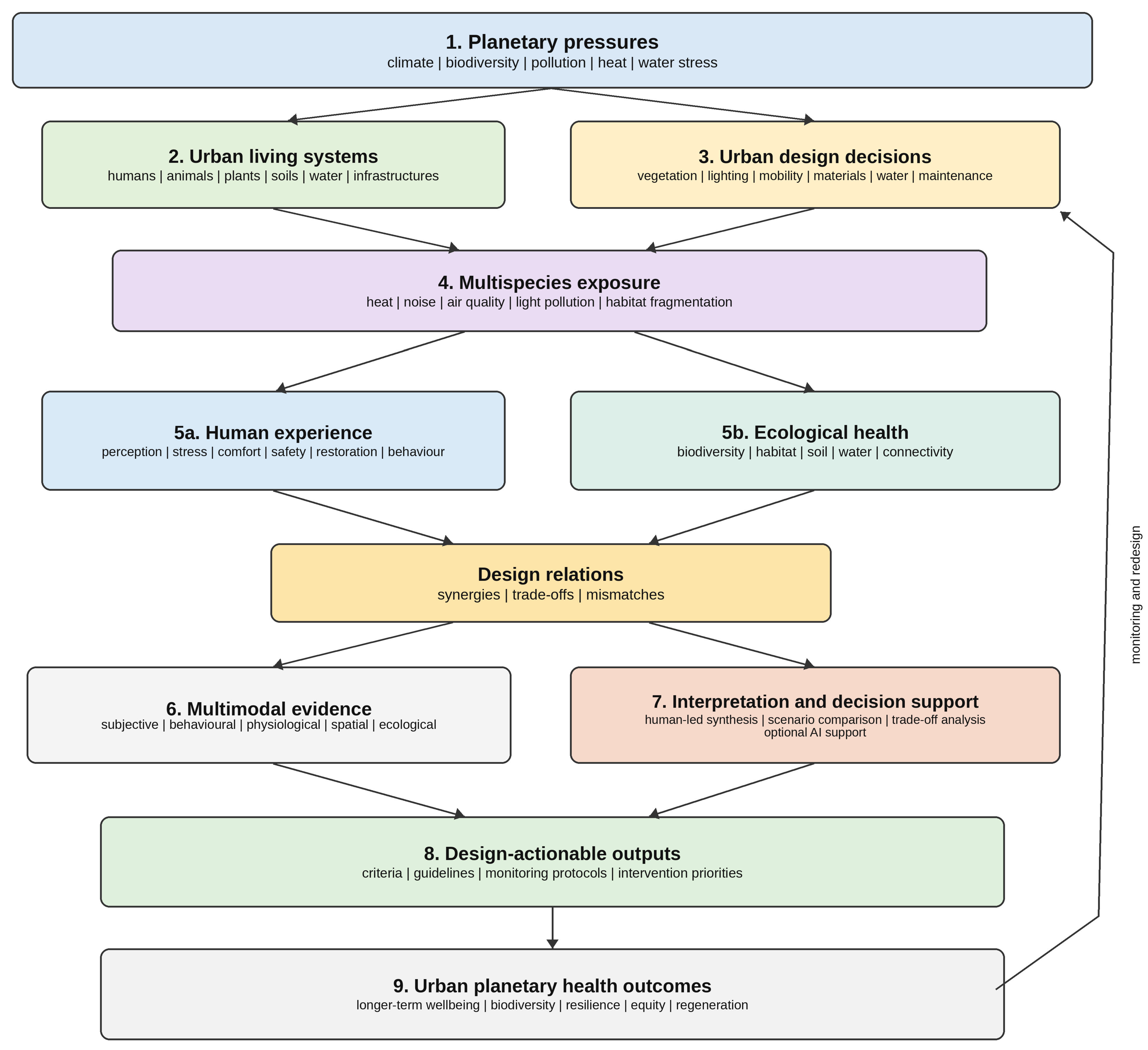
Table 1.
Framework development process.
| Step | Purpose | Literature domains | Output |
| Conceptual grounding | Define the theoretical boundary of the framework. | Urban health, planetary health, One Health, EcoHealth, healthy sustainable cities. | Conceptual positioning and problem definition. |
| Targeted critical synthesis | Identify gaps in integration and design translation. | Green-space quality, urban biodiversity, environmental psychology, environmental exposure, justice, multimodal assessment. | Gap categories and relational design problems. |
| Framework construction | Translate gaps into a conceptual structure. | Urban design variables, human outcomes, ecological outcomes, evidence methods, decision support. | Urban Planetary Health Experience-Ecology Framework (UPHEx-Eco) layers and design-relation logic. |
| Illustrative application | Demonstrate how the framework supports design reasoning. | Biodiverse urban park design and evaluation. | Example of human-ecological evidence requirements and design responses. |
Table 7.
Methodological agenda for future research.
| Priority | Research task | Expected contribution |
| Integrated human-ecological protocols | Assess human experience and ecological health within the same urban design problem. | Relational evidence rather than parallel indicators. |
| Minimum multimodal datasets | Combine spatial, environmental, experiential, behavioural, physiological and ecological evidence where feasible. | Stronger triangulation and clearer design interpretation. |
| VR plus field validation | Use immersive simulation for scenario testing and real sites for ecological and behavioural validation. | Pre-implementation evidence with ecological validity. |
| Ecological monitoring in design evaluation | Include biodiversity, habitat, vegetation vitality, soil and water indicators in design assessment. | Ecological health becomes design-actionable. |
| Trade-off and synergy analysis | Explicitly identify where human-experience and ecological-health responses align or diverge. | Design negotiation becomes visible. |
| Transparent interpretation and decision support | Compare scenarios and trade-offs through human-led analysis; use AI only when it adds interpretable value. | Decision support remains traceable to evidence and design choices. |
| Justice-oriented evaluation | Assess unequal exposure, green gentrification, vulnerable populations and ecological vulnerability. | Human and ecological justice guide design action. |
| Longitudinal monitoring | Evaluate seasonal, post-intervention and long-term ecological and experiential change. | Urban planetary health becomes adaptive and accountable. |
Disclaimer/Publisher’s Note: The statements, opinions and data contained in all publications are solely those of the individual author(s) and contributor(s) and not of MDPI and/or the editor(s). MDPI and/or the editor(s) disclaim responsibility for any injury to people or property resulting from any ideas, methods, instructions or products referred to in the content. |
© 2026 by the authors. Licensee MDPI, Basel, Switzerland. This article is an open access article distributed under the terms and conditions of the Creative Commons Attribution (CC BY) license (http://creativecommons.org/licenses/by/4.0/).
Copyright: This open access article is published under a Creative Commons CC BY 4.0 license, which permit the free download, distribution, and reuse, provided that the author and preprint are cited in any reuse.