

Submitted:
15 July 2026
Posted:
16 July 2026
You are already at the latest version
Abstract
Betulin, a lupane-type pentacyclic triterpene abundant in birch bark, is a useful natural scaffold for semisynthetic medicinal chemistry and process-oriented natural product chemistry. This review examines betulin 3,28-diacetate as an important derivative that is readily prepared, easily purified as a crystalline compound, and useful both as a target molecule and as a protected intermediate for further functionalization. The article surveys three connected areas: access to betulin from birch biomass, acetylation methods at labor-atory and process scale, and the synthetic utility of the diacetate in preparing more ad-vanced lupane derivatives. It summarizes extraction, purification, and analytical charac-terization of betulin, including melting-point analysis, chromatography, IR spectroscopy, NMR spectroscopy, and mass spectrometry. The review also compares classical acetyla-tion using acetic anhydride and acid catalysts with base-mediated approaches and green-er or more process-relevant variants, including direct bark acetylation and supercritical carbon dioxide-assisted isolation. Overall, betulin 3,28-diacetate is a practical and versa-tile intermediate for access to monoacetates, oxidized derivatives, and other lupane com-pounds, while further progress depends on improved catalyst choice, solvent replacement, process intensification, and analytical standardization.
Keywords:
betulin
; betulin 3
; 28-diacetate
; birch bark
; acetylation
; triterpenes
; natural products
; extraction
; purification
; semisynthesis
; green chemistry
1. Introduction
Betulin (1) is a naturally abundant pentacyclic triterpene of the lupane series that occurs in many plant species but is especially enriched in the outer bark of birch, where it can constitute a major portion of the extractives fraction [1,3,5].
Because of this abundance, betulin has long attracted interest as a renewable platform molecule for the preparation of biologically active derivatives, especially betulinic acid, betulonic acid, and multifunctional semisynthetic analogues aimed at anticancer, antimicrobial, antiviral, and anti-inflammatory applications [2,4,6,8].
The chemistry of betulin is strongly shaped by its functional pattern: a secondary hydroxyl group at C-3, a primary hydroxyl group at C-28, and an isopropenyl fragment associated with the C-20/C-29 exocyclic alkene system, all embedded in a rigid, hydrophobic pentacyclic skeleton [2,3,5].
From a synthetic perspective, this arrangement creates both opportunity and difficulty. The two hydroxyl groups provide obvious handles for esterification, oxidation, and conjugation, yet the low polarity, poor aqueous solubility, tendency toward aggregation, and sensitivity of product isolation to crystalline form complicate both analytical work and downstream synthesis [6,8].
Betulin 3,28-diacetate addresses several of these practical issues at once. Acetylation increases lipophilicity, suppresses hydrogen-bond donation, often improves crystallization behavior, and creates a protected intermediate that can be carried through otherwise incompatible reaction sequences [1,3,5,7].
For this reason, betulin diacetate appears repeatedly in the literature not merely as a simple ester, but as a strategic branching point between raw natural feedstock and higher-value molecular architectures [2,5]. The structures of compounds 1–6 are shown in Figure 1.
The present review is designed for submission to Molecules and is therefore organized as a chemistry-led survey with explicit attention to synthesis, process translation, and structure-guided derivatization.
The article first examines the extraction and purification of betulin from birch bark, then summarizes analytical methods used for identity and purity control, then compares laboratory and industrial acetylation strategies, and finally analyses the synthetic and biomedical relevance of betulin diacetate-derived transformations.
Particular emphasis is placed on where betulin diacetate offers genuine practical advantages over direct use of betulin itself, especially in protection chemistry, process
2. Sources, Extraction, and Purification of Betulin
2.1. Natural Sources and Localization in Birch Bark
Betulin is a naturally occurring pentacyclic triterpene widely distributed throughout the plant kingdom; however, exceptionally high concentrations are primarily associated with birch species [9]. The compound has been identified in numerous plants, including fungi and medicinal herbs, but industrial interest is overwhelmingly focused on birch bark because of its unusually high triterpene content and broad availability as a forestry by-product [10,11].
Among natural sources, birch trees represent the most practical feedstock for large-scale betulin production. Species belonging to the genus Betula, particularly Betula pendula, Betula pubescens, and related taxa, are recognized as especially rich sources of lupane-type triterpenes [12]. In many reports, betulin constitutes the dominant component of the extractable triterpenoid fraction, which distinguishes birch bark from most other natural sources of terpenoid compounds [13]. Representative birch species commonly used as industrial sources of betulin and their relative abundance are summarized in Table 1.
The distribution of betulin within birch tissues is highly non-uniform. The compound is predominantly localized in the outer bark layer rather than in wood or inner bark tissues [14]. This localization is biologically significant because the outer bark functions as a protective barrier against environmental stressors, pathogens, moisture loss, and mechanical damage. The accumulation of hydrophobic triterpenes within this tissue contributes to these protective properties while simultaneously creating a naturally enriched source of extractable material [15]. The localization of betulin within bark tissues and its relationship to downstream processing are illustrated schematically in Figure 2.
The localization of betulin within the outer bark has important technological implications. Because the compound is concentrated within relatively specific tissue layers, preprocessing operations such as bark separation, drying, grinding, and particle-size reduction directly influence extraction efficiency and process economics. Outer bark enrichment can increase extraction yields while simultaneously reducing the proportion of unwanted woody components entering downstream processing [16].
Despite the overall abundance of betulin in birch bark, substantial variability exists between species and even between samples from the same species. Reported concentrations are influenced by multiple factors, including species identity, geographical origin, climate, tree age, harvesting season, storage conditions, and analytical methodology [17]. Such variability complicates direct comparison between literature reports because observed differences often reflect extraction protocols and sampling procedures rather than exclusively biological factors.
Consequently, birch bark should not be considered a chemically uniform feedstock. From an industrial perspective, understanding variability in raw materials is essential because differences in bark composition affect extraction efficiency, impurity profiles, purification requirements, and ultimately the suitability of isolated betulin for subsequent chemical transformations [18,19].
2.2. Conventional Extraction Methods
The industrial relevance of betulin is closely linked to the possibility of isolating large quantities of the compound from birch bark by relatively simple and scalable extraction procedures [20]. Conventional extraction methods remain the most widely used approaches because they are technologically straightforward, compatible with standard equipment, and well established in both laboratory and pilot-scale workflows. Although a variety of newer extraction technologies has been explored, classical solvent-based extraction still serves as the main benchmark for comparison in betulin processing [21].
The majority of conventional procedures rely on solid–liquid extraction with organic solvents capable of dissolving lipophilic triterpenes. Among these approaches, Soxhlet extraction is one of the most frequently reported techniques because of its simplicity and reproducibility. Continuous solvent recirculation enables prolonged contact between the solvent and biomass, which can improve recovery of triterpenoid components [22].
However, Soxhlet extraction is associated with long extraction times, high solvent consumption, and elevated energy demand, which limits its attractiveness for large-scale processing. Figure 3 illustrates the main conventional extraction workflows used for betulin isolation from birch bark.
Reflux extraction is another commonly employed method for isolating betulin from birch bark. In this approach, ground bark is heated with an organic solvent under reflux conditions for extended periods, allowing efficient solvent penetration into the tissue matrix. Compared with Soxhlet extraction, reflux systems are generally easier to scale and integrate into industrial workflows, although their performance remains strongly dependent on temperature, extraction time, solvent composition, and particle size [23].
The choice of solvent plays a critical role in conventional extraction because solvent polarity strongly influences both yield and impurity profile. Alcohols such as ethanol and isopropanol are among the most widely used media because they dissolve triterpenes while offering comparatively better safety and environmental profiles [24]. Ethyl acetate, acetone, chloroform, and mixed-solvent systems have also been reported, although more aggressive solvents often increase the co-extraction of waxes, phenolics, pigments, and other lipophilic constituents (table 2).
Pre-treatment of bark also has a pronounced effect on extraction efficiency. Drying, milling, and particle-size reduction increase accessible surface area and improve mass transfer, usually resulting in higher extraction yields. At the same time, excessive size reduction can promote the extraction of unwanted components and complicate downstream purification.
A central limitation of conventional extraction methods is that higher crude extract yield does not necessarily translate into better process performance. More exhaustive extraction conditions often produce crude mixtures containing substantial amounts of waxes, resinous compounds, phenolics, and structurally related triterpenes [25]. As a result, maximizing extract yield may increase purification requirements and reduce overall process efficiency for subsequent chemical transformations [26].
From the perspective of betulin 3,28-diacetate synthesis, extraction procedures should therefore be evaluated not only according to isolated yield but also according to the chemical suitability of the obtained feedstock. Conventional extraction methods remain attractive because of their simplicity and scalability; however, their practical value depends on balancing extraction efficiency with purification burden and downstream synthetic compatibility [27].
2.3. Purification and Crystallization of Betulin
The isolation of crude triterpenoid extracts from birch bark does not yield material automatically suitable for synthetic applications. Conventional solvent extractions typically produce complex mixtures that include waxes, fatty substances, phenolic compounds, resin acids, pigments and closely related triterpenes; therefore, purification is a critical unit operation prior to any downstream chemical transformation, including acetylation [28,29].
Purification strategies for betulin exploit differences in solubility, crystallization behaviour and chromatographic mobility. Recrystallization is the predominant technique used at both laboratory and preparative scales because it combines operational simplicity, comparatively low cost and good scalability; the intrinsically high crystallinity of betulin facilitates selective precipitation from solvent systems in which many impurities remain soluble (table 3).
Solvent choice strongly governs purification performance because betulin has low room-temperature solubility in many common solvents but increases solubility markedly on heating [30,31]. Alcohols (ethanol, isopropanol) are most frequently used, striking an acceptable balance between solubility, safety and recovery; mixed-solvent systems are often exploited to tune supersaturation and to promote selective crystal nucleation and growth [32]. Controlled heating, seeding and solvent composition can thus be used to steer both yield and purity.
Crystallization parameters directly determine both chemical and physical quality of the isolated solid. Cooling rate, solvent composition, solute concentration and crystallization temperature influence crystal morphology, particle-size distribution, filtration behaviour and the tendency to occlude impurities [33]. Slow cooling and seeded growth commonly yield larger, better-ordered crystals with improved filterability, whereas rapid precipitation tends to produce fine, poorly filterable material and increases entrapment of impurities. The overall purification strategy should therefore balance recovery, purity, solvent consumption, and downstream synthetic compatibility [34]. The principal stages involved in obtaining synthetic-grade betulin are summarized in Figure 4.
When very high purity is required, repeated recrystallization cycles are employed; however, each cycle reduces overall recovery and increases solvent consumption. Chromatographic methods (e.g.,normal-phase silica or reversed-phase preparative separations) can deliver exceptional purity but are generally unattractive for large-scale processing owing to solvent usage, cost and limited throughput [35]. Thus, industrially practical purification protocols require a trade-off between final purity, material recovery and process economics [36].
From the standpoint of subsequent acetylation (e.g., preparation of betulin 3,28-diacetate), purification quality has direct mechanistic and operational consequences. Residual phenolics, organic acids, pigments or resinous components can (1) participate in undesired side reactions, (2) act as acid/base impurities that alter acetylation kinetics or selectivity, and (3) complicate downstream isolation of acetylated products. Consequently, purification must be treated as an enabling step that determines synthetic reproducibility and process robustness [37].
Crystallization-based purification remains the practical method of choice to produce synthetic-grade betulin because it combines simplicity, scalability and the capacity to furnish material suitably pure for subsequent derivatization.
3. Analytical Characterization of Betulin and Betulin Diacetate
3.1. General Considerations
Reliable analytical characterization is essential for both betulin and betulin diacetate because their structural complexity, limited volatility, low solubility, and the frequent presence of closely related triterpenes complicate identification and purity assessment. Analytical methods therefore play a central role not only in confirming molecular structure but also in evaluating extraction efficiency, monitoring chemical transformations, assessing impurity profiles, and ensuring reproducibility across studies [38].
The characterization of betulin is challenged by its physicochemical properties. As a pentacyclic lupane-type triterpene bearing two hydroxyl groups and a highly hydrophobic carbon framework, betulin shows poor solubility in many common solvents, negligible volatility, and a strong tendency to crystallize. These features directly affect sample preparation, chromatographic separation, and spectroscopic analysis [39].
Conversion of betulin into betulin diacetate introduces additional analytical considerations. Acetylation changes molecular polarity, solubility, spectroscopic signatures, and chromatographic retention, so methods that are suitable for betulin often require adaptation or complementary confirmation when applied to the diacetylated derivative [40,41].
A further challenge arises from the structural similarity of naturally occurring triterpenes present in birch bark extracts [42]. Compounds such as lupeol, betulinic acid, erythrodiol, and other related metabolites may exhibit comparable physicochemical behavior, making selective identification difficult when only a single analytical technique is used [43]. For this reason, modern characterization strategies generally rely on a combination of complementary methods [44].
In practice, analytical characterization serves two interconnected purposes: structural confirmation and purity assessment [45]. Structural confirmation verifies molecular identity and chemical modification, whereas purity assessment evaluates residual starting materials, co-extracted impurities, side products, and incomplete transformations [46]. Because no single technique provides a complete picture, integrated analytical workflows are generally preferred [47].
The analytical requirements also depend on the stage of investigation. Crude extracts require methods capable of handling complex mixtures and evaluating extraction performance, whereas purified betulin and betulin diacetate demand higher-resolution techniques capable of confirming structure and detecting minor impurities [48]. Characterization should therefore be viewed as a progressive process that evolves alongside extraction, purification, and derivatization.
Reliable characterization of betulin and betulin diacetate requires the combined use of spectroscopic, chromatographic, and physicochemical methods. The optimal analytical toolkit depends on the objective of analysis, the complexity of the sample, and the level of structural confidence required.
Accordingly, the analytical characterization of betulin and betulin diacetate is best discussed through complementary spectroscopic, chromatographic, and mass spectrometric approaches, followed by an assessment of purity-related challenges and limitations [49].
3.2. Spectroscopic Characterization
Spectroscopic methods form the foundation of structural characterization for both betulin and betulin diacetate because they provide direct information on functional groups, molecular framework, and chemical modification [51]. In practice, spectroscopic analysis is usually performed by combining complementary techniques, since no single method can provide complete structural confirmation for complex triterpenoid molecules [52].
Infrared spectroscopy is one of the most widely used tools for rapid functional-group identification and reaction monitoring [53]. For betulin, FTIR is particularly useful for confirming hydroxyl functionalities and characteristic hydrocarbon vibrations associated with the pentacyclic triterpene skeleton. After acetylation, distinct spectral changes arise from replacement of hydroxyl groups with acetyl substituents. As a result, FTIR is commonly employed to monitor acetylation reactions and estimate conversion qualitatively [54].
Nuclear magnetic resonance spectroscopy remains the most informative technique for structural confirmation of betulin derivatives [55]. Both 1H and 13C NMR provide detailed information on carbon-skeleton connectivity, functional-group environment, and substitution pattern. In betulin, characteristic resonances associated with hydroxyl-bearing carbons, exomethylene groups, and methyl groups enable reliable structural assignment. Following acetylation, systematic chemical-shift changes and the appearance of acetate-derived signals provide strong evidence for successful derivatization [56].
Characterization of betulin diacetate especially benefits from direct comparison of spectra before and after derivatization. Acetylation alters the electronic environment around oxygen-containing groups, producing predictable changes in both infrared and NMR spectra [57]. Therefore, comparative spectral analysis of precursor and product often provides stronger evidence than isolated measurements alone [58].
Two-dimensional NMR methods can further improve structural confidence, particularly when distinguishing structurally related triterpenes or confirming substitution patterns. Correlation experiments such as COSY, HSQC, and HMBC [59] help resolve overlapping resonances and support assignment of molecular connectivity in more complex samples (table 4).
Although spectroscopic techniques provide powerful structural information, they also have limitations when used alone. They may confirm molecular identity, but they give limited insight into trace impurities, residual starting materials, or minor side products. For this reason, spectroscopic characterization is usually complemented by chromatographic and/or mass spectrometric methods to ensure a more complete analytical assessment [60].
Spectroscopic characterization fulfils two major roles in studies of betulin and betulin diacetate: verification of molecular identity and confirmation of successful chemical transformation. The combined use of complementary spectroscopic methods therefore remains the most reliable strategy for structural analysis of these triterpenoid systems.
3.3. Chromatographic Characterization and Separation Methods
Chromatographic techniques play a central role in the analysis of betulin and betulin diacetate because they enable separation of structurally related compounds, assessment of purity, monitoring of chemical transformations, and quantitative analysis of complex mixtures. In contrast to spectroscopic methods, which primarily provide structural information, chromatographic approaches are especially useful for evaluating sample composition and impurity profiles [61,62].
Thin-layer chromatography remains one of the most widely used analytical tools during extraction, purification, and derivatization studies because of its simplicity, low cost, and rapid turnaround. TLC is commonly applied to monitor extraction efficiency, assess purification progress, and follow acetylation reactions [63]. Because betulin and its acetylated derivatives differ in polarity, they typically exhibit distinct retention behavior, allowing rapid qualitative assessment of reaction progress [64].
High-performance liquid chromatography is one of the most powerful methods for triterpenoid characterization because it offers improved separation efficiency, reproducibility, and quantitative capability [65]. Reverse-phase HPLC is particularly useful for betulin-containing mixtures due to the relatively hydrophobic nature of pentacyclic triterpenes. Retention behaviour is strongly influenced by mobile phase composition, stationary-phase characteristics, and analyte polarity, so method optimization is essential for reliable analysis [66].
Betulin diacetate presents additional chromatographic considerations because acetylation alters molecular polarity and hydrophobicity. These changes generally affect retention time and separation behaviour relative to the parent compound [67]. Consequently, chromatographic methods developed for betulin may require re-optimization when applied to acetylated derivatives.
Gas chromatography can also be used for triterpenoid analysis; however, direct analysis of betulin is limited by its low volatility and thermal sensitivity. Derivatization is therefore often required prior to GC analysis. Although GC-based approaches can provide high sensitivity and effective separation, the additional preparation step increases analytical complexity.
Chromatographic methods are particularly valuable for crude extract analysis because birch bark samples often contain numerous structurally related triterpenes, waxes, resin acids, and other lipophilic constituents. Under these conditions, chromatographic separation is essential for distinguishing target compounds from co-extracted materials and for evaluating purification efficiency [68].
Quantitative analysis is another important application of chromatography in betulin research. Peak integration enables estimation of extraction efficiency, purification performance, conversion during acetylation, and product purity. Reliable quantification is especially important when comparing synthetic protocols or optimizing process parameters [69]. The main chromatographic methods used for betulin and betulin diacetate are summarized in Table 5.
Despite their analytical power, chromatographic methods also have limitations. Method development may be time-consuming, retention behaviour may vary across systems, and closely related triterpenes may require extensive optimization to achieve satisfactory resolution. For this reason, chromatographic analysis is most effective when combined with complementary spectroscopic and mass spectrometric techniques [70].
Chromatographic methods provide essential information on purity, composition, and transformation efficiency, making them indispensable tools for characterization of betulin and betulin diacetate throughout extraction, purification, and synthetic workflows.
3.4. Mass Spectrometry and Hyphenated Analytical Techniques
Mass spectrometric methods occupy an important position in the analytical characterization of betulin and betulin diacetate because they provide molecular-level information on molecular weight, fragmentation behavior, structural modification, and impurity composition [71]. When combined with chromatographic separation, mass spectrometry substantially increases analytical confidence in the analysis of complex triterpenoid systems [72].
A principal advantage of mass spectrometry is the rapid confirmation of molecular composition. For betulin and its acetylated derivatives, molecular-ion detection enables verification of successful chemical transformation through the expected change in molecular mass after acetylation [73]. This capability is particularly valuable because structurally related triterpenes often exhibit similar chromatographic and spectroscopic behavior [74].
Fragmentation analysis provides additional structural information beyond molecular-weight determination. Characteristic fragmentation pathways of pentacyclic triterpenes can generate diagnostic fragment ions that assist in compound identification and in differentiation from closely related molecules [75]. Comparison of fragmentation patterns before and after derivatization may therefore provide additional support for successful acetylation [76].
The coupling of chromatography with mass spectrometry has significantly expanded analytical possibilities in triterpenoid research [77]. Liquid chromatography–mass spectrometry combines chromatographic separation with molecular identification, enabling simultaneous evaluation of purity, component distribution, and molecular composition [78]. Such approaches are particularly useful for crude extracts or partially purified samples containing multiple structurally similar constituents. The main mass spectrometric and hyphenated techniques used for betulin and betulin diacetate are summarized in Table 6.
Gas chromatography–mass spectrometry may also be applied to triterpenoid analysis; however, direct analysis of betulin is limited by its low volatility and thermal sensitivity [79]. Derivatization is therefore often required before GC-MS analysis. Although this additional step increases analytical complexity, GC-MS can provide highly sensitive detection and informative fragmentation patterns [80].
High-resolution mass spectrometry further improves analytical reliability by enabling accurate-mass measurement and molecular-formula confirmation. These approaches are especially useful when distinguishing compounds with similar nominal masses or when analyzing complex reaction mixtures containing minor components.
Despite their analytical power, mass spectrometric methods also have limitations. Fragmentation patterns can be complex, ionization efficiency may vary substantially between compounds, and quantitative interpretation often requires careful calibration. In addition, structural isomers may yield similar mass spectra, making complementary spectroscopic characterization essential [81].
Mass spectrometry and hyphenated analytical techniques provide critical information on molecular identity, structural modification, impurity composition, and reaction outcomes. Their integration with chromatographic and spectroscopic methods therefore represents one of the most reliable strategies for comprehensive characterization of betulin and betulin diacetate.
3.5. Purity Assessment and Analytical Challenges
Purity assessment is a critical component of the characterization of betulin and betulin diacetate because even minor amounts of co-extracted, residual, or transformation-related impurities can influence both analytical interpretation and downstream reactivity. In practice, purity evaluation should not be regarded as a final supplementary step, but rather as an essential part of determining whether the isolated material is suitable for synthesis, derivatization, or biological investigation [82,83].
A major difficulty arises from the fact that betulin-rich birch bark fractions rarely contain betulin as a single component. Depending on the botanical source, extraction method, and degree of purification, samples may also contain lupeol, betulinic acid, erythrodiol, waxes, fatty substances, resin acids, pigments, and other lipophilic constituents [84]. These components may persist through purification steps and can interfere with both chromatographic and spectroscopic interpretation [85].
Purity assessment becomes even more demanding in the case of betulin diacetate. Incomplete acetylation may leave residual betulin, while partial conversion can generate monoacetylated intermediates that are analytically close to the target product [86]. In addition, side products arising from hydrolysis, overreaction, or contamination may further complicate interpretation. As a result, a single analytical method is rarely sufficient for confident evaluation of product purity [87]. The most common impurities encountered in betulin and betulin diacetate samples, together with preferred analytical methods for their detection, are summarized in Table 7.
Another analytical challenge lies in the structural similarity of triterpenoids. Many compounds present in birch bark extracts share the same lupane-type scaffold or exhibit closely related physicochemical properties, which can lead to overlapping chromatographic retention, similar NMR patterns, or related mass-spectral behavior [88]. Consequently, impurity profiling and product verification strongly depend on analytical resolution, method sensitivity, and the availability of appropriate reference data [89].
Purity evaluation is further complicated by differences in reporting practice across the literature. Some studies emphasize isolated yield, others report chromatographic purity, and some rely largely on spectroscopic consistency without providing full quantitative impurity profiles. Such variability makes direct comparison difficult and may obscure whether a sample is genuinely suitable for synthetic use or only partially purified [90,91].
From a practical standpoint, the most reliable purity assessment relies on orthogonal analytical methods. Chromatographic techniques are especially effective for detecting residual starting materials and related triterpenes, spectroscopic methods confirm structural identity and chemical transformation, and mass spectrometry provides complementary evidence for molecular composition and minor components. When these methods are used together, confidence in product purity is substantially improved [92].
Analytical challenges are also amplified by the physicochemical properties of the compounds themselves. Betulin is poorly soluble in many solvents, highly crystalline, and sensitive to crystallization conditions, all of which can influence apparent purity, batch reproducibility, and recovery [93]. Betulin diacetate may display different solubility and retention behaviour, which further emphasizes the need for carefully controlled analytical conditions.
3.6. Integrated Analytical Strategies and Quality Control
The characterization of betulin and betulin diacetate rarely relies on a single analytical technique because the structural complexity of pentacyclic triterpenes, together with the frequent presence of closely related impurities, requires complementary analytical evidence [94]. For this reason, modern characterization increasingly depends on integrated analytical workflows that combine spectroscopic, chromatographic, and mass spectrometric methods [95].
Integrated strategies are particularly valuable because each analytical class contributes different but mutually reinforcing information. Spectroscopic methods primarily confirm molecular structure and functional-group transformation, chromatographic methods evaluate purity and component distribution, and mass spectrometric techniques provide molecular-level confirmation while facilitating the detection of minor constituents. When these approaches are combined, the probability of incorrect structural assignment is substantially reduced and analytical confidence is significantly improved [96,97].
The analytical strategy should also reflect the stage of material processing. Crude bark extracts require methods capable of handling chemically complex mixtures and rapidly assessing extraction or purification efficiency, whereas purified betulin and betulin diacetate require greater structural confidence and more stringent purity evaluation. Accordingly, analytical workflows should evolve together with extraction, purification, and derivatization rather than remain fixed throughout the study [98].
During extraction and purification, high-throughput techniques are often preferred because multiple samples must be screened in a relatively short time. Under these conditions, TLC and FTIR are useful for preliminary monitoring, whereas HPLC, NMR, and mass spectrometry are more appropriate for final characterization and quality verification [99,100,101]. A stage-oriented integrated analytical workflow for betulin and betulin diacetate is summarized in Table 8.
Quality control represents an additional challenge when comparing data across the literature. Reported analytical outcomes may vary substantially because of differences in sample preparation, instrumental settings, calibration procedures, integration methods, and purity criteria. Reproducible characterization therefore depends not only on the use of reliable analytical techniques but also on transparent and standardized reporting practices [102].
The increasing complexity of synthetic modifications further strengthens the need for integrated characterization strategies. As functionalization reactions generate more structurally elaborate derivatives, structural confidence increasingly depends on orthogonal evidence rather than isolated analytical observations. In practical terms, reliable assignment of betulin diacetate and related derivatives is best supported by concordant data obtained from spectroscopy, chromatography, and mass spectrometry [103].
Therefore, comprehensive characterization of betulin and betulin diacetate is most reliably achieved through integrated analytical workflows that combine multiple complementary techniques. Such approaches improve structural confidence, strengthen reproducibility, and provide more dependable assessment of purity, reaction efficiency, and product quality.
4. Laboratory-Scale Synthesis of Betulin 3,28-Diacetate
4.1. Overview of Acetylation Logic
Acetylation is one of the most straightforward and widely used chemical transformations of naturally occurring triterpenes because it allows systematic tuning of molecular properties without altering the underlying carbon skeleton. In betulin, this reaction primarily involves the hydroxyl groups at C-3 and C-28, giving rise to betulin 3,28-diacetate. The conceptual basis of acetylation and the transformation of hydroxyl functionalities into acetate groups are illustrated in Figure 5.
The rationale for acetylating betulin lies mainly in the modulation of polarity and intermolecular interactions. The parent compound contains two hydroxyl groups capable of hydrogen bonding, which strongly affect solubility, crystallization behavior, chromatographic mobility, and chemical reactivity [104]. Conversion of these hydroxyl groups into acetate esters reduces hydrogen-bonding capacity and changes the physicochemical profile while leaving the pentacyclic lupane framework intact [105].
Acetylation also offers several practical synthetic benefits. Introduction of acetate groups can improve handling, facilitate purification, adjust solubility, and provide a versatile intermediate for further derivatization. For this reason, betulin diacetate is often used not only as a target compound but also as a synthetic precursor for more elaborate transformations [106,107].
From a mechanistic standpoint, acetylation occurs through nucleophilic attack of the oxygen atoms of hydroxyl groups on an activated acetylating reagent, followed by ester bond formation. Although the reaction is conceptually simple, complete diacetylation depends strongly on the reaction conditions, since the two hydroxyl groups differ in steric accessibility and reactivity [108].
Under less reactive conditions or when reagent availability is limited, partial acetylation may occur, leading to monoacetylated products. Therefore, preparation of betulin 3,28-diacetate generally requires conditions that promote efficient conversion of both hydroxyl groups while suppressing side reactions and decomposition [109].
The significance of acetylation extends beyond synthetic convenience, because it also affects analytical behavior and purification. Changes in polarity, spectroscopic response, chromatographic retention, and crystallization properties mean that conversion to betulin diacetate alters not only the structure but also the downstream processing requirements [110].
4.2. Classical Acetylation Using Acetic Anhydride and Mineral Acid Catalysts
Classical acetylation of betulin to betulin 3,28-diacetate is based primarily on acetic anhydride-containing systems, in which acetic anhydride acts as the acetyl donor and, in many procedures, also as the reaction medium [111]. This strategy remains one of the most widely used laboratory approaches because it combines simple reaction setup, inexpensive reagents, and effective conversion of both hydroxyl groups present in the betulin molecule [112].
The practical value of acetic anhydride is associated with its high reactivity toward hydroxyl-containing substrates and its ability to simplify reaction design by reducing the need for additional solvents. For this reason, acetic anhydride-based acetylation has become a standard route for preparing betulin 3,28-diacetate as a target compound or as a protected intermediate in multistep triterpenoid synthesis [113,114].
Early classical procedures often employed strong acid catalysts to accelerate ester formation, but the use of excessively harsh acidic conditions was not always selective [115]. In particular, sulfuric acid in boiling acetic anhydride was reported to induce rearrangement of betulin to allobetulin-derived products rather than afford the desired betulin 3,28-diacetate cleanly. This observation is important because it shows that the efficiency of classical acetylation depends not only on catalytic activation, but also on preservation of the native lupane skeleton during reaction [116].
Subsequent improvements demonstrated that catalyst selection must be optimized with regard to both conversion and chemoselectivity. Replacement of sulfuric acid with orthophosphoric acid under related acetylation conditions was reported to suppress isomerization and allow formation of betulin 3,28-diacetate. These findings indicate that stronger acidity does not necessarily provide a better synthetic outcome, especially when structural rearrangement of the substrate is possible [117,118].
Reaction temperature also plays a decisive role in classical acetylation systems. Elevated temperatures usually accelerate acetylation and shorten reaction time, but they may simultaneously increase the risk of side reactions, decomposition, and formation of colored impurities that complicate isolation and purification. Consequently, optimization of the classical process requires balancing sufficient thermal activation with maintenance of product quality [119].
Another important factor is the nonequivalence of the two hydroxyl groups of betulin located at C-3 and C-28 [120]. Because these positions differ in steric accessibility and local chemical environment, complete diacetylation requires conditions that are reactive enough to convert both functions while avoiding overactivation of the triterpene framework. From this perspective, catalyst loading should be regarded as an adjustable parameter rather than a quantity to be maximized [121].
Despite its limitations, classical acetylation remains attractive because of its operational simplicity and its compatibility with conventional laboratory equipment. When the reaction conditions are selected appropriately, high conversion and satisfactory isolated yields can be achieved using relatively straightforward workup procedures [122]. However, strongly acidic systems may complicate neutralization, increase corrosiveness, reduce operational safety, and generate larger amounts of acidic waste.
The classical route to betulin 3,28-diacetate should be described as an acetic-anhydride-based acetylation platform rather than as a uniformly mineral-acid-driven process (figure 5). The literature supports the conclusion that efficient synthesis depends on careful control of catalyst identity, acidity, and temperature in order to achieve complete acetylation of the C-3 and C-28 hydroxyl groups without inducing skeletal rearrangement. Table 9 summarizes the main classical acetylation approaches, while Figure 5 shows the representative transformation of betulin into betulin 3,28-diacetate [123,124].
4.3. Organic Catalysts and Promoter-Assisted Acetylation
The limitations associated with classical mineral acid-catalyzed acetylation have stimulated interest in alternative catalytic systems that provide milder conditions, simpler purification, and better operational control. Organic catalysts and promoter-assisted approaches therefore represent attractive alternatives for the acetylation of betulin because they often combine high catalytic efficiency with reduced reaction severity [125,126].
Organic catalytic systems generally operate by increasing the electrophilic activation of the acetylating reagent or by facilitating acyl transfer through reactive intermediates. In contrast to strongly acidic media, many of these catalysts promote acetylation under comparatively mild conditions, which reduces the likelihood of degradation, rearrangement, and difficult downstream workup [127].
Among promoter-assisted systems, nucleophilic catalysts such as DMAP are especially effective because they form reactive acylpyridinium intermediates that transfer the acetyl group more rapidly than acetic anhydride alone. This mechanism explains why DMAP-type catalysts are widely used in difficult acylation reactions and why they are often preferred when mild but efficient acetylation is required [128].
Organic acid catalysts have also been explored as alternatives to strong mineral acids. Compared with highly corrosive catalytic systems, weaker organic acids may improve handling and reduce equipment corrosion, although their lower acidity can require longer reaction times or additional optimization to achieve complete deacetylation [129].
Catalytic efficiency in promoter-assisted systems depends strongly on reaction conditions, including temperature, catalyst loading, reagent stoichiometry, solvent choice, and substrate concentration. Because performance varies substantially between promoter systems, optimization is often more important than the mere choice of catalyst [130,131].
One of the main advantages of organic catalytic systems is improved control over reaction severity. Milder conditions can reduce impurity formation, facilitate selective acetylation, and simplify purification of the final product, which becomes especially important when the synthesis is scaled beyond small exploratory experiments [132,133]. Despite these advantages, promoter-assisted acetylation methods also have limitations. Some catalysts may be more expensive, moisture-sensitive, or require additional removal steps after the reaction, and highly active promoters do not always provide the best overall process performance if purification becomes more difficult [134].
From a practical perspective, organic catalysts and promoter-assisted systems occupy an intermediate position between classical strong-acid acetylation and more sustainable low-solvent strategies. Their growing use reflects the current emphasis on reaction efficiency, operational simplicity, and better control over synthetic outcomes [135,136].
Promoter-assisted acetylation broadens the synthetic toolbox for preparing betulin 3,28-diacetate by offering catalytic alternatives that improve efficiency while reducing reliance on strongly acidic reaction conditions. As shown in Figure 6, promoter-assisted acetylation of betulin can be carried out under mild catalytic conditions using acetic anhydride in the presence of DMAP or pyridine. The main representative systems and their practical features are summarized in Table 10.
4.4. Base-Mediated Acetylation Systems
Base-mediated acetylation represents an important alternative to strongly acidic catalytic systems because it often provides milder reaction conditions, better reaction control, and a reduced risk of acid-promoted side reactions. These features are particularly relevant for the synthesis of betulin 3,28-diacetate, since the transformation requires acetylation of two hydroxyl groups that differ in steric accessibility and chemical reactivity [137].
The role of bases in acetylation is not limited to simple proton scavenging. Basic media can neutralize acidic by-products, promote activation of the hydroxyl groups, and maintain conditions favorable for continued acetyl transfer. As a result, base-mediated systems often serve both catalytic and operational functions within the same reaction setup [138].
Among the most widely used base-promoted approaches are nitrogen-containing systems, especially pyridine-based protocols. Pyridine is attractive because it can act simultaneously as solvent, base, catalyst, and acid scavenger [139]. This multifunctional behavior explains its long-standing use in acetylation chemistry, despite concerns related to toxicity, odor, and purification of residual pyridine after reaction completion [140].
Imidazole-based systems have also been explored because their nucleophilic character can facilitate formation of reactive acetyl-transfer intermediates. Such mechanisms may accelerate ester formation while allowing the reaction to proceed under relatively mild conditions [141]. For this reason, imidazole-containing systems are often considered useful alternatives when reduced reaction severity is desired [142].
The efficiency of base-mediated acetylation depends strongly on reaction parameters such as reagent stoichiometry, catalyst loading, temperature, solvent choice, and reaction time. Insufficient base concentration may lower conversion, whereas excessive amounts may increase reagent consumption and complicate product isolation without providing a proportional improvement in yield [143].
One of the main advantages of base-mediated systems is improved operational control. Compared with strongly acidic conditions, base-promoted acetylation generally reduces corrosion concerns, minimizes acid-catalyzed degradation, and can simplify neutralization after completion of the reaction. These advantages become especially important when reproducibility and scalability are required [144].
Despite these benefits, base-mediated acetylation also has limitations. Pyridine-based systems may create unpleasant handling conditions and require extensive purification because residual base can interfere with isolation and analytical characterization of the product. Likewise, highly nucleophilic catalysts may complicate workup if their removal is not straightforward [145].
From a practical standpoint, base-mediated systems provide a useful compromise between efficiency and operational simplicity. Their use reflects the need to achieve effective acetylation under controlled conditions while avoiding the harshness of strongly acidic protocols.
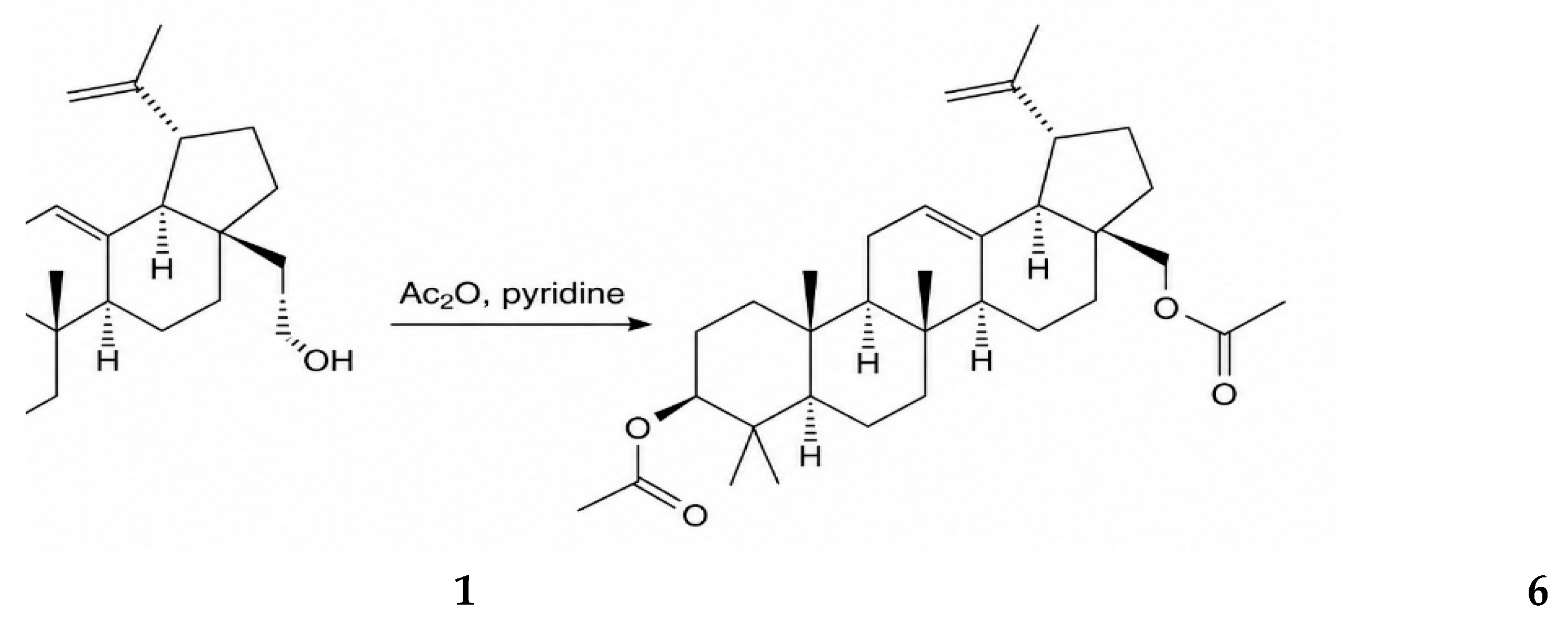
As shown in Figure 7, base-mediated acetylation of betulin proceeds under relatively mild conditions in the presence of pyridine or related nitrogen-containing bases. The most representative systems, together with their main advantages and practical limitations, are summarized in Table 11.
Base-mediated acetylation broadens the synthetic options available for preparation of betulin 3,28-diacetate by offering alternative reaction environments that improve control and may simplify downstream processing{146].
Figure 7.
Base-mediated acetylation of betulin to betulin 3,28-diacetate.
4.5. Low-Solvent, Solvent-Free, and Mechanochemical Approaches
Low-solvent, solvent-free, and mechanochemical approaches have attracted increasing attention as greener alternatives to conventional solution-phase acetylation of betulin. These methods are designed to reduce solvent consumption, simplify purification, and improve process efficiency while still enabling effective conversion to betulin 3,28-diacetate. Low-solvent systems can increase the effective concentration of reactants and improve collision frequency, which may accelerate acetylation. At the same time, reduced solvent content can increase viscosity, limit heat transfer, and make mixing less efficient. For this reason, low-solvent methods require careful balance between concentration and operability [147,148,149,150].
Solvent-free acetylation goes one step further by eliminating conventional reaction media altogether. In such systems, the reagents themselves serve as both reactants and reaction environment. This often reduces waste and simplifies the post-reaction workup, but it also makes the outcome more dependent on reagent ratios, temperature control, and efficient mixing [151,152].
Mechanochemical synthesis offers another sustainable route by using mechanical energy, such as grinding or milling, to promote reaction. These methods can accelerate transformation under minimal-solvent or solvent-free conditions and often shorten reaction times. Their performance depends strongly on milling intensity, reaction time, stoichiometry, catalyst choice, and energy input [153,154].
Despite their advantages, these approaches also have limitations. Reduced solvent availability can complicate temperature regulation and product isolation, while the need for specialized equipment may limit accessibility in some laboratories. In addition, solid-state reaction behaviour is often less predictable than homogeneous solution chemistry [155,156].
From a practical standpoint, these methods should be viewed as complementary strategies rather than universal replacements for conventional acetylation. Their value lies in improving sustainability and process efficiency under appropriate conditions [157].
Low-solvent, solvent-free, and mechanochemical approaches reflect the broader move toward greener synthetic chemistry by showing that betulin 3,28-diacetate can be prepared efficiently while reducing reliance on solvent-intensive systems [158]. The principal features of low-solvent, solvent-free, and mechanochemical acetylation are summarized in Table 12, while a representative transformation is shown in Figure 8.
These alternative methods expand the synthetic toolbox for betulin acetylation and support the development of more sustainable routes to betulin 3,28-diacetate.
4.6. Comparative Assessment of Laboratory Acetylation Methods
The diversity of reported acetylation procedures shows that no single laboratory method can be regarded as universally optimal for the preparation of betulin 3,28-diacetate. Method selection should therefore depend on the specific goals of the synthesis, including conversion efficiency, operational simplicity, scalability, sustainability, purification requirements, and final product quality [159].
Classical acid-catalyzed systems remain widely used because they generally offer straightforward reaction design and high conversion efficiency. The combination of acetic anhydride with strong acid catalysts can rapidly acetylate both hydroxyl groups under relatively simple laboratory conditions. However, these benefits are often offset by increased corrosion, more difficult workup, and the generation of larger amounts of acidic waste [160]. Organic catalysts and promoter-assisted systems provide an alternative strategy aimed at reducing reaction severity while maintaining efficient acetyl transfer. Such methods often improve reaction control and reduce the purification burden. At the same time, the use of additional catalysts may increase system complexity and require further optimization to achieve consistently high yields [161].
Base-mediated systems occupy an intermediate position between strongly acidic and promoter-assisted methodologies. Pyridine-, imidazole-, and amine-based procedures can provide efficient acetylation together with improved operational control. Nevertheless, issues such as catalyst removal, reagent toxicity, and purification remain important practical considerations [162]. Low-solvent, solvent-free, and mechanochemical approaches have emerged in response to sustainability concerns and the growing emphasis on process intensification. These methods can reduce solvent consumption and simplify reaction workflows, although their broader implementation may be limited by the need for careful optimization and, in some cases, specialized equipment [163].
Reaction efficiency alone should not be used as the sole criterion for evaluating synthetic performance. High conversion may still be accompanied by difficult purification, excessive solvent use, complicated catalyst removal, or poor scalability. For this reason, meaningful comparison between literature procedures must consider both reaction outcome and downstream processing. Another difficulty in comparing reported methods is the variability of experimental design and analytical characterization. Differences in catalyst loading, reagent excess, purification strategy, reaction scale, and yield determination often make direct comparison between studies uncertain [164,165].
From a practical perspective, method selection usually reflects compromise rather than optimization of a single parameter. Small-scale exploratory synthesis may prioritize simplicity and rapid conversion, whereas preparative procedures more often emphasize reproducibility, purification efficiency, and sustainability [166].
The relative strengths and limitations of the main acetylation strategies are summarized in Table 13, highlighting that the most suitable method depends on the balance between efficiency, selectivity, purification, and sustainability.
Comparative evaluation indicates that the synthesis of betulin 3,28-diacetate should be treated as a multidimensional optimization problem in which reaction efficiency, operational practicality, environmental impact, and product quality must all be considered simultaneously.
5. Process Chemistry and Industrial Approaches
5.1. Transition from Laboratory Synthesis to Process Chemistry
Laboratory synthesis of betulin 3,28-diacetate is primarily aimed at demonstrating reaction feasibility, achieving satisfactory conversion, and obtaining analytically characterized material. However, procedures that perform well on a small scale do not necessarily translate directly into practical production processes. For this reason, the transition from laboratory synthesis to process chemistry requires a broader evaluation of reaction design, operational robustness, scalability, and economic viability. A key difference between laboratory and process development lies in the criteria used to judge success. Laboratory optimization often focuses on isolated yield and reaction completion, whereas process chemistry must also account for reagent consumption, energy demand, waste generation, purification burden, reproducibility, and overall production cost. As a result, conditions that appear efficient in a flask may prove less attractive once scale-up is considered [167,168].
Scale strongly affects reaction behavior because larger reactor volumes alter heat transfer, mixing efficiency, mass transfer, and local reagent distribution. A reaction that proceeds reproducibly at gram scale may show incomplete mixing, temperature gradients, or variable conversion in larger equipment. This is especially relevant for acetylation reactions, where efficient contact between reactants and stable thermal control are critical for consistent performance [169].
Another important issue is workflow simplification. Laboratory procedures often tolerate multiple purification steps, repeated recrystallization, and extensive solvent use, but these operations become increasingly expensive and time-consuming at larger scale. Process-oriented development therefore places greater emphasis on reducing downstream processing and simplifying isolation of the target product [170,171]. Raw material variability adds another layer of complexity. Unlike highly standardized laboratory substrates, biomass-derived feedstocks may differ in purity, moisture content, impurity profile, and physical properties. Since betulin is commonly obtained from natural sources, process development must accommodate fluctuations in feedstock quality while maintaining reproducible product quality [172].
Safety becomes more critical as scale increases. Larger reaction volumes intensify the consequences of heat release, reagent handling, solvent use, and process upsets. Consequently, process chemistry must assess not only synthetic efficiency but also thermal control, operational safety, and robustness under manufacturing conditions [173].
Process development therefore shifts the optimization target from maximizing isolated yield alone to balancing several interconnected variables. Reagent efficiency, solvent consumption, catalyst loading, purification requirements, energy demand, and waste generation all influence whether a laboratory method can realistically be transferred to larger-scale production [174].
From a practical standpoint, the transition from laboratory synthesis to process chemistry should be understood as redesign of the entire synthetic workflow rather than simple enlargement of batch size. The objective is to create an integrated process that delivers consistent product quality while remaining economically and operationally viable [175]. Successful translation of laboratory acetylation methods into industrially relevant processes requires combining synthetic chemistry with process engineering, optimization strategy, and manufacturing constraints. This perspective is essential for evaluating the real-world feasibility of large-scale production of betulin 3,28-diacetate. The principal differences between laboratory synthesis and process chemistry are summarized in Table 14, highlighting the shift from reaction feasibility to integrated process performance [176].
Accordingly, scale-up of betulin acetylation should be approached as process redesign rather than simple enlargement of reaction volume.
5.2. Reaction Engineering and Scale-Up Considerations
Scaling acetylation processes requires attention to reaction engineering parameters that go far beyond simple enlargement of reactor volume. Although acetylation is often treated as a straightforward transformation, scale-up can introduce important challenges related to heat transfer, mass transfer, mixing efficiency, reagent addition rate, solvent handling, and process safety [177]. Thermal management is one of the most critical issues during scale-up. Acetylation reactions involving acetic anhydride, acetyl chloride, or catalytic activation systems can generate substantial heat, and insufficient temperature control may lead to localized overheating, undesired side reactions, product discoloration, or reduced selectivity. As reactor volume increases, heat removal becomes more difficult because the surface-area-to-volume ratio decreases [178].
Mass transfer and mixing efficiency are equally important. Conditions that are effective at the laboratory scale, such as magnetic stirring, cannot always be transferred directly to larger reactors. Heterogeneous reaction mixtures, viscous media, or poorly soluble substrates may produce concentration gradients and incomplete reagent contact. For this reason, impeller design, agitation intensity, and mixing regime must be selected carefully to maintain reaction homogeneity. Reagent addition strategy is another important engineering variable. Controlled addition of the acetylating reagent can improve selectivity, moderate heat release, and reduce the need for large excesses of reagent. Semi-batch or continuous feeding strategies are often preferred when reaction exotherms must be managed more effectively [179,180].
Solvent selection and solvent loading also influence scale-up performance. Higher solvent volumes may facilitate mixing and thermal control, but they increase costs associated with solvent recovery, recycling, and waste treatment. As a result, process intensification efforts often aim to reduce solvent use or shift toward more concentrated or solvent-free operating conditions when feasible [181].
Product isolation and purification become more demanding at larger scale. Chromatographic purification, which may be practical in small-scale laboratory work, is usually not economical for production. Scalable alternatives such as crystallization, precipitation, extraction, and phase separation are therefore preferred whenever they can deliver product of sufficient purity [182,183].
Safety considerations become much more significant as scale increases. Larger inventories of reactive reagents, exothermic behavior, and corrosive by-products can substantially increase process risk. Consequently, process development should include calorimetric assessment, hazard evaluation, and safety analysis to ensure that the acetylation can be carried out under controlled and reproducible conditions [184].
The main engineering factors governing scale-up are summarized in Table 15, while the paragraph above highlights why each of them becomes more important as the process moves from laboratory to production scale.
A good scale-up requires integration of synthetic chemistry with reaction engineering principles. A process that is efficient in the laboratory must also be robust, safe, economically viable, and sustainable if it is to be translated into larger-scale production of betulin 3,28-diacetate [185].
5.3. Optimization of Reaction Parameters for Large-Scale Production
Optimization of reaction conditions represents a critical stage in the development of scalable acetylation processes because parameters that appear satisfactory during laboratory synthesis often require re-evaluation during scale-up. Changes in mixing, heat transfer, reagent distribution, and reaction kinetics may substantially affect process performance, making direct transfer of laboratory conditions unreliable without additional process-oriented optimization [186]. Reaction temperature is among the most influential optimization variables. Elevated temperatures may accelerate acetylation and improve substrate conversion, but excessive heating may also promote side reactions, decomposition, or undesired by-product formation. Accordingly, optimization typically seeks a balance between reaction rate, selectivity, and operational safety rather than simple maximization of temperature [187]. Reaction time also requires careful evaluation. Excessively long reaction durations reduce productivity and increase operational costs, whereas insufficient reaction times may lead to incomplete conversion and diminished isolated yields. Kinetic assessment is therefore essential for defining an economically favorable operating window [188].
The stoichiometric ratio between betulin and the acetylating reagent significantly affects both conversion efficiency and process economics. Although excess acetic anhydride or another acetylating agent may help drive the reaction toward completion, excessive reagent loading increases material cost, complicates purification, and generates larger waste streams. For this reason, optimization studies frequently aim to minimize reagent excess while preserving acceptable yield and process robustness [189].
Catalyst loading constitutes another important optimization parameter. Catalytic systems based on nucleophilic catalysts, bases, acids, or promoter combinations may substantially accelerate acetylation, but unnecessarily high catalyst concentrations can increase manufacturing cost and complicate downstream purification. Determination of the minimal effective catalyst loading is therefore desirable from both economic and operational perspectives [190].
Solvent concentration and substrate loading strongly influence productivity metrics. Increasing substrate concentration generally improves reactor productivity and reduces solvent consumption, although excessively concentrated systems may create mixing difficulties, mass transfer limitations, or thermal control problems. Optimization therefore typically seeks the highest feasible substrate loading that does not compromise reaction control or product quality [191].
Modern process optimization increasingly employs statistical methodologies such as design of experiments, response surface methodology, and multivariable optimization. These approaches allow simultaneous evaluation of interacting variables and can substantially reduce experimental effort compared with one-factor-at-a-time studies [192]. The key variables governing reaction optimization are summarized in Table 16, which highlights the need to balance temperature, reaction time, stoichiometry, catalyst loading, and substrate concentration in order to define a robust and scalable operating window [193].
5.4. Product Isolation, Workup, and Downstream Processing
Product isolation and downstream processing are critical stages in the development of scalable acetylation processes because they often determine overall efficiency, manufacturing cost, product purity, and environmental impact. In many cases, downstream operations account for a substantial portion of total production cost, which makes their optimization just as important as optimization of the reaction itself. After acetylation is complete, the first task is removal of excess acetylating agent, catalyst, solvent, and by-products. Residual acetic anhydride, acetyl chloride, acids, bases, or catalytic additives can interfere with purification, so they must be quenched or neutralized efficiently. These operations must be designed carefully to avoid hydrolysis of the product or formation of secondary impurities [196,197].
Liquid–liquid extraction remains one of the most widely used isolation methods because it is simple and scalable. Its performance, however, depends strongly on solvent choice, phase behavior, product solubility, and impurity partitioning. For that reason, extraction conditions usually require optimization to maximize recovery while minimizing solvent use [198]. Solvent removal and concentration become increasingly important at larger scale because evaporation directly affects energy consumption and processing time. The use of low-toxicity, recyclable, and easily removable solvents can improve both process sustainability and economics [199].
Crystallization is often preferred as an industrial purification strategy because it combines isolation and purification in a single operation while remaining relatively inexpensive and scalable [200]. Its success depends on careful control of solvent choice, cooling rate, antisolvent addition, and supersaturation, all of which influence crystal form, purity, filtration behaviour, and yield [201].
Precipitation-based isolation may be useful when chromatographic purification is not practical on production scale. Although chromatography is highly effective in laboratory work, it usually requires too much solvent, time, and cost for large-scale manufacturing. For this reason, scalable non-chromatographic methods are generally favoured whenever product purity can be achieved [202].
Drying is another essential part of downstream processing. Residual solvent, moisture content, particle size, and physical stability can all affect storage behaviour and final product quality [203]. Appropriate drying methods, such as vacuum drying or controlled-temperature drying, are therefore important during process development. The main downstream operations and their practical roles are summarized in Table 17.
5.5. Green Chemistry and Sustainability Considerations
Growing environmental concerns, stricter regulatory requirements, and the economic burden of waste generation have increased interest in more sustainable acetylation processes. As a result, modern process development increasingly incorporates green chemistry principles aimed at lowering environmental impact while maintaining efficiency and economic viability. A major sustainability challenge in conventional acetylation is the use of hazardous reagents, large solvent volumes, and stoichiometric activating agents that generate substantial waste. Traditional systems based on excess acetic anhydride, acetyl chlorides, or halogenated solvents may give high conversion, but they often perform poorly when assessed using green chemistry criteria [207,208].
Solvent choice is one of the most important factors affecting sustainability. Replacing toxic or environmentally problematic solvents with safer alternatives, reducing solvent volume, or moving to solvent-free methods can significantly decrease waste generation and improve the overall environmental profile. In many cases, solvent reduction also lowers energy demand during solvent recovery and downstream processing [209,210].
Catalyst choice is equally important. Catalytic systems that work at low loading, under mild conditions, or with recyclable components can reduce material use and process waste. For this reason, reusable catalysts and heterogeneous systems are attracting increasing attention as alternatives to conventional stoichiometric methods [211].
Energy efficiency is another central consideration in sustainable process design. Reactions carried out at lower temperatures, in shorter times, or under intensified conditions can substantially reduce energy consumption. Alternative activation methods such as microwave heating, mechanochemical processing, and continuous-flow operation are therefore often explored as ways to improve process efficiency [212,213].
Waste minimization is commonly evaluated using quantitative metrics such as atom economy, reaction mass efficiency, process mass intensity, and E-factor. These measures provide an objective basis for comparing alternative routes and identifying where process improvements are most needed. The use of renewable feedstocks and bio-based substrates further supports sustainable manufacturing. Since many acetylation targets originate from natural products, the development of efficient transformations compatible with renewable starting materials fits well within broader goals of green chemical production [214,215].
The principal sustainability strategies are summarized in Table 18, highlighting the importance of solvent minimization, catalyst efficiency, energy conservation, waste reduction, and the use of renewable feedstocks in process development.
Accordingly, sustainable acetylation should be evaluated not only by chemical yield, but also by its solvent demand, catalyst efficiency, energy requirements, and overall environmental footprint.
Integrating green chemistry principles into acetylation process development requires balancing reaction efficiency, cost, environmental impact, safety, and industrial practicality in order to establish more sustainable manufacturing routes [216].
5.6. Economic and Industrial Feasibility
Economic feasibility is a decisive factor in determining whether a laboratory acetylation method can be translated into industrial practice. Although many procedures perform well at small scale, their real-world applicability depends on manufacturing cost, process simplicity, raw material availability, operational demands, and overall production efficiency. Raw material cost is one of the first economic considerations in process development. The choice of acetylating reagent, catalyst, solvent, and auxiliary reagents directly affects production expense. Highly reactive systems may offer excellent yields and short reaction times, but these advantages can be offset by expensive reagents, difficult handling, or costly purification [217,218].
Process productivity strongly influences industrial attractiveness. Reaction time, substrate loading, space–time yield, and reactor utilization all affect manufacturing efficiency. Processes that require long reaction times, highly dilute conditions, or multiple sequential steps are usually less competitive, even if they perform well in the laboratory. Downstream processing often accounts for a substantial portion of total manufacturing cost. Solvent recovery, purification, waste treatment, energy use, and product isolation can all significantly affect overall expenses. For this reason, economically attractive processes usually favor simplified purification and reduced solvent consumption [219].
Equipment requirements and process complexity also play an important role. Methods that require specialized reactors, strict moisture exclusion, extreme temperatures, or elaborate multistep operations may increase both capital cost and operational burden. By contrast, simpler and more robust procedures are generally easier to implement at scale [220].
Supply-chain considerations further shape industrial feasibility. Reliable access to starting materials, catalyst availability, reagent stability, and transportation logistics all contribute to process robustness and commercial scalability. A method that depends on difficult-to-source or unstable reagents may be less attractive in practice, even if its chemistry is efficient. Economic evaluation increasingly includes sustainability-related factors because waste generation, solvent consumption, energy demand, and regulatory compliance all contribute directly to cost. In many cases, greener processes are also more economical because they reduce resource use and simplify operation [221].
The main factors affecting economic feasibility are summarized in Table 19, showing that industrial success depends on a balance between reagent cost, process efficiency, downstream burden, equipment demand, and supply-chain reliability.
Industrial implementation requires a balance between synthetic efficiency, economic performance, operational simplicity, safety, reproducibility, and supply-chain reliability. A process is most likely to succeed commercially when it is not only chemically effective but also practical, scalable, and cost-conscious.
5.7. Current Challenges and Future Industrial Perspectives
Despite substantial progress in the development of acetylation methodologies, numerous challenges continue to limit broader industrial implementation of many laboratory-scale processes. Although modern acetylation strategies frequently demonstrate high yields, improved selectivity, and increasingly sustainable reaction conditions, translation from laboratory optimization to industrial manufacturing remains a complex task requiring integration of synthetic chemistry, process engineering, economic evaluation, and regulatory considerations [222].
One of the major challenges involves balancing reaction efficiency with process simplicity. Many highly efficient acetylation protocols rely on specialized catalysts, excessive reagent loading, complex reaction conditions, or purification procedures that may reduce practical scalability. Development of operationally simple and robust processes therefore remains an important objective. Another persistent limitation involves sustainability-performance trade-offs. Greener methodologies frequently aim to reduce solvent consumption, minimize waste generation, or decrease energy demands; however, environmentally improved processes may sometimes exhibit reduced productivity, lower selectivity, or increased process complexity. Future development therefore increasingly focuses on achieving sustainability improvements without compromising manufacturing performance. Large-scale manufacturing additionally requires improved control over reproducibility and process robustness. Small variations in mixing, temperature distribution, reagent quality, or raw material composition may significantly affect process outcomes during scale-up. Consequently, greater emphasis is increasingly placed on process analytical technologies, in-line monitoring, and data-driven optimization approaches. Emerging manufacturing technologies may provide new opportunities for industrial acetylation processes. Continuous-flow processing, process intensification strategies, automation, high-throughput optimization, and digital process control have attracted growing interest as tools capable of improving efficiency, reproducibility, and scalability [223].
Future research is also expected to increasingly focus on integration of renewable feedstocks, circular manufacturing concepts, catalyst recyclability, solvent recovery systems, and low-energy processing technologies. Such developments align with broader industrial trends toward sustainable and resource-efficient chemical manufacturing [224].
Future industrial progress will likely depend not only on the discovery of new acetylation methodologies but also on the successful integration of synthetic efficiency, process engineering, sustainability, and economic practicality into scalable manufacturing platforms.
6. Betulin Diacetate as a Protecting-Group Scaffold
6.1. Strategic Value of the Diacetate
Betulin diacetate occupies a central position in betulin chemistry because it functions not only as an acetylated product but also as a versatile protected intermediate for downstream transformations. Conversion of the C-3 and C-28 hydroxyl groups into acetate esters reduces competing reactivity and creates a more controllable synthetic scaffold [225]. Protection as the diacetate is especially useful because native betulin contains two hydroxyl functions with different steric and electronic environments. This can complicate selective functionalization and increase the likelihood of side reactions. Diacetylation simplifies reaction planning by masking both hydroxyl groups and improving chemoselective control in later steps [226].
The diacetate scaffold is also valuable for stepwise deprotection strategies. Under controlled conditions, one acetyl group may be removed while the other remains protected, providing access to monoacetylated intermediates. These intermediates are important for regioselective synthesis and other transformations that are difficult to perform directly on unprotected botulin [227].
In oxidation chemistry, the diacetate can serve as a useful precursor because protection of the hydroxyl groups helps suppress unwanted side reactions and improves selectivity. For this reason, betulin diacetate is often used in the preparation of oxidized derivatives and more structurally complex intermediates. Beyond its synthetic role, formation of the diacetate may also improve practical handling. Changes in polarity, solubility, crystallinity, and purification behavior can simplify isolation and support multistep workflows. These properties contribute to the widespread use of diacetylated intermediates in both laboratory and process-oriented synthesis [228,229].
Betulin diacetate should be viewed not as a final product alone, but as a strategically important platform that enables controlled functionalization, improved reaction selectivity, and broader access to diverse betulin derivatives.
6.2. Access to Monoacetates by Controlled Hydrolysis
Controlled hydrolysis of betulin diacetate is an important synthetic strategy for preparing selectively protected intermediates for further functionalization. Because betulin contains two hydroxyl groups at C-3 and C-28 that differ in steric environment, accessibility, and reactivity, partial deacetylation can provide monoacetylated derivatives with distinct synthetic value [230].
Selective hydrolysis takes advantage of differences in the stability and reactivity of the two ester groups within the diacetate scaffold. Under carefully optimized conditions, one acetyl group can be removed preferentially while the other remains protected, allowing access to monoacetates. Such transformations require careful control of reagent concentration, temperature, reaction time, solvent composition, and catalyst loading. Base-mediated hydrolysis is among the most commonly used approaches for controlled deprotection. Mild alkaline conditions can promote gradual ester cleavage while minimizing overhydrolysis and degradation of sensitive intermediates. However, strongly basic conditions or prolonged reaction times may reduce regioselectivity and lead to full deprotection [231].
Acid-mediated hydrolysis has also been explored in some systems, although achieving a good balance between reaction rate and selectivity often requires careful optimization. The choice of hydrolysis method therefore depends on the desired regioisomer, substrate sensitivity, and compatibility with later synthetic steps.
Monoacetylated derivatives obtained through controlled hydrolysis are versatile intermediates because selective exposure of either the secondary hydroxyl group at C-3 or the primary hydroxyl group at C-28 enables targeted functionalization. These partially protected compounds are useful in oxidation reactions, coupling processes, heterocycle introduction, and the preparation of structurally diverse derivatives [232].
From a synthetic perspective, controlled hydrolysis converts betulin diacetate from a simple protecting-group derivative into a flexible intermediate that directs regioselective reaction pathways and expands the accessible chemical space of betulin-based compounds [233].
6.3. Oxidation and Diversification Pathways
Oxidation reactions represent a major downstream application of protected betulin intermediates because they enable the conversion of a relatively simple triterpenoid framework into more structurally complex derivatives with expanded synthetic value. In this context, betulin diacetate and selectively protected monoacetates are frequently used as practical intermediates because acetyl protection improves control over subsequent oxidative transformations [234].
The presence of acetyl protecting groups is particularly important in oxidation chemistry because unprotected hydroxyl groups may participate in competing reactions, reduce selectivity, or undergo undesired transformation. By masking the C-3 and C-28 hydroxyl functions, acetylation helps direct oxidation to the desired site and improves the chemoselectivity of the overall process. Oxidation at the primary hydroxyl group at C-28 is among the most widely studied transformations. Conversion of this position into an aldehyde or carboxylic acid derivative provides key intermediates for the synthesis of a broad range of modified triterpenoids [235]. Such transformations often serve as foundational steps in the preparation of biologically relevant betulin-derived scaffolds. In addition to C-28 oxidation, further modification may involve the secondary hydroxyl group at C-3 or the use of multistep oxidation sequences to introduce additional functionality. Selectively protected intermediates are especially useful in these cases because they allow better control of reaction pathways and help suppress side-product formation.
Oxidized betulin derivatives are also valuable as platforms for further diversification. They can be used in condensation reactions, coupling processes, heterocycle-forming transformations, nucleophilic substitution reactions, and the attachment of pharmacologically relevant fragments [236]. As a result, oxidation chemistry often functions as a gateway to structurally diverse betulin-based compound libraries.
The combined use of acetyl protection, selective deprotection, oxidation, and subsequent diversification provides a flexible strategy for expanding the accessible chemical space of betulin derivatives and constructing more complex molecular architectures.
7. Functionalization Enabled by Acetylated Intermediates
7.1. Beyond C-3 and C-28 Functionalization
Although most synthetic modifications of betulin derivatives have historically focused on the hydroxyl groups at C-3 and C-28, increasing attention has been given to transformations in other regions of the triterpenoid framework. Expanding beyond conventional hydroxyl chemistry makes it possible to access greater structural diversity and may also alter physicochemical properties and biological activity [237].
The limited number of naturally reactive functional groups in betulin creates an inherent challenge for selective modification at alternative positions. In this context, acetylated intermediates often play an enabling role by temporarily suppressing hydroxyl-group reactivity while allowing synthetic manipulation of less accessible parts of the molecule [238].
Among the alternative sites, the side chain and terminal alkene region have attracted particular interest. Functionalization at these positions may proceed through oxidation, addition reactions, radical pathways, rearrangements, or multistep sequences that introduce new reactive handles for later derivatization. Such strategies substantially broaden the accessible chemical space beyond simple hydroxyl modification [239]. Modification outside C-3 and C-28 also supports the construction of more complex molecular architectures through sequential or orthogonal functionalization. By combining acetyl protection with selective transformation of alternative sites, synthetic chemists can introduce multiple independent modifications within a single scaffold [240].
These diversification strategies are especially important because changes introduced outside the conventional hydroxyl positions may influence molecular conformation, lipophilicity, membrane interactions, and overall biological behavior. For this reason, non-classical functionalization has become an increasingly important direction in betulin chemistry [241].
Functionalization beyond C-3 and C-28 expands the role of acetylated intermediates from simple protected derivatives to versatile synthetic platforms for more sophisticated molecular design.
7.2. Synthetic and Biological Implications
Expansion of functionalization strategies beyond simple acetylation has increased the synthetic value of betulin-derived intermediates by opening access to structurally diverse molecular architectures. The ability to selectively protect, modify, oxidize, and diversify the betulin scaffold provides opportunities not only to expand chemical space, but also to tune molecular properties relevant to biological performance [242].
From a synthetic perspective, acetylated intermediates are especially useful platforms for sequential and orthogonal reaction design. Temporary protection of hydroxyl functionalities enables selective introduction of additional structural changes while maintaining control over reaction pathways. This makes it possible to prepare more complex derivatives that would be difficult to access directly from unprotected botulin [243]. Structural diversification often leads to substantial changes in physicochemical properties. Introduction of additional functional groups, altered oxidation states, heterocyclic fragments, or side-chain modifications may influence lipophilicity, polarity, conformational flexibility, and intermolecular interactions. As a result, relatively small structural modifications can produce meaningful differences in chemical behavior and formulation properties [244].
The biological implications of structural diversification have also attracted considerable attention. Changes in substitution pattern may affect membrane permeability, target binding, metabolic stability, and pharmacokinetic behavior. Although structure–activity relationships depend strongly on the specific derivative class and biological system, many studies indicate that controlled structural modification can significantly influence biological performance [245].
Importantly, acetylation should not be viewed only as a terminal transformation. It is also a strategic enabling step that supports broader molecular design. By functioning both as a protection strategy and as a platform for later diversification, acetylated intermediates contribute to the generation of structurally complex libraries suitable for biological screening and further optimization.
The synthetic and biological significance of acetylated betulin intermediates extends beyond simple functional-group modification and reflects their broader role as enabling platforms for molecular diversification and rational derivative design [246].
8. Solubility and Translational Considerations
8.1. Physicochemical Consequences of Acetylation
Acetylation of betulin produces effects that extend beyond simple functional-group modification and substantially alters the physicochemical behavior of the parent triterpenoid scaffold. Conversion of hydroxyl groups into acetate esters changes polarity, intermolecular interactions, solubility, and molecular packing, thereby influencing both synthetic handling and downstream use. One of the most important consequences of acetylation is the reduction of hydroxyl-group polarity and hydrogen-bonding capacity. Replacing free hydroxyl functionalities with acetyl groups decreases the hydrogen-bond donor ability of the molecule and usually increases lipophilicity. These changes can strongly affect interactions with solvents, reagents, and surrounding molecular environments [247].
Acetylation also has a pronounced effect on solubility. Native betulin is often poorly soluble in many common solvents because of its rigid polycyclic structure and hydrogen-bond-mediated self-association. Formation of monoacetylated or diacetylated derivatives frequently changes solvent compatibility and may improve dissolution in selected organic media, which in turn can influence reaction efficiency and purification behavior.
Changes in intermolecular interactions may also affect crystallinity, crystal packing, melting behavior, and other solid-state properties. These effects are particularly relevant because variations in crystal form can influence isolation efficiency, storage stability, and reproducibility during processing [248,249].
Modification of polarity and surface properties may further influence membrane interactions, partitioning behavior, and transport-related characteristics. Although these effects depend on substitution pattern and molecular context, acetylation often produces measurable changes in physicochemical profiles that are relevant to later applications.
Acetylation should be viewed not only as a chemical transformation, but also as a method for tuning molecular properties that affect both synthetic accessibility and application potential.
8.2. Synthetic Implications for Future Development
The expanding role of acetylation in betulin chemistry suggests that future developments will increasingly treat acetylated derivatives not as final products, but as enabling intermediates for more advanced molecular design. The ability to selectively protect, transform, and diversify the triterpenoid scaffold creates opportunities for more modular and efficient synthetic strategies [250].
One important direction is the integration of acetylation into multistep sequences designed to improve chemoselectivity and overall efficiency. Monoacetylated and diacetylated intermediates make it possible to carry out sequential transformations that would be difficult to achieve directly on unprotected betulin. As a result, future synthetic planning will likely rely more heavily on deliberate protection–deprotection sequences [251].
Further progress is also expected through the development of more selective and controllable reaction systems. Improved catalysts, better reaction engineering, and finer control over regioselectivity may allow access to more complex derivatives while reducing synthetic complexity and material consumption. The growing emphasis on sustainable chemistry will also shape future development. Lower-waste acetylation methods, reduced-solvent protocols, recyclable catalysts, and energy-efficient processing are likely to become increasingly important as synthetic routes are adapted for larger-scale use [252].
Another major direction involves expanding chemical diversity through the combination of acetylation with oxidation, orthogonal functionalization, and modular diversification strategies. These approaches may facilitate the construction of structurally varied libraries suitable for biological screening and lead optimization. Advances in automation, high-throughput experimentation, continuous processing, and data-driven optimization may further accelerate progress by making it easier to explore reaction conditions and synthetic pathways efficiently. These tools are likely to become more important as target structures become more complex and process requirements more demanding [253].
Future progress in betulin chemistry will depend not only on discovering new transformations, but also on improving how existing reactions are combined into efficient, scalable, selective, and sustainable synthetic platforms [254].
9. Conclusion
Betulin acetylation has emerged as a central transformation in triterpenoid chemistry, not simply because it furnishes a stable protected derivative, but because it establishes a versatile synthetic entry point for controlled diversification of the betulin scaffold. In particular, betulin 3,28-diacetate occupies a strategically important position as both a practical synthetic target and a multifunctional intermediate that supports selective deprotection, oxidation, orthogonal functionalization, and sequential derivatization. Its value therefore extends well beyond the protection of hydroxyl groups and into the broader logic of scaffold engineering.
The reviewed literature makes clear that no single acetylation protocol is universally optimal. Classical acid-catalyzed methods remain attractive because they are operationally simple and often provide rapid conversion, but their practical use is frequently constrained by harsh reaction conditions, overactivation, rearrangement risk, corrosion issues, and difficult purification. More modern approaches, including organic catalyst-assisted, base-mediated, low-solvent, solvent-free, and mechanochemical methods, address some of these limitations by enabling milder conditions, improved selectivity, reduced solvent demand, and better sustainability profiles. At the same time, each of these strategies introduces its own constraints, such as catalyst removal, equipment dependence, workup complexity, or the need for careful parameter optimization.
A major conclusion of this review is that betulin diacetate should be understood as a platform compound rather than a terminal acetylation product. The masking of the C-3 and C-28 hydroxyl groups enables reaction sequences that are difficult to execute directly on unprotected betulin, while partial hydrolysis provides access to monoacetylated intermediates with distinct synthetic utility. In this sense, acetylation acts as an enabling step that organizes later functionalization logic and expands the accessible chemical space of betulin derivatives.
The downstream significance of acetylation is equally important. Acetylated intermediates frequently display altered polarity, solubility, crystallinity, and molecular packing, which can improve handling and influence purification behavior. These physicochemical changes affect not only laboratory isolation but also the feasibility of scale-up, formulation, and further synthetic conversion. Accordingly, the practical importance of betulin acetylation lies in the combined effect of protection chemistry and property tuning.
From a process perspective, translation of laboratory acetylation methods into industrially relevant workflows requires a broader framework than reaction yield alone. Heat transfer, mass transfer, reagent feeding, product isolation, waste generation, catalyst loading, and safety all become decisive variables during scale-up. Downstream processing, in particular, often determines whether a route is economically viable, since solvent recovery, purification, and waste treatment may dominate the overall cost profile. For this reason, the most attractive synthetic routes are those that combine chemical efficiency with operational simplicity, manageable risk, and reproducible product quality.
Sustainability considerations further strengthen the case for process redesign. The growing emphasis on green chemistry has shifted attention toward solvent reduction, energy-efficient operation, recyclable catalysts, and alternative activation technologies. In parallel, quantitative metrics such as process mass intensity, E-factor, and atom economy provide a more realistic basis for comparing routes than isolated yield alone. These criteria reinforce the view that the most successful acetylation processes will be those that balance performance with environmental and economic responsibility.
The broader synthetic implications are substantial. Future development is likely to focus on integrating acetylation into modular protection–deprotection sequences, coupling it more tightly with oxidation and diversification strategies, and applying data-driven optimization, automation, and continuous processing to improve selectivity and scalability. Such advances are expected to move the field away from isolated transformation thinking and toward more integrated synthetic platform design.
Betulin acetylation should be viewed as a strategic enabling technology in triterpenoid chemistry. Its importance derives from the way it supports molecular protection, controlled reactivity, downstream diversification, and process adaptability. Betulin 3,28-diacetate is therefore best understood not as an endpoint, but as a foundational intermediate that connects laboratory synthesis, process development, and the future expansion of betulin-derived molecular space.
Author Contributions
For research articles with several authors, a short paragraph specifying their individual contributions must be provided. The following statements should be used “Conceptualization, Zhaxybayeva A. and Yevloyeva K.; methodology, Zhaxybayeva A.; software, Yevloyeva K.; validation, Kaliyeva S. and Nurmukhanbetova N.; formal analysis, Ostretsova I. and Kassenova N.; investigation, Kazyakhmetova D.; resources, Yevloyeva K.; data curation, Yevloyeva K.; writing—original draft preparation, Zhaxybayeva A.; writing—review and editing, Yevloyeva K.; visualization, Yeskendirova A.; supervision, Yevloyeva K.; project administration, Zhaxybayeva A.; funding acquisition, Zhaxybayeva A. All authors have read and agreed to the published version of the manuscript.”.
Funding
This research received no external funding.
Data Availability Statement
No new data were created or analyzed in this study. Data sharing is not applicable to this article.
Acknowledgments
The authors would like to thank Lancaster University for providing a supportive research environment and academic resources during the visiting research stay, which contributed to the preparation of this manuscript. During the preparation of this manuscript/study, the authors used ChemDraw 22.2 and Created in BioRender. Zhaxybayeva, A. (2026) https://BioRender.com/lq1ss62. During the preparation of this manuscript, the authors used Google NotebookLM for literature organization and assistance with text structuring. The authors have reviewed and edited all outputs and take full responsibility for the content of this publication.
Conflicts of Interest
The authors declare no conflicts of interest.
Abbreviations
The following abbreviations are used in this manuscript:
| FTIR | Fourier-transform infrared spectroscopy |
| NMR | Nuclear magnetic resonance |
| TLC | Thin-layer chromatography |
| HPLC | High-performance liquid chromatography |
| UV | Ultraviolet |
| ELSD | Evaporative light scattering detection |
| CAD | Charged aerosol detection |
| GC | Gas chromatography |
| MS | Mass spectrometry |
| COSY | Correlation spectroscopy |
| HSQC | Heteronuclear single quantum coherence |
| HMBC | Heteronuclear multiple bond correlation |
| DEPT | Distortionless enhancement by polarization transfer |
| UAE | Ultrasound-assisted extraction |
| PLE | Pressurized liquid extraction |
| EtOH | Ethanol |
| iPrOH | Isopropanol |
| EtOAc | Ethyl acetate |
| CO2 | Carbon dioxide |
References
- Demets, O. V., Takibayeva, A., Kassenov, R., & Aliyeva, M. (2022). Methods of Betulin Extraction from Birch Bark. Molecules 2022, Vol. 27, Page 3621, 27(11), 3621. [CrossRef]
- Hordyjewska, A., Ostapiuk, A., Horecka, A., & Kurzepa, J. (2019). Betulin and betulinic acid: triterpenoids derivatives with a powerful biological potential. Phytochemistry Reviews 2019 18:3, 18(3), 929–951. [CrossRef]
- Alakurtti, S., Mäkelä, T., Koskimies, S., & Yli-Kauhaluoma, J. (2006). Pharmacological properties of the ubiquitous natural product betulin. European Journal of Pharmaceutical Sciences, 29(1), 1–13. [CrossRef]
- Yogeeswari, P., & Sriram, D. (2010). Betulinic Acid and Its Derivatives: A Review on their Biological Properties. Current Medicinal Chemistry, 12(6), 657–666. [CrossRef]
- Krasutsky, P. A. (2006). Birch bark research and development. Natural Product Reports, 23(6), 919–942. [CrossRef]
- Laszczyk, M. N. (2009). Pentacyclic Triterpenes of the Lupane, Oleanane and Ursane Group as Tools in Cancer Therapy. Planta Medica, 75(15), 1549–1560. [CrossRef]
- Pisha, E., Chai, H., Lee, I. S., Chagwedera, T. E., Farnsworth, N. R., Cordell, G. A., Beecher, C. W. W., Fong, H. H. S., Kinghorn, A. D., Brown, D. M., Wani, M. C., Wall, M. E., Hieken, T. J., Gupta, T. K. D., & Pezzuto, J. M. (1995). Discovery of betulinic acid as a selective inhibitor of human melanoma that functions by induction of apoptosis. Nature Medicine 1995 1:10, 1(10), 1046–1051. [CrossRef]
- Rastogi, S., Pandey, M. M., & Rawat, A. K. S. (2015). Medicinal plants of the genus Betula—Traditional uses and a phytochemical–pharmacological review. Journal of Ethnopharmacology, 159, 62–83. [CrossRef]
- Šiman, P., Bezrouk, A., Tichá, A., Kozáková, H., Hudcovic, T., Kučera, O., & Niang, M. (2025). Promising protocol for in vivo experiments with betulin. Pharmaceutics, 17(8), 1051. [CrossRef]
- Adepoju, F. O., Shevyrin, V. A., Kovaleva, E. G., Mondragón, A. C., Cepeda, A., & Miranda, J. M. (2026). Natural deep eutectic solvents for the green extraction of betulin from birch bark: Chemical characterization and evaluation of antioxidant activity. Clean Technologies, 8(2), 49. [CrossRef]
- Kissas, T., Kiritsi, D., Athanasiou, I., Nyström, A., Onoufriadis, A., & Mourtzinos, I. (2026). Wound-healing effects of birch bark and propolis extracts on epidermolysis bullosa keratinocytes. International Journal of Molecular Sciences, 27(13), 5746. [CrossRef]
- Chinchilla, N., Medronho, B., Almeida, Z. L., Aliaño-González, M. J., Macías, F. A., Palma, M., Romano, A., Svanedal, I., Norgren, M., & Carrera, C. (2026). Optimized ultrasound-assisted extraction of betulin from Betula pendula bark: A sustainable approach to forest residue valorization. Wood Science and Technology, 60, 35. [CrossRef]
- Luque-Jurado, I., Rivas, S., Lebrón-Aguilar, R., Quintanilla-López, J. E., Sanz, M. L., & Soria, A. C. (2026). Ultrasound-assisted extraction of bioactive birch (Betula sp.) bark triterpenoids using hydrophobic natural deep eutectic solvents. Analytical and Bioanalytical Chemistry, 418(6), 1713-1723. [CrossRef]
- Świtalska, M., Chrobak, E., Kadela-Tomanek, M., Wietrzyk, J., & Bębenek, E. (2025). Betulin-hippuric acid conjugates: Chemistry, antiproliferative activity and mechanism of action. Applied Sciences, 15(17), 9824. [CrossRef]
- Farooq, M., Zborowski, C., Nousiainen, P. A., Tienaho, J., Korpinen, R., & Österberg, M. (2025). Supramolecular architectures based on the self-assembly of suberin hydrolysate, betulin, and their hybrids. Langmuir, 41(29), 19156-19172. [CrossRef]
- 16 Bergelin, E., & Holmbom, B. (2008). Reactions and Distribution of Birch Extractives in Kraft Pulp Oxygen Delignification. Journal of Wood Chemistry and Technology, 28(4), 261–269. [CrossRef]
- Pinto, P. C. R. O., Sousa, A. F., Silvestre, A. J. D., Neto, C. P., Gandini, A., Eckerman, C., & Holmbom, B. (2009). Quercus suber and Betula pendula outer barks as renewable sources of oleochemicals: A comparative study. Industrial Crops and Products, 29(1), 126–132. [CrossRef]
- Hayek, E. W. H., Jordis, U., Moche, W., & Sauter, F. (1989). A bicentennial of betulin. Phytochemistry, 28(9), 2229–2242. [CrossRef]
- Cîntǎ Pînzaru, S., Leopold, N., & Kiefer, W. (2002). Vibrational spectroscopy of betulinic acid HIV inhibitor and of its birch bark natural source. Talanta, 57(4), 625–631. [CrossRef]
- Wang, L., Hu, Y., Guo, G., Li, J., Fang, X., & Zhao, L. (2024). Enhanced and green extraction betulin from Celtis sinensis leaves using hydrophobic deep eutectic solvent. Biomass Conversion and Biorefinery, 14, 9321–9331. [CrossRef]
- Roy, M., Kashyap, P., Dash, K. K., Shams, R., BhagyaRaj, G. V. S., Mukarram, S. A., & Kovács, B. (2025). Integration of ultrasound-assisted extraction and deep eutectic solvent for enhanced recovery of bioactive compounds: Innovative green approach. Food Chemistry Advances, 9, 101153. [CrossRef]
- Fridén, M. E., Jumaah, F., Gustavsson, C., Enmark, M., Fornstedt, T., Turner, C., Sjöberg, P. J. R., & S amuelsson, J. (2016). Evaluation and analysis of environmentally sustainable methodologies for extraction of betulin from birch bark with a focus on industrial feasibility. Green Chemistry, 18(2), 516–523. [CrossRef]
- Hu, Z., Guo, N., Wang, Z., Liu, Y., Wang, Y., Ding, W., Zhang, D., Wang, Y., & Yan, X. (2013). Development and validation of an LC–ESI/MS/MS method with precolumn derivatization for the determination of betulin in rat plasma. Journal of Chromatography B, 939, 38–44. [CrossRef]
- Holonec, L., Ranga, F., Crainic, D., Truţa, A., & Socaciu, C. (2012). Evaluation of Betulin and Betulinic Acid Content in Birch Bark from Different Forestry Areas of Western Carpathians. Notulae Botanicae Horti Agrobotanici Cluj-Napoca, 40(2), 99–105. [CrossRef]
- Martins, K. P., Hernandez Brito, N. L., Costa, G. B., Silva Ramos, J., Silvestre Barbosa Alessi, A. C., Santos, T. A., Melo Da Silva, A. E., Machado, I. F., Medeiros Marques, L. L., Droval Arcain, A. A., et al. (2025). Natural deep eutectic solvents (NADES) in food systems: Emerging applications, extraction efficiency, safety concerns, and regulatory challenges. Journal of Agricultural and Food Chemistry, 73, 32982–32994. [CrossRef]
- Le, N. T., Van Nguyen, H., Le, G. Q., Hoang, T. H. X., Nguyen, K. V., Ho, D. V., Nguyen, H. T. T., & Nguyen, H. T. (2025). Eco-friendly extraction and recovery of triterpenoids from persimmon leaves (Diospyros kaki L.f.) using ultrasound-assisted deep eutectic solvents and macroporous resins. Analytical Methods, 17(7), 1567–1578. [CrossRef]
- Filin, P. D., et al. (2025). Analysis of betulin complex formation with polar solvents using DFT methods. Journal of Biomedical Photonics & Engineering, 11(2), 020306. [CrossRef]
- Moghaddam, M. G., Ahmad, F. B. H., Samzadeh-Kermani, A., Moghaddam, M. G., Ahmad, F. B. H., & Samzadeh-Kermani, A. (2012). Biological Activity of Betulinic Acid: A Review. Pharmacology & Pharmacy, 3(2), 119–123. [CrossRef]
- Shai, L. J., McGaw, L. J., Aderogba, M. A., Mdee, L. K., & Eloff, J. N. (2008). Four pentacyclic triterpenoids with antifungal and antibacterial activity from Curtisia dentata (Burm.f) C.A. Sm. leaves. Journal of Ethnopharmacology, 119(2), 238–244. [CrossRef]
- Pires, I. V., Meller da Silva, L. H., da Cruz Rodriguez, A. M., & Saldaña, M. D. A. (2024). Natural deep eutectic solvents for anthocyanin extraction from agricultural sources: Process parameters, economic and environmental analysis, and industrial challenges. Comprehensive Reviews in Food Science and Food Safety, 23, e70057. [CrossRef]
- Wu, S., Fan, X., Yang, P., Tian, B., Jia, X., Xie, H., Shan, C., Han, J., Zhang, F., & Wang, H. (2026). Ultrasound-assisted deep eutectic solvent extraction and bioactivity evaluation of phenolic compounds from white birch bark. Industrial Crops and Products, 242, 122900. [CrossRef]
- Zeng, C., Wang, Y., Liu, Y., Su, S., Lu, Y., Qin, S., & Shi, M. (2024). Self-constructed water-in-oil Pickering emulsions as a tool for increasing bioaccessibility of betulin. Food Chemistry: X, 21, 101056. [CrossRef]
- Rugină, D., Socaciu, M. A., Nistor, M., Diaconeasa, Z., Cenariu, M., Tabaran, F. A., & Socaciu, C. (2024). Liposomal and nanostructured lipid nanoformulations of a pentacyclic triterpenoid birch bark extract: Structural characterization and in vitro effects on melanoma B16-F10 and Walker 256 tumor cells apoptosis. Pharmaceuticals, 17(12), 1630. [CrossRef]
- Lv, Y., Li, W., Liao, W., Jiang, H., Liu, Y., Cao, J., Lu, W., & Feng, Y. (2024). Nano-drug delivery systems based on natural products. International Journal of Nanomedicine, 19, 541–569. [CrossRef]
- Socaciu, C., Fetea, F., & Socaciu, M. A. (2024). Synthesis and characterization of PEGylated liposomes and nanostructured lipid carriers with entrapped bioactive triterpenoids: Comparative fingerprints and quantification by UHPLC-QTOF-ESI+-MS, ATR-FTIR spectroscopy, and HPLC-DAD. Pharmaceuticals, 18, 33. [CrossRef]
- Sathiyapriyan, P., et al. (2025). Current PAT landscape in the downstream processing of biopharmaceuticals. Analytical Science Advances, 6(1), e70013. [CrossRef]
- Innocente, A., Casanova, B. B., Klein, F., Lana, A. D., Pereira, D., Muniz, M. N., Sonnet, P., Gosmann, G., Fuentefria, A. M., & Gnoatto, S. C. B. (2014). Synthesis of Isosteric Triterpenoid Derivatives and Antifungal Activity. Chemical Biology & Drug Design, 83(3), 344–349. [CrossRef]
- Levdansky, V. A., Kondrasenko, A. A., Levdansky, A. V, & Kuznetsov, B. N. (2016). Synthesis of Betulin Diacetate and Betulin Dipropionate. Journal of Siberian Federal University. Chemistry, 3(9). [CrossRef]
- Alakurtti, S., Mäkelä, T., Koskimies, S., & Yli-Kauhaluoma, J. (2006). Pharmacological properties of the ubiquitous natural product betulin. European Journal of Pharmaceutical Sciences : Official Journal of the European Federation for Pharmaceutical Sciences, 29(1), 1–13. [CrossRef]
- Graikioti, D., Athanassopoulos, C. M., Schito, A. M., & Alfei, S. (2025). Synthesis and characterization of triphenyl phosphonium-modified triterpenoids with never reported antibacterial effects against clinically relevant Gram-positive superbugs. Pharmaceutics, 17(12), 1614. [CrossRef]
- Silva, M. C., Catão, A. J. L., Borges, L. L., Aguiar, A. S. N., Cunha, G. O. S., Lima, D. C. A., Menezes, A. C. S., Ayala, A. P., & Napolitano, H. B. (2025). Comprehensive molecular modeling analysis of betulin, a triterpene isolated from Miconia burchellii (Melastomataceae) native to the Brazilian Cerrado. ChemistrySelect, 10(40). [CrossRef]
- Kuczynska, K., Cmoch, P., Rárová, L., Jaźwiński, J., Korda, A., Morzycki, J. W., Kvasnicová, M., Gwardiak, K., Karczewski, R., Anzabi, M. Y., Luboradzki, R., Strnad, M., & Pakulski, Z. (2025). In pursuit of cytotoxic triterpenoids. Functionalization of lupane, taraxastane, friedelane, and baccharane derivatives via oxidation with selenium reagents. European Journal of Medicinal Chemistry, 295, 117770. [CrossRef]
- Huang, X., Hao, N., Shu, L., Wei, Z., Shi, J., Tian, Y., Chen, G., Yang, X., & Che, Z. (2025). Preparation and insecticidal activities of betulin-cinnamic acid-related hybrid compounds and insights into the stress response of Plutella xylostella L. Pest Management Science, 81(8), 4243-4255. [CrossRef]
- Chrobak, E., Świtalska, M., Wietrzyk, J., & Bębenek, E. (2024). Synthesis, structure, and in vitro biological evaluation of semi-synthetic derivatives of betulin. Applied Sciences, 14(21), 9970. [CrossRef]
- Bębenek, E., Pęcak, P., Kadela-Tomanek, M., Orzechowska, B., & Chrobak, E. (2024). Derivatives of betulin and betulinic acid containing a phosphonate group—In silico studies and preliminary in vitro assessment of antiviral activity. Applied Sciences, 14(4), 1452. [CrossRef]
- Prodea, A., Milan, A., Mioc, M., Mioc, A., Oprean, C., Racoviceanu, R., Negrea-Ghiulai, R., Mardale, G., Avram, Ș., Balan-Porcărașu, M., et al. (2024). Novel betulin-1,2,4-triazole derivatives promote in vitro dose-dependent anticancer cytotoxicity. Processes, 12(1), 24. [CrossRef]
- Juárez-Méndez, M. T., Jiménez-Alcalá, G., Borges-Argáez, R., Chan-Zapata, I., Ayora-Talavera, G., Caballero, N. A., Melendez, F. J., & Castro, M. E. (2026). Triterpene derivatives from Diospyros anisandra S. F. Blake against influenza A (H1N1) virus: In vitro and in silico assays. Journal of Molecular Structure, 1351, 144267. [CrossRef]
- Vinay, V., & Sadhana, P. (2024). Evaluation of betulin for hair growth promoting activity in rats. International Journal of Pharmaceutical Chemistry and Analysis, 11, 62–71. [CrossRef]
- Adepoju, F. O., Sokolova, K. V., Gette, I. F., Danilova, I. G., Tsurkan, M. V., Mondragon, A. C., Kovaleva, E. G., & Miranda, J. M. (2024). Protective effect of betulin on streptozotocin–nicotinamide-induced diabetes in female rats. International Journal of Molecular Sciences, 25(4), 2166. [CrossRef]
- Kozubek, M., Hoenke, S., Schmidt, T., Deigner, H. P., Al-Harrasi, A., & Csuk, R. (2022). Synthesis and cytotoxicity of betulin and betulinic acid derived 30-oxo-amides. Steroids, 182, 109014. [CrossRef]
- Kozubek, M., Hoenke, S., Schmidt, T., Deigner, H. P., Al-Harrasi, A., & Csuk, R. (2022). Synthesis and cytotoxicity of betulin and betulinic acid derived 30-oxo-amides. Steroids, 182, 109014. [CrossRef]
- Myasoyedova, Y. V., Belyaeva, E. R., Ishmuratova, N. M., Ishmetova, D. V., Vakhitov, V. A., & Ishmuratov, G. Y. (2023). Synthesis and anticancer activity of N-acylhydrazones derived from betulin diacetate. Russian Journal of Organic Chemistry, 59(6), 787-792. [CrossRef]
- Spivak, A. Y., Keiser, J., Vargas, M., Gubaidullin, R. R., Nedopekina, D. A., Shakurova, E. R., Khalitova, R. R., Victor, N., & Odinokov, V. N. (2014). Synthesis and activity of new triphenylphosphonium derivatives of betulin and betulinic acid against Schistosoma mansoni in vitro and in vivo. Bioorganic & Medicinal Chemistry, 22(21), 6297-6304. [CrossRef]
- Chrobak, E., Bębenek, E., Kadela-Tomanek, M., Latocha, M., Jelsch, C., Wenger, E., & Boryczka, S. (2016). Betulin phosphonates; synthesis, structure, and cytotoxic activity. Molecules, 21(9), 1123. [CrossRef]
- Chrobak, E., Jastrzębska, M., Bębenek, E., Kadela-Tomanek, M., Marciniec, K., Latocha, M., Wrzalik, R., Kusz, J., & Boryczka, S. (2021). Molecular structure, in vitro anticancer study and molecular docking of new phosphate derivatives of betulin. Molecules, 26(3), 737. [CrossRef]
- Chrobak, E., Marciniec, K., Dąbrowska, A., Pęcak, P., Bębenek, E., Kadela-Tomanek, M., Bak, A., Jastrzębska, M., & Boryczka, S. (2019). New phosphorus analogs of bevirimat: Synthesis, evaluation of anti-HIV-1 activity and molecular docking study. International Journal of Molecular Sciences, 20(20), 5209. [CrossRef]
- Nazarov, M. A., Polovnikova, A. A., & Tolmacheva, I. A. (2023). Synthesis of betulin conjugates and its 1,2,3-triazole derivatives. Polymer Science, Series D, 16, 543-548. [CrossRef]
- Özdemir, Z., Rybková, M., Vlk, M., Šaman, D., Rárová, L., & Wimmer, Z. (2020). Synthesis and pharmacological effects of diosgenin-betulinic acid conjugates. Molecules, 25(15), 3546. [CrossRef]
- Wang, Y., Huang, X., Zhang, X., Wang, J., Li, K., Liu, G., Lu, K., Zhang, X., Xie, C., Zheng, T., et al. (2022). Synthesis and biological evaluation of novel allobetulon/allobetulin-nucleoside conjugates as antitumor agents. Molecules, 27(15), 4738. [CrossRef]
- Xu, G., Xu, X., Liu, J., Jia, Q., Ke, C., Zhang, H., Xu, C., Ou, E., Tan, W., & Zhao, Y. (2022). Mitochondria-targeted triphenylphosphonium conjugated C-3 modified betulin: Synthesis, antitumor properties and mechanism of action. ChemMedChem, 16, e202100659. [CrossRef]
- Tabrez, S., & Gosar, A. (2023). An overview and discussion of azido impurities and their risk assessments in drug substances and drug products. Asian Journal of Applied Chemistry Research, 13(4), 20-30. [CrossRef]
- Zeng, L. R., Pan, B. W., Cai, J., Liu, L. J., Dong, Z. C., Zhou, Y., Feng, T. T., & Shi, Y. (2024). Construction, structural modification, and bioactivity evaluation of pentacyclic triterpenoid privileged scaffolds in active natural products. RSC Advances, 14, 39436-39461.
- Orság, Š., Frydrych, I., Lišková, B., Gurská, S., Přibylka, A., Hodoň, J., Džubák, P., Hajdúch, M., & Urban, M. (2026). Synthesis and biological evaluation of novel C-30 modified lupane triterpenoids selectively cytotoxic against cancer cells. European Journal of Medicinal Chemistry, 302(1), 118268. [CrossRef]
- Wang, Z., Felstead, H. R., Troup, R. I., Linclau, B., & Williamson, P. T. F. (2023). Lipophilicity modulations by fluorination correlate with membrane partitioning. Angewandte Chemie International Edition, 62(10), e202301077. [CrossRef]
- Pulido Teuta, J., Narváez-Cuenca, C. E., & Ávila Murillo, M. (2024). A high-performance liquid chromatography method validation and a box–behnken experimental design for the extraction optimization of quercitrin from Nectandra reticulata. RSC Advances, 14, 21874-21886. [CrossRef]
- Nagybákay, N. E., Sarapinaitė, L., & Syrpas, M. (2023). Optimization of pressurized ethanol extraction for efficient recovery of hyperoside and other valuable polar antioxidant-rich extracts from Betula pendula Roth leaves. Industrial Crops and Products, 205, 117565. [CrossRef]
- Zhou, G. Y. (2024). Exploring ester prodrugs: A comprehensive review of approaches, applications, and methods. Pharmacology & Pharmacy, 15, 269-284. [CrossRef]
- Badea, G. I., Gatea, F., Litescu-Filipescu, S. C., Alecu, A., Chira, A., Damian, C. M., & Radu, G. L. (2025). Optimization of green ultrasound-assisted extraction of carotenoids and tocopherol from tomato waste using NADESs. Molecules, 30(3), 591. [CrossRef]
- Luque-Jurado, I., Quintanilla-López, J. E., Lebrón-Aguilar, R., Soria, A. C., & Sanz, M. L. (2025). Development of an LC-MS method for the analysis of birch (Betula sp.) bark bioactives extracted with biosolvents. Molecules, 30, 3181. [CrossRef]
- Ou-Yang, T., Zhang, Y., Luo, H.-Z., Liu, Y., & Ma, S.-C. (2023). Novel compounds discovery approach based on UPLC-QTOF-MS/MS chemical profile reveals birch bark extract anti-inflammatory, -oxidative, and -proliferative effects. Journal of Ethnopharmacology, 306, 116148. [CrossRef]
- Auersvald, M., Šiman, M., Vozka, P., & Straka, P. (2025). Quantitative determination of olefins in pyrolysis oils from waste plastics and tires using selective adsorption by Ag–SiO2 followed by GC×GC-FID. Talanta, 281, 126792. [CrossRef]
- Liu, X., Ahlgren, S., Korthout, H. A. A. J., Salomé-Abarca, L. F., Bayona, L. M., Verpoorte, R., & Choi, Y. H. (2018). Broad range chemical profiling of natural deep eutectic solvent extracts using a high performance thin layer chromatography–based method. Journal of Chromatography A, 1532, 198-207. [CrossRef]
- Zihad, S. M. N. K., Uddin, S. J., Sifat, N., Lovely, F., Rouf, R., Shilpi, J. A., Sheikh, B. Y., & Göransson, U. (2021). Antioxidant properties and phenolic profiling by UPLC-QTOF-MS of Ajwah, Safawy and Sukkari cultivars of date palm. Biochemical and Biophysical Research Reports, 25, 100909. [CrossRef]
- Zhang, W., Jiang, H., Yang, J., Jin, M., Du, Y., Sun, Q., Cao, L., & Xu, H. (2019). Safety assessment and antioxidant evaluation of betulin by LC–MS combined with free radical assays. Analytical Biochemistry, 587, 113460. [CrossRef]
- Svečnjak, L., Marijanović, Z., Okińczyc, P., Kuś, P. M., & Jerković, I. (2020). Mediterranean propolis from the Adriatic Sea islands as a source of natural antioxidants: Comprehensive chemical biodiversity determined by GC-MS, FTIR-ATR, UHPLC-DAD-QQTOF-MS, DPPH and FRAP assay. Antioxidants, 9(4), 337. [CrossRef]
- Yuan, C., Liu, B., & Liu, H. (2015). Characterization of hydroxypropyl-β-cyclodextrins with different substitution patterns via FTIR, GC-MS, and TG-DTA. Carbohydrate Polymers, 118, 36-40. [CrossRef]
- Caligiani, A., Malavasi, G., Palla, G., Marseglia, A., Tognolini, M., & Bruni, R. (2013). A simple GC-MS method for the screening of betulinic, corosolic, maslinic, oleanolic and ursolic acid contents in commercial botanicals used as food supplement ingredients. Food Chemistry, 136(2), 735-741. [CrossRef]
- Hassan, A., Rasheed, M., Ali, M., Ishrat, G., & Ahmed, M. (2018). Identification of five new triterpenoids from ethylacetate bark extract of Holoptelea integrifolia (Roxb.) Planch by GC-MS. Natural Products Chemistry & Research, 6(1), 5. [CrossRef]
- Rathod, R. H., Chaudhari, S. R., Patil, A. S., & Shirkhedkar, A. A. (2019). Ultra-high performance liquid chromatography-MS/MS (UHPLC-MS/MS) in practice: Analysis of drugs and pharmaceutical formulations. Future Journal of Pharmaceutical Sciences, 5(1), 6. [CrossRef]
- Kaverin, M. V., Morozova, P. A., & Snegur, L. V. (2022). Betulin, betulonic acid, 3-aminobetulinic acid. Improved extraction and preparative syntheses of derivatives. Russian Chemical Bulletin, 71(10), 2236-2240. [CrossRef]
- Ouyang, T., Yin, H., Yang, J., Liu, Y., & Ma, S. (2022). Tissue regeneration effect of betulin via inhibition of ROS/MAPKs/NF-ĸB axis using zebrafish model. Biomedicine & Pharmacotherapy, 153, 113420. [CrossRef]
- Sarkar, P., Alheety, M. A., & Srivastava, V. (2023). Molecular docking and ADMET study of spice-derived potential phytochemicals against human DNA topoisomerase III alpha. Macromolecular Symposia, 407(1), 2200108. [CrossRef]
- Munawar, S., Zahoor, A. F., Hussain, S. M., Ahmad, S., Mansha, A., Parveen, B., Ali, K. G., & Irfan, A. (2023). Steglich esterification: A versatile synthetic approach toward the synthesis of natural products, their analogues/derivatives. Heliyon, 10(1), e23416. [CrossRef]
- Kaur, P., Arora, S., & Singh, R. (2022). Isolation, characterization and biological activities of betulin from Acacia nilotica bark. Scientific Reports, 12(1), 9370. [CrossRef]
- Jordan, A., Whymark, K. D., Sydenham, J., & Sneddon, H. F. (2021). A solvent-reagent selection guide for Steglich-type esterification of carboxylic acids. Green Chemistry, 23(17), 6405-6413. [CrossRef]
- Chmiel, T., Mieszkowska, A., Kempińska-Kupczyk, D., Kot-Wasik, A., Namieśnik, J., & Mazerska, Z. (2019). The impact of lipophilicity on environmental processes, drug delivery and bioavailability of food components. Microchemical Journal, 146, 393-406. [CrossRef]
- Mohd Fuad, F., Mohd Nadzir, M., & Harun@Kamaruddin, A. (2021). Hydrophilic natural deep eutectic solvent: A review on physicochemical properties and extractability of bioactive compounds. Journal of Molecular Liquids, 339, 116923. [CrossRef]
- Vo, T. P., Pham, T. V., Tran, T. N. H., Vo, L. T. V., Vu, T. T., Pham, N. D., & Nguyen, D. Q. (2023). Ultrasonic-assisted and microwave-assisted extraction of phenolics and terpenoids from Abelmoschus sagittifolius (Kurz) Merr roots using natural deep eutectic solvents. ACS Omega, 8(33), 29704-29716. [CrossRef]
- Jablonský, M., Šima, J., Strižincová, P., Hroboňová, K., Majová, V., & Ház, A. (2021). Valorization of birch bark using a low transition temperature mixture composed of choline chloride and lactic acid. Green Processing and Synthesis, 10(1), 902-911. [CrossRef]
- Bajkacz, S., & Adamek, J. (2018). Development of a method based on natural deep eutectic solvents for extraction of flavonoids from food samples. Food Analytical Methods, 11(5), 1330-1344. [CrossRef]
- Shang, X., Dou, Y., Zhang, Y., Tan, J.-N., Liu, X., & Zhang, Z. (2019). Tailor-made natural deep eutectic solvents for green extraction of isoflavones from chickpea (Cicer arietinum L.) sprouts. Industrial Crops and Products, 140, 111724. [CrossRef]
- Ajao, O., Benali, M., Faye, A., Li, H., Maillard, D., & Ton-That, M. T. (2021). Multi-product biorefinery system for wood-barks valorization into tannins extracts, lignin-based polyurethane foam and cellulose-based composites: Techno-economic evaluation. Industrial Crops and Products, 167, 113435. [CrossRef]
- Perlikova, P., Kvasnica, M., Urban, M., Hajduch, M., & Sarek, J. (2019). 2-Deoxyglycoside conjugates of lupane triterpenoids with high cytotoxic activity─Synthesis, activity, and pharmacokinetic profile. Bioconjugate Chemistry, 30(11), 2844-2858. [CrossRef]
- Nistor, G., Mioc, M., Mioc, A., Balan-Porcarasu, M., Racoviceanu, R., Prodea, A., Milan, A., Ghiulai, R., Semenescu, A., Dehelean, C., et al. (2022). The C30-modulation of betulinic acid using 1,2,4-triazole: A promising strategy for increasing its antimelanoma cytotoxic potential. Molecules, 27(22), 7807. [CrossRef]
- Andrić, F., Bajusz, D., Rácz, A., Šegan, S., & Héberger, K. (2016). Multivariate assessment of lipophilicity scales—Computational and reversed phase thin-layer chromatographic indices. Journal of Pharmaceutical and Biomedical Analysis, 127, 81-93. [CrossRef]
- Constantinescu, T., Lungu, C. N., & Lung, I. (2019). Lipophilicity as a central component of drug-like properties of chalchones and flavonoid derivatives. Molecules, 24(8), 1505. [CrossRef]
- Belosludtsev, K. N., Ilzorkina, A. I., Belosludtseva, N. V., Sharapov, V. A., Penkov, N. V., Serov, D. A., Karagyaur, M. N., Nedopekina, D. A., Davletshin, E. V., Solovieva, M. E., et al. (2022). Comparative study of cytotoxic and membranotropic properties of betulinic acid-F16 conjugate on breast adenocarcinoma cells (MCF-7) and primary human fibroblasts. Biomedicines, 10(11), 2903. [CrossRef]
- Apostolov, S., Vastag, G., Matijević, B., Daković-Sekulić, T., & Mariković, A. (2020). Thin-layer chromatography on reversed phase in the characterization of retention behaviour, lipophilicity, and pharmacokinetics of cyanoacetamide derivatives. Journal of the Chilean Chemical Society, 65(1), 4654-4660. [CrossRef]
- Bunaciu, A. A., Fleschin, S., & Aboul-Enein, H. Y. (2022). Detection of sunflower oils adulteration by ATR-FTIR spectra. Chemical Papers, 76, 5533-5539. [CrossRef]
- Tanner, N., & Lichtenberg-Kraag, B. (2019). Identification and quantification of single and multi-adulteration of beeswax by FTIR-ATR spectroscopy. European Journal of Lipid Science and Technology, 121(10), 1900245. [CrossRef]
- Starek, M., Plenis, A., Zagrobelna, M., & Dąbrowska, M. (2021). Assessment of lipophilicity descriptors of selected NSAIDs obtained at different TLC stationary phases. Pharmaceutics, 13(4), 440. [CrossRef]
- Martis, E. A. F., & Téletchéa, S. (2025). Ten quick tips to perform meaningful and reproducible molecular docking calculations. PLoS Computational Biology, 21(1), e1013030. [CrossRef]
- Šegan, S., Jevtić, I., Tosti, T., Penjišević, J., Šukalović, V., Kostić-Rajačić, S., & Milojković-Opsenica, D. (2022). Determination of lipophilicity and ionization of fentanyl and its 3-substituted analogs by reversed-phase thin-layer chromatography. Journal of Chromatography B, 1211, 123481. [CrossRef]
- Elumalai, K., Srinivasan, S., & Shanmugam, A. (2024). Review of the efficacy of nanoparticle-based drug delivery systems for cancer treatment. Biomedical Technology, 5, 109–122. [CrossRef]
- Wang, J., & Shi, Y.-M. (2023). Recent updates on anticancer activity of betulin and betulinic acid hybrids (A review). Russian Journal of General Chemistry, 93(3), 610–627. [CrossRef]
- Bachořík, J., Frydrych, I., Gurská, S., Dostál, Š., Pokorný, J., Džubák, P., Hajdúch, M., & Urban, M. (2026). New synthetic approach to C-30 ethers, esters, and amines of betulin using the Mitsunobu reaction and biological evaluation of the products. ACS Omega. [CrossRef]
- Rzepka, Z., Bębenek, E., Chrobak, E., & Wrześniok, D. (2022). Synthesis and anticancer activity of indole-functionalized derivatives of betulin. Pharmaceutics, 14(11), 2372. [CrossRef]
- Kuznetsova, S. A., Shakhtshneider, T. P., Mikhailenko, M. A., Malyar, Y. N., Kichkailo, A. S., Drebushchak, V. A., & Kuznetsov, B. N. (2022). Preparation and antitumor activity of betulin dipropionate and its composites. Biointerface Research in Applied Chemistry, 12(5), 6873–6894. [CrossRef]
- Güttler, A., Eiselt, Y., Funtan, A., Thiel, A., Petrenko, M., Keßler, J., Thondorf, I., Paschke, R., Vordermark, D., & Bache, M. (2021). Betulin sulfonamides as carbonic anhydrase inhibitors and anticancer agents in breast cancer cells. International Journal of Molecular Sciences, 22(16), 8808. [CrossRef]
- Savić, J. S., Vitnik, V., Obradović, D., Vitnik, Ž., Petrić, V., Čkalovski, T., Lazović, S., & Crevar, M. (2023). Reversed-phase thin-layer chromatographic and computational evaluation of lipophilicity parameters of α,β-unsaturated acids. JPC-Journal of Planar Chromatography-Modern TLC, 36, 415–423. [CrossRef]
- Frankos, N. A., Nair, M. S., Lane, A. M., Glista, M. M., Graber, J. K., Black, A. E. F., Newman, T. G. L. X., Griffin, E. R., Luca, K. M., Chartier, E. J., Heisler, D. B., & Montgomery, T. D. (2026). [3 + 2] Cycloadditions of tertiary amine N-oxides and azoarenes as a route to substituted 1,2,4-triazolidines. ACS Organic & Inorganic Au, 6(1), 119-129. [CrossRef]
- Yan, S., Zhang, Y., Chen, L., & Jin, Z. (2025). The synthesis of pyrethroids. Journal of Agricultural and Food Chemistry, 73(46), 29281-29295. [CrossRef]
- de Mello, L. L. O., Leal, C. M., Amaro, M. C., Andrade-de-Siqueira, A. I., de Moraes, J., da Silva Filho, A. A., & Amarante, G. W. (2025). Eremanthus erythropappus as a source of antiparasitic agents: In vitro and in vivo efficacy against Schistosoma mansoni. ACS Omega, 10(28), 30773-30784. [CrossRef]
- Liao, Z., Chen, C., Lu, J., Du, D., Teng, H., Zhou, Y., & Wu, S. (2026). An enzyme cascade for green synthesis of chrysanthemol and chrysanthemic acid: Key precursors for pyrethrins and pyrethroids. Green Chemistry, 28(24), 9983-9995. [CrossRef]
- Tran, L., Phan, T.-T., Tran, L. V. H., Nguyen, M. C., Vo, H. C., Quang, N. T., Le, P. T. H., Mai, Q.-M., Thai, K.-M., & Tran, H. N. K. (2026). Pentacyclic triterpenoids from Ziziphus jujuba Lamk. fruits as dual inhibitors of PTP1B and α-glucosidase: In vitro and in silico evaluations. RSC Advances, 16(33), 29905-29917. [CrossRef]
- Zhu, W., He, X., Gao, Y., Liu, M., Ye, J., & Ning, S. (2026). Metal-free electrochemical decarboxylative cyclization of N-aryl glycines with azobenzenes. Organic & Biomolecular Chemistry, 24(16), 3506-3511. [CrossRef]
- Zhang, M.-Z., Liu, H., Yang, J., Guo, S.-R., & Wen, J. (2026). Recent advances in decarboxylative functionalization of N-arylglycines via photo- and electro-catalysis: A green chemistry perspective. Green Chemistry, 68. [CrossRef]
- Ma, S., Chen, Z., & Xuan, J. (2025). Visible-light promoted photochemical transformations of azo compounds. Chinese Journal of Organic Chemistry, 45(5), 1669. [CrossRef]
- Tang, X., Li, F., Huang, S., Xu, L., Wang, L., & Guo, Y. (2024). Cu-NADH as laccase mimics for efficient aryl C-H amination. Inorganic Chemistry Communications, 167, 112726. [CrossRef]
- Nemtarev, A. V., Ponomaryov, D. V., Idrisova, L. R., Anikina, L. V., Brel’, V. K., Tsepaeva, O. V., & Mironov, V. F. (2024). 5,6-Dihydropyran derivatives of nor-lupane: Synthesis and properties. Russian Chemical Bulletin, 73(8), 2261-2269. [CrossRef]
- Wen, J., Yin, Y., Yan, K., Li, B., Zhang, M.-Z., & Yang, J. (2024). Electrosynthesis of N/S-heterocycles. Green Chemistry, 26(13), 7532-7551. [CrossRef]
- Herbert, L. A., Bruguière, A., Derbré, S., Richomme, P., & Peña-Rodríguez, L. M. (2024). 13C NMR dereplication-assisted isolation of bioactive polyphenolic metabolites from Clusia flava Jacq. Natural Product Research, 38(7), 1089-1098. [CrossRef]
- Khusnutdinova, E. F., Petrova, A. V., & Kazakova, O. B. (2024). Antiviral potency of lupane and oleanane alkynyl-derivatives against human cytomegalovirus and papillomavirus. The Journal of Antibiotics, 77(1), 50-56. [CrossRef]
- Semenenko, O. M., Lipson, V. V., Sadchenko, A. O., Vashchenko, O. V., Kasian, N. A., Sviechnikova, L. V., Lisetski, L. M., Babak, M. L., Vakula, V. M., Borysov, O. V., Holota, Y. V., Zozulya, S. O., Borysko, P. O., & Mazepa, O. V. (2024). Synthesis of methotrexate-betulonic acid hybrids and evaluation of their effect on artificial and Caco-2 cell membranes. Steroids, 201, 109332. [CrossRef]
- Bębenek, E., Chrobak, E., Rzepka, Z., & Wrześniok, D. (2022). New betulin derivatives with nitrogen heterocyclic moiety—Synthesis and anticancer activity in vitro. Biomolecules, 12(10), 1540. [CrossRef]
- Wen, J., Ma, J., Yan, K., Zhang, X., Huang, K., Wu, L., Li, D., & Yang, J. (2023). Electrochemical silver-catalyzed [2 + 2 + 1] decarboxylation of N-aryl glycines with azobenzenes access to 1,2,4-triazolidines. ACS Sustainable Chemistry & Engineering, 11(47), 16785–16792. [CrossRef]
- Yang, J., Ma, W., Wang, S., Li, J., & Zhou, H. (2023). Visible-light-mediated cycloaddition of azobenzenes and nonstabilized azomethine ylides to access 1,2,4-triazolidines. Advanced Synthesis & Catalysis, 365(23), 4303–4309. [CrossRef]
- Wang, N., Jin, Y., Huang, T., Zhou, J., Zhang, Y., & Li, N. (2022). Continuous production of 3,5,5-trimethylhexanoyl chloride and CFD simulations of single-phase flow in an advanced-flow reactor. Journal of the Taiwan Institute of Chemical Engineers, 138, 104465. [CrossRef]
- Levdansky, A. V., Garyntseva, N. V., & Levdansky, V. A. (2023). Esterification of betulin 3-acetate in melts of some organic acids. Chemistry of Natural Compounds, 59(5), 862–864. [CrossRef]
- Grigoreva, A., Kolobova, E., Pakrieva, E., Mäki-Arvela, P., Kuznetsova, S., Carabineiro, S. A. C., Bogdanchikova, N., Pestryakov, A., & Murzin, D. Yu. (2022). Liquid-phase oxidation of betulin over supported Ag NPs catalysts: Kinetic regularities, catalyst deactivation and reactivation. Molecular Catalysis, 528, 112461. [CrossRef]
- Komissarova, N. G., Orlov, A. V., Malikova, K. A., Nugumanov, T. R., & Yunusov, M. S. (2022). Nitrones based on pentacyclic triterpenoids. Chemistry of Natural Compounds, 58(6), 1069–1074. [CrossRef]
- Komissarova, N. G., Orlov, A. V., Suponitskii, K. Yu., & Yunusov, M. Yu. (2023). Molecular and crystal structures of pyrrolo[3,2-b]lup-20(29)-ene-28-carbonitrile. Journal of Structural Chemistry, 64(12), 2386–2390. [CrossRef]
- Yakovleva, M. P., Sayakhov, R. R., Nugumanov, T. R., Medvedeva, N. I., Ishmuratova, N. M., & Ishmuratov, G. Yu. (2023). Performic acid—dichloromethane system as chemoselective reagent in the synthesis of 29-nor-20-O-formyl derivatives of betulin. Russian Chemical Bulletin, 72(10), 2484–2491. [CrossRef]
- Li, C., Zhong, Q., Tang, S., Wang, L., Li, P., & Li, H. (2022). Electrochemical formal [3 + 2] cycloaddition of azobenzenes with hexahydro-1,3,5-triazines. Organic Chemistry Frontiers, 9(14), 3769–3774. [CrossRef]
- Giniyatullina, G. V. (2022). Synthesis and antitumor activity of O- and N-propylamino-derivatives of betulin. Chemistry of Natural Compounds, 58(4), 684–692. [CrossRef]
- Lee, B. S., Cho, Y.-R., Jeong, M., Jang, Y. S., Kim, J.-C., Byun, S., & Kim, K. H. (2022). Anti-atopic dermatitis activity of Cornus walteri and identification of the bioactive compounds. Applied Sciences, 12(17), 8857. [CrossRef]
- Ressmann, A. K., Schneider, M., Gaertner, P., Weil, M., & Bica, K. (2017). Design and synthesis of basic ionic liquids for the esterification of triterpenic acids. Monatshefte für Chemie - Chemical Monthly, 148, 139–148. [CrossRef]
- Aye Mar, A., Koohang, A., Majewski, N. D., Szotek, E. L., Eiznhamer, D. A., Flavin, M. T., & Xu, Z. Q. (2009). Synthesis and cytotoxicity of 28-carboxymethoxy lupane triterpenoids. Preference of 28-O-acylation over 28-O-alkylation of betulin by ethyl bromoacetate. Chinese Chemical Letters, 20(10), 1141–1144. [CrossRef]
- Parra, A., Martin-Fonseca, S., Rivas, F., Reyes-Zurita, F. J., Medina-O'Donnell, M., Martinez, A., Garcia-Granados, A., Lupiañez, J. A., & Albericio, F. (2014). Semi-synthesis of acylated triterpenes from olive-oil industry wastes for the development of anticancer and anti-HIV agents. European Journal of Medicinal Chemistry, 74, 278–301. [CrossRef]
- Medina-O'Donnell, M., Rivas, F., Reyes-Zurita, F. J., Martinez, A., Martin-Fonseca, S., Garcia-Granados, A., Ferrer-Martín, R. M., Lupiañez, J. A., & Parra, A. (2016). Semi-synthesis and antiproliferative evaluation of PEGylated pentacyclic triterpenes. European Journal of Medicinal Chemistry, 118, 64–78. [CrossRef]
- Hughes, D. L. (1996). Progress in the Mitsunobu reaction. A review. Organic Preparations and Procedures International, 28(2), 127–164. [CrossRef]
- Santos, R. C., Salvador, J. A. R., Marín, S., & Cascante, M. (2009). Novel semisynthetic derivatives of betulin and betulinic acid with cytotoxic activity. Bioorganic & Medicinal Chemistry, 17(17), 6241–6250. [CrossRef]
- Xiong, J., Kashiwada, Y., Chen, C. H., Qian, K., Morris-Natschke, S. L., Lee, K. H., & Takaishi, Y. (2010). Conjugates of betulin derivatives with AZT as potent anti-HIV agents. Bioorganic & Medicinal Chemistry, 18(17), 6451–6469. [CrossRef]
- Kashiwada, Y., Sekiya, M., Ikeshiro, Y., Fujioka, T., Kilgore, N. R., Wild, C. T., Allaway, G. P., & Lee, K. H. (2004). 3-O-Glutaryl-dihydrobetulin and related monoacyl derivatives as potent anti-HIV agents. Bioorganic & Medicinal Chemistry Letters, 14(23), 5851–5853. [CrossRef]
- Gauthier, C., Legault, J., Lebrun, M., Dufour, P., & Pichette, A. (2006). Glycosidation of lupane-type triterpenoids as potent in vitro cytotoxic agents. Bioorganic & Medicinal Chemistry, 14(19), 6713–6725. [CrossRef]
- Bhandari, P., Patel, N. K., Gangwal, R. P., Sangamwar, A. T., & Bhutani, K. K. (2014). Oleanolic acid analogs as NO, TNF-α and IL-1β inhibitors: Synthesis, biological evaluation and docking studies. Bioorganic & Medicinal Chemistry Letters, 24(17), 4114–4119. [CrossRef]
- Österberg, M., Henn, K. A., Farooq, M., & Valle-Delgado, J. J. (2023). Biobased nanomaterials─The role of interfacial interactions for advanced materials. Chemical Reviews, 123(5), 2200–2241. [CrossRef]
- Percebom, A. M., Towesend, V. J., de Paula Silva de Andrade Pereira, M., & Pérez Gramatges, A. (2018). Sustainable self-assembly strategies for emerging nanomaterials. Current Opinion in Green and Sustainable Chemistry, 12, 8–14. [CrossRef]
- Borrega, M., Kalliola, A., Määttänen, M., Borisova, A. S., Mikkelson, A., & Tamminen, T. (2022). Alkaline extraction of polyphenols for valorization of industrial spruce bark. Bioresource Technology Reports, 19, 101129. [CrossRef]
- Thorenz, A., Wietschel, L., Stindt, D., & Tuma, A. (2018). Assessment of agroforestry residue potentials for the bioeconomy in the European Union. Journal of Cleaner Production, 176, 348–359. [CrossRef]
- Garcia-Seisdedos, H., Empereur-Mot, C., Elad, N., & Levy, E. D. (2017). Proteins evolve on the edge of supramolecular self-assembly. Nature, 548(7666), 244–247. [CrossRef]
- Palmer, L. C., Velichko, Y. S., Olvera de la Cruz, M., & Stupp, S. I. (2007). Supramolecular self-assembly codes for functional structures. Philosophical Transactions of the Royal Society A: Mathematical, Physical and Engineering Sciences, 365(1855), 1417–1433. [CrossRef]
- Zhang, R., & Ma, E. (2021). Improving dimensional stability of Populus cathayana wood by suberin monomers with heat treatment. iForest, 14(4), 313–319. [CrossRef]
- Zhao, Q., Mäkinen, M., Haapala, A., & Jänis, J. (2020). Thermochemical conversion of birch bark by temperature-programmed slow pyrolysis with fractional condensation. Journal of Analytical and Applied Pyrolysis, 150, 104843. [CrossRef]
- Kontturi, E., Laaksonen, P., Linder, M. B., Nonappa, Gröschel, A. H., Rojas, O. J., & Ikkala, O. (2018). Advanced materials through assembly of nanocelluloses. Advanced Materials, 30(24), 1703779. [CrossRef]
- Wågberg, L., & Erlandsson, J. (2021). The use of layer-by-layer self-assembly and nanocellulose to prepare advanced functional materials. Advanced Materials, 33(28), 2001474. [CrossRef]
- Whitesides, G. M., Mathias, J. P., & Seto, C. T. (1991). Molecular self-assembly and nanochemistry: A chemical strategy for the synthesis of nanostructures. Science, 254(5036), 1312–1319. [CrossRef]
- Gandini, A., Pascoal Neto, C., & Silvestre, A. J. D. D. (2006). Suberin: A promising renewable resource for novel macromolecular materials. Progress in Polymer Science, 31(10), 878–892. [CrossRef]
- Al-Karmalawy, A. A., Eissa, M. E., Ashour, N. A., Yousef, T. A., Al Khatib, A. O., & Hawas, S. S. (2025). Medicinal chemistry perspectives on anticancer drug design based on clinical applications (2015–2025). RSC Advances, 15, 36441–36471. [CrossRef]
- Behera, A., & Padhi, S. (2020). Passive and active targeting strategies for the delivery of the camptothecin anticancer drug: A review. Environmental Chemistry Letters, 18, 1557–1567. [CrossRef]
- Hao, M., & Xu, H. (2024). Chemistry and Biology of Podophyllotoxins: An Update. Chemistry—A European Journal, 30, e202302595. [CrossRef]
- Chopra, B., & Dhingra, A. K. (2021). Natural products: A lead for drug discovery and development. Phytotherapy Research, 35, 4660–4702. [CrossRef]
- Nemli, E., Saricaoglu, B., Kirkin, C., Ozkan, G., Capanoglu, E., Habtemariam, S., Sharifi-Rad, J., & Calina, D. (2024). Chemopreventive and Chemotherapeutic Potential of Betulin and Betulinic Acid: Mechanistic Insights from In Vitro, In Vivo and Clinical Studies. Food Science & Nutrition, 12, 10059–10069. [CrossRef]
- Serafi, A., & Wasilewski, A. (2025). Synthesis and antimicrobial activity of new betulin derivatives. Scientific Reports, 15, 17719. [CrossRef]
- Milan, A., Mioc, M., Mioc, A., Gogulescu, A., Mardale, G., Avram, Ș., Maksimović, T., Mara, B., & Șoica, C. (2024). Cytotoxic Potential of Betulinic Acid Fatty Esters and Their Liposomal Formulations: Targeting Breast, Colon, and Lung Cancer Cell Lines. Molecules, 29, 3399. [CrossRef]
- Hoenke, S., Heise, N. V., Kahnt, M., Deigner, H. P., & Csuk, R. (2020). Betulinic acid derived amides are highly cytotoxic, apoptotic and selective. European Journal of Medicinal Chemistry, 207, 112815. [CrossRef]
- Makars, R., Rizikovs, J., & Paze, A. (2022). Study of catalysts for suberinic acid-based adhesive polymerization. Materials Science Forum, 1071, 182–188. [CrossRef]
- Sipponen, M. H., Farooq, M., Koivisto, J., Pellis, A., Seitsonen, J., & Österberg, M. (2018). Spatially confined lignin nanospheres for biocatalytic ester synthesis in aqueous media. Nature Communications, 9, 1–7. [CrossRef]
- Langevin, D., Lozano, O., Salvati, A., Kestens, V., Monopoli, M., Raspaud, E., Mariot, S., Salonen, A., Thomas, S., Driessen, M., Haase, A., Nelissen, I., Smisdom, N., Pompa, P. P., Maiorano, G., Puntes, V., Puchowicz, D., Stępnik, M., Suárez, G., ... Dawson, K. (2018). Inter-laboratory comparison of nanoparticle size measurements using dynamic light scattering and differential centrifugal sedimentation. NanoImpact, 10, 97–107. [CrossRef]
- Bag, B. G., & Dash, S. S. (2015). Hierarchical self-assembly of a renewable nanosized pentacyclic dihydroxy-triterpenoid betulin yielding flower-like architectures. Langmuir, 31(51), 13664–13672. [CrossRef]
- Niu, X., Foster, E. J., Patrick, B. O., & Rojas, O. J. (2022). Betulin self-assembly: From high axial aspect crystals to hedgehog suprastructures. Advanced Functional Materials, 32(44), 2206058. [CrossRef]
- Jäger, S., Laszczyk, M. N., & Scheffler, A. (2008). A preliminary pharmacokinetic study of betulin, the main pentacyclic triterpene from extract of outer bark of birch (Betulae alba cortex). Molecules, 13(12), 3224–3235. [CrossRef]
- Małaczewska, J., Kaczorek-Łukowska, E., & Kazuń, B. (2021). High cytotoxicity of betulin towards fish and murine fibroblasts: Is betulin safe for nonneoplastic cells? BMC Veterinary Research, 17(1), 198. [CrossRef]
- Sursyakova, V. V., Levdansky, V. A., & Rubaylo, A. I. (2020). Strong complexation of water-soluble betulin derivatives with (2-hydroxypropyl)-γ-cyclodextrin studied by affinity capillary electrophoresis. Electrophoresis, 41(1-2), 112–115. [CrossRef]
- Dehelean, C. A., Feflea, S., Gheorgheosu, D., Ganta, S., Cimpean, A. M., Muntean, D., & Amiji, M. M. (2013). Anti-angiogenic and anti-cancer evaluation of betulin nanoemulsion in chicken chorioallantoic membrane and skin carcinoma in Balb/c mice. Journal of Biomedical Nanotechnology, 9(4), 577–589. [CrossRef]
- John, R., Dalal, B., Shankarkumar, A., & Devarajan, P. V. (2021). Innovative betulin nanosuspension exhibits enhanced anticancer activity in a triple negative breast cancer cell line and zebrafish angiogenesis model. International Journal of Pharmaceutics, 600, 120511. [CrossRef]
- Bieringer, T., Buchholz, S., & Kockmann, N. (2013). Future production concepts in the chemical industry: Modular – small-scale – continuous. Chemical Engineering & Technology, 36(6), 900–910. [CrossRef]
- Incropera, F. P., DeWitt, D. P., Bergman, T. L., & Lavine, A. S. (2011). Fundamentals of heat and mass transfer (7th ed.). Wiley.
- Free, T. (2020). Scale-up challenges in laboratory environments. BioTechniques, 69(1), 1–3. [CrossRef]
- Tudesco, M. T., Moschetta, E. G., & Voight, E. A. (2018). Enabling continuous operations in API synthesis. Organic Process Research & Development, 22(11), 1564–1569. [CrossRef]
- Chea, J. D., Lehr, A. L., Stengel, J. P., Savelski, M. J., Slater, C. S., & Yenkie, K. M. (2020). Evaluation of solvent recovery options for economic feasibility and environmental impact in pharmaceutical processes. Industrial & Engineering Chemistry Research, 59(13), 5931–5944. [CrossRef]
- Myerson, A. S. (2019). Handbook of industrial crystallization (3rd ed.). Cambridge University Press. [CrossRef]
- Aboagye, E. A., Chea, J. D., & Yenkie, K. M. (2021). Systems-level roadmap for solvent recovery and reuse in industries. iScience, 24(10), 103114. [CrossRef]
- Dimian, A. C., Bildea, C. S., & Kiss, A. A. (2014). Integrated design and simulation of chemical processes. Computer Aided Chemical Engineering, 35, 449–488. Elsevier. [CrossRef]
- Gentilcore, C., Jin, K., Barzallo, G., Vozka, P., & Wang, N.-H. L. (2024). Low-pressure hydrothermal processing for conversion of polystyrene into oils. Journal of Environmental Chemical Engineering, 12(5), 113836. [CrossRef]
- Ren, D., Yang, Y., Fang, M., Xie, T., Li, K., Zhang, J., Zhuang, Y., & Yi, L. (2026). Synergistic effects of viscosity and Kamlet-Taft parameters in deep eutectic solvents for enhanced extraction of flavonoids from citrus waste. Chemical Engineering Journal, 533, 174811. [CrossRef]
- Nong, J., Gui, T., Li, Y., Xie, Y., & Wang, Y. (2025). Copper-Catalyzed Selective C(sp3)–H Esterification Using Azidobenziodoxole Derivatives as the Mediator. Organic Letters, 27(35), 9674–9680. [CrossRef]
- Xu, S., Held, I., Kempf, B., Mayr, H., Steglich, W., & Zipse, H. (2005). The DMAP-catalyzed acetylation of alcohols—A mechanistic study (DMAP = 4-(dimethylamino)pyridine). Chemistry—A European Journal, 11(16), 4751–4757. [CrossRef]
- Mayr, S., Marin-Luna, M., & Zipse, H. (2021). Size-Driven Inversion of Selectivity in Esterification Reactions: Secondary Beat Primary Alcohols. The Journal of Organic Chemistry, 86(4), 3456–3489. [CrossRef]
- Zhang, Y., Jiang, Y., Wang, Y., Sun, T., Meng, Y., Huang, Y., Lv, X., Gao, J., Zhang, X., Zhang, S., & Liu, S. (2022). Photoredox/Copper Dual-Catalyzed Benzylic C–H Esterification via Radical-Polar Crossover. Organic Letters, 24(14), 2679–2683. [CrossRef]
- Yue, M., Qiu, G., Wang, L., & Yang, W. (2025). A New Approach to Thickening Polymers through the Esterification Reaction of Poly(styrene-alt-maleic anhydride) and Sugar (Alcohol). Industrial & Engineering Chemistry Research, 64(22), 10852–10863. [CrossRef]
- Luo, Y., Yan, L., Jia, J., Wang, H., Zhang, M., Qin, J., & Sun, W. (2026). Optimization of Deep Eutectic Solvent Extraction Process and Study on the Anti-Alcoholic Fatty Liver Disease Activity and Mechanism of Flavonoids From Lophatherum gracile Brongn. Chemical Biology & Drug Design, 107(6). [CrossRef]
- Liu, J., Fu, M. L., & Chen, Q. H. (2011). Biotransformation Optimization of Betulin into Betulinic Acid Production Catalysed by Cultured Armillaria Luteo-Virens Sacc ZJUQH100-6 Cells. Journal of Applied Microbiology, 110(1), 90–97. [CrossRef]
- Chen, Q., Liu, J., Zhang, H., He, G., & Fu, M. (2009). The Betulinic Acid Production from Betulin through Biotransformation by Fungi. Enzyme and Microbial Technology, 45(3), 175–180. [CrossRef]
- Kumar, D., & Dubey, K. K. (2017). An efficient process for the transformation of betulin to betulinic acid by a strain of Bacillus megaterium. 3 Biotech, 7, 157. [CrossRef]
- Obayomi, O. V., Ghasemlou, M., Torley, P. J., Chandrapala, J., & Dokouhaki, M. (2026). Green extraction of polyphenols from food and agricultural waste using NADES and non-thermal technologies: Mechanisms, optimization, and circular bioeconomy applications. Separation and Purification Technology, 405, 138905. [CrossRef]
- Singh, I. P., & Sharma, A. (2026). Natural deep eutectic solvents as green extraction media for nutritional and functional bioactives. Journal of Agricultural and Food Chemistry, 74(19), 14758–14793. [CrossRef]
- Karod, M., Hubble, A. H., Maag, A. R., Pollard, Z. A., & Goldfarb, J. L. (2022). Clay-catalyzed in situ pyrolysis of cherry pits for upgraded biofuels and heterogeneous adsorbents as recoverable by-products. Biomass Conversion and Biorefinery. [CrossRef]
- Meng, X., Chow, Y. H., Al-Obaidi, A. S. M., Wei, E. P. S., Oh, K. S., Lam, W. H., Zhao, J., Li, Y., & Tee, L. H. (2026). Kinetic modeling of anthocyanin extraction-degradation from dragon fruit peel via NADES-ATPS. Food Chemistry, 520, 149789. [CrossRef]
- Ryoo, D., Lee, S.-S., Gionfriddo, E., & Anderson, J. L. (2026). Fluorinated ionic liquids as gas chromatographic stationary phases for the separation of volatile per- and polyfluoroalkyl substances. Analytica Chimica Acta. [CrossRef]
- Li, Y., Jiang, X., Liang, Q., & Shi, W. (2026). Molecular insights into the role of betaine-based natural deep eutectic solvents in enhancing gel properties of shrimp surimi. Innovative Food Science & Emerging Technologies, 111, 104607. [CrossRef]
- Khouri, S. J., et al. (2024). Salicylic acid solubility and thermodynamic dissociation constant at various temperatures in water. Journal of Solution Chemistry, 53.
- Nordström, F. L., & Rasmuson, Å. C. (2006). Solubility and melting properties of salicylic acid. Journal of Chemical and Engineering Data, 51(5), 1668–1671.
- Karod, M., Pollard, Z. A., Ahmad, M. T., Dou, G., Gao, L., & Goldfarb, J. L. (2022). Impact of bentonite clay on in situ pyrolysis vs. hydrothermal carbonization of avocado pit biomass. Catalysts, 12(6), 655. [CrossRef]
- Carbajal-Padilla, D., Sarmiento-Narvaez, D., Meza-Arenas, J. M., Gómez-Salazar, J. A., Corona-Chávez, A., & Sosa-Morales, M. E. (2026). Physicochemical and dielectric characterization of natural deep eutectic solutions (NaDES): Effect of molar ratio and type of hydrogen bond donors. Food and Bioproducts Processing, 159, 16–24. [CrossRef]
- Ribeiro, M. A. M., dos Santos, I. R. F., de Lima Pereira, J. F., Xenofonte, J. V. F., & da Costa, J. G. M. (2026). Natural antioxidants from the Caatinga with insights from Stryphnodendron rotundifolium as a model for phenolic-based food additives. Discover Green Chemistry, 1(1). [CrossRef]
- Mesquita, L. M. de Souza, Contieri, L. S., Silva, F. A. e, Bagini, R. H., Bragagnolo, F. S., Strieder, M. M., Sosa, F. H. B., Schaeffer, N., Freire, M. G., Ventura, S. P. M., Coutinho, J. A. P., & Rostagno, M. A. (2024). Path2Green: introducing 12 green extraction principles and a novel metric for assessing sustainability in biomass valorization. Green Chemistry, 26(19), 10087. [CrossRef]
- Bepari, M. R., Sullivan, L. R., O'Harra, K. E., Barbosa, G. D., Turner, C. H., & Bara, J. E. (2024). Depolymerizing Polyethylene Terephthalate (PET) via "Imidazolysis" for Obtaining a Diverse Array of Intermediates from Plastic Waste. ACS Applied Polymer Materials, 6(13), 7886-7896. [CrossRef]
- Adepoju, F. O., Shevyrin, V. A., Kovaleva, E. G., Mondragón, A. C., Cepeda, A., & Miranda, J. M. (2026). Natural Deep Eutectic Solvents for the Green Extraction of Betulin from Birch Bark: Chemical Characterization and Evaluation of Antioxidant Activity. Clean Technologies, 8(2), 49. [CrossRef]
- Valles-Salas, G., Morales-Castro, J., Gamboa-Gómez, C. I., Morales-Contreras, B. E., Rosas-Flores, W., Ochoa-Martínez, L. A., Contreras-Esquivel, J. C., Ávila-Galván, A. M., & Manzanares-Meza, O. A. (2026). Natural deep eutectic solvents (NADES): dual functionality in the extraction and stabilization of polyphenols, terpenoids and nitrogen compounds. Food Chemistry, 1, 150236. [CrossRef]
- Jain, A., Kumari, A., Saha, S. K., Shukla, K., Chauhan, A., Metre, R. K., & Rana, N. K. (2023). Recyclable Polymer Supported DMAP Catalyzed Cascade Synthesis of α-Pyrones. The Journal of Organic Chemistry, 88(15), 11346-11351. [CrossRef]
- Maneechote, W., Pathom-aree, W., Suwannarach, N., Chaijaem, P., Cheirsilp, B., Chaipoot, S., Srimongkol, P., Huo, S., & Srinuanpan, S. (2026). Enhanced recovery of fluorescent pigment–protein complexes from Spirulina biomass via ultrasound-assisted deep eutectic solvent extraction: Toward sustainable natural food colorants with anti-colorectal cancer potential. Food Bioscience, 77, 108350. [CrossRef]
- Dalligos, D. M., Pilling, M. J., Dimitrakis, G., & Ball, L. T. (2023). Coaxial Dielectric Spectroscopy as an In-Line Process Analytical Technique for Reaction Monitoring. Organic Process Research & Development, 27(6), 1094-1103. [CrossRef]
- Shafiq, M., Ali, S., & Zeb, L. (2026). Recent Advances in NADES-Assisted Process Intensification Technologies for Sustainable Recovery of Microalgal Bioactives: Challenges and Future Prospectives. Marine Drugs, 24(4), 146. [CrossRef]
- Batuwita, B. K. H. H., Tilley, A., Chin, S. T., & Stathopoulos, C. (2026). Advanced Green Extraction Methods for Valorising Artichoke Waste: Bioactive Composition, Stabilisation, and Implications for Nutrition and Disease Prevention. Foods, 15(12), 2048. [CrossRef]
- Rajan, D., Rajan, S., Sundaravadivelu, K., & Gupta, R. K. (2026). Valorization of agri-food waste for sustainable extraction of bioactive compounds and their application in bio-based packaging. Chemical Engineering Journal: Green and Sustainable, 2, 100064. [CrossRef]
- Chinchilla, N., Medronho, B., Almeida, Z. L., Aliaño-González, M. J., Macías, F. A., Palma, M., Romano, A., Svanedal, I., Norgren, M., & Carrera, C. (2026). Optimized ultrasound-assisted extraction of betulin from Betula pendula bark: A sustainable approach to forest residue valorization. Wood Science and Technology, 60, 35.
- Yadav, P., Nousiainen, P., & Farooq, M. (2026). Environmental impact and cost of bio-based hydrophobic multifunctional coatings. Environmental Science and Pollution Research, 33(14), 6657–6677. [CrossRef]
- Patnaik, C. (2026). Rising purity expectations are reshaping the chromatography resin market. BioProcess International, 24(4), 240402.
- Martins, K. P., Hernandez Brito, N. L., Costa, G. B., Silva Ramos, J., Silvestre Barbosa Alessi, A. C., Santos, T. A., Melo da Silva, A. E., Machado, I. F., Medeiros Marques, L. L., Droval Arcain, A. A., & Reitz Cardoso, F. A. (2025). Natural deep eutectic solvents (NADES) in food systems: Emerging applications, extraction efficiency, safety concerns, and regulatory challenges. Journal of Agricultural and Food Chemistry, 73(52), 32982–32994. [CrossRef]
- Räsänen, K., Kärkönen, A., Tienaho, J., Korpinen, R., Nousiainen, P., Farooq, M., Babaeipour, S., Räty, T., Yadav, P., Österberg, M., & Saranpää, P. (2025). In vitro safety and ecotoxicity tests of suberin- and lignin-based nanoparticles. Industrial Crops and Products, 237, 122226. [CrossRef]
- Ejeromedoghene, O., Akor, E., Bont, S., Druiventak, A., & Oladipo, A. (2026). Harnessing deep eutectic solvents for the extraction of biomolecules from plant waste: Their industrial applications, optimization, and mechanistic structure. Next Sustainability, 7, 100363. [CrossRef]
- Thamer, I., & Kumaravel, V. (2026). Natural deep eutectic solvents for bio-based industrial applications: Properties and sustainable extraction with biomedical features. Industrial Crops and Products, 244, 123159. [CrossRef]
- Grbić, J., Davidović, S., Bogdanović, M., Miljković, M., Petrović, P., Mijin, D., & Djukić-Vuković, A. (2026). Unlocking the Potential of Natural Deep Eutectic Solvents for the Valorization of Different Biological Materials. Molecules, 31(5), 835. [CrossRef]
- Bednarczyk-Cwynar, B., Ruszkowski, P., Günther, A., Sip, S., Bednarek-Rajewska, K., & Zalewski, P. (2025). Enhancing the pharmacological properties of triterpenes through acetylation: An anticancer and antioxidant perspective. Molecules, 30(12), 2661. [CrossRef]
- Świtalska, M., Chrobak, E., Kadela-Tomanek, M., Wietrzyk, J., & Bębenek, E. (2025). Betulin-hippuric acid conjugates: Chemistry, antiproliferative activity and mechanism of action. Applied Sciences, 15(17), 9824. [CrossRef]
- Chrobak, E., Świtalska, M., Wietrzyk, J., & Bębenek, E. (2025). New difunctional derivatives of betulin: Preparation, characterization and antiproliferative potential. Molecules, 30(3), 611. [CrossRef]
- Chrobak, E., Świtalska, M., Madej, M., Wietrzyk, J., & Bębenek, E. (2026). Phosphoramidate derivatives of betulin, new molecules with promising biological activity: Synthesis and characterization. Molecules, 31(6), 935. [CrossRef]
- Jaroszewski, B., Jelonek, K., & Kasperczyk, J. (2024). Drug delivery systems of betulin and its derivatives: An overview. Biomedicines, 12(6), 1168. [CrossRef]
- Juárez-Méndez, M. T., Jiménez-Alcalá, G., Borges-Argáez, R., Chan-Zapata, I., Ayora-Talavera, G., Caballero, N. A., Melendez, F. J., & Castro, M. E. (2026). Triterpene derivatives from Diospyros anisandra S. F. Blake against influenza A (H1N1) virus: In vitro and in silico assays. Journal of Molecular Structure, 1351, 144267. [CrossRef]
- Graikioti, D., Athanassopoulos, C. M., Schito, A. M., & Alfei, S. (2025). Synthesis and characterization of triphenyl phosphonium-modified triterpenoids with never reported antibacterial effects against clinically relevant Gram-positive superbugs. Pharmaceutics, 17(12), 1614. [CrossRef]
- Kuczynska, K., Cmoch, P., Rárová, L., Jaźwiński, J., Korda, A., Morzycki, J. W., Kvasnicová, M., Gwardiak, K., Karczewski, R., Yaghoobi Anzabi, M., Luboradzki, R., Strnad, M., & Pakulski, Z. (2025). In pursuit of cytotoxic triterpenoids. Functionalization of lupane, taraxastane, friedelane, and baccharane derivatives via oxidation with selenium reagents. European Journal of Medicinal Chemistry, 295, 117770. [CrossRef]
- Huang, X., Hao, N., Shu, L., Wei, Z., Shi, J., Tian, Y., Chen, G., Yang, X., & Che, Z. (2025). Preparation and insecticidal activities of betulin-cinnamic acid-related hybrid compounds and insights into the stress response of Plutella xylostella L. Pest Management Science, 81(8), 4243-4255. [CrossRef]
- Vydrina, V. A., Sayakhov, R. R., Yakovleva, M. P., Zileeva, Z. R., Talipov, R. F., & Ishmuratov, G. Y. (2021). Synthesis of α,ω-diketodiesters from betulin. Chemistry of Natural Compounds, 57(4), 706-711. [CrossRef]
- Kurbatov, E. S., Kostrub, V. V., & Kurbatov, S. V. (2012). Synthesis of betulonic aldehyde derivatives. Russian Journal of Bioorganic Chemistry, 38(7), 740-742. [CrossRef]
- Lugiņina, J., Linden, M., Bazulis, M., Kumpiņš, V., Mishnev, A., Popov, S. A., Golubeva, T. S., Waldvogel, S. R., Shults, E. E., & Turks, M. (2021). Electrosynthesis of stable betulin-derived nitrile oxides and their application in synthesis of cytostatic lupane-type triterpenoid-isoxazole conjugates. European Journal of Organic Chemistry, 2021(17), 2557-2577. [CrossRef]
- Chrobak, E., Bębenek, E., Marciniec, K., Kadela-Tomanek, M., Siudak, S., Latocha, M., & Boryczka, S. (2021). New 30-substituted derivatives of pentacyclic triterpenes: Preparation, biological activity, and molecular docking study. Journal of Molecular Structure, 1226, 129394. [CrossRef]
- Ponomaryov, D. V., Grigor´eva, L. R., Nemtarev, A. V., Tsepaeva, O. V., Mironov, V. F., & Antipin, I. S. (2020). Synthesis of C-29-phosphonium derivatives of 3,28-diacetoxylup-20(29)-en-30-oic acid. Russian Chemical Bulletin, 69(3), 487–491. [CrossRef]
- Pohjala, L., Alakurtti, S., Ahola, T., & Yli-Kauhaluoma, J. (2009). Betulin-derived compounds as inhibitors of alphavirus replication. Journal of Natural Products, 72(11), 1917–1926. [CrossRef]
- Lin, J., Zhu, Z., Chen, Y., Ma, Z., Zuo, W., & Zhu, M. (2023). Synthesis and cytotoxicity evaluation of betulin cycloolefin derivatives by ruthenium-catalyzed ring-closing metathesis. Journal of Natural Products, 86(4), 842–849. [CrossRef]
- Deng, Y., Wang, R., Ma, Z., Zuo, W., & Zhu, M. (2025). S-Alkylated sulfonium betulin derivatives: Synthesis, antibacterial activities, and wound healing applications. Bioorganic Chemistry, 154, 108056. [CrossRef]
- Li, Y., Wang, J., Li, L., Song, W., Li, M., Hua, X., Wang, Y., Yuan, J., & Xue, Z. (2023). Natural products of pentacyclic triterpenoids: From discovery to heterologous biosynthesis. Natural Product Reports, 40, 1303–1353.
- Rodrigues, G. C. S., Dos Santos Maia, M., de Souza, T. A., de Oliveira Lima, E., Dos Santos, L. E. C. G., Silva, S. L., da Silva, M. S., Filho, J. M. B., da Silva Rodrigues Junior, V., Scotti, L., & Scotti, M. T. (2023). Antimicrobial potential of betulinic acid and investigation of the mechanism of action against nuclear and metabolic enzymes with molecular modeling. Pathogens, 12, 449.
- Dai, L., Liu, R., Hu, L.-Q., Wang, J.-H., & Si, C.-L. (2017). Self-Assembled PEG–Carboxymethylcellulose Nanoparticles/α-Cyclodextrin Hydrogels for Injectable and Thermosensitive Drug Delivery. RSC Advances, 7(5), 2905–2912. [CrossRef]
- Molmeret, M., Garcia-Perez, J., & Kowalski, K. (2024). Insights into betulinic acid to fight the interkingdom biofilm Staphylococcus aureus-Candida albicans. International Journal of Antimicrobial Agents, 63, 107055.
- Frew, Q., Rennekampff, H.-O., Dziewulski, P., Moiemen, N., Zahn, T., & Hartmann, B. (2019). Betulin Wound Gel Accelerated Healing of Superficial Partial Thickness Burns: Results of a Randomized, Intra-individually Controlled, Phase III Trial with 12-months Follow-up. Burns, 45(4), 876–890. [CrossRef]
- Arnott, J. A., & Planey, S. L. (2012). The influence of lipophilicity in drug discovery and design. Expert Opinion on Drug Discovery, 7(10), 863–875. [CrossRef]
- Drebushchak, T. N., Mikhailovskaya, A. V., Drebushchak, V. A., Mikhailenko, M. A., Myz’, S. A., Shakhtshneider, T. P., & Kuznetsova, S. A. (2020). Crystalline forms of betulin: Polymorphism or pseudopolymorphism?. Journal of Structural Chemistry, 61(8), 1260–1266. [CrossRef]
- Yang, D., Gong, N., Zhang, L., & Lu, Y. (2016). Isostructurality among 5 solvatomorphs of betulin: X-ray structure and characterization. Journal of Pharmaceutical Sciences, 105(6), 1867–1873. [CrossRef]
- Sousa, J. L. C., Freire, C. S. R., Silvestre, A. J. D., & Silva, A. M. S. (2019). Recent developments in the functionalization of betulinic acid and its natural analogues: A route to new bioactive compounds. Molecules, 24(2), 355. [CrossRef]
- An, T., Zha, W., & Zi, J. (2020). Biotechnological production of betulinic acid and derivatives and their applications. Applied Microbiology and Biotechnology, 104(8), 3339–3348. [CrossRef]
- Jordan, A., Whymark, K. D., Sydenham, J., & Sneddon, H. F. (2021). A solvent-reagent selection guide for Steglich-type esterification of carboxylic acids. Green Chemistry, 23(17), 6405–6413. [CrossRef]
- Atanasov, A. G., Zotchev, S. B., Dirsch, V. M., & Supuran, C. T. (2021). Natural products in drug discovery: Advances and opportunities. Nature Reviews Drug Discovery, 20(3), 200–216. [CrossRef]
- Malheiro, V., Santos, B., Figueiras, A., & Mascarenhas-Melo, F. (2025). The potential of artificial intelligence in pharmaceutical innovation: From drug discovery to clinical trials. Pharmaceuticals, 18(6), 788. [CrossRef]
Figure 1.
Structures of betulin (1), betulinic acid (2), betulonic acid (3), betulin 3-acetate (4), betulin 28-acetate (5), and betulin 3,28-diacetate (6).
Figure 1.
Structures of betulin (1), betulinic acid (2), betulonic acid (3), betulin 3-acetate (4), betulin 28-acetate (5), and betulin 3,28-diacetate (6).
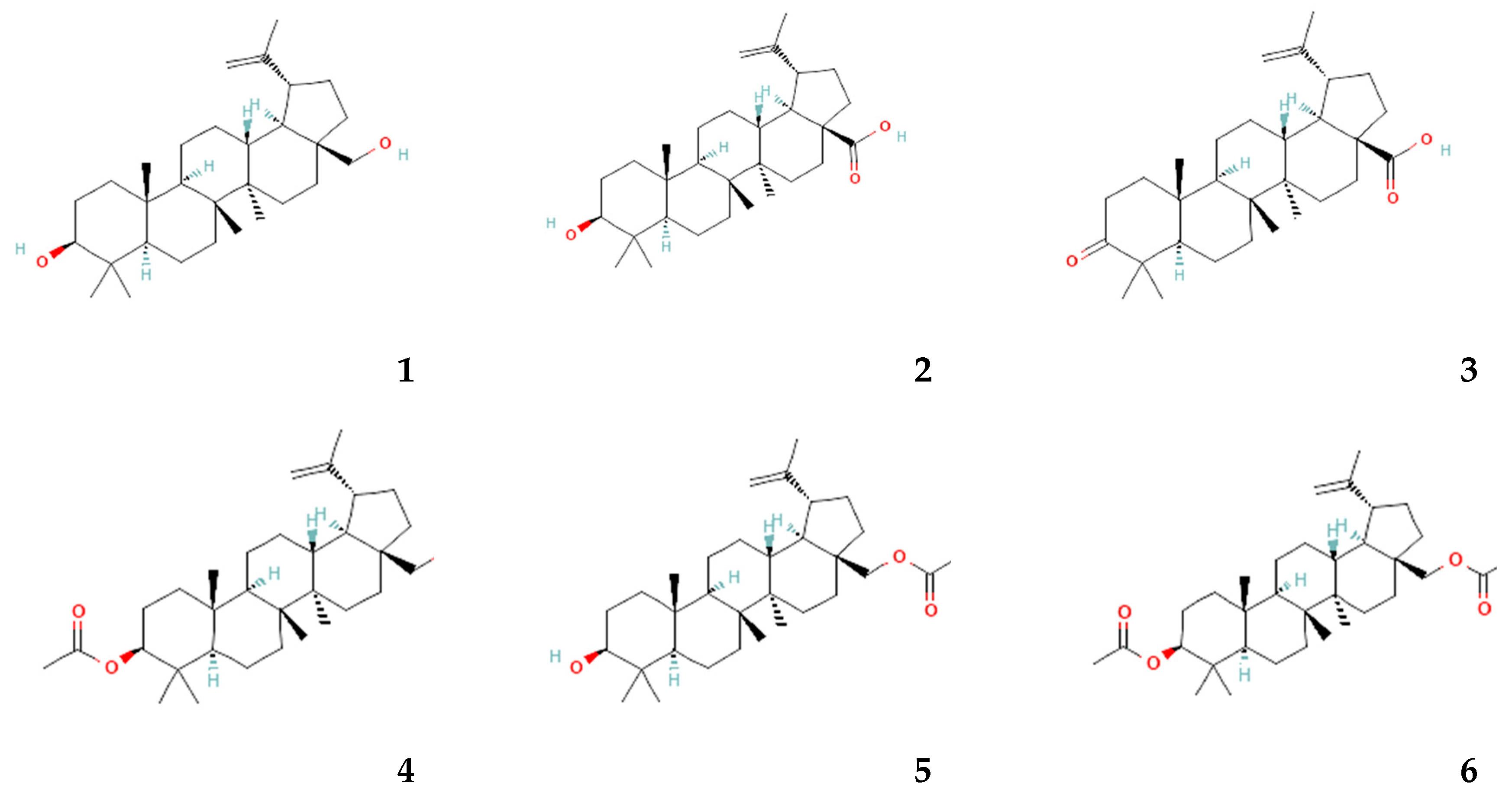
Figure 2.
Scientific schematic of betulin localization in birch outer bark.
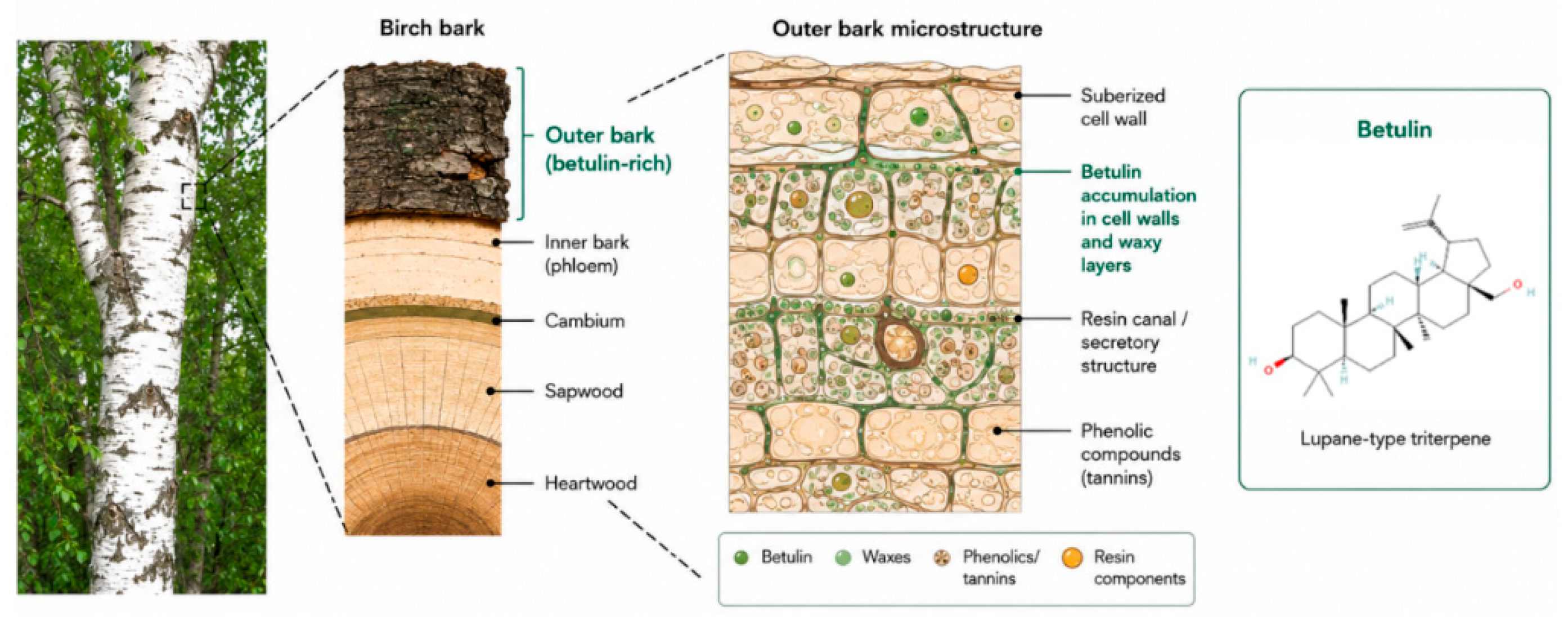
Figure 3.
Schematic comparison of conventional betulin extraction workflows from birch bark, highlighting Soxhlet extraction, reflux extraction, and the associated trade-offs in time, solvent consumption, and process scalability.
Figure 3.
Schematic comparison of conventional betulin extraction workflows from birch bark, highlighting Soxhlet extraction, reflux extraction, and the associated trade-offs in time, solvent consumption, and process scalability.
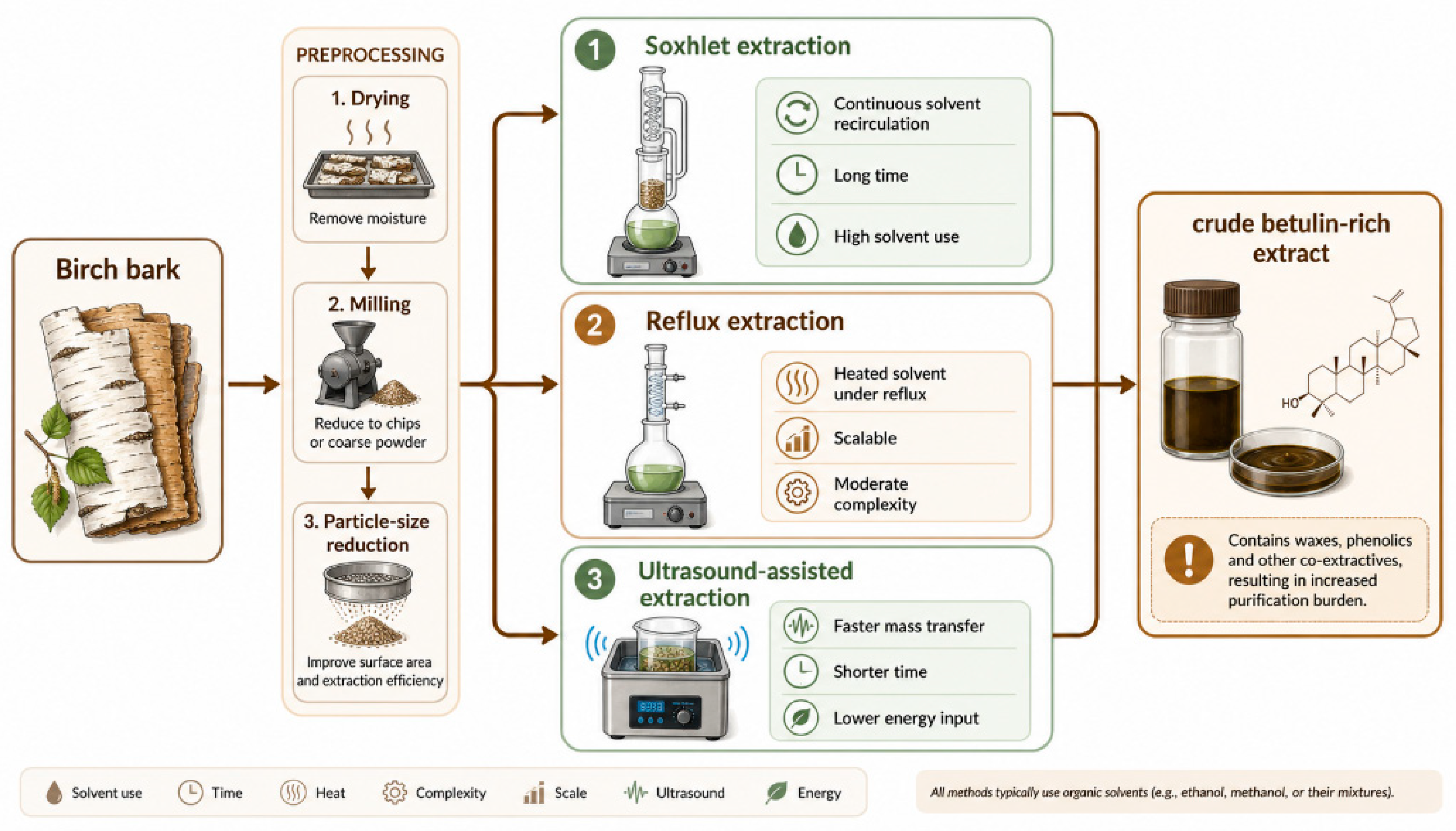
Figure 4.
Flow diagram of a typical purification sequence for betulin starting from a crude triterpenoid extract: dissolution and hot filtration, controlled cooling with seeding, filtration and collection of crystalline betulin, and optional recrystallization or chromatographic polishing.
Figure 4.
Flow diagram of a typical purification sequence for betulin starting from a crude triterpenoid extract: dissolution and hot filtration, controlled cooling with seeding, filtration and collection of crystalline betulin, and optional recrystallization or chromatographic polishing.
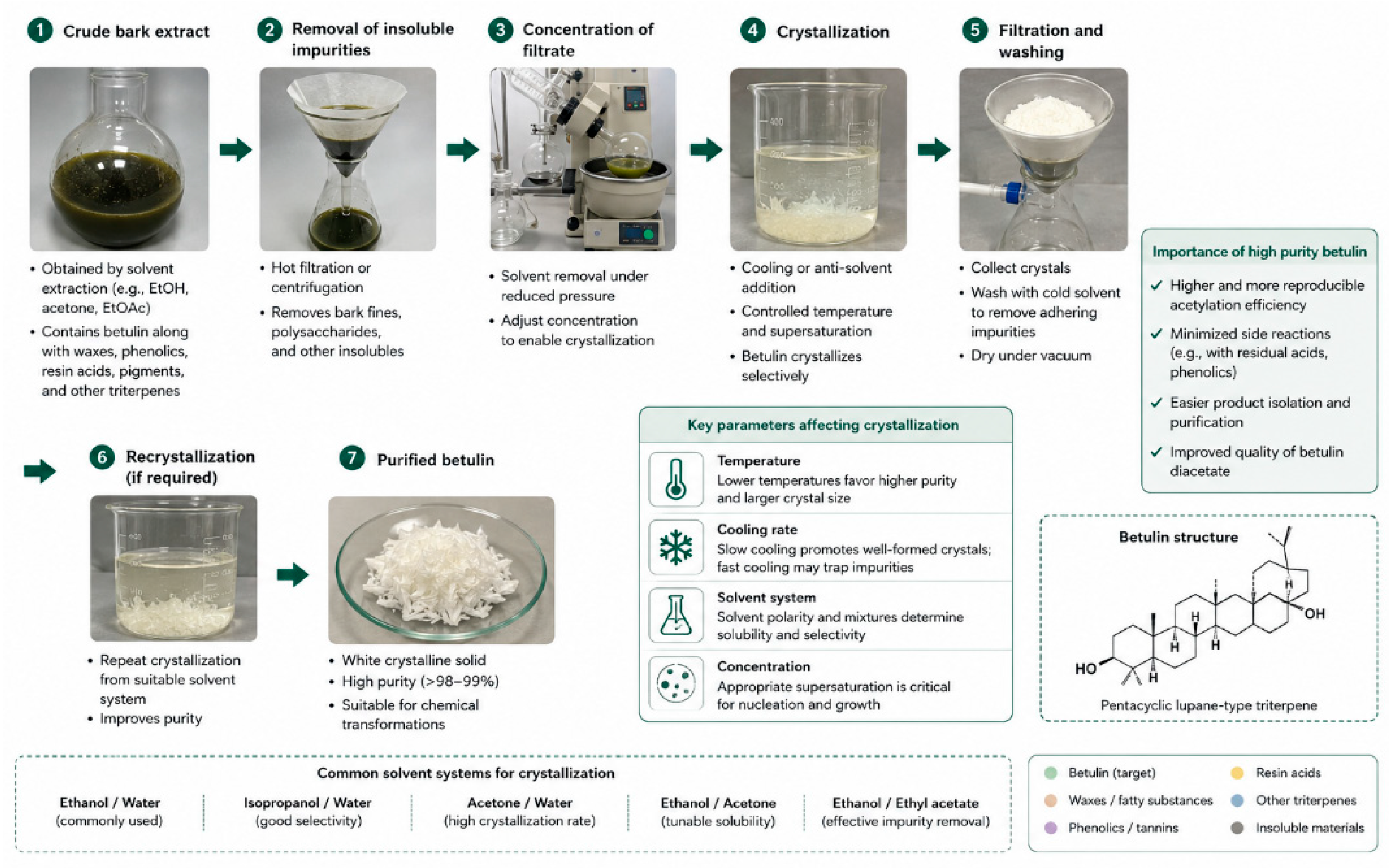
Figure 5.
General acetylation concept for conversion of betulin to betulin 3,28-diacetate.
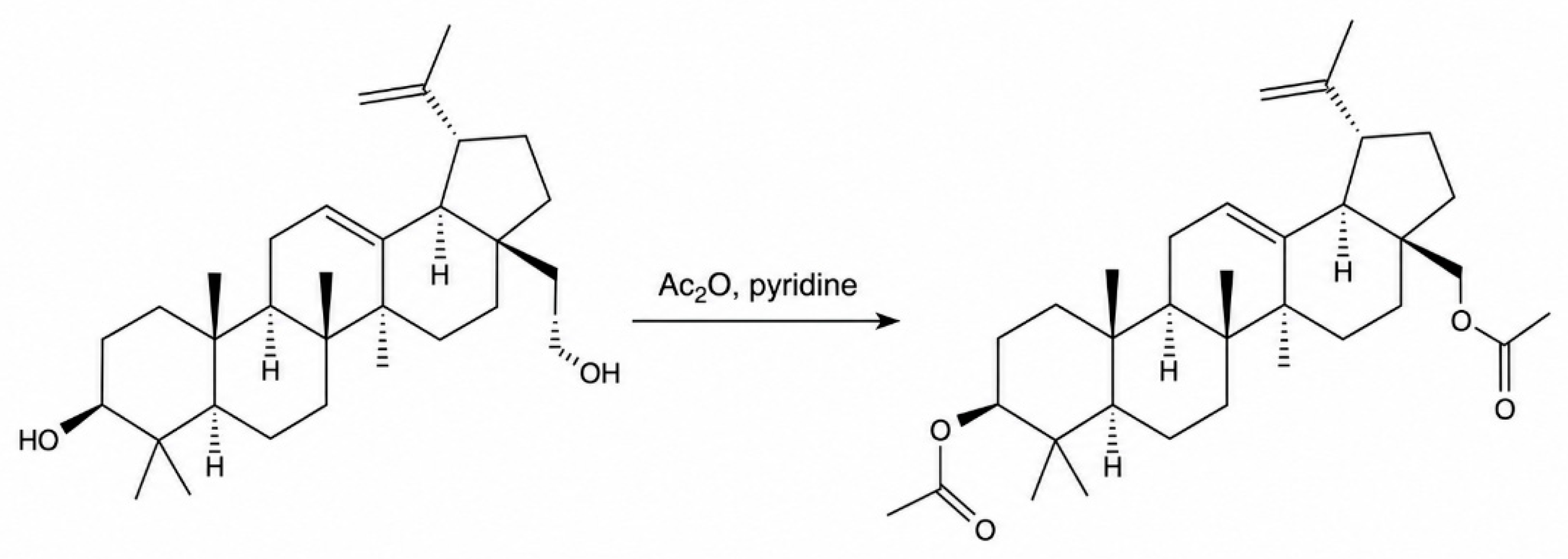
Figure 6.
Promoter-assisted acetylation of betulin to botulin.
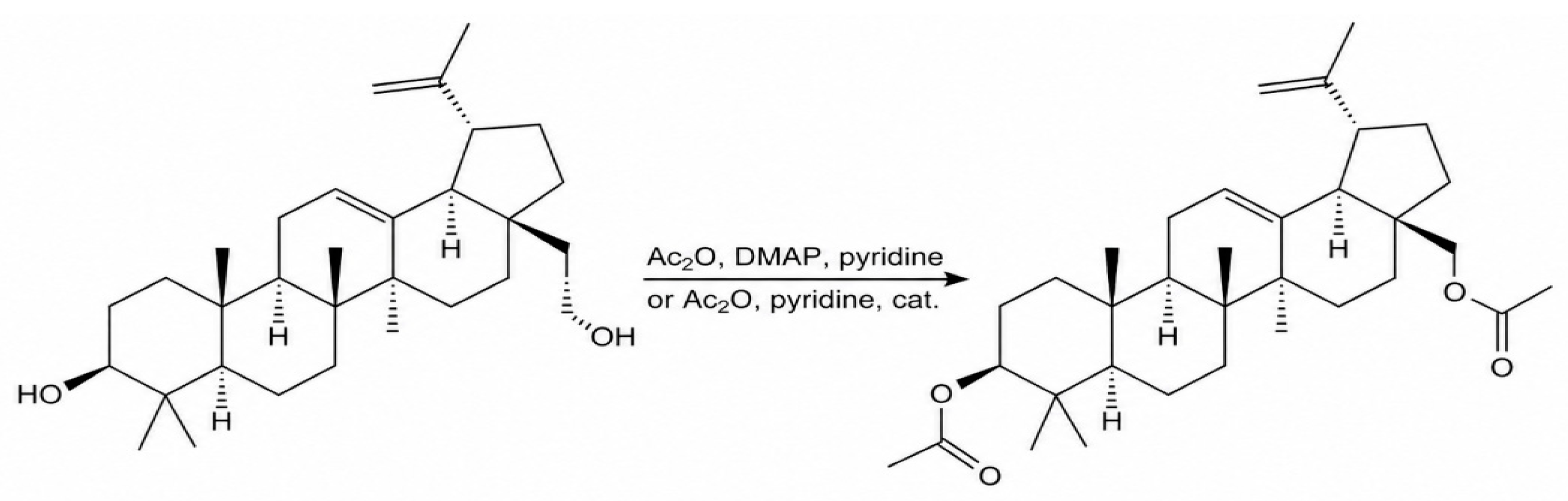
Figure 8.
Low-solvent or mechanochemical acetylation of betulin to betulin 3,28-diacetate.
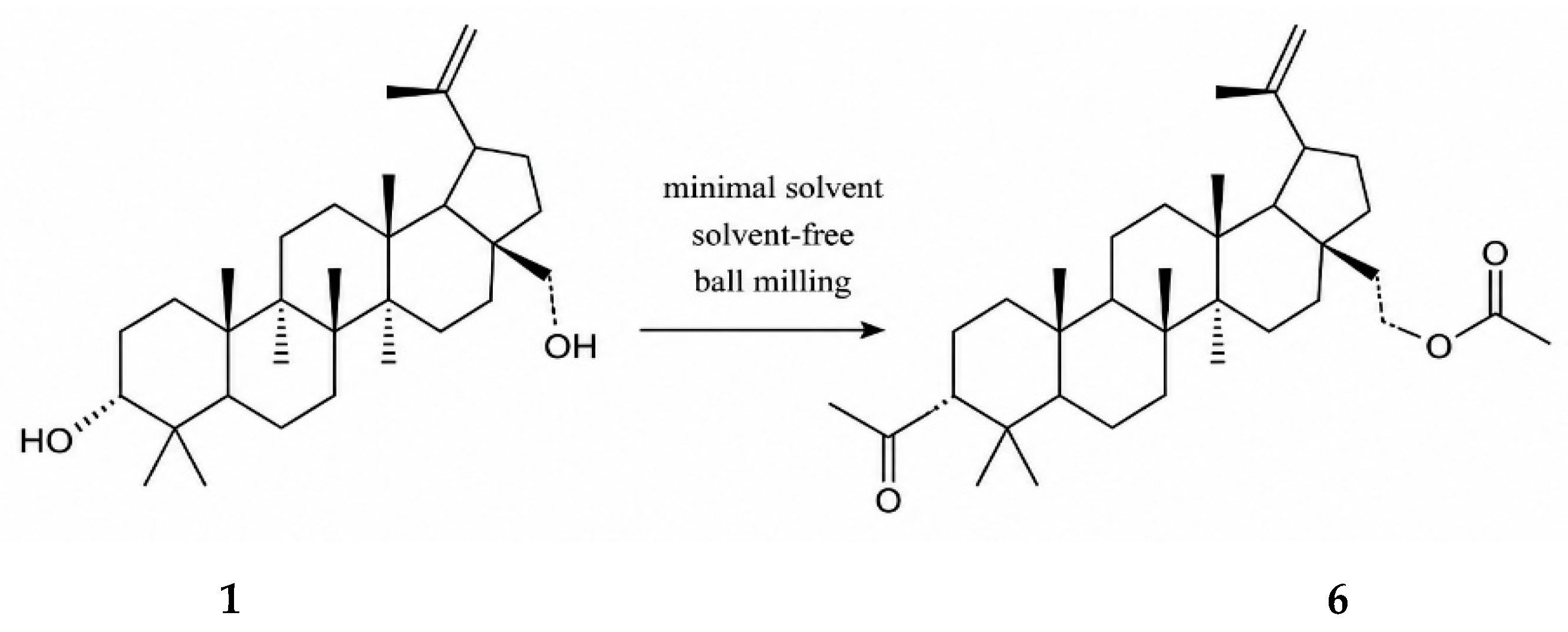
Disclaimer/Publisher’s Note: The statements, opinions and data contained in all publications are solely those of the individual author(s) and contributor(s) and not of MDPI and/or the editor(s). MDPI and/or the editor(s) disclaim responsibility for any injury to people or property resulting from any ideas, methods, instructions or products referred to in the content. |
© 2026 by the authors. Licensee MDPI, Basel, Switzerland. This article is an open access article distributed under the terms and conditions of the Creative Commons Attribution (CC BY) license (http://creativecommons.org/licenses/by/4.0/).
Copyright: This open access article is published under a Creative Commons CC BY 4.0 license, which permit the free download, distribution, and reuse, provided that the author and preprint are cited in any reuse.