

Submitted:
14 July 2026
Posted:
16 July 2026
You are already at the latest version
Abstract
Background: Leg ulceration is a debilitating complication of thalassaemia syndromes, particularly among patients with non-transfusion-dependent thalassaemia (NTDT). Although chronic anaemia is considered a major contributor, clinically relevant haemoglobin (Hb) thresholds associated with ulcer development remain poorly defined. Methods: We conducted a retrospective longitudinal cohort study of patients managed at a specialised Adult and Adolescent Thalassaemia Care Centre established in 2011. Iterative generalised linear mixed-effects modelling (GLMM) with a logit link function was utilised across 84 patients to systematically identify high-risk longitudinal Hb thresholds for the entire cohort and stratified by genotype. A subsequent multi-exposure GLMM framework evaluated independent clinical risk factors, adjusted for sex and genotype. Results: Iterative threshold testing across the entire cohort identified an optimal biological and statistical cutoff at Hb < 5.0 g/dL, associated with a significant risk of ulceration (partially adjusted OR = 2.87, 95% CI: 1.15 - 7.14, P = 0.024). Genotype-stratified analysis revealed that this threshold effect was predominantly driven by the HbEβ-thalassaemia subpopulation, in which the risk escalated sharply between 4.5g/dL (OR = 33.28, P = 0.001) and 5.5g/dL (OR = 2.42, P = 0.023). In the fully adjusted multivariable model, an Hb < 5.0g/dL remained a robust, independent driver of ulceration (aOR = 2.67, 95%CI: 1.08 - 6.62, P = 0.034). Additionally, active follow-up duration (aOR = 1.17 per year, P < 0.001) and cumulative transfusion burden (aOR = 1.43 per unit, P = 0.004) were identified as independent risk factors. Gender and underlying genotype demonstrated no independent association (P > 0.05). Conclusions: A longitudinal hemoglobin level below 5.0g/dL represents a critical threshold for lower-extremity ulceration in thalassaemia, exhibiting a particularly profound risk in HbE/β-thalassaemia. Proactive clinical management targeted at sustaining Hb levels strictly above this threshold, while managing secondary complications reflected by transfusion burden, may optimise microvascular outcomes.
Keywords:
thalassaemia
; HbE/β-thalassaemia
; leg ulcer
; severe anaemia
; haemoglobin threshold
Introduction
Leg ulceration is a well-recognised but incompletely understood complication of thalassaemia syndromes, particularly in patients with non-transfusion-dependent thalassaemia (NTDT). Although improvements in regular transfusion practices, iron chelation therapies, and comprehensive multidisciplinary care have substantially improved overall survival, leg ulcers continue to cause significant patient morbidity through chronic pain, recurrent bacterial infection, impaired physical mobility, and reduced quality of life. The pathogenesis of ulcer formation is believed to be multifactorial, involving chronic tissue hypoxia, ineffective erythropoiesis, accelerated haemolysis, endothelial dysfunction, hypercoagulability, venous insufficiency, and iron-mediated vascular injury (Sleiman et al. 2018; Mehta et al. 2022; Musallam, Cappellini, and Taher 2008; Tahar, Musallam, and Cappellini 2023).
Leg ulcers are reported more frequently in NTDT phenotypes than in regularly transfused thalassaemia major, with increasing age, splenectomy, severe chronic anaemia, and hypercoagulable states identified as important risk factors. However, reported prevalence rates vary considerably between studies, reflecting differences in patient cohorts, underlying disease severity, and access to specialized haematology care (Tahar, Musallam, and Cappellini 2023; Sleiman et al. 2018).
Despite being recognised for several decades, the epidemiology and natural history of thalassaemia-associated leg ulcers remain poorly characterised. Recent work by Mehta and colleagues in Sri Lanka reported leg ulcers in 22% of patients with HbE/β-thalassaemia, suggesting that this complication may be substantially more common than previously appreciated in specific South Asian populations. These investigators also highlighted the limited evidence base supporting current management strategies and the absence of controlled studies evaluating preventive or therapeutic interventions (Mehta et al. 2022).
Data from South Asia remain particularly sparse, and contemporary longitudinal studies examining predictors of leg ulcer development across different thalassaemia genotypes are limited. While chronic anaemia is widely regarded as a central pathogenic driver, clinically relevant haemoglobin thresholds associated with ulcer development have not been clearly defined. Furthermore, it remains uncertain whether the relationship between anaemia and ulceration differs across distinct thalassaemia phenotypes. We therefore analysed longitudinal clinical data from a Sri Lankan thalassaemia cohort to identify specific haemoglobin thresholds associated with leg ulcer development and to evaluate demographic and disease-related factors that may independently influence ulcer risk.
Methods
Study Design and Population
We conducted a retrospective longitudinal cohort study at the Adult and Adolescent Thalassaemia Care Centre, which was established in 2011. Clinic records of all patients with a laboratory-confirmed diagnosis of thalassaemia syndrome (HbE/β-thalassaemia, thalassaemia intermedia, or thalassaemia major) were reviewed. Individuals who developed at least one leg ulcer episode during long-term follow-up were identified. Medical records were reviewed in detail, and patient interviews were undertaken, when necessary, to confirm that all recorded ulcers were directly attributable to thalassaemia-related complications rather than alternative causes (such as major trauma or unrelated severe peripheral vascular disease). The precise date of onset of the first ulcer and any subsequent recurrent ulcer episodes were recorded relative to clinical visits. To minimise confounding, cases were paired with age- and sex-matched controls selected from the same thalassaemia cohort who remained free of leg ulcers throughout the follow-up period.
Longitudinal clinical, haematological, biochemical, and radiological data were extracted from the earliest available records and arranged chronologically. Haematological variables included steady-state haemoglobin concentration, pre-transfusion haemoglobin level, haemoglobin F concentration, and platelet count. Clinical variables captured longitudinally included diabetes mellitus, chronic liver disease/cirrhosis, hepatitis C infection, osteoporosis or fractures, splenectomy status, gallstones, and cholecystectomy. Measures of systemic iron burden included serial serum ferritin concentrations and, where available, T2* magnetic resonance imaging (MRI) assessments of cardiac and hepatic iron loading. Of the 84 age- and sex-matched patients (42 cases, 42 controls) forming the analytic cohort, 5 patients had no recorded longitudinal haemoglobin, transfusion, or follow-up data across their period of observation and could therefore not contribute to the generalised linear mixed-effects models; all reported GLMM results are accordingly based on the remaining 79 patients (4,569 visits), while baseline descriptive characteristics in Table 1 reflect the full 84-patient matched cohort.
Statistical Analysis
Descriptive statistics were used to summarise demographic and clinical characteristics. Continuous variables were evaluated for normality using the Shapiro-Wilk test. To ensure consistency across all parameters, continuous data (including normally distributed haemoglobin) are presented as medians with interquartile ranges (IQRs). Categorical variables were reported as frequencies and percentages. Baseline features between patients with leg ulcers and matched controls were compared using independent Mann-Whitney U tests, Chi-square tests, or Fisher's exact tests, as appropriate.
To account for the longitudinal structure of the data, repeated measurements within individuals, and the matched design, generalized linear mixed-effects models (GLMMs) with a logit link function were constructed using a two-stage modeling approach: Stage 1 (Threshold Identification): First, GLMMs were utilized to evaluate the longitudinal association between hemoglobin (Hb) levels and the risk of leg ulceration, systematically identifying the specific Hb threshold or "cut-off" level associated with a significantly increased probability of ulcer development. This threshold analysis was executed across the entire cohort and subsequently stratified by genotype (HbE/β-thalassaemia, thalassaemia intermedia, or thalassaemia major). Stage 2 (Multivariable Risk Factor Analysis): Once the primary Hb thresholds were established, a subsequent multivariable GLMM framework was constructed to identify other independent risk factors for leg ulceration. Candidate independent variables included genotype (HbE/β-thalassaemia, thalassaemia intermedia, or thalassaemia major), sex, age, cumulative follow-up duration, longitudinal transfusion burden (defined as the number of transfusion events per year), splenectomy status, hydroxyurea exposure, and time-varying markers of iron overload. The total follow-up duration within our specialised care framework was selected as a primary independent risk factor, rather than chronological age. Because Hb optimisation and active clinical maintenance were strictly managed throughout the observation period, total follow-up time served as a better indicator of cumulative exposure to controlled clinical management and disease progression. Given that age and follow-up duration represent highly related proxy measures, chronological age was omitted from multivariable models to prevent collinearity. Final models were subsequently adjusted for sex and thalassaemia genotype.
For all mixed models, patient identification numbers were specified as a random intercept to control for intra-individual correlation over time. Statistical significance was defined as a two-tailed p < 0.05. All analyses were performed using R programming language version 4.5.1.
Ethics Approval
The study was conducted in accordance with the Declaration of Helsinki and received approval from the Ethics Review Committee of the Faculty of Medicine, University of Kelaniya. As this was a retrospective analysis of routinely collected clinical data, informed consent requirements were waived by the Ethics Review Committee.
Results
A total of 84 individuals were evaluated, evenly divided between the Control (n = 42) and Patient (n = 42) groups. The cohorts were well-matched across baseline demographics, clinical history, and laboratory parameters (Table 1). Age milestones were comparable between groups; the median age at clinical presentation was 3.5 years for controls versus 1.8 years for patients, while the median age at enrollment was 31.8 and 32.4 years, respectively. No significant differences were observed in sex distribution, thalassemia genotype, transfusion burden, or mean and maximum haemoglobin levels during follow-up. However, the patient group exhibited lower nadir haemoglobin levels during the study period compared to the control group (median minimum Hb: 5.1 vs 5.6 g/dL; p = 0.027).
Haemoglobin Threshold Associated with Leg Ulcer Development
To determine the specific haemoglobin (Hb) threshold significantly associated with an increased probability of leg ulceration, iterative generalised linear mixed-effects modelling (GLMM) was performed across a gradient of clinical cutoff points ranging from 3.5g/dL to 11.5 g/dL across both the combined cohort (Cases and Controls) and within Cases alone (Table 2). An escalation in the risk of leg ulceration was first observed at an Hb threshold of < 4.5g/dL (six events; OR = 3.68, 95% CI: 1.08 - 12.52, P = 0.037). The peak statistical significance and risk magnitude were identified at the < 5.0g/dL threshold (12 events; OR = 3.81, 95% CI: 1.76-8.26, P = 0.001). This elevated risk remained significant up to the <5.5g/dL threshold (12 events; OR = 1.93, 95% CI: 1.07 - 3.47, P = 0.028). Hb cutoffs of 6.0g/dL or above demonstrated no association with leg ulcer risk, with odds ratios stabilising near or below 1.0 (P > 0.05). A similar pattern was observed when the analysis was restricted to the case group, confirming that the identified Hb thresholds reliably tracked ulcer severity and clinical dynamics of recurrence within affected individuals. Consequently, an Hb level of <5.0g/dL was selected as the optimal cutoff for the cohort to be carried forward into subsequent multivariable risk-factor analyses.
Genotype-Specific Analyses
To evaluate whether the impact of anaemia severity on leg ulceration varied by underlying genetic aetiology, separate iterative mixed-effects analyses were performed within each thalassaemia subpopulation (Table 2, subgroup columns). The strongest threshold effect was observed within the HbE/β-thalassaemia cohort. In this subgroup, risk rose sharply once Hb fell below 5.5 g/dL (OR = 2.42, 95% CI: 1.13–5.18, P = 0.023), rose further below the primary study threshold of 5.0 g/dL (OR = 6.48, 95% CI: 2.30-18.28, P = 0.001) and escalated further below 4.5 g/dL (OR = 33.28, 95% CI: 4.55–243.50, P = 0.001), identifying a clear high-risk band between 4.5 and 5.5 g/dL specific to this genotype. Conversely, within the thalassaemia intermedia (TI) and thalassaemia major (TM) cohorts, anaemia thresholds were not associated with an increased ulcer risk at any cutoff. The single nominally significant result among these two genotypes was a paradoxical protective association in the TI subgroup at Hb <7.0 g/dL (OR = 0.28, 95% CI: 0.09-0.87, P = 0.028); given the small subgroup size (n – 12) and a direction opposite to the primary hypothesis, this most likely reflects a false-positive finding arising from testing multiple thresholds rather than a true biological effect. Figure 1 shows the haemoglobin trajectories over follow-up for different genotypes. The wider confidence bands and greater visit-to-visit fluctuation apparent in the TI trajectory in Figure 1 most likely reflect the smaller subgroup size (n = 12) relative to the E-β-thalassaemia and TM cohorts, together with more variable inter-transfusion intervals in TI, rather than a distinct biological pattern.
Smoothed longitudinal haemoglobin trajectories for patients with HbE/β-thalassaemia, thalassaemia intermedia (TI), and thalassaemia major (TM) during follow-up. The shaded regions represent 95% confidence intervals. Patients with HbE/β-thalassaemia consistently demonstrated the lowest haemoglobin concentrations throughout follow-up.
Longitudinal Predictors of Leg Ulcer Development
To identify independent clinical drivers of lower-extremity ulceration, multivariable generalised linear mixed-effects models (GLMM) were fitted to evaluate the critical haemoglobin threshold (Hb < 5.0g/dL) alongside other covariates. In this primary model, severe anaemia episodes falling below the threshold were strongly and independently associated with ulcer development; patients experiencing an Hb < 5.0g/dL at a visit carried a nearly three-fold increase in the odds of developing a leg ulcer (Partially adjusted OR = 2.87, 95%CI: 1.15 - 7.14, P = 0.024, adjusted for follow-up time and units transfused). A longer follow-up period was also an independent risk factor, with each additional year of active follow-up associated with an 18% increase in the odds of ulcer identification (OR = 1.18 per year, 95% CI: 1.11 - 1.25, P < 0.001). Cumulative transfusion volume was significant, with each unit of blood transfused escalating the odds of lower-extremity ulceration by 43% (OR = 1.43, 95%CI: 1.12 - 1.82, P = 0.004). To verify that these associations were robust to demographic and clinical confounding, a secondary model was constructed, adjusting for gender and thalassaemia genotype, evaluating HbE/β-thalassaemia as the reference group. Following full covariate adjustment, the independent clinical significance of the primary risk factors remained highly stable. Severe anaemia (Hb < 5.0g/dL) was confirmed as a robust independent driver of ulceration, with affected patients experiencing a 2.67-fold increase in the odds of developing a leg ulcer (OR = 2.67, 95%CI: 1.08 - 6.62, P = 0.034). Similarly, both longitudinal exposure and treatment metrics retained statistical significance with virtually unchanged effect sizes: each additional year of active follow-up duration increased the odds of ulcer identification by 17% (OR = 1.17, 95%CI: 1.11 - 1.25, P < 0.001), while each unit of blood transfused escalated the risk by 43% (OR = 1.43, 95% CI: 1.13 - 1.82, P = 0.004). No independent associations with leg ulcer risk were observed for demographic or genotypic covariates within this fully adjusted framework (Table 3).
No significant independent association was observed between splenectomy status and elevated serum ferritin concentrations and leg ulcer risk. Hydroxyurea use was more common among patients with leg ulcers than among those without ulcers (33% vs 22%). However, in the multivariable model adjusting for underlying haemoglobin levels and phenotype, hydroxyurea exposure was not an independent predictor of ulceration, confirming that this univariable imbalance was driven by confounding by indication (whereby patients with more severe baseline anaemia were preferentially prescribed hydroxyurea).
Discussion
In this longitudinal cohort study, severe anaemia was strongly associated with an increased risk of leg ulcer development in patients with thalassaemia syndromes. A time-updated haemoglobin concentration below 5.0 g/dL was associated with a nearly three-fold increase in ulcer risk in the overall cohort (partially adjusted OR = 2.87, 95% CI: 1.15–7.14), and this association was predominantly driven by the subgroup of patients with E-β-thalassaemia. Risk remained significantly elevated, albeit attenuated, up to a threshold of 5.5 g/dL (OR = 1.93), beyond which no association with ulceration was detected. In contrast, no significant independent haemoglobin threshold was identified among patients with thalassaemia intermedia or thalassaemia major.
The relationship between profound chronic anaemia and leg ulceration is biologically plausible and consistent with known pathophysiological pathways. Chronic tissue hypoxia, endothelial dysfunction, accelerated intravascular haemolysis, and hypercoagulability have all been implicated in compromised microvascular tissue perfusion and subsequent ulcer pathogenesis (Mehta et al. 2022; Tahar, Musallam, and Cappellini 2023). Our findings extend current clinical knowledge by suggesting that repeated or sustained exposure to profound anaemia below a critical threshold (5.0 g/dL) may be the primary driver of ulceration. The observation that E-β-thalassaemia patients maintained the lowest average haemoglobin trajectories throughout follow-up likely explains why this critical threshold effect was confined to this specific subgroup. This finding aligns with prior epidemiological reports demonstrating a remarkably high burden of leg ulceration among patients with HbE/β-thalassaemia in Sri Lanka and other endemic South Asian regions (Premawardhena et al. 2005).
A longer follow-up duration was also strongly associated with ulcer development (chronological age was not entered into the final adjusted models owing to collinearity with follow-up duearion). This finding is consistent with previous literature showing that leg ulcers are predominantly a complication of adult patients with thalassaemia, reflecting cumulative microvascular injury resulting from decades of exposure to chronic hypoxia and haemolysis (Sleiman et al. 2018; Tahar, Musallam, and Cappellini 2023; Ali T Taher et al. 2010).
In contrast to some prior literature, sex, splenectomy status, and elevated ferritin concentrations were not significantly associated with ulcer risk in our adjusted model. While splenectomy is widely associated with thromboembolic complications in NTDT cohorts (A T Taher et al. 2010), our longitudinal model suggests that when accounting for the severity of the underlying anaemia trajectory, splenectomy itself may not be the primary independent driver of ulceration in this specific cohort.
The major strengths of this study include its long-term longitudinal design, the large number of time-updated clinical observations (4,569 visits), and the comparative evaluation of multiple thalassaemia phenotypes. However, several limitations should be acknowledged. The study was conducted at a single adult specialized centre and, of the 84 age- and sex-matched patients enrolled, only 79 contributed sufficient longitudinal data to be included in the mixed-effects models, reflecting a relatively small total number of individual patients . Consequently, the identified exploratory haemoglobin threshold requires external validation in larger, independent international cohorts. Furthermore, because haemoglobin levels fluctuate dynamically between clinical visits, we were unable to determine the exact minimum duration of severe anaemia required to precipitate an acute ulceration event.
In conclusion, severe anaemia dipping below a critical threshold of approximately 5.0 g/dL is strongly and independently associated with leg ulcer development, particularly among patients with E-β-thalassaemia. These findings suggest that optimized clinical management aimed at preventing recurrent or profound drops in haemoglobin may represent an essential therapeutic strategy for reducing the high burden of debilitating leg ulcers in this vulnerable patient population.
Author Contributions
Conceptualization, A.P. and S.P.; Methodology, S.P. and S.W.; Formal analysis, D.E.; Data curation, J.K.; Writing—original draft preparation, K.F.; Writing—review and editing, K.F., A.P., S.P., D.E. and S.W.; Supervision, A.P. and S.W. All authors have read and agreed to the published version of the manuscript.
Funding
This research was funded by the University of Kelaniya, Sri Lanka (RC/2025/PPSD02).
Institutional Review Board Statement
This study was conducted in accordance with the Declaration of Helsinki and approved by the Ethics Review Committee of the Faculty of Medicine, University of Kelaniya.
Informed: Consent Statement Patient consent was waived by the Ethics Review Committee, as this was a retrospective analysis of routinely collected clinical data.
Data Availability Statement
The data presented in this study are available on request from the corresponding author. The data are not publicly available due to patient privacy restrictions.
Acknowledgments
The authors thank the staff at the Hemal's Thalassaemia Care Unit, Mahara, and all the patients who contributed to this study.
Conflicts of Interest
The authors declare no conflict of interest.
References
- Mehta, Vikita; Kirubarajan, Abirami; Sabouhanian, Amir; Jayawardena, Sanasi M; Chandrakumaran, Priya; Thangavelu, Nila; Cader, Refai; et al. Leg Ulcers: A Report in Patients with Hemoglobin E Beta Thalassemia and Review of the Literature in Severe Beta Thalassemia. Acta Haematologica 2022, 145(3), 334–43. [Google Scholar] [CrossRef] [PubMed]
- Musallam, Khaled; Cappellini, Maria D; Taher, Ali. Challenges Associated with Prolonged Survival of Patients with Thalassemia: Transitioning from Childhood to Adulthood. Pediatrics 2008, 121(5), e1426-9. [Google Scholar] [CrossRef] [PubMed]
- Premawardhena, A; Fisher, C A; Olivieri, N F; de Silva, S; Arambepola, M; Perera, W; O’Donnell, A; et al. Haemoglobin E β Thalassaemia in Sri Lanka. The Lancet 2005, 366(9495), 1467–70. [Google Scholar] [CrossRef] [PubMed]
- Sleiman, Joseph; Tarhini, Ali; Bou-Fakhredin, Rayan; Saliba, Antoine N; Cappellini, Maria Domenica; Taher, Ali T. Non-Transfusion-Dependent Thalassemia: An Update on Complications and Management. International Journal of Molecular Sciences 2018, 19(1). [Google Scholar] [CrossRef] [PubMed]
- Tahar, AT; Musallam, KM; Cappellini, MD. Leg Ulcers. In Guidelines for the Management of Non-Transfusion-Dependent β-Thalassaemia, 3rd Edition ed; Nicosia, 2023. [Google Scholar]
- Taher, A T; Musallam, K M; Karimi, M; El-Beshlawy, A; Belhoul, K; Daar, S; Saned, M; Cesaretti, C; Cappellini, M D. Splenectomy and Thrombosis: The Case of Thalassemia Intermedia. Journal of Thrombosis and Haemostasis 2010, 8(10), 2152–58. [Google Scholar] [CrossRef] [PubMed]
- Taher, Ali T; Musallam, Khaled M; El-Beshlawy, Amal; Karimi, Mehran; Daar, Shahina; Belhoul, Khawla; Saned, Mohamed-SalahEldin; Graziadei, Giovanna; Cappellini, Maria D. Age-Related Complications in Treatment-Naïve Patients with Thalassaemia Intermedia. British Journal of Haematology 2010, 150(4), 486–89. [Google Scholar] [CrossRef] [PubMed]
Figure 1.
Longitudinal haemoglobin trajectories according to thalassaemia phenotype.
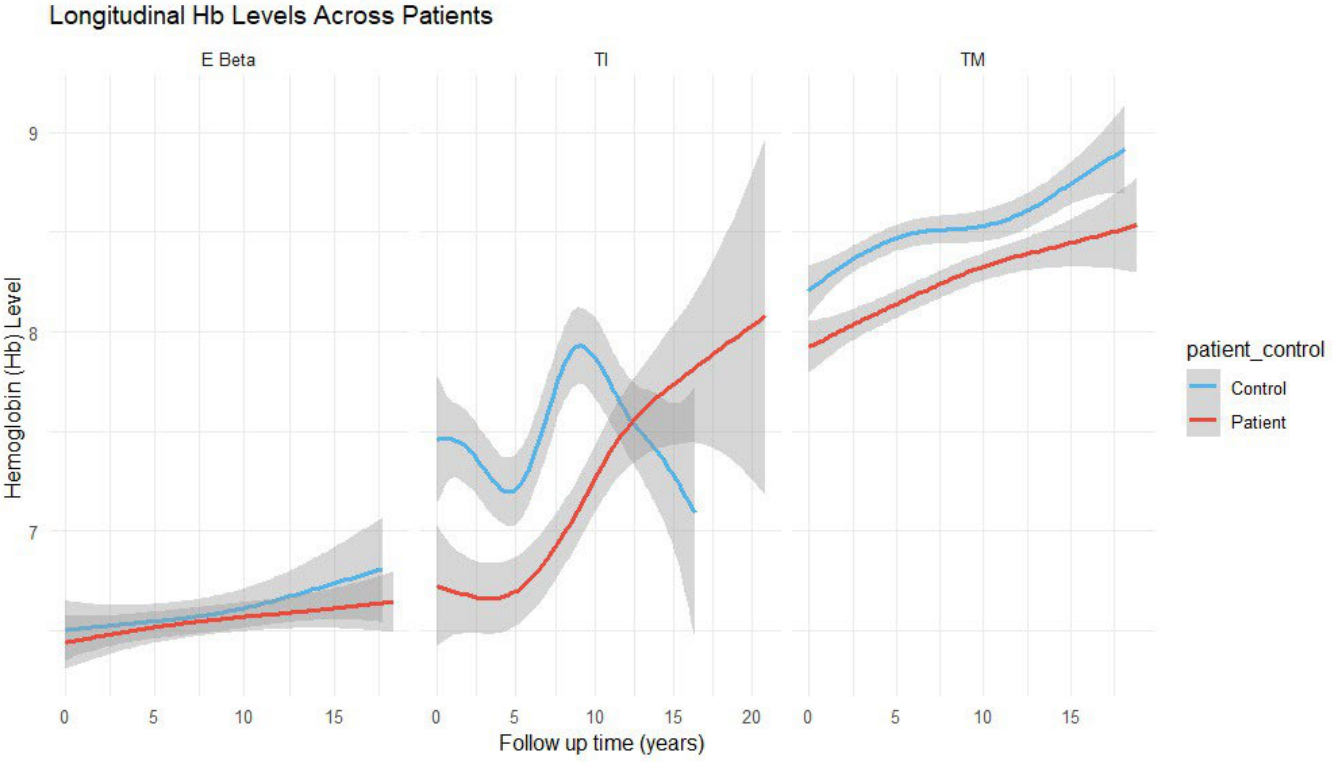

Table 1.
Baseline demographic, clinical, and laboratory characteristics of the study cohort.
| Characteristic |
Control N = 421 |
Patient N = 421 |
p-value2 |
| Age at presentation (years) | 3.5 (0.8 - 9.0) | 1.8 (0.6 - 13.0) | 0.519 |
| Age at enrollment (years) | 31.8 (24.9 - 40.3) | 32.4 (27.8 - 43.8) | 0.720 |
| Sex | 0.999 | ||
| Female | 19 (45%) | 19 (45%) | |
| Male | 23 (55%) | 23 (55%) | |
| Genotype | 0.999 | ||
| HbE/β-thalassaemia | 15 (36%) | 15 (36%) | |
| Thalassaemia intermedia | 12 (29%) | 12 (29%) | |
| Thalassaemia major | 15 (36%) | 15 (36%) | |
| Follow-up time (years) | 11.0 (8.4 - 15.4) | 13.2 (11.2 - 15.8) | 0.137 |
| Number of visits | 69.5 (23.0 - 131.0) | 76.0 (33.0 - 146.0) | 0.434 |
| Units transfused | 137.5 (43.0 - 280.0) | 165.5 (73.0 - 323.0) | 0.348 |
| Minimum Hb | 5.6 (4.9 - 6.5) | 5.1 (4.2 - 5.8) | 0.027 |
| Mean Hb | 7.7 (6.9 - 8.5) | 7.2 (6.6 - 8.0) | 0.139 |
| Maximum Hb | 10.0 (8.5 - 10.6) | 9.9 (8.4 - 10.7) | 0.819 |
| Mean Hbf | 25.4 (11.3 - 50.7) | 14.1 (6.4 - 59.7) | 0.445 |
| Mean platelet | 299.0 (224.0 - 568.5) | 342.3 (236.0 - 517.3) | 0.857 |
| Mean ferritin | 1,389.7 (822.5 - 2,098.9) | 1,655.6 (860.9 - 2,349.5) | 0.316 |
| Mean t2 heart | 30.4 (23.3 - 37.2) | 37.2 (26.7 - 45.3) | 0.059 |
| Mean t2 liver | 6.3 (4.6 - 8.6) | 7.1 (5.6 - 8.3) | 0.655 |
| Splenectomy | 13 (31%) | 21 (50%) | 0.075 |
| Gall stones | 22 (52%) | 25 (60%) | 0.510 |
| Cholecystectomy | 9 (21%) | 11 (26%) | 0.608 |
| Diabetes | 8 (19%) | 7 (17%) | 0.776 |
| Bone pain | 2 (4.8%) | 6 (14%) | 0.265 |
| Fractures | 1 (2.4%) | 2 (4.8%) | 0.999 |
| Amputation | 0 (0%) | 2 (4.8%) | 0.494 |
| Cirrhosis | 2 (4.8%) | 5 (12%) | 0.433 |
| Hydroxyurea | 11 (26%) | 14 (33%) | 0.474 |
|
1 Median (Q1 - Q3); n (%); 2 Wilcoxon rank sum test; Pearson's Chi-squared test; Wilcoxon rank sum exact test; Fisher's exact test | |||
Table 2.
Generalised linear mixed-effects model (GLMM) evaluating iterative haemoglobin (Hb) thresholds for the risk of leg ulceration across the longitudinal thalassaemia cohort.
Table 2.
Generalised linear mixed-effects model (GLMM) evaluating iterative haemoglobin (Hb) thresholds for the risk of leg ulceration across the longitudinal thalassaemia cohort.
| For cases and controls | For cases | ||||
| Hb Threshold (<g/dL) | Cumulative Events (n) | Unadjusted Odds Ratio (95%CI) | P value | Unadjusted Odds Ratio (95%CI) | P value |
| 2.5 | 2 | 44.39 (1.51 - 1302.54) | 0.028 | 20.23 (1.07 - 384.19) | 0.045 |
| 3.0 | 3 | 16.73 (0.92 - 305.83) | 0.057 | 8.98 (0.75 - 107.7) | 0.083 |
| 3.5 | 3 | 6.03 (0.59 - 61.98) | 0.131 | 4.86 (0.55 - 42.61) | 0.153 |
| 4.0 | 3 | 3.68 (0.42 - 31.99) | 0.238 | 2.93 (0.40 - 21.70) | 0.292 |
| 4.5 | 6 | 3.68 (1.08 - 12.52) | 0.037 | 3.03 (0.95 - 9.61) | 0.060 |
| 5.0 | 12 | 3.81 (1.76 - 8.26) | 0.001 | 3.24 (1.55 - 6.80) | 0.002 |
| 5.5 | 12 | 1.93 (1.07 - 3.47) | 0.028 | 1.78 (1.01 - 3.15) | 0.046 |
| 6.0 | 16 | 1.03 (0.62 - 1.71) | 0.903 | 0.99 (0.61 - 1.61) | 0.969 |
| 6.5 | 22 | 0.90 (0.57 - 1.42) | 0.645 | 0.87 (0.57 - 1.35) | 0.546 |
| 7.0 | 26 | 0.72 (0.46 - 1.12) | 0.148 | 0.72 (0.47 - 1.11) | 0.138 |
| 7.5 | 31 | 0.83 (0.52 - 1.32) | 0.429 | 0.84 (0.54 - 1.31) | 0.444 |
| 8.0 | 38 | 0.86 (0.54 - 1.37) | 0.531 | 0.87 (0.56 - 1.36) | 0.545 |
| 8.5 | 42 | 1.18 (0.69 - 2.01) | 0.552 | 1.17 (0.70 - 1.95) | 0.559 |
| 9.0 | 43 | 0.69 (0.37 - 1.28) | 0.240 | 0.70 (0.38 - 1.27) | 0.238 |
| 9.5 | 43 | 0.65 (0.31 - 1.36) | 0.251 | 0.66 (0.32 - 1.36) | 0.261 |
| 10.0 | 43 | 1.29 (0.32 - 5.17) | 0.717 | 1.33 (0.34 - 5.11) | 0.681 |
| 10.5 | 43 | 1.42 (0.14 - 14.20) | 0.764 | 1.40 (0.15 -13.34) | 0.773 |
| 11.0 | 43 | 0.54 (0.03 - 9.08) | 0.669 | 0.47 (0.03 - 8.87) | 0.617 |
| 11.5 | 43 | 0.39 (0.02 - 9.42) | 0.563 | 0.40 (0.02 - 9.28) | 0.571 |
Table 3.
Multivariable GLMM Analysis for Independent Risk Factors of Leg Ulceration.
| Risk Factor | Partially adjusted OR (95% CI)* | P-value | Fully Adjusted OR (aOR, 95% CI)** | P-value |
| Severe Anaemia (Hb < 5.0 g/dL) | 2.87 (1.15–7.14) | 0.024 | 2.67 (1.08–6.62) | 0.034 |
| Follow-up Duration (per year) | 1.18 (1.11–1.25) | < 0.001 | 1.17 (1.11–1.25) | < 0.001 |
| Transfusion Burden (per unit) | 1.43 (1.12–1.82) | 0.004 | 1.43 (1.13–1.82) | 0.004 |
| Gender (Ref: Female): Male | 1.81 (0.16–21.05) | 0.635 | ||
| Genotype (Ref: HbE/β-thalassaemia) | ||||
| Thalassaemia Intermedia (TI) | 0.14 (0.01–3.21) | 0.221 | ||
| Thalassaemia Major (TM) | 0.13 (0.01–2.14) | 0.153 |
CI, confidence interval; Hb, haemoglobin; OR, odds ratio; aOR, adjusted odds ratio. Baseline unadjusted model random intercept variance = 27.23 (SD = 5.22); Adjusted model random intercept variance = 20.75 (SD = 4.56). *Partially adjusted baseline model contains haemoglobin threshold, follow-up time, and units transfused. ** Adjusted model incorporates all listed demographic and clinical covariates simultaneously.
Disclaimer/Publisher’s Note: The statements, opinions and data contained in all publications are solely those of the individual author(s) and contributor(s) and not of MDPI and/or the editor(s). MDPI and/or the editor(s) disclaim responsibility for any injury to people or property resulting from any ideas, methods, instructions or products referred to in the content. |
© 2026 by the authors. Licensee MDPI, Basel, Switzerland. This article is an open access article distributed under the terms and conditions of the Creative Commons Attribution (CC BY) license (http://creativecommons.org/licenses/by/4.0/).
Copyright: This open access article is published under a Creative Commons CC BY 4.0 license, which permit the free download, distribution, and reuse, provided that the author and preprint are cited in any reuse.


