

Submitted:
15 July 2026
Posted:
15 July 2026
You are already at the latest version
Abstract
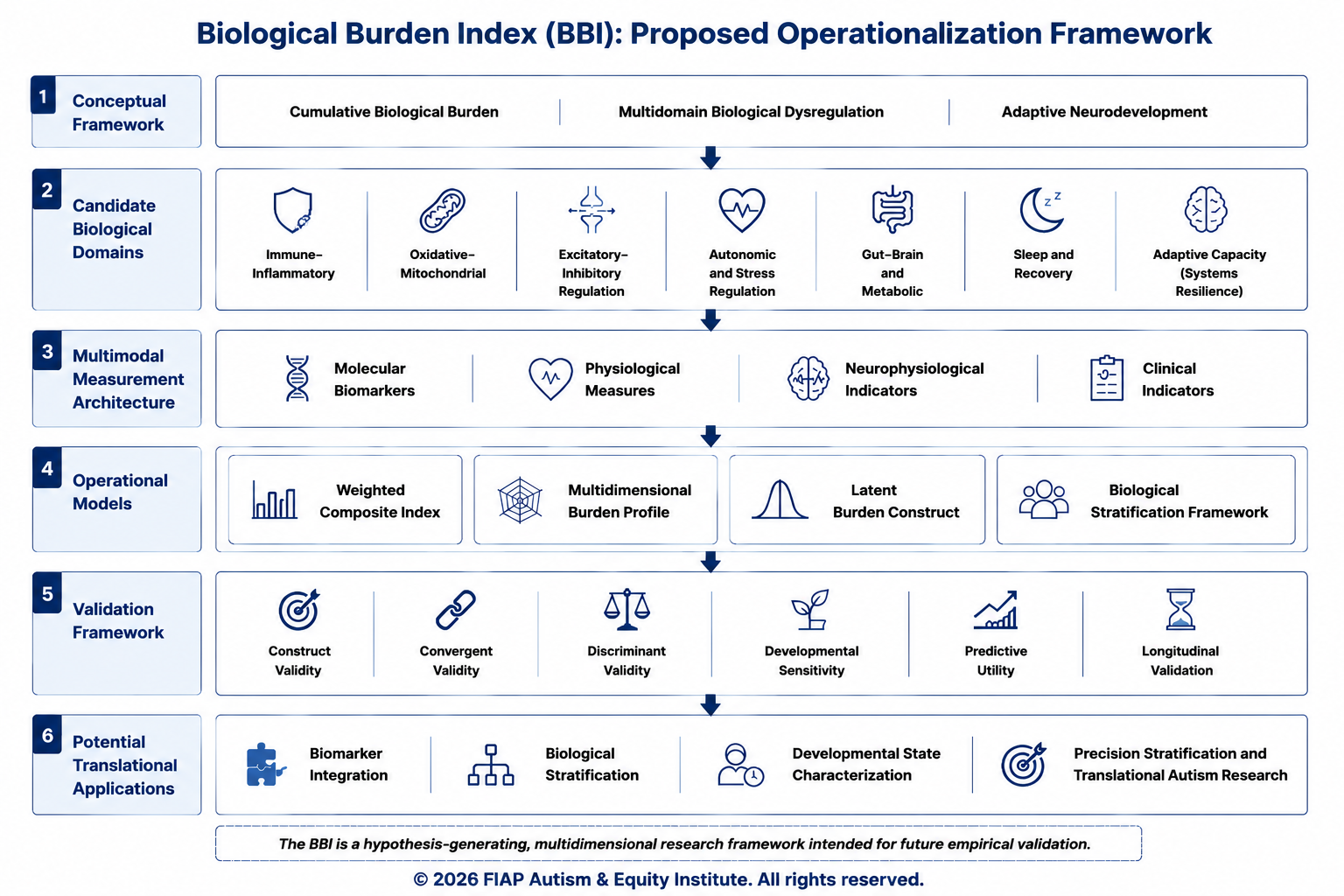
Background: Autism spectrum disorder (ASD) is characterized by substantial biological and clinical heterogeneity that cannot be adequately explained by isolated biomarkers or single-system models. The Biological Burden Index (BBI) has been proposed as a hypothesis-generating multidimensional framework to organize convergent biological dysregulations that may contribute to interindividual variability in adaptive capacity, neurodevelopmental plasticity, and therapeutic responsiveness. Objective: This article examines how the BBI may be operationalized as a measurable, testable, and translational research construct rather than as a validated clinical instrument, providing a methodological foundation for future empirical investigation and precision stratification in autism. Methods and Conceptual Framework: Rather than representing a single biomarker, the BBI conceptualizes cumulative biological burden as an emergent multidomain property arising from the dynamic convergence of previously established physiological, molecular, immunological, metabolic, autonomic, and neurodevelopmental domains. Four complementary operational models are examined: (1) a weighted composite index, (2) a multidimensional burden profile, (3) a latent burden construct, and (4) a biological stratification framework for identifying clinically meaningful subgroups. Candidate biological domains, objective indicators, multimodal measurement layers, mathematical aggregation strategies, analytical approaches, and validation requirements are reviewed. Results and Translational Perspective: We argue that premature reduction of the BBI to a single summary score risks obscuring biologically meaningful heterogeneity, whereas multidimensional profile-based approaches provide a stronger foundation for early empirical validation, longitudinal characterization, biomarker integration, and precision stratification. Operationalization is presented as the critical methodological process through which the BBI can evolve from a conceptual framework into a scientifically usable research construct. Conclusions: By clarifying operational pathways, measurement architectures, and validation strategies, the BBI establishes a methodological foundation for future multimodal biomarker integration, translational autism research, and the progressive development of complementary precision frameworks addressing therapeutic engagement, intervention responsiveness, and human-supervised digital implementation while preserving the multidimensional complexity of biological burden.
Keywords:
autism spectrum disorder
; Biological Burden Index
; multidomain biological burden
; biological stratification
; biomarkers
; allostatic load
; neurodevelopmental plasticity
; precision autism care
; translational research
Copyright: This open access article is published under a Creative Commons CC BY 4.0 license, which permit the free download, distribution, and reuse, provided that the author and preprint are cited in any reuse.


