
Submitted:
15 July 2026
Posted:
15 July 2026
You are already at the latest version
Abstract
Background: Autism spectrum disorder (ASD) is characterized by substantial biological and clinical heterogeneity that cannot be adequately explained by isolated biomarkers or single-system models. The Biological Burden Index (BBI) has been proposed as a hypothesis-generating multidimensional framework to organize convergent biological dysregulations that may contribute to interindividual variability in adaptive capacity, neurodevelopmental plasticity, and therapeutic responsiveness. Objective: This article examines how the BBI may be operationalized as a measurable, testable, and translational research construct rather than as a validated clinical instrument, providing a methodological foundation for future empirical investigation and precision stratification in autism. Methods and Conceptual Framework: Rather than representing a single biomarker, the BBI conceptualizes cumulative biological burden as an emergent multidomain property arising from the dynamic convergence of previously established physiological, molecular, immunological, metabolic, autonomic, and neurodevelopmental domains. Four complementary operational models are examined: (1) a weighted composite index, (2) a multidimensional burden profile, (3) a latent burden construct, and (4) a biological stratification framework for identifying clinically meaningful subgroups. Candidate biological domains, objective indicators, multimodal measurement layers, mathematical aggregation strategies, analytical approaches, and validation requirements are reviewed. Results and Translational Perspective: We argue that premature reduction of the BBI to a single summary score risks obscuring biologically meaningful heterogeneity, whereas multidimensional profile-based approaches provide a stronger foundation for early empirical validation, longitudinal characterization, biomarker integration, and precision stratification. Operationalization is presented as the critical methodological process through which the BBI can evolve from a conceptual framework into a scientifically usable research construct. Conclusions: By clarifying operational pathways, measurement architectures, and validation strategies, the BBI establishes a methodological foundation for future multimodal biomarker integration, translational autism research, and the progressive development of complementary precision frameworks addressing therapeutic engagement, intervention responsiveness, and human-supervised digital implementation while preserving the multidimensional complexity of biological burden.
Keywords:
autism spectrum disorder
; Biological Burden Index
; multidomain biological burden
; biological stratification
; biomarkers
; allostatic load
; neurodevelopmental plasticity
; precision autism care
; translational research
Introduction
Despite decades of intensive biological research, explaining the remarkable heterogeneity of autism spectrum disorder (ASD) remains one of the central challenges in contemporary autism science. Autism spectrum disorder (ASD) is characterized by profound biological, developmental, and clinical heterogeneity that remains insufficiently explained by single biomarkers or isolated pathophysiological mechanisms. Although numerous molecular, immune, metabolic, neurophysiological, and genetic alterations have been associated with autism, no individual biological marker has demonstrated sufficient sensitivity or specificity to account for the marked variability observed in developmental trajectories, adaptive functioning, neuroplastic potential, or therapeutic responsiveness. This persistent complexity has increasingly shifted attention toward systems-oriented and multidomain approaches capable of integrating interacting biological processes rather than studying isolated biological variables separately (Lenroot & Yeung, 2013; Loth et al., 2016; Masi et al., 2017; Parellada et al., 2023).
The conceptual foundations of the Biological Burden Index (BBI) are informed by broader theories of cumulative biological dysregulation, particularly the framework of allostatic load proposed by McEwen and Stellar, which describes how repeated physiological adaptation to chronic stress progressively affects multiple interacting biological systems (McEwen & Stellar, 1993). Subsequent developments have expanded this perspective to encompass complex interactions among immune, endocrine, autonomic, metabolic, mitochondrial, inflammatory, and neural regulatory processes. While these models have substantially advanced understanding of cumulative physiological burden across a wide range of medical conditions, they were not specifically designed to characterize the multidimensional biological heterogeneity underlying autism or to support biologically informed precision stratification in neurodevelopmental disorders. The BBI builds upon these theoretical foundations while extending them into a developmentally sensitive framework specifically designed to organize multidomain biological burden for autism research. This perspective recognizes that neurodevelopmental variability emerges from dynamic interactions among biological systems, developmental processes, and contextual factors (Loth et al., 2016; Loth, 2023).
Accordingly, the Biological Burden Index has therefore been proposed as a hypothesis-generating multidimensional framework for understanding how convergent biological dysregulations may collectively constrain adaptive capacity, neurodevelopmental plasticity, and therapeutic responsiveness in autism. Rather than conceptualizing biological burden as the consequence of isolated abnormalities, the BBI proposes that cumulative interactions among multiple biological systems may provide a more biologically plausible explanation for interindividual variability in developmental readiness and intervention responsiveness. By shifting attention away from isolated biomarkers toward multidomain biological convergence, the BBI offers a systems-level framework capable of integrating biological complexity while preserving meaningful heterogeneity.
Conceptual plausibility alone, however, is insufficient for translational relevance. A theoretical framework may be scientifically compelling and still fail to generate cumulative empirical value if it cannot be operationalized into measurable, reproducible, and testable research procedures. Without explicit operationalization, the BBI cannot be evaluated across independent cohorts, compared across studies, incorporated into multimodal research protocols, or examined for developmental and predictive validity. Consequently, the next critical step in the evolution of the BBI is not additional conceptual expansion, but rigorous methodological clarification (Borsboom et al., 2004; Cronbach & Meehl, 1955; Messick, 1995).
Operationalizing the BBI raises several fundamental methodological questions. Should multidomain biological burden be represented as a weighted composite index, a multidimensional biological profile, a latent construct inferred from observed indicators, or a biological stratification framework capable of identifying clinically meaningful subgroups? Which multidomain biological systems should be represented? Which measurable indicators best capture cumulative burden? How should multimodal biological information be integrated while preserving the complexity of interacting physiological systems? Most importantly, how can such a construct be validated without reducing biological heterogeneity to overly simplistic summary measures? These questions are not merely methodological; they determine the scientific identity of the BBI itself and the types of translational inferences that the framework may legitimately support.
In this article, we examine the methodological pathways through which the Biological Burden Index may be operationalized for autism research. We review complementary operational models, candidate biological domains, objective indicators, multimodal measurement architectures, analytical strategies, and validation requirements. We argue that preserving multidimensional biological information is essential for biologically informed precision stratification and future translational research. Rather than reducing biological burden to a single summary score, we propose that multidimensional profile-based approaches provide the most biologically faithful foundation for early empirical validation and future implementation across longitudinal and multimodal autism research.
Why Operationalization is the Critical Next Step for the BBI (Version 2.0)
The conceptual formulation of the Biological Burden Index addresses an important gap in autism research by proposing that cumulative and interacting biological dysregulations may provide a more informative representation of developmental variability than isolated biomarkers considered independently. Nevertheless, conceptual innovation alone cannot generate the empirical foundation required for translational science. The critical next step is therefore not further theoretical expansion, but the rigorous operationalization of the construct into measurable, reproducible, developmentally sensitive, and analytically robust research procedures.
Operationalization is particularly essential for multidomain constructs because they seek to characterize emergent biological properties that cannot be adequately represented by individual biomarkers alone. Unlike conventional biomarker approaches, which evaluate biological variables individually, multidomain frameworks require explicit methodological strategies capable of integrating interacting physiological systems while preserving biologically meaningful heterogeneity. Consequently, the scientific validity of the BBI depends not only on the selection of candidate biological domains but also on the transparency, reproducibility, and theoretical coherence of its operational architecture.
Operationalization also determines what the BBI ultimately becomes in research practice. A construct that appears conceptually unified may assume fundamentally different operational forms depending on how it is measured. If operationalized as a weighted composite index, the BBI assumes that multidomain burden can be summarized into a continuous quantitative metric. If operationalized as a multidimensional biological profile, its primary value lies in preserving structured variation across biological systems. If conceptualized as a latent construct, biological burden becomes an underlying variable inferred from observed indicators. Alternatively, if implemented as a biological stratification framework, the principal objective shifts toward identifying biologically meaningful subgroups rather than estimating a single dimension of severity. These approaches should not necessarily be viewed as competing alternatives; rather, they represent complementary methodological strategies that may be appropriate for different research questions and stages of empirical development.
Without explicit methodological clarification, the BBI remains vulnerable to three major risks. The first is over-reduction, whereby multidimensional biological complexity is prematurely compressed into a single summary score that obscures meaningful heterogeneity. The second is over-expansion, whereby excessive conceptual inclusiveness reduces empirical specificity and limits reproducibility. A third risk is fragmentation, whereby individual biological systems are investigated independently, preventing the cumulative interactions that define multidomain biological burden from being adequately represented. Operationalization therefore protects not only measurement validity but also the conceptual integrity of the framework itself.
Operationalization further determines whether the BBI can realistically support the translational objectives for which it was originally proposed. These objectives include multimodal biomarker integration, biologically informed precision stratification, developmental state characterization, longitudinal monitoring of biological burden, and future investigation of individual variability in therapeutic responsiveness. None of these translational objectives can be meaningfully pursued unless the framework is translated into a coherent measurement architecture composed of clearly defined biological domains, objective indicators, analytical procedures, and validation criteria. Operationalization should therefore be understood not as a secondary methodological exercise appended to theory, but as the process through which theoretical constructs become scientifically usable.
Importantly, operationalization should remain sufficiently flexible to accommodate future advances in biomarker discovery, systems biology, and computational modeling while preserving the conceptual coherence of the Biological Burden Index.
Ultimately, the central methodological challenge is not simply determining how many biological variables should be measured, but defining the nature of the biological burden construct itself. Resolving this question will determine whether the BBI can evolve into a robust multidomain research framework capable of supporting future empirical validation, precision stratification, multimodal biological integration, and, ultimately, the development of complementary translational and human-supervised computational frameworks for precision autism research.
Four Candidate Models for Operationalizing the Biological Burden Index
Operationalizing a multidomain construct such as the Biological Burden Index (BBI) extends well beyond a technical measurement exercise. Different operational models embody distinct assumptions regarding the nature of cumulative biological burden, the relationships among its constituent domains, and the translational objectives the framework is intended to address. Rather than representing mutually exclusive alternatives, these models should be viewed as complementary methodological pathways that may become appropriate at different stages of empirical development. Early phases of construct development are likely to prioritize preservation of biological complexity and autism heterogeneity, whereas later stages may increasingly emphasize statistical integration, subgroup discovery, and parsimonious quantitative representation.
To facilitate comparison, the principal characteristics, methodological assumptions, advantages, limitations, and potential translational applications of the four candidate operational models are summarized in Table 1.

1. Weighted Composite Index Model
One possible strategy is to operationalize the BBI as a weighted composite index in which burden-related indicators from multiple biological domains are standardized and integrated into a single continuous score. This approach assumes that cumulative biological burden can be represented quantitatively by aggregating contributions from several physiological systems into a unified metric.
Conceptually, the weighted composite model offers an intuitive representation of overall biological burden and facilitates comparisons across individuals, developmental stages, or longitudinal follow-up. Because many clinical prediction models rely on composite scores, this strategy may appear attractive for future translational applications involving treatment monitoring or risk estimation (Collins & Lanza, 2010).
Illustrative Mathematical Formulation of the Weighted Composite Model
From a mathematical perspective, the weighted composite model assumes that multidomain biological burden can be approximated as the weighted linear combination of standardized biological domain scores.
General formulation of the weighted composite Biological Burden Index (BBI):
BBI = Σ(i=1→n) w_i z_i
Where:
BBI = Biological Burden Index
z_i = standardized value (e.g., z-score) of the i-th biological domain
w_i = weighting coefficient assigned to the i-th domain
n = number of biological domains included in the composite model
Methodological note. This equation is presented solely as a generic mathematical illustration of one possible weighted composite implementation. It is not intended to represent the preferred operationalization of the BBI at the current stage of development, where multidimensional profile-based approaches are considered methodologically more appropriate. The principal strengths of this model include computational simplicity, ease of communication, straightforward statistical implementation, and potential usefulness for longitudinal monitoring. A single summary score could facilitate investigation of whether greater cumulative biological burden predicts developmental instability, reduced neuroplastic responsiveness, or poorer therapeutic outcomes.
However, important limitations must also be acknowledged. Collapsing multidimensional biological information into a single scalar score inevitably compresses multidimensional biological complexity. Individuals with identical composite scores may possess entirely different biological configurations, which may have distinct developmental and therapeutic implications (Lenroot & Yeung, 2013; Masi et al., 2017). Furthermore, determining biologically meaningful weighting coefficients remains highly challenging. Equal weighting lacks physiological justification, whereas empirically derived weights are likely to vary according to developmental stage, population characteristics, and clinical outcomes.
Consequently, although the weighted composite model may become valuable during later stages of validation, it appears premature as the primary operational representation of the BBI during its initial phase of empirical development.
2. The Multidimensional Burden Profile Model
A second—and, at the current stage of development, arguably the most conceptually faithful—approach is to operationalize the BBI as a multidimensional burden profile. Rather than collapsing multiple biological dimensions into a single summary score, this model preserves structured variation across distinct burden domains, allowing each biological system to retain its individual contribution to the overall burden architecture. The resulting pattern constitutes an individual's multidimensional biological burden profile.
This operational strategy is closely aligned with the original theoretical formulation of the BBI as a multidomain framework designed to characterize convergent biological dysregulation without assuming that all biological domains contribute equally or linearly to a single underlying dimension (Loth, 2023; Masi et al., 2017). It therefore avoids the premature simplification of biologically heterogeneous processes into a single scalar value before sufficient empirical evidence exists to justify such reduction.
The principal strength of the multidimensional profile model lies in its ability to preserve biological complexity while maintaining domain-level interpretability. Each burden domain remains independently interpretable, enabling investigators to examine not only the overall magnitude of biological burden but also the specific configuration through which burden is expressed. Consequently, two individuals may exhibit comparable overall levels of biological burden while presenting fundamentally different domain-specific profiles, potentially reflecting distinct developmental trajectories, adaptive constraints, or intervention-related vulnerabilities.
This approach is particularly consistent with contemporary views of autism as a heterogeneous neurodevelopmental condition characterized by multiple interacting biological pathways rather than a single pathophysiological mechanism. By preserving domain-level information, the multidimensional model allows researchers to investigate whether specific burden configurations are preferentially associated with particular developmental phenotypes, adaptive functioning patterns, or therapeutic responsiveness.
From a translational perspective, multidimensional profiling offers several additional advantages. It facilitates longitudinal monitoring of changes within individual biological domains, enables comparison of burden configurations across developmental stages, and supports precision-oriented investigations aimed at identifying biologically meaningful patterns rather than relying exclusively on overall burden severity. Future translational research may also integrate multidomain biological burden profiles with complementary frameworks designed to characterize therapeutic engagement and intervention responsiveness, thereby supporting increasingly comprehensive precision stratification approaches (Fuamba, 2026a).
Similarly, future multimodal computational frameworks may investigate whether specific multidomain burden configurations are associated with variations in neuroplastic accessibility across developmental contexts, thereby providing an additional layer of biological interpretation for individualized intervention planning (Fuamba, 2026c).
Despite these advantages, the multidimensional profile model is not without limitations. Interpreting multiple biological domains simultaneously inevitably increases analytical complexity and requires careful consideration of interactions among physiological systems. Furthermore, meaningful interpretation depends on the selection of biologically justified domains, standardized measurement procedures, and adequate visualization strategies capable of representing complex multidimensional profiles in clinically interpretable ways.
Importantly, preserving multidimensional biological information at this stage does not preclude future statistical integration; rather, it provides the empirical foundation upon which more parsimonious representations can later be developed and rigorously evaluated.
Nevertheless, at the current stage of BBI development, the multidimensional burden profile model represents the most biologically coherent and methodologically defensible operationalization. It preserves the conceptual architecture of the original framework, respects the intrinsic heterogeneity of autism, and establishes a flexible foundation upon which more sophisticated statistical, computational, or hybrid operational frameworks may subsequently be developed and empirically validated.
3. The Latent Burden Construct Model
A third methodological approach conceptualizes the BBI as a latent biological burden construct. In this framework, cumulative biological burden is not measured directly but inferred statistically from multiple observable biological indicators distributed across several domains. The underlying assumption is that the diverse manifestations of biological dysregulation reflect a common higher-order construct that cannot be observed directly but can be estimated through appropriate latent-variable modeling techniques (Borsboom et al., 2004; Cronbach & Meehl, 1955).
This approach is deeply rooted in classical psychometric theory and construct validation. Rather than treating the observed biological variables as independent contributors, latent modeling examines whether they share sufficient common variance to justify the existence of an underlying multidimensional burden construct. Analytical approaches such as structural equation modeling, confirmatory factor analysis, bifactor models, and related latent-variable techniques may therefore provide valuable tools for testing the internal coherence and construct validity of the BBI.
If empirical evidence supports the existence of such a latent construct, the BBI could evolve beyond a conceptual organization of biological domains toward a statistically supported explanatory framework capable of integrating multiple physiological systems within a unified theoretical model.
The principal advantage of this approach lies in its capacity to distinguish common biological burden from measurement error and domain-specific variance. Consequently, latent modeling may provide stronger evidence for construct validity than simple composite scoring by demonstrating that multiple biomarkers converge upon a shared underlying biological dimension.
However, important methodological challenges accompany this strategy. Latent variable models require large, well-characterized datasets, rigorous assumptions regarding measurement invariance, and sufficient sample sizes to ensure stable parameter estimation. Moreover, statistically well-fitting latent structures do not necessarily correspond to biologically meaningful mechanisms. Consequently, latent modeling should be interpreted as a complementary validation strategy rather than definitive evidence of biological causality.
Accordingly, latent modeling should be viewed as one component of a broader validation strategy rather than as a substitute for biological interpretation.
From a developmental perspective, latent representations of biological burden may also vary across age, developmental stage, and clinical subgroup, emphasizing the importance of longitudinal validation before considering clinical implementation.
4. The Biological Stratification Framework Model
A fourth operational strategy positions the BBI primarily as a biological stratification framework. Rather than generating a continuous score or estimating a latent construct, this model seeks to identify biologically meaningful subgroups characterized by distinct multidomain burden configurations (Collins & Lanza, 2010; Pugliese et al., 2024).
The rationale underlying this approach is closely aligned with the principles of precision medicine and precision psychiatry. Contemporary autism research increasingly recognizes as encompassing multiple biological pathways that may converge toward similar behavioral phenotypes while differing substantially in their underlying physiological architecture. Accordingly, individuals presenting comparable clinical characteristics may nevertheless exhibit markedly different biological burden profiles.
Potential examples include inflammatory-dominant, metabolic-autonomic, mitochondrial, oxidative stress-related, neuroimmune, or mixed multidomain burden configurations. Identifying such profiles may improve understanding of developmental heterogeneity and help explain why therapeutic responsiveness differs despite broadly similar diagnostic presentations.
From a translational perspective, the stratification framework is particularly attractive for translational research because it shifts emphasis from average group effects toward individualized biological characterization. Such subgroup identification could eventually support more targeted intervention studies, facilitate biomarker-informed participant selection, and improve interpretation of heterogeneous treatment outcomes.
Nevertheless, important methodological challenges remain. Stratification solutions are highly sensitive to variable selection, clustering algorithms, sample composition, and analytical assumptions. Without independent replication, subgroup structures may reflect dataset-specific statistical artifacts rather than biologically reproducible entities. Consequently, robust external validation across independent cohorts remains essential before any stratification framework can be considered clinically meaningful.
At present, biological stratification should therefore continue to be regarded as a promising translational objective rather than an established clinical application of the BBI.
Future empirical research will ultimately determine whether biologically meaningful subgroup structures emerge consistently across independent cohorts and multimodal datasets.
Comparative Interpretation of the Four Models
The four candidate operational models represent complementary methodological frameworks rather than competing alternatives. Each addresses a distinct scientific objective and may become particularly valuable at different stages of construct development.
The weighted composite index model emphasizes simplicity, quantitative integration, and longitudinal usability. The multidimensional burden profile model preserves biological fidelity, interpretability, and autism heterogeneity. The latent burden construct model focuses on construct validation and statistical coherence, whereas the biological stratification framework aims to identify biologically meaningful subgroups that may ultimately support precision-oriented research (Borsboom et al., 2004; Collins & Lanza, 2010).
Rather than selecting a single universally optimal operational strategy, these approaches should be viewed as progressive components of an evolving translational research program. Early empirical investigations should prioritize multidimensional burden profiling because it best preserves biological complexity while avoiding premature reduction of heterogeneous biological processes into a single quantitative dimension. As progressively larger multimodal datasets become available, latent-variable modeling, biological stratification, and empirically derived composite indices may subsequently be developed, compared, and validated.
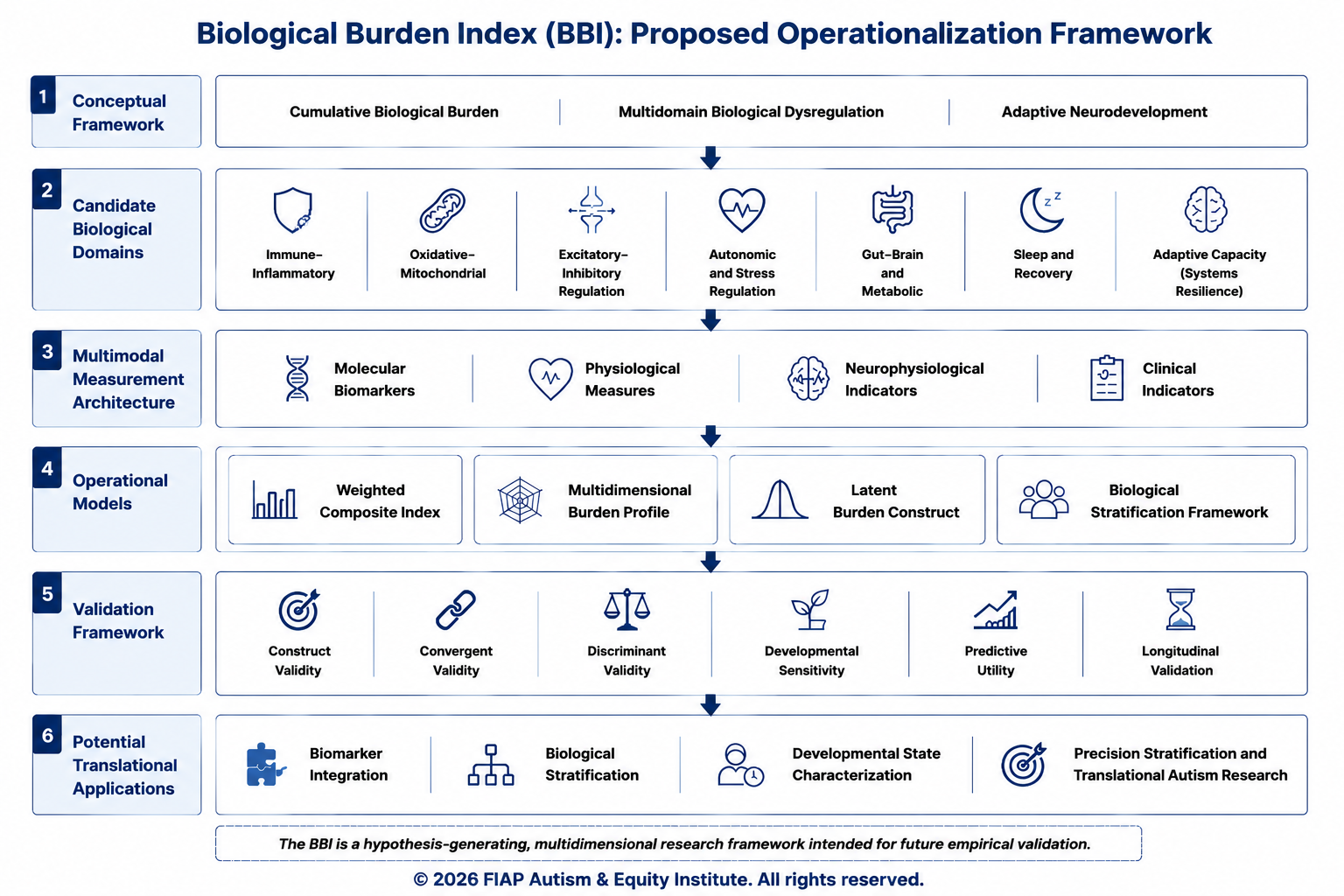
Accordingly, the multidimensional burden profile model currently represents the most scientifically defensible operational foundation for the BBI. It preserves the theoretical architecture of the original framework, respects the multidomain nature of biological burden, accommodates the intrinsic heterogeneity of autism, and establishes a rigorous methodological platform for future validation studies and precision-oriented translational applications. The overall methodological architecture proposed for operationalizing the Biological Burden Index is summarized in Figure 1.
Candidate Biological Domains and Operational Biomarkers
The Biological Burden Index is intended to characterize cumulative biological burden through the integration of multiple physiological systems that collectively influence adaptive neurodevelopment, neuroplastic potential, and therapeutic responsiveness. Consequently, selecting candidate biological domains represents a critical methodological step in operationalizing the framework. The objective is not to provide an exhaustive inventory of autism biology, but rather to identify biologically plausible domains that satisfy three essential criteria: (i) convergent empirical evidence supporting their involvement in autism or neurodevelopmental adaptation; (ii) availability of measurable and reproducible biomarkers; and (iii) plausible mechanistic links to adaptive plasticity, developmental regulation, or intervention responsiveness.
Conceptually, these domains should not be regarded as independent biological compartments. Rather, they constitute an interacting physiological network in which dysregulation within one domain may propagate across others through reciprocal neuroimmune, neuroendocrine, metabolic, autonomic, and neuroplastic mechanisms. The multidomain architecture of the BBI therefore reflects biological systems integration rather than simple biomarker aggregation.
The candidate domains described below represent an initial operational framework that remains open to empirical refinement as additional evidence accumulates.
1. Immune–Inflammatory Domain
The immune–inflammatory domain represents one of the strongest candidates for inclusion within the BBI because convergent evidence indicates that immune dysregulation and chronic neuroinflammatory processes may influence synaptic maturation, microglial activity, neuronal connectivity, and experience-dependent neuroplasticity. Persistent immune dysregulation and chronic neuroinflammatory activity may therefore constitute an important source of cumulative biological burden capable of constraining adaptive neurodevelopment, altering adaptive neuroplasticity, and reducing developmental flexibility (Kim et al., 2018; Xiong et al., 2023; Zhuang et al., 2024).
Although no single inflammatory biomarker is likely to capture cumulative immune burden adequately, integrating multiple complementary indicators may provide a more biologically informative representation of this domain.
Candidate operational biomarkers may include:
- Circulating inflammatory cytokines (e.g., IL-1β, IL-6, TNF-α)
- C-reactive protein (CRP)
- Chemokine profiles
- Immune-cell activation markers
- Composite inflammatory indices
From a translational perspective, this domain may contribute to identifying individuals in whom persistent inflammatory burden represents a Predominant biological constraint affecting adaptive functioning and therapeutic responsiveness.
2. Oxidative–Mitochondrial Domain
The oxidative–mitochondrial domain occupies a central position within the BBI because adaptive neuroplasticity is fundamentally dependent upon adequate cellular energy availability. Synaptic remodeling, learning, neuronal signaling, and developmental adaptation require substantial cellular energy availability. Consequently, mitochondrial dysfunction, oxidative stress, impaired redox regulation, and reduced metabolic efficiency may collectively limit the organism's capacity to sustain adaptive neuroplastic processes (Rossignol & Frye, 2012; Frye, 2020).
Candidate operational biomarkers may include:
- Mitochondrial respiratory function
- ATP production
- Lactate–pyruvate ratio
- Oxidative stress markers
- Glutathione redox balance
- Lipid peroxidation products
- Metabolic efficiency indices
This domain provides an important biological foundation for future investigations examining energetic capacity as a multidomain determinant of adaptive reserve, neuroplastic responsiveness, and developmental regulation (Fuamba, 2026b).
3. Excitatory–Inhibitory Regulatory Domain
Balanced excitatory and inhibitory neural activity is essential for stable information processing, adaptive learning, sensory regulation, and synaptic plasticity. Increasing evidence suggests that disturbances in excitatory–inhibitory regulation may contribute to atypical neural connectivity, altered sensory processing, and developmental heterogeneity in autism (Uzunova et al., 2016).
Because no single electrophysiological measure adequately captures excitatory–inhibitory balance, multimodal neurophysiological assessment may provide a more informative operational representation of this domain.
Candidate operational biomarkers may include:
- Electroencephalographic (EEG) indices
- Cortical oscillatory activity
- Gamma-band synchronization
- Measures reflecting glutamatergic and GABAergic regulation
- Electrophysiological markers of network stability
Operationalizing this domain may improve understanding of neural regulatory balance as one component of cumulative biological burden.
4. Autonomic and Stress-Regulation Domain
Adaptive learning and therapeutic engagement depend not only on cognitive capacity but also on physiological regulation. The autonomic nervous system plays a central role in maintaining arousal stability, environmental adaptation, emotional regulation, and recovery following stress exposure (Cheng et al., 2020; Owens et al., 2021; Taylor et al., 2021).
Candidate operational biomarkers may include:
- Heart-rate variability (HRV)
- Resting autonomic tone
- Stress-induced physiological reactivity
- Recovery following acute stress
- Diurnal cortisol rhythm
- Psychophysiological regulation measures
Because physiological regulation strongly influences behavioral availability and adaptive functioning, this domain may represent an important determinant of biological readiness for therapeutic engagement.
5. Gut–Brain and Metabolic Domain
Converging evidence supports bidirectional interactions between gastrointestinal physiology, microbial ecology, systemic metabolism, immune regulation, and brain function. Alterations within the gut–brain axis may therefore contribute indirectly to cumulative biological burden through multiple interacting physiological pathways (Morton et al., 2023; Wong, 2021; Zhuang et al., 2024).
Candidate operational biomarkers may include:
- Microbiome diversity indices
- Intestinal permeability markers
- Short-chain fatty acid profiles
- Metabolic biomarkers
- Gastrointestinal inflammatory markers
Rather than representing an isolated gastrointestinal process, this domain reflects complex systemic interactions capable of influencing neurodevelopmental regulation through multiple biological pathways.
6. Sleep and Recovery Domain
Restorative sleep constitutes one of the principal physiological mechanisms supporting memory consolidation, synaptic remodeling, metabolic recovery, emotional regulation, and adaptive neuroplasticity. Sleep disturbances therefore represent a plausible contributor to cumulative biological burden (Owens et al., 2021; Zhuang et al., 2024).
Candidate operational biomarkers may include:
- Total sleep duration
- Sleep efficiency
- Sleep fragmentation
- REM and slow-wave sleep architecture
- Actigraphy-derived sleep measures
- Caregiver-reported sleep quality
This domain is particularly attractive because several indicators may be measured non-invasively using nearable technologies and unobtrusive environmental sensing systems, thereby facilitating longitudinal monitoring.
7. Adaptive Capacity (Systems Resilience) Domain
Unlike the preceding domains, adaptive capacity does not represent an isolated biological system but rather an integrative property reflecting the organism's ability to maintain physiological flexibility, recover from stress, and sustain adaptive neuroplasticity despite cumulative biological burden. This systems-level perspective is consistent with emerging concepts of brain resilience, which emphasize that adaptive capacity arises from the coordinated interaction of multiple biological systems rather than any single physiological mechanism (Frye, 2020; Owens et al., 2021; Udeh-Momoh et al., 2025; Laguna et al., 2025).
Operationalizing this domain requires objective physiological proxies rather than abstract conceptual descriptors.
Candidate operational biomarkers may include:
- Heart-rate variability recovery following acute stress
- Cortisol recovery dynamics
- Brain-Derived Neurotrophic Factor (BDNF)
- Neurotrophic signaling biomarkers
- EEG markers of cortical flexibility
- Gamma oscillatory activity
- Mu rhythm desynchronization
- Autonomic recovery indices
These biomarkers provide measurable estimates of systemic resilience and adaptive reserve while remaining consistent with current knowledge regarding neuroplasticity, physiological regulation, and stress adaptation (Owens et al., 2021; Laguna et al., 2025; Mohammedsaeed, W., & Alharbi, M. (2025). Their inclusion directly addresses the need for reproducible operational indicators of adaptive capacity rather than relying on conceptual descriptions alone.
Importantly, these candidate domains are intended to provide an initial operational architecture rather than a definitive or exhaustive representation of cumulative biological burden. Their composition and relative contribution should remain open to empirical refinement as biological knowledge evolves.
Integrative Perspective
Taken together, these candidate biological domains should not be interpreted as an exhaustive representation of autism biology. Rather, they constitute a parsimonious yet biologically comprehensive multidimensional framework designed to capture biologically plausible sources of cumulative burden with potential relevance for adaptive neurodevelopment, neuroplasticity, and therapeutic responsiveness (Loth, 2023; Parellada et al., 2023; Mohammedsaeed & Alharbi, 2025).
Importantly, the BBI does not assume that each domain contributes equally across individuals or developmental stages. Future empirical studies will determine whether particular domains exert differential influence, whether weighting should remain dynamic across developmental contexts, and whether distinct multidomain burden configurations correspond to biologically meaningful phenotypes (Loth et al., 2016; Pugliese et al., 2024; Mohammedsaeed & Alharbi, 2025).
Accordingly, Table 2 summarizes the candidate biological domains together with representative operational biomarkers proposed for the initial empirical development of the Biological Burden Index.

Measurement Architecture: A Multimodal Framework for Biological Burden Assessment
Operationalizing the Biological Burden Index extends well beyond defining conceptual domains. It requires a coherent measurement architecture capable of translating multidimensional biological burden into objective, reproducible, and clinically interpretable variables. Accordingly, the measurement strategy must balance biological validity, technical feasibility, scalability, and translational relevance while accommodating the inherent heterogeneity of autism.
A central methodological premise of the BBI is that cumulative biological burden cannot be adequately represented by any single class of measurements. Different physiological systems are best characterized using different measurement modalities, each contributing complementary information regarding the individual's biological state. Consequently, the BBI is conceived as an inherently multimodal construct, integrating molecular biomarkers, physiological recordings, neurophysiological measures, and clinically observable indicators within a unified measurement framework.
The first measurement layer comprises molecular and biochemical biomarkers, particularly relevant for inflammatory, oxidative-mitochondrial, metabolic, and gut–brain domains. Candidate biomarkers include circulating cytokines, oxidative stress markers, mitochondrial metabolites, neurotrophic factors, endocrine biomarkers, and metabolic signatures obtained from minimally invasive biological specimens, including blood, saliva, urine, and other validated biological matrices.
The second layer consists of physiological and psychophysiological measurements, reflecting dynamic regulatory processes that cannot be adequately captured through laboratory biomarkers alone. Heart-rate variability, autonomic flexibility, respiratory dynamics, sleep architecture, circadian rhythms, electrodermal activity, and stress-recovery trajectories represent examples of physiological variables capable of providing continuous information regarding regulatory capacity and adaptive resilience.
A third layer incorporates neurophysiological measurements, including electroencephalographic indices, oscillatory activity, functional connectivity measures, and other markers reflecting excitatory–inhibitory regulation, neural synchrony, and network-level adaptability. These variables may provide a more direct approximation of biological processes directly supporting adaptive neuroplasticity.
Finally, selected clinical and developmental indicators may serve as pragmatic surrogate indicators when advanced laboratory or neurophysiological measurements are not readily available. Although less biologically specific, standardized clinical indicators may substantially increase feasibility during early translational studies while facilitating implementation across diverse healthcare environments.
Rather than considering these measurement modalities as competing alternatives, the proposed BBI architecture integrates them into a hierarchical multimodal framework in which complementary sources of biological information collectively contribute to characterizing cumulative biological burden. This strategy preserves biological complexity while maintaining sufficient flexibility to accommodate different research settings, technological resources, and stages of construct validation.
Importantly, multimodal integration should remain modular, allowing new biomarkers and measurement technologies to be incorporated as empirical knowledge evolves.
Future human-supervised multimodal computational frameworks may progressively integrate these heterogeneous biological data streams to generate individualized multidomain burden profiles while supporting dynamic characterization of biological state and neuroplastic accessibility (Fuamba, 2026c; Laguna et al., 2025; Parellada et al., 2023; Udeh-Momoh et al., 2025; Mohammedsaeed & Alharbi, 2025).
Analytic Strategies: Integrating Multidimensional Biological Information
Once candidate biological domains and measurement layers have been operationalized, the principal challenge becomes analytical. The analytical objective extends beyond measuring biological variables to measure biological variables but to determine how heterogeneous physiological information should be integrated, modeled, and interpreted in ways that remain biologically plausible, statistically robust, and clinically meaningful.
Several complementary analytical strategies may contribute to future BBI development.
Initially, equal weighting approaches may provide a transparent exploratory framework during early feasibility studies. As progressively larger datasets become available, weighting coefficients may subsequently be derived empirically using machine-learning techniques, Bayesian optimization, or other data-driven approaches capable of identifying the relative contribution of individual domains across different developmental contexts.
Importantly, weighting strategies should remain transparent and biologically interpretable rather than relying exclusively on statistical optimization.
A second family of analytical methods involves multivariate clustering and biological stratification. Rather than assuming continuous variation alone, clustering algorithms may identify reproducible multidomain burden configurations representing biologically meaningful subgroups. Such subgroup discovery is particularly consistent with contemporary precision medicine approaches and may provide valuable insight into the biological heterogeneity underlying autism.
A third analytical strategy involves latent variable modeling, including confirmatory factor analysis and structural equation modeling, which may evaluate whether observed biological indicators converge toward a common higher-order burden construct. If empirically supported, latent modeling would strengthen construct validity by demonstrating that multidomain biological dysregulation reflects an interpretable underlying dimension rather than an arbitrary collection of biomarkers.
Importantly, because biological burden is inherently dynamic, longitudinal modeling constitutes an essential component of BBI operationalization. Repeated measurements may characterize developmental trajectories, temporal fluctuations, intervention-related biological changes, and adaptive responses that cannot be captured through cross-sectional assessment alone.
Collectively, these analytical strategies should be viewed as complementary and iterative components of an evolving methodological framework rather than mutually exclusive alternatives.
Together, the proposed measurement architecture and analytical strategies establish the methodological foundation upon which empirical validation of the Biological Burden Index can be systematically undertaken.
Validation Framework: From Conceptual Plausibility to Scientific Utility
The long-term scientific value of the Biological Burden Index ultimately depends upon rigorous empirical validation. Conceptual coherence alone is insufficient to establish scientific utility; rather, the BBI must demonstrate reproducible measurement properties, developmental relevance, and meaningful predictive performance across independent populations. Validation should therefore proceed through several complementary stages.
First, content validity requires demonstrating that each biological domain has been selected on the basis of robust theoretical rationale and empirical evidence. Candidate biomarkers should reflect biologically meaningful mechanisms rather than convenience or data availability alone.
Second, construct validity requires empirical evidence that multidomain burden profiles behave consistently with theoretical expectations. Specifically, the proposed biological architecture should exhibit interpretable relationships among domains while remaining empirically distinguishable from related but conceptually different constructs.
Third, convergent and discriminant validity are essential. If the BBI is valid, higher biological burden should demonstrate meaningful associations with impaired physiological regulation, reduced adaptive reserve, diminished neuroplastic accessibility, and decreased therapeutic responsiveness, while remaining distinguishable from autism severity, intellectual functioning, or general comorbidity burden (Laguna et al., 2025; Parellada et al., 2023).
Fourth, the BBI must demonstrate developmental sensitivity, recognizing that biological burden may evolve throughout development and that domain-specific contributions may vary according to age, maturation, and environmental context.
Finally, the ultimate translational relevance of the BBI depends upon predictive utility. Future studies should determine whether multidomain biological burden predicts developmental trajectories, adaptive functioning, therapeutic engagement, intervention responsiveness, or neuroplastic accessibility more consistently and accurately than isolated biomarkers considered independently.
Validation should ultimately demonstrate not only statistical robustness but also biological interpretability, clinical relevance, and practical utility for biological stratification in autism research.
External validation across independent cohorts, institutions, and longitudinal datasets will ultimately be essential to establish the generalizability and reproducibility of the BBI.
Translational Implications: From Biological Burden to Precision Intervention
The principal contribution of the Biological Burden Index extends beyond biological characterization toward the development of a translational framework capable of supporting precision-oriented translational autism research.
One immediate application involves biological subgroup identification, whereby multidomain burden profiles may distinguish physiologically meaningful subpopulations sharing common biological architectures despite similar behavioral diagnoses.
A second application concerns multimodal biomarker integration. Rather than evaluating individual biomarkers in isolation, the BBI provides an organizing framework through which multiple physiological systems may be interpreted within an integrated biological framework, thereby improving biological interpretability while preserving multidimensional complexity.
Beyond subgroup identification, multidomain burden profiling may also facilitate characterization of an individual's current developmental biological state, distinguishing transient biological constraints from more persistent physiological vulnerability.
An important downstream application involves the integration of the BBI with complementary precision-oriented frameworks. Whereas the BBI characterizes cumulative biological constraints, the Therapeutic Engagement Index (TEI) provides a complementary multidimensional framework for characterizing functional therapeutic engagement and intervention responsiveness (Fuamba, 2026a). Together, these complementary frameworks may contribute to increasingly comprehensive precision stratification approaches while preserving their conceptual independence.
Similarly, future human-supervised multimodal computational frameworks may investigate whether specific multidomain burden configurations contribute to variations in dynamic neuroplastic accessibility, thereby providing biological context for individualized intervention timing and adaptive therapeutic planning (Fuamba, 2026c).
Collectively, these complementary frameworks illustrate how the BBI may ultimately function as the biological foundation within a broader precision intervention ecosystem integrating biological profiling, therapeutic engagement, neuroplastic accessibility, and individualized intervention planning.
This translational architecture also provides a scalable methodological foundation upon which future biologically informed, human-supervised digital frameworks may progressively support individualized precision intervention across the neurodevelopmental lifespan.
Limitations and Methodological Considerations
Although operationalization is essential for transforming the Biological Burden Index into a scientifically testable framework, it inevitably introduces important conceptual, methodological, and translational challenges. Recognizing these limitations is fundamental to ensuring that future empirical development remains biologically rigorous and clinically meaningful rather than prematurely overinterpreted.
One of the principal risks is over-reduction. Because quantitative research frequently favors parsimonious summary metrics, there may be a natural tendency to reduce multidimensional biological burden to a single numerical score. Although such simplification may improve computational convenience and statistical modeling, it also risks obscuring biologically meaningful heterogeneity by collapsing distinct physiological mechanisms into an undifferentiated measure. Individuals with identical composite scores may nevertheless exhibit fundamentally different multidomain biological architectures with potentially different developmental and therapeutic implications (Lenroot & Yeung, 2013; Masi et al., 2017).
Conversely, the BBI also faces the opposite challenge of over-expansion. Excessive inclusion of biological domains, biomarkers, or physiological systems could compromise conceptual coherence, reduce reproducibility, and ultimately undermine the construct's empirical utility. Consequently, future development should prioritize biological relevance and mechanistic plausibility rather than exhaustive coverage of autism biology (Loth, 2023; Zhuang et al., 2024).
A further methodological concern involves construct contamination. The BBI is intended to characterize cumulative biological burden rather than its downstream clinical consequences. Incorporating variables that represent behavioral outcomes, adaptive functioning, or therapeutic responsiveness directly into the burden construct would introduce circularity and compromise construct validity (Cronbach & Meehl, 1955; Messick, 1995). Maintaining a clear distinction between biological burden and its functional manifestations therefore represents an essential principle of future operationalization.
Another important consideration concerns false precision. Sophisticated biomarkers, computational models, weighting algorithms, or multimodal integration strategies may create an illusion of biological certainty that exceeds current empirical knowledge. The apparent mathematical precision of an operationalized index should never be interpreted as evidence of biological completeness. Rather, every operational model represents an approximation of an inherently dynamic and multidimensional biological reality (Borsboom et al., 2004).
Accordingly, increasing computational sophistication should not be interpreted as increasing biological certainty unless supported by independent empirical validation.
Finally, the present framework should not be interpreted as a validated clinical instrument. The BBI remains a hypothesis-generating translational research framework whose proposed architecture requires systematic empirical validation before any clinical implementation can be considered. At its current stage, its primary purpose is to guide biological investigation, facilitate multidomain integration, and stimulate the development of reproducible research methodologies rather than to support individual clinical decision-making.
Future Directions
The future scientific value of the Biological Burden Index will depend upon its successful transition from conceptual plausibility to rigorous empirical validation. The framework now provides a coherent theoretical architecture; the next stage is to determine whether this architecture can be translated into reproducible measurement models capable of generating biologically meaningful and clinically relevant evidence.
Beyond autism research, emerging frameworks on brain resilience increasingly support the need for multidimensional approaches capable of integrating interacting biological systems rather than relying on isolated biomarkers, reinforcing the broader translational relevance of the proposed BBI architecture (Udeh-Momoh et al., 2025).
An immediate priority is the establishment of a minimum viable operational architecture consisting of a limited number of biologically justified domains that are measurable, reproducible, and directly relevant to adaptive neurodevelopment and neuroplasticity (Laguna et al., 2025; Zhuang et al., 2024). Beginning with a parsimonious multidomain framework will facilitate feasibility testing while preserving conceptual coherence during early empirical development (Frye, 2020; Owens et al., 2021; Rossignol & Frye, 2012; Zhuang et al., 2024).
A second priority involves developing standardized operational definitions, biomarker selection criteria, and measurement protocols to ensure that future investigations operationalize the BBI consistently across research settings. Harmonized methodology will be essential for cumulative evidence generation, replication, and eventual multicenter validation.
Before large-scale validation is attempted, the BBI should undergo pilot feasibility studies designed to evaluate the practical implementation of multidomain biological assessment, multimodal data integration, and longitudinal measurement procedures. Such studies will provide essential information regarding feasibility, reliability, participant acceptability, and technical reproducibility.
An additional priority involves direct empirical comparison of the four candidate operational models proposed in this manuscript. Rather than assuming that one universally optimal solution exists, future investigations should determine which operational strategies are most appropriate for different scientific questions, developmental stages, and translational applications (Collins & Lanza, 2010; Pugliese et al., 2024).
An additional long-term priority will be external validation across independent cohorts, institutions, and healthcare systems to establish the generalizability and robustness of the proposed framework.
Because cumulative biological burden is inherently dynamic, longitudinal validation should become a central component of future research. Repeated measurements may characterize developmental trajectories, temporal fluctuations, biological responses to intervention, and evolving patterns of adaptive regulation that cannot be adequately captured through cross-sectional designs.
Future empirical research should investigate how cumulative biological burden, therapeutic engagement, and dynamic neuroplastic accessibility interact longitudinally across development while remaining conceptually distinct constructs (Fuamba, 2026a; Fuamba, 2026c).
Conclusion
Operationalizing the Biological Burden Index represents the critical transition from conceptual innovation to empirical science. The principal challenge extends beyond measuring additional biological variables; it involves determining how cumulative multidomain biological burden should be represented, interpreted, and validated in ways that remain biologically coherent, developmentally sensitive, and translationally informative.
Throughout this article, we have argued that multidimensional burden profiling currently provides the most scientifically defensible foundation for BBI operationalization. Rather than prematurely reducing biological complexity to a single composite score, preserving structured variation across interacting physiological systems better reflects contemporary understanding of autism heterogeneity while providing greater flexibility for future empirical investigation. Composite indices, latent-variable models, and biological stratification frameworks should therefore be viewed as complementary methodological developments whose utility must ultimately be established through empirical validation.
More broadly, the BBI contributes to a broader shift in autism research from isolated biomarker discovery toward integrative models capable of characterizing cumulative biological burden across multiple interacting physiological systems. If systematically validated, the framework may support biologically informed subgroup identification, multimodal biomarker integration, developmental state characterization, and increasingly precise investigation of adaptive neurodevelopment and therapeutic responsiveness.
Building upon this perspective, the BBI establishes a methodological foundation upon which complementary translational frameworks may progressively build increasingly precise, biologically informed models of individualized autism intervention.
Importantly, the BBI should not be viewed as an endpoint but as the biological cornerstone of a broader translational research agenda. Future empirical work may progressively integrate multidomain biological burden with complementary frameworks addressing therapeutic engagement, neuroplastic accessibility, and individualized intervention planning, thereby supporting the long-term development of biologically informed precision intervention strategies.
At present, however, the Biological Burden Index remains a hypothesis-generating research framework. Its ultimate scientific value will depend not upon the elegance of its conceptual architecture alone, but upon its ability to generate reproducible empirical evidence, withstand independent validation, and contribute meaningfully to improving our understanding of biological heterogeneity in autism. Operationalization therefore represents not the completion of the BBI, but the beginning of its scientific maturation.
Legend. The figure illustrates the proposed methodological pathway for operationalizing the Biological Burden Index (BBI) as a multidimensional translational research framework. Beginning with the conceptual definition of cumulative biological burden, the framework progresses through candidate biological domains (immune–inflammatory, oxidative–mitochondrial, excitatory–inhibitory regulation, autonomic and stress regulation, gut–brain and metabolic function, sleep and recovery, and adaptive capacity), followed by multimodal measurement layers integrating molecular biomarkers, physiological measures, neurophysiological indicators, and clinical variables. These multidimensional data are subsequently analyzed using four complementary operational approaches: weighted composite index, multidimensional burden profile, latent burden construct, and biological stratification framework. The resulting models undergo empirical validation through construct validity, convergent and discriminant validity, developmental sensitivity, predictive utility, and longitudinal assessment before supporting translational applications, including biomarker integration, biological stratification, developmental state characterization, and precision-oriented autism research. The figure emphasizes that the BBI is proposed as a hypothesis-generating research framework intended to guide future empirical validation rather than as a validated clinical instrument.
Ethics Statement
This manuscript does not report human-subject data, animal data, clinical intervention, identifiable health information, or retrospective record review. It presents a conceptual and translational research architecture. Therefore, research ethics board approval was not required for the present manuscript. Future feasibility studies, pilot validation, data collection, or implementation research involving autistic children, caregivers, clinicians, educational contexts, health-related information, or service records will require appropriate ethics review, consent procedures, privacy safeguards, and governance approval before initiation.
Data Availability Statement
No datasets were generated or analyzed for the present manuscript. The BBI framework is presented as a conceptual and hypothesis-generating architecture. Future empirical studies will require predefined data governance procedures, privacy protections, data minimization, and ethics-approved data-sharing arrangements where applicable.
Author Contributions
YF conceived the BBI framework, developed the conceptual architecture, and wrote the manuscript.
Conflict of Interest Statement
The author is the founder of FIAP Autism & Equity Institute and the originator of the The BBI framework conceptual architecture. The BBI framework, FIAP-related constructs, figures, terminology, translational models, and future digital implementation concepts may constitute intellectual assets under development. The present manuscript is conceptual and does not present a validated clinical product, commercial device, medical intervention, diagnostic tool, or autonomous decision-support system.
Funding Statement
No specific external funding was received for the preparation of this manuscript.
Clinical and Translational Caution
The BBI framework is not a validated clinical instrument, diagnostic system, biomarker panel, medical device, treatment-selection algorithm, or autonomous decision-making technology. It should not be used to make clinical decisions, determine service eligibility, restrict care, diagnose autism or any other condition, or modify intervention delivery outside an approved research protocol.
Intellectual Property Notice
© 2026 FIAP Autism & Equity Institute / Yves Fuamba. All rights reserved. The conceptual architecture, terminology, figures, tables, and translational model described in this manuscript are presented for scientific communication and hypothesis generation. No license is granted for unauthorized clinical, commercial, digital, algorithmic, educational, or derivative use without prior written authorization.
Acknowledgments
Generative artificial intelligence tools were used for language refinement and figure-development support. All AI-assisted outputs were critically reviewed, revised, verified, and approved by the author, who takes full responsibility for the accuracy, originality, integrity, and scientific content of the manuscript. The tools used included ChatGPT (OpenAI) for language refinement and figure development support.
References
- Borsboom, D.; Mellenbergh, G. J.; Van Heerden, J. The concept of validity. Psychological Review 2004, 111(4), 1061–1071. [Google Scholar] [CrossRef] [PubMed]
- Cheng, Y.-C.; Huang, Y.-C.; Huang, W.-L. Heart rate variability in individuals with autism spectrum disorders: A meta-analysis. Neuroscience & Biobehavioral Reviews 2020, 118, 463–471. [Google Scholar] [CrossRef] [PubMed]
- Chetcuti, L.; Uljarević, M.; Schuck, R. K.; Hardan, A. Y.; Gengoux, G. W.; Trembath, D.; Vadgama, Y.; Varcin, K. J.; Vivanti, G.; Whitehouse, A. J. O.; Helton, M.; Frazier, T. W. Characterizing predictors of response to behavioral interventions for children with autism spectrum disorder: A meta-analytic approach. Clinical Psychology Review 2025, 118, 102611. [Google Scholar]
- Collins, L. M.; Lanza, S. T. Latent class and latent transition analysis: With applications in the social, behavioral, and health sciences; Wiley, 2010. [Google Scholar]
- Cronbach, L. J.; Meehl, P. E. Construct validity in psychological tests. Psychological Bulletin 1955, 52(4), 281–302. [Google Scholar] [CrossRef] [PubMed]
- Frye, R. E. Mitochondrial dysfunction in autism spectrum disorder: Unique abnormalities and targeted treatments. Seminars in Pediatric Neurology 2020, 35, 100829. [Google Scholar] [CrossRef] [PubMed]
- Kim, J. W.; Seung, H.; Kwon, K. J.; Ko, M. J.; Lee, E. J.; Oh, H. A.; Choi, C. S.; Kim, K. C.; Gonzales, E. L. T. Microglia and autism spectrum disorder: Overview of current evidence and novel immunomodulatory treatment options. Clinical Psychopharmacology and Neuroscience 2018, 16(3), 246–252. [Google Scholar] [CrossRef] [PubMed]
- Lenroot, R. K.; Yeung, P. K. Heterogeneity within autism spectrum disorders: What have we learned from neuroimaging studies? Frontiers in Human Neuroscience 2013, 7, 733. [Google Scholar] [CrossRef] [PubMed]
- Loth, E. Does the current state of biomarker discovery in autism reflect the limits of reductionism in precision medicine? Suggestions for an integrative approach that considers dynamic mechanisms between brain, body, and the social environment. Frontiers in Psychiatry 2023, 14, 1085445. [Google Scholar] [CrossRef] [PubMed]
- Loth, E.; Murphy, D. G.; Spooren, W. Defining precision medicine approaches to autism spectrum disorders: Concepts and challenges. Frontiers in Psychiatry 2016, 7, 188. [Google Scholar] [CrossRef] [PubMed]
- Masi, A.; DeMayo, M. M.; Glozier, N.; Guastella, A. J. An overview of autism spectrum disorder, heterogeneity and treatment options. Neuroscience Bulletin 2017, 33(2), 183–193. [Google Scholar] [CrossRef] [PubMed]
- Messick, S. Validity of psychological assessment: Validation of inferences from persons’ responses and performances as scientific inquiry into score meaning. American Psychologist 1995, 50(9), 741–749. [Google Scholar] [CrossRef]
- Morton, J. T.; Jin, D. M.; Aksenov, A. A.; Nothias, L.-F.; Darzi, Y.; Van Treuren, W.; Vázquez-Baeza, Y.; McDonald, D.; Goldfeder, R. L.; Avila-Pacheco, J.; Bouslimani, A.; Melnik, A. V. Multi-level analysis of the gut–brain axis shows autism spectrum disorder-associated molecular and microbial profiles. Nature Neuroscience 2023, 26(7), 1208–1217. [Google Scholar] [CrossRef] [PubMed]
- Owens, A. P.; Jones, J.; Charman, T.; Pickles, A.; Simonoff, E.; Happé, F.; Baird, G.; Tye, C. Autonomic dysfunction in autism spectrum disorder. Frontiers in Integrative Neuroscience 2021, 15, 787037. [Google Scholar] [CrossRef] [PubMed]
- Parellada, M.; Andreu-Bernabeu, Á.; Burdeus, M.; San José Cáceres, A.; Urbiola, E.; Carpenter, L. L.; Kraguljac, N. V.; McDonald, W. M.; Nemeroff, C. B.; Rodriguez, C. I.; Widge, A. S.; State, M. W.; Sanders, S. J. In search of biomarkers to guide interventions in autism spectrum disorder: A systematic review. American Journal of Psychiatry 2023, 180(1), 23–40. [Google Scholar] [CrossRef] [PubMed]
- Pugliese, C. E.; Handsman, R.; You, X.; Anthony, L. G.; Gutermuth Anthony, L. A.; Kenworthy, L.; Wallace, G. L. Probing heterogeneity to identify individualized treatment approaches in autism: Specific clusters of executive function challenges link to distinct co-occurring mental health problems. Autism 2024, 28(11), 2834–2847. [Google Scholar] [CrossRef] [PubMed]
- Rossignol, D. A.; Frye, R. E. Mitochondrial dysfunction in autism spectrum disorders: A systematic review and meta-analysis. Molecular Psychiatry 2012, 17(3), 290–314. [Google Scholar] [CrossRef] [PubMed]
- Taylor, E. C.; Livingston, L. A.; Callan, M. J.; Ashwin, C.; Shah, P. Autonomic dysfunction in autism: The roles of anxiety, depression, and stress. Autism 2021, 25(3), 744–752. [Google Scholar] [CrossRef] [PubMed]
- Uzunova, G.; Pallanti, S.; Hollander, E. Excitatory/inhibitory imbalance in autism spectrum disorders: Implications for interventions and therapeutics. The World Journal of Biological Psychiatry 2016, 17(3), 174–186. [Google Scholar] [CrossRef] [PubMed]
- Wong, G. C. The gut-microbiota-brain axis in autism spectrum disorder. In Comprehensive guide to autism; Patel, V. B., Preedy, V. R., Martin, C. R., Eds.; Springer, 2021. [Google Scholar]
- Xiong, Y.; Chen, J.; Li, Y. Microglia and astrocytes underlie neuroinflammation and synaptic susceptibility in autism spectrum disorder. Frontiers in Neuroscience 2023, 17, 1125428. [Google Scholar] [CrossRef] [PubMed]
- Zhuang, H.; Yang, H.; Hong, D.; Huang, C.; Chen, J. Autism spectrum disorder: Pathogenesis, biomarker, and intervention therapy. MedComm 2024, 5(3), e497. [Google Scholar] [CrossRef] [PubMed]
- Fuamba, Y. The Therapeutic Engagement Index in Autism: A hypothesis-generating framework for stratifying intervention responsiveness and adaptive therapeutic availability. Frontiers in Child and Adolescent Psychiatry 2026a, 5, 1872562. [Google Scholar] [CrossRef] [PubMed]
- Fuamba, Y. Energetic Capacity in Autism: A Translational Construct Linking Biological Burden, Adaptive Reserve, Neuroplasticity, and Therapeutic Engagement. 202607.0862, Version 1. Preprints 2026b. [Google Scholar] [CrossRef]
- Fuamba, Y. Digitalizing the Neuroplastic Accessibility Index: A Multimodal, Safety-Aware Framework for Timing-Sensitive Precision Intervention in Autism and Neurodevelopmental Conditions. 202607.0366, Version 1. Preprints 2026c. [Google Scholar] [CrossRef]
- McEwen, B. S.; Stellar, E. Stress and the individual: Mechanisms leading to disease. Archives of Internal Medicine 1993, 153(18), 2093–2101. [Google Scholar] [CrossRef]
- Laguna, G.G.C.; Gusmão, A.B.F.; Marques, B.O. Neuroplasticity in autism spectrum disorder: A systematic review. Dementia & Neuropsychologia 2025, 19, e20240182. [Google Scholar] [CrossRef]
- Kalisch, R. Building Resilience: The Stress Response as a Driving Force for Neuroplasticity and Adaptation. Biological Psychiatry. 2025.
- Udeh-Momoh, C. T.; Migeot, J.; Blackmon, K.; Mielke, M. M.; Melloni, M.; Cox, L.; Yaffe, K.; Santamaria-Garcia, H.; Stern, Y.; …; Ibanez, A. Resilience and brain health in global populations. Nature Medicine 2025, 31(8), 2518–2531. [Google Scholar] [CrossRef] [PubMed]
- Mohammedsaeed, W.; Alharbi, M. Biochemical Markers as Predictors of Health Outcomes in Autism Spectrum Disorder: A Comprehensive Systematic Review and Meta-analysis. Journal of Molecular Neuroscience 2025, 75, 17. [Google Scholar] [CrossRef] [PubMed]
Figure 1.
Proposed Operationalization Framework of the Biological Burden Index (BBI): From Conceptual Architecture to Translational Applications.
Figure 1.
Proposed Operationalization Framework of the Biological Burden Index (BBI): From Conceptual Architecture to Translational Applications.

Disclaimer/Publisher’s Note: The statements, opinions and data contained in all publications are solely those of the individual author(s) and contributor(s) and not of MDPI and/or the editor(s). MDPI and/or the editor(s) disclaim responsibility for any injury to people or property resulting from any ideas, methods, instructions or products referred to in the content. |
© 2026 by the authors. Licensee MDPI, Basel, Switzerland. This article is an open access article distributed under the terms and conditions of the Creative Commons Attribution (CC BY) license (http://creativecommons.org/licenses/by/4.0/).
Copyright: This open access article is published under a Creative Commons CC BY 4.0 license, which permit the free download, distribution, and reuse, provided that the author and preprint are cited in any reuse.