

Submitted:
15 July 2026
Posted:
15 July 2026
You are already at the latest version
Abstract
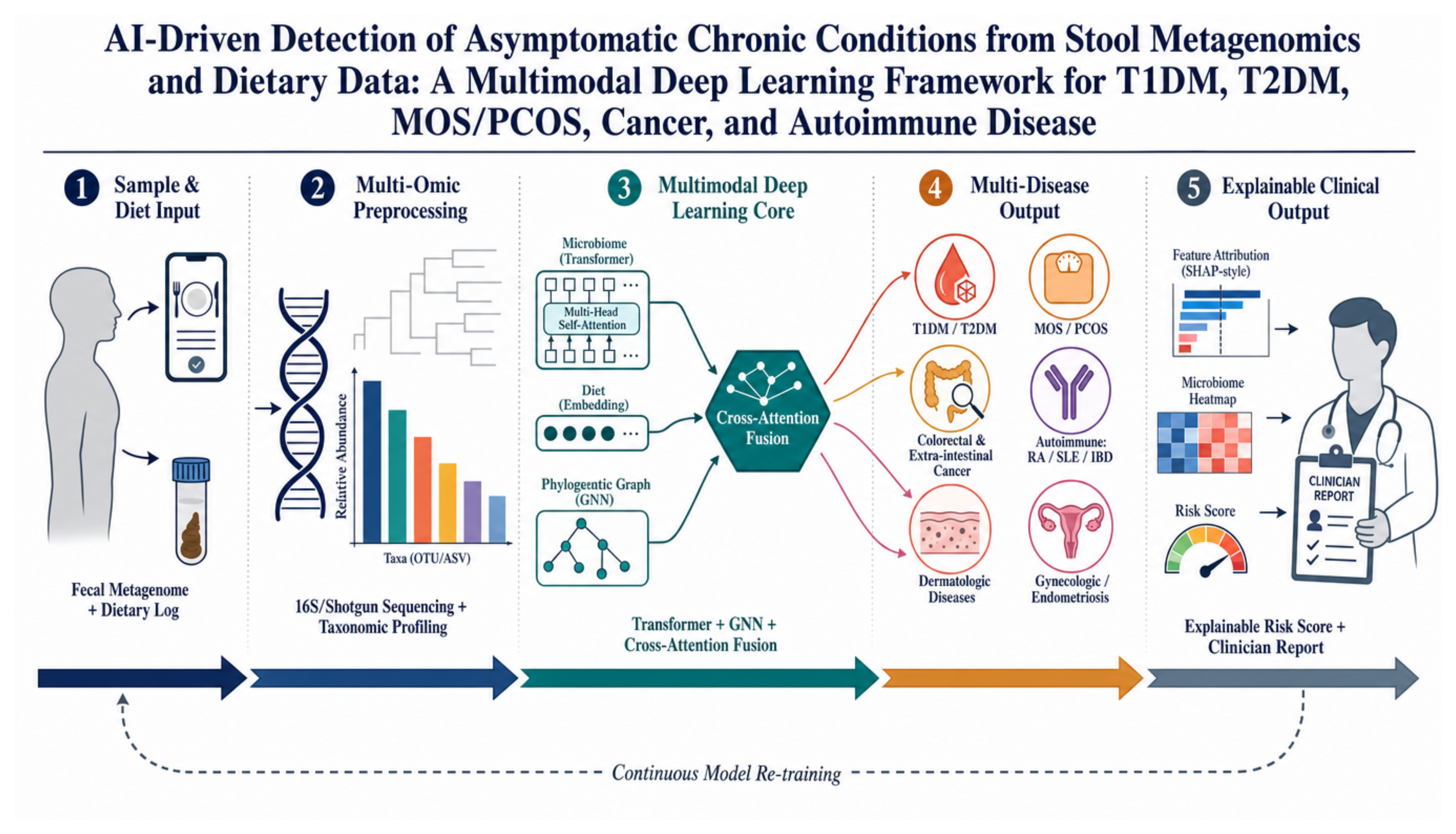
Chronic non-communicable conditions – type 1 diabetes mellitus (T1DM), type 2 diabetes mellitus (T2DM), metabolic obesity syndrome (MOS), polycystic ovary syndrome (PCOS), colorectal and extra-intestinal cancers, systemic autoimmune disease, and dermatologic and gynecologic disorders linked to gut dysbiosis – share a prolonged asymptomatic phase during which conventional screening is invasive, insensitive, or resource-intensive. This review synthesizes 2021-2025 literature on fecal microbiome-based artificial intelligence (AI) diagnostics across these conditions. We surveyed machine learning classifiers trained on 16S rRNA and shotgun metagenomic data, extracting reported discriminative performance, validated microbial and short-chain fatty acid (SCFA) biomarkers, and cross-cohort reproducibility. Reported classifiers achieve areas under the curve (AUC) typically between 0.79 and 0.93 across disease domains (e.g., 0.792 for autoimmune disease subtyping, 0.82-0.90 for colorectal cancer, 0.93 for PCOS subtyping), with dietary data integration and SCFA quantification further improving discrimination. We propose a multimodal deep learning architecture – combining a microbiome transformer encoder, dietary embedding module, host feature multilayer perceptron, phylogenetic graph neural network, and cross-attention fusion layer – coupled with explainable AI (SHAP, attention heatmaps, microbial risk scores) for clinical interpretability. We conclude that fecal microbiome-based multimodal AI is a technically mature but clinically unvalidated candidate for population-scale pre-symptomatic screening, pending prospective, harmonized cross-cohort trials.
Keywords:
gut microbiome
; machine learning
; type 1 diabetes mellitus
; type 2 diabetes mellitus
; metabolic obesity syndrome
; polycystic ovary syndrome
; colorectal cancer
; autoimmune disease
; precision nutrition
; explainable AI
Copyright: This open access article is published under a Creative Commons CC BY 4.0 license, which permit the free download, distribution, and reuse, provided that the author and preprint are cited in any reuse.


