

Submitted:
14 July 2026
Posted:
15 July 2026
You are already at the latest version
Preprints on COVID-19 and SARS-CoV-2
Abstract
This study assessed the Entrepreneurial Intentions and Actions of youth within the City of Tshwane, post-COVID-19 pandemic, using the Theory of Planned Behaviour. The study focused on the influence of COVID-19 on Attitudes Towards Entrepreneurship, Subjective Norms, as well as Self-Efficacy, leading to Entrepreneurial Intentions and later Entrepreneurial Actions. Data were collected from 326 youths from five regions in the City of Tshwane, through convenience sampling, using a self-administered questionnaire. The findings were generated from results analyzed through Microsoft Excel, IBM SPSS v29 and STATA v13. The results provide evidence that COVID-19 positively influenced the antecedents of the Theory of Planned Behaviour. Moreover, the results revealed that Subjective Norms is not an important antecedent towards the formation of Entrepreneurial Intentions. Furthermore, Self-Efficacy had a direct relationship with both youth Entrepreneurial Intentions and actions. The findings thus add to the advancement of the Theory of Planned Behaviour. Based on this research, establishing institutions that focus on entrepreneurial growth and support to promote entrepreneurship can be the government’s goal in addressing the issues of youth unemployment. Additionally, an entrepreneurship environment that allows the exercise of entrepreneurship from a fundamental age is very crucial in the country.
Keywords:
entrepreneurship
; entrepreneurial intentions
; entrepreneurial actions
; COVID-19
; theory of planned behaviour
; South Africa
1. Introduction
Despite the growing importance of entrepreneurship as well as its benefits to the economy and individuals, South Africa is among the countries with low entrepreneurial activities, even with a high unemployment rate. The COVID-19 pandemic further altered the global economic state, creating both challenges and opportunities for entrepreneurship. This comes after a couple of authors indicated that the pandemic has had an impact on entrepreneurship in particular (Chauke & Chinyakata, 2020; Chetty et al., 2022; Rehan et al., 2021). With the numerous benefits and developments that entrepreneurship has, especially among the youth, various issues have been encountered in various nations and throughout the world with the engagement of entrepreneurship (Mahlaole & Malebana, 2022). South Africa, in particular, is among the nations with inadequate entrepreneurship, especially among the youth, despite its high levels of unemployment every quarter. This comes after Motsepe et al. (2026) cry that youth unemployment in the country remains a persistent socio-economic challenge. Furthermore, South Africa has high levels of unemployment that could potentially be further exacerbated by the COVID-19 pandemic. South Africa’s overall youth unemployment rate (all youth ranging from the ages of 15 to 34 years) was standing at 46.3% on the first quarter report of the year 2021 (Statistics South Africa, 2021), and increased to 64.4% (15-24 years) and 42.9% (25-34 years) during the second quarter of that year (Maluleke, 2021). In the last quarter of 2025, youth unemployment slightly decreased to 43.8% when compared to the 2021 statistics, confirming a persistent vulnerability among youth (Motsepe et al., 2026). The official unemployment rate in Gauteng alone stood at 36,7% during the first quarter of 2022 (Statistics South Africa, 2022) and decreased to 33,7% during the third quarter of 2023 (Statistics South Africa, 2023), although it would not be deemed as an expected improvement. Pereira et al. (2024) agree that the rate of unemployment amongst the youth has continued to rise and has reached significant proportions. Looking at the above-mentioned unemployment rates, Motsepe et al. (2026) highlight that when youth are kept out of economic activities of the countries, households get to be financially vulnerable and have less ability to withstand generational change, which leads to communities experiencing less social cohesion and a constrained economic development potential. Therefore, since youth are then viewed as the catalysts for economic growth even in emerging economies such as South Africa (Zwane & Osuigwe, 2024), the country is in critical need of a more dynamic, job-creating, and inventive growth path, especially in the aftermath of the COVID-19 pandemic (Mahlaole & Malebana, 2022). Since unemployment has raised concerns in South Africa, entrepreneurship would then be vital towards eradicating the issues surrounding the high youth unemployment rates in the country.
Entrepreneurial motivation is important when considering translating entrepreneurial intention into action; consequently, entrepreneurs who detect, analyze, and exploit possibilities drive entrepreneurial activity (Malebana, 2014). This is due to the fact that new entrepreneurial ventures are the outcome of individuals’ intentions and their subsequent actions; much of what we consider entrepreneurial activity is predetermined intents (Bogatyreva et al., 2019). Therefore, in South Africa, where youth unemployment rates are particularly high, understanding how Entrepreneurial Intentions can be converted to entrepreneurial actions should be a fundamental aspect to look at in assisting with combating youth unemployment. This study then adopted the Theory of Planned Behaviour to use its antecedents in being able to determine the Entrepreneurial Intentions of the youth, which should later be translated into Entrepreneurial Actions.
Therefore, in this study, a conceptual framework has been adopted and incorporated with the effects of COVID-19 to measure the youths’ Entrepreneurial Intentions towards Entrepreneurial Actions in the City of Tshwane post-pandemic. Given the role of entrepreneurship in addressing unemployment and economic development across the world, the research problem for the study is expressed as follows: Despite the significant challenge of youth unemployment due to a variety of factors, such as scarcity of job vacancies and a highly competitive labor market, South Africa continues to see a low level of youth Entrepreneurial Intentions and actions.
Emerging from the above problem, this research aims to answer the question “What is the relationship between Entrepreneurial Intentions and actions of youth in the City of Tshwane after the COVID-19 pandemic?”. The results will provide both theoretical and practical implications for designing and adapting to interventions that will help alleviate the concerns of youth unemployment through the engagement of entrepreneurship, which will strengthen South Africa’s economic growth. This research stands out due to its unique approach of incorporating the COVID-19 effects into the Theory of Planned Behaviour as well as assessing the link of Entrepreneurial Intentions towards Entrepreneurial Actions. Notably, it expands the existing literature on models for measuring Entrepreneurial Intentions.
2. Literature Review
2.1. Entrepreneurship
Entrepreneurship is promoted as a potential career option given the high rate of unemployment, which mostly impacts the youth (Ndovela & Chinyamurindi, 2021). But what is entrepreneurship? Multiple authors (Letsoalo & Rankhumise, 2020; Maheshwari, 2021) claim that the term “entrepreneurship” has existed for as long as men have existed and has been found to be used in a variety of contexts and methods, leading to several definitions and interpretations. Chetty et al. (2022) confirms that the notion of the concept of “entrepreneurship” cannot be described by a single term or definition, and numerous research efforts have been made to define it. This means the term entrepreneurship has several definitions that vary according to the context and what it wants to describe. However, various definitions of the term may still end up with the same consensus on what entrepreneurship entails. This is indeed supported by Ajani et al. (2023) who notes that despite the lack of a widely accepted and all-encompassing definition, it is an established reality that entrepreneurship is distinguished by distinctive qualities, including the capacity to introduce a new venture. Entrepreneurship is the process by which an entrepreneur not only recognizes an opportunity but also takes on it, with the process including launching a business as well as taking calculated risks in order to make a profitable income (Devi & Singh, 2023; Roos & Botha, 2022). Therefore, entrepreneurship is a deliberate process in which individuals mentally prepare to carry out the action of identifying opportunities, creating ventures, or even developing existing ventures. In this research, it entails not only identifying a gap in the market or opportunity but speaks into taking the risk of using all available resources for the creation of wealth, employment opportunities, as well as contributing to the country’s economic growth. Although acting on recognized opportunities is the definition of an entrepreneur, this should be a continuous process of striving for improvement rather than a one-time occurrence.
The reason behind the importance of entrepreneurship in every country’s economy, especially relevant in developing countries such as South Africa (Zwane & Osuigwe, 2024), it comes with its potential to bring job creation, innovation, productivity, creativity, positive social development, and most importantly, economic growth (Al Bati et al., 2022; Anal & Singh, 2023; Mahlaole & Malebana, 2022; Masilela et al., 2020; Molema et al., 2026; Ndovela & Chinyamurindi, 2021; Nsahlai et al., 2020; Oni & Mavuyangwa, 2019). In addition, Mahlaole and Malebana (2022) press that a higher emphasis on entrepreneurship would allow more businesses to emerge, formalizing many sectors of the South African economy. Generally, this would eradicate the prime issue of youth unemployment and an unstable economy within South Africa. Nonetheless, Rehan et al. (2021) concludes that entrepreneurship is not only important at the country level but also at the individual level.
2.2. COVID-19 Impact on Entrepreneurship
Across the world, economic crises have been faced before, such as financial crises; however, COVID-19 was multifaceted and intense (Vazirani & Bhattacharjee, 2022). The COVID-19 outbreak has affected millions of lives in various ways, has caused significant disruptions to economies worldwide, and has brought dire and unfavorable conditions to humankind, as well as economic, physical and mental consequences worldwide (Alessa et al., 2021; Baadjie & Manyaga, 2023; Chauke & Chinyakata, 2020; Chetty et al., 2022; Mundhree & Beharry-Ramraj, 2022; Ng et al., 2022). COVID-19 is caused by SARS-CoV-2 virus, which is one of many related viruses that can cause colds and other respiratory infections (Baadjie & Manyaga, 2023). Symptoms of the virus include fever and coughing, and it spreads through contact or droplets. COVID-19 was first reported to the World Health Organisation (WHO) on 31 December 2019, and on 30 January 2020, it was formally declared a global health emergency (Baadjie & Manyaga, 2023). As it would then be seen as a global health emergency, South Africa had one of the highest rates of infection in Africa (Chauke & Chinyakata, 2020). As a result, the president of South Africa implemented severe measures on 15 March 2020, including closing all ports of entry, prohibiting travel from high-risk countries, closing schools, and outlawing gatherings of large numbers of people (Baadjie & Manyaga, 2023; Bayona-Oré, 2023). This was done to prevent the rapid spread of the disease, as medical facilities were not large enough to handle the high number, and there was no vaccine to control the virus yet.
Researchers claim that South Africa has had the lowest percentage of the youth population participating in entrepreneurial activities, which suggests that the entrepreneurship state in the country was poor (Dzomonda & Fatoki, 2019; Mundhree & Beharry-Ramraj, 2022). Prior to the COVID-19 pandemic in 2020, the majority of entrepreneurs regularly faced considerable challenges and setbacks in an environment characterized by extreme uncertainty, rapid change, information, and resource scarcity (Botha & Pietersen, 2020). Some of those setbacks and challenges have led to a hostile business environment, which has resulted in a significant decline in the Total Early-Stage Entrepreneurial Activity from 10.8% in 2019 to 8.5% in 2022 and an increase in the business discontinuation rate from 4.9% in 2019 to 13.9% in 2021 (Mothibi et al., 2024). These values were before, during and after the COVID-19 pandemic. The pandemic also created social, health, and market uncertainty, highlighting the need for strong leadership regarding the adjustments necessary for entrepreneurial endeavors to survive (Alessa et al., 2021). Then the pandemic in South Africa caused many young people's businesses to close temporarily, and those that did stay open have reported poor profits (Chauke & Chinyakata, 2020). A study conducted revealed that the COVID-19 pandemic negatively affected entrepreneurship and that the crisis would have both short- and long-term impacts on youth entrepreneurship in particular (Chetty et al., 2022). Nonetheless, Chauke and Chinyakata (2020) also indicated that by providing youth development post-COVID-19 to help youth recover from the pandemic's effects and for the sustainable development of the nation, South Africa has a greater need for targeted youth development assistance to reduce the negative effects of COVID-19 through government departments, districts, metros, and local government.
Entrepreneurship or employment? A question raised by Zhu et al. (2022), especially after many businesses had to fire employees to survive the COVID-19 pandemic, has made it difficult for young people who are graduating to find good jobs. Molema et al. (2026) highlight that in South Africa, entrepreneurship, opposed to employment, plays an important role in socio-economic development, particularly in mitigating unemployment. Furthermore, it is claimed that the most successful countries in the world are those with high levels of Entrepreneurial Intentions and actions (Oni & Mavuyangwa, 2019). Therefore, entrepreneurship over employment is the best solution, looking at the benefits that also include employment itself. However, findings from one study revealed that youth preferred seeking employment rather than venturing into entrepreneurship (Ajani et al., 2023). This is however conflicted by the small labor market in South Africa that is not able to absorb the majority of the unemployed. Nonetheless, the most pressing issues facing entrepreneurship in the modern world are usually conflict, crises, and unstable conditions (Al Bati et al., 2022). In this context, COVID-19 as a world crisis would be seen as an unfavorable condition. However, despite many negative effects that were associated with and caused by the pandemic, there could be a source of new opportunities (Ghofarany & Satrya, 2021). This was supported by Mundhree and Beharry-Ramraj (2022), who noted that not all pandemic effects are negative and that some entrepreneurs during the COVID-19 pandemic were able to transform their businesses, particularly due to the pandemic's impact. Therefore, particularly in times of crisis, Bayona-Oré (2023) stresses that reallocating resources may be deemed necessary, and new activities would emerge to replace obsolete ones, thus alleviating unemployment. Nevertheless, the pandemic has raised awareness of the significance of entrepreneurship (Ng et al., 2022), and all opportunities presented by the pandemic forced youth who are entrepreneurs, employed or unemployed to consider things they usually would not do (Mundhree & Beharry-Ramraj, 2022).
2.3. Entrepreneurial Intentions and Actions
Why are intentions interesting to those who care about the formation of entrepreneurial ventures? A question raised by Krueger Jr et al. (2000). To answer that, the best way to predict entrepreneurship, a planned activity, is through intention, an active cognitive process that channels beliefs, perceptions, and other exogenous inputs into the intention to act and then into the actual action (Anal & Singh, 2023). Entrepreneurial intention is a reliable prediction to measure entrepreneurship in entrepreneurial activity and form an entrepreneurial behaviour, where a person’s level of entrepreneurial intention influences them to behave as an entrepreneur (Masnun et al., 2023). This then comes to tell us that the initial step towards indulging in the action of entrepreneurship is having Entrepreneurial Intentions (Ng et al., 2024; Vazirani & Bhattacharjee, 2022).
Finally, entrepreneurial intention, which is defined as a person's desire to start their own business, is acknowledged for its significance in forecasting the conduct of entrepreneurial activity (Bayona-Oré, 2023). Phetha et al. (2022) Suggests that many definitions of Entrepreneurial Intentions have been suggested by various authors since the 17th century. As it sheds light on the motivations behind people's decisions to launch new businesses, entrepreneurial intention is also seen as an important area of research in the field of entrepreneurship (Mabhena & Ncube, 2024). The idea was specifically developed to examine people's intentions regarding the entrepreneurial sector (Anal & Singh, 2023). Entrepreneurial Intentions is simply defined as an individual’s belief that they will start a new business in the future (Roos & Botha, 2022). According to Masilela et al. (2020), several factors, including poverty, perception, entrepreneurial skills, peer pressure, opportunity, and supportive surroundings, can impact an individual's decision to launch their entrepreneurial venture. Conclusively, characteristics including limited job possibilities, entrepreneurial education, mentality, and abilities all have an impact on Entrepreneurial Intentions (Phetha et al., 2022).
Botha and Pietersen (2020) claims that Entrepreneurial Actions are often cited as the most influential factor in the performance or accomplishment of an entrepreneurial venture. This is because Entrepreneurial Action is widely viewed as an intentionally planned behaviour (Ng et al., 2022). This means that business ventures successfully exist due to entrepreneurial action. Zhu et al. (2022) claims that researchers believe that strengthening entrepreneurial activities may promote innovative projects, wealth creation, increased competition, employment creation, and economic growth. Therefore, with all the benefits of entrepreneurship, Entrepreneurial Actions considered the driver of achieving those benefits.
Roos and Botha (2022) note that many individuals intend to start a new business and become entrepreneurs, but only a small percentage proceed from intention to action. This comes after Bogatyreva et al. (2019) caution that sometimes intentions do not translate into actual entrepreneurship, creating an intention-to-action gap. This highlights a disconnect between Entrepreneurial Intentions and actual Entrepreneurial Actions, underscoring the need to bridge this gap to promote entrepreneurship that contributes to economic growth through job creation. Therefore, entrepreneurship does not exist if Entrepreneurial Intentions are not translated into Entrepreneurial Actions. Ajzen (1985) claims that though not all intentions are carried out, they do govern actions; some are completely abandoned, while others are modified to fit changing circumstances. However, without entrepreneurial activity, the desire to launch a new business is suppressed (Dzomonda & Fatoki, 2019). This was supported by Dlamini and Botha (2023), who found that a person's degree of intention, combined with entrepreneurial opportunities, is a reliable indicator of their likelihood of taking entrepreneurial action. It is therefore important to note that Entrepreneurial Intentions and actions are two different variables that work hand in hand. For instance, for a business to exist, one should have started with the intention to have one and further translated those intentions into actions by acting on them. Furthermore, new entrepreneurial ventures are products of entrepreneurial action (Dzomonda & Fatoki, 2019) and are incepted by Entrepreneurial Intentions. Therefore, entrepreneurship should be defined by both Entrepreneurial Intentions and actions; without the combination of the two, entrepreneurship does not exist.
2.4. Models Explaining Entrepreneurial Intentions
The intricacies of entrepreneurship can be captured by intention-based models, which also offer a framework for creating reliable, testable models (Devi & Singh, 2023; Krueger Jr et al., 2000). The study of Entrepreneurial Intentions has a rich history in the field of Entrepreneurship research, drawing upon various theoretical perspectives to understand the factors that drive individuals to become entrepreneurs (Mabhena & Ncube, 2024). According to Anal and Singh (2023), over the years, a lot of research has been conducted on entrepreneurial intent using either a single theory or a combination of models and theories. However, Devi and Singh (2023) claims that an individual’s Entrepreneurial Intentions cannot be explained using one theory and model. This means not a single theory or model exists in explaining Entrepreneurial Intentions, and from different contexts, multiple theories and models exist with their advantages and disadvantages. Among the theories that forecast Entrepreneurial Intentions are the Maximization of Expected Utility model, the Theory of Planned Behaviour, the Theory of the Entrepreneurial Event, and the Model of Implementing Entrepreneurial Ideas (Devi & Singh, 2023; Ebewo & Nesamvuni, 2020). Other theories that have not been extensively applied in research include McClelland's achievement theory, Davidsson's economic-psychological model of 1995, Robinson and colleagues' entrepreneurial attitude orientation scale of 1991, Krueger and Carsrud's integrated model of 1993, the entrepreneurial potential model, Krueger’s structural model of 1993, and Shapero’s cognitive experiential self-theory (Devi & Singh, 2023). Nonetheless, across all these cognition-based theories, an individual’s perception or cognitions serve as the primary explanatory mechanism for the formation of behavioral intentions (Ebewo & Nesamvuni, 2020).
When Shapero developed the Model of Entrepreneurial Event in 1982, instead of predicting any intention, Shapero concentrated on using the framework to ascertain Entrepreneurial Intentions (Al Bati et al., 2022; Rehan et al., 2021). But before that, in 1975, Fishbein and Ajzen created the Theory of Reasoned Action to examine people's attitudes and behaviour (Devi & Singh, 2023). The Theory of Planned Behaviour was further developed and thought to be the most accurate predictor of intentions to behave over time (Dlamini & Botha, 2023). Conversely, it was developed as an extension of the Theory of Reasoned Action, which was flawed in its ability to address behaviour over which people have only limited volitional control (Devi & Singh, 2023; Ebewo & Nesamvuni, 2020; Hoffman & Peters, 2021; Mahlaole & Malebana, 2022; Msosa & Radebe, 2022; Ng et al., 2024).
Besides the variety of the above theories employed in explaining the intentions of entrepreneurs, the most widely used model for predicting human behaviour is the Theory of Planned Behaviour (Ebewo, Rugimbana, et al., 2017; Mabhena & Ncube, 2024; Maheshwari, 2021; Mahlaole & Malebana, 2022; Malebana, 2014; Mothibi & Malebana, 2019; Ng et al., 2024; Ruiz-Rosa et al., 2020; Urban & Chantson, 2019). This comes after Mahlaole and Malebana (2022) explain that this model outperforms other frameworks in terms of analytical power and that it is the most widely accepted for explaining the cause and effect of Entrepreneurial Intentions. However, Mabhena and Ncube (2024) argue that there are inconsistent findings with the applicability of the Theory of Planned Behaviour and that there is a need for a more comprehensive framework for studying entrepreneurship. Nonetheless, a couple of authors added that the Entrepreneurial Event Model too is mostly used in addition to the Theory of Planned Behaviour for studying Entrepreneurial Intentions (Anal & Singh, 2023; Ghofarany & Satrya, 2021; Maheshwari, 2021; Mahlaole & Malebana, 2022; Rehan et al., 2021; Roos & Botha, 2022).
2.5. Conceptual Model and Hypotheses Development
To formulate hypotheses for this research, the study adopted the Theory of Planned Behaviour (presented in Figure 1) to measure Entrepreneurial Intentions and actions among youth, while incorporating the COVID-19 Effects to assess the pandemic's impact on these intentions and actions.
The Theory of Planned Behaviour was applicable to this study as it serves as the foundation for much of the theoretical advancement in studies and other research that aim to further our knowledge of Entrepreneurial Intentions (Anderson, 2023). Mabhena and Ncube (2024) also adds that this proposed model for studying Entrepreneurial Intentions offers a comprehensive, multidimensional approach to understanding the complex factors that drive individuals to engage in entrepreneurship. Although Entrepreneurial Intentions are measured using antecedents of the Theory of Planned Behavior, a few other characteristics specific to the study's setting have emerged that aid in determining Entrepreneurial Intentions in those settings (which are the effects of COVID-19 in this case). This model posits that an individual’s behaviour of acting towards an action is determined by their intentions, influenced by Attitude Towards the Behaviour, Subjective Norms and Perceived Behavioral Control/Self-Efficacy (Ajani et al., 2023; Mabhena & Ncube, 2024; Msosa & Radebe, 2022; Ng et al., 2024; Rehan et al., 2021; Ruiz-Rosa et al., 2020).
Within this conceptual framework and Hypothesis, COVID-19 Effects were first hypothesized with the antecedents of the Theory of Planned Behaviour—namely the Attitudes Towards Entrepreneurship, Subjective Norms, as well as Self-Efficacy. However, the results derived from the above-mentioned antecedents with the COVID-19 Effects alone would not be sufficient. Further, the relationships between each antecedent and the Entrepreneurial Intentions variable were also measured. Lastly, the Entrepreneurial Intentions variable was directly hypothesized with Entrepreneurial Intentions to measure the link between wanting to be an entrepreneur and engaging in entrepreneurial activities. To aid the investigation of the research question in this study and in light of the theoretical assumptions of the adopted conceptual model of Entrepreneurial Intentions, the hypothesis is presented in the literature below.
As Chetty et al. (2022) claim that the pandemic negatively impacted entrepreneurship with short and long-term effects on youth entrepreneurships, this research found it important to measure the effect of post-COVID-19 effects on the antecedents of the Theory of Planned Behaviour, as they are primarily used to measure intentions. A study by Duong et al. (2022) highlights that COVID-19-related distress lessened the effect of attitude towards entrepreneurship on Entrepreneurial Intention as well as the link between Entrepreneurial Intention and actual behaviour. This might be due to individuals’ hesitations on entrepreneurship due to the pandemic's impact overall. On the other hand, another research concluded that the Pandemic had a serious impact on entrepreneurs' businesses, which in turn led to a decrease in economic activity (Alessa et al., 2021). The absence of a significant association between Entrepreneurial Intentions and behaviour during the pandemic suggests that external factors can disrupt the translation of intention into actions (Mothibi et al., 2024). Rehan et al. (2021) further augment that the pandemic may have a negative influence on entrepreneurial intention as it led to limited financial resources, psychological issues, and social and mental health of individuals. However, a study that was moderating the role of COVID-19 revealed a significant effect on the relationship between independent variables (personal factors) and Entrepreneurial Intentions (Al Bati et al., 2022).
According to Oni and Mavuyangwa (2019) the pertinent topic to be addressed by applying attitudes to this study is: what do young people think about launching their own businesses or becoming entrepreneurs? This construct was deemed to be important in this research, as a couple of authors have tested and found it to be positive towards Entrepreneurial Intentions (Duong et al., 2022; Ndovela & Chinyamurindi, 2021; Ng et al., 2024; Phetha et al., 2022). It is described as the degree to which individuals have a positive or negative appraisal of particular behaviors, and is also based on their considerations of the expected outcomes when performing such behaviors (Duong et al., 2022). Within the studies of entrepreneurship, attitudes towards behaviour reflect a person’s favorable or unfavorable valuation of following an entrepreneurial career (Bayona-Oré, 2023; Malebana, 2014; Masilela et al., 2020). Furthermore, Duong et al. (2022) adds that attitude towards behaviour is dependent on how much people value certain behaviors either positively or negatively, and it also depends on how they think about the results they expect while engaging in certain behaviors. This variable is important as Ndovela and Chinyamurindi (2021) notes that it serves as a major factor in entrepreneurship, as one would argue that for entrepreneurship to succeed, one needs to be in the right state of mind. Therefore, the first hypothesis is as follows:
H1
: COVID-19 effects moderate the relationship between Attitude Toward Entrepreneurship and Entrepreneurial Intentions.
Nsahlai et al. (2020) notes the idea that young people are inspired to pursue entrepreneurship by parents and family members who are interested in it. This comes after Mahlaole and Malebana (2022) and Ng et al. (2024) described Subjective Norm as a person’s opinion of whether the majority of significant people in their life think they should or should not do a certain act in question. It also refers to an individual's perception of the encouragement or discouragement of surrounded people if they conduct certain behaviour (Duong et al., 2022). This effect usually focuses on closer people, such as intimate relatives, friends, parents, and coworkers (Msosa & Radebe, 2022; Oni & Mavuyangwa, 2019). Masilela et al. (2020) then cautions that as Subjective Norms reveal one’s belief of becoming an entrepreneur, an individual’s Subjective Norms are important in determining their Entrepreneurial Intentions. However, this construct seems to be the weakest when it comes to measuring Entrepreneurial Intentions, as several authors indicated that it has a weak link towards Entrepreneurial Intentions (Anal & Singh, 2023; Anderson, 2023; Duong et al., 2022; Ebewo & Nesamvuni, 2020). Interestingly, research conducted by Roos and Botha (2022) points out that family members had a significant influence on an individual’s Entrepreneurial Intentions and action gap, not directly but rather at a psychological level. The second hypothesis is as follows:
H2
: COVID-19 effects moderate the relationship between Subjective Norms and Entrepreneurial Intentions.
The final antecedent of the Theory of Planned Behaviour was derived as Self-Efficacy, as per Figure 1. The relationship was based on the moderating effect of COVID-19 on the relationship between Self-Efficacy and Entrepreneurial Intentions. It is important to note that Self-Efficacy is similar and used interchangeably with Perceived Behavioral control, which was developed and influenced greatly through Bandura’s work (Hoffman & Peters, 2021; Ng et al., 2024). Self-Efficacy, which is related to self-identity that describes how someone thinks in their own skills, is the idea that someone can accomplish results and goals (Roos & Botha, 2022). It helps to better understand Entrepreneurial Intentions and the conditions under which these would be translated into actions (Fenech et al., 2019). Hence, it is considered the explanatory variable of entrepreneurial intention, and it positively influences it (Devi & Singh, 2023; Rehan et al., 2021). Likewise, an increase in Self-Efficacy is likely to lead to more people intending to engage in entrepreneurship (Maheshwari, 2021; Msosa & Radebe, 2022; Phetha et al., 2022). The third hypothesis is as follows:
H3
: COVID-19 effects moderate the relationship between Self-Efficacy and Entrepreneurial Intentions.
Being an entrepreneur is clearly a conscious action and having a strong entrepreneurial intention can have a huge influence on an individual’s intention to start a new business (Mahlaole & Malebana, 2022). Dlamini and Botha (2023) conducted research on the relationship between Entrepreneurial Intentions and Entrepreneurial Actions and revealed that it is relevant in entrepreneurship research due to its contribution leading to the entrepreneurial activity taking place. de Alwis et al. (2022) also conducted research to understand the intention-action relationship and confirmed a positive association between the two. And lastly, the final hypothesis in this study is as follows:
H4
: Entrepreneurial Intention positively relates to Entrepreneurial Action of the youth.
With all four hypotheses presented above, the formulation of the conceptual model is therefore presented below (Figure 1), with the flow of the hypotheses of this study.
3. Methodology
To assess the effects of post-COVID-19 Entrepreneurial Intentions and actions among youth, this study applied the positivist research philosophy as it employs quantitative techniques for data collection and analysis. Quantitative research allows for the quantification of behaviour, opinions, attitudes and other variables, as well as the generalization of findings across a larger population (Mahlaole & Malebana, 2022). In addition, the quantitative research design was preferred as it can also be used to support or reject hypotheses, and is frequently associated with a deductive strategy that prioritizes the use of data in theory (Mahlaole & Malebana, 2022), as in relation to this research.
3.1. Population and Sampling
The target population of this study comprised approximately 1,21 million youth residing in the City of Tshwane between the ages of 18 and 35. Participants were conveniently sampled from areas where youth usually gather, such as fast-food establishments, parks, libraries, and higher learning institutions.
A target sample of 385 respondents was initially identified to achieve a 50% response distribution, a 95% confidence level and a 5% margin of error (Raosoft.com, 2024). The final sample comprised a convenience sample of 326 youth who fully took part in the study.
3.2. Data Collection and Analysis
Data was collected using a self-administered questionnaire (see Table 1 below) that was tested and validated by various authors who conducted similar research, as indicated below, with the relevant sources.
The questionnaire included demographic characteristics and five sections aligned with the study’s constructs. The instrument items were adapted to align the context of COVID-19, Entrepreneurial Intentions, and Entrepreneurial Actions of youth, using the five-point Likert scale (between 1=strongly disagree and 5=strongly agree). Final analysis, as per Table 2 below, showed strong internal consistency, with Cronbach’s Alpha values ranging between 0.730 and 0.945, confirming the instrument’s reliability.
Data were collected through a self-administered questionnaire that was randomly distributed to the youth through the participants' convenience. Data was cleaned through Microsoft Excel before commencing with data analysis. Quantitative analyses were conducted through SPSS version 29 for descriptive and reliability analyses. The hypotheses were tested through STATA version 13 for regression analysis using Structural Equation Modelling (SEM). The SEM examined the relationship between five variables, namely COVID-19 Effects, Attitude Towards Entrepreneurship, Subjective Norms, Self-Efficacy, Entrepreneurial Intentions, and Entrepreneurial Actions. The relationships hypothesized are as depicted in Figure 1 (H1-H4).
The SEM was selected for analysis because it can simultaneously assess measurement validity and examine structural relationships among latent constructs while accounting for measurement error, making it well-suited to theory-driven entrepreneurship research (Hair et al., 2017). The SEM Analysis followed a two-step procedure which includes the measurement of the model validation and subsequent structural model testing.
To assess the model fit, the study utilized multiple goodness-of-fit indices, including the Comparative Fit Index (CFI), the Tucker-Lewis Index (TLI), the Root Mean Square Error of Approximation (RMSEA), and the Standardized Root Mean Square Residual (SRMR). Improvements in the model fit were interpreted alongside their theoretical plausibility to ensure transparency, rigor, and credibility in the SEM analysis (Hu & Bentler, 1999).
3.3. Ethical Approval and Consent
For this research, ethics approval was obtained from the Tshwane University of Technology Ethics Committee, with ethics number FCRE2022/09/009-MS (2). Participants were informed about the purpose of the study, their voluntary participation and rights, as well as the confidentiality of their results.
Overall, the methodological framework provided a systematic, rigorous, and replicable approach to assessing post-COVID-19 Entrepreneurial Intentions and actions among youth in the City of Tshwane.
4. Results
4.1. Profile of the Respondents
As per the demographic profile of the sample depicted in Table 3, the respondents' characteristics included gender, age, education level, employment status, and exposure to entrepreneurial education.
Table 1 indicates a total sample size of respondents across multiple regions in the City of Tshwane, with 238 (73.0%) female, 87 (26.7%) male and 1 (0.3%) respondent who did not disclose their gender. On the age distribution, the majority (41.7%) of the respondents were between 22 and 25 years, followed by 27.0% in the 26 – 29 years age group, 16.6% in the 30 – 35 years age group, and 14.7% between the ages of 18 and 21 years. With regards to their education level majority (27.6%) had obtained a grade 12 certificate, followed by bachelors degree / advanced diploma (27.0%), diploma (22.1%), honours / postgraduate diploma (13.2%), post grade 12 certificate (0.9%), masters degree (3.7%), pre-grade 12 (0.9%), doctoral degree (0.6%), and 0.6% respondents chose other. The majority of the participants indicated that they are studying (43.3%), followed by 23.0% who were part-time employed, 18.7% employed full time, 10.7% unemployed, 3.4% self-employed, and 0.9% indicated ‘other’ form of employment status. Lastly, as a total of 326 respondents took part in the study, the final demographic question measured participants' exposure to entrepreneurial education, with 50% indicating they had received some form of entrepreneurial education, and the other 50% indicating they had not.
As per the date in Figure 2, one of the prominent themes is the increased intention to become an entrepreneur due to the aftermath of the COVID-19 pandemic, with a significant portion of participants indicating that the pandemic has increased their entrepreneurial intention (B-1.1). Specifically, 26.10% of respondents agreed, and 22.40% strongly agreed that COVID-19 significantly increased their intention to become entrepreneurs. However, 30.40% were unsure, and only 10.40% and 10.70% strongly disagreed and disagreed, respectively. Similarly, (B-1.2) 27.60% of participants agreed, and 23.00% strongly agreed that they are now more likely to start their own business due to the pandemic, while leaving 28.50% uncertain, as well as 7.10% and 13.80% strongly disagreeing and disagreeing correspondingly. This suggests that entrepreneurship is seen as a more appealing and potentially secure option compared to traditional employment, as data reveal that 27.00% of participants agreed and 26.40% strongly agreed that a career as an entrepreneur is more attractive to them due to COVID-19’s effects on the job market (B-1.3). However, it is important to note that, despite the above positive perception of the sample, a substantial proportion of participants (56.40%) strongly agreed that COVID-19 has had a serious impact on entrepreneurs’ businesses (B-1.4). This follows a majority of 25.8% who agreed with the above statement, with 17.8% who were Neutral, as well as those who disagreed and those who strongly disagreed. Additionally, 31.30% strongly agreed, and 26.40% agreed that the pandemic led to the permanent closure of some businesses (B-1.5). These highlight the severe challenges and disruptions faced by entrepreneurs, including financial losses, operational difficulties, and the possibility of complete shutdown of their ventures. Changes in customer behaviour due to the pandemic also emerged (B-1.6), with a combination of 66.20% (33.40% agreed and 32.80% strongly agreed) of participants acknowledging that the COVID-19 pandemic has indeed affected customer behaviour. Only a notable 24.50% were unsure of the above statement, while 3.70% and 5.50% strongly disagreed and disagreed, respectively. Despite various challenges, respondents see the pandemic as an opportunity for future development in the sense that a notable 28.50% agreed, and 25.50% strongly agreed that the COVID-19 pandemic is considered a chance to develop entrepreneurs’ business operations in the future (B-1.7). This suggests that entrepreneurs are optimistic and view the pandemic as a period of transformation and innovation, during which they can re-evaluate and improve their business practices to better align with evolving market conditions. Financial and economic barriers were also evident in the responses. A significant 34.00% of participants strongly agreed, and 31.30% agreed that starting a business during an economic climate such as the COVID-19 pandemic would pose serious financial difficulties (B-1.8). Additionally, 29.10% strongly agreed, and 24.80% agreed that COVID-19 is an unfavorable economic climate for starting a business (B-1.9).
4.2. Reliability of the Questionnaire
For research results to be acceptable, the reliability of the variables had to be confirmed with Cronbach’s Alpha. Common lore among applied researchers is that 0.70 is the standard level of acceptability for a research instrument to be deemed as reliable, and should not be more than 0.90 (Mellinger & Hanson, 2020; Msosa & Radebe, 2022; Phetha et al., 2022; Sürücü & Maslakci, 2020). All scales accomplished Cronbach’s Alpha score between 0.730 and 0.945, which is over the recommended threshold of 0.7 as well as below 0.9, indicating that the measurement instrument employed to gather data for this study was consistent and that the survey questions measured what they were meant to measure in order to produce reliable results suitable for statistical analysis.
4.3. Structural Model Assessment
The model fit was measured using Chi-square and Normed X2/df values, as well as other model fit indices such as the Comparative Fit Index (CFI), Tucker-Lewis Index (TLI), and Root Mean Square Error of Approximation (RMSEA). The recommended cut-off value for the goodness-of-fit indices was based on Hu and Bentler (1999) and later Hair et al. (2017) suggestions. According to standard practice, a suitable model fit is indicated by a value greater than 0.90 for CFI and TLI, and a value of less than 0.08 for RMSEA. However, a cut-off value near 0.95 for TLI, CFI, and a cut-off value close to 0.06 for RMSEA are required to support that there is a moderately good fit between the hypothesized model and the observed data (Hair et al., 2017; Hu & Bentler, 1999).
The original proposed conceptual model (Table 4) (CFI=0.716, TLI=0.468, RMSEA=0.301, Chi-Square: 845.585, CD (R2): 0.437) yields an unacceptable model fit; thus, some modifications were made to settle on a model that better fit the data. A single indicator was eliminated based on modification indices. It is worth noting that the model fit was progressed using a conservative strategy, that is, none of the errors of the terms was allowed to covary.
The output in Table 4 generally supports hypotheses 1, 3, and 4. Although Attitudes Towards Entrepreneurship (β = 0.3749), Subjective Norms (β = 0.1769), and Self-Efficacy (β = 0.4705) are positively influenced by COVID-19 effects (stemming from hypotheses 1, 2, and 3), it is important to note that only Attitudes Towards Entrepreneurship (β = 0.3583) and Self-Efficacy (β = 0.3324) positively influence Entrepreneurial Intentions. Additionally, Entrepreneurial Intentions (β = 1.1562) positively influence Entrepreneurial Actions. As a result, this means only Hypotheses 1, 3, and 4 can be accepted at a p < 0.000 significance level, as Subjective Norm has no significant relationship with Entrepreneurial Intentions (β = 0.1058, p = 0.123), as it does not have a strong effect on the proposed conceptual model.
As shown in Table 5, the revised conceptual model shows an improvement on the overall relative to the initial conceptual model, with a likelihood ratio chi-square of 3.93 (p > 0.559), demonstrating that the model sufficiently signifies the data. With TLI of 1.004, RMSEA is reported at 0.000 and CD (R2): 0.300, suggesting an outstanding fit. The CFI was 1.000. This shows that the entire data covariation could be created by employing the hypothesized model.
With modifications conducted on the initial conceptual model to ensure data fit, the direct influence of COVID-19 towards Attitude Towards Entrepreneurship, Subjective Norms, and Self-Efficacy were maintained as they all had a positive relationship. On the other hand, Entrepreneurial Intentions are found to be influenced by both Attitude Towards Entrepreneurship (β = 0.3782, p < 0.000) and Self-Efficacy (β = 0.3528, p < 0.000). This indicates that positive attitudes as well as enhanced Self-Efficacy led to stronger intentions to act towards entrepreneurship, highlighting the importance of these factors in the intention formation process. Lastly, Entrepreneurial Action is significantly influenced by Entrepreneurial Intentions (β = 0.8902, p <0.000) and Self-Efficacy (β = 0.2973, p = 0.002). This strong relationship suggests that higher intentions and Self-Efficacy are critical towards translating intentions towards actions.
Constructed on the revised SEM, a representation of the goodness of fit for the study was finalized (Table 5 below) and is presented in Figure 3, which illustrates the revised conceptual model. The overall fit of the reviewed model demonstrates a good fit, with a likelihood ratio chi-square of 3.93 (p > 0.559), indicating that the model adequately fits the data. The RMSEA is reported at 0.000, suggesting an outstanding fit.
Figure 3 presents the updated conceptual model illustrating the final proposed relationship between COVID-19 Effects, the antecedents of the Theory of Planned Behaviour, Entrepreneurial Intentions, as well as Entrepreneurial Actions. Direct and interactive relationships were revealed in addition to the accepted hypothesized relationships through the basis of the SEM analysis.
5. Discussion
In this study, the outcomes demonstrate that the Theory of Planned Behaviour has a favorable association with Entrepreneurial Intentions that lead to action of the youth; however, a few developments were observed that may question the theory's full support for measuring youths’ Entrepreneurial Intentions in the future. However, the effects of COVID-19 were positively related to the antecedents of the Theory of Planned Behaviour.
Based on the research question, the objective of the study was to investigate and attempt to answer the following question: What is the relationship between Entrepreneurial Intentions and actions among youth in the City of Tshwane after the COVID-19 pandemic?
The study applied the Theory of Planned Behaviour to assess the impact of COVID-19 on youth Entrepreneurial Intentions and actions in the City of Tshwane. Four hypotheses were tested, focusing on three antecedents of Entrepreneurial Intentions: Attitude Towards Entrepreneurship, Subjective Norms, and Self-Efficacy. The findings revealed that COVID-19 significantly influenced all three antecedents of Entrepreneurial Intentions. However, only Attitude Towards Entrepreneurship and Self-Efficacy demonstrated a positive and significant relationship with Entrepreneurial Intentions. Contrary to traditional Theory of Planned Behaviour models, Subjective Norms did not play a significant role in entrepreneurial decision-making among this population.
COVID-19 significantly increased Entrepreneurial Intention and Entrepreneurial Actions by affecting most of the antecedents of the Theory of Planned Behaviour. The final findings indicated that COVID-19 effects had significant effects on Attitude Towards Entrepreneurship (p<.000), Subjective Norms (p < .000), and Self-Efficacy (p<.000). This indicates that the three antecedents of the Theory of Planned Behaviour that led to Entrepreneurial Intentions are positively correlated with the effects of the COVID-19 pandemic. However, no hypotheses focused solely on this relationship. A study conducted by Ruiz-Rosa et al. (2020) found that the COVID-19 crisis led to a decrease in Entrepreneurial Intentions after the pandemic. This means that the pandemic had a negative impact on entrepreneurship, and such pandemics would worsen a country's economic state (with higher unemployment and a lower GDP per capita), as there would be little motivation to become an entrepreneur. Yet, a study conducted post-COVID-19 found that COVID-19 positively affects the Entrepreneurial Intentions of youth (Botezat et al. 2022:14). Although the pandemic had negative psychological impacts and economic burdens, the study by Botezat et al. (2022) asserts that, post-pandemic, Entrepreneurial Intentions are encouraged.
Attitudes Towards Entrepreneurship produced a significant result (p<.000) for Entrepreneurial Intentions when regressed on each other. This confirms that attitude can be perceived as an advancement towards Entrepreneurial Intentions. As the first hypothesis regresses COVID-19 effects on Attitude Towards Entrepreneurship and Entrepreneurial Intentions, the hypothesis (hypothesis 1) is accepted. Multiple researchers support the acceptance of this hypothesis(Fenech et al., 2019; Hoffman & Peters, 2021; Mothibi & Malebana, 2019; Ndovela & Chinyamurindi, 2021), who have observed a positive relationship between ATE and Entrepreneurial Intentions. This means the youth's intentions to become entrepreneurs are positively influenced or supported by their Attitude Towards Entrepreneurship (the behaviour in this case), although Mothibi et al. (2024) and Bayona-Oré (2023) have opposed this, indicating that Attitudes Towards Entrepreneurship had no positive effect on Entrepreneurial Intentions.
Subjective Norms produced inconsistent and nonsignificant results when regressed on COVID-19 effects and on their influence on Entrepreneurial Intentions. Initially, before the conceptual framework was revised, Subjective Norms were regressed on COVID-19 effects and Entrepreneurial Intentions, yielding p-values of <0.000 and <0.123, respectively. Since Subjective Norms do not have a direct relationship with Entrepreneurial Intentions, even though they show that the effects of COVID-19 directly influence them, the second hypothesis was rejected. Interestingly, in support of the above finding, Anderson (2023) has confirmed that, in the presence of the Theory of Planned Behavior’s antecedents, Subjective Norms do not predict Entrepreneurial Intentions. Therefore, the present results failed to support the role of Subjective Norms in the formation of Entrepreneurial Intentions. This aligns with similar research that finds Subjective Norms have little or no influence on Entrepreneurial Intentions (Anderson, 2023; Ebewo & Nesamvuni, 2020; Fenech et al., 2019; Hoffman & Peters, 2021; Krueger Jr et al., 2000; Masnun et al., 2023; Mothibi et al., 2024). However, other researchers disagree with the above authors and have found that Subjective Norms do have a positive relationship towards Entrepreneurial Intentions (Bayona-Oré, 2023; Mahlaole & Malebana, 2022; Mothibi & Malebana, 2019; Msosa & Radebe, 2022; Ndovela & Chinyamurindi, 2021). Nonetheless, the modified model proposes that Subjective Norms have a direct relationship with Self-Efficacy and Attitude Toward Entrepreneurship, as per the similar findings by Ruiz-Rosa et al. (2020).
The last antecedent of the Theory of Planned Behaviour was Self-Efficacy, which showed significant results when regressed against COVID-19 effects and Entrepreneurial Intentions, with p-values of 0.000 on both. This outcome led to the acceptance of the third hypothesis as well. In support of the above results, various studies have agreed that indeed Self-Efficacy does play a positive role towards Entrepreneurial Intentions (Ajani et al., 2023; Letsoalo & Rankhumise, 2020; Masnun et al., 2023; Phetha et al., 2022). However, a study by Duong et al. (2022) revealed that COVID-19 have decreased entrepreneurial Self-Efficacy and intention to start a business. Furthermore, this was supported by a couple of older studies that found that Self-Efficacy (without the context of COVID-19) does not influence youth with Entrepreneurial Intentions (Fenech et al., 2019; Maheshwari, 2021; Msosa & Radebe, 2022). Interestingly, a rare finding in this research suggests that Self-Efficacy (as an antecedent of Entrepreneurial Intentions) has a direct, positive relationship with Entrepreneurial Actions. This is similar to de Alwis et al. (2022), who mention that although intention is an adequate predictor of action, Perceived Behavioral Control (similar to Self-Efficacy) can have an independent influence on entrepreneurial action. However, a study conducted by Hemachandra (2022) did not support the idea that Perceived Behavioral Control is positively related to Entrepreneurial Actions, which contradicts our findings (only when Perceived Behavioral Control is viewed similarly to Self-Efficacy).
The last part of the hypothesis testing was to confirm the direct impact of Entrepreneurial Intentions on actions, after identifying the relation between COVID-19 effects and the antecedents of the Theory of Planned Behaviour, leading to Entrepreneurial Intentions. This was motivated by the fact that intentions, by themselves, are insufficient without action; hence, translating intentions into action is crucial for entrepreneurial growth. Therefore, the results show a positive relationship between the two: Entrepreneurial Actions are an outcome of Entrepreneurial Intentions (p-value = 0.000). This finding was in line with a study by Dlamini and Botha (2023) that revealed entrepreneurship is statistically significant in all three stages of Entrepreneurial Actions, studies conducted among university students on translating intentions to actions (de Alwis et al., 2022; Dzomonda & Fatoki, 2019), as well as a study conducted by Ng et al. (2022) that found entrepreneurial intention positively relating to Entrepreneurial Actions under the moderating influence of COVID-19 perceptions. However, the youth in the City of Tshwane in this research were noted to have very low entrepreneurial action outcomes, as they have done little in establishing their business ventures. Therefore, entrepreneurial action is more likely to result in the formation of new ventures than simply having a solid concept, potential or intention for entrepreneurship (Dzomonda & Fatoki, 2019). On the other hand, a study conducted by Vazirani and Bhattacharjee (2022) found that Entrepreneurial Intentions did not, in and of themselves, lead to Entrepreneurial Actions (business venturing in that particular research), as the act of venturing depended solely on the recognition of opportunity.
The overall findings suggest that while COVID-19 created economic challenges, it also presented opportunities for youth to consider entrepreneurship as a viable career path. This study demonstrates that the COVID-19 pandemic significantly enhanced Entrepreneurial Intentions among youth in the City of Tshwane. The pandemic strengthened Attitudes Towards Entrepreneurship and Self-Efficacy, which in turn positively influenced Entrepreneurial Intentions and actions. The strong relationship between Entrepreneurial Intentions and actions suggests that, when adequately supported, young people are likely to translate their entrepreneurial aspirations into concrete business ventures. However, the literature reviewed indicates that youth unemployment rates in South Africa are unacceptably high. Conversely, despite high unemployment rates and the benefits of entrepreneurship, the state of entrepreneurship in South Africa remains a major concern, as youth are not entrepreneurially active.
6. Conclusions
The study assessed post-COVID-19 Entrepreneurial Intentions and actions among the youth in the City of Tshwane, with a focus on the moderating effects of COVID-19 between the antecedents of the Theory of Planned Behaviour and Entrepreneurial Intentions towards Entrepreneurial Actions. The literature review situated youth entrepreneurship in South Africa, the impact of COVID-19 within the country, the relationship between intentions and actions, as well as the Theory of Planned Behaviour.
This study contributes to the development of the Theory of Planned Behaviour by incorporating Self-Efficacy as an extrinsic variable, demonstrating its positive relationship with Entrepreneurial Actions following Entrepreneurial Intentions. The findings challenge the relevance of Subjective Norms with the Theory of Planned Behaviour, suggesting it is not reliable in determining Entrepreneurial Intentions. This raises questions about the overall feasibility of the Theory of Planned Behaviour in future entrepreneurship research, particularly in youth contexts. The study reinforces the importance of understanding the link between Entrepreneurial Intentions and actions, supporting the notion that intention is a necessary precursor to Entrepreneurial Actions. It also adds to the limited body of research examining the direct impact of COVID-19 on antecedents of the Theory of Planned Behaviour, offering insights into how economic crises may influence youth entrepreneurship. These findings highlight the need to promote factors that stimulate Entrepreneurial Intentions, especially during periods of economic stability.
Youth unemployment in South Africa remains a critical socio-economic challenge, further exacerbated by global crises such as the COVID-19 pandemic. The findings of this study highlight the urgent need to promote Entrepreneurial Intentions and actions among youth, particularly considering the labor markets inability to absorb most young job seekers. The study reveals a significant gap in entrepreneurship education and awareness, suggesting that entrepreneurship is not sufficiently integrated into the national education system. This calls for the Department of Basic Education and the Department of Higher Education and Training to implement entrepreneurship education as a compulsory subject across all levels of schooling. Early exposure to entrepreneurial concepts is essential for cultivating a mindset geared toward innovation and self-employment. Higher education institutions are encouraged to establish entrepreneurship training centres that provide awareness, mentorship, and practical support to aspiring entrepreneurs. Creating environments that allow youth to engage in entrepreneurial activities from an early stage can significantly increase the likelihood of translating Entrepreneurial Intentions into tangible Entrepreneurial Actions. Government support programs, both financial and non-financial, play a vital role in encouraging youth entrepreneurship. However, these programs must be more accessible and better marketed, particularly to the disadvantaged youth. Simplifying application processes and ensuring visibility of available resources are key to enhancing participation. Furthermore, entrepreneurship interventions should focus on skills development through hands-on training, leadership cultivation, and access to market research tools. Entrepreneurial centres, incubators, and university-based entrepreneurial events and competitions can serve as platforms for nurturing entrepreneurial talent. These efforts, combined with targeted support, can foster a sustainable entrepreneurial ecosystem that empowers youth and contributes to long-term economic growth.
This study presents several limitations that suggest directions for future research. Firstly, the use of convenience sampling within the City of Tshwane limits the generalizability of findings, as the youth perspectives from other regions of South Africa were not considered. Secondly, half of the participants lacked formal education in entrepreneurship, potentially affecting their ability to engage meaningfully with the questionnaire and skewing results. Thirdly, while the Theory of Planned Behaviour was employed as the theoretical framework, not all its variables effectively captured Entrepreneurial Intentions, raising concerns about its suitability and the need to explore alternative or supplementary models. Fourthly, the study adopted a cross-sectional design, which restricts the ability to observe changes in Entrepreneurial Intentions over time or determine whether intentions lead to actual Entrepreneurial Actions. Lastly, the exclusive use of a quantitative approach may have overlooked nuanced insights that a mixed-methods design could have revealed.
The researchers believe that further research can be conducted to evaluate the effectiveness of Entrepreneurial Actions arising from Entrepreneurial Intentions among youths. Such research could include the continued applicability of using the Theory of Planned Behaviour in measuring Entrepreneurial Intentions of youth in a particular context. Conducting longitudinal studies that evaluate the transformation of Entrepreneurial Intentions to actual Entrepreneurial Actions. To acquire in-depth analysis, researchers should consider making use of the mixed-methods research approach on such investigations. Also, future studies can focus on evaluating factors that can influence Entrepreneurial Intentions towards Entrepreneurial Actions post-economic crisis, such as the COVID-19 pandemic.
Author Contributions
Conceptualization, A.A.C., E.N.N., and P.E.E; methodology, A.A.C. and P.E.E.; software, P.E.E. and A.A.C.; validation, P.E.E. and A.A.C.; formal analysis, A.A.C. and P.E.E.; investigation, A.A.C., E.N.N., and P.E.E.; data curation, A.A.C.; writing—original draft preparation, A.A.C.; writing—review and editing, A.A.C., E.E.N. and P.E.E.; visualization, A.A.C; supervision, P.E.E. and E.N.N. All authors have read and agreed to the published version of the manuscript.
Funding
This research received no external funding.
Institutional Review Board Statement
The study was conducted in accordance with the Declaration of Helsinki, and approved by the Ethics Committee of the Tshwane University of Technology (protocol code FCRE2022/09/009-MS (2), date of approval – 01 December 2022).”
Informed Consent Statement
Participants’ informed consent was obtained prior to completing the survey.
Data Availability Statement
Data is available from the corresponding author.
Acknowledgments
The authors acknowledge the peer support of the respondents for contributing their insights through the survey to the development of this research. The authors have reviewed and edited the output and take full responsibility for the content of this publication.
Conflicts of Interest
BizPreneur is a company that specializes in research and training. Dr Elona, is the co-supervisor of Americo. The authors declare no conflicts of interest.
References
- Ajani, O. A.; Khumatake, M. R.; Gamede, B. T. A Systematic Review of Entrepreneurship Eucation in Hgher Eucation as Pnacea to Uemployment Rduction in South African Gaduates. Int. J. Res. Bus. Soc. Sci. (2147-4478) 2023, 12(9), 392–404. [Google Scholar] [CrossRef]
- Ajzen, I. From Intentions to Actions: A Theory of Planned Behavior; Springer, 1985. [Google Scholar] [CrossRef]
- Ajzen, I. The theory of planned behavior. Organ. Behav. Hum. Decis. Process. 1991, 50(2), 179–211. [Google Scholar] [CrossRef]
- Al Bati, D. N.; Ahmad, A.; Al-Refai, A. M.; Aldweeri, R. Factors Influencing Student Entrepreneurial Intentions With the Moderating Role of COVID-19: A Comparison Study. J. Posit. Sch. Psychol. 2022, 6(10), 1040–1064. [Google Scholar] [CrossRef]
- Alessa, A. A.; Alotaibie, T. M.; Elmoez, Z.; Alhamad, H. E. Impact of COVID-19 on eEtrepreneurship and Consumer Behaviour: A Case Study in Saudi Arabia. J. Asian Financ. Econ. Bus. 2021, 8(5), 201–210. [Google Scholar] [CrossRef]
- Anal, D.; Singh, D. Entrepreneurial Intentions Theories. EPRA Int. J. Multidiscip. Res. (IJMR) 2023, 151–155. [Google Scholar] [CrossRef]
- Anderson, J. R. The Role of Subjective Norms in Developing Entrepreneurial Intentions in University Students. J. Strategy Manag. 2023, 16(4), 643–653. [Google Scholar] [CrossRef]
- Baadjie, T. P.; Manyaga, B. Exploring Post-COVID-19 Lockdown Survival Strategies for SMMEs in Johannesburg, Gauteng. J. Contemp. Manag. 2023, 20(1), 560–587. [Google Scholar] [CrossRef]
- Bayona-Oré, S. The Theory of Planned Behaviour and the Entrepreneurial Intention of University Students. J. Turk. Sci. Educ. 2023, 20(1), 136–149. [Google Scholar] [CrossRef]
- Bogatyreva, K.; Edelman, L. F.; Manolova, T. S.; Osiyevskyy, O.; Shirokova, G. When do entrepreneurial intentions lead to actions? The role of national culture. J. Bus. Res. 2019, 96, 309–321. [Google Scholar] [CrossRef]
- Botezat, E.-A.; Constăngioară, A.; Dodescu, A.-O.; Pop-Cohuţ, I.-C. How stable are students’ entrepreneurial intentions in the COVID-19 pandemic context? Sustainability 2022, 14(9), 5690. [Google Scholar] [CrossRef]
- Botha, M.; Pietersen, M. Entrepreneurial action and competencies: exploring pathways to venturing accomplishments. Entrep. Res. J. 2020, 12(4), 529–557. [Google Scholar] [CrossRef]
- Chauke, T. A.; Chinyakata, R. The Effects of the COVID-19 Outbreak on the Positive Development of Young People in Malamulele, South Africa. The Thinker 2020, 84(2), 70–75. [Google Scholar] [CrossRef]
- Chetty, R.; Beharry-Ramraj, A.; Gurayah, J. R. The Impacts of COVID-19 on Youth Entrepreneurship in South Africa. Afr. J. Dev. Stud. 2022, 2022(si1), 223. [Google Scholar] [CrossRef]
- de Alwis, D.; Kodithuwakku, K.; Hemachandra, D. Determinants of Translating Entrepreneurial Intention to Action: A Study of Undergraduate Students of the University of Peradeniya, Sri Lanka. J. Bus. Res. Insights 2022, 8(II). [Google Scholar] [CrossRef]
- Devi, S.; Singh, P. A Review of Literature on Entrepreneurial Intention Theories and Research EPRA. Int. J. Multidiscip. Res. (IJMR) 2023, 71–76. [Google Scholar] [CrossRef]
- Dlamini, M.; Botha, M. Entrepreneurial intention and the three stages of entrepreneurial action: a process approach. Front. Psychol. 2023, 14, 14. [Google Scholar] [CrossRef]
- Duong, C. D.; Ha, N. T.; Le, T. L.; Nguyen, T. L. P.; Nguyen, T. H. T.; Van Pham, T. Moderating effects of COVID-19-related psychological distress on the cognitive process of entrepreneurship among higher education students in Vietnam. High. Educ. Ski. Work-Based Learn. 2022, 944–962. [Google Scholar] [CrossRef]
- Dzomonda, O.; Fatoki, O. Entrepreneurial action as an antecedent to new venture creation among business students in South Africa. 2019. [Google Scholar] [CrossRef]
- Ebewo, P. E.; Nesamvuni, A. E. Entrepreneural Environment as an Antecedent of University Students' Entrepreneurship Intentions. J. Entrep. Innov. 2020, 1(2), 67–82. [Google Scholar] [CrossRef]
- Ebewo, P. E.; Rugimbana, R.; Shambare, R. Effects of entrepreneurship education on students’ entrepreneurial intentions: A case of Botswana. Management 2017, 5(4), 278–289. [Google Scholar] [CrossRef]
- Ebewo, P. E.; Shambare, R.; Rugimbana, R. Entrepreneurial intentions of Tshwane University of Technology, arts and design students. Afr. J. Bus. Manag. 2017, 11(9), 175–182. [Google Scholar] [CrossRef]
- Fenech, R.; Baguant, P.; Ivanov, D. Entrepreneurial attitudes, self-efficacy, and subjective norms amongst female Emirati entrepreneurs. Int. J. Entrep. 2019, 23(1), 1–11. [Google Scholar]
- Ghofarany, E. M.; Satrya, A. Entrepreneurial Intention Among Students During the Covid-19 Pandemic: Exploring Contextual Factor of Entrepreneurial Intention. Seventh Padang International Conference On Economics Education, Economics, Business and Management, Accounting and Entrepreneurship (PICEEBA 2021), 2021. [Google Scholar]
- Gielnik, M. M.; Frese, M.; Kahara-Kawuki, A.; Wasswa Katono, I.; Kyejjusa, S.; Ngoma, M.; Munene, J.; Namatovu-Dawa, R.; Nansubuga, F.; Orobia, L. Action and action-regulation in entrepreneurship: Evaluating a student training for promoting entrepreneurship. Acad. Manag. Learn. Educ. 2015, 14(1), 69–94. [Google Scholar] [CrossRef]
- Hair, J. F.; Hult, T. G.; Ringle, C. M.; Sarstedt, M. A Primer on Partial Least Squares Structural Equation Modelling (PLS-SEM). In Handbook of market research; SAGE, Ed.; SAGE, 2017; Vol. Second edition, p. 374. [Google Scholar]
- Hoffman, M.; Peters, R. Universities as a pipeline of entrepreneurs in an emerging economy a model of entrepreneurial intention. Acad. Entrep. J. 2021, 27(2), 1–6. [Google Scholar]
- Hu, L. t.; Bentler, P. M. Cutoff criteria for fit indexes in covariance structure analysis: Conventional criteria versus new alternatives. Struct. Equ. Model. A Multidiscip. J. 1999, 6(1), 1–55. [Google Scholar] [CrossRef]
- Krueger, N. F., Jr.; Reilly, M. D.; Carsrud, A. L. Competing Models of Entrepreneurial Intentions. J. Bus. Ventur. 2000, 15(5-6), 411–432. [Google Scholar] [CrossRef]
- Letsoalo, M. E.; Rankhumise, E. M. Students' entrepreneurial Intentions at Two South African Universities. J. Entrep. Educ. 2020, 23(1), 1–14. [Google Scholar]
- Mabhena, M.; Ncube, M. A Framework for Studying Entrepreneurial Intent. Int. J. Res. Sci. Innov. 2024, 11, 306–321. [Google Scholar] [CrossRef]
- Maheshwari, G. Factors influencing entrepreneurial intentions the most for university students in Vietnam: educational support, personality traits or TPB components? Educ.+ Train. 2021, 63(7/8), 1138–1153. [Google Scholar] [CrossRef]
- Mahlaole, S. T.; Malebana, M. J. Effects of gender on students’ entrepreneurial intentions: a theory of planned behaviour perspective. Open J. Bus. Manag. 2022, 10(1), 57–76. [Google Scholar] [CrossRef]
- Malebana, M. J. Entrepreneurial intentions and entrepreneurial motivation of South African rural university students. J. Econ. Behav. Stud. 2014, 6(9), 709–726. [Google Scholar] [CrossRef]
- Maluleke, R. Quarterly Labour Fource Survey (QLFS) Q2:2021. 2021. Available online: http://www.statssa.gov.za/publications/P0211/Presentation%20QLFS%20Q2_2021.pdf.
- Masilela, B.; Pangala, J.; van Vuuren, J. Investigating the entrepreneurial intentions of social grant recipients in the cities of Johannesburg and Tshwane. South Afr. J. Bus. Manag. 2020, 51(1), 1–11. [Google Scholar] [CrossRef]
- Masnun, A.; Charli, C. O.; Hartoyo, B.; Hidayat, R.; Menhard, M. Subjective Normsand Entrepreneurship Education Towards Self-Efficacy and Entrepreneurship. J. Account. Financ. Manag. 2023, 3(6), 300–309. [Google Scholar] [CrossRef]
- Mellinger, C. D.; Hanson, T. A. Methodological considerations for survey research: Validity, reliability, and quantitative analysis. Linguist. Antverp. New Series–Themes Transl. Stud. 2020, 19. [Google Scholar] [CrossRef]
- Molema, M. L.; Ebewo, P. E.; Ndlovu, E. N. Entrepreneurial Coaching and Self-Efficacy as Catalysts for Business Growth Among Women Entrepreneurs in Gauteng, South Africa. Adm. Sci. 2026, 16(2), 60. [Google Scholar] [CrossRef]
- Mothibi, N. H.; Malebana, M. J. Determinants of entrepreneurial intentions of secondary school learners in Mamelodi, South Africa. Acad. Entrep. J. 2019, 25(2), 1–14. [Google Scholar]
- Mothibi, N. H.; Malebana, M. J.; Rankhumise, E. M. Munificent Environment Factors Influencing Entrepreneurial Intention and Behaviour: The Moderating Role of Risk-Taking Propensity. Adm. Sci. 2024, 14(9), 230. [Google Scholar] [CrossRef]
- Motsepe, H.; Sethu, M. J.; Zitha, H. E. Youth Unemployment and Its Socio-Economic Consequences in the Nkangala District Municipality of Mpumalanga Province, South Africa. Int. J. Appl. Res. Bus. Manag. 2026, 7(3). [Google Scholar] [CrossRef]
- Msosa, S. K.; Radebe, S. Antecedents of entrepreneurial intentions amongst higher education students in South Africa. Bus. Excell. Manag. 2022, 12(2), 47–65. [Google Scholar] [CrossRef]
- Mundhree, J.; Beharry-Ramraj, A. An understanding of how immigration offers a solution against the implications of the Covid-19 pandemic on youth entrepreneurship in South Africa. Gend. Behav. 2022, 20(3), 19898–19921. [Google Scholar]
- Ndovela, M.; Chinyamurindi, W. T. Entrepreneurial careers: Factors influencing entrepreneurial intentions using a sample of undergraduate exit students. South Afr. J. High. Educ. 2021, 35(3), 146–162. [Google Scholar] [CrossRef]
- Ng, H. S.; Chiang, T. Y.; Kee, D. M. H. Entrepreneurial Intention-Behaviour Link: The Moderating Effects of Covid-19 Perception, Entrepreneurial Motivation, and Prior Entrepreneurial Exposure. Proceeding: 3rd Auckland International Conference on Social Sciences, Education, Entrepreneurship and Technology 2022, 2022. [Google Scholar]
- Ng, H. S.; Ramayah, T.; Kee, D. M. H.; Khan, M. J.; Khan, R. U. Examining the mediating role of the theory of planned behaviour in the links between personality, education, opportunities and entrepreneurial intentions. J. Infrastruct. Policy Dev. 2024, 8(10), 4974. [Google Scholar] [CrossRef]
- Nsahlai, V. K.; Zogli, L.-K. J.; Lawa, E.; Dlamini, B. I. Investigating the deterring factors for youth entrepreneurial intention among students at a South African University. J. Rev. Glob. Econ. 2020, Vol. 9. [Google Scholar]
- Oni, O.; Mavuyangwa, V. Entrepreneurial intentions of students in a historically disadvantaged university in South Africa. Acta Commer. 2019, 19(2), 1–7. [Google Scholar] [CrossRef]
- Pereira, D. J.; Joosub, N.; Basson, P. The psychological factors influencing youth moving from unemployment to employment in South Africa. Afr. J. Career Dev. 2024, 6(1), 118. [Google Scholar] [CrossRef]
- Phetha, M. H.; Amoo, A.; Adam, J. K. Entrepreneurial intention of matric commerce students: An empirical study. South. Afr. J. Entrep. Small Bus. Manag. 2022, 14(1), 9. [Google Scholar] [CrossRef]
- Raosoft.com. Raosoft Sample Size Calculator. 2024. Available online: http://www.raosoft.com/samplesize.html.
- Rehan, M. F.; Mumtaz, R.; Khan, Q. I. Effect of COVID-19 crises on entrepreneurship readiness of university students in Pakistan. Sustain. Bus. Soc. Emerg. Econ. 2021, 3(4), 485–495. [Google Scholar] [CrossRef]
- Roos, P.; Botha, M. The entrepreneurial intention-action gap and contextual factors: Towards a conceptual model. South Afr. J. Econ. Manag. Sci. 2022, 25(1), 4232. [Google Scholar] [CrossRef]
- Ruiz-Rosa, I.; Gutiérrez-Taño, D.; García-Rodríguez, F. J. Social Entrepreneurial Intention and the Impact of COVID-19 Pandemic: A Structural Model. Sustainability 2020, 12(17), 6970. [Google Scholar] [CrossRef]
- Statistics South Africa. Quarterly Labour Force Report - Quarter 1 of 2021. 2021. Available online: https://www.statssa.gov.za/publications/P0211/Media%20release%20QLFS%20Q1%202021.pdf.
- Statistics South Africa. Quarterly Labour Force Survey: Quarter 1 of 2022. South Africa: Statistical Release, P0211. 2022. Available online: https://www.statssa.gov.za/publications/P0211/P02111stQuarter2022.pdf.
- Statistics South Africa. Quarterly Labour Force Survey: Quarter 3 of 2023. Statistical Release, P0211. 2023. Available online: https://www.statssa.gov.za/publications/P0211/Presentation%20QLFS%20Q3%202023.pdf.
- Sundelson, J. Entrepreneurship Intentions Amongst South African TVET Students: An Application of the Theory of Planned Behaviour; Dissertation, University of Cape Town, 2021; Available online: https://open.uct.ac.za/items/492dc3c7-0f08-4e26-b8d5-6b88e11088cd.
- Sürücü, L.; Maslakci, A. Validity and reliability in quantitative research. Bus. Manag. Stud. An. Int. J. 2020, 8(3), 2694–2726. [Google Scholar] [CrossRef]
- Urban, B.; Chantson, J. Academic entrepreneurship in South Africa: testing for entrepreneurial intentions. J. Technol. Transf. 2019, 44, 948–980. [Google Scholar] [CrossRef]
- Vazirani, A.; Bhattacharjee, T. Necessity or opportunity: A case of business venturing decision during COVID-19 pandemic. Manag. Decis. Econ. 2022, 43(3), 768–778. [Google Scholar] [CrossRef]
- Zhu, R.; Zhao, G.; Long, Z.; Huang, Y.; Huang, Z. Entrepreneurship or employment? A survey of college students’ sustainable entrepreneurial Intentions. Sustainability 2022, 14(9), 5466. [Google Scholar] [CrossRef]
- Zwane, S.; Osuigwe, U. U. Entrepreneurship interventions and the intentions of South African youths to start own business. South. Afr. J. Entrep. Small Bus. Manag. 2024, 16(1), 944. [Google Scholar] [CrossRef]
Figure 1.
Conceptual Model and Hypothesized Relationships. Source: Adapted from Ajzen (1991).
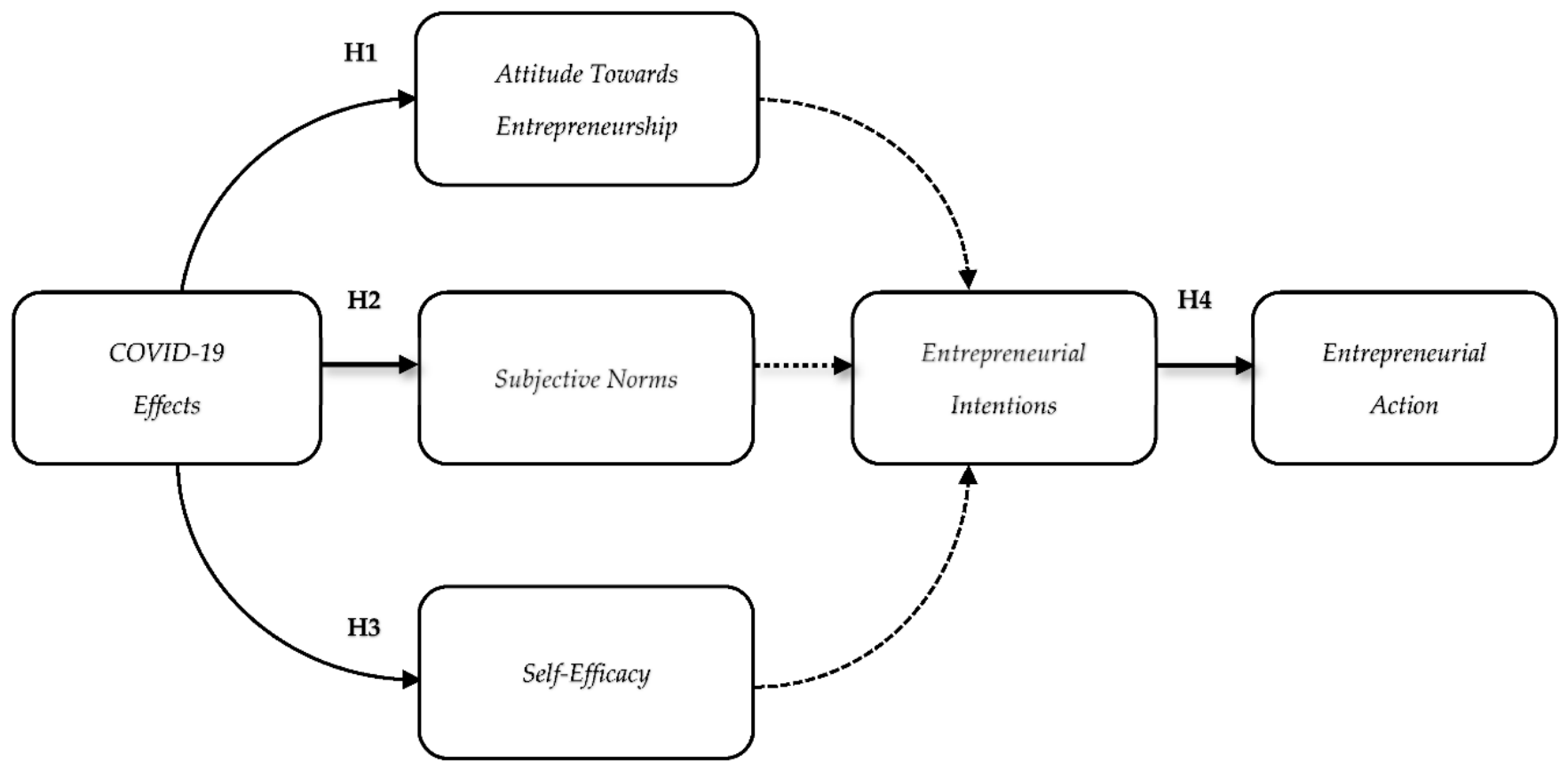
Figure 2.
COVID-19 Effects Data. Source: Researchers’ Findings.
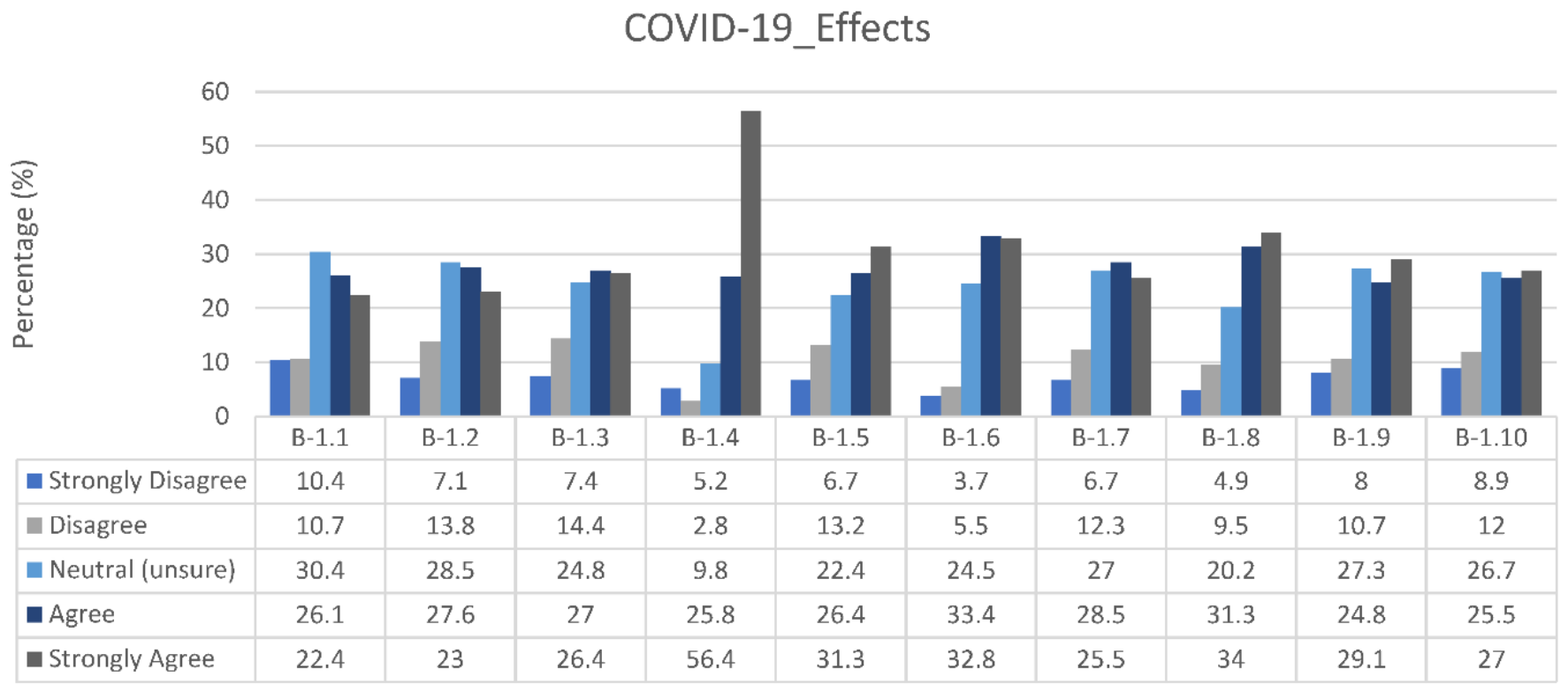
Figure 3.
Revised Conceptual Model.
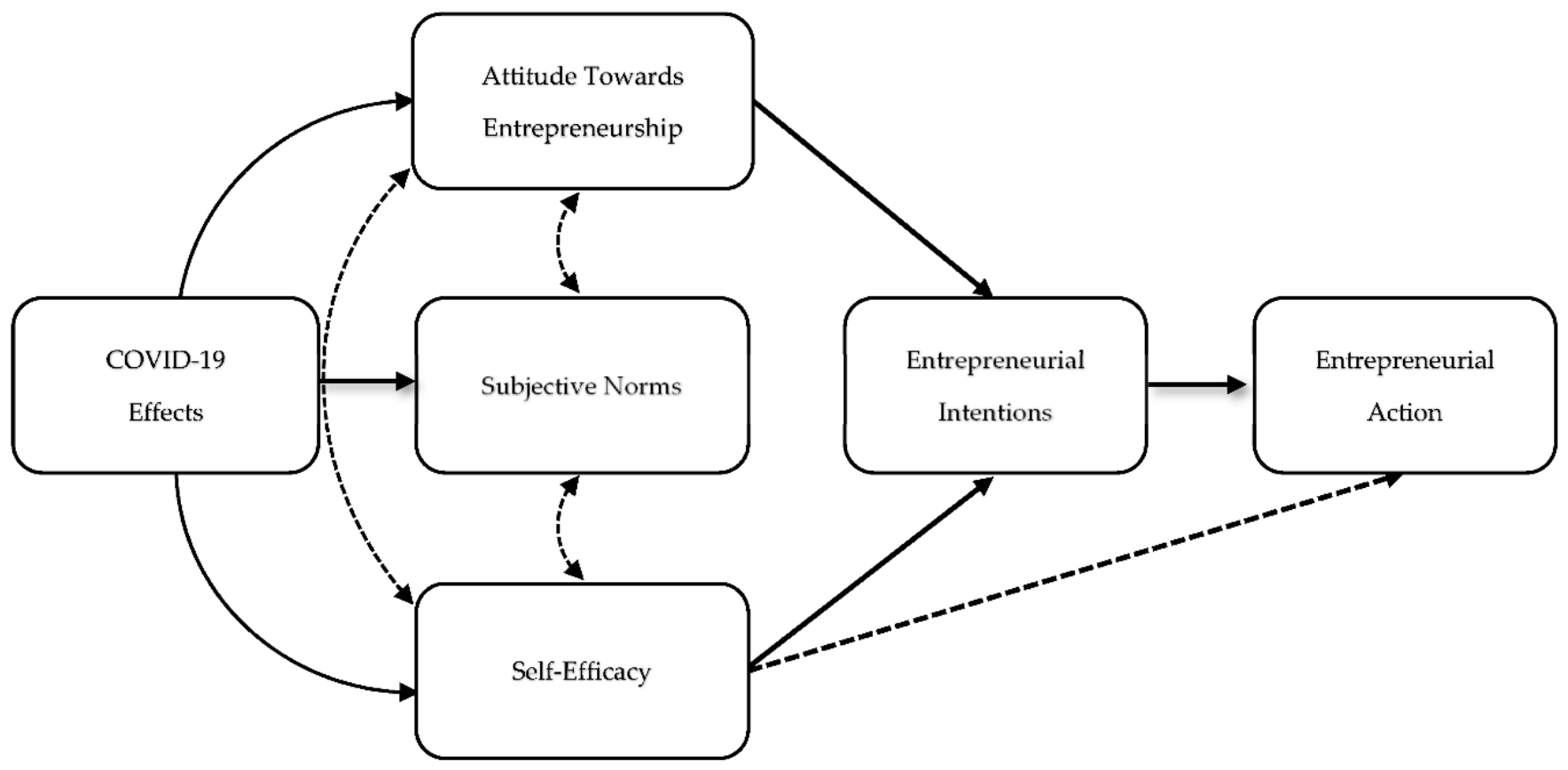

Table 1.
Layout of the Measuring Instrument Compiled for the Study.
| Name of Variable | Definition/Items Included | Number of items | Measurement Scale | Source |
|---|---|---|---|---|
| Demographics | This was an introductory section that enabled research participants to describe their basic demographic details, including their gender, age, level of education, employment status, and, most importantly, their exposure to any form of entrepreneurial education. | 5 | Nominal | (Ebewo, Rugimbana, et al., 2017; Nsahlai et al., 2020; Sundelson, 2021) |
| Effects of COVID-19 | In this section, several statements were presented to participants on a Likert scale from 1 to 5. Participants were expected to rate the statements provided based on their perceptions and experience of how COVID-19 affected entrepreneurship. | 10 | Likert | (Alessa et al., 2021; Ghofarany & Satrya, 2021; Sundelson, 2021) |
| Attitudes Towards Entrepreneurship | Statements here were based on participants’ attitude and how they influence themselves to develop intentions towards being entrepreneurial. | 6 | Likert | (Ebewo, Shambare, et al., 2017; Sundelson, 2021) |
| Subjective Norm | Statements in this section measured how the participants view what people around them think if they would become an entrepreneur and how important that is for them in being entrepreneurial. | 5 | Likert | (Ebewo, Shambare, et al., 2017; Sundelson, 2021) |
| Self-Efficacy | The statements below measured participants' Self-Efficacy in their ability to influence the transformation of Entrepreneurial Intentions into Entrepreneurial Actions. | 9 | Likert | (Duong et al., 2022) |
| Entrepreneurial Intentions | As the research focused primarily on Entrepreneurial Intentions, statements in this section measured participants' levels of Entrepreneurial Intentions. | 7 | Likert | (Ebewo, Shambare, et al., 2017; Ghofarany & Satrya, 2021; Oni & Mavuyangwa, 2019; Sundelson, 2021) |
| Entrepreneurial Actions | As the research focused primarily on Entrepreneurial Actions, statements in this section measured the level of Entrepreneurial Actions of the participants | 10 | Likert | (Botha & Pietersen, 2020; Dzomonda & Fatoki, 2019; Gielnik et al., 2015) |
Source: Researchers’ Findings.
Table 2.
Cronbach’s Alpha Questionnaire Reliability Test.
| Constructs | Number of Items | Cronbach’s Alpha Results |
|---|---|---|
| COVID-19_Effects | 10 items | 0.757 |
| Attitude_Towards_Entrepreneurship | 6 items | 0.875 |
| Subjective_Norms | 5 items | 0.730 |
| Self_Efficacy | 9 items | 0.923 |
| Entrepreneurial_Intentions | 7 items | 0.757 |
| Entrepreneurial_Actions | 10 items | 0.945 |
Source: Researchers’ Findings.
Table 3.
Demographic Profile of the Respondents.
| Variables | Description | Frequency | Percent |
| Gender | Male | 87 | 26.7% |
| Female | 238 | 73.0% | |
| Other | 1 | 0.3% | |
| Age | 18 to 21 years | 48 | 14.7% |
| 22 to 25 years | 136 | 41.7% | |
| 26 to 29 years | 88 | 27.0% | |
| 30 to 35 years | 54 | 16.6% | |
| Education | Pre-Grade 12 | 3 | 0.9% |
| Grade 12 | 90 | 27.6% | |
| Post-Grade 12 Certificate | 14 | 4.3% | |
| Diploma | 72 | 22.1% | |
| Bachelors Degree / Advanced Diploma | 88 | 27.0% | |
| Honours Degree / Postgraduate Diploma | 43 | 13.2% | |
| Masters Degree | 12 | 3.7% | |
| Doctoral Degree | 2 | 0.6% | |
| Other | 2 | 0.6% | |
| Employment Status | Full-time employed | 61 | 18.7% |
| Part-time employed | 75 | 23.0% | |
| Self-employed | 11 | 3.4% | |
| Unemployed | 35 | 10.7% | |
| Studying | 141 | 43.3% | |
| Other | 3 | 0.9% | |
| Entrepreneurial Education Exposure | Yes | 163 | 50.0% |
| No | 163 | 50.0% |
Source: Researchers’ Findings.
Table 4.
Structural Equation Model: Conceptual Model.
| Coef. | OIM Std. Err. | Z | P>|z| | |
|---|---|---|---|---|
| Structural ATEnter <- | ||||
| COVID-19_Effects _cons |
.3749122 10.83948 |
.0328362 1.218035 |
11.42 8.90 |
0.000 0.000 |
| SNorm <- | ||||
| COVID-19Effects _cons |
.1768773 11.87022 |
.0281351 1.043651 |
6.29 11.37 |
0.000 0.000 |
| SEfficacy <- | ||||
| COVID-19Effects _cons |
.4705472 15.58865 |
.051534 1.911616 |
9.13 8.15 |
0.000 0.000 |
| EIntent <- | ||||
| ATEnter SNorm SEfficacy _cons |
.3582728 .1057572 .3324494 3.369981 |
.0608918 .0685846 .0421518 1.230958 |
5.88 1.54 7.89 2.74 |
0.000 0.123 0.000 0.006 |
| EAct<- | ||||
| EIntent _cons |
1.156211 -2.059311 |
.0905503 2.313156 |
12.77 -0.89 |
0.000 0.373 |
| Fit statistic | Value | Description | ||
| Likelihood Ratio | ||||
| Chi2_ms(8) p > chi2 Chi2_bs(15) p > chi2 |
243.695 0.000 845.585 0.000 |
Model vs. saturated Baseline vs. saturated |
||
| Population Error | ||||
| RMSEA 90% CI, lower bound upper bound pclose |
0.301 0.269 0.334 -0.000 |
Root mean squared error of approximation Probability RMSEA <= 0.05 |
||
| Information Criteria | ||||
| AIC BIC |
11947.960 12012.337 |
Akaike’s information criterion Bayesian information criterion |
||
| Information Criteria | ||||
| CFI TLI |
0.716 0.468 |
Comparative fit index Trucker-Lewis index |
||
| Information Criteria | ||||
| SRMR CD |
0.117 0.437 |
Standardized root mean squared residual Coefficient of determination |
||
| LR test of model vs. saturated: chi2(8) = 243.69, Prob > chi2 = 0.0000 Source: Researchers’ own findings | ||||
Table 5.
Structural Equation Model: Revised Conceptual Model.
| Coef. | OIM Std. Err. | Z | P>|z| | |
|---|---|---|---|---|
| Structural ATEnter <- | ||||
| COVID-19_Effects _cons |
.3749122 10.83948 |
.0328362 1.218035 |
11.42 8.90 |
0.000 0.000 |
| SNorm <- | ||||
| COVID-19Effects _cons |
.1768773 11.87022 |
.0281351 1.043651 |
6.29 11.37 |
0.000 0.000 |
| SEfficacy <- | ||||
| COVID-19Effects _cons |
.4705472 15.58865 |
.051534 1.911616 |
9.13 8.15 |
0.000 0.000 |
| EIntent <- | ||||
| ATEnter SEfficacy _cons |
.378188 .3527976 4.153027 |
.059723 .0401788 1.125413 |
6.33 8.78 3.69 |
0.000 0.000 0.000 |
| EAct<- | ||||
| SEfficacy EIntent _cons |
.2973341 .8902264 -5.154669 |
.0943044 .1227744 2.481164 |
3.15 7.25 -2.08 |
0.002 0.000 0.038 |
| Fit statistic | Value | Description | ||
| Likelihood Ratio | ||||
| Chi2_ms(8) p > chi2 Chi2_bs(15) p > chi2 |
3.934 0.559 845.585 0.000 |
Model vs. saturated Baseline vs. saturated |
||
| Population Error | ||||
| RMSEA 90% CI, lower bound upper bound pclose |
0.000 0.000 0.068 0.857 |
Root mean squared error of approximation Probability RMSEA <= 0.05 |
||
| Information Criteria | ||||
| AIC BIC |
11714.99 11789.937 |
Akaike’s information criterion Bayesian information criterion |
||
| Information Criteria | ||||
| CFI TLI |
1.000 1.004 |
Comparative fit index Trucker-Lewis index |
||
| Information Criteria | ||||
| SRMR CD |
0.012 0.300 |
Standardized root mean squared residual Coefficient of determination |
||
| LR Test of model vs. saturated: chi2(5) = 3.93, Prob > chi2 = 0.5590 Source: Researchers’ own findings | ||||
Disclaimer/Publisher’s Note: The statements, opinions and data contained in all publications are solely those of the individual author(s) and contributor(s) and not of MDPI and/or the editor(s). MDPI and/or the editor(s) disclaim responsibility for any injury to people or property resulting from any ideas, methods, instructions or products referred to in the content. |
© 2026 by the authors. Licensee MDPI, Basel, Switzerland. This article is an open access article distributed under the terms and conditions of the Creative Commons Attribution (CC BY) license (http://creativecommons.org/licenses/by/4.0/).
Copyright: This open access article is published under a Creative Commons CC BY 4.0 license, which permit the free download, distribution, and reuse, provided that the author and preprint are cited in any reuse.


