

Submitted:
14 July 2026
Posted:
15 July 2026
You are already at the latest version
Abstract
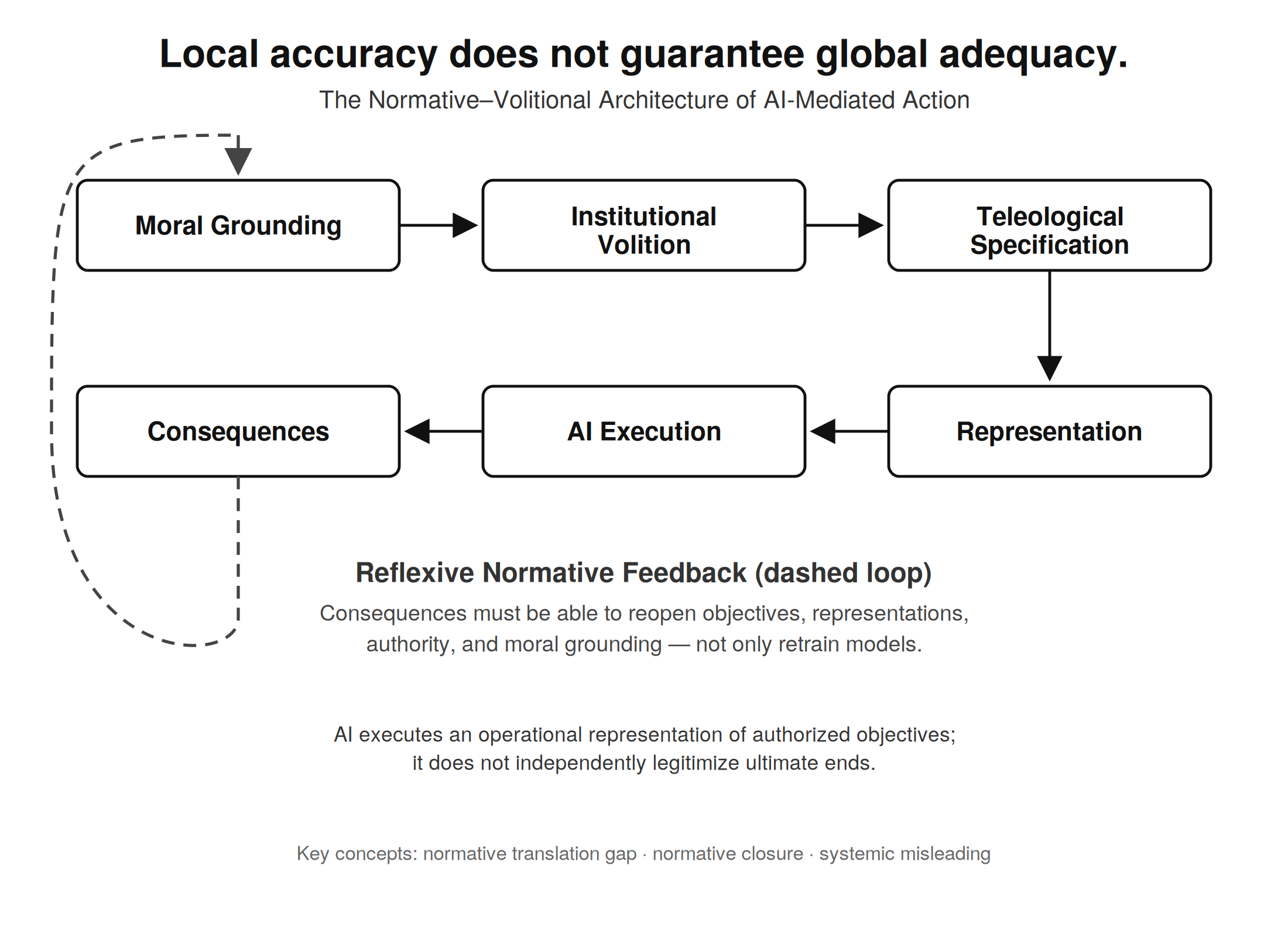
Evaluation of artificial intelligence concentrates on local performance — accuracy, calibration, robustness — while the upstream normative and volitional architecture that fixes what a system is for remains largely unexamined by those metrics. Existing scholarship has established that bias, proxy variables, problem formulation, measurement, alignment, and governance are value-laden; what remains insufficiently integrated is a single propagation account connecting moral grounding, authorized volition, teleological translation, representation, AI execution, and feedback. This article develops such an account: the Normative–Volitional Architecture of AI-Mediated Action, M → W → T → R → E → I_AI → D → A → C. Moral grounding (M) constrains what may legitimately be pursued; human or institutional volition (W) commits to a direction; teleological specification (T) translates that commitment into objectives and proxies; representation (R) determines which reality is available to the system; and AI performs inference and execution within that structure. The central argument is that AI executes an operational representation of authorized will; it does not independently legitimize ultimate ends. Systemic error therefore arises not only from malformed will but from the normative translation gap between defensible purposes and their operational encodings, and it persists under normative closure — the absence of an institutionalized feedback path through which consequences can reopen objectives, representations, and authority, rather than merely retraining models. Documented cases in healthcare allocation, risk assessment, hiring, engagement optimization, and welfare administration illustrate how locally correct outputs can constitute globally misleading trajectories, and a reflexive governance framework specifies remedies at each architectural layer.
Keywords:
AI ethics
; moral grounding
; objective functions
; systemic error
; sociotechnical systems
; normative feedback
Copyright: This open access article is published under a Creative Commons CC BY 4.0 license, which permit the free download, distribution, and reuse, provided that the author and preprint are cited in any reuse.


