
Submitted:
13 July 2026
Posted:
15 July 2026
You are already at the latest version
Abstract
Salinity is a major abiotic constraint that limits maize productivity by disrupting plant growth, photosynthesis, nutrient homeostasis, antioxidant defense, and rhizosphere functioning. This study evaluated the individual and combined effects of N-acyl homoserine lactone (AHL), cellulose-wicked biochar (CWB), silicon-enriched biochar (SEB), and cellulose-wicked silicon-enriched biochar (CWSEB) on maize grown under naturally non-saline (2.56 dS m−1) and saline (5.21 dS m−1) field conditions. Two salinity environments and eight treatments (control, AHL, CWB, CWB + AHL, SEB, SEB + AHL, CWSEB, and CWSEB + AHL) were evaluated with four replicates. Salinity markedly impaired maize growth, photosynthesis, and productivity, whereas the combined application of CWSEB + AHL produced the strongest mitigation response. Under saline conditions, CWSEB + AHL increased plant height by 14.57%, root length by 82.89%, photosynthetic rate by 33.14%, and grain yield by 31.03%, and biological yield by 85.67% relative to the saline control. The combined treatment also enhanced rhizosphere AHL concentration, exopolysaccharide production, and ACC deaminase activity by 33.33%, 30.56%, and 29.56%, respectively, while substantially increasing total soluble proteins and free amino acids. These coordinated responses indicate that CWSEB + AHL alleviated salinity stress by simultaneously improving plant physiological performance and rhizosphere functional activity. In conclusion, integrating CWSEB and AHL proved to be the most effective strategy for alleviating salinity stress in maize under non-saline and naturally saline soil conditions. Future studies should validate the long-term performance of CWSEB + AHL across diverse agroecological conditions and elucidate the underlying molecular and rhizosphere microbial mechanisms responsible for salinity tolerance.
Keywords:
quorum sensing
; salinity tolerance
; N-acyl homoserine lactone
; silicon-enriched biochar
; plant–microbe interactions
; soil enzymes
; rhizosphere functionality
; ACC deaminase
; Zea mays
1. Introduction
Soil salinity is one of the most serious environmental constraints limiting agricultural productivity worldwide. More than 20% of irrigated agricultural land is affected by salinity, and its prevalence is expected to increase due to climate change, inappropriate irrigation practices, seawater intrusion, and soil degradation [1,2]. Salinity adversely affects plant growth through osmotic stress, ionic toxicity, nutrient imbalance, and excessive production of reactive oxygen species (ROS), resulting in impaired physiological and biochemical processes and ultimately reducing crop productivity [3]. Developing sustainable strategies to improve crop performance under saline conditions has therefore become a major priority for global food security and climate-resilient agriculture.
Maize (Zea mays L.) is among the most important cereal crops globally, serving as a vital source of food, feed, and industrial raw materials. However, maize is moderately sensitive to salinity, particularly during early growth stages [4,5]. Excessive accumulation of Na+ and Cl− ions disrupts water uptake, nutrient acquisition, photosynthesis, and metabolic activities, leading to substantial reductions in growth and yield [6]. Traditional salinity management approaches, including leaching, chemical amendments, and breeding for salt tolerance, are often constrained by high costs, limited effectiveness, and long implementation periods [7]. Consequently, environmentally friendly and biologically based technologies are increasingly being explored to enhance crop resilience under saline conditions [8,9].
Biochar has emerged as a promising soil amendment for improving soil quality and crop performance under abiotic stress conditions. Its porous structure, high surface area, and abundant functional groups enhance water retention, nutrient availability, and microbial activity in the rhizosphere [10,11]. Recently, silicon-enriched biochar has gained considerable attention because silicon improves salinity tolerance by reducing Na+ uptake, enhancing K+ acquisition, maintaining membrane stability, and strengthening antioxidant defense systems [12,13]. Furthermore, the incorporation of cellulose as a wick within biochar matrices may improve moisture distribution and nutrient transport in the root zone, thereby enhancing the effectiveness of biochar under saline conditions.
In addition to soil amendments, microbial signaling molecules have recently emerged as potential tools for improving plant stress tolerance. N-acyl homoserine lactones (AHLs), the primary quorum-sensing molecules produced by Gram-negative bacteria, regulate microbial communication and influence plant–microbe interactions [14,15]. Increasing evidence indicates that plants can perceive AHL signals, resulting in enhanced root development, nutrient acquisition, antioxidant activity, osmolyte accumulation, and stress-responsive gene expression [16]. These responses collectively contribute to improved tolerance against environmental stresses, including salinity.
Although cellulose-wicked silicon-enriched biochar (CWSEB) and AHLs have individually demonstrated significant potential for alleviating salinity stress, their combined effects remain largely unexplored. Moreover, little information is available regarding the interaction between AHL-mediated signaling and cellulose-wicked silicon-enriched biochar in regulating soil–plant–microbe processes under saline conditions. The integration of these approaches may provide synergistic benefits by simultaneously improving rhizosphere conditions, microbial activity, ionic homeostasis, and plant defense mechanisms.
New developments reveals that enable the integration of biochar with microbial quorum-sensing signals demonstrate the potential of next-generation rhizosphere management strategies that can alter the soil microenvironment and regulate plant-microbe interactions simultaneously. These strategies will contribute to plant adaptation. Unlike conventional biochar, which improves many of the soil’s physical and chemical properties, regenerated biochar acts as a reactive matrix that influences microbial community and composition, biofilm formation and the persistence of signalling molecules within the rhizosphere [17,18]. The porous architecture and high surface area of engineered biochars can modify microbial habitats and influence the persistence and diffusion of signaling molecules within the rhizosphere, potentially affecting quorum-sensing processes, although these interactions remain poorly understood. N-acyl homoserine lactones (AHLs), the primary quorum-sensing molecules in many Gram-negative bacteria, regulate microbial cooperation, exopolysaccharide production, ACC deaminase activity and root-associated biofilm development. These processes contribute to enhanced plant performance in response to abiotic stress [16,19]. Overall, combining AHL-mediated signalling with silicon-enriched cellulose wick biochar creates complementary mechanisms that enhance rhizosphere functionality, maintain ionic homeostasis, stimulate beneficial microbial processes and increase physiological resistance under saline conditions. However, despite this promising conceptual framework, there is a lack of experimental studies demonstrating the synergistic interaction between engineered biochar and quorum-sensing molecules under field salinity.
This study investigated whether integrating microbial quorum-sensing signals with an engineered, silicon-enriched biochar platform could regulate rhizosphere processes and plant physiological responses simultaneously under naturally saline field conditions. It was hypothesized that combining these two biologically complementary approaches would generate improvements in rhizosphere functionality, ionic homeostasis, photosynthetic efficiency, and grain productivity that would exceed the improvements achieved by either treatment alone.
2. Results
Under non-saline conditions, the combined application of cellulose-wicked silicon-enriched biochar and N-acyl homoserine lactone (CWSEB + AHL) significantly increased the number of grains cob−1 (32.66%), 1000-grain weight (24.98%), grain yield (91.85%), and biological yield (39.28%) relative to the untreated control. Similarly increases of 24.99%, 20.89%, 82.01%, and 36.10% were recorded with SEB + AHL, whereas CWB + AHL increased these attributes by 21.14%, 13.61%, 67.24%, and 26.70%, as compared to their control.
Under salinity stress, CWSEB + AHL resulted in significant increases in the number of grains cob−1 (38.47%), 1000-grain weight (27.96%), grain yield (31.03%), and biological yield (85.67%) relative to the stressed control. Increases of 33.31%, 23.26%, 26.47%, and 80.76% were obtained with SEB + AHL, while CWB + AHL improved the corresponding attributes by 28.58%, 18.99%, 21.75%, and 68.79%, as compared to their control (Table 1).
Under non-saline conditions, the combined application of cellulose-wicked silicon-enriched biochar and N-acyl homoserine lactone (CWSEB + AHL) significantly increased AHL Concentration in Rhizosphere (29.06%), Exopolysaccharide Production (29.68%), and ACC Deaminase Activity (29.35%), and Cob length (26.89%) relative to the untreated control. Similar increases of 23.77%, 18.20%, 16.70%, and 13.94% were recorded with SEB + AHL, whereas CWB + AHL increased these attributes by 26.42%, 21.70%, 19.19%, and 16.63%, respective to their controls.
Under salinity stress, CWSEB + AHL resulted in significant increases in AHL Concentration in Rhizosphere (33.33%), Exopolysaccharide Production (30.56%), and ACC Deaminase Activity (29.56%), and Cob length (26.92%) relative to the stressed control. Increases of 28.72%, 20.67%, 20.36%, and 19.23% were obtained with SEB + AHL, while CWB + AHL improved the corresponding attributes by 30.77%, 24.44%, 23.38%, and 22.12%, as compared to respective controls (Table 1).
The combined application of cellulose-wicked silicon-enriched biochar and N-acyl homoserine lactone (CWSEB + AHL) significantly increased plant height, shoot length, and root length by 28.65%, 7.84%, and 41.26%, respectively, compared with the untreated control under non-saline conditions. Significant increases of 24.00%, 5.81%, and 19.22%, were also recorded with SEB + AHL, whereas CWB + AHL increased these traits by 20.65%, 4.78%, and 16.80%, compared with the non-saline control.
Under salinity stress, CWSEB + AHL significantly increased plant height, shoot length, and root length by 14.57%, 15.43%, and 82.89%, respectively, relative to the saline control. Corresponding increases of 12.59%, 13.29%, and 64.74%, respectively, were observed with SEB + AHL, while CWB + AHL increased these parameters by 11.28%, 12.18%, and 68.95%, compared with the treated control (Figure 1A–C).
Under non-saline conditions, cellulose-wicked silicon-enriched biochar combined with CWSEB + AHL significantly increased shoot fresh weight, root dry weight, and shoot dry weight by 27.63%, 37.18%, and 29.38%,respectively, relative to the untreated control. Similar increases of 25.59%, 28.43%, and 25.88%, respectively, were also observed with SEB + AHL, whereas CWB + AHL enhanced these parameters by 21.05%, 23.29%, and 23.43%, relative to untreated control controls.
Under saline conditions, CWSEB + AHL significantly increased shoot fresh weight, root dry weight, and shoot dry weight by 10.73%, 62.03%, and 47.22%, respectively, relative to the saline control. Corresponding increases of 8.87%, 56.63%, and 39.16%, respectively, were recorded with SEB + AHL, while CWB + AHL increased these parameters by 7.82%, 44.14%, and 31.47%, as compared with the saline control (Figure 2A–C).
Application of cellulose-wicked silicon-enriched biochar and N-acyl homoserine lactone (CWSEB + AHL) under non-saline conditions significantly increased chlorophyll a, chlorophyll b, total chlorophyll, and carotenoid contents by 24.86%, 24.34%, 24.71%, and 26.72%, respectively, compared with the untreated control. Similar improvements were also observed with SEB + AHL (12.29%, 12.50%, 12.35%, and 9.48%, respectively), followed by CWB + AHL (16.48%, 16.45%, 16.47%, and 13.79%, relative to the non-saline control.
Under salinity stress, the highest increase in chlorophyll a (27.90%), chlorophyll b (29.82%), total chlorophyll (28.46%), and carotenoid contents (28.73%) was observed with CWSEB + AHL compared with the stressed control. This was followed by SEB + AHL, which improved these pigments by 20.29%, 21.05%, 20.26%, and 20.69%, respectively, whereas CWB + AHL increased them by 22.10%, 23.68%, 22.56%, and 22.99%, respectively relative to the saline control (Figure 3A–D).
Application of cellulose-wicked silicon-enriched biochar and N-acyl homoserine lactone (CWSEB + AHL) under non-saline conditions significantly enhanced the photosynthetic rate, transpiration rate, stomatal conductance, and water use efficiency (WUE) by 32.73%, 50.49%, 54.12%, and 12.27%, respectively, compared with the untreated control. Similar positive responses were recorded with SEB + AHL (17.21%, 22.47%, 22.36%, and 10.78%, respectively) and CWB + AHL (20.47%, 25.84%, 32.94%, and 9.77%, compared with the untreated control.
Under salinity stress, the highest increases in photosynthetic rate (33.14%), transpiration rate (136.89%), stomatal conductance (165.51%), and WUE (45.49%) were observed with CWSEB + AHL relative to the stressed control. SEB + AHL enhanced these parameters by 17.52%, 96.25%, 103.44%, and 36.53%, respectively, while CWB + AHL increased them by 20.57%, 113.30%, 144.82%, and 27.28% respectively, compared with the stressed control (Figure 4A–D).
Under non-saline conditions, the integration of cellulose-wicked silicon-enriched biochar and N-acyl homoserine lactone (CWSEB + AHL) significantly increased total soluble protein, free amino acids, and root colonization by 33.28%, 42.96%, and 29.36%, respectively, relative to the untreated control. Similar improvements were recorded with CWB + AHL, which increased these parameters by 17.67%, 20.97%, and 23.35%, respectively, followed by SEB + AHL, and with corresponding increases of 14.72%, 17.17%, and 25.67% compared with the non-saline control.
Under salinity stress, the integration of CWSEB + AHL produced the greatest increases in total soluble protein (83.58%), free amino acids (84.81%), and root colonization (20.65%) relative to the stressed control. Corresponding increases of 62.75%, 68.86%, and 16.31% were recorded with CWB + AHL, whereas SEB + AHL enhanced these attributes by 52.84%, 59.16%, and 18.49%, respectively compared with the saline control (Figure 5A–C).
Under non-saline conditions, CWSEB + AHL significantly reduced total phenolic content and glutathione reductase (GR) activity by 30.81% and 20.26%, respectively, relative to the untreated control. Similar decline was observed with SEB + AHL, which reduced these parameters by 27.82% and 15.98%, respectively, followed by CWB + AHL, and with the similar reductions of 21.73% and 13.01% compared with non-saline and saline control. Under salinity stress, the greatest reductions in total phenolic content (26.18%) and GR activity (26.83%) were recorded with CWSEB + AHL relative to the stressed control. CWB + AHL reduced these parameters by 22.21% and 20.48%, respectively, whereas SEB + AHL resulted in reductions of 23.87% and 22.94%, respectively compared with saline control (Figure 6A,B).
Under non-saline conditions, the combined amendment CWSEB + AHL significantly reduced superoxide dismutase (SOD), peroxidase (POD), catalase (CAT), and ascorbate peroxidase (APX) activities by 21.31%, 26.98%, 21.80%, and 42.46%, respectively, relative to the untreated control. Reductions of 19.48%, 22.09%, 16.91%, and 36.49% were also achieved with SEB + AHL, while CWB + AHL decreased the corresponding enzymatic activities by 17.87%, 18.05%, 14.31%, and 30.84%, respectively relative to the untreated control. Individual applications of AHL, CWSEB, SEB, and CWB also reduced antioxidant enzyme activities, compared with the untreated control however, their effects were less pronounced than those of the combined treatments.
Under salinity stress, CWSEB + AHL resulted in significant reductions in SOD (22.26%), POD (29.04%), CAT (27.18%), and APX (14.11%) activities relative to the stressed control. Similarly reductions of 18.78%, 25.23%, 23.98%, and 11.35% were observed with SEB + AHL, while CWB + AHL decreased these enzymatic activities by 15.14%, 18.44%, 20.47%, and 10.18%, respectively relative to the stressed control. Individual application of AHL, CWSEB, SEB, and CWB also reduced antioxidant enzyme activities under saline conditions, with comparatively smaller responses than those obtained with the combined treatments (Figure 7A–D).
3. Discussion
3.1. Regulation of Plant Growth, Biomass Accumulation, and Yield Formation Under Salinity Stress
This improved growth and biomass production, after combined treatment with cellulose-wicked silicon-enriched biochar (CWSEB) and N-acyl homoserine lactone (AHL), is likely due to complementary regulation of soil properties, nutrient uptake, and plant physiological processes. The benefit of biochar to soil moisture holding capacity and nutrient availability allows the ongoing uptake of CO2 for photosynthesis and carbon assimilation, leading to a continuous supply of photo assimilates for grain formation and grain filling [36,37]. It enhances the soil structure, water holding capacity, cation exchange capacity, and nutrient retention, leading to increased root development and better water and mineral nutrient uptake under saline conditions [38,39]. Silicon also plays a role in reproductive success by maintaining chloroplast integrity, improving nutrient-use efficiency, regulating ionic homeostasis, and minimizing reproductive impairment under salinity stress, thus improving sink strength and grain [40,41] In addition to protecting plants against salinity damage, silicon also acts as a membrane stabilizer, limiting Na+ accumulation, maintaining K+ homeostasis, and ensuring metabolic activity, which allows for continuous plant growth under stress conditions [42,43]. Furthermore, AHL regulate nutrient mobilization, root activity and phytohormone production that contribute to a more efficient assimilate translocation from source tissues to developing grains, which is enhanced by AHL [16,44]. Together, these mechanisms have a complementary effect that facilitates coordinated control of the soil-plant-microbe continuum to drive plant growth and biomass production, as observed in previous studies where silicon-enriched biochar and microbial signaling were shown to have synergistic effects on stress tolerance in maize and other cereal crops [41,45,46].
3.2. Regulation of Photosynthetic Performance Under Salinity Stress
The increase of photosynthetic pigments and gas exchange has been observed after the application of combined cellulose-wicked silicon-enriched biochar (CWSEB) and N -acyl homoserine lactone (AHL), indicating an improvement in the photosynthetic efficiency and physiological adaptation under saline environment. Biochar increases soil moisture availability and nutrient levels, especially nitrogen and magnesium, which are crucial for the biosynthesis of chlorophyll and the functionality of photosynthetic machinery [10,36]. Further, silicon protects chloroplasts ultrastructure, regulates stomatal opening and closure, improves CO2 fixation and prevents salt stress-induced damage to the photosynthetic apparatus, preserving membrane stability and ionic toxicity [47,48]. Concurrently, AHL-mediated quorum sensing helps to enhance beneficial rhizosphere microorganisms, which enhances nutrient uptake, activate production of phytohormones, and maintain photosynthetic metabolism under stress conditions [16,44]. Thus, the combined effect of the soil amendments, silicon nutrition and plant–microbe interactions, as a coordinated action, will enhance carbon fixation, water-use efficiency and overall photosynthetic performance, which is consistent with previous findings reporting that the coordinated regulation of these three factors can maintain maize and other cereal crops’ photosynthetic capacity and stress tolerance under salinity conditions [39,49].
3.3. Biochemical Responses
The enhanced accumulation of total soluble proteins and free amino acids following the combined application of cellulose-wicked silicon-enriched biochar (CWSEB) and N-acyl homoserine lactone (AHL) indicates improved metabolic adjustment under salinity stress. Biochar enhances soil nutrient availability, particularly nitrogen, while improving water retention and root-zone conditions, thereby supporting protein biosynthesis and amino acid metabolism [10,50]. Simultaneously, AHL-mediated quorum sensing stimulates plant growth-promoting microbial activities, including biological nitrogen fixation, nutrient mobilization, phytohormone production, and ACC deaminase activity, which collectively sustain nitrogen assimilation and cellular metabolism under stress conditions [14,51]. Silicon further promotes nitrogen assimilation, stabilizes cellular membranes and metabolic enzymes, and protects protein synthesis from salinity-induced disruption by maintaining ionic and osmotic homeostasis [52,53]. Collectively, these complementary mechanisms maintain biochemical homeostasis and improve metabolic resilience under salinity stress, consistent with previous reports describing the synergistic effects of biochar, silicon, and beneficial microbial interactions on plant biochemical performance [13,50].
3.4. Modulation of Oxidative Stress-Antioxidant Defense System
The findings of the combined treatment of cellulose-wicked silicon-enriched biochar (CWSEB) with N -acyl homoserine lactone (AHL) show the enhancement of stress-related metabolites and antioxidant defense, suggesting better regulation of cellular redox homeostasis under salinity stress. Salinity causes excessive production of reactive oxygen species (ROS) such as superoxide radicals and hydrogen peroxide that leads to lipid peroxidation, membrane disruption, protein oxidation, and metabolic dysfunction unless they are efficiently detoxified [54,55]. The simultaneous use of biochar, silicon and AHL may have reduced the production of ROS at its origin by further optimizing ionic homeostasis, nutrient uptake and water relations, in addition to the increased antioxidant activity [56].
Under saline conditions, biochar enhances soil physicochemical properties and nutrient availability, which helps reduce oxidative stress, while silicon helps maintain the stability of the soil membranes and a healthy ultrastructure of the chloroplasts and contributes to the regulation of Na+/K+ homeostasis [57,58] At the same time, AHL-mediated quorum sensing promotes beneficial microbial activity in the rhizosphere, thereby enhancing the uptake of nutrients, reducing stress-related metabolism and boosting plants’ intrinsic antioxidant capacity [16,58]. Thus, the decreases in the activities of SOD, POD, CAT, APX, and GR as well as in the accumulation of phenolics probably reflect not reduced antioxidant defense system activity, but a reduced oxidative pressure and a return to the cellular redox balance. Under integrated soil amendments and plant growth-promoting microbial interactions that counteract salinity-induced oxidative stress, significant reductions in antioxidant enzyme activities were observed, which led to enhanced physiological stability and stress tolerance [59,60].
3.5. Rhizosphere Signaling and Microbial Functionality in Salinity Tolerance
Incorporation of cellulose-wicked silicon-containing biochar (CWSEB) and N-acyl homoserine lactone (AHL) increased rhizosphere functional performance through quorum sensing by AHL, root colonization, EPS synthesis, and ACC deaminase activity. Biochar offers a porous environment that helps preserve signaling compounds and aids in the settlement of beneficial microbes, enhancing microbial signaling and colonization [61,62]. Increased EPS production results in soil aggregation, moisture conservation, and root protection, while ACC deaminase decreases stress-induced ethylene formation, encouraging root growth and nutrient uptake in response to salt stress [63,64]. Efficient control of all these rhizosphere functions is vital for facilitating plant-microbe interactions and resource acquisition, eventually resulting in cob formation under salinity, as confirmed previously [65].
4. Materials and Methods
Before the application of treatments and irrigation, composite soil samples (0–20 cm depth) were collected from the experimental field to determine the initial physicochemical properties following standard analytical procedures. A summary of the soil properties analyzed is shown in Table 1 A and B.
4.1. Experimental Design and Treatment Plan
The experimental design was randomized complete block design (RCBD) to study individual and combined effect of AHL, cellulose-wicked biochar (CWB), silicon-enriched biochar (SEB), and cellulose-wicked silicon-enriched biochar (CWSEB) on maize under saline and non-saline conditions. Two levels of salinity were made such as 2.56 dS m-1 (non-saline soil) and 5.21 dS m-1 (saline soil). The salinity levels were replicated 8 times each with (no control), AHL, CWSEB, CWSEB + AHL, CWB, CWB + AHL, SEB, and SEB + AHL, for a total of 16 treatment combinations. Within each block, treatments were randomly allocated to minimize experimental error and make a fair comparison between treatments.
4.2. Plot Dimensions, Seeds Rate and Sowing
The field experiment was conducted using 4 m × 4 m (16 m2) plots. Certified seeds of the maize (Zea mays L.) hybrid Pioneer P1543 were sown at a seed rate of 25 kg ha−1, maintaining a row-to-row spacing of 75 cm and a plant-to-plant spacing of 20 cm. Three seeds were manually sown per hill and later thinned to one healthy plant per hill at the two-leaf stage to achieve a uniform plant population of approximately 66,700 plants ha−1.
4.3. Fertilization
The recommended fertilizer rates of 250 kg N, 125 kg P2O5, and 125 kg K2O ha−1 were applied uniformly to all experimental plots. Based on the 4 m × 4 m (16 m2) plot size, this corresponded to 400 g N, 200 g P2O5, and 200 g K2O per plot. The entire doses of phosphorus and potassium, along with one-third of the nitrogen (133.3 g N plot−1), were incorporated into the soil during final land preparation before sowing. The remaining two-thirds of the nitrogen (266.7 g N plot−1) was applied as two equal split doses (133.3 g N plot−1 each) at the V6 vegetative stage and tasseling stage, followed by irrigation.
4.4. Irrigation Management
A total of 18 inches of irrigation water per acre was applied during the crop cycle in six irrigations, with 3 inches of water per acre applied at each irrigation. Irrigations were scheduled at sowing (for germination), four-leaf (V4), six-leaf (V6), tasseling (VT), silking (R1), and grain-filling (R3) stages, which represent the critical growth stages of maize. The irrigation schedule and quantity were kept identical for all treatments to ensure that differences in plant growth, physiological responses, rhizosphere characteristics, and yield were attributable solely to the natural soil salinity levels and amendment treatments rather than differences in water availability.
4.5. Cellulose-Wicked Biochar (CWB)
Cellulose-wicked biochar (CWB) was produced from dried cotton stalks through slow pyrolysis under oxygen-limited conditions at 500 °C for 2 h. After cooling to room temperature, the biochar was ground and passed through a 2-mm sieve to obtain a uniform particle size. The prepared biochar was stored in airtight polyethylene bags until field application.
4.6. Silicon-Enriched Biochar (SEB)
Silicon-enriched biochar (SEB) was prepared by enriching the cotton stalks biochar with 5% (w/v) sodium silicate (Na2SiO3•9H2O) solution prior to pyrolysis. The silicon-treated feedstock was then pyrolyzed under the same conditions as CWB (500 °C for 2 h), ground, sieved (<2 mm), and stored in sealed containers until use.
4.7. Application of CWB and SEB
The biochar amendments were incorporated into the top 0–20 cm soil layer during final land preparation before sowing at an application rate of 0.5% (w/w equivalent) according to the treatment plan. In the combined treatments, biochar was applied together with N-acyl homoserine lactone (AHL). Once incorporated, the soil was thoroughly mixed to ensure uniform distribution of the amendments before seed sowing.
4.8. N-Acyl Homoserine Lactone (AHL)
N-acyl homoserine lactone (AHL; N-octanoyl-L-homoserine lactone, C8-HSL) was used as a bacterial quorum-sensing signaling molecule. A 10 μM AHL solution was prepared using sterile distilled water. Maize seeds were surface sterilized with 1% sodium hypochlorite for 2 min, rinsed thoroughly with sterile distilled water, and primed in the AHL solution for 12 h before sowing. In addition, a soil drench of 10 μM AHL was applied around the root zone at 7, 20, and 35 days after sowing (DAS) according to the designated treatments. Control treatments received an equal volume of sterile distilled water.
4.9. Harvesting and Data Collection
For the determination of physiological, biochemical and antioxidant attributes, leaf samples were taken at the vegetative stage. All the collected samples were frozen in liquid nitrogen and kept at −80 °C for further analysis. At physiological maturity (120 DAS), maize plants were manually harvested from the central rows of each experimental plot to avoid border effects. Growth, biomass, yield and rhizosphere-related parameters were measured in the harvested plants using the respective analytical procedures.
4.10. Growth and Yield Measurements
Five plants were randomly selected from the center rows of each experimental plot at physiological maturity to measure growth and yield attributes of the plants. The height of the plants and length of the shoots was measured from the soil surface to the tip of the tassel with the help of a measuring tape, whereas root length was measured after the careful excavation of the plants and washing the roots with distilled water in order to wash off the adhering soil particles. The fresh shoot biomass was measured right after harvesting with a digital balance. Root and shoot samples were then oven dried at 65 ± 5 °C until dry, to assess root dry weight and shoot dry weight. Cob length was measured at harvest using a digital Vernier caliper. After threshing each cob, it was manually counted the number of grains per cob. One thousand grains were randomly sampled from each of the treatments and weighed on an analytical balance to calculate the 1000-grain weight. The grain yield and biological yield were observed per plant and expressed in grams per plant.
4.11. Photosynthetic Pigments and Gas Exchange Measurements
Chlorophyll pigments were estimated at the vegetative stage of plants using fully expanded upper leaves. The contents of chlorophyll a, chlorophyll b, total chlorophyll and carotenoids were determined after extraction in 80% (v/v) acetone and absorbance was measured by UV–Visible spectrophotometer at 663, 645 and 470 nm [29]. Net photosynthetic rate (Pn), transpiration rate (E) and stomatal conductance (gs) were determined in fully expanded leaves under ambient environmental conditions with a portable photosynthesis system (LI-6400XT, LI-COR Biosciences, Lincoln, NE, USA, or equivalent). To determine water use efficiency (WUE), the ratio of net photosynthetic rate to transpiration rate (Pn/E) was calculated.
4.12. Biochemical Analyses
4.13. Antioxidant Enzyme Analyses
The activity of superoxide dismutase (SOD) was measured by nitro blue tetrazolium (NBT) and the method [32]. Peroxidase (POD) activity was determined by following the oxidation of guaiacol by hydrogen peroxide as described by Chance and Maehly [33]. Catalase (CAT) activity was measured by observing the decomposition rate of hydrogen peroxide as described by Chance and Maehly [33]. The ascorbate peroxidase (APx) activity was measured by the oxidation of ascorbic acid at 290 nm according to the method of Nakano and Asada [34]. Glutathione reductase (GR) activity was estimated by following the oxidation of NADPH at 340 nm according to Foyer and Halliwell [35].
4.14. Rhizosphere
At harvest, a sample of soil was taken from the root zone (rhizosphere soil) of maize plants by carefully lifting the loosely attached soil from around the roots, and another sample of soil was carefully removed from the root surface that was very tightly attached. It was immediately picked up in the lab and kept cool. Standard microbiological and biochemical methods were used to determine the root colonization (%), concentration of AHL in the rhizosphere, exopolysaccharide (EPS) production and ACC deaminase activity. Soil samples were kept at 4 °C until analyses were carried out within 48 h to avoid loss of microbial activity and ensure accurate analytical results.
4.15. Statistical Analysis
Normality of experimental data, and homogeneity of variance, was assessed by the Shapiro–Wilk test and Levene’s test, respectively. The data were confirmed for normality and homogeneity of variance and analyzed using two-way analysis of variance (ANOVA) to compare the main effects of soil salinity, amendment treatments and soil salinity x amendment interactions. Treatment means were compared using Tukey’s honestly significant difference (HSD) test at P ≤ 0.05. OriginPro 2026 was used for all statistical analyses.
5. Conclusions
This study showed that using N-acyl homoserine lactone (AHL) and cellulose-wicked silicon-enriched biochar (CWSEB) together effectively reduced the harmful effects of salinity on maize. This was achieved by improving plant growth, photosynthetic performance, biomass accumulation, yield attributes, and rhizosphere functionality. Of all the treatments, CWSEB + AHL performed best consistently under both non-saline and saline conditions, highlighting the interaction between AHL-mediated quorum sensing and the improvement of the rhizosphere by biochar. Enhanced salinity tolerance was associated with improved nutrient acquisition, antioxidant defense, root colonization, exopolysaccharide production, ACC deaminase activity, and rhizosphere AHL concentration. The integrated application also promoted favorable soil–plant–microbe interactions, thereby improving physiological resilience and maintaining crop productivity under saline conditions. These findings emphasize the potential of combining quorum-sensing molecules with engineered biochar as an innovative, sustainable approach to managing salinity stress in maize cultivation. Overall, the combined use of AHL and CWSEB is a promising and sustainable strategy for enhancing maize productivity. It may contribute to the development of next-generation rhizosphere engineering strategies for climate-resilient agriculture, providing a conceptual framework for combining engineered soil amendments with microbial signaling molecules to enhance crop resilience in increasingly saline environments. However, multi-location field trials and molecular investigations are needed to confirm the long-term stability of the observed responses.
Ethics Approval and Consent to Participate
We all declare that the manuscript reporting studies do not involve any human participants, human data, or human tissue. So, it is not applicable.
Permission to Collect Sample
No permission is required for the collection of soil samples and plant material (seeds).
Consent for Publication
Not Applicable.
AI-Assisted Language Editing Statement
The authors used artificial intelligence (AI) tools, including ChatGPT, solely for English-language improvement, grammar correction, and manuscript readability enhancement. All scientific content, data analysis, interpretations, and conclusions were developed and verified by the authors, who take full responsibility for the accuracy and integrity of the work.
Author Contributions
Conceptualization, Y.L.; methodology, Y.L.; software, Y.L.; validation, Y.L.; formal analysis, S.H.; investigation, S.H.; resources, S.H.; data curation, S.H.; writing—original draft preparation, S.H.; R.K.I.; writing—review and editing, R.K.I., E.B; visualization, R.K.I., E.B.; supervision, Y.L.; project administration, Y.L.; funding acquisition, Y.L. All authors have read and agreed to the published version of the manuscript.
Funding
This work was funded by Princess Nourah bint Abdulrahman University Researchers Supporting Project number (PNURSP2026R241), Princess Nourah bint Abdulrahman University, Riyadh, Saudi Arabia. This research was funded by the National Natural Science Foundation of China (No. 42167014), Natural Science Foundation of Jiangxi Province (No.20202BAB205008), and the Research Project of Jinggangshan University (Natural Sciences) (JZB1915).
Data Availability Statement
All data generated or analyzed during this study are included in this published article.
Acknowledgments
This work was funded by Princess Nourah bint Abdulrahman University Researchers Supporting Project number (PNURSP2026R241), Princess Nourah bint Abdulrahman University, Riyadh, Saudi Arabia. This research was funded by the National Natural Science Foundation of China (No. 42167014), Natural Science Foundation of Jiangxi Province (No.20202BAB205008), and the Research Project of Jinggangshan University (Natural Sciences) (JZB1915).
Conflicts of Interest
The authors declare no conflicts of interest.
References
- Hasan, M.M.; Rahman M.A.; Corpas, F.J.; Rahman, M.M.; Jahan, M.S.; Liu, X.; Ghimire, S.; Alabdallah, N.M.; Wassem, M.; Alharbi, B.M.; et al. Salt stress tolerance in rice (Oryza sativa L.): A proteomic overview of recent advances and future prospects. ThinkTech (Texas Tech Univ.) 2023, 11:100307. [CrossRef]
- Amerian, M.; Palangi, A.; Gohari G.; G. Ntatsi. Enhancing salinity tolerance in cucumber through Selenium biofortification and grafting. BMC Plant Biol. 2024, 24:24. [CrossRef]
- Xiao, F.; Zhou, H. Plant salt response: Perception, signaling, and tolerance. Front. Plant Sci. 2023, 13:1053699. [CrossRef]
- Cao, Y.; Zhou, X.; Song, H.; Zhang, M.; Jiang, C. Advances in deciphering salt tolerance mechanism in maize. Crop J. 2023. 11:1001–1010. [CrossRef]
- He, X.; Zhu, J.; Gong, X.; Zhang, D.; Li, Y.; Zhang, X.; Zhao, X.; Zhou, C. Advances in deciphering the mechanisms of salt tolerance in Maize. Plant Signal. \& Behav. 2025, 20:2479513. [CrossRef]
- Dikobe, T.B.; Mashile, B.;. Sinthumule, R.R.; Ruzvidzo, O. Distinct Morpho-Physiological Responses of Maize to Salinity Stress. Am. J. Plant Sci. 2021, 12:946–959.
- Mishra, A.K.; Das, R.; George Kerry, R.; Biswal, B.; Sinha, T.; Sharma, S.; Arora, P.; Kumar, M. Promising management strategies to improve crop sustainability and to amend soil salinity. Front. Environ. Sci. 2023a, 10. [CrossRef]
- Venditti, S.; Salmeron, I.; Tafalla, P.N.; Hobus, I.; Kolisch, G.; Hansen, J. Biochar from recovered cellulose as new admixture in constructed wetlands for micropollutant removal: A circular approach. Sci. Total Environ. 2024, 927:172055. [CrossRef]
- Machado, L.M.M.; Perondi, D.; Manera, C.; Godinho, M.; Collazzo, G.C.; Silva, L.F.O.; Oliveira, M.L.S.; Ahmad, N.; Mohandoss S.; Dotto, G.L. Bleached cellulose biochars as a sustainable alternative for oilfield-produced water (OPW) treatment and environmental remediation. Sep. Purif. Technol. 2025,357:130136. [CrossRef]
- Rathinapriya, P.; Maharajan, T.; Jothi, R.; Prabakaran, M.; Lee, I.-B.; Yi, P.-H.; Jeong, S.T. Unlocking biochar impacts on abiotic stress dynamics: a systematic review of soil quality and crop improvement. Front. Plant Sci. 2025, 15:1479925. [CrossRef]
- Liu, X.; Manevski, K.; Liang, J.; Li, Y. Editorial: Biochar role in enhancing agro-ecosystem resilience. Front. Sustain. Food Syst. 2026, 10:1822246. [CrossRef]
- Alsamadany, H.; Alharby, H.F.; Al-Zahrani, H.S.; Alzahrani, Y.M.; Almaghamsi, A.A.; Abbas, G.; Farooq, M.A. Silicon-nanoparticles doped biochar is more effective than biochar for mitigation of arsenic and salinity stress in Quinoa: Insight to human health risk assessment. Front. Plant Sci. 2022, 13:989504. [CrossRef]
- Gill, S.; Ramzan, M.; Naz, G.; Ali, L.; Danish, S.; Ansari, M.J.; Salmen, S.H. Effect of silicon nanoparticle-based biochar on wheat growth, antioxidants and nutrients concentration under salinity stress. Sci. Rep. 2024, 14:6380. [CrossRef]
- Majdura, J.; Jankiewicz, U.; Gałązka A.; Orzechowski, S.. The Role of Quorum Sensing Molecules in Bacterial–Plant Interactions. Metabolites 2023, 13:114. [CrossRef]
- Shahni, Y.S.; Singh, K.P.; Pandey, S.; Panigrahi, C.K.; Das, N.; Panotra, N.; Sharavanan, P.T.; Mishra, S.R. Role of Quorum Sensing Molecules in Plant-microbe Interaction for Sustainable Agriculture: A Review. J. Adv. Biol. Biotechnol. 2025, 28:889–903. [CrossRef]
- Duan, Y.; Han, M.; Schikora, A. The coordinated responses of host plants to diverse N-acyl homoserine lactones. Plant Signaling & Behavior, 2024, 19(1). [CrossRef]
- Lehmann, J.; Joseph, S. (Eds.). Biochar for Environmental Management: Science, Technology and Implementation (2nd ed.). Routledge. 2015, . [CrossRef]
- Joseph, S.; Cowie, A. L.; Van Zwieten, L.; Bolan, N.; Budai, A.; Buss, W.; Cayuela, M. L.; Graber, E. R.; Ippolito, J. A.; Kuzyakov, Y.; et al. How biochar works, and when it doesn’t: A review of mechanisms controlling soil and plant responses to biochar. GCB Bioenergy, 2021, 13, 1731–1764. [CrossRef]
- Schikora, A.; Schenk, S.T.; Hartmann, A. Beneficial effects of bacteria-plant communication based on quorum sensing molecules of the N -acyl homoserine lactone group . Plant Mol Biol 2016, 90, 605–612). [CrossRef]
- Page, A.L.; Miller, R.H.; Keeny, D.R. Soil pH and lime requirement. In: A.L. Page (ed.), Methods of Soil Analysis: Part 2 Chemical and Microbiological Properties, 9.2.2/Agronomy Monographs. American Society of Agronomy, Inc. and Soil Science Society of America, Inc., Madison. 1983. pp. 199–208.
- Rhoades, J.D. Salinity: electrical conductivity and total dissolved solids. In: D.L. Sparks, A.L. Page, P.A. Helmke, R.H. Loeppert, P. N. Soltanpour, M. A. Tabatabai, C. T. Johnston, and M. E. Sumner (eds.), Methods of Soil Analysis, Part 3, Chemical Methods. Soil Science Society of America, Madison, WI, USA. 1996, pp.417–435. [CrossRef]
- Nelson, D.W.; Sommers, L.E. Total Carbon, Organic Carbon, and Organic Matter. In: A.L. Page (ed.), Methods of Soil Analysis: Part 2 Chemical and Microbiological Properties. American Society of Agronomy, Crop Science Society of America, and Soil Science Society of America, Madison, WI, USA. 1982, pp.539–579.
- Bremner, J.M. Nitrogen-Total. In: D.L. Sumner, A.L. Sparks, P.A. Page, R.H. Helmke, N.P. Loeppert, A.M. Soltanpour, T.C. Tabatabai, and E.M. Johnston (eds.), Methods of Soil Analysis Part 3. Chemical Methods-SSSA Book Series 5. John Wiley & Sons, Inc., Madison, WI, USA. 1996, pp.1085–1121.
- Kuo, S. Phosphorus. In: D.L. Sparks, A.L. Page, P.A. Helmke, R.H. Loeppert, P.N. Soltanpour, M.A. Tabatabai, C.T. Johnston, and M.E. Sumner (eds.), Methods of Soil Analysis Part 3: Chemical Methods. John Wiley & Sons, Ltd., SSSA, Madison, Wisconsin. 2018, pp.869–919.
- Pratt, P.F. Potassium. In: A.G. Norman (ed.), Methods of Soil Analysis, Part 2: Chemical and Microbiological Properties. John Wiley & Sons, Ltd., Madison, WI, USA. 2016, pp.1022–1030.
- Donald, A.H.; Hanson, D. Determination of potassium and sodium by flame emission spectrophotometry. In: Y. Kalra (ed.), Handbook of Reference Methods for Plant Analysis. CRC Press, Washington, D.C. 1998, pp.153–155.
- Gee, G.W.; Bauder, J.W. Particle-size Analysis. In: A. Klute (ed.), Methods of soil analysis. Part 1. Physical and mineralogical methods. John Wiley & Sons, Inc., Madison, WI, USA. 2018, pp.383–411.
- Estefan, G.; Sommer, R.; Ryan, J. Methods of Soil , Plant , and Water Analysis : A manual for the West Asia and North Africa region, 3rd Ed. G. Estefan, R. Sommer, and J. Ryan (eds.). International Center for Agricultural Research in the Dry Areas (ICARDA), Beirut, Lebanon, 2013.
- Arnon, D.I. Copper enzymes in isolated chloroplasts Polyphenoloxidase in beta vulgaris. Plant Physiol. 1949. 24:1–15.
- Bradford, M.M. A rapid and sensitive method for the quantitation of microgram quantities of protein using the principle of protein dye binding. Anal. Biochem. 1976, 72:248–254.
- Moore, S.; Stein, W.H. A modified ninhydrin reagent for the photometric determination of amino acids and related compounds. J. Biol. Chem. 1954, 211:907–913. [CrossRef]
- Dhindsa, R.S.; Plumb-Dhindsa P.L.; Reid, D.M. Leaf senescence and lipid peroxidation: Effects of some phytohormones, and scavengers of free radicals and singlet oxygen. Physiol. Plant. 1982, 56:453–457. [CrossRef]
- Chance, B.; Maehly, A.C. Assay of catalases and peroxidases. Methods in Enzymology. John Wiley & Sons, Ltd. 1955, pp.764–775.
- Nakano, Y.; Asada, K. Hydrogen Peroxide is Scavenged by Ascorbate-specific Peroxidase in Spinach Chloroplasts. Plant Cell Physiol. 1981, 22:867–880. [CrossRef]
- Foyer, C.H.; Halliwell, B. The presence of glutathione and glutathione reductase in chloroplasts: A proposed role in ascorbic acid metabolism. Planta, 1976. 133:21–25. [CrossRef]
- Elkhlifi, Z.; Iftikhar, J.; Sarraf, M.; Ali, B.; Saleem, M.H.; Ibranshahib, I.; Bispo, M.D.; Meili, L.; Ercisli, S.; Torun Kayabasi E.; et al. Potential Role of Biochar on Capturing Soil Nutrients, Carbon Sequestration and Managing Environmental Challenges: A Review. Sustainability, 2023, 15:2527. [CrossRef]
- Kabir, E.; Kim K.-H.; Kwon, E.E. Biochar as a tool for the improvement of soil and environment. Front. Environ. Sci. 2023. 11. [CrossRef]
- Huang, K.; Li, M.; Li, R.; Rasul, F.; Shahzad, S.; Wu, C.; Shao, J.; Huang, G.; Li, R.; Almari, S.; Hashem, M.; Aamer, M. Soil acidification and salinity: the importance of biochar application to agricultural soils. Front. Plant Sci. 2023, 14:1206820. [CrossRef]
- Chi, W.; Nan, Q.; Liu, Y.; Dong, D.; Qin, Y.; Li, S.; Wu, W. Stress resistance enhancing with biochar application and promotion on crop growth. Biochar, 2024, 6:43. [CrossRef]
- Adil, M.; Noor Shah, A.; Khan, A.N.; Younas, T.; Sajid Mehmood, M.; Mahmood, A.; Asghar, R.M.A.; Sheeraz Javed, M. Amelioration of harmful effects of soil salinity on plants through silicon application: a review. Pakistan J. Bot. 2023, 55:1–10. [CrossRef]
- Barão, L. The Use of Si-Based Fertilization to Improve Agricultural Performance. J. Soil Sci. Plant Nutr. 2023, 23:1096–1108. [CrossRef]
- Mahmood, M.Z.; Odeibat, H.A.; Ahmad, R.; Gatasheh, M.K.; Shahzad M.; Abbasi, A.M. Low apoplastic Na+ and intracellular ionic homeostasis confer salinity tolerance upon Ca2SiO4 chemigation in Zea mays L. under salt stress. Front. Plant Sci. 2024, 14:1268750. [CrossRef]
- Siddiqi, K.S.; Husen, A.; Zahra, N.; Moheman, A. Harnessing silicon nanoparticles and various forms of silicon for enhanced plant growth performance under salinity stress: application and mechanism. Discov. Nano 2025, 20:89. [CrossRef]
- Singh, A.A.; Singh, A.K. Role of bacterial quorum sensing in plant growth promotion. World J. Microbiol. Biotechnol. 2025, 41:1–17.
- Abubakar, W.; Uddin, M.; Kasim, S.; Zaibon, S.; Shamsuzzaman, S.M.; Haque, A.; Reza, A. Biochar and Silicon for Sustainable Agriculture in Acid Soil- Nutrient Dynamics and Maize Production: A Review. Agric. Rev. 2023, 45:44–51. [CrossRef]
- Boutafda, A.; Kounbach, S.; Zourif, A.; Benhida, R.; Danouche, M. Silicon at the Soil–Plant–Microbiome Interface: Rhizospheric Reconfiguration and Crop Resilience to Environmental Stresses. Plants, 2026, 15:1320. [CrossRef]
- Vineeth, T.V.; Krishna, G.K.; Pandesha, P.H.; Sathee, L.; Thomas, S.; James, D.; Ravikiran, K.T.; Taria, S.; John, C.; Vinaykumar, N.M. et al. Photosynthetic machinery under salinity stress: Trepidations and adaptive mechanisms. Photosynthetica, 2023, 61:73–93. [CrossRef]
- Xu, R.; Huang, J.; Guo, H.; Wang, C.; Zhan, H. Functions of silicon and phytolith in higher plants. Plant Signal. Behav. 2023, 18:2198848. [CrossRef]
- Liu, Q., K. Meki, H. Zheng, Y. Yuan, M. Shao, X. Luo, X. Li, Z. Jiang, F. Li and B. Xing. Biochar application in remediating salt-affected soil to achieve carbon neutrality and abate climate change. Biochar 2023, 5:45. [CrossRef]
- Gao, Z.-W.; Ding, J.; Ali, B.; Nawaz, M.; Hassan, M.U.; Ali, A.; Rasheed, A.; Khan, M.N.; Ozdemir, F.A.; Iqbal, R. et al. Putting Biochar in Action: A Black Gold for Efficient Mitigation of Salinity Stress in Plants. Review and Future Directions. ACS Omega 2024, 9:31237–31253. [CrossRef]
- Shahid, M.; Singh, U.B.; Khan, M.S.; Singh, P.; Kumar, R.; Singh, R.N.; Kumar, A.; Singh, H. V. Bacterial ACC deaminase: Insights into enzymology, biochemistry, genetics, and potential role in amelioration of environmental stress in crop plants. Front. Microbiol. 2023, 14:1132770. [CrossRef]
- Yan, G.; Fan, X.; Peng, M.; Yin, C.; Xiao, Z.; Liang, Y. Silicon Improves Rice Salinity Resistance by Alleviating Ionic Toxicity and Osmotic Constraint in an Organ-Specific Pattern. Front. Plant Sci. 2020, 11:260. [CrossRef]
- Mukarram, M.; Khan, M.M.A.; Kurjak, D.; Lux, A.; Corpas, F.J. Silicon nanoparticles (SiNPs) restore photosynthesis and essential oil content by upgrading enzymatic antioxidant metabolism in lemongrass (Cymbopogon flexuosus) under salt stress. Front. Plant Sci. 2023, 14:1116769. [CrossRef]
- Kesawat, M.S.; Satheesh, N.; Kherawat, B.S.; Kumar, A.; Kim, H.-U.; Chung, S.-M.; Kumar, M. Regulation of Reactive Oxygen Species during Salt Stress in Plants and Their Crosstalk with Other Signaling Molecules—Current Perspectives and Future Directions. Plants, 2023, 12:864. [CrossRef]
- Ali, Q.; Sami, A.; Haider, M.Z.; Ashfaq, M.; Javed, M.A. Antioxidant production promotes defense mechanism and different gene expression level in Zea mays under abiotic stress. Sci. Rep. 2024, 14:7114. [CrossRef]
- Abdulmajeed, A.M. Salinity stress amelioration and morpho-physiological growth stimulation by silicon priming and biochar supplementation in Chenopodium quinoa. Not. Bot. Horti Agrobot. Cluj-Napoca, 2023, 51:13043. [CrossRef]
- Murtaza, G.; Rizwan, M.; Usman, M.; Hyder, S.; Akram, M.I.; Deeb, M.; Alkahtani, J.; AlMunqedhi, B.M.; Hendy, A.S.; Ali, M.R. et al. Biochar enhances the growth and physiological characteristics of Medicago sativa, Amaranthus caudatus and Zea mays in saline soils. BMC Plant Biol. 2024, 24:304. [CrossRef]
- Zulfiqar, B.; Raza, M.A.S.; Akhtar, M.; Zhang, N.; Hussain, M.; Ahmad, J.; Abdel-Maksoud, M.A.; Ebaid, H.; Iqbal, R.; Aslam, M.U. et al. Combined application of biochar and silicon nanoparticles enhance soil and wheat productivity under drought: Insights into physiological and antioxidant defense mechanisms. Curr. Plant Biol. 2024, 40:100424. [CrossRef]
- Kaushal, M. Insights Into Microbially Induced Salt Tolerance and Endurance Mechanisms (STEM) in Plants. Front. Microbiol. 2020, 11:01518. [CrossRef]
- Mishra, A.K.; Das, R.; George Kerry, R.; Biswal, B.; Sinha, T.; Sharma, S.; Arora, P.; Kumar, M. Promising management strategies to improve crop sustainability and to amend soil salinity. Front. Environ. Sci. 2023b. 10:10.3389/fenvs.2022.962581.
- Khan, N.; Humm, E.; Jayakarunakaran, A.; Hirsch, A.M. Reviewing and renewing the use of beneficial root and soil bacteria for plant growth and sustainability in nutrient-poor, arid soils. Front. Plant Sci. 2023, 14:1147535. [CrossRef]
- Yang, H.; Kerner, P.; Liang, X.; Struhs, E.; Mirkouei, A.; You, Y. Biochar amendment modulates root metabolome and rhizosphere microbiome of wheat. Biochar 2025, 7:46. [CrossRef]
- Alturki, A.; Murali, M.; Omar, A.F.; Rehan, M.; Sayyed, R.Z. Recent advances in PGPR-mediated resilience toward interactive effects of drought and salt stress in plants. Front. Microbiol. 2023, 14:1214845. [CrossRef]
- Acharya, B.R.; Gill, S.P.; Kaundal, A.; Sandhu, D. Strategies for combating plant salinity stress: the potential of plant growth-promoting microorganisms. Front. Plant Sci. 2024, 15:1406913. [CrossRef]
- Ouhaddou, R.; Meddich, A.; Ikan, C.; Lahlali, R.; Ait Barka, E.; Hajirezaei, M.-R.; Duponnois, R.; Baslam, M. Enhancing Maize Productivity and Soil Health under Salt Stress through Physiological Adaptation and Metabolic Regulation Using Indigenous Biostimulants. Plants 2023, 12:3703. [CrossRef]
Figure 1.
Effects of cellulose-wicked silicon-enriched biochar (CWSEB), cellulose-wicked biochar (CWB), silicon-enriched biochar (SEB), and N-acyl homoserine lactone (AHL) on maize growth attributes under non-saline and saline conditions: (A) plant height, (B) shoot length, and (C) root length. Bars represent means ± SD, compared using Tukey’s HSD test. Different letters on the bars indicate significant differences at P ≤ 0.05.
Figure 1.
Effects of cellulose-wicked silicon-enriched biochar (CWSEB), cellulose-wicked biochar (CWB), silicon-enriched biochar (SEB), and N-acyl homoserine lactone (AHL) on maize growth attributes under non-saline and saline conditions: (A) plant height, (B) shoot length, and (C) root length. Bars represent means ± SD, compared using Tukey’s HSD test. Different letters on the bars indicate significant differences at P ≤ 0.05.
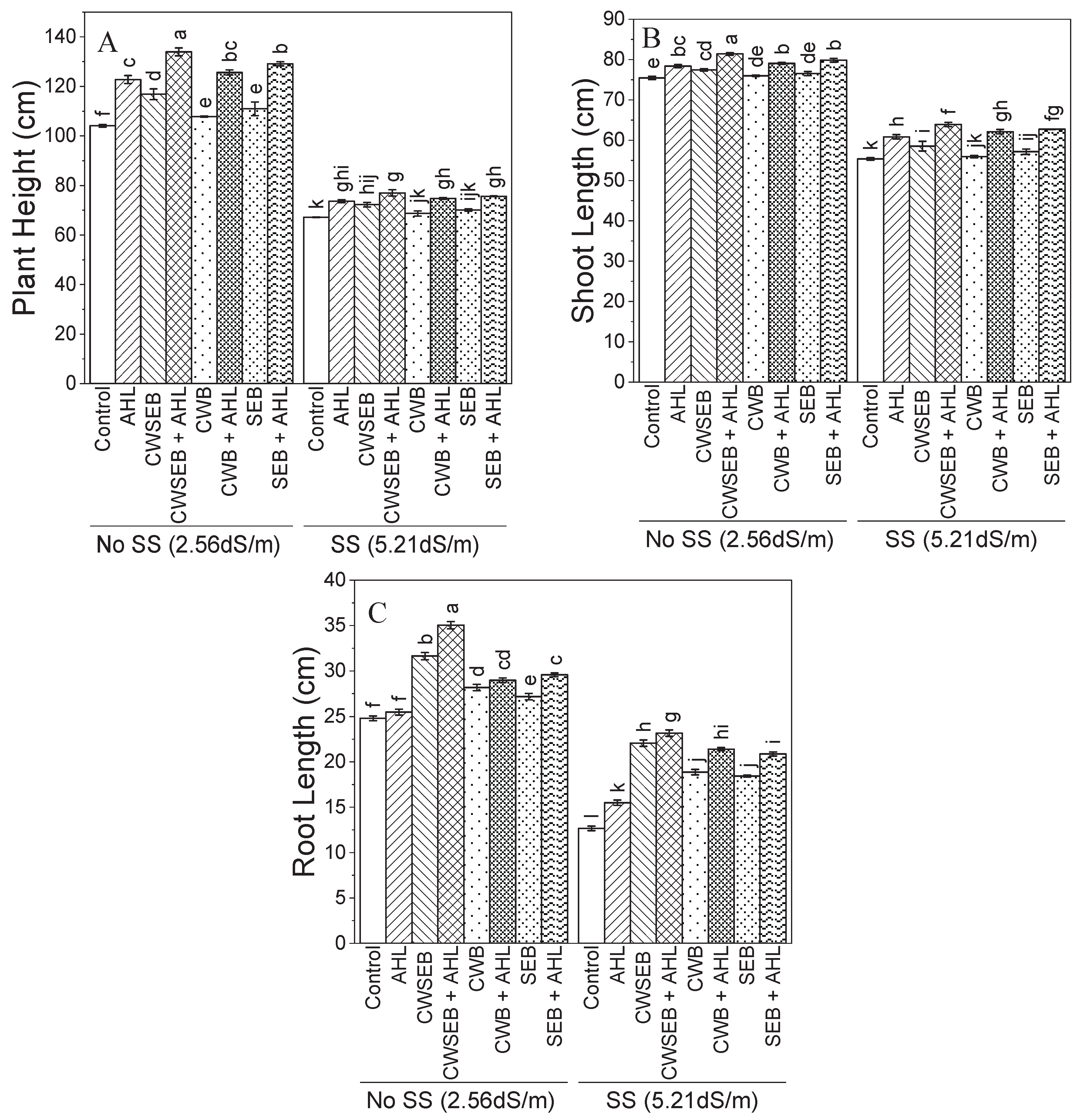
Figure 2.
Effects of cellulose-wicked silicon-enriched biochar (CWSEB), cellulose-wicked biochar (CWB), silicon-enriched biochar (SEB), and N-acyl homoserine lactone (AHL) on maize biomass attributes under non-saline and saline conditions: (A) shoot fresh weight, (B) root dry weight, and (C) shoot dry weight. Bars represent means ± SD, compared using Tukey’s HSD test. Different letters on the bars indicate significant differences at P ≤ 0.05.
Figure 2.
Effects of cellulose-wicked silicon-enriched biochar (CWSEB), cellulose-wicked biochar (CWB), silicon-enriched biochar (SEB), and N-acyl homoserine lactone (AHL) on maize biomass attributes under non-saline and saline conditions: (A) shoot fresh weight, (B) root dry weight, and (C) shoot dry weight. Bars represent means ± SD, compared using Tukey’s HSD test. Different letters on the bars indicate significant differences at P ≤ 0.05.
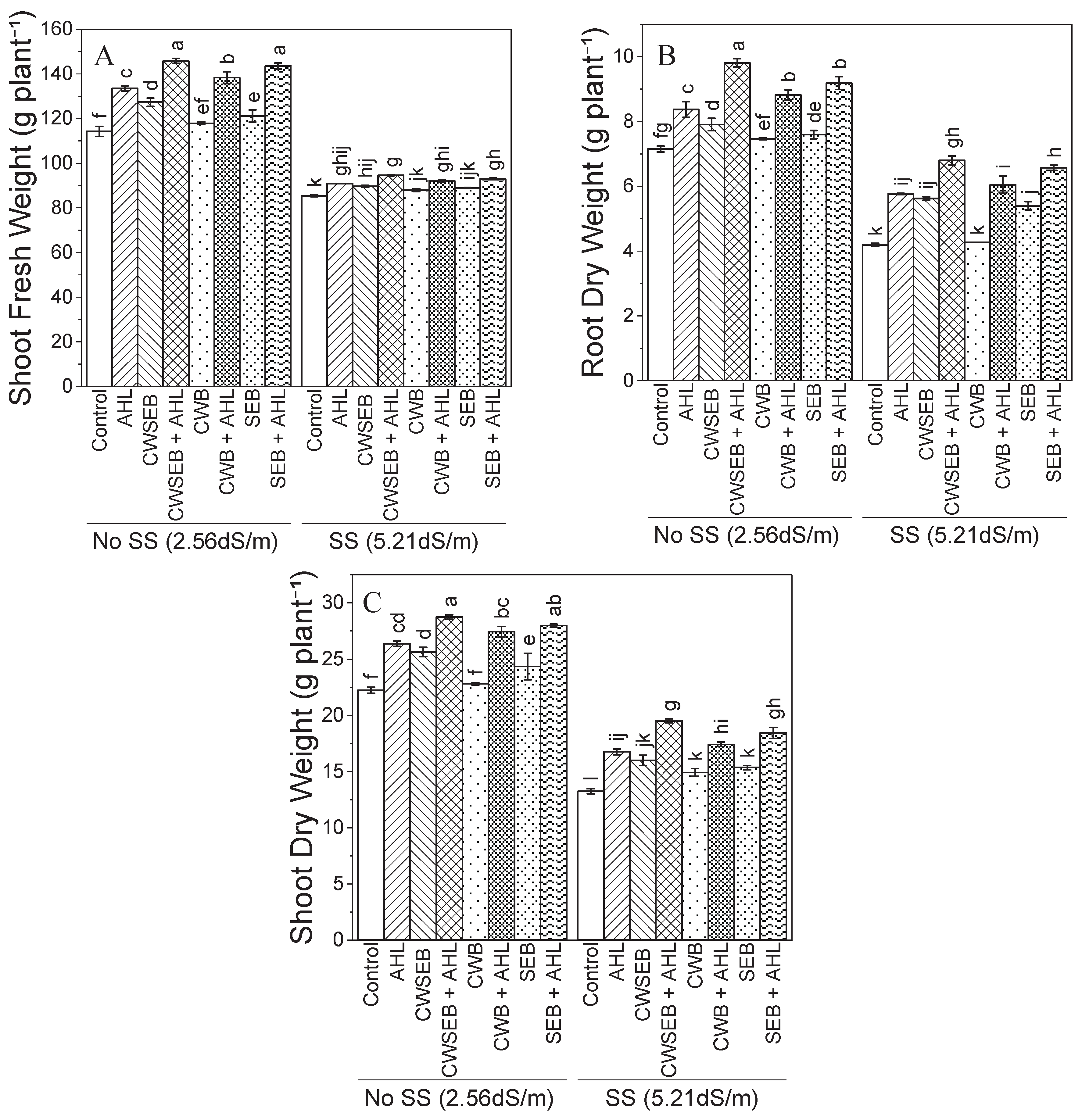
Figure 3.
Effects of cellulose-wicked silicon-enriched biochar (CWSEB), cellulose-wicked biochar (CWB), silicon-enriched biochar (SEB), and N-acyl homoserine lactone (AHL) on photosynthetic pigments of maize under non-saline and saline conditions: (A) chlorophyll a, (B) chlorophyll b, (C) total chlorophyll, and (D) carotenoids. Bars represent means ± SD, compared using Tukey’s HSD test. Different letters on the bars indicate significant differences at P ≤ 0.05.
Figure 3.
Effects of cellulose-wicked silicon-enriched biochar (CWSEB), cellulose-wicked biochar (CWB), silicon-enriched biochar (SEB), and N-acyl homoserine lactone (AHL) on photosynthetic pigments of maize under non-saline and saline conditions: (A) chlorophyll a, (B) chlorophyll b, (C) total chlorophyll, and (D) carotenoids. Bars represent means ± SD, compared using Tukey’s HSD test. Different letters on the bars indicate significant differences at P ≤ 0.05.
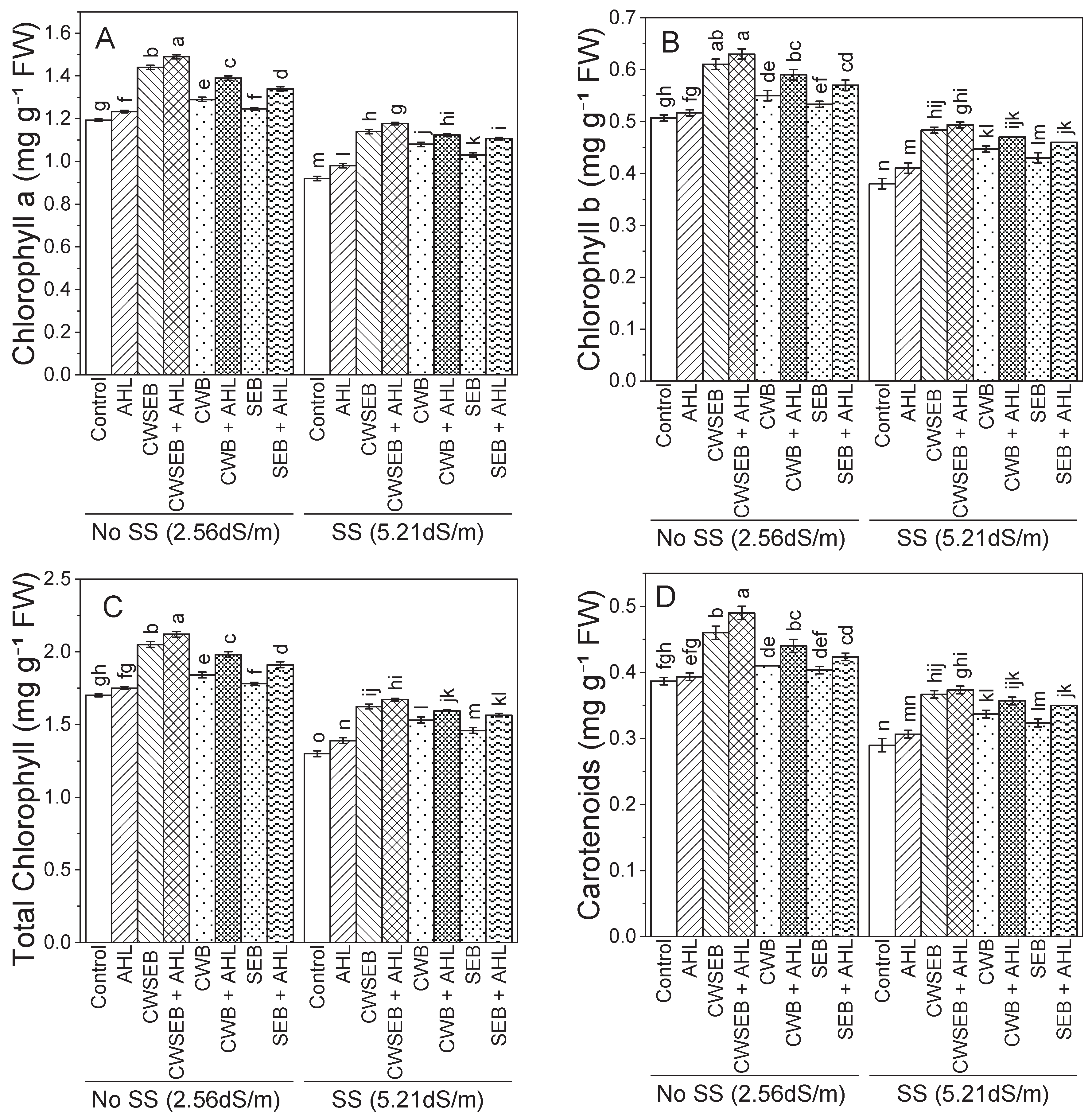
Figure 4.
Effects of cellulose-wicked silicon-enriched biochar (CWSEB), cellulose-wicked biochar (CWB), silicon-enriched biochar (SEB), and N-acyl homoserine lactone (AHL) on gas exchange parameters of maize under non-saline and saline conditions: (A) photosynthetic rate, (B) transpiration rate, (C) stomatal conductance, and (D) water use efficiency (WUE). Bars represent means ± SD, compared using Tukey’s HSD test. Different letters on the bars indicate significant differences at P ≤ 0.05.
Figure 4.
Effects of cellulose-wicked silicon-enriched biochar (CWSEB), cellulose-wicked biochar (CWB), silicon-enriched biochar (SEB), and N-acyl homoserine lactone (AHL) on gas exchange parameters of maize under non-saline and saline conditions: (A) photosynthetic rate, (B) transpiration rate, (C) stomatal conductance, and (D) water use efficiency (WUE). Bars represent means ± SD, compared using Tukey’s HSD test. Different letters on the bars indicate significant differences at P ≤ 0.05.
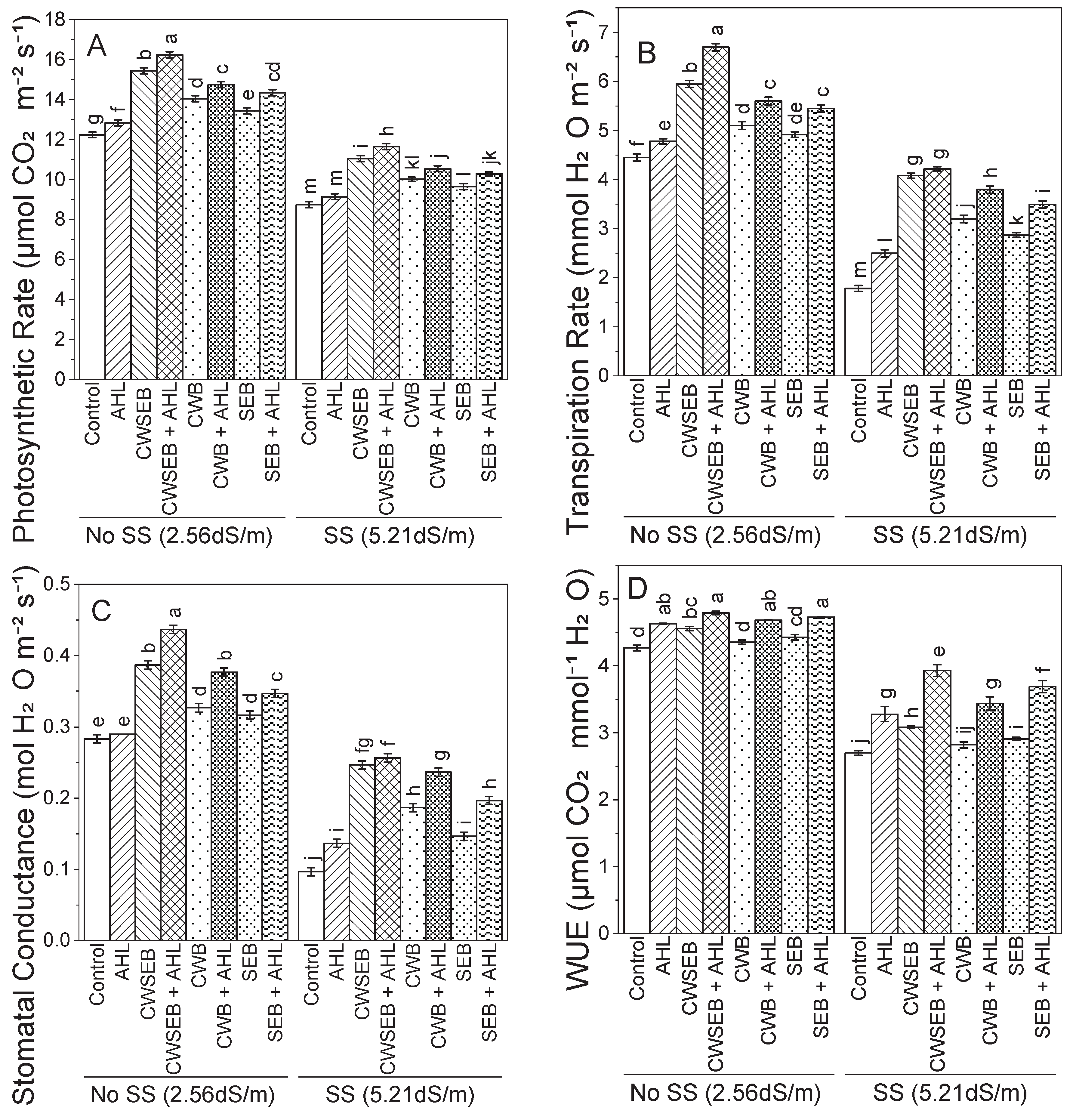
Figure 5.
Effects of cellulose-wicked silicon-enriched biochar (CWSEB), cellulose-wicked biochar (CWB), silicon-enriched biochar (SEB), and N-acyl homoserine lactone (AHL) on biochemical attributes of maize under non-saline and saline conditions: (A) total soluble protein, (B) free amino acids, and (C) root colonization. Bars represent means ± SD, compared using Tukey’s HSD test. Different letters on the bars indicate significant differences at P ≤ 0.05.
Figure 5.
Effects of cellulose-wicked silicon-enriched biochar (CWSEB), cellulose-wicked biochar (CWB), silicon-enriched biochar (SEB), and N-acyl homoserine lactone (AHL) on biochemical attributes of maize under non-saline and saline conditions: (A) total soluble protein, (B) free amino acids, and (C) root colonization. Bars represent means ± SD, compared using Tukey’s HSD test. Different letters on the bars indicate significant differences at P ≤ 0.05.
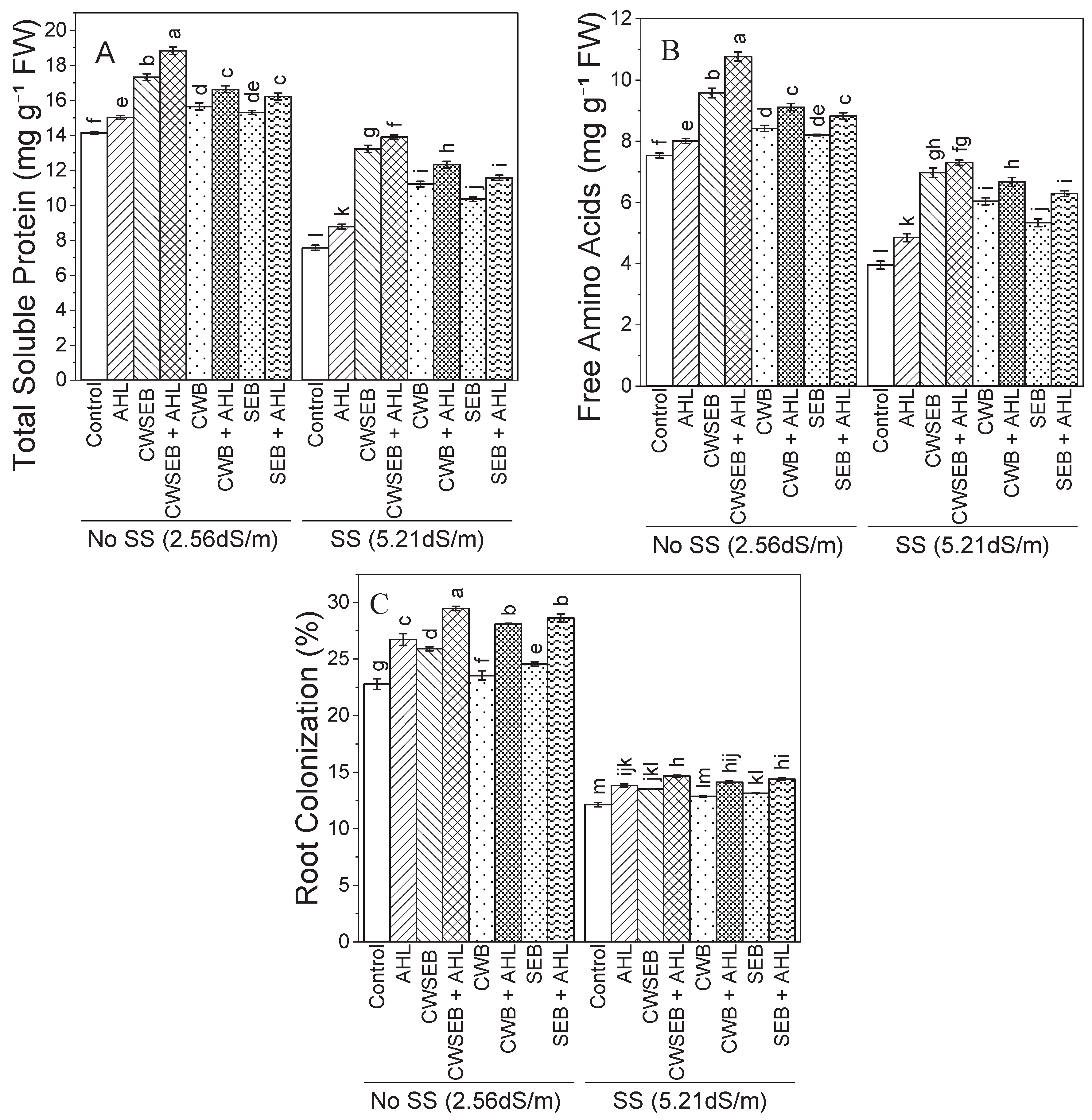
Figure 6.
Effects of cellulose-wicked silicon-enriched biochar (CWSEB), cellulose-wicked biochar (CWB), silicon-enriched biochar (SEB), and N-acyl homoserine lactone (AHL) on stress-related metabolites of maize under non-saline and saline conditions: (A) total phenolic content and (B) glutathione reductase (GR) activity. Bars represent means ± SD, compared using Tukey’s HSD test. Different letters on the bars indicate significant differences at P ≤ 0.05.
Figure 6.
Effects of cellulose-wicked silicon-enriched biochar (CWSEB), cellulose-wicked biochar (CWB), silicon-enriched biochar (SEB), and N-acyl homoserine lactone (AHL) on stress-related metabolites of maize under non-saline and saline conditions: (A) total phenolic content and (B) glutathione reductase (GR) activity. Bars represent means ± SD, compared using Tukey’s HSD test. Different letters on the bars indicate significant differences at P ≤ 0.05.
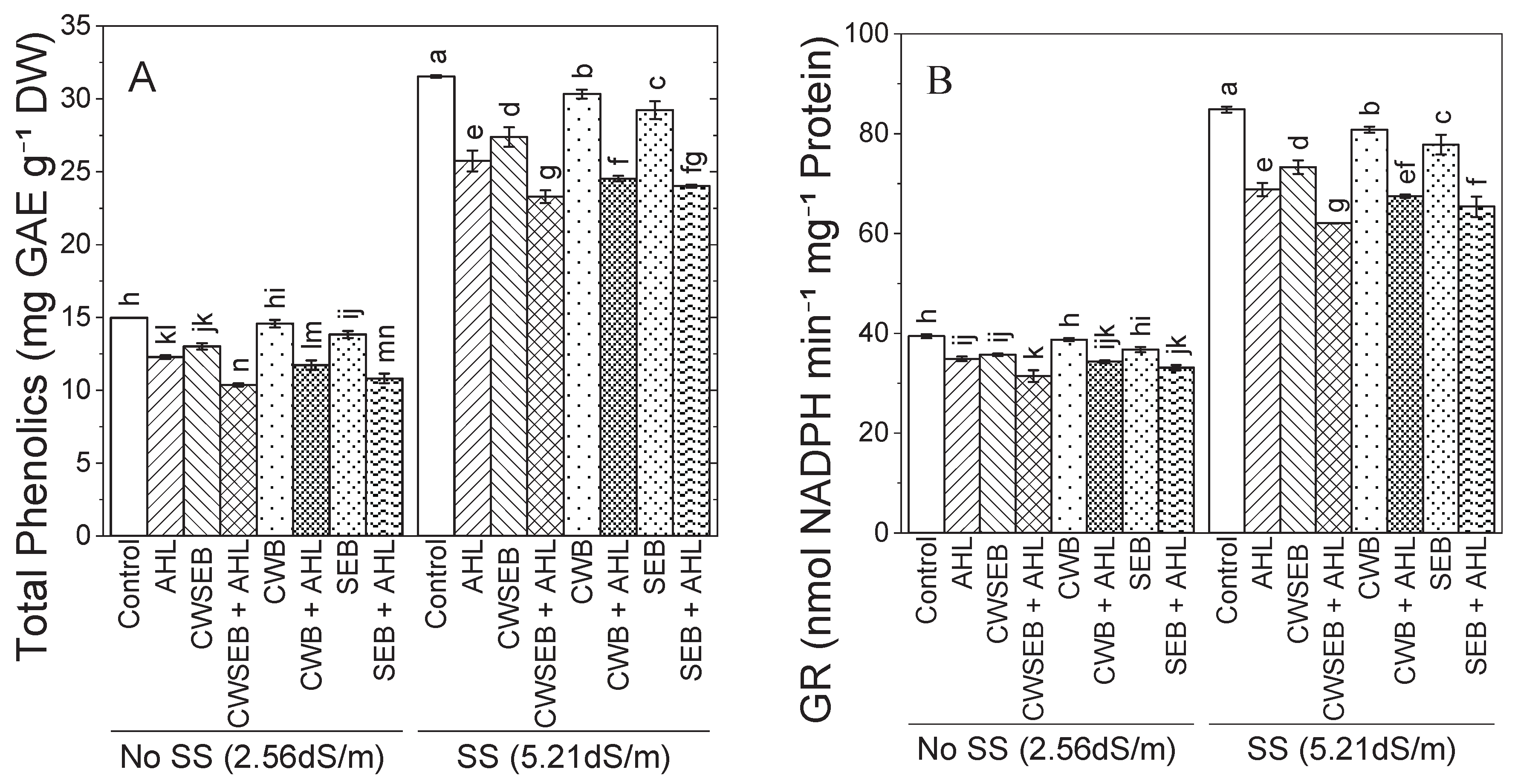
Figure 7.
Effects of cellulose-wicked silicon-enriched biochar (CWSEB), cellulose-wicked biochar (CWB), silicon-enriched biochar (SEB), and N-acyl homoserine lactone (AHL) on antioxidant enzyme activities of maize under non-saline and saline conditions: (A) superoxide dismutase (SOD), (B) peroxidase (POD), (C) catalase (CAT), and (D) ascorbate peroxidase (APX). Bars represent means ± SD, compared using Tukey’s HSD test. Different letters on the bars indicate significant differences at P ≤ 0.05.
Figure 7.
Effects of cellulose-wicked silicon-enriched biochar (CWSEB), cellulose-wicked biochar (CWB), silicon-enriched biochar (SEB), and N-acyl homoserine lactone (AHL) on antioxidant enzyme activities of maize under non-saline and saline conditions: (A) superoxide dismutase (SOD), (B) peroxidase (POD), (C) catalase (CAT), and (D) ascorbate peroxidase (APX). Bars represent means ± SD, compared using Tukey’s HSD test. Different letters on the bars indicate significant differences at P ≤ 0.05.
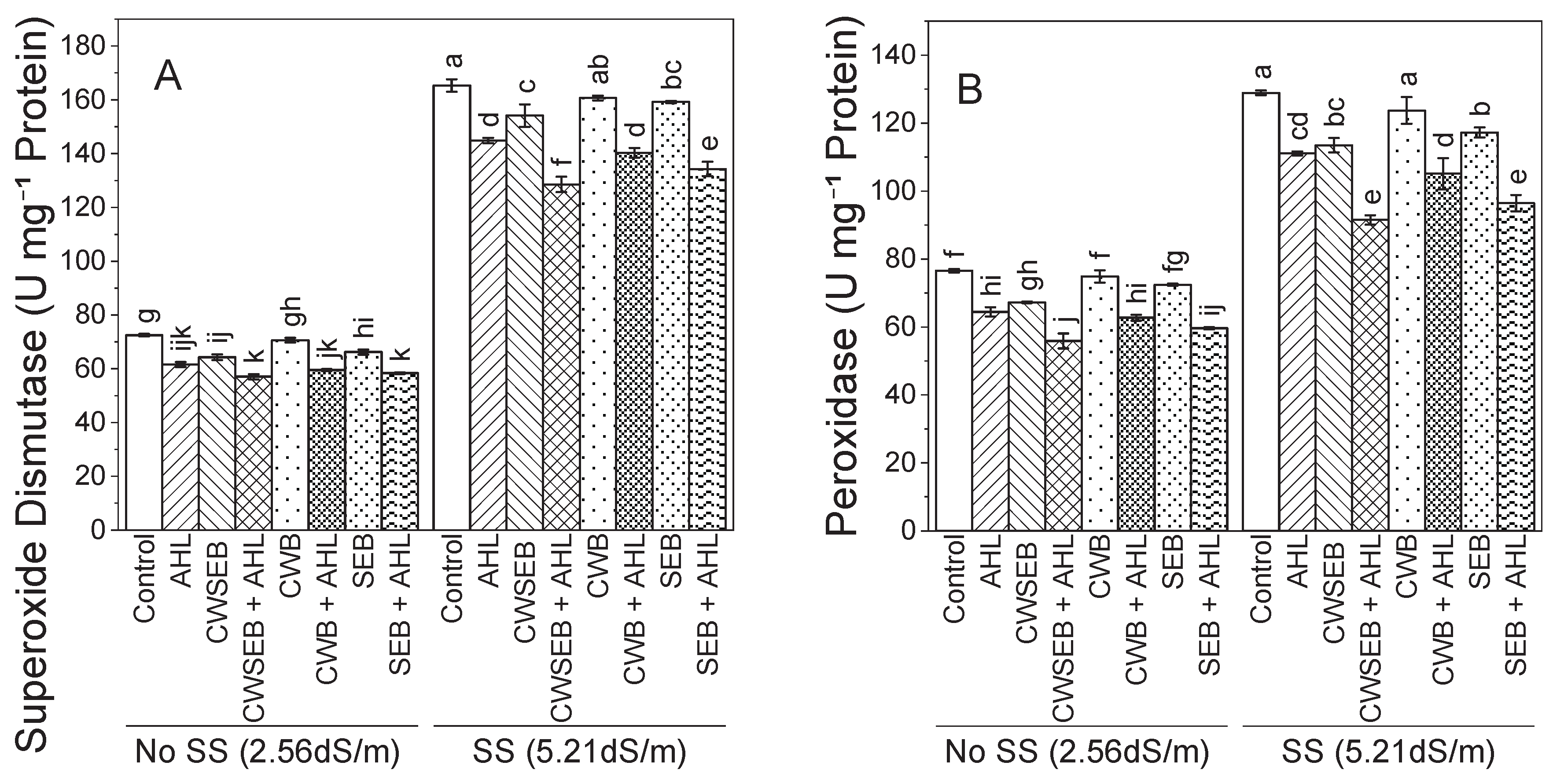
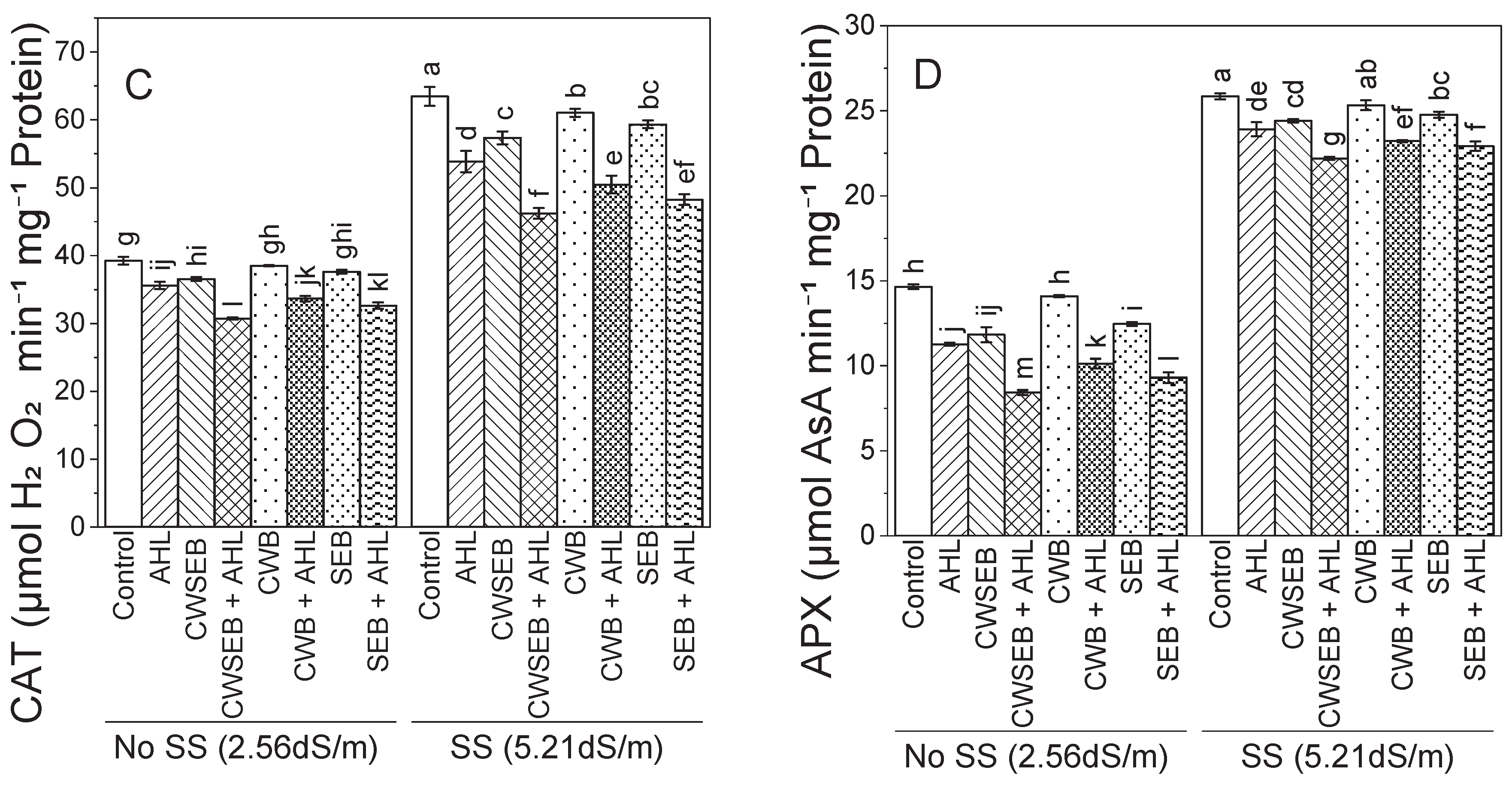

Table 1.
Interactive effects of cellulose-wicked biochar (CWB), silicon-enriched biochar (SEB), cellulose-wicked silicon-enriched biochar (CWSEB), and N-acyl homoserine lactone (AHL) on rhizosphere microbial traits, cob development, yield components, and biological yield of maize under non-saline and saline conditions.
Table 1.
Interactive effects of cellulose-wicked biochar (CWB), silicon-enriched biochar (SEB), cellulose-wicked silicon-enriched biochar (CWSEB), and N-acyl homoserine lactone (AHL) on rhizosphere microbial traits, cob development, yield components, and biological yield of maize under non-saline and saline conditions.
| Salinity | Treatment |
Number of Grains Cob−1 |
1000-Grain Weight (g) |
Grain Yield (g plant−1) |
Biological Yield (g plant−1) |
| No SS | Control | 257.24 ± 2.85g | 275.84 ± 1.04def | 83.04 ± 1.99f | 198.38 ± 2.54f |
| No SS | AHL | 303.64 ± 3.28cd | 293.82 ± 2.53c | 125.61 ± 4.93c | 237.42 ± 4.47bc |
| No SS | CWSEB | 295.19 ± 3.87de | 289.10 ± 0.60cd | 116.79 ± 2.16c | 223.68 ± 6.81cd |
| No SS | CWSEB + AHL | 341.26 ± 11.49a | 344.73 ± 3.74a | 159.31 ± 5.35a | 276.29 ± 0.37a |
| No SS | CWB | 271.90 ± 6.07f | 280.54 ± 0.31cde | 92.05 ± 5.47e | 206.30 ± 3.50ef |
| No SS | CWB + AHL | 311.62 ± 3.67bc | 313.37 ± 13.03b | 138.87 ± 0.62b | 251.35 ± 6.26b |
| No SS | SEB | 287.24 ± 0.79e | 284.86 ± 1.62cde | 102.24 ± 5.55d | 216.30 ± 3.90de |
| No SS | SEB + AHL | 321.52 ± 5.60b | 333.45 ± 7.28a | 151.14 ± 2.67a | 269.99 ± 5.63a |
| SS | Control | 154.81 ± 4.05n | 221.78 ± 0.81j | 51.35 ± 0.72j | 96.22 ± 3.38l |
| SS | AHL | 189.34 ± 1.44jk | 257.90 ± 2.98gh | 61.23 ± 0.84ghi | 142.39 ± 10.06i |
| SS | CWSEB | 181.05 ± 2.90kl | 247.49 ± 4.35hi | 59.74 ± 0.54ghij | 128.57 ± 3.39ij |
| SS | CWSEB + AHL | 214.37 ± 3.59h | 283.79 ± 8.03cde | 67.28 ± 0.84g | 178.65 ± 1.12g |
| SS | CWB | 161.79 ± 0.99mn | 226.85 ± 2.56j | 53.08 ± 0.89ij | 112.98 ± 3.91k |
| SS | CWB + AHL | 199.06 ± 2.32ij | 263.90 ± 4.57fg | 62.52 ± 0.39gh | 162.42 ± 6.79h |
| SS | SEB | 170.39 ± 1.35lm | 232.79 ± 4.47ij | 56.60 ± 1.69hij | 120.36 ± 2.09jk |
| SS | SEB + AHL | 206.37 ± 4.16hi | 273.38 ± 3.39ef | 64.94 ± 1.29gh | 173.93 ± 2.35gh |
| Salinity | Treatment | AHL Concentration in Rhizosphere (µM) | Exopolysaccharide Production (mg g−1 Soil) | ACC Deaminase Activity (µmol α-KB mg−1 Protein h−1) |
Cob Length (cm) |
| No SS | Control | 0.88 ± 0.01f | 4.01 ± 0.04fg | 2.95 ± 0.03fg | 13.63 ± 0.12fg |
| No SS | AHL | 1.06 ± 0.02cd | 4.14 ± 0.06f | 3.03 ± 0.03f | 13.97 ± 0.12f |
| No SS | CWSEB | 1.02 ± 0.02d | 5.00 ± 0.05b | 3.64 ± 0.04b | 16.40 ± 0.20b |
| No SS | CWSEB + AHL | 1.14 ± 0.01a | 5.20 ± 0.05a | 3.82 ± 0.04a | 17.30 ± 0.20a |
| No SS | CWB | 0.97 ± 0.02e | 4.58 ± 0.06d | 3.37 ± 0.03d | 15.17 ± 0.15d |
| No SS | CWB + AHL | 1.12 ± 0.01ab | 4.88 ± 0.06bc | 3.52 ± 0.04c | 15.90 ± 0.20c |
| No SS | SEB | 0.93 ± 0.02e | 4.34 ± 0.06e | 3.20 ± 0.04e | 14.50 ± 0.20e |
| No SS | SEB + AHL | 1.09 ± 0.01bc | 4.74 ± 0.06cd | 3.45 ± 0.03cd | 15.53 ± 0.15cd |
| SS | Control | 0.65 ± 0.02l | 3.00 ± 0.08n | 2.21 ± 0.03n | 10.40 ± 0.20n |
| SS | AHL | 0.82 ± 0.01hi | 3.18 ± 0.06m | 2.34 ± 0.04m | 11.00 ± 0.20m |
| SS | CWSEB | 0.79 ± 0.02ij | 3.82 ± 0.02hi | 2.81 ± 0.02hi | 12.93 ± 0.06hi |
| SS | CWSEB + AHL | 0.87 ± 0.01fg | 3.92 ± 0.03gh | 2.86 ± 0.02gh | 13.20 ± 0.10gh |
| SS | CWB | 0.75 ± 0.02jk | 3.50 ± 0.06kl | 2.59 ± 0.03k | 12.07 ± 0.15kl |
| SS | CWB + AHL | 0.85 ± 0.00fgh | 3.73 ± 0.05ij | 2.73 ± 0.03ij | 12.70 ± 0.10ij |
| SS | SEB | 0.71 ± 0.02k | 3.34 ± 0.06lm | 2.48 ± 0.04l | 11.70 ± 0.20l |
| SS | SEB + AHL | 0.84 ± 0.01gh | 3.62 ± 0.06jk | 2.66 ± 0.02jk | 12.40 ± 0.10jk |
Table 1.
A. Physicochemical characteristics of the pre-experimental soil and irrigation water before treatment application. B.
Table 1.
A. Physicochemical characteristics of the pre-experimental soil and irrigation water before treatment application. B.
| A | |||
| Soil property | Non-saline soil | Saline soil | References |
| pH | 8 | 8.14 | [20] |
| ECe (dS m−1) | 2.56 | 5.21 | [21] |
| Soil organic matter (%) | 0.71 | 0.38 | [22] |
| Total nitrogen (%) | 0.046 | 0.028 | [23] |
| Available phosphorus (µg g−1) | 8.64 | 4.93 | [24] |
| Extractable potassium (µg g−1) | 168 | 101 | [25] |
| Extractable sodium (µg g−1) | 118 | 287 | [26] |
| Texture | Clay loam | Clay loam | [27] |
| B | |||
| Irrigation | Values | References | |
| pH | 7.58 | ||
| EC (µS cm−1) | 812 | ||
| Carbonates (meq L−1) | 0.04 | ||
| Bicarbonates (meq L−1) | 5.84 | ||
| Ca + Mg (meq L−1) | 2.95 | ||
| Chloride (meq L−1) | 1.92 | ||
| Sodium (mg L−1) | 142 | ||
Disclaimer/Publisher’s Note: The statements, opinions and data contained in all publications are solely those of the individual author(s) and contributor(s) and not of MDPI and/or the editor(s). MDPI and/or the editor(s) disclaim responsibility for any injury to people or property resulting from any ideas, methods, instructions or products referred to in the content. |
© 2026 by the authors. Licensee MDPI, Basel, Switzerland. This article is an open access article distributed under the terms and conditions of the Creative Commons Attribution (CC BY) license (http://creativecommons.org/licenses/by/4.0/).
Copyright: This open access article is published under a Creative Commons CC BY 4.0 license, which permit the free download, distribution, and reuse, provided that the author and preprint are cited in any reuse.


