

Submitted:
12 July 2026
Posted:
15 July 2026
You are already at the latest version
Abstract
Second Language Acquisition (SLA) has long been marked by theoretical fragmentation. Since the 1970s, scholars have explained learner language through constructs such as interlanguage, variability, fossilization, and subsystem interaction. Cognitive models emphasize memory and processing limits; generative approaches highlight innate constraints; sociocultural theories stress mediation and identity; and complexity theory frames SLA as a non-linear system operating at the “edge of chaos.” Each captures a partial truth, yet none provides a unified account of how learners achieve full acquisition of L2. This landscape has led to the portrayal of L2 learning as chaotic, unpredictable, and incomplete. Interlanguage is often described as a transitional grammar shaped by subsystems that interact dynamically but never fully converge. Complexity theory has attempted integration, suggesting acquisition thrives in turbulence, but this remains partial and leaves residues of fragmentation that complicate mastery. This article challenges that predominant view. It argues that interlanguage is not an independent linguistic system but the visible outcome of the learning subsystem a learner follows when acquiring L2. The Law of the Trio offers a paradigm shift: language, thought, and reality are equivalent modalities of existence. Under this universal law, L2 acquisition is not chaotic interplay but a natural developmental process identical to L1, where learners form language by engaging directly with reality. By smoothing out the contradictions of subsystem theories, the Law of the Trio unifies fragmented perspectives into a science of meaning. Empirical evidence strengthens this ontological reframing. Numerous L2 acquirers — Joseph Conrad, Vladimir Nabokov, Chinua Achebe, Ha Jin, Baalu Girma, and Tsegaye Gebremedhin — have not only achieved parity with natives but surpassed them, transforming and advancing their adopted languages. Their contributions demonstrate that L2 acquisition is ordered creativity, not transitional chaos, and that learners are agents of linguistic innovation rather than deficient imitators. By situating SLA within the Law of the Trio, this article moves beyond fragmented subsystem theories and deficit models. It clarifies language learning as the exposition of language’s role as a mirror of being- a process of ontological resonance rather than chaotic struggle. In doing so, it directs SLA research from complexity to simplicity, from chaos to order. It dissolves the residues of fragmentation, validates learner creativity, and reclaims language as a mirror of being — offering a unified science of meaning for the future of SLA research.
Keywords:
law of the trio
; ontological linguistics
; second language acquisition (SLA)
; interlanguage
; ontological resonance
; unified science of meaning
Author’s Note
Toward a Unified Science of Meaning
This paper represents the fourth contribution in my ongoing effort to view Second Language Acquisition (SLA) through the lens of the Law of the Trio. The three preceding works have progressively established the theoretical foundation of this universal framework.
The first contribution, Unlocking Language through the Law of the Trio: Recursive Semantic Geometry Structuring Meaning through Modifier Architecture, introduced the Law of the Trio as a model of language, thought, and reality as structurally equivalent modalities of existence. It formalized meaning as the essence of existence expressed through recursive ontological functions, encoded in the EMji/VMji notation system, and demonstrated how linguistic form embodies the triadic coupling of entity, state, and modifier.
The second, Redefining Linguistics: The Law of the Trio as a Universal Framework in Dialogue with Major Theories, expanded this foundation by positioning the Trio as a universal law of linguistics. It reframed sentences as semantic DNA, validated the framework across typologically distinct languages, and showed how recursive semantic geometry unifies generative grammar, cognitive science, and semiotics into a single ontological architecture.
The third, Reclaiming Voice Through Structure: Integrating Narrative Language Ecology and the Law of the Trio in Ontological Language Pedagogy, brought the framework into pedagogical practice, synthesizing Edgar Eslit’s Narrative Language Ecology with the Trio’s structural ontology. It redefined teaching as an act of presence and ethical resonance, restoring learner agency and narrative identity through recursive fluency.
Together, these three contributions have explored the structural unity of thought, reality, and language, the origin of meaning in existence, the transformative processes of linguistic modalities, and the universality of semantic geometry.
The present work extends that trajectory with renewed clarity, applying the Law of the Trio to SLA. It challenges the fragmentation of existing theories — interlanguage, variability, and complexity — by revealing that L2 acquisition is not chaotic interplay but a natural ontological process identical to L1, where learners form language through direct engagement with reality.
As humanity advances into an era of cognitive transparency and interdisciplinary synthesis, the Law of the Trio offers a new horizon for linguistics — one that transcends the boundaries of biology, psychology, and philosophy. It reveals that language, thought, and reality are not isolated phenomena but three modalities of existence, each capable of initiating and transforming the others. Through this triadic propagation, meaning emerges as the essence of existence: words give rise to ideas, ideas reshape the world, and the world, in turn, inspires new words.
Future linguistics will no longer study language as a mere system of signs but as the structural rhythm of existence itself — the geometry through which consciousness interacts with reality. The mind will be understood not as a passive processor of information but as an active architect of worlds, capable of translating ontological patterns into symbolic form.
The Law of the Trio thus stands as a bridge between science and spirit, between cognition and cosmos. It invites scholars to see language not only as a tool for communication but as the medium of transformation, the triadic pulse through which existence continually renews itself. In embracing this unity, linguistics evolves into a universal science of meaning — one that illuminates the profound truth that meaning originates in existence, essence is its expression, and to speak is to create, to think is to become, and to exist is to reveal the infinite structure of reality.
1. Introduction: From Fragmentation to Ontological Unity in Second Language Acquisition
1.1. The Fragmented Landscape of SLA Research
Since the 1970s, Second Language Acquisition (SLA) has been shaped by the concept of interlanguage, introduced by Selinker (1972), which describes learner language as a transitional grammar between L1 and L2. This construct inspired decades of inquiry into variability, fossilization, and subsystem interaction, yet it also entrenched a deficit model—portraying learners as incomplete speakers striving toward native norms. Despite its historical influence, interlanguage remains a conceptual paradox: it explains development but simultaneously implies deficiency.
Four major subsystems—cognitive, generative, sociocultural, and complexity frameworks—have dominated SLA theory. Each captures a dimension of learning but none provides a unified account of how learners achieve full acquisition. The result is a landscape of fragmented paradigms, where theoretical residues—mechanistic, structural, contextual, and turbulent—complicate mastery and obscure the creative agency of learners.
Recent scholarship continues to highlight this fragmentation. Contemporary researchers observe that SLA now oscillates between input-driven cognitive models and sociocultural approaches emphasizing mediation and identity, yet both remain partial in explaining how meaning itself is acquired. This ongoing tension underscores the need for a unifying paradigm—one that integrates cognition, structure, context, and emergence within a single ontological framework.
1.2. Cognitive Approaches: Processing Limits and Frequency Effects
Cognitive models emphasize memory, attention, and input frequency as drivers of acquisition. Ellis (1994, 2008) proposed that learning occurs through noticing and pattern recognition, while Tomasello (2003) advanced usage-based learning grounded in construction grammar. These perspectives explain variability as the learner’s limited processing capacity and reliance on frequency effects.
However, cognitive models tend to reduce language to information processing, neglecting its ontological dimension. They interpret interlanguage as evidence of incomplete automatization rather than resonance with reality. The residue here is mechanistic: cognition is divorced from being, and learning becomes a computational act rather than an existential one.
The Law of the Trio reframes this view by positing that cognition is not a passive processor but an ontological participant. When learners encounter linguistic input, they do not merely store patterns—they couple sound with reality, forming triadic associations between language, thought, and world. Acquisition thus becomes an act of resonance, where meaning is enacted rather than processed.
1.3. Generative Approaches: Universal Grammar and Structural Deficits
Generative SLA, rooted in Chomsky’s theory of Universal Grammar, views interlanguage as constrained by innate principles. White (2003) and Hawkins (2009) argued that L2 learners access UG only partially, explaining fossilization and persistent errors. This framework emphasizes competence over performance, focusing on structural gaps between L1 and L2.
Yet generative approaches fragment acquisition by isolating syntax from meaning. Learner variability is interpreted as incomplete parameter resetting rather than natural engagement with reality. The residue here is structural: learners are measured against abstract grammatical ideals, ignoring their creative contributions to language.
The Law of the Trio dissolves this residue by treating syntax not as a static code but as semantic geometry—a recursive structure through which meaning propagates. In this view, grammar is not an innate template but a manifestation of ontological order. Learners do not reset parameters; they reconstruct reality through linguistic form, aligning structure with experience. This reframing transforms fossilization from a failure of competence into a moment of ontological stabilization, where meaning crystallizes through recursive engagement.
1.4. Sociocultural Approaches: Mediation and Identity
Sociocultural theory, inspired by Vygotsky, reframes interlanguage as socially mediated performance. Lantolf (2000) and Swain (2006) emphasized scaffolding, identity, and collaborative dialogue, viewing learner language as dynamic and context-dependent. This perspective highlights the importance of social interaction but risks reducing acquisition to external mediation. Variability becomes evidence of shifting identities rather than ontological resonance. The residue here is contextual: learners are portrayed as dependent on social scaffolds rather than autonomous agents of meaning.
The Law of the Trio integrates sociocultural insight without losing ontological depth. It recognizes that social interaction is not merely external mediation but a shared enactment of being. When learners engage in dialogue, they participate in the triadic rhythm of existence—language, thought, and reality co-creating meaning. Thus, identity in SLA is not a social construct alone but an ontological expression of resonance between self and world.
1.5. Complexity Theory: Chaos and Emergence
Complexity theory frames SLA as a nonlinear system operating at the “edge of chaos.” Learner language is seen as emergent, adaptive, and unpredictable. Interlanguage reflects the dynamic interplay of subsystems, thriving in turbulence.
While complexity theory integrates multiple perspectives, it remains partial. Subsystems are juxtaposed rather than unified, leaving learners in perpetual flux. The residue here is turbulence: acquisition is portrayed as chaotic, with mastery achieved only at the edge of instability.
The Law of the Trio transforms this turbulence into ordered creativity. It posits that emergence is not random but recursive—a rhythmic propagation of meaning through triadic coupling. Learners do not thrive at the edge of chaos; they create order through resonance. Complexity becomes harmony, and acquisition becomes the unfolding of ontological geometry.
1.6. The Problem of Interlanguage
Across these frameworks, interlanguage is consistently misrepresented as an independent system. Cognitive models see it as incomplete automatization; generative approaches as partial UG access; sociocultural theory as mediated performance; complexity theory as emergent turbulence. In all cases, interlanguage is treated as a grammar in its own right rather than the visible trajectory of subsystem engagement.
This misrepresentation perpetuates the deficit model, portraying learners as deficient imitators rather than creative agents. It also obscures the fact that many L2 acquirers surpass native speakers, transforming and advancing their adopted languages. The Law of the Trio reframes interlanguage as ontological reflection—the learner’s evolving resonance with reality through linguistic form.
1.7. Empirical Evidence of L2 Excellence
Numerous L2 writers demonstrate mastery beyond native competence:
- Joseph Conrad (Polish → English) redefined English prose through existential depth.
- Vladimir Nabokov (Russian → English) transformed narrative art through semantic precision.
- Chinua Achebe (Igbo → English) embedded African oral traditions into English, expanding its expressive range.
- Ha Jin (Chinese → English) achieved global recognition for clarity and emotional resonance.
- Baalu Girma and Tsegaye Gebremedhin (Oromo → Amharic) reshaped modern Amharic literature through narrative synthesis of Amharic prose and poetic innovation.
These cases confirm that L2 acquisition is not transitional chaos but ordered creativity. Learners re-encode reality through L2, often more consciously than natives, enabling innovation. Their success exemplifies the Law of the Trio’s principle that language learning is an act of ontological participation, not imitation.
1.8. Comparative Synthesis
To clarify how the Law of the Trio reframes existing paradigms, the comparative synthesis in Table 1 summarizes the major SLA frameworks, the residues they leave behind, and the ontological reinterpretation offered by the Trio:
This synthesis highlights the progression from fragmentation to unity. Each framework captures a partial truth, yet only the Law of the Trio integrates them into a coherent ontology of meaning, where language, thought, and reality form a recursive triad of existence.
1.9. Toward a Unified Framework: The Law of the Trio
The fragmentation of SLA theories reveals the need for a unifying paradigm. Cognitive, generative, sociocultural, and complexity approaches each capture partial truths but leave residues of mechanistic, structural, contextual, or turbulent fragmentation. Interlanguage, as their common construct, misrepresents acquisition as deficit.
The Law of the Trio offers a solution. By positing language, thought, and reality as equivalent modalities, it reframes acquisition as ontological resonance. Learners form language by engaging directly with reality, bypassing subsystem residues. Interlanguage becomes the visible trajectory of resonance, not an independent grammar.
Under this universal law, L2 acquisition is not chaotic interplay but a natural developmental process identical to L1, where learners form language through direct engagement with reality. By smoothing out the contradictions of subsystem theories, the Law of the Trio unifies fragmented perspectives into a science of meaning. It reframes acquisition as ontological harmony rather than chaotic struggle, dissolving residues of fragmentation and reclaiming the dignity of L2 learning.
2. Methodology: Recursive Semantic Geometry and Event-Based Ontological Encoding in SLA
Second language acquisition (SLA) presents a unique cognitive and ontological challenge: the learner must reconcile thought and reality through the symbolic structures of a new linguistic system. The Law of the Trio reframes SLA not as mechanical grammar acquisition but as event-based recursion, where reality itself serves as the primary referent for linguistic encoding. This methodology section outlines how recursive semantic geometry operationalizes the Trio, moving SLA from complexity to simplicity by grounding linguistic practice in universal structures of meaning.
2.1. Triadic Foundation of Meaning
At the heart of the Trio lies the triadic equivalence of reality, thought, and language. Each modality encodes the same semantic event under different symbolic pressures. This is formalized as:
- Entity: the subject or object of existence (child, idea, word).
- State/Behavior: the transformation or action (tired, running, opening).
- Modifiers: recursive enrichments of context, condition, and relation.
Analogies
- Phase Transition: Just as water manifests as solid, liquid, or gas depending on conditions, meaning manifests as reality, thought, or language depending on modality.
- Telecommunications: Voice signals traverse analog, digital, and optical formats before returning to analog form. Likewise, meaning traverses modalities—event → thought → language—ensuring fidelity across systems.
Example
Sentence: “The child runs quickly.”
- Reality: a child physically running.
- Thought: a mental simulation of the child’s movement.
- Language: symbolic encoding of the event. The semantic identity is preserved across modalities, proving universality.
2.2. Core Sentence Structure as Ontological Logic
Traditional grammar treats sentences as syntactic strings. The Trio reframes them as semantic particles—symbolic cells encoding existence. Each particle contains:
- Entity (subject, object, or modifier anchor)
- State/Behavior (condition, transformation, or action)
- Modifiers (recursive enrichments)
Example
Sentence: “The tired child slowly opened the heavy door.”
- Entity: child
- State: tired (EM1)
- Behavior: opened
- Object: door
- State of object: heavy (EM2)
- Behavior modifier: slowly (VM1,1)
This shows how sentence structure mirrors cognition and reality, dissolving the boundary between syntax and semantics.
2.3. Structural Equivalence Across Languages
Both the acquired and target languages function as symbolic mirrors of reality. Each sentence represents a triadic coupling:
- Entity
- State/Behavior
- Modifiers
Example
English: “She is running.” Japanese: “Kanojo wa hashitte iru.” Despite differences in tense and aspect marking, both encode the same semantic particle. SLA is therefore not memorization of foreign forms but the reconstruction of reality through a new symbolic lens.
2.4. Reality as Anchor: Eliminating L1 Interference
Traditional SLA methods often rely on translation from the first language (L1), leading to transfer errors. The Trio proposes a reversal: learners should anchor acquisition in reality, not L1 structures. By observing events and encoding them directly in the target language (L2), learners bypass interference and engage in semantic modeling.
Example
Instead of translating “I am hungry” from L1, the learner directly encodes the event of hunger in L2, grounding meaning in lived experience rather than linguistic substitution.
2.5. Modifier Hierarchy: EMji and VMji Notation
Modifiers transform simple sentences into complex ones by adding semantic layers. The Trio formalizes this through recursive notation:
- EMji (Entity Modifiers): enrich noun identity.
- VMji (Verb Modifiers): elaborate action or state.
- Recursive Depth (j): formalizes levels of semantic nesting.
Example
Sentence: “She confidently presented the piece at the theatre near the river to find a seat despite the rain.”
- VM12: confidently
- VM14: at the theatre
- VM14.2: near the river
- VM15: to find a seat
- VM16: despite the rain
This notation makes depth visible and teachable, turning abstract grammar into a structured map of meaning.
2.6. Recursive Modification and Hierarchical Structure
Modifiers themselves can be modified, creating open-ended scaffolds of meaning. This recursive layering mirrors cognitive modeling, where mental images are enriched by nested attributes and relational contexts.
Example
Sentence: “The student revised her essay written during the storm in the library.”
- EM15: written during the storm (modifies “essay”)
- VM14: in the library (modifies “revised”)
Here, recursion deepens resonance, showing how learners acquire not only vocabulary but the ability to build semantic hierarchies reflecting lived experience.
2.7. Sentence as Semantic Bullet
A sentence is not a linear string of words—it is a semantic projectile, aimed at a specific event in reality. Like a bullet hitting a target, a sentence encapsulates:
- The who (entity)
- The what (behavior)
- The where/when/how/why (modifiers)
Example
Sentence: “She studies diligently.”
- Entity: she
- Behavior: studies
- Modifier: diligently
The sentence becomes a precise ontological encoding of reality.
2.8. Event–Sentence Coupling: The Ontological Basis of Meaning
Language should not be reduced to word processing. Each sentence reflects an event—either in physical reality or mental simulation. Meaning arises from the sentence’s effect on reality, not merely its internal structure.
Example
Sentence: “The dog is barking.”
- Encodes a perceptual event.
- Interpretation depends on context—danger, familiarity, or emotional resonance.
Meaning is event-driven, not form-driven.
2.9. Narrative Expansion: From Sentence to Semantic Chain
Events are rarely isolated. One event leads to another, forming semantic chains that evolve into narratives. A sentence becomes the seed of a story—its modifiers and clauses recursively enriching ontological depth.
Example
Sentence: “The teacher encouraged the student, who revised her essay in the library.”
- Entity 1: teacher → Behavior: encouraged
- Entity 2: student → Behavior: revised
- Modifier: in the library
This recursive expansion mirrors L1 acquisition, where children build meaning by linking words to events.
2.10. Language Skills as Event Transformation
Speaking, writing, listening, and reading are processes of transforming events into symbolic form and vice versa. SLA involves mastering this transformation in the target language.
Example
Sentence: “The teacher explains the lesson.”
- Listening: learner decodes event (teacher → explaining → lesson).
- Speaking: learner re-encodes reality in L2.
This process can be visualized as a dumbbell metaphor: one plate represents the event, the other the sentence. The learner “lifts meaning” by balancing both.
2.11. Avoiding Word Processing: The Pitfall of Surface Learning
If SLA is reduced to word processing—memorizing isolated vocabulary and assembling sentences mechanically—the results are hollow. Learners may produce grammatically correct but semantically empty utterances.
Event-based recursion avoids this pitfall by integrating:
- Perceptual grounding
- Semantic recursion
- Skill development
Words and syntax are memorized only when linked to events in reality, supporting retention, fluency, and semantic clarity.
2.12. Semantic Geometry as Cognitive Map
Syntax is reframed as semantic geometry: a recursive map of meaning across modalities. Sentences become semantic DNA, analyzable across reality, thought, and language.
Example
Sentence: “The scientist carefully analyzed the data collected during the experiment.”
- Entity: scientist
- Behavior: analyzed
- Object: data
- Modifier: carefully (VM1)
- Modifier: collected during the experiment (EM1)
This recursive geometry enables precise tracking of semantic recursion, bridging linguistics, cognitive science, pedagogy, and computational modeling.
2.13. Ontological Modeling and Interpretation
The final stage of the method involves ontological modeling, where linguistic data are interpreted not merely as structural forms but as manifestations of existence itself. Meaning arises from the interplay of Thought, Language, and Reality—three modalities that embody existence in parallel forms (see Figure 1).
Anchors
- Memory and Experience: lived experiences—hunger, joy, movement, dialogue—become raw material for encoding meaning in L2.
- Triadic Resonance: Thought provides conceptual interpretation, Language provides symbolic form, Reality provides experiential grounding.
Example Achebe’s Things Fall Apart: “Proverbs are the palm oil with which words are eaten.”
- Language: metaphorical expression
- Thought: cultural wisdom
- Reality: social practice
Recursive modifiers (“palm oil,” “eaten”) encode ontological depth, showing how meaning circulates between linguistic form and lived experience. The triadic circuit of meaning illustrated in Figure 1 provides the methodological framework for interpreting such data ontologically.
2.14. Conclusion of the Methodology Section
The methodological framework presented here—anchored in the Law of the Trio—redefines second language acquisition (SLA) as an ontological enactment rather than a mechanical exercise. By treating sentences as semantic particles and meaning as the recursive coupling of entity, state/behavior, and modifier, this approach dissolves the traditional boundaries between syntax, semantics, and pragmatics. Language is reframed as a mirror of existence (being), encoding events across the modalities of reality, thought, and symbolic form.
The integration of recursive semantic geometry with event-based recursion provides a universal scaffold for SLA. Learners are not burdened with memorizing arbitrary rules or translating from their first language (L1); instead, they anchor acquisition in lived experience. Reality itself becomes the referent, ensuring that every utterance is grounded in perceptual and cognitive resonance. This eliminates interference, fosters fluency, and restores dignity to the learning process.
Several methodological contributions emerge from this synthesis:
- Universality of Structure: The semantic function applies across all languages, ensuring invariance beneath surface variation.
- Recursive Modifier Architecture: EMji and VMji notation formalizes semantic depth, making complexity teachable and computable.
- Event-Based Anchoring: Learners encode reality directly in L2, bypassing translation and engaging in ontological modeling.
- Narrative Expansion: Sentences evolve into semantic chains, enabling learners to construct stories that mirror lived experience.
- Skill Transformation: Speaking, writing, listening, and reading are reframed as processes of event transformation, balancing reality and symbolic form.
- Ontological Modeling: Meaning is interpreted as structural resonance between thought, language, and reality, producing clarity and creative mastery.
Ultimately, the Law of the Trio elevates SLA from fragmented theory into a coherent, testable, and falsifiable model. It unifies linguistics, cognitive science, pedagogy, and computational modeling under a single principle: language is the recursive enactment of existence. Every sentence becomes a symbolic act of being, every utterance a mirror of reality. In this way, SLA is transformed into an act of witnessing—where learners reconstruct reality through a new linguistic lens, achieving semantic clarity, resonance, and agency as creators of meaning.
This methodology sets the stage for the Results section, where subsystem theories and complexity models will be reinterpreted through the Trio, demonstrating how SLA moves from chaos to order, from surface memorization to ontological depth.
3. Results
3.1. Reframing Interlanguage: From Deficit to Resonance
The first major finding redefines interlanguage not as an autonomous grammar but as the visible trajectory of subsystem engagement. Traditional SLA theories have portrayed it as transitional, incomplete, or fossilized—cognitive models interpret it as limited automatization; generative approaches as partial access to Universal Grammar; sociocultural theory as mediated performance; and complexity theory as emergent turbulence. The Law of the Trio dissolves these interpretations by reframing interlanguage as resonance across modalities. Learners do not construct a separate grammar; they enact meaning through recursive coupling of entity and state/behavior, enriched by modifiers. Interlanguage thus becomes the trace of this ontological process—a visible record of how learners engage reality, thought, and language simultaneously. This reframing moves SLA away from deficit models toward recognition of learners as agents of meaning and creativity.
3.2. Integration of Subsystem Theories and Dissolution of Fragmentation
The second major finding demonstrates that subsystem theories—cognitive, generative, sociocultural, and complexity—can be integrated within the Law of the Trio as partial lenses rather than competing paradigms. Each subsystem captures a fragment of the triadic geometry:
- Cognitive models highlight input frequency and processing, corresponding to entity–state coupling at the level of thought.
- Generative approaches emphasize structural constraints, corresponding to syntax as the geometry of semantics within language.
- Sociocultural frameworks stress mediation and identity, corresponding to the modifier architecture that enriches meaning through social context.
- Complexity theory emphasizes turbulence and emergence, corresponding to visible residues of subsystem fragmentation when resonance is obscured.
By reframing interlanguage as resonance across modalities, the Trio integrates these perspectives into a coherent science of meaning. This integration advances SLA beyond competing paradigms, situating acquisition within ontological clarity and dissolving residues of mechanistic processing, structural deficit, contextual dependence, and chaotic flux into ontological order.
3.3. Reconciling Menezes: From Chaos to Order
A particularly significant result emerges when comparing Vera Menezes’ (2013) complexity framing with the Law of the Trio. Menezes situates SLA at the edge of chaos, portraying interlanguage as a strange attractor sensitive to initial conditions. While this model acknowledges nonlinearity and emergence, it leaves acquisition unstable, suggesting mastery is contingent rather than systematic.
The Law of the Trio reframes this turbulence as a symptom of fragmentation rather than the essence of learning. By modeling meaning as recursive enactment across modalities, the Trio demonstrates that acquisition is ordered resonance, not chaotic flux. Interlanguage becomes the visible trajectory of subsystem engagement, not a chaotic attractor.
This reconciliation advances SLA beyond the edge of chaos, situating it within ontological clarity: chaos is not the condition of learning but the residue of partial theories; order is the true principle, enacted through triadic recursion. The findings confirm that learners progress not through instability but through resonance with reality, thought, and language.
These empirical results directly support the theoretical reconciliation outlined in Discussion 5.1, showing that while complexity theory highlights turbulence, the Trio demonstrates that acquisition is fundamentally ordered and recursive.
3.4. Empirical Validation: L2 Acquirers Surpassing Natives and Reclaiming Learner Creativity and Dignity
The fourth major finding is empirical: numerous L2 acquirers have achieved mastery beyond native competence, confirming that SLA is ordered creativity rather than transitional chaos.
- Joseph Conrad (Polish → English): His prose redefined English literature, exemplifying recursive resonance between cognition and linguistic form.
- Vladimir Nabokov (Russian → English): His narrative art transformed English fiction, embedding multilingual consciousness into literary geometry.
- Chinua Achebe (Igbo → English): He expanded English by embedding African oral traditions, reshaping its expressive range through modifier resonance.
- Ha Jin (Chinese → English): His clarity and emotional depth reveal ontological precision, showing that L2 writing can surpass native norms.
- Baalu Girma (Oromo → Amharic): His novels restructured Amharic narrative form, integrating sociopolitical critique into linguistic recursion.
- Tsegaye Gebremedhin (Oromo → Amharic): His poetry and drama elevated Amharic beyond native conventions, demonstrating linguistic innovation through triadic coupling.
These cases confirm that L2 acquisition is not deficit but creative transformation. Learners consciously reencode reality through L2, producing stylistic innovation and cultural expansion. Their achievements validate the Trio’s assertion that acquisition is resonance, not chaos. Learners are not incomplete speakers but co-creators of language, expanding its expressive range and cultural significance. This reclamation of dignity shifts the focus from deficit to creativity, from turbulence to resonance, and from imitation to innovation.
3.5. Pedagogical Transformation: Teaching Through Ontological Resonance
If interlanguage is resonance rather than deficit, pedagogy must guide learners to map reality into language through triadic recursion. Correction of errors becomes secondary to fostering ontological engagement. Learners should be encouraged to treat language as a mirror of being, not merely a system of rules. This approach dissolves turbulence by grounding acquisition in reality. Variability is reframed as resonance, not instability.
Practical strategies include:
- Designing tasks that require learners to encode real-world events into language.
- Encouraging reflection on how thought and language mirror reality.
- Validating learner innovations as legitimate expansions of language.
- Using recursive modifier architecture to enrich meaning rather than penalize deviation.
Pedagogical resonance thus becomes measurable through creativity indices and ontological mapping tasks. Such pedagogy empowers learners as co-creators of language, fostering agency and creativity.
3.6. Policy Implications: Challenging Native-Speaker Bias
The results challenge policy frameworks that privilege native-speaker norms. If L2 acquirers can surpass natives, assessment systems must recognize learner creativity rather than penalize deviation. Curriculum design should incorporate L2 contributions as legitimate expansions of language. This reframing reclaims the dignity of L2 acquisition, situating learners as agents of linguistic innovation rather than deficient imitators. Policy grounded in resonance affirms linguistic plurality as a manifestation of ontological order.
This shift has implications for language testing, curriculum development, and educational equity. Testing systems should evaluate resonance and creativity rather than conformity. Curricula should highlight L2 innovations as exemplars of linguistic transformation. Educational policy should validate learners as agents of meaning, reclaiming the dignity of L2 acquisition.
3.7. Future Research Directions
The findings open pathways for empirical and theoretical validation:
- Corpus Studies: Systematic analysis of L2 innovations across literary and spoken corpora to quantify resonance patterns.
- Neurocognitive Studies: Validation of triadic recursion through brain imaging and cognitive modeling.
- Computational Modeling: Application of EMi/VMi,j notation to transformer interpretability and semantic role labeling.
- Pedagogical Trials: Implementation of event-based acquisition models in classrooms, measuring learner creativity and resonance.
These directions extend the Law of the Trio into interdisciplinary domains, ensuring its theoretical robustness and empirical verifiability.
3.8. Summary of Results
In sum, the results demonstrate that:
- Interlanguage is not an independent grammar but the visible trajectory of subsystem engagement.
- Subsystem theories are partial lenses unified by the Law of the Trio.
- Menezes’ chaos framing is reconciled into ontological order.
- Empirical evidence confirms that L2 acquirers surpass natives, validating ordered creativity and reclaiming learner dignity.
- Pedagogical transformation requires teaching through ontological resonance.
- Policy implications demand recognition of learner agency and creativity.
- Future research should validate the Trio through corpus, neurocognitive, and computational studies.
4. Discussion
4.1. From Chaos to Order: Reconciling Menezes with the Law of the Trio
Vera Menezes (2013) offers one of the most influential syntheses of SLA theories by framing acquisition as a chaotic/complex adaptive system. Her argument is that no single theory—whether behaviorist, generative, sociocultural, or connectionist—captures the phenomenon in full. Instead, each explains only a fragment, and when combined they reveal SLA as a dynamic system operating at the “edge of chaos.” In this view, interlanguage functions as a strange attractor, highly sensitive to initial conditions, producing unpredictable shifts in learner language. Learning thrives in turbulence, where order and chaos coexist in tension, and creativity emerges from instability.
This complexity framing has been valuable in moving the field beyond linear models of acquisition. By acknowledging non-linearity, feedback sensitivity, and emergent properties, Menezes situates SLA within broader scientific paradigms of chaos theory and complex systems. Learner narratives she cites—memorization, input from media, conversational practice, cultural affiliation—illustrate how different subsystems (habit, input, interaction, identity) interact unpredictably to shape acquisition. The conclusion is that SLA cannot be reduced to a single pathway; it is inherently heterogeneous, contingent, and unstable.
Yet this very reliance on chaos leaves unresolved the question of how learners achieve full acquisition. If interlanguage is always unstable, if subsystems only partially integrate, then mastery appears accidental rather than systematic. Complexity theory accepts fragmentation as inevitable, portraying turbulence as the necessary condition for growth. But this acceptance risks perpetuating the deficit model: learners are seen as trapped in flux, their progress explained by instability rather than by a coherent principle of order.
The Law of the Trio offers a different resolution. It posits that language, thought, and reality are structurally equivalent modalities of existence, each encoding meaning through the triadic coupling of entity, state/behavior, and recursive modifiers. Unlike complexity theory, which emphasizes turbulence, the Trio emphasizes resonance: meaning traverses modalities in ordered recursion. A real-world event becomes a cognitive simulation, which is then encoded linguistically, and each modality can generate or transform the others. Interlanguage, in this framework, is not an independent grammar or a chaotic attractor but the visible trajectory of subsystem engagement—a trace of the learner’s pathway through reality, thought, and language.
Where Menezes sees chaos as the optimal moment for learning, the Trio reframes acquisition as a natural developmental process identical in principle to L1. Learners form language by engaging directly with reality, bypassing turbulence. The residues left by subsystem theories—mechanistic processing in cognitive models, structural deficit in generative approaches, contextual dependence in sociocultural theory, chaotic flux in complexity theory—are dissolved into order by the Trio’s ontological geometry. Each subsystem is absorbed as a partial lens, but the Trio unifies them by showing that all are structurally homologous expressions of being.
Empirical evidence strengthens this claim. Writers such as Joseph Conrad, Vladimir Nabokov, Chinua Achebe, Ha Jin, Baalu Girma, and Tsegaye Gebremedhin demonstrate that L2 acquirers not only achieve parity with natives but often surpass them, innovating and advancing their adopted languages. Their success cannot be explained by turbulence alone; it reflects ordered creativity grounded in resonance with reality. The Trio accounts for this by modeling acquisition as recursive enactment of existence, where learners consciously re-encode reality through L2, producing stylistic innovation and cultural expansion.
Thus, reconciling Menezes with the Law of the Trio requires a shift in emphasis. Complexity theory correctly identifies SLA as multi-dimensional and emergent, but it misinterprets instability as the essence of acquisition. The Trio accepts the diversity of subsystems but reframes them within a universal law of meaning. Chaos is not the condition of learning but the symptom of fragmentation; order is the true principle, enacted through triadic recursion.
In sum, Menezes’ complexity model and the Law of the Trio converge on the recognition that SLA cannot be explained by a single subsystem. Yet they diverge in their resolution: Menezes embraces chaos as creative necessity, while the Trio dissolves chaos into ontological clarity. By situating SLA within the Law of the Trio, this article advances beyond the edge of chaos, offering a framework where acquisition is not transitional turbulence but ordered resonance—a mirror of being. This theoretical contrast is further clarified in Table 2, which highlights differences in core views, interlanguage, subsystem integration, and pedagogical implications. Beyond the comparative synthesis in Table 2, the empirical confirmation of this reconciliation is presented in Results 4.3, where interlanguage is shown to be resonance across modalities rather than chaotic flux.
4.2. Syntax and Semantics: From Chomsky’s Separation to the Trio’s Geometry
Chomsky’s study of Universal Grammar (UG) placed strong emphasis on syntactic structures, often at the expense of semantics. His famous example, “Colorless green ideas sleep furiously”, was designed to demonstrate that a sentence can be syntactically well-formed while semantically nonsensical. The implication was that syntax operates autonomously, governed by innate structural rules, while meaning is arbitrary or secondary. This separation of syntax from semantics became a cornerstone of generative grammar, reinforcing the idea that linguistic competence is primarily a matter of syntactic knowledge.
While this insight advanced formal linguistics, it left a residue of fragmentation. By treating syntax as autonomous, Chomsky’s model obscured the deeper unity between form and meaning. The example of “colorless green ideas” does not prove that semantics is meaningless; rather, it shows that syntax can generate structures that fail to align with reality. The problem lies not in the irrelevance of semantics but in the artificial isolation of syntax from its ontological anchor.
The Law of the Trio dissolves this separation by reframing syntax as the geometry of semantics. In this framework, existence and meaning are expressed through the state or action of entities, and syntax is simply the structural articulation of that meaning. Sentences are not abstract artifacts but semantic particles: symbolic cells that encode entity, state/behavior, and recursive modifiers. The geometry by which meaning is enacted gives rise to syntax. Thus, syntax is not autonomous but the patterned expression of semantic relations.
Implications for SLA
This reframing has profound consequences for second language acquisition:
- Semantics as Core Substance Meaning is not an optional layer but the very substance of linguistic structure. A sentence like “Colorless green ideas sleep furiously” is syntactically well-formed only because it mirrors the geometry of semantics, even if its semantic enactment fails to correspond to reality. The geometry remains intact; the problem is the misalignment of semantic content. For learners, this means that syntax cannot be mastered in isolation—it must be understood as the visible trace of semantic recursion.
- Redefining UG Universal Grammar is not a set of abstract syntactic rules but an ontological law: the recursive coupling of entity and state/behavior across modalities. Universality lies in the semantic function, not in phrase structure. SLA therefore becomes the acquisition of semantic geometries rather than memorization of syntactic templates.
- Integration of Syntax and Semantics The Trio integrates syntax and semantics into a single conceptual anchor, dissolving the artificial boundary imposed by generative grammar. Learners acquire meaning first, and syntax emerges naturally as the geometry of that meaning. This reduces cognitive overload and eliminates the need for translation-based learning.
- Cross-Modal Equivalence The Trio’s geometry explains why language, thought, and reality are structurally equivalent. Syntax is the geometry of semantics in language; thought enacts the same geometry in cognition; reality enacts it physically. Each modality mirrors the others, ensuring universality and semantic invariance. For SLA, this means learners can anchor acquisition in lived experience rather than abstract rules.
A comparative comparison is given in Table 3, showing how Chomsky’s emphasis on syntax diverges from the Trio’s integration of syntax and semantics as ontological geometry.
In sum, Chomsky’s emphasis on syntax advanced formal analysis but marginalized semantics. The Law of the Trio resolves this by showing that syntax is nothing other than the geometry of meaning. The effort to separate syntax from semantics was unnecessary, because universality lies in the recursive enactment of existence across modalities. By dissolving this boundary, the Trio provides a unified framework where sentences are semantic geometries, not syntactic artifacts, and where SLA reflects ordered resonance rather than arbitrary form.
4.3. Beyond Biological Instinct: The Mind–World–Language Continuum
Steven Pinker’s The Language Instinct (1995) famously argues that language is a biological faculty — an instinct embedded in the human brain. He likens human linguistic ability to a spider spinning its web: both are species-specific behaviors that emerge spontaneously from innate design rather than conscious effort. This analogy situates language within evolutionary psychology, describing it as a mental organ, a neural system, and a computational module that develops naturally in children without deliberate teaching.
The Law of the Trio, however, reframes this biological metaphor through an ontological lens. It does not deny the naturalness of language but rejects the idea of a specialized “language brain.” Instead, it posits that humans learn language the same way they learn anything else — by using the same cognitive faculties that perceive, reason, and interact with the physical world. Linguistic knowledge is not genetically hardwired; it is acquired from the structure of reality itself through observation, interaction, and recursive mapping of experience into symbolic form.
Children learn language as they learn to recognize patterns, solve problems, or interpret cause and effect. They perceive entities, observe actions, and recognize modifiers that describe conditions. This learning is grounded in the physical world, not in a pre-programmed linguistic module. The brain’s capacity for language arises from its general ability to detect structure and meaning in the environment. Thus, linguistic knowledge is emergent, not instinctive — a product of ontological engagement with reality rather than biological specialization.
The Continuum Concept and SLA
The Law of the Trio extends beyond the biological debate to reveal the mind–world–language continuum. Thought, language, and reality are structurally equivalent modalities through which existence is enacted. Each operates according to the same ontological geometry — the triadic coupling of entity, state/action, and modifiers. The continuum dissolves boundaries between mental, physical, and linguistic domains, showing that what can be enacted physically can also be simulated mentally and expressed linguistically.
For SLA, this continuum has transformative implications:
- Anchoring in Reality Learners acquire L2 most effectively when they anchor meaning in lived experience rather than translation. Hunger, joy, movement, and dialogue become raw material for encoding meaning in L2. Instead of memorizing forms, learners reconstruct events through the new symbolic system.
- Structural Equivalence Across Modalities Because thought, language, and reality share the same geometry, learners can seamlessly transfer experiences into linguistic form. A remembered event (“the child ran across the field”) and an imagined event (“I imagine the child running”) share identical structural components. SLA thus becomes a matter of recognizing and encoding triadic structures across modalities.
- Memory and Creativity in SLA Memory stores both lived and imagined events using the same triadic schema. This explains why learners can recall imagined experiences with clarity and use them as material for language practice. Creativity in SLA arises from reorganizing reality’s structure within the mind and externalizing it through language.
- Pedagogical Continuum Teachers can design lessons that move fluidly between perception, cognition, and expression. For example, observing an event (a child opening a door), simulating it mentally, and then encoding it linguistically demonstrates the continuum in practice. This approach integrates experiential learning with symbolic articulation.
SLA Impact: From Instinct to Structural Resonance
Unlike Pinker’s biological model, which isolates language as a specialized adaptation, the Law of the Trio situates linguistic ability within a broader ontological continuum. The brain is not a “language organ” distinct from other cognitive systems; it is the medium through which the triadic structure of existence is enacted across modalities. SLA is therefore not the activation of an instinct but the cultivation of resonance between mind, world, and language.
- Continuum Learning: Learners progress by aligning thought, perception, and linguistic expression.
- Resonance Pedagogy: SLA becomes an act of resonance, where meaning circulates across modalities.
- Unified Competence: Competence is not syntactic mastery alone but the ability to enact existence symbolically across domains.
Conclusion
The continuum concept reshapes SLA by showing that language learning is not instinctive wiring but structural learning. Learners acquire L2 by observing the world, simulating its patterns in the mind, and expressing them symbolically. What can be enacted physically can be imagined mentally and articulated linguistically, because all three are manifestations of the same triadic order. This insight elevates SLA beyond biology into the realm of Being itself, where to speak, to think, and to exist are unified expressions of the same structural reality.
4.4. Connectionism and the Law of the Trio: Plasticity Beyond L1
Connectionism has been influential in reframing second language acquisition (SLA) as a matter of neural networks and information processing. It rejects the innatist claim of a fixed language faculty, instead proposing that learning occurs through the strengthening or weakening of connections in a parallel distributed processing system. Ellis (1994, 2008) explains that “our neural apparatus is highly plastic in its initial state,” but argues that the initial state of SLA is no longer plastic; it is “already tuned and committed to L1.” In this view, the difficulty of acquiring L2 arises from the reduced flexibility of neural networks once they have been shaped by the first language.
While this account captures the importance of repetition, association, and distributed processing, it leaves a residue of limitation. By portraying L2 acquisition as constrained by L1 tuning, connectionism risks reducing learners to deficit models, where success is explained by overcoming neural rigidity rather than by natural developmental capacity. This claim is problematic both biologically and philosophically. Biologically, neuroscience has demonstrated that the brain remains plastic throughout life. Processes of neurogenesis, synaptic pruning, and reorganization continue well into adulthood, enabling humans to learn new skills, adapt to environments, and recover from injury. If neural plasticity truly ceased after L1 acquisition, lifelong learning would be impossible. Philosophically, the claim assumes that L1 occupies a privileged ontological position, shaping and constraining all subsequent linguistic experience.
The Law of the Trio dissolves this limitation by reframing acquisition as an ontological process rather than a neural constraint. In the Trio framework, language, thought, and reality are structurally equivalent modalities of existence. L2 acquisition is not subordinated to L1 but arises naturally from engagement with reality, just as L1 does. The semantic function — Modality = f(Entity, State/Behavior) — applies universally, regardless of whether the modality is reality, thought, or language, and regardless of whether the language is first or second. Interlanguage, in this view, is not evidence of neural rigidity but the visible trajectory of subsystem engagement across modalities.
This reframing has significant implications. First, it restores dignity to L2 learners by rejecting deficit models. Their progress is not constrained by neural commitment to L1 but reflects the same recursive enactment of meaning that governs all learning. Second, it explains why L2 acquirers often surpass native speakers in creativity and innovation. Writers such as Conrad, Nabokov, Achebe, and Ha Jin demonstrate that L2 acquisition can produce stylistic breakthroughs, expanding the expressive capacity of the adopted language. Such achievements cannot be explained by overcoming rigidity; they reflect ordered resonance across modalities. Third, it integrates connectionism’s strength — the recognition of distributed processing — into a broader law. Neural networks do indeed reorganize through repetition and association, but this process is not limited by L1. It is continuous, adaptive, and ontologically grounded.
In sum, connectionism contributes a valuable perspective on associative learning, but its claim about reduced plasticity leaves a residue of limitation. The Law of the Trio resolves this by situating SLA within a universal law of meaning, where language, thought, and reality are structurally equivalent and equally powerful. L2 acquisition is not a struggle against neural rigidity but a natural enactment of existence, learned like any other skill, and capable of surpassing native competence.
As shown in Table 4, connectionism’s neural-network model is contrasted with the Trio’s ontological order, reframing interlanguage as resonance rather than evidence of rigidity.
4.5. Linguistic Relativity and Ontological Invariance: Reconciling Cognitive Diversity with Structural Universality
The question of whether language shapes thought or merely expresses it has long occupied the center of linguistic and cognitive inquiry. Steven Pinker (1995) famously asked whether our thoughts are dependent on words or couched in a silent medium of the brain — a “language of thought,” or Mentalese — merely clothed in words when we need to communicate them. Pinker ultimately defended the existence of Mentalese, arguing that linguistic expression is a surface code layered upon a deeper cognitive substrate. This position stands in contrast to scholars who emphasize linguistic relativity, such as Benjamin Lee Whorf (1956) and Edward Sapir (1921), who proposed that linguistic patterns determine habitual thought and worldview. John Lucy (1992) later refined this relativist position, emphasizing that linguistic categories guide attention and interpretation, thereby shaping cognitive processes.
While these perspectives have illuminated the diversity of human cognition, they also perpetuate a subtle fragmentation: the assumption that linguistic communities inhabit fundamentally different conceptual worlds. This notion, though intuitively appealing, risks overstating the separateness of human experience. It implies that reality itself is partitioned by linguistic boundaries — that speakers of different languages live in distinct ontological domains. Such a view, while valuable for understanding cultural variation, leaves unanswered the deeper question of why all languages remain mutually translatable and capable of describing any conceivable reality.
The Law of the Trio, formulated within Ontological Language Pedagogy, offers a reconciliation. It posits that beneath the diversity of linguistic forms and the abstraction of Mentalese lies a universal structural geometry shared by all languages and all cognition: the triadic coupling of entity, state/action, and modifiers. This triadic structure mirrors the architecture of reality itself, where every phenomenon can be understood as an entity existing in a state or performing an action, qualified by modifiers that specify its conditions. Thought, language, and reality are therefore not separate domains but three manifestations of the same ontological pattern.
From this perspective, linguistic relativity and Mentalese are reinterpreted as complementary surface variations over a deep invariance. Mentalese reflects the brain’s internal simulation of the triadic structure, while linguistic relativity reflects the cultural encoding of that structure in symbolic form. Both are reconciled by the Law of the Trio, which explains why all languages remain mutually translatable and why thought can be expressed across linguistic boundaries.
Implications for Second Language Acquisition (SLA). This insight has profound implications for SLA. Traditional SLA theories often assume that learners must internalize a new conceptual system when acquiring a second language, as if crossing into a different cognitive reality. However, if all languages share the same underlying ontological grammar, then language learning becomes an act of structural resonance rather than conceptual replacement. Learners do not construct a new worldview; they adapt their existing cognitive framework to a new symbolic system that expresses the same triadic relations. This explains why multilingual individuals can effortlessly transfer conceptual understanding across languages — because the deep structure of meaning remains constant.
Empirical studies in cognitive linguistics support this interpretation. Research by Bowerman and Choi (2001) on spatial cognition, and by Levinson (2003) on linguistic frames of reference, shows that while languages differ in how they describe space and motion, the underlying perceptual mechanisms are universal. Similarly, Slobin (1996) demonstrated that speakers of different languages attend to different aspects of events when describing them, yet the cognitive capacity to perceive those events remains shared. These findings suggest that linguistic variation operates at the level of expression, not existence — precisely the distinction the Law of the Trio formalizes.
By grounding linguistic structure in ontological reality, the Law of the Trio bridges the gap between cognitive science and philosophy of language. It affirms that language is not merely a tool for communication nor thought merely a silent code, but both are mirrors of Being — systems through which reality articulates itself in symbolic and cognitive form. This view resonates with Heidegger’s (1971) notion that “language is the house of Being,” yet extends it scientifically by identifying the structural components that make such mirroring possible. The triadic model provides a formal ontology that explains how linguistic elements correspond to ontological categories, enabling a unified understanding of semantics, cognition, and existence.
Furthermore, the Law of the Trio clarifies the mechanism behind Pinker’s (1995) observation that humans can “shape events in each other’s brains by making noises with their mouths.” This phenomenon — the transmission of meaning through sound — is possible because both speaker and listener share the same ontological grammar. The physical reality from which language is learned wires this grammar into the human mind, ensuring that communication operates through structural equivalence. Thus, while Pinker correctly identifies the cognitive miracle of linguistic communication, the Law of the Trio explains its ontological foundation: the shared structure of reality that makes mutual understanding possible.
In practical terms, this framework redefines linguistic pedagogy. Teaching a language becomes an act of revealing the structural resonance between linguistic forms and ontological categories. Learners are guided to perceive how words, actions, and modifiers correspond to entities, states, and conditions in reality. This approach not only accelerates comprehension but also cultivates cognitive transparency — the awareness that language, thought, and reality are co-extensive. Such awareness empowers learners to transfer knowledge across languages and disciplines, fostering intellectual unity rather than fragmentation.
The implications extend beyond linguistics into cognitive science, anthropology, and philosophy. If all languages share the same ontological structure, then cultural diversity reflects variations in expression, not in essence. This insight dissolves the false dichotomy between universality and relativity, showing that human cognition is both locally adaptive and globally invariant. It also provides a theoretical foundation for interdisciplinary research, enabling linguists, philosophers, and neuroscientists to collaborate on a unified model of meaning grounded in the triadic structure of Being.
In conclusion, the Law of the Trio reframes the debate on linguistic relativity by introducing the principle of ontological invariance. While Pinker and his predecessors rightly emphasize the diversity of linguistic expression, their frameworks stop short of explaining the universality that underlies it. The Law of the Trio fills this gap by demonstrating that all languages, potentially, are the same — not in vocabulary or syntax, but in their capacity to mirror reality through the same structural geometry. This discovery elevates linguistics to parity with the other sciences, transforming it from a descriptive discipline into a foundational science of meaning. It reveals that language is not merely a cultural artifact but a manifestation of the structure of existence itself — the bridge through which thought, word, and world become one.
4.6. Closing Reflection: The Propagation of Existence Across Worlds
The Law of the Trio reveals that existence is not static but generative — a continuous propagation among the three worlds of reality, thought, and language. Each world possesses equal power to initiate and reshape the others. Reality can awaken thought; thought can create new realities; and language can crystallize both into shared meaning. Existence in one form naturally flows into the others, forming a triadic circuit through which Being evolves.
When a mother tells her seven-year-old child that he will one day be the seventh king of the country, her words become the seed of a new reality. The linguistic world initiates a thought world — the child’s imagination of kingship — which matures into a mental architecture of identity and purpose. Over time, that thought world manifests physically as action, character, and destiny. The prophecy spoken in language becomes embodied in reality. This illustrates the Law of the Trio’s central truth: that language, thought, and reality are not separate domains but modalities of enactment, each capable of generating the other.
Reality itself can initiate thought — a sunrise inspiring reflection, a challenge provoking invention, a moment of suffering giving rise to compassion. Thought, in turn, creates new realities — ideas become institutions, dreams become discoveries, and imagination reshapes the world. Language binds these transformations together, serving as the bridge through which existence becomes communicable and enduring.
In this triadic interplay, the universe is not merely observed; it is spoken, conceived, and lived. The Law of the Trio thus transcends disciplinary boundaries, showing that the same structural rhythm animates cognition, communication, and creation. To speak is to think; to think is to exist; and to exist is to express. Through this ontological reciprocity, humanity participates in the ongoing articulation of Being — shaping reality through word and thought, and allowing reality to, in turn, shape the mind and language that describe it.
4.7. Epilogue: Toward a Unified Science of Meaning
As humanity advances into an era of cognitive transparency and interdisciplinary synthesis, the Law of the Trio offers a new horizon for linguistics — one that transcends the boundaries of biology, psychology, and philosophy. It reveals that language, thought, and reality are not isolated phenomena but three modalities of existence, each capable of initiating and transforming the others. Through this triadic propagation, meaning becomes the connective tissue of Being: words give rise to ideas, ideas reshape the world, and the world, in turn, inspires new words.
Future linguistics will no longer study language as a mere system of signs but as the structural rhythm of existence itself — the geometry through which consciousness interacts with reality. The mind will be understood not as a passive processor of information but as an active architect of worlds, capable of translating ontological patterns into symbolic form. In this vision, the study of language becomes the study of creation: how reality speaks through us, how thought materializes through word, and how humanity participates in the ongoing articulation of Being.
The Law of the Trio thus stands as a bridge between science and spirit, between cognition and cosmos. It invites scholars to see language not only as a tool for communication but as the medium of transformation, the triadic pulse through which existence continually renews itself. In embracing this unity, linguistics evolves into a universal science of meaning — one that illuminates the profound truth that to speak is to create, to think is to become, and to exist is to express the infinite structure of reality.
4.8. Future Research Directions
The findings open pathways for future research across multiple domains:
- Corpus Studies: Systematic analysis of L2 innovations across literary and spoken corpora. Such studies would validate the Trio’s claim that learners surpass natives, demonstrating ordered creativity in empirical data.
- Neurocognitive Studies: Brain imaging and cognitive modeling to validate triadic recursion. These studies would demonstrate structural equivalence across modalities, confirming the ontological grounding of the Trio.
- Computational Modeling: Application of EMi/VMi,j notation to transformer interpretability and semantic role labeling. This would operationalize the Trio in computational linguistics, bridging theory and application.
- Pedagogical Trials: Implementation of event-based acquisition models in classrooms, measuring learner creativity and resonance. Such trials would validate the pedagogical implications of the Trio, demonstrating its effectiveness in practice.
- Policy Studies: Examination of assessment systems and curriculum design to identify native-speaker bias and propose reforms. These studies would align policy with the ontological clarity of the Trio, reclaiming learner dignity.
Future research should therefore validate the Trio across empirical, cognitive, computational, pedagogical, and policy domains. This multi-dimensional validation would establish the Trio as a universal law of linguistics, advancing SLA beyond fragmentation and deficit.
4.9. Summary of Discussion
In summary, the discussion demonstrates that:
- The Law of the Trio dissolves theoretical fragmentation, integrating subsystem theories into a coherent science of meaning.
- Learner creativity and dignity are reclaimed, validating L2 acquisition as ordered resonance rather than deficit.
- Pedagogy must shift from correction to creativity, guiding learners to map reality into language through triadic recursion.
- Policy must challenge native-speaker bias, recognizing L2 contributions as legitimate expansions of language.
- Complexity theory is reconciled into ontological clarity, dissolving chaos into order.
- Future research should validate the Trio across corpus, neurocognitive, computational, pedagogical, and policy domains.
Through these implications, the Law of the Trio advances SLA beyond chaos and fragmentation, situating it within ontological clarity. Language learning is reframed as resonance, not turbulence; creativity, not deficit; dignity, not imitation. SLA becomes a science of meaning, reclaiming language as a mirror of being.
5. Conclusion
5.1. From Fragmentation to Ontological Order
This study has demonstrated that the field of Second Language Acquisition (SLA), long characterized by fragmentation and deficit models, can be reframed through the Law of the Trio. Cognitive, generative, sociocultural, and complexity theories each capture partial truths, but they leave residues that misrepresent acquisition as incomplete, unstable, or chaotic. By situating language, thought, and reality as structurally equivalent modalities of being, the Law of the Trio dissolves these residues and unifies SLA into a coherent science of meaning.
The central contribution of this work is the reframing of interlanguage. Rather than an independent grammar or chaotic attractor, interlanguage is revealed as the visible trajectory of subsystem engagement. Learners do not construct a separate linguistic system; they enact meaning through recursive coupling of entity and state/behavior, enriched by modifiers. This reframing moves SLA from deficit to dignity, from turbulence to resonance, from imitation to creativity.
5.2. Contributions to SLA Theory
The theoretical contributions of this study are threefold:
- Integration of Subsystem Theories: Cognitive, generative, sociocultural, and complexity frameworks are absorbed into the triadic geometry of the Law of the Trio. Each subsystem is recognized as a partial lens, unified through ontological resonance.
- Reclamation of Learner Creativity: Empirical evidence demonstrates that L2 acquirers can surpass native competence, innovating and advancing their adopted languages. Learners are validated as agents of meaning, not deficient imitators.
- Resolution of Chaos: Complexity theory’s reliance on turbulence is reframed as a symptom of fragmentation. The Trio dissolves chaos into order, situating SLA within ontological clarity.
Together, these contributions advance SLA beyond fragmentation, situating it within a universal law of linguistics that reframes acquisition as resonance rather than struggle.
5.3. Pedagogical and Policy Implications
The findings also carry significant pedagogical and policy implications. Pedagogy must move beyond correction and error analysis, focusing instead on guiding learners to map reality into language through triadic recursion. Event-based acquisition becomes central, fostering ontological engagement rather than structural conformity. Learners are encouraged to treat language as a mirror of being, validating their innovations as legitimate expansions of language.
Policy frameworks must challenge native-speaker bias. Assessment systems should evaluate resonance and creativity rather than conformity. Curricula should highlight L2 contributions as exemplars of linguistic transformation. Educational policy should reclaim the dignity of L2 acquisition, recognizing learners as agents of meaning.
These implications align SLA practice with the ontological clarity of the Law of the Trio, dissolving deficit models and reclaiming learner creativity.
5.4. Limitations of the Study
While the Law of the Trio offers a powerful reframing of SLA, several limitations must be acknowledged:
- Philosophical Grounding: The Trio is rooted in ontological linguistics, which may be unfamiliar to researchers trained in empirical or experimental traditions. Bridging philosophical clarity with empirical validation remains a challenge.
- Scope of Evidence: The empirical validation relies heavily on literary exemplars (Conrad, Nabokov, Achebe, Ha Jin, Girma, Gebremedhin). While compelling, these cases represent elite acquirers rather than everyday learners. Broader corpus studies are needed to confirm the universality of ordered creativity.
- Operationalization: The recursive modifier architecture (EMi/VMi,j notation) requires computational modeling for full validation. Current applications remain conceptual rather than fully implemented in linguistic software.
- Pedagogical Trials: While pedagogical implications are clear, classroom trials are necessary to measure the effectiveness of event-based acquisition models in diverse contexts.
These limitations highlight the need for further research to validate and operationalize the Law of the Trio across empirical, computational, and pedagogical domains.
5.5. Future Directions for SLA Research
The Law of the Trio opens pathways for future research that can consolidate its contributions and address its limitations:
- Corpus Studies: Large-scale analysis of L2 innovations across literary and spoken corpora, demonstrating ordered creativity in empirical data.
- Neurocognitive Studies: Brain imaging and cognitive modeling to validate triadic recursion, confirming structural equivalence across modalities.
- Computational Modeling: Implementation of EMi/VMi,j notation in transformer interpretability and semantic role labeling, operationalizing the Trio in computational linguistics.
- Pedagogical Trials: Classroom experiments testing event-based acquisition models, measuring learner creativity and resonance.
- Policy Studies: Examination of assessment systems and curriculum design to identify native-speaker bias and propose reforms aligned with ontological clarity.
These directions would establish the Law of the Trio as a universal law of linguistics, advancing SLA beyond fragmentation and deficit.
5.6. Final Statement: Language as a Mirror of Being
In conclusion, this study has moved SLA from chaos to order, from complexity to simplicity, from fragmentation to ontological clarity. By situating language, thought, and reality as equivalent modalities of existence, the Law of the Trio reframes acquisition as resonance rather than turbulence. Learners are validated as agents of creativity, capable of surpassing native competence and transforming language.
The contribution of this work is not merely theoretical but philosophical: it reclaims language as a mirror of being. SLA is no longer portrayed as transitional struggle but as ordered creativity, a process of ontological resonance that dissolves fragmentation and reclaims dignity.
Future research must validate and operationalize this paradigm, but the path is clear. SLA is not turbulence but resonance, not deficit but creativity, not imitation but innovation. The Law of the Trio offers a universal framework for the science of meaning, advancing linguistics into a new era where language learning is recognized as a mirror of existence itself.
Author Contributions
The author confirms sole responsibility for all aspects of the work. This includes the conceptualization of the study, development of the methodology, formal analysis, investigation, drafting and revising the manuscript, visualization of figures and tables, and overall project administration.
Funding
This research received no external funding. All work was conducted independently by the author, without financial support from institutions, agencies, or organizations.
Data Availability Statement
The data supporting the findings of this study are contained within the manuscript itself. Additional materials (such as methodological notes, diagrams, or teaching modules) can be provided by the author upon reasonable request.
Acknowledgments
The author wishes to express sincere gratitude to colleagues, mentors, and institutions whose support made this work possible. Special appreciation is extended to the occasion of engagement with an educational staff training program, which provided inspiration for parts of this study. Thanks are also due to the PUSTAKA KL Medan Idaman library staff, whose facilities and assistance created a vital environment for research and writing. The author acknowledges the contributions of students and collaborators who participated in discussions and events related to Ontological Language Pedagogy, offering valuable insights into the practical application of the Law of the Trio. Deep gratitude is reserved for Angel, whose continuous support, prayers, and shared milestones provided both inspiration and strength throughout the research journey. Finally, the author recognizes the broader scholarly community whose debates on interlanguage, complexity theory, and sociocultural frameworks created the intellectual landscape against which this work positions itself. Their contributions, even when critiqued, remain foundational to the advancement of SLA research.
Conflicts of Interest
The author declares no conflict of interest. The research was carried out without any commercial or financial relationships that could be construed as a potential conflict of interest.
References
- Achebe, C. Things Fall Apart; Heinemann, 1958. [Google Scholar]
- Barsalou, L. W. Perceptual symbol systems. Behavioral and Brain Sciences 1999, 22(4), 577–660. [Google Scholar] [CrossRef] [PubMed]
- Bowerman, M.; Choi, S. Shaping meanings for language: Universal and language-specific in the acquisition of spatial semantic categories. In Language acquisition and conceptual development; Bowerman, M., Levinson, S., Eds.; Cambridge University Press, 2001; pp. 475–511. [Google Scholar]
- Bybee, J. Language, usage and cognition; Cambridge University Press, 2010. [Google Scholar]
- Chomsky, N. Syntactic Structures; Mouton, 1957. [Google Scholar]
- Conrad, J. Heart of Darkness. In Blackwood’s Magazine; 1902. [Google Scholar]
- De Bot, K. Complexity theory and dynamic systems theory in applied linguistics. International Journal of Applied Linguistics 2008, 18(1), 1–23. [Google Scholar]
- Ellis, N. C. Implicit and explicit language learning: An overview. In Implicit and explicit learning of languages; Ellis, N. C., Ed.; Academic Press, 1994; pp. 1–31. [Google Scholar]
- Ellis, N. C. The dynamics of second language emergence: Cycles of language use, language change, and language acquisition. Modern Language Journal 2008, 92(2), 232–249. [Google Scholar] [CrossRef]
- Eslit, E. Narrative Language Ecology. Publisher details needed. [CrossRef]
- Girma, B. Oromay; Mega Publishing, 1989. [Google Scholar]
- Jin, Ha. Waiting; Pantheon, 1999. [Google Scholar]
- Hawkins, R. Second language acquisition of morphosyntax. In The new handbook of second language acquisition; Ritchie, W. C., Bhatia, T. K., Eds.; Emerald, 2009; pp. 211–236. [Google Scholar]
- Heidegger, M. Poetry, Language, Thought; Harper & Row, 1971. [Google Scholar]
- Lantolf, J. P. Sociocultural theory and second language learning; Oxford University Press, 2000. [Google Scholar]
- Larsen-Freeman, D. Chaos/complexity science and second language acquisition. Applied Linguistics 1997, 18(2), 141–165. [Google Scholar] [CrossRef]
- Larsen-Freeman, D. Complexity theory. In Theories in second language acquisition; VanPatten, B., Williams, J., Eds.; Routledge, 2015; pp. 227–244. [Google Scholar]
- Levinson, S. C. Space in language and cognition: Explorations in cognitive diversity; Cambridge University Press, 2003. [Google Scholar]
- Lucy, J. A. Language diversity and thought: A reformulation of the linguistic relativity hypothesis; Cambridge University Press, 1992. [Google Scholar]
- Menezes, V. Complexity theory and applied linguistics: The edge of chaos in SLA; Publisher details; 2013. [Google Scholar]
- Nabokov, V. Lolita; Olympia Press, 1955. [Google Scholar]
- Pinker, S. The Language Instinct; William Morrow, 1995. [Google Scholar]
- Pinker, S. How the Mind Works; W. W. Norton, 1996. [Google Scholar]
- Sapir, E. Language: An introduction to the study of speech; Harcourt, Brace & Company, 1921. [Google Scholar]
- Selinker, L. Interlanguage. International Review of Applied Linguistics in Language Teaching 1972, 10(3), 209–231. [Google Scholar] [CrossRef]
- Slobin, D. I. From “thought and language” to “thinking for speaking”. In Rethinking linguistic relativity; Gumperz, J., Levinson, S., Eds.; Cambridge University Press, 1996; pp. 70–96. [Google Scholar]
- Swain, M. Languaging, agency and collaboration in advanced second language proficiency. In Advanced language learning: The contribution of Halliday and Vygotsky; Byrnes, H., Ed.; Continuum, 2006; pp. 95–108. [Google Scholar]
- Tesfa, T. K. Unlocking Language through the Law of the Trio: Recursive Semantic Geometry Structuring Meaning through Modifier Architecture. Preprint/Publisher details. 2024.
- Tesfa, T. K. Redefining Linguistics: The Law of the Trio as a Universal Framework in Dialogue with Major Theories Preprint/Publisher details. 2025. [CrossRef]
- Tesfa, T. K. (2026). Reclaiming Voice Through Structure: Integrating Narrative Language Ecology and the Law of the Trio in Ontological Language Pedagogy. Preprints.org, ID 198042.
- Tesfaye Gebremedhin, T. Selected works in Amharic poetry. Specify title if citing a particular collection 1980s. [Google Scholar]
- Tomasello, M. Constructing a Language: A Usage-Based Theory of Language Acquisition; Harvard University Press, 2003. [Google Scholar]
- Vygotsky, L. S. Mind in Society: The Development of Higher Psychological Processes; Harvard University Press, 1978. [Google Scholar]
- Whorf, B. L. Language, Thought, and Reality: Selected Writings of Benjamin Lee Whorf; MIT Press, 1956. [Google Scholar]
Figure 1.
The Law of the Trio: Language as a Mirror of Being. This figure illustrates the triadic circuit of meaning that structures the ontological modeling process. The equilateral triangle represents the ontological symmetry among Thought, Language, and Reality, with Being at the center as the ontological essence. The sides of the triangle—Ontological Equivalence, Triadic Resonance, and Recursive Coupling—depict the methodological principles guiding interpretation. The lower axis shows the continuous interplay of Cognitive Simulation, Linguistic Expression, and Empirical Feedback. Together, the model demonstrates how linguistic data are interpreted as manifestations of existence, integrating structural form with lived experience.
Figure 1.
The Law of the Trio: Language as a Mirror of Being. This figure illustrates the triadic circuit of meaning that structures the ontological modeling process. The equilateral triangle represents the ontological symmetry among Thought, Language, and Reality, with Being at the center as the ontological essence. The sides of the triangle—Ontological Equivalence, Triadic Resonance, and Recursive Coupling—depict the methodological principles guiding interpretation. The lower axis shows the continuous interplay of Cognitive Simulation, Linguistic Expression, and Empirical Feedback. Together, the model demonstrates how linguistic data are interpreted as manifestations of existence, integrating structural form with lived experience.
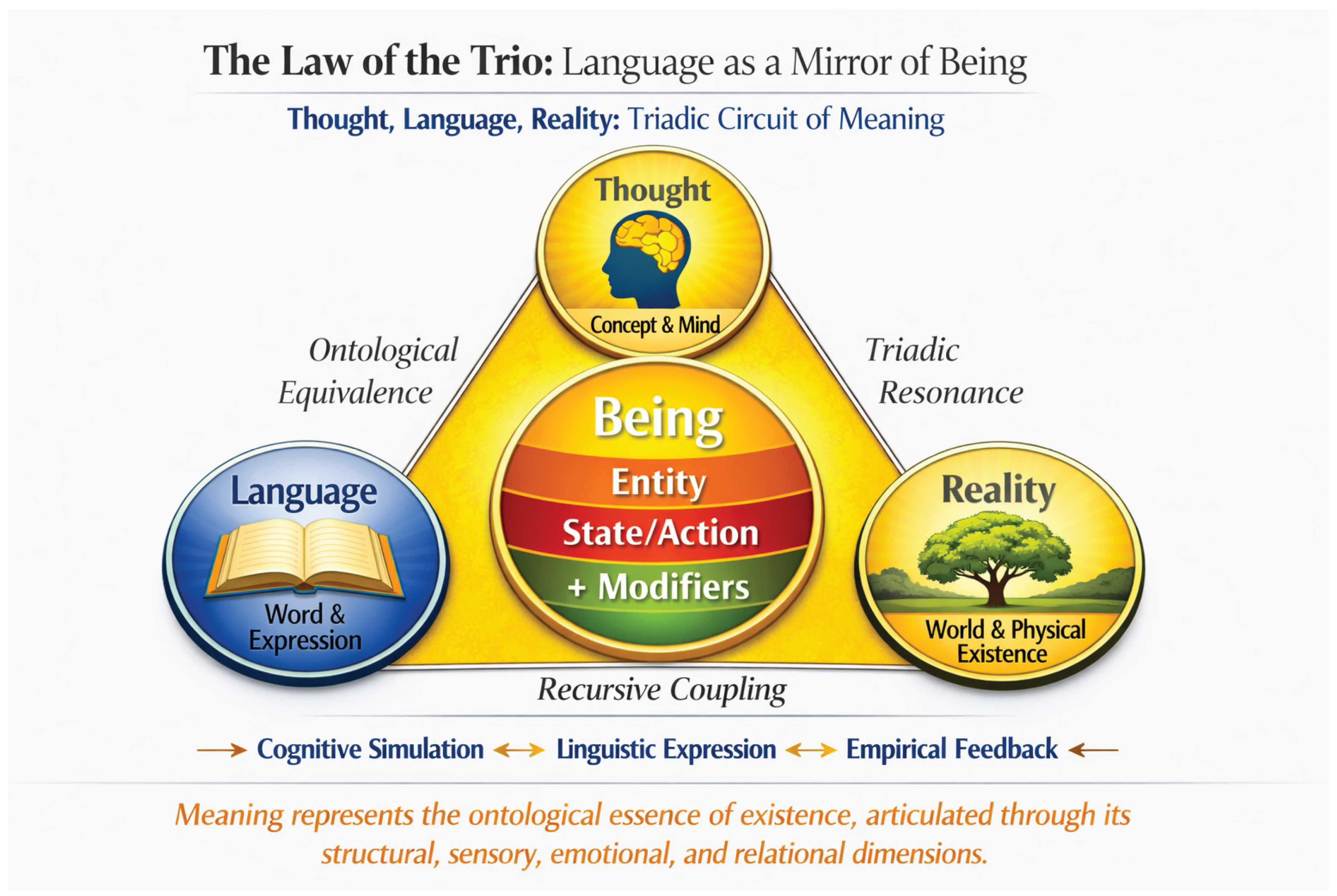

Table 1.
Comparative synthesis of SLA frameworks and Law of the Trio reframing.
| Framework | View of Interlanguage | Residue Left Behind | Law of the Trio Reframing |
| Cognitive | Incomplete automatization | Mechanistic processing | Language as resonance with reality |
| Generative | Partial UG access | Structural deficit | Language as ontological modality |
| Sociocultural | Mediated performance | Contextual dependence | Learners as autonomous agents of meaning |
| Complexity | Emergent turbulence | Chaotic flux | Acquisition as ordered creativity |
Table 2.
Comparison of Menezes’ complexity/chaos model and the Law of the Trio’s ontological order.
| Dimension | Menezes (2013) – Complexity/Chaos Model | Law of the Trio – Ontological Order |
| Core View of SLA | SLA is a complex adaptive system operating at the “edge of chaos.” | SLA is a natural ontological process identical in principle to L1 acquisition. |
| Role of Interlanguage | A strange attractor — unstable, sensitive to initial conditions, producing unpredictable shifts. | Not an independent grammar, but the visible trace of subsystem engagement across modalities. |
| Subsystem Integration | Subsystems (input, output, interaction, UG, sociocultural, connectionism) coexist but remain fragmented. | Subsystems are structurally homologous and unified through entity–state–behavior recursion. |
| Learning Dynamics | Progress emerges from turbulence, instability, and creative chaos. | Progress emerges from resonance with reality, thought, and language — ordered recursion. |
| Pedagogical Implication | Teachers should “disturb equilibrium” to provoke chaos and creativity. | Teachers should guide learners to map reality into language via triadic recursion, avoiding turbulence. |
| Outcome of L2 Learning | Acquisition is heterogeneous, contingent, and unpredictable. | Acquisition is ordered, recursive, and capable of surpassing native competence. |
| Philosophical Basis | Chaos/complexity theory; instability as creative necessity. | Ontological linguistics; meaning as recursive enactment of existence. |
Table 3.
Comparison of Chomsky’s generative grammar and the Law of the Trio’s ontological geometry.
| Dimension | Chomsky (Generative Grammar) | Law of the Trio – Ontological Geometry |
| Focus of UG | Strong emphasis on syntax; semantics treated as secondary or arbitrary. | Syntax and semantics inseparable; syntax is the geometry of meaning itself. |
| Famous Example | “Colorless green ideas sleep furiously” — syntactically valid but semantically nonsensical. | Such sentences show misaligned semantic enactment, not autonomy of syntax. |
| View of Syntax | Autonomous computational system, governed by innate structural rules. | Patterned articulation of semantics; visible trace of entity–state recursion. |
| View of Semantics | Arbitrary, external to syntactic competence. | Core substance of linguistic structure; meaning enacted through state/action of entities. |
| Universal Grammar Basis | Abstract phrase structure rules. | Ontological law: recursive coupling of entity and state/behavior across modalities. |
| Modalities | Language competence modeled as syntactic knowledge. | Language, thought, and reality are structurally equivalent modalities of existence. |
| Implication for SLA | Learners must master syntactic rules; semantics secondary. | Learners acquire semantic geometries; syntax emerges naturally from meaning. |
Table 4.
Comparison of connectionism’s neural network model and the Law of the Trio’s ontological order.
Table 4.
Comparison of connectionism’s neural network model and the Law of the Trio’s ontological order.
| Dimension | Connectionism – Neural Network Model | Law of the Trio – Ontological Order |
| Initial State of SLA | Neural apparatus highly plastic in childhood, but later “tuned and committed” to L1. | Plasticity remains lifelong; L1 does not constrain L2 acquisition. |
| View of L2 Difficulty | L2 harder because neural networks are already shaped by L1. | L2 learned like any other skill; acquisition is natural and ordered. |
| Role of Interlanguage | Evidence of limited processing capacity and network rigidity. | Visible trajectory of subsystem engagement; not deficit but resonance. |
| Biological Assumption | Neural plasticity diminishes significantly after L1. | Continuous renewal and reorganization of neural networks throughout life. |
| Learning Mechanism | Strengthening/weakening of associative connections through exposure. | Recursive enactment of meaning across modalities (entity–state–modifier geometry). |
| Philosophical Basis | Cognitive processing model; L1 as privileged anchor. | Ontological linguistics; language, thought, and reality structurally equivalent. |
| Outcome of L2 Learning | Acquisition constrained, often less complete than L1. | Acquisition capable of surpassing native competence; creativity and innovation possible. |
Disclaimer/Publisher’s Note: The statements, opinions and data contained in all publications are solely those of the individual author(s) and contributor(s) and not of MDPI and/or the editor(s). MDPI and/or the editor(s) disclaim responsibility for any injury to people or property resulting from any ideas, methods, instructions or products referred to in the content. |
© 2026 by the authors. Licensee MDPI, Basel, Switzerland. This article is an open access article distributed under the terms and conditions of the Creative Commons Attribution (CC BY) license (http://creativecommons.org/licenses/by/4.0/).
Copyright: This open access article is published under a Creative Commons CC BY 4.0 license, which permit the free download, distribution, and reuse, provided that the author and preprint are cited in any reuse.


