
Submitted:
13 July 2026
Posted:
15 July 2026
You are already at the latest version
Abstract
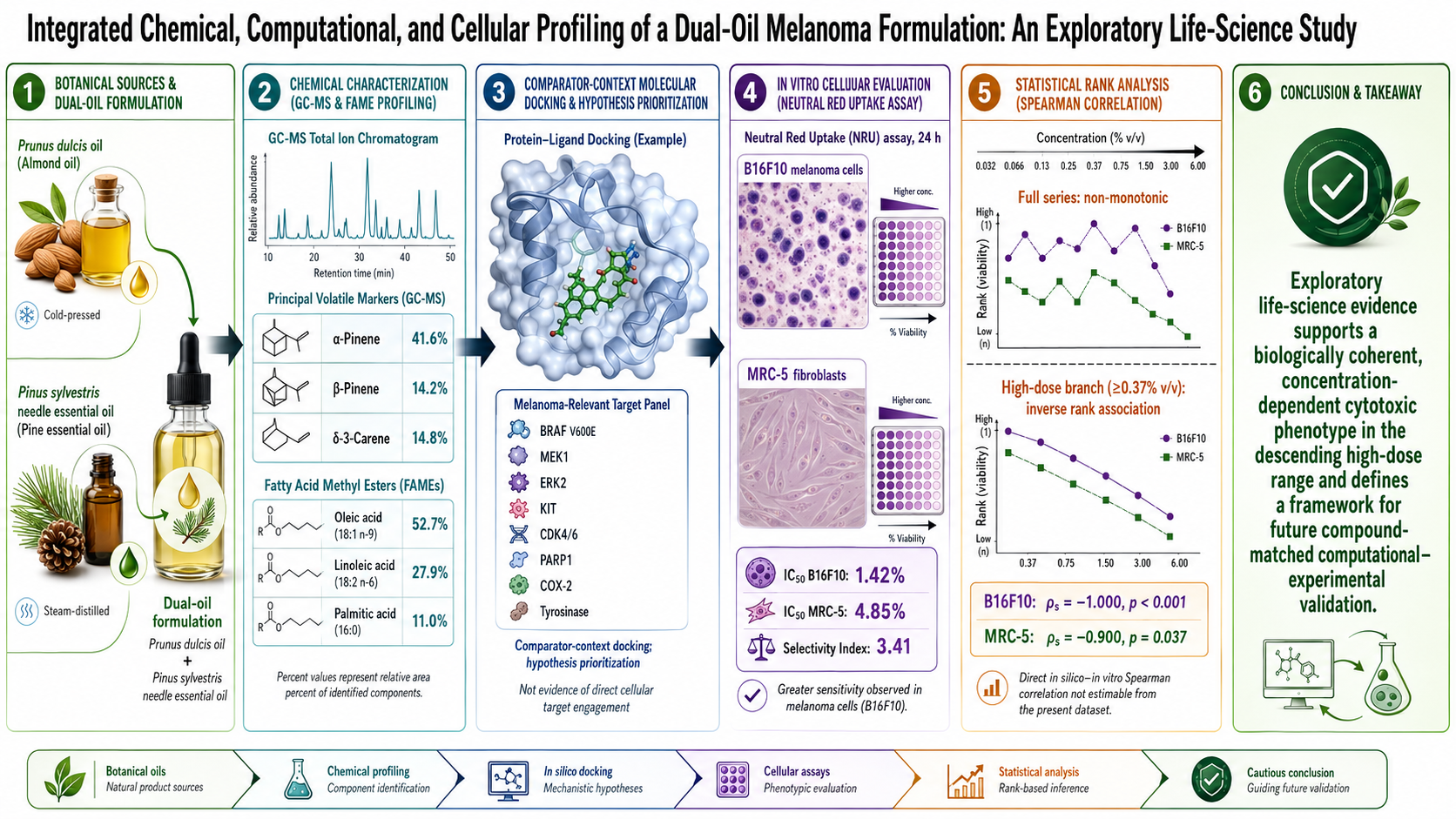
Background: Malignant melanoma is characterized by molecular heterogeneity, adap-tive signaling, and limited durability of therapeutic responses. This exploratory study examined a chemically characterized dual-oil formulation composed of cold-pressed Prunus dulcis oil and Pinus sylvestris needle essential oil as an integrated life-science model linking formulation chemistry, comparator-context molecular docking, and cel-lular viability. Methods: GC-MS/FAME profiling defined the principal formula-tion-associated markers. Docking was used to prioritize structurally plausible interac-tions across a melanoma-relevant target panel, while Neutral Red Uptake assays quan-tified 24-h viability in B16F10 melanoma cells and MRC-5 fibroblasts. Spearman rank analysis was applied to the concentration–viability series to test monotonic biological coherence; a direct component-level docking-to-cellular correlation was prospectively evaluated for estimability. Results: The combined formulation yielded estimated IC50 values of 1.42% in B16F10 cells and 4.85% in MRC-5 cells (selectivity index, 3.41). Across the complete concentration range, the relationship was non-monotonic (B16F10: ρs = −0.429, p = 0.289; MRC-5: ρs = −0.381, p = 0.352), whereas the descending high-dose branch (≥0.37% v/v) showed strong inverse rank associations (B16F10: ρs = −1.000, p < 0.001; MRC-5: ρs = −0.900, p = 0.037). A statistically valid direct in silico–in vitro Spear-man coefficient could not be calculated because compound-resolved cellular pheno-types were unavailable for the six docked chemical markers. Conclusions: The data support a biologically coherent, concentration-dependent cytotoxic phenotype within the descending exposure range and define a rigorous framework for future com-pound-matched computational–experimental validation. The study should be inter-preted as hypothesis-generating rather than as evidence of cellular target engagement or therapeutic efficacy.
Keywords:
malignant melanoma
; Prunus dulcis
; Pinus sylvestris
; α-pinene
; GC-MS
; molecular docking
; neutral red uptake assay
; Spearman rank correlation
; translational life science
; preclinical validation
Copyright: This open access article is published under a Creative Commons CC BY 4.0 license, which permit the free download, distribution, and reuse, provided that the author and preprint are cited in any reuse.


