
Submitted:
11 July 2026
Posted:
15 July 2026
You are already at the latest version
Abstract
The concept of sense of place has long been central to human geography, environmental psychology, landscape studies, and heritage discourse. Traditionally understood as the emotional, experiential, and symbolic meanings people attach to places, sense of place has evolved alongside changing interpretations of landscape and heritage. This paper revisits the concept of sense of place and critically examines its interaction with landscape and heritage frameworks. By tracing theoretical developments and exploring contemporary challenges—such as globalization, heritage commodification, and climate change—the paper argues that sense of place remains a vital integrative concept. It enables a deeper understanding of how landscapes and heritage sites are lived, remembered, contested, and managed. The paper concludes that recognizing the dynamic and relational nature of sense of place is essential for sustainable landscape planning and inclusive heritage practices.
Keywords:
sense of place
; landscape
; heritage
; cultural landscape
; identity
; place attachment
Theme
Sense of place is a term repeatedly used in a wide range of applications across various disciplines. This paper specifically focuses on, and reviews, the relationship between people and places/landscape settings, rural and urban, and how we react to them physically and how we perceive them. In addition to rural settings, attention centring on urban places that acknowledges the critical role of community engagement has gathered momentum over the last 35+ years as the debate on conservation of urban heritage has expanded [1]. In both rural and urban locations the focus is on (i) the settings where we live, work, recreate which promote a sense of belonging and identity both physically and also mentally related to their cultural meanings and (ii) through our perception of places from our past with their associated memories and sense of identity. These are the places/landscapes that have tangible and intangible associations for people. Here I deliberately use the term ‘places’ rather than ‘spaces’ for reasons set out later in this paper. Sense of place is, therefore, a multidimensional, complex construct reflecting the relationship between people and their (spatial) settings [2]. It has long been a critical topic in human geography scholarly debate so that as Casey [3] opines ‘A remarkable convergence between geography and philosophy has become increasingly manifest’ and that it is a collaboration between the two that has been evident since attention to place emerged with the work of [4] Relph (1976) and [5] Tuan (1976). (See below for further discussion). It has also been a focus for anthropological studies.
Coincidental with, and partially preceding Relph and Tuan is the work of George Seddon [6] with Sense of place: a response to an environment: the Swan Coastal Plain, Western Australia and also Landprints and Reflections on Place and Landscape (Seddon [7]1. Seddon’s works are a pre-eminent and comprehensive contribution to an Australian sense of place which has universal application. This is clearly apparent in the discerning comment that ‘A sense of place shows most clearly in the way the community feels about and uses the landscape’ [6]. Nevertheless all too often Seddon’s work is overlooked in so-called mainstream literature on sense of place. Perhaps this is because his writing ‘is characterised by an enduring attention to both landscape and environment, and a bringing together knowledge from the arts and the sciences’ [8]. Seddon makes it clear he did not invent the term. Nevertheless his introduction of sense of place into the fields of landscape and environmental design was an astute move. On a personal note I well recall when I was teaching in a landscape architecture program in the 1990s the frustration of dealing with landscape assessments that focused on reactions of people to the seen landscape and what constituted the most liked landscapes, e.g. those that included diversity of topography and vegetation. This was done either on site with people asked to rank the views on a scale of preference or done off site using photographs. I also recall Seddon dismissing these approaches as ‘the trivial pursuit of landscape.’
At this point we may ask where does the concept of landscape slot into thinking on changing perspectives in heritage. In addressing this question is the understanding that one of our deepest needs is for a sense of identity and belonging [9]. In this context the three words ‘identity’, ‘memory’ and ‘belonging’ are invariably linked with what is meant by sense of place. In this connection a common denominator in this is human attachment to landscape and how we find identity in landscape and place and that such a phenomenon is cross cultural. Nevertheless as Stilgoe [10] speculated:
Landscape is a slippery word. It means more than scenery, painting, pleasant rural vista, or ornamental planting around a country house. It means shaped land, land modified for permanent human occupation, for dwelling, agriculture, manufacturing, government, worship, for pleasure. A landscape happens not by chance but contrivance, by premeditation, design …
In effect, Stilgoe in using the words ‘shaped land, land modified for permanent human occupation, for dwelling, agriculture, manufacturing, government, worship, for pleasure…’ was going beyond the term ‘landscape’ to encompass the meaning of ‘the landscape’. Inquiry on landscape in cultural (human) geography and related disciplines such as anthropology since the late 1970s has thrived2. In doing so it has progressively delved into landscape not simply or predominantly as history or a physical cultural product, but also ─ and more significantly ─ as cultural process reflecting human action over time with associated pluralistic meanings and human values [11]. It reflects David Lowental’s [12] view that
…it is the landscape as a whole - that largely man-made tapestry, in which all other artefacts re embedded … which gives then their sense of place. (words in bold my emphasis).
Notably Mitchell [13] suggested the need to ‘think of landscape not as object to be seen or a text to be read, but as a process by which identities are formed … (think) not just what landscape “is” or “means”, but what it does, how it works as cultural practice.’ In this vein it is what Olwig [14] neatly calls ‘an active scene of practice.’ Here Mitchell and Olwig are referring to sense of place by any other name. J B Jackson [15] in his inimitable, unpretentious approach suggested that ‘we are not spectators: the human landscape is not a work of art. It is the temporary product of much sweat and hardship and earnest thought … and we should never tinker with the landscape without thinking of those who live in the midst of it.’ Jackson’s interest was essentially in the patterns in the landscape and the processes that shaped these. J B Jackson offered an illuminating vignette of the derivation of the word ‘landscape’ as ‘a space on the surface of the earth; intuitively we know that it is a space with a degree of permanence, with its own distinctive character, either topographical or cultural, and above all a space shared by a group of people’ (my emphasis) [16]. He then briefly discusses the origin of the word in Old English, German, Dutch, and French connections. Above all his focus is the everyday, vernacular landscape in which we conduct our activities: ‘a composition of man-made or man-modified spaces to serve as infrastructure or background for our collective existence’ that underscores our identity, presence and history [16]. Within this surely is the essence of sense of place. Indeed J B Jackson has been a major contributor to sense of place studies
Inevitably when we refer to human settings there is crossover between the constructs of landscape and/or places3. Barrell [17] reflects on the word ‘landscape’ and its use for example when we refer to the ‘landscape’ of a particular locality. He uses an example in the UK, a county (e.g. the landscape of Derbyshire). It immediately suggests notions of value and form and seeing in a certain way, i.e. seeing it pictorially. He compares this to the word ‘terrain’ which he posits is awkward and limited in its application. He suggests also that such notions of landscape have painterly connections (see below) and that this led to landscape being regarded as a visual phenomenon replete with meanings as beguilingly expressed by Milton [18] in his 1654 pastoral poem L’Allegro: ‘Streit mine eye hath caught new pleasures Whilst the lantskip round it measures.’ It should be noted that Milton referred to ‘the landscape’ (lantskip). As more reference over time came to be made of the landscape of a place it has outstepped the limitations of space which the sense of a landscape had imposed [17].
Landscape, Art and Place Identity
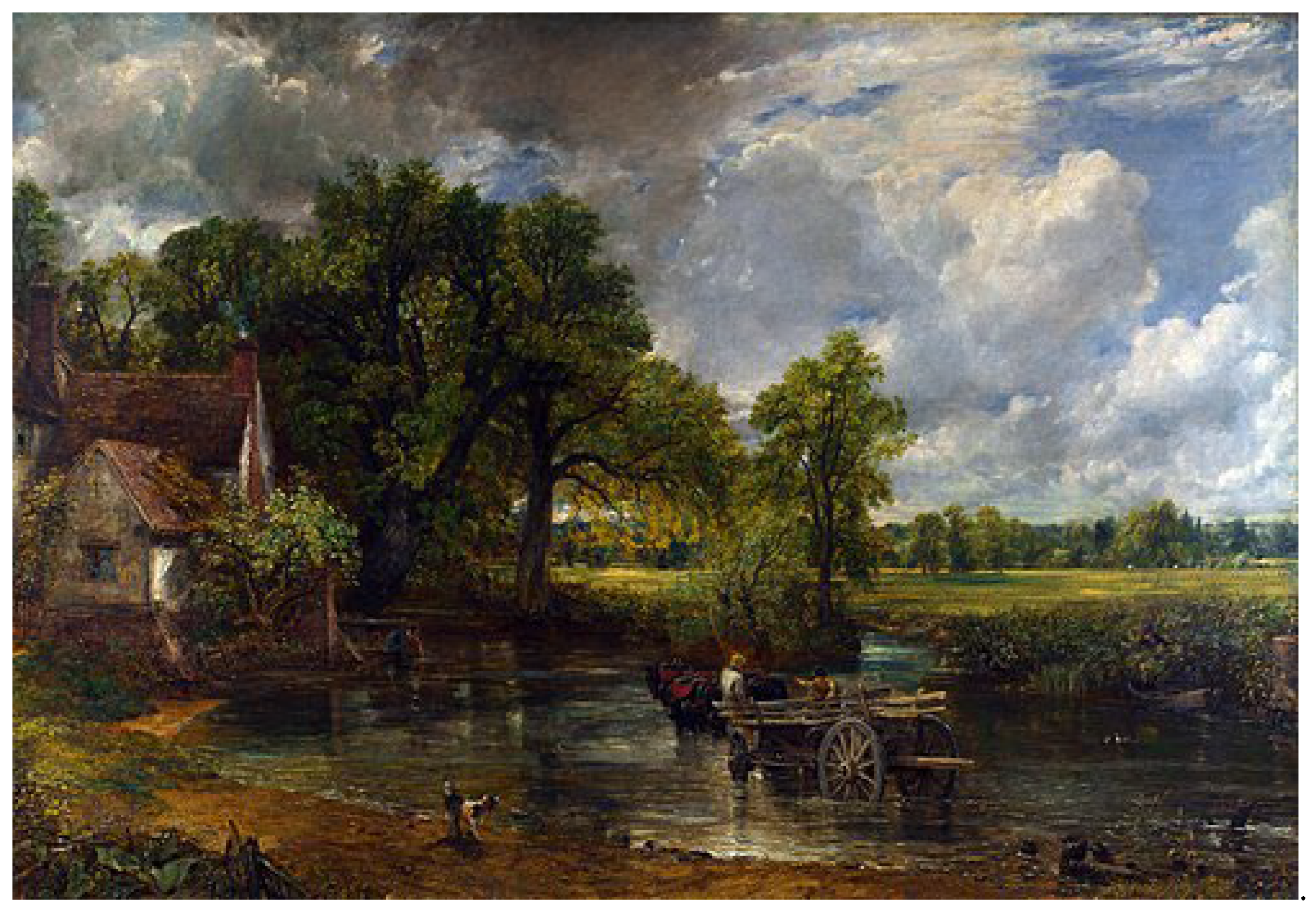
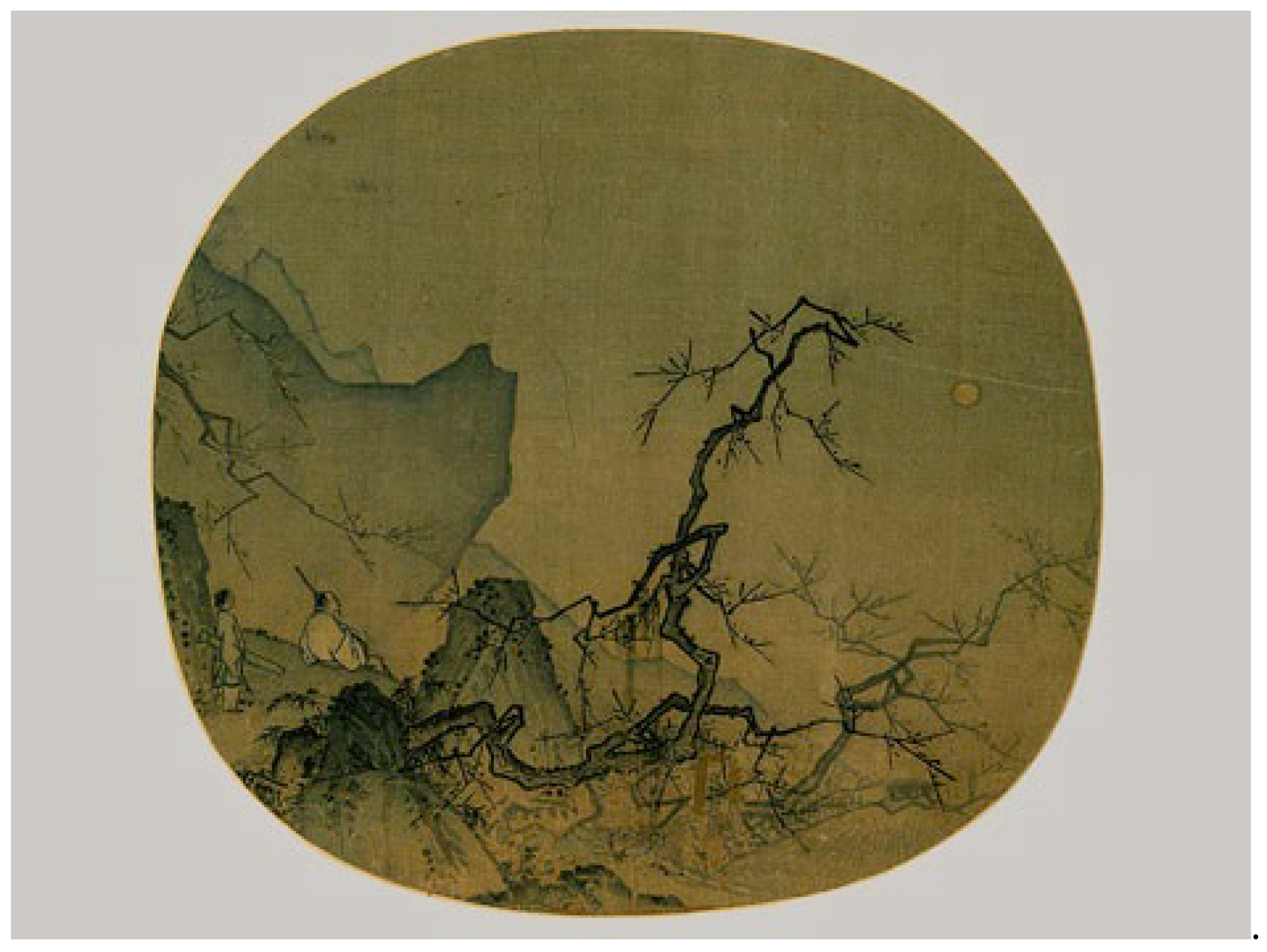
There is a long-standing link between paintings and how we see landscape (the landscape?). Indeed the sense of place concept inherent in seeing, thinking of, and experiencing landscape is intrinsic to pictorial images as in landscape paintings. Think of John Constable’s famous rural image of the English countryside, The Hay Wain (1821) , and how it encapsulated (and still does) the admired English picturesque landscape movement redolent of the 18th and early 19th centuries, as seen in the work of the two great landscape designers, William Kent and Lancelot (Capability) Brown. Kent’s work at Rousham for example represents the first phase of English picturesque landscape design where reflections of nature were central to concepts of landscape. Rousham remains almost as Kent left it illustrating why Horace Walpole, writer, historian and antiquarian, famously declared that Kent ‘leapt the fence and saw that all nature was a garden’. In contrast is a renowned historic Chinese example Viewing Plum Blossom by Moonlight (Ma Yuan ca. 1190–1225) from the early 13th century, Southern Song dynasty (Figure 3). It is an exquisite delicate painting on silk (originally on a fan) celebrated for its evocative representation of nature and human emotion. The painting captures a serene scene of a scholar admiring plum blossom. The composition is characterized by the contrast between the dark hues of the trees and rocks juxtaposed with the light tones of the moonlit sky and the tranquility of an early spring evening and symbolism of the plum blossom’s resilient beauty. The scholar’s presence suggests connection between humanity and nature reflecting ideals of harmony and balance. The painting inspires viewers to contemplate the beauty of nature and the introspective moment it inspires (Metropolitan Museum of Modern Art: https://metmuseum.org/art/collection/search44638).
Figure 1.
The Hay Wain, John Constable 1821.
Critical to the link between Western landscape perception and art were the compositions particularly of Claude4 (c1604/1682), but also Poussin (1594/1665). Claude spent most of his life in Italy and is one of the earliest artists to concentrate on landscape painting.
Figure 2.
Viewing Plum Blossom by Moonlight.
Alexander Pope the English poet, translator, and satirist of the Enlightenment era, considered one of the most prominent English poets of the early 18th century, had suggested in 1734, that "all gardening is landscape painting. Just like a landscape hung up." Pope was not speaking in a detached from reality sense in that at Twickenham he had created his now famous grotto and gardens that presaged the eighteenth-century English landscape movement [19].In this context Claude’s landscapes were representations of idealised scenes of improved and selected nature, possibly based on real life places. They were idealised into the flowing dreamlike images of pastoral beauty with the addition of small figures typically representing scenes from the bible or classical mythology, thereby forming a genre of history paintings. The links between paintings, poetry, creating gardens and study of aesthetics in a complex of associations and meanings underpinned the idea that ‘recognition of the formal structure of a landscape was not a purely passive activity’ [17] whereby:
The contemplation of landscape was not, then, a passive activity: it involved reconstructing the landscape in the imagination, according to the principles of composition that had to be learned, and were indeed learned so thoroughly that in the later eighteenth century it became impossible for anyone with an aesthetic interest in landscape to look at the countryside without applying them. [17].
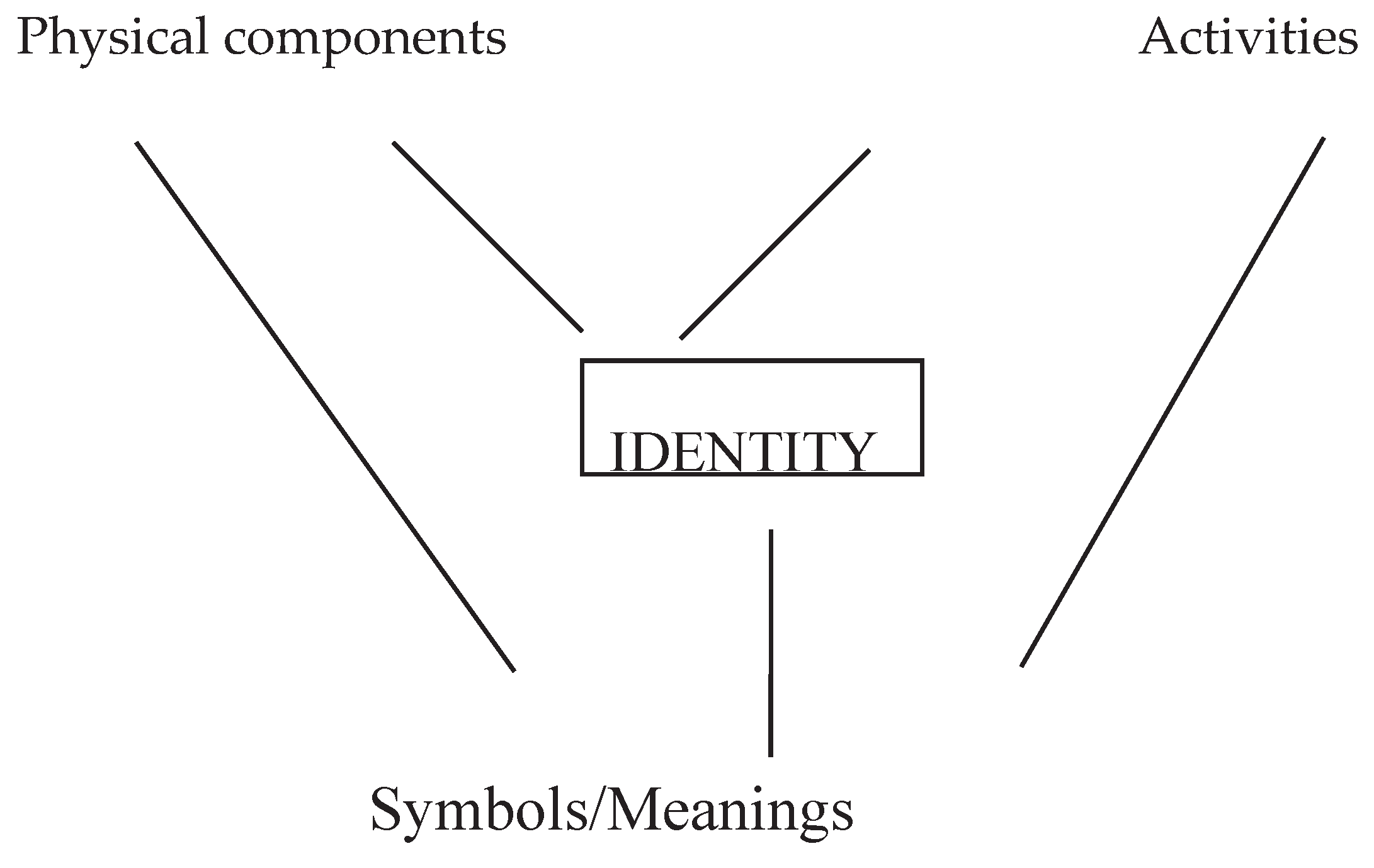
The places we inhabit, therefore, are marked by distinctive characteristics. These are tangible, as in the physical patterns and components of our surrounds, and intangible as in the symbolic meanings and values we associate with places and landscapes, and also to objects and to traditional ways of expression as in language, art, song, dance. In this way physical spaces, sites and objects become places in the wider cultural landscape setting. They offer a past, are part of the present and suggest future continuity. It is these places with their association of meanings which give rise to local identity and sense of place of communities (Figure 3).
Figure 3.
Place identity and its components (Taylor adapted from Relph 1976).
Sense of Place: What Is It?
Landscape, Place, Space
Consistent with the title of this review using the term ‘landscape’, attention is drawn to Relph’s 1976 book [4] highly apposite observation that ‘The spirit of a place lies in its landscape’. Relph’s book fifty years on stands as a foundational and highly influential leader in place theory5 and sense of place, a topic he has continued to explore. The term ‘spirit’ has associational connections and meanings in the sense of spirit as ‘the non-physical part of a person … the seat of emotions and character; the soul’ (OED6). In this way the abstract idea of spirit is inseparable from the intangibility of the accumulation of human memories and meanings – private and collective – and identity that we associate with the word ‘landscape.’ Focusing on landscape as a key word, inevitably brings into consideration inquiry into the meaning of the words ‘places’ and ‘spaces’ and their relationship to ‘landscape.’
Critical to reflections sense of place are the words ‘space’, ‘place’, and ‘landscape’. We are apt to interchange these three words and use them synonymously, when in fact, whilst linked, they have different associations [5,13]. For Tuan, for example, space can be described as a location which has no social connections; no value has been added to it and no meaning ascribed to it. It is more or less abstract. Nevertheless, there is a relationship between space and place in that spaces become places when given human connections and meaning, either through physical interaction or in indirect and conceptual, symbolic ways [5] Relph [4] portrays this as ‘however we feel or know or explain space, there is always some associated sense or concept of place … space provides the context for place but derives its meaning from particular places.’ Tilley [20] dissects the space/place continuum as follows:
Space is a far more abstract construct than place. It provides a situational context for places, but derives its meaning from particular places (quoting Relph). Without places there can be no spaces, and the former have primary ontological significance as centres of bodily activity, human significance and emotional attachment … There may be strong affection for place (topophilia) or aversion (topophobia), but places are always far more than points or locations because they have distinctive meanings and values for persons. Personal and cultural identity is bound up with place.
Underpinning this review is the fact that over the past eighteen months or so I have acted as reviewer for a number of papers on sense of place (submitted to various journals) that have failed to comprehend its intricately laced interactive nature and cross references between different constructs of sense of place. One, for example, asserted that a sense of place exists without clear constructs. Notable is that in coming to this debateable conclusion it relied on limited citations from the past ten years. It thereby blithely ignored the extensive rich compendium of earlier critically significant scholarly and professional writings. Such an approach raises the question, do we want or need a standardised way of expressing sense of place, and if so, why? Hence the decision to attempt an up-to-date overview, taking a lead from the elegantly simple construction that ‘places not only are, they happen’[3A] (And it is because they happen that they lend themselves so well to narration, whether as history or as a story). Consistent with this thinking is that of Ingold [21] in his penetratingly perceptive essay ‘The temporality 7of landscape’ in which it is possible to see the concept of place and that of landscape are closely interconnected. It is where ‘the landscape tells—or rather is—a story’ linked to two themes. One is that human life is a process that involves the passage of time; second is that this is reflected in the formation of lived-in landscapes. Inherent in such thinking is that places and landscapes are not static, so that perceptions of places and landscape change are virtually synonymous.
Just as a particular place is at least several kinds of things, Casey [3] claims there are many sorts of places and not one basic kind only – one supposedly supreme genus [3]. He examines how to be in place is to know, is to become aware of one’s very consciousness and sensuous presence in the world. From there Casey argues that the experience of place is no secondary grid overlaid on the presumed primacy of space. ‘Rather …place is the most fundamental form of embodied experience – the site of powerful fusion of self, space, and time.’ . The term ‘experience of place’ in these observations is sense of place by any other name with implications for what sense of place is. Nevertheless there are examples of sense of place being used in contexts that may be seen as spurious, as in real-estate advertisements [22] as noted by Relph (nd) [32] reflects on this phenomenon with extravagant use of terms such as ‘luxurious’, ‘waterfront estate’, ‘prestigious’, ‘historic ambience’ as a naive substitution for spirit of place which is unfortunate and best avoided.
Genius Loci
There is a range of definitions/alternative words for expressing what is meant by sense of place. In particular is genius loci connected with the concept of spirit of place. The term ‘Genius Loci’ refers to the protective spirit associated with a particular location in ancient Roman religion. This spirit was believed to embody the essence of place, serving as its guardian and protector. The Genius Loci was integral to Roman spiritual life as it was invoked in rituals and offerings to ensure the safety and prosperity of the community and its environment (Wikipedia +1). Specific locations were therefore thought to possess spiritual significance. These sprits were revered in various settings, from homes to public spaces, and were often invoked during rituals to seek their favour and protection. Over time, the notion of the Genius Loci evolved, expanding from deities to include a broader range of sacred sites such as temples and natural landmarks (mythologyworldwide.com). Here can be seen the concept of the ordinarily sacred places which are recognised in cultural heritage conservation. Through time the concept of genius loci has widened to include not just special places but ordinary everyday places. Lynda Sexson [23] offers a theology of everyday experience that shows how the sense of place is found in the details and commonplaces of ordinary life.
Urban Form
In line with interest in urban settings, form and ordinary everyday places, the perceptive observation by J B Jackson’s offers food for thought [24] :
Most of us, I suspect, without giving much thought to the matter, would say that a sense of place, a sense of being at home in a town or city, grows as we become accustomed to it and learn to know its peculiarities. It is my belief that a sense of place is something that we ourselves create in the course of time. It is the result of habit or custom..
Inherent and influential deliberations on urban form were central to the innovative thinking of Kevin Lynch [25] and Gordon Cullen [26]. Lynch focused on the imageability of a city and its legibility for people. He used three cities (Boston, Jersey City and Los Angeles) for gathering information by interviewing inhabitants to review the mental images or pictures that people perceive as they move around the city, i.e. their conceptions of the city form. From interviews with inhabitants on the streets and sketch maps drawn by them, he proposed that what featured most in the images were: paths, edges, nodes (centres) districts and landmarks and that these images are used by people to navigate their way through the city. He created for a central part of Boston ‘a diagrammatic representation of its major visual elements derived from the field reconnaissance’ [25] where people navigate through the city mainly by spatial images. In a later book [27], in understanding the central role of landscape in the story of people, events and places through time offering a sense of continuity and sense of place, beautifully expresses this process as representing a sense of the stream of time.
Cullen introduced the concept of townscape on the basis that a city is more than the sum of its parts and one reasons why people like to live in communities. He suggests we need to try to understand ‘the visual impact which a city has on those who live in it or visit it’ [27]. In effect Cullen saw the city as a series of urban spaces and ‘analyses the experiences we have of urban spaces from the perspective of the person in the street [in order] to establish the fundamental components of that experience, noting particularly the importance of serial vision, of places or centres, and of the content of those places’ [4]. To illustrate his ideas of serial vision and sequence of experiences Cullen [28] sketched a series of these spatial experiences―such as enclosure, precincts , focal points―based on a plan with eight sequential movements from one space to another representing different human experiences of places. He then enlarges on this concept of spatial experience in an engaging series of examples highlighting aspects such as closed vistas, punctuation, narrowing, definition, accessible outdoor rooms: all sense of place by any other name.
Overview: Sense of Place Constructs
Alexander Pope (1731) the English poet, translator, and satirist of the Enlightenment era (see above) suggested the concept of genius loci should be considered as a critically important principle in garden and landscape design. Here there are cross references to the approach taken by Seddon [6]. Pope set out this thesis in his Epistle IV, to Richard Boyle, Earl of Burlington[29]:
Consult the Genius of the Place in all;
- That tells the Waters or to rise, or fall,
- Or helps th' ambitious Hill the heav'n to scale,
- Or scoops in circling theatres the Vale,
- Calls in the Country, catches opening glades,
- Joins willing woods, and varies shades from shades,
- Now breaks or now directs, th' intending Lines;
- Paints as you plant, and, as you work, designs.
Underlying my comments is the question to what extent Sense of Place and its meanings ̶ or perhaps more accurately Senses of Place ̶ can be measured satisfactorily through questionnaires and/or interviews of numbers of people living in or visiting a place? Certainly they may be measured quantitatively, but what about people’s reactions and feelings about the place?, i.e.qualitative experiences that people associate with places. Is it feasible and indeed relevant to combine quantitative and qualitative approaches? The architectural historian Norberg-Schutz [30] did in his discussion of the essence of places, exploring how architecture transcends mere physical structures to embody the spirit of a locale. Using the conceptual framework of genius loci, or the spirit of place, Norberg-Schulz explored the connection between human experience and the environment, arguing that every place has an intrinsic character that influences and nurtures our sense of being. Similarly Eyles [31] in his book Senses of Place addresses views/experiences of people living in a small town (Towcester) in the Midlands of England. Eyles adopted an approach to surveying residents’ senses of place inquiring into connections between knowledge and human interest in which quantitative and qualitative methods were relevant in identifying ten different senses of place:
Social
Apathetic-acquiescent
Instrumental
Nostalgic
Commodity
Platform/stage
Family
Way of life
Roots
Environmental
Of the ten Relph (nd) [32] suggests the following are the most important.
Social – dominated by social ties and interactions
Apathetic or acquiescent – no sense of place; little interest in place
Instrumental – place regarded either as a means to an end or as preventing opportunities in terms of providing goods, services and formal opportunities
Nostalgic – dominated by feelings about the past
Substantially less important were the following, which are usually treated in discussion of sense of place as essential:
- Family
- Roots
- Environment
Regardless of whether Eyles’ conclusions apply elsewhere, Relph (nd) [32] proposes Eyles’ work is important because it shows that sense of place is not some sort of universally consistent response to the places (landscapes?) where we live, have lived or visit. Responses vary place to place, vary for the same place and vary over time. Further to this aspect it is critical to understand that responses to sense of place inquiry may be negative as well as positive, and if negative the reasons why may, on further research and inquiry, hold the key to understanding why. Erfani [33] clearly spells out the reasons that sense of place is not universally consistent:
Sense of place has long been used to explain the relationships between humans and places. Sense of place refers to various socio-cultural, emotional, and psychological meanings, values, and feelings humans may attribute to places, individually and as a community. Sense of place as an overarching concept that explains human–place relations arguably include the other place-based constructs of place attachment, place identity, place satisfaction, and place dependence. Sense of place is a dynamic concept that varies in time and space. Individuals may develop different senses of place at different stages of their lives and in various socio-cultural settings [33]
Ambiguity of Place Nostalgia
A word consistently associated with sense of place is nostalgia. Is it merely a sentimentality for the past, typically for a period or place with pleasant personal associations or does it have deeper meanings and applicability in urban heritage conservation? Bideau and Yan [34] -- using the case of the traditional Gulou precinct (Beijing) -- suggest that nostalgia is ambiguous. It has resulted in some residents moving out and some staying as upgrading has taken place, leading to the authors’ assumption ‘that nostalgic feelings would drive residents to want to stay’ by no means applied to all residents. They observed ‘that by expressing nostalgic attachment to their neighbourhood, many residents were actually legitimising their willingness to move. Emotional attachment does not transform into an act of attachment … [so that] there are multiple layers of nostalgia. And those that could easily be overturned by economic compensation may not be seen as nostalgic as other forms of nostalgia.’ In a context of looking at the past Zhang [35] proposes that it can be approached through the lenses of history, memory, and heritage, among which heritage serves as a body of selected history and memory where history attaches itself to events, memory attaches itself to objects and places. Consequent to this Zhang [35] claims, using an urban analogy, that in relation to an urban setting the city can be regarded as its people’s collective memory (quoting Rossi [36]).
The significance of nostalgia in urban heritage conservation thinking is succinctly summarised by Smith and Campbell [37]:
It is also important to note that recognising nostalgia as a form of affective practice allows us to shear it of its long association with melancholy, maudlin sentimentality and futile longing, and recognise at least the potential for it to be present centred, and available for inspiring thinking and imagining that is oriented to the future. As a process of remembering that is overtly, and often unashamedly, emotional, nostalgia is an important phenomenon in understanding how the past is both brought to bear on the present and on the development of social and political agendas for the future.
Berliner [38] refers to the above phenomenon where the interface between nostalgia, urban memory and change occurs as ‘multiple nostalgias’ in his discourse on Luang Prabang. He suggests that contrary to received wisdom from some experts and sometimes scholars who may criticise changes that take place, local communities may see things differently and welcome change that brings economic opportunity. Such is the case at the World Heritage site of Luang Prabang, listed in 1995. Berliner [38] also addresses the idea of multiple and conflicting nostalgias between foreign heritage experts, expatriates and international tourists looking from a ‘Western romanticized perception of Buddhism and colonial perceptions of other people’s traditional life ... the charme nostalgique’ in contrast to perceptions and values of local people. Many of the latter rent their houses in the old centre to foreigners and happily go to live in the suburbs in what they see as better modern housing, or the houses are turned into tourist guest houses. What experts describe as ‘kitsch’ – pane glass and new windows, flowerpots, fences and lacquer – ‘are widely adored by locals’ [38] who also insist that tradition is not changing, custom is not disappearing, nor do they long for the world that some foreign experts and tourists lament has disappeared. One may speculate whether the focus on integrity of architectural style and bricks, stone, timber seemingly devoid of socially meaningful cultural associative values at Luang Prabang would be prominent if the World Heritage nomination had been a decade later in the mid to late-2000s when UNESCO thinking on urban conservation turned to the historic urban landscapes (HUL) paradigm and cities as cultural landscapes? Similarly in this context Bideau and Yan [34] outline tension between the local population of Gulou and the official municipal planning commission approach of preservation of what is seen as a nostalgic neighbourhood. Consequently the local community struggled to have their voice heard in support of their maintaining their social and cultural livelihood against official heritage nostalgia which is based on preserving physical setting.
Another word consistently linked with sense of place is ‘communities’ or ‘community’. Again like ‘landscape’ community is a slippery term, or more to the point a contradictory phenomenon in that sense of community may be absent. It may also be an alienating experience as well as a fulfilling one. In this connection Eyles [31] emphasises:
The concept of community is, however, not without problems. While it often refers to a territorial entity, often the village or neighbourhood, it remains an evocative idea ̶ ambiguous, nebulous, almost intangible, yet retaining significance in both academic practice and everyday life. For the former, it remains a starting point, albeit flawed, for the investigation of localised social relationships and institutions and the interpretation of images and meanings which individuals and groups hold about the world and themselves. For the latter, community in some unspecified way refers to a place or sense of refuge where people … interact or imply peacefully coexist. It has the connotations of home, roots, belonging.
Such considerations prompt the question of whether there is such a thing as ‘the community’ reflecting one cohesive group in considering sense of place? In effect within any given community there will frequently be different groups (communities?) with dissimilar viewpoints of their sense of place. In dealing with these different groups it is critical not to take action or decisions on possible changes on the basis of the views of one person supposedly speaking on behalf of the community, i.e. the spokesperson, as the only viewpoint on sense of place. It is essential that a pluralistic range of views and ideas has been canvassed. Having input on a range of ideas and opinions from a range of participants is essential.
Identity, Memory: Attachment to Places
Place meaning and sense of place are inextricably linked with the question of why people revisit places from their past or visit places to experience a connection with the past of their ancestors. This is despite the old dictum ‘never go back.’ People are curious and will want to go back to places either physically or through reclaiming memories and sense of belonging and identity. This is not always a positive experience, such as loss of places that have changed beyond recognition or simply disappeared. Read [39] explores this in a thoughtful, provoking study of human emotional and psychological impacts of losing a place. He probes the reasons underlying human attachment to places such as homes and neighbourhoods or even whole towns cleared for redevelopment. Read’s narrative is disturbing but also strangely inspirational in terms of human reaction to loss8.
Zhu [40] throws interesting light on a particular form of remembering place through diaspora tourism in China. Zhu tracks how in 2014 a group of about eighty people known as Dungans from Kazakhstan, Kyrgyzstan and Uzbekistan travelled in a ‘Homecoming event’ to Xi’an in China to celebrate their return after over 140 years of displacement from their homeland. The term "Dungan" has been used by Central Asian Turkic and Tajik-speaking people to refer to Chinese-speaking Muslims for several centuries. They were forced to leave originally after failed uprisings against the government of the Qing Empire. By their return diaspora communities gain a sense of belonging through connecting with their roots to their ancestral homeland and its people. It has now become a weeklong annual event organised by the Cultural Centre of the Muslim Quarter and the district government of Lianhu of Xi’an. The Municipal Office of Foreign Affairs of Xi’an, the Municipal Bureau of Tourism, the Bureau of Ethnic and Religious Affairs and local Business Associations in the Muslim Quarter also contribute to planning and organising these annual events. The detailed itinerary of the tours was developed by the Cultural Centre of the Muslim Quarter.
Composed of various cultural and religious activities, the week-long tourism event celebrates the Dungan claim of homecoming and associated revitalised memories. Local organisers show everyday life of local residents (Hui) in the Muslim Quarter and how it is their home including local shops, ceremonial and religious events in the twelve mosques. Dungan businesspeople draw upon their ethnic solidarity, diasporic identity and origins to re-establish economic and cultural connection with Hui Muslims. Since the end of the Cold War, the relationship between China and its neighbouring countries in Central Asia has been strengthened due to the mutual needs of cultural and eco nomic exchange. The Dungan homecoming in Xi’an has become a case in point to show the roles of diaspora tourism and the ways homecoming strengthens the transnational connections.
Background: Plurality of Approaches and Commonality of Words and Ideas
At this point it is clear that there is no one straightforward definition of sense of place. Erfani addresses this question by asking do we need one and if so, why? [34], given that its concept and application vary across disciplines such as ‘environmental psychology, geography, urban and planning literature’. Nevertheless Erfani [41] in his comprehensive review of reconceptualisations of sense of place proposes that ‘discussion of the contributions from a plurality of approaches deepens our understanding of sense of place, its complexity, dynamic, and multidimensionality.’ In effect Erfani acknowledges the diversity of definitions, conceptual frameworks, and empirical methods to study people-place relations. He overviews an overarching conceptual framework aiming to connect disjointed aspects of this field of research through extensive literature searches. Emerging is a meaningful interrelationship that evolves between individual (self), community and place shown in Figure 4 (from Figure 2 in Erfani [4]). His study acknowledges the diversity and proposes an overarching conceptual framework aiming to connect disjointed aspects of this field of research in order to contribute to deepening the literature on sense of place.
There is an old adage that if you want to know where you are going it is a good idea to understand where you started. With this in mind and Erfani’s modelling there follows a brief inquiry into mainstream literature chronicling various steps through time and associated words relating to sense of place since the early 1960s. Why the early 1960s?: because 1961 was the year Jane Jacobs published her highly regarded book The Death and Life of Great American Cities [35]. She argued relentlessly and provocatively for efforts to protect neighbourhoods from urban renewal and slum clearance that were ignoring the feelings and needs of urban communities. She understood what makes streets safe or unsafe; what constitutes a neighbourhood, and what function it serves within the city at large. Further she grasped how sense of place works through the minds of the community. The work of Lynch and Cullen (see above) were contemporaneous with Jacobs, again reflecting developing concepts and scholarly sense of place linked to professional practice.
Words commonly associated with sense of place include: identity, memory, values including people/place relationships (positive and negative), community, time, landscape, well-being, belonging, culture9. Understanding these in terms of human sense of place involves not just studying places in a physical, quantitative approach but also through a qualitative approach addressing associative values, i.e. intangible qualities, people associate with places. As a result different theories and approaches have been adopted to investigate sense of place’ leading to a ‘plurality of approaches that have deepened our understanding of sense of place, its complexity, dynamic, and multidimensionality’ [41]. Nevertheless such notions of sense of place have been critiqued as overly static and ignore complexities of modern globalised societies (https://www.ebsco.com/research-starters/geography-and-cartography/sense-place)
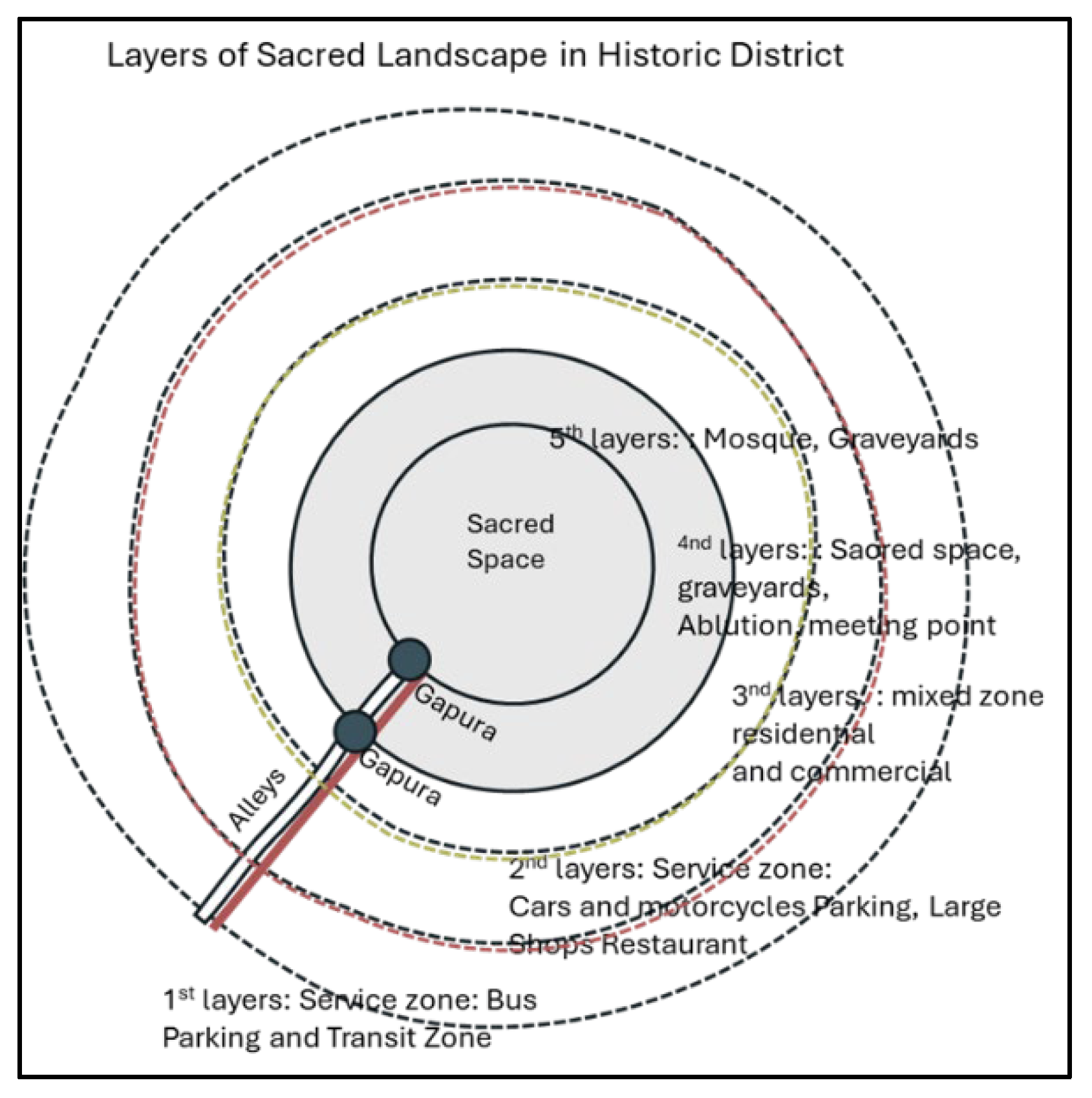
In contrast there can be little doubt that sense of place has international cross-cultural connections as can be seen, for example, with reference to how intangible heritage is instrumental in shaping Islamic Sacred Districts in Java [43]. Taking the stance that intangible heritage is an active participant in cultural and identity formation, a dynamic force that shapes culture and space Tucunan et al discuss how ongoing processes of valuing, re-evaluating, and negotiating boundaries between material and immaterial heritage unfold. A case in point is urban heritage in postcolonial Java and how generational rituals and social practices shape and reshape urban districts. It draws on how four case studies from the early Islamic period reflect how the rituals of ziyarah (pilgrimage)and haul (death commemoration) in the seven cities of Java have been transmitted through generations since 1600 and defy linear historicism. The practices of ziyarah and haul are rooted in religious and memory traditions of the Walisanga (nine Islamic figures who spread Islam in Jave in the 1200 to 1400s and have been extended in the modern period to more recent Islamic figures. Ziyarah refers to pilgrimages to the graveyards of the Walisanga especially during the holy month of Ramadan. Haul is the annual commemoration of their deaths, observed on the day of their passing. Each year around 1 million pilgrims visit nine graveyards in the seven cities of Gresik, Surabaya, Tuban, Lamogan, Kudus, Demak, and Cirebon. The paper analyses how religious and memory traditions play a significant role in how five layers of sacred landscape activity are created and recognised through their functions from the less sacred to the most (Figure 5). Linked to this and contrary to the experience of Luang Prabang (see above) is that people in sacred places in Java have a way or romanticising their heritage to stay there, live there and insist in having identity there (resident registration) even if they have moved: again a prime example of nostalgic sense of place.10
J B Jackson has been a major and informed contributor to sense of place studies starting with his 1963 paper ‘Goodbye to Evolution’ Landscape 3/2 Winter 1963-6411, repeated and developed in his 1994 book A Sense of Place, a Sense of time. [24]. However, somewhat disparagingly he expresses the view that sense of place has lost much of its meaning as it has been captured by architects, urban designers, interior decorators and condominium promoters. Is this because it is an awkward modern translation of genius loci that Jackson suggests means not a place but the guardian divinity of the place indicating celebration or ritual replaced by the term ‘genius of a place’? Nevertheless maybe this is immaterial in that as Jackson acknowledges ‘we recognise that certain localities have an attraction which gives us a certain indefinable sense of well-being … [So] that original notion
Conclusion
The last word goes to Relph’s extensive explorations since 1976 of concept of place, sense of place, spirit of place, placemaking, placelessness and non-place and almost everything to do with place and places, in particular his posting of the following which highlights important variations in the lexicon of sense of place (https://www.placeness.com).
Sense of Place as a Distinctive Aspect of Somewhere (=Genius Loci)
Sense and Nonsense of Place
Sense of Place as a Faculty for Distinguishing and Appreciating Places
Variations in Sense of Place over Time
Different Types of Sense of Place
Drudgery, Oppression and a Poisoned Sense of Place
GIS and Measurement of Sense of Place
A Global Sense of Place
Sense of Place as a Phenomenological Bridge between Person and World
Sense of Place as a Neurological Bridge between Self and World
A Pragmatic Sense of Place
A Commercial/Retail Sense of Place
In effect this list and other discussions on various of Relph’s postings (Relph nd) together with the message of the review paper underpin the notion that sense of place is plural, dynamic and can vary across different cultures. It is not static and can vary over time within a community or culture.
Acknowledgments
I am grateful to G Erfani for permission to reproduce the diagram in Figure 4. from his 2022 publication Reconceptualising Sense of Place: Towards a Conceptual Framework for Investigating Individual-Community-Interrelationships, Journal of Planning Literature, 37 (3) 452-466.
Conflicts of Interest
The author declares no conflicts of interest.
| 1 | Particularly notable in Landprints is Theme III in particular sections 11 ‘Sense of place’ and Section 12 ‘The genius loci and Australian landscape.’ |
| 2 | For example it included the scholarly work of Carl Sauer, Fred Kniffen, Wilbur Zilensky, David Lowenthal, Peirce Lewis, Marwyn Samuels, Donald Meinig, Tuan, Denis Cosgrove, Duncan and Duncan, historians such as W.G. Hoskins (Taylor 2012). |
| 3 | This is where terminology becomes tricky. Is there a crossover between the two words, for example with places residing in the wider landscape? |
| 4 | His full name was Claude Lorrain, but shortened to Claude |
| 5 | It was reissued in 2008 |
| 6 | Oxford English Dictionary |
| 7 | In philosophy, temporality is traditionally the linear progression of past, present, and future. In social sciences, temporality is also studied with respect to human's perception of time and the social organization of time (Ialenti, Vincent (2020). Deep Time Reckoning. Cambridge, Massachusetts: The MIT Press). https://en.wikipedia.org/wiki/Temporality#cite_note-1
|
| 8 | Here I can quote a personal experience of returning to a place changed out of all recognition which created a personal sense of dislocation and sadness even though I would not in reality have wanted to live there again. I was born (1937) in a small industrial town (Hyde) on the outskirts of Manchester (UK) in a nineteenth century terraced house (no bathroom, a lavatory that was a hole in plank over a stinking sewer) next door to a cotton mill, leaving this to go to university 1956/59. The surrounding community however was close knit and supportive. It had a resonant sense of place and belonging. Leaving this in 1961 to live in a small semi-detached house, I would occasionally walk down the street to reconnect with my past. Leaving the UK in 1975 to live and work in Australia I did not return to UK for a visit until 1992. By this time the house and neighbourhood I recalled were no longer there having been cleared under a slum clearance order and replaced by a motorway. I managed to locate where I thought the house and terrace had stood and was standing at a major roundabout occupied by a large advertising bill-board and access to the motorway. My reaction was a forlorn purposelessness not least heightened by my earliest memory of the street was as a small child waking at 5.30am to the sound on hundreds of people wearing clogs clip clopping down the street to start work at the mill. Would I want to return to those days? No, but the sense of loss of place remains vivid. |
| 9 | Culture is a commonly recurring word in discourse related to sense of place raising the question of what is it? Donald Horne [44] nicely phrases it as: ‘the repertoire of collective habits of thinking and acting that give particular meanings to existence.’ |
| 10 | Pers comm from Karina Tucunan. |
| 11 | Jackson started what he called Landscape magazine in 1961. |
| 12 | Common Ground was founded in 1983 by Sue Clifford, Angela King and Roger Deakin. Is based in Dorset (UK) |
| 13 | This raises the question is there such a thing as a natural landscape. The answer is NO, all landscape is cultural, whilst there are natural environments. |
References
- Ginzarly, M.; Pereira Roders, A.; Teller, J. Mapping historic urban landscape values through social media’. J. Cult. Herit. 2019, 36, 1–11. [Google Scholar] [CrossRef]
- Caves, R. W. Encyclopedia of the City; Routledge: London, 2004. [Google Scholar]
- Casey, E. Between Geography and Philosophy: What Does It Mean to Be in the Place-World? In Annals of the Association of American Geographers; 2001; Vol. 91, No. 4, pp. 683–693. [Google Scholar]
- Casey, E. How to Get from Space to Place in a Fairly Short Stretch of Time. In Phenomenological Prolegomena’ pp14-52 in Senses of Place; Field, Basso, Eds.; 1996. [Google Scholar]
- Relph, E. Place and Placelessness; Pion: London, 1976. [Google Scholar]
- Tuan, Y. Space and Place: the perspective of experience; University of Minnesota, Minneapolis, 1976. [Google Scholar]
- Seddon, G. Sense of place: a response to an environment: the Swan Coastal Plain, Western Australia; University of Western Australia: Perth, 1972. [Google Scholar]
- Seddon, G. Landprints. Reflections on place and Landscape; Cambridge University Press: Cambridge and New York, 1977. [Google Scholar]
- Gaynor, A. (Ed.) George Seddon. Selected Writings; La Trobe University Press in association with Black Inc.: Melbourne, 2019; p. vii. [Google Scholar]
- Taylor, K. ‘Ken Taylor on the human side of heritage conservation’ Routledge blog site. 2015. Available online: http://bit.ly/158PwVA.
- Stilgoe, J. R. Common Landscapes of America 1580-1845; Yale University Press: New Haven and London, 1982; p. 10. [Google Scholar]
- Taylor, K.; Lennon, J. (Eds.) 11. Taylor K., (2012), ‘Landscape and Meaning: Context for a global discourse on cultural landscape values’. In Cultural Landscapes Routledge Key Issues in Cultural Heritage Series; London & New York Routledge.
- Lowenthal, D.; Binney, M. (Eds.) 12. Lowenthal, D. (1981) ‘Introduction’. In Our Past Before Us. Why Do We Save It? Temple Smith: London; p. p12.
- Mitchell, W.J.T. Landscape and Power; University of Chicago Press: Chicago, 2002. [Google Scholar]
- Olwig, K.R. ‘The practice of landscape “conventions” and the just landscape: the case of the European Landscape Convention’. Landsc. Res. 2007, 32:6, 579–594. [Google Scholar] [CrossRef]
- Jackson, J.B. Landscape in Sight. Looking at America. John Brinkerhoff Jackson, edited by Helen L Horowitz; Yale University Press: New Haven and London, 1997; p. 343. [Google Scholar]
- Jackson, J.B. Discovering the Vernacular Landscape; Yale University Press, 1984; p. 5 and 8. [Google Scholar]
- Barrell, J. The Idea of Landscape and Sense of Place 1730-1840; Cambridge University Press.: Cambridge, 1972; p. 5/6. [Google Scholar]
- Milton, John. 1654. L’Al. [CrossRef]
- Cody, D. ‘Alexander Pope's Twickenham’, The Victorian Web: Linking Scholarship, Teaching and Learning since 1994. 2000. Available online: https://victoria.web.org/previctorian/pope/twickenhamhtml.
- Tilley, C.Y. ‘Space, place landscape and perception: phenomenological perspectives’ from Tilley C.Y., A phenomenology of landscape: places, paths and monuments; Berg: Oxford, 1994; pp. 7–34. [Google Scholar]
- Ingold, T. ‘The Temporality of the Landscape’. World Archaeol. 1993, 25(2), 152–174. [Google Scholar] [CrossRef]
- Clay, G. Real Places: An Unconventional Guide to America’s Generic Landscapes; University of Chicago Press: Chicago, 1994. [Google Scholar]
- Sexson, L. Ordinarily Sacred; University of Virginia Press: Charlottesville, 1992. [Google Scholar]
- Jackson, J. B. A Sense of Place, a Sense of Time; Yale: New Haven & London, 1994. [Google Scholar]
- Lynch, K. The Image of the City; Cambridge USA: MA, MIT Pre, 1960. [Google Scholar]
- Cullen, G. Townscape; Architectural Press: London, 1960. [Google Scholar]
- Lynch, K. What time is this place? The MIT Press: Cambridge, MA, 1972. [Google Scholar]
- Cullen, G. The Concise Townscape; Architectural Press: London, 1971. [Google Scholar]
- Pope A., (1731) Epistles to Several Persons: Epistle IV To Richard Boyle, Earl of Burlington Of false taste; an epistle to the Right Honourable Richard Earl of Burlington. Occasion'd by his publishing Palladio's designs of the baths, arches, theatres, &c. of ancient Rome, 3rd edn. (London, L. Gilliver, 1731 [i.e. 1732]). pam f Fisher Rare Book Library (Toronto). A miscellany on taste, by Mr. Pope, &c. viz. I. Of taste in architecture, an epistle to the Earl of Burlington. With notes variorum, and a compleat [sic] key.
- Norberg-Shulz, C. Genius Loci: Towards a Phenomenology of Architecture; Rizzoli: New York, 1979. [Google Scholar]
- Eyles, J. Senses of place; Silverbrook Press: UK, 1985. [Google Scholar]
- Relph, E. (nd) Placeness, Place, Placelessness. Sense of Place: an Overview. A website by Edward (Ted) Relph exploring the concept of place, sense of place, spirit of place, placemaking, placelessness and non-place, and almost everything to do with place and places. Available online: https://www.placeness.com.
- Erfani, G. ‘Sense of Place’. In Wharf B The Encyclopedia of Human Geography; Springer: Cham, 2024; pp. pp1–5. [Google Scholar] [CrossRef]
- Bideau, C. F. G.; Yan, H. Historic Urban Landscape in Beijing Gulou Project and Its Contested Memories. In Chinese Heritage in the Making; Maags, Christina, Svensson, Marina, Eds.; Amsterdam University Press: Amsterdam, 2018; pp. 106–117. [Google Scholar]
- Zhang, W. The Confluence and Influence of Colonial Factors in Contemporary Heritage Making of Harbin. A thesis submitted for the degree of Doctor of Philosophy of The Australian National University, Canberra, Australia, 2022. [Google Scholar]
- Rossi, A. The Architecture of the City; Ghirardo, D.; Ockman, J., Translators; The MIT Press: Cambridge, Massachusetts, 1982. [Google Scholar]
- Smith, L.; Campbell, G. ‘Nostalgia for the future’: nostalgia and the politics of class. Int. J. Herit. Stud. 2017, Vol 23(No 7), 612–627; p.612. [Google Scholar] [CrossRef]
- Berliner, D. ‘Multiple nostalgias: The fabric of heritage in Luang Prabang (Lao PDR)’. J. R. Anthropol. Inst. 2012, 18, 769–786. [Google Scholar] [CrossRef]
- Read, P. Returning to nothing: the meaning of lost places; Cambridge University Press: Cambridge; Melbourne, 1996. [Google Scholar]
- Zhu, Y. ‘Memory, homecoming and the politics of diaspora tourism in China’. Tour. Geogr. 2023, 25(1), 95–112. [Google Scholar]
- Erfani, G. ‘Reconceptualising Sense of Place: Towards a Conceptual Framework for Investigating Individual-Community-Place Interrelationships’. In Journal of Planning Literature; Sage Journals, 2022; Volume 37, 3, pp. 452–466. [Google Scholar]
- Jacobs, J. The Death and Life of Great American Cities; 1961. [Google Scholar]
- Tucunan, K.; Taylor, K.; Laachir, K. Ritual, Memory, and the city: How Intangible Heritage Shapes Islamic Sacred Districts. Int. J. Intang. Herit. … 2026. [Google Scholar]
- Horne, D. The Public Culture: the triumph of industrialism; Pluto: London, 1986. [Google Scholar]
Figure 4.
The interrelationships between individual, community, and place reproduced from Erfani 2022 Figure 2 by kind permission of Goran Erfani.
Figure 4.
The interrelationships between individual, community, and place reproduced from Erfani 2022 Figure 2 by kind permission of Goran Erfani.
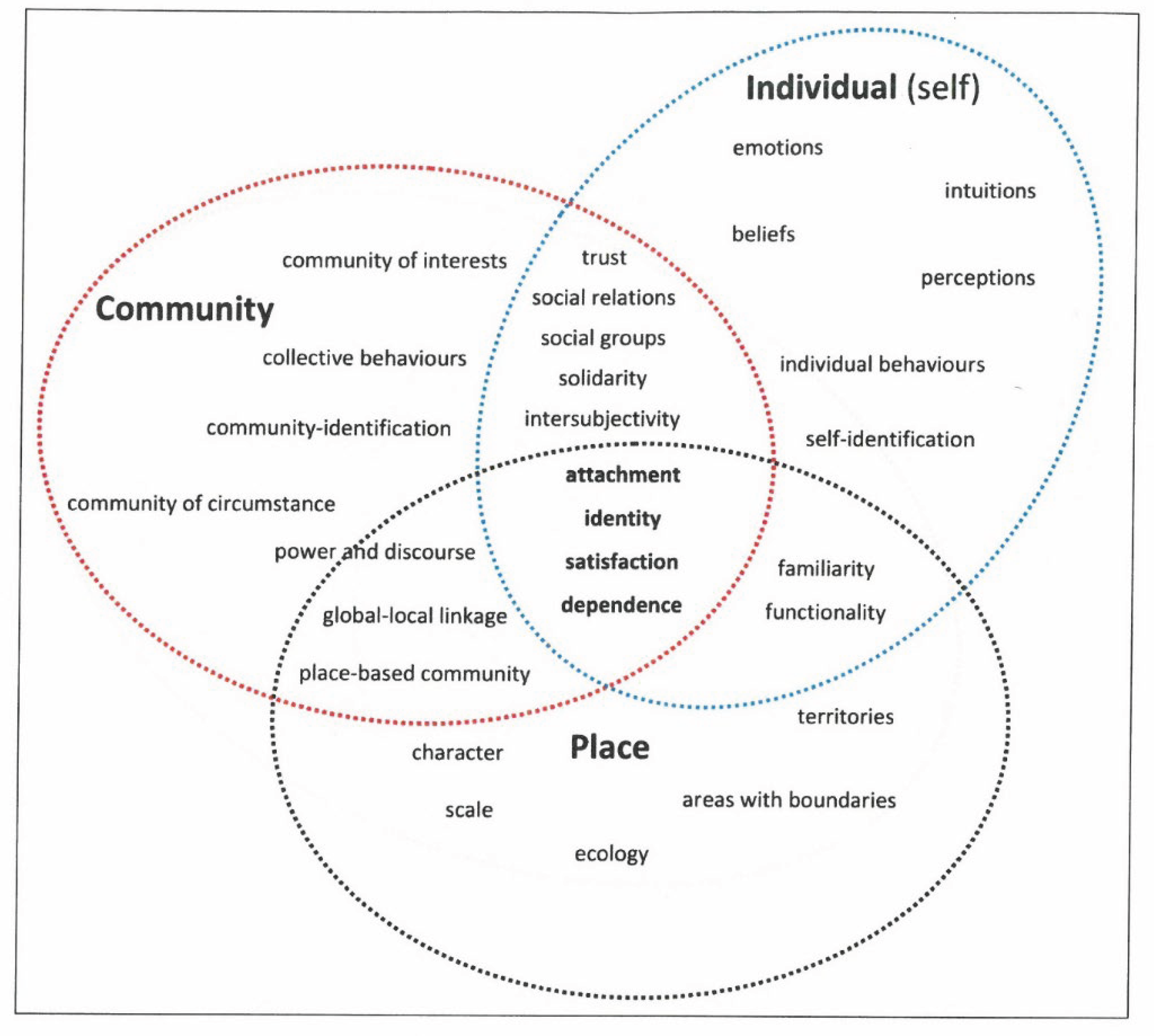
Figure 5.
Layers of Sacred Landscape in Postcolonial Java (from Figure 2 in Tucunan et al 2026 [43]), indicating celebration of ritual, of repeated celebration or reverence, is still inherent in the phrase’. The past lives on. Significantly Jackson adds that ‘… one way of defining such localities would be to say that they are cherished because they are embedded in the everyday world around us and easily accessible, but at the same time are distinct from the world.’ A key word here is ‘distinct’ in that it cross references to the idea of local distinctiveness central to the Common Ground movement. Local distinctiveness is the essence of what makes a place special. It includes cultural landscape, wildlife, history, traditions and architecture that contribute to a community’ identity. The concept emerged in the 1980s12 and emphasises the importance of celebrating and preserving the unique features of local areas, which may include anything from local dialects and customs to specific architectural styles and natural landscape13 (https://www.commonground.org.uk/local-distinctiveness).
Figure 5.
Layers of Sacred Landscape in Postcolonial Java (from Figure 2 in Tucunan et al 2026 [43]), indicating celebration of ritual, of repeated celebration or reverence, is still inherent in the phrase’. The past lives on. Significantly Jackson adds that ‘… one way of defining such localities would be to say that they are cherished because they are embedded in the everyday world around us and easily accessible, but at the same time are distinct from the world.’ A key word here is ‘distinct’ in that it cross references to the idea of local distinctiveness central to the Common Ground movement. Local distinctiveness is the essence of what makes a place special. It includes cultural landscape, wildlife, history, traditions and architecture that contribute to a community’ identity. The concept emerged in the 1980s12 and emphasises the importance of celebrating and preserving the unique features of local areas, which may include anything from local dialects and customs to specific architectural styles and natural landscape13 (https://www.commonground.org.uk/local-distinctiveness).
Disclaimer/Publisher’s Note: The statements, opinions and data contained in all publications are solely those of the individual author(s) and contributor(s) and not of MDPI and/or the editor(s). MDPI and/or the editor(s) disclaim responsibility for any injury to people or property resulting from any ideas, methods, instructions or products referred to in the content. |
© 2026 by the authors. Licensee MDPI, Basel, Switzerland. This article is an open access article distributed under the terms and conditions of the Creative Commons Attribution (CC BY) license (http://creativecommons.org/licenses/by/4.0/).
Copyright: This open access article is published under a Creative Commons CC BY 4.0 license, which permit the free download, distribution, and reuse, provided that the author and preprint are cited in any reuse.


