
Submitted:
12 July 2026
Posted:
14 July 2026
You are already at the latest version
Abstract
In the central Andes, the use of fire in non-domestic contexts is widespread and deeply rooted in tradition. Due to its sacred nature and transformative power, fire has been an important component of ritual performances, past and present, to cleanse and purify, to diseases, to communicate with powerful invisible agents, and above all, to protect the community. Archaeological evidence from the Acari Valley, on the south coast of Peru, demonstrates that fire was used continuously in ritual contexts from as early as the Initial Period up to the time of the Inka state. Throughout this long period of time, fire was used either to signal the beginning or to mark the culmination of rituals.
Keywords:
central Andes
; Peruvian south coast
; rituals
; fire
; Wari state
; Inka state
The bodies [of dead ancestors] were brought out with a large retinue for all solemn festivals [...]. In the square they were seated in a row according to their authority, and there the servants and guardians ate and drank. A flame was kindled before the deceased of a certain firewood that was carved and cut all the same length (Cobo 1990 [1653]:40).
Introduction
It is the evening of July 24th, the eve of Santiago Day, and throughout the Ayacucho Valley of the Peruvian central highlands the people eagerly await the lighting of the bonfires to offer gratitude to Pachamama (Mother Earth) and the Wamanis (sacred mountains) for feeding and protecting the community and their farm animals. It is understood that Pachamama provides food while the Wamanis send water for the plants, the animals and people, as well as act as guardians (Abercrombie 1998, 33; Allen 1988, Bastien 1985, 76, 80). There would be no life without them. Hence, fire is lit with the “hope of producing positive effects and to avert negative effects” (Winder 2009, 13). At dusk, the first lights can be seen in the distance on the slopes of the mountains on the east side of the valley; suddenly there are lights all around the valley and in the valley itself.
At home we also have been waiting for this moment, and as soon as we notice the first lights on the nearby mountains we run outside, near the animals, and proceed to light our bonfire. We have all gathered in a circle around the fire to watch the beautiful flames. Fire is like a magnet; it captures your attention, your imagination, and brings a sense of tranquility and warmth. More importantly, almost everything ordinary comes to a sudden stop. We can see that our neighbors also have their campfires lit. You can also hear noise; oh, people are singing by the campfire, and we do the same. Tomorrow, some of our neighbors will brand their animals, and this celebration will be carried out throughout the month of August (Valdez, Bettcher and Valdez 2022, 63). Bonfires are lit in anticipation of the annual branding ceremony. Originally it may have been called something else, definitely not Santiago.
It is a time for celebration, and memory goes flying back to past years when we also did the same along with our grandparents who have since departed to the afterlife. Grandparents used to remind us that Wamani Raswillka, the highest mountain peak to the east, protects the entire population of the valley and surrounding region. Our fire slowly dies down, and the celebration is coming to an end; it was short, but we’ll do it again next year. When did all this start? It is reported that in Inka times, a bonfire was lit to warm the mummified bodies of the ancestors and to burn offerings to the gods (Cieza de León 1959, 181-182; Molina 1947 [1572], 57, 65). Fire was also used to deliver special gifts to the gods (Brundage 1967, 86) and to fight sickness (Guaman Poma 1936 [1615], 253; Zuidema 1985, 221). Will the day ever come when this custom ends? Nobody knows! Whatever the case, the most obvious thing is that everyone in this part of the Andes shares this custom of lighting the fire at the same time as if we were all connected. I guess we are connected, or at least we think the same way. Definitely, it is a way to send a signal to everyone that here we are and you can see us.
Along with wind, water and earth, fire is one of the elements of the natural world that has a privileged place in the ritual celebrations that transcend cultures, territories, and time (Winder 2009, 12). Often seen as a destructive force, fire is also the single most empowering element, closely associated with lightning (Scott, et al., 2016). Such is the power of fire that some researchers assert that the earliest forms of worship perhaps were fire-related (Argyle 2000). In the central Andes, the custom of using fire as part of important celebrations is widespread and deeply rooted in tradition. Indeed, it has been determined that around 2500 BC, fire was lit in specially built structures and in what appears to have been ritual celebrations (Grieder, et al., 1988; Izumi and Terada 1972; Onuki 1993; Pozorski and Pozorski 2000; Shady and Machacuay 2003). As the archaeological findings attest, this custom was practiced both, on the Pacific coast and in the highlands about the same time. As pointed out, this practice still continues today in the central highlands although in a rather modified manner. Indeed, there is no need for specially built buildings, as fire is lit outdoors, in open spaces that during the rainy season become farmland. When the fields are irrigated and the crops planted, all traces of the fire are completely erased.
The continuity of this ancient tradition demonstrates that fire is of vital importance in Andean rituals and comparable to ritually significant products such as coca leaves, chicha (fermented beverages), and mullu (Spondylus) shells (Allen 1988; Bolin 1998, 14-15; Murra 1975, 257). Moreover, in the central Andes every human action requires constant interaction and negotiation with powerful agents that, it is asserted, maintain strong influence in daily life (Allen 1988, 27; Bautista and Rosenfeld 2017, 7; Hastorf 2007, 78). That being the case, many of these actions often take place outside the residence (Moore 2017, 308), while walking or traveling, and during which important products such as the sacred coca leaves are shared with the deities (Nielsen, Angiorama and Ávila 2017, 245-246).
In this discussion, my aim is to present the archaeological evidence for the use of fire in ritual contexts over an extensive time in the Peruvian south coast valley of Acarí (Figure 1). During this long chronological sequence, though changes occurred in the specific contexts in which fire was used, the importance of fire did not. Indeed, available evidence indicates that each time the valley was integrated into a wider sphere of interaction, the use of fire was modified, suggesting that external influences were, perhaps, behind these changes. This discussion begins with Initial Period evidence and culminates with the use of fire in the rituals staged by the Inka.
Rituals at the Initial Period Settlement of Hacha
The earliest known permanent settlement established in the Acarí Valley is Hacha, located in the middle section of the valley, approximately 21 km from the sea (Gayton 1967; Katterman 1994; Riddell and Valdez 1988; Robinson 1994). Radiocarbon measurements indicate that the site was built around 3398 cal. AP and abandoned about 2737 cal AP (Valdez 2020, 18). Hacha is a unique site for the south coast, as it represents the introduction of ceramic technology to this region (Burger 1995, 103; Fung Pineda 1988, 83; Lanning 1967, 81; Lumbreras 1974, 52; Menzel, Rowe and Dawson 1964, 258; Quilter 2014, 158). The Hacha ceramic style bears similarities to the Muyo Moqo style from the Waywaka site from Apurímac, in the south-central highlands of Peru (Grossman 1972, 1985, 48, 57) and suggests that the inhabitants of these two early settlements, located not only at considerable distances, but also in different geographical settings, maintained close contact. In addition to ceramics, obsidian from the source of Quispisisa is found at both sites.
The Hacha site was found by Dorothy Menzel and Francis A. Riddell in 1954 (Valdez 2020, 11) and first reported by Rowe (1956, 137). Subsequently, Rowe visited the site on several occasions and observed that the site “has habitation refuse covering an irregular area about 800 by 200 m along an abandoned channel of the Acari River” (Rowe (1963, 5-6). During one of these visits, Rowe, along with Thomas Patterson, found some anthropomorphic figures made of unfired clay (Valdez 2020, 16). Apart from the work done by Rowe and Patterson, the site remained ignored despite its importance. It was under these circumstances that in 1984 Robinson decided to excavate at the site. In 1986 the site was again excavated (Riddell and Valdez 1988; Robinson 1994). In total five structures were uncovered, revealing for the first time the nature of the Initial period buildings of the valley. Of the five excavated buildings, Structure 2 stood apart.
Structure 2 was described by Robinson (1994, 11) as the “most complex and best preserved of the five structures investigated thus far. It consists of three distinct rooms separated by walls somewhat less than two meters in height.” From the three mentioned rooms, the one in the northwest side (Room 3) is of interest for the purpose of this discussion. According to Robinson, room 3 measures 4 by 4 m but its west wall had already been destroyed. A hearth was found occupying a central section of the room. Before the excavation led by Robinson, Structure 2 was already partially exposed and it had been worked on during the previous years. In 1999, in response to an inquiry, J. H. Rowe was kind enough to send me copies of his 1959 field diary. On page 130 of the diary, there is a drawing that resembles the eastern portion of Structure 2. For instance, the entrances from rooms 2 and 3 to room 1 are at the correct locations. The drawing also includes the vertical measurement of the wall, which is 1.26 m. Furthermore, according to Robinson (1994, 11), “Room 1 is connected to the two rooms by well-made trapezoidal doorways.” Rowe, for his part, includes a section drawing of one of the entrances, which is indeed trapezoidal in shape, with a width of 46 cm at the base and 43 cm at the top (1). This confirms that both Rowe and Robinson excavated the same structure but at different times. When I discussed the Hacha site a few years ago (Valdez 2020), I had not realized that Rowe’s drawing was also of Structure 2. Besides a brief reference in one of his publications (Rowe 1963), J. H. Rowe never published about the work he carried out at this important early site.
Room 3 of Structure 2 is important for two reasons. First, it is the only one where a hearth has been found occupying a central location (Figure 2) and thus resembles the structures with hearths, such as those discussed by Grieder and colleagues (1988, 39-43) and Onuki (1993, 76), for example. The outstanding difference is obviously that the Hacha structure is modest and much smaller, and its construction must have required less effort than the structures described by Pozorski and Pozorski (1993, 46-47, 58-59) and Shady and Machacuay (2003), for instance. Therefore, the small size of the Hacha building perhaps says something about the size of the population of Hacha. Regardless of its size, the central location of the hearth may have been for the purpose of forming a circle, the “archetypal symbol of wholeness” (Crowley 1996, 43), the sacred space created each time fire is lit (Winder 2009, 11). Second, the east and north walls of the room with the hearth had been decorated with zoomorphic pictographs (Figure 3) that appear to represent camelids (Riddell and Valdez 1988). Similar findings have not been found in the other two rooms, nor in the other structures at Hacha, thus making this space particularly unique. As such, there is a possibility that some activity, likely ritualistic in nature, was performed in this small space. The fact that its walls were decorated suggests that this may have been a space whose function transcended the everyday.
Pozorski and Pozorski (1993, 47) assert that structures associated with hearths probably were spaces where “ritual activities involving burnt offerings” were carried out. The smaller size of the structures, including the one from Hacha, may indicate that the ritual activities were restricted to “relatively few participants in more private ceremonies” (Pozorski and Pozorski 1993, 47).
Additional evidence also relevant to this discussion comes from Structure 4 of Hacha, excavated during the 1986 field season. Immediately south of Structure 4, a group of three human skulls was found, two belonging to adults and the third to a juvenile (Riddell and Valdez 1988, 9). The skulls had been placed side by side on a sand formation and were associated with a hearth. While it is difficult to determine how the three skulls were obtained or whether they represent acts of decapitation, what is noteworthy is that at the time of their burial, fire was set alight. There can be little doubt that this was deliberate, and once the fire was extinguished, the skulls were covered with sand. Nearby, also in association with Structure 4, two burials were exposed (Robinson 1994) but none were associated with fire. The skulls from Hacha are comparable to those found at the Asia site, south of Lima, although those from the latter come from a pre-ceramic context (Proulx 1971, 16). In any case, the evidence from Asia and Hacha demonstrate an early interest of the people of the Peruvian south coast in recovering human skulls. It must be noted that the skulls from Hacha (and those from Asia) lack the hole in the frontal bone characteristic of the Nasca trophy heads (Proulx 1971, 16; Verano 2003, 526).
Flames for the Dead
The Early Horizon is the least known period in the Acarí Valley. In fact, to date, not a single settlement belonging to this period has been identified (Valdez 2020). In contrast to this apparent void, eight large settlements, protected with massive fortification walls, were established in this valley during the first half of the following Early Intermediate Period (ca. 1 - 600 AD). The presence of these large settlements suggests that the valley had been occupied during the previous period. The noteworthy aspect is that along the entire Peruvian south coast, there is not a single settlement comparable to the fortified sites of Acari, settlements where enormous resources and energy were invested to establish the defensive barriers (Valdez 2009, 2014). The fortified sites of Acarí are contemporaneous with the early Nasca sites; however, the latter were nothing more than small villages established along the course of the rivers (Beresford-Jones 2011, 49; Conlee and Schreiber 2006, 97; Reindel 2009, 451-452). This is a significant contrast that strongly suggests that social conditions in Acarí, on the one hand, and the valleys immediately further north, on the other hand, were different (Valdez et al. 2026). Available archaeological evidence indicates that there was an urgent need for defense in Acarí.
In 2004 an archaeological excavation was carried out in Huarato (Figure 1), one of the Early Intermediate Period fortified settlements of the Acarí Valley (Rowe 1963, 12). The excavation resulted in the finding of several burials (Valdez 2006), which were previously unknown for the Acarí Valley. The burials in Huarato are of two types: urn burials and pit burials with roofs. Urn burials were used exclusively to bury children, while pit burials with roofs to bury the young and adults. In all known cases, these consist of single burials. Furthermore, the dead had been buried inside of houses or immediately outside them.
The second burial type is the most relevant for the purposes of this discussion. These consist of pits dug in the ground to an average depth of 1 m. The interior of the pits is cylindrical, with an average diameter of 80 cm, and unmodified walls. In preparation for burial, the dead were covered with cotton cloth and tied with a rope around the waist. Burial posture was with the knees drawn up to the chest and the arms wrapped around the legs. Inside the pits, the bodies were deposited in a resting position (Figure 4A), with their backs resting against one of the walls and facing north (Valdez 2006, 8). Offerings consist mainly of gourd bottles and agricultural products such as manioc and sweet potato, and small baskets. A bottle gourd found in the tomb depicted in Figure 4A had been placed upright, suggesting that it contained some liquid at the time of its placement. Ceramic objects were rare, and when present, they were undecorated pieces. Once the deceased and the offerings were placed in their designated locations, the tomb was covered with a thatched roof (Figure 4B), over which a thick layer of mud was poured to seal the tomb. Once the roof was in place, the tomb became a small, well-protected enclosure. Subsequently, a cobblestone was placed on the wet mud as a burial marker.
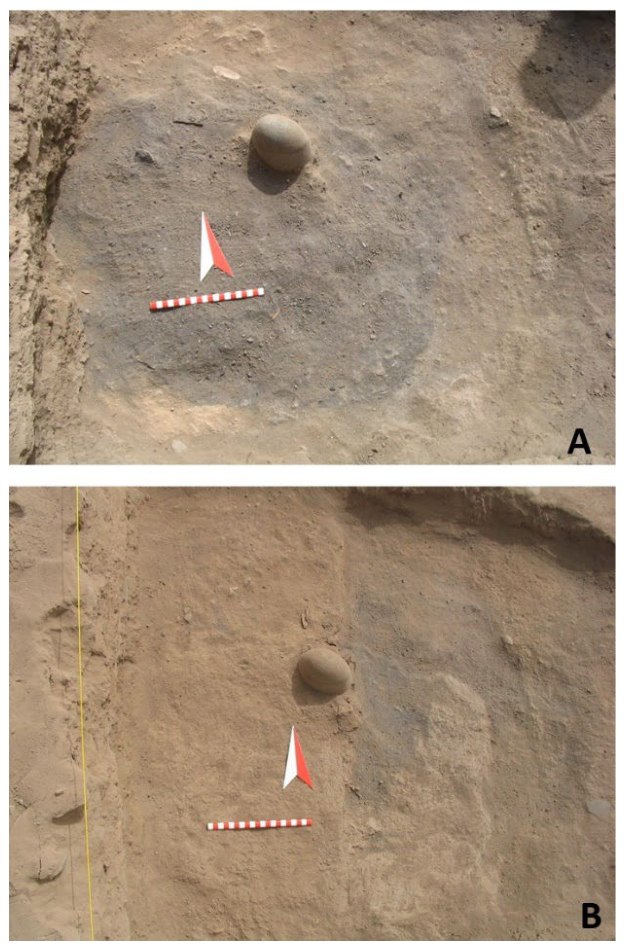
What is described here in a simplified manner appears to be part of a long mortuary process. The final act of the ritual was to light a fire on top of the mud layer (Figure 5A), which appears to have marked the culmination of the mortuary ritual. While it is difficult to ascertain the reasons for the use of fire at the end of this process, it can be suggested that perhaps it was a way to mark the closure of life and a way of bidding farewell to the soul of the deceased person (Valdez et al. 2026). What can be observed is that once the fire was consumed, the remaining ash was covered with another layer of mud (Figure 5B), with which the floor of the house was eventually restored.
Figure 5.
A. Deposition of ash uncovered over the mud layer that sealed the adult male burial of Huarato depicted in Figure 4A; B. Layer of mud deposited on top of the ash accumulation shown in Figure 5A.
The burial process discussed here briefly is unique to this period and this valley, and therefore different from Nasca burial customs (Carmichael 1995). As pointed out, in the Acari Valley, the living and the dead shared the same space, with the exception that the living occupied the upper world and the dead the underworld. In contrast, the Nasca people were always buried in designated cemeteries (DeLeonardis 2000:365). Moreover, in the case of the Nasca, there is no indication whatsoever about the use of fire during mortuary rituals. This is a significant difference that denotes the ideological variations between the Nasca and the local inhabitants of Acarí (Valdez 2006; Valdez et al. 2026).
Middle Horizon Wari Rituals in Acarí
In the central Andes, the Middle Horizon (ca. 600-1000 AD) marks the aggressive expansion of the Wari state from its center of origin, the Ayacucho Valley in the Peruvian central highlands. The present-day Peruvian south coast was one of the regions annexed by the Wari state (Conlee 2010; Conlee and Schreiber 2006; Menzel 1964). In the newly incorporated regions, the Wari state organized ritual celebrations that consisted in the deliberate shattering of finely made large-sized ceramic vessels that afterwards were buried. The best evidence of ritually sacrificed ceramic vessels comes from the Pacheco site in the Nazca Valley (Menzel 1964, 21). This custom is unique to the Wari state and has been recognized as the “Middle Horizon offering tradition” (Menzel 1968, 48). Similar sacrifices were also made in the same valley of Ayacucho, the Wari heartland (Cook 2001), and elsewhere (Glowacki 2012). According to Menzel (1968, 49), the Wari “offerings are an expression of great religious devotion and elaborate ceremonial.” Understandably, it is difficult to determine the reason, or reasons, for which these sacrifices were made; however, one possibility is that through these acts the Wari authorities sought to justify and legitimize their intrusive presence in regions such as the south coast. Moreover, the ritual celebrations performed in the newly conquered territories, perhaps, were purposely staged to showcase Wari state religion.
At the time of the Wari expansion to the Acarí Valley, La Oroya (Figure 1) may have been one of the most important settlements in this valley (Valdez 2020, 2023). It also appears that the site was immense and was located near the most fertile section of the valley. Unfortunately, La Oroya has been destroyed, leaving only a small mound of what was originally a large settlement. This is a terrible reality of most archaeological sites in Peru. The destruction of La Oroya is linked with the rapid growth of the contemporary town of Acarí.
In 2005, while the municipality of Acarí was carrying out the opening of trenches for the installation of the town’s drainage system, workers accidentally uncovered a deposit containing fragments of ceramics. As soon as I was informed of the find, I went to the site to verify the report. Upon arrival, I observed many ceramic fragments scattered on the surface immediately surrounding the trench. A more detailed inspection of the trench determined that the cut made by the workers had exposed only one side of the deposit, with much of it still in its original place (Figure 6). Faced with this unique situation, it was decided to carry out a rescue excavation, as the deposit was in danger of being completely destroyed (Valdez 2023).
When the rescue excavation began, the surface of the find had already been removed. Just a few centimeters below, a layer of fine sand was exposed, which had been purposely deposited to cover the ceramic fragments underneath. The pit is circular, approximately 1.30 m wide and 1.10 m deep. The deeper it goes, the narrower it becomes (Figures 7A & B). As in other known cases (see Glowacki 2012), the ceramic fragments, mostly from large-sized vessels, had been placed horizontally (Valdez 2023, 378), suggesting that the sherds were deposited with care. The most striking aspect of the discovery was that at the base of the pit there was evidence of fire in the form of ash, burnt earth and deformed ceramic fragments. The latter apparently due to a high temperature. In addition, several ceramic fragments recovered from the base of the pit had a solid, shiny black material adhering to them. Some of these fragments were soaked in water for several days but did not dissolve. Since no carbon samples were found, a sample of this unknown material was recovered and sent to the laboratory for dating. Unfortunately, this could not be dated and to this day it is unknown what this material is.
Figure 7.
A. View of the rescue excavation of the ceramic offering deposit from the La Oroya site; B. Base of the pit where the shattered ceramic sherds of the La Oroya site were buried.
Figure 7.
A. View of the rescue excavation of the ceramic offering deposit from the La Oroya site; B. Base of the pit where the shattered ceramic sherds of the La Oroya site were buried.
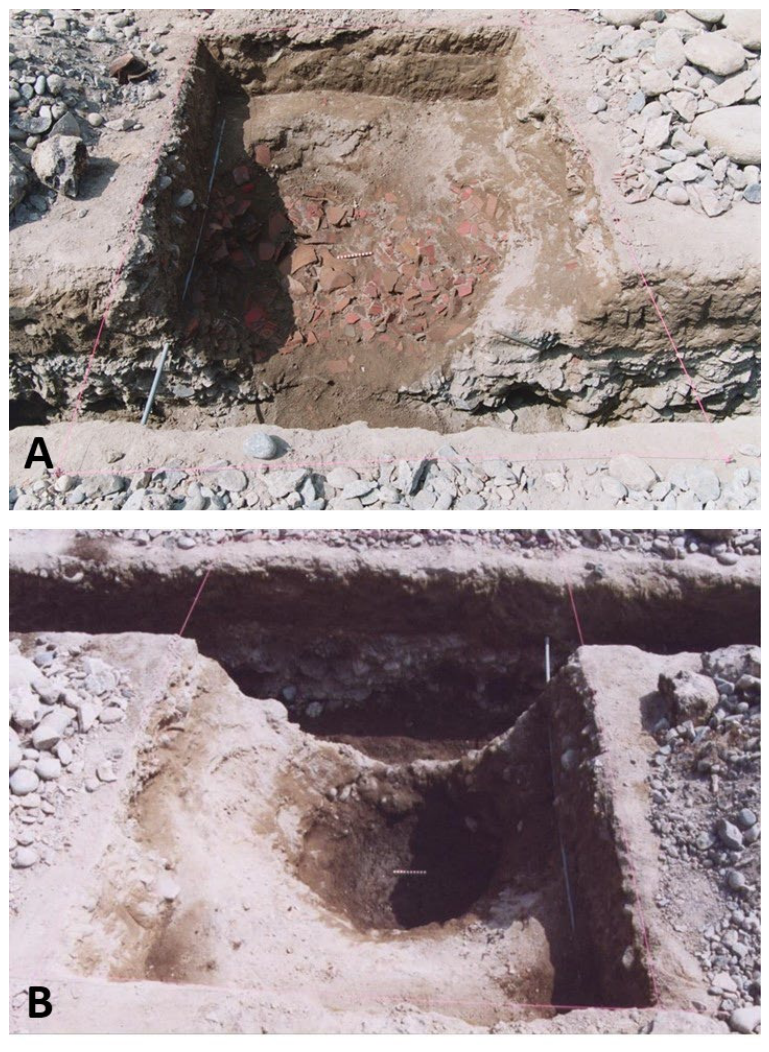
Until the discovery of the La Oroya ceramic deposit, it was unknown that fire was used during the sacrifice of the Wari ceramic vessels. What has been determined is that once the pit was dug, fire was lit at its base. The possible reasons for this act are difficult to ascertain, but it could have been a way to purify the place and to transform it into one associated with the Wari state. Additionally, it is possible that specific products of ceremonial importance were burned there as offerings to the Wari gods and local deities. Only after the fire had burned out were the fragments of the sacrificed pottery deposited. Available evidence suggests that fire was burnt for a sufficiently long time, causing not only the temperature at the bottom of the pit to rise, but also to deform the ceramic sherds deposited at the base of the pit. Once the pottery fragments were deposited, the pit was sealed with sand and soil. This would have caused the high temperature at the base of the pit to persist for an extended period, causing the ceramic fragments to deform.
During the rescue excavation, every effort was made to recover all the ceramic fragments. However, during the attempt made to restore the vessels, it became clear that more than half of the vessels were missing (Figure 8). This suggests that the sacrificial vessels appear to have been buried in more than one pit, thus leaving open the possibility that somewhere nearby there is still buried a deposit containing the missing parts of the vessels that have been partially restored.
In summary, the Wari expansion into new regions such as the Acarí Valley resulted in ritual celebrations that consisted in the deliberate sacrifice of large ceramic vessels. These celebrations possibly marked the successful annexation of a new territory into Wari domains and served to showcase the Wari ideology to the local people, as well as to normalize the abnormal situation caused by the Wari intrusion. One can be certain that this type of ritualized gatherings possibly included other actions, such as singing and praying that leave no material evidence.
Inka Imperial Sacrifices at Tambo Viejo
Seating himself, Tupa Inca made a solemn sacrifice of animals and birds, burning them in a fire which was kindled in his presence; and in this way they worshipped the sun, which they believed to be God (Sarmiento de Gamboa 1999 [1572], 130).
In the Aucaypata plaza the priests of the Creator burned in the morning a white llama, maize, coca leaves, and spondylus-colored bird feathers begging the Creator to give a good year… (Molina 1947 [1572], 64-65, [my translation]).
Father Bernabé Cobo (1990 [1653], 8) identified the Inkas as the “most encumbered with ceremonies, superstitions, idols, and sacrifices” due to the fact that they worshiped a diversity of deities, some of which were heavenly, such as the Sun (Tayta Inti), the Moon (Mama Killa), and Thunder (Illapa), in addition to several earthly divinities that included Pachamama, Qochamama (Mother Sea) and high snow-capped mountains (Molina 1947 [1572], 51; Montesinos 1882, 194-95). The Inkas were certain that powerful deities and spirits were present everywhere and that human life was heavily influenced by them (Arriaga 1968 [1621], 24). Convinced that they could negotiate with the deities and spirits, the Inka periodically organized ritual gatherings following the lunar calendar to bestow offerings and communicate with the supernatural beings. It was understood that once the gifts were presented in a ritualized context, the deities would reciprocate by sending good fortune (D’Altroy 2014, 405). While child sacrifice (capacochas) was the most valuable and offered on the most solemn occasions (Brundage 1967, 69; Sullivan 1996, 307-8), the most customary sacrifices consisted of domesticated animals, such as llamas (Lama glama) and guinea pigs (Cavia porcellus) (Acosta 1962 [1550], 206; Arriaga 1968 [1621], 42; Betanzos 2003 [1576], 76; Calancha 1975 [1638], 850; Murra 1983, 85-87; Polo de Ondegardo 1988 [1559], 226). Among the material goods, finely made textiles, called cumbi, were also sacrificed in large quantities (Santillán 1927 [1563-64], 29; Murra 1962, 714; Zuidema 1985, 220). In this manner, Inka sacrifices were rather different from Wari sacrifices (Menzel 1968, 51).
All the offerings to the deities were burned in the main plaza of Cuzco, the capital city, and the ashes were collected carefully and stored in a special place. For the Inkas, fire was a means by which they could deliver gifts to the gods. The two rivers that flow through the city merge at a place known as the Lion’s Tail (Pumapchupan), located at the base of the Coricancha (Zuidema 1985). This place was recognized as Tinku, the place where the rivers meet, a truly holy site in the Inka worldview. As the rivers swelled due to the rains, everyone gathered in Pumapchupan, where they brought the ash they had collected from the ceremonies held throughout the year, and “with all proper precautions, these ashes were cast over the wall into the running waters to be ceremonially removed from Cuzcoquiti” (Brundage 1967, 86).
Here was annually performed the festival, common to all Peru, of the purapucyo. Flowers of many kinds were thrown into the river, and in a great bonfire lighted at the terraced point of land many llamas and other animals were burned that the river might eat and be fat. Rich and lovely garments were also added to the flames so that the water-spirit might not lack clothing. Finally, the Incas here toasted the special huaca of their waters, throwing into the tumbling stream cups of akha [fermented beverage] while themselves drinking from others (Brundage 1967, 87).
During the last few years, the Inka provincial center of Tambo Viejo has been the focus of archaeological research (Valdez and Bettcher 2021, 2022). Tambo Viejo was the Inka imperial establishment built in the Acarí Valley following the Inka expansion to the south coast. The results of the investigation at the site demonstrate that the Inka state organized ritual celebrations in which guinea pigs, llamas and occasionally dogs were sacrificed. Hundreds of guinea pigs had been sacrificed in Tambo Viejo, and on at least one occasion, a hearth was found adjacent to the sacrificed rodents (Figure 9), proving that fire was lit during the sacrifices (Valdez 2019, 597). While ethnohistorical sources claim that the offerings were burned, archaeological evidence at this site contradicts this assertion; rather, the guinea pigs appear to have been buried alive and died of suffocation.
Likewise, the investigation at Tambo Viejo resulted in the discovery of dozens of sacrificed llamas (Valdez, Bettcher and Huamaní 2020). Without exception, the llamas were only a few months old, demonstrating a preference for young animals. Although llamas of all colors were sacrificed, there was also a preference to sacrifice llamas with white fur. Cobo (1990 [1653], 113) states that brown llamas were sacrificed to Viracocha (the Creator), multicolored llamas to Thunder (Illapa), and white llamas to the Sun. Furthermore, it is known that white llamas were symbols of prestige and the Inka himself used to walk in the streets of Cuzco with his white llama, called napa (Guaman Poma 1936 [1613], 318-319).
During the most recent field research at Tambo Viejo, a group of nine young llamas was exposed. The llamas had been adorned with colorful tassels and necklaces, and placed in a pre-dug pit, their limbs flexed towards their bodies and secured with rope, facing the sunrise (Figure 10). It appears that the animals were intentionally positioned in this way to give the impression of traveling, like a caravan. In only two cases were the animals’ necks slightly bent to one side. In addition, on both sides of the animals’ heads, a small pole had been planted upright, with tropical bird feathers tied to its upper end (Valdez, et al, 2025), thus confirming the use of feathers in Inka rituals (Polo de Ondegardo 1916 [1571], 39). Subsequently, the highly esteemed products in Inka times, such as coca leaves (Cieza de León 1973 [1552], 221; Cobo 1990 [1653], 116) and fragments of Spondylus shell (Murra 1975, 257; Sarmiento de Gamboa 1999 [1572], 167) were scattered over the animals. Once this procedure was completed, a layer of clean sand was placed over the llamas. Finally, in what appears to have signaled the culmination of the ritual celebration, a fire had been lit in a central location where the animals were buried. Thus, archaeological evidence demonstrates that fire was part of the Inka imperial rituals performed in Tambo Viejo. However, and contrary to ethnohistorical accounts, the llamas were never burned. Rather, just like the guinea pigs, the llamas too appear to have been buried alive and died of suffocation. Knowing that during the capacocha sacrifices the Inkas buried children alive (Betanzos 2003 [1576], 76), it is not surprising that they also did something similar with the animals.
Of course, other actions also performed during ritual acts, such as prayers and chants, to cite some, do not leave material evidence, so this account is incomplete. The same can be said of the people who led and attended these celebrations, that more likely included the local conquered people. For the latter, witnessing imperial ritual celebrations must have had profound effects on their collective memory. Indeed, it is possible that what was observed was remembered and discussed even later. Ultimately, through these actions that allowed socialization, Tambo Viejo must have been transformed into a place associated with the Inka state and Inka worldview.
The archaeological evidence from the Inka provincial center of Tambo Viejo confirms the version of the written sources regarding the sacrifice of guinea pigs and llamas. However, contrary to the chroniclers’ account, the sacrificed animals were not burned. Rather, archaeological evidence indicates that the animals appear to have been buried alive, as no trauma (cuts) has been found that could have caused their death. Thus, it seems more likely that the sacrificed animals died of suffocation. This observation suggests, on the one hand, that the sacrifice of animals in the capital city was done differently from the provinces, or, on the other hand, that the chroniclers’ version regarding animal sacrifice is simply wrong. Obviously, early Spaniards never witnessed Inka rituals, much less Inka animal sacrifice. Their accounts were based on second-hand sources. Any information they managed to gather about Inka rituals may have been fabricated stories. When this is the case, archaeology is our only source for direct evidence.
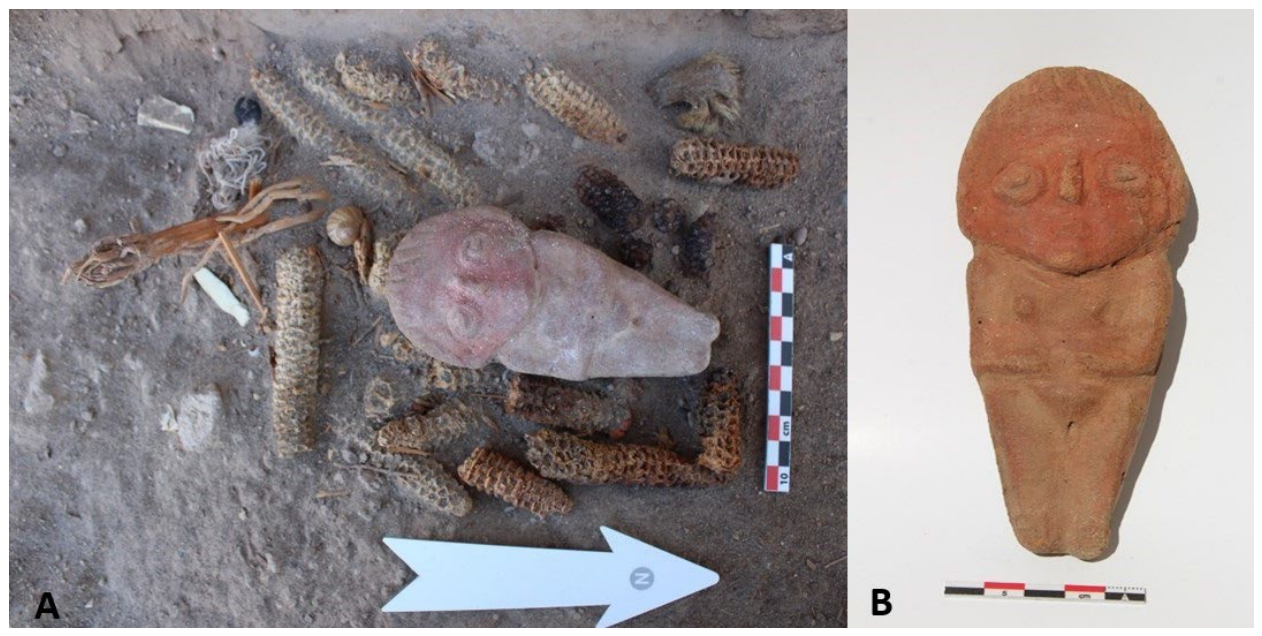
In addition to the sacrifice of animals, in one case an anthropomorphic figurine was found placed face down directly on an accumulation of partially burned maize cobs (Figure 11). This finding indicates that, for some reason, the figurine not only had to be placed on the corn cobs, but the cobs themselves had to be partially burned, perhaps as an indication that the place should first be purified by fire. Clay figurines occur with some regularity at the site, although most of them already broken. What stands out is that, without an exception, the figurines are female. The association of this female anthropomorphic figurine with maize cobs is perhaps an indication of the importance of fertility. We must also remember that for the Inkas, maize was also a sacred product, recognized as Mama Zara (mother maize) and was very important in the production of chicha (maize beer). Thus, the evidence from Tambo Viejo demonstrates that every Inka action was accompanied by rituals in which the use of fire was crucial.
Inka ritual celebrations must have been appropriate occasions for sharing food and possibly drink. In the specific case of Tambo Viejo, it has been determined that food was prepared in earthen ovens, known as pachamanka (Valdez and Bettcher 2021). This type of food preparation was already known on the south coast of Peru as early as the Early Intermediate Period (Valdez 1994). In this manner, fire was also necessary in the preparation of food for special occasions and consumed in ritualized contexts. In sum, these types of gatherings were possibly opportunities that enabled the creation of group identity (Whitehouse and Lanman 2014), critical for the establishment and maintenance of political ties as well as for consolidating the empire.
Discussion and Conclusion
Cobo was correct with his identification of the peoples of the Andes as one of the “most encumbered with ceremonies, superstitions, idols, and sacrifices.” However, the Inkas were not alone when it came to this behavior, as religious beliefs and practices are known to be central to the concerns of humanity in general (Rappaport 1971, 23). Inka behavior esteemed from the belief that humans are not the only ones occupying this physical space, but that we share it with other agents that greatly influence our lives. Based on this fundamental principle, in the central Andes every human action, from dawn till dusk, requires constant interaction and negotiation with powerful agents (Allen 1988). In the distant past, rituals appear to have been the mechanisms also used for this purpose, while the sharing of coca leaves with the deities (Sarmiento de Gamboa 1999 [1572], 130), for example, allowed for the establishment and renewal of the forms of reciprocity and respectful relationship.
Most importantly, however, by participating in these acts the Inkas were merely following traditions that were well established long before the existence of the Inka state itself. The archaeological evidence discussed here demonstrates that lighting a fire to begin (or culminate) an important celebration date back at least to the Initial Period. During this sufficiently long time, the use of fire in the most intimate gatherings was continuous, although the specific contexts changed. Based on the information available for Inka times, it seems that fire was the means by which contact could be established with the deities, and sometimes even to deliver special gifts, which the deities were expected to reciprocate by sending good omens. For earlier periods, perhaps that was also the purpose for lighting the fire. However, the use of fire at the end of the mortuary ritual discussed here may have been to facilitate the journey of the deceased’s soul to the afterlife, occasions during which fire was the power that drew everyone toward it.
| 1 | One of the hallmarks of Inka architecture was the trapezoidal doorways, windows and niches. The evidence from the Initial Period site of Hacha demonstrates that the Inka were not the first to establish this type of doorways. |
References
- Abercrombie, T. A. Pathways of Memory and Power: Ethnography and History Among an Andean People; The University of Wisconsin Press: Madison, 1998. [Google Scholar]
- Acosta, J. Historia Natural y Moral de las Indias. Edition prepared by E. O’Gorman; Fondo de Cultura Económica: Mexico, D.F, 1962 (1550. [Google Scholar]
- Allen, C. J. The Hold Life Has: Coca and Cultural Identity in an Andean Community; Smithsonian Institution Press: Washington, D.C., 1988. [Google Scholar]
- Argyle, M. Psychology and Religion; Routledge: London and New York, 2000. [Google Scholar]
- Arriaga, J. The extirpation of idolatry in Peru; University of Kentucky Press: Lexington, 1968 (1621. [Google Scholar]
- Bastien, J. W. Mountain of the Condor: Metaphor and Ritual in an Andean Ayllu; Waveland Press, Inc: Illinois, 1985. [Google Scholar]
- Bautista, S.; Rosenfeld, S. An archaeology of Rituals. In Rituals of the Past: Prehispanic and Colonial Case Studies in Andean Archaeology; Bautista, S., Rosenfeld, S., Eds.; University Press of Colorado: Boulder, 2017; pp. 3–20. [Google Scholar]
- Beresford-Jones, D. The Lost Woodlands of Ancient Nasca: A case Study in Ecological and Culture Collapse; The British Academy, Oxford University Press: Oxford, 2011. [Google Scholar]
- Betanzos, J. Suma y Narración de los Incas. Edición anotada por Marcos Jiménez de la Espada; eBook Academia Collection: Barcelona, 2003 (1576. [Google Scholar]
- Brundage, B. C. Lords of Cuzco: A History and Description of the Inca People in their Final Days; University of Oklahoma Press: Norman, 1967. [Google Scholar]
- Burger, R. L. Chavin and the Origins of Andean Civilization; Thames and Hudson: London, 1995. [Google Scholar]
- Calancha, A. Coronica Moralizadora del Orden de San Agustín en el Perú, con sus egenplares en esta Monarquía . In Crónicas del Perú; Edición de Ignacio Prado Pastor: Lima, 1975 (1638); vol. II-III. [Google Scholar]
- Carmichael, P. H. Nasca burial patterns: social structure and mortuary ideology. In Tombs for the Living: Andean Mortuary Practices; Dillehay, T. D., Ed.; Dumbarton Oaks: Washington, D.C., 1995; pp. 161–187. [Google Scholar]
- Cieza de León, P. The Incas of Pedro de Cieza de León (Translated by Harriet de Onis); University of Oklahoma Press: Norman, 1959. [Google Scholar]
- Cieza de León, P. La Crónica del Perú; Ediciones Peisa: Lima, 1973 (1553. [Google Scholar]
- Cobo, B. Inca Religion and Customs; University of Texas Press: Austin, 1990 (1653. [Google Scholar]
- Cook, A. G. Huari D-shaped structures, sacrificial offerings, and divine rulership. In Ritual Sacrifice in Ancient Peru; Benson, E. P., Cook, A. G., Eds.; University of Texas Press: Austin, 2001; pp. 137–163. [Google Scholar]
- Conlee, C. A. Local opportunism and colonial ties during the Middle Horizon. In Beyond Wari Walls: Regional Perspectives on Middle Horizon Peru; Jennings, J., Ed.; University of New Mexico Press: Albuquerque, 2010; pp. 96–112. [Google Scholar]
- Conlee, C. A.; Schreiber, K. J. The role of intermediate elites in the balkanization and reformation of post-Wari society in Nasca, Peru. In Intermediate Elites in Pre-Columbian States and Empires; Elson, C. M., Covey, R. A., Eds.; University of Arizona Press: Tucson, 2006; pp. 94–111. [Google Scholar]
- Crowley, V. Wicca: A Comprehensive Guide to the Old Religion in the Modern World; Element: London, 2003. [Google Scholar]
- D’Altroy, Terence N. The Incas, 2nd edition; John Wiley & Sons, Ltd, 2014. [Google Scholar]
- Fung Pineda, R. The Late Preceramic and Initial Period. In Peruvian Archaeology; Keatinge, R. W., Ed.; Cambridge University Press: Cambridge, 1988; pp. 67–97. [Google Scholar]
- DeLeonardis, L. The body context: interpreting early Nasca decapitated burials. Lat. Am. Antiq. 2000, 11(4), 363–386. [Google Scholar] [CrossRef]
- Gayton, A. H. Textiles from Hacha, Peru. Ñawpa Pacha 1967, 5, 1–14. [Google Scholar] [CrossRef]
- Glowacki, M. Shattered ceramics and offerings. In Wari: Lords of the Andes; Bergh, S. E., Ed.; The Cleveland Metropolitan Museum and Thames and Hudson: New York, 2012; pp. 145–157. [Google Scholar]
- Grieder, T.; Mendoza, A. Bueno; Smith, C. E.; Malina, R. M. La Galgada, Peru: A Preceramic Culture in Transition; University of Texas Press: Austin, 1988. [Google Scholar]
- Grossman, J. W. Early Ceramic Cultures of Andahuaylas, Apurimac, Peru . PhD dissertation, Department of Anthropology, University of California, Berkeley, 1972. [Google Scholar]
- Grossman, J. W. Demographic change and economic transformation in the south-central highlands of pre-Huari Peru. Ñawpa Pacha 1985, 21, 45–126. [Google Scholar]
- Guaman Poma, F. Nueva Corónica y Buen Gobierno . In Travaux et mémoires de l’institut d’ethnologie 23; Institut d’ethnologie, Université de Paris: Paris, 1936 (1613). [Google Scholar]
- Hastorf, C. A. Archaeological Andean rituals: performance, liturgy, and meaning. In The Archaeology of Ritual; Kyriakidis, E., Ed.; Cotsen Institute of Archaeology, University of California: Los Angeles, 2007; pp. 77–108. [Google Scholar]
- Izumi, S.; Terada, K. (Eds.) Andes 4: Excavations at Kotosh, Peru, 1963 and 1966; University of Tokyo Press: Tokyo, 1972. [Google Scholar]
- Katterman, G. L. Early cotton textiles from Hacha, Peru. Andean Past. 1994, 4, 39–51. [Google Scholar]
- Lanning, E. P. Peru before the Incas; Prentice-Hall, Inc., Englewood Cliffs: New Jersey, 1967. [Google Scholar]
- Lumbreras, L. G. The Peoples and Cultures of Ancient Peru; Smithsonian Institution Press: Washington, D.C., 1974. [Google Scholar]
- Menzel, D. Style and time in the Middle Horizon. Ñawpa Pacha 1964, 2, 1–106. [Google Scholar] [CrossRef]
- Menzel, D. New data on the Huari empire in the Middle Horizon 2A. Ñawpa Pacha 1968, 6, 47–114. [Google Scholar] [CrossRef]
- Menzel, D.; Rowe, J. H.; Dawson, L. E. The Paracas Pottery of Ica: A Study in Style and Time . In University of California Publications in American Archaeology and Ethnology; University of California: Berkeley and Los Angeles, 1964; Volume 50. [Google Scholar]
- Molina, C. Ritos y fábulas de los Incas; Editorial Futuro S.R.L: Buenos Aires, 1947 (1572. [Google Scholar]
- Montesinos, F. Memorias antiguas historiales políticas del Perú; San Bernardino (CA), 1882. [Google Scholar]
- Moore, J. D. Rituals of the past: final comments. In Rituals of the Past: Prehispanic and Colonial Case Studies in Andean Archaeology; Bautista, S., Rosenfeld, S., Eds.; University Press of Colorado: Boulder, 2017; pp. 295–311. [Google Scholar]
- Murra, J. V. Cloth and its functions in the Inca state. Am. Anthropol. 1962, 64(4), 710–728. [Google Scholar] [CrossRef]
- Murra, J. V. Formaciones Económicas y Políticas del Mundo Andino; Instituto de Estudios Andinos: Lima, 1975. [Google Scholar]
- Murra, J. V. La organización económica del estado Inca; Siglo Veintiuno, América Nuestra: Mexico City, 1983. [Google Scholar]
- Nielsen, A. E.; Angiorama, C. I.; Ávila, F. Ritual as interaction with non-humans: prehispanic mountain pass shrines in the southern Andes. In Rituals of the Past: Prehispanic and Colonial Case Studies in Andean Archaeology; Bautista, S., Rosenfeld, S., Eds.; University Press of Colorado: Boulder, 2017; pp. 241–266. [Google Scholar]
- Onuki, Y. Las actividades ceremoniales tempranas en la cuenca del alto Huallaga y algunos problemas generales. Senri Ethnol. Stud. 1993, 37, 69–96. [Google Scholar]
- Polo de Ondegardo, J. 1988 (1559). Los errores y supersticiones de los indios, sacados del tratado y averiguaciones que hizo el Licenciado Polo. Rev. Histórica 1, 207–31.
- Polo de Ondegardo, J. Informaciones acerca de la Religión y Gobierno de los Incas; Sanmartin y Ca: Lima, 1916 (1571. [Google Scholar]
- Pozorski, T.; Pozorski, S. Early complex society and ceremonialism on the Peruvian north coast. Senri Ethnol. Stud. 1993, 37, 45–68. [Google Scholar]
- Pozorski, S.; Pozorski, T. El desarrollo de la sociedad compleja en el valle de Casma. Arqueol. Y Soc. 2000, 13, 79–98. [Google Scholar] [CrossRef]
- Proulx, D. A. Headhunting in ancient Peru. Archaeology 1971, 24(1), 16–21. [Google Scholar]
- Quilter, J. The Ancient Central Andes; Routledge World Archaeology: London and New York, 2014. [Google Scholar]
- Rappaport, R. A. The sacred and human evolution. Annu. Rev. Ecol. Syst. 1971, 2, 23–44. [Google Scholar] [CrossRef]
- Reindel, M. Life at the edge of the desert - archaeological reconstruction of the settlement history in the valleys of Palpa, Peru. In New Technologies for Archaeology; Reindel, M., Wagner, G. A., Eds.; Springer-Verlag Berling: Heidelberg, 2009; pp. 439–461. [Google Scholar]
- Riddell, F. A.; Valdez, L. M. Hacha y la ocupación temprana del valle de Acarí. Gac. Arqueol. Andin. 1988, 16, 6–10. [Google Scholar]
- Robinson, R. W. Recent excavations at Hacha in the Acari Valley, Peru. Andean Past. 1994, 4, 9–37. [Google Scholar]
- Rosenfeld, S. A.; Bautista, S. L. An archaeology of Rituals. In Rituals of the Past: Prehispanic and Colonial Case Studies in Andean Archaeology; Bautista, S. L., Rosenfeld, S. A., Eds.; University Press of Colorado: Denver, 2017; pp. 3–20. [Google Scholar]
- Rowe, J. H. Archaeological explorations in southern Peru, 1954-1955. Am. Antiq. 1956, 22(2), 135–151. [Google Scholar] [CrossRef]
- Rowe, J. H. Urban settlements in Ancient Peru. Ñawpa Pacha 1963, 1, 1–27. [Google Scholar] [CrossRef]
- Santillan, H. Relación del origen, descendencia, política y gobierno de los Incas . In Lima: Colección de libros y documentos referentes a la historia del Perú, Serie II; 1927 (1563-64); Vol. 9. [Google Scholar]
- Sarmiento de Gamboa, P. History of the Incas; Dover Publications, Inc: Mineola, New York, 1999 (1572. [Google Scholar]
- Scott, A. C.; Chaloner, W. G.; Belcher, C. M.; Ross, C. I. The interaction of fire and humankind: introduction. Philosophical Trans. R. Soc.> B 2016, 371, 1–8. [Google Scholar] [CrossRef]
- Shady, R.; Machacuay, M. “El altar del fuego sagrado del templo mayor de la ciudad sagrada de Caral-Supe.” In La Ciudad Sagrada de Caral-Supe: Los Orígenes de la Civilización Andina y la Formación del Estado Pristino en el Antiguo Perú; Shady, R., Leyva, C., Eds.; Instituto Nacional de Cultura: Lima, 2003; pp. 169–185. [Google Scholar]
- Sullivan, W. The Secret of the Incas: Myth, Astronomy, and the War against Time; Crown Publishers, Inc: New York, 1996. [Google Scholar]
- Valdez, L. M. Cahuachi: new evidence for an early Nasca ceremonial role. Curr. Anthropol. 1994, 35(5), 675–679. [Google Scholar] [CrossRef]
- Valdez, L. M. Los vecinos de Nasca: entierros de la tradición Huarato del valle de Acarí, Perú. Bull. De l’Institut Français d’Études Andin. 2006, 35(1), 1–20. [Google Scholar] [CrossRef]
- Valdez, L. M. Walled settlements, buffer zones, and human decapitation in the Acari Valley, Peru. J. Anthropol. Res. 2009, 65(3), 389–416. [Google Scholar] [CrossRef]
- Valdez, L. M. The earliest fortifications of the Peruvian south coast. Ñawpa Pacha 2014, 34(2), 201–222. [Google Scholar] [CrossRef]
- Valdez, L. M. Inka sacrificial guinea pigs from Tambo Viejo, Peru. Int. J. Osteoarchaeol. 2019, 29, 595–601. [Google Scholar] [CrossRef]
- Valdez, L. M. Las ocupaciones tempranas del valle de Acarí, Perú. Boletín De La Soc. Chil. De Arqueol. 2020, 50, 7–39. [Google Scholar]
- Valdez, L. M. The archaeology of rituals: Middle Horizon shattered ceramics and the Acari Valley, Peru. Rev. De Arqueol. Am. 2023, 41, 365–401. [Google Scholar]
- Valdez, L. M.; Bettcher, K. J. Inka special occasion food. World Archaeol. 2021, 53(2), 327–344. [Google Scholar] [CrossRef]
- Valdez, L. M.; Bettcher, K. J. El centro provincial Inka de Tambo Viejo. Arqueológicas 2022, 31, 233–263. [Google Scholar]
- Valdez, L. M.; Bettcher, K. J.; Huamaní, M. N. Inka llama offerings from Tambo Viejo, Acari Valley, Peru. Antiquity 2020, 94(378), 1557–1574. [Google Scholar] [CrossRef]
- Valdez, L. M.; Bettcher, K. J.; Serván, F.; Zárate, F. Las plumas en los rituales Inkas de Tambo Viejo. Boletín De Arqueol. PUCP 2025, 37(1), 13–34. [Google Scholar] [CrossRef]
- Valdez, L. M.; Bettcher, K. J.; Valdez, J. E. Crisscrossing the Peruvian central highlands and beyond. In Caravans in Socio-Cultural Perspective: Past and Present; Clarkson, P. B., Santoro, C. M., Eds.; Routledge: London and New York, 2022; pp. 54–70. [Google Scholar]
- Valdez, L. M.; Hunt, L. A.; Gamarra, E.; Bettcher, K. J. The burials and trophy heads from the Early Intermediate Period settlement of Tambo Viejo, Acari Valley, Peru. Andean Past. 2026, 15. [Google Scholar]
- Verano, J. W. Mummified trophy heads from Peru: diagnostic features and medicolegal significance. J. Forensic Sci. 2003, 48(3), 252–530. [Google Scholar] [CrossRef]
- Whitehouse, H.; Lanman, J. The ties that bind us: ritual, fusion, and identification. Curr. Anthropol. 2014, 55, 674–695. [Google Scholar] [CrossRef]
- Winder, B. Positive aspects of fire: fire in ritual and religion. Ir. J. Psychol. 2009, 30(1-2), 5–19. [Google Scholar] [CrossRef]
- Zuidema, R. Tom. The lion in the city: royal symbols of transition in Cuzco. In Animal Myths and Metaphors in South America; Urton, G., Ed.; The University of Utah Press: Salt Lake City, 1985; pp. 183–250. [Google Scholar]
Figure 1.
Map of location of the archaeological sites of Hacha, Huarato, La Oroya and Tambo Viejo in the Acari Valley, on the south coast of Peru.
Figure 1.
Map of location of the archaeological sites of Hacha, Huarato, La Oroya and Tambo Viejo in the Acari Valley, on the south coast of Peru.
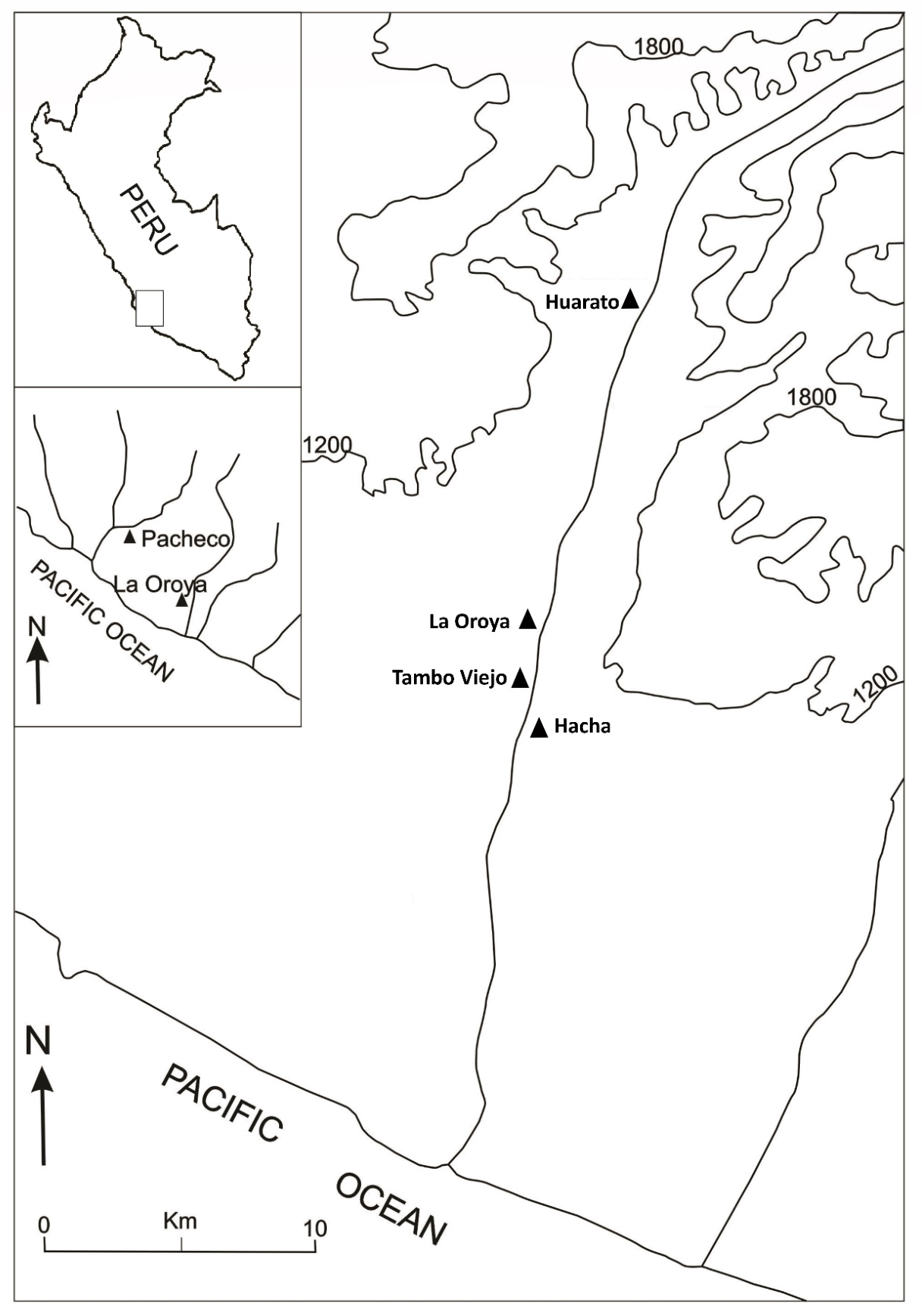
Figure 2.
Map of the Structure 2 of Hacha (drawing prepared by Rubén Quispe).
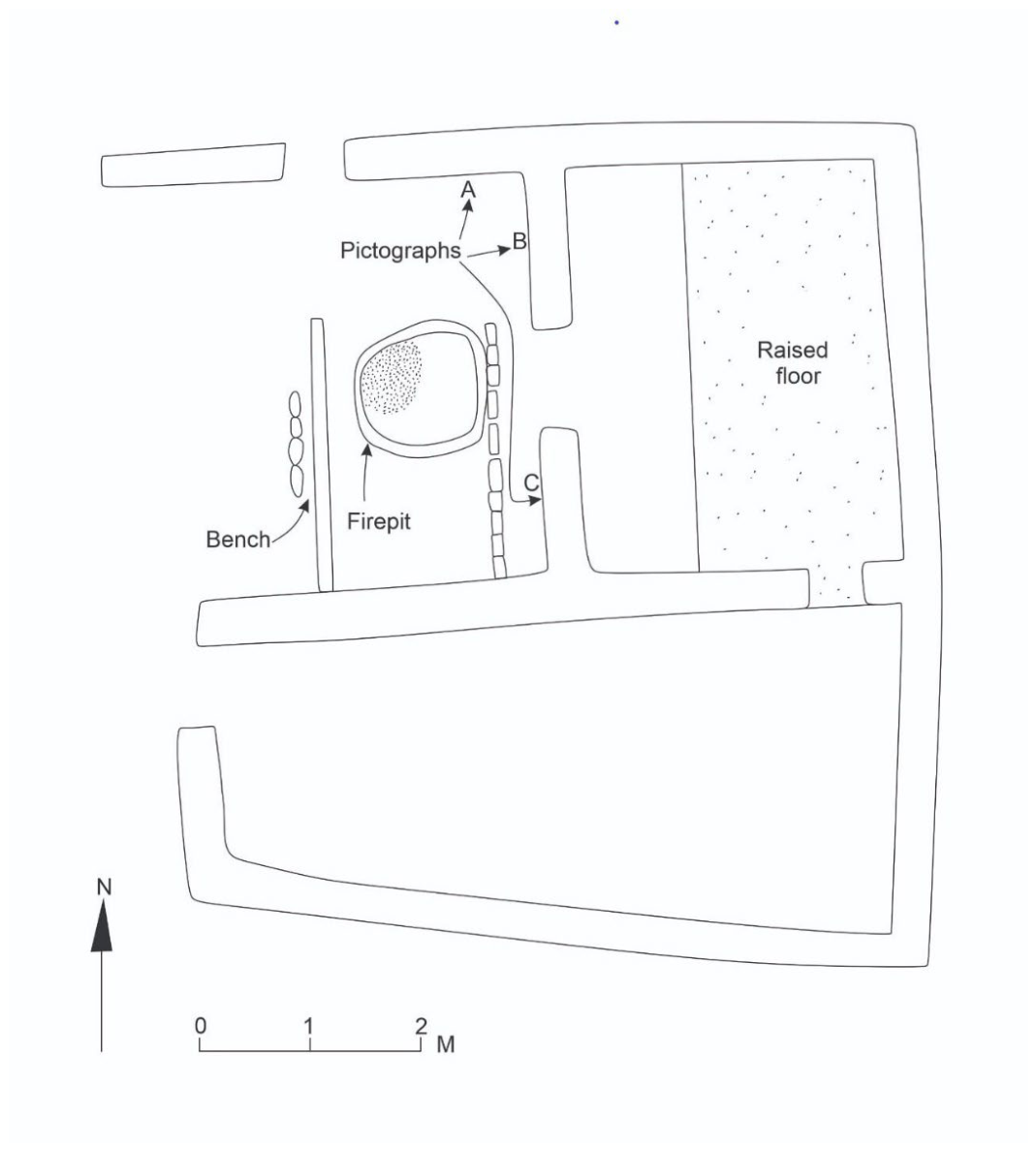
Figure 3.
Pictographs of Structure 2 of the Hacha site (drawing prepared by Rubén Quispe).
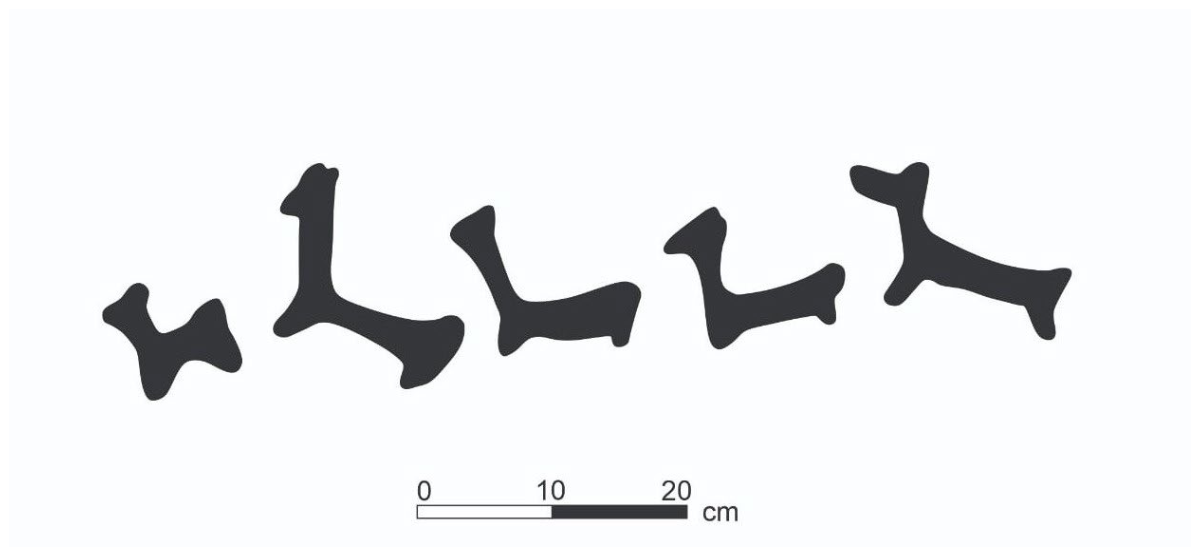
Figure 4.
A. Burial of an adult male from Huarato; note the bottle gourd as the only offering; B. Hatched roof of the burial of an adult male of Huarato depicted in Figure 4A.
Figure 4.
A. Burial of an adult male from Huarato; note the bottle gourd as the only offering; B. Hatched roof of the burial of an adult male of Huarato depicted in Figure 4A.
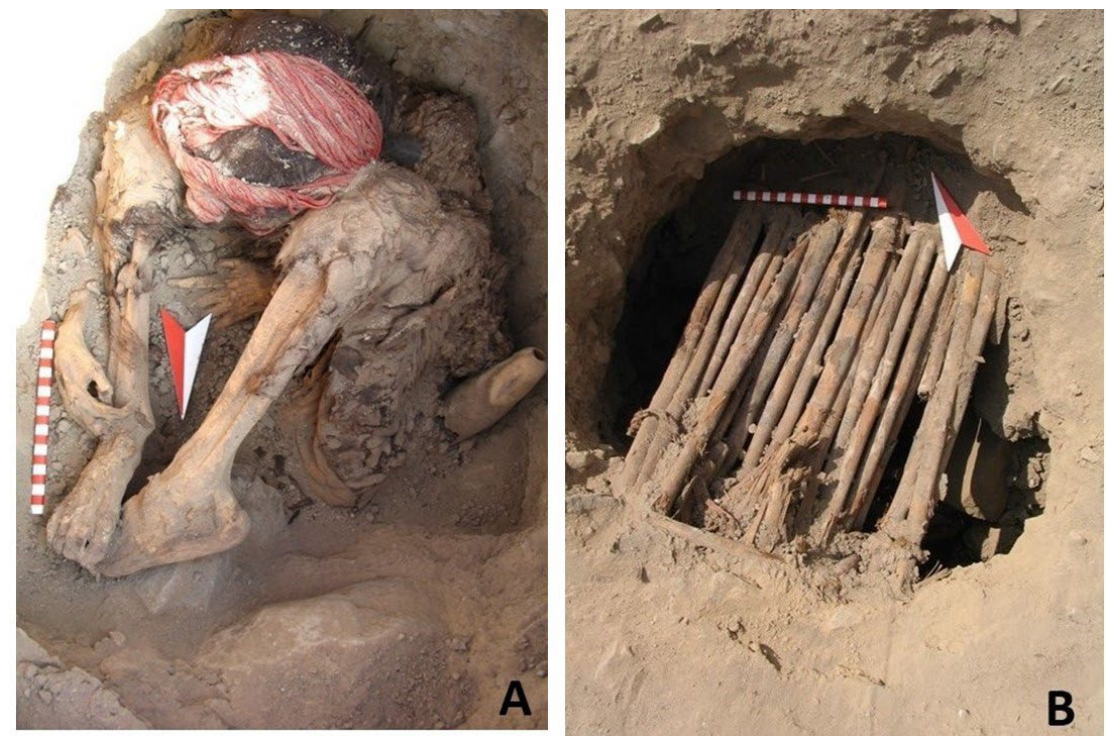
Figure 6.
View of the deposit of the shattered ceramics from the La Oroya site following its fortuitous discovery.
Figure 6.
View of the deposit of the shattered ceramics from the La Oroya site following its fortuitous discovery.
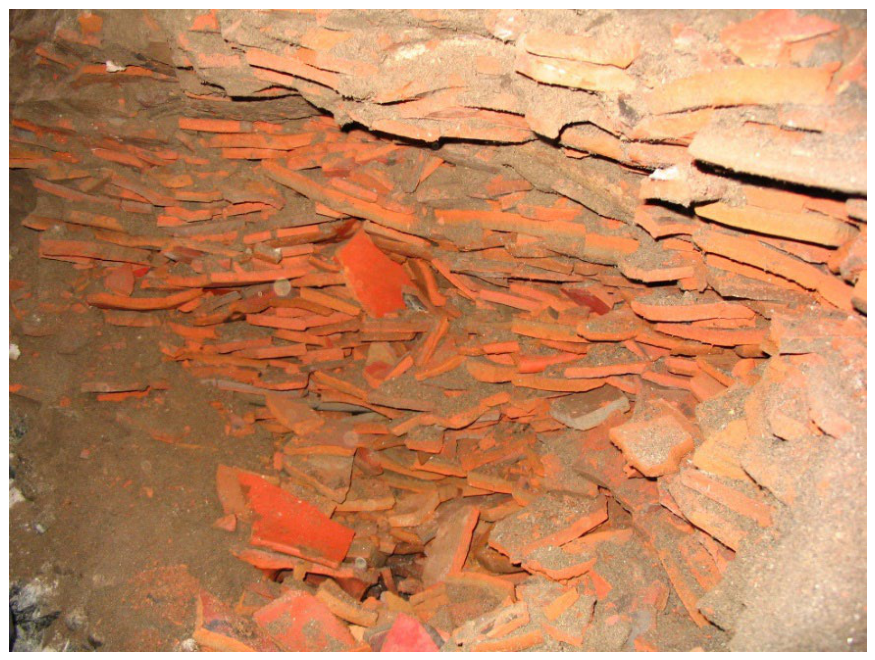
Figure 8.
A. View of the ceramic sherds from the deposit excavated at the La Oroya site. B. Group of the partially restored ceramic vessels from the La Oroya site. C - D. Samples of partially restored ceramic vessels from the La Oroya site.
Figure 8.
A. View of the ceramic sherds from the deposit excavated at the La Oroya site. B. Group of the partially restored ceramic vessels from the La Oroya site. C - D. Samples of partially restored ceramic vessels from the La Oroya site.
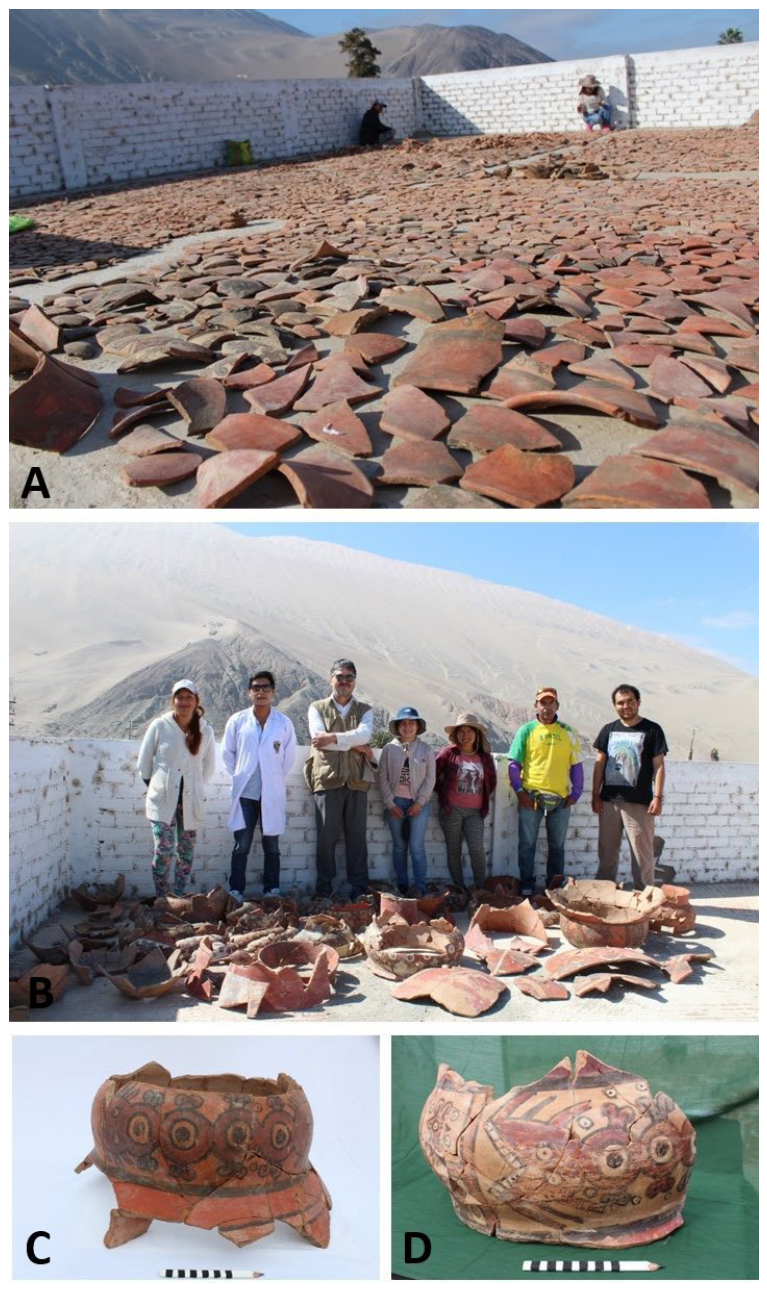
Figure 9.
Sacrificed guinea pigs from Tambo Viejo associated with a hearth.
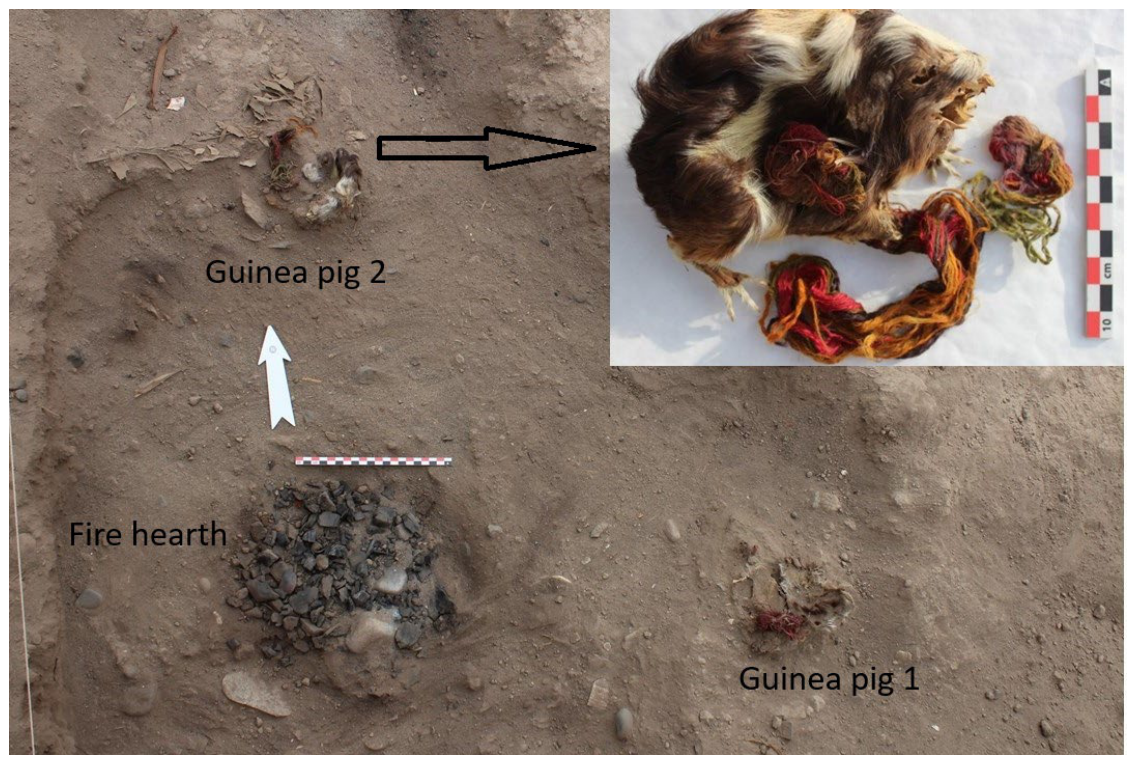
Figure 10.
One of the sacrificed llamas from Structure 4 of the Tambo Viejo site.
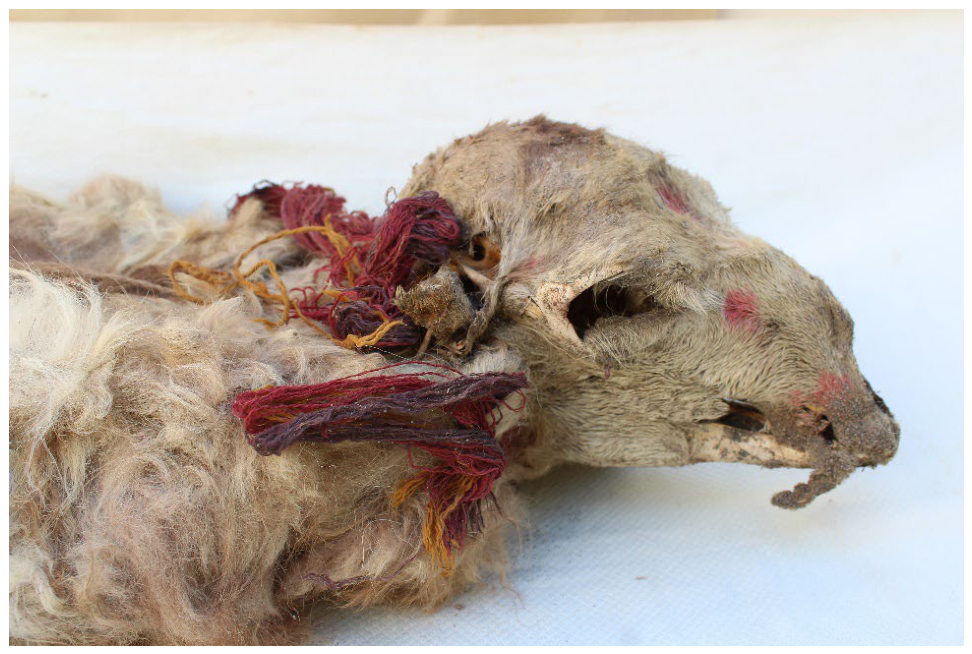
Figure 11.
An Inka anthropomorphic figurine from Structure 2 of Tambo Viejo that was found over a group of partially burned maize cobs One of the sacrificed llamas from Structure 4 of the Tambo Viejo site.
Figure 11.
An Inka anthropomorphic figurine from Structure 2 of Tambo Viejo that was found over a group of partially burned maize cobs One of the sacrificed llamas from Structure 4 of the Tambo Viejo site.
Disclaimer/Publisher’s Note: The statements, opinions and data contained in all publications are solely those of the individual author(s) and contributor(s) and not of MDPI and/or the editor(s). MDPI and/or the editor(s) disclaim responsibility for any injury to people or property resulting from any ideas, methods, instructions or products referred to in the content. |
© 2026 by the authors. Licensee MDPI, Basel, Switzerland. This article is an open access article distributed under the terms and conditions of the Creative Commons Attribution (CC BY) license (http://creativecommons.org/licenses/by/4.0/).
Copyright: This open access article is published under a Creative Commons CC BY 4.0 license, which permit the free download, distribution, and reuse, provided that the author and preprint are cited in any reuse.