
Submitted:
09 July 2026
Posted:
14 July 2026
You are already at the latest version
Abstract
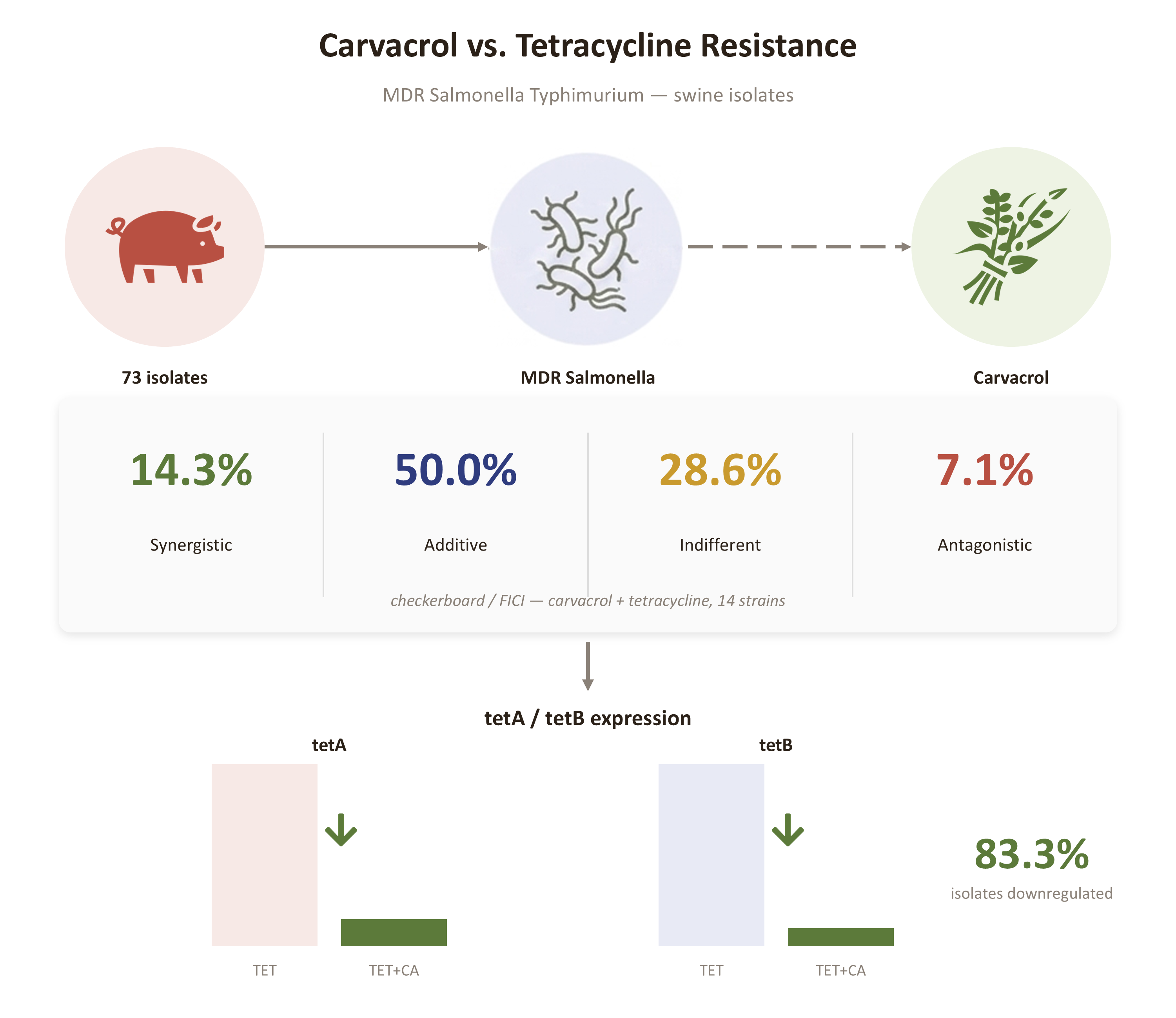
Salmonella Typhimurium is an important pathogen affecting both animal production and public health, with pigs representing a major reservoir. The increasing prevalence of antimicrobial resistance highlights the need for alternative or complementary therapeutic strategies. Carvacrol, a phenolic constituent of Origanum vulgare essential oil, has recognized antimicrobial activity and may contribute to the modulation of antimicrobial resistance mechanisms. The present study investigated the antimicrobial activity of carvacrol and tetracycline, individually and in combination, against swine-derived S. Typhimurium strains. Minimum inhibitory concentrations (MIC) and minimum bactericidal concentrations (MBC) were determined by broth microdilution. Interactions between both compounds were assessed by checkerboard assays using the fractional inhibitory concentration index (FICI). Relative expression of tetracycline resistance genes was analysed by quantitative real-time PCR in selected isolates exposed to tetracycline alone or combined with carvacrol. Carvacrol MIC values ranged from 0.5 to 16 mg/mL, with MIC₅₀ and MIC₉₀ values of 2 and 4 mg/mL, respectively. MBC and MIC values were identical in 84.9% of the isolates, indicating a strong bactericidal effect. Tetracycline MIC₅₀ and MIC₉₀ values were 256 and 512 µg/mL, respectively. Checkerboard assays showed synergistic interactions in 14.3% of strains, additive effects in 50.0%, indifferent responses in 28.6%, and antagonism in 1%. Combined exposure reduced tetA and tetB expression in most tested isolates compared with tetracycline alone, although responses were strain dependent. These findings demonstrate that carvacrol exhibits antimicrobial activity against swine-derived multidrug-resistant S. Typhimurium and may enhance tetracycline activity while modulating resistance-associated gene expression. Carvacrol could represent a promising natural adjuvant for antimicrobial control strategies in swine production.
Keywords:
Salmonella typhimurium
; carvacrol
; tetracycline
; antimicrobial resistance
; tet genes
; multidrug resistance
; swine
Copyright: This open access article is published under a Creative Commons CC BY 4.0 license, which permit the free download, distribution, and reuse, provided that the author and preprint are cited in any reuse.


