

Submitted:
13 July 2026
Posted:
14 July 2026
You are already at the latest version
Abstract
Background/Objectives: We conducted a scoping review to explore the available literature on the association between lead exposure and NAFLD/MAFLD. The primary objective of this review was to discern the extent to which lead exposure has been posited as a deter-minant or risk factor for NAFLD/MAFLD.
Methods: The scoping literature review, conducted following the framework proposed by Arksey and O'Malley, aimed to summarize evidence on the relationship between lead ex-posure and NAFLD/MAFLD. Inclusion criteria were observational studies analyzing hu-man populations, excluding review articles, case reports, and animal studies. The types of participants, exposure of interest (lead), and outcomes (NAFLD/MAFLD onset and out-comes) were reviewed and descriptively summarized to chart the available literature.
Results: The review identified 62 documents, with ten articles meeting the inclusion crite-ria. These studies predominantly utilized population health surveys and observational approaches. Positive risk-adjusted associations between blood lead levels (BLL) and NAFLD were reported in six studies, with one study indicating correlations between BLL and fatty liver indexes and another suggesting a link between lead exposure duration and liver fibrosis. Notably, the fourth quartile of BLL consistently exhibited higher odds of NAFLD/MAFLD across studies.
Conclusion: Our scoping review reveals a consistent pattern linking higher lead exposure, particularly in the fourth blood lead level quartile, to increased odds of Non-Alcoholic Fatty Liver Disease/Metabolic-Associated Fatty Liver Disease (NAFLD/MAFLD).
Keywords:
NAFLD
; MAFLD
; lead exposure
; environmental health
; scoping review
1. Introduction
Non-Alcoholic Fatty Liver Disease (NAFLD), now recognized as Metabolic-Associated Fatty Liver Disease (MAFLD), has emerged as a burgeoning global health concern characterized by hepatic fat accumulation in the absence of significant alcohol consumption [1]. Its prevalence has risen precipitously, paralleling shifts in lifestyle and dietary patterns [2,3,4]. The complex etiology of NAFLD/MAFLD encompasses a spectrum of genetic, metabolic, and environmental factors. In this context, the role of environmental exposures in contributing to NAFLD/MAFLD pathogenesis warrants meticulous exploration.
NAFLD/MAFLD is increasingly acknowledged as a complex interplay between genetic predisposition and environmental factors, prompting investigations into the potential influence of environmental contaminants such as lead [5,6]. Lead has long been recognized for its adverse health effects, particularly on the hepatic system. The hepatotoxic properties of lead and its capacity to disrupt metabolic processes provide a rationale for examining its potential association with NAFLD/MAFLD. Experimental evidence and epidemiological observations underscore the plausibility of lead exposure influencing metabolic pathways and hepatocellular function [7,8,9], warranting a comprehensive review of the existing literature.
Therefore, we conducted a scoping review to explore the available literature on the association between lead exposure and NAFLD/MAFLD. The primary objective of this review was to discern the extent to which lead exposure has been posited as a determinant or risk factor for NAFLD/MAFLD.
2. Materials and Methods
We performed a scoping literature review following the framework proposed in the seminal paper by Arksey and O’Malley [10,11] and according to the recommendations from the Joanna Briggs Institute. Moreover, the review was reported according to the PRISMA extension for scoping reviews (the PRISMA-ScR) [12].
2.1. Review Question
This scoping review was performed to summarize the evidence about the relationship between lead exposure and NAFLD/MAFLD. To this end, we framed a prognostic question specifying the types of Participants, types of Index prognostic factor, and types of outcomes as follows: Participants: general population; Index prognostic factor: lead exposure; Outcomes: NAFLD/MAFLD onset and outcomes. Thus, the review answered the following question:
What information and empirical data have been reported concerning the association between lead exposure and its impact on the onset and outcomes of Non-Alcoholic Fatty Liver Disease (NAFLD)/Metabolic Associated Fatty Liver Disease (MAFLD)?
2.2. Inclusion/exclusion Criteria
All peer-reviewed published literature describing or analyzing the relationship between lead exposure and NAFLD/MAFLD were considered eligible for inclusion. We included observational studies (cohorts, case-control, and cross-sectional studies) that analyzed human populations of any age and investigated the association between lead exposure/blood lead levels and risk of NAFLD/MAFLD. We excluded review articles, case reports, and studies performed on animals.
2.3. Types of Participants
Because we were interested in learning about lead exposure effects on the risk of NAFLD/MAFLD in humans, we did not restrict the inclusion criteria to a particular population of interest. Instead, studies with population-based data (i.e., surveys) or those performed in populations with a baseline higher risk of lead exposure (i.e., industrial workers or people living near industrial zones) were considered appropriate for inclusion.
2.4. Exposure of Interest
Lead was the exposure of interest. The principal sources of lead exposure are paints, water, soil, dust, cooking and baking utensils, and leaded gasoline. Industrial emissions can also be responsible for population exposure to lead.
For this review, we included studies where lead exposure was objectively defined by quantifying blood lead levels (BLL) in the individuals analyzed. Although BLL ≥ 5ug/dL is considered elevated, we did not restrict the BLL to a particular cut-off value. Instead, we extracted data on the exposure of interest using the cut-off values reported on each study and by exposure quartiles, if available.
2.5. Concept, Context, and Outcomes
The association between lead exposure and NAFLD/MAFLD onset and outcomes was the core concept of this scoping review. This concept was explored in observational studies examining the effect of lead exposure on the following outcomes of interest: 1. Hepatic steatosis, and 2. Liver fibrosis. These outcomes were not pre-defined; we included and extracted outcome data according to the definitions reported in each study.
2.6. Search Methods
Electronic database searches were performed in MEDLINE (through OVID), EMBASE, and SCOPUS from inception to November 15/2023. Search strategies were designed to include words related to the condition of interest (NAFLD, MAFLD) and the exposure of interest (lead exposure). For example, the search strategy in MEDLINE was: (exp Lead/ OR exp Lead Poisoning/ OR lead exposure.mp. OR lead toxicity.mp. OR “blood lead levels”.mp. OR “lead levels”.mp.) AND (exp Non-alcoholic Fatty Liver Disease/ OR nafld.mp. OR metabolic associated fatty liver disease.mp. OR MAFLD.mp. OR exp Fatty Liver/ OR non-alcoholic steatohepatitis.mp.).
2.7. Study Selection
The records found in the electronic search strategies were imported into Ryyan. Then, two authors independently screened titles and abstracts according to the inclusion criteria previously described. Finally, relevant articles identified in this phase were retrieved as full texts and reviewed by two authors, who selected the articles to be included in the scoping review.
2.8. Data Extraction and Synthesis of the Literature
The articles selected, based on the inclusion/exclusion criteria, were then reviewed to collect information relevant to the review research question. The data was extracted into a data collection form and included: author, year and country of publication, data sources (i.e., national survey data, large observational studies, among others), number of individuals analyzed, demographic and clinical characteristics, the definition of lead exposure and method for its quantification, and definition of outcomes (NAFLD/MAFLD). Also, the estimates of the effect of lead exposure in NAFLD/MAFLD were extracted as reported in each study. When available, adjusted effect estimates by quartile of lead exposure were collected.
All the data was extracted as reported in the primary source (peer-reviewed article) and summarized descriptively to chart the available literature.
3. Results
Figure 1 provides the flow diagram for the screening and selection of the studies included in the review. A total of 62 documents were retrieved from MEDLINE, SCOPUS, and EMBASE searches. Twenty-two of these documents were duplicates. Thereby leaving 40 articles for screening. After applying the review inclusion/exclusion criteria, ten articles were included [7,9,13,14,15,16,17,18,19,20]. See Table 1 for a general overview of the studies included in the review
The ten articles included in this scoping review were published between 2010 and 2022. Eight articles were secondary analyses of population Health surveys (NANHES=4, Korean National Environmental Health Survey=1, Korean National Health and Nutrition Examination Survey=1, Survey on Prevalence in East China for Metabolic Diseases and Risk Factors=2). In addition, one was a cross-sectional study with data from workers of a battery manufacturing factory, and one was a prospective cohort study from Mexico. All studies examined the relationship between Lead exposure (measured in BLL) and NAFLD/MAFLD.
Six studies reported positive risk-adjusted associations between BLL and the odds of NAFLD. One study reported positive correlations between BLL and indexes reflecting fatty liver and fibrosis. Another one reported a positive correlation between the duration of lead exposure and the degree of liver fibrosis. Finally, two studies found no associations between lead exposure and NAFLD/MAFLD.
Table 2 shows the results from multivariable regression analyses showing the risk-adjusted odds of NAFLD/MAFLD across quartiles of blood lead levels.
4. Discussion
This scoping review summarized the evidence around the association between lead exposure and the likelihood of NAFLD/MAFLD. The most obvious finding to emerge from this study was a noticeable pattern in which higher levels of lead exposure induced greater odds of NAFLD/MAFLD, more evident in the BLL 4th quartile, where positive associations were more often reported, reflecting a plausible dose-response relationship consistent across studies. Indeed, the study by Zhai et al.[15] reported a considerably rising prevalence at each BLL quartile. The NAFLD/MAFLD prevalence went from 35% and 34% in the first BLL quartile to 47% and 48% in the Q4 for males and females, respectively.
Although continued efforts are needed to unravel the cause-effect relationship between lead exposure and NAFLD/MALFD, the data synthesized herein provides a compelling argument favoring a plausible association exhibiting attributes of causation. First, the association was consistent across studies, in line with Hill’s concept of consistency, including different persons, places, contexts, and times [21]. Second, it displayed a biological gradient as the outcome odds increased with increasing exposure doses (See Table 2). Third, the associations reported were strong. Moreover, the association between lead and NAFLD/MAFLD is supported by biologically plausible mechanisms. Lead triggers a chain reaction starting with lipid peroxidation, cell membrane destabilization, and cell death. It is well-known from histological examinations that exposure to lead nanoparticles increases hepatic glucose levels and induces fatty liver accumulation in rats [22]. Chronically, lead induces fatty liver changes with periportal inflammation.
In humans, lead exposure demonstrated by elevated blood lead levels induces pathological liver changes that can be indirectly measured using non-invasive imaging tests [23]. Indeed, two of the ten articles diagnosed NAFLD/MAFLD using vibration-controlled transient elastography (VCTE). Spaur et al. [7] defined liver steatosis as a CAP260 dB/m and significant liver fibrosis as a liver stiffness value higher than 7kPa. They found that higher levels of BLL were related to an increased likelihood of VCTE abnormal results. Similarly, Teerasarntipan [14]found that more extended periods of lead exposure were positively correlated with the degree of liver impairment on transient elastography, potentially increasing the chance of more advanced liver disease at diagnosis. Therefore, individuals with prolonged periods of exposure (i.e., those living for many years in industrial areas with a proven higher likelihood of lead exposure) should be prioritized when implementing programs for the early detection of NAFLD/MAFLD.
Continued improvement of non-invasive imaging techniques in assessing fatty liver and liver fibrosis holds key to truly advancing NAFLD/MAFLD early detection in special populations at higher risk of the condition. Current EASL guidelines recommend calculating the FIB-4 score in patients at risk of metabolic-associated chronic liver disease and evaluating liver stiffness by transient elastography [24]. Patients with LS≥8 on elastography should undergo liver biopsy if the hepatologist considers it a reasonable approach. Of course, these recommendations have to be placed in context. Thus, as we have demonstrated an association between lead exposure and higher risk-adjusted odds of NAFLD, individuals exposed to sources of lead (i.e., individuals living near industrial zones and workers of battery-manufacturing factories) should undergo a medical evaluation including the assessment of liver health using non-invasive tools, either serological or imagining tests. Given its practicality and the fact that it can be performed at the bedside, transient elastography may be an efficient alternative for NAFLD/MAFLD screening in populations with a higher risk of lead toxicity.
However, studies are still needed to evaluate whether a vibration-controlled transient elastography screening strategy improves liver-related outcomes. These studies should also assess the cost-effectiveness of such strategies. Currently, the LiverScreen project [25], a multicenter European research study, is testing the hypothesis that implementing a screening program using transient elastography may increase the detection of asymptomatic patients with advanced liver fibrosis, thereby increasing the likelihood of early interventions, which may result in better outcomes. Suppose the population-based data from the LiverScreening project indicates that transient elastography is accurate and effective. In that case, it is rational to posit that such a strategy may have significant implications for evaluating liver health when the baseline risk is higher, such as in the case of the population explored in this review: those with evidence of lead exposure. In the meantime, at least the Fib-4 score should be calculated among individuals with risk factors for environmental lead toxicity.
5. Conclusions
Our scoping review reveals a consistent pattern linking higher lead exposure, particularly in the fourth blood lead level quartile, to increased odds of Non-Alcoholic Fatty Liver Disease/Metabolic-Associated Fatty Liver Disease (NAFLD/MAFLD). This observed association aligns with established criteria for causation, supported by a biological gradient and strong reported associations across diverse studies. The biological plausibility of lead-induced processes further supports this link. Notably, non-invasive imaging tools, especially vibration-controlled transient elastography, emerge as valuable in assessing liver health in lead-exposed individuals. While awaiting further validation of screening strategies, routine medical evaluations, including Fib-4 score calculations, seem pragmatic for those with potential lead exposure, highlighting the importance of ongoing research for early NAFLD/MAFLD detection in at-risk populations.
Supplementary Materials
The following supporting information can be downloaded at the website of this paper posted on Preprints.org.
Funding
This research received no external.
Institutional Review Board Statement
Not applicable.
Informed Consent Statement
Not applicable.
Data Availability Statement
No data were generated for the preparation of this article.
Acknowledgments
None.
Conflicts of Interest
The authors declare no conflicts of interest.
Abbreviations
The following abbreviations are used in this manuscript:
| NAFLD | Non-Alcoholic Fatty Liver Disease |
| MAFLD | Metabolic Associated Fatty-Liver Disease |
References
- Lake, J.E.; Overton, T.; Naggie, S.; et al. Expert Panel Review on Nonalcoholic Fatty Liver Disease in Persons With Human Immunodeficiency Virus. Clin. Gastroenterol. Hepatol. 2022, 20, 256–268. [Google Scholar] [CrossRef] [PubMed]
- Ando, Y.; Jou, J.H. Nonalcoholic Fatty Liver Disease and Recent Guideline Updates. Clin. Liver Dis. 2021, 17, 23–28. [Google Scholar] [CrossRef] [PubMed]
- The global, regional, and national burden of cirrhosis by cause in 195 countries and territories, 1990-2017: a systematic analysis for the Global Burden of Disease Study 2017. Lancet Gastroenterol. Hepatol. 2020, 5, 245–266. [CrossRef] [PubMed]
- Younossi, Z.; Anstee, Q.M.; Marietti, M.; et al. Global burden of NAFLD and NASH: trends, predictions, risk factors and prevention. Nat. Rev. Gastroenterol. Hepatol. 2018, 15, 11–20. [Google Scholar] [CrossRef] [PubMed]
- Riazi, K.; Azhari, H.; Charette, J.H.; et al. The prevalence and incidence of NAFLD worldwide: a systematic review and meta-analysis. Lancet Gastroenterol. Hepatol. 2022, 7, 851–861. [Google Scholar] [CrossRef] [PubMed]
- Mikhail, T.H.; El-Sawaf, H.A.; Ibrahim, K.M.; et al. Evaluation of the effect of lead exposure on the liver in Egyptian lead tank welders. Z. Ernahrungswiss 1980, 19, 50–56. [Google Scholar] [CrossRef] [PubMed]
- Spaur, M.; Nigra, A.E.; Sanchez, T.R.; et al. Association of blood manganese, selenium with steatosis, fibrosis in the National Health and Nutrition Examination Survey, 2017-18. Env. Res. 2022, 213, 113647. [Google Scholar] [CrossRef] [PubMed]
- Wang, X.; Yao, N. Effect of Herb formula Xiao-Zhi-Hua-Xian-Tang against nonalcoholic steatohepatitis with advanced fibrosis: A preliminary clinical study. Hepatol. Int. 2017, 11, S939–S940. [Google Scholar] [CrossRef] [PubMed]
- Wan, H.; Wang, Y.; Zhang, H.; et al. Chronic lead exposure induces fatty liver disease associated with the variations of gut microbiota. Ecotoxicol. Env. Saf. 2022, 232, 113257. [Google Scholar] [CrossRef] [PubMed]
- Arksey, H.; O’Malley, L. Scoping studies: towards a methodological framework. Int. J. Soc. Res. Methodol. 2005, 8, 19–32. [Google Scholar] [CrossRef]
- Peters, M.D.J.; Godfrey, C.M.; Khalil, H.; et al. Guidance for conducting systematic scoping reviews. Int. J. Evid. Based Healthc. 2015, 13, 141–146. [Google Scholar] [CrossRef] [PubMed]
- Tricco, A.C.; Lillie, E.; Zarin, W.; et al. PRISMA Extension for Scoping Reviews (PRISMA-ScR): Checklist and Explanation. Ann. Intern Med. 2018, 169, 467–473. [Google Scholar] [CrossRef] [PubMed]
- Yang, C.; Li, Y.; Ding, R.; et al. Lead exposure as a causative factor for metabolic associated fatty liver disease (MAFLD) and a lead exposure related nomogram for MAFLD prevalence. Front. Public Heal. 2022, 10. [Google Scholar] [CrossRef]
- Teerasarntipan, T.; Chaiteerakij, R.; Prueksapanich, P.; Werawatganon, D. Changes in inflammatory cytokines, antioxidants and liver stiffness after chelation therapy in individuals with chronic lead poisoning. BMC Gastroenterol. 2020, 20, 263. [Google Scholar] [CrossRef] [PubMed]
- Zhai, H.; Chen, C.; Wang, N.; et al. Blood lead level is associated with non-alcoholic fatty liver disease in the Yangtze River Delta region of China in the context of rapid urbanization. Env. Health 2017, 16, 93. [Google Scholar] [CrossRef] [PubMed]
- Reja, D.; Makar, M.; Visaria, A.; et al. Blood lead level is associated with advanced liver fibrosis in patients with non-alcoholic fatty liver disease: A nationwide survey (NHANES 2011-2016). Ann. Hepatol. 2020, 19, 404–410. [Google Scholar] [CrossRef] [PubMed]
- Moon, M.K.; Lee, I.; Lee, A.; et al. Lead, mercury, and cadmium exposures are associated with obesity but not with diabetes mellitus: Korean National Environmental Health Survey (KoNEHS) 2015-2017. Env. Res. 2022, 204, 111888. [Google Scholar] [CrossRef] [PubMed]
- Chung, S.M.; Moon, J.S.; Yoon, J.S.; et al. The sex-specific effects of blood lead, mercury, and cadmium levels on hepatic steatosis and fibrosis: Korean nationwide cross-sectional study. J. Trace Elem. Med. Biol. Organ Soc. Min. Trace Elem. 2020, 62, 126601. [Google Scholar] [CrossRef] [PubMed]
- Cave, M.; Appana, S.; Patel, M.; et al. Polychlorinated biphenyls, lead, and mercury are associated with liver disease in American adults: NHANES 2003-2004. Env. Health Perspect. 2010, 118, 1735–1742. [Google Scholar] [CrossRef] [PubMed]
- Betanzos-Robledo, L.; Cantoral, A.; Peterson, K.E.; et al. Association between cumulative childhood blood lead exposure and hepatic steatosis in young Mexican adults. Env. Res. 2021, 196, 110980. [Google Scholar] [CrossRef] [PubMed]
- Fedak, K.M.; Bernal, A.; Capshaw, Z.A.; Gross, S. Applying the Bradford Hill criteria in the 21st century: how data integration has changed causal inference in molecular epidemiology. Emerg. Themes Epidemiol. 2015, 12, 14. [Google Scholar] [CrossRef] [PubMed]
- Zhou, J.; Zhang, N.; Aldhahrani, A.; et al. Puerarin ameliorates nonalcoholic fatty liver in rats by regulating hepatic lipid accumulation, oxidative stress, and inflammation. Front Immunol. 2022, 13, 956688. [Google Scholar] [CrossRef] [PubMed]
- Galizzi, H.O.; Couto, C.A.; Taranto, D.O.L.; et al. Accuracy of non-invasive methods/models for predicting esophageal varices in patients with compensated advanced chronic liver disease secondary to nonalcoholic fatty liver disease. Ann. Hepatol. 2021, 20, 100229. [Google Scholar] [CrossRef]
- EASL. EASL Clinical Practice Guidelines on non-invasive tests for evaluation of liver disease severity and prognosis - 2021 update. J. Hepatol. 2021, 75, 659–689. [Google Scholar] [CrossRef] [PubMed]
- Graupera, I.; Thiele, M.; Ma, A.T.; et al. LiverScreen project: study protocol for screening for liver fibrosis in the general population in European countries. BMC Public Health 2022, 22, 1385. [Google Scholar] [CrossRef] [PubMed]
Figure 1.
PRISMA flow diagram.
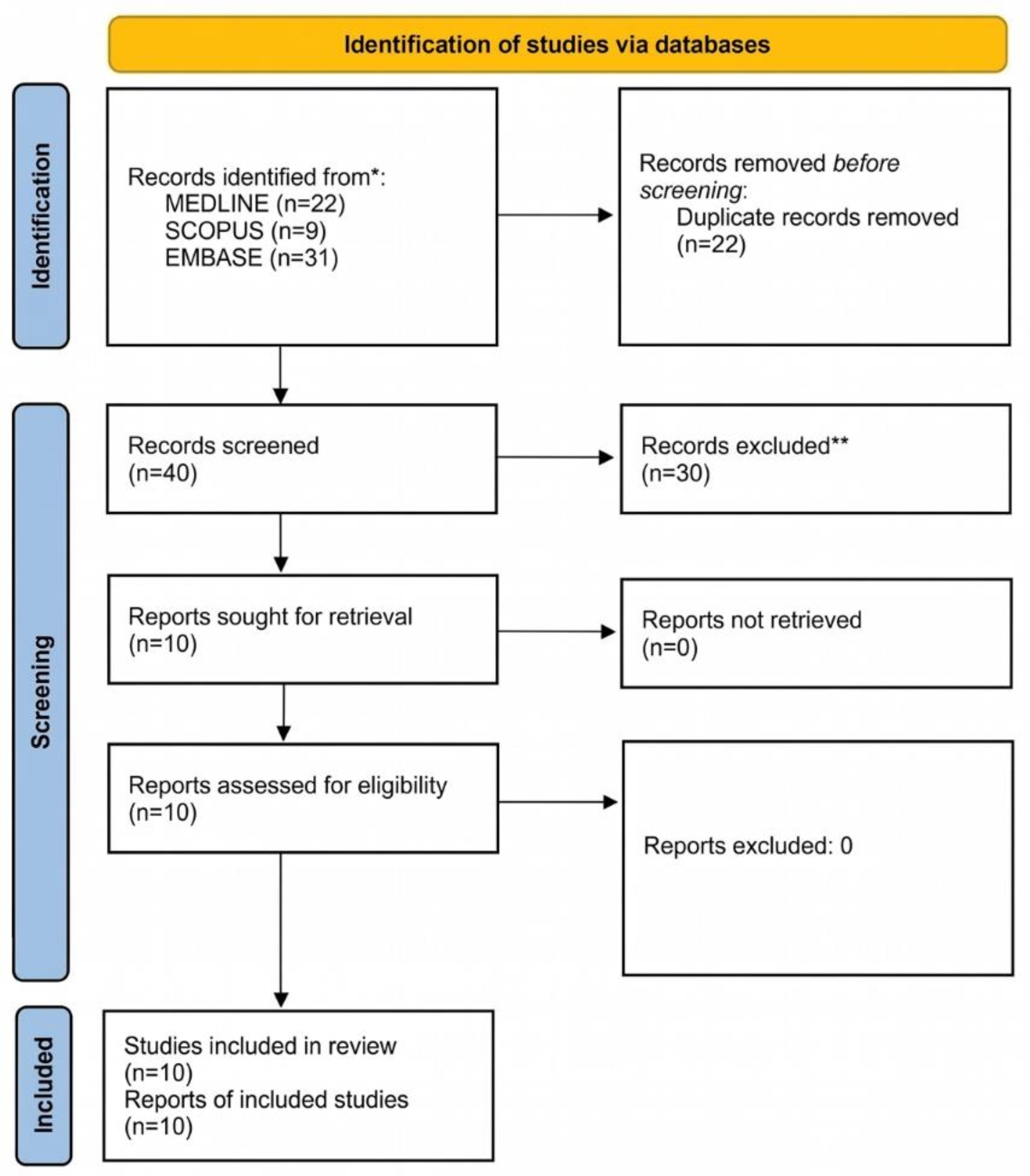

Table 1.
Characteristics of the studies included in the review.
| Author/y | Objective | Study type | Data source | Country | Follow-up period |
Blood lead level determination? | NAFLD definition | Association between lead and NAFLD |
Summary of the relationship between lead and NAFLD |
Model adjustment (confounders) |
|---|---|---|---|---|---|---|---|---|---|---|
| Betanzos-Robledo 2021 | This study aims to estimate the association between cumulative lead exposure during early life from 1 to 4 years of age with biomarkers of hepatic steatosis in young adulthood in a Mexico City bith cohort. |
Population cohort study | Young adults from the Early Life Exposure in Mexico to Environmental Toxicants (ELEMENT) project |
Mexico | From 1994 to 2016 |
Childhood blood samples were collected annually from ages 1-4 years. |
Liver fat content on MRI ≥5% | Positive association | Individuals in the higher quartile of childhood blood lead level had higher hepatic fat content (beta=5,67 95% CI: 1,89-9,44) |
Sex, birth weight, breatfeeding and mother’s education, smoking habits, energy intake, sitting hours per day and BMI |
| Chung 2020 | We explored the sex-specific relationships of blood lead, mercury and cadmium levels with hepatic steatosis and hepatic fibrosis, using the hepatic steatosis index and fibrosis 4 index |
Population cross sectional |
Korea National Health and Nutrition Examination Survey (KNHANES) in 2016 and 2017. |
South Korea | No follow-up |
Blood lead levels were measured in venous whole- blood samples. |
Hepatic steatosis was defined by a Hepatic Steatosis Index ≥36. Hepatic fibrosis was defined by a FIB-4 score >2.67 |
Positive corelation | Blood lead levels were positively correlated with higher HSI values (MEN: r=0,085; p<0,001 - WOMEN: r=0,073; p<0.001) and higher FIB-4 values (MEN: 0,184; p<0.001 - WOMEN: r=0,2; p<0.001). |
N/A |
| Moon 2022 | “We employed a nationally representative adult population who participated in the Korean National Environmental Health Survey 2015-2017 and explored the associations of heavy metal exposure with obesity and obesity- related traits such as |
Population cross sectional |
Korean National Environmental Health Survey 2015-2017 |
South Korea | No follow- up |
Blood lead was measure in blood using a graphite furnance atomic absorption spectrometry |
Hepatic steatosis index (HSI) was employed to determine NAFLD cases. HSI≥36 was considered to indicate NAFLD. |
Positive Association | AST and GGT were positively associated with higher levels of blood lead. There were no significant risk-adjusted odds of NAFLD with blood lead levels |
Age, sex, cigarette smoking, alcohol drinking, exercise and education levels. |
Table 2.
Quartiles of Lead exposure.
| Author/y | Outcome definition | BLL Quartile 1 | BLL Quartile 2 | BLL Quartile 3 | BLL Quartile 4 | ||||
|---|---|---|---|---|---|---|---|---|---|
| Values | Association | Values | Association | Values | Association | Values | Association | ||
| Wan 2022 | NAFLD= liver steatosis in US | ≤ 3.1 ug/dL | Ref | > 3.1, ≤ 4.7 ug/dL | OR=1,05, 95% CI: 0,84-1,3 | >4.7, ≤ 6.6 ug/dL | OR=1,4, 95% CI:1,13-1,74* | > 6.6 ug/dL | OR=1,32, 95% CI:1,18-1,49* |
| MAFLD$ | ≤ 3.1 ug/dL | Ref | > 3.1, ≤ 4.7 ug/dL | OR=1,08, 95% CI:0,86-1,8 | >4.7, ≤ 6.6 ug/dL | OR=1,39, 95% CI: 1,12-1,73* | > 6.6 ug/dL | OR=1,3, 95% CI:1,16-1,46* | |
| Moon 2022 | HSI≥36 indicated NAFLD. | <1,26 ug/dL | Ref | 1.26-<1.71 μg/dL | OR=1,14, 95% CI:0,84-1,54 | 1.71-<2.32 μg/dL | OR=1,37, 95% CI:0,96-1,96 | ≥2.32 μg/dL | OR=1,32, 95% CI:0,93-1,88 |
| Betanzos-Robledo 2021 | Liver fat content on MRI | 10,16-18,71 ug/dL | Ref | 18,75-23,17 ug/dL | β=-0,08, 95% CI:-4,16 to 4,01 | 23,43-27,55 ug/dL | β=0,86, 95% CI:-3,23 to 4,94 | 28,27-47,32 ug/dL | β=5,32, 95% CI:1,24 to 9,40* |
| Reja 2020 | Advanced fibrosis= NFS> 0.676 | <0,635 ug/dL | Ref | 0.635–1.01 ug/dL | OR=2,79, 95% CI:1,39-5,63* | 1.01–1.62 ug/dL | OR=3,74, 95% CI: 2,01-6,96* | >1.62 ug/dL | OR=5,93, 95% CI: 2,88-12,24* |
| Zhai 2017 | Liver steatosis in US (males) | ≤ 3,60 ug/dL | Ref | 3,61-5,29 ug/dL | OR=1,69, 95% CI:0,84-3,41 | 5,30-7,28 ug/dL | OR=1,83, 95% CI: 0,87-3,85 | ≥7,29 ug/dL | OR=2,16, 95% CI:0,98-4,7 |
| Liver steatosis in US (Women) | ≤ 3,60 ug/dL | Ref | 3,61-5,29 ug/dL | OR=1,38, 95% CI:0,95-2 | 5,30-7,28 ug/dL | OR=1,49, 95% CI:1,02-2,18* | ≥7,29 ug/dL | OR=1,61, 95% CI:1,08-2,4* | |
| Liver steatosis in US (Prevalence in males) | ≤ 3,60 ug/dL | 35,3% | 3,61-5,29 ug/dL | 37,7% | 5,30-7,28 ug/dL | 42,7% | ≥7,29 ug/dL | 47,3% | |
| Liver steatosis in US (Prevalence in Women) | ≤ 3,60 ug/dL | 34,1% | 3,61-5,29 ug/dL | 39,1% | 5,30-7,28 ug/dL | 42,5% | ≥7,29 ug/dL | 48,5% | |
| Cave 2010 | NAFLD=ALT elevation in the absence of other identifiable causes of liver disease. | 0,8-1,3 ug/dL | Ref | 1,3-1,90 ug/dL | OR= 1.2, 95% CI:0.9-1.7 | 1,90-3,3 ug/dL | OR=1.5, 95% CI: 1,0-2,1 | >3,3 ug/dL | OR=1,6, 95%CI:1,1-2,3* |
US: ultrasound, BLL: Blood Lead Level, HIS: Hepatic Stetosis Index, Ref: Reference Value, *Significant risk-adjusted associations from multivariable regression analyses. $: liver steatosis in US + one of the following three criteria: general overweight/obesity, presence of type 2 diabetes, or evidence of metabolic dysregulation.
Disclaimer/Publisher’s Note: The statements, opinions and data contained in all publications are solely those of the individual author(s) and contributor(s) and not of MDPI and/or the editor(s). MDPI and/or the editor(s) disclaim responsibility for any injury to people or property resulting from any ideas, methods, instructions or products referred to in the content. |
© 2026 by the authors. Licensee MDPI, Basel, Switzerland. This article is an open access article distributed under the terms and conditions of the Creative Commons Attribution (CC BY) license (http://creativecommons.org/licenses/by/4.0/).
Copyright: This open access article is published under a Creative Commons CC BY 4.0 license, which permit the free download, distribution, and reuse, provided that the author and preprint are cited in any reuse.


