

Submitted:
11 July 2026
Posted:
14 July 2026
You are already at the latest version
Abstract
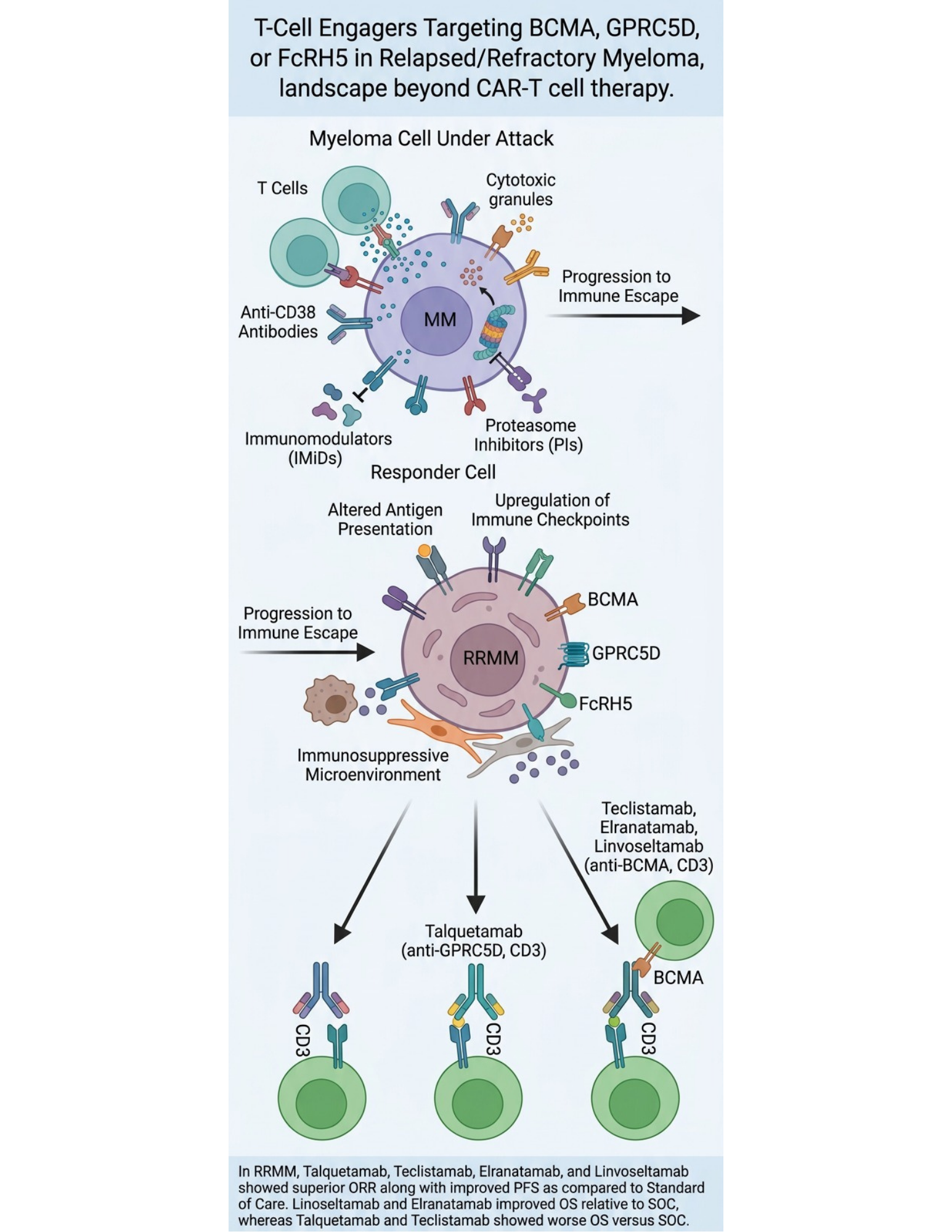
Background: Relapsed/refractory multiple myeloma is marked by frequent triple-class refractoriness and poor survival, whereas bispecific antibodies targeting BCMA, GPRC5D, or FcRH5 show meaningful activity even in heavily pretreated and post-BCMA disease.This meta-analysis evaluates and compares the efficacy and safety of these agents in RRMM using direct and indirect evidence. Methods: We manually searched 7 databases and identified 44 studies for quantitative analysis. Forest plots were created using R 4.1.x software. Results: Versus SOC, odds of ORR were higher with Talquetamab, Teclistamab, Elranatamab, and Linvoseltamab (5.73, 4.86, 3.84, 2.63). PFS improved with Teclistamab (HR 0.50, 95% CI 0.36–0.55), Talquetamab (0.50, 0.36–0.55), Elranatamab (0.45, 0.36–0.55), and Linvoseltamab (0.23, 0.17–0.31). Linoseltamab and Elranatamab showed numerically longer OS relative to SOC ( HR 0.41, 0.24–0.70) and (HR 0.58, 0.43–0.78), but numerically shorter OS with Teclistamab (HR 1.82, 1.37–2.42) and Talquetamab (HR 1.75, 1.20–2.57). In pooled single‑arm data, Talquetamab had the highest ORR (72%) and CRS (68%); Teclistamab showed ORR of 61% with CRS 61% and Linvoseltamab showed ORR of 60% with CRS 51%. Cevostamab and Elranatamab had ORR 49% and 56% with CRS 61% and 52%, respectively. Conclusion: In RRMM, all bispecific antibodies showed superior ORR along with improved PFS as compared to SOC. Linoseltamab and Elranatamab showed numerically longer OS relative to SOC, whereas Talquetamab and Teclistamab showed numerically shorter OS versus SOC, within the constraints of adjusted cross-trial comparisons.
Keywords:
BCMA
; GPRC5D
; FcRH5
; relapsed/ refractory multiple myeloma
1. Introduction
Relapsed/refractory multiple myeloma (RRMM) has been defined as an advanced disease that either progresses during treatment within 60 days of the last regimen administered or recurs after an initial response to therapy.[1,2] Although standard treatments for multiple myeloma patients include proteasome inhibitors (PIs), immunomodulatory drugs (IMiDs), and anti-CD38 monoclonal antibodies, a growing subset of patients develop triple-class refractory (TCR) disease (refractory to ≥1 PI, ≥1 IMiD, and an anti-CD38 antibody), which indicates poor outcomes with overall survival frequently less than a year in observational cohorts.[3] The need for more effective immune-based treatments has been highlighted by recent prospective data among triple-class exposed (TCE) RRMM, that revealed limited outcomes (ORR ~32%, median OS 13.8 months).[4]
Idecabtagene vicleucel (Ide-cel) and Ciltacabtagene autoleucel (Cilta-cel), two BCMA-directed CAR-T therapies, have evolved the clinical and investigational outlook through the production of deep responses in heavily pretreated RRMM. Ide-cel also demonstrated durable activity in KarMMa with persistent efficiency in long-term follow-up data. In extended CARTITUDE-1 follow-up, Cilta-cel showed longer survival (median OS 60.7 months at ~5-year follow-up in treated patients).[5,6] There is currently no single definitive post-CAR-T standard treatment, and progression that follows after BCMA CAR-T therapy is still common. Retreatment or sequencing strategies that include T-cell-redirecting agents, switching targets, as well as BCMA-directed strategies are backed by emerging data. Resistance may involve antigen escape and other tumor-intrinsic adaptive mechanisms, yet response times after salvage may be shorter.[7,8]
Importantly, the equity implications of these novel therapies are increasingly recognized. African American, Hispanic, Asian patients are underrepresented in pivotal cellular therapy trials, and recent studies suggest disparities in access and potentially differences in inflammatory toxicity and outcomes. Some multicenter datasets report comparable efficacy when access is achieved, emphasizing that structural barriers may be a key driver of outcome gaps.[9,10,11]This further emphasizes the need for inclusion of real world data representing diverse ethnic and socioeconomic groups in conjunction with data from clinical trials while trying to gauge the efficacy of bispecific antibodies (bsAbs) in the treatment of RRMM.
Targeting myeloma antigens such as BCMA (Teclistamab; Elranatamab), GPRC5D (Talquetamab), and FcRH5 (Cevostamab), bispecific antibodies (bsAbs) or T-cell redirecting therapies have rapidly grown into a novel option for RRMM. Clinical trials have shown substantial activity even in post-BCMA exposed settings.[12,13,14,15] However, because of diverse populations, prior exposure to BCMA, and developing sequencing techniques (including bsAbs as bridging to CAR-T), comparative efficacy and survival standards across individual bsAbs remain ambiguous.[13,14,15,16] Therefore, the objective of this meta-analysis is to draw robust and thorough comparisons between the different bispecific antibodies in terms of efficacy, their impact on survival outcomes in RRMM, and the differences in their adverse effect profiles by including data from pivotal trials and real world databases.
2. Methods
This systematic review and meta analysis was constructed in accordance with the recommendations and criteria outlined in the Preferred Items for Systematic reviews and Meta-analyses (PRISMA) reporting guidelines.[17] After formulating the clinical question and refining it into a focused systematic review question using the PICOS framework (Patients, Interventions, Comparators, Outcomes, and Study design), we conducted a manual search of major medical databases, including PubMed, Embase, Cochrane library, Scopus, Google Scholar, and Web Of Science in English from inception through January 2026.The search was conducted using the following PICO format. P: adult participants (age > 18 years) who had relapsed/refractory multiple myeloma (triple refractory to anti CD 38 therapy, immunomodulator, or pentarefractory), I: Intervention group treated with bispecific antibodies either targeting BCMA x CD3 or GPR5CD x CD3 or FcRH5 x CD3 receptors; C: control group treated with Standard of care (SOC); O: Objective response rate (ORR), ≥ Very Good Partial response (VGPR), Infections, Cytokine release syndrome (CRS), Progression free survival (PFS), Overall survival (OS), Immune Effector Cell-associated neurotoxicity syndrome (ICANS), ≥ Grade 3 Neutropenia, Thrombocytopenia and anemia; S: Single arm clinical trials, Retrospective studies, Matching adjusted indirect comparison studies, Inverse probability of treatment weighting comparison studies. Our meta-analysis was prospectively registered in PROSPERO (ID: CRD420261347139).
2.1. Eligibility Criteria
We conducted a systematic review of relevant studies published in the database from inception to January 2026, available in English; and meticulously screened and analyzed clinical trials, cohort studies and comparative studies. Studies were included if: (1) They involved humans and ≥ 18-year-old participants were enrolled; (2) Heavily pretreated RRMM populations with a high proportion of triple/penta-refractory patients and were treated with bispecific antibodies either targeting BCMA x CD3 or GPR5CD x CD3 or FcRH5 x CD3 receptors; and (3) ≥ 1 of the below mentioned parameters is available or can be calculated: ORR, ≥VGPR, ≥CR, Infections, CRS, PFS, OS, ICANS, ≥ Grade 3 Neutropenia, Thrombocytopenia and anemia. Studies were excluded if: (1) They were non-human studies (cell culture, animal models); (2) Case reports, protocol articles, reviews, news articles, letters to the editor, editorials were excluded; (3) They were duplicates; (4) They were written in languages other than English or studies without English translated versions; (5) The data were incomplete on clinical outcome statistical measures (odds ratios, 95% CIs) or the outcome measures were unable to be calculated with the available data.
2.2. Outcome Measures
The primary outcomes of this systematic review and meta-analysis were ORR, ≥VGPR, PFS, and OS. Secondary outcomes were ≥ CR, Infections, CRS, ICANS, ≥ Grade 3 Neutropenia, ≥ Grade 3 Thrombocytopenia and ≥ Grade 3 Anemia in patients of RRMM who were treated with bispecific antibodies.
2.3. Data Synthesis and Analysis
The selected studies were reviewed, and the data were independently extracted by two researchers (SS and HS). Discrepancies between them were resolved by consensus among all authors.
We extracted study characteristics (authors, year, region, design, sample size, age, outcomes) into an Excel spreadsheet. We structured the narrative synthesis by patient and exposure characteristics and summarized effect sizes for each outcome. When ORs and 95% CIs were not reported, we calculated crude values from 2×2 tables. We considered differences statistically significant at p <0.05.
To assess heterogeneity in effect measures, we used the I2 statistic (per Cochrane Handbook guidelines), where I2 reflects the percentage of total variation due to between-study differences:<30% (low), 30-60% ( moderate), 60-75% (substantial), and >75% (considerable).[18] We explored sources of heterogeneity via leave-one-out analysis. Given expected variability, we used the random-effects model of DerSimonian and Laird to pool ORs and 95% CIs.[19] Sensitivity analyses involved dropping one study at a time to test robustness.
A sensitivity analysis on the basis of prior BCMA exposure was conducted. All analyses were performed with the R 4.4.1 version. Since this study was a meta-analysis of published studies, institutional review board approval was not required.
2.4. Study Quality Assessment
The quality of observational studies was evaluated using the Newcastle-Ottawa scale (NOS), and single arm clinical trials using the ROBINS-I tool.[20,21] Studies scoring 7-9 were classified as high quality, 4-6 as moderate quality, and ≤3 as low quality. Two reviewers (SS and HS) independently assessed the risk of bias, with any discrepancies resolved through consensus among all authors.
2.5. Search Results
A total of 10,956 articles were collected from 7 database searches. Before the screening of the potential articles, 5989 duplicate articles were removed, and a total of 4967 records were screened; 4853 were further removed from the screening process. Of the remaining publications, 114 were sought for retrieval, out of which 21 reports could not be retrieved. A total of 93 articles were assessed for eligibility in the final review process, out of which 22 articles were excluded due to the wrong study design, 16 articles were excluded due to the wrong population, and 11 were excluded due to the wrong publication type. The remaining 44 articles (19 single arm trials with 21 cohorts, 15 retrospective studies, 10 comparative studies) were finally included in this systematic review and quantitative meta analysis. Two studies contributed two independent cohorts yielding a total of 46 cohorts for the final analysis. The systematic approach adopted for the study selection is illustrated in Figure 1 of the PRISMA flow diagram. The detailed search strategy with yielded results is summarized in Table 1 in the supplementary Table file. Figure S1, S2.A, S2.B in the supplementary file depicts the overall risk of bias of the included studies.
3. Results
3.1. Network Meta Analysis
3.2. Objective Response Rate (ORR) and ≥ Very Good Partial Response (≥VGPR)
As depicted in the heat map Figure 2, after inversion, the analysis concluded that the odds of achieving an ORR were 4.86-fold higher with Teclistamab (95% CI 3.58, 6.59), 5.73-fold higher with Talquetamab (95% CI 4.26-7.71), 3.84-fold higher with Elranatamab (95% CI 2.90, 5.09), and 2.63-fold higher with Linvoseltamab (95% CI 1.71, 4.02), compared with SOC. Also, when Talquetamab was compared with other BsAbs, it showed significantly higher ORR than Linvoseltamab (OR 2.17, 95% CI 1.30, 3.70), a numerically higher ORR than Teclistamab (OR 1.18, 95% CI 0.77, 1.81), and Elranatamab (OR 1.49, 95% CI 0.92, 2.21), although the latter two comparisons were not statistically significant. Teclistamab showed significantly higher ORR than Linvoseltamab (OR 1.85, 95% CI 1.10, 3.13) but comparable ORR with Elranatamab (OR 1.27, 95% CI 0.83, 1.92).
Sensitivity analysis was performed based on prior BCMA exposure, as mentioned in Supplementary file figure S3. In the BCMA naive cohort, Linvoseltamab, Talquetamab, Teclistamab achieve much higher response rates than SOC. Among the bispecifics, Teclistamab had a statistically higher ORR than Linvoseltamab, Talquetamab showed a numerically better ORR than Linvoseltamab with borderline significance, and Teclistamab and Talquetamab (and Elranatamab vs either) had broadly similar ORRs. The BCMA exposed cohort had only 2 studies limiting the feasibility of indirect analysis in this cohort.
The network heat map in Figure S4 concluded that the odds of achieving a ≥ VGPR were 8.62-fold higher with Elranatamab , 5.38-fold higher with Linvoseltamab , 12.50-fold higher with Teclistamab and 10.00-fold higher with Talquetamab compared with SOC. Detailed sensitivity analysis has been mentioned in Figures S5.
3.3. Progression-Free Survival (PFS)
The network heat map for PFS in Figure 3 shows that all three bispecific antibodies are associated with longer PFS than SOC, with the highest benefit observed for Linvoseltamab (HR 0.23, 95% CI 0.17-0.31 vs SOC), followed by Elranatamab (HR 0.45, 95% CI 0.36-0.55), Teclistamab (HR 0.50, 95% CI 0.36-0.55), and Talquetamab (HR 0.50, 95% CI 0.36-0.55). When compared amongst each other, Talquetamab and Teclistamab showed a 50% lower risk of progression or death than Linvoseltamab respectively (HR 0.50, 95% CI 0.35-0.72) (HR 0.50 95% CI 0.36-0.70). There was no difference observed in PFS either between Talquetamab and Teclistamab (HR 1.00 95% CI 0.77-1.31), or between Talquetamab and Elranatamab (HR 0.97 95% CI 0.73-1.31), and between Teclistamab and Elranatamab (HR 0.97 95% CI 0.74-1.28). Linvoseltamab showed lower PFS relative to Elranatamab (HR 1.94 95% CI 1.36-2.77).
Upon sensitivity analysis with prior BCMA exposure, as mentioned in Figure S6 and S7 in the Supplementary file, all bispecifics improved PFS in the BCMA-naive group compared with SOC, with Linvoseltamab having the greatest effect, followed by Elranatamab, Talquetamab, and Teclistamab (HR 0.23,0.42,0.49,0.50). PFS with Linvoseltamab was lower than with Elranatamab (HR 0.54, 95% CI 0.37, 0.81), and it showed numerically higher but statistically insignificant difference as compared to Talquetamab (HR 0.52, 95% CI 0.72, 1.72) and Teclistamab (HR 0.52, 95% CI 0.79, 1.47). Elranatamab, Talquetamab and Teclistamab had broadly similar PFS. In patients previously exposed to BCMA-directed agents, Elranatamab showed a numerically higher PFS than SOC (HR 0.52, 95% CI 0.34, 0.79), whereas Talquetamab showed a numerically shorter PFS than SOC (HR 2.22, 95% CI 1.71, 2.89) The PFS with Talquetamab and Elranatamab did not differ significantly from each other.
3.4. Overall Survival (OS)
The network heat map for OS in Figure 4 shows that all four bispecific antibodies are associated with numerically longer OS than SOC, with the numerically lowest HR observed for Linvoseltamab (HR 0.41, 95% CI 0.24-.70 vs SOC), followed by Elranatamab (HR 0.58, 95% CI 0.43-0.78). Both Talquetamab and Teclistamab showed numerically shorter OS relative to SOC (HR 1.75, 95% CI 1.20-2.57) and (HR 1.82, 95% CI 1.37-2.42). Talquetamab showed a similar OS when compared with Linvoseltamab (HR 0.72, 95% CI 0.37-1.39) and Elranatamab (HR 1.02, 95% CI 0.63-1.64). Also, Teclistamab demonstrated a comparable OS to Linvoseltamab (HR 0.75, 95% CI 0.40-1.38) and Talquetamab (HR 1.04, 95% CI 0.65-1.67). Elranatamab and Teclistamab also showed similar OS (HR 1.06, 95% CI 0.70-1.59), while Linvoseltamab showed a numerically higher hazard of death compared with Elranatamab (HR:1.41, 95% CI 0.76-2.62), although not statistically significant.
Upon sensitivity analysis with prior BCMA exposure, as mentioned in the Supplementary file S8 and S9, In the BCMA-naive cohort, Linvoseltamab and Elranatamab showed numerically longer OS versus SOC (HR 0.41, 95% CI 0.23,0.72) and (HR 0.54 , 95% CI 0.38,0.76), while Teclistamab showed numerically shorter OS as compared to SOC (HR 1.82, 95% CI 1.36, 2.44). The value of OS with Talquetamab was roughly comparable to SOC. Among the bispecifics themselves, no pair showed a statistically clear OS advantage. In the BCMA exposed cohort, Talquetamab showed numerically shorter OS as compared to SOC (HR 2.08, 95% CI 1.43, 3.03), SOC and Elranatamab had roughly comparable OS, and Talquetamab and Elranatamab had broadly similar OS.
3.5. Single Arm Pooled Analysis
A total of 36 studies (21 single arm trials, 15 retrospective studies) were included in the pooled single arm analysis.
Talquetamab
Across 13 studies with 1,494 patients treated with Talquetamab-based regimens, the pooled objective response rate was 72% (95% CI: 68–75%) with moderate heterogeneity (I² = 40%).
≥ VGPR was achieved in 37% of 1,269 patients (95% CI: 21–57%; I² = 93%) and ≥ CR in 18% of 760 patients (95% CI: 11–28%; I² = 85%). The pooled incidence of ICANS was 25% (95% CI 19–33%) in 577 patients and CRS was seen in 68% (95% CI 61–75%) in 1,355 patients. The pooled incidences of grade 3 - 4 thrombocytopenia, anemia, and neutropenia were 25%, 31%, and 30% among 577 patients, and infections occurred in 58% of 1,268 patients (95% CI 44–71%). Detailed forest plots are summarized in Figures S10 to S18.
Teclistamab
Across 11 cohorts with 1249 patients treated with Teclistamab based regimens, the pooled objective response rate was 61% (95 % Cl: 57-66%) with moderate between-study heterogeneity (I² = 52.3 %). ≥ VGPR was achieved in 47% of 946 patients (95% Cl: 32-62%; I² = 84.0%) and ≥ CR in 35% of 836 patients (95% Cl: 24-47; I² = 82.5%). The pooled incidence of ICANS was 7% (95% Cl : 5-11%) in 946 patients, CRS occurred in 61% (95 % Cl: 54-67 %) in 946 patients, and grade 3- 4 thrombocytopenia, anemia and neutropenia occurred in 19%, 24%, 50% among 783, 581, and 823 patients respectively. Infections occurred in 66% of 946 patients. Detailed forest plots are summarized in Figures S19 to S27.
Cevostamab
Across 7 studies with 458 patients treated with Cevostamab based regimens, the pooled ORR was 49 % (95 % Cl: 24-74%) with moderate between-study heterogeneity(I² = 86.6 %).
≥ VGPR was achieved in 27% of 404 patients (95% Cl: 20-35%; I² = 34.4%) and ≥ CR in 10% of 383 patients (95% Cl: 4-24%; I² = 64.4%). The pooled incidence of ICANS was 20% (95% Cl: 10-35%) in 331 patients, CRS occurred in 74% in 458 patients, and the pooled incidence of grade 3 - 4 thrombocytopenia, anemia and neutropenia were 38%, 29%, 31% among 42, 261 and 261 patients respectively. Infections occurred in 52% of 215 patients. Detailed forest plots are summarized in Figures S28 to S36.
Elranatamab
Across 6 studies with 552 patients treated with Elranatamab based regimens, the pooled ORR was 56% (95 % Cl: 44 - 68%) with moderate between-study heterogeneity (I² = 74.6 %).
≥ VGPR was achieved in 52% of 303 patients (95% Cl: 38-66 %; I² = 28.7 %) and ≥ CR in 32% of 366 patients (95% Cl: 19 - 49 %; I² = 61.7 %). The pooled incidence of ICANS was 11% (95% Cl :1-58 %) in 303 patients, CRS occurred in 74% in 552 patients, and the pooled incidence of grade 3-4 thrombocytopenia, anemia and neutropenia were 28%, 49%, 56% among 248, 303 and 303 patients respectively. Infections occurred in 60% of 224 patients. Detailed forest plots are summarized in Figures S37 to S45.
Linvoseltamab
Across 2 studies with 221 patients treated with Linvoseltamab based regimens, the pooled ORR was 60% (95 % Cl: 0 - 100%) with high between-study heterogeneity (I² = 91.5%) and CRS occurred in 51% of 221 patients. ≥ VGPR was achieved in 51% of 221 patients (95% Cl: 0-100%; I² = 91.9%) and ≥ CR in 34% of 221 patients (95% Cl: 0-100%; I² = 94.6%) and the pooled incidence of grade 3-4 thrombocytopenia, anemia and neutropenia were 19%, 30%,40% among 221, 221 and 221 patients respectively. Infections occurred in 74% of 221 patients. Detailed forest plots are summarized in Figures S46 to S53.
3.6. Sensitivity Analysis of Single Arm Trials/Studies
In the BCMA- naive cohort, ORR was 72% with Talquetamab, 82% with Teclistamab, 62% with Elranatamab, and 39% with Cevostamab; CRS occurred in 66%, 61% and 75% respectively. In the BCMA-exposed cohort, ORR was 72% with Talquetamab, 60% with Teclistamab, and 50% with Elranatamab; CRS occurred in 64%, 57%, and 42% respectively. Detailed forest plots are mentioned in S54 to S73.
4. Discussion
This meta-analysis explores the efficacy of different bispecific antibodies in RRMM with diverse risk profiles and varying degrees of disease burden. Due to limited studies with head to head comparisons of BsAb in the treatment of RRMM, we performed direct and indirect comparisons between individual BsAbs and Standard of care (SOC). Currently, most BsAb trials are single-arm monotherapy studies but what makes this analysis unique is the integration of real -world physician's choice data from global electronic health records, adjusted for baseline differences via IPTW and MAIC with clinical trial outcomes, making it first of its kind comprehensive network meta analysis by bridging these sources.[56,61,62]Apart from incorporating real world physician’s choice of care, this meta analysis differs from a recently published meta analysis as it includes both direct and indirect (network) pooled comparisons among different Bsabs and SOC, whereas the other meta analysis was limited to just direct pooled analysis of few clinical trials.[63]
Common challenges that occur during the treatment of RRMM usually erupt due to resistance mechanisms like T-cell fatigue or antigen escape; limiting the efficiency of single-epitope targeting therapies. Mechanisms like biallelic TNFRSF17 (BCMA), GPRC5D deletions, and non-truncating BCMA ectodomain in-frame/missense mutations disrupt TCE binding, leading to preferential selection of BCMA-negative and GPRC5D-negative clones, with marked downregulation of these receptors, eventually contributing to antigen escape and limiting the efficacy of single-epitope-targeting therapies.[64,65] The findings of our analysis support antigen-switching strategies in RRMM. For ectodomain mutations impairing a BCMA-targeted TCE , switching to a non-cross-reactive construct (e.g. Teclistamab to Elranatamab with equivalent efficacy, ORR: 61% vs 56%) remains a viable option. However, biallelic BCMA loss necessitates targeting alternative antigens like GPRC5D for optimal efficacy. This approach is substantiated by comparable ORR (68% vs 61%) and ≥ VGPR rates (37% vs 47%) between GPRC5D- targeting Talquetamab and BCMA- targeting Teclistamab. Apart from antigen escape, T- cell fitness is an important parameter which measures how well T cells can proliferate, resist exhaustion, and sustain effector function and has emerged as a critical determinant of response to T-cell redirecting therapies. Patients whose CD8+ T-cell clones are more exhausted show impaired proliferation, reduced effector cytokine production and cytotoxicity. They also experience higher levels of inhibitory receptors (e.g., PD-1, LAG-3) and tend to have higher nonresponse rates and shorter PFS with BCMA- directed bispecifics. This underscores that pretreatment T-cell fitness strongly determines T-cell engager efficacy and toxicity.[66] Another component which is responsible for the potency and selectivity of T-cell engagers is the antigen density which is the number of target molecules per tumor cell and their spatial arrangement. Higher antigen density increases T-cell recruitment and tumor lysis but also increases the risk of on-target off-tumor effects. Studies have shown that tuning sensitivity to antigen density can preserve antitumor activity while limiting normal -tissue recognition.[67]
Also, high disease burden which is measured by tumor mass, circulating tumor cells, extramedullary disease, and aggressive tumor biology contributes to both resistance and toxicity with T-cell engagers. This is because heavily infiltrated sites need strong T-cell infiltration and may favour immune escape, while large antigen load amplifies cytokine release and systemic inflammation. Tumor microenvironment, including immunosuppressive myeloid regulatory cells, regulatory T-cells, inhibitory cytokines, and metabolic constraints, has shown to blunt T-cell engager activity by reducing T-cell functionality and promoting exhaustion, whereas more permissive microenvironments support durable response. Henceforth, these are classified as key “tumor-extrinsic” resistance mechanisms to TCEs.[68,69]
During T-cell therapy, activated T cells and inflammatory mediators affect non-target cells. This “bystander” activation contributes to systemic cytokine-mediated toxicity and potential off-tumor tissue injury in organs expressing low levels of the target antigen. Therefore, organ-specific toxicity should be considered as part of safety assessment and target selection in current and future T-cell engager strategies.[70,71] In our analysis, patients who received Talquetamab experienced lesser incidence of infections as compared to Teclistamab and Elranatamab (58% vs 66% and 60%). Notably, the higher incidence of ≥ Grade 3 infections with Teclistamab and Elranatamab compared to Talquetamab (27% vs 34% vs 22%) parallels their greater rates of ≥ Grade 3 neutropenia 50% and 56% vs 30%), suggesting that deeper treatment-related neutropenia with BCMA- directed bispecifics contributes to the excess burden of serious infections relative to GPRC5D-targeting agents. latter. This can be attributed to the higher cytokine storm and more extensive depletion of the plasma-cell compartment,, humoral immunity and marrow reserve and hypogammaglobulinemia caused by BCMA-targeting agents than GPRC5D-targeting agents.[72,73] A descriptive study from the REISAMIC registry reported that infectious complications with T-cell engagers occurred predominantly in heavily pretreated hematologic malignancies, with an infection-related mortality of 2.8%, highlighting pneumonia, COVID -19, and bacterial bloodstream infections as major contributors.[74] The Blood Cancer Journal expert consensus on monitoring, prophylaxis, and treatment of infections in bispecific-treated RRMM recommends HSV/VZV and PJP prophylaxis for all patients, but no routine antifungal prophylaxis except in high- risk or profoundly neutropenic patients. They also suggest use of Granulocyte - Colony stimulating factors for grade 3 neutropenia, and IVIG replacement to reduce serious infections, which is supported by observational data showing marked reductions in severe infections with IVIG in anti-BCMA bispecific recipients.[75,76,77]
Other hematological side effects were quite similar between both Talquetamab and Teclistamab with (31% vs 24%) of >Grade 3 anemia and 25% vs 19% of >Grade 3 thrombocytopenia. Also, Talquetamab and Teclistamab showed similar rates of CRS (68% vs 66%) and a slightly higher incidence of CRS was observed with Elranatamab (74%). Higher incidence of ICANS was seen with GPR5CD-targeting agent Talquetamab (25%) as compared to BCMA -targeting agents Elranatamab and Teclistamab (11% and 7%). Moreover, the dysgeusia which is unique to GPRC5D- targeting agents occurred in nearly 70% patients in our analysis but was low grade and manageable. This is because GPR5CD-targeting agents engage T cells in tissue environments that are more prone to local inflammation and neural/vascular irritation and keratinized tissues whereas BCMA-targeting agents predominantly attack the T cells within the lymphoid/plasma cell compartments.
Interestingly, our study also concludes that single arm analysis of either GPRC5D targeting monotherapy (e.g., Talquetamab) or BCMA alone (e.g., Teclistamab) have shown inferior ORR, ≥ CR as compared to the pooled ORR of trials employing both GPR5CD and Daratumumab combination therapy. This could be attributed to Daratumumab’s ability to combat T-cell exhaustion due to its speculated ability of T-cell alteration through expansion of CD4+ helper T cells and CD8+ cytotoxic T cells in blood and marrow, causing a shift from naive to effector-memory CD8+ T cells which ultimately leads to release from an exhausted phenotype.[78,79,80]
Moreover, the employment of Talquetamab and Teclistamab together showed superior ORR rates than either Talquetamab or Teclistamab alone which is indicated by our analysis (86% with combination vs 68% with Talquetamab and 61% with Teclistamab) and ≥ VGPR (78% vs 37% vs 47%) with no considerable difference in CRS (79% vs 68% vs 61%) or infections (63% vs 58% vs 66%). This supports the hypothesis that simultaneous targeting of BCMA and GPRC5D or other targets could be an ideal way to mitigate target loss and improve efficacy in RRMM which was also implemented in the RedirecTT trial.[81]
4.1. Strengths and Limitations
One of the major strengths of the study is the inclusion of heterogenous populations across different geographical regions and a good blend of real world data. Although most of the therapies approved for RRMM are based on single arm clinical trials, analyses like ours can be useful to contextualize the clinical efficacy of novel agents against the real world options and inform clinical decision-making. Although the application of IPTW and MAIC used to compare clinical trials with real world data mitigated the effects of confounding and baseline covariate differences to a certain extent and we performed subgroup analysis on the basis of prior BCMA exposure but the real world data was not adjusted for some parameters like cytogenetic risk, presence of extra medullary disease (EMD), ECOG performance status, as all the factors were not reported uniformly in the real world studies. This includes some inevitable “unmeasured confounding” bias which potentially includes either overestimation (or underestimation) of treatment effects. Secondly, patients without sufficient information in their electronic health records were excluded in the final inclusion in real world data, introducing potential selection bias. Lastly, In myeloma microenvironment, upregulation of PD -1 on T-cells and PD -L1 on malignant plasma cells contribute to T-cell anergy which hampers the cytotoxic activity of T-cell redirecting BsAbs. Dual PD-1/TIGIT blockade has been shown to restore oxidative phosphorylation in exhausted T cells, enhancing BsAb or CAR-T efficacy in Multiple myeloma models.[82,83] So, novel constructs such as BCMA/GPRC5D × PDL-1 bispecific IgG1 molecules might show potent activity by simultaneously engaging tumor cells and locally inhibiting PD-L1 signaling which can be explored as a future treatment strategy in RRMM.
5. Conclusion
This network meta-analysis concludes that bispecific T-cell engagers that target BCMA, GPRC5D, or FcRH5 provide significantly greater response rates and clinically significant improvements in PFS as compared to SOC with comparable efficacy amongst them in RRMM. Our study concluded numerically longer OS results with Elranatamab and numerically shorter OS results with Talquetamab and Teclistamab. However, these findings should be interpreted cautiously because the comparative evidence base for Elranatamab in this analysis rests on 4 comparative cohorts, whereas less comparative cohorts were available for the latter. Also, most of the included studies had a median follow-up of approximately a year or considerable censoring at 12 months, which might have reduced the precision of 1-year Kaplan - Meier overall survival estimates and This makes our findings vulnerable to limitations related to follow-up duration and censoring, residual confounding and post- treatment course. Because progression free survival 2 (PFS2) and subsequent therapy details were not reported, we could not evaluate the impact of treatment sequencing and post-progression survival on OS, which likely contributes to the observed discordance between PFS and OS in some comparisons. So, these findings are hypothesis-generating and should be interpreted cautiously in the absence of head-to-head randomized data. As a result, our conclusions should not be interpreted as definitive evidence that specific bispecific antibodies improve or worsen survival as compared with SOC, but rather as comparative efficacy signals that warrant confirmation in prospective randomized or pragmatic trials with head-to head comparisons.
Author Contributions
SS: HS, and TP were involved in the conceptualization of the study. SS and HS performed the data collection and data synthesis. SS and HS, with the assistance of TA and AG, performed data analysis with statistics. SS, TS and AG carefully supervised manuscript preparation and writing along with editing of tables and figures. SP, AJ and TP thoroughly scrutinized the manuscript writing.
Funding
No third party has provided any assistance for this meta-analysis.
Conflicts of interest
All the authors have no conflicts of interests to declare in relation to this manuscript.
Disclosures: All the authors have no financial or personal interests to disclose in relation to this manuscript.
Abbreviations
| RRRM | Relapsed/Refractory Multiple Myeloma. |
| PIs | Proteasome Inhibitors. |
| IMiDs | Immunomodulatory Drugs. |
| TCR | Triple-class refractory. |
| TCE | Triple-class exposed. |
| Ide-cel | Idecabtagene vicleucel. |
| Cilta-cel | Ciltacabtagene autoleucel. |
| BsAbs | Bispecific antibodies. |
| BCMA | B-cell maturation antigen. |
| GPRC5D | G protein-coupled receptor family C group 5 member D. |
| FcRH5 | Fc receptor homolog 5. |
| vs | versus. |
| PRISMA | Preferred Items for Systematic reviews and Meta-analyses. |
| PICOS | Patients, Interventions, Comparators, Outcomes, and Study design. |
| SOC | Standard of care. |
| ORR | Objective response rate. |
| VGPR | Very Good Partial Response. |
| CR | Complete Response. |
| CRS | Cytokine release syndrome. |
| PFS | Progression free survival. |
| OS | Overall survival. |
| ICANS | Immune Effector Cell-associated neurotoxicity syndrome. |
| NOS | Newcastle-Ottawa scale. |
| MAIC | Matching adjusted indirect comparison cohorts. |
| IPTW | Inverse probability of treatment weighting comparison studies. |
| CI | Confidence Interval. |
| OR | Odds Ratio. |
| HR | Hazard Ratio. |
| EMD | Extra medullary disease. |
| ECOG | Eastern Cooperative Oncology Group. |
| PD-1 | Programmed Cell Death Protein 1. |
| TIGIT | T Cell Immunoreceptor with Ig and ITIM Domains. |
References
- Kumar, S.; Paiva, B.; Anderson, K.C.; et al. International Myeloma Working Group consensus criteria for response and minimal residual disease assessment in multiple myeloma. Lancet Oncol. 2016, 17(8), e328–e346. [Google Scholar] [CrossRef] [PubMed]
- Moreau, P.; Kumar, S.K.; San Miguel, J.; et al. Treatment of relapsed and refractory multiple myeloma: recommendations from the International Myeloma Working Group. Lancet Oncol. 2021, 22(3), e105–e118. [Google Scholar] [CrossRef] [PubMed]
- Costa, L.J.; Hungria, V.; Mohty, M.; Mateos, M. How I treat triple-class refractory multiple myeloma. Br. J. Haematol. 2022, 198(2), 244–256. [Google Scholar] [CrossRef] [PubMed]
- Mateos, M.V.; Weisel, K.; De Stefano, V.; et al. LocoMMotion: a study of real-life current standards of care in triple-class exposed patients with relapsed/refractory multiple myeloma – 2-year follow-up (final analysis). Leukemia 2024, 38(12), 2554–2560. [Google Scholar] [CrossRef] [PubMed]
- Munshi, N.C.; Anderson, L.D.; Shah, N.; et al. Idecabtagene Vicleucel in Relapsed and Refractory Multiple Myeloma. N Engl. J. Med. 2021, 384(8), 705–716. [Google Scholar] [CrossRef] [PubMed]
- Jagannath, S.; Martin, T.G.; Lin, Y.; et al. Long-Term (≥5-Year) Remission and Survival After Treatment With Ciltacabtagene Autoleucel in CARTITUDE-1 Patients With Relapsed/Refractory Multiple Myeloma. J. Clin. Oncol. 2025, 43(25), 2766–2771. [Google Scholar] [CrossRef] [PubMed]
- Lee, H.; Ahn, S.; Maity, R.; et al. Mechanisms of antigen escape from BCMA- or GPRC5D-targeted immunotherapies in multiple myeloma. Nat. Med. 2023, 29(9), 2295–2306. [Google Scholar] [CrossRef] [PubMed]
- Reyes, K.R.; Liu, Y.C.; Huang, C.Y.; et al. Salvage therapies including retreatment with BCMA-directed approaches after BCMA CAR-T relapses for multiple myeloma. Blood Adv. 2024, 8(9), 2207–2216. [Google Scholar] [CrossRef] [PubMed]
- Alqazaqi, R.; Schinke, C.; Thanendrarajan, S.; et al. Geographic and Racial Disparities in Access to Chimeric Antigen Receptor–T Cells and Bispecific Antibodies Trials for Multiple Myeloma. JAMA Netw. Open 2022, 5(8), e2228877. [Google Scholar] [CrossRef] [PubMed]
- Peres, L.C.; Oswald, L.B.; Dillard, C.M.; et al. Racial and ethnic differences in clinical outcomes among patients with multiple myeloma treated with CAR T-cell therapy. Blood Adv. 2024, 8(1), 251–259. [Google Scholar] [CrossRef] [PubMed]
- Bhutani, M.; Habib, A.; Vegel, A.; et al. Outcomes of CAR T-Cell therapy in relapsed/refractory multiple myeloma by race: a multicenter real-world study. Blood Cancer J. 2025, 15(1), 200. [Google Scholar] [CrossRef] [PubMed]
- Moreau, P.; Garfall, A.L.; Van De Donk, N.W.C.J.; et al. Teclistamab in Relapsed or Refractory Multiple Myeloma. N Engl. J. Med. 2022, 387(6), 495–505. [Google Scholar] [CrossRef] [PubMed]
- Lesokhin, A.M.; Tomasson, M.H.; Arnulf, B.; et al. Elranatamab in relapsed or refractory multiple myeloma: phase 2 MagnetisMM-3 trial results. Nat. Med. 2023, 29(9), 2259–2267. [Google Scholar] [CrossRef] [PubMed]
- Chari, A.; Touzeau, C.; Schinke, C.; et al. Safety and activity of talquetamab in patients with relapsed or refractory multiple myeloma (MonumenTAL-1): a multicentre, open-label, phase 1–2 study. Lancet Haematol. 2025, 12(4), e269–e281. [Google Scholar] [CrossRef] [PubMed]
- Touzeau, C.; Krishnan, A.Y.; Moreau, P.; et al. Efficacy and safety of teclistamab in patients with relapsed/refractory multiple myeloma after BCMA-targeting therapies. Blood 2024, 144(23), 2375–2388. [Google Scholar] [CrossRef] [PubMed]
- Fandrei, D.; Seiffert, S.; Rade, M.; et al. Bispecific Antibodies as Bridging to BCMA CAR-T Cell Therapy for Relapsed/Refractory Multiple Myeloma. Blood Cancer Discov. 2025, 6(1), 38–54. [Google Scholar] [CrossRef] [PubMed]
- Page, M.J.; McKenzie, J.E.; Bossuyt, P.M.; et al. The PRISMA 2020 statement: an updated guideline for reporting systematic reviews. BMJ Published online. 2021, n71. [Google Scholar] [CrossRef] [PubMed]
- Higgins, J.P.T.; Altman, D.G.; Gøtzsche, P.C.; et al. The Cochrane Collaboration’s tool for assessing risk of bias in randomised trials. BMJ 2011, 343, d5928. [Google Scholar] [CrossRef] [PubMed]
- DerSimonian, R.; Laird, N. Meta-analysis in clinical trials. Control Clin. Trials 1986, 7(3), 177–188. [Google Scholar] [CrossRef] [PubMed]
- Stang, A. Critical evaluation of the Newcastle-Ottawa scale for the assessment of the quality of nonrandomized studies in meta-analyses. Eur. J. Epidemiol. 2010, 25(9), 603–605. [Google Scholar] [CrossRef] [PubMed]
- Sterne, J.A.; Hernán, M.A.; Reeves, B.C.; et al. ROBINS-I: a tool for assessing risk of bias in non-randomised studies of interventions. BMJ Published online. 2016, i4919. [CrossRef] [PubMed]
- Chari, A.; van de Donk, N.W.C.J.; Dholaria, B.; et al. Talquetamab plus daratumumab for the treatment of relapsed or refractory multiple myeloma in the TRIMM-2 study. Blood 2025, 146(24), 2902–2913. [Google Scholar] [CrossRef] [PubMed]
- Chari, A.; Touzeau, C.; Schinke, C.; et al. Safety and activity of talquetamab in patients with relapsed or refractory multiple myeloma (MonumenTAL-1): a multicentre, open-label, phase 1–2 study. Lancet Haematol. 2025, 12(4), e269–e281. [Google Scholar] [CrossRef] [PubMed]
- Rasche, L.; Schinke, C.D.; Touzeau, C.; et al. Efficacy and safety from the phase 1/2 MonumenTAL-1 study of talquetamab, a GPRC5D×CD3 bispecific antibody, in patients with relapsed/refractory multiple myeloma: Analyses at an extended median follow-up. J. Clin. Oncol. 2025, 43((16_) suppl, 7528–7528. [Google Scholar] [CrossRef]
- Searle, E.; Quach, H.; Biran, N.; et al. MM-349 Talquetamab (Tal), a GPRC5D×CD3 Bispecific Antibody (BsAb), in Combination With Pomalidomide (Pom) in Patients With Relapsed/Refractory Multiple Myeloma (RRMM): Efficacy and Safety Results From the Phase 1b MonumenTAL-2 Study. Clin. Lymphoma Myeloma Leuk. 2024, 24, S549–S550. [Google Scholar] [CrossRef]
- Popat, R.; Uttervall, K.; Perrot, A.; et al. Safety results from REALiTAL: A multi-country observational retrospective study of talquetamab in patients with relapsed/refractory multiple myeloma outside of clinical trials. Blood 2025, 146 (Supplement 1), 4573–4573. [Google Scholar] [CrossRef]
- Pasvolsky, O.; Grajales-Cruz, A.; Hansen, D.; et al. Talquetamab for relapsed/refractory multiple myeloma : Real-world outcomes from the US multiple myeloma immunotherapy consortium. Blood 2025, 146 (Supplement 1), 137–137. [Google Scholar] [CrossRef]
- Frenking, J.H.; Riedhammer, C.; Teipel, R.; et al. A German multicenter real-world analysis of talquetamab in 138 patients with relapsed/refractory multiple myeloma. HemaSphere 2025, 9(4), e70114. [Google Scholar] [CrossRef] [PubMed]
- Al Hadidi, S.; Szabo, A.; Mohan Lal, B.; et al. Talquetamab in relapsed refractory multiple myeloma: multi-institutional real-world study. Blood Cancer J. 2025, 15(1), 196. [Google Scholar] [CrossRef] [PubMed]
- Dhakal, B.; Akhtar, O.S.; Cowan, A.J.; et al. Talquetamab Bridging: Paving the Way to B-Cell Maturation Antigen (BCMA) CAR-T Cell Therapy in Relapsed/Refractory Multiple Myeloma (RRMM). Blood 2024, 144 (Supplement 1), 931–931. [Google Scholar] [CrossRef]
- Gill, S.K.; Fleming, E.; Gebre, H.; et al. Real World Outcomes with Talquetamab, a T-Cell-Redirecting GPRC5D Bispecific Antibody: A Single Center Experience for Relapsed/ Refractory Multiple Myeloma (RRMM). Blood 2024, 144 (Supplement 1), 7047–7047. [Google Scholar] [CrossRef]
- Neupane, K.; Wright, C.; Whiting, J.; et al. Real-world outcomes of talquetamab in Relapsed/Refractory multiple myeloma. Blood 2025, 146 (Supplement 1), 4051–4051. [Google Scholar] [CrossRef]
- Van De Donk, N.W.C.J.; Moreau, P.; Garfall, A.L.; et al. Long-term follow-up from MajesTEC-1 of teclistamab, a B-cell maturation antigen (BCMA) x CD3 bispecific antibody, in patients with relapsed/refractory multiple myeloma (RRMM). J. Clin. Oncol. 2023, 41((16_) suppl, 8011–8011. [Google Scholar] [CrossRef]
- Touzeau, C.; Krishnan, A.Y.; Moreau, P.; et al. Efficacy and safety of teclistamab in patients with relapsed/refractory multiple myeloma after BCMA-targeting therapies. Blood 2024, 144(23), 2375–2388. [Google Scholar] [CrossRef] [PubMed]
- D'Souza, Anita; Costa, Luciano J.; San-Miguel, Jesús F.; Berdeja, Jesus G; Giles, Daniel Morillo; Touzeau, Cyrille; McKay, John T; Dholaria, Bhagirathbhai; Martin, Thomas G; Perrot, Aurore; Oriol, Albert; Balari, Anna Sureda; Prior, Thomas; Ghosh, Debopriya; Kang, Lijuan; Larsen, Julie S; Ludlage, Hein; Vandenberk, Lien; Chen, Lingling; Koster, Bas D; Sun, Weili; Kobos, Rachel; Searle, Emma; Matous, Jeffrey V; Chari, Ajai; Kampfenkel, Tobias. Teclistamab, Daratumumab, and Pomalidomide in Patients with Relapsed/Refractory Multiple Myeloma: Results from the Majestec-2 Cohort a and Trimm-2 Studies. Blood 2024, 144 (Supplement 1), 495. [Google Scholar] [CrossRef]
- Offner, F.; Decaux, O.; Hulin, C.; et al. S194: TECLISTAMAB (TEC) + NIROGACESTAT (NIRO) IN RELAPSED/REFRACTORY MULTIPLE MYELOMA (RRMM): THE PHASE 1B MAJESTEC-2 STUDY. HemaSphere 2023, 7(S3), e1257964. [Google Scholar] [CrossRef]
- Searle, E.; Quach, H.; Wong, S.; et al. P30 SINGLE COHORT RESULTS FROM MAJESTEC-2: TECLISTAMAB (TEC) IN COMBINATION WITH SUBCUTANEOUS DARATUMUMAB (DARA) AND LENALIDOMIDE (LEN) IN PATIENTS WITH MULTIPLE MYELOMA (MM). HemaSphere 2023, 7(S2), 27–27. [Google Scholar] [CrossRef]
- Uttervall, K.; Kortum, M.K.; Perrot, A.; et al. REALiTEC: a multi-country observational retrospective study of teclistamab in patients with relapsed/refractory multiple myeloma outside of clinical trials. Haematologica Published online. 2026. [Google Scholar] [CrossRef] [PubMed]
- Tan, C.R.; Asoori, S.; Huang, C.Y.; et al. Real-world evaluation of teclistamab for the treatment of relapsed/refractory multiple myeloma (RRMM): an International Myeloma Working Group Study. Blood Cancer J. 2025, 15, 53. [Google Scholar] [CrossRef] [PubMed]
- Perrot, A.; Hulin, C.; Boumendil, A.; et al. Teclistamab in relapsed refractory multiple myeloma: a multi-institutional real-world study from the French early access program. Haematologica 2024, 110(4), 990–994. [Google Scholar] [CrossRef] [PubMed]
- Riedhammer, C.; Bassermann, F.; Besemer, B.; et al. Real-world analysis of teclistamab in 123 RRMM patients from Germany. Leukemia 2024, 38(2), 365–371. [Google Scholar] [CrossRef] [PubMed]
- Mohan, M.; Monge, J.; Shah, N.; et al. Teclistamab in relapsed refractory multiple myeloma: multi-institutional real-world study. Blood Cancer J. 2024, 14(1), 35. [Google Scholar] [CrossRef] [PubMed]
- Dima, D.; Davis, J.A.; Ahmed, N.; et al. Safety and Efficacy of Teclistamab in Patients with Relapsed/Refractory Multiple Myeloma: A Real-World Experience. Transplant. Cell. Ther. 2024, 30(3), 308.e1–308.e13. [Google Scholar] [CrossRef] [PubMed]
- Bahlis, N.J.; Costello, C.L.; Raje, N.S.; et al. Elranatamab in relapsed or refractory multiple myeloma: the MagnetisMM-1 phase 1 trial. Nat. Med. 2023, 29(10), 2570–2576. [Google Scholar] [CrossRef] [PubMed]
- Lesokhin, A.M.; Tomasson, M.H.; Arnulf, B.; et al. Elranatamab in relapsed or refractory multiple myeloma: phase 2 MagnetisMM-3 trial results. Nat. Med. 2023, 29(9), 2259–2267. [Google Scholar] [CrossRef] [PubMed]
- Malard, F.; Bobin, A.; Labopin, M.; et al. Elranatamab monotherapy in the real-word setting in relapsed-refractory multiple myeloma: results of the French compassionate use program on behalf of the IFM. Blood Cancer J. 2024, 14(1), 219. [Google Scholar] [CrossRef] [PubMed]
- Portuguese, A.; Davis, J.; Raza, S.; et al. Real-world outcomes with elranatamab in multiple myeloma: A multi-center analysis from the United States multiple myeloma immunotherapy consortium. Blood 2025, 146 (Supplement 1), 136–136. [Google Scholar] [CrossRef]
- Lee, H.C.; Bumma, N.; Richter, J.R.; et al. LINKER-MM1 study: Linvoseltamab (REGN5458) in patients with relapsed/refractory multiple myeloma. J. Clin. Oncol. 2023, 41((16_) suppl, 8006–8006. [Google Scholar] [CrossRef]
- Bumma, N.; Richter, J.; Jagannath, S.; et al. Linvoseltamab for Treatment of Relapsed/Refractory Multiple Myeloma. J. Clin. Oncol. 2024, 42(22), 2702–2712. [Google Scholar] [CrossRef] [PubMed]
- Kumar, S.; Berdeja, J.; Sborov, D.; et al. Cevostamab in patients with relapsed/refractory multiple myeloma who are triple-class refractory and have received a prior BCMA-targeted ADC or CAR T-cell: initial results from the phase I/II CAMMA 2 study. Presented at: European Hematology Association (EHA) Annual Meeting, June 13–16, 2024. [Google Scholar]
- Ho, P.J.; Quach, H.; Delimpasi, S.; et al. Subcutaneous cevostamab demonstrates manageable safety and clinically meaningful activity in Relapsed/Refractory multiple myeloma (RRMM): First results from the Phase Ib CAMMA 3 study. Blood 2025, 146 (Supplement 1), 700–700. [Google Scholar] [CrossRef]
- Richter, J.; Thomas, S.K.; Krishnan, A.Y.; et al. Cevostamab in Patients with Heavily Pretreated Relapsed/Refractory Multiple Myeloma (RRMM): Updated Results from an Ongoing Phase I Study Demonstrate Clinically Meaningful Activity and Manageable Safety and Inform the Doses and Regimen for Combination Studies. Blood 2024, 144 (Supplement 1), 1021–1021. [Google Scholar] [CrossRef]
- Harrison, S.; Hasselbalch Riley, C.; Mian, H.; et al. Tumor clearance, T-cell fitness, and minimal residual disease (MRD) outcomes in patients with relapsed/refractory multiple myeloma (RRMM) treated with cevostamab plus pomalidomide and dexamethasone: Biomarker analyses from CAMMA 1 Arm B. Blood 2025, 146 (Supplement 1), 252–252. [Google Scholar] [CrossRef]
- Delforge, M.; Richter, J.; Cohen, Y.C.; et al. Biomarker Correlates and Clinical Activity of Cevostamab in Patients (pts) with Triple-Class Refractory Multiple Myeloma (MM) Who Have Received ≥1 Prior B-Cell Maturation Antigen (BCMA)-Targeted Bispecific Antibody (BsAb): Results from the Phase I/II CAMMA 2 Study. Blood 2024, 144 (Supplement 1), 4732–4732. [Google Scholar] [CrossRef]
- Mol, Isha; Hu, Yannan; LeBlanc, Thomas W; Cappelleri, Joseph C; Chu, Haitao; Nador, Guido; Aydin, Didem; Perez Cruz, Isabel; Hlavacek, Patrick. Elranatamab versus physician’s choice of treatment in patients with triple-class exposed/refractory multiple myeloma: an updated matching-adjusted indirect comparison. J. Comp. Eff. Res. 2025. [Google Scholar] [CrossRef] [PubMed]
- Costa, L.J.; LeBlanc, T.W.; Tesch, H.; et al. Elranatamab efficacy in MagnetisMM-3 compared with real-world control arms in triple-class refractory multiple myeloma. Future Oncol. 2024, 20(17), 1175–1189. [Google Scholar] [CrossRef] [PubMed]
- Tsang, C.; O’Reilly, J.E.; Carpenter, L.; et al. Comparison of outcomes with elranatamab and real world treatments in the UK for triple class exposed relapsed and refractory multiple myeloma. BMC Cancer 2025, 25(1), 1219. [Google Scholar] [CrossRef] [PubMed]
- Kumar, S.; Jagannath, S.; Weisel, K.C.; et al. Comparative Effectiveness of Linvoseltamab Versus Current Real-World (RW) Standard-of-Care (SOC) Therapies in Triple-Class Exposed Relapsed/Refractory Multiple Myeloma (RRMM): Key Subgroups Analysis. Blood 2024, 144 (Supplement 1), 7012–7012. [Google Scholar] [CrossRef]
- Einsele, H.; Moreau, P.; Bahlis, N.; et al. Comparative Efficacy of Talquetamab vs. Current Treatments in the LocoMMotion and MoMMent Studies in Patients with Triple-Class-Exposed Relapsed/Refractory Multiple Myeloma. Adv. Ther. 2024, 41(4), 1576–1593. [Google Scholar] [CrossRef] [PubMed]
- Ye, J.C.; Biran, N.; Nair, S.; et al. Talquetamab Versus Real-World Physician’s Choice Treatment: Comparative Effectiveness in Patients With Triple-Class Exposed Relapsed/Refractory Multiple Myeloma. Clin. Lymphoma Myeloma Leuk. 2025, 25(2), 124–134.e5. [Google Scholar] [CrossRef] [PubMed]
- Krishnan, A.; Nooka, A.K.; Chari, A.; et al. Teclistamab versus real-world physician’s choice of therapy in triple-class exposed relapsed/refractory multiple myeloma. J. Comp. Eff. Res. 2023, 12(6), e220186. [Google Scholar] [CrossRef] [PubMed]
- Moreau, P.; Mateos, M.V.; Gonzalez Garcia, M.E.; et al. Comparative Effectiveness of Teclistamab Versus Real-World Physician’s Choice of Therapy in LocoMMotion and MoMMent in Triple-Class Exposed Relapsed/Refractory Multiple Myeloma. Adv. Ther. 2024, 41(2), 696–715. [Google Scholar] [CrossRef] [PubMed]
- Bakogeorgou, S.; Filippatos, C.; Malandrakis, P.; et al. Safety and Efficacy of Bispecific Antibody Treatment in Relapsed/Refractory Multiple Myeloma: A Systematic Review and Meta-Analysis of Proportions from Clinical Trials. Cancers 2025, 17(17), 2727. [Google Scholar] [CrossRef] [PubMed]
- Lee, H.; Ahn, S.; Gonzales, G.A.; et al. Multimodal antigenic escape to GPRC5D-targeted T cell engagers in multiple myeloma. Nat Med. Published online. 15 January 2026. [CrossRef]
- Lee, H.; Ahn, S.; Maity, R.; et al. Mechanisms of antigen escape from BCMA- or GPRC5D-targeted immunotherapies in multiple myeloma. Nat. Med. 2023, 29(9), 2295–2306. [Google Scholar] [CrossRef] [PubMed]
- Theprungsirikul, P.; Yu, M.; Rall, K.; et al. Associations of T-cell fitness prior to B-cell maturation antigen (BCMA)–targeted chimeric antigen receptor T-cell (CART) and bispecific T-cell engager (BiTE) therapies and efficacy/toxicity in relapsed/refractory multiple myeloma (RRMM). JCO 2024, 42((16_) suppl, 7549–7549. [Google Scholar] [CrossRef]
- Bluemel, C.; Hausmann, S.; Fluhr, P.; et al. Epitope distance to the target cell membrane and antigen size determine the potency of T cell-mediated lysis by BiTE antibodies specific for a large melanoma surface antigen. Cancer Immunol. Immunother. 2010, 59(8), 1197–1209. [Google Scholar] [CrossRef] [PubMed]
- Cao, L.; Leclercq-Cohen, G.; Klein, C.; Sorrentino, A.; Bacac, M. Mechanistic insights into resistance mechanisms to T cell engagers. Front Immunol. 2025, 16, 1583044. [Google Scholar] [CrossRef] [PubMed]
- Baeuerle, P.A.; Sauer, K.; Grieshaber-Bouyer, R.; Michaelson, J.S. T cell engagers emerge as a compelling therapeutic modality. J. Exp. Med. 2026, 223(2), e20251652. [Google Scholar] [CrossRef] [PubMed]
- Yang, Q.; Wang, S.; Liu, F.; Yu, Y.; Zhao, H. The trinity of T cell engagement: navigating the molecular and clinical landscape of CAR-T, TILs, and TCEs in the war against cancer. Front Immunol. 2026, 17, 1847986. [Google Scholar] [CrossRef] [PubMed]
- Garcia-Lorenzo, E.; Dorta, M.; Doger, B.; Pedregal, M.; Moreno, V. Landscape of T-cell engagers in solid tumors. The Oncologist 2026, 31(5), oyag129. [Google Scholar] [CrossRef] [PubMed]
- Mohan, M.; Nagavally, S.; Dhakal, B.; et al. Risk of infections with B-cell maturation antigen-directed immunotherapy in multiple myeloma. Blood Adv. 2022, 6(8), 2466–2470. [Google Scholar] [CrossRef] [PubMed]
- Hammons, L.R.; Szabo, A.; Janardan, A.; et al. Kinetics of Humoral Immunodeficiency With Bispecific Antibody Therapy in Relapsed Refractory Multiple Myeloma. JAMA Netw. Open 2022, 5(10), e2238961. [Google Scholar] [CrossRef] [PubMed]
- Hueso, T.; Cagnat, J.; Ouali, K.; et al. Infectious Complications in Patients Treated With T-cell Engagers as Cancer Immunotherapies, a Descriptive Study From the REISAMIC Registry. Clin. Infect. Dis. 2025, 81(5), 1019–1022. [Google Scholar] [CrossRef] [PubMed]
- Raje, N.; Anderson, K.; Einsele, H.; et al. Monitoring, prophylaxis, and treatment of infections in patients with MM receiving bispecific antibody therapy: consensus recommendations from an expert panel. Blood Cancer J. 2023, 13(1), 116. [Google Scholar] [CrossRef] [PubMed]
- Popat, R.; Cheok, K.; Sridhar, A.; et al. Infection Risk and Use of Prophylaxis with Anti-BCMA Bispecific T Cell Engagers and Belantamab Mafodotin for Patients with Relapsed and Refractory Multiple Myeloma. Blood 2023, 142 (Supplement 1), 4702–4702. [Google Scholar] [CrossRef]
- Lancman, G.; Parsa, K.; Kotlarz, K.; et al. IVIg Use Associated with Ten-Fold Reduction of Serious Infections in Multiple Myeloma Patients Treated with Anti-BCMA Bispecific Antibodies. Blood Cancer Discov. 2023, 4(6), 440–451. [Google Scholar] [CrossRef] [PubMed]
- Krejcik, J.; Casneuf, T.; Nijhof, I.S.; et al. Daratumumab depletes CD38+ immune regulatory cells, promotes T-cell expansion, and skews T-cell repertoire in multiple myeloma. Blood 2016, 128(3), 384–394. [Google Scholar] [CrossRef] [PubMed]
- Cerrano, M.; Castella, B.; Lia, G.; et al. Immunomodulatory and clinical effects of daratumumab in T-cell acute lymphoblastic leukaemia. Br. J. Haematol. 2020, 191(1). [Google Scholar] [CrossRef] [PubMed]
- Leblay, N.; Maity, R.; Hasan, F.; Neri, P. Deregulation of Adaptive T Cell Immunity in Multiple Myeloma: Insights Into Mechanisms and Therapeutic Opportunities. Front Oncol. 2020, 10, 636. [Google Scholar] [CrossRef] [PubMed]
- Mateos, M.V.; Magen, H.; Gatt, M.; et al. Safety and efficacy of talquetamab + teclistamab in patients with Relapsed/Refractory multiple myeloma from Phase 1b of redirectt-1: Results with an extended median follow-up of 3 years. Blood 2025, 146 (Supplement 1), 701–701. [Google Scholar] [CrossRef]
- Ouyang, W.; Jin, S.W.; Xu, N.; et al. PD-1 downregulation enhances CAR-T cell antitumor efficiency by preserving a cell memory phenotype and reducing exhaustion. J. Immunother. Cancer 2024, 12(4), e008429. [Google Scholar] [CrossRef] [PubMed]
- Xia, Y.; Zhu, J.; Guo, R.; et al. Preclinical evaluation of TIGIT as a target to enhance efficacy and mitigate T cell exhaustion in multiple myeloma following BCMA-CAR-T therapy. Cell Death Dis. 2025, 16(1), 890. [Google Scholar] [CrossRef] [PubMed]
Figure 1.
PRISMA Flowchart.
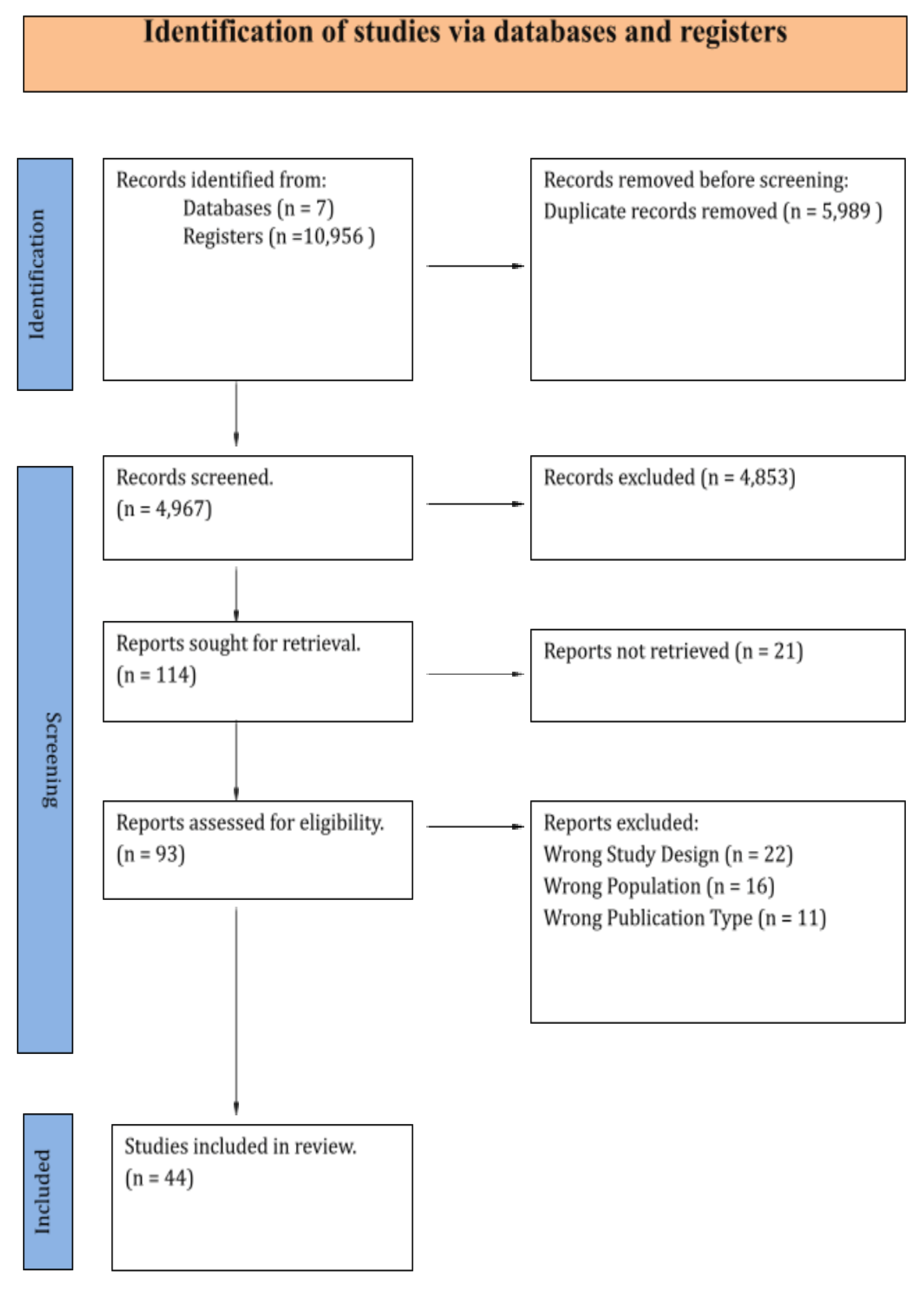
Figure 2.
Network heat map of pairwise odds ratio for ORR comparing Bispecific agents and Standard of Care regimens.
Figure 2.
Network heat map of pairwise odds ratio for ORR comparing Bispecific agents and Standard of Care regimens.
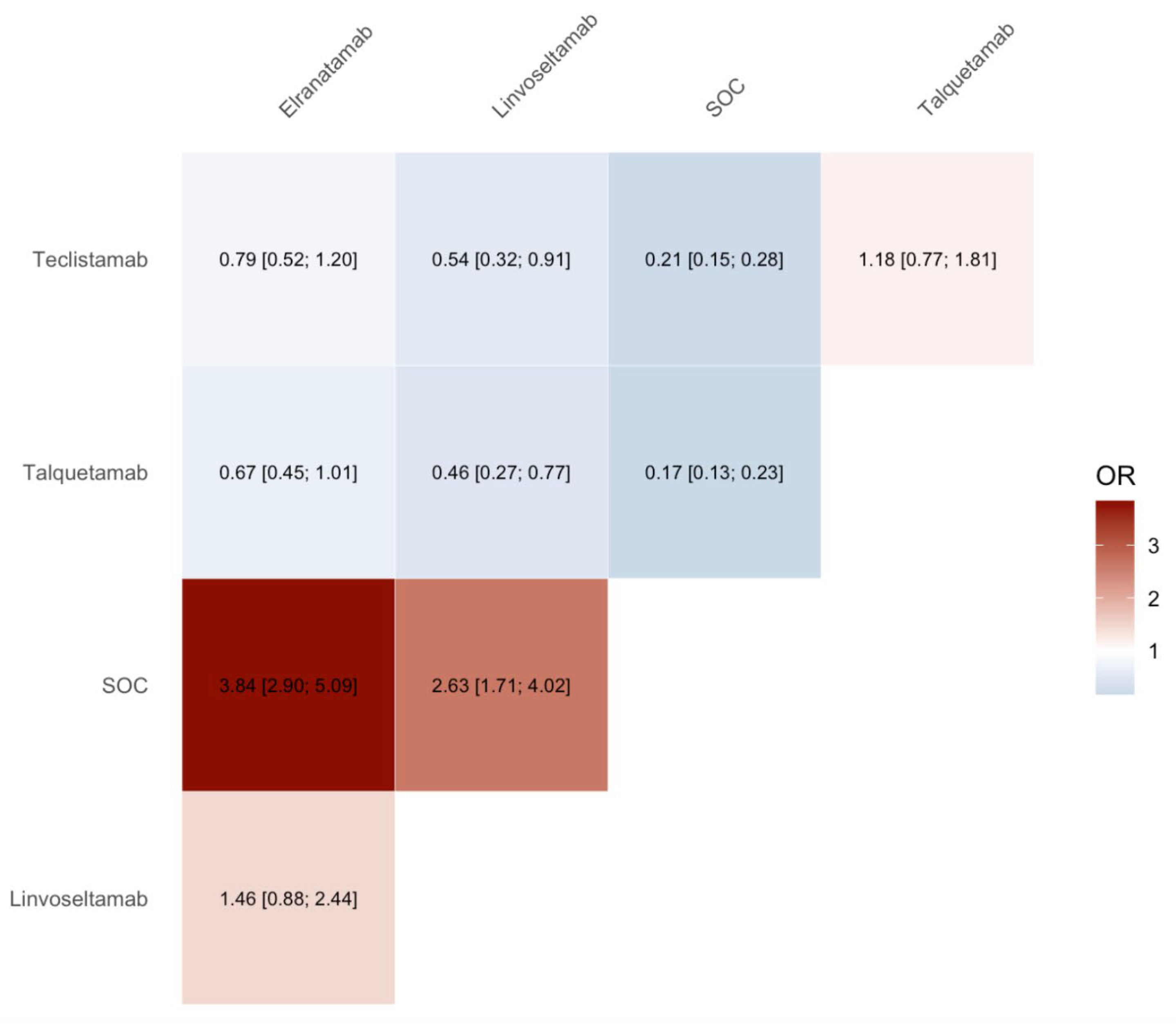
Figure 3.
Network heat map of pairwise hazard ratio for comparing PFS comparing Bispecific agents and SOC regimens.
Figure 3.
Network heat map of pairwise hazard ratio for comparing PFS comparing Bispecific agents and SOC regimens.
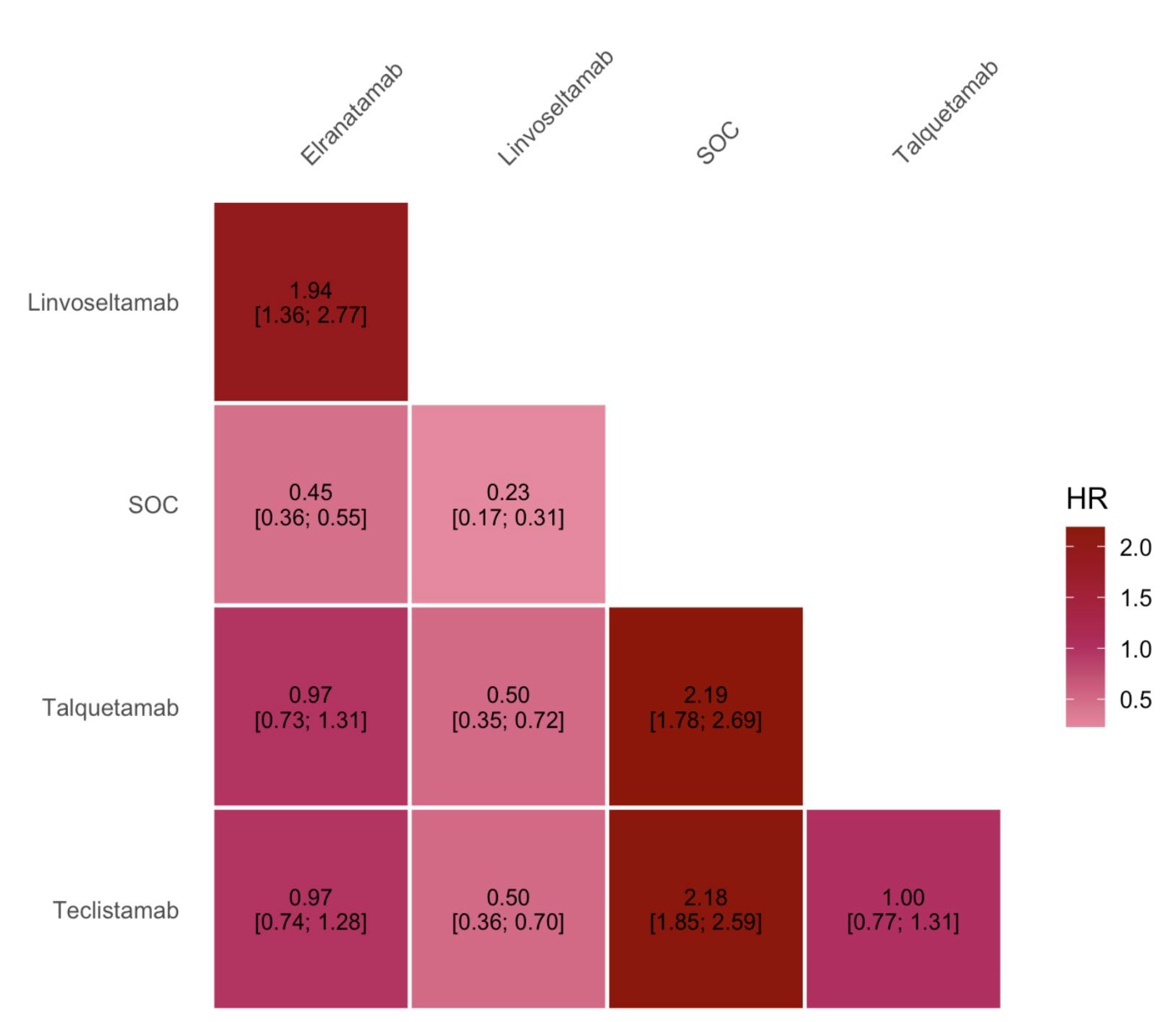
Figure 4.
Network heat map of pairwise hazard ratio for comparing OS comparing Bispecific agents and Standard of Care regimens.
Figure 4.
Network heat map of pairwise hazard ratio for comparing OS comparing Bispecific agents and Standard of Care regimens.
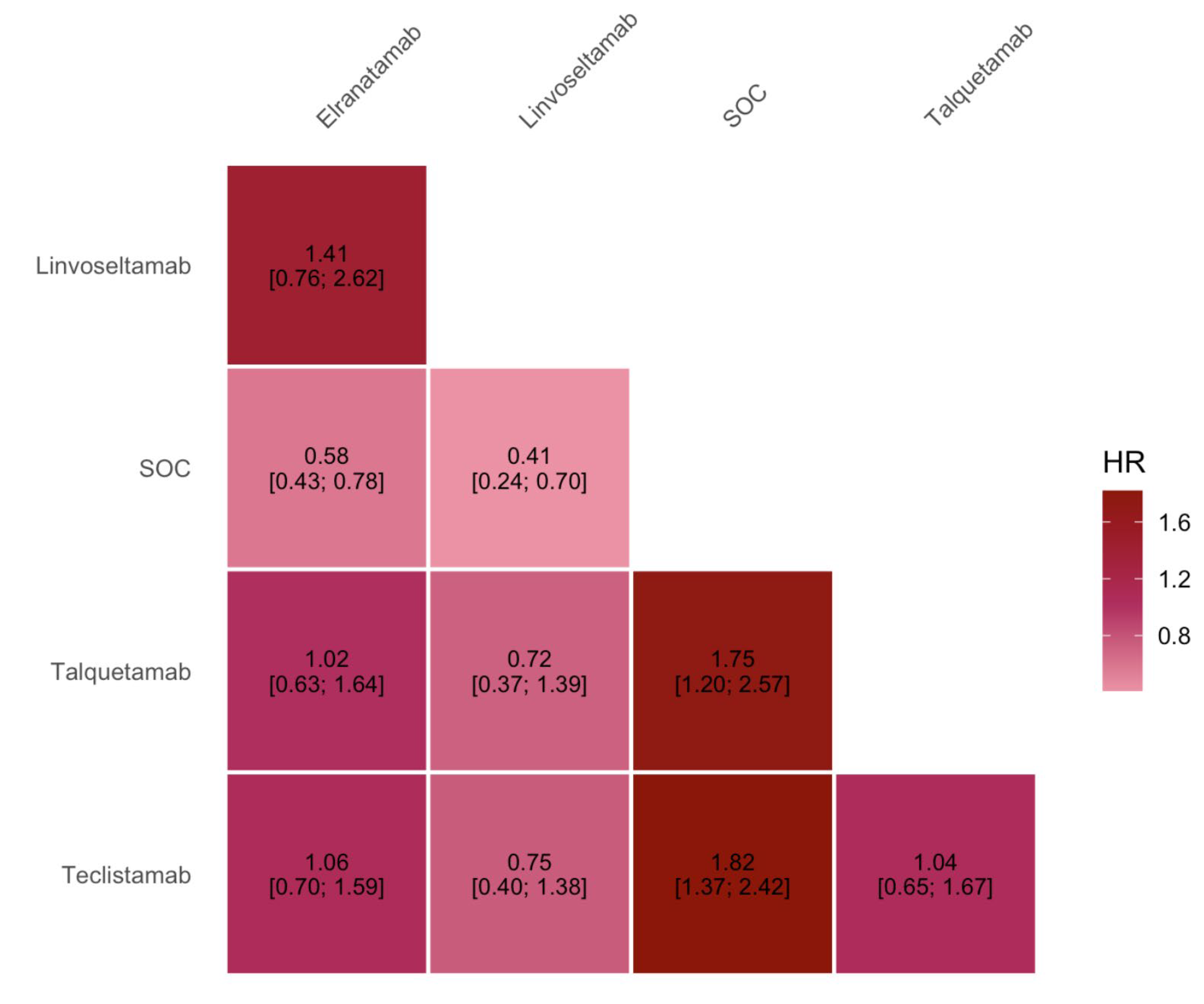

Table 1.
Characteristics of Single arm trials and Retrospective studies. Total population (n) denotes the entire treated cohort for each study and triple refractory (n) and penta refractory population (n) denotes the absolute number of triple refractory and pentarefractory patients in each study. *In TRIMM-2 (NCT04108195), triple-class refractory status was reported only for the overall cohort (40/65 patients, 61.5%) and not by individual arm.
Table 1.
Characteristics of Single arm trials and Retrospective studies. Total population (n) denotes the entire treated cohort for each study and triple refractory (n) and penta refractory population (n) denotes the absolute number of triple refractory and pentarefractory patients in each study. *In TRIMM-2 (NCT04108195), triple-class refractory status was reported only for the overall cohort (40/65 patients, 61.5%) and not by individual arm.
| Study name | Study type | Total population (n) |
Triple refractory population (n) | Penta refractory population (n) | Target | Prior LOT (n) | Median follow-up (months) |
|---|---|---|---|---|---|---|---|
| Chari et al. 2025 (TRIMM-2 0.4 mg /kg QW) NCT04108195[22] | Phase 1b | 14 | * (overall TRIMM-2 40/65, 61.5%) | NR | GPRC5D,CD3,CD38 | 5 | 18.6 |
| Chari et al. 2025 (TRIMM-2 0.8 mg /kg Q2W) NCT04108195[22] | Phase 1b | 50 | * (overall TRIMM-2 40/65, 61.5%) | NR | GPRC5D,CD3,CD38 | 5 | 18.6 |
| Chari et al. 2025 (MonumenTAL-1 0.4 mg /kg QW) NCT04634552 [23] | Phase 2 | 143 | 106 | 42 | GPRC5D,CD3 | 5 | 14.9 |
| Chari et al. 2025 (MonumenTAL-1 0.8 mg /kg Q2W) NCT04634552[23] | Phase 2 | 154 | 100 | 34 | GPRC5D,CD3 | 4 | 31.2 |
| Rasche et al. 2025 (MonumenTAL-1 (post–T-cell-redirected cohorts) NCT04634552[24] |
Phase 2 | 78 | NR | NR | GPRC5D,CD3 | ≥3 | 16.8 |
| Searle et al. 2024 (MonumenTAL-2 Cohort E) NCT05050097[25] | Phase 1b | 35 | 7 | NR | GPRC5D,CD3 | 3 | 11.4 |
| Popat et al. 2025[26] | Retrospective | 93 | 91 | 80 | GPRC5D,CD3 | 5 | 15 |
| Pasvolsky et al.2025[27] | Retrospective | 484 | NR | 242 | GPRC5D,CD3 | 6 | N/A |
| Frenking et al. 2025[28] | Retrospective | 138 | 118 | 64 | GPRC5D,CD3 | 6 | 8.2 |
| Al hadidi et al. 2025[29] | Retrospective | 114 | 114 | 90 | GPRC5D,CD3 | 6 | 10 |
| Dhakal et al. 2024[30] | Retrospective | 77 | 56 | NR | GPRC5D,CD3 | 4 | N/A |
| Gill et al. 2024[31] | Retrospective | 27 | 26 | NR | GPRC5D,CD3 | 8 | N/A |
| Neupane et. al. 2025[32] | Retrospective | 87 | 76 | NR | GPRC5D,CD3 | 6 | N/A |
| Donk et al. 2023 (MajesTEC-1 Cohort A, anti-BCMA naive) NCT04557098 [33] | Phase 2 | 165 | 68 | NR | BCMA,CD3 | 5 | 30 |
| Touzeau et al. 2024 (MajesTEC-1 Cohort C, prior anti-BCMA) NCT04557098 [34] | Phase 2 | 40 | 40 | 32 | BCMA,CD3 | 5 | 28 |
| D'Souza et al. 2024 (MajesTEC-2 Cohort A) NCT04722146[35] | Phase 1b | 17 | 9 | 0 | BCMA,CD3,CD38 | 2 | 16.2 |
| Offner et al. 2023 (MajesTEC-2 Cohort C) NCT04722146[36] | Phase 1b | 28 | 28 | 0 | BCMA,CD3 | 4 | 14.7 |
| Searle et al. 2023 (MajesTEC-2 Cohort E) NCT04722146[37] | Phase 1b | 32 | 15 | NR | BCMA,CD3,CD38 | 2 | 8.4 |
| Uttervall et al. 2026[38] | Retrospective | 113 | 89 | 50 | BCMA,CD3 | 6 | 20.7 |
| Tan et al. 2025[39] | Retrospective | 210 | 174 | 92 | BCMA,CD3 | 6 | 5.3 |
| Perrot et al. 2024[40] | Retrospective | 303 | 129 | NR | BCMA,CD3 | 5 | 11.9 |
| Reidhammer et al. 2024[41] | Retrospective | 123 | 114 | 74 | BCMA,CD3 | 6 | 5.5 |
| Mohan et al. 2024[42] | Retrospective | 110 | 95 | 84 | BCMA,CD3 | 6 | 3.2 |
| Dima et al. 2023[43] | Retrospective | 108 | 99 | 68 | BCMA,CD3 | 5 | 3.8 |
| Bahlis et al. 2023 (MagnetisMM-1) NCT03269136 [44] | Phase 1 | 55 | 50 | 43 | BCMA,CD3 | 5 | 12 |
| Lesokhin et al. 2023 (MagnetisMM-3 Cohort A BCMA-naïve) NCT04649359 [45] | Phase 2 | 123 | 119 | 52 | BCMA,CD3 | 5 | 14.7 |
| Lesokhin et al. 2023 (MagnetisMM-3 Cohort B, Prior BCMA)NCT04649359 [45] | Phase 2 | 63 | 61 | 27 | BCMA,CD3 | 5 | 10.4 |
| Malard et al. 2024[46] | Retrospective | 101 | 97 | 77 | BCMA,CD3 | 5 | 15.5 |
| Portuguese et al. 2025[47] | Retrospective | 125 | 118 | 61 | BCMA,CD3 | 6 | 7.5 |
| Lee et al. 2024 (LINKER-MM1 50 mg cohort) NCT03761108[48] | Phase 1/2 | 104 | 97 | 56 | BCMA,CD3 | 6 | 7.7 |
| Bumma et al. 2024 (LINKER-MM1 200 mg cohort) NCT03761108[49] | Phase 1/2 | 117 | 96 | 33 | BCMA,CD3 | 5 | 21.3 |
| Kumar et al. 2024 (CAMMA-2 A1) NCT05535244[50] | Phase 1/2 | 21 | 21 | NR | FcRH5,CD3 | 6 | 11 |
| Ho et al. 2025 (CAMMA-3) NCT04910568[51] | Phase 1 | 52 | 52 | NR | FcRH5,CD3 | 5 | 6.5 |
| Richter et al. 2024 (GO39775) NCT03275103[52] | Phase 1 | 167 | 160 | 123 | FcRH5,CD3 | 6 | 11.3 |
| Harrison et al. 2025(CAMMA-1 Arm B) NCT04910568[53] | Phase 1b | 64 | 64 | NR | FcRH5,CD3 | 2 | N/A |
| Deforge et al. 2024 (CAMMA-2 A2) NCT05535244[54] | Phase 1/2 | 21 | 18 | 13 | FcRH5,CD3 | 8 | 5.7 |
Table 2.
Characteristics of Comparative studies. BsAb: Bispecific antibody, SOC: Standard of Care. MAIC: Matching adjusted indirect comparison cohorts, IPTW: Inverse probability of treatment weighting comparison studies. NR: Not reported.
Table 2.
Characteristics of Comparative studies. BsAb: Bispecific antibody, SOC: Standard of Care. MAIC: Matching adjusted indirect comparison cohorts, IPTW: Inverse probability of treatment weighting comparison studies. NR: Not reported.
| Study name | Bispecific antibody | Control | BsAb (n) | SOC (n) | BsAb triple/penta refractory(n) | SOC triple/penta refractory (n) | Study Type | Prior LOT BsAb (n) | Prior LOT Control (n) | Median follow-up, BsAb (in months) | Median follow-up, SOC (in months) |
|---|---|---|---|---|---|---|---|---|---|---|---|
| Mol et al. 2025[55] | Elranatamab | SOC | 123 | 248 | 123/NR | 248/NR | MAIC | NR | NR | 28.4 | 26.4 |
| Costa et al. 2024-Flatiron Health[56] | Elranatamab | SOC | 123 | 152 | 44/NR | 36/NR | MAIC | 5.2 | 4.0 | 15 | N/A |
| Costa et al. 2024-COTA Comparisons[56] | Elranatamab | SOC | 123 | 239 | 40/NR | 59/NR | MAIC | 5.2 | 4.9 | 15 | N/A |
| Tsang et al. 2025[57] | Elranatamab | SOC | 123 | 81 | 123/NR | 81/NR | IPTW | 5 | 4 | 28.4 | N/A |
| Kumar et al. 2024[58] | Linvoseltamab | SOC | 105 | 307 | 105/NR | 307/NR | MAIC | NR | NR | 14.3 | N/A |
| Einsele et al. 2024[59] | Talquetamab | SOC | 145 | 177 | 145/NR | 177/NR | MAIC | 3 | 3 | 29.8 | 26.4 |
| Ye et al. 2024[60] | Talquetamab | SOC | 143 | 1169 | 64/42 | 458/349 | IPTW | NR | 3.6 | 18.8 | 13.4 |
| Krishnan et al. 2023[61] | Teclistamab | SOC | 165 | 364 | 78/50 | 169/119 | MAIC | NR | NR | 14.1 | 18.2 |
| Moreau et al. 2024-LocoMMotion[62] | Teclistamab | SOC | 165 | 248 | 20/50 | 30/93 | MAIC | NR | NR | 22.8 | 26.4 |
| Moreau et al. 2024- LocoMMotion+ MoMMent pooled[62] | Teclistamab | SOC | 165 | 302 | 20/50 | 37/108 | MAIC | NR | NR | 22.8 | 24.3 |
Disclaimer/Publisher’s Note: The statements, opinions and data contained in all publications are solely those of the individual author(s) and contributor(s) and not of MDPI and/or the editor(s). MDPI and/or the editor(s) disclaim responsibility for any injury to people or property resulting from any ideas, methods, instructions or products referred to in the content. |
© 2026 by the authors. Licensee MDPI, Basel, Switzerland. This article is an open access article distributed under the terms and conditions of the Creative Commons Attribution (CC BY) license.
Copyright: This open access article is published under a Creative Commons CC BY 4.0 license, which permit the free download, distribution, and reuse, provided that the author and preprint are cited in any reuse.


