

Submitted:
13 July 2026
Posted:
14 July 2026
You are already at the latest version
Abstract
Brussels Sprout Island is a research-creation and design-research prototype that examines how climate-friendly diet can be reframed as a sensory, relational, and non-shaming public communication practice. Rather than presenting lower-emission eating through carbon-footprint instruction, moral correction, or individual restraint, the prototype stages planting, cooking, sharing, slow environmental feedback, and repair as interaction mechanisms. Using interaction logs, pre/post micro-surveys, and short exhibition interviews with a small convenience sample (N = 16), the study asks whether participants can temporarily reframe climate-friendly eating through rhythm, care, shared meals, and repair rather than guilt or dietary purity. The findings are formative and exhibition-bound. They indicate short-term reductions in perceived judgment and guilt/shame, increased relational and self-efficacy language, and preliminary behavioral traces of kitchen/table repair routes after the monster trigger. The contribution is therefore a design-research prototype and provisional interaction grammar for future comparative and longitudinal testing of non-shaming climate-food communication.
Keywords:
climate-friendly diet
; design research
; research-creation
; sensory design
; commensality
; emotional eating
Part 1 Introduction
The argument becomes sharper once lower-emission eating and moralized dietary correctness are no longer treated as the same thing. All food experience is too often bracketed, in climate discourse, as detached climate content. That content is then pushed to the front, while the actual meanings of eating are left beneath it: solo dinners after shift work, rushed lunches between childcare tasks, comfort foods used to regulate stress, and shared meals that signify care more than virtue are all encountered as ordinary occasions of practice. So the problem only seems to be solvable by better numbers. Actually, it cannot be solved by better numbers alone. The public failure lies in a mismatch between abstract carbon messaging and the social-emotional texture of eating. (see Supplementary Table S1)
At first, climate-friendly diet may seem legible through carbon numbers and personal responsibility, but finally the paper is left with eating as it is lived: through stress, comfort, time pressure, habit, and relation. In a field that has not lacked stronger claims about behavioral change, this paper merits a narrower framing by reason of its exhibition scale, prototype form, and temporary communicative aim. For Brussels Sprout Island does not solve this mismatch at the level of everyday dietary practice. The mismatch cannot be accounted for wholly in terms of carbon-footprint instruction, moral correction, individual self-discipline, or personal failure. Some distance remains between what lower-emission eating means as climate evidence and how meals are actually chosen, desired, shared, and repaired.
What can an interface change? How briefly can it change it? How can discussion move from guilt to relation? Who, or what, makes a meal sustainable? This communication problem is not healed by carbon accounting alone; even the promise of numerical intelligibility is not enough. Yet, if participants simply knew more about emissions, that would not suffice. In calling the prototype non-shaming, the paper allows other demands than those for factual dietary instruction. In place of carbon-accounting instruction, Brussels Sprout Island offers a pixel-art world of planting, cooking, sharing, and contributing; in place of moral verdict, it tests whether sensory rhythm and social relation can become usable entry points for discussion (Garnett, 2011; Poore and Nemecek, 2018; Fischler, 2011; Mol, 2008).
1.1. Research Problems and Contributions
One way in which climate-friendly diet goes astray in public communication, in concrete judgments, is the frequency with which lower-emission eating is framed as moral arithmetic, as though clear numbers would automatically produce better choices. Another is the frequency with which daily life is treated with a barely concealed impatience. People eating under time pressure, loneliness, fatigue, and the need for self- soothing get their ration of explanation and advice. Still, it is clear that such advice is often felt to be a form of intrusion: evidence of the communicator’s interference with habits and comforts that would rather deliver themselves in their own ordinary sequence of needs. (see Supplementary Table S2)
Brussels Sprout Island, in the paper’s account, expresses the displacement of food communication as pure instruction, a move which in climate discourse has become a standard way of ushering in a moralized dietary vocabulary. Within research-creation and design research, the prototype is treated as a research instrument that produces claims and evidence. It is there to keep nothing hanging in the way between the work and the questions it brings into view, rather than to sit as an artwork that merely illustrates them (Frayling, 1993; Zimmerman et al., 2007; Koskinen et al., 2011; Gaver, 2012).
1.2. Definition of Research Object and Argumentation Object
Before moving into theory and method, the paper needs to define its argumentative object clearly. Otherwise, the project is easily misread either as a dietary-intervention study that must prove long-term carbon reduction, or as an aesthetic treatment of climate that cannot be evaluated. The broader scientific basis for climate-friendly diet is already well established through work on life-cycle assessment, food systems, land use, and mitigation pathways (Aleksandrowicz et al., 2016; Hallström et al., 2015; Springmann et al., 2016; Tilman and Clark, 2014). (see Supplementary Table S3 and Supplementary Table S4)
By public-interface hypothesis, I mean a narrower claim: not that a game can directly make people eat less meat, and not that one exhibition interaction can establish a stable non-shaming communication mechanism. In calling Brussels Sprout Island a test of this hypothesis, the study acknowledges a purpose beyond dietary instruction or moral correction. It acknowledges that the problem is, in some sense, grammatical: if climate- friendly diet is reframed from personal correctness to caring practice, and if food choices are staged through playable relational mechanisms, then participants may move, for a short time, from guilt, discipline, and purity toward rhythm, care, reciprocity, and shared meals. Ultimately, the response evaluated here is modest: whether such a temporary shift can be observed within an exhibition context. This formative function of the prototype cuts across design, communication, and food practice. (see Figure 1)
The article does not position the work as psychotherapy or as a clinical intervention. It draws on research on emotional eating to explain why stress often pulls people toward fast, sweet, or immediately comforting foods, and it uses the 'binge monster' as a non- shaming interaction device rather than a diagnostic category.
Methodologically, the project belongs to research-creation and design research: the prototype is a way ofproducing and testing claims, not merely an artwork waiting for interpretation.
Part 2 Theoretical Framework
2.1. Theoretical Framework I: Promoting the "Moral Trap" in Climate-Friendly Diet
The public spread of climate-friendly diet seems to be "conveying the facts" on the surface, but in fact it is more like creating a moral position that can be quickly accepted and consumed. The complex food system is simplified into a few numbers that are easy to share and non-this or that judgment, and then requires individuals to immediately fulfill a macro-level justice through self-restraint. Research based on life cycle assessment does clearly show that there are significant differences in greenhouse gas emissions, land use and other aspects of different foods (Garnett, 2011; Poore and Nemecek, 2018), and the comprehensive assessment also puts dietary transformation in the first place of the mitigation path and land system (Clark et al., 2020; IPCC, 2019). (see Supplementary Table S5)
Three mechanisms drive this moralization trap. First, abstraction translates meals into metrics that may be scientifically valid but socially unusable. Second, binary rhetoric turns eating into a test of purity and failure. Third, there is nothing interchangeable about the relational settings in which food is actually chosen, shared, and sustained, even though privatization keeps assigning responsibility to the individual.
Thus, the strategy of Brussels Sprout Island is a clear and testable one. It shifts attention away from the memorization of correct environmental numbers and states that food choice can become a temporal and relational practice once users enter an atmospheric world of planting, cooking, gifting, and table-building. Precisely because impact returns through slow feedback in soil, coastline, and emotional weather, players are allowed to register environmental accumulation as a perceptible systemic echo rather than as moral accusation.
2.2. Theoretical Framework II: Digital Symbiosis as an Interface Logic
Modern discussions of commensality are not merely discussions of eating together; they are discussions of how relation itself gets staged. The modern dilemmas of attention, reciprocity, invitation, and belonging are argued out on the field of the shared meal. Commensality appears here as one of the privileged forms by which social life defines itself, names itself, and dramatizes itself. Digital forms of commensality, in particular, show that interfaces can stage these relations even when people are not physically at the same table. In Brussels Sprout Island, the question is therefore not only what is eaten, but how cooking, gifting, and contribution are made visible as social acts. (see Supplementary Figure S1)
The burden of climate-friendly diet is not best explained by anti-science. It is better explained by a communication model that treats change as solitary virtue. By relocating diet within shared care, reciprocity, and everyday repair, the prototype turns sustainability into a relational practice and gives design research a clearer disciplinary object: the shaping ofpublic food experience.
The Methods and Results use a set of formative indicators, not always decisive in themselves, which reflect or attempt to register the short-term relational reframing tested by the prototype. Among the indicators devised for this purpose are relationship-oriented choices, long-table contributions, slow-feedback recall, and changes in the language participants use to describe food, responsibility, and care. And as the study’s claim is deliberately formative, these measures are most interesting when they are read as exhibition-bound traces . As the preceding theoretical frame suggests, the relevance of these indicators and the legitimacy of interpreting them remain limited by the setting, sample, and duration of contact. But the point is that the evaluation not only does not, but cannot, establish that the grammar works across publics or everyday food contexts. It is being tested. It stands in a double role: as a design proposition and as a provisional observational frame. The section thus becomes an occasion for inspecting whether the prototype can produce short-term signs of relational reframing under exhibition conditions (Forlizzi and Battarbee, 2004).
According to this relational framing, for design to remain in contact with the reality of food practice it must also reach what is often left unspoken: the immediate emotional work that eating carries under stress, loneliness, or exhaustion. But what is the point of a non-shaming design here? For truly, it is slower redirection rather than correction alone that Brussels Sprout Island has to make available. If people reach for fast and familiar comfort, and the interface treats deviation as a signal that can be redirected through slower, more caring alternatives, then the design is not merely cataloguing error but opening another path through it.
The 'binge monster' is the clearest example of that strategy. It does not punish the player for lack of discipline. Instead, it marks the accumulation of an unsustainable rhythm and invites repair through cooking, sharing, and returning to slower forms of care. The design aim is to convert self-blame into a readable and revisable interaction sequence. (see Supplementary Figure S2)
Part 3 Research Design and Data
3.1. Research Design and Data
3.1.1. Samples and Recruitment
To this end, while Brussels Sprout Island was encountered in the informal movement of an exhibition/vernissage setting, a small convenience sample was assembled around a specific act of participation. People who were willing to stop, interact with a design prototype, complete a short questionnaire, and take part in a brief interview were entered into the record; the final valid sample was N = 16. There is, needless to say, no sampling basis for treating this group as representative. The function of the sample was like that of a formative prototype test: above and beyond recruitment convenience, mechanism inspection. The modern appeal of rapid exhibition feedback was genuine, but the limits of convenience sampling went deeper. The sample should not stand for wider publics, different dietary cultures, lower-access food contexts, or everyday decision-making situations outside the exhibition. Inclusion criteria were age 18 or older, ability to understand the interface language used in the session, and willingness to complete a short anonymous questionnaire and interview. Exclusion criteria included inability to complete the task or refusal to be logged/interviewed. The form of this evaluation is therefore a constrained encounter between prototype and participant; the judgment it can support is correspondingly constrained. The sample size supports lightweight, mechanism-oriented descriptive statistics and non-parametric pre/post checks, but not population-level inference or strong causal claims (Creswell and Plano Clark, 2017). (see Supplementary Figure S3)
3.1.2. Process and Data Collection
The duration of each experience is controlled at about 18-22 minutes to ensure that it conforms to the flow arrangement of the exhibition site and the patience of the participants. The process is divided into three stages: baseline evaluation before the experience, the experience process, and feedback collection after the experience. Before the on-site experience begins, participants need to complete a 2-3-minute baseline scale and an open-ended question about "comfort food" to understand their existing emotional burden and the experience background related to climate diet discourse; the experience process lasts about 10-12 minutes, allowing participants to Explore and make choices freely. The researcher collects interaction logs, stay time and observation notes, and records them on screen after obtaining the consent of the participants; after the experience, the participants need to complete a 5-7-minute follow-up measurement table, recollection questions about clues and short interviews (Kvale and Brinkmann, 2009; Lazar et al., 2017) to verify whether a "frame transfer" has occurred, and the audience such as How to interpret the slow feedback clues you provided? The whole process revolves around the key mechanisms ofthe work, which have been clearly defined in the materials of the work.
3.1.3. Coding Framework and Reliability
The double-coding procedure was such an audit device. It was the attempt, procedurally, to make qualitative coding more inspectable. It was, in the most modest sense, a consistency check. And, as such, it must be judged by criteria of formative auditability in addition to interpretive fit. The main coder coded all qualitative materials, while a second coder blindly coded approximately 20% of the interview texts, that is, 4 interview texts. The overall Cohen’s kappa was 0.78, acceptable as an initial consistency check for this small formative study. But the problem was not reliability in general; it was the boundary between TASTE_IMAGINATION and CARE_RELATION. The codebook was therefore clarified: CARE_RELATION was coded only when the participant explicitly linked food to someone, a shared setting, a recipient, or a care relation. (see Supplementary Table S6) (see Table 1)
3.2.4. Data Management and Ethics
Given that this study explores the theme of loneliness and emotional eating, we hope to follow the principle of "minimal intervention" in ethics (Kvale and Brinkmann, 2009; Light and Akama, 2014): no identifiable personal information will be collected; the interview will focus on experiential narrative rather than clinical diagnosis; participants will not be prompted to disclose sensitive medical history; all records will be stored in anonymous IDs. Storage; screen recording will not contain facial images; participants can terminate the interview at any time and request the deletion of the record. When quoting interview excerpts in writing, de-identification should be carried out. Only keep short paragraphs related to the explanation of the mechanism, and do not summarize personal experiences as pathological conclusions. This is also crucial for the "non-shaming" position itself, and research should not reproduce shame when verifying theories.
Part 4 Project AS Method
Seen at the level of mechanism, one knows that the project does not begin as a mere exhortation to gentleness and then somehow grow into interface structure. To read it at all, familiarity with the specific parts is essential: the recipient prompt moves choice away from solitary optimization, the long table externalizes eating as a shared field rather than a private scoreboard, slow feedback blocks the instant moral verdict, and the monster loop turns dietary drift into a repair problem rather than a character flaw. Even more important, the reader has to come equipped with some sympathy for the way the interface itself explicates food practice. The design breaks every rule of moral decorum established for dietary communication; this is interface work by redistribution, without softness as its final explanation. One should perhaps be grateful that the project makes this intervention structurally rather than rhetorically, because some audiences may still mistake its tone for softness. Yet its actual intervention lies in the reallocation of what the interface treats as salient. (see Supplementary Table S7)
4.1. Project as a Method: Scenario and Mechanism Overview
It remains to be seen whether Brussels Sprout Island, as a more easily inspectable design-research apparatus, can do more than present a finished artwork later dressed in theory. By far the most important methodological point is that the prototype takes up the same function as a research instrument: it makes specific interface assumptions observable in a short exhibition encounter. Here we have a design-research apparatus as the paper ordinarily needs it. Here there are candidate mechanisms. Yet it is not false to treat the long table, the kitchen scene, slow atmospheric feedback, and the binge-monster cycle as comparable units, because each is first of all a recordable interface proposition. Contribution, recipient selection, cue recall, post-trigger repair routes, and language shifts in short interviews are the traces drawn from that encounter. In this study, the interface as a forum for public, relational judgment is brought forward. The point is to make interpretive effects traceable enough to be compared, questioned, and redesigned. (see Supplementary Figure S4)
The long table scene is the public node of this logic, which transforms interpersonal interaction in the private kitchen into visible public accumulation. The key feature of the long table is not the emotional narrative. The number of contributions, the duration of stay, the frequency ofpatronage, and whether the rhythm ofplanting and cooking changes after the contribution can all be behavioral traces to verify whether interpersonal interaction really occurs. These constitute an auditable interface structure. And the long table shifts the "responsibility" from the individual to the collective level, so that sustainable diet no longer depends on shame, but on a sense of ritual and reciprocity. Theoretically speaking, a path from individual obligation to collective practice is boring, pallid, if it remains only a matter of private will (Mol, 2008; Tronto, 1993). It lacks durability. When actions are embedded in a shared structure, repetitiveness and sustainability become more likely, because they no longer depend entirely on the continuous strain of personal pressure.
The kitchen scene further leads the rhythm selection to the interpersonal choice. The most important thing here is not "what to cook", but the interface forces you to answer "who is this meal for? Only then does this clear approach, directed straight at the target audience, become worthwhile: it shifts sustainable dieting out of the pale routine of personal optimization and into relation.
When people choose to cook for themselves, anonymous neighbors or public tables, they are actually practicing a different social imagination, and at the same time transforming "climate responsibility" from isolated self-restraint to common caring practice. A large number of studies on digital catering have repeatedly shown that dining together does not depend on the actual existence of the same table; in contrast, it depends on organized synchronization, mutual visibility and the imaginary conditions of "the existence of others" (Pereira-Castro et al., 2022; Spence et al., 2019). The kitchen mechanism here provides these conditions at the interface level: it sets goals for contributions, allows people to imagine objects, and allows subsequent sharing scenarios to reuse this imagination, thus changing the climate-friendly diet from "I should" to "what can I do for? ".
The slow feedback system in the work (such as emotional weather, soil condition, coastline clarity) undertakes the task of "transforming influence into atmosphere". Mainstream communication often presents the impact as a punitive result, that is, "you did something wrong, so you should feel guilty". But you let the influence appear in a gradual way (Anderson, 2009; Böhme, 1993), like the rise and fall of the tide, echoing in the background, making it easier for the audience to form a "cumulative reasoning": my choice will not be immediately judged as right or wrong, but gradually shape the environment and atmosphere like the rhythm of life. This feedback design changes the presentation of responsibility, making it more in line with systematic thinking than moral judgment, and is also more suitable for the cognitive load of short-term experience in the exhibition environment. This is in line with the main idea of this article: we are concerned about whether the audience can transform the macro impact into an operable micro rhythm, not whether they can remember the specific numbers (Drucker, 2014; Höök et al., 2015). (see Supplementary Figure S5)
By these standards, the Night Forest and Binge Monster cycle is the prototype’s most direct test of non-shaming repair logic. The case for treating an unsustainable rhythm as a signal , since the loop gives participants slower alternatives: returning to the kitchen, preparing soup, or sharing through the long table. But this cycle also marks, and this is the methodological limit of the study, a candidate mechanism. This caution is well taken. Given the small exhibition study and the absence of a control condition, the loop should be read as a design probe. Its importance, interpretive and methodological, lies in showing whether a negative cue can be followed by continued interaction and relational repair routes. All questions of promise aside, any stronger comparison would be misleading here. It is the whole point of the present framing that the material has barely passed beyond formative observation. Unlike a validated behavior-change mechanism, the Night Forest and Binge Monster cycle stands or falls here by whether its traces can be interpreted as preliminary evidence for a candidate grammar of repair(Neff, 2003; Gilbert, 2009; Light and Akama, 2014).
Part 5 Results
5.1. Sample, Experience Intensity and Overall Participation Mode
In the context of this exhibition, a total of 16 valid samples were collected by the lightweight study. The background of the participants is deliberately diversified to avoid that the data only reflects "those who are born to support sustainable development". The age of the participants is between 22 and 38 years old (the average age is 29.4 years old). The diet they describe is omnivorous, flexible vegetarian, and highly dependent on takeaway. In the open-ended questions before the experience, more than half of the participants directly linked "comfort food" with "hurry, eating alone and mental fatigue", which presents a typical situation of lack of time and loneliness, for the follow-up on whether "can shamelessness reduce the defense mechanism" (Devonport et al., 2019; Heatherton and Baumeister, 1991)'s judgment provides a realistic starting point. (see Supplementary Table S8)
5.2. Pre-Post Shifts
I can think of only one cautious way to use these quantitative results here: as short- term self-report evidence after a single exhibition encounter. The pattern is selective, exhibition-bound, statistically modest, and, if the word is not too strong, promising. It is not a diet-change result. Nor should one necessarily ask that it be. Nevertheless, since the study’s narrower claim concerns a temporary frame shift, the pre/post pattern needs to be faced. Whatever the numbers are as formative evidence, they are not proof of a general non-shaming food-communication mechanism. There is the matter ofperceived judgment, for example. Its decline is not trivial: the feeling of being judged when discussing climate-friendly diets decreased from M = 4.8 to M = 3.5 on a 1-7 scale (Wilcoxon p approximately .01). Probably it belongs to the kind of small exhibition result that gains value precisely by being read within its narrow frame. The shame/guilt item, though, supplies a parallel signal, declining from M = 4.6 to M = 3.2 (p approximately .008). In the same pattern, relational-care framing increased from M = 3.9 to M = 5.2 (p approximately .004), and self-efficacy for imperfect small changes increased from M = 3.4 to M = 4.6 (p approximately .006). But there is no plausible way of making these figures carry more than the authorial claim allows: they indicate a promising formative signal of a short-term frame shift. A greater methodological danger would be to load the numbers with causal force they cannot bear. The following behavioral and qualitative traces are therefore used to inspect how this shift may have been produced inside the prototype, while keeping the absence of a control condition in view.
5.3. Evidence of Behavior at the Mechanism Level
Certainly, the Monster Track provides a useful but limited behavioral checkpoint for the repair logic, particularly around the Night Forest / monster event. Yet the methodological fact remains that its principal value is not to prove repair, but to show what participants do after a moment of disruption. The record is small but concrete:
among the 16 participants, 9 triggered the Night Forest / monster event; within this subgroup, 1 participant exited within 60 seconds, 4 returned to the kitchen to complete a slow-cooking action, and 3 moved toward long-table discussion or contribution within 120 seconds. If these traces are suggestive, it is because the negative cue did not immediately become a punitive endpoint for some participants. One can imagine a stronger test with a larger sample and a comparison condition. But the present evidence depends on a more limited kind of interpretive tact. A careful reading of the Monster Track must therefore keep the loop as a design probe. Yet in treating these traces as early feasibility evidence, the analysis must not undermine their actual force, which lies in showing that some participants remained inside a non-shaming repair loop after disruption. This is precisely where the present study must stop: the data support a candidate grammar of repair (Bardzell, 2010; Light and Akama, 2014; Sengers et al., 2005). (see Supplementary Table S9 and Supplementary Table S10) (see Figure 2)
5.4. Frame Shifts and Inference from Slow Feedback
Listing the interview traces, the analysis makes certain groupings of participant language; the most useful grouping is whether they used a different vocabulary after the encounter. Thus, the same exhibition interaction may move from guilt, duty, or being judged toward rhythm, care, relation, and repair. Another grouping allows approval, taste description, and relational speech to be separated. I cannot accept the easy view that liking the prototype and reframing climate-friendly eating are interchangeable, since the whole study precisely depends on distinguishing these responses. The same caution would not apply, however, to the more limited claim that the encounter may have softened the moral entry point and made relational speech available. In this small exhibition study, several participants described climate-friendly eating with less emphasis on guilt, duty, or judgment, and more emphasis on rhythm, care, relation, and repair. There is good reason to read this as a formative shift in language . And the pattern cannot be allowed to stand as proof of persistence outside the exhibition, since future work would need larger samples, comparison formats, and follow-up sessions to test whether this vocabulary remains available in everyday food contexts (Braun and Clarke, 2006; Mol, 2008; Puig de la Bellacasa, 2017).
Most useful to the case for slow-feedback legibility are the immediate post- experience recall results, which indicate that 81% of participants could recall at least two feedback dimensions and state their direction. For the feedback grammar these results describe, the prototype can be credited with short-term readability. But either participants noticed the feedback dimensions or they did not. And, assuming these recall reports are coded correctly, the study is no more bound to treat them as proof of everyday food- decision transfer than it is to treat a single exhibition encounter as a longitudinal intervention. Why may not a formative exhibition study hold up as its standard the simpler question of whether participants recognized gradual accumulation rather than instant reward or punishment? In any case, 62% described the changes in that way. These results support the short-term legibility of the feedback grammar, but they do not demonstrate long-term learning or transfer to everyday food decisions. (see Figure 3)
Still, misunderstandings do exist, and they have design value. Decorative misunderstandings (such as misunderstanding gradients as backgrounds) account for about 19%, judgmental misunderstandings account for about 12%, and linear overassertions account for about 9%. These misunderstandings should not be covered up. They constitute the most powerful "boundary conditions" in the discussion chapter, because they can tell you which audiences need clearer alignment prompts and replay anchors, and which audiences will automatically convert any feedback into ethical scores, thus indirectly supporting your "micro-interaction for reasoning alignment" design contribution (Candy and Edmonds, 2018; Stappers and Giaccardi, 2017). (see Supplementary Table S11)
6. Discussion
6.1. Mainly Discover How to Support the Three Contributions
The clearest finding appears in one bounded register of the study: a traceable, short- term shift in framing under exhibition conditions. The interpretation centers on the relation among four candidate mechanisms: the kitchen specifying a recipient, the long table externalizing contribution, atmospheric feedback replacing punishment, and the monster loop offering repair rather than blame. The analysis does not place these components into one interchangeable proof of behavior change. Their effects are not the same thing as durable dietary change, nor do they show that relational framing will work for all publics. Thus, the main point the study makes is not a general causal one. It is not only a report of reduced guilt and self-discipline language, but a statement that some participants, under these exhibition conditions, described the experience through care, rhythm, and shared practice. Precisely because these participants did show such a shift, the prototype can be treated as a candidate interaction grammar for non-shaming climate- food communication, with design components and expected traces made explicit enough for future comparative testing. (see Supplementary Table S12)
6.2. Boundary Conditions, Misreads, and Why They Matter
A useful counterpoint should also be acknowledged. Not every audience will respond best to relational framing alone. Some settings still require explicit nutritional guidance, affordability discussion, or supply-side change that a small narrative prototype cannot deliver. The project does not replace structural food-policy questions; it addresses a narrower but stubborn communicative problem. Its value lies in loosening guilt as the default entry point, not in claiming that atmosphere and care talk are sufficient to produce durable dietary transition on their own. (see Supplementary Figure S7)
This boundary is methodological as well as ethical: discussions ofthe exhibition evidence are diagnostics of whose food experience the prototype can and cannot speak for. The subject of participant response can too easily pre-empt questions of access, culture, and constraint, unless the study keeps those questions visible. The dilemmas of diet, care, affordability, obligation, and identity are not all argued out on the field of an exhibition encounter. The exhibition/vernissage context is only one mirror of possible public response, shaped by a small convenience sample, no randomized control condition, and no delayed follow-up. In particular, questions of generalization are of the greatest importance here: are these findings meaningful for wider publics, for different dietary cultures, for lower-access food contexts, for people whose eating is shaped by affordability, access, religion, family obligation, or cultural identity more strongly than by exhibition interaction? To bury these differences under a general claim would be an ethical failure of overreach. For, as an act of methodological definition, the boundary is also a self-limitation. The results should therefore be treated as early feasibility evidence for an interaction grammar (Creswell and Plano Clark, 2017; Lazar et al., 2017).
The discussion part should not be the place to explain the most abstract concepts and interpret all the results as "this work is very successful". Misunderstandings and counterexamples should be regarded as methodological discoveries (Bardzell and Bardzell, 2013; Sengers et al., 2005). They tell us under what conditions, "atmosphere echo" will be regarded as "moral judgment", and under what conditions, "sharing containers" will be interpreted as "moral behavior". For example, decorative misunderstandings in the slow feedback process indicate the actual limitations of attention resources in the exhibition scene: the audience may focus on explicit interactions and ignore progressive hints. This does not imply that the audience does not have enough understanding; indicates that the interface does not provide sufficient low- cost alignment tips. So, this misinterpretation also reveals that some audiences will automatically interpret any feedback as part of the deeper social grammar practices ofthe scoring system. (see Supplementary Table S13)
6.4. Research Limitations and Follow-Up Steps
All subsequent readings of these results should be similarly cautious, or at least explicit: either the exhibition study is treated as a small formative test, or it is made to carry claims it cannot support. One merit of the present framing is that the customary accent of overclaiming is missing. Does the prototype prove a general non-shaming intervention? Very well, it does not. The paper invites the reader to leave that stronger claim aside and attend to the form that is actually here: a formative exhibition prototype. Indeed, there is little reason to mourn this limitation, since the study was never a full intervention trial. The limitations come directly from the exhibition situation and from the formative status of the prototype (Creswell and Plano Clark, 2017; Lazar et al., 2017). Why can the results not be made stronger? In a word: design. First, there is the small sample size, short stay time, and uncontrolled participant background. Then there is the absence of a comparison condition, which means the study cannot separate the effects of route structure, pixel-art atmosphere, novelty, interview prompting, and specific interaction loops. Thus, what the results support is a sign of frame shift and relational engagement under these conditions. The non-shaming tone may reduce defensive reactions for some participants, but it may also seem too gentle or insufficiently urgent for others. Two important next steps follow from this limitation: a stronger study should compare this grammar with carbon-footprint pages, recipe cards, and moralized diet messaging, and it should include delayed follow-up to test whether relational language persists. (see Supplementary Figure S8)
7. Conclusion
Climate-friendly diet is not treated here as a problem of message repetition or dietary obedience. Most climate-food communication consists either of correct environmental instruction or of moralized self-discipline; Brussels Sprout Island instead reframes the issue as a sensory and relational design problem. The other point relates to the exhibition encounter. In the study’s account, planting, cooking, sharing, slow feedback, and repair are the sources of a temporary grammar through which sustainable eating may feel more shared, discussable, and repairable. As a piece of design research, the prototype works in a deliberately modest register, with a small convenience sample (N = 16), single-session interaction logs, pre/post micro-surveys, and short interviews. Where stronger intervention studies would need long duration and controlled comparison, this paper travels light; where a behavior-change claim would require dietary follow-up, it offers a set of blunt formative traces. In short, the study has formulated a non-shaming interaction grammar in the exhibition manner: limited, inspectable, and provisionally useful. Its argument is clean-cut and bounded, and, within that limit, the early signals are consistent:
perceived judgment and guilt/shame declined after the experience, relational framing and small-change self-efficacy increased, several participants used care/rhythm language in retelling, and some post-monster-trigger responses followed kitchen or long-table repair routes. (see Supplementary Table S14)
The paper does not plumb the full depth of durable dietary behavior change, generalized public communication, or solved non-shaming food practice. But its virtues, not the least of which are explicitness and redesignability, are considerable. To climate- food communication work unfamiliar with this kind of interaction grammar, the very problem the prototype raises should be useful: how recipient selection in the kitchen, shared contribution through the long table, slow atmospheric feedback, and a repair loop after the monster trigger can be made explicit, inspected, and redesigned. Brussels Sprout Island is more stimulating as a design-research account than as a claim of completed intervention. Indeed, the paper does not present proof that non-shaming food communication has been solved. The value of the paper lies in the forthright application of this diagnosis to interface design. In this sense, Brussels Sprout Island offers a candidate grammar for future comparative studies of climate-friendly food communication (Mol, 2008; Puig de la Bellacasa, 2017; Tronto, 1993).
Ethics and data availability: Participants provided informed consent; no identifying personal data are reported; anonymized aggregate data are available from the corresponding author on reasonable request. (see Supplementary Table S16 and Supplementary Figure S10)
Supplementary Materials
The following supporting information can be downloaded at the website of this paper posted on Preprints.org.
References
- Aleksandrowicz, L., Green, R., Joy, E. J. M., Smith, P., & Haines, A. (2016). The impacts of dietary change on greenhouse gas emissions, land use, water use, and health: A systematic review. PLoS ONE, 11(11), e0165797. [CrossRef]
- Anderson, B. (2009). Affective atmospheres. Emotion, Space and Society, 2(2), 77-81. [CrossRef]
- Bandura, A. (1997). Self-efficacy: The exercise of control. W. H. Freeman.
- Bardzell, J., & Bardzell, S. (2013). What is "critical" about critical design? In Proceedings of the SIGCHI Conference on Human Factors in Computing Systems (pp. 3297-3306). ACM. [CrossRef]
- Bardzell, S. (2010). Feminist HCI: Taking stock and outlining an agenda for design. In Proceedings of the SIGCHI Conference on Human Factors in Computing Systems (pp. 1301-1310). ACM. [CrossRef]
- Bogost, I. (2007). Persuasive games: The expressive power of videogames. MIT Press.
- Böhme, G. (1993). Atmosphere as the fundamental concept of a new aesthetics. Thesis Eleven, 36(1), 113-126. [CrossRef]
- Bongers, P., Jansen, A., Houben, K., & Roefs, A. (2016). Emotional eating is not what you think it is and emotional eating scales do not measure what you think they measure. Frontiers in Psychology, 7, 1932. [CrossRef]
- Braun, V., & Clarke, V. (2006). Using thematic analysis in psychology. Qualitative Research in Psychology, 3(2), 77-101. [CrossRef]
- Cacioppo, J. T., & Hawkley, L. C. (2009). Perceived social isolation and cognition. Trends in Cognitive Sciences, 13(10), 447-454. [CrossRef]
- Candy, L., & Edmonds, E. (2018). Practice-based research in the creative arts: Foundations and futures from the front line. Leonardo, 51(1), 63-69. [CrossRef]
- Clark, M. A., Domingo, N. G. G., Colgan, K., Thakrar, S. K., Tilman, D., Lynch, J., Azevedo, I. L., & Hill, J. D. (2020). Global food system emissions could preclude achieving the 1.5° and 2°C climate change targets. Science, 370(6517), 705-708. [CrossRef]
- Creswell, J. W., & Plano Clark, V. L. (2017). Designing and conducting mixed methods research (3rd ed.). SAGE.
- Dallman, M. F. (2010). Stress-induced obesity and the emotional nervous system. Trends in Endocrinology & Metabolism, 21(3), 159-165. [CrossRef]
- de Castro, J. M. (1994). Family and friends produce greater social facilitation of food intake than other companions. Physiology & Behavior, 56(3), 445-455. [CrossRef]
- Devonport, T. J., Nicholls, W., & Fullerton, C. (2019). A systematic review of the association between emotions and eating behavior. Appetite, 133, 235-246. [CrossRef]
- Drucker, J. (2014). Graphesis: Visual forms of knowledge production. Harvard University Press.
- Fischler, C. (2011). Commensality, society and culture. Social Science Information, 50(3- 4), 528-548. [CrossRef]
- Forlizzi, J., & Battarbee, K. (2004). Understanding experience in interactive systems. In Proceedings of the 5th Conference on Designing Interactive Systems (pp. 261- 268). ACM. [CrossRef]
- Frayling, C. (1993). Research in art and design. Royal College of Art Research Papers, 1(1), 1-5.
- Garnett, T. (2011). Where are the best opportunities for reducing greenhouse gas emissions in the food system (including the food chain)? Food Policy, 36 (S1), S23-S32. [CrossRef]
- Gaver, W. (2012). What should we expect from research through design? In Proceedings of the SIGCHI Conference on Human Factors in Computing Systems (pp. 937-946). ACM. Gilbert, P. (2009). The compassionate mind. New Harbinger. [CrossRef]
- Hallström, E., Carlsson-Kanyama, A., & Börjesson, P. (2015). Environmental impact of dietary change: A systematic review. Journal of Cleaner Production, 91, 1-11.
- . [CrossRef]
- Heatherton, T. F., & Baumeister, R. F. (1991). Binge eating as escape from self- awareness. Psychological Bulletin, 110(1), 86-108. [CrossRef]
- Holt-Lunstad, J., Smith, T. B., Baker, M., Harris, T., & Stephenson, D. (2015). Loneliness and social isolation as risk factors for mortality: A meta-analytic review. Perspectives on Psychological Science, 10(2), 227-237. [CrossRef]
- Höök, K., Ståhl, A., Jonsson, M., Mercurio, J., Karlsson, A., & Johnson, E. C. B. (2015). Somaesthetic design. Interactions, 22(4), 26-33. [CrossRef]
- IPCC. (2019). Climate Change and Land: An IPCC special report on climate change, desertification, land degradation, sustainable land management, food security, and greenhouse gas fluxes in terrestrial ecosystems. Intergovernmental Panel on Climate Change.
- Koskinen, I., Zimmerman, J., Binder, T., Redström, J., & Wensveen, S. (2011). Design research through practice: From the lab, field, and showroom. Morgan Kaufmann.
- Kranzbühler, A. M., & Schifferstein, H. N. J. (2023). The effect of meat-shaming on meat eaters' emotions and intentions to adapt behavior. Food Quality and Preference, 107, 104831. [CrossRef]
- Kvale, S., & Brinkmann, S. (2009). InterViews: Learning the craft of qualitative research interviewing (2nd ed.). SAGE.
- Lazar, J., Feng, J. H., & Hochheiser, H. (2017). Research methods in human-computer interaction (2nd ed.). Morgan Kaufmann.
- Light, A., & Akama, Y. (2014). Structuring future social relations: The politics of care in participatory practice. In Proceedings of the 13th Participatory Design Conference (pp. 151-160). ACM. [CrossRef]
- Macht, M. (2008). How emotions affect eating: A five-way model. Appetite, 50(1), 1-11. [CrossRef]
- Mol, A. (2008). The logic of care: Health and the problem of patient choice. Routledge.
- Moser, S. C. (2010). Communicating climate change: History, challenges, process and future directions. Wiley Interdisciplinary Reviews: Climate Change, 1(1), 31-53. [CrossRef]
- Neff, K. D. (2003). Self-compassion: An alternative conceptualization of a healthy attitude toward oneself. Self and Identity, 2(2), 85-101. [CrossRef]
- Nisbet, M. C. (2009). Communicating climate change: Why frames matter for public engagement. Environment, 51(2), 12-23. [CrossRef]
- O'Neill, S., & Nicholson-Cole, S. (2009). "Fear won't do it": Promoting positive engagement with climate change through visual and iconic representations. Science Communication, 30(3), 355-379. [CrossRef]
- Papies, E. K., Davis, T., Farrar, S., Sinclair, M., & Wehbe, L. (2024). How (not) to talk about plant-based foods: Using language to support meat reduction. Proceedings of the Nutrition Society, 83(1), 97-108. [CrossRef]
- Pereira-Castro, M. R., Covic, A. N., Gomide, A. I., et al. (2022). Digital forms of commensality in the 21st century: A scoping review. International Journal of Environmental Research and Public Health, 19(24), 16734. [CrossRef]
- Poore, J., & Nemecek, T. (2018). Reducing food's environmental impacts through producers and consumers. Science, 360(6392), 987-992. [CrossRef]
- Puig de la Bellacasa, M. (2017). Matters of care: Speculative ethics in more than human worlds. University of Minnesota Press.
- Reichenberger, J., Schnepper, R., Arend, A.-K., & Blechert, J. (2020). Emotional eating in healthy individuals and patients with an eating disorder: Psychometric, experimental and naturalistic studies. Proceedings of the Nutrition Society, 79(3), 290-299. [CrossRef]
- Saldaña, J. (2016). The coding manual for qualitative researchers (3rd ed.). SAGE.
- Salen, K., & Zimmerman, E. (2004). Rules ofplay: Game design fundamentals. MIT Press.
- Sengers, P., Boehner, K., David, S., & Kaye, J. (2005). Reflective design. In Proceedings of the 4th Decennial Conference on Critical Computing (pp. 49-58). ACM. [CrossRef]
- Sobal, J., & Nelson, M. K. (2003). Commensal eating patterns: A community study. Appetite, 41(2), 181-190. [CrossRef]
- Spence, C., Mancini, M., & Huisman, G. (2019). Digital commensality: Eating and drinking in the company of technology. Frontiers in Psychology, 10, 2252. [CrossRef]
- Springmann, M., Godfray, H. C. J., Rayner, M., & Scarborough, P. (2016). Analysis and valuation of the health and climate change co-benefits of dietary change. Proceedings of the National Academy of Sciences of the United States of America 113(15), 4146-4151. [CrossRef]
- Stappers, P. J., & Giaccardi, E. (2017). Research through design. In M. Soegaard & R. F. Dam (Eds.), The encyclopedia of human-computer interaction (2nd ed.). Interaction Design Foundation.
- Tilman, D., & Clark, M. (2014). Global diets link environmental sustainability and human health. Nature, 515(7528), 518-522. [CrossRef]
- Tronto, J. C. (1993). Moral boundaries: A political argument for an ethic of care. Routledge.
- Willett, W., Rockström, J., Loken, B., Springmann, M., Lang, T., Vermeulen, S., et al. (2019). Food in the Anthropocene: The EAT-Lancet Commission on healthy diets from sustainable food systems. The Lancet, 393(10170), 447-492. [CrossRef]
- Zimmerman, J., Forlizzi, J., & Evenson, S. (2007). Research through design as a method for interaction design research in HCI. In Proceedings of the SIGCHI Conference on Human Factors in Computing Systems (pp. 493-502). ACM. [CrossRef]
Figure 1.
Public Interface Hypothesis.
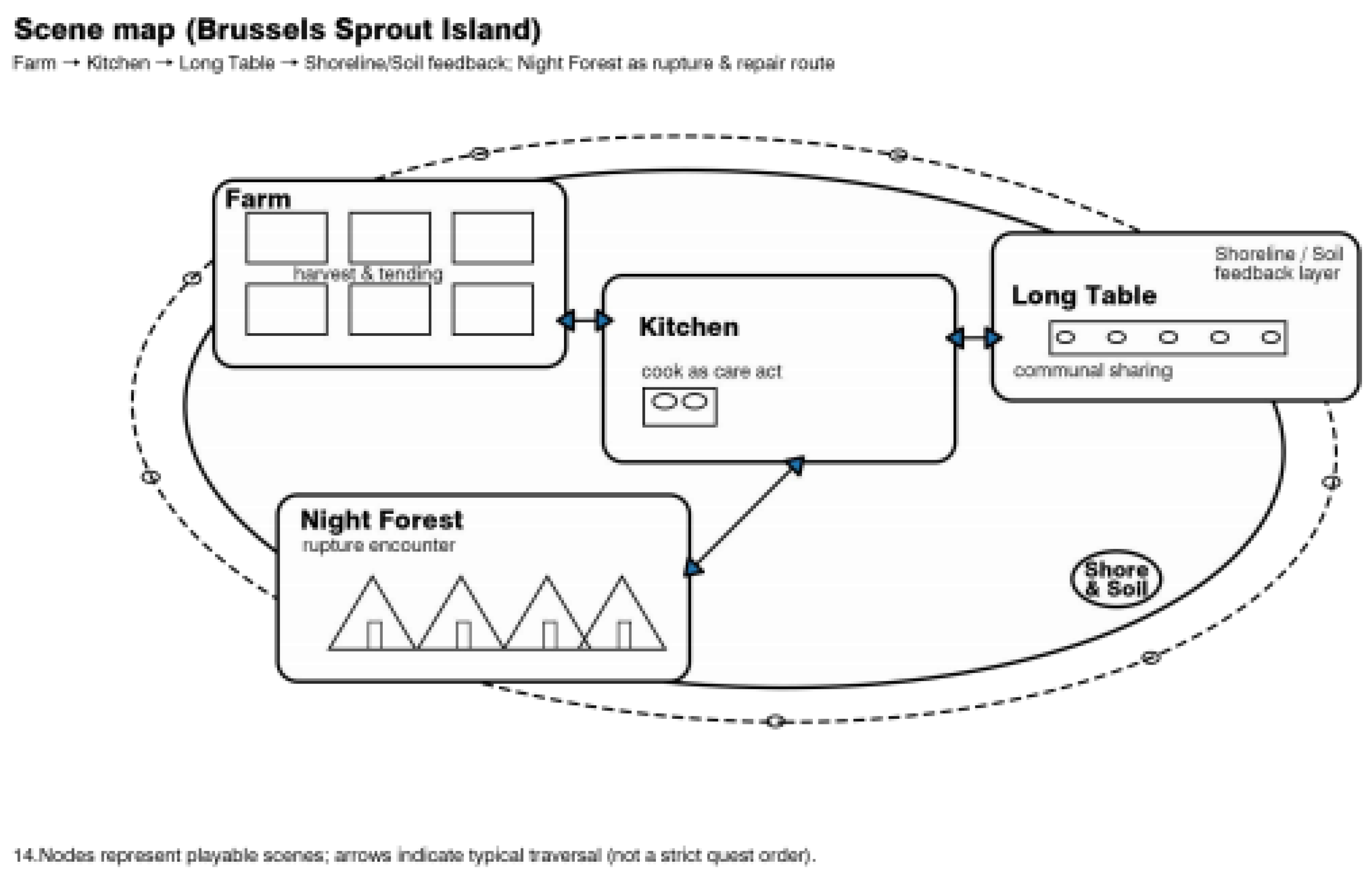
Figure 2.
Joint Display: Monster Trigger -> Repair Action Type -> Dropout vs Continuation.
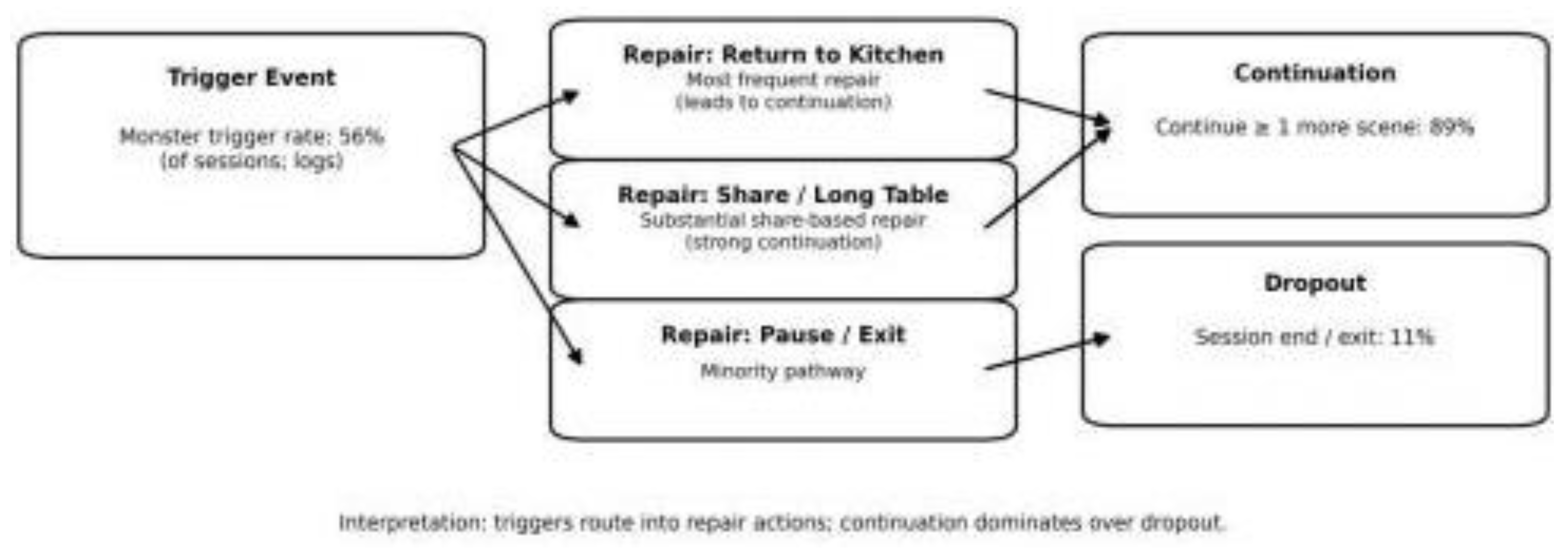
Figure 3.
Repair Loop Joint Display: Trigger -> Primary Path (Kitchen/Table/Exit) -> Slow-Feedback Recovery Over Time.
Figure 3.
Repair Loop Joint Display: Trigger -> Primary Path (Kitchen/Table/Exit) -> Slow-Feedback Recovery Over Time.
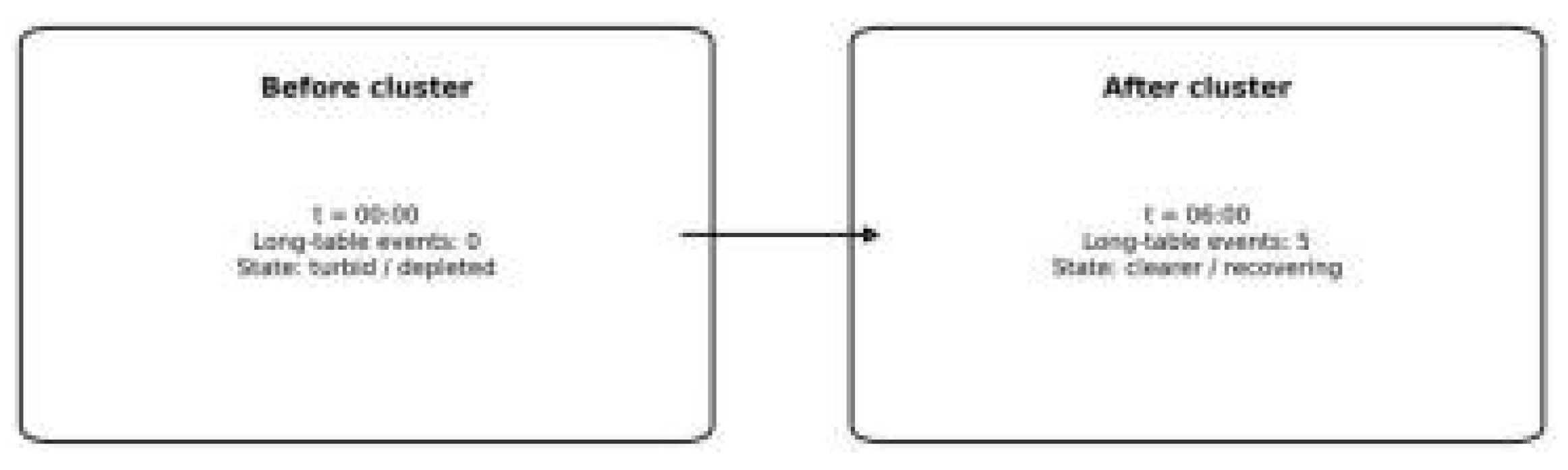

Table 1.
Qualitative Coding Framework for Frame Shifts and Commensality.
| Code | Definition | Inclusion/Exclusi on | Example Excerpt |
Link to Claim |
|---|---|---|---|---|
| MORAL_DUTY | Frames climate- friendly eating as moral obligation or purity test. | Include: should/ought/bein g good; Exclude: practical constraints. |
“I know I should eat better for the planet.” |
Moralization trap (2. 1) |
| GUILT_SHAME | Self-blame, embarrassment, fear of being judged. | Include: guilty/ashamed; Exclude: neutral regret. |
“It makes me feel like I'm failing.” |
Non-shaming design |
| TASTE_IMAGINATIO N | Sensory language and taste curiosity (bitterness, warmth, smell). | Include: taste/texture; Exclude: nutrition facts only. |
“The bitter sprouts felt like slow comfort. ” |
From abstract to felt |
| CARE_RELATION | Talks about cooking/eating as care for self/others, companionship. | Include: for someone / together; Exclude: purely individual health. |
“I wanted to leave soup for someone. ” |
Relationalizati on (commensality ) |
| RHYTHM_PRACTICE | Frames sustainability as rhythm/habit/tempo rather than one- time choice. | Include: pacing, routine; Exclude: single pledge. | “It’s about slowing down, not being perfect.” |
Agency-as- rhythm |
| SYSTEM_FEEDBACK | Interprets soil/shoreline/weat her as system response to accumulated choices. |
Include: links cue to actions; Exclude: noticing cue only. | “The shoreline got clearer when I reduced takeout.” |
Cue comprehension |
| RESISTANCE_DEFEN SE | Dismisses message as preachy/controlling ; defensive humor. |
Include: ‘preachy’; Exclude: critique of UI usability. | “This usually feels like moral policing. ” |
Moralization trap |
| SHIFT_STATEMENT | Explicit ‘before vs after’ reframing in participant language. | Include: contrastive framing; Exclude: vague liking. |
“Not guilt, more like caring for myself.” | Primary outcome (frame shift) |
Disclaimer/Publisher’s Note: The statements, opinions and data contained in all publications are solely those of the individual author(s) and contributor(s) and not of MDPI and/or the editor(s). MDPI and/or the editor(s) disclaim responsibility for any injury to people or property resulting from any ideas, methods, instructions or products referred to in the content. |
© 2026 by the authors. Licensee MDPI, Basel, Switzerland. This article is an open access article distributed under the terms and conditions of the Creative Commons Attribution (CC BY) license (http://creativecommons.org/licenses/by/4.0/).
Copyright: This open access article is published under a Creative Commons CC BY 4.0 license, which permit the free download, distribution, and reuse, provided that the author and preprint are cited in any reuse.