

Submitted:
13 July 2026
Posted:
14 July 2026
You are already at the latest version
Abstract
Silk degumming is an essential pretreatment process that removes sericin from raw silk to improve softness, luster, and dyeability. Conventional alkaline degumming methods are effective but require harsh chemicals that may damage silk fibroin and generate environmentally harmful effluents. This study investigated a sustainable enzymatic degumming approach using papaya (Carica papaya) latex, a natural source of papain enzyme, followed by natural dyeing with henna (Lawsonia inermis) extract. Raw silk fabrics were treated with papaya enzyme concentrations of 5%, 10%, 15%, and 20% at 40 °C and 45 °C for 60 min. Degumming performance was evaluated through weight loss and CIE whiteness index measurements. The degummed fabrics were mordanted with potash alum or copper sulfate before dyeing with henna extract, and color characteristics together with rubbing and washing fastness were assessed. Degumming efficiency increased from 11.24% to 17.60% with increasing enzyme concentration, while the highest CIE whiteness index (59.52) was obtained at 20% enzyme concentration and 45 °C. Potash alum produced brighter yellow shades, whereas copper sulfate generated darker shades with comparable hue. All dyed samples exhibited excellent dry rubbing fastness (Grade 5), good wet rubbing fastness (Grade 4), and good washing fastness. The results demonstrate that papaya latex-assisted enzymatic degumming combined with natural henna dyeing provides an environmentally friendly alternative to conventional silk wet processing.
Keywords:
silk
; papaya latex
; papain
; enzymatic degumming
; natural dyeing
; henna
; sustainable textile processing
; mordant
; color fastness
1. Introduction
Silk is one of the most valuable natural protein fibers because of its exceptional luster, softness, moisture absorption, comfort, and mechanical properties [1,2]. Among the different commercial silk varieties, Bombyx mori silk is the most widely utilized due to its uniform filament structure, excellent spinnability, and superior textile performance [2]. Structurally, silk consists mainly of two proteins: fibroin, which forms the structural core of the filament, and sericin, a gummy protein that surrounds fibroin and binds adjacent filaments together [3,4].
Although sericin protects silk during cocoon formation, it affects textile processing by reducing luster, increasing stiffness, and hindering uniform dye penetration. Therefore, degumming is an indispensable pretreatment step before dyeing and finishing [5,6]. Conventional degumming generally employs soap and alkaline chemicals such as sodium carbonate at elevated temperatures. While these methods efficiently remove sericin, they may partially hydrolyze fibroin, reduce fiber strength, consume significant amounts of water and energy, and generate alkaline wastewater requiring treatment [7].
Growing environmental concerns have encouraged the development of sustainable alternatives for silk processing. Enzymatic degumming has attracted considerable attention because proteolytic enzymes selectively hydrolyze sericin while largely preserving fibroin. Compared with conventional chemical treatments, enzymatic processes operate under milder conditions, reduce chemical consumption, lower energy requirements, and minimize environmental impact [7,8].
Papaya (Carica papaya) latex is a natural source of papain, a cysteine protease capable of hydrolyzing proteinaceous materials [9]. Owing to its specificity toward peptide bonds, papain has been investigated as an environmentally friendly degumming agent for silk [10]. The use of plant-derived enzymes is particularly attractive because they are renewable, biodegradable, and compatible with green textile manufacturing strategies [11,12].
Natural dyeing has also gained renewed interest as the textile industry seeks to reduce dependence on synthetic dyes [13,14]. Henna (Lawsonia inermis) contains the natural pigment lawsone, which forms stable complexes with protein fibers in the presence of suitable mordants [15]. Besides providing aesthetically pleasing shades, natural dyes contribute to reduced environmental pollution and improved sustainability [16].
Although previous studies have reported enzymatic silk degumming, limited research has systematically evaluated the combined effects of papaya enzyme concentration and processing temperature while integrating enzymatic pretreatment with natural henna dyeing and subsequent color performance evaluation [17,18,19]. Therefore, this study aims to investigate the influence of papaya latex concentration (5–20%) and treatment temperature (40–45 °C) on silk degumming efficiency and whiteness, followed by mordant-assisted henna dyeing. The work further evaluates color characteristics together with washing and rubbing fastness to assess the feasibility of a sustainable silk wet-processing route.
2. Materials and Methods
2.1. Materials
Raw Bombyx mori silk fabric was used as the substrate for all experiments. Fresh papaya (Carica papaya) latex was collected and used as the natural source of papain enzyme for enzymatic degumming [9]. A phosphate buffer solution was prepared to activate and stabilize the enzyme prior to treatment. Potash alum [KAl(SO4)2·12H2O] and copper sulfate (CuSO4·5H2O) were employed as mordants for natural dyeing. Commercial henna (Lawsonia inermis) powder was used as the natural dye source [15]. Distilled water was used throughout the experimental work.
The experimental equipment included an electronic balance, laboratory beakers, a magnetic stirrer, and a laboratory sample dyeing machine.
2.2. Preparation of Papaya Enzyme Solution
Fresh papaya latex (15 g) was mixed with 100 mL of phosphate buffer solution to prepare the enzyme stock solution.
Figure 1.
Preparation of papaya enzyme solution.
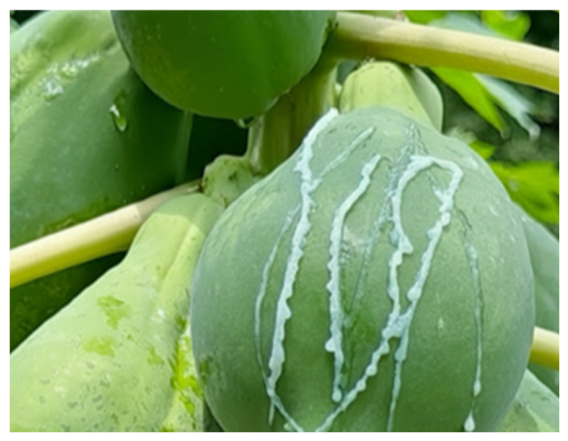
The mixture was maintained at room temperature for 24 h to facilitate enzyme activation before use in the degumming experiments [10].
2.3. Enzymatic Degumming of Silk
Silk fabrics were enzymatically degummed using papaya enzyme solutions with concentrations of 5%, 10%, 15%, and 20% [17]. Each treatment bath was prepared by diluting the enzyme stock solution with distilled water while maintaining a material-to-liquor ratio (M:L) of 1:50.
The degumming treatments were conducted at two temperatures (40 °C and 45 °C) for 60 min [5,7]. After treatment, the fabrics were thoroughly rinsed with distilled water to remove residual sericin and enzyme, followed by drying under ambient laboratory conditions.
Figure 2.
Silk fabrics before (a) and after (b) washing following enzymatic degumming with papaya latex.
Figure 2.
Silk fabrics before (a) and after (b) washing following enzymatic degumming with papaya latex.
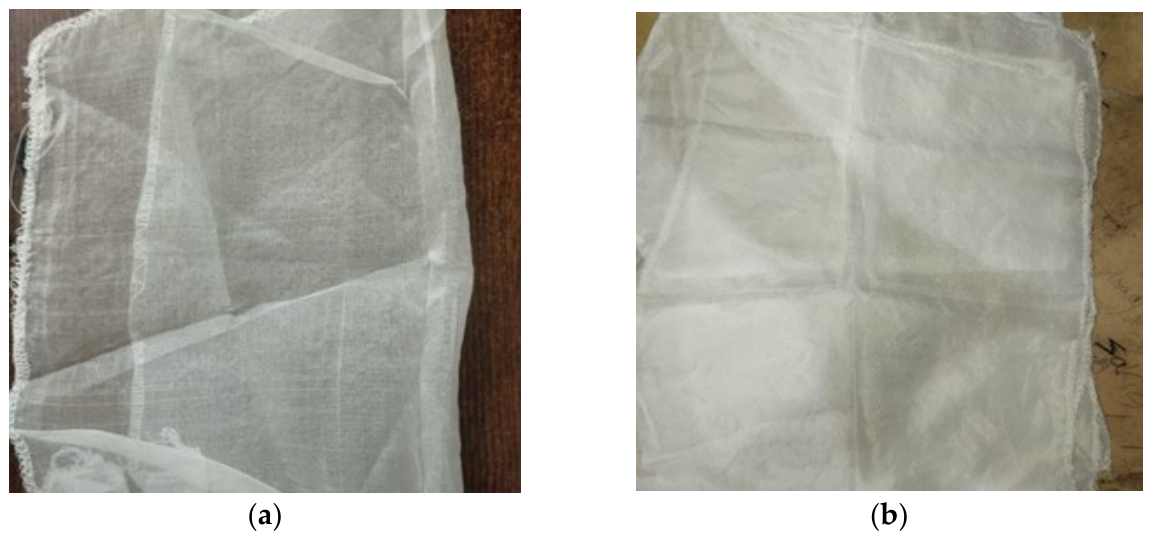

Table 1.
Experimental conditions for enzymatic silk degumming.
| Sample | Enzyme concentration (%) | Temperature (°C) | Time (min) |
| D1 | 5 | 40 | 60 |
| D2 | 10 | 40 | 60 |
| D3 | 15 | 40 | 60 |
| D4 | 20 | 40 | 60 |
| D5 | 5 | 45 | 60 |
| D6 | 10 | 45 | 60 |
| D7 | 15 | 45 | 60 |
| D8 | 20 | 45 | 60 |
2.4. Mordanting
Following degumming, the silk samples were mordanted separately using potash alum and copper sulfate to improve the affinity of the natural dye for the silk fibers [14,20].
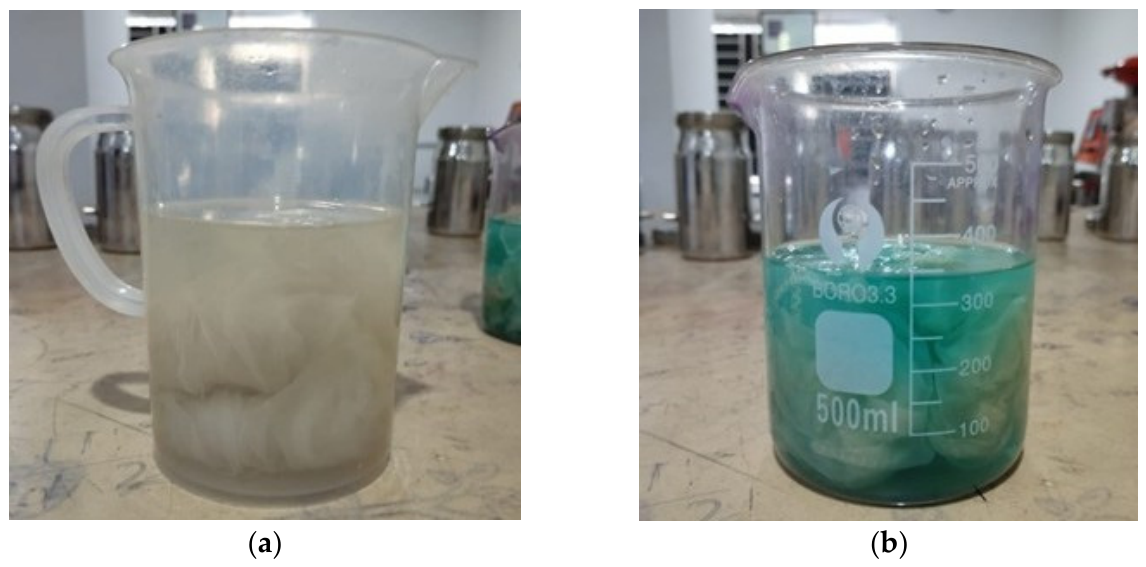
Each mordant bath contained 3 g/L of mordant dissolved in 100 mL of distilled water. The silk fabrics were treated at 80 °C for 60 min. After mordanting, the samples were rinsed with distilled water and dried before dyeing.
Figure 3.
Mordanting of enzymatically degummed silk using (a) potash alum and (b) copper sulfate.
2.5. Natural Dyeing with Henna
Henna dye extract was prepared by dispersing 8 g/L of henna powder in 800 mL of distilled water [19]. The mixture was heated to boiling, stirred thoroughly, and filtered to obtain a clear dye solution.
The mordanted silk samples were dyed using 100 mL of filtered dye extract at 80 °C for 60 min in a laboratory sample dyeing machine [18]. After dyeing, the samples were rinsed with distilled water to remove unfixed dye and then dried under ambient laboratory conditions.
Figure 4.
Henna-dyed silk fabrics mordanted with (a) potash alum and (b) copper sulfate.
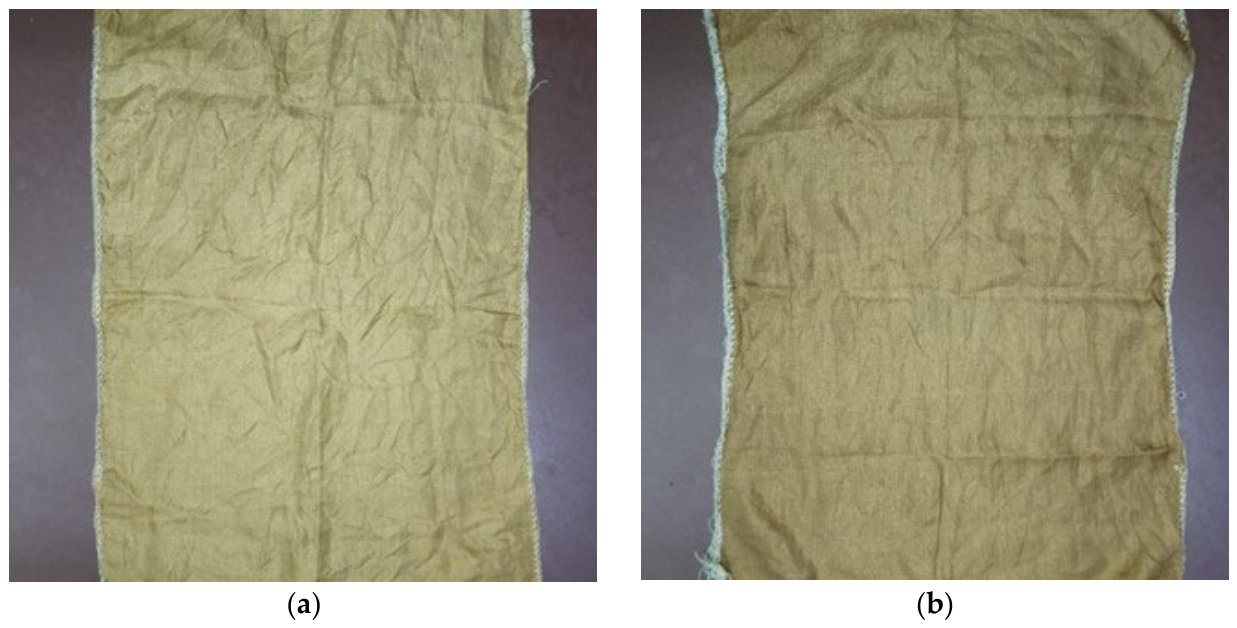
Copper sulfate–mordanted samples were designated C1–C4, whereas potash alum–mordanted samples were designated P1–P4.
2.6. Evaluation of Degumming Efficiency
Degumming efficiency was determined by measuring the percentage weight loss of silk before and after enzymatic treatment using Equation (1):
where W1 is the weight of the raw silk before degumming and W2 is the weight after degumming.
Degumming Efficiency (%) = (W1 − W2)/ W1 ×1
2.7. Whiteness Measurement
The whiteness of the degummed silk samples was evaluated using the CIE Whiteness Index (WI). The corresponding CIE Tint Value was also recorded to assess changes in the visual appearance of the silk after enzymatic treatment.
2.8. Color Measurement
The dyed silk fabrics were characterized using the CIELAB color space. The color parameters including L* (lightness), b* (yellow–blue coordinate), C* (chroma), and h° (hue angle) were measured under D65 illuminant and 10° standard observer conditions.
2.9. Color Fastness Tests
Color fastness to rubbing was evaluated according to ISO 105-X12 [21], while color fastness to washing was assessed according to BS EN ISO 105-C06 [22]. Dry and wet rubbing fastness were rated using the standard gray scale [23]. Washing fastness was evaluated based on color change and staining on adjacent multifiber fabrics.
3. Results
3.1. Enzymatic Degumming Efficiency
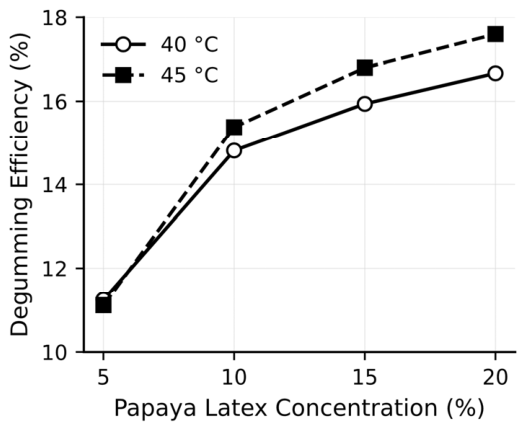
The degumming efficiency of silk fabrics treated with papaya latex increased with increasing enzyme concentration at both treatment temperatures (Table 2). The lowest degumming efficiency (11.11–11.24%) was observed at 5% enzyme concentration, whereas the highest values were obtained at 20% enzyme concentration. The maximum degumming efficiency reached 17.60% for sample D8 treated at 45 °C, indicating that both higher enzyme concentration and slightly elevated temperature enhanced sericin removal.
The results suggest that increasing papain concentration improved enzymatic hydrolysis of sericin, while treatment at 45 °C promoted enzyme activity compared with 40 °C.
Figure 5.
Effect of papaya enzyme concentration and treatment temperature on silk degumming efficiency.
Figure 5.
Effect of papaya enzyme concentration and treatment temperature on silk degumming efficiency.
3.2. Whiteness of Degummed Silk
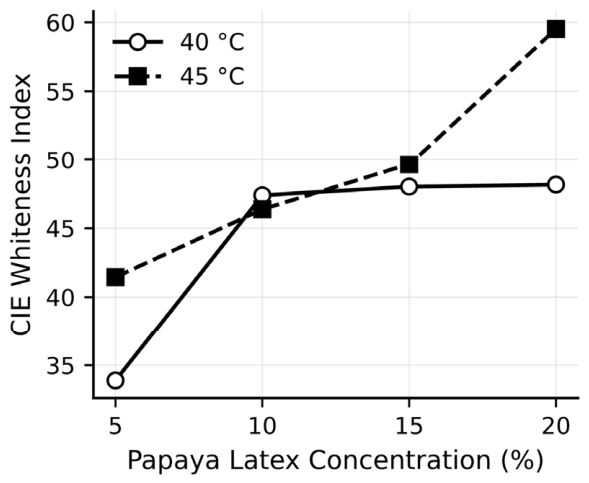
The whiteness index of silk fabrics increased with increasing papaya enzyme concentration (Table 3). The highest CIE Whiteness Index (59.52) was recorded for sample D8 (20% enzyme, 45 °C), while the lowest value (33.89) was observed for sample D1 (5% enzyme, 40 °C).
The increase in whiteness indicates progressive removal of the sericin layer and surface impurities, exposing the brighter fibroin surface.
Figure 6.
Effect of enzyme concentration on the CIE whiteness index of degummed silk fabrics.
3.3. Color Characteristics of Dyed Silk Fabrics
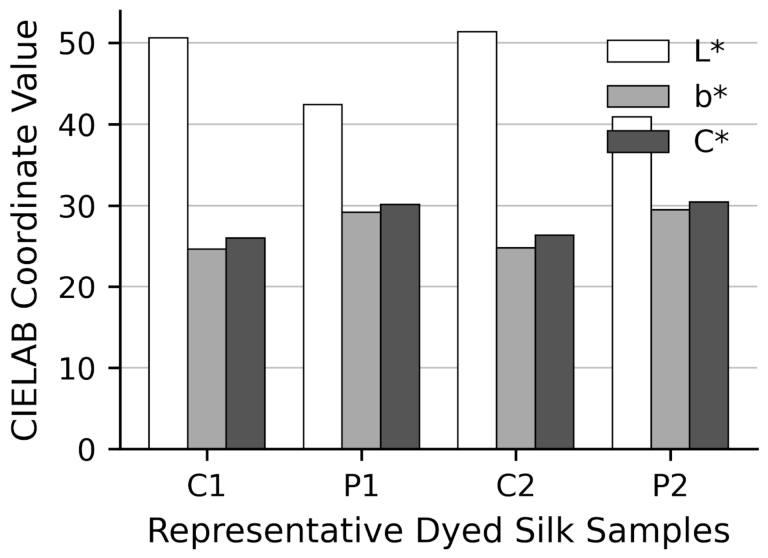
Colorimetric analysis showed that both mordants successfully fixed the henna dye onto the silk fabrics (Table 4). Potash alum–mordanted samples exhibited higher lightness (L*), greater yellowness (b*), and higher chroma values than copper sulfate–mordanted samples. In contrast, copper sulfate produced comparatively darker shades.
Although differences in lightness and chroma were observed, the hue angle remained similar, indicating that both mordants produced colors within the same hue family.
Figure 7.
Comparison of CIELAB color coordinates (L*, b*, and C*) of henna-dyed silk fabrics mordanted with potash alum and copper sulfate.
Figure 7.
Comparison of CIELAB color coordinates (L*, b*, and C*) of henna-dyed silk fabrics mordanted with potash alum and copper sulfate.
3.4. Color Fastness to Rubbing
All dyed silk samples exhibited excellent resistance to rubbing (Table 5). Dry rubbing fastness achieved Grade 5 for all samples, while wet rubbing fastness reached Grade 4. These results indicate effective dye fixation following mordanting and natural dyeing.
3.5. Color Fastness to Washing
The washing fastness results are summarized in Table 6. All dyed samples showed a Grade 4 rating for color change and Grade 4–5 staining ratings on adjacent fibers, demonstrating satisfactory wash durability.
4. Discussion
4.1. Influence of Papaya Latex on Silk Degumming
The present study demonstrates that papaya latex is an effective natural source of papain enzyme for the enzymatic degumming of silk. Degumming efficiency increased progressively with enzyme concentration, reaching a maximum value of 17.60% at 20% enzyme concentration and 45 °C. This trend suggests that increasing papain availability enhances the hydrolysis of sericin, thereby exposing the fibroin surface more effectively.
Papain is a cysteine protease that selectively cleaves peptide bonds in sericin while causing minimal damage to silk fibroin under controlled processing conditions. Compared with conventional alkaline degumming, enzymatic treatment operates under milder conditions, reducing fiber degradation while lowering chemical consumption and wastewater pollution. The present findings are consistent with previous studies reporting that papain effectively removes sericin without significantly compromising the mechanical integrity of silk fibers.
The higher degumming efficiency observed at 45 °C compared with 40 °C indicates that moderate temperature promotes enzymatic activity. However, enzyme performance generally declines at excessively high temperatures due to thermal denaturation. Therefore, maintaining an appropriate balance between temperature and enzyme concentration is essential for efficient silk processing.
4.2. Effect on Whiteness
The CIE Whiteness Index increased with increasing papaya enzyme concentration. Sample D8 exhibited the highest whiteness value (59.52), indicating the most effective removal of sericin and associated impurities.
The increase in whiteness can be attributed to the exposure of the smooth fibroin surface following enzymatic hydrolysis of sericin. Since sericin contains pigments and non-fibrous impurities that reduce light reflection, its removal enhances the optical appearance and natural luster of silk. These findings demonstrate that papaya-assisted enzymatic degumming can improve fabric appearance without the need for harsh bleaching treatments.
4.3. Dyeing Behaviour of Enzymatically Degummed Silk
Following enzymatic degumming, silk fabrics were successfully dyed using henna extract after mordanting with potash alum or copper sulfate. Colorimetric analysis indicated that both mordants produced stable dye fixation but generated different visual shades.
Potash alum–mordanted samples generally produced brighter and more vivid yellowish shades, whereas copper sulfate resulted in comparatively darker shades. The similar hue angles observed for both mordants indicate that the basic color family remained unchanged, while differences in lightness and chroma reflected variations in dye–mordant interactions.
Henna contains the natural pigment lawsone, which forms coordination complexes with metal ions supplied by mordants before binding to amino acid residues present in silk fibroin. Consequently, mordant selection significantly influences color depth, brightness, and overall shade development.
4.4. Color Fastness
The dyed silk fabrics exhibited excellent rubbing fastness and satisfactory washing fastness. Dry rubbing fastness reached Grade 5 for all samples, whereas wet rubbing fastness remained at Grade 4. Similarly, washing fastness demonstrated Grade 4 color change and Grade 4–5 staining ratings.
These results indicate that enzymatic degumming did not adversely affect dye fixation. Instead, the combined effects of proper degumming and mordanting promoted stable interaction between henna dye molecules and silk fibers, resulting in durable coloration suitable for textile applications.
4.5. Environmental Implications
The textile industry is increasingly adopting environmentally responsible processing technologies to reduce chemical pollution and energy consumption. Conventional silk degumming generates alkaline wastewater and may damage silk fibers due to the use of sodium carbonate and soap at elevated temperatures.
In contrast, papaya latex represents a renewable and biodegradable enzymatic resource capable of removing sericin under relatively mild conditions. Combined with natural henna dyeing, this process minimizes the use of synthetic chemicals while producing acceptable fabric quality and color fastness. Therefore, the proposed process supports the transition toward sustainable silk wet processing.
5. Conclusions
Papaya latex containing papain enzyme was successfully applied as a natural degumming agent for Bombyx mori silk fabrics. Enzymatic degumming effectively removed sericin, improved fabric whiteness, and enhanced the suitability of silk for natural dyeing with henna extract. Degumming efficiency increased with enzyme concentration, reaching a maximum of 17.60% at 20% enzyme concentration and 45 °C.
Natural dyeing using henna produced satisfactory color characteristics after mordanting with potash alum and copper sulfate. All dyed samples demonstrated excellent rubbing fastness and good washing fastness, confirming the effectiveness of the proposed green processing route.
Overall, papaya-assisted enzymatic degumming combined with natural henna dyeing provides a sustainable alternative to conventional chemical processing. Future research should investigate the influence of enzymatic treatment on tensile strength, surface morphology, color strength (K/S), and long-term durability to further optimize environmentally friendly silk processing.
Author Contributions
Conceptualization: Md. Imtiyaz Hasnat; Methodology: Md. Imtiyaz Hasnat; Investigation: Md. Imtiyaz Hasnat; Formal Analysis: Md. Imtiyaz Hasnat; Data Curation: Md. Imtiyaz Hasnat; Writing—Original Draft Preparation: Md. Imtiyaz Hasnat; Writing—Review and Editing: All authors; Visualization: Md. Imtiyaz Hasnat; Supervision: Md. Rezaul Karim. All authors have read and agreed to the published version of the manuscript.
Funding
This research received no external funding.
Data Availability Statement
The data presented in this study are available from the corresponding author upon reasonable request.
Acknowledgments
The authors gratefully acknowledge the Department of Textile Engineering, Port City International University, Chattogram, Bangladesh, for providing laboratory facilities and technical support to conduct this research. The authors also thank Md. Rezaul Karim, Assistant Professor, Department of Textile Engineering, for his guidance and supervision throughout the project.
Conflicts of Interest
The authors declare no conflicts of interest.
References
- Altman, G.H.; Diaz, F.; Jakuba, C.; Calabro, T.; Horan, R.L.; Chen, J.; Lu, H.; Richmond, J.; Kaplan, D.L. Silk-Based Biomaterials. Biomaterials 2003, 24, 401–416. [Google Scholar] [CrossRef] [PubMed]
- Rockwood, D.N.; Preda, R.C.; Yücel, T.; Wang, X.; Lovett, M.L.; Kaplan, D.L. Materials Fabrication from Bombyx Mori Silk Fibroin. Nat. Protoc. 2011, 6, 1612–1631. [Google Scholar] [CrossRef] [PubMed]
- Zhang, Y.-Q. Applications of Natural Silk Protein Sericin in Biomaterials. Biotechnol. Adv. 2002, 20, 91–100. [Google Scholar] [CrossRef]
- Kundu, B.; Rajkhowa, R.; Kundu, S.C.; Wang, X. Silk Fibroin Biomaterials for Tissue Regenerations. Adv. Drug Deliv. Rev. 2013, 65, 457–470. [Google Scholar] [CrossRef] [PubMed]
- Gulrajani, M.L. Degumming of Silk. Rev. Prog. Color. Relat. Top. 1992, 22, 79–89. [Google Scholar] [CrossRef]
- Biswal, B.; Dan, A.K.; Sengupta, A.; Das, M.; Bindhani, B.K.; Das, D.; Parhi, P.K. Extraction of Silk Fibroin with Several Sericin Removal Processes and Its Importance in Tissue Engineering: A Review. J. Polym. Env. 2022, 30, 2222–2253. [Google Scholar] [CrossRef]
- Zhu, L.; Lin, J.; Pei, L.; Luo, Y.; Li, D.; Huang, Z. Recent Advances in Environmentally Friendly and Green Degumming Processes of Silk for Textile and Non-Textile Applications. Polymers 2022, 14, 659. [Google Scholar] [CrossRef] [PubMed]
- Cavaco-Paulo, A.; Gübitz, G.M. Textile Processing with Enzymes; Textile Institute (Manchester, England): Woodhead: Boca Raton, Fla.: Cambridge; CRC, 2003; ISBN 978-0-8493-1776-7. [Google Scholar]
- Koul, B.; Pudhuvai, B.; Sharma, C.; Kumar, A.; Sharma, V.; Yadav, D.; Jin, J.-O. Carica Papaya L.: A Tropical Fruit with Benefits beyond the Tropics. Diversity 2022, 14, 683. [Google Scholar] [CrossRef]
- Baines, B.S.; Brocklehurst, K. A Necessary Modification to the Preparation of Papain from Any High-Quality Latex of Carica Papaya and Evidence for the Structural Integrity of the Enzyme Produced by Traditional Methods. Biochem. J. 1979, 177, 541–548. [Google Scholar] [CrossRef] [PubMed]
- Catarino, M.L.; Sampaio, F.; Gonçalves, A.L. Sustainable Wet Processing Technologies for the Textile Industry: A Comprehensive Review. Sustainability 2025, 17, 3041. [Google Scholar] [CrossRef]
- Singh, Y.R.; Mutum, N.; Naz, R.; Goyal, A. Eco-Friendly Enzymatic Degumming of Ramie (Boehmeria Nivea) Bast Fibres and Pineapple (Ananas Comosus) Leaf Fibres by Xylobiohydrolase, Pectate Lyase and Mannanase. Cellulose 2025, 32, 10491–10512. [Google Scholar] [CrossRef]
- Yusuf, M.; Shabbir, M.; Mohammad, F. Natural Colorants: Historical, Processing and Sustainable Prospects. Nat. Prod. Bioprospect. 2017, 7, 123–145. [Google Scholar] [CrossRef] [PubMed]
- Vankar, P.S. Natural Dyes for Textiles: Sources, Chemistry and Applications. In The Textile Institute book series; Woodhead Publishing: Duxford (Cambridgeshire, England), 2017; ISBN 978-0-08-101274-1. [Google Scholar]
- Bhuiyan, M.A.R.; Islam, A.; Ali, A.; Islam, M.N. Color and Chemical Constitution of Natural Dye Henna (Lawsonia Inermis L) and Its Application in the Coloration of Textiles. J. Clean. Prod. 2017, 167, 14–22. [Google Scholar] [CrossRef]
- Samanta, A.K.; Agarwal, P. Application of Natural Dyes on Textiles. INDIAN J. FIBRE TEXT. RES. 2009. [Google Scholar] [CrossRef]
- Rawan, S.; Zhang, S.; Dhavale, A.; Burji, M.C.; Kore, U. Optimization of Enzyme-Assisted Ultrasonic Irradiation Silk Degumming Process. J. Inst. Eng. India Ser. E 2023, 104, 237–250. [Google Scholar] [CrossRef]
- Hasan, Md.M.; Abu Nayem, K.; Anwarul Azim, A.Y.M.; Ghosh, N.C. Application of Purified Lawsone as Natural Dye on Cotton and Silk Fabric. J. Text. 2015, 2015, 932627. [Google Scholar] [CrossRef]
- Alam, M.M.; Rahman, M.L.; Haque, M.Z. Extraction of Henna Leaf Dye and Its Dyeing Effects on Textile Fibre. Bangladesh J. Sci. Ind. Res. 2007, 42, 217–222. [Google Scholar] [CrossRef]
- Cardon, D. Natural Dyes. In Sources, tradition, technology and science; 2007; p. 268. [Google Scholar]
- LVS, E. 105-X12: 2016; Textiles—Tests for Colour Fastness—Part X12: Colour Fastness to Rubbing; Riga Technical University: Riga, Latvia, 2016. [Google Scholar]
- ISO 105-C06:2010; Textiles—Tests for Colour Fastness—Part C06: Colour Fastness to Domestic and Commercial Laundering.
- ISO 105-J02; Textiles—Tests for Colour Fastness—Part J02.
Table 2.
Degumming efficiency of silk fabrics treated with papaya latex.
| Sample | Enzyme (%) | Temperature (°C) | Time (min) | Degumming Efficiency (%) |
| D1 | 5 | 40 | 60 | 11.24 |
| D2 | 10 | 40 | 60 | 14.81 |
| D3 | 15 | 40 | 60 | 15.94 |
| D4 | 20 | 40 | 60 | 16.67 |
| D5 | 5 | 45 | 60 | 11.11 |
| D6 | 10 | 45 | 60 | 15.38 |
| D7 | 15 | 45 | 60 | 16.80 |
| D8 | 20 | 45 | 60 | 17.60 |
Table 3.
CIE whiteness index of enzymatically degummed silk fabrics.
| Sample | Enzyme (%) | Temperature (°C) | CIE Whiteness Index | CIE Tint |
| D1 | 5 | 40 | 33.89 | -3.22 |
| D2 | 10 | 40 | 47.39 | -2.65 |
| D3 | 15 | 40 | 48.02 | -3.02 |
| D4 | 20 | 40 | 48.17 | -2.86 |
| D5 | 5 | 45 | 41.45 | -2.75 |
| D6 | 10 | 45 | 46.37 | -2.35 |
| D7 | 15 | 45 | 49.66 | -2.34 |
| D8 | 20 | 45 | 59.52 | 3.61 |
Table 4.
CIELAB color coordinates of representative dyed silk samples.
| Sample | Illuminant/Observer | L* | b* | C* | h° |
| C1 | D65/10° | 50.60 | 24.69 | 26.08 | -4.31 |
| P1 | D65/10° | 42.44 | 29.23 | 30.19 | -3.98 |
| C2 | D65/10° | 51.34 | 24.87 | 26.39 | -4.44 |
| P2 | D65/10° | 40.93 | 29.50 | 30.48 | -4.02 |
Table 5.
Color Fastness to Rubbing.
| Sample | Dry Rubbing | Wet Rubbing |
| C1 | 5 | 4 |
| C2 | 5 | 4 |
| C3 | 5 | 4 |
| C4 | 5 | 4 |
| P1 | 5 | 4 |
| P2 | 5 | 4 |
| P3 | 5 | 4 |
| P4 | 5 | 4 |
Table 6.
Color fastness to washing.
| Property | Rating |
| Color change | 4 |
| Staining on acetate | 4–5 |
| Staining on cotton | 4–5 |
| Staining on polyamide | 4–5 |
| Staining on polyester | 4–5 |
| Staining on acrylic | 4–5 |
| Staining on wool | 4–5 |
Disclaimer/Publisher’s Note: The statements, opinions and data contained in all publications are solely those of the individual author(s) and contributor(s) and not of MDPI and/or the editor(s). MDPI and/or the editor(s) disclaim responsibility for any injury to people or property resulting from any ideas, methods, instructions or products referred to in the content. |
© 2026 by the authors. Licensee MDPI, Basel, Switzerland. This article is an open access article distributed under the terms and conditions of the Creative Commons Attribution (CC BY) license (http://creativecommons.org/licenses/by/4.0/).
Copyright: This open access article is published under a Creative Commons CC BY 4.0 license, which permit the free download, distribution, and reuse, provided that the author and preprint are cited in any reuse.