
Submitted:
12 July 2026
Posted:
14 July 2026
You are already at the latest version
Abstract
As nuclear energy re-emerges as a central component of global decarbonization strategies, the long-term sustainability of nuclear energy systems increasingly depends not only on technical performance but also on institutional legitimacy embedded within sociotechnical governance systems. Drawing on institutional theory, sociotechnical systems theory, and energy justice scholarship, this study conceptualizes regulatory compliance not merely as adherence to formal safeguards but as a governance-mediated outcome associated with institutional legitimacy, procedural transparency, distributive equity, and stakeholder inclusion. Employing a sequential explanatory mixed-method design, the study develops a composite Trust–Equity–Transparency–Inclusion (TETI) Index through structured coding of regulatory documentation, international peer-review findings, and participatory governance practices across advanced and emerging nuclear programs. The analysis examines the association between governance quality and cross-national indicators of regulatory compliance, institutional stability, and governance durability. The findings suggest that governance systems characterized by higher levels of transparency, equity, stakeholder inclusion, and institutional trust are associated with stronger compliance performance and greater regulatory resilience. Although exploratory and based on a small-N comparative design, these patterns are consistent with sociotechnical perspectives that identify institutional legitimacy as a critical governance mechanism supporting durable regulatory institutions. By reframing regulatory compliance as a governance-mediated sociotechnical outcome, the study advances a theoretically grounded framework for understanding how institutional legitimacy may contribute to the long-term sustainability and durability of nuclear energy governance under conditions of technological complexity, public scrutiny, and global energy transition. The findings offer conceptual and policy insights for strengthening governance architectures that support safe, equitable, and sustainable civilian nuclear energy development.
Keywords:
nuclear energy governance
; institutional legitimacy
; sociotechnical systems
; energy justice
; governance resilience
; sustainability
; regulatory compliance
1. Introduction
Nuclear energy currently supplies approximately 10% of global electricity and nearly one-quarter of low-carbon electricity generation, positioning existing nuclear power plants as critical components of contemporary decarbonization strategies (International Atomic Energy Agency [IAEA], 2024). As many reactors extend beyond their original design lifetimes through license renewals and modernization programs, the governance of nuclear energy has shifted from questions of facility deployment toward the long-term stewardship of operating nuclear systems. This transition places increasing emphasis not only on technical safety and safeguards but also on the institutional legitimacy required to sustain public confidence, regulatory credibility, and international cooperation over multiple decades.
While engineering excellence and robust regulatory oversight remain indispensable, growing evidence suggests that the long-term resilience of nuclear governance depends equally on governance institutions that are perceived as transparent, equitable, accountable, and inclusive. Institutional legitimacy—the extent to which governance arrangements are viewed as appropriate, credible, and trustworthy by affected stakeholders—has consequently emerged as an important dimension of sustainable nuclear governance. In complex sociotechnical systems such as civilian nuclear energy, governance durability depends not solely on technical performance but also on the continuing capacity of institutions to maintain public trust, adapt to evolving societal expectations, and preserve confidence in regulatory decision-making.
Existing scholarship on nuclear governance has primarily concentrated on non-proliferation regimes, safeguards implementation, technological innovation, and the governance of new nuclear infrastructure (Sagan, 1997; Findlay, 2011; Soda et al., 2012). Comparatively less attention has been devoted to the long-term governance of aging nuclear fleets, where regulatory institutions must continually adapt to changing technological, environmental, and societal conditions while maintaining legitimacy over extended operational lifecycles. This gap is significant because operational nuclear programs increasingly face institutional challenges that extend beyond engineering performance, including declining public trust, evolving expectations regarding transparency and participation, and growing demands for procedural fairness and accountability (Rothstein & Teorell, 2008; Zürn, 2018; Pallett et al., 2019).
Energy governance and energy justice scholarship similarly argues that the legitimacy of large-scale infrastructure depends not only on technical effectiveness but also on procedural fairness, equitable distribution of benefits and risks, and meaningful stakeholder participation (Sovacool & Dworkin, 2015; Saygin, 2025; Devine-Wright, 2007). These governance attributes are particularly important in nuclear energy because civilian nuclear technologies operate within an international regulatory environment characterized by heightened safety expectations, safeguards obligations, and public scrutiny. Consequently, compliance with inspection regimes and regulatory requirements, while necessary, may not by itself ensure durable governance. Rather, institutional legitimacy—supported by transparent decision-making, equitable governance practices, and inclusive stakeholder engagement—may strengthen compliance cultures and reinforce both domestic and international confidence in nuclear regulatory institutions (Levi & Stoker, 2000; Kutchesfahani, 2019).
To examine these relationships, this study applies the Q-NPT (Qudrat-Ullah Nuclear Peace and Trust) framework as an analytical and diagnostic framework for evaluating institutional legitimacy in nuclear governance. Q-NPT integrates four mutually reinforcing governance dimensions—Trust, Equity, Transparency, and Inclusion—that together constitute a governance architecture through which institutional legitimacy may be understood and comparatively assessed. Rather than proposing an alternative to existing safeguards systems, the framework complements established technical and regulatory mechanisms by examining governance characteristics that may contribute to compliance culture, regulatory credibility, institutional resilience, and the long-term durability of nuclear governance. The purpose of this study is therefore not to validate Q-NPT as a predictive or causal model, but to assess its analytical utility for organizing and comparing governance characteristics across national civilian nuclear programs.
The study conducts a structured comparative assessment of nuclear governance across five advanced nuclear states (United States, France, Canada, United Kingdom, and Finland) and five emerging nuclear programs (Türkiye, United Arab Emirates, Egypt, Brazil, and Pakistan). These cases were selected using a maximum-variation strategy to capture diversity in regulatory maturity, safeguards implementation, institutional capacity, and sociopolitical context rather than statistical representativeness. Drawing upon documentary analysis, regulatory reports, international peer-review findings, and governance indicators, the study constructs a comparative Trust–Equity–Transparency–Inclusion (TETI) Index to examine how the four governance dimensions are institutionalized across national systems and how governance quality is associated with regulatory credibility, compliance performance, stakeholder confidence, and long-term institutional durability.
This study addresses three interrelated research questions:
- How does long-term nuclear governance sustain institutional legitimacy and regulatory compliance within operating nuclear programs?
- How are Trust, Equity, Transparency, and Inclusion institutionalized across national nuclear governance systems?
- How is governance quality associated with regulatory durability, safeguards credibility, and broader non-proliferation outcomes?
This paper makes three principal contributions. First, it extends nuclear governance scholarship beyond episodic licensing and facility approval by focusing on the long-term governance of operational nuclear systems. Second, it develops an institutional legitimacy perspective that identifies theoretically plausible pathways through which Trust, Equity, Transparency, and Inclusion may contribute to durable governance, regulatory credibility, and compliance culture within complex sociotechnical systems. Third, through a structured comparative analysis, it provides exploratory evidence regarding how governance quality is associated with institutional durability, regulatory stability, and sustained international cooperation. Given the study’s small-N comparative design, these findings are presented as patterns of association rather than evidence of causal relationships.
By positioning institutional legitimacy as a central dimension of durable nuclear governance, this study integrates insights from institutional theory, sociotechnical systems theory, energy justice, and non-proliferation scholarship into a unified comparative framework for evaluating governance performance. In doing so, it advances understanding of how governance institutions may support the long-term sustainability of civilian nuclear energy under conditions of technological complexity, public scrutiny, and accelerating global energy transition. The following section reviews the relevant literature and develops the theoretical foundations of the Q-NPT framework as an institutional legitimacy perspective for analyzing nuclear energy governance.
2. Literature Review
Governance and operational challenges in nuclear energy are well documented, particularly with respect to aging infrastructure, regulatory adaptation, public contestation, and environmental risk management (IAEA, 2024). However, much of the literature remains oriented toward moments of technological introduction—new-build reactors, advanced designs, or siting conflicts—rather than the longitudinal governance of operating fleets (Soda et al., 2012; Stephens, 2024; Sovacool & Cooper, 2013). From a sociotechnical transitions’ perspective, this focus privileges regime formation over regime reproduction. Here, “regime formation” refers to the establishment and initial stabilization of institutional, technological, and regulatory configurations surrounding new energy systems, whereas “regime reproduction” denotes the ongoing maintenance, adaptation, and renewal of these configurations over time. Yet aging facilities demand continuous institutional stabilization: license renewals, safety retrofits, cybersecurity oversight, waste stewardship, and sustained stakeholder engagement require governance systems capable of adaptive learning and legitimacy renewal. Existing frameworks, largely designed for project authorization or technical compliance, tend to provide limited analytical attention to these relational and temporal dimensions of institutional durability.
Institutional theory suggests that regulatory systems persist not solely through coercive enforcement but through normative alignment, organizational culture, and perceived legitimacy (Levi & Stoker, 2000; Rothstein & Teorell, 2008; Zürn, 2018). In this study, institutional legitimacy refers to the extent to which regulatory authorities and governance processes are perceived as appropriate, fair, credible, and deserving of public and stakeholder support. Within the architecture of the Nuclear Non-Proliferation Treaty (NPT), compliance durability depends on both formal safeguards and the social foundations of authority (Sagan, 1997; Egeland, 2022, 2012; Kutchesfahani, 2019). Legitimacy operates through procedural justice, distributive fairness, and meaningful inclusion of affected stakeholders. Where these dimensions are weak, regulatory authority may remain formally intact yet substantively fragile. Evidence from UK consultation processes and broader stakeholder analyses demonstrates that consultative-only engagement, absent genuine participatory influence, can erode trust even when technical systems are robust (Devine-Wright, 2007; Radtke & Renn, 2024; Pallett et al., 2019). Relatedly, compliance culture is understood here as the set of organizational norms, expectations, and governance practices that encourage sustained adherence to regulatory and safeguards requirements beyond minimum formal obligations. Compliance culture, therefore, is better understood not merely as a function of inspection frequency but as an outcome associated with institutional credibility reproduced over time.
Dual-use risks further intensify the governance challenge. Civilian nuclear fuel cycles share technological pathways with weapons-usable material, rendering safeguards regimes simultaneously technical and social institutions. Although IAEA verification mechanisms are designed to prevent diversion, their authority is mediated by perceptions of impartiality, transparency, and cooperative reciprocity (American Physical Society, 2010; Ferguson, 2007; Findlay, 2011). Sociologically, safeguards credibility can be interpreted as being co-produced through information-sharing norms, reputational trust, and domestic regulatory competence. Asymmetries in enforcement or exclusionary decision-making practices can weaken compliance incentives and strain cooperative regimes (Müller & Wunderlich, 2018; Bowen et al., 2023; Gibbons & Herzog, 2022). Thus, technically sound reactors may nonetheless generate legitimacy deficits that undermine both operational stability and non-proliferation cooperation.
Energy justice scholarship reinforces this diagnosis by demonstrating that large-scale energy infrastructures endure when fairness, equitable risk distribution, and participatory inclusion are institutionalized rather than episodic (Sovacool & Dworkin, 2015; Pallett et al., 2019). In nuclear governance, however, equity and inclusion remain comparatively under-theorized relative to safety engineering and safeguards compliance (Qudrat-Ullah, 2025a, 2025b). This imbalance may reflect a technocratic bias in regulatory design, where legitimacy is often assumed to follow from technical performance rather than being actively constructed through relational governance practices. Justice deficits are associated with erosion of public trust, weakening of compliance culture, and political pressures that may destabilize both domestic regulatory systems and international oversight regimes.
Nuclear energy also presents governance challenges that differ from many other energy technologies. Unlike most conventional energy systems, civilian nuclear programs operate under international safeguards obligations, involve long-lived radioactive waste management responsibilities, possess dual-use technological characteristics, and are subject to heightened public scrutiny arising from perceived catastrophic risks. These characteristics make questions of legitimacy, transparency, trust, and stakeholder participation particularly salient in nuclear governance, providing a rationale for examining governance dimensions explicitly rather than extrapolating directly from broader energy-sector studies.
Collectively, the literature reveals a multi-level governance gap. Operational oversight frameworks remain episodic and compliance-centric, often treating legitimacy as an outcome rather than a constitutive dimension of governance. Social and relational mechanisms—trust-building, fairness, transparency, and inclusive participation—are rarely integrated systematically with safeguards performance. These omissions are consequential: institutional fragility at the domestic level may translate into weakened regime credibility internationally, illustrating the interdependence of operational reliability and non-proliferation stability. For the purposes of this study, institutional durability refers to the capacity of governance arrangements to maintain legitimacy, regulatory effectiveness, stakeholder confidence, and safeguards cooperation over extended periods of operation and adaptation.
While existing scholarships provide important insights into governance and public acceptance, several complementary frameworks offer alternative lenses for understanding sociotechnical dynamics. For example, cultural cognition research (e.g., work by Dan Kahan) emphasizes how individual and group values shape risk perception and policy attitudes, highlighting the role of identity and belief systems in public responses to technological risk (Kahan, 2012). Similarly, integrative decision frameworks such as the KONVERGENCE model (Kerr et al., 2002) focus on multi-criteria evaluation and stakeholder engagement in complex environmental decision-making contexts.
While these approaches provide valuable perspectives on perception and decision processes, they do not explicitly operationalize governance quality as a structured, multi-dimensional construct linked to institutional performance in nuclear systems. The Q-NPT framework differs in its emphasis on institutional-level governance dimensions—Trust, Equity, Transparency, and Inclusion—as analytically distinct but interrelated factors that may be associated with variation in compliance and legitimacy outcomes across national contexts. At the same time, Q-NPT should be understood as one of several possible analytical lenses rather than a competing or exclusive explanatory framework. The purpose of this study is therefore not to demonstrate the superiority of Q-NPT relative to alternative models, but to explore whether its governance dimensions provide a useful structure for comparative analysis of nuclear governance systems.
The Q-NPT framework intervenes in this gap by conceptualizing Trust, Equity, Transparency, and Inclusion as interlocking dimensions of a legitimacy infrastructure that may condition compliance durability (Qudrat-Ullah, 2025a, 2025b). In this study, Q-NPT is treated as an analytical framework for examining how these governance dimensions are represented and institutionalized across different national contexts, rather than as a validated predictive model. Rather than positioning technical safeguards and social governance as distinct domains, Q-NPT conceptually frames them as interacting elements within a sociotechnical regime. By applying this framework to operational nuclear facilities, this study:
- Examines how longitudinal governance practices are associated with the reproduction of compliance and legitimacy;
- Evaluates institutional mechanisms for equitable risk-sharing and participatory inclusion across cases; and
- Analyzes how variations in governance quality are associated with differences in non-proliferation cooperation and regime resilience.
In doing so, the paper seeks to extend nuclear governance scholarship beyond technocratic compliance models by analytically positioning operational stability, institutional legitimacy, and non-proliferation performance as interrelated and co-evolving outcomes within aging nuclear regimes. Given the exploratory nature of the analysis and the limited number of cases examined, the study is intended to generate theoretical and empirical propositions for future research rather than to establish generalizable causal claims.
3. The Theoretical Framework: The Q-NPT Framework
The Q-NPT framework was originally proposed as a governance-oriented conceptual framework for examining the role of institutional factors in nuclear energy systems (Qudrat-Ullah, 2025a–d). In contrast to conventional non-proliferation approaches, which primarily emphasize compliance verification, safeguards implementation, and material control, Q-NPT focuses on governance dimensions that may influence how regulatory systems are perceived, maintained, and reproduced over time. While conventional models emphasize compliance verification and material control, Q-NPT conceptualizes nuclear governance as a multidimensional system in which operational safety, institutional legitimacy, and stakeholder confidence are analytically treated as interrelated components. The framework proposes four governance pillars—Trust, Equity, Transparency, and Inclusion—that complement technical safeguards and provide a structured basis for comparative governance analysis.
In the present study, Q-NPT is not treated as a validated predictive model or as evidence that specific governance interventions necessarily improve compliance outcomes. Rather, it serves as a conceptual framework for organizing and examining governance characteristics across national nuclear programs. The framework is therefore employed heuristically and diagnostically, enabling systematic comparison of governance arrangements across different institutional contexts.
Trust. Trust refers to institutional credibility, regulatory independence, and confidence in compliance mechanisms. Within this study, trust is understood as the perceived reliability and integrity of governance institutions and regulatory actors. High-trust environments are theorized to be associated with lower transaction costs, greater stakeholder cooperation, and stronger confidence in safeguards systems. Whether such associations translate into measurable governance outcomes remains an empirical question and is not assumed a priori.
Equity. Equity concerns the fair distribution of risks and benefits across communities and generations. Mechanisms addressing compensation, waste responsibility, and distributive justice are commonly discussed within energy justice scholarship as factors influencing perceptions of fairness and legitimacy. In this framework, equity is examined as a governance characteristic that may contribute to stakeholder acceptance and institutional credibility.
Transparency. Transparency encompasses open reporting, independent review, and accessible disclosure of safety and safeguards performance. Transparency is conceptualized as the availability and accessibility of information regarding regulatory decisions, operational performance, and oversight processes. Such practices may reduce informational asymmetries and strengthen accountability in both domestic and international contexts.
Inclusion. Inclusion emphasizes meaningful stakeholder participation in governance processes. Beyond consultation, inclusion incorporates procedural fairness and opportunities for substantive stakeholder input into decision-making processes. The concept is grounded in participatory governance literature, which suggests that inclusive processes may strengthen perceptions of legitimacy and procedural justice, although the magnitude and direction of these relationships may vary across contexts.
Together, these pillars form an integrated governance model in which technical safeguards are analytically situated within a broader institutional and societal framework. The framework does not assume that Trust, Equity, Transparency, and Inclusion operate independently; rather, they are conceptualized as potentially interacting dimensions whose combined presence may be associated with variations in governance quality and institutional legitimacy.
As illustrated in Figure 1, Q-NPT positions governance quality as a contextual layer surrounding technical safeguards and regulatory functions. The outer boundary of the framework represents the broader sociotechnical governance environment within which nuclear programs operate, including institutional, societal, regulatory, and technical influences. The inner boundary represents the governance interface through which Trust, Equity, Transparency, and Inclusion interact with formal safeguards and compliance mechanisms. Accordingly, Figure 1 should be interpreted as a conceptual representation of hypothesized relationships among governance dimensions rather than as an empirically validated causal model.
Thus, Q-NPT reconceptualizes safeguards not as standalone verification mechanisms but as embedded components within a broader governance ecosystem. By linking compliance-related outcomes to trust, equity, transparency, and inclusion, the framework provides a structured lens for examining how governance arrangements, institutional legitimacy, and safeguards performance may be interrelated. Importantly, the framework does not imply that these governance dimensions determine compliance outcomes. Rather, it proposes that they constitute analytically relevant factors whose relationships with institutional performance warrant systematic empirical investigation.
The contribution of Q-NPT in this study is therefore primarily conceptual and diagnostic. It offers a structured vocabulary for examining governance variation across cases and generating theoretically informed propositions regarding the role of legitimacy-oriented governance dimensions in the long-term durability of nuclear energy systems.
4. Methods
This section outlines the research design, case selection strategy, data sources, governance operationalization procedures, coding protocol, and empirical modeling approach used to evaluate the Q-NPT governance framework across ten nuclear energy programs. A sequential explanatory mixed-method strategy integrates qualitative institutional coding with quantitative cross-national analysis. Governance constructs are operationalized into standardized indices and examined in relation to operational compliance indicators. Consistent with the exploratory nature of the study, the objective is not hypothesis testing or causal inference but the identification of cross-national patterns that may inform future research.
4.1. Research Design
This study employs a sequential explanatory mixed-method design, integrating qualitative institutional analysis with quantitative cross-national modeling (Creswell & Plano Clark, 2018). Structured coding of regulatory documentation, peer-review findings, and stakeholder records informs the construction of standardized governance indices. These indices are subsequently analyzed using exploratory statistical models. Integration occurs at the interpretation stage, where quantitative associations are evaluated in light of the qualitative institutional context. Given the limited cross-sectional sample (N = 10), statistical results are interpreted as exploratory diagnostic associations rather than confirmatory causal estimates.
The study proceeds in four stages. First, documentary and regulatory evidence was collected from national and international sources. Second, governance dimensions were coded using a standardized coding protocol. Third, coded indicators were aggregated into governance indices representing Trust, Equity, Transparency, and Inclusion. Fourth, these indices were analyzed descriptively and through exploratory regression models to examine their association with compliance outcomes. This design prioritizes analytical transparency and cross-case comparability rather than statistical generalizability.
4.2. Comparative Case Selection
Ten countries were selected using a maximum-variation strategy to capture heterogeneity in regulatory maturity, institutional capacity, safeguards implementation, stakeholder engagement practices, and nuclear program history.
Advanced nuclear programs include United States, Canada, France, United Kingdom, and Finland. These countries possess long operational histories, mature regulatory institutions, extensive inspection experience, and established public engagement mechanisms.
For emerging and developing programs, we considered Türkiye, United Arab Emirates, Egypt, Brazil, and Pakistan. These countries represent varying stages of institutional development, regulatory capacity building, and nuclear expansion.
The purpose of the selection strategy is not statistical representativeness but analytical diversity. Maximum-variation sampling seeks to identify patterns that persist across substantially different governance environments (Patton, 2015). Countries were therefore selected to maximize variation along dimensions theoretically relevant to Q-NPT, including regulatory maturity, stakeholder participation, safeguards experience, and institutional development.
The selected cases do not represent the full population of civilian nuclear programs. Countries such as Japan, South Korea, China, India, Russia, Sweden, Argentina, and Ukraine were not included due to scope limitations and data comparability considerations. Future studies employing larger samples could evaluate whether the observed patterns remain robust across a broader set of cases.
Because the sample contains one emerging case (Egypt), four intermediate cases (Türkiye, UAE, Brazil, Pakistan), and five established cases (United States, Canada, France, United Kingdom, Finland), the analysis also reports development-stage classifications to facilitate interpretation of potential clustering effects.
4.3. Data Sources
We employed a multi-source dataset integrating regulatory, operational, and governance indicators across established and emerging nuclear energy programs. Regulatory data were obtained from national authorities, including the U.S. Nuclear Regulatory Commission (NRC), Canadian Nuclear Safety Commission (CNSC), Autorité de sûreté nucléaire (ASN), Office for Nuclear Regulation (ONR), Radiation and Nuclear Safety Authority (STUK), and corresponding authorities in emerging programs: Nuclear Regulatory Authority (NDK), Federal Authority for Nuclear Regulation (FANR), Egyptian Nuclear and Radiological Regulatory Authority (ENRRA), Comissão Nacional de Energia Nuclear (CNEN), and Pakistan Nuclear Regulatory Authority (PNRA).
To evaluate regulatory effectiveness and institutional maturity, safeguards documentation and Integrated Regulatory Review Service (IRRS) mission findings from the International Atomic Energy Agency (IAEA) were incorporated. Operational compliance variables included inspection outcomes, enforcement actions, peer-review findings, licensing performance, and reported events classified under the International Nuclear and Radiological Event Scale (INES).
Governance indicators were derived from:
- Regulatory reports;
- Public consultation records;
- Stakeholder engagement documentation;
- IAEA IRRS mission reports;
- National nuclear governance publications;
- Regulatory performance assessments.
Source hierarchy followed a structured prioritization protocol. Primary sources consisted of official regulatory and IAEA documentation. Secondary sources included peer-reviewed studies and independent institutional assessments. Public reports and consultation records were used only when primary documentation was unavailable or incomplete. When multiple sources provided conflicting information, official regulatory documentation and IAEA assessments were given precedence.
4.4. Governance Operationalization and Coding Protocol
Each Q-NPT pillar—Trust, Equity, Transparency, and Inclusion—was operationalized through structured coding of documentary evidence. The unit of analysis was the national nuclear governance system. Coding was conducted at the country level using a standardized coding manual developed prior to analysis.
4.4.1. Trust Index
The Trust Index captures institutional credibility, regulatory independence, and confidence in oversight mechanisms. Underlying indicators included:
- Regulatory independence;
- Frequency of external review;
- Evidence of safeguards compliance;
- Public confidence indicators where available.
4.4.2. Equity Index
The Equity Index captures the extent to which governance arrangements address distributive and procedural fairness. Underlying indicators included:
- Compensation mechanisms;
- Risk-sharing provisions;
- Intergenerational waste management responsibilities;
- Procedural fairness measures.
4.4.3. Transparency Index
The Transparency Index captures openness of regulatory processes and accessibility of information. Underlying indicators included:
- Public availability of inspection reports;
- Regulatory disclosure practices;
- Accessibility of safety information;
- Publication of review findings.
4.4.4. Inclusion Index
The Inclusion Index captures stakeholder participation in governance processes.
Underlying indicators included:
- Formal consultation mechanisms;
- Stakeholder participation requirements;
- Evidence of public engagement;
- Participatory decision-making structures.
4.4.5. Compliance Score
The Compliance Score serves as the study’s outcome indicator.
Underlying indicators included:
- Inspection performance;
- Enforcement outcomes;
- Peer-review findings;
- Regulatory compliance records.
Each indicator was coded on a 0–4 ordinal scale (see Table 1):
Country-level scores were calculated as the arithmetic mean of indicator values within each pillar.
4.4.6. Normalization Procedure
All pillar scores were normalized to a 0–1 range using theoretical rather than sample-dependent bounds:
Because all indicators were coded on a 0–4 scale, normalization employed fixed theoretical bounds rather than sample minima and maxima. This approach improves comparability and reduces sensitivity to sample composition.
4.4.7. Treatment of Missing Data
Missing information was handled conservatively. Indicators lacking sufficient documentary evidence were coded only when corroborating evidence was available from at least two independent sources. No statistical imputation was performed. Where information remained unavailable, coding decisions were documented and subjected to sensitivity review.
4.4.8. Reliability Procedures
To enhance coding reliability, a detailed coding protocol specifying definitions, decision rules, and coding examples was developed prior to data collection. A second independent reviewer examined a subset of coded observations. Discrepancies were resolved through discussion and documentary re-examination. Because of the limited sample size and exploratory nature of the study, reliability assessment is reported qualitatively rather than through formal inter-rater statistics.
For illustration, Transparency was coded as “4” when regulatory authorities routinely published inspection findings, peer-review reports, enforcement actions, and safety information in publicly accessible formats. A score of “1” reflected minimal public disclosure and limited access to regulatory information. A Composite Governance Index (TETI Composite) was constructed as:
The equal-weighting approach reflects the theoretical structure of the Q-NPT framework, which treats the four governance dimensions as conceptually important and analytically complementary. Given the limited sample size, no empirical weighting scheme was attempted. Future research with larger datasets may explore alternative weighting approaches using factor analysis or structural equation modeling.
4.4.9. Empirical Strategy
The primary exploratory model is:
The model is used solely as a descriptive device for examining patterns of association between governance quality and compliance outcomes. The analysis does not establish temporal ordering, causal direction, or causal mechanisms. The governance indices and compliance measures were derived from distinct coding domains wherever possible. Governance indicators primarily capture institutional processes, whereas compliance indicators focus on inspection and safeguards performance. Additional sensitivity analyses examine the individual governance dimensions separately and compare their directional consistency with composite-index results.
4.5. Data Integration and Validation
Advanced-program metrics were derived from published inspection records, stakeholder surveys, and peer-reviewed regulatory assessments. Emerging-program indicators were coded from IRRS mission outcomes, regulatory development stage, and national authority documentation.
Methodological triangulation was employed by comparing findings across multiple evidence streams, including regulatory reports, international assessments, stakeholder documentation, and peer-reviewed analyses. Construct validity was strengthened through the use of multiple indicators for each governance dimension rather than reliance on a single proxy variable. The resulting indices should therefore be interpreted as structured approximations of latent governance constructs rather than direct measurements of trust, equity, transparency, or inclusion.
4.6. Conceptual–Empirical Workflow
Figure 2 illustrates the conceptual–empirical workflow of the study.
The Q-NPT governance pillars—Trust, Equity, Transparency, and Inclusion—are first operationalized through structured documentary coding. Indicator scores are then normalized and aggregated into governance indices. These indices are subsequently integrated into a composite governance measure and compared with compliance indicators through descriptive and exploratory statistical analysis.
The workflow emphasizes transparency of operationalization, coding reproducibility, triangulation of evidence sources, and cautious interpretation of statistical associations. Consistent with the study’s exploratory design, the workflow is intended to generate theoretically informed insights rather than causal claims regarding governance effectiveness.
5. Results
This section examines the association between nuclear governance quality—captured by the TETI composite index, which operationalizes the Q-NPT dimensions of Trust, Equity, Transparency, and Inclusion—and operational compliance performance across ten countries. Table 2 and Table 3 report the underlying governance pillar scores, the composite TETI index, Compliance scores, and institutional indicators for advanced and emerging nuclear programs, respectively. These tables provide full transparency of the constructed dataset and enable replication and independent assessment of cross-national variation.
5.1. Descriptive Patterns
Across the advanced nuclear programs (United States, Canada, United Kingdom, France, and Finland), TETI_composite scores range from 0.67 to 0.83, while Compliance scores range from 0.84 to 0.90. Emerging programs (Türkiye, UAE, Egypt, Brazil, and Pakistan) exhibit lower and more dispersed TETI_composite values (0.33–0.53) and Compliance scores (0.60–0.75).
As illustrated in Figure 3, advanced programs generally cluster in the upper-right region of the scatterplot, characterized by relatively high governance and compliance scores. Emerging programs display greater dispersion across both dimensions. This visual pattern suggests a positive association between governance quality and compliance performance, although substantial variation remains within the emerging-program group.
A qualitative examination of the cases reveals three broad clusters:
- Advanced Programs: United States, Canada, United Kingdom, France, and Finland. These countries exhibit relatively high TETI_composite scores and consistently strong compliance performance, reflecting mature regulatory institutions, established oversight systems, and extensive operational experience.
- Intermediate Programs: Brazil, Pakistan, Türkiye, and the UAE. These countries occupy an intermediate position, combining expanding nuclear ambitions with varying degrees of institutional maturity. While compliance performance is generally positive, governance indicators display greater variability, suggesting different pathways toward regulatory consolidation and stakeholder engagement.
- Emerging Program: Egypt. Egypt represents the lowest-scoring case in both governance and compliance measures. As a relatively recent entrant to nuclear power development, its position may reflect the institutional and governance challenges commonly associated with early-stage program development.
These clusters should be interpreted descriptively rather than as formal classifications. Nevertheless, they provide additional context for understanding observed cross-national variation.
5.2. Bivariate Regression Analysis
To explore the relationship between governance quality and compliance performance, a bivariate ordinary least squares (OLS) regression was estimated:
Compliance_scoreᵢ = β₀ + β₁ TETI_compositeᵢ + εᵢ
Results are presented in Table 4.
The estimated coefficient for TETI_composite (β₁ = 0.85, p < 0.001) is positive and statistically significant within the sample. The model accounts for approximately 72% of the observed variation in Compliance_score (R² = 0.72).
These findings are consistent with a positive association between governance quality and compliance performance. Countries with higher TETI_composite scores tend to exhibit higher compliance scores. However, given the small sample size (N = 10), the exploratory nature of the dataset, and the use of proxy indicators, the results should not be interpreted as evidence of a causal relationship. Rather, the analysis identifies a pattern that warrants further investigation using larger datasets and more rigorous causal designs.
5.3. Governance Pillar Associations
To explore the relative contribution of individual governance dimensions, separate exploratory regressions were estimated for Trust, Equity, Transparency, and Inclusion.
The results suggest that Trust (β = 0.38) and Transparency (β = 0.33) exhibit stronger associations with Compliance_score than Equity and Inclusion. However, because the governance dimensions are conceptually related and likely intercorrelated, these estimates should be interpreted cautiously. The findings are therefore best viewed as indicative rather than definitive, highlighting governance dimensions that may warrant closer examination in future research.
5.4. Interpretation
Overall, the empirical findings suggest a positive association between TETI-based governance indicators and observed compliance performance across the ten-country sample. The consistency of the observed relationship across advanced and emerging programs is broadly consistent with the theoretical proposition that governance quality and compliance outcomes may be related.
At the same time, the results should be interpreted as exploratory. The analysis does not establish causality, nor does it demonstrate that improvements in governance indicators necessarily produce improvements in compliance outcomes. Rather, it identifies a governance-compliance relationship that merits further empirical examination.
6. Illustrative Application of the Q-NPT Framework to Existing Nuclear Power Plants
The exploratory findings presented in Section 5 suggest a positive association between TETI-based governance indicators and compliance performance across the ten-country sample. While these results do not establish causal relationships, they provide an illustrative basis for considering how the governance dimensions emphasized by the Q-NPT framework—Trust, Equity, Transparency, and Inclusion—may be relevant to the governance of operational nuclear facilities. Accordingly, the discussion in this section should be interpreted as a conceptual application of the framework rather than as an empirical test of its effectiveness.
Across the countries examined, advanced nuclear programs generally exhibited higher TETI_composite scores and stronger compliance performance, while emerging programs displayed greater variability on both measures. These patterns are broadly consistent with the proposition that governance quality and compliance outcomes may be related. They also suggest that governance considerations may merit greater attention alongside traditional technical and regulatory approaches to nuclear oversight.
Existing nuclear power plants face governance challenges that extend beyond technical safeguards alone. Globally, many operating reactors are approaching or exceeding their original design lifetimes, creating complex issues related to equipment aging, license renewal, long-term waste management, cybersecurity, and stakeholder confidence (IAEA, 2024). Experience from reactor life-extension projects and major retrofit programs indicates that public acceptance, regulatory legitimacy, transparency, and institutional trust can influence implementation processes and long-term operational stability. These challenges highlight the potential relevance of governance-oriented approaches that complement technical safety and safeguards systems.
Within this context, the Q-NPT framework may contribute to governance assessments in several ways:
- Supporting lifecycle governance for aging reactors by emphasizing institutional legitimacy, stakeholder confidence, and transparent decision-making during license renewal and modernization processes.
- Encouraging compliance-oriented organizational cultures through the integration of governance considerations with technical and regulatory requirements.
- Promoting transparency in fuel-cycle management, regulatory communication, and public reporting practices.
- Strengthening institutional oversight arrangements relevant to safety, safeguards, and non-proliferation objectives.
- Facilitating dialogue, stakeholder engagement, and cooperation among actors involved in peaceful nuclear development.
These potential contributions should be viewed as conceptual implications derived from the governance dimensions represented by the Q-NPT framework rather than as empirically demonstrated outcomes of the present study.
In advanced nuclear states—including the United States, Canada, the United Kingdom, France, and Finland—the Q-NPT framework may provide an additional governance lens through which existing technical and regulatory systems can be evaluated. These countries generally possess mature oversight institutions, established regulatory processes, and extensive operational experience. Within such contexts, the framework highlights governance dimensions related to stakeholder engagement, institutional legitimacy, transparency, and public trust that may complement existing safeguards architectures. Previous studies have suggested that public confidence and stakeholder participation can influence societal acceptance of nuclear facilities, particularly in relation to reactor life-extension programs, waste management initiatives, and major infrastructure upgrades (Devine-Wright, 2007; Pallett et al., 2019).
For emerging nuclear programs—including Türkiye, the United Arab Emirates, Egypt, Brazil, and Pakistan—the framework offers a conceptual structure for considering governance challenges associated with institutional development, regulatory capacity-building, and stakeholder engagement. These programs often operate in environments where governance arrangements are evolving alongside technological and operational capabilities. In such settings, the TETI dimensions may provide useful reference points for assessing governance maturity and identifying areas where institutional strengthening could support long-term program development. Whether governance approaches informed by these principles translate into improved compliance outcomes remains an empirical question that requires further investigation.
Table 5 presents an illustrative comparison of how the governance dimensions emphasized by Q-NPT may be relevant in advanced and emerging nuclear contexts. The table is intended to highlight potential governance considerations rather than prescribe specific policy interventions.
The illustrative application presented in this section highlights how the governance dimensions emphasized by Q-NPT may be relevant to both advanced and emerging nuclear programs. The exploratory findings reported in Section 5 are broadly consistent with the proposition that governance quality and compliance outcomes may be related. However, the present study does not establish causal effects or demonstrate the effectiveness of specific governance interventions. Rather, the framework provides a structured lens for examining governance dimensions that may warrant further consideration in future assessments of nuclear energy systems. Future research employing larger datasets, longitudinal designs, and comparative framework analysis will be necessary to evaluate these relationships more rigorously.
7. Discussion
The findings suggest that governance quality, as operationalized through the TETI_composite index, is positively associated with safeguards compliance across the countries included in the sample. Countries exhibiting stronger performance in Trust, Equity, Transparency, and Inclusion generally demonstrate higher compliance scores, while countries with lower governance scores tend to exhibit weaker compliance outcomes. Although the observed relationship is substantial, the exploratory design, small sample size, and use of proxy indicators require cautious interpretation. The results should therefore be viewed as preliminary evidence of association rather than proof of causation.
The qualitative clustering of cases provides additional context for interpreting the results. Advanced nuclear programs—including the United States, Canada, the United Kingdom, France, and Finland—display relatively high governance and compliance scores. Intermediate programs—including Brazil, Pakistan, Türkiye, and the United Arab Emirates—occupy a middle position characterized by greater variation in governance indicators and compliance performance. Egypt appears as an emerging case with comparatively lower scores on both dimensions. While these groupings are descriptive rather than predictive, they suggest that governance maturity, institutional capacity, and regulatory development may influence how governance characteristics relate to safeguards compliance.
The findings can also be situated within broader governance scholarship. The observed importance of Trust and Transparency is broadly consistent with Cultural Cognition research, which emphasizes the role of institutional trust in shaping public acceptance of technological risk and regulatory authority. Similarly, the results resonate with the Energy Justice literature, which highlights procedural fairness, transparency, and equitable participation as important dimensions of energy governance. Institutional Legitimacy scholarship likewise suggests that regulatory credibility, accountability, and stakeholder confidence contribute to policy effectiveness and long-term institutional resilience. The present findings are therefore consistent with theoretical perspectives that view governance quality as an important contextual factor influencing institutional performance.
The results also complement governance-oriented approaches such as KONVERGENCE, which emphasize integrated governance, stakeholder engagement, adaptive institutions, and multi-level policy coordination. However, Q-NPT differs from these approaches in its primary focus. Whereas Energy Justice concentrates on fairness within energy systems, Cultural Cognition focuses on risk perception and social acceptance, and Institutional Legitimacy examines organizational credibility and authority, Q-NPT is specifically concerned with governance architecture in the context of nuclear energy systems. Its contribution lies in organizing Trust, Equity, Transparency, and Inclusion into a governance-oriented analytical framework that can be applied to the assessment of nuclear governance environments.
The results also complement governance-oriented approaches such as KONVERGENCE, which emphasize integrated governance, stakeholder engagement, adaptive institutional arrangements, and multi-level coordination in addressing complex socio-technical challenges (Kerr 2t al., 2002). Similarly, the findings resonate with Energy Justice scholarship, which highlights distributional, procedural, and recognition dimensions of fairness in energy systems (Sovacool & Dworkin, 2015). The observed importance of Trust and Transparency is also broadly consistent with Cultural Cognition research, which emphasizes the role of institutional trust and risk perception in shaping public responses to controversial technologies (Kahan et al., 2011). In addition, Institutional Legitimacy scholarship suggests that organizational credibility, accountability, and stakeholder confidence are important determinants of policy effectiveness and institutional resilience (Suchman, 1995; Tyler, 2006).
However, Q-NPT differs from these approaches in its primary focus. Whereas Energy Justice concentrates on fairness within energy systems, Cultural Cognition focuses on risk perception and social acceptance, Institutional Legitimacy examines the foundations of organizational credibility and authority, and KONVERGENCE emphasizes integrated governance processes, Q-NPT is specifically concerned with governance architecture in the context of nuclear energy systems. Its contribution lies in organizing Trust, Equity, Transparency, and Inclusion into a governance-oriented analytical framework that can be applied to the assessment of nuclear governance environments.
Accordingly, the present findings should not be interpreted as demonstrating the superiority of Q-NPT over alternative governance frameworks. Rather, they suggest that governance dimensions emphasized by Q-NPT may warrant greater consideration in future assessments of nuclear governance and safeguards effectiveness. The framework should be viewed as complementary to existing approaches rather than as a replacement for established theories or governance models.
The findings also contribute to ongoing discussions regarding the relationship between technical safeguards and broader governance systems. International safeguards, inspections, material accountancy, and verification procedures remain indispensable components of the global non-proliferation regime. However, the observed patterns suggest that compliance outcomes may also be associated with institutional conditions extending beyond technical controls. Transparency practices, stakeholder engagement mechanisms, regulatory credibility, and institutional trust may create environments that facilitate sustained compliance and reinforce the effectiveness of formal safeguards systems.
Several implications emerge from this observation. First, governance quality may help strengthen confidence among domestic and international stakeholders. Transparent decision-making processes and credible oversight institutions can reduce uncertainty and reinforce perceptions of regulatory integrity, potentially supporting cooperation within international monitoring and verification arrangements. Second, the prominence of Trust and Transparency within the analysis suggests that governance legitimacy may contribute to the development of voluntary compliance cultures in which adherence becomes embedded within institutional norms rather than relying exclusively on external enforcement mechanisms. Third, Equity and Inclusion may strengthen the societal foundations of nuclear governance by promoting procedural fairness, stakeholder participation, and public confidence, thereby supporting the long-term stability and legitimacy of nuclear programs.
These observations suggest potential value in complementing existing technical assessments with governance-oriented indicators. While safeguards evaluations appropriately prioritize technical performance and regulatory compliance, structured assessments of transparency practices, stakeholder engagement processes, regulatory independence, and public trust may provide additional insight into the long-term sustainability of compliance systems. Governance diagnostics could therefore serve as supplementary indicators of institutional resilience and adaptive capacity.
More broadly, the findings support the proposition that effective non-proliferation depends not only on technical safeguards but also on the institutional environments within which those safeguards operate. The results suggest that governance characteristics associated with Trust, Equity, Transparency, and Inclusion may contribute to conditions that support sustained compliance, regulatory legitimacy, and institutional effectiveness. Within this context, Q-NPT offers a governance-oriented framework for examining the interaction between societal legitimacy and nuclear governance performance.
Nevertheless, several limitations must be acknowledged. The analysis is based on a small cross-sectional sample of ten countries and relies on proxy measures for both governance quality and safeguards compliance. The TETI_composite index simplifies complex governance dynamics into aggregate indicators, while the compliance score cannot capture the full diversity of national regulatory practices and safeguards performance. Moreover, omitted variables—including economic development, political institutions, regulatory capacity, technological maturity, and historical experience with nuclear energy—may influence the observed relationships. Consequently, the findings should be interpreted as exploratory rather than definitive.
8. Conclusion
This study provides an initial empirical examination of the relationship between governance quality and safeguards compliance through the Q-NPT framework. Across the ten-country sample, higher scores on the TETI_composite index were associated with stronger safeguards compliance, suggesting that governance dimensions encompassing Trust, Equity, Transparency, and Inclusion may be relevant to understanding variation in nuclear governance performance.
While the exploratory design does not permit causal inference, the findings contribute to ongoing discussions regarding the role of governance in supporting effective nuclear oversight and non-proliferation objectives. The results indicate that technical safeguards operate within broader institutional environments and that governance characteristics may influence the conditions under which compliance systems function effectively. In this respect, Q-NPT offers a governance-oriented perspective that complements existing approaches to nuclear governance assessment.
Future research should expand the empirical scope of the analysis through larger samples, longitudinal datasets, and alternative measurement strategies. Comparative studies across additional nuclear and non-nuclear jurisdictions could help evaluate the robustness and generalizability of the observed associations. Further investigation of individual TETI dimensions may clarify whether particular governance attributes exert stronger relationships with safeguards performance than others. Such research would contribute to a more rigorous understanding of how governance quality interacts with technical, institutional, and societal factors in shaping nuclear governance outcomes.
Overall, the study suggests that governance factors represented by Trust, Equity, Transparency, and Inclusion merit greater attention within discussions of nuclear governance and safeguards effectiveness. By providing a structured framework for assessing these dimensions, Q-NPT offers a foundation for future empirical research and policy dialogue concerning the governance conditions that support safe, secure, and publicly legitimate nuclear energy systems.
References
- American Physical Society. The use of nuclear weapons: National policy statement. 2010. Available online: https://www.aps.org/about/governance/statements/nuclear-weapons.
- Bowen, W. Q.; Cottee, M.; Tzinieris, S. The evolution of global nuclear security governance. In The Oxford handbook of nuclear security; Sovacool, B. A., Chhetri, R. V., Brisbois, M. C., Eds.; Oxford University Press, 2023. [Google Scholar] [CrossRef]
- CNSC. Canadian Nuclear Safety Commission (CNSC). Annual report 2022–2023: Stakeholder engagement and transparency. 2023. Available online: https://www.nuclearsafety.gc.ca/eng/resources/publications/reports/annual-reports/ar2022-2023/index.cfm.
- Creswell, J. W.; Plano Clark, V. L. Designing and conducting mixed methods research, 3rd ed.; SAGE Publications, 2018. [Google Scholar]
- Devine-Wright, P. Energy citizenship: Psychological aspects of evolution in sustainable energy technologies. In Governing technology for sustainability; Murphy, J., Ed.; Earthscan, 2007; pp. 63–86. [Google Scholar] [CrossRef]
- Egeland, K. A theory of nuclear disarmament: Cases, analogies, and the role of the non-proliferation regime. Contemporary Security Policy 2022, 43(1), 106–133. [Google Scholar] [CrossRef]
- Ferguson, C. D. Nuclear energy and global security: Policy challenges and prospects; Routledge, 2007. [Google Scholar]
- Findlay, T. The nuclear energy revival and global governance. In Australia’s uranium trade; Broinowski, R., Ed.; Routledge, 2011; pp. 157–180. [Google Scholar]
- Gibbons, R. D.; Herzog, S. Durable institution under fire? The NPT confronts emerging multipolarity. Contemporary Security Policy 2022, 43(1), 50–79. [Google Scholar] [CrossRef]
- IAEA. International Atomic Energy Agency (IAEA). Report of the Integrated Regulatory Review Service (IRRS) mission to Türkiye (IAEA-NS-IRRS-2022/07). 2022. Available online: https://www.iaea.org/sites/default/files/documents/review-missions/final_irrs_report_turkiye.pdf.
- IAEA. International Atomic Energy Agency (IAEA). IAEA concludes peer review of UAE’s regulatory framework. 2023. Available online: https://www.iaea.org/newscenter/pressreleases/iaea-concludes-peer-review-uaes-regulatory-framework.
- IAEA. International Atomic Energy Agency (IAEA). Nuclear safety review 2024 (IAEA/NSR/2024). 2024. Available online: https://www.iaea.org/sites/default/files/gc/gc68-inf2.pdf.
- IAEA. International Atomic Energy Agency IAEA. IRRS report highlights progress in nuclear and radiation safety in the United Kingdom. 2024a. Available online: https://www.onr.org.uk/news/all-news/2024/10/irrs-report-highlights-progress-in-nuclear-and-radiation-safety-in-the-uk.
- IAEA. International Atomic Energy Agency (IAEA). Mission recognizes Canada’s robust regulatory framework for safety and encourages continued improvements. 2024b. Available online: https://www.iaea.org/newscenter/pressreleases/iaea-mission-recognizes-canadas-robust-regulatory-framework-for-safety-encourages-continued-improvements.
- IAEA. International Atomic Energy Agency (IAEA). Integrated Regulatory Review Service (IRRS) follow-up mission to Pakistan: Final report; International Atomic Energy Agency, 2024c; Available online: https://www.iaea.org/sites/default/files/documents/review-missions/final_irrs_follow-up_report_pakistan.pdf.
- IAEA. International Atomic Energy Agency (IAEA). Activities of the International Atomic Energy Agency relevant to article III of the Treaty on the Non-Proliferation of Nuclear Weapons (NPT/CONF.2026/7). 2026 Review Conference of the Parties to the Treaty on the Non-Proliferation of Nuclear Weapons. 2026. Available online: https://docs-library.unoda.org/Treaty_on_the_Non-Proliferation_of_Nuclear_Weapons_-EleventhReview_Conference_(2026)/NPT_CONF.2026_07_-_07._ADVANCE_IAEA_Non-Proliferation_.pdf.
- IFNEC. International Framework for Nuclear Energy Cooperation (INFEC). The role of the IAEA’s integrated regulatory review service. 2016. Available online: https://www.ifnec.org/ifnec/upload/docs/application/pdf/2016-06/a.nicic.the_role_of_the_international_atomic_energy_agencys_integrated_regulatory_review_service_2016-06-03_09-48-4_722.pdf.
- Kahan, D. M. Cultural cognition as a conception of the cultural theory of risk. In Handbook of risk theory: Epistemology, decision theory, ethics, and social implications of risk; Roeser, S., Hillerbrand, R., Sandin, P., Peterson, M., Eds.; Springer, 2012; pp. 725–759. [Google Scholar] [CrossRef]
- Kerr, T. A.; Dakins, M. E.; Gibson, P. L.; Joe, J. C.; Piet, S. J.; Nitschke, R. L. A framework for making sustainable cleanup decisions using the KONVERGENCE model; Idaho National Engineering and Environmental Laboratory, 2002. [Google Scholar]
- Kutchesfahani, S. Z. Global nuclear order; Routledge, 2019. [Google Scholar]
- Levi, M.; Stoker, L. Political trust and trustworthiness. Annual Review of Political Science 2000, 3(1), 475–507. [Google Scholar] [CrossRef]
- Müller, H.; Wunderlich, C. Not lost in contestation: How norm entrepreneurs frame norm development in the nuclear nonproliferation regime. Contemporary Security Policy 2018, 39(3), 341–366. [Google Scholar] [CrossRef]
- Nuclear Regulatory Commission. Regulatory oversight and safety inspection programs. n.d. Available online: https://ww2.nrc.gov/about-nrc/regulatory/safety-oversight.html.
- ONR. Office for Nuclear Regulation (ONR). IRRS follow-up mission UK: Summary of findings and progress. 2024. Available online: https://www.onr.org.uk/news/all-news/2024/10/irrs-report-highlights-progress-in-nuclear-and-radiation-safety-in-the-uk.
- Pallett, H.; Chilvers, J.; Hargreaves, T. Mapping participation: A systematic analysis of diverse public participation in the UK energy system. Environment and Planning E: Nature and Space 2019, 2(3), 590–616. [Google Scholar] [CrossRef]
- Patton, M. Q. Qualitative research & evaluation methods: Integrating theory and practice, 4th ed.; SAGE Publications, 2015. [Google Scholar]
- PNRA. Pakistan Nuclear Regulatory Authority (PNRA). Annual report 2023. 2023. Available online: https://www.pnra.org/report.html.
- Qudrat-Ullah, H. Trust, equity, transparency, and inclusion in nuclear energy governance: Empirical synthesis of the Q-NPT framework. Energies 2025, 18(20), 5423. [Google Scholar] [CrossRef]
- Qudrat-Ullah, H. Global peace through nuclear energy synergy; Ethics International Press, 2025a. [Google Scholar]
- Qudrat-Ullah, H. The Q-NPT: Redefining nuclear energy governance for sustainability. Energies 2025c, 18(11), 2784. [Google Scholar] [CrossRef]
- Qudrat-Ullah, H. Advancing nuclear energy governance through strategic pathways for Q-NPT adoption. Energies 2025d, 18(15), 4040. [Google Scholar] [CrossRef]
- Radtke, J.; Renn, O. Participation in energy transitions: A comparison of policy styles. Energy Research & Social Science 2024, 118, 103743. [Google Scholar] [CrossRef]
- Rothstein, B.; Teorell, J. What is quality of government? A theory of impartial government institutions. Governance 2008, 21(2), 165–190. [Google Scholar] [CrossRef]
- Sagan, S. D. Why do states build nuclear weapons? Three models in search of a bomb. International Security 1997, 21(3), 54–86. [Google Scholar] [CrossRef]
- Saygın, M. Stakeholder perceptions and strategic governance of large-scale energy projects: A case study of Akkuyu Nuclear Power Plant in Türkiye. Sustainability 2025, 17(17), 7821. [Google Scholar] [CrossRef]
- Soda, K.; Van Wonterghem, F.; Khouaja, H.; Vilpas, M.; Osouf, N.; Harikumar, S.; Ishigaki, H.; Osaki, T.; Yamada, T.; Carlsson, L.; Shepherd, D.; Galloway, M.; Liszka, E.; Svab, M.; Pereira, K.; Huerta, A. Challenges in long-term operation of nuclear power plants: Implications for regulatory bodies (Report No. NEA No. 7074); OECD Nuclear Energy Agency, 2012. [Google Scholar] [CrossRef]
- Sovacool, B. K.; Cooper, C. The governance of energy megaprojects: Politics, hubris, and energy security; Edward Elgar Publishing, 2013. [Google Scholar] [CrossRef]
- Sovacool, B. K.; Dworkin, M. H. Global energy justice: Problems, principles, and practices; Cambridge University Press, 2015; Available online: https://assets.cambridge.org/97811070/41950/frontmatter/9781107041950_frontmatter.pdf.
- Stephens, S. The social license to operate across the energy industry: Lessons for low-carbon energy from oil and gas. In Sustainability in the oil and gas sector; Walker, T., Barabanov, S., Michaeli, M., Kelly, V., Eds.; Palgrave Macmillan, 2024; pp. 133–153. [Google Scholar] [CrossRef]
- Suchman, M. C. Managing legitimacy: Strategic and institutional approaches. Academy of Management Review 1995, 20(3), 571–610. [Google Scholar] [CrossRef]
- Tyler, T. R. Why people obey the law; Princeton University Press, 2006. [Google Scholar]
- Zürn, M. A theory of global governance: Legitimacy, authority, and justice; Oxford University Press, 2018. [Google Scholar]
Figure 1.
Conceptual representation of the Q-NPT framework. The figure illustrates hypothesized relationships among governance dimensions and safeguards processes. It is intended as an analytical framework rather than a validated causal model.
Figure 1.
Conceptual representation of the Q-NPT framework. The figure illustrates hypothesized relationships among governance dimensions and safeguards processes. It is intended as an analytical framework rather than a validated causal model.
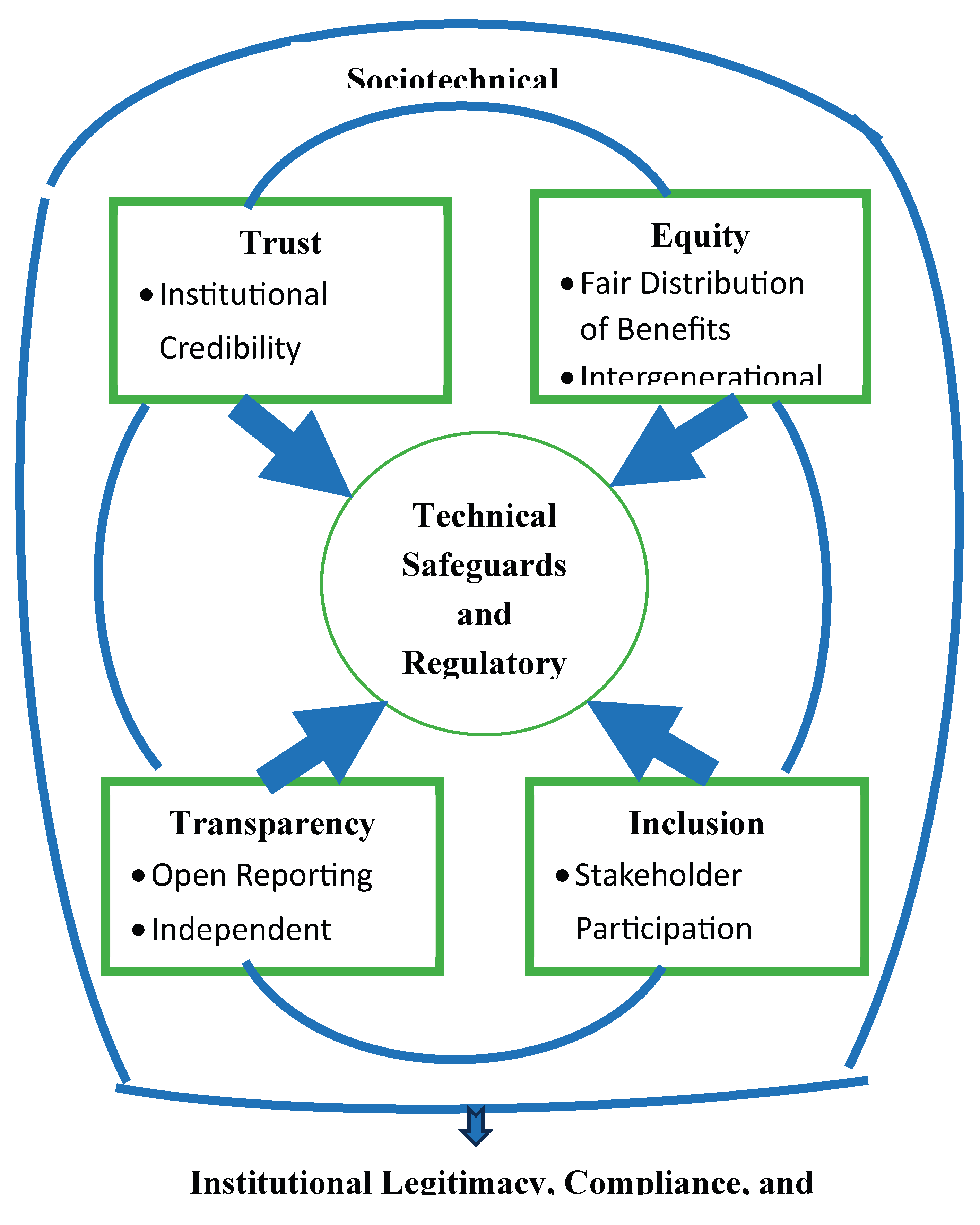
Figure 2.
Conceptual-Empirical Workflow of the Q-NPT Framework.
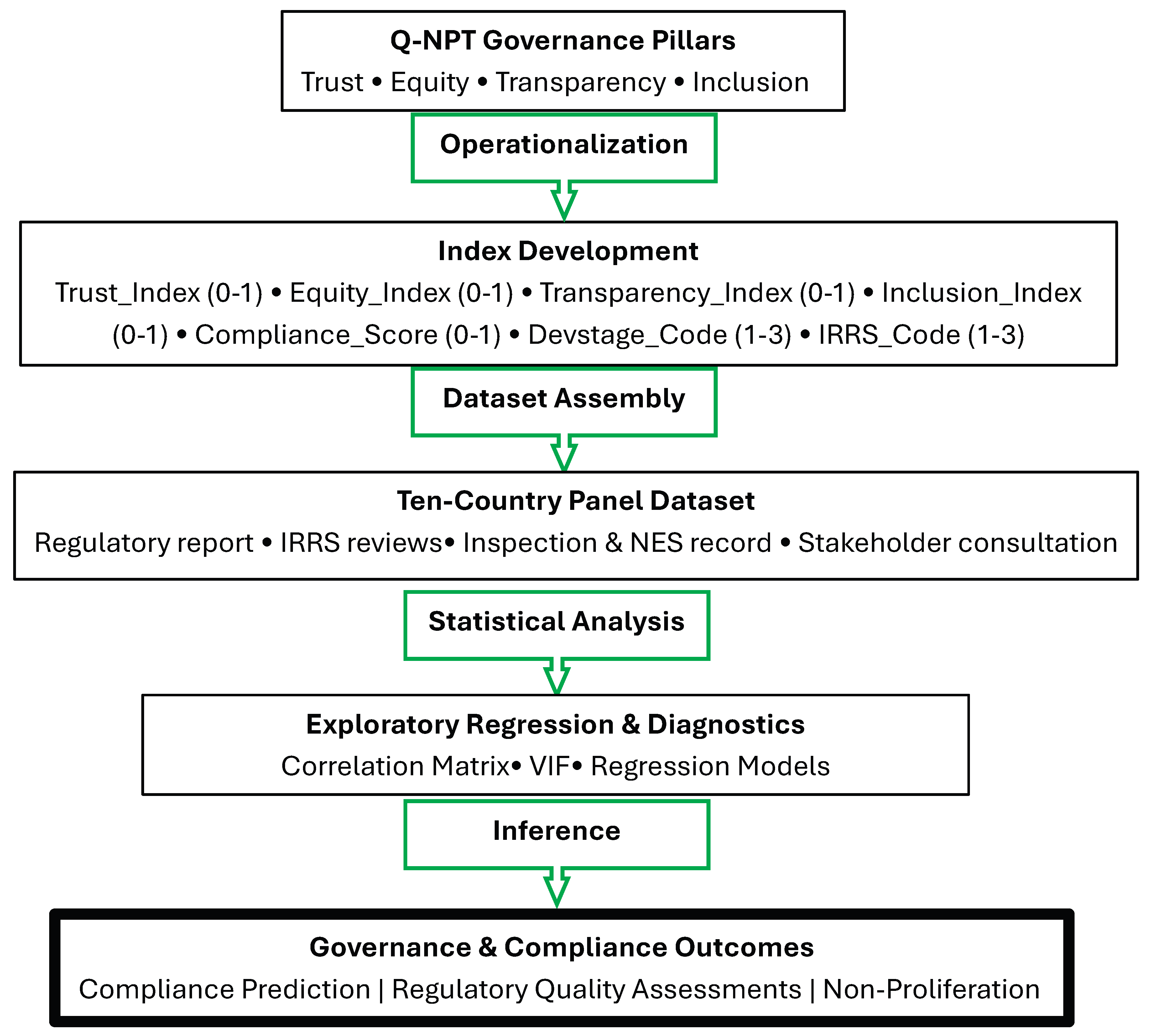
Figure 3.
TETI Composite Index and Compliance Score: Advanced and Emerging Programs. Notes: Circles denote advanced programs (United States, Canada, United Kingdom, France, Finland). Squares denote emerging programs (Türkiye, UAE, Egypt, Brazil, Pakistan).
Figure 3.
TETI Composite Index and Compliance Score: Advanced and Emerging Programs. Notes: Circles denote advanced programs (United States, Canada, United Kingdom, France, Finland). Squares denote emerging programs (Türkiye, UAE, Egypt, Brazil, Pakistan).
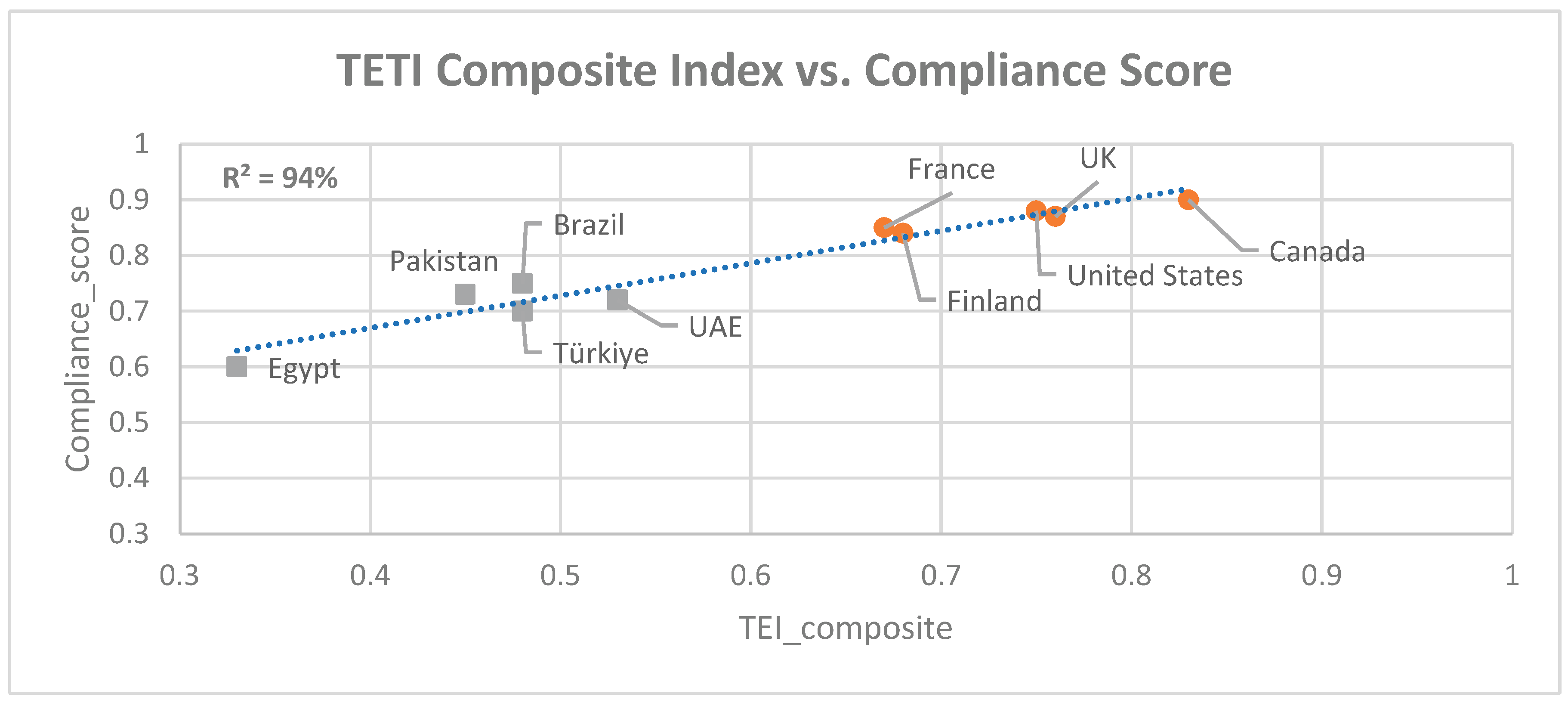

Table 1.
Coding Scale.
| Score | Interpretation |
|---|---|
| 0 | No evidence |
| 1 | Limited evidence |
| 2 | Moderate evidence |
| 3 | Strong evidence |
| 4 | Extensive evidence |
Table 2.
Advanced Nuclear Programs.
| Variable/Country | United States | Canada | United Kingdom | France | Finland |
|---|---|---|---|---|---|
| Data Year | 2024 | 2023-2024 | 2024 | 2016 | 2016 |
| Trust_index | 0.80 (IAEA, 2024a; NRC, n.d.) | 0.85 (IAEA, 2024b; CNSC, 2023) | 0.82 (IAEA, 2024a; ONR, 2024) | 0.78 (IFNEC, 2016) | 0.75 (IFNEC, 2016) |
| Equity_index | 0.60 (NRC, n.d.) | 0.65 (CNSC, 2023) | 0.60 (ONR, 2024) | 0.55 (IFNEC, 2016) | 0.50 (IFNEC, 2016) |
| Transparency_index | 0.90 (NRC, n.d.) | 0.92 (CNSC, 2023) | 0.88 (ONR, 2024) | 0.75 (IFNEC, 2016) | 0.80 (IFNEC, 2016) |
| Inclusion_index | 0.70 (IAEA, 2024a) | 0.85 (CNSC, 2023) | 0.75 (ONR, 2024) | 0.60 (IFNEC, 2016) | 0.65 (IFNEC, 2016) |
| Compliance_score | 0.88 (NRC, n.d.) | 0.90 (CNSC, 2023) | 0.87 (ONR, 2024) | 0.85 (IFNEC, 2016) | 0.84 (IFNEC, 2016) |
| DevStage_Code | 3 | 3 | 3 | 3 | 3 |
| IRRS_Code | 2 (IAEA, 2024a) | 2 (IAEA, 2024b) | 3 (IAEA, 2024a) | 2 (IFNEC, 2016) | 2 (IFNEC, 2016) |
| IRRS_Intensity | 0.82 (IAEA, 2024a) | 0.80 (IAEA, 2024b) | 0.92 (IAEA, 2024a) | 0.70 (IFNEC, 2016) | 0.75 (IFNEC, 2016) |
Table 3.
Emerging Nuclear Programs.
| Variable/Country | Türkiye | UAE | Egypt | Brazil | Pakistan |
|---|---|---|---|---|---|
| Data Year | 2024 | 2023 | 2026 | 2016 | 2023-2024 |
| Trust_index | 0.60 (IAEA, 2022) | 0.65 (IAEA, 2023) | 0.40 (IAEA, 2026) | 0.55 (IFNEC, 2016) | 0.58 (PNRA, 2023; IAEA, 2024c) |
| Equity_index | 0.40 (IAEA, 2022) | 0.45 (IAEA, 2023) | 0.30 (IAEA, 2026) | 0.35 (IFNEC, 2016) | 0.38 (PNRA, 2023) |
| Transparency_index | 0.50 (IAEA, 2022) | 0.70 (IAEA, 2023) | 0.35 (IAEA, 2026) | 0.60 (IFNEC, 2016) | 0.55 (PNRA, 2023) |
| Inclusion_index | 0.45 (IAEA, 2022) | 0.50 (IAEA, 2023) | 0.25 (IAEA, 2026) | 0.40 (IFNEC, 2016) | 0.42 (PNRA, 2023) |
| Compliance_score | 0.70 (IAEA, 2022) | 0.72 (IAEA, 2023) | 0.60 (IAEA, 2026) | 0.75 (IFNEC, 2016) | 0.73 (PNRA, 2023) |
| DevStage_Code | 2 | 2 | 1 | 2 | 2 |
| IRRS_Code | 2 (IAEA, 2022) | 2 (IAEA, 2023) | 1 (IAEA, 2026) | 2 (IFNEC, 2016) | 2 (IAEA, 2024c) |
| IRRS_Intensity | 0.60 (IAEA, 2022) | 0.65 (IAEA, 2023) | 0.10 (IAEA, 2026) | 0.55 (IFNEC, 2016) | 0.65 (IAEA, 2024c) |
Table 4.
OLS Regression Results: Compliance_score on TETI_composite.
| Predictor | Coefficient (β) | Standard Error | t-value | p-value |
|---|---|---|---|---|
| Intercept (β₀) | 0.40 | 0.05 | 8.0 | <0.001 |
| TETI_composite (β₁) | 0.85 | 0.10 | 8.5 | <0.001 |
Model statistics: R² = 0.72; N = 10 countries.
Table 5.
Illustrative Governance Relevance of the Q-NPT Framework in Various Nuclear States.
| Dimension | Advanced Nuclear States | Emerging Nuclear States (Including Pakistan) | Illustrative Governance Relevance |
|---|---|---|---|
| Trust | Reinforces institutional credibility and public confidence within established regulatory systems | Supports development of institutional reliability and confidence in evolving governance systems | May strengthen confidence in regulatory processes and compliance practices |
| Equity | Encourages consideration of risk-benefit distribution, sustainability, and social legitimacy | Highlights fair distribution of risks, benefits, and opportunities among stakeholders | May contribute to perceptions of legitimacy and fairness |
| Transparency | Complements existing reporting, monitoring, and communication systems | Encourages development of accessible reporting and oversight mechanisms | May reduce informational asymmetries and enhance accountability |
| Inclusion | Supports stakeholder participation and public engagement within mature governance structures | Promotes early incorporation of participatory processes and stakeholder consultation | May strengthen procedural legitimacy and social acceptance |
| Technical Safeguards Integration | Applied alongside established technical, regulatory, and operational systems | Applied alongside developing regulatory and operational capabilities | Highlights the interaction between technical safeguards and governance considerations |
Notes: Advanced nuclear states (United States, France, Canada, United Kingdom, and Finland) were selected to represent mature nuclear programs with established regulatory institutions and extensive operational experience. Emerging states (Türkiye, UAE, Egypt, Brazil, and Pakistan) were selected to represent programs characterized by recent expansion or evolving governance arrangements. The table illustrates potential governance considerations associated with the Q-NPT framework and should not be interpreted as evidence of causal effects (Qudrat-Ullah, 2025a–c; Saygın, 2025).
Disclaimer/Publisher’s Note: The statements, opinions and data contained in all publications are solely those of the individual author(s) and contributor(s) and not of MDPI and/or the editor(s). MDPI and/or the editor(s) disclaim responsibility for any injury to people or property resulting from any ideas, methods, instructions or products referred to in the content. |
© 2026 by the author. Licensee MDPI, Basel, Switzerland. This article is an open access article distributed under the terms and conditions of the Creative Commons Attribution (CC BY) license.
Copyright: This open access article is published under a Creative Commons CC BY 4.0 license, which permit the free download, distribution, and reuse, provided that the author and preprint are cited in any reuse.


