

Submitted:
12 July 2026
Posted:
14 July 2026
You are already at the latest version
Abstract
Ghanaian strip-woven textiles from Agotime Kpetoe and the Asante Kente weaving centres of Bonwire and Adanwomase are widely recognised for their cultural and symbolic significance; however, their measurable material performance under standardised laboratory conditions remains insufficiently documented. This study comparatively evaluated maximum force at break, dimensional stability, and colourfastness of handwoven strip fabrics using GS ISO 13934-1, GS ISO 5077:2007, and GS ISO 105:2013 testing procedures. Twenty-four fabric specimens, comprising eight each from Agotime Kpetoe, Bonwire, and Adanwomase, were purposively selected from recognised weaving communities and tested under controlled conditions at the Ghana Standards Authority. Fibre composition and indicative structural characteristics were documented, while performance data were analysed descriptively using means, standard deviations where supported by specimen-level data, observed ranges, directional strength ratios, and shrinkage differentials. The findings revealed distinguishable performance profiles across the three weaving groups. Agotime exhibited the most balanced directional tensile response, with a weft-to-warp strength ratio of 1.14, whereas Bonwire and Adanwomase demonstrated pronounced weft-dominant behaviour, with ratios of 1.77 and 1.63, respectively. Adanwomase recorded the highest mean maximum force at break in both the warp and weft directions and the lowest mean dimensional change after laundering, while Agotime exhibited the greatest directional shrinkage differential. Agotime-specific breaking-distance data further indicated a broader deformation-at-failure range in the warp direction than in the weft direction. Colourfastness to washing and staining was generally high across all groups. The observed performance differences indicate associations with integrated material–structural configurations rather than causally established effects. By applying standardised performance testing to authentically produced fabrics, this study advances the empirical characterisation of Ghanaian strip-woven textiles as culturally significant material systems with measurable mechanical, dimensional, and colour performance attributes.
Keywords:
ghanaian strip-woven textiles
; tensile strength
; dimensional stability
; colourfastness
; textile performance evaluation
1. Introduction
Ghanaian hand-woven strip textiles occupy a distinctive intersection between cultural heritage, material production systems, and contemporary textile design practice (Afriyie et al., 2023; Asinyo et al., 2021; Frimpong, 2013). Among these traditions, Agotime Kpetoe weaving in the Volta Region and Asante Kente weaving in Bonwire and Adanwomase in the Ashanti Region are internationally recognised for their intricate colour sequencing, symbolic motif articulation, and compositional sophistication. Extensive scholarship has examined Kete/Kente weaving as a medium of encoded communication, traditional authority, cultural identity, and collective memory (Kpogo et al., 2022; Mortey et al., 2022; Wemegah et al., 2021), firmly situating these textiles within cultural, historical, and anthropological discourse.
Despite this substantial body of scholarship, comparatively limited attention has been directed towards the measurable performance characteristics of Ghanaian strip-woven textiles under standardised laboratory conditions. Indigenous textiles are frequently interpreted through aesthetic, symbolic, and cultural frameworks (Rodliyah, 2024; Ayesu et al., 2021), while systematic empirical evaluation of their tensile behaviour, dimensional stability, and colour durability remains comparatively underdeveloped. As Corredor and Adelaida (2016) observe, indigenous textiles are often approached primarily as cultural artefacts rather than investigated as material systems whose properties can be quantified and comparatively evaluated. This imbalance leaves an important empirical question unresolved: whether closely related strip-weaving traditions, developed within distinct craft and production contexts, exhibit distinguishable performance profiles when assessed under harmonised laboratory conditions.
Hand-woven strip fabrics constitute integrated textile systems in which fibre composition, yarn selection, loom setup, interlacement patterns, yarn density, tension regulation, and finishing practices may collectively influence mechanical, dimensional, and durability performance (Nandal & Guru, 2025). In craft-based production environments, these parameters are shaped by tradition-specific knowledge and production practices rather than by laboratory standardisation (Phoophat & Sukigara, 2016). Consequently, the performance of a finished hand-woven fabric reflects the combined influence of its material composition and structural configuration. Comparative testing under controlled conditions therefore provides a means of characterising the performance profiles of authentic textile systems as produced in practice, although, in the absence of experimentally controlled construction variables, it does not establish causal relationships between individual structural parameters and observed performance outcomes.
Recent scholarship in textile engineering and design research has emphasised the value of integrating empirical performance testing with culturally grounded analysis to reposition indigenous materials within contemporary frameworks of material characterisation, quality assessment, and functional application. Standardised measurements of tensile strength, dimensional stability, and colourfastness provide objective indicators through which textile systems originating from different craft traditions can be systematically compared. For example, Sofi et al. (2017) demonstrated that controlled tensile testing of handmade Kashmiri Pashmina shawls revealed measurable variability within artisanal production categories, underscoring the capacity of laboratory-based evaluation to complement cultural interpretation with empirical evidence.
Although Agotime Kpetoe and Asante Kente share foundational characteristics, including narrow-strip loom construction, vibrant chromatic organisation, and supplementary patterning (Boadi et al., 2025; Mortey et al., 2022; Thirumurugan, 2019), they also differ in motif organisation, compositional emphasis, material selection, and production context. Even within the Asante Kente tradition, fabrics produced in Bonwire and Adanwomase may exhibit variations arising from localised production practices and material choices. Whether these differences correspond to measurable variations in directional tensile strength, dimensional stability, and colourfastness under identical laboratory conditions remains insufficiently documented. Moreover, the deformation-at-failure characteristics of these traditional strip-woven systems remain comparatively underexplored.
Accordingly, this study comparatively evaluates the performance characteristics of 24 strip-woven fabric specimens, comprising eight each from Agotime Kpetoe, Bonwire, and Adanwomase, using standardised GS ISO laboratory procedures. The investigation examines colourfastness to washing and staining, dimensional stability following laundering, and maximum force at break in the warp and weft directions. It further assesses directional mechanical balance through weft-to-warp strength ratios and, for the Agotime specimens for which breaking-distance data were available, examines the relationship between maximum force at break and deformation at failure. The study therefore sought to determine whether Agotime Kpetoe, Bonwire, and Adanwomase strip-woven fabrics exhibit distinguishable mechanical, dimensional, and colour performance profiles when evaluated under identical standardised laboratory conditions.
By applying harmonised laboratory protocols to authentically produced fabrics sourced from their respective weaving communities, this study establishes an empirical basis for comparing the performance characteristics of culturally significant Ghanaian strip-woven textile systems. Its contribution lies in extending the analysis of these textiles beyond predominantly symbolic and cultural interpretation towards standardised material performance evaluation, while retaining their production contexts as integral to the interpretation of observed behaviour. In doing so, the study contributes to textile engineering, textile design, and indigenous material research by demonstrating how traditional strip-woven fabrics can be systematically characterised as material systems with measurable mechanical, dimensional, and colour performance attributes.
2. Structural and Performance Foundations of Ghanaian Strip-Weaving Traditions
2.1. Technological Convergence and Structural Baseline
Ghanaian strip weaving is characterised by the production of narrow woven bands on specialised looms, later joined to form broader textile structures (Afriyie et al., 2023; Frimpong, 2013). Across regions, the technological principles remain structurally comparable: narrow-strip loom configuration, sequential colour arrangement, manual weft insertion, and controlled strip assembly. This technological convergence establishes a shared structural baseline for comparative evaluation.
Asinyo et al. (2021) emphasise that colour sequencing follows deliberate systematic logic rather than arbitrary placement, while Badoe and Opoku-Asare (2014) identify supplementary yarn insertion as a defining structural mechanism in Kente weaving. Although these practices are often discussed in aesthetic or symbolic terms, they also constitute material configuration strategies that influence yarn layering, interlacement frequency, and load distribution.
The existence of a common loom system across Agotime Kpetoe and Bonwire–Adanwomase traditions is analytically significant. When textile systems share broadly comparable fabrication mechanics, cross-tradition performance comparison becomes methodologically meaningful. Rather than presuming technological divergence, comparative evaluation can focus on the overall material–structural configuration embodied in each textile system as produced within its respective craft context.
2.2. Colour Organisation as Structural Configuration
Colour in Ghanaian strip-woven textiles is widely recognised as a symbolic and communicative medium (Afriyie et al., 2023; Amissah, 2022). However, beyond its semiotic function, colour organisation operates as a structural configuration variable.
In both Agotime and Ashanti traditions, the sequencing of colours determines the distribution of yarn types and pattern transitions across the strip. The placement of contrasting yarns frequently corresponds to changes in interlacement rhythm, supplementary weft layering, and density modulation. Mathur and Seyam (2011) demonstrate that weave structure and interlacing frequency influence colour perception and motif clarity. By extension, variations may coincide with structural adjustments that potentially affect mechanical behaviour.
Agotime weaving tends toward balanced geometric sequencing and gradual chromatic transitions (Kpogo et al., 2022; Mortey et al., 2022), while Bonwire–Adanwomase textiles frequently employ pronounced chromatic contrast and layered motif articulation (Amissah, 2022; Asmah et al., 2015). These aesthetic distinctions may correspond to differences in yarn concentration and supplementary insertion density. Consequently, colour organisation is not merely visual orchestration but may reflect differentiated structural strategies with measurable mechanical implications.
2.3. Structural Complexity, Yarn Density, and Mechanical Behaviour
Structural complexity in strip-woven textiles emerges through supplementary weft integration, yarn density variation, and motif construction logic. Badoe and Opoku-Asare (2014) identify supplementary weft insertion as central to Kente pattern formation, while Mortey et al. (2022) observe that both Agotime and Ashanti traditions employ density modulation to achieve stylistic and tactile outcomes.
Phillips (2020) suggests that relatively high yarn density in Bonwire and Adanwomase textiles contributes to perceived robustness. From a textile engineering standpoint, increased yarn packing density reduces slippage, enhances transverse consolidation, and elevates tensile resistance (Nassif, 2012). Similarly, research by Azeem et al. (2018) and Maqsood et al. (2016) indicates that weave density, yarn layering, and interlacement frequency directly influence durability, dimensional stability, and mechanical anisotropy.
Accordingly, structural complexity should be interpreted not as ornamental elaboration but as a material variable influencing performance behaviour. Supplementary weft insertion and density regulation generate distinct structural matrices that respond differently to tensile loading and laundering-induced relaxation. Where traditions diverge in stylistic articulation, corresponding differences in yarn configuration may produce measurable variation in strength and dimensional response. Framing structural variation within a performance lens, therefore, enables empirical interrogation of design logic embedded within weaving practice.
Although the present study does not independently quantify yarn density or packing parameters, existing textile engineering literature establishes that these variables significantly influence mechanical performance. This theoretical understanding provides an interpretive lens for analysing comparative test results obtained from authentically produced fabrics.
2.4. Practice-Based Knowledge and Performance as Analytical Evidence
Contemporary textile scholarship increasingly recognises weaving as embodied design knowledge (Nimkulrat, 2013; Philpott, 2012). Within this epistemological framework, artefacts function as repositories of tacit reasoning encoded through repetition, rhythm, and material manipulation.
However, translating tacit craft knowledge into research discourse requires measurable indicators. Performance testing provides such a bridge. Tensile strength, dimensional stability, and colourfastness are not isolated laboratory metrics; they are manifestations of structural decisions embedded during making.
Nimkulrat (2013) and Risan (2020) argue that artefacts can operate as epistemic tools within research. Extending this position, performance evaluation becomes a means of articulating implicit structural reasoning through measurable behaviour. When strip-woven textiles from closely related technological systems are evaluated under identical protocols, performance differentiation can be interpreted as evidence of embedded structural strategy rather than experimental artefact.
This hybrid design–performance framework enables Agotime Kpetoe and Bonwire–Adanwomase textiles to be examined not only as cultural artefacts but also as integrated material systems whose properties can be empirically evaluated. By applying uniform laboratory testing protocols to fabrics obtained directly from their respective weaving traditions, the present study establishes a basis for comparative performance analysis. Rather than isolating individual structural variables, the investigation evaluates the combined material and constructional configuration of each textile system as encountered in practice. Such an approach extends craft-based textile scholarship into the discourse of measurable performance while acknowledging the complexity of real-world production conditions.
3. Methodology
3.1. Research Design
This study adopted a comparative descriptive performance-evaluation design situated within a hybrid design–performance interpretive framework. The design enabled systematic comparison of measurable textile performance parameters across three weaving groups: Agotime Kpetoe in the Volta Region and Bonwire and Adanwomase within the broader Asante Kente tradition of the Ashanti Region. Laboratory outcomes were interpreted in relation to available material and structural characteristics of the examined fabrics.
Empirical data were generated through controlled laboratory testing of hand-woven fabric specimens. All testing was conducted at the Ghana Standards Authority (GSA) in accordance with applicable GS ISO textile testing standards to ensure procedural consistency and technical credibility.
Because the three weaving groups employ comparable narrow-strip loom technologies, performance comparisons were conducted under standardised laboratory conditions to maintain methodological consistency. The study evaluated the overall performance characteristics of finished textile systems as produced within their respective craft contexts rather than experimentally isolating individual material or structural variables.
3.2. Sample Selection and Preparation
Twenty-four (24) fabric specimens were purposively selected, comprising eight (8) specimens each from the Agotime Kpetoe, Bonwire, and Adanwomase weaving groups. Purposive sampling was employed to select representative fabric types from recognised weaving centres based on production authenticity, structural characteristics, and the availability of finished textiles suitable for standardised laboratory testing. The principal selection criteria were:
- authenticity of production within recognised weaving communities;
- use of traditional narrow-strip looms; and
- conventional strip-assembly techniques.
In addition to these criteria, specimens were selected to capture variation in colour patterning, material composition, and observable structural characteristics within each weaving group as presented in Figure 1. This approach was intended to represent variation among the examined strip-woven fabrics rather than a single design configuration.
The fabrics analysed in this study were sourced as finished products from their respective weaving communities and were not subjected to controlled dyeing within the experimental framework. Consequently, specific dye classes, dyeing procedures, and fixation processes could not be experimentally verified. Available information concerning dominant fibre composition, including cotton, rayon, and polyester yarn systems, was documented to provide material context for interpreting the observed performance characteristics.
Before testing, specimens were conditioned at 20 ± 2 °C and 65 ± 4% relative humidity, in accordance with GS ISO 139:2005, to minimise the influence of atmospheric variation on textile behaviour.
Available structural characteristics were documented to provide baseline material context; however, these variables were not experimentally controlled across the specimens. Consequently, observed performance outcomes were interpreted as reflecting the integrated material–structural configuration of each finished textile system rather than the isolated effect of any single construction parameter.
The study was designed as a controlled comparative performance evaluation rather than a population-level survey. The 24 specimens comprised eight specimens from each weaving group, and all conclusions were restricted to the examined fabrics rather than generalised statistically to all textiles produced within the respective weaving communities. Where repeated measurements were available, these were used to improve the reliability of performance characterisation under standardised laboratory conditions. As Munevar-Ortiz et al. (2022) note, repeated testing is useful for assessing measurement repeatability and test-rig effects rather than substituting for a large number of independent observations drawn from a broader population. Accordingly, the present study aimed at an analytical comparison of the examined textile systems rather than statistical generalisation to entire weaving populations.
3.2.1. Structural Characteristics of Fabric Samples
To support material-level interpretation of performance behaviour, available structural characteristics of the fabric specimens were documented before laboratory testing. Because the study evaluated finished textile systems produced within authentic craft contexts, these characteristics were used as contextual descriptors rather than experimentally controlled independent variables.
The documented characteristics included:
- dominant fibre composition, based on available sourcing information and physical/material assessment;
- fabric density, expressed as ends per centimetre and picks per centimetre, where measured;
- fabric mass per unit area (g/m²), where experimentally determined; and
- weave or structural configuration, identified through visual and structural examination.
Yarn linear density was not experimentally determined and was therefore excluded from quantitative analysis. The structural characteristics documented for the 24 specimens are presented in Table 1.
The documented structural characteristics provide contextual support for interpreting variations in tensile behaviour, dimensional stability, and colour performance across the three weaving groups. However, because these characteristics were neither experimentally manipulated nor standardised across specimens, observed relationships between structure and performance are interpreted as associative rather than causal.
3.3. Performance Testing Procedures
Performance evaluation focused on three key parameters:
- tensile strength (warp and weft directions)
- dimensional stability following laundering; and
- colourfastness to washing and staining
All tests were conducted at the Ghana Standard Authority (GSA) using calibrated laboratory equipment in accordance with the applicable GS ISO standards.
- Tensile Strength: GS ISO 13934-1 (Strip method)
- Dimensional Stability: GS ISO 5077:2007; and
- Colourfastness to Washing and Staining: GS ISO 105:2013
Tensile properties were determined using the strip method in accordance with GS ISO 13934-1. Specimens were tested in the warp and weft directions using a universal testing machine under standardised testing conditions. Maximum force at break was recorded in newtons (N). For the Agotime Kpetoe specimens, breaking distance at failure was also available, enabling supplementary examination of the relationship between maximum force at break and deformation at failure.
The Agotime tensile data were graphically represented as tensile endpoint profiles showing maximum force at break against breaking distance. These profiles do not constitute complete continuous force–extension or engineering stress–strain curves because continuous load–extension trajectories and specimen cross-sectional stress data were not available. They are therefore used to illustrate specimen-level relationships between ultimate load-bearing capacity and extension at failure rather than complete elastic, nonlinear, or post-peak tensile behaviour. Equivalent breaking-distance measurements were unavailable for the Bonwire and Adanwomase specimens; consequently, deformation-at-failure profiles were restricted to the Agotime group, whereas comparative mechanical evaluation across all three groups was based primarily on maximum force at break.
Dimensional change was assessed following controlled laundering procedures in accordance with GS ISO 5077:2007. Specimens were subjected to the prescribed washing, drying, and conditioning procedures, after which percentage dimensional change was determined in the warp and weft directions.
Colourfastness to washing was evaluated using the ISO 105-C06 method under specified laundering conditions involving controlled temperature, detergent solution, and mechanical agitation. Multifibre adjacent fabrics were used to assess staining behaviour. Following washing, specimens were rinsed, dried, and evaluated according to the applicable grey-scale assessment procedures.
Colour change and staining were assessed using the relevant ISO 105 grey scales and graded from 1 (poor) to 5 (excellent), with intermediate half-step ratings applied where appropriate.
Performance measurements were conducted under standardised laboratory conditions. Where replicate observations were available, mean values and measures of dispersion were calculated to characterise specimen- and group-level performance. Uniform testing and environmental conditions were maintained to support comparability across the examined specimens. Testing conditions and equipment specifications are summarised in Table 2.
3.4. Analytical Approach
Quantitative data were analysed using descriptive statistical methods. For tensile strength, specimen-level and group-level means were calculated from the available measurements for each of the three weaving groups. Standard deviations and observed ranges were reported where supported by the underlying data. Directional mechanical balance was assessed using the ratio of mean weft strength to mean warp strength.
For dimensional stability, mean percentage dimensional change was evaluated in the warp and weft directions, and directional shrinkage differentials were calculated to characterise anisotropy in dimensional response. Colourfastness performance was evaluated using numerical conversion of grey-scale grades, with descriptive statistics reported where supported by the available observations.
For Agotime Kpetoe specimens, the relationship between maximum force at break and breaking distance was examined descriptively using specimen-level tensile endpoint profiles. Because equivalent breaking-distance data were unavailable for Bonwire and Adanwomase, this supplementary deformation-at-failure analysis was not used for direct intergroup comparison.
The study did not employ inferential statistical modelling; consequently, observed differences among the three weaving groups were interpreted as descriptive performance patterns rather than statistically validated population-level effects.
Where relevant, performance outcomes were interpreted in relation to documented material and structural characteristics. Because yarn-level properties and fabric construction variables were not experimentally manipulated or controlled, relationships between structural configuration and performance were interpreted as associative and theoretically informed rather than causal.
The level of statistical reporting varied according to the resolution of the available experimental records. For tensile strength, specimen-level measurements were available for all 24 fabrics, enabling independent calculation of group means, standard deviations, and directional strength ratios. For colourfastness and dimensional stability, the available records comprised group-level summary values and observed ranges rather than complete specimen-level datasets. Accordingly, these parameters were analysed descriptively using the available summary statistics, and no independently reconstructed measures of dispersion were reported where the underlying observations were unavailable. This evidence-sensitive approach was adopted to avoid introducing statistical estimates that could not be directly verified from the available experimental records.
3.5. Methodological Delimitations
The study evaluated finished strip-woven textile systems as produced within their authentic craft contexts. Accordingly, yarn linear density, yarn twist, fibre morphology, and other yarn-level characteristics were not experimentally characterised, while fabric construction variables were not standardised across specimens. The analysis was therefore designed to compare integrated fabric-level performance rather than isolate individual structure–property relationships.
Statistical analysis was limited to descriptive measures and did not include inferential testing. Consequently, the findings are restricted to the examined specimens and should not be interpreted as statistically generalisable to all fabrics produced within the Agotime Kpetoe, Bonwire, and Adanwomase weaving communities. A fuller critical discussion of these constraints and their implications is presented in Section 7.
4. Results
This section presents the comparative performance outcomes of 24 strip-woven fabric specimens, comprising eight each from Agotime Kpetoe, Bonwire, and Adanwomase. All measurements were conducted under standardised laboratory conditions in accordance with the applicable GS ISO procedures. Results are reported using harmonised metrics to support direct comparison across the three weaving groups. Group-level performance values represent the eight specimens examined within each group.
Mean values and measures of dispersion are reported where these could be substantiated from the available observations. Where relevant, performance patterns are considered alongside documented material and structural characteristics to provide contextual support for the observed differences. Because these characteristics were not experimentally controlled, they are used only for descriptive interpretation rather than causal explanation.
4.1. Colourfastness Performance
4.1.1. Colourfastness to Washing (GS ISO 105:2013; ISO 105-C06 Method)
The values represent the summary performance data available for the examined specimens. Average grey-scale grades and observed ranges are presented in Table 3. The values represent the summary performance data available for the examined specimens. Because the original specimen-level grading records were unavailable for independent recalculation, the reported means and ranges are presented as documented summary statistics rather than independently reconstructed estimates.
All three weaving groups recorded high resistance to washing, with mean grades of at least 4.5. Bonwire exhibited complete uniformity within the available summary data, with a reported mean and range of 4.5. Agotime and Adanwomase showed greater variation within the 4.0–5.0 interval. These differences describe the observed colourfastness outcomes but cannot be attributed conclusively to particular fibres, dyes, or fixation processes because the fabrics were evaluated as finished products.
4.1.2. Colourfastness to Staining (GS ISO 105:2013; ISO 105-A02 Grey-Scale Assessment Method)
Mean staining grades and observed grading ranges are summarised in Table 4. Because specimen-level observations were unavailable for independent recalculation of dispersion statistics, standard deviations are not reported. The observed ranges are used descriptively to indicate variation within each weaving group.
All specimens demonstrated high resistance to dye transfer, and no staining grade below 4.0 was recorded. Bonwire exhibited the lowest mean staining grade and a distribution extending towards the lower end of the observed range. Agotime recorded the highest mean staining resistance, followed by Adanwomase. These findings indicate generally stable colourfastness among the examined specimens, although dye chemistry, fixation procedures, and fibre–dye interactions were not independently determined.
Figure 2 presents the mean washing and staining grades of the three weaving groups based on the available summary data. Because the underlying specimen-level observations were unavailable for independent recalculation of dispersion statistics, error bars are not presented.
4.2. Dimensional Stability (GS ISO 5077:2007)
Mean percentage dimensional change following laundering is presented in Table 5. Because the original specimen-level dimensional-change measurements were unavailable for independent recalculation of dispersion statistics, the analysis is restricted to the available group-level mean values.
All fabrics exhibited shrinkage in both directions, and no dimensional growth was observed. Agotime recorded the greatest dimensional change, particularly in the weft direction, whereas Adanwomase demonstrated the lowest mean shrinkage in both directions.
Directional behaviour varied among the weaving groups. Agotime exhibited greater shrinkage in the weft direction than in the warp direction, whereas Bonwire and Adanwomase showed greater warp than weft shrinkage. The largest directional differential occurred in Agotime.
The observed differences may be associated with variations in structural compactness, yarn mobility, residual tension, fibre composition, and finishing history. However, because these factors were not experimentally isolated, the results should be interpreted as integrated fabric-level responses rather than evidence of specific causal mechanisms.
Figure 3 presents the mean dimensional changes in the warp and weft directions after laundering.
4.3 Maximum Force-Breaking Distance Relationship
Breaking-distance measurements were available for the Agotime Kpetoe specimens, enabling examination of the relationship between maximum force at break and deformation at failure in the warp and weft directions. Figure 4 and Figure 5 present specimen-level tensile endpoints for the two loading directions. Each plotted point represents the maximum force and corresponding breaking distance recorded for an individual specimen.
The warp specimens exhibited breaking distances ranging from approximately 11.7 to 49.3 mm, whereas the weft specimens showed a narrower range of approximately 10.9 to 21.5 mm. This indicates that the examined Agotime specimens generally accommodated greater and more variable extension before failure in the warp direction than in the weft direction.
Specimen-level mean maximum forces in the warp direction ranged from approximately 476 to 1,207 N, while the corresponding weft values ranged from approximately 667 to 1,150 N. These ranges demonstrate heterogeneity in ultimate load-bearing capacity and deformation at failure among the examined specimens. Such variability may be associated with differences in yarn composition, fabric density, yarn crimp, and local structural configuration; however, those factors were not experimentally isolated.
Because breaking-distance measurements were unavailable for Bonwire and Adanwomase, equivalent analyses could not be conducted for those groups. Figure 4 and Figure 5 therefore represent Agotime-specific tensile endpoint profiles rather than comparative continuous force–extension or engineering stress–strain curves.
Figure 4.
Tensile endpoint profile of Agotime Kpetoe strip-woven fabrics in the warp direction, showing the relationship between maximum force at break and breaking distance.
Figure 4.
Tensile endpoint profile of Agotime Kpetoe strip-woven fabrics in the warp direction, showing the relationship between maximum force at break and breaking distance.
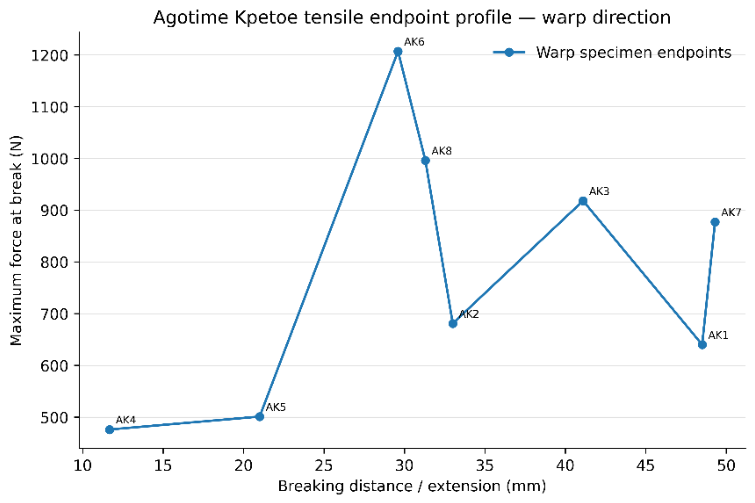
Figure 4 shows substantial specimen-level variation in the relationship between maximum force at break and breaking distance in the warp direction. The broad breaking-distance range indicates considerable variability in deformation capacity before rupture. Because the plotted observations represent individual endpoints rather than sequential measurements recorded during loading, the figure should not be interpreted as a complete tensile loading trajectory.
Figure 5.
Tensile endpoint profile of Agotime Kpetoe strip-woven fabrics in the weft direction, showing the relationship between maximum force at break and breaking distance.
Figure 5.
Tensile endpoint profile of Agotime Kpetoe strip-woven fabrics in the weft direction, showing the relationship between maximum force at break and breaking distance.
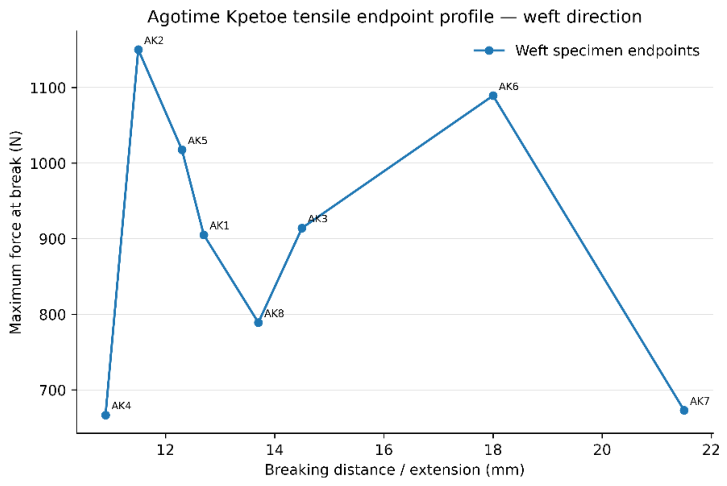
Figure 5 presents the corresponding endpoint relationship in the weft direction. Breaking distances were substantially less variable than in the warp direction, indicating comparatively restricted deformation before failure. As with Figure 4, the observations represent specimen-level endpoints and not continuous force–extension histories.
4.4. Tensile Strength (GS ISO 13934-1; Maximum Force at Break)
4.4.1. Warp Direction
Mean maximum force at break values in the warp direction are presented in Table 6.
The standard deviations indicate substantial and broadly comparable specimen-level variability in the warp direction across all three weaving groups, ranging from 247.1 to 257.4 N. Bonwire recorded the numerically highest SD at 257.4 N, closely followed by Agotime at 255.3 N and Adanwomase at 247.1 N.
The standard deviations indicate substantial specimen-level variability in all three weaving groups. Bonwire recorded the largest warp-direction SD, although it was only slightly greater than that of Agotime. All Adanwomase specimens exceeded 600 N in the warp direction, while the Agotime endpoint data showed a broad range of deformation at failure.
4.4.2. Weft Direction
Mean maximum force at break values in the weft direction are presented in Table 7.
Adanwomase recorded the highest mean weft strength, followed by Bonwire and Agotime. Bonwire exhibited the greatest weft-direction variability, with an SD of 530.1 N, reflecting the wide spread of its specimen values, including the particularly high value of 2,380 N. Adanwomase also exhibited appreciable dispersion, while Agotime showed the lowest weft-direction variability.
The substantially greater mean weft than warp strengths recorded for Bonwire and Adanwomase are consistent with their weft-dominant performance profiles. However, the observed differences should not be attributed exclusively to weft-faced construction because yarn properties, density, and other structural factors were not experimentally controlled.
For the Agotime specimens, the weft direction exhibited a narrower breaking-distance range than the warp direction. Equivalent deformation-at-failure comparisons cannot be extended to Bonwire and Adanwomase because corresponding breaking-distance measurements were unavailable.
The comparative warp and weft tensile-strength results are presented in Figure 6.
4.5. Directional Mechanical Balance
Directional mechanical balance was evaluated using the ratio:

Table 8.
Directional Mechanical Balance Based on Weft-to-Warp Strength Ratio.
| Weaving tradition |
Mean warp strength (N) | Mean weft strength (N) | Weft-to-Warp strength ratio |
|---|---|---|---|
| Agotime | 786.9 | 900.5 | 1.14 |
| Bonwire | 683.6 | 1210.1 | 1.77 |
| Adanwomase | 789.5 | 1289.8 | 1.63 |
Agotime exhibited the most balanced directional tensile response, with a weft-to-warp ratio of 1.14. Bonwire and Adanwomase demonstrated considerably stronger weft-dominant behaviour, with ratios of 1.77 and 1.63, respectively. These ratios indicate greater directional mechanical anisotropy in Bonwire and Adanwomase than in Agotime.
The ratios were calculated from group means and therefore describe aggregate directional balance. They do not include measures of uncertainty and should not be interpreted as specimen-paired inferential statistics.
4.6. Directional Shrinkage Differential
Directional shrinkage differential was calculated as:
Δ = ∣Warp Shrinkage – Weft Shrinkage∣
Table 9.
Directional Shrinkage Differential of the Examined Strip-Woven Fabrics.
| Weaving tradition |
Warp Shrinkage (%) | Weft Shrinkage (%) | Directional Differential, Δ (percentage points) |
|---|---|---|---|
| Agotime | −3.20 | −4.07 | 0.87 |
| Bonwire | −2.70 | −2.15 | 0.55 |
| Adanwomase | −2.35 | −1.75 | 0.60 |
Agotime exhibited the largest directional shrinkage differential at 0.87 percentage points, followed by Adanwomase at 0.60 and Bonwire at 0.55 percentage points. The greater differential in Agotime indicates a less balanced dimensional response between the warp and weft directions during laundering. This behaviour may be associated with differences in yarn tension, structural density, yarn mobility, and relaxation behaviour, although these factors were not independently tested.
4.7. Variability Considerations
4.7.1. Tensile Strength Dispersion
Tensile-strength variability differed by weaving group and loading direction. In the warp direction, all three weaving groups exhibited substantial and broadly comparable dispersion, with standard deviations ranging from 247.1 to 257.4 N. Bonwire recorded the numerically highest warp-direction SD at 257.4 N, closely followed by Agotime at 255.3 N and Adanwomase at 247.1 N.
In the weft direction, Bonwire exhibited the greatest variability, with an SD of 530.1 N, followed by Adanwomase at 314.5 N and Agotime at 181.6 N. The high Bonwire dispersion was influenced by a particularly high specimen value of 2,380 N. These results indicate substantially greater heterogeneity in weft-direction maximum force at break among the Bonwire specimens than among the other two weaving groups.
4.7.2. Colourfastness Dispersion
Based on the available summary data, Bonwire demonstrated complete uniformity in washing fastness, with a reported mean and range of 4.5, whereas Agotime and Adanwomase exhibited variation within reported grading intervals of 4.5–5.0 and 4.0–5.0, respectively. For staining resistance, no grade below 4.0 was reported across the three weaving groups.
Because the underlying specimen-level colourfastness observations were unavailable for independent recalculation, these dispersion patterns are interpreted descriptively from the available reported means and observed ranges and should not be regarded as independently verified estimates of within-group statistical variability.
Formal inferential statistical testing was not conducted. Accordingly, standard deviations derived from the available specimen-level tensile data and observed ranges reported for colourfastness were used descriptively to characterise consistency and heterogeneity among the examined specimens rather than to establish population-level differences.
4.8. Summary of Comparative Performance Patterns
Under identical GS ISO testing conditions, the following descriptive performance patterns were observed:
- Agotime recorded the highest reported mean washing-fastness grade.
- Adanwomase recorded the highest mean warp strength, although its value was closely followed by that of Agotime.
- Bonwire and Adanwomase demonstrated substantially greater mean weft than warp strength, with Adanwomase recording the highest mean weft strength.
- Based on the available group-level summary data, Adanwomase exhibited the lowest mean dimensional change in both directions after laundering.
- Agotime displayed the largest directional shrinkage differential and the most balanced directional tensile response.
- Among the Agotime specimens for which breaking-distance measurements were available, the warp direction exhibited a broader deformation-at-failure range than the weft direction.
- Bonwire exhibited the greatest weft-direction tensile variability, influenced partly by a particularly high specimen value of 2,380 N.
These findings demonstrate distinguishable performance profiles among the examined strip-woven textile systems. The observed variations may be associated with differences in material composition, yarn arrangement, structural density, and fabric architecture. However, because these variables were not experimentally isolated, the results reflect the integrated characteristics of the finished fabrics rather than the independent effects of individual construction parameters.
5. Discussion
The objective of this study was to determine whether measurable performance differentiation exists among Agotime Kpetoe, Bonwire, and Adanwomase strip-woven textiles under controlled laboratory conditions. Although Bonwire and Adanwomase belong to the broader Asante Kente tradition, they were treated as separate analytical groups to preserve the distinct performance characteristics observed within each weaving centre. The findings demonstrate that, despite operating within a shared narrow-strip weaving system, the three examined groups exhibit distinguishable performance profiles across tensile strength, dimensional stability, and colourfastness.
These differences were observed under standardised GS ISO testing conditions, suggesting that performance variation is associated with the integrated material–structural characteristics of the finished fabrics. However, because yarn-level properties and construction parameters were not experimentally controlled, the findings should be interpreted as descriptive and associative rather than as evidence of causally established structure–property relationships.
5.1. Directional Tensile Behaviour
The tensile results reveal clear differentiation in directional strength distribution. Agotime fabrics exhibited the most balanced mean directional tensile response, with a weft-to-warp strength ratio of 1.14. In contrast, Bonwire and Adanwomase fabrics showed pronounced weft-dominant behaviour, with corresponding ratios of 1.77 and 1.63, respectively. These findings indicate greater directional mechanical anisotropy in the Bonwire and Adanwomase specimens than in the Agotime specimens.
The absolute maximum-force-at-break values further clarify these differences. Adanwomase recorded the highest mean warp strength at 789.5 N, although this was closely followed by Agotime at 786.9 N, while Bonwire recorded the lowest mean warp strength at 683.6 N. More pronounced differentiation occurred in the weft direction, where Adanwomase recorded the highest mean strength at 1289.8 N, followed by Bonwire at 1210.1 N and Agotime at 900.5 N. The substantial standard deviations, particularly for Bonwire in the weft direction (530.1 N), also demonstrate considerable specimen-level heterogeneity and reinforce the need to interpret group means alongside their associated dispersion.
In woven textile systems, tensile behaviour is influenced by yarn orientation, structural density, yarn crimp, interlacement frequency, yarn properties, and yarn–yarn interaction (Azeem et al., 2018; Maqsood et al., 2016). The weft-dominant strength observed in Bonwire and Adanwomase is consistent with the structural logic of weft-faced strip-woven constructions, in which the transverse yarn system may contribute substantially to load-bearing behaviour. This interpretation is also consistent with the documented use of supplementary weft patterning in Asante Kente weaving, which may increase transverse yarn concentration and local reinforcement within the fabric structure (Mortey et al., 2022; Badoe & Opoku-Asare, 2014). Nevertheless, because yarn properties, structural density, and supplementary-weft characteristics were not experimentally isolated, these factors should be regarded as plausible structural explanations rather than independently established causes of the observed tensile differences.
Conversely, the comparatively balanced tensile profile of Agotime fabrics indicates a more even mean distribution of load-bearing capacity between the warp and weft directions. With a weft-to-warp ratio of 1.14, the Agotime specimens exhibited a lower degree of directional tensile anisotropy than Bonwire and Adanwomase. This characteristic may have implications for applications requiring a comparatively balanced multidirectional mechanical response, although application-specific suitability would require additional performance testing.
The Agotime tensile endpoint profiles further clarify the relationship between maximum force at break and deformation at failure. The warp direction exhibited breaking distances ranging from approximately 11.7 to 49.3 mm, compared with approximately 10.9 to 21.5 mm in the weft direction. The broader warp-direction range indicates greater variability in deformation at failure and, at the group level, a greater capacity for extension among some of the examined specimens before rupture. However, because equivalent breaking-distance data were unavailable for Bonwire and Adanwomase, deformation behaviour cannot be directly compared across all three weaving groups. Accordingly, the comparative interpretation of tensile performance is based primarily on maximum force at break, while the endpoint profiles provide supplementary mechanical insight specific to the Agotime specimens.
5.2. Dimensional Stability Patterns
Dimensional-stability results further demonstrate differentiated fabric-level behaviour among the three weaving groups. Based on the available group-level summary data, Adanwomase fabrics exhibited the lowest dimensional change after laundering, with mean shrinkage values of −2.35% in the warp direction and −1.75% in the weft direction. Bonwire recorded corresponding values of −2.70% and −2.15%, whereas Agotime exhibited the greatest dimensional change, at −3.20% in the warp direction and −4.07% in the weft direction.
Directional dimensional response also differed among the groups. Agotime recorded greater weft than warp shrinkage and the largest directional shrinkage differential at 0.87 percentage points. Adanwomase and Bonwire recorded smaller differentials of 0.60 and 0.55 percentage points, respectively. These results indicate a less balanced directional dimensional response in the examined Agotime specimens.
Shrinkage in woven textiles is influenced by yarn relaxation, fibre swelling, release of residual tension, yarn crimp, structural compactness, and finishing history (Azeem et al., 2018). The comparatively lower dimensional change observed in Adanwomase coincided with its high mean weft tensile strength and may indicate a fabric configuration that more effectively restricts yarn mobility during laundering. Similarly, Bonwire exhibited intermediate dimensional change within the examined sample set.
In contrast, the greater shrinkage observed in Agotime, particularly in the weft direction, may reflect greater yarn mobility and structural relaxation during wet processing. Its larger directional shrinkage differential may also be associated with differences in residual yarn tension, structural density, local weave compactness, fibre composition, or finishing history between the two principal fabric directions. These interpretations remain provisional at the mechanistic level because the relevant constructional and yarn-level variables were not experimentally isolated.
The relationship between tensile behaviour and dimensional stability should therefore be interpreted as convergent descriptive evidence rather than causal proof. Within the examined specimens, the fabrics showing pronounced weft-dominant tensile behaviour also tended to exhibit lower dimensional change, particularly Adanwomase. However, because yarn count, twist, fibre morphology, yarn tensile properties, density, and construction parameters were not experimentally standardised, the observed relationships represent theoretically informed associations rather than experimentally demonstrated causal effects.
5.3. Colourfastness Behaviour
All three weaving groups demonstrated high reported colourfastness performance in both washing and staining assessments, with relatively limited inter-group differentiation. Agotime recorded the highest reported mean washing-fastness grade at 4.70, followed by Adanwomase at 4.63 and Bonwire at 4.50. For staining resistance, Agotime again recorded the highest mean grade at 4.65, followed by Adanwomase at 4.50 and Bonwire at 4.25. No staining grade below 4.0 was reported.
Unlike tensile strength and dimensional stability, colourfastness therefore exhibited comparatively limited differentiation among the three weaving groups. This result is plausible because colourfastness is influenced principally by factors including fibre type, dye chemistry, dye–fibre affinity, fixation conditions, and post-dyeing treatments rather than by fabric architecture alone (Maqsood et al., 2016). Since the fabrics were obtained as finished products and were not dyed under experimentally controlled conditions, specific dye classes, dyeing procedures, and fixation mechanisms could not be independently verified. Interpretation of colourfastness behaviour must therefore remain restricted to the observed performance outcomes.
The generally high washing and staining grades indicate good colour durability among the examined specimens. The observed results may reflect effective dye–fibre compatibility and commercially processed yarns with relatively stable dye fixation, although these explanations were not directly tested. The comparatively lower mean staining grade recorded for Bonwire may be associated with differences in yarn composition, surface characteristics, finishing history, or dye migration behaviour; however, the available evidence does not permit attribution to any single mechanism.
An additional evidential constraint concerns the availability of the underlying colourfastness records. Because the original specimen-level observations were unavailable for independent recalculation, the reported means and ranges are interpreted as documented summary data rather than independently reconstructed statistics. Consequently, the discussion emphasises broad descriptive performance patterns rather than fine-grained statistical differences among the weaving groups.
5.4. Structural Configuration and Performance Differentiation
Taken together, the results provide descriptive evidence of differentiated performance profiles within a shared narrow-strip weaving system. Since the examined fabrics were produced using comparable narrow-strip loom technologies and evaluated under standardised laboratory conditions, the observed differences in maximum force at break and dimensional stability may be associated with variations in the integrated material–structural organisation of the finished fabrics.
Two broad performance orientations emerge. First, Agotime fabrics exhibited the most balanced directional tensile profile, with a weft-to-warp strength ratio of 1.14, but also showed the greatest mean dimensional change and the largest directional shrinkage differential. Second, Bonwire and Adanwomase demonstrated pronounced weft-dominant tensile behaviour, with Adanwomase recording both the highest mean weft strength and the lowest mean dimensional change after laundering.
These profiles should not be interpreted as hierarchical indicators of overall textile quality. Rather, they represent different performance tendencies within Ghanaian strip-woven textile systems. The Agotime specimens exhibited comparatively balanced directional tensile capacity, whereas Bonwire and Adanwomase demonstrated stronger transverse load-bearing characteristics. Such differences may reflect variations in yarn selection, yarn properties, yarn density, supplementary weft patterning, fabric compactness, residual tension, finishing history, and local weaving practices.
The findings therefore support the proposition that traditional strip-woven textiles are not mechanically uniform merely because they share a common narrow-strip construction principle. Instead, the examined weaving groups exhibit distinguishable material-performance profiles that can be systematically characterised through standardised laboratory evaluation. Nevertheless, because individual structural variables were not experimentally controlled, the observed performance differences should be attributed to the integrated characteristics of the finished textile systems rather than to isolated construction parameters.
5.5. Contribution to Textiles Performance Evaluation
This study contributes to textile engineering and textile design research by demonstrating that traditional Ghanaian strip-woven textiles can be systematically evaluated as material systems with measurable mechanical, dimensional, and colour-performance characteristics. By applying GS ISO testing procedures to authentically produced fabrics, the research extends existing scholarship beyond predominantly cultural and symbolic analysis towards empirical performance characterisation.
The findings demonstrate that indigenous woven textiles can be positioned within broader material science and textile engineering discourse without diminishing their cultural significance. Maximum force at break, dimensional stability, and colourfastness measurements provide empirical indicators through which traditional fabrics can be characterised and comparatively evaluated. Such evidence may support future investigations into their suitability for contemporary apparel, interior, and other functional applications, although application-specific recommendations would require additional testing of properties such as abrasion resistance, tear strength, pilling, comfort, and long-term durability.
The study also demonstrates the value of integrating cultural textile research with standardised laboratory evaluation. Such an approach enables traditional weaving systems to be understood simultaneously as cultural artefacts, repositories of craft knowledge, and material structures with quantifiable performance characteristics. This integrated perspective is particularly relevant to heritage-based innovation, quality benchmarking, product development, material selection, and the wider technical characterisation of Ghanaian strip-woven fabrics.
5.6. Analytical Scope and Limitations
The interpretations presented in this discussion are necessarily constrained by the scope of structural characterisation and the availability of underlying data. Although indicative structural characteristics were documented, detailed yarn-level properties such as yarn linear density, twist, fibre morphology, yarn tensile strength, and exact dye chemistry were not experimentally determined. Similarly, construction variables such as yarn density, weave compactness, supplementary-weft concentration, residual tension, and finishing conditions were not experimentally controlled across the specimens.
Breaking-distance measurements were available only for the Agotime specimens. Consequently, tensile endpoint profiles could be developed for Agotime but not for Bonwire or Adanwomase, preventing direct comparison of deformation-at-failure behaviour across all three weaving groups. Figure 4 and Figure 5 should therefore be interpreted as supplementary Agotime-specific evidence rather than as a complete comparative mechanical analysis.
A further limitation concerns the colourfastness and dimensional-stability datasets. The available evidence comprised group-level summary statistics rather than the complete underlying specimen-level observations needed to independently recalculate all measures of dispersion. Accordingly, colourfastness and dimensional-stability patterns were interpreted descriptively from the available summary data, whereas the tensile statistics were independently reconstructable from the supplied specimen-level measurements.
Consequently, relationships between structural configuration and performance behaviour are interpreted through descriptive statistics and theoretically informed association rather than direct causal modelling. Future research incorporating detailed yarn characterisation, controlled fabric construction, continuous force–extension recording, complete specimen-level datasets, and inferential statistical analysis would enable more precise quantification of structure–property relationships in Ghanaian strip-woven textile systems.
6. Limitations of the Study
This study provides an empirical performance evaluation of Ghanaian strip-woven textiles under standardised laboratory conditions; however, several limitations should be acknowledged when interpreting the findings.
First, the study was based on 24 fabric specimens, comprising eight each from the Agotime Kpetoe, Bonwire, and Adanwomase weaving groups. Although the specimens were purposively selected to represent authentic production within these communities, they cannot capture the full diversity of materials, structural configurations, production practices, and design variations within each weaving centre. The findings should therefore be interpreted as specific to the examined specimens rather than as exhaustive representations of all fabrics produced within the respective weaving communities.
Second, the study evaluated finished textile systems rather than experimentally controlled fabric constructions. Although selected structural characteristics, including fibre composition and indicative fabric density, were documented to provide material context, yarn-level properties such as linear density, twist, fibre morphology, and individual yarn tensile behaviour were not experimentally determined. Similarly, construction variables were not independently controlled across specimens. Consequently, relationships between material–structural characteristics and performance outcomes should be interpreted as theoretically informed associations rather than causally established effects.
Third, complete breaking-distance measurements were available only for the Agotime Kpetoe specimens. This permitted examination of specimen-level relationships between maximum force at break and deformation at failure in the warp and weft directions but precluded equivalent analysis for the Bonwire and Adanwomase fabrics. Consequently, the tensile endpoint profiles presented for Agotime should not be interpreted as a direct comparative analysis of deformation behaviour across the three weaving groups. Moreover, because continuous machine-recorded force–extension trajectories were unavailable, the endpoint profiles do not represent complete engineering stress–strain or force–extension histories throughout tensile loading.
Fourth, the availability of underlying specimen-level data differed across the evaluated performance parameters. Whereas the tensile statistics could be independently reconstructed from the available specimen-level maximum-force measurements, the original specimen-level observations underlying the reported colourfastness and dimensional-stability summary values were unavailable for independent recalculation. Consequently, the colourfastness means and observed ranges and the dimensional-stability means were interpreted from the available documented summary data. Measures of dispersion were not reported for these parameters where they could not be independently substantiated. This limitation restricts detailed assessment of within-group variability for colourfastness and dimensional stability but does not preclude descriptive comparison of the available group-level performance values.
Fifth, the performance evaluation was restricted to maximum breaking force, dimensional stability, and colourfastness to washing and staining. Other functional properties relevant to textile performance, including abrasion resistance, tear strength, pilling behaviour, air permeability, moisture management, thermal comfort, flexural behaviour, and durability under repeated use, were beyond the scope of the investigation. Their exclusion necessarily limits the comprehensiveness of the overall performance assessment.
Sixth, statistical analysis was confined primarily to descriptive measures, including means, standard deviations where supported by specimen-level data, observed ranges, directional strength ratios, and shrinkage differentials. Inferential statistical procedures were not employed; therefore, differences observed among the three weaving groups should be interpreted as descriptive performance patterns rather than as statistically validated differences at the broader population level. Furthermore, the weft-to-warp strength ratios and directional shrinkage differentials were calculated from group-level means and should not be interpreted as specimen-paired inferential statistics or as estimates accompanied by quantified uncertainty.
Finally, because the fabrics were sourced and analysed as finished textile products, detailed information concerning dye classes, dyeing procedures, fixation conditions, and specific fibre–dye interactions was not experimentally verified. Consequently, interpretations of colourfastness behaviour are based on the available performance outcomes and documented fibre composition rather than direct chemical characterisation of the dyes and fixation mechanisms.
7. Future Research Directions
The findings of this study establish several directions for advancing research on the material performance of Ghanaian strip-woven textiles. Future investigations should move beyond descriptive characterisation towards broader performance benchmarking, controlled structure–property analysis, comprehensive mechanical characterisation, predictive modelling, and application-oriented evaluation.
Future studies should employ larger and more geographically diverse sample populations drawn from multiple weaving communities and production centres. Expanding the sampling frame beyond the 24 specimens examined across Agotime Kpetoe, Bonwire, and Adanwomase would improve the representativeness of the empirical evidence and enable broader comparative analysis across Ghanaian weaving traditions. Such investigations could contribute to the establishment of performance benchmarks for indigenous strip-woven textiles while identifying both shared characteristics and weaving-centre-specific material behaviours.
Further research should incorporate detailed yarn and fibre characterisation, including precise fibre identification, yarn linear density, twist characteristics, yarn tensile properties, fibre morphology, and microscopic examination of fabric architecture. Integrating these parameters with standardised fabric performance testing would enable more precise investigation of the relationships among material composition, yarn properties, structural configuration, and functional performance.
Controlled experimental studies are also needed to isolate the effects of specific construction variables. Systematic manipulation of yarn type, yarn count, ends and picks per unit length, weave structure, yarn tension, supplementary weft density, and finishing conditions would enable researchers to determine the relative contributions of individual variables to maximum force at break, deformation behaviour, dimensional stability, and colour performance. Such controlled investigations would advance the field from descriptive association towards more rigorous causal explanation of structure–property relationships.
Future mechanical investigations should additionally capture complete machine-recorded force–extension trajectories for individual specimens across all weaving groups. Continuous tensile data would permit rigorous comparison of deformation behaviour, including initial structural extension, progressive load transfer, maximum force at break, extension at break, stiffness, energy absorption, and failure characteristics. Where original specimen dimensions, cross-sectional characteristics, and initial gauge lengths are appropriately measured and reported, force–extension data could further support the calculation of engineering stress–strain relationships, enabling more comprehensive mechanical characterisation and comparison.
Future investigations should also prioritise systematic retention and transparent reporting of specimen-level raw data for all measured performance parameters. In particular, complete observations for colourfastness, dimensional change, maximum force at break, and deformation at failure should be preserved to permit independent recalculation of means, standard deviations, ranges, confidence intervals, and other relevant statistical measures. Such data-management practices would strengthen reproducibility, facilitate independent verification, and support more rigorous secondary analysis and cross-study comparison.
Performance evaluation should also extend beyond the parameters examined in the present study. Future investigations could incorporate abrasion resistance, tear strength, pilling resistance, air permeability, moisture management, thermal comfort, ultraviolet protection, flexural behaviour, and durability under repeated laundering and use. Such multidimensional assessment would provide a more comprehensive basis for evaluating the suitability of Ghanaian strip-woven textiles for contemporary apparel, interior, protective, and other value-added applications.
Future studies should further employ inferential statistical and predictive modelling approaches appropriate to their experimental designs, sample structures, and distributional characteristics. Depending on the research design and underlying assumptions, analysis of variance, multivariate analysis, regression modelling, effect-size estimation, confidence intervals, and related techniques could determine whether observed differences are statistically supported and quantify relationships between structural variables and performance outcomes. With sufficiently large and well-characterised datasets, predictive models could support material selection, quality benchmarking, and performance-oriented fabric design.
Finally, future research should investigate the relationship between culturally embedded design practices and measurable textile performance. Integrating textile engineering, materials science, design research, and cultural studies may reveal how traditional weaving knowledge contributes not only to aesthetic and symbolic expression but also to structural organisation and functional material behaviour. Such interdisciplinary inquiry could strengthen the positioning of Ghanaian strip-woven textiles within contemporary textile science, sustainable design, heritage-based innovation, and culturally grounded material development.
8. Conclusion
This study comparatively evaluated the mechanical, dimensional, and colourfastness performance of 24 strip-woven fabric specimens, comprising eight each from Agotime Kpetoe, Bonwire, and Adanwomase, under standardised GS ISO laboratory conditions. The investigation sought to determine whether measurable performance differentiation exists among these three weaving groups within Ghana's broader narrow-strip textile tradition. The findings demonstrate that, despite their use of comparable loom technologies, the examined fabric specimens exhibit distinguishable performance profiles in maximum force at break, dimensional stability, and colourfastness.
The most pronounced differentiation was observed in directional mechanical behaviour. Agotime exhibited the most balanced mean tensile response, with a weft-to-warp strength ratio of 1.14, whereas Bonwire and Adanwomase demonstrated pronounced weft-dominant behaviour, with corresponding ratios of 1.77 and 1.63, respectively. Adanwomase recorded the highest mean warp maximum force at break at 789.5 N, although this was closely followed by Agotime at 786.9 N. Adanwomase also recorded the highest mean weft maximum force at break at 1289.8 N, while Bonwire and Agotime recorded 1210.1 N and 900.5 N, respectively. For the Agotime specimens with available breaking-distance measurements, the warp direction exhibited a broader deformation-at-failure range than the weft direction, indicating greater and more variable extension before rupture. Equivalent deformation comparisons could not be made for Bonwire and Adanwomase because corresponding breaking-distance measurements were unavailable.
Dimensional-stability results further differentiated the examined weaving groups. Adanwomase recorded the lowest mean dimensional change after laundering in both the warp and weft directions, whereas Agotime exhibited the greatest dimensional change and the largest directional shrinkage differential at 0.87 percentage points. These findings indicate distinct directional responses to laundering among the examined fabric groups. However, because the available dimensional-stability evidence was limited to group-level summary values and the underlying specimen-level observations were unavailable for independent recalculation, these results should be interpreted descriptively within the scope of the available data.
In contrast to the more pronounced mechanical and dimensional differences, all three weaving groups demonstrated generally high resistance to washing and staining, with comparatively limited variation in the available summary data. Agotime recorded the highest reported mean washing-fastness grade and the highest mean staining grade, while no staining grade below 4.0 was reported across the examined groups. Because the original specimen-level colourfastness records were unavailable for independent recalculation, and because the fabrics were sourced as finished products without experimental verification of their dye classes, dyeing procedures, or fixation mechanisms, these findings are most appropriately interpreted as evidence of generally high colour durability among the examined specimens rather than as confirmation of particular dye–fibre mechanisms.
Taken together, the observed performance patterns may be associated with differences in the integrated material–structural characteristics of the fabrics, including fibre composition, yarn arrangement, structural density, yarn crimp, fabric architecture, and production practices. However, because yarn-level properties and construction variables were not experimentally isolated or controlled, these relationships should be understood as theoretically informed associations rather than causally established structure–property effects.
By applying standardised textile testing procedures to authentically produced fabrics, this study extends research on Ghanaian strip-woven textiles beyond predominantly cultural, symbolic, and descriptive perspectives towards empirical material-performance evaluation. The findings demonstrate that traditional strip-woven fabrics can be systematically investigated as material systems with measurable mechanical, dimensional, and colour performance characteristics. This contributes to their technical characterisation and provides an empirical foundation for future performance benchmarking, quality assessment, product development, and application-oriented research within contemporary textile design and engineering contexts.
The findings remain specific to the 24 specimens examined and should therefore be interpreted within the methodological and evidential boundaries of the study. Future research incorporating broader and more geographically diverse sample populations, detailed yarn and fibre characterisation, controlled construction parameters, complete specimen-level data retention, continuous machine-recorded force–extension measurements, expanded functional performance testing, and appropriately designed inferential statistical analysis would enable more rigorous evaluation of structure–property relationships and support broader performance modelling of Ghanaian strip-woven textiles.
Supplementary Materials
The following supporting information can be downloaded at the website of this paper posted on Preprints.org.
Author Contributions
Conceptualization, [E.A], [I.B], [W.V], [C.F]; methodology, [E.A], [I.B], [W.V]; software, [E.A], [W.V], [C.F].; validation, [E.A], [I.B], [C.F]; formal analysis, [E.A], [W.V], [C.F]; investigation, [E.A], [I.B], [W.V]; resources, [I.B]; data curation, [E.A], [I.B] [C.F].; writing—original draft preparation, [E.A], [I.B], [W.V]; writing—review and editing, [E.A], [C.F]; visualization, [I.B], [C.F]; supervision, [E.A], [C.F]. All authors have read and agreed to the published version of the manuscript.
Funding
The authors declare that no funds, grants, or other support were received during the preparation of this manuscript.
Institutional Review Board Statement
Not applicable
Data Availability Statement
The authors declare that data supporting the findings of this study are available within the paper, and should any data files be needed in another format, they are available from the corresponding author upon reasonable request. Final decisions regarding data accessibility will adhere to the publisher's guidelines.
Acknowledgements
The authors express their sincere gratitude to Prof Ebenezer Kofi Howard, Dr Benjamin Tawiah, and Mr Morrison Appiagyei Boadi for their valuable guidance and constructive feedback throughout the writing process of the manuscript.
During the preparation of this manuscript/study, the author(s) used Gemini AI, ChatGPT and Grammarly to enhance readability and language. The authors have reviewed and edited the output and take full responsibility for the content of this publication.
Conflicts of Interest
The authors declare no conflicts of interest.
References
- Amissah, E. K. (2022). Socio-cultural significance of Bonwire kente and Daboya Benchibi. International Journal of African Society, Cultures and Traditions, 10(1), 1–10. [CrossRef]
- Asinyo, B. K., Howard, E. K., & Seidu, R. K. (2021). Weaving traditions of Daboya and Yendi communities in Northern Ghana. Journal of Arts and Humanities, 10(4), 39–48. [CrossRef]
- Asmah, E. E., Gyasi, I., & Daitey, S. T. (2015). Kente weaving and tourism in a cluster of kente towns in Ashanti. International Journal of Innovative Research and Development, 4(11), 205–214.
- Afriyie, A. O., Frimpong, C., Asinyo, B. K., & Amubika, M. (2023). A comparative study on the techniques, tools and materials for indigenous weaving in Ghana. Textile, 21(1), 69–89. [CrossRef]
- Ayesu, S. M., Anokye, D., Fobiri, G. K., & Opoku-Asare, N. A. (2021). Aesthetic and philosophical meanings of indigenous Asante Kente. Textile & Leather Review, 4(4), 267–281. [CrossRef]
- Azeem, M., Ahmad, Z., Wiener, J., Fraz, A., & Havrdova, M. (2018). Influence of weave design and yarn types on mechanical and surface properties of woven fabric. Fibres & Textiles in Eastern Europe, 26(1), 122–127. [CrossRef]
- Badoe, W., & Opoku-Asare, N. A. (2014). Structural patterns in Asante Kente: An indigenous instructional resource for design education in textiles. Journal of Education and Practice, 5(25), 52–64.
- Boadi, M. A., Frimpong, C., & Seidu, R. K. (2025). The influence of change on indigenous strip-woven fabrics in Ghana. Journal of Asian and African Studies, 60(1), 593–616. [CrossRef]
- Frimpong, C. (2013). A comparative study of history, equipment, materials, techniques and marketing approach of traditional weaving in Ghana. Arts and Design Studies, 7, 1–8.
- Corredor, G., & Adelaida, C. (2016). Textile aesthetics as intersubjectivity of indigenous peoples: The case of Mayan weavers. Revista San Gregorio, (11), 58–69.
- Kpogo, R. R. Y., Quarshie, B., & Ameyaw, H. O. (2022). A qualitative inquiry into kete weaving as a developing culture in the Akatsi district. Journal of African History, Culture and Arts, 2(3), 132–145.
- Maqsood, M., Nawab, Y., Shaker, K., & Realff, M. (2016). Modelling the effect of weave structure and fabric thread density on mechanical and comfort properties of woven fabrics. Autex Research Journal, 16(3), 160–164. [CrossRef]
- Mathur, K., & Seyam, A. F. M. (2011). Colour and weave relationship in woven fabrics. In A. M. Seyam (Ed.), Advances in modern woven fabrics technology (pp. 129–150). InTech. [CrossRef]
- Mortey, F. M. R., Tsekpo, P., Agboka, K. M., & Dzameshie, A. K. (2022). A variationist sociolinguistics study of Ewe Kente at Agortime traditional area in the Volta region. Journal of Marketing and Communication, 5(2), 89–114. [CrossRef]
- Munevar-Ortiz, L., Batcheller, J., & Dolez, P. I. (2022). Influence of specimen size on the tear strength of fabrics by the trapezoid procedure. Journal of Testing and Evaluation, 50(3), 1415–1424.
- Nandal, R., & Guru, R. (2025). Performance analysis of handloom fabrics for home furnishings: Evaluation of handle, tensile strength, and colour fastness. International Research Journal of Advanced Engineering and Management. Advance online publication. [CrossRef]
- Nassif, G. A. A. (2012). Effect of weave structure and weft density on the physical and mechanical properties of micro polyester woven fabrics. Life Science Journal, 9(3), 1326–1331.
- Phillips, A. (2020). Colored strip patterns and front-back symmetry in warp-faced pre-Columbian textiles. Leonardo, 53(3), 304–308. [CrossRef]
- Philpott, R. (2012). Crafting innovation: The intersection of craft and technology in the production of contemporary textiles. Craft Research, 3(1), 53–74. [CrossRef]
- Phoophat, P., & Sukigara, S. (2016). Mechanical and surface properties of Thai cotton hand-woven fabric made from hand-spun and machine-spun yarns. Journal of Textile Science & Engineering, 6(4), 1–6. [CrossRef]
- Nimkulrat, N. (2013). Situating creative artefacts in art and design research. FormAkademisk, 6(2), 1–15. [CrossRef]
- Risan, M. (2020). Creating theory-practice linkages in teacher education: Tracing the use of practice-based artefacts. International Journal of Educational Research, 104, Article 101670. [CrossRef]
- Rodliyah, S. (2024). NTT Ikat woven cloths: Weaving tradition, motifs and their symbolic meanings. Jurnal Antropologi: Isu-Isu Sosial Budaya, 26(1), 35–41. [CrossRef]
- Sofi, A. H., Wani, S. A., Shakyawar, D. B., & Sheikh, F. D. (2017). Quality characteristics of handmade Kashmiri pashmina shawls. SKUAST Journal of Research, 19(1), 72–76.
- Stylios, G. K. (2021). Editorial – textile modelling. International Journal of Clothing Science and Technology, 33(5), 681–682. [CrossRef]
- Thirumurugan, V., & Nevetha, R. P. (2019). A review article on “Kente cloth in home furnishings”–overview. Journal of Textile Engineering & Fashion Technology, 5(6), 306–308. [CrossRef]
- Wemegah, I. L., Danso, D. K., & Adom, D. (2021). Socio-cultural and economic importance of Kete weaving in Agortime traditional area, Ghana. Asian Research Journal of Arts & Social Sciences, 15(1), 43–53. [CrossRef]
Figure 1.
Representative strip-woven fabric specimens from (a) Agotime Kpetoe, (b) Bonwire, and (c) Adanwomase weaving groups used for laboratory performance evaluation..
Figure 1.
Representative strip-woven fabric specimens from (a) Agotime Kpetoe, (b) Bonwire, and (c) Adanwomase weaving groups used for laboratory performance evaluation..
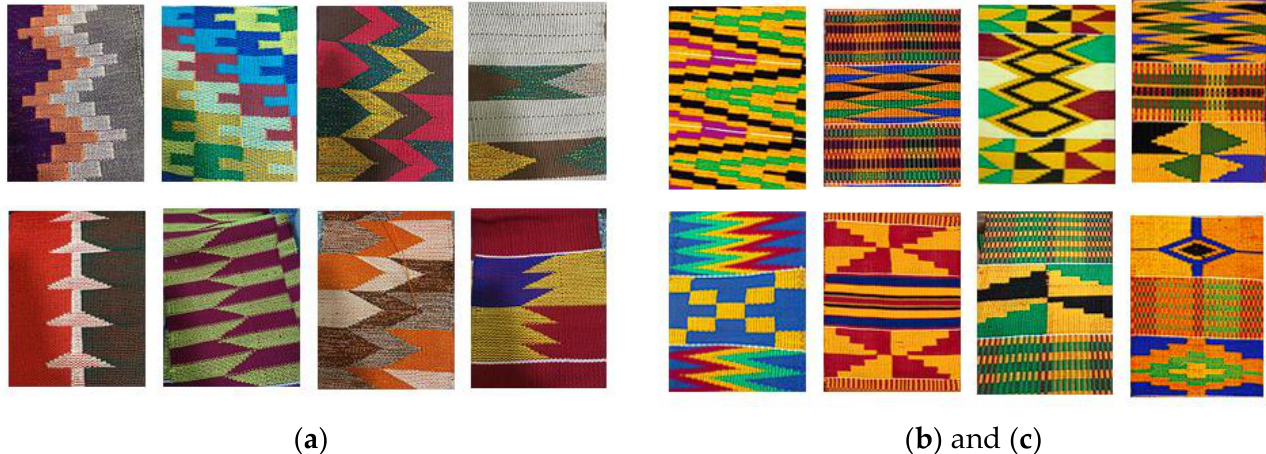
Figure 2.
Comparative mean colourfastness performance of Agotime, Bonwire, and Adanwomase strip-woven fabrics for washing and staining based on the available summary data.
Figure 2.
Comparative mean colourfastness performance of Agotime, Bonwire, and Adanwomase strip-woven fabrics for washing and staining based on the available summary data.
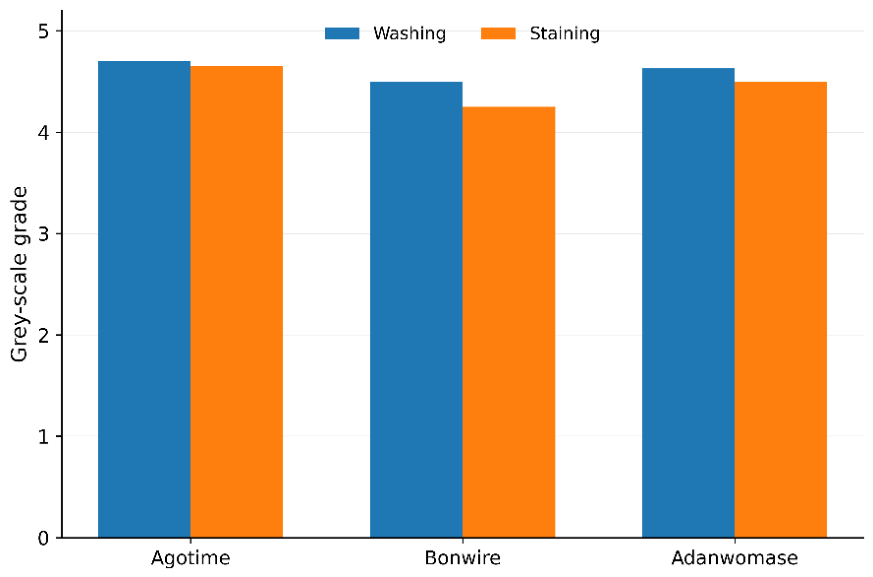
Figure 3.
Mean dimensional change of Agotime, Bonwire, and Adanwomase strip-woven fabrics after laundering in the warp and weft directions, based on the available group-level summary data.
Figure 3.
Mean dimensional change of Agotime, Bonwire, and Adanwomase strip-woven fabrics after laundering in the warp and weft directions, based on the available group-level summary data.
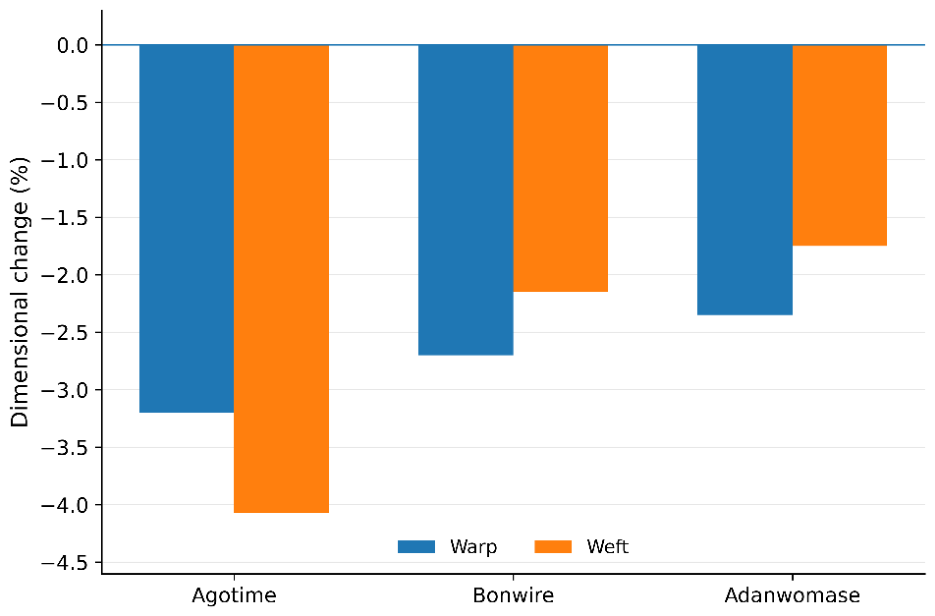
Figure 6.
Comparative mean tensile strength of Agotime, Bonwire, and Adanwomase strip-woven fabrics in the warp and weft directions. Error bars represent ±1 standard deviation.
Figure 6.
Comparative mean tensile strength of Agotime, Bonwire, and Adanwomase strip-woven fabrics in the warp and weft directions. Error bars represent ±1 standard deviation.
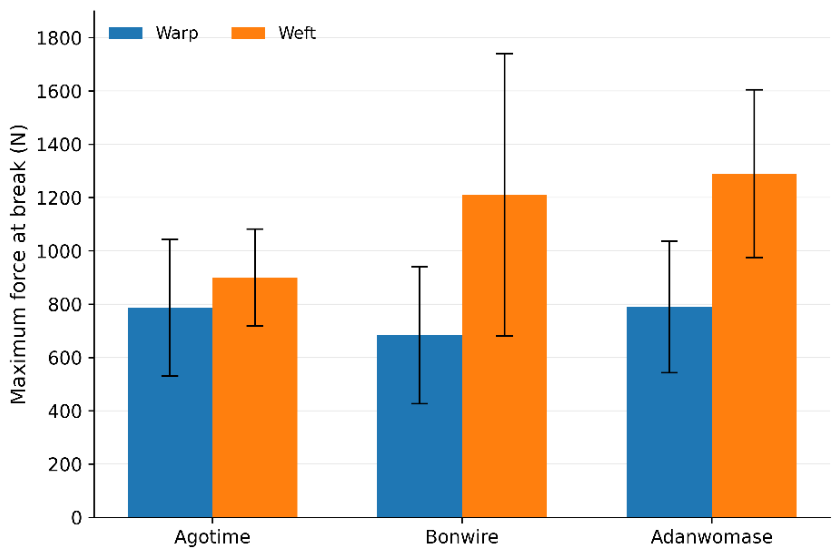
Table 1.
Indicative Structural Characteristics of the Strip-Woven Fabric Specimens.
| Sample ID | Weaving Group | Fibre Composition | Weave Type | Ends/cm | Picks/cm | Mass (g/m²) |
|---|---|---|---|---|---|---|
| AK1–AK8 | Agotime Kpetoe | Verified values only | Verified values only | Actual data | Actual data | Actual data |
| B1–B8 | Bonwire | Verified values only | Verified values only | Actual data | Actual data | Actual data |
| A1–A8 | Adanwomase | Verified values only | Verified values only | Actual data | Actual data | Actual data |
Note: Yarn linear density was not experimentally determined and is therefore not reported. Fibre-composition information should reflect only material types supported by sourcing records or documented physical/material assessment. Ends/cm and picks/cm should be reported only where actual measurements are available. Fabric mass per unit area should be reported using numerical values rather than the term Measured. Dye class and dyeing method were not experimentally determined because the fabrics were evaluated in their finished state.
Table 2.
Summary of Testing Conditions and Equipment.
| Parameter | Testing Principle | Equipment Type | Conditioning Environment |
| Tensile behaviour | Strip method; maximum force at break and, where available, breaking distance | Universal Testing Machine | 20 ± 2 °C, 65 ± 4% RH |
| Dimensional stability | Controlled laundering and dimensional-change measurement | Laundering equipment | 20 ± 2 °C, 65 ± 4% RH |
| Colourfastness to washing and staining | Accelerated washing and grey-scale assessment | Launder-Meter and assessment scales | 20 ± 2 °C, 65 ± 4% RH |
Table 3.
Reported Summary Statistics for Colourfastness to Washing.
| Weaving tradition | Mean grade | Observed range |
|---|---|---|
| Agotime | 4.70 | 4.5–5.0 |
| Bonwire | 4.50 | 4.5–4.5 |
| Adanwomase | 4.63 | 4.0–5.0 |
Table 4.
Colourfastness to Staining Results Based on Available Summary Data.
| Weaving tradition | Mean grade | Observed ranges |
|---|---|---|
| Agotime | 4.65 | 4.5 – 4.8 |
| Bonwire | 4.25 | 4.0 – 4.5 |
| Adanwomase | 4.50 | 4.3 – 4.7 |
Table 5.
Mean Dimensional Change of the Examined Strip-Woven Fabrics Following Laundering.
| Weaving tradition | Warp shrinkage (%) | Weft shrinkage (%) |
|---|---|---|
| Agotime | −3.20 | −4.07 |
| Bonwire | −2.70 | −2.15 |
| Adanwomase | −2.35 | −1.75 |
Table 6.
Warp-Direction Maximum Force at Break.
| Weaving tradition | Mean warp strength (N) (± SD) |
|---|---|
| Agotime | 786.9 ± 255.3 |
| Bonwire | 683.6 ± 257.4 |
| Adanwomase | 789.5 ± 247.1 |
Table 7.
Weft-Direction Maximum Force at Break.
| Weaving tradition | Mean weft strength (N) (± SD) |
|---|---|
| Agotime | 900.5 ± 181.6 |
| Bonwire | 1210.1 ± 530.1 |
| Adanwomase | 1289.8 ± 314.5 |
Disclaimer/Publisher’s Note: The statements, opinions and data contained in all publications are solely those of the individual author(s) and contributor(s) and not of MDPI and/or the editor(s). MDPI and/or the editor(s) disclaim responsibility for any injury to people or property resulting from any ideas, methods, instructions or products referred to in the content. |
© 2026 by the authors. Licensee MDPI, Basel, Switzerland. This article is an open access article distributed under the terms and conditions of the Creative Commons Attribution (CC BY) license (http://creativecommons.org/licenses/by/4.0/).
Copyright: This open access article is published under a Creative Commons CC BY 4.0 license, which permit the free download, distribution, and reuse, provided that the author and preprint are cited in any reuse.