

Submitted:
11 July 2026
Posted:
14 July 2026
You are already at the latest version
Abstract
Kubernetes has become the dominant orchestration platform for cloud-native applications, where autoscaling plays a critical role in maintaining performance, availability, and infrastructure efficiency. Traditional Kubernetes autoscaling mechanisms, including the Horizontal Pod Autoscaler (HPA), Vertical Pod Autoscaler (VPA), Cluster Autoscaler (CA), and Kubernetes Event-Driven Autoscaling (KEDA), primarily rely on reactive threshold-based scaling policies. Although these approaches are effective for relatively stable workloads, they often struggle to handle highly dynamic and bursty traffic patterns commonly observed in modern microservices, edge systems, and artificial intelligence (AI)-driven applications.Recent advances in machine learning (ML) and AI have significantly influenced Kubernetes autoscaling research. Researchers increasingly explored predictive forecasting, reinforcement learning, graph neural networks, and hybrid optimization frameworks to improve scaling responsiveness, reduce latency, minimize infrastructure cost, and optimize service-level objective (SLO) compliance. This paper presents a comprehensive review of ML-based Kubernetes autoscaling techniques published recently. The review is organized into four major autoscaling categories: HPA, VPA, CA, and event-driven autoscaling through KEDA. The paper further analyzes emerging trends, including transformer-based forecasting, multi-agent reinforcement learning, graph-enhanced orchestration, GPU-aware autoscaling, and in-place vertical scaling. Finally, open research challenges such as cross-workload generalization, explainability, scaling conflicts, and edge-cloud deployment constraints are discussed.
Keywords:
Kubernetes
; autoscaling
; machine learning
; deep learning
; reinforcement learning
; horizontal pod autoscaler
; vertical pod autoscaler
; cluster autoscaler
; KEDA
; cloud-native computing
1. Introduction
The rapid growth of cloud-native computing and containerized microservices has significantly increased the importance of Kubernetes as a production orchestration platform. As enterprise applications become increasingly distributed and workload patterns become more unpredictable, efficient resource management has become essential for maintaining application performance and infrastructure efficiency.
Autoscaling is one of the most important capabilities provided by Kubernetes. It enables applications and infrastructure resources to dynamically adjust according to workload demand. Kubernetes natively provides several autoscaling mechanisms, including the Horizontal Pod Autoscaler (HPA), Vertical Pod Autoscaler (VPA), and Cluster Autoscaler (CA). In addition, Kubernetes Event-Driven Autoscaling (KEDA) has gained significant popularity for handling event-driven and asynchronous workloads [1,2,3,4].
Despite their widespread adoption, traditional Kubernetes autoscalers primarily rely on reactive threshold-based policies. These mechanisms generally monitor metrics such as CPU utilization, memory consumption, or queue length and make scaling decisions after workload changes have already occurred. As a result, reactive autoscaling often suffers from delayed responses, scaling oscillations, resource overprovisioning, and poor performance under bursty or unpredictable workloads.
To address these limitations, recent research has increasingly explored ML and AI techniques for predictive and adaptive autoscaling. ML-based autoscaling systems aim to forecast future workload demand, optimize scaling decisions proactively, and coordinate multiple scaling dimensions simultaneously. Between 2023 and 2026, Kubernetes autoscaling research evolved rapidly from traditional time-series forecasting models toward reinforcement learning, graph neural networks, transformer architectures, and multi-agent optimization frameworks.
This paper presents a comprehensive review of ML-based Kubernetes autoscaling research published recently. The review focuses on four major autoscaling categories: HPA, VPA, CA, and KEDA. The primary contributions of this paper are summarized as follows:
- A focused review of recent ML-based Kubernetes autoscaling studies.
- Comparative analysis across HPA, VPA, CA, and KEDA.
- Identification of dominant ML techniques and architectural trends.
- Discussion of open research challenges and future directions.
- Consolidation of emerging developments recently publish.
The remainder of this paper is organized as follows. Section II presents the background of Kubernetes autoscaling mechanisms. Section III describes the review methodology. Sections IV–VII discuss ML-based approaches for HPA, VPA, CA, and KEDA, respectively. Section VIII provides cross-category comparative analysis. Section IX highlights open research challenges. Section X concludes the paper.
2. Background of Kubernetes Autoscaling
2.1. Horizontal Pod Autoscaler
The Horizontal Pod Autoscaler dynamically adjusts the number of pod replicas based on observed workload metrics such as CPU utilization, memory usage, or custom metrics. HPA remains the most widely used Kubernetes autoscaling mechanism due to its simplicity and direct integration with Kubernetes workloads [1].
The default HPA controller periodically monitors metrics and calculates the desired replica count based on predefined thresholds. While this reactive mechanism works effectively for stable workloads, it often struggles under sudden traffic spikes or rapidly changing workload patterns. Delayed scaling actions can lead to increased response latency, service degradation, and temporary resource shortages.
Recent research increasingly integrates ML models into HPA to enable predictive scaling. Time-series forecasting models such as Long Short-Term Memory (LSTM), Gated Recurrent Unit (GRU), Prophet, and Transformer architectures are commonly used to predict future workload demand before scaling actions are required [6,7,9].
2.2. Vertical Pod Autoscaler
The Vertical Pod Autoscaler dynamically adjusts CPU and memory resource allocations for running containers. Unlike HPA, which scales horizontally by modifying replica counts, VPA focuses on right-sizing container resources [2].
VPA consists of three major components: the recommender, updater, and admission controller. The recommender analyzes historical resource usage and generates CPU and memory recommendations. The updater applies resource changes, while the admission controller injects recommended values into newly created pods.
Recent Kubernetes releases introducing in-place pod resizing significantly increased research interest in ML-enhanced VPA systems. In-place resizing allows resource adjustments without restarting containers, making predictive and continuous vertical scaling increasingly practical for production environments [5,15].
2.3. Cluster Autoscaler
The Cluster Autoscaler manages infrastructure-level scaling by adding or removing worker nodes according to cluster resource demand. When workloads cannot be scheduled because of insufficient node capacity, the Cluster Autoscaler provisions additional nodes automatically.
Traditional CA approaches primarily rely on pending pod states and node utilization metrics. However, infrastructure provisioning delays can significantly affect application responsiveness. Consequently, recent research explores predictive node provisioning using ML techniques such as reinforcement learning, graph neural networks, and workload forecasting [11,21].
2.4. Kubernetes Event-Driven Autoscaling
KEDA extends Kubernetes autoscaling by enabling event-driven scaling using external triggers such as message queues, Kafka streams, RabbitMQ, Prometheus metrics, and custom application events [4]. KEDA has become increasingly important for serverless systems, AI inference workloads, streaming applications, and asynchronous microservices. One of its major advantages is scale-to-zero capability, which allows workloads to shut down during idle periods to reduce infrastructure cost.
3. Research Methodology
This paper conducts a focused literature review of ML-based Kubernetes autoscaling research published between 2023 and 2026. The review process follows a systematic filtering approach to identify relevant studies across multiple research databases.
The primary databases and sources used in this review include IEEE Xplore, ACM Digital Library, ScienceDirect, SpringerLink, Frontiers, arXiv, and Semantic Scholar. The following keyword combinations were used during the search process: “Kubernetes autoscaling machine learning,” “predictive HPA Kubernetes,” “Vertical Pod Autoscaler deep learning,” “Cluster Autoscaler reinforcement learning,” “KEDA predictive autoscaling,” “Transformer Kubernetes autoscaling,” and “multi-agent reinforcement learning Kubernetes.”
Studies were included if they satisfied the following conditions: publication between 2023 and 2026, primary focus on Kubernetes autoscaling, use of ML or AI techniques, inclusion of experimental evaluation or architectural contribution, and publication in academic venues or recognized preprint repositories. Tutorials, marketing-oriented vendor content, duplicate publications, non-technical opinion articles, and sources without technical evaluation were excluded from the main comparative analysis tables.
4. Machine Learning-Based Horizontal Pod Autoscaler
4.1. Deep Learning and Time-Series Forecasting
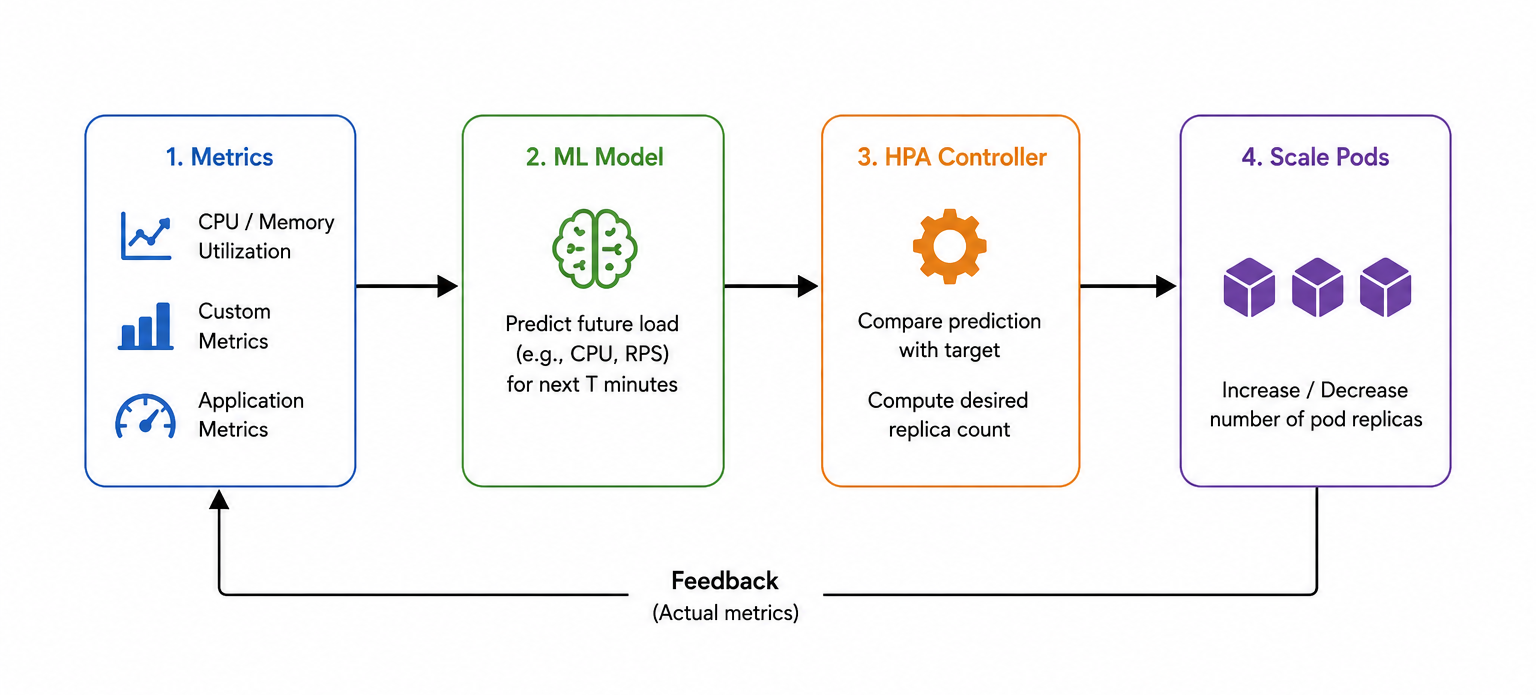
Figure 1 illustrates a simplified ML-enhanced HPA architecture. The workflow starts with metric collection from Kubernetes, application services, and custom monitoring systems. These metrics are passed to an ML model that predicts future workload demand. The HPA controller then compares the predicted values with scaling targets and computes the desired number of pod replicas.
Between 2023 and 2026, HPA research experienced significant growth in predictive workload forecasting techniques. Traditional reactive scaling strategies increasingly evolved toward proactive scaling systems capable of forecasting future workload demand.
Guruge and Priyadarshana proposed a hybrid Prophet and LSTM forecasting framework for Kubernetes autoscaling [6]. Their approach combined statistical forecasting with deep learning sequence modeling to improve prediction accuracy under fluctuating workloads. ByteDance introduced E3Former, an ensemble Transformer-based workload forecasting framework designed for large-scale production microservices [7]. The architecture combined multiple Transformer predictors to capture complex workload behaviors and improve latency-aware autoscaling decisions.
Several studies also explored lightweight deep learning approaches for cloud-native autoscaling. Zhang et al. proposed a CNN-based autoscaling model incorporating adaptive cooling mechanisms to reduce scaling oscillations and improve stability [8]. Reinforcement learning also became one of the most active research directions in Kubernetes autoscaling. Manzano et al. introduced a Bi-LSTM and PPO-based autoscaling framework designed to mitigate temporal blindness in Kubernetes scaling decisions [9].
Hierarchical multi-agent reinforcement learning frameworks such as MAS-H2 attempted to coordinate workload planning, horizontal scaling, and system-wide optimization simultaneously [10]. Graph-enhanced multi-agent approaches also appeared as a promising direction for decentralized autoscaling in larger clusters [11].
4.2. Comparative Analysis for HPA
Table 1 summarizes representative machine learning techniques applied to the Horizontal Pod Autoscaler recently. The reviewed studies demonstrate a clear transition from traditional reactive scaling toward predictive and intelligent autoscaling frameworks. Time-series forecasting models such as LSTM, Prophet, and Transformer architectures are widely adopted to predict workload demand proactively. In addition, reinforcement learning and multi-agent optimization frameworks increasingly appear in large-scale Kubernetes environments to improve scaling coordination, latency reduction, and resource utilization efficiency.
5. Machine Learning-Based Vertical Pod Autoscaler
5.1. Intelligent Vertical Scaling
Figure 2 shows a simplified ML-enhanced VPA architecture. The system collects CPU and memory usage from running pods, predicts optimal resource requests through an ML recommender, and then applies updated CPU and memory values using VPA components.
Vertical scaling research experienced substantial growth following the introduction of in-place pod resizing capabilities in Kubernetes. Prior to these developments, VPA updates typically required pod eviction and recreation, limiting applicability for latency-sensitive applications. Recent ML-based VPA systems increasingly focus on predictive resource allocation and intelligent right-sizing without workload interruption.
MARLISE introduced a multi-agent reinforcement learning framework for in-place vertical scaling of stateful microservices [15]. The system optimized CPU and memory allocation dynamically while avoiding service disruption. Similarly, LSTM-MARL-Ape-X proposed a distributed resource allocation framework combining BiLSTM forecasting with multi-agent reinforcement learning [16]. Bayesian optimization techniques also became increasingly relevant for container and JVM tuning scenarios [18].
5.2. Coordinated Vertical and Horizontal Scaling
One of the major research challenges in Kubernetes autoscaling is coordination between HPA and VPA. Both systems may react to CPU utilization simultaneously but in opposite directions, potentially creating scaling conflicts. Recent hierarchical reinforcement learning frameworks attempt to address this issue through coordinated multi-dimensional scaling policies [10]. These approaches aim to jointly optimize replica count, container resource allocation, and infrastructure provisioning.
5.3. Comparative Analysis for VPA
Table 2 presents recent machine learning-based approaches for Vertical Pod Autoscaler optimization. Unlike HPA, VPA research focuses primarily on intelligent resource right-sizing, CPU and memory allocation prediction, and in-place resource adjustment. Recent studies increasingly integrate reinforcement learning, Bayesian optimization, and deep learning forecasting to improve scaling precision while minimizing service disruption. Coordinated HPA-VPA optimization also emerged as an important research direction for resolving multi-dimensional scaling conflicts in Kubernetes environments.
6. Machine Learning-Based Cluster Autoscaler
6.1. Intelligent Cluster Provisioning
Figure 3 presents a simplified ML-driven CA architecture. The system collects resource utilization, pending pod information, node capacity, and historical cluster data. An ML prediction module forecasts future cluster demand, and the autoscaler decision engine determines whether to add nodes, remove nodes, or take no action.
Cluster Autoscaler research increasingly focuses on predictive infrastructure provisioning. Instead of waiting for pending pods to trigger node creation, ML-based approaches attempt to forecast workload growth proactively.
HGraphScale introduced a hierarchical graph neural network framework combined with deep reinforcement learning for cluster autoscaling [21]. The architecture captured complex microservice dependencies and workload relationships. ST-GNN frameworks further extended this concept by incorporating spatio-temporal workload modeling for large-scale orchestration [22]. Graph-enhanced reinforcement learning approaches such as AGMARL-DKS addressed scalability limitations in large Kubernetes environments by enabling decentralized decision-making across distributed agents [11].
6.2. Edge and Distributed Resource Management
Edge-cloud orchestration became another major research direction between 2024 and 2026. Researchers increasingly explored distributed reinforcement learning for IoT-edge-cloud resource management. Transfer learning and GRU-based forecasting frameworks demonstrated promising performance in handling workload variability across heterogeneous edge environments [23]. These approaches are particularly important for latency-sensitive systems such as AI inference, smart cities, and 5G network functions.
6.3. Comparative Analysis for Cluster Autoscaler
Table 3 summarizes representative ML-driven Cluster Autoscaler techniques proposed in recent studies. Current research increasingly emphasizes predictive node provisioning, distributed orchestration, and intelligent infrastructure optimization for large-scale Kubernetes clusters. Graph neural networks, reinforcement learning, and spatio-temporal forecasting models are widely explored to improve node scaling decisions, reduce provisioning latency, and optimize workload distribution across cloud and edge environments.
7. Machine Learning-Based KEDA and Event-Driven Autoscaling
7.1. Predictive Event-Driven Scaling
Figure 4 illustrates a simplified ML-enhanced KEDA architecture. Event sources such as Kafka, RabbitMQ, Prometheus, cloud services, and custom webhooks provide metrics or events to KEDA scalers. An ML prediction module forecasts future event load, and KEDA integrates with HPA to adjust pod replicas, including scale-to-zero and scale-from-zero scenarios.
KEDA emerged as one of the most influential event-driven autoscaling frameworks in Kubernetes ecosystems. Unlike traditional HPA systems relying primarily on CPU utilization, KEDA enables autoscaling based on external events such as queue depth, streaming metrics, and application-specific triggers.
Recent research increasingly integrates ML forecasting into KEDA pipelines. Predictive KEDA systems aim to anticipate incoming workloads before queues become saturated. The IIT KEDA study evaluated multiple deep learning approaches, including LSTM, GRU, Bi-GRU, and XGBoost, for predictive event-driven scaling [29]. PredictKube introduced AI-based forecasting for KEDA scaling using Prometheus metrics and historical workload behavior [31].
7.2. GPU-Aware and AI Inference Scaling
AI inference workloads became one of the fastest-growing Kubernetes deployment categories between 2024 and 2026. Large language models, image generation systems, and GPU-intensive inference services require efficient autoscaling because idle GPU resources can be expensive. Recent KEDA research increasingly focuses on scale-to-zero GPU inference architectures. KServe and KEDA integrations demonstrated practical approaches for scaling AI inference services using queue-driven triggers and predictive demand forecasting [32].
7.3. Comparative Analysis for KEDA
Table 4 presents recent machine learning-enhanced KEDA and event-driven autoscaling approaches. Unlike traditional resource-based autoscaling, KEDA focuses on external event processing, queue monitoring, and asynchronous workload management. Recent studies increasingly integrate predictive analytics, deep learning forecasting, and intelligent queue analysis to improve event-driven scaling responsiveness. GPU-aware autoscaling and scale-to-zero optimization also emerged as important research directions for AI inference workloads and cloud-native serverless systems.
8. Cross-Category Comparative Analysis
Across all four autoscaling categories, several ML techniques emerged as dominant approaches. Time-series forecasting models such as LSTM, GRU, and Prophet remained widely adopted because of their ability to capture workload trends and temporal behavior. Transformer-based architectures gained increasing popularity due to their ability to model long-range workload dependencies [7].
Reinforcement learning approaches became particularly important for multi-dimensional autoscaling optimization. PPO, DQN, and multi-agent reinforcement learning frameworks demonstrated strong potential for coordinated scaling decisions [9,10,11]. Graph neural networks also emerged as a promising direction for cluster-level orchestration because they can naturally represent microservice dependencies and workload relationships [21,22].
A clear architectural transition can be observed between early 2023 studies and more recent 2025–2026 research. Earlier studies primarily focused on isolated forecasting models for individual autoscaling mechanisms. In contrast, recent systems increasingly adopt hierarchical, multi-agent, and multi-objective architectures capable of coordinating HPA, VPA, CA, and KEDA simultaneously.
Another important trend is the integration of AI inference workloads into Kubernetes autoscaling research. GPU-aware scaling and scale-to-zero architectures are becoming increasingly important as AI services continue to grow [32].
9. Open Research Challenges
9.1. Cross-Workload Generalization
One of the most important challenges in ML-based autoscaling is workload diversity. Models trained on one workload type may perform poorly when deployed in different environments. General-purpose autoscaling models capable of handling heterogeneous workload patterns remain an open research problem.
9.2. Explainability and Trustworthiness
Many reinforcement learning and deep learning autoscaling systems operate as black-box decision models. Production deployment requires explainable scaling decisions to improve operator trust and facilitate debugging. Explainable AI for autoscaling remains relatively underexplored.
9.3. Multi-Dimensional Scaling Coordination
Coordinating HPA, VPA, CA, and KEDA simultaneously remains difficult because scaling decisions may interact in conflicting ways. Future research must focus on unified orchestration policies capable of optimizing multiple scaling dimensions concurrently.
9.4. Edge and AI Workload Constraints
Edge computing environments and GPU-intensive AI workloads introduce additional autoscaling constraints, including latency sensitivity, energy efficiency, and hardware provisioning delays. Lightweight and distributed ML-based autoscaling frameworks will likely become increasingly important for future Kubernetes ecosystems.
10. Conclusions
This paper presented a comprehensive review of ML-based Kubernetes autoscaling research published recently. The review focused on four major autoscaling categories: HPA, VPA, CA, and KEDA.
The findings demonstrate that Kubernetes autoscaling research is rapidly evolving from reactive threshold-based mechanisms toward intelligent, proactive, and coordinated orchestration systems. Deep learning, reinforcement learning, graph neural networks, and hybrid forecasting frameworks increasingly dominate recent research contributions.
Transformer-based forecasting, multi-agent reinforcement learning, graph-enhanced orchestration, and predictive event-driven scaling emerged as major research trends. At the same time, open challenges remain in explainability, workload generalization, scaling coordination, and edge-cloud deployment.
Future Kubernetes autoscaling systems will likely move toward fully autonomous resource orchestration frameworks capable of jointly optimizing performance, energy efficiency, cost, and reliability across highly dynamic cloud-native environments.
References
- Kubernetes Documentation, “Horizontal Pod Autoscaling,” 2024.
- Kubernetes Documentation, “Vertical Pod Autoscaling,” 2026.
- Kubernetes Documentation, “Autoscaling Workloads,” 2025.
- KEDA, “Kubernetes Event-Driven Autoscaling,” 2025. [CrossRef] [PubMed]
- Kubernetes Blog, “In-Place Pod Resize Graduates to Stable,” 2025. [CrossRef] [PubMed]
- T. Guruge and B. Priyadarshana, “Time Series Forecasting-Based Kubernetes Autoscaling Using Prophet and LSTM,” Frontiers in Computer Science, 2025.
- ByteDance Research, “E3Former: Online Ensemble Transformer for Accurate Cloud Workload Forecasting,” arXiv preprint, 2025.
- Zhang et al., “Cloud Resource Auto-Scaling Strategy Based on CNN-Lightweight,” 2025. [CrossRef] [PubMed]
- Manzano et al., “Mitigating Temporal Blindness in Kubernetes Autoscaling,” arXiv preprint, 2026.
- “MAS-H2: A Hierarchical Multi-Agent System for Holistic Cloud-Native Autoscaling,” arXiv preprint, 2026.
- “AGMARL-DKS: Adaptive Graph-Enhanced Multi-Agent Reinforcement Learning for Kubernetes,” arXiv preprint, 2026.
- Vestergaard et al., “Comparing Neural and Statistical Time-Series Models for Proactive Autoscaling,” 2025. [CrossRef] [PubMed]
- Punniyamoorthy et al., “An SLO-Driven and Cost-Aware Autoscaling Framework for Kubernetes,” arXiv preprint, 2025.
- “STAR: Spatial-Temporal Autoscaling for Cloud Applications with Deep Reinforcement Learning,” 2026.
- “MARLISE: Multi-Agent Reinforcement Learning-Based In-Place Scaling Engine,” arXiv preprint, 2025.
- “A Scalable Machine Learning Strategy for Resource Allocation in Cloud-Native Environments,” Nature Scientific Reports, 2025. [CrossRef] [PubMed]
- “Understanding Kubernetes-Based Adaptive Cost Optimization for Vertical Pod Autoscaling,” 2025. [CrossRef] [PubMed]
- Akamas, “Kubernetes VPA Autoscaling: Effect on Service Cost and Efficiency,” 2023.
- CNCF Blog, “Optimizing Kubernetes Vertical Pod Autoscaler Responsiveness,” 2023. [CrossRef] [PubMed]
- “Towards Intelligent Container Orchestration in Cloud Computing,” 2026.
- “HGraphScale: Hierarchical Graph Learning for Autoscaling in Kubernetes,” IEEE Transactions on Services Computing, 2025.
- “Immersive Intelligence: ST-GNN Guided and RL-Optimized Orchestration,” 2026.
- “Towards a Proactive Autoscaling Framework for Data Stream Processing at the Edge,” arXiv preprint, 2025.
- “Deep Reinforcement Learning for Resource Management in IoT-Edge-Cloud Environments,” 2026.
- “Reinforcement Learning-Driven Kubernetes Autoscaling for High-Traffic 5G Network Functions,” 2025. [CrossRef] [PubMed]
- “A Kubernetes Custom Scheduler Based on Reinforcement Learning for Compute-Intensive Pods,” 2026.
- “Enhancing Kubernetes Resilience through Anomaly Detection and Predictive Scaling,” arXiv preprint, 2025.
- “Toward Context-Aware Anomaly Detection for AIOps in Kubernetes,” 2026. [CrossRef] [PubMed]
- “Predictive Autoscaler for Kubernetes with Kubernetes Event-Driven Autoscaling,” 2024.
- “Predictive Autoscaling in Kubernetes Microservices with KEDA and Deep Neural Networks,” 2026.
- PredictKube, “AI-Based Predictive Autoscaling for KEDA,” 2023.
- “Event-Driven Scaling for Machine Learning: KEDA and KServe,” 2026.
- Flightcrew, “Scaling Kubernetes with KEDA and RabbitMQ,” 2025. [CrossRef] [PubMed]
Figure 1.
Simple architecture of an ML-enhanced Horizontal Pod Autoscaler (HPA).
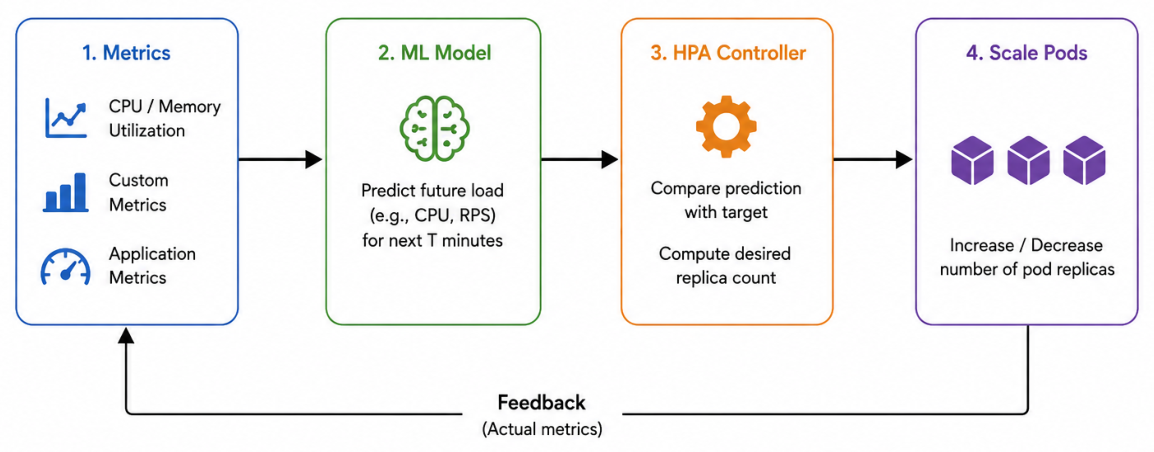
Figure 2.
Simple architecture of an ML-enhanced Vertical Pod Autoscaler (VPA).
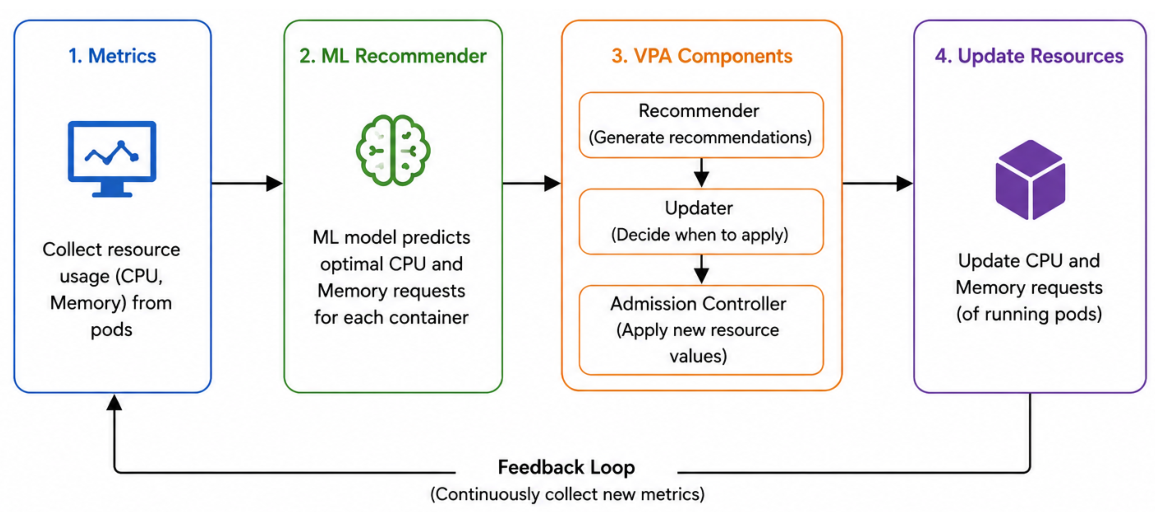
Figure 3.
Simple architecture of an ML-driven Cluster Autoscaler (CA).
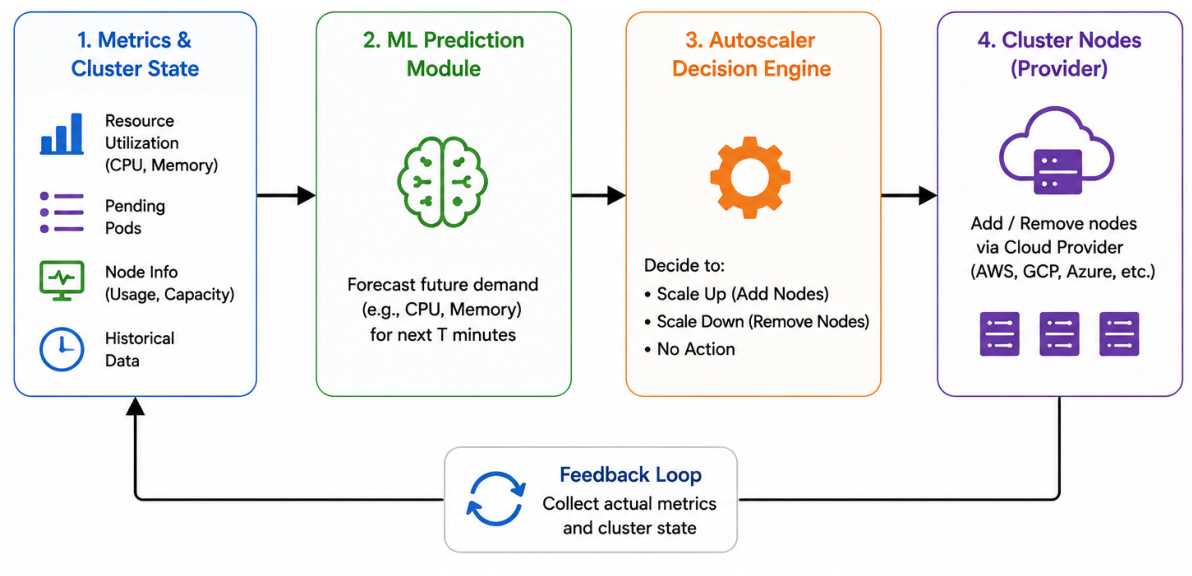
Figure 4.
Simple architecture of ML-enhanced KEDA for event-driven autoscaling.
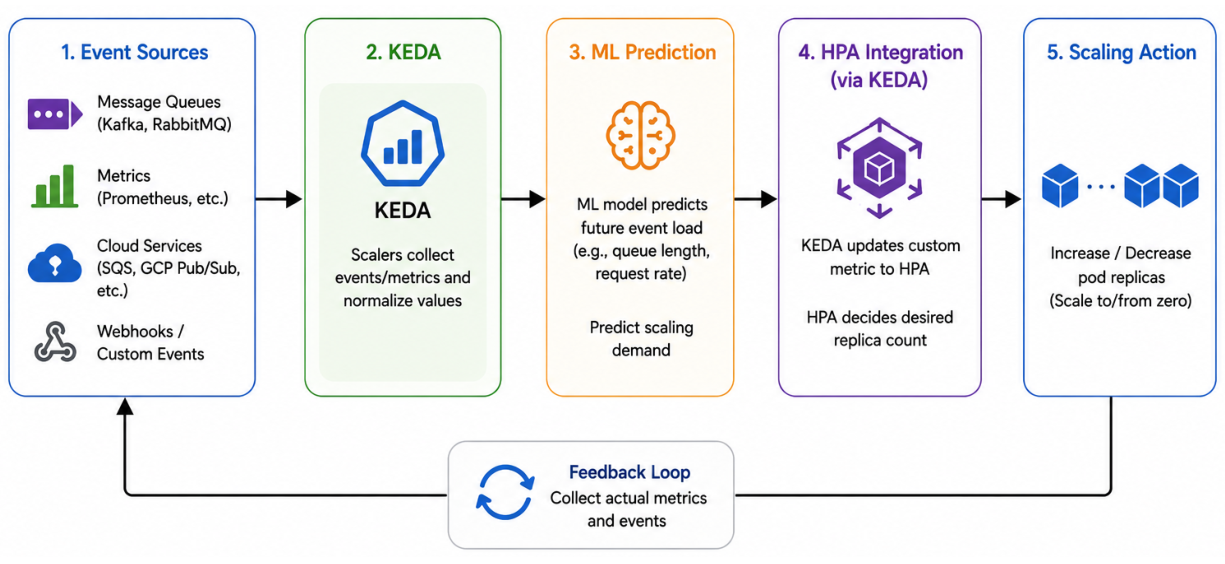

Table 1.
ML Techniques for Horizontal Pod Autoscaler (HPA).
| Ref. | Authors / Year | ML Technique | Environment | Main Contribution |
|---|---|---|---|---|
| [6] | Guruge and Priyadarshana (2025) | Prophet + LSTM | Kubernetes workloads | Hybrid forecasting improves proactive scaling accuracy. |
| [7] | ByteDance E3Former (2025) | Ensemble Transformer | Production microservices | Transformer-based workload prediction for latency-aware autoscaling. |
| [8] | Zhang et al. (2025) | CNN-Lightweight | Cloud workloads | Adaptive cooling and scaling stabilization. |
| [9] | Manzano et al. (2026) | Bi-LSTM + PPO | Azure/Kubernetes | Reinforcement learning for latency-aware HPA. |
| [10] | MAS-H2 (2026) | Hierarchical MARL | GKE testbed | Multi-agent coordination between HPA and VPA. |
| [11] | AGMARL-DKS (2026) | Graph-enhanced MARL | Large Kubernetes clusters | Decentralized autoscaling decisions. |
| [12] | Vestergaard et al. (2025) | Comparative time-series models | FinTech workloads | Comparison of neural and statistical forecasting for proactive scaling. |
| [13] | Punniyamoorthy et al. (2025) | SLO-aware AIOps | Kubernetes microservices | Cost-aware and SLO-driven autoscaling. |
| [14] | STAR (2026) | Spatial-temporal DRL | Cloud application traces | DRL optimization for workload dynamics. |
Table 2.
ML Techniques for Vertical Pod Autoscaler (VPA).
| Ref. | Authors / Year | ML Technique | Optimization Target | Main Contribution |
|---|---|---|---|---|
| [15] | MARLISE (2025) | Multi-agent RL | In-place CPU/memory resize | Stateful workload vertical scaling without restart. |
| [16] | LSTM-MARL-Ape-X (2025) | BiLSTM + MARL | Distributed resource allocation | SLA-aware and energy-efficient scaling. |
| [17] | AI-VPA Study (2025) | Deep learning forecasting | Resource right-sizing | Long-horizon workload prediction. |
| [18] | Akamas (2023) | Bayesian optimization | JVM/container tuning | Cost-aware VPA optimization. |
| [19] | CNCF VPA Optimization (2023) | Heuristic + ML tuning | Recommender responsiveness | Improved VPA responsiveness. |
| [10] | MAS-H2 (2026) | Hierarchical MARL | HPA/VPA coordination | Unified autoscaling conflict resolution. |
| [20] | IJERT ICO (2026) | LSTM + CNN | Container provisioning | Deep learning-based vertical scaling. |
Table 3.
ML Techniques for Cluster Autoscaler.
| Ref. | Authors / Year | ML Technique | Cluster Target | Main Contribution |
|---|---|---|---|---|
| [21] | HGraphScale (2025) | CHGNN + DRL | Cluster and pod scaling | Hierarchical graph learning for autoscaling. |
| [22] | ST-GNN Framework (2026) | ST-GNN + RL | Intent-aware orchestration | Unified spatio-temporal orchestration. |
| [11] | AGMARL-DKS (2026) | Graph-enhanced MARL | Large Kubernetes clusters | Decentralized scalable autoscaling. |
| [14] | STAR (2026) | Spatial-temporal DRL | Cloud application clusters | Captures temporal and spatial workload patterns. |
| [23] | GRU + Transfer Learning (2025) | GRU + DTW transfer | Edge cluster provisioning | Domain adaptation for proactive scaling. |
| [24] | Melbourne IoT-Edge MARL (2026) | Multi-agent RL | Edge-cloud continuum | Region-aware distributed provisioning. |
| [25] | WJAETS 5G DRL (2025) | Deep RL | 5G node slicing | Robust autoscaling under traffic variation. |
| [26] | RL Kubernetes Scheduler (2026) | RL scheduling | Compute-intensive workloads | Improved resource utilization. |
| [27] | Kubernetes Anomaly Detection (2025) | LSTM + Autoencoder | Fault prediction | Predictive anomaly-aware autoscaling. |
| [28] | IEEE AIOps Transformer (2026) | Masked Transformer | Container anomaly detection | Reduction of false scaling events. |
Table 4.
ML Techniques for KEDA/Event-Driven Autoscaling.
| Ref. | Authors / Year | ML Technique | Trigger Source | Main Contribution |
|---|---|---|---|---|
| [29] | IIT KEDA Study (2024) | Bi-GRU, GRU, LSTM | Multi-source KEDA metrics | Bi-GRU provides strong prediction accuracy. |
| [30] | Jisem-Journal (2026) | DNN + Prophet | CPU, memory, network, storage | Multivariate predictive autoscaling. |
| [31] | PredictKube (2023) | AI time-series forecasting | Prometheus metrics | Forecast-based proactive KEDA scaling. |
| [32] | KServe + KEDA (2026) | Demand prediction | LLM inference queues | Scale-from-zero GPU inference workloads. |
| [33] | Flightcrew RabbitMQ Study (2025) | Queue-depth scaling | RabbitMQ workloads | Event-driven queue-aware scaling. |
Disclaimer/Publisher’s Note: The statements, opinions and data contained in all publications are solely those of the individual author(s) and contributor(s) and not of MDPI and/or the editor(s). MDPI and/or the editor(s) disclaim responsibility for any injury to people or property resulting from any ideas, methods, instructions or products referred to in the content. |
© 2026 by the authors. Licensee MDPI, Basel, Switzerland. This article is an open access article distributed under the terms and conditions of the Creative Commons Attribution (CC BY) license (http://creativecommons.org/licenses/by/4.0/).
Copyright: This open access article is published under a Creative Commons CC BY 4.0 license, which permit the free download, distribution, and reuse, provided that the author and preprint are cited in any reuse.


