

Submitted:
13 July 2026
Posted:
14 July 2026
You are already at the latest version
Abstract
This study sought to utilize a multilevel institutional perspective to analyze corporate social responsibility (CSR) practices in Vietnam, which is a developing country with institutional voids and competing normative systems. Data were collected using a survey of 463 managers of various Vietnamese companies. Then, a PLS-SEM model was used to assess the roles of individual-level (IND) variables and the organizational context (ORG) in CSR, as well as the influence of the external social context (EXT). The results showed that ORG is the primary internal factor of CSR (β = 0.258; p < 0.001). IND has a slight influence on CSR (β = -0.074; p = 0.033) in opposition to theoretical expectation. EXT is positively moderating the IND–CSR and ORG–CSR relationships, with Governance and Tradition being more significant than Modernity. The implications are that CSR in countries undergoing transition has a hybrid nature and that there is an institutional hierarchy.
Keywords:
CSR
; institutional theory
; multilevel institutions
; transitional economy
; Vietnam
; sustainable development
1. Introduction
Corporate social responsibility (CSR) has gained much attention from various stakeholders and has been studied in detail by many researchers [1]. Many enterprises engage in a number of activities for the good of society in accordance with their social responsibilities, well above the requirements of law [2]. CSR has already become a mature phenomenon, and this has allowed it to play a role in the development of new business models [3]. CSR assumes a strategic role in business planning and serves as a tool of governance aimed at achieving sustainable economic, social, and environmental development [4]. Based on the fact that the United Nations Sustainable Development Goals (SDGs) have entered the world agenda very recently, CSR is regarded as an important means for companies to become competitive and legitimate in an increasingly demanding business environment [5].
Although CSR has become a topic of interest for research in recent decades, it is still lacking some theoretical and empirical insights about the processes of this practice in transitional economies. Much of the existing research is based on Western interpretation of the subject, implying that free markets are at a highly developed stage with a strong legal system and considerable control by civil society [6,7]. Applying theories in the area of CSR to transitional economies requires substantial modification, as the differences in institutions and culture can lead to misleading results [8,9]. The issue is that most studies focus on one-level research, referring to the analysis of yearly reports or surveys [9]. Multi-level research involving both macro-institutional factors and organizational and managerial context is rare [6,10,11]. Furthermore, there are very few context-sensitive studies that would help better understand the interaction between the traditional values and modern pressures in transitional economies [6,9].
The case study of Vietnam was chosen for identifying the knowledge gap because of its status of being a transitional economy with a special set of institutional characteristics [6,12]. Vietnam has moved towards a market economy since its “Doi Moi” (Renovation) policy, and now both socialist and capitalist systems coexist in one society [7,9]. When Vietnam participates in new-generation free trade agreements (FTAs), such as the EU-Vietnam FTA, Vietnamese enterprises have to comply with international labor and environmental standards [13]. Furthermore, the Eastern cultural approach, influenced by Confucianism and Buddhism, generated special ideas about business ethics, where the “Heart” and social harmony are the main elements [7,14]. The current research conducted in Vietnam enriches the theory as it studies how firms from a transitional economy adopt and modify the concept of CSR to make it fit the local context [6,9].
This research aims to identify the variables that enhance CSR implementation in transition economies using a multilevel institutional framework based on the works of Nguyen et al. [6], Edwards and Phan [15], and Athanasopoulou and Selsky [16]. In other words, CSR implementation is influenced by macro conditions of regulation, meso strategies of organizational behavior, and micro managers’ characteristics [6,11,16]. The incorporation of these factors with the context of the organization and external environment would give an overall understanding of how CSR is carried out in a transitional economy [6].
This research is supposed to result in three essential contributions. It seeks to enrich institutional theory by illustrating how institutional pressure acts in combination [6,11]. The existing knowledge concerning CSR in non-Western contexts is broadened due to the inclusion of cultural traditional factors in the model [6,9]. Moreover, the use of survey data from 463 managers in combination with PLS-SEM analysis results in a multi-level model validation [17]. The dataset is significant because it represents CSR practices from the perspective of managers at the organizational level, which helps to have a better understanding of CSR apart from using annual reports that reflect only publicly available information [18]. Lastly, results of the research have an important value for managers willing to implement CSR as part of their business strategy to increase competitiveness [19,20]. For policymakers, the research provides scientific input for the development of legal and national action programs aiming at the promotion of responsible business practices in line with sustainable development goals [7,13].
2. Literature Review and Hypotheses Development
2.1. Corporate Social Responsibility for Sustainable Development
The idea of CSR was first introduced in the middle of the 20th century and has been evolving through generations and social circumstances since that time [21]. Carroll’s pyramid model [22] is considered one of the key theoretical approaches. As per this approach, four aspects make up corporate responsibility, which are economic, legal, ethical, and philanthropic: making profits, obeying the laws, satisfying society’s moral expectations, and giving back to the community. The economic, environmental, and social aspects are represented in the Triple Bottom Line approach proposed by Elkington [23]. These aspects are connected with profits, people, and planet. The Stakeholder Theory developed by numerous scientists, like Edward Freeman and John Mcvea [24], states that businesses should keep a balance between the stakeholders’ interests and pay attention to meeting their needs. In recent years, CSR has been recognized as important and necessary not only for companies to boost their earnings but also for global development [4]. In transitional economies like Vietnam, the adoption of CSR is influenced by global standards and national characteristics, which results in the appearance of certain difficulties [6]. Companies use CSR to implement their plans regarding SDGs, but the degree of understanding of CSR is still limited to charity initiatives [6,20].
2.2. CSR In Transition Economies
In transitioning economies, the adoption of CSR is quite different from its implementation in developed economies due to the influences of institutional changes and globalization. In developed economies, CSR drivers are mainly represented by the pressure from stakeholders like consumers and investors and a well-functioning legal system [26]. However, CSR is performed in transitioning economies through a hybrid model, representing the combination of contemporary governance norms and values with the practices inherited from the previous economic system. According to Stoian and Zaharia [27], CSR in these economies is influenced by international practices (exogenous CSR) and national (endogenous CSR) context represented by the local historical and institutional environment. Thus, in transition economies, CSR implementation is not aimed at achieving strategic objectives such as emission reductions, responsible investments, or creation of sustainable value for stakeholders. Instead, CSR is a reactive process focused on gaining legitimacy for businesses, fulfilling institutional requirements, and improving competitiveness in dynamic environments [27]. This means that the CSR models and policies developed in developed economies should be modified to suit the requirements of transition economies.
Moreover, there exist institutional gaps in transitional economies, where the market institutions are not properly functioning while the Government continues playing a crucial role in economic regulation and the allocation of resources [6]. Hence, companies are frequently obliged to deal with various types of institutional pressures that may contradict each other. For example, in China, the inconsistency between the aim of the central government regarding sustainable development and the desire of local authorities to boost short-term economic development has resulted in a decoupling of CSR implementation practices so that the companies’ commitments to CSR do not comply with their practical behavior [28]. In Vietnam, new-generation FTAs require companies to correspond to international CSR standards while adapting to the modernizing national legal framework and regulatory mechanisms [13]. It can be stressed that this environment is characterized by different levels and dimensions of the institutional environment, so that both business and institutional factors at different levels are shaping the context for CSR in the country.
The differences in institutional contexts indicate that empirical evidence from developed countries may not adequately explain the processes of CSR development and implementation in transitional economies. It is likely that in Vietnam, where market economy principles coexist with socialist orientations and a strong role of government regulation, CSR mechanisms will be shaped by individual, organizational, and institutional factors working together [6]. Thus, the creation of integrated research models that take into account the levels of influence and special features of the institutional context will help explain CSR behavior in transition economies more fully.
2.3. Multilevel Institutional Perspective
Institutional theory proposes that the application of CSR is determined by the confluence of the influences of many factors on different layers of society, namely, the individual (micro), organizational (meso), and institutional (macro) level [10,16]. Moreover, the application of CSR is affected by formal institutions, which may include any written laws, regulations, and standards of compliance, as well as informal institutions such as culture and customs [6,11,14,18]. In the context of Vietnam’s transitional economy, CSR takes place under the influence of formal requirements of international integration and local culture, as well as changing norms and imitation of stakeholders. Hence, it can be concluded that CSR behavior is to be explained from the perspective of multilevel institutional theory, which presupposes consideration of the influence of managers’ characteristics, the organization’s context, and institutional environment [6,13,29].
Individual Level
Managers play a decisive role in guiding and implementing CSR activities [7]. Managers’ perceptions not only reflect personal values and beliefs but also serve as a mechanism for interpreting signals from the institutional environment, thereby translating stakeholders’ pressures and expectations into corporate decisions and action programs [30,31,32]. Many empirical studies show that managers’ personal characteristics, ethical values, beliefs, and demographic traits significantly influence their attitudes and intentions to engage in CSR activities [33,34,35]. Senior managers play an important role in allocating financial and human resources and setting strategic priorities for the implementation of CSR [30].
In Vietnam, empirical studies showed that when managers have a positive awareness of CSR, businesses tend to strengthen their CSR commitment, thereby promoting corporate citizenship behavior and improving employee performance [36]. Although local cultural values and philosophies influence this perception, the interaction between individual factors and institutional pressures further confirms the central role of managers in determining the level of CSR implementation in businesses [37]. Therefore, the study proposes the following hypothesis:
H1.Individual managers’ perspectives positively impact firms’ CSR implementation in Vietnam.
Organizational Context
Beyond managers’ roles, the organizational context is a crucial factor in determining the ability to translate CSR commitments into practical actions. To implement CSR effectively, businesses need to integrate social responsibility values into their organizational culture, governance systems, and human resource management policies, thereby facilitating resource mobilization and encouraging employee participation [20,38]. Studies in Vietnam show that the capacity to implement CSR varies significantly among businesses. Small and medium-sized enterprises (SMEs) in Vietnam often face difficulties accessing the resources and knowledge needed to implement CSR systematically [39]. Enterprises participating in global supply chains face pressure from international customers and partners to meet CSR standards, even with limited resources [19,40]. This evidence suggests that the influence of the organizational context on CSR depends not only on firms’ size or resources but also on the interaction between internal governance capabilities and external environmental pressures. However, most current studies consider only single aspects of the organizational context or focus on listed companies, without fully assessing the combined role of the organizational context in CSR implementation across different perspectives in Vietnam [7,41]. Therefore, this study proposes the following hypothesis:
H2.The organizational context positively impacts CSR implementation in Vietnam.
External Social Context
In transitional economies, the application of CSR is impacted by both the internal circumstances of the company and the external social environment, including institutional conditions, culture, and conditions of the social environment as explained by Jamali & Karam [8]. This environment influences how CSR implementation is perceived, justified, and acted based on institutional pressures, social norms, and stakeholder claims, and also impacts relationships between factors on individual, organizational, and CSR implementation levels [6]. The institutional theory (adapted from studies conducted by Edwards and Phan [15] and Nguyen et al. [6] has conceptualized the effect of the external social environment on CSR implementation into three major components – traditions, governance, and modernity that demonstrate the crucial features of the Vietnamese institutional and social environment and are likely to have a moderating impact on CSR implementation.
Tradition
In economies where there is a transition, tradition plays an essential role in informal institutions, together with ethical norms, religious beliefs, and cultural standards that are passed from one generation to another, making companies understand what CSR means and how it needs to be pursued [6]. In Vietnam, there are many Confucian principles such as “Heart,” “Humanity,” “Righteousness,” and “Trust,” as well as beliefs of Buddhism such as “Compassion” and “Karma.” The Vietnamese principles imply traditions of communityism and family spirit, which help the nation develop ethics and socially responsible behavior in companies, influencing many different aspects of social life, including charity and community investments [7,15,39,42]. Traditional values influence the behavior of an individual and provide many aspects of intrinsic influence on CSR implementation [6].
Governance
Governance signifies the part played by the state, quality of institutions, and legal systems in steering business conduct [43]. The Vietnamese state promotes CSR by means of political doctrines, rules, and regulations, labor and environmental norms, and structures such as trade unions and the Vietnam Women’s Union, thus a pressure from institutions for businesses to get engaged in social accountability [15,44]. However, existing institutional gaps and weaknesses in law application result in differences in CSR compliance [12,41]. It means that governance is of great importance in CSR execution.
Modernity
Modernity, which is associated with global integration, digital transformation, and economic globalization, is changing CSR practices in Vietnam by introducing international standards, requirements from free trade agreements like the EVFTA, international standards like ISO 26000, and rising expectations of stakeholders [15,46]. The above challenges push companies to evolve from philanthropy-driven CSR to more product-driven strategic CSR that meets the global competition requirements [39]. However, due to the existing institutional voids and profit-seeking objectives, the influence of modernity on CSR is not always consistent and can produce various levels of CSR, from formal to reactive CSR [12,44]. Some aspects of modernity might strengthen the impact of internal factors because more pressure comes from the external market and stakeholders. However, the role of modernization in this process has not been explored in the Vietnamese context [6].
Based on the above gaps, the authors suggest the following hypotheses:
H3a. The external social context positively moderates the relationship between individual-level factors and CSR performance, such that the impact of individual-level factors on CSR implementation is stronger in a favorable external social context.
H3b. The external social context positively moderates the relationship between the organizational context and the implementation of CSR, such that the impact of the organizational context on CSR implementation is stronger in a favorable external social context.
3. Methods
3.1. Research Design
Based on the literature review, the following research model is proposed (Figure 1):
The study team designed a structured questionnaire that was mainly built upon the work of Van and Nguyen [40], Nguyen et al. [6], Athanasopoulos and Selsky [16], Minh et al. [7], Ortmann [44], Vuong [12], and Edwards and Phan [15]. This questionnaire went through several rounds of refinement after consulting with five CSR experts, two specialists in research methodology, and two highly experienced managers with the aim of evaluating variables, scales, and techniques; reflecting on feasibility; ensuring clarity; and making sure that wording was contextually relevant to business. As a result, a pilot test was conducted with 20 managers in order to create the final version of the questionnaire.
The final survey included the use of a 5-point Likert scale (1 – Completely disagree; 5 – Completely agree). The survey consisted of two independent variables: Individual level (IND), which includes 8 measurements (IND1-IND8), and Organizational context (ORG), which consists of 5 measurements (ORG1-ORG5). There was one moderator, being External social context with variables of Tradition (TRA), having been assessed with the 4 measurements (TRA1-TRA4); Governance (GOV) with 5 measurements (GOV1-GOV5); and Modernity (MOD) with 4 measurements (MOD1-MOD4). The dependent variable was CSR (CSR1-CSR5) (See Appendix A, Table A1).
3.2. Sample and Data Collection
The process of proportionate stratified sampling was utilized based on the business size, assessed by the number of people employed and the amount of revenue earned according to the classification rules laid down by the Vietnamese legislation in Decree 80/2021/ND-CP. The sample was distributed proportionately to reflect the existing situation in the population regarding business size.
Three geographical areas of Vietnam were chosen. In each of these areas, three provinces were selected. In the Northern area, Hanoi was chosen as the capital of Vietnam, being situated in the Red River Delta. Bac Ninh and Bac Giang1 were chosen according to the respective location of this territory, being situated between the delta and highlands and being located in the northern highland and mountainous area. In the Highland area, Quang Nam province of Vietnam was chosen as a coastal territory, and Quang Ngai province was defined as transitional between coastal and highland areas, being situated there, while Dak Lak is located in the middle of the Highlands. In the Southern area, being located in the Mekong Delta region, Can Tho province was chosen, as Dong Nai serves as a connecting territory between different provinces of the South area, Central provinces, and Southern highlands. Ben Tre province is a coastal province which plays a strategic role in the region.
This research work adopts Partial Least Squares Structural Equation Modeling (PLS-SEM). The determination of sample size in PLS-SEM should be based on the complexity of the model and the level of statistical power needed [17]. The latent variable with the largest number of indicators is IND with eight observed variables. Therefore, according to the 10 times rule, the minimum sample size is determined to be 80 observations [17]. Notably, this is only a guiding rule. Therefore, many papers use this rule along with a statistical power analysis. Cohen [47], for instance, argues that for a significance level alpha= 0.05, with the power of the test equal to 0.80 where there are two predictors and the mean effect size equaling f2=0.15, the minimum sample size is about 68 observations.
The respondents of the study were managers of companies in Vietnam whose decisions refer to the implementation of CSR. Given that they frequently travel around the world, in order to simplify the process of conducting the survey, a letter of contact and the questionnaire were sent to these organizations beforehand. After the process of sending the letter was completed, the managers were contacted by the members of the research group in order to finalize the schedule for the interview. The interviews were conducted in the second quarter of 2025. As a result, the study obtained 463 usable respondents, which significantly surpassed the minimum requirements of both methods and fulfilled the conditions of adequate statistical power, guaranteeing the stability of the coefficients obtained, the reliability of the bootstrap outcomes, and the possibility to find statistically significant relationships via PLS-SEM [17].
3.3. Descriptive Statistics of the Survey Sample
The characteristics of the sample are presented in Table 1.
Respondents in this survey are often mature professionals with strong educational backgrounds, as 86.2% are 36 years and older, and over 90% have at least an undergraduate degree. This has a positive impact on modern management views as well as approach to CSR, which is thought of as long-term sustainable development instead of purely fulfilling regulations. Women in management hold 47.1% of leadership positions, showing that there is movement towards gender equality and increasing importance of women in building responsible corporate cultures. The survey featured Vietnamese private companies a lot, as most businesses in this sample were small and micro-sized, where 32% of respondents employed 10 or fewer people and 46.2% reported revenues of less than 3 billion dong. The data suggests that half of the businesses have been operating for more than 10 years, which is evidence of organizational sustainability.
3.4. Data Processing and Analysis
The relationship between individual level (IND), organizational context (ORG), external social context (EXT), and CSR was examined via a two-step model in SPSS 26 and SMARTPLS 4 according to the two-stage methodology of PLS-SEM [17]. In the first stage, the measurement model is assessed for its appropriateness for further analysis, and the second stage focuses on the structural model study. Cronbach’s alpha, reliability of the internal consistency of the measurement model, and its convergent and discriminant validity are used for measurement model evaluation [48]. The structural model is evaluated based on both direct and indirect effects in order to prove or disprove the hypothesis posed in the research. Path coefficients, R2, f2, and p-values are applied in the evaluation process. In this work, the variable ETX is defined as a second-order construct formed by three first-order constructs named Tradition (TRA), Governance (GOV), and Modernity (MOD).
3. Results
3.1. Measurement Model Analysis
The results of the preliminary analysis indicated that the following variables: IND5, IND6, ORG1, ORG2, and ORG3 had lower loadings than 0.7 (see Appendix A, Table 2A), thus indicating the necessity of eliminating these variables [17]. For the CSR group, CSR3, CSR4, and CSR5 are just below the cut-off of 0.7; therefore, the variable with the weakest loading coefficient, CSR5, was eliminated to see how it impacts the results. After eliminating this variable and conducting the analysis again, the CSR4 variable turned out to have a load factor lower than the 0.7 threshold (see Appendix A, Table 2A); thus, it was eliminated as well. After eliminating CSR5, the second rerun revealed that all load factors varied between 0.709 and 0.934 (see Table 2), thus demonstrating that all variables are significant.
Cronbach’s Alpha coefficients of all variables were from 0.793 to 0.911. The value of the Composite Reliability (CR) (rho_a) index was from 0.807 to 0.912. They were higher than 0.7 [49]. The above indicates that measurement variables are valid (Table 3).
The Fornell-Larker test and Heterotrait-Monotrait Ratio approach (HTMT) were used to evaluate discriminant validity [48]. In this case, HTMT values for the latent variables ranged from 0.00 to less than 0.90, which confirms that discriminant validity has been established in the context of this study (see Table 4).
According to the results from the Fornell-Larker test, it was found that the square root of the average variance extracted (AVE) of each latent variable exceeded the correlation coefficient of that variable to every other latent variable. This justifies the claim that each latent variable is better able to explain its observed variables than the other latent variables. Thus, for the purpose of this research, discriminant requirements of Fornell and Larcker have been met.
The initial two first-order constructs, namely GOV and TRA, have outer weight p-value < 0.05 (see Table 5), thus confirming the statistical significance of these factors towards the creation of the second-order construct EXT. For MOD, however, the p-value of outer weight is > 0.05 (p = 0.206), hence necessitating investigation of the outer loading coefficient to understand the extent of contribution of this factor.
The MOD latent variable had an outer loading coefficient of 0.590 (Table 6), surpassing the threshold of 0.50. As per the PLS-SEM guidelines [17], it has been maintained in the model, even if it does not have a significant weight, because it has a considerable outer loading coefficient (greater than 0.5), which is a sufficient contribution to the overall integrity of the structure.
As a result, all the first-order constructs of the model (GOV, MOD, TRA) contribute meaningfully towards the establishment of the second-order construct EXT, and hence these variables have been included in further analysis.
The calculated values of VIF for the variables ranged between 1.162 and 1.378 (Table 6), which seemed to be less than the threshold of 5 [17]. Thus, it is confirmed that there are no instances of multicollinearity among the first-order constructs, therefore ensuring the statistical validity of the second-order construct EXT.
3.2. Structural Model Analysis
Once the model of measurement has been validated in terms of reliability and validity, the next step in this study is the evaluation of the model of structural equations developed in order to test the hypotheses. The results are shown in Figure 1 and Figure 2.
Bootstrap resampling of 5000 repetitions was carried out for the evaluation of the significance of the path coefficients of structural equations. The results of the analysis indicate acceptance of the hypotheses H1 and H2. The impact of the factor ORG (Organizational Context) on CSR is shown to be positive and statistically significant (β = 0.258; p < 0.001), which means that CSR cannot be performed without a favorable organizational context. On the contrary, the IND (Individual Level) factor affects CSR in a negative way, and the impact is statistically significant as well (β = -0.074; p = 0.033), which means that individual-specific factors negatively influence the application of CSR in the research environment.

Table 7.
Hypotheses results analysis.
| Original sample | Sample mean | Standard deviation | T statistics | P values | |
| IND -> EXT | -0.074 | -0.066 | 0.035 | 2.137 | 0.033 |
| ORG -> EXT | 0.258 | 0.254 | 0.047 | 5.487 | 0.000 |
Source: Authors’ analysis.
In the application of the bootstrap method with 5,000 samples, the results of the test indicated that EXT × IND’s moderating effect on CSR was statistically significant at a 95% confidence level (p-value = 0.049 < 0.05). Thus, the hypothesis associating EXT with the moderating effect on the dependent variable CSR is confirmed. The positive moderation coefficient (β = 0.076) indicates that as EXT increases, the influence of IND on CSR becomes more pronounced.
In this case, EXT × ORG’s moderating effect on CSR was statistically significant at a 90% confidence level (p-value = 0.055 < 0.1); thus, the hypothesis regarding EXT’s moderating effect in the relationship between ORG and CSR remains true; EXT allows effects of ORG on CSR to change (Table 8).
The inner VIF values for the IND, ORG, and EXT variables were 1.397, 1.545, and 1.496, respectively. All values are under the cutoff value of 5 [17], which shows that there is no multicollinearity; therefore, the results were reliable.
The CSR adjusted R2 value was noted to be equal to 0.373, which indicates that, given the variables IND and ORG, plus the moderating relationship, the overall CSR variation accounts for 37.3%.
The contribution of the independent variables to CSR was given as f2 values, which indicated that IND contributed only 0.006, while ORG contributed 0.070 to CSR. Based on these calculations and Cohen’s criterion, it could be concluded that ORG had a small impact, while IND had even less effect.
The PLSpredict procedure was used in the study to measure the predictive power of the out-of-sample records. The outcomes indicate that the Q2 value of the latent variable, CSR, was greater than zero and that the Q2 values of the observed variables were positive (Table 10), indicating that the model has good predictive capability for new observations outside the study dataset.
4. Discussion
The findings of the research identified three points. First, the evidence suggests the primary role of the organizational context over the individual level in driving CSR (β=0.258, p<0.001), contrary to Hemingway and Maclagan’s assumption of managers’ personal beliefs being the most important factor [34]. Second, it has been found that the external social context moderates the impacts of IND on CSR and ORG on CSR positively (p=0.049 and p=0.055), which is similar to the multi-level institutional conceptualization proposed by Aguilera et al. [10], which posits that several levels of institutions matter for understanding modern-day processes. Finally, it has been identified that due to the presence of three components in the external social context, governance and tradition play an important role while modernity does not, which indicates the importance of national and local institutions over the effects of international integration processes.
Another important factor is that while the negative effect of IND on CSR (not aligned with the hypothesis direction introduced in H1) cannot deny the importance of managers’ role, it does clarify the hybrid nature of CSR activities in post-socialist countries as describled by Stoian & Zaharia [27], which manifests when people with the appropriate ethical beliefs act as philanthropists rather than CSR agents in the contexts where institutional arrangements do not create the opportunities for formal CSR initiatives to be implemented as of Luo et al., [28]. This outcome is different from Phuoc and Huan [36], who evaluated employee citizenship dispositions or actions rather than the CSR of corporations themselves, as the contribution of IND when controlling for ORG and EXT is too weak and even negative, which indicates a certain inhibition. On the contrary, H2 is validated, supporting internal governance capacity as an institutional mechanism allowing for achieving behavioral intentions [10,20], confirming the findings of Gazi et al. [30], which stressed the importance of top management, and clarifying the difference in CSR capabilities between small and medium-sized enterprises and multinational corporations in Vietnam, as in Van & Nguyen [40]. Hypotheses H3a and H3b show that a favorable external institutional environment boosts both the above relationships and provide empirical confirmation of the statement that CSR behavior is produced by the interplay of agents and multi-level institutional structures [50,51], in contrast to previous institutional studies, which only showed the direct effect without checking the importance of the cross-level moderation role [6].
Tradition has a significant influence on CSR by imposing informal sanctions: the influence of Confucian and Buddhist beliefs as well as community values, similar to Edwards & Phan’s work [15], creates social prestige that forces companies to implement CSR programs (i.e., this mechanism is of a dynamic nature, unlike the cultural role in the studies mentioned before by Hoang & Jones [52]). Governance has an equal impact on CSR by enforcing coercive and normative practices: legal (labor and environmental law) and socio-political organizations reduce the institutional gap, so intentions can be transformed into actual practices; however, when law enforcement is low, this leads to a reduction of the effect, explaining different levels of CSR application by companies, similar to the results of Kabir & Thai [41]. Modernity, on the other hand, has very low impact due to its external character as it imitates the impacts of integration (EVFTA, ISO 26000), therefore, the absence of Governance enforcement and the presence of the internalization of Tradition make it possible to say that globalization mode of operation is more about being formally legitimate than implementing the actual change as in products of Anner [53] and Bilowol & Doan [54]. This means that the theory of stratified institutions is justified, as it shows that different levels of endogenous, formal, and exogenous institutions have different contributions to CSR practices, while the distinction is not detected in any of the studies that provide institutional factors in a single measure.
5. Conclusions
5.1. Conclusions
The findings of the research indicate that organizational context is a more critical factor influencing CSR implementation in Vietnamese companies instead of managers’ individual perceptions. Both individual and organizational factors become much more effective when the external social context is advantageous enough, specifically when traditional values and the quality of state governance strengthen and support each other. It should be pointed out that the push for modernization by itself does not result in a real change without these two institutional bases. By clarifying the complexity of interactions and diversity of institutional elements that contribute to CSR practices, the conducted research provides an empirical framework that can be widely applied for developing sustainable solutions in transitional economies. The study also identifies areas for further research on the nature of coexistence, rivalry, and complementarity of endogenous, formal, and external institutional layers.
5.2. Theoretical Implications
The first contribution of this research is the extension of Institutional Theory through demonstrating that the impact of institutions on business practices is not only additive, but multiplicative across the various levels, where the individual level of the value is realized only when the proper organizational structure and a suitable external institutional environment exist concurrently. This is a great improvement over the traditional institutional perspective, which often claims a linear and independent nature of the relationship between institutional pressure and CSR behavior.
The second contribution of the above-mentioned study is its theoretical and methodological contribution to Multi-Level Institutional Theory by studying all three levels simultaneously within one structural model-micro, meso, and macro-with the macro level controlling the other two levels [10]. This integrated approach helps to bridge the gap pointed out by CSR researchers, as there are very few multi-level models available in the literature.
Thirdly, the most interesting novelty with relation to previous CSR research is that the common assumption regarding the impact of management perceptions is reversed. The study presents statistical proof of the negative influence of hybrid CSR on post-socialist and transitional economies [27], while drawing practitioners’ attention to the possibility of misinterpretation associated with measuring only personal feelings and attitudes to CSR without considering organizational and institutional surroundings.
Furthermore, research into CSR in transitional economies has bridged the gap by quantifying the unique regulatory functions of the institutional framework – tradition, governance, and modernity [6], which were mostly analyzed qualitatively or as separate basic elements. The revealed diversity among institutional components made it possible to build a better analytical framework for the analysis of the institutional deficit as not a uniform status but as a range of institutional layers with different levels of development and efficiency.
Moreover, when it comes to sustainable development research, the results of the study show that achieving sustainable development goals at the corporate level in transitional economies should not rely only on leaders’ integrity but also call for creating a synergy between the organizational management capacity and institutional environment.
5.3. Implications for Management
From the perspective of businesses, the importance of systemic context as compared to the individual in CSR means that an effective implementation of CSR has to be made institutional rather than squeezed by individual companies through developing formal CSR policies and allocating budgets and personnel as well as integrating indicators of CSR into governance and performance evaluation systems.
With regard to the managers, the implication of the strong importance of governance viewed in the context of CSR means that managers must go further than making only individuals aware of the existence of ethical standards. Instead, they have to take the next step in the conversion of individual ethical standards into organizational mechanisms, such as in the establishment of transparent processes of CSR decision-making, training successor squads, and creation of a corporate culture valuing social responsibility as a normal practice.
Concerning the Government, the meaningful role of the Governance indicates that it has to keep filling institutional gaps by making labor and environmental legislation stricter, regulations in relation to CSR and sustainable development simpler and more transparent, and assisting socio-political organizations in being additional mechanisms of transmission of formal law.
For industry associations, a weaker role of Modernity in comparison with Tradition and Governance suggests that the introduction of global CSR standards requires an accompanying practical guidance program designed according to national culture and specific capabilities of local businesses, particularly small and medium-sized companies, in order to ensure proper adoption of global principles without formal compliance.
For investors, particularly responsible investors and ESG investment funds, the study suggests that the assessment of a target company’s commitment to CSR should go beyond just reports and top managers’ personality traits but rather take into account its internal management abilities and the degree of correspondence of the company with the business environment it operates in.
5.3. Limitations And Future Research Recommendations
Although the study contributes in many ways, there are still some limitations. The survey undertaken involves a sample of 463 managers in Vietnamese companies, and the data has been collected cross-sectionally, which undermines longitudinal analysis of association among variables and considerably limits the power of causal inferences. Moreover, due to the fact that the data obtained pertains only to the Vietnamese environment, it needs to be approached with caution regarding local context to generalize the findings to countries with transitional economies.
Further research can build on this study by conducting longitudinal research on the stability of the relationships or examining a multi-level institutional model cross-nationally. The finding that the individual level has a negative impact on CSR is quite surprising and needs further clarification through qualitative studies (interviews, case studies, etc.) to find out psychological and organizational mechanisms of this phenomenon.
Author Contributions
Conceptualization, C.T.N., T.N.B., T.T.H.T., T.H.T.T.; Methodology, C.T.N., T.N.B., T.T.H.T.; Software: T.N.B.; Validation, C.T.N., T.N.B., T.T.H.T., T.H.T.T.; Formal analysis, T.N.B.; Investigation, C.T.N., T.N.B., T.T.H.T., T.H.T.T.; Resources: C.T.N., T.N.B., T.T.H.T.; Data curation, C.T.N., T.N.B., T.T.H.T.; Writing-original draft preparation, C.T.N., T.N.B., T.T.H.T., T.H.T.T.; Writing-review and editing, C.T.N., T.N.B.; Visualization, T.N.B.; Supervision, C.T.N., T.N.B., T.T.H.T.; Project administration, C.T.N., T.T.H.T.; Funding acquisition: C.T.N., T.T.H.T. All authors have read and agreed to the published version of the manuscript.
Funding
This research was funded by the National Foundation for Science and Technology Development of Viet Nam, Project “Solutions to ensure corporate social responsibility implementation by Vietnamese enterprises in the context of Viet Nam’s new generation free trade agreements (FTAs)”; grant number KX.01.01/21-30.
Institutional Review Board Statement
Ethical review and approval were waived for this study, with an exemption from the Ethics Committee of the Faculty of Tourism and Foreign Languages, Vietnam National University of Agriculture, because it involved an anonymous, non-interventional questionnaire administered to experts for academic research purposes. The study did not involve biomedical or experimental procedures, clinical interventions, medical treatment, biological sample collection, vulnerable participants, deception, or the collection of sensitive personal information.
Informed Consent Statement
Participants were informed at the beginning of the confidential survey, and their voluntary participation was considered informed consent.
Data Availability Statement
The data supporting the findings of this study are not publicly available due to ethical considerations and participant confidentiality. Data may be obtained from the corresponding author upon reasonable request and subject to institutional approval.
Conflicts of Interest
The authors declare no conflicts of interest.
Appendix A
Table A1.
Questionnaire Items.
| Variables | Items | Descriptions | Sources |
| Corporate Social Responsibility |
CSR1 | Our firm has a policy of ensuring honesty and fairness in its dealings with partners. | Gazi et al. [30], Van & Nguyen [40] |
| CSR2 | Our firm respects consumers, provides full and accurate information about its products, and has an after-sales policy. | ||
| CSR3 | Our firm implements a program to minimize its negative impact and protect and improve the quality of the natural environment. | ||
| CSR4 | Our firm implements labor laws and ensures fair working conditions for employees. | ||
| CSR5 | Our firm supports education and vocational training for local youth to promote sustainable growth, as well as funding for local activities. | ||
| Individual level | IND1 | I proactively encourage integrating CSR into the firm’s management and business operations. | Nguyen et al. [6], Maon et al. [55] |
| IND2 | I am aware that implementing CSR is a crucial responsibility for sustainable development. | ||
| IND3 | I am willing to dedicate my time and resources to supporting the firm’s CSR activities. | ||
| IND4 | I am ready to propose initiatives to improve the effectiveness of CSR implementation in our firm. | ||
| IND5 | I believe that implementing CSR brings long-term benefits to the firm and stakeholders. | ||
| IND6 | I recognize my personal responsibility in promoting CSR implementation within the firm. | ||
| IND7 | I consider adherence to ethical standards an essential element of management decisions. | ||
| IND8 | I always consider the social and environmental impact when making decisions related to my firm’s operations. | ||
| Organizational context | ORG1 | CSR is integrated into the company’s strategy and operating practices. | Minh et al. [7], Van & Nguyen [40], Nguyen et al. [6] |
| ORG2 | Firm allocates resources to implement CSR activities. | ||
| ORG3 | The firm establishes a department or an individual to coordinate CSR activities. | ||
| ORG4 | The firm has an effective coordination mechanism among departments to implement CSR activities. | ||
| ORG5 | The firm regularly encourages and recognizes employee initiatives in implementing CSR. | ||
| External social context | |||
| Tradition | TRA1 | Vietnamese traditional ethical values encourage the firm to fulfill its social responsibilities. | Van & Nguyen [40]. Nguyen et al. [6], Minh et al. [7], Edwards & Phan [15] |
| TRA2 | Local cultural norms and customs influence the firm’s decision to implement CSR. | ||
| TRA3 | The firm’s reputation and prestige within the local community are important drivers of CSR implementation. | ||
| TRA4 | Maintaining traditional values of responsibility and mutual support helps guide the firm’s CSR activities. | ||
| Governance | GOV1 | Labor and environmental regulations are the mandatory basis for implementing CSR. | Van & Nguyen [40]. Nguyen et al. [6], Athanasopoulou & Selsky [16], Minh et al. [7], Ortmann [44], Edwards & Phan [15] |
| GOV2 | Tax incentives and green credit policies encourage businesses to implement CSR more effectively. | ||
| GOV3 | Public procurement programs, eco-labels, and the promotion of CSR practices. | ||
| GOV4 | Coordination between government agencies and associations helps firms implement CSR more effectively. | ||
| GOV5 | Supervision and law enforcement by regulatory agencies encourage firms to implement CSR. | ||
| Modernity | MOD1 | International standards and commitments in new-generation FTAs (CPTPP, EVFTA, UKVFTA) compel firms to adopt social responsibility practices. | Van & Nguyen [40]. Nguyen et al. [6], Athanasopoulou & Selsky [16], Minh et al. [7], Ortmann [44], Edwards & Phan [15] |
| MOD2 | Demands from international customers and partners are driving firms to enhance their CSR practices. | ||
| MOD3 | New platforms (digital transformation and technological innovation) promote firms to implement CSR more effectively. | ||
| MOD4 | Competitive pressure in global supply chains is driving firms to strengthen their CSR practices. | ||
Table A2.
Outer loadings before removing unsatisfactory observed variables.
| FirstOuter loadings | ||||||
| CSR | GOV | IND | MOD | ORG | TRA | |
| CSR1 | 0.792 | |||||
| CSR2 | 0.757 | |||||
| CSR3 | 0.662 | |||||
| CSR4 | 0.654 | |||||
| CSR5 | 0.622 | |||||
| GOV1 | 0.730 | |||||
| GOV2 | 0.791 | |||||
| GOV3 | 0.742 | |||||
| GOV4 | 0.854 | |||||
| GOV5 | 0.818 | |||||
| IND1 | 0.801 | |||||
| IND2 | 0.807 | |||||
| IND3 | 0.772 | |||||
| IND4 | 0.703 | |||||
| IND5 | 0.030 | |||||
| IND6 | 0.090 | |||||
| IND7 | 0.713 | |||||
| IND8 | 0.729 | |||||
| MOD1 | 0.869 | |||||
| MOD2 | 0.900 | |||||
| MOD3 | 0.909 | |||||
| MOD4 | 0.877 | |||||
| ORG1 | 0.005 | |||||
| ORG2 | 0.399 | |||||
| ORG3 | 0.305 | |||||
| ORG4 | 0.910 | |||||
| ORG5 | 0.885 | |||||
| TRA1 | 0.869 | |||||
| TRA2 | 0.838 | |||||
| TRA3 | 0.862 | |||||
| TRA4 | 0.854 | |||||
| SecondOuter Loadings | ||||||
| CSR | GOV | IND | MOD | ORG | TRA | |
| CSR1 | 0.846 | |||||
| CSR2 | 0.814 | |||||
| CSR3 | 0.721 | |||||
| CSR4 | 0.661 | |||||
| GOV1 | 0.729 | |||||
| GOV2 | 0.791 | |||||
| GOV3 | 0.742 | |||||
| GOV4 | 0.854 | |||||
| GOV5 | 0.818 | |||||
| IND1 | 0.798 | |||||
| IND2 | 0.802 | |||||
| IND3 | 0.773 | |||||
| IND4 | 0.708 | |||||
| IND7 | 0.722 | |||||
| IND8 | 0.742 | |||||
| MOD1 | 0.870 | |||||
| MOD2 | 0.900 | |||||
| MOD3 | 0.909 | |||||
| MOD4 | 0.876 | |||||
| ORG4 | 0.940 | |||||
| ORG5 | 0.930 | |||||
| TRA1 | 0.869 | |||||
| TRA2 | 0.838 | |||||
| TRA3 | 0.862 | |||||
| TRA4 | 0.855 | |||||
Source: Authors’ analysis.
| 1 | After 1/7/2025, these two provinces were intergrated into one province entitled Bac Ninh according to the Resolution No. 202/2025/QH15 dated June 12, 2025, of the Vietnamese National Assembly on the reorganization of provincial-level administrative units. |
References
- Coldwell, D. A.; Venter, R.; Maisela, S. CSR orientations in an unequal, dualistic socio-economic situation: a qualitative analysis of Black-owned South African SMEs. In Approaches to Corporate Social Responsibility; Routledge, 2024; pp. 196–214. [Google Scholar]
- Gillan, S. L.; Koch, A.; Starks, L. T. Firms and Social Responsibility: A Review of ESG and CSR Research in Corporate Finance. J. Corp. Financ. 2021, 66, 101889. [Google Scholar] [CrossRef]
- Halkos, G.; Skouloudis, A. Corporate social responsibility and innovative capacity: Intersection in a macro-level perspective. J. Clean. Prod. 2018. [Google Scholar] [CrossRef]
- Tu, V. B.; Abay, M.; Boying, X. Corporate social responsibility & firm efficiency: evidence from endogenous cost inefficiency stochastic frontier analysis. Appl. Econ. 2022, 54:55, 6380–6392. [Google Scholar] [CrossRef]
- Ashurov, S.; Musse, O. S. H.; Abdelhak, T. Evaluating Corporate Social Responsibility in Achieving Sustainable Development and Social Welfare. BRICS J. Econ. 2024, 5(2), 78–102. [Google Scholar] [CrossRef]
- Nguyen, M.; Bensemann, J.; Kelly, S. Corporate social responsibility (CSR) in Vietnam: a conceptual framework. Int. J. Corp. Soc. Responsib. 2018, 3, 9. [Google Scholar] [CrossRef]
- Minh, N.; Khan, M.; Bensemann, J.; Sulaiman, R. Corporate social responsibility among service sector SMEs in Vietnam: exploring the influence of national context. Qual. Quant. 2025, 59, 3977–4001. [Google Scholar] [CrossRef]
- Jamali, D.; Karam, C. Corporate social responsibility in developing countries as an emerging field of study. Int. J. Manag. Rev. 2018, 20(1), 32–61. [Google Scholar] [CrossRef]
- Nguyen, M.; Khan, M.; Bensemann, J. Corporate Social Responsibility in Vietnam: Systematic Review of Research and Future Directions. Soc. Bus. Rev. 2022, 17(1), 92–119. [Google Scholar]
- Aguilera, R. V.; Rupp, D. E.; Williams, C. A.; Ganapathi, J. Putting the S back in corporate social responsibility: A multilevel theory of social change in organizations. Acad. Manag. Rev. 2007, 32(3), 836–863. [Google Scholar] [CrossRef]
- Risi, D.; Vigneau, L.; Bohn, S.; Wickert, C. Institutional theory-based research on corporate social responsibility: Bringing values back in. Int. J. Manag. Rev. 2023, 25, 3–23. [Google Scholar] [CrossRef]
- Vuong, Q. H. Vietnam’s political economy in transition (1986-2016). Vietnam’s Political Economy in Transition (1986-2016). In OSF Preprints 48kus; Center for Open Science, 2014. [Google Scholar]
- Dung, N. T.; Thu, N. X.; Huyen, N. T. T. Corporate Social Responsibility on Labour under the EVFTA and Policy Implications for Vietnam. VNU J. Sci. Leg. Stud. 2024, 40(3), 57–71. [Google Scholar] [CrossRef]
- Nguyen, M.; Truong, M. The effect of culture on enterprise’s perception of corporate social responsibility: The case of Vietnam. Procedia CIRP 40. 2016, 680–686. [Google Scholar] [CrossRef]
- Edwards, V.; Phan, A. Managers and management in Vietnam: 25 years of economic renovation (Doi moi); Routledge: London, 2014. [Google Scholar]
- Athanasopoulou, A.; Selsky, J. W. The Social Context of Corporate Social Responsibility: Enriching Research with Multiple Perspectives and Multiple Levels. Bus. Soc. 2015, 54, 322–364. [Google Scholar] [CrossRef]
- Hair, J. F.; Hult, G. T. M.; Ringle, C. M.; Sarstedt, M. A Primer on Partial Least Squares Structural Equation Modeling (PLS-SEM), 3rd ed.; Sage, 2022. [Google Scholar] [CrossRef]
- Jahid, M. A.; Yaya, R.; Pratolo, S.; Pribadi, F. Institutional factors and CSR reporting in a developing country: Evidence from the neo-institutional perspective. Cogent Bus. Manag. 2023, 10(1). [Google Scholar] [CrossRef]
- Nayak, R.; Akbari, M.; Far, S. M. Recent Sustainable Trends in Vietnam’s Fashion Supply Chain. J. Clean. Prod. 2019, 225, 291–303. [Google Scholar] [CrossRef]
- Thao, L. H. N.; Anh, D. N. P.; Cuong, V. H.; Ngoc, N. T. K.; Cuong, V. V. The effect of corporate social responsibility on firm performance: Evidence from Vietnam. Probl. Perspect. Manag. 2023, 21(3), 528–542. [Google Scholar] [CrossRef]
- Rahim, M. M. On the Perspectives of the Implementation of ‘Corporate Social Responsibility’. In Transnational Corporations Review; 2011; Volume 3, Available online: www.tnc-online.net.
- Carroll, A. B. The pyramid of corporate social responsibility: Toward the moral management of organizational stakeholders. Bus. Horiz. 1991, 34(4), 39–48. [Google Scholar] [CrossRef]
- Elkington, J. Towards the Sustainable Corporation: Win-Win-Win Business Strategies for Sustainable Development. Calif. Manag. Rev. 1994, 36(2), 90–100. [Google Scholar] [CrossRef]
- Freeman, E. R.; Mcvea. A Stakeholder Approach to Strategic Management. In Darden Business School; 2001; Volume 2001, No. 1, pp. 8–16. [Google Scholar]
- Nguyen, T.; Pham, T.; Than, T.; Tran, T.; Nguyen, T. The role of corporate social responsibilities in tourism and hospitality: The case of Vietnam. Viet Nam. Management Sci. Lett.> 2020, 10(9), 2089–2098. [Google Scholar] [CrossRef]
- Gajadhur, R. Corporate Social Responsibility in Developed as opposed to Developing Countries and the Link to Sustainability. Athens J. Law. 2022, 8(2), 189–216. [Google Scholar] [CrossRef]
- Stoian, C.; Zaharia, R. M. CSR Development in Post-Communist Economies: Employees’ expectations towards corporate socially responsible behaviour – the case of Romania. Bus. Ethics A Eur. Rev. 2012, 21(4), 380–401. [Google Scholar] [CrossRef]
- Luo, X. R.; Wang, D.; Zhang, J. Whose call to answer: Institutional complexity and firms’ CSR reporting. Acad. Manag. J. 2017, 60(1), 321–344. [Google Scholar] [CrossRef]
- Vuong, Q.-H.; Ho, M.-T.; La, V.-P.; Dam, V. N.; Khiem, B. Q.; Cuong, N. P. K.; Vuong, T.-T.; Nguyen, H. K.; Nguyen, H. V.; Pham, H.-H.; Napier, N. K. “Cultural additivity” and how the values and norms of Confucianism, Buddhism, and Taoism co-exist, interact, and influence Vietnamese society: A Bayesian analysis of long-standing folktales, using R and Stan; Université libre de Bruxelles; Working Paper No. CEB 18-015, 2018. [Google Scholar]
- Gazi, M. A. I.; Rahman, M. K. H.; Masud, A. A.; Amin, M. B.; Chaity, N. S.; Senathirajah, A. R. b. S.; Abdullah, M. AI Capability and Sustainable Performance: Unveiling the Mediating Effects of Organizational Creativity and Green Innovation with Knowledge Sharing Culture as a Moderator. Sustainability 2024, 16(17), 7466. [Google Scholar] [CrossRef]
- Tefera, M.; He, Y.; Liu, L. A link between top managers’ perception and corporate social responsibility (2019). Int. J. Res. Bus. Soc. Sci. [CrossRef]
- Santos, M. V.; Garcia, M. T. Managers’ opinions: reality or fiction: a narrative approach. Manag. Decis. 2006, 44(6), 752–770. [Google Scholar] [CrossRef]
- Quazi, A. M. Identifying the determinants of corporate managers’ perceived social obligations. Manag. Decis. 2003, 41(9), 822–831. [Google Scholar] [CrossRef]
- Hemingway, C.A.; Maclagan, P.W. Managers’ Personal Values as Drivers of Corporate Social Responsibility. J. Bus. Ethics 2004, 50, 33–44. [Google Scholar] [CrossRef]
- Rameshwar, R.; Saha, R.; Sanyal, S.N. Strategic corporate social responsibility, capabilities, and opportunities: Empirical substantiation and futuristic implications. Corp. Soc. Responsib. Env. Manag. 2020, 27, 2816–2830. [Google Scholar] [CrossRef]
- Phuoc, N. L.; Huan, N. Q. Impact Of Corporate Social Responsibility Awareness, The Intermediate Role of Organizational Trust on Employee Work Performance: A Study at Pesticide Production Enterprises in The Mekong Delta. Int. J. Relig. 2024, 5(12), 619–642. [Google Scholar] [CrossRef]
- Vu, M. H.; Rasovska, I. The perception and adoption of corporate social responsibility in tourism businesses in a fast-growing destination – A case of Phu Quoc Island Vietnam. Res. Sci. Today 2017, 1(13), 124–137. [Google Scholar]
- Lo Nigro, G.; Rizzitello, E.; Mansueto, F.; Pace, F. From Corporate Social Responsibility to Financial Performance: The Role of Employee Engagement. Sustainability 2026, 18(9), 4276. [Google Scholar] [CrossRef]
- Tran, A. N.; Jeppesen, S. SMEs in their own right: The views of managersand workers in Vietnamese textiles, garment, and footwear companies. J. Bus. Ethics 2016, 137(3), 589–608. [Google Scholar] [CrossRef]
- Van, L. T.-H.; Nguyen, P. A. Corporate Social Responsibility and SMEs in Vietnam: A Study in the Textile and Garment Industry. J. Risk Financ. Manag. 2019, 12(4), 174. [Google Scholar] [CrossRef]
- Kabir, R.; Thai, H. M. Key factors determining corporate social responsibility practices of Vietnamese firms and the joint effects of foreign ownership. J. Multinatl. Financ. Manag. 2021, 59, 100676. [Google Scholar] [CrossRef]
- Visser, W. Corporate Social Responsibility in Developing Countries. In The Oxford Handbook of Corporate Social Responsibility; Crane, A., Matten, D., McWilliams, A., Moon, J., Siegel, D. S., Eds.; Oxford University Press, 2008. [Google Scholar] [CrossRef]
- Gaffar, U. H.; Susanti, G.; Alwi. Exploring the Role of Governance in Corporate Social Responsibility: Impact on Performance and Sustainable Practices. KnE Soc. Sci. 2025, 10(18), 1316–1326. [Google Scholar] [CrossRef]
- Ortmann, S. Environmental governance in Vietnam: Institutional reforms and failures; Palgrave Macmillan: Cham, 2017. [Google Scholar]
- Kabir, R.; Thai, H. M. Does corporate governance shape the relationship between corporate social responsibility and financial performance? Pac. Account. Rev. 2017, vol. 29(2), pages 227–258. [Google Scholar]
- Newman, C.; Rand, J.; Tarp, F.; Trifkovic, N. The transmission of socially responsible behaviour through international trade. Eur. Econ. Rev. 2018, 101, 250–267. [Google Scholar] [CrossRef]
- Cohen, J. Statistical Power Analysis for the Behavioral Sciences, 2nd ed.; Routledge, 1988. [Google Scholar] [CrossRef]
- Henseler, J.; Ringle, C. M.; Sarstedt, M. A new criterion for assessing discriminant validity in variance-based structural equation modeling. J. Acad. Mark. Sci. 2014, 43(1), 115–135. [Google Scholar] [CrossRef]
- Devellis, R. F. Scale development: Theory and Application, 3rd ed.; Bickman, L., Rog, D. J., Eds.; Sage: Los Angeles, USA, 2012. [Google Scholar]
- Di Maggio, P.; Powell, W.W. The Iron Cage Revisited: Collective Rationality and Institutional Isomorphism in Organizational Fields. Am. Sociol. Rev. 1983, 48, 147–160. [Google Scholar] [CrossRef]
- Campbell, L. Why Would Corporations Behave in Socially Responsible Ways? An Institutional Theory of Corporate Social Responsibility. Acad. Manag. Rev. 2007, 32, 946–967. Available online: http://www.jstor.org/stable/20159343. [CrossRef]
- Hoang, D.; Jones, B. Why do corporate codes of conduct fail? Women workers and clothing supply chains in Vietnam. Glob. Soc. Policy 2012, 12(1), 67–85. [Google Scholar] [CrossRef]
- Anner, M. Corporate social responsibility and freedom of association rights: The precarious quest for legitimacy and control in global supply chains. Politics Soc. 2012, 40(4), 609–644. [Google Scholar] [CrossRef]
- Bilowol, J.; Doan, M. A. Multinational corporations’ role in developing Vietnam’s public relations industry through corporate social responsibility. Public Relat. Rev. 2015, 41(5), 825–832. [Google Scholar] [CrossRef]
- Maon, F.; Lindgreen, A.; Swaen, V. Thinking of the organization as a system: The role of managerial perceptions in developing a corporate social responsibility strategic agenda. In Systems Research and Behavioral Science; 2008. [Google Scholar] [CrossRef]
Figure 1.
Research model. Source: Proposed by the research team.
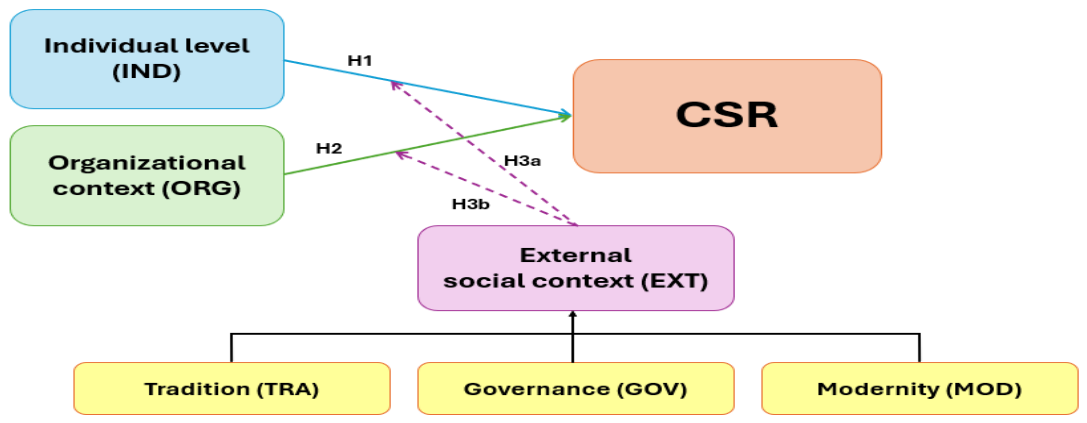
Diagram 1.
SEM Phase 1. Source: Authors’ analysis.
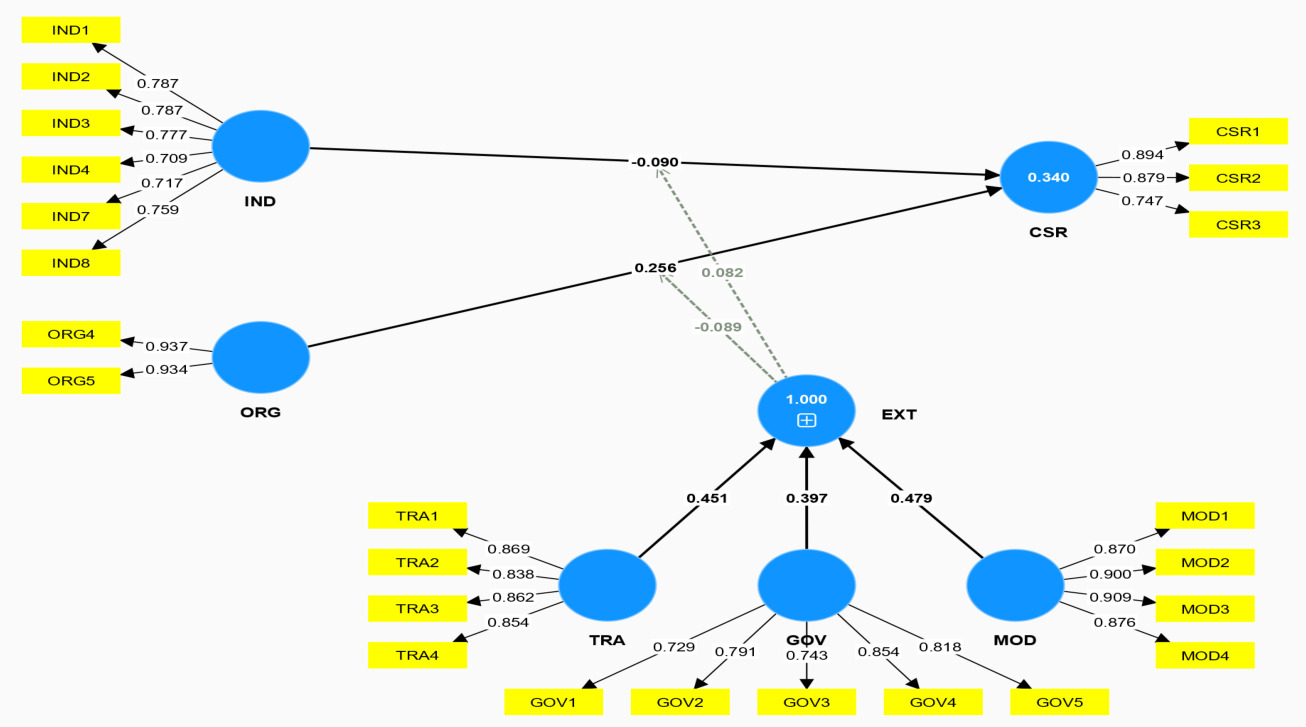
Diagram 2.
SEM Phase 2. Source: Authors’ analysis.
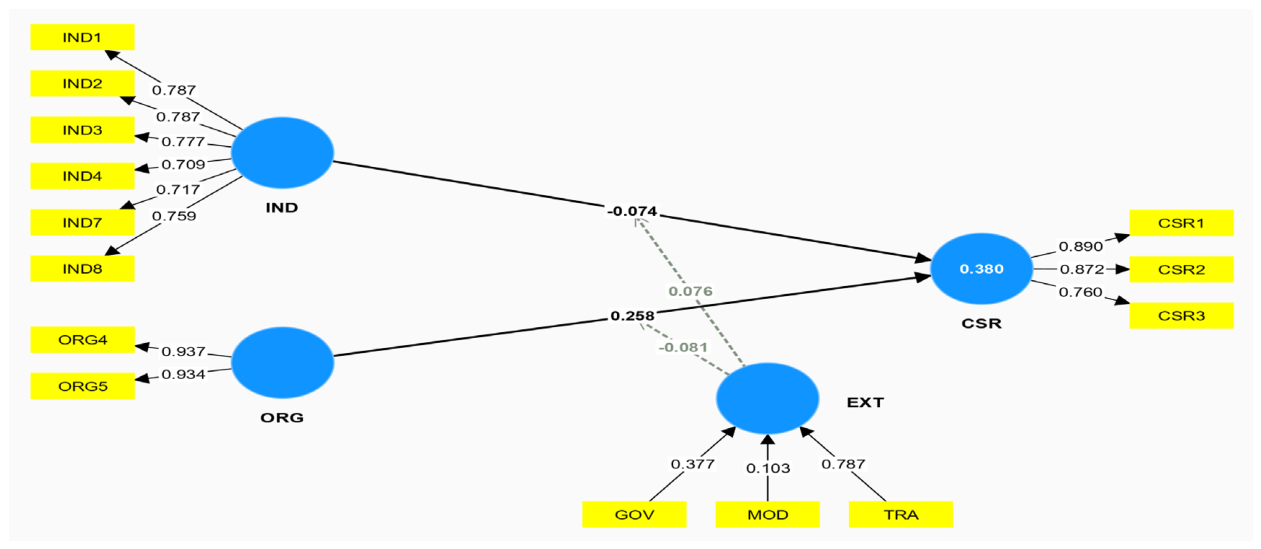
Table 1.
Characteristics of the samples.
| Respondents‘characteristics | |||
| Criteria | Classification | Quantity | Ratio (%) |
| Gender | Male | 245 | 52.9 |
| Female | 218 | 47.1 | |
| Age | < 25 years | 0 | 0 |
| 25-35 years | 64 | 13.8 | |
| 36-45 years | 222 | 47.9 | |
| 46-55 years | 120 | 25.9 | |
| 56-62 years | 42 | 9.1 | |
| ≥ 62 years | 15 | 3.2 | |
| Educational level | Secondary school | 5 | 1.1 |
| High school | 38 | 8.2 | |
| College/University | 390 | 84.2 | |
| Postgraduate | 30 | 6.5 | |
| Firms’ characteristics | |||
| Legal form | State-owned enterprises | 28 | 6.0 |
| Private enterprises | 373 | 80.6 | |
| FDI enterprises | 62 | 13.4 | |
| Areas | Agriculture, forestry and aquaculture | 41 | 8.9 |
| Services | 228 | 49.2 | |
| Industry and construction | 194 | 41.9 | |
| Years of operation | 0 – 3 years | 42 | 9.1 |
| 4-5 years | 57 | 12.3 | |
| 6-10 years | 118 | 25.5 | |
| 11-20 years | 170 | 36.7 | |
| Over 20 years | 76 | 16.4 | |
| Number of employees | Under 10 employees | 148 | 32.0 |
| 10 - 49 employees | 159 | 34.3 | |
| 50 - 249 employees | 96 | 20.7 | |
| Over 250 employees | 60 | 13 | |
| Average revenue Last 2 years |
Under 3,000 million VND | 214 | 46.2 |
| 3,000-50,000 million VND | 146 | 31.5 | |
| 50,000-300,000 million VND | 72 | 15.6 | |
| Over 300,000 million VND | 31 | 6.7 | |
| Locations | |||
|
The North region |
Hanoi | 93 | 20.1 |
| Bac Ninh | 45 | 9.7 | |
| Bac Giang | 58 | 12.5 | |
| The Central and Highland region | Quang Nam | 52 | 11.2 |
| Quang Ngai | 43 | 9.3 | |
| Dak Lak | 31 | 6.7 | |
| The South region | Dong Nai | 25 | 5.4 |
| Can Tho | 48 | 10.4 | |
| Ben Tre | 68 | 14.7 | |
Source: Survey data, 2025.
Table 2.
Outer loadings.
| CSR | GOV | IND | MOD | ORG | TRA | |
| CSR1 | 0.894 | |||||
| CSR2 | 0.879 | |||||
| CSR3 | 0.747 | |||||
| GOV1 | 0.729 | |||||
| GOV2 | 0.791 | |||||
| GOV3 | 0.743 | |||||
| GOV4 | 0.854 | |||||
| GOV5 | 0.818 | |||||
| IND1 | 0.787 | |||||
| IND2 | 0.787 | |||||
| IND3 | 0.777 | |||||
| IND4 | 0.709 | |||||
| IND7 | 0.717 | |||||
| IND8 | 0.759 | |||||
| MOD1 | 0.870 | |||||
| MOD2 | 0.900 | |||||
| MOD3 | 0.909 | |||||
| MOD4 | 0.876 | |||||
| ORG4 | 0.937 | |||||
| ORG5 | 0.934 | |||||
| TRA1 | 0.869 | |||||
| TRA2 | 0.838 | |||||
| TRA3 | 0.862 | |||||
| TRA4 | 0.854 |
Source: Authors’ analysis.
Table 3.
Construct reliability and validity.
| Cronbach’s alpha |
Composite reliability (rho_a) |
Composite reliability (rho_c) | Average variance extracted (AVE) | |
| CSR | 0.793 | 0.807 | 0.880 | 0.710 |
| GOV | 0.847 | 0.855 | 0.891 | 0.622 |
| IND | 0.853 | 0.860 | 0.889 | 0.573 |
| MOD | 0.911 | 0.912 | 0.938 | 0.790 |
| ORG | 0.857 | 0.857 | 0.933 | 0.875 |
| TRA | 0.879 | 0.880 | 0.916 | 0.733 |
Source: Authors’ analysis.
Table 4.
Discriminant validity test among constructs by the Fornell-Larcker criterion and Heterotrait-monotrait ratio (HTMT) - Matrix.
Table 4.
Discriminant validity test among constructs by the Fornell-Larcker criterion and Heterotrait-monotrait ratio (HTMT) - Matrix.
| CSR | GOV | IND | MOD | ORG | TRA | |
| Heterotrait-monotrait ratio (HTMT) - Matrix | ||||||
| CSR | ||||||
| GOV | 0.402 | |||||
| IND | 0.258 | 0.711 | ||||
| MOD | 0.393 | 0.418 | 0.442 | |||
| ORG | 0.575 | 0.567 | 0.519 | 0.532 | ||
| TRA | 0.621 | 0.242 | 0.216 | 0.493 | 0.424 | |
| Fornell-Larcker criterion | ||||||
| CSR | 0.843 | |||||
| GOV | 0.332 | 0.788 | ||||
| IND | 0.221 | 0.604 | 0.757 | |||
| MOD | 0.336 | 0.369 | 0.392 | 0.889 | ||
| ORG | 0.476 | 0.482 | 0.445 | 0.471 | 0.935 | |
| TRA | 0.517 | 0.214 | 0.190 | 0.442 | 0.371 | 0.856 |
Source: Authors’ analysis.
Table 5.
Outer weights.
| Original sample | Sample mean |
Standard deviation |
T statistics | P values | |
| GOV->EXT | 0.377 | 0.376 | 0.073 | 5.158 | 0.000 |
| MOD->EXT | 0.103 | 0.100 | 0.081 | 1.264 | 0.206 |
| TRA -> EXT | 0.787 | 0.784 | 0.061 | 12.887 | 0.000 |
Source: Authors’ analysis.
Table 6.
Outer loadings and Outer model - List.
| Outer loadings | Outer model - List | |
| EXT | VIF | |
| GOV | 0.584 | 1.162 |
| MOD | 0.590 | 1.378 |
| TRA | 0.914 | 1.248 |
Source: Authors’ analysis.
Table 8.
Moderation analysis outcomes.
| Original sample | Sample mean | Standard deviation | T statistics | P values | |
| EXT x ORG-> CSR | -0.081 | -0.079 | 0.042 | 1.923 | 0.055 |
| EXT x IND -> CSR | 0.076 | 0.074 | 0.039 | 1.971 | 0.049 |
Source: Authors’ analysis.
Table 10.
PLSpredict LV summary.
| PLSpredict LV summary | ||||||||
| Q2predict | RMSE | MAE | ||||||
| CSR | 0.361 | 0.804 | 0.625 | |||||
| PLSpredict MV summary | ||||||||
| Q2predict | PLS-SEM_RMSE | PLS-SEM_MAE | LM_RMSE | LM_MAE | IA_RMSE | IA_MAE | ||
| CSR1 | 0.295 | 0.953 | 0.749 | 0.963 | 0.755 | 1.135 | 0.924 | |
| CSR2 | 0.246 | 0.930 | 0.713 | 0.929 | 0.718 | 1.071 | 0.853 | |
| CSR3 | 0.223 | 0.960 | 0.732 | 0.969 | 0.741 | 1.090 | 0.884 | |
Source: Authors’ analysis.
Disclaimer/Publisher’s Note: The statements, opinions and data contained in all publications are solely those of the individual author(s) and contributor(s) and not of MDPI and/or the editor(s). MDPI and/or the editor(s) disclaim responsibility for any injury to people or property resulting from any ideas, methods, instructions or products referred to in the content. |
© 2026 by the authors. Licensee MDPI, Basel, Switzerland. This article is an open access article distributed under the terms and conditions of the Creative Commons Attribution (CC BY) license (http://creativecommons.org/licenses/by/4.0/).
Copyright: This open access article is published under a Creative Commons CC BY 4.0 license, which permit the free download, distribution, and reuse, provided that the author and preprint are cited in any reuse.