

Submitted:
12 July 2026
Posted:
14 July 2026
You are already at the latest version
Abstract
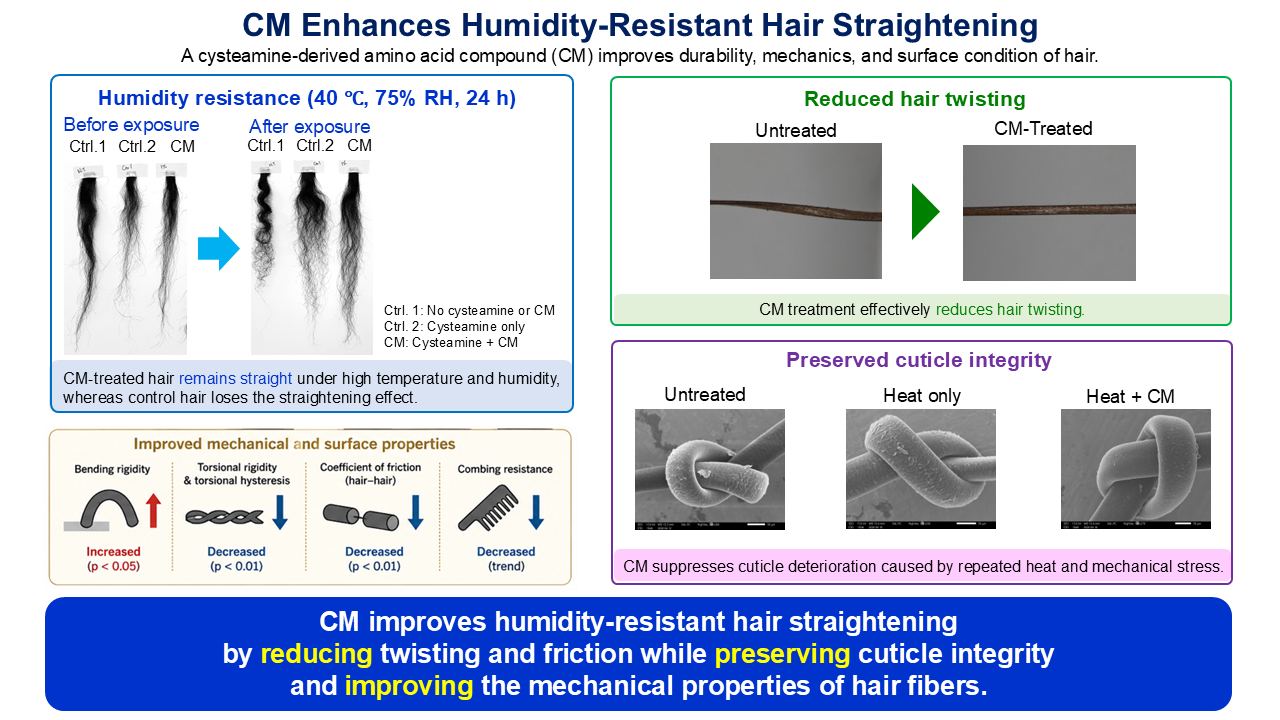
This study investigated the effects of incorporating a novel amino acid compound (CM) into a reductive hair-straightening formulation on hair shape stability, mechanical properties, and surface characteristics. Hair trees from Brazilian donors were treated with a cysteamine-based straightening system, with or without CM, and evaluated under high-temperature, high-humidity conditions (40 °C, 75% relative humidity). CM-treated hair remained straight after 24 h of humidity exposure, whereas the control group exhibited partial or complete loss of the straightening effect. The mean hair spread width significantly decreased in the CM-treated group, indicating improved macroscopic shape stability. Mechanical analysis revealed a significant increase in bending rigidity (p < 0.05), whereas torsional rigidity and torsional hysteresis were significantly decreased (p < 0.01), suggesting direction-dependent changes in fiber mechanics. Furthermore, the coefficient of friction was significantly reduced following CM treatment, and the combing resistance tended to decrease. Scanning electron microscopy images revealed suppression of cuticle deterioration induced by repeated thermal and mechanical stress. Collectively, reduced torsion, improved shape retention, increased bending stiffness, and decreased fiber–fiber friction contributed to the improved combability and enhanced durability of straightening performance. Overall, CM enhanced humidity-resistant straightening while improving the surface and mechanical properties of the hair fibers. These findings suggest that CM is a promising additive for the development of humidity-resistant hair-straightening formulations.
Keywords:
wavy hair
; curly hair
; kinky hair
; amino acid compound
; hair straightening
; humidity resistance
; friction reduction
1. Introduction
In recent years, hairstyling preferences have become increasingly diverse; however, straight hair continues to maintain its popularity among many consumers. In particular, achieving effective and durable straightening of strongly curled hair—such as wavy, curly, or kinky hair—remains a significant technical challenge [1,2,3]. Hair morphology varies substantially among individuals and across ethnic backgrounds, with differences reported in curl diameter, cross-sectional geometry, follicle curvature, and cortical cell distribution [4,5,6,7]. For example, hair of African origin is typically characterized by tight curls, pronounced curvature, and torsion, whereas hair of Brazilian origin exhibits a broad range of morphologies, from wavy to curly, reflecting substantial structural diversity. Strongly curled hair is typically characterized by a small radius of curvature (often less than 1 mm), as well as a helical or zigzag fiber morphology, and an elliptical to flattened cross-section. Compared with straight or mildly wavy hair, these fibers tend to exhibit greater structural heterogeneity and mechanical anisotropy. These features are associated with asymmetric distributions of orthocortical and paracortical cells within the cortex, as well as curved or elliptical follicular geometry [8,9]. Consequently, strongly curled hair tends to show increased fiber–fiber friction, greater mechanical fragility, reduced combability, and decreased durability of straightening effects, particularly under high-humidity conditions [2,5,10]. Temporary straightening methods such as flat ironing and blow drying provide only short-term effects and do not fundamentally alter the intrinsic structural characteristics of the fiber [2,5]. To achieve long-lasting straightening effects, aldehyde-based treatments, such as formaldehyde and glutaraldehyde systems, have been employed. However, these compounds have been associated with mucosal irritation and potential carcinogenic risks [1,3], leading to increased regulatory restrictions and demand for safer alternatives [11]. Conventional reducing systems achieve permanent shape modification by cleaving cysteine disulfide bonds and reforming them in new configurations [12]. Nevertheless, the formation of mixed disulfides during the reduction process has been suggested to contribute to structural weakening of the fiber [13]. To mitigate this issue, combined reducing systems, such as thioglycolic acid with dithiodiglycolic acid, have been proposed [14]. Other approaches include glyoxylic acid–based crosslinking systems [15] and strategies that promote internal structural rearrangement through fiber swelling prior to fixation [16]. An amino acid compound, 2-(2-aminoethylthio)succinic acid, synthesized from fumaric acid and cysteamine hydrochloride (CM), has been reported to be effective for hair straightening, moisture retention, improvement of hair texture, and shape control of wavy hair. Small-angle X-ray scattering analysis revealed an increase in the distance between intermediate filaments and improved filament orientation within hair fibers [17]. In addition, a related study reported that a compound derived from muconic acid and cysteamine hydrochloride exhibited high shape memory and persistence at 80 °C in a curl retention test [18]. Based on these findings, the present study aimed to investigate the straightening performance and physicochemical properties of strongly wavy Brazilian and African origin by incorporating the CM compound into a cysteamine-based hair-straightening system.
2. Materials and Methods
2.1. Materials
Hair tresses obtained from Brazilian donors with mild-to-moderately wavy or curly hair were purchased from a commercial supplier (Galeria do Rock Valdos Black Power). Hair tresses from donors of African descent with strongly wavy hair were obtained from a regional distributor (Agent Totsuka, Japan). A novel amino acid compound (CM) was synthesized according to methods previously reported by Katayama et al. [19] and used in this study.
2.2. Hair-Straightening Treatment Using a Reducing Agent
Hair tresses of Brazilian origin were used in this study. The first treatment solution (agent 1) contained 5 wt% cysteamine (Tokyo Chemical Industry, Tokyo, Japan) and 1 wt% CM. The solution was prepared in a glass beaker using an analytical balance (Shimadzu AUX120, Shimadzu Corp., Kyoto, Japan) and diluted with purified water to a bath ratio of 50 (w/w). Hair tresses were immersed in the solution using a stainless steel tray or a glass beaker. After rinsing with water, hair fibers were combed straight using a plastic comb and dried in cool air using a hair dryer (Nano Care EH-NA0G, Panasonic Corp., Osaka, Japan). Thermal treatment was then performed using a hair iron (SALON MOON SLMOO6WH) at 180 °C. Subsequently, the hair was immersed for 7 min in a second treatment solution (agent 2) consisting of a 2 wt% aqueous hydrogen peroxide solution. This solution was prepared by diluting 30% or 35% peroxide (FUJIFILM Wako Pure Chemical Corp., Osaka, Japan) in purified water in a volumetric flask. The bath ratio was adjusted to 50 (w/w), and immersion was performed using a stainless steel tray or glass beaker. After a final rinse with water, the hair was dried using cool air from a hair dryer. Hair treated with agent 1 (without cysteamine and CM) was defined as Control 1, whereas hair treated with cysteamine only (without the CM) was defined as Control 2.
2.3. Evaluation of the Stability of Straightened Hair under Controlled Temperature and Humidity Conditions
After the straightening treatment, hair tresses of Brazilian origin were stored in an incubator (Kimura Sangyo, Japan) maintained at 40 °C and 75% relative humidity (RH) for 24 h. The hair condition was then evaluated.
2.4. Measurement of Hair Spread Width
After straightening, tresses of Brazilian origin were trimmed from the hair tips to a length of 15 cm. The total maximum deviation distance D (mm) from the straight line connecting both ends of the hair fiber was calculated as the sum of the upper distance a (mm) and lower distance b (mm) (Figure 1). Ten individual hair fibers were measured for each sample, and the mean value was calculated. All measurements were performed under controlled environmental conditions of 25 ± 5 °C and 40 ± 10% RH.
2.5. Microscopic Observation
A single hair fiber of African origin was placed on a glass slide and secured at both ends using adhesive tape. Images were acquired using a digital microscope (VHX-8000, Keyence Corp., Osaka, Japan). To enable observation of the same region before and after treatment, the observation area was marked in advance. Subsequently, hair fibers treated with the CM-containing straightening formulation were observed under the same microscopic conditions.
2.6. Bending Test
After the straightening treatment, hair tresses of Brazilian origin were subjected to bending measurements using a KES-FB2 pure bending tester (Kato Tech Co., Ltd., Kyoto, Japan; maximum curvature: ± 2.5 cm⁻¹; deformation rate: 0.5 cm⁻¹ s⁻¹). Test specimens were prepared by aligning 20 individual hair fibers in parallel at 1 mm intervals. Measurements were conducted under controlled environmental conditions of 25 ± 5 °C and 40 ± 10% RH. Figure 2 shows the relationship between bending moment (M) and curvature (K). The bending rigidity (B) was calculated from the slope of the curve in the curvature range of K = 0.5–1.5 cm⁻¹. The bending hysteresis (2HB) was determined from the difference in bending moment between the loading and unloading processes at K = 1.0 cm⁻¹ [20].
2.7. Torsional Test
The torsional properties of Brazilian hair after straightening were measured using a KES-YN1 torsional tester (Kato Tech Co., Ltd., Kyoto, Japan). Each hair sample was prepared at a length of 1 cm. Measurements were performed once per sample, and 16 individual hair fibers were tested for each condition. All measurements were conducted under controlled environmental conditions of 25 ± 5 °C and 40 ± 10% RH. The hair diameter was measured using a digital micrometer (IP65, Mitutoyo Corp., Kanagawa, Japan), and the cross-sectional area was approximated by assuming a circular cross-section. Figure 3 shows the relationship between the torsional moment and twist angle. The torsional rigidity (G) was calculated from the slope of the curve in the range from 0 to π radians. The torsional hysteresis (2HG) was determined from the difference in torsional moment between the loading and unloading processes at π radians. All values were normalized per unit cross-sectional area.
2.8. Friction Measurement
The frictional properties of hair of Brazilian origin after straightening were measured using a multifunctional static and kinetic friction tester (TL201Tt, Trinity Lab Co., Ltd., Japan). Ten treated hair fibers were aligned in parallel at 1 mm intervals on a glass slide with a unified cuticle orientation. Measurements were conducted under controlled environmental conditions of 25 ± 5 °C and 40 ± 10% RH. A rubber contactor designed to mimic the human finger (Trinity Lab Co., Ltd., Japan) was used as the contact probe. The measurement conditions were as follows: a contactor sliding speed of 1.4 mm s⁻¹ and an applied load of 20 g. Each glass slide specimen was used for a single measurement. For each hair sample, three independent slide specimens were measured, and the mean friction coefficient (MIU) was calculated.
2.9. Combing Test
The combing properties of hair of Brazilian origin after the straightening treatment were evaluated using a multifunctional static and kinetic friction tester (TL201Tt, Trinity Lab Co., Ltd., Japan). Both ends of the hair tress were fixed, and a comb was passed from the root toward the tip five consecutive times. The measurement conditions were as follows: comb travel distance of 30 mm, combing speed of 1 mm s⁻¹, temperature of 25 ± 5 °C, and RH of 50 ± 10%. To minimize variability, the first two combing cycles were excluded from the analysis. The results were calculated using the mean values obtained from the third to fifth cycles over the 2–3 cm region.
2.10. Scanning Electron Microscopy (SEM)
Individual hair fibers of Brazilian origin were used to evaluate the effects of the CM treatment on the surface morphology of hair fibers following mechanical interaction. For the CM treatment, a 0.5% aqueous CM solution was uniformly sprayed onto the hair fibers using a spray bottle. After blow drying, the fibers were heated with a hair straightener set at 230 °C. This treatment cycle was repeated three times. The treated hair fibers were then loosely tied into an overhand knot. A 30 g clip weight was attached to one end of each fiber, and the opposite end was slowly lifted to produce a reproducible degree of knot tightening. The knotted hair samples were sputter-coated with platinum using a Fine Coater (JEC-3000FC, JEOL Ltd., Tokyo, Japan) under reduced pressure conditions at a coating current of 20 mA for 80 s. The surface morphology was subsequently observed using a scanning electron microscope (SEM). SEM observations were performed in secondary electron detection mode at an accelerating voltage of 15 kV, a working distance of 13.3 mm, and under high-vacuum conditions.
2.11. Statistical Analysis
Data are presented as the mean ± standard deviation (SD), as specified in the figure legends. Statistical differences among three groups were evaluated using one-way analysis of variance (ANOVA) followed by Tukey's honestly significant difference (HSD) test. Statistical differences between two groups were evaluated using a two-tailed unpaired Student's t-test. A p value < 0.05 was considered statistically significant. Statistical significance was denoted as follows: n.s., not significant; *, p < 0.05; **, p < 0.01; ***, p < 0.001. The number of replicates (n) for each experiment is provided in the corresponding figure legends.
3. Results
3.1. Stability of Straightened Hair under Controlled Temperature and Humidity Conditions
Figure 4 shows representative images of hair tresses after storage at 40 °C and 75% RH for 24 h. Panel (a) shows a photograph immediately after treatment, while panel (b) shows the condition after 24 h. The hair in Control 1 returned to a state similar to that before treatment, whereas Control 2 exhibited partial loss of the straightening effect. By contrast, CM-treated hair maintained a straight configuration. The partial persistence of the straightening effect observed in Control 1, which did not contain a reducing agent, was likely due to the high-temperature treatment applied using the hair iron.
3.2. Measurement of Hair Spread Width
Figure 5 shows the mean hair spread width after straightening treatment, with values of 29.1 ± 4.9 mm for Control 1, 18.3 ± 4.9 mm for Control 2, and 11.2 ± 4.7 mm for the CM-treated group. The use of CM significantly reduced frizz and enhanced the straightening effect.
3.3. Optical Imaging
Twisted hair sections before and after CM treatment were observed under an optical microscope (Figure 6). The results revealed that hair fiber twisting was eliminated after straightening treatment with CM.
3.4. Bending and Torsional Properties
The bending moment (M) can be expressed as follows:
where M is the bending moment, E is the Young’s modulus, I is the second moment of area, and ρ is the radius of curvature. The product EI is referred to as the bending rigidity. A higher bending rigidity corresponds to a smaller curvature under a given bending moment, indicating greater resistance to bending. Hair treated with CM exhibited a significant increase in bending rigidity compared with the blank-treated group (p = 0.011), as shown in Figure 7(a). By contrast, no significant difference in bending hysteresis was observed between the CM-treated and blank-treated groups (Fig. 7(b)). Both torsional rigidity and torsional hysteresis were significantly lower in the CM-treated group than in the blank-treated group at the 1% significance level (p = 0.009 and p = 0.001, respectively) (Figure 8).
3.5. SEM
Representative SEM images of knotted hair fibers are shown in Figure 9. Hair fibers subjected to repeated flat-ironing at 230 °C without CM treatment (Figure 9a,b) exhibited apparent cuticle lifting and surface roughening around the knot region. These features are indicative of surface deterioration caused by repeated thermal treatment combined with fiber–fiber mechanical interaction. In contrast, hair treated with 0.5% CM (Figure 9c) exhibited a smoother surface morphology, with fewer regions showing cuticle lifting. The cuticle layers appeared relatively intact compared with those of hair treated without CM, suggesting that CM treatment suppressed surface deterioration induced by repeated high-temperature treatment and mechanical stress.
3.6. Friction and Combing Properties
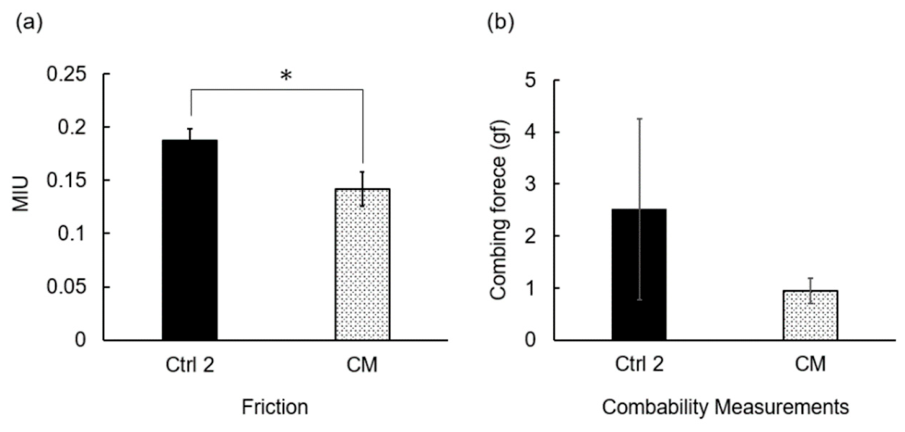
In the friction test (Figure 10(a)), the coefficient of friction was significantly lower in the CM-treated group than in the blank-treated group (p = 0.02). In general, perm treatment tends to increase the frictional resistance of hair fibers [10]. However, in the present study, a reduction in the coefficient of friction was observed. In the combing test shown in Figure 10(b), the resistance force generated during combing tended to be lower in the CM-treated tresses than in the blank-treated group. Nevertheless, owing to the large variability observed in the blank-treated group, no statistically significant difference was detected (Figure 10). In addition, CM-treated hair tresses exhibited improved tactile properties and increased gloss.
4. Discussion
In this study, the effects of incorporating the CM compound into a reducing hair straightening formulation on hair shape stability, mechanical properties, and surface characteristics were comprehensively evaluated. The results demonstrated that CM treatment improved the durability of the straightening effect under high-temperature and high-humidity conditions. After storage at 40 °C and 75% RH for 24 h, hair in Control 1 (without a reducing agent) largely returned to its pre-treatment state. Although Control 2, which contained cysteamine alone, retained a certain degree of straightening, a partial loss of the straightened configuration was observed. In contrast, the CM-treated group maintained a substantially straighter shape, indicating that the addition of the CM enhanced shape retention beyond that achieved by cysteamine treatment alone. These observations were further supported by quantitative measurements of hair spread width, which were lowest in the CM-treated group, confirming superior macroscopic shape stability. Together, these findings suggest that the CM compound contributes not only to the initial straightening process but also to the long-term stability of the straightened configuration under humid environmental conditions.
Under high-humidity conditions, hydrogen bonds within hair fibers are prone to rearrangement, and thermal treatment alone generally induces only reversible structural changes. Therefore, the partial straightness observed in Control 1 was likely attributable to temporary structural reorganization caused by high-temperature ironing; however, this effect is readily diminished upon humidity exposure. In contrast, the maintained configuration in the CM-treated group suggests that more stable modifications of the internal fiber structure were induced. Because hair spread width reflects fiber curvature and the distribution of internal stresses, the reduced spread width observed following CM treatment may indicate altered stress relaxation behavior within the fiber. Microscopic observations indicated the elimination of twisting in severely wavy hair of African origin. African hair is characterized by pronounced fiber curvature and twisting, which influence its appearance and manageability [21]. The reduction in fiber twisting observed after CM treatment suggests that microscopic structural changes within the fiber were translated into improved macroscopic shape stability.
The mechanical analysis provided additional insight into the basis of the improved straightening performance. Bending rigidity was significantly increased following CM treatment. According to the relationship between the bending moment, bending rigidity, and curvature, an increase in bending rigidity corresponds to reduced curvature under a given external load, indicating that the hair maintains a straight configuration more effectively. In contrast, no significant difference in bending hysteresis was observed, suggesting that the elastic stiffness of the fiber increased without substantially altering its viscoelastic energy-dissipation behavior.
Interestingly, torsional rigidity and torsional hysteresis were significantly decreased following CM treatment. The simultaneous increase in bending rigidity and decrease in torsional rigidity may suggest that different structural components within the hair fiber were affected to different extents. Specifically, resistance to bending along the fiber axis appears to have increased, whereas resistance to twisting deformation decreased. Such direction-dependent mechanical changes may be associated with reorganization of keratin intermediate filaments and alterations in interfibrillar interactions within the cortex [22,23,24]. Further investigation are currently underway to clarify the structural responsible for these changes.
Conventional reducing treatments are often associated with fiber swelling, increased hydrophilicity, and structural damage [24,25]. Indeed, permanent waving treatments have been reported to promote swelling and compromise fiber integrity. In contrast, the present results suggest that CM treatment increased stiffness and shape retention at the tress level, while simultaneously imparting greater flexibility at the single-fiber level through reduced torsional rigidity. This unique mechanical balance may contribute to improved tactile properties without compromising structural stability. These interpretations are consistent with the observed improvements in hair appearance and handling characteristics following CM treatment, although quantitative sensory evaluation remains the subject of ongoing investigation. Moreover, the SEM observations indicated that CM treatment suppressed cuticle deterioration induced by repeated thermal and mechanical stress, suggesting that the compound contributes not only to internal mechanical modification but also to preservation of fiber surface integrity.
The coefficient of friction was significantly reduced following CM treatment, and the combing resistance tended to decrease. The SEM observations provided additional insight into the origin of these effects. Hair fibers subjected to repeated flat-ironing without CM treatment exhibited pronounced cuticle lifting and surface deterioration around the knot region, whereas CM-treated hair retained a smoother surface morphology with less apparent cuticle disruption. These observations suggest that CM treatment suppresses surface damage induced by thermal and mechanical stress.
Surface morphology plays an important role in the frictional behavior and combability of hair fibers. The condition of the cuticle is known to influence surface friction and fiber–fiber interactions [26]. Irregularities such as lifted cuticle edges can increase mechanical interlocking between adjacent fibers and contribute to mechanical damage during grooming [27]. Furthermore, frictional and electrostatic interactions have been reported to affect combability and tactile perception of hair fibers [28]. The smoother cuticle surface observed in the CM-treated group may, therefore, contribute directly to the reduced friction coefficient observed in the present study.
Collectively, these findings suggest that CM treatment modifies not only the internal mechanical properties of hair fiber but also its surface characteristics. The combination of reduced torsion, increased bending rigidity, preservation of cuticle morphology, and reduced friction appears to contribute to improved combability and durable straightening performance.
Overall, the reductions in torsion, friction, and hair spread width, together with increased bending rigidity and suppression of cuticle deterioration observed after CM treatment, appear to contribute collectively to improved combability and durable straightening performance. These results suggest that incorporation of the CM compound promotes stable straightening while maintaining favorable mechanical and surface properties of the hair fiber under humid conditions. Further studies are warranted to elucidate the molecular and structural mechanisms underlying these effects.
5. Conclusions
In this study, the incorporation of a novel amino acid derivative (CM) into a reducing hair-straightening formulation significantly enhanced straightening performance and improved shape retention under high-temperature and high-humidity conditions. CM-treated hair exhibited a reduced hair spread width and maintained a straightened configuration after humidity exposure, indicating enhanced macroscopic shape stability. Mechanical analysis revealed a differential responses to CM treatment. Bending rigidity was significantly increased, whereas torsional rigidity and torsional hysteresis were decreased. These findings suggest that CM treatment alters the mechanical behaviour of hair fibers in a manner that promotes resistance to bending deformation while maintaining flexibility with respect to twisting deformation.
In addition, the CM-treated group exhibited a significantly reduced coefficient of friction and showed a tendency toward improved combability. SEM observations further demonstrated suppression of cuticle deterioration induced by repeated thermal and mechanical stress, suggesting that CM treatment contributes to preservation of hair surface integrity.
Overall, the results indicate that the CM compound improves the durability of hair straightening under humid conditions while maintaining favorable mechanical and surface properties of the hair fiber. Further studies are warranted to elucidate the molecular and structural mechanisms underlying these effects and to clarify the chemical modifications associated with the straightening process. These findings highlight the potential utility of the CM compound as a novel additive for humidity-resistant hair straightening formulations.
Acknowledgments
We would like to express our sincere gratitude to Professor Mari Inoue and Mr. Choji Murata from the Graduate School of Human Development and Environment, Kobe University, for kindly lending us equipment for physical property evaluation, as well as for their detailed guidance on its usage and analytical methods. Their support and assistance were invaluable to this research.
Conflicts of Interest
None.
References
- Bolduc, C.; Shapiro, J. Hair care products: Waving, straightening, conditioning, and coloring. Clin. Dermatol. 2001, 19, 431–436. [CrossRef]
- Konno, S.; Asanuma, K.; Nonomura, Y. Friction Dynamics of Straight, Curly, and Wavy Hair. J. Oleo Sci. 2024, 73, 801–811. [CrossRef]
- Gavazzoni Dias, M.F.R.G. Hair cosmetics: An overview. Int. J. Trichology 2015, 7, 2–15. [CrossRef]
- Franbourg, A.; Hallegot, P.; Baltenneck, F.; Toutain, C.; Leroy, F. Current research on ethnic hair. J. Am. Acad. Dermatol. 2003, 48(suppl.), S115–S119. [CrossRef]
- Robbins, C.R. Chemical and Physical Behavior of Human Hair, 5th ed.; Springer: Berlin, Germany, 2012. [CrossRef]
- Loussouarn, G.; Garcel, A.L.; Lozano, I.; Collaudin, C.; Porter, C.; Panhard, S.; Saint-Léger, D.; de La Mettrie, R. Worldwide diversity of hair curliness: A new method of assessment. Int. J. Dermatol. 2007, 46(suppl. 1), 2–6. [CrossRef]
- Wolfram, L.J. Human hair: A unique physicochemical composite. J. Am. Acad. Dermatol. 2003, 48(Suppl. 6), S106–S114. [CrossRef]
- Harland, D.P.; Vernon, J.A.; Woods, J.L.; Nagase, S.; Itou, T.; Koike, K.; Scobie, D.A.; Grosvenor, A.J.; Dyer, J.M.; Clerens, S. Intrinsic curvature in wool fibres is determined by the relative length of orthocortical and paracortical cells. J. Exp. Biol. 2018, 221, jeb172312. [CrossRef]
- Ezawa, Y.; Nagase, S.; Mamada, A.; Inoue, S.; Koike, K.; Itou, T. Stiffness of human hair correlates with the fractions of cortical cell types. Cosmetics 2019, 6, 24. [CrossRef]
- Bhushan, B. Nanoscale characterization of human hair and hair conditioners. Prog. Mater. Sci. 2008, 53, 585–710. [CrossRef]
- Fiume, M.M.; Heldreth, B.; Bergfeld, W.F.; et al. Final report of the Cosmetic Ingredient Review Expert Panel on the safety assessment of dicarboxylic acids, salts, and esters. Int. J. Toxicol. 2012, 31 (Suppl.), 5S–76S. [CrossRef]
- Diaz, P.; Wong, M.Y.M. Set relaxation of human hair. J. Soc. Cosmet. Chem. 1983, 34, 205–212.
- Ogawa, S.; Takeda, Y.; Kaneyama, K.; Joko, K.; Arai, K. Chemical reactions occurring in curing treatment for permanent hair straightening using thioglycolic and dithioglycolic acids. Sen’i Gakkaishi 2009, 65, 15–23. [CrossRef]
- Wong, M.; Wis-Surel, G.; Epps, J. Mechanism of hair straightening. J. Soc. Cosmet. Chem. 1994, 45, 347–360.
- Ishimori, T.; Watanabe, D.; Arai, K. Structure and its extensional properties of straightened hair prepared by heat treatment with glyoxylic acid. J. Fiber Sci. Technol. 2019, 75, 72–92. [CrossRef]
- Garti, N.; Aserin, A.; Kopilovich, A. Transparent macroemulsions for cosmetic applications. Int. J. Cosmet. Sci. 1986, 8, 1–8. [CrossRef]
- Sato, S.; Tabuchi, H.; Katayama, K.; Matsumoto, K.; Miyamoto, H.; Kanno, S.; Sekiguchi, H.; Tanaka, Y.; Inoue, M.; Murata, C.; et al. Synthesis of a new amino acid derivative with long-lasting hair shape control effects and elucidation of its mechanisms. Int. J. Cosmet. Sci. 2025, 47, 585–596. [CrossRef]
- Katayama, K.; Sato, S.; Matsumoto, K.; Miyamoto, H.; Tanaka, Y.; Hotta, H.; Tsujino, Y. Effects of muconic acid derivatives to improve hair quality. J. Cosmet. Sci. Soc. Jpn 2024, 49, 109–115.
- Katayama, K.; Hotta, H.; Tsujino, Y. Efficient synthesis of cis,cis-muconic acid by catechol oxidation of ozone in the presence of a base. Molecules 2025, 30, 201. [CrossRef]
- Koo, Y.S. Bending behavior of coated yarns. Fibers Polym. 2001, 2, 148–152. [CrossRef]
- Khumalo, N.P.; Doe, P.T.; Dawber, R.P.R.; Ferguson, D.J.P. What is normal black African hair? A light and scanning electron-microscopic study. J. Am. Acad. Dermatol. 2000, 43, 814–820. [CrossRef]
- Kreplak, L.; Doucet, J.; Dumas, P.; Briki, F. New aspects of the α-helix to β-sheet transition in keratin fibers. Biophys. J. 2004, 87, 640–647. [CrossRef]
- Fudge, D.S.; Gardner, K.H.; Forsyth, V.T.; Riekel, C.; Gosline, J.M. The Mechanical Properties of Hydrated Intermediate Filaments: Insights from Hagfish Slime Threads. Biophys. J. 2003, 85, 2015–2027. [CrossRef]
- Feughelman, M. Mechanical properties and structure of alpha-keratin fibres. Int. J. Cosmet. Sci. 1997, 19, 77–89.
- Sandhu, S.S.; Robbins, C.R. A simple and sensitive technique, based on protein loss measurements, to assess surface damage to human hair. J. Soc. Cosmet. Chem. 1993, 44, 163–175.
- Swift, J.A. The human hair cuticle. J. Cosmet. Sci. 1997, 48, 379–393.
- Gummer, C.L. Mechanical properties of hair in relation to hair breakage. J. Cosmet. Sci. 1997, 48, 379–387.
- Bishop, D.P. Friction and static generation in human hair fibres. Text. Res. J. 2004, 74, 309–315.
Figure 1.
Measurement of hair spread width. The hair spread width was calculated as the sum of the measured distances (a) and (b). The solid line represents the hair image. Distances (a) and (b) indicate the upper and lower deviation widths, respectively.
Figure 1.
Measurement of hair spread width. The hair spread width was calculated as the sum of the measured distances (a) and (b). The solid line represents the hair image. Distances (a) and (b) indicate the upper and lower deviation widths, respectively.

Figure 2.
Hair-bending moment vs. curvature.
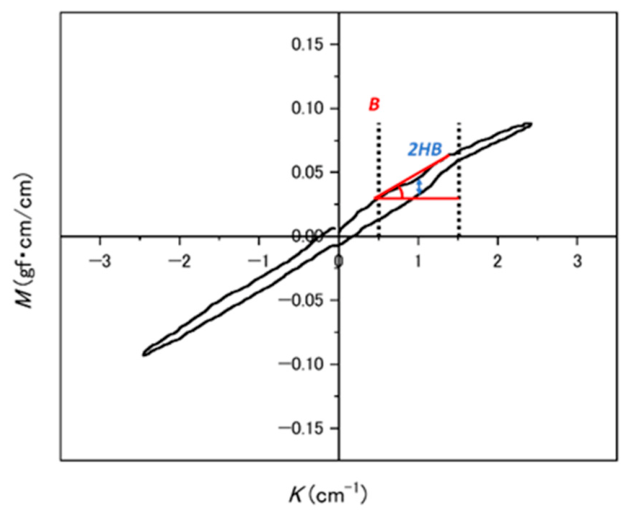
Figure 3.
Torque–torsion angle curve of hair.
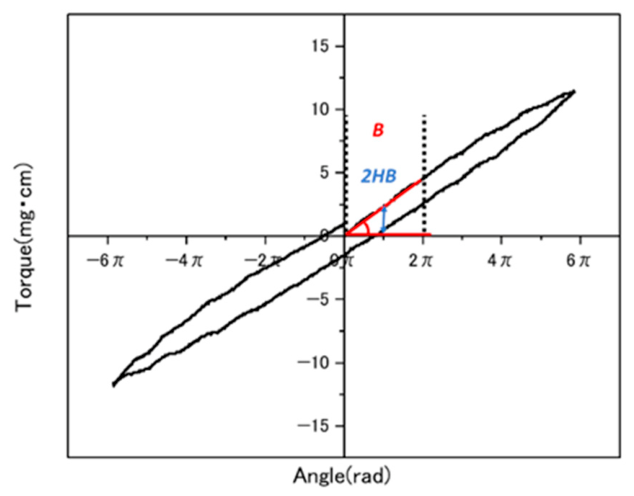
Figure 4.
Photographs of treated hair after the straightening process and after 24 h of storage at 40 °C and 75% RH. Brazilian hair was straightened (a) and then stored at 40 °C and 75% RH for 24 h (b). Control 1 (Ctrl. 1): Hair bundle treated without cysteamine and CM as the first agent. Control 2 (Ctrl. 2): Hair bundle treated with cysteamine only as the first agent. CM: Hair bundle treated with cysteamine and CM as the first agent.
Figure 4.
Photographs of treated hair after the straightening process and after 24 h of storage at 40 °C and 75% RH. Brazilian hair was straightened (a) and then stored at 40 °C and 75% RH for 24 h (b). Control 1 (Ctrl. 1): Hair bundle treated without cysteamine and CM as the first agent. Control 2 (Ctrl. 2): Hair bundle treated with cysteamine only as the first agent. CM: Hair bundle treated with cysteamine and CM as the first agent.
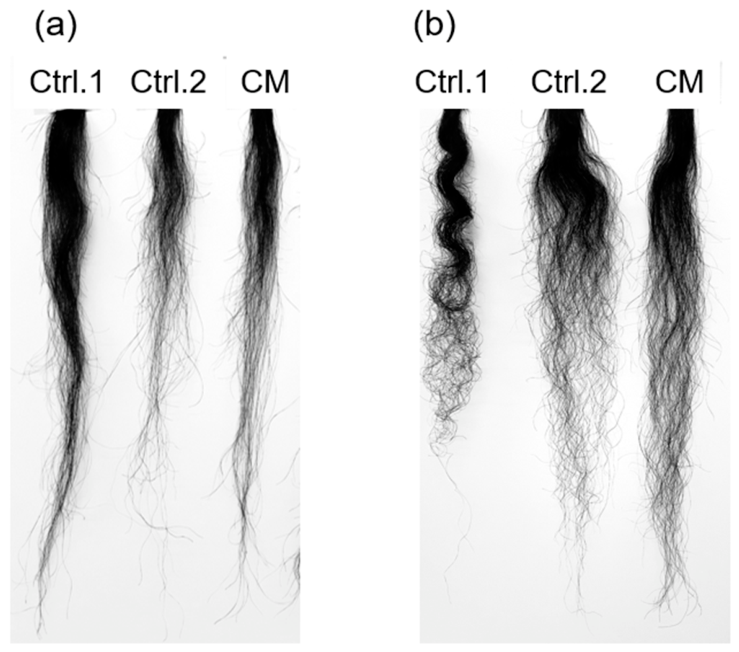
Figure 5.
Hair spread width measurement. Control 1 (Ctrl. 1): Hair treated without cysteamine and CM as the first agent. Control 2 (Ctrl. 2): Hair treated with cysteamine only as the first agent. CM: Hair treated with cysteamine and CM as the first agent (n = 10).
Figure 5.
Hair spread width measurement. Control 1 (Ctrl. 1): Hair treated without cysteamine and CM as the first agent. Control 2 (Ctrl. 2): Hair treated with cysteamine only as the first agent. CM: Hair treated with cysteamine and CM as the first agent (n = 10).
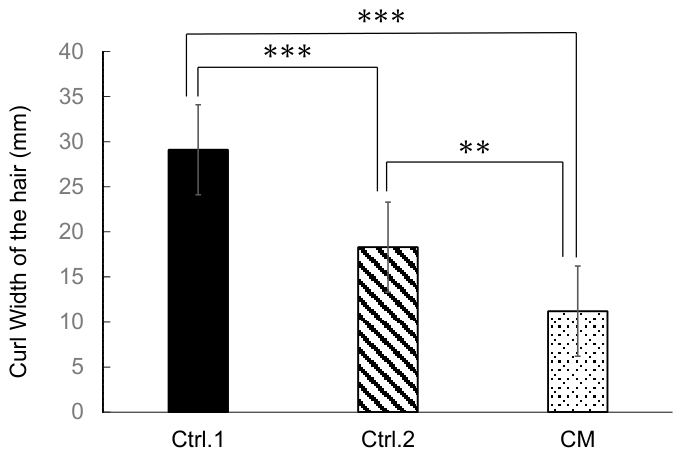
Figure 6.
Observation of hair under an optical microscope. (a) Untreated. (b) Treated with CM.
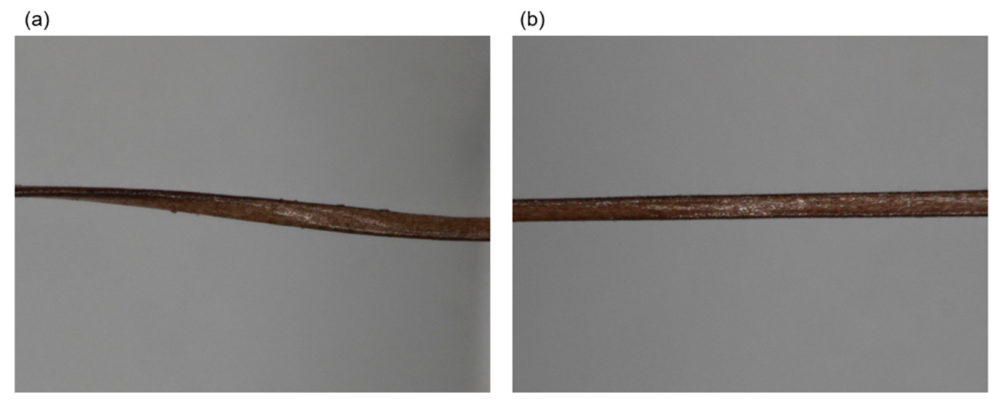
Figure 7.
(a) Average bending stiffness of hair. (b) Average bending hysteresis of hair. Control 2 (Ctrl. 2): Hair treated with cysteamine only as the first agent. CM: Hair treated with cysteamine and CM as the first agent (n = 12).
Figure 7.
(a) Average bending stiffness of hair. (b) Average bending hysteresis of hair. Control 2 (Ctrl. 2): Hair treated with cysteamine only as the first agent. CM: Hair treated with cysteamine and CM as the first agent (n = 12).
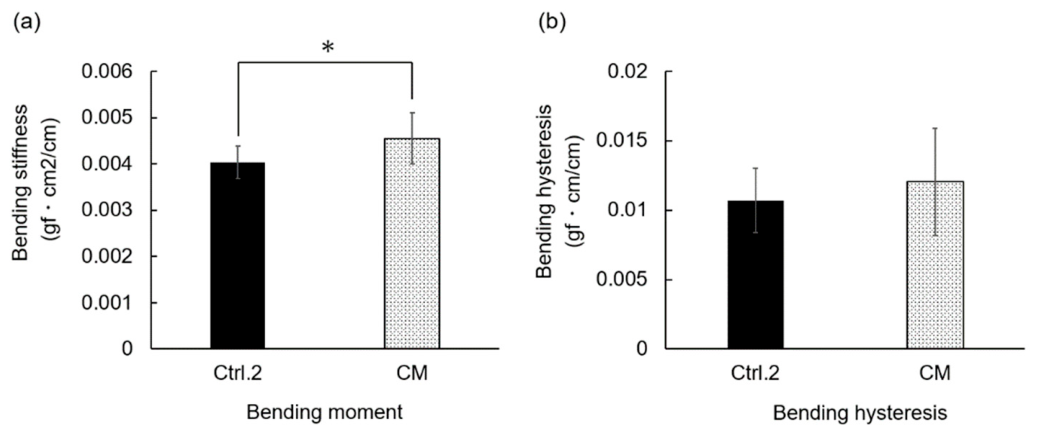
Figure 8.
(a) Average torsional stiffness of hair. (b) Average torsional hysteresis of hair. Control 2 (Ctrl. 2): Hair treated with cysteamine only as the first agent. CM: Hair treated with cysteamine and CM compound as the first agent (n = 12).
Figure 8.
(a) Average torsional stiffness of hair. (b) Average torsional hysteresis of hair. Control 2 (Ctrl. 2): Hair treated with cysteamine only as the first agent. CM: Hair treated with cysteamine and CM compound as the first agent (n = 12).
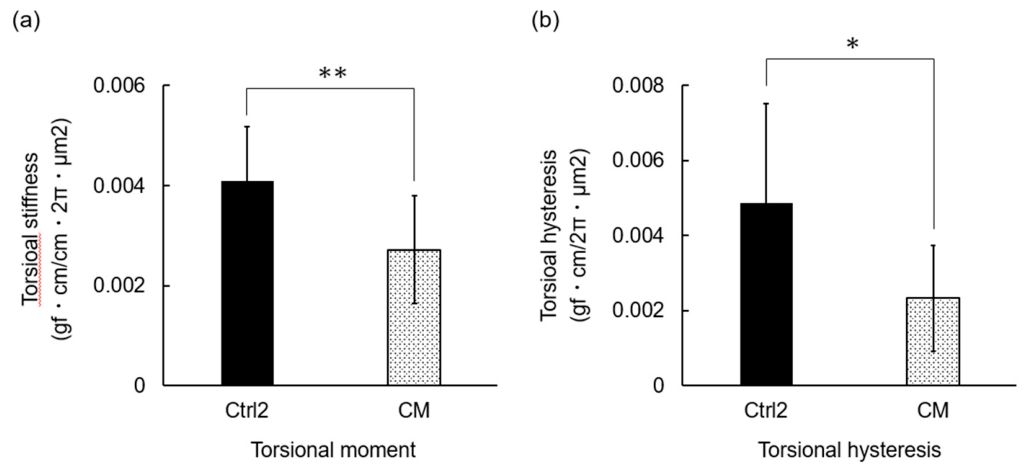
Figure 9.
Representative SEM images of knotted hair fibers. (a) Untreated hair. (b) Hair subjected to flat-ironing at 230 °C for three cycles without CM treatment. (c) Hair subjected to flat-ironing at 230 °C for three cycles in the presence of 0.5% CM.
Figure 9.
Representative SEM images of knotted hair fibers. (a) Untreated hair. (b) Hair subjected to flat-ironing at 230 °C for three cycles without CM treatment. (c) Hair subjected to flat-ironing at 230 °C for three cycles in the presence of 0.5% CM.
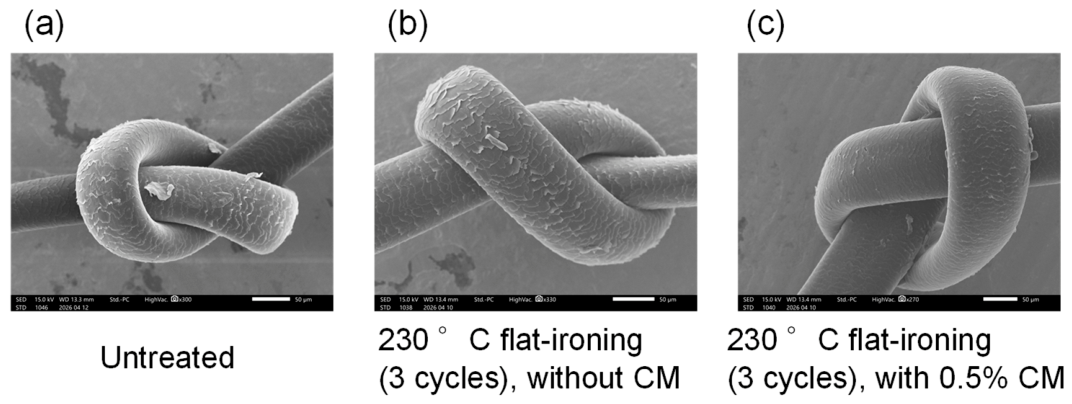
Figure 10.
(a) Coefficient of friction (MIU) of hair. (b) Combing force of hair. Control 2 (Ctrl. 2): Hair treated with cysteamine only as the first agent. CM: Hair treated with cysteamine and CM as the first agent (n = 3).
Figure 10.
(a) Coefficient of friction (MIU) of hair. (b) Combing force of hair. Control 2 (Ctrl. 2): Hair treated with cysteamine only as the first agent. CM: Hair treated with cysteamine and CM as the first agent (n = 3).
Disclaimer/Publisher’s Note: The statements, opinions and data contained in all publications are solely those of the individual author(s) and contributor(s) and not of MDPI and/or the editor(s). MDPI and/or the editor(s) disclaim responsibility for any injury to people or property resulting from any ideas, methods, instructions or products referred to in the content. |
© 2026 by the authors. Licensee MDPI, Basel, Switzerland. This article is an open access article distributed under the terms and conditions of the Creative Commons Attribution (CC BY) license (http://creativecommons.org/licenses/by/4.0/).
Copyright: This open access article is published under a Creative Commons CC BY 4.0 license, which permit the free download, distribution, and reuse, provided that the author and preprint are cited in any reuse.


