

Submitted:
13 July 2026
Posted:
14 July 2026
You are already at the latest version
Abstract
Ancient manuscripts are cultural objects encoding physical, chemical, linguistic, historical, philosophical and social information. To unify heterogeneous disciplinary evidence within a single relational and geometric formalism, we propose a Grothendieckian framework inspired by category theory, sheaf theory, topoi and algebraic geometry. Each discipline is represented as an independent graph whose nodes and edges encode its own entities and relationships. Local observations are attached to graph neighborhoods through sections of sheaves, while structure-preserving functors align corresponding entities across disciplinary domains. Natural transformations evaluate the consistency of alternative mappings, while cohomological analysis identifies hidden structural constraints. Subsequently, compatible local information is assembled using descent theory, whereas stacks and derived categories incorporate multiple manuscript versions and their historical evolution. The integrated relational structure is represented geometrically through schemes, with the common invariant subgraph interpreted as the manuscript’s motive, namely the maximal relational architecture preserved across all disciplinary representations. This approach could provide a mathematical strategy for integrating heterogeneous evidence without privileging any single disciplinary viewpoint. Potential applications include manuscript authentication, conservation planning, textual criticism, comparative philology, cultural heritage analytics, historical knowledge integration and development of interoperable artificial intelligence systems for multidisciplinary manuscript research.
Keywords:
invariants
; functors
; sheaves
; topology
; provenance
Introduction
The interpretation of ancient manuscripts requires the integration of evidence originating from different disciplines, including paleography, philology, linguistics, chemistry, physics, history, art history, conservation science, etc. Advances in non-destructive analytical techniques have expanded the range of measurable properties extracted from manuscripts (Tack et al. 2016; Stabile et al. 2021; Angelotti et al. 2026), including parchment composition, pigment chemistry, ink formulation, radiocarbon dating, multispectral imaging and microstructural characterization (Radini et al. 2019; Tournié et al. 2019; Autran et al. 2021; Popović et al. 2025). In parallel, computational methods have enabled increasingly sophisticated analyses of textual organization, authorship, semantic relationships and historical transmission (Romano et al. 2023; Ceccarelli et al. 2025). Network science, machine learning and digital humanities have contributed tools for representing relationships among textual units, scribes, manuscripts and historical actors (Xu et al. 2023; Chen 2024; Zhu et al. 2025). However, relationships identified by one discipline are often compared only qualitatively across disciplines, hindering the identification of higher-order structures. A general mathematical language for combining different disciplinary viewpoints into a unified representation is still largely undeveloped.
We aim to develop an axiomatic construction inspired by Grothendieckian geometry, introducing the mathematical objects and relationships required for the geometric analysis of ancient manuscripts (Zalamea 2015; Morone, Leifer, and Makse 2020; Sobota and Zdomskyy 2024; Gili et al. 2024; Bennequin and Berthoz 2025; Marquès 2025). Our theoretical goal is to establish a coherent mathematical formalism capable of representing ancient manuscripts as geometric objects whose heterogeneous disciplinary descriptions can be integrated within a single relational framework.
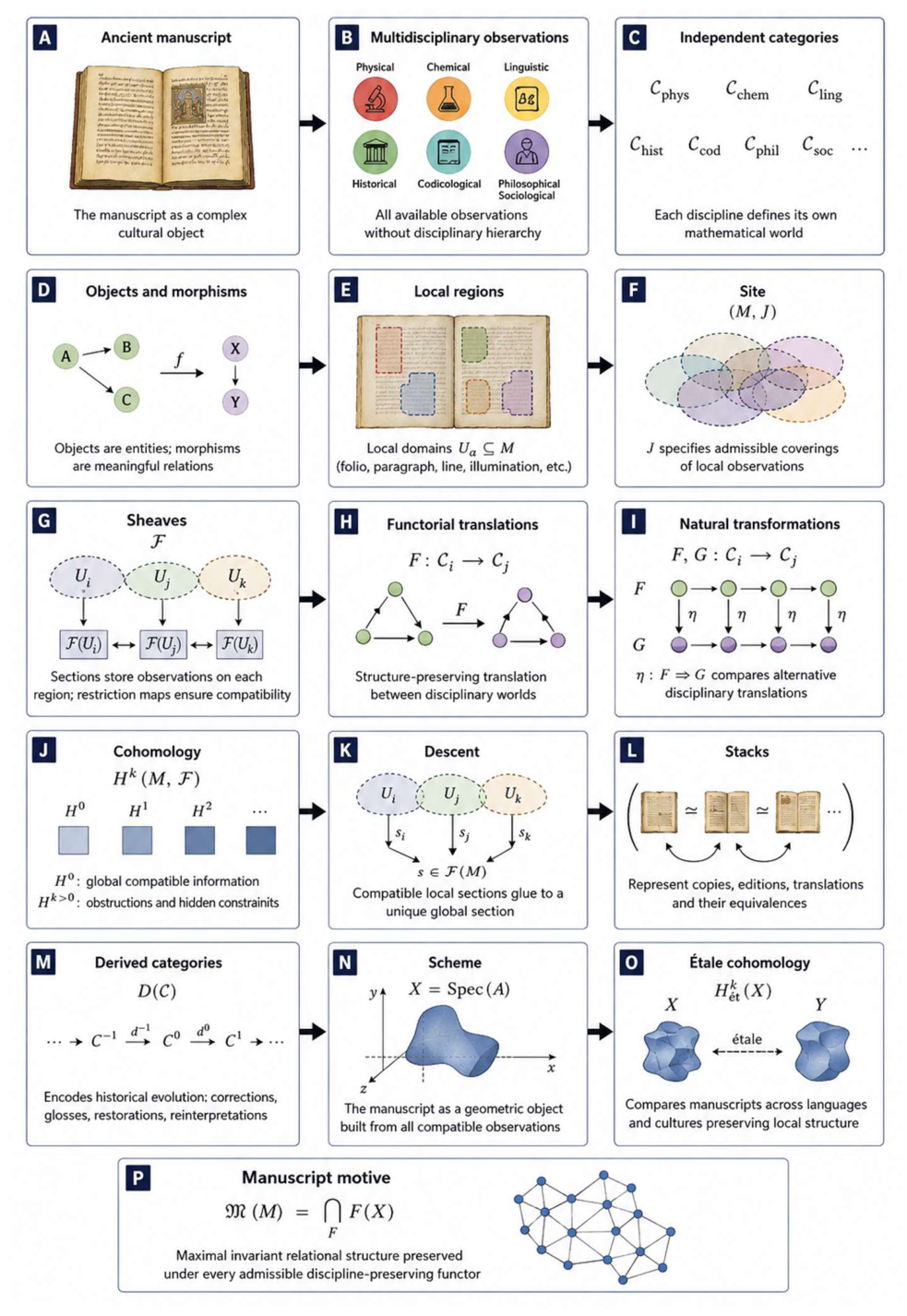
We regard each disciplinary viewpoint as a coherent relational world rather than an isolated dataset (Luo 1999; Dubuc and Sanchez de la Vega 2000; Pisier 2012; McLarty 2018). Every discipline is represented by an independent mathematical category whose objects and morphisms encode its entities and relationships. Local observations are associated with manuscript regions through sheaves, while functors translate information between categories and natural transformations assess the compatibility of alternative translations. Cohomology identifies global inconsistencies, after which compatible local descriptions are assembled by descent into a unified representation incorporating multiple manuscript versions, historical modifications and transmission pathways through stacks and derived categories. The resulting structure is interpreted geometrically as a scheme from which the manuscript’s motive is extracted, defined as the maximal relational architecture preserved under all admissible discipline-preserving functors. The overall construction is summarized in Figure 1.
Initially, an ancient manuscript can be regarded as a finite collection of observations rather than as a text. Let
denote the set of all observations associated with the manuscript. Each observation may correspond to a measurable physical quantity, a chemical property, a linguistic element, a historical event, an iconographic feature, a codicological characteristic, a philosophical concept, a sociological relationship, etc. Since each discipline captures only one aspect of the manuscript, no hierarchy is imposed among these observations. At the outset, the manuscript has no privileged mathematical description. Instead, each discipline provides an independent relational representation that is subsequently integrated into a unified geometric construction.
Each scientific discipline defines its own mathematical category. Let
denote the category associated with discipline . Its objects,
represent the entities studied by that discipline, whereas its morphisms,
describe admissible relationships between those entities. For instance, in the physical category, objects may consist of parchment regions, fibres, folios or bindings, while morphisms represent structural or mechanical relationships. In chemistry, objects become pigment samples, ink deposits or molecular compounds connected through compositional similarities or reaction pathways. Linguistics regards words, sentences, semantic concepts or grammatical constructions as objects linked through syntactic or semantic relations. History introduces scribes, production centres, historical events and ownership records connected by chronological or documentary relationships. Philosophy may represent concepts and arguments, whereas sociology considers readers, monasteries, libraries and transmission routes.
Morphisms stand for the elementary relations through which every category acquires structure. If and are two objects of a category,
denotes a morphism relating them. Morphisms satisfy the axioms of identity and composition,
and
whenever
Composition enables elementary relationships to be combined into increasingly comprehensive explanatory chains. For example, a physical measurement may lead to material identification, which may constrain technological chronology and eventually historical provenance. Similarly, a linguistic observation may propagate through grammatical analysis toward dialect identification and geographical localization. Therefore, complex interpretations emerge through successive compositions of elementary morphisms rather than through isolated measurements.
Next, the manuscript could be decomposed into local regions. Let
denote an arbitrary local domain. Depending on the investigation, a local region may correspond to an individual folio, a paragraph, an illumination, a line of text, a pigment layer, a damaged portion or any subset of observations. Importantly, locality is not restricted to physical neighbourhoods. Two distant folios sharing identical scribal characteristics may belong to the same local analytical region, whereas neighbouring folios exhibiting different material histories may belong to distinct regions. Locality becomes an abstract relational concept rather than a purely spatial one.
To formalize locality, the manuscript is endowed with a Grothendieck topology. Let
denote a site, where specifies the admissible covering families
Unlike ordinary topology, a covering does not necessarily describe geometric openness but identifies collections of compatible local observations sufficient to reconstruct larger portions of the manuscript. The choice of coverings depends entirely on analytical coherence rather than physical adjacency. Consequently, chemistry, linguistics and history may generate different local coverings while still referring to the same manuscript.
Each local region carries measurable information through a sheaf. Let
be a sheaf over the site . Every local domain receives a corresponding collection of observations
called the sections over . Sections may contain spectra, pigment compositions, transcription data, grammatical analyses, historical metadata, codicological measurements or any other disciplinary observations. Whenever
restriction morphisms
transfer information consistently from larger regions to smaller ones. The sheaf satisfies the classical gluing axiom: if local sections
agree on every overlap
then there exists a unique global section
whose restrictions coincide with every . Local observations become mathematically compatible before any global interpretation is attempted.
Independent disciplinary worlds must subsequently communicate through functors. Given two categories,
a functor
maps objects to objects and morphisms to morphisms while preserving identity morphisms and composition,
The preservation of relational structure distinguishes functorial translation from ordinary data conversion. For instance, a linguistic inference regarding geographical dialect may become a historical localization without modifying the logical relationships among the observations. Likewise, pigment provenance inferred chemically may become a node within historical trade networks while maintaining its original relational context. Therefore, functors translate entire relational organizations rather than isolated variables.
Different disciplinary translations frequently coexist. Suppose two functors,
produce alternative historical interpretations from the same observations. Their compatibility is expressed through a natural transformation
whose components
satisfy
for every morphism
Natural transformations compare complete translations rather than individual observations. They provide mathematical criterion for determining whether different disciplinary interpretations remain globally coherent.
Once compatible translations have been established, global consistency becomes a cohomological problem. Cohomology assesses whether local information can be assembled into a coherent global description. For the sheaf , one computes the cohomology groups
The zeroth group
contains globally compatible sections. Higher-order groups identify obstructions preventing perfect integration. Non-trivial elements of
may point towards inconsistencies between historical chronology and chemical dating, incompatible palaeographic assignments or conflicting restoration histories. Higher-dimensional groups detect progressively more complex incompatibilities involving multiple disciplinary domains simultaneously, while cohomology characterizes the manuscript through global structural constraints rather than isolated discrepancies.
Whenever cohomological obstructions vanish, descent theory reconstructs the manuscript from compatible local data. Given a covering
together with compatible local sections,
satisfying
there exists a unique global section
whose restrictions reproduce every local observation. Therefore, descent provides the rigorous mathematical mechanism through which fragmented evidence becomes a unified description.
Ancient manuscripts frequently exist in multiple manifestations. Original copies, later reproductions, translations, commentaries, restorations and palimpsests cannot be represented adequately as isolated objects. Their mathematical description requires stacks, which generalize ordinary spaces by retaining equivalences and automorphisms among related objects. A stack records not only each manuscript version, but also every symmetry relating those versions. Two copies differing only through minor orthographic changes are distinct while preserving their equivalence within the larger mathematical object.
Historical evolution further introduces derived categories. Instead of studying isolated objects, one considers complexes
linked by differentials
Passing to the derived category
retains the complete history of transformations, including corrections, glosses, erasures, translations, restorations and reinterpretations accumulated through centuries. Consequently, the manuscript acquires temporal depth rather than being a static object.
After these constructions, every compatible disciplinary representation may be assembled into a geometric object. Let
denote the algebra generated by all compatible observations and their relations. Then the manuscript is represented by the affine scheme
whose points correspond to prime ideals encoding coherent relational structures rather than individual measurements. This means that material composition, textual organization, historical context and semantic organization could become geometric coordinates of the same mathematical space.
Comparisons among manuscripts originating from different cultures require invariants independent of vocabulary or local conventions. Étale morphisms preserve local structure while allowing global comparison among distinct schemes. Étale cohomology identifies deep correspondences invisible to ordinary textual comparison, revealing structural similarities among manuscripts despite differences in language, script or cultural tradition.
The final mathematical object sought by our construction is the manuscript’s motive. Inspired by Grothendieck’s notion of motives in algebraic geometry (Huber 1995; Rej and Marcolli 2011; Baez 2025), we introduce a new operational definition. Let
denote the collection of all admissible discipline-preserving functors acting on the manuscript’s geometric representation. The manuscript motive is defined as the maximal invariant relational structure preserved under every admissible functorial translation,
This invariant does not correspond to any single aspect of the manuscript, whether physical, textual, chemical, historical or cultural. Instead, it represents the largest relational architecture surviving every mathematically admissible disciplinary perspective. The motive constitutes the manuscript’s structural identity, i.e., the organization simultaneously preserved by its material composition, textual content, historical evolution, semantic architecture and social transmission.
Overall, our approach transforms an ancient manuscript from a heterogeneous collection of observations into a unified geometric object whose invariant relational structure is represented within a Grothendieckian geometry.

Table 1.
Sequential construction of the proposed Grothendieckian geometry of ancient manuscripts. The table summarizes the mathematical objects introduced during the progressive transformation of an ancient manuscript from a heterogeneous collection of multidisciplinary observations into a unified geometric object. The final invariant, defined as the manuscript’s motive, is the maximal relational structure preserved across all admissible disciplinary representations.
Table 1.
Sequential construction of the proposed Grothendieckian geometry of ancient manuscripts. The table summarizes the mathematical objects introduced during the progressive transformation of an ancient manuscript from a heterogeneous collection of multidisciplinary observations into a unified geometric object. The final invariant, defined as the manuscript’s motive, is the maximal relational structure preserved across all admissible disciplinary representations.
| Step | Grothendieckian concept | Mathematical object | Manuscript features examined | Role in manuscript geometry |
|---|---|---|---|---|
| 1 | Observations | Parchment, inks, pigments, text, dates, provenance, annotations | Collect all available evidence | |
| 2 | Categories | Physics, chemistry, linguistics, history, codicology, philosophy, sociology | Separate disciplinary worlds | |
| 3 | Objects & morphisms | Folios, pigments, words, scribes, places and their relationships | Define elementary relational structure | |
| 4 | Local regions | Individual folios, paragraphs, illuminations, damaged areas | Partition the manuscript into local domains | |
| 5 | Site | Compatible local analytical regions | Define admissible local observations | |
| 6 | Sheaf | Spectra, OCR, grammar, codicology, metadata | Associate observations with each local region | |
| 7 | Functor | Correspondence between material, textual and historical evidence | Translate one disciplinary description into another | |
| 8 | Natural transformation | Independent provenance or dating hypotheses | Compare alternative interpretations | |
| 9 | Cohomology | Dating conflicts, inconsistent provenance, missing information | Detect global inconsistencies | |
| 10 | Descent | Compatible multidisciplinary observations | Reconstruct the complete manuscript | |
| 11 | Stack | Copies, editions, translations, commentaries, palimpsests | Represent manuscript families | |
| 12 | Derived category | Corrections, glosses, restorations, historical revisions | Describe temporal evolution | |
| 13 | Scheme | Integrated physical, textual, historical and semantic information | Construct the manuscript’s geometric space | |
| 14 | Étale cohomology | Related manuscripts from different languages or traditions | Reveal deep structural correspondences | |
| 15 | Motive | Stable multidisciplinary relationships | Extract the manuscript’s universal relational identity |
Illustrative Theoretical Construction of the Manuscript Motive
To clarify how our mathematical construction may be applied in practice, we consider a hypothetical ancient manuscript. Each mathematical step follows from the definitions introduced in the preceding sections.
At first, we identify the observable characteristics of the manuscript. Rather than privileging textual information, all measurable or interpretable features are considered equally informative. The physical description includes the writing support, folio organization, parchment morphology, binding structure and page layout. Chemical observations comprise ink composition, pigment distribution and material degradation. Linguistic analysis identifies lexical usage, grammatical organization and semantic relationships among textual units. Historical investigation reconstructs chronology, provenance, ownership and documentary references, whereas codicology characterizes quire structure, pagination, scribal practices and corrections. Additional disciplinary perspectives, including iconography, philosophy or sociology, may contribute further observations whenever appropriate. At this stage, the manuscript is still a heterogeneous collection of independent observations. Each disciplinary description is represented as an independent category whose objects correspond to the entities examined within that discipline and whose morphisms encode their internal relationships. For instance, physical objects may consist of parchment regions connected by structural continuity, chemical objects of pigment samples linked by compositional similarity, linguistic objects of words or concepts connected by syntactic or semantic relations, and historical objects of places, individuals or events linked by chronological dependencies. Every category develops its own internal relational architecture independently of the others. The first mathematical outcome of this stage is a collection of coherent but mutually disconnected relational worlds, each describing one aspect of the manuscript.
Subsequently, the manuscript is decomposed into local analytical regions. These regions need not correspond exclusively to physical subdivisions such as folios or pages, but may equally represent paragraphs, illuminated initials, marginal annotations, damaged areas or any subset of observations sharing analytical coherence. Every local region receives a collection of disciplinary observations represented as sections of appropriate sheaves. Restriction morphisms ensure that information is internally consistent when passing from larger regions to smaller ones. Whenever neighbouring regions contain compatible observations, the sheaf axioms guarantee that they can later be assembled into a unique global description. The principal outcome of this stage is the replacement of isolated measurements by mathematically consistent local descriptions distributed across the manuscript.
Then, relations among the independent disciplinary categories are established through functors. Correspondences between chemistry and history may associate pigment provenance with historical trade networks, while linguistic characteristics may be translated into geographical localization or chronological attribution. Codicological observations may similarly constrain historical reconstruction through quire organization or scribal practice.
Subsequently, natural transformations compare these independent translations. If multiple disciplinary pathways converge toward the same interpretation, the corresponding natural transformations express their compatibility. Conversely, incompatible translations reveal regions requiring further investigation. At this point, the manuscript is no longer represented by independent disciplinary descriptions, but by an interconnected network of mathematically compatible relationships.
The global consistency of these relationships is examined through cohomological analysis. Rather than focusing on individual observations, cohomology evaluates whether the complete collection of local sections can be assembled into a globally coherent object. Compatible observations contribute to the zeroth cohomology, whereas higher-order cohomology groups identify incompatibility, missing information or structural contradictions linking several disciplinary domains simultaneously. When these obstructions are absent or sufficiently resolved, descent theory reconstructs a unique global object by gluing all compatible local descriptions. The resulting mathematical object represents the manuscript as an integrated relational entity rather than as the sum of independent analytical results.
Then, the construction is extended to incorporate the manuscript’s historical complexity. Multiple copies, translations, editions, restorations and commentaries are represented as objects within a stack, preserving both their individual identities and their mutual equivalences. Derived categories further incorporate successive historical transformations, including revisions, glosses, interpolations and corrections, allowing the manuscript to be represented together with its temporal evolution rather than as a static document.
Subsequently, the integrated algebra generated by all compatible observations is transformed into a geometric object through the construction of a scheme. At this stage, material composition, textual organization, historical transmission and conceptual architecture become different coordinate systems describing the same underlying geometric space.
The final step consists of identifying the manuscript’s motive. Every admissible discipline-preserving functor provides an alternative representation of the geometric object. The structures invariant under all such representations are retained, whereas discipline-specific features not surviving these translations are discarded. The remaining invariant relational architecture constitutes the manuscript’s motive according to our operational definition. The expected theoretical outcome is not a numerical value or statistical descriptor, but a geometric object representing the structural identity of the manuscript. This object simultaneously captures information shared by physical composition, textual organization, historical development, semantic structure and cultural transmission while remaining independent of any individual disciplinary viewpoint. Consequently, two manuscripts differing in language, material support or historical context may nevertheless possess closely related motives if their deepest relational organization is preserved, whereas apparently similar manuscripts may exhibit distinct motives when their invariant structures differ.
Overall, the mathematical concepts introduced throughout the manuscript could combine into a single coherent sequence leading from local multidisciplinary observations to a geometric representation of ancient documentary knowledge.
Conclusions
We asked whether heterogeneous evidence in ancient manuscripts can be represented within a single mathematical language rather than fragmented among independent disciplinary analyses. We aim to provide a coherent language in which material, textual, historical and conceptual evidence can be represented within a common geometric setting. we introduced a Grothendieckian construction that progressively transforms multidisciplinary observations into a unified geometric object through categories, morphisms, sites, sheaves, functors, natural transformations, cohomology, descent theory, stacks, derived categories and schemes. The motive was defined as the maximal invariant relational structure preserved under all admissible discipline-preserving functors.
Our study has limitations. Our construction is theoretical and avoids simulations or applications to individual manuscripts, leaving future studies to evaluate computational feasibility and practical implementation. Several concepts adopted from Grothendieck’s mathematics, particularly motives, schemes and stacks, are introduced through operational definitions adapted to manuscript analysis. Specialists in algebraic geometry may regard our definitions as analogical extensions rather than direct applications of the original theory. We do not specify unique algorithms for defining admissible coverings or selecting functors. Generalizability requires to be established across manuscript traditions differing in age, preservation, language or documentary complexity. Additional questions are unanswered, including uniqueness of the extracted motive, stability of the invariant under incomplete observations, relationship between different admissible geometric constructions and computational complexity associated with large manuscript corpora.
Our approach suggests experimentally testable hypotheses. First, independently constructed disciplinary graphs describing the same manuscript should converge toward a common invariant relational substructure after functorial alignment. This prediction can be evaluated by measuring graph similarity before and after alignment using graph edit distance, graph kernels or spectral similarity, with the expectation that aligned representations will exhibit significantly higher structural agreement than randomly permuted graphs.
Second, the size of the extracted motive should increase as additional complementary disciplines are incorporated until reaching a stable plateau, providing a measurable convergence criterion for multidisciplinary integration.
Third, manuscripts belonging to the same textual tradition should exhibit more similar motives than unrelated manuscripts even when written in different languages, scripts or materials. Similarity could be quantified through graph isomorphism scores, persistent topological descriptors or distances between invariant subgraphs, with manuscript families expected to cluster significantly more closely than unrelated controls.
Fourth, manuscripts containing later interpolations, restorations or forged additions should produce localized cohomological inconsistencies that coincide with independently established historical anomalies. Their detection sensitivity and specificity could be quantified against expert annotations.
Fifth, successive historical copies should preserve the original invariant structure despite physical or linguistic modifications. A measurable expectation is that invariant-node retention decreases more slowly than overall graph similarity as copying distance increases.
Future investigations could develop explicit computational algorithms, compare alternative categorical representations, study the uniqueness and stability of manuscript motives under noisy or incomplete observations, and extend the formalism to archaeological artefacts and documentary archives.
Beyond manuscript research, our approach may support the development of interoperable analytical environments in which heterogeneous evidence can be represented without privileging any single discipline. These representations could facilitate communication among historians, conservators, philologists, chemists, physicists and computer scientists by providing a common relational vocabulary rather than discipline-specific data structures. Museum collections, digital repositories and cultural heritage databases could benefit from mathematically consistent descriptions capable of integrating material analyses, textual metadata and historical documentation within the same formal representation. Also, our framework may stimulate new educational approaches in which abstract concepts from category theory and algebraic geometry are illustrated through tangible historical objects, encouraging the development of common standards for multidisciplinary knowledge representation.
Authors’ contributions. The Author performed: study concept and design, acquisition of data, analysis and interpretation of data, drafting of the manuscript, critical revision of the manuscript for important intellectual content, statistical analysis, obtained funding, administrative, technical and material support, study supervision.
Ethics approval and consent to participate
Ethics approval statement is not applicable. This research does not contain any studies with human participants or animals performed by the Author.
Consent for publication
The Author transfers all copyright ownership, in the event the work is published. The undersigned author warrants that the article is original, does not infringe on any copyright or other proprietary right of any third part, is not under consideration by another journal and has not been previously published.
Availability of data and materials
All data and materials generated or analyzed during this study are included in the manuscript. The Author had full access to all the data in the study and took responsibility for the integrity of the data and the accuracy of the data analysis.
Declaration of generative AI and AI-assisted technologies in the writing process
During the preparation of this work, the author used ChatGPT 5.3 to assist with data analysis and manuscript drafting and to improve spelling, grammar and general editing. After using this tool, the author reviewed and edited the content as needed, taking full responsibility for the content of the publication.
Funding
This research did not receive any specific grant from funding agencies in the public, commercial or not-for-profit sectors.
References
- Angelotti, G.; Nicolardi, F.; Henderson, P.; Seales, W. B. Ink Detection from Surface Topography of the Herculaneum Papyri. In Scientific Reports; Advance online publication, 2026. [Google Scholar] [CrossRef] [PubMed]
- Autran, Pierre-Olivier; Dejoie, Catherine; Bordet, Pierre; Hodeau, Jean-Louis; Dugand, Caroline; et al. Revealing the Nature of Black Pigments Used on Ancient Egyptian Papyri from Champollion Collection. Anal. Chem. 2021, 93(2), 701–709. [Google Scholar] [CrossRef] [PubMed]
- Baez, John C. “Motivating Motives.” In The Mathematical and Philosophical Legacy of Alexander Grothendieck, edited by Marco Panza, Daniele C. Struppa, and Jean-Jacques Szczeniarz. In arXiv; Also available as; Birkhäuser: Basel, 2025. [Google Scholar] [CrossRef]
- Bennequin, D.; Berthoz, A. Brain’s Geometries for Movements and Beauty Judgments. A Contribution of Topos Geometries. Front. Psychol. 2025, 16, 1583185. [Google Scholar] [CrossRef] [PubMed]
- Ceccarelli, S.; Rippa, M.; Caruso, G.; Luvidi, L.; S. Boccuti, M.; et al. Pulsed Thermographic Analysis of Herculaneum Papyri. Sci. Rep. 2025, 15(1), 34466. [Google Scholar] [CrossRef] [PubMed]
- Chen, Z. (HTBNet) Arbitrary Shape Scene Text Detection with Binarization of Hyperbolic Tangent and Cross-Entropy. Entropy 2024, 26(7), 560. [Google Scholar] [CrossRef] [PubMed]
- Dubuc, E. J.; Sanchez de la Vega, C. On the Galois Theory of Grothendieck. Boletín De La Acad. Nac. De Cienc. De Córdoba 2000, 65. [Google Scholar]
- Gili, T.; Avila, B.; Pasquini, L.; Holodny, A.; Phillips, D.; Boldi, P.; et al. Fibration Symmetry-Breaking Supports Functional Transitions in a Brain Network Engaged in Language. arXiv 2024, arXiv:2409.02674v1. [Google Scholar]
- Huber, Annette. “Grothendieck Motives.” In Mixed Motives and Their Realization in Derived Categories. In Lecture Notes in Mathematics; Springer: Berlin and Heidelberg, 1995; vol. 1604, pp. 100–138. [Google Scholar] [CrossRef]
- Luo, Feng. Grothendieck’s Reconstruction Principle and 2-Dimensional Topology and Geometry. Commun. Contemp. Math. 1999, 1(2), 125–53. [Google Scholar] [CrossRef]
- Marquès, J. A Criterion for Categories on Which Every Grothendieck Topology Is Rigid. Appl. Categ. Struct. 2025, 33(6), 37. [Google Scholar] [CrossRef] [PubMed]
- McLarty, Colin. Grothendieck’s Unifying Vision of Geometry. In Foundations of Mathematics and Physics One Century After Hilbert; Kouneiher, Jaume, Ed.; Springer: Cham, 2018; pp. 81–106. [Google Scholar] [CrossRef]
- Morone, F.; Leifer, I.; Makse, H. A. Fibration Symmetries Uncover the Building Blocks of Biological Networks. Proc. Natl. Acad. Sci. USA 2020, 117(15), 8306–14. [Google Scholar] [CrossRef] [PubMed]
- Pisier, Gilles. Grothendieck’s Theorem, Past and Present. Bull. Am. Math. Soc. 2012, 49(2), 237–323. [Google Scholar] [CrossRef]
- Popović, M.; Dhali, M. A.; Schomaker, L.; van der Plicht, J.; Lund Rasmussen, K.; La Nasa, J.; Degano, I.; Colombini, M. Perla; Tigchelaar, E. Dating Ancient Manuscripts Using Radiocarbon and AI-Based Writing Style Analysis. PLoS ONE 2025, 20(6), e0323185. [Google Scholar] [CrossRef] [PubMed]
- Radini, A.; Tromp, M.; Beach, A.; Tong, E.; Speller, C.; McCormick, M.; Dudgeon, J. V.; Collins, M. J.; Rühli, F.; Kröger, R.; Warinner, C. Medieval Women’s Early Involvement in Manuscript Production Suggested by Lapis Lazuli Identification in Dental Calculus. Sci. Adv. 2019, 5(1), eaau7126. [Google Scholar] [CrossRef] [PubMed]
- Rej, Abhijnan; Marcolli, Matilde. Motives: An Introductory Survey for Physicists. In Contemporary Mathematics;arXiv; Also available as; American Mathematical Society: Providence, RI, 2011; Volume 539, pp. 377–415. [Google Scholar] [CrossRef]
- Romano, F. P.; Puglia, E.; Caliri, C.; Pavone, D. P.; Alessandrelli, M.; Busacca, A.; et al. Layout of Ancient Greek Papyri through Lead-Drawn Ruling Lines Revealed by Macro X-Ray Fluorescence Imaging. Sci. Rep. 2023, 13(1), 6582. [Google Scholar] [CrossRef] [PubMed]
- Sobota, D.; Zdomskyy, L. Convergence of Measures after Adding a Real. Arch. Math. Log. 2024, 63(1–2), 135–62. [Google Scholar] [CrossRef] [PubMed]
- Stabile, S.; Palermo, F.; Bukreeva, I.; Mele, D.; Formoso, V.; Bartolino, R.; Cedola, A. A Computational Platform for the Virtual Unfolding of Herculaneum Papyri. Sci. Rep. 2021, 11(1), 1695. [Google Scholar] [CrossRef] [PubMed]
- Tack, P.; Cotte, M.; Bauters, S.; Brun, E.; Banerjee, D.; Bras, W.; Ferrero, C.; Delattre, D.; Mocella, V.; Vincze, L. Tracking Ink Composition on Herculaneum Papyrus Scrolls: Quantification and Speciation of Lead by X-Ray Based Techniques and Monte Carlo Simulations. Sci. Rep. 2016, 6, 20763. [Google Scholar] [CrossRef] [PubMed]
- Tournié, A.; Fleischer, K.; Bukreeva, I.; Palermo, F.; Perino, M.; et al. Ancient Greek Text Concealed on the Back of Unrolled Papyrus Revealed through Shortwave-Infrared Hyperspectral Imaging. Sci. Adv. 2019, 5(10), eaav8936. [Google Scholar] [CrossRef] [PubMed]
- Xu, X.; Chang, Y.; An, J.; Du, Y. Chinese Text Classification by Combining Chinese-BERTology-wwm and GCN. PeerJ Comput. Sci. 2023, 9, e1544. [Google Scholar] [CrossRef] [PubMed]
- Zalamea, F. Peirce’s Cenopythagorean Categories, Merleau-Ponty’s Chiasmatic Entrelacs and Grothendieck’s Résumé. Prog. Biophys. Mol. Biol. 2015, 119(3), 437–41. [Google Scholar] [CrossRef] [PubMed]
- Zhu, H.; Xia, J.; Liu, R.; Deng, B. SPIRIT: Structural Entropy Guided Prefix Tuning for Hierarchical Text Classification. Entropy 2025, 27(2), 128. [Google Scholar] [CrossRef] [PubMed]
Figure 1.
The construction begins by defining the mathematical objects and their relationships, before assembling them into increasingly complex structures. Every mathematical object introduced below defines a coherent geometric language in which physical, chemical, linguistic, historical, codicological, philosophical and sociological evidence become different manifestations of the same underlying mathematical entity.
Figure 1.
The construction begins by defining the mathematical objects and their relationships, before assembling them into increasingly complex structures. Every mathematical object introduced below defines a coherent geometric language in which physical, chemical, linguistic, historical, codicological, philosophical and sociological evidence become different manifestations of the same underlying mathematical entity.
Disclaimer/Publisher’s Note: The statements, opinions and data contained in all publications are solely those of the individual author(s) and contributor(s) and not of MDPI and/or the editor(s). MDPI and/or the editor(s) disclaim responsibility for any injury to people or property resulting from any ideas, methods, instructions or products referred to in the content. |
© 2026 by the authors. Licensee MDPI, Basel, Switzerland. This article is an open access article distributed under the terms and conditions of the Creative Commons Attribution (CC BY) license (http://creativecommons.org/licenses/by/4.0/).
Copyright: This open access article is published under a Creative Commons CC BY 4.0 license, which permit the free download, distribution, and reuse, provided that the author and preprint are cited in any reuse.


