

Submitted:
10 July 2026
Posted:
14 July 2026
You are already at the latest version
Abstract
Electric motorcycle morphology design involves relationships among whole-vehicle profiles, exposed local modules, affective semantics, evaluation criteria, and AI-assisted generation constraints. These relationships are often treated as separate outputs, making it difficult to explain how perceptual evidence supports design generation. This study proposes an evidence-weighted heterogeneous graph mapping approach for analyzing symmetry–asymmetry patterns in electric motorcycle morphology design. A dataset of 176 electric motorcycles from 31 brands was constructed and organized into whole-vehicle archetypes and local styling modules. Kansei engineering and semantic differential evaluation obtained perceptual data from 78 valid questionnaires. The Analytic Hierarchy Process (AHP) was applied to determine expert-based criterion weights, and the Technique for Order Preference by Similarity to Ideal Solution (TOPSIS) was used to rank whole-vehicle and local-module alternatives. In the proposed graph, vehicle samples, styling modules, Kansei dimensions, evaluation weights, ranking outputs, and prompt constraints are represented as heterogeneous nodes, while perceptual association, module–whole coordination, symmetry–asymmetry balance, and evidence-to-generation mapping are represented as weighted edges. The results identify system integration, form proportion and tension, safety perception, visual futurism, and brand identity as dominant perceptual dimensions. A second-round evaluation with 71 participants indicates that graph-structured evidence can improve traceability and controllability in AI-assisted concept generation.
Keywords:
evidence-weighted graph
; heterogeneous graph mapping
; symmetry–asymmetry analysis
; electric motorcycle morphology
; AI-assisted concept generation
; Kansei engineering
; AHP–TOPSIS
; design knowledge representation
1. Introduction
Electric motorcycles are becoming complex product systems in which exterior morphology, electric-platform packaging, intelligent interfaces, and brand identity are closely connected. Compared with fuel-powered motorcycles, they are not merely vehicles with replaced propulsion systems. Battery layout, compact drivetrains, electronic control units, lighting systems, and human–machine interfaces reshape the relationship between internal structure and exterior form [1,2,3]. Morphology design therefore concerns not only aesthetic expression, but also perceived stability, technical integration, visual balance, and product identity [4]. In this context, symmetry should not be understood only as exact geometric repetition. For electric motorcycle morphology, it is more appropriately interpreted as a relational principle involving bilateral coherence, side-profile continuity, proportional coordination, and the balance between whole-vehicle form and local styling modules. This interpretation is important because electric motorcycles often combine structurally symmetric layouts with visually dynamic or partially asymmetric cues, such as forward-leaning posture, exposed electric-platform volumes, integrated lighting, and modular enclosures.
The design challenge is not simply to produce visually novel schemes. A concept may appear futuristic, but if its visual mass, contour rhythm, module distribution, and brand-related features are not perceived as coherent, it may weaken users’ sense of stability, reliability, and emotional appeal. Electric motorcycle morphology therefore needs to be evaluated as a set of connected relationships: whole-vehicle profile, local modules, affective semantics, expert criteria, and generation constraints. A graph-based representation is useful in this context because it can organize these elements as nodes and relations rather than as isolated evaluation results.
User-centered design provides several tools for linking product form with affective response. Kansei engineering translates users’ impressions into design-relevant semantic dimensions, and the semantic differential (SD) method measures affective evaluations through bipolar adjective scales [5]. The Analytic Hierarchy Process (AHP) derives criterion weights through pairwise comparison, while the Technique for Order Preference by Similarity to Ideal Solution (TOPSIS) ranks alternatives according to their distance from positive and negative ideal solutions [6]. Artificial intelligence-generated content (AIGC) has also become relevant to early-stage design because it can generate visual alternatives from textual, visual, or semantic constraints [7]. These methods are complementary, but they are often used as separate procedures. SD produces perception scores, AHP produces weights, TOPSIS produces rankings, and AIGC produces images. The relationships among these outputs are less clearly represented.
Existing studies therefore leave three issues unresolved. First, affective evaluation and multi-criteria decision-making are often connected procedurally but not relationally. Although user perception can be measured, the way perceptual evidence becomes design priority is not always transparent [8]. Second, AI-assisted concept generation is still weakly linked to prior evaluation evidence. In many prompt-driven explorations, generated schemes may be visually attractive, but the connection between prompt elements and user-perception data remains unclear [9]. Third, many studies focus either on whole-product impressions or on isolated styling features, while electric motorcycle perception depends on the coordination of body proportion, headlight configuration, front fairing, seat–tail structure, wheel design, and electric-platform packaging [10]. These limitations are closely related: without a structured representation of samples, semantic dimensions, weights, rankings, and generation constraints, it is difficult to explain how symmetry–asymmetry relations affect user preference and AI-assisted generation.
To address this problem, this study proposes an evidence-weighted heterogeneous graph mapping approach for symmetry–asymmetry analysis in electric motorcycle morphology design. Electric motorcycle samples are organized into whole-vehicle archetypes and local styling modules. Kansei descriptors are extracted as semantic dimensions, SD evaluation is used to measure user perception, AHP is used to derive criterion weights, and TOPSIS is used to rank whole-vehicle and local-module alternatives. These outputs are then represented as graph-structured design knowledge, in which samples, modules, semantic dimensions, evaluation weights, ranking results, AIGC prompt constraints, and generated schemes form heterogeneous nodes. Their relations include sample–semantic association, module–whole coordination, symmetry–asymmetry balance, and evaluation-to-generation mapping.
The contribution of this study lies in linking affective evaluation, graph-based representation, and AI-assisted morphology generation. First, it reframes symmetry–asymmetry in electric motorcycle design as a morphology-level relation among whole-vehicle continuity, local modules, proportional tension, and perceptual balance. Second, it represents SD scores, AHP weights, and TOPSIS rankings as graph-structured design knowledge rather than as separate decision outputs. Third, it translates graph-structured perceptual evidence into controllable AIGC prompt constraints, providing a traceable path from user evaluation to AI-assisted concept generation.
This study addresses the following research questions:
RQ1. How can electric motorcycle morphology, affective semantics, evaluation criteria, and AI-generation constraints be represented as graph-structured design knowledge?
RQ2. Which symmetry–asymmetry relations between whole-vehicle profiles and local styling modules most strongly influence user perception?
RQ3. How can graph-structured perceptual evidence be translated into controllable AI-assisted morphology-generation inputs?
2. Literature Review
2.1. Electric Motorcycle Morphology and Symmetry–Asymmetry Relations
The electrification of motorcycles has changed the logic through which vehicle morphology is structured and perceived. Electric motorcycles are not simply fuel-powered motorcycles with replaced propulsion systems; battery layout, compact drivetrains, electronic control units, lighting systems, and intelligent interfaces reshape the relationship between internal packaging, exterior proportion, and visual identity. Kirca et al. [11] discussed electric motorcycle development from the perspective of engineering variables such as battery capacity, motor performance, range, mass, and packaging feasibility, while Frizziero et al. [12] emphasized style analysis, component design, digital modeling, simulation, and prototyping. The difference between these studies is important because it shows that electric motorcycle morphology is influenced by both technical architecture and styling intention, rather than by exterior form alone.
This transformation also changes the visual cues used to express power, stability, and product identity. Traditional motorcycles often communicate mechanical character through exposed engines, fuel-tank volume, exhaust systems, and frame structures. In electric motorcycles, these elements are weakened or reorganized through battery-centered volumes, integrated enclosures, lighting signatures, and digital interfaces. Suparmadi et al. [13] found that users expected electric motorcycles to express playfulness, masculinity, compactness, and activeness, indicating that emotional and symbolic qualities remain important after electrification. However, studies on electric vehicles do not always translate directly to electric motorcycles. Sun and Park [14] showed that simplified front-end features can influence emotional preference in battery electric vehicles, whereas Zhang et al. [15] noted that experience-based affective methods may be limited in vocabulary extraction and preference prediction. Wang et al. [16] further suggested that product identity can be supported by combining shape grammar, Kansei engineering, and AI-assisted form design.
In this context, symmetry–asymmetry is understood not as exact geometric repetition, but as a morphology-level relationship among whole-vehicle continuity, exposed local modules, proportional tension, and perceptual balance. This interpretation is particularly relevant to electric motorcycles because their open riding posture, compact electric platform, and visible module composition make the coordination between whole form and local details more perceptually salient than in enclosed vehicle bodies.
2.2. Kansei-Based Perceptual Evaluation and Multi-Criteria Decision Support
Kansei engineering provides a basis for translating subjective impressions into design-relevant variables. Yan and Li [17] emphasized the relationship between technical attributes and affective attributes in emotional design, which is important for electric motorcycle morphology because body proportion, front fairing, lighting configuration, seat–tail structure, and wheel-hub design may carry different perceptual meanings. Related studies have applied Kansei engineering at different design scales. Čok et al. [18] used it to identify styling elements in electric bicycle design, while Liu and Yang [19] introduced virtual reality to improve affective preference evaluation. Kang [20] and Chen [21] further connected vehicle styling features with perceptual responses. These studies share the assumption that user perception can be structured, but their methods differ in stimulus form, evaluation environment, and modeling depth. Such differences matter because perceptual results obtained from static images, VR scenes, or feature-level models may not represent the same design judgment.
Recent work has moved Kansei engineering from perception description toward design optimization. Wang et al. [22] proposed a KE–TOPSIS–AISM method to coordinate multiple emotional responses, whereas Tang et al. [23] combined machine learning, multi-objective optimization, and TOPSIS for scheme selection. Gan et al. [24] further used Kansei information as affective prior knowledge for generative models. These approaches suggest that Kansei data can support design decisions beyond vocabulary extraction, although they also reveal a methodological boundary: Kansei and SD evaluation can capture perceptual differences, but they cannot independently determine criterion priority or alternative ranking.
AHP and TOPSIS address this decision-making problem from different angles. AHP decomposes a decision problem into hierarchical criteria and derives weights through pairwise comparison [25,26] making expert judgment explicit but also dependent on hierarchy quality. Wang et al. [27] and Wang [28] showed how subjective styling judgments and linguistic information can be transformed into computable values. TOPSIS ranks alternatives by comparing distances from positive and negative ideal solutions [29], and has been applied to product concept evaluation, sustainable product development, and electric two-wheeler eco-design [30,31,32]. In electric motorcycle morphology design, however, SD scores, AHP weights, and TOPSIS rankings remain insufficient if they are treated as separate outputs. Their stronger value lies in representing how samples, semantic dimensions, evaluation weights, and design alternatives are connected as graph-structured design knowledge.
2.3. Graph-Based Design Knowledge Representation for AI-Assisted Generation
AIGC has expanded early-stage product-form exploration by supporting alternative proportions, component configurations, and visual identities. Cooper [33] and Jin et al. [34] emphasize its value in concept generation and cross-modal design information production. However, generative efficiency does not ensure design reliability. Li et al. [35] note that stable human–AI collaboration remains limited, whereas Chen et al. [36] show that AIGC improves visual hierarchy when design goals are clearly specified. This contrast indicates that AIGC depends not only on generation capacity, but also on the quality of design constraints.
Recent studies have combined AIGC with Kansei engineering and preference modeling. Li et al. [37] and Du et al. [38] both translate affective demands into product-form generation, but their methods differ: one emphasizes preference alignment, while the other uses factor analysis, morphological decomposition, regression modeling, Stable Diffusion, and LoRA for generation control. Jin et al. [39] and Pan et al. [40] further connect AIGC with evaluation indicators and design screening. These studies reduce open-ended generation, yet evidence is often used as an input or filter rather than as a relation structure.
Graph-based modeling provides such a structure. Studies on graph diagnosability and edge connectivity show how node relations and structural dependence can be formally represented [41,42]. Recent graph-AI research also demonstrates the ability of graph attention mechanisms to capture dynamic relations among interconnected entities [43]. In engineering design, semantic networks and knowledge graphs have been used to represent design entities, relations, and multi-granularity knowledge for search, conceptual design, and reuse [44,45,46]. Building on these studies, this research represents electric motorcycle samples, modules, Kansei dimensions, AHP weights, TOPSIS rankings, prompt constraints, and generated schemes as heterogeneous nodes, and organizes their perceptual, morphological, symmetry–asymmetry, and evaluation-to-generation links as weighted relations.
2.4. Research Gap and Positioning
The reviewed studies converge on one point: electric motorcycle morphology cannot be understood only as exterior styling. Electrification changes technical packaging, component exposure, and visual identity [11,12], while Kansei-based studies show that users interpret product form through affective and symbolic meanings [17,18,19,20,21]. However, these two lines of research examine different levels of the same problem. Product-development studies focus mainly on engineering feasibility and design process, whereas affective studies focus on perception measurement. This separation matters because user preference in electric motorcycles is shaped by both structural layout and visible styling cues.
A similar methodological gap appears in decision-support studies. Kansei engineering and SD evaluation are effective for capturing perceptual differences, while AHP and TOPSIS help transform subjective judgments into weights and rankings [22,23,24,25,26,27,28,29,30,31,32]. Yet these methods often produce separate matrices, criteria weights, or ranked alternatives. They explain “which factor is important” or “which scheme performs better”, but less clearly show how samples, semantic dimensions, module relationships, and design priorities are connected.
AIGC studies address another side of the problem. They demonstrate the potential of AI-assisted concept generation, but also reveal inconsistent outcomes when generation is not constrained by explicit design evidence [33,34,35,36,37,38,39,40]. Graph theory and graph-AI studies provide a methodological basis for representing structural relations, node dependence, and dynamic interactions among interconnected entities [41,42,43]. In contrast, design knowledge graph studies offer stronger traceability for design entities, semantic relations, and reusable product-form knowledge [44,45,46]. However, these two lines of research have rarely been integrated with Kansei-based perceptual evaluation and AI-assisted morphology generation.
3. Materials and Methods
This study adopted a sequential mixed-method design to model symmetry–asymmetry relations in electric motorcycle morphology and translate perceptual evidence into AI-assisted generation constraints. The procedure consisted of five stages: hierarchical evaluation modeling and AHP-based weighting, sample construction and morphological coding, Kansei vocabulary extraction and SD-based perceptual evaluation, graph-based AHP–TOPSIS mapping, and AIGC-assisted generation with re-evaluation. Each stage produced explicit data for the next stage, including evaluation indicators, coded morphology samples, SD scores, criterion weights, TOPSIS rankings, graph-defined relations, prompt constraints, and generated concepts. This structure allowed user perception, expert judgment, morphology ranking, and AI-generation inputs to be connected within a traceable design knowledge model.
3.1. Hierarchical Evaluation Model and AHP-Based Weighting
To establish a consistent criterion system for the subsequent weighting and ranking procedures, a hierarchical evaluation model was constructed before the perceptual evaluation. Electric motorcycles differ from conventional fuel-powered motorcycles in power architecture, structural organization, and usage scenarios; therefore, their styling evaluation needs to consider both affective perception and electric-platform characteristics. Candidate evaluation factors were identified from relevant literature, preliminary user questionnaires, open-ended semantic descriptions, and semi-structured expert interviews. The initial factors were then reviewed and screened by experts to establish a three-level evaluation model consisting of a target layer, first-level driving factors, and second-level evaluation indicators.
The target layer was defined as the optimal affective–engineering integrated solution for electric motorcycle styling design. The first-level driving factors included Styling and Identity Factors (B1), Riding and Emotional Experience Factors (B2), and Technology and Engineering Factors (B3). Ten second-level indicators were specified under these three dimensions: form proportion and tension, brand identity, visual futurism, personalization, perceived agility, riding immersion, emotional excitement, system integration, safety perception, and technological trust. The hierarchical structure is shown in Figure 1.
Eight experts in transportation design, industrial design, and engineering development were invited to participate in the pairwise comparison. Five experts were from universities and three were from enterprises or R&D institutions, with an average professional experience of 9.8 years. The individual judgment matrices were aggregated using the geometric mean method.
To determine the relative importance of each indicator, the Analytic Hierarchy Process (AHP) was adopted for weight calculation [47]. For a given layer containing n elements, the judgment matrix is expressed as:
where aij represents the importance of element i relative to element j. The reciprocal relationship of the judgment matrix is expressed as:
In this study, the Saaty 1–9 scale was used to compare the relative importance of evaluation indicators at each level. After the judgment matrix was constructed, column normalization was conducted:
The normalized matrix was then averaged by row to obtain the relative weight of each element:
Thus, the weight vector is given by:
where wᵢ > 0, and
The maximum eigenvalue, consistency index, and consistency ratio were calculated to test the consistency of the judgment matrix:
where RI denotes the random consistency index. A judgment matrix was considered acceptable when CR < 0.10. The final local and global weights provided the weighting coefficients for the subsequent AHP–TOPSIS integrated evaluation.
3.2. Sample Construction and Morphological Coding
To provide standardized visual stimuli for the perceptual evaluation, a two-level sample library was constructed to support the analysis of electric motorcycle styling. Whole-vehicle images were collected from official manufacturer websites, professional motorcycle media platforms, public design databases, and industry information channels. The retrieval period ranged from January 2021 to March 2025. The search terms included “electric motorcycle”, “e-motorcycle”, “electric two-wheeler”, and “electric motorcycle styling design”. A total of 426 whole-vehicle images were initially obtained.
The samples were screened according to image quality, vehicle attributes, and viewing conditions. Included samples were required to show a complete vehicle contour, identifiable local features, sufficient resolution for contour abstraction, and representative styling characteristics of electric motorcycles. Duplicate images, non-pure-electric models, heavily modified vehicles, severely occluded images, and images unsuitable for standardization were excluded. After screening, 176 valid whole-vehicle samples from 31 brands were retained. To ensure comparability in the subsequent perceptual evaluation, the retained images were further normalized in terms of viewing direction, scale, background, and visual presentation. This standardization also provided a consistent basis for identifying side-profile contour features and symmetry-related morphological cues. The workflow of sample retrieval, screening, standardization, and classification is shown in Figure 2.
Based on the retained samples, whole-vehicle archetypes were classified according to posture, visual center of gravity, enclosure relationship, side-profile contour, and overall styling impression. Five archetypes were identified: Sport Street Type, Scooter Type, Retro Type, Adventure Type, and Futuristic Concept Type. These archetypes were coded as T1–T5 for classification. In the subsequent perceptual evaluation, one representative sample from each archetype was selected and coded as S1–S5. The definitions and morphological characteristics of the five archetypes are presented in Table 1. To clarify the morphological basis of the archetype classification, representative samples were further abstracted into side-profile contour lines. This procedure was not intended to measure geometric symmetry in a strict mathematical sense. Instead, symmetry was treated as a perceptual and morphology-level cue reflected in side-profile balance, contour continuity, proportional coordination between upper and lower volumes, front–rear visual mass balance, and the coherence between whole-vehicle form and local styling modules. The representative images and contour abstractions of the five semantic-oriented whole-vehicle archetypes are presented in Table 2.
To verify the reliability of the archetype classification, five researchers with transportation-design backgrounds independently classified the 176 valid samples. Fleiss’ kappa was used to measure inter-rater agreement, and the result was κ = 0.84, indicating high classification consistency. Samples with inconsistent classification results were further reviewed by three experts until consensus was reached.
Local styling modules were defined according to the visual elements that strongly influence electric motorcycle identity. Four modules were included: Headlight, Front Fairing, Seat and Tail, and Wheel Hub. These modules correspond to front-end recognition, body enclosure, riding posture perception, and electric-platform expression. The modular decomposition is shown in Figure 3.
A morphological coding system was established for both whole-vehicle archetypes and local styling modules. The whole-vehicle level included five archetypal proportions coded as S1–S5. The local-module level included four groups of features: Headlight features coded as S6–S10, Front Fairing features as S11–S15, Seat and Tail features as S16–S20, and Wheel Hub features as S21–S25. This coding system provided a consistent basis for SD perceptual evaluation, AHP–TOPSIS ranking, and subsequent AIGC constraint mapping. The coding system is shown in Table 3.
3.3. Kansei Vocabulary Extraction and SD-Based Perceptual Evaluation
Kansei vocabulary was extracted and screened to describe users’ affective impressions of electric motorcycle styling [48]. Candidate terms were collected from literature sources, product-related texts, expert interviews, professional media reports, and users’ open-ended descriptions. The collected terms were screened according to three criteria: relevance to styling perception, semantic clarity, and suitability for bipolar SD scales. Functional, promotional, ambiguous, or appearance-irrelevant terms were removed, and synonymous terms were merged. The complete Kansei vocabulary set is provided in Appendix A, Table A1.
The retained Kansei terms were then mapped to the hierarchical evaluation model. Each term was assigned to the driving factor that best represented its dominant perceptual meaning. The mapping followed three principles: each term should directly reflect the corresponding perceptual indicator; overlapping terms should be assigned according to their primary interpretation in electric motorcycle styling; and the retained terms should be suitable for constructing bipolar semantic word pairs [49]. The mapping among first-level driving factors, second-level indicators, primary Kansei vocabulary, and SD word pairs is shown in Table 4.
An SD-based perceptual evaluation experiment was conducted to quantify users’ affective responses. Based on the core Kansei vocabulary, bipolar word pairs were constructed for the evaluation indicators. A seven-point scale ranging from +3 to −3 was used. Because the positive descriptor was placed on the left side of each pair, +3 indicated a strong tendency toward the positive descriptor, 0 indicated neutrality, and −3 indicated a strong tendency toward the opposite descriptor [50].
Participants were recruited according to their experience with motorcycles, electric two-wheelers, or related mobility products. A total of 90 participants took part in the experiment, including 57 males and 33 females. After data cleaning, 78 valid responses were retained. Most participants were between 20 and 39 years old. Among the valid respondents, 69.2% had motorcycle riding experience, and 76.9% had experience using or being exposed to electric two-wheeled mobility products. Under standardized instructions and evaluation conditions, participants evaluated the whole-vehicle and local-module samples. To reduce order effects, the sample presentation sequence was randomized.
Questionnaires were excluded if they showed abnormally short response time, missing key items, or evident non-differentiated response patterns. The criteria for retaining a valid questionnaire were as follows: response time of no less than 180 s, completion rate of at least 95% for scale items, and no occurrence of selecting the same score for more than 10 consecutive items. The retained data were used to construct the perceptual evaluation matrix:
where xij denotes the mean SD score of sample i on evaluation indicator j, n denotes the number of evaluated styling samples, and m denotes the number of Kansei evaluation indicators. This matrix served as the user-perception input for the integrated AHP–TOPSIS evaluation.
3.4. Evidence-Weighted Heterogeneous Graph Mapping and Integrated AHP–TOPSIS Evaluation
To link perceptual evaluation with AI-assisted generation, the SD–AHP–TOPSIS results were represented as a graph-based design knowledge model. The model is defined as:
where Vᵍ is the node set, Eᵍ is the relation set, and Wᵍ is the weight set. Vᵍ includes vehicle samples, local modules, Kansei semantic dimensions, evaluation-priority nodes, TOPSIS ranking outputs, AIGC prompt constraints, and generated schemes. Eᵍ describes the relations among these nodes, including sample–semantic association, module–whole coordination, symmetry–asymmetry relation, and evidence-to-generation mapping. Wᵍ is derived from SD mean scores, AHP weights, TOPSIS closeness coefficients, prompt-emphasis coefficients, and second-round evaluation scores.
G = (Vᵍ, Eᵍ, Wᵍ)
In this study, the graph model served as a weighted heterogeneous representation rather than a graph-learning algorithm. Its edge weights were derived from SD scores, AHP weights, TOPSIS closeness coefficients, prompt-emphasis coefficients, and second-round evaluation scores. The corresponding node, relation, and weight definitions are summarized in Table 5.
Based on this graph-based formulation, the integrated AHP–TOPSIS procedure was used to rank the whole-vehicle prototypes and local-module alternatives. The SD matrix provided user-based perceptual scores, and the AHP weights defined criterion importance. TOPSIS then identified the alternatives closest to the preferred perceptual profile by calculating relative closeness coefficients [51].
Using the perceptual evaluation matrix defined in Eq. (10), the SD scores were first normalized to reduce scale effects. For benefit-type indicators, vector normalization was adopted:
Accordingly, the normalized decision matrix can be expressed as:
where n denotes the number of electric motorcycle styling samples and m denotes the number of evaluation indicators.
On the basis of the normalized matrix, the indicator weights wj obtained from the AHP analysis in Section 3.1 were incorporated to construct the weighted normalized matrix:
That is:
Based on the weighted normalized matrix, the positive ideal solution and negative ideal solution were determined. The positive ideal solution represents a hypothetical alternative in which all evaluation indicators achieve their optimal values, whereas the negative ideal solution represents a hypothetical alternative in which all indicators take their least desirable values:
where:
Subsequently, the Euclidean distances between each alternative and the positive and negative ideal solutions were calculated as:
The relative closeness coefficient of each alternative was then computed as:
where 0 ≤ Cᵢ ≤ 1. A larger Cᵢ value indicates that the alternative is closer to the positive ideal solution and farther from the negative ideal solution, and therefore exhibits better overall performance [52].
Based on the relative closeness coefficient, whole-vehicle prototypes and local-module alternatives were ranked separately. In the graph-based model, these rankings were treated as output nodes connected to sample nodes, module nodes, and semantic dimension nodes. Higher-ranked alternatives were regarded as stronger morphology nodes within the graph-structured perceptual evidence.
The ranking results were then translated into AIGC prompt constraints. Preferred whole-vehicle schemes defined the basic morphology direction, preferred local-module features defined component-level constraints, and high-weight Kansei indicators were converted into semantic emphasis terms. AIGC was used as a controlled generation tool rather than an autonomous design solution. The generation process used ComfyUI v0.17.0, stabilityai/stable-diffusion-xl-base-1.0, and ControlNet-SDXL conditioning modules, with Lineart and Canny as visual control conditions. The model configuration was kept consistent across iterations to reduce uncontrolled variation. The generated schemes were screened by experts and re-evaluated through a second-round SD questionnaire to examine perceptual alignment and traceability.
4. Results of Perceptual Evaluation, Multi-Criteria Ranking, and Graph-Based Relation Representation
4.1. Distribution of Semantic Evaluation Weights and Identification of Key Perceptual Factors
To identify the relative importance of perceptual factors in electric motorcycle styling evaluation, AHP weight calculation was conducted based on expert judgment matrices. The consistency test results are reported in Table 6.
All CR values were below 0.10, indicating that the expert judgments reached an acceptable level of consistency [53]. The derived weights were therefore used for subsequent SD-weighted evaluation and TOPSIS ranking.
At the first-level dimension, Styling and Identity obtained the highest weight (0.418), followed by Technology and Engineering (0.335) and Riding and Emotional Experience (0.247) (Table 7). This result indicates that visual identity, form organization, and technological integration were given greater importance than riding-related emotional experience alone.
At the second-level factor level, the highest-ranking indicators within the three first-level dimensions were Form Proportion and Tension (C11), Perceived Agility (C21), and System Integration (C31). From the perspective of global weights, the five highest-ranking factors were System Integration (C31, 0.131), Form Proportion and Tension (C11, 0.121), Safety Perception (C32, 0.112), Visual Futurism (C13, 0.109), and Brand Identity (C12, 0.100). Their cumulative weight reached 0.573, accounting for 57.3% of the total weight.
The global weight distribution is visualized in Figure 4.
Figure 4 indicates that C31, C11, and C32 formed the highest-weight group, followed by C13 and C12. The weighting results were subsequently used in the SD evaluation and TOPSIS-based ranking analysis.
4.2. Perceptual Results of Electric Motorcycle Styling Based on the Semantic Differential Method
Based on the AHP results, the SD evaluation was used to examine how different styling samples performed across the core Kansei semantic dimensions. A total of 78 valid questionnaires were used to calculate the mean perceptual scores of the whole-vehicle and local-module samples.
First, the mean SD scores of the five whole-vehicle samples, S1–S5, were calculated, as shown in Table 8.
S1 received higher scores in Dynamic, Agile, and Exciting perceptions, while maintaining moderate performance in Futuristic, Recognizable, Integrated, and Safe dimensions. S5 performed better in Futuristic, Unique, Integrated, and Intelligent dimensions. By contrast, S2 and S4 showed relatively stronger safety-related perception. These results suggest that the whole-vehicle samples did not present a single dominant pattern; instead, each sample expressed a different perceptual tendency.
The complete local-module SD matrix contains 20 samples and 10 perceptual indicators; therefore, it is provided in Appendix A, Table A2. To compare the perceptual profiles of the whole-vehicle and local-module samples, the combined mean SD-score matrix was visualized as a heatmap (Figure 5).
The heatmap further clarifies the perceptual differences among the samples. At the whole-vehicle level, S1 was associated with stronger Dynamic, Agile, and Exciting perceptions, whereas S5 was more closely related to Futuristic, Unique, Integrated, and Intelligent perceptions. At the local-module level, the preferred features showed clearer module-specific tendencies: the matrix-style headlight strengthened technological and futuristic impressions; the fully enclosed front fairing enhanced Integrated and Safe perceptions; the floating seat–tail emphasized Dynamic and Agile impressions; and the minimalist electric wheel hub improved Intelligent and visually coherent expression.
4.3. Comprehensive Evaluation Results of Electric Motorcycle Styling Schemes Based on AHP–TOPSIS
After obtaining the global AHP weights and SD mean scores, TOPSIS was applied to conduct a comprehensive evaluation of the whole-vehicle and local styling alternatives. Compared with direct comparison of SD means, the AHP–TOPSIS model considers both the perceptual performance of each sample and the relative importance of each semantic dimension [54]. The whole-vehicle ranking results are presented in Table 9.
S1 achieved the highest relative closeness coefficient among the whole-vehicle samples, with a value of 0.6375, followed by S5 (0.5920), S4 (0.5449), S2 (0.4322), and S3 (0.3542). This ranking indicates that S1 showed the strongest overall performance after the AHP-derived indicator weights were incorporated into the TOPSIS evaluation. In relation to the SD results, the advantage of S1 can be attributed to its relatively balanced performance across several high-weight perceptual factors, particularly System Integration, Form Proportion and Tension, Safety Perception, Visual Futurism, and Brand Identity. S5 also demonstrated a high level of comprehensive performance, mainly due to its stronger scores in Futuristic, Unique, Integrated, and Intelligent perceptions.
The complete TOPSIS results for the local-module alternatives are reported in Appendix A, Table A3. To maintain the focus of the main text, only the highest-ranking feature in each local module is discussed here. In the headlight module, S9 ranked first with a relative closeness coefficient of 0.8440. In the front fairing module, S15 obtained the highest coefficient of 0.7742. In the seat–tail module, S20 ranked first with a coefficient of 0.6210, while S25 achieved the highest score in the wheel-hub module with a coefficient of 0.6505.
These module-level results are consistent with the high-weight perceptual factors identified in Section 4.1. The matrix-style headlight represented by S9 contributes to technological recognition and futuristic expression. The fully enclosed front fairing represented by S15 enhances front-end integrity, system integration, and perceived safety. The floating seat–tail represented by S20 supports a lighter and more dynamic rear-end impression. The minimalist electric wheel hub represented by S25 strengthens technological coherence and clean electric-vehicle identity.
To provide a comparative view of the TOPSIS results, the relative closeness coefficients of the whole-vehicle samples and the highest-ranking local features were visualized in Figure 6.
Figure 6 compares the relative closeness coefficients of the five whole-vehicle samples and the best-performing feature in each local module. At the whole-vehicle level, S1 showed the strongest weighted perceptual performance, followed by S5 and S4. At the local-module level, S9, S15, S20, and S25 represented the preferred styling features within their respective modules. These findings provide the feature-selection basis for the subsequent AIGC-assisted concept generation.
4.4. Graph-Structured Representation of Symmetry–Asymmetry Design Relations
The AHP, SD, and TOPSIS results were further reorganized as graph-structured perceptual evidence. In this representation, the semantic dimensions with higher AHP weights were treated as priority nodes, and the preferred whole-vehicle and local-module samples were treated as morphology nodes. The five highest-weight semantic dimensions were System Integration (C31), Form Proportion and Tension (C11), Safety Perception (C32), Visual Futurism (C13), and Brand Identity (C12), which together accounted for 57.3% of the total global weight. This result indicates that users’ perception of electric motorcycle morphology was mainly influenced by structural integration, proportional coordination, perceived safety, futuristic expression, and recognizable brand identity.
At the morphology level, S1 and S5 were identified as the main whole-vehicle nodes, while S9, S15, S20, and S25 were identified as the preferred local-module nodes. These nodes did not function as isolated ranking outputs, but as connected design evidence within the symmetry–asymmetry relation structure. S1 provided a dynamic and proportionally tense whole-vehicle direction, whereas S5 contributed more strongly to futuristic and intelligent expression. Among the local modules, S9 strengthened technological recognition through the headlight configuration, S15 supported integrated enclosure and safety perception through the front fairing, S20 contributed to rear-end balance through the seat–tail structure, and S25 reinforced a cleaner electric-vehicle identity through the wheel-hub form.
Based on these results, the main graph evidence chain can be summarized as follows: S1/S5 and S9/S15/S20/S25 were connected to C31/C11/C32/C13/C12 through SD-based perceptual associations, weighted by AHP priorities, and ordered by TOPSIS closeness coefficients. This relation chain was then used to translate preferred whole-vehicle directions, local-module features, and high-priority semantic dimensions into AIGC prompt constraints in the following generation stage. Therefore, the graph-based representation did not add another ranking procedure. Instead, it converted the existing perceptual evaluation and multi-criteria decision results into a traceable relation structure for AI-assisted electric motorcycle morphology generation.
5. AI-Assisted Concept Generation Based on Graph-Structured Perceptual Evidence
The results in Section 4 identified the key perceptual factors, preferred whole-vehicle direction, and high-performing local styling features in electric motorcycle styling evaluation. This section applies these evaluation outputs to the AIGC-assisted generation stage and validates whether the quantified perceptual evidence can guide controllable concept generation. Specifically, the AHP, SD, and TOPSIS outputs were translated into generation constraints, and the generated concepts were examined through expert screening and a second-round perceptual evaluation. The purpose of this stage was not to treat AIGC as an independent design source. Instead, it examined whether graph-structured perceptual evidence could be translated into generation constraints that produced concepts aligned with the intended perceptual priorities and preferred morphology features.
5.1. Translation of Graph-Structured Perceptual Evidence Into AI-Generation Constraints
The AIGC-assisted generation process was based on three types of constraints: semantic priority, perceptual performance, and formal reference. The AHP results determined the priority of perceptual factors; the SD results indicated the direction and strength of users’ responses to key semantic dimensions; and the TOPSIS results identified the preferred whole-vehicle direction and local styling features. The overall generation and re-evaluation process is shown in Figure 7.
To translate the quantitative evaluation results into operational inputs for concept generation, the outputs of AHP, SD evaluation, and TOPSIS were reorganized into semantic priorities and morphology-oriented design constraints [55]. The sport-street archetype represented by S1 was adopted as the overall vehicle-form direction, while S9, S15, S20, and S25 were selected as local styling references for the headlight, front fairing, seat–tail structure, and wheel hub, respectively. These preferred whole-vehicle and module-level samples were further processed through visual extraction and side-profile reconstruction to clarify key morphological cues, including proportional balance, contour continuity, forward-leaning posture, integrated enclosure, and electric-platform expression. The extracted cues were then converted into weighted prompt expressions for constrained AIGC-assisted concept generation, as summarized in Appendix A, Table A4.
The global AHP weights were further converted into tiered prompt-emphasis coefficients within a controlled range of 1.1–1.6. Higher-ranked factors, such as System Integration, Form Proportion and Tension, Safety Perception, Visual Futurism, and Brand Identity, were assigned stronger emphasis. Lower-ranked factors were retained as auxiliary constraints to preserve semantic completeness and design variation. These coefficients were derived from the relative ranking and interval grouping of the global AHP weights, rather than from arbitrary manual assignment.
The full prompt was organized as a structured combination of semantic, morphological, and rendering constraints. The prompt structure can be expressed as Eq. (21), where each term corresponds to a specific generation constraint.
In this expression, P denotes the complete prompt structure, Pb denotes the basic product description, Ki denotes the weighted semantic fragment, ai denotes the prompt-emphasis coefficient assigned to each Kansei descriptor, Pw denotes the whole-vehicle direction constraint, Pl denotes the local feature constraint, Pr denotes the rendering-control term, and Pn denotes the negative constraint term.
Preferred styling features were further extracted and reconstructed before generation [56]. The complete visual extraction and reconstruction process is provided in Table 10. At the whole-vehicle level, S1 was used as the reference for forward-leaning proportion, contour tension, and upper-body volume organization. At the local-module level, S9, S15, S20, and S25 provided styling cues for front-end identity, front-fairing integration, lightweight rear expression, and electric-oriented wheel geometry. The upper central volume retained in the reference was not treated as a conventional fuel tank. Instead, it was reinterpreted as an upper-body functional volume associated with storage, structural enclosure, and electric-platform integration.
5.2. Controlled AIGC Generation and Expert Screening
A constrained image-to-image generation mode was adopted to produce electric motorcycle concept schemes [57]. The reconstructed whole-vehicle contour was used to control vehicle posture and proportional relationships, while the local reference board constrained the expression of the headlight, front fairing, seat–tail, and wheel hub. This setting was intended to reduce the uncertainty of prompt-only generation and to keep the generated schemes aligned with the evaluation results.
All input images were standardized to 1024 × 1024 px, a 45° front three-quarter view, a white background, consistent visual scale, centered composition, no rider, and no occlusion. The generation protocol used a fixed basic prompt template, with controlled adjustments to semantic weights, local feature combinations, and sampling parameters [58,59]. The main parameter settings were sampling steps = 35, CFG scale = 7.0, denoise strength = 0.55, and control weight = 0.80. Under the dual-control-channel setting, the control weights of lineart and canny were 0.80 and 0.55, respectively. The generation environment included ComfyUI v0.17.0, stabilityai/stable-diffusion-xl-base-1.0, and xinsir/controlnet-union-sdxl-1.0.
A total of 200 candidate schemes were generated. Technical cleaning first removed outputs with evident distortion, structural inconsistency, abnormal perspective, missing local components, severe deviation from control cues, or visible traditional fuel-tank symbols. After this step, seven professionals conducted preliminary screening. The panel included three university experts and four industry experts, with an average professional or research experience of 9.3 years.
The reviewers evaluated the candidate schemes using four criteria: whole-vehicle proportional consistency, coordination of local modules, responsiveness to high-weight perceptual factors, and structural and stylistic rationality. A candidate scheme was retained only when its mean score was no less than 4.0, no individual criterion score was below 3.0, and at least five reviewers gave positive retention judgments. Based on this screening, four representative schemes were selected for the second-round perceptual evaluation. The selected schemes are shown in Figure 8.
Although the four concepts followed the same evaluation-derived constraint system, they showed differences in whole-vehicle proportion, front-end identity, enclosure relationship, tail convergence, wheel-hub expression, and upper central volume treatment. These variations made them suitable for the subsequent perceptual re-evaluation.
5.3. Re-Evaluation of Generated Concepts and Graph-Based Traceability Validation
To examine whether the generated schemes corresponded to the target perceptual semantics, a second-round perceptual evaluation was conducted. The questionnaire used the same 10 pairs of Kansei bipolar semantic scales as the first-round evaluation. All schemes were presented with the same background, scale, and viewpoint, and the display order was randomized.
A total of 75 questionnaires were distributed, and 71 valid responses were retained after invalid samples were removed. Participants were 22–38 years old; 54.9% were male and 45.1% were female. Among them, 62.0% had motorcycle riding experience, and 69.0% had experience with electric mobility products. Cronbach’s alpha was 0.89, indicating good internal consistency of the re-evaluation data.
AHP–TOPSIS was then applied to rank the four generated schemes under the same weighting system used in Section 4. The results are presented in Table 11.
G3 achieved the highest relative closeness coefficient (0.662), followed by G1 (0.594), G4 (0.559), and G2 (0.512). This ranking indicates that the four schemes differed in their ability to integrate the high-priority perceptual factors, even though they were generated under the same constraint system.
The advantage of G3 can be attributed to its more balanced integration of forward-leaning whole-vehicle proportion, front enclosure integrity, system integration, futuristic recognition, upper central functional volume, and electric-oriented local details. G1 showed a stronger dynamic posture but weaker overall integration. G4 presented relatively complete local feature expression, but its proportional tension was less pronounced. G2 adopted a more exploratory formal language, yet showed weaker consistency between the whole-vehicle configuration and local modules. Overall, the second-round evaluation suggests that graph-structured perceptual evidence can translate weighted perceptual priorities into design constraints and support the selection of schemes that better correspond to target perceptual semantics.
6. Discussion
This study developed an evidence-weighted heterogeneous graph mapping approach for analyzing symmetry–asymmetry relations in electric motorcycle morphology design. By integrating Kansei engineering, SD evaluation, AHP, TOPSIS, and AIGC-assisted generation, the study linked user perception, expert weighting, morphology ranking, and generation constraints within a graph-structured design knowledge model. The findings show that electric motorcycle morphology is not evaluated through isolated styling features, but through relational patterns among whole-vehicle profiles, local modules, semantic dimensions, and perceived form balance.
6.1. Affective Perception in Electric Motorcycle Styling
The results indicate that electric motorcycle styling perception can be structured through Kansei vocabulary extraction, hierarchical indicator construction, and SD-based evaluation. This finding is consistent with previous Kansei-oriented product design studies, which have shown that users’ affective responses to product form can be translated into analyzable semantic variables and design information [17,18,19,20,21]. However, the present study extends this research stream to electric motorcycles, whose styling perception is shaped by electric-platform architecture, exposed local modules, riding posture, and visual identity.
This extension is important because electric motorcycles differ from both fuel-powered motorcycles and other electric mobility products. Kirca et al. [11] and Frizziero et al. [12] emphasized that electric motorcycle development is influenced by powertrain layout, battery packaging, vehicle mass, digital modeling, and prototype validation. Their studies mainly clarify the engineering and development-process side of electrification. The present study complements this perspective by showing how these technical changes are visually interpreted by users. The high weights assigned to System Integration, Form Proportion and Tension, Safety Perception, Visual Futurism, and Brand Identity suggest that users do not evaluate electric motorcycle styling only through surface novelty. Rather, they respond to whether the design communicates structural coherence, electric-platform identity, safety, and recognizability.
This result also refines previous perception-oriented findings. Suparmadi et al. [13] showed that users expected electric motorcycles to express qualities such as activeness, compactness, masculinity, and playfulness. Sun and Park [14] and Zhang et al. [15] further emphasized simplified and emotionally engaging features in electric vehicle front-end design. The present findings are consistent with their emphasis on affective perception, but they show that electric motorcycle styling cannot be explained by a single front-end cue or isolated emotional adjective. Instead, perception is formed through the interaction of whole-vehicle proportion, front-end expression, enclosure structure, local-module configuration, and electric-platform identity.
6.2. Whole-Vehicle Semantics and Symmetry–Asymmetry Coordination of Local Modules
The TOPSIS results show that whole-vehicle styling provides the main semantic direction for users’ perceptual judgments. The sport-street-oriented sample S1 achieved the strongest comprehensive performance, while S5 and S4 also showed relatively high rankings. This suggests that users preferred styling directions combining dynamic proportion, structural tension, and recognizable electric identity. This finding is broadly consistent with Kang [20] and Chen [21], who showed that vehicle styling components contribute to affective judgment. However, the present study further distinguishes between whole-vehicle semantics and local-module support.
This distinction is particularly important for electric motorcycles. In automobile styling research, the front face, side profile, or body volume is often analyzed as a relatively stable visual unit. Electric motorcycles are different because the headlight, front fairing, seat–tail structure, wheel hub, side enclosure, and upper central body volume are directly exposed and visually connected with riding posture. Local modules therefore cannot be interpreted only as decorative features. Their value depends on whether they reinforce the overall semantic direction of the vehicle and contribute to symmetry-related visual balance.
From the perspective of symmetry and asymmetry, the results suggest that preferred electric motorcycle schemes do not depend on rigid geometric symmetry. Instead, users responded more positively to dynamic visual equilibrium. Forward-leaning posture, exposed electric-platform volumes, and futuristic local details may introduce expressive asymmetrical tension, but these cues remain acceptable when they are balanced by continuous side-profile contours, proportional coordination, stable front–rear visual mass distribution, and module–whole coherence. Therefore, symmetry in this study should be understood as a perception-oriented balance between structural coherence and expressive variation rather than exact left–right repetition.
The local-module rankings support this interpretation. The matrix-style headlight, fully enclosed front fairing, floating seat–tail structure, and minimalist electric wheel hub did not perform well simply because they were visually novel. Their contribution lies in supporting higher-level perceptual meanings. The matrix-style headlight strengthens technological recognition and front-end identity; the fully enclosed front fairing improves system integration and perceived safety; the floating seat–tail structure contributes to lightness and dynamic posture; and the minimalist electric wheel hub supports electric-oriented coherence. This extends studies by Wang et al. [22], Tang et al. [23], and Gan et al. [24], which connected Kansei information with optimization or generation, by showing that feature optimization in electric motorcycle styling should be coordinated across both whole-vehicle and local-module levels while maintaining dynamic balance between symmetry-related coherence and expressive asymmetrical variation.
6.3. Graph-Structured Evidence for Controllable AI-Assisted Generation
The third research question concerned how graph-structured perceptual evidence can be translated into controllable AI-assisted morphology generation. The results suggest that AIGC is more useful when it is guided by explicit relations among samples, semantic priorities, ranking outputs, and morphology constraints. This responds to a common limitation in prompt-driven design generation: visual richness does not necessarily ensure design relevance when user perception and evaluation criteria are weakly connected to generation inputs [33,34,35,36,37,38,39,40].
In this study, the graph structure linked three forms of evidence: SD-based sample performance, AHP-derived semantic priorities, and TOPSIS-based morphology rankings. High-priority dimensions, including System Integration, Form Proportion and Tension, Safety Perception, Visual Futurism, and Brand Identity, were converted into prompt emphasis terms. Preferred whole-vehicle directions and local-module features then defined the morphological constraints for generation. Compared with open-ended prompting, this approach provided a clearer path from evaluation evidence to AIGC input.
The second-round evaluation also shows that controlled generation still requires design judgment. Although all generated schemes followed the same evidence structure, their perceptual performance differed. G3 performed best because it organized forward-leaning proportion, front enclosure, technological identity, upper-body functional volume, and electric-oriented local details into a more coherent whole. This indicates that AI-assisted generation should not be judged by feature inclusion alone, but by whether the selected features form a coordinated morphology-level relation.
6.4. Theoretical and Practical Implications
Theoretically, this study extends symmetry–asymmetry analysis from geometric form description to graph-based relational modeling in AI-assisted product morphology design. In the context of electric motorcycles, symmetry is not limited to left–right repetition or formal regularity. It is expressed through the relational coordination of whole-vehicle continuity, local-module exposure, proportional tension, visual mass distribution, and semantic coherence. This interpretation is useful for product categories in which technical architecture and visible modules jointly shape user perception.
The study also extends Kansei-oriented design research by representing SD scores, AHP weights, TOPSIS rankings, and AIGC prompt constraints as connected design knowledge rather than separate decision outputs. This graph-based representation clarifies how affective perception, expert judgment, and AI-generation inputs interact. The contribution therefore lies not in applying multiple methods side by side, but in organizing them into a traceable relation structure for morphology evaluation and controlled generation.
6.5. Limitations and Future Research
Several limitations remain. First, the participant samples were limited in size and composition. Future studies should include larger and more diverse groups to examine differences related to age, cultural background, riding experience, and familiarity with electric mobility products. Second, the evaluation was mainly based on standardized images. Although this improved visual control, static images cannot fully capture three-dimensional volume, material texture, ergonomic interaction, or riding experience. Future research could incorporate VR simulation, physical mock-ups, or riding-simulator experiments. Third, the AHP-based weighting process relied on expert judgment. Future studies could compare AHP with entropy weighting, CRITIC, or user-derived preference models to test the stability of the framework. Finally, the AIGC stage was influenced by model characteristics, prompt interpretation, and generation randomness. Future work should compare different generative models, record generation logs more systematically, and extend the framework to CMF, HMI, ergonomics, and broader product-experience factors.
7. Conclusions
This study proposed a graph-based AI-assisted modeling approach for analyzing symmetry–asymmetry relations in electric motorcycle morphology design. By integrating Kansei engineering, SD evaluation, AHP, TOPSIS, and AIGC-assisted generation, the study represented whole-vehicle samples, local modules, semantic dimensions, evaluation weights, ranking outputs, prompt constraints, and generated schemes as graph-structured design knowledge.
The results show that System Integration, Form Proportion and Tension, Safety Perception, Visual Futurism, and Brand Identity were the most influential perceptual dimensions. At the whole-vehicle level, S1 achieved the strongest comprehensive performance, followed by S5 and S4. At the local-module level, S9, S15, S20, and S25 represented the preferred styling features for the headlight, front fairing, seat–tail, and wheel-hub modules, respectively. These findings indicate that electric motorcycle styling preference is shaped by both overall semantic direction and the coordination of local-module cues.
Compared with studies that treat affective evaluation, multi-criteria ranking, and AIGC generation as separate procedures, this study connects these outputs through a graph-based relation structure. The contribution lies in showing how perceptual evidence, weighted rankings, prompt constraints, and re-evaluation results can form a traceable path from morphology evaluation to AI-assisted concept generation.
The findings also clarify that symmetry in electric motorcycle morphology should be understood as a relational design principle rather than exact geometric repetition. Side-profile continuity, proportional coordination, module–whole coherence, and controlled asymmetrical tension jointly shape users’ perception of form balance. By linking these morphology-level relations with SD scores, AHP weights, TOPSIS rankings, and AIGC prompt constraints, the proposed approach provides a traceable path from perceptual evaluation to AI-assisted concept generation. Future research should expand participant diversity, incorporate immersive evaluation environments, compare alternative weighting and generation-control methods, and extend the model to CMF, HMI, ergonomics, and broader product-experience factors.
Author Contributions
Conceptualization, L.X. and E.J.; methodology, L.X. and M.L.; formal analysis, L.X.; investigation, L.X. and D.H.; data curation, L.X.; visualization, L.X.; writing—original draft preparation, L.X.; writing—review and editing, M.L., E.J. and D.H.; supervision, M.L. and E.J.; project administration, E.J.; funding acquisition, M.L. All authors have read and agreed to the published version of the manuscript.
Funding
This research was supported by the National Research Foundation of Korea (NRF) in 2023 under Grant No. NRF-2023S1A5A8080721.
Institutional Review Board Statement
The study was conducted in accordance with the Declaration of Helsinki, and approved by the Institutional Review Board of Hanyang University (date of approval: 12 Mar 2026).
Informed Consent Statement
Informed consent was obtained from all subjects involved in the study.
Data Availability Statement
The aggregated data supporting the findings of this study are included in the article and Appendix A. Additional anonymized questionnaire data and evaluation records are available from the corresponding authors upon reasonable request, subject to ethical and privacy restrictions.
Conflicts of Interest
The authors declare no conflicts of interest.
Abbreviations
The following abbreviations are used in this manuscript:
| AHP | Analytic Hierarchy Process |
| SD | Semantic Differential |
| TOPSIS | Technique for Order Preference by Similarity to Ideal Solution |
| AI | Artificial Intelligence |
| AIGC | Artificial Intelligence-Generated Content |
| CMF | Color, Material, and Finish |
| HMI | Human–Machine Interface |
| VR | Virtual Reality |
| CR | Consistency Ratio |
| RI | Random Index |
| MCDM | Multi-Criteria Decision-Making |
| SDXL | Stable Diffusion XL |
| LoRA | Low-Rank Adaptation |
| CFG | Classifier-Free Guidance |
Appendix A
Appendix A.1. Complete Kansei Vocabulary Set

Table A1.
Complete Kansei vocabulary set for electric motorcycle styling evaluation.
| Kansei vocabulary set | ||||
|---|---|---|---|---|
| Dynamic | Brand-identifiable | Flexible | Seamless | Safe |
| Futuristic | Connected | Sporty | Radical | Reliable |
| Cohesive | Intelligent | Aggressive | Signature | Exciting |
| Unified | High-tech | Compact | Solid | Nimble |
| Immersive | Understandable | Advanced | Fun | Integrated |
| Unique | Enclosed | Smart | Light | Iconic |
| Energetic | Coherent | Expressive | Agile | Mechanical |
| Thrilling | Individualistic | Customized | Recognizable | Stable |
Appendix A.2. Complete SD Evaluation Results.
Table A2.
Complete mean semantic differential scores of local styling features by module.
| Module | Sample | C11 | C12 | C13 | C14 | C21 | C22 | C23 | C31 | C32 | C33 |
|---|---|---|---|---|---|---|---|---|---|---|---|
| Headlight Module | S6 | 0.40 | 0.80 | -0.20 | 0.30 | 0.10 | -0.30 | 0.20 | 0.00 | 0.50 | -0.40 |
| S7 | 1.20 | 0.60 | 1.40 | 0.80 | 0.70 | 0.00 | 1.00 | 0.90 | 0.80 | 1.20 | |
| S8 | 1.80 | 0.90 | 1.00 | 1.00 | 1.10 | 0.10 | 1.50 | 0.70 | 0.70 | 0.90 | |
| S9 | 1.50 | 1.00 | 2.10 | 1.30 | 0.90 | -0.10 | 1.30 | 1.20 | 0.80 | 1.90 | |
| S10 | 1.30 | 0.70 | 1.80 | 1.50 | 0.80 | -0.20 | 1.10 | 1.10 | 0.60 | 1.60 | |
| Front Fairing Module | S11 | 1.10 | 0.80 | 0.30 | 0.60 | 0.90 | 0.10 | 0.80 | 0.40 | 0.70 | 0.20 |
| S12 | 1.70 | 0.90 | 1.10 | 0.90 | 1.20 | 0.20 | 1.40 | 0.90 | 1.00 | 0.80 | |
| S13 | 0.50 | 0.70 | 0.60 | 0.40 | 0.60 | 1.00 | 0.30 | 1.30 | 1.50 | 0.50 | |
| S14 | 0.90 | 0.80 | 0.80 | 0.50 | 0.80 | 1.20 | 0.60 | 1.10 | 1.80 | 0.60 | |
| S15 | 1.40 | 0.90 | 1.70 | 1.10 | 1.00 | 0.60 | 1.20 | 1.50 | 1.30 | 1.30 | |
| Seat and Tail Module | S16 | 1.70 | 0.50 | 0.90 | 0.80 | 1.00 | -0.10 | 1.60 | 0.50 | 0.40 | 0.20 |
| S17 | 0.30 | 0.40 | 0.20 | 0.10 | 0.40 | 1.30 | 0.00 | 1.10 | 1.30 | 0.10 | |
| S18 | 0.80 | 1.00 | -0.10 | 1.40 | 0.60 | 0.50 | 0.40 | 0.40 | 0.80 | -0.20 | |
| S19 | 1.10 | 0.70 | 0.50 | 0.70 | 0.80 | 0.80 | 0.90 | 0.80 | 1.10 | 0.40 | |
| S20 | 1.50 | 0.60 | 1.60 | 1.80 | 1.00 | -0.20 | 1.30 | 0.90 | 0.50 | 1.50 | |
| Wheel Hub Module | S21 | 0.20 | 0.60 | -0.30 | 0.50 | 0.00 | -0.40 | 0.10 | 0.20 | 0.50 | -0.50 |
| S22 | 0.70 | 0.70 | 0.40 | 0.70 | 0.40 | -0.20 | 0.50 | 0.50 | 0.80 | 0.20 | |
| S23 | 1.10 | 0.50 | 1.50 | 1.10 | 0.70 | -0.30 | 0.90 | 0.90 | 0.70 | 1.20 | |
| S24 | 0.80 | 0.60 | 0.60 | 0.80 | 0.50 | -0.10 | 0.60 | 0.70 | 1.00 | 0.40 | |
| S25 | 1.30 | 0.40 | 1.90 | 1.40 | 0.60 | -0.30 | 1.00 | 1.20 | 0.60 | 1.80 |
Appendix A.3. Complete TOPSIS Results.
Table A3.
Complete TOPSIS ranking results of local styling features by module.
| Module | Sample | Distance from Positive Ideal Solution Di+ |
Distance from Negative Ideal Solution Di− | Relative Closeness Ci |
Rank |
|---|---|---|---|---|---|
| Headlight Module |
S6 | 0.3079 | 0.0500 | 0.1397 | 5 |
| S7 | 0.1442 | 0.2160 | 0.5996 | 4 | |
| S8 | 0.1029 | 0.2457 | 0.7048 | 2 | |
| S9 | 0.0539 | 0.2917 | 0.8440 | 1 | |
| S10 | 0.1354 | 0.2292 | 0.6287 | 3 | |
| Front Fairing Module |
S11 | 0.2643 | 0.1001 | 0.2748 | 5 |
| S12 | 0.1462 | 0.2311 | 0.6125 | 2 | |
| S13 | 0.2444 | 0.1531 | 0.3852 | 4 | |
| S14 | 0.1786 | 0.1842 | 0.5078 | 3 | |
| S15 | 0.0803 | 0.2752 | 0.7742 | 1 | |
| Seat and Tail Module |
S16 | 0.2167 | 0.1875 | 0.4639 | 3 |
| S17 | 0.2448 | 0.1912 | 0.4385 | 4 | |
| S18 | 0.2371 | 0.1466 | 0.3821 | 5 | |
| S19 | 0.1527 | 0.1793 | 0.5401 | 2 | |
| S20 | 0.1500 | 0.2458 | 0.6210 | 1 | |
| Wheel Hub Module |
S21 | 0.3057 | 0.0667 | 0.1791 | 5 |
| S22 | 0.1815 | 0.1673 | 0.4797 | 4 | |
| S23 | 0.1251 | 0.2249 | 0.6426 | 2 | |
| S24 | 0.1445 | 0.2047 | 0.5862 | 3 | |
| S25 | 0.1448 | 0.2695 | 0.6505 | 1 |
Appendix A.4. AIGC Design Constraints.
Table A4.
Translation of AHP/SD/TOPSIS results into AIGC design constraints for electric motorcycle concept generation.
Table A4.
Translation of AHP/SD/TOPSIS results into AIGC design constraints for electric motorcycle concept generation.
| Code | Kansei Descriptor |
Global Weight | Rank | Formal Cue / Design Constraint | Representative Prompt Expression |
|---|---|---|---|---|---|
| C31 | Integrated | 0.131 | 1 | Emphasize the coherence among battery layout, body structure, and fairing surfaces; maintain a unified electric motorcycle form language. | integrated electric motorcycle form:1.6 |
| C11 | Dynamic | 0.121 | 2 | Strengthen the forward-leaning proportion, speed-oriented stance, and tension of the body profile. | dynamic forward-leaning proportion:1.5 |
| C32 | Safe | 0.112 | 3 | Reinforce a stable front mass, protective enclosure, and visually secure structural relationship. | stable and safe visual structure:1.4 |
| C13 | Futuristic | 0.109 | 4 | Highlight technological styling language, sharp surfacing, and electric-era visual identity. | futuristic technological styling:1.4 |
| C12 | Recognizable | 0.100 | 5 | Preserve a clear brand-oriented front identity and distinctive signature features. | recognizable brand-oriented identity:1.3 |
| C33 | Intelligent | 0.090 | 6 | Introduce interface-like details and intelligent product cues consistent with EV styling. | intelligent interface expression:1.2 |
| C21 | Agile | 0.089 | 7 | Emphasize lightweight body language and a compact, responsive visual posture. | agile lightweight body language:1.2 |
| C14 | Unique | 0.088 | 8 | Maintain individualized styling character and differentiated form features. | unique customized character:1.2 |
| C22 | Immersive | 0.079 | 9 | Enhance rider-oriented enclosure and the perceived integration between rider and vehicle. | immersive rider-oriented posture:1.1 |
| C23 | Exciting | 0.078 | 10 | Add emotionally stimulating visual cues while preserving overall stylistic consistency. | exciting emotional expression:1.1 |
References
- Wang, J.; Yang, H. Low carbon future of vehicle sharing, automation, and electrification: A review of modeling mobility behavior and demand. Renew. Sustain. Energy Rev. 2023, 177. [Google Scholar] [CrossRef]
- Eccarius, T.; Lu, C.-C. Powered two-wheelers for sustainable mobility: A review of consumer adoption of electric motorcycles. Int. J. Sustain. Transp. 2019, 14, 215–231. [Google Scholar] [CrossRef]
- Frizziero, L.; Freddi, M.; Bucchi, G.; Coltelli, L.; Leon-Cardenas, C. Electric Bike Product Conception and Styling According to Design Trends. Designs 2022, 6, 42. [Google Scholar] [CrossRef]
- Liu, C.; Jia, G.; Kong, J. Requirement-Oriented Engineering Characteristic Identification for a Sustainable Product–Service System: A Multi-Method Approach. Sustainability 2020, 12, 8880. [Google Scholar] [CrossRef]
- Hartono, M. The modified Kansei Engineering-based application for sustainable service design. Int. J. Ind. Ergon. 2020, 79. [Google Scholar] [CrossRef]
- Tronnebati, I.; El Yadari, M.; Jawab, F. A Review of Green Supplier Evaluation and Selection Issues Using MCDM, MP and AI Models. Sustainability 2022, 14, 16714. [Google Scholar] [CrossRef]
- Zhu, C.; Cui, L.; Tang, Y.; Wang, J. The Evolution and Future Perspectives of Artificial Intelligence-Generated Content. IEEE Trans. Syst. Man. Cybern. Syst. 2025, 56, 546–564. [Google Scholar] [CrossRef]
- van Remmen, J.; Wartzack, S.; Miehling, J. A systematic literature analysis of influencing factors affecting the balance between usability and emotional product design. J. Eng. Des. 2025, 36, 1711–1751. [Google Scholar] [CrossRef]
- Wang, Y.; Luo, L.; Liu, H. Bridging the Semantic Gap Between Customer Needs and Design Specifications Using User-Generated Content. IEEE Trans. Eng. Manag. 2020, 69, 1622–1634. [Google Scholar] [CrossRef]
- Sareh, P. Inspired by nature, refined by numbers: formal–functional bioinspiration and intelligent computation in vehicle design. R. Soc. Open Sci. 2025, 12. [Google Scholar] [CrossRef] [PubMed]
- Kirca, M.C.; McGordon, A.; Dinh, T.Q. Rapid Decision-Making Tool for Electric Powertrain Sizing for Motorcycles during New Product Development. Energies 2024, 17, 330. [Google Scholar] [CrossRef]
- Frizziero, L.; Leon-Cardenas, C.; Galiè, G.; Alessandri, G.; Iannarelli, L.; Lucci, L.; Merighi, S.; Polignano, P. IDeS Method Applied to an Innovative Motorbike—Applying Topology Optimization and Augmented Reality. Inventions 2022, 7, 91. [Google Scholar] [CrossRef]
- Suparmadi, Y.; Riyadi, S.; Junaidy, D.W. Indonesian Consumer Preference on Electric Motorcycle Design with Kansei Engineering Approach. J. Vis. Art. Des. 2021, 13, 1–17. [Google Scholar] [CrossRef]
- Sun, Z.; Park, K. A Study on the Preference of Electric Vehicle Front Design Elements. Appl. Sci. 2024, 14, 3262. [Google Scholar] [CrossRef]
- Zhang, Y.; Wu, J.; Sun, L.; Wang, Q.; Wang, X.; Li, Y. A Method for the Front-End Design of Electric SUVs Integrating Kansei Engineering and the Seagull Optimization Algorithm. Electronics 2025, 14, 1641. [Google Scholar] [CrossRef]
- Wang, C.; Zhang, J.; Liu, D.; Cai, Y.; Gu, Q. An AI-Powered Product Identity Form Design Method Based on Shape Grammar and Kansei Engineering: Integrating Midjourney and Grey-AHP-QFD. Appl. Sci. 2024, 14, 7444. [Google Scholar] [CrossRef]
- Yan, H.-B.; Li, Z. Review of sentiment analysis: An emotional product development view. Front. Eng. Manag. 2022, 9, 592–609. [Google Scholar] [CrossRef]
- Čok, V.; Vlah, D.; Povh, J. Methodology for mapping form design elements with user preferences using Kansei engineering and VDI. J. Eng. Des. 2021, 33, 144–170. [Google Scholar] [CrossRef]
- Liu, X.; Yang, S. Study on product form design via Kansei engineering and virtual reality. J. Eng. Des. 2022, 33, 412–440. [Google Scholar] [CrossRef]
- Kang, X. Combining rough set theory and support vector regression to the sustainable form design of hybrid electric vehicle. J. Clean. Prod. 2021, 304. [Google Scholar] [CrossRef]
- Chen, Z. An Elderly-Oriented Form Design of Low-Speed New Energy Vehicles Based on Rough Set Theory and Support Vector Regression. World Electr. Veh. J. 2024, 15, 389. [Google Scholar] [CrossRef]
- Wang, M.; Cheng, X.; He, Z. Research on Multiple Affective Responses Design of Product Based on Kansei Engineering and TOPSIS-AISM. Math. Probl. Eng. 2022, 2022, 1–12. [Google Scholar] [CrossRef]
- Tang, W.-Y.; Xiang, Z.-R.; Ding, T.-C.; Zhao, X.; Zhang, Q.; Zou, R. Research on multi-objective optimisation of product form design based on kansei engineering. J. Eng. Des. 2024, 35, 1023–1048. [Google Scholar] [CrossRef]
- Gan, Y.; Ji, Y.; Jiang, S.; Liu, X.; Feng, Z.; Li, Y.; Liu, Y. Integrating aesthetic and emotional preferences in social robot design: An affective design approach with Kansei Engineering and Deep Convolutional Generative Adversarial Network. Int. J. Ind. Ergon. 2021, 83. [Google Scholar] [CrossRef]
- Chaube, S.; Pant, S.; Kumar, A.; Uniyal, S.; Singh, M.K.; Kotecha, K.; Kumar, A. An Overview of Multi-Criteria Decision Analysis and the Applications of AHP and TOPSIS Methods. Int. J. Math. Eng. Manag. Sci. 2024, 9, 581–615. [Google Scholar] [CrossRef]
- Rawat, S.S.; Pant, S.; Kumar, A.; Ram, M.; Sharma, H.K.; Kumar, A. A State-of-the-Art Survey on Analytical Hierarchy Process Applications in Sustainable Development. Int. J. Math. Eng. Manag. Sci. 2022, 7, 883–917. [Google Scholar] [CrossRef]
- Wang, Z.; Zhong, Y.; Chai, S.-L.; Niu, S.-F.; Yang, M.-L.; Wu, G.-R. Product design evaluation based on improved CRITIC and Comprehensive Cloud-TOPSIS – Applied to automotive styling design evaluation. Adv. Eng. Inform. 2024, 60. [Google Scholar] [CrossRef]
- Wang, T. A Novel Approach of Integrating Natural Language Processing Techniques with Fuzzy TOPSIS for Product Evaluation. Symmetry 2022, 14, 120. [Google Scholar] [CrossRef]
- Yu, Z.; Zhao, W.; Guo, X.; Hu, H.; Fu, C.; Liu, Y. Multi-Indicators Decision for Product Design Solutions: A TOPSIS-MOGA Integrated Model. Processes 2022, 10, 303. [Google Scholar] [CrossRef]
- Hameed, A.Z.; Kandasamy, J.; Raj, S.A.; Baghdadi, M.A.; Shahzad, M.A. Sustainable Product Development Using FMEA ECQFD TRIZ and Fuzzy TOPSIS. Sustainability 2022, 14, 14345. [Google Scholar] [CrossRef]
- Arbabi, H.; Vahedi-Nouri, B.; Iranmanesh, S.; Tavakkoli-Moghaddam, R. A data-driven multi-criteria decision-making approach for assessing new product conceptual designs. Proc. Inst. Mech. Eng. Part B J. Eng. Manuf. 2021, 236, 1900–1911. [Google Scholar] [CrossRef]
- Das, K.; Kumar, R. Assessment of Electric Two-Wheeler Ecosystem Using Novel Pareto Optimality and TOPSIS Methods for an Ideal Design Solution. World Electr. Veh. J. 2023, 14, 215. [Google Scholar] [CrossRef]
- Cooper, R.G. The AI transformation of product innovation. Ind. Mark. Manag. 2024, 119, 62–74. [Google Scholar] [CrossRef]
- Jin, J.; Yang, M.; Hu, H.; Guo, X.; Luo, J.; Liu, Y. Empowering design innovation using AI-generated content. J. Eng. Des. 2024, 36, 1–18. [Google Scholar] [CrossRef]
- Li, W.; Zhang, W.; Wu, W.; Xu, J. Exploring human-machine collaboration paths in the context of AI- generation content creation: a case study in product styling design. J. Eng. Des. 2024, 36, 298–324. [Google Scholar] [CrossRef]
- Chen, G.; Lan, X.; Liu, K.; Cheng, C. Research on fusion generation algorithm of visual communication and product design based on AIGC technology. Syst. Soft Comput. 2025, 7. [Google Scholar] [CrossRef]
- Li, X.; Su, J.; Zhang, Z.; Bai, R. Product innovation concept generation based on deep learning and Kansei engineering. J. Eng. Des. 2021, 32, 559–589. [Google Scholar] [CrossRef]
- Du, Y.; Liu, X.; Cai, M.; Park, K. A Product’s Kansei Appearance Design Method Based on Conditional-Controlled AI Image Generation. Sustainability 2024, 16, 8837. [Google Scholar] [CrossRef]
- Jin, Q.; Zhao, J.; Bao, W.; Zhao, J.; Zhang, Y.; Hu, F. Can AIGC Aid Intelligent Robot Design? A Tentative Research of Apple-Harvesting Robot. Processes 2025, 13, 2422. [Google Scholar] [CrossRef]
- Pan, S.; Bin Anwar, R.; Awang, N.N.B.; He, Y. Constructing a Sustainable Evaluation Framework for AIGC Technology in Yixing Zisha Pottery: Balancing Heritage Preservation and Innovation. Sustainability 2025, 17, 910. [Google Scholar] [CrossRef]
- Wang, M.; Wang, S. Diagnosability of Cayley Graph Networks Generated by Transposition Trees under the Comparison Diagnosis Model. Ann. Appl. Math. 2016, 32, 166–173. [Google Scholar]
- Wang, S.; Wang, M. The Edge Connectivity of Expanded k-Ary n-Cubes. Discret. Dyn. Nat. Soc. 2018, 2018, 7867342. [Google Scholar] [CrossRef]
- Wei, Z.-L.; An, H.-Y.; Yao, Y.; Su, W.-C.; Li, G.; Saifullah; Sun, B.-F.; Wang, M.-J. FSTGAT: Financial Spatio-Temporal Graph Attention Network for Non-Stationary Financial Systems and Its Application in Stock Price Prediction. Symmetry 2025, 17, 1344. [Google Scholar] [CrossRef]
- Han, J.; Sarica, S.; Shi, F.; Luo, J. Semantic Networks for Engineering Design: State of the Art and Future Directions. J. Mech. Des. 2021, 144, 1–45. [Google Scholar] [CrossRef]
- Huang, Y.; Yu, S.; Chu, J.; Su, Z.; Zhu, Y.; Wang, H.; Wang, M.; Fan, H. Design knowledge graph-aided conceptual product design approach based on joint entity and relation extraction. J. Intell. Fuzzy Syst. 2023, 44, 5333–5355. [Google Scholar] [CrossRef]
- Jia, J.; Zhang, Y.; Saad, M. Knowledge graph-based multi-granularity tacit design knowledge reuse for product design. J. Comput. Des. Eng. 2024, 12, 53–79. [Google Scholar] [CrossRef]
- Pant, S.; Kumar, A.; Ram, M.; Klochkov, Y.; Sharma, H.K. Consistency Indices in Analytic Hierarchy Process: A Review. Mathematics 2022, 10, 1206. [Google Scholar] [CrossRef]
- Du, Y.; Zhang, M.; Cai, M.; Park, K. Construction of Product Appearance Kansei Evaluation Model Based on Online Reviews and FAHP: A Case Study of Household Portable Air Conditioners. Sustainability 2024, 16, 3132. [Google Scholar] [CrossRef]
- Qi, Y.; Kim, K. Evaluation of electric car styling based on analytic hierarchy process and Kansei engineering: A study on mainstream Chinese electric car brands. Heliyon 2024, 10, e26999. [Google Scholar] [CrossRef] [PubMed]
- Okamoto, S.; Wakamatsu, K.; Nakauchi, S.; Kwon, J.; Sakamoto, M. Computation of Sensory-Affective Relationships Depending on Material Categories of Pictorial Stimuli. IEEE Trans. Affect. Comput. 2020, 14, 498–508. [Google Scholar] [CrossRef]
- Jiang, J.; Ren, M.; Wang, J. Interval number multi-attribute decision-making method based on TOPSIS. Alex. Eng. J. 2022, 61, 5059–5064. [Google Scholar] [CrossRef]
- Chakraborty, S. TOPSIS and Modified TOPSIS: A comparative analysis. Decis. Anal. J. 2022, 2. [Google Scholar] [CrossRef]
- Frish, S.; Talmor, I.; Hadar, O.; Shoshany, M.; Shapira, A. Enhancing consistency of AHP-based expert judgements: A new approach and its implementation in an interactive tool. MethodsX 2025, 14, 103341. [Google Scholar] [CrossRef] [PubMed]
- Li, M.; Wang, L.; Li, L. Research on narrative design of handicraft intangible cultural heritage creative products based on AHP-TOPSIS method. Heliyon 2024, 10, e33027. [Google Scholar] [CrossRef] [PubMed]
- Wu, J.; Cai, Y.; Sun, T.; Ma, K.; Lu, C. Integrating AIGC with design: dependence, application, and evolution - a systematic literature review. J. Eng. Des. 2024, 36, 758–796. [Google Scholar] [CrossRef]
- Cao, Y.; Li, S.; Liu, Y.; Yan, Z.; Dai, Y.; Yu, P.; Sun, L. A Survey of AI-Generated Content (AIGC). ACM Comput. Surv. 2025, 57, 1–38. [Google Scholar] [CrossRef]
- Wang, Z.; Niu, S.; Fu, C.; Hu, S.; Huang, L. Advancing data-driven sustainable design: A novel NEV form design approach in China's market. J. Clean. Prod. 2024, 461. [Google Scholar] [CrossRef]
- Li, B.; Hu, Z.; Liu, Y.; Wang, Z. Integrating Kansei Engineering and AI-Generated Image for Commercial Vehicle Body Morphology Design. Symmetry 2025, 17, 1971. [Google Scholar] [CrossRef]
- Li, J.; Zhang, S.; Sun, L.; Wu, J.; Song, J.; Wang, X.; Li, J. Enhancing product concept image generation through semantic feature prompts and LoRA training. Sci. Rep. 2025, 15, 40795. [Google Scholar] [CrossRef] [PubMed]
Figure 1.
Hierarchical structural model of driving factors for electric motorcycle styling design.
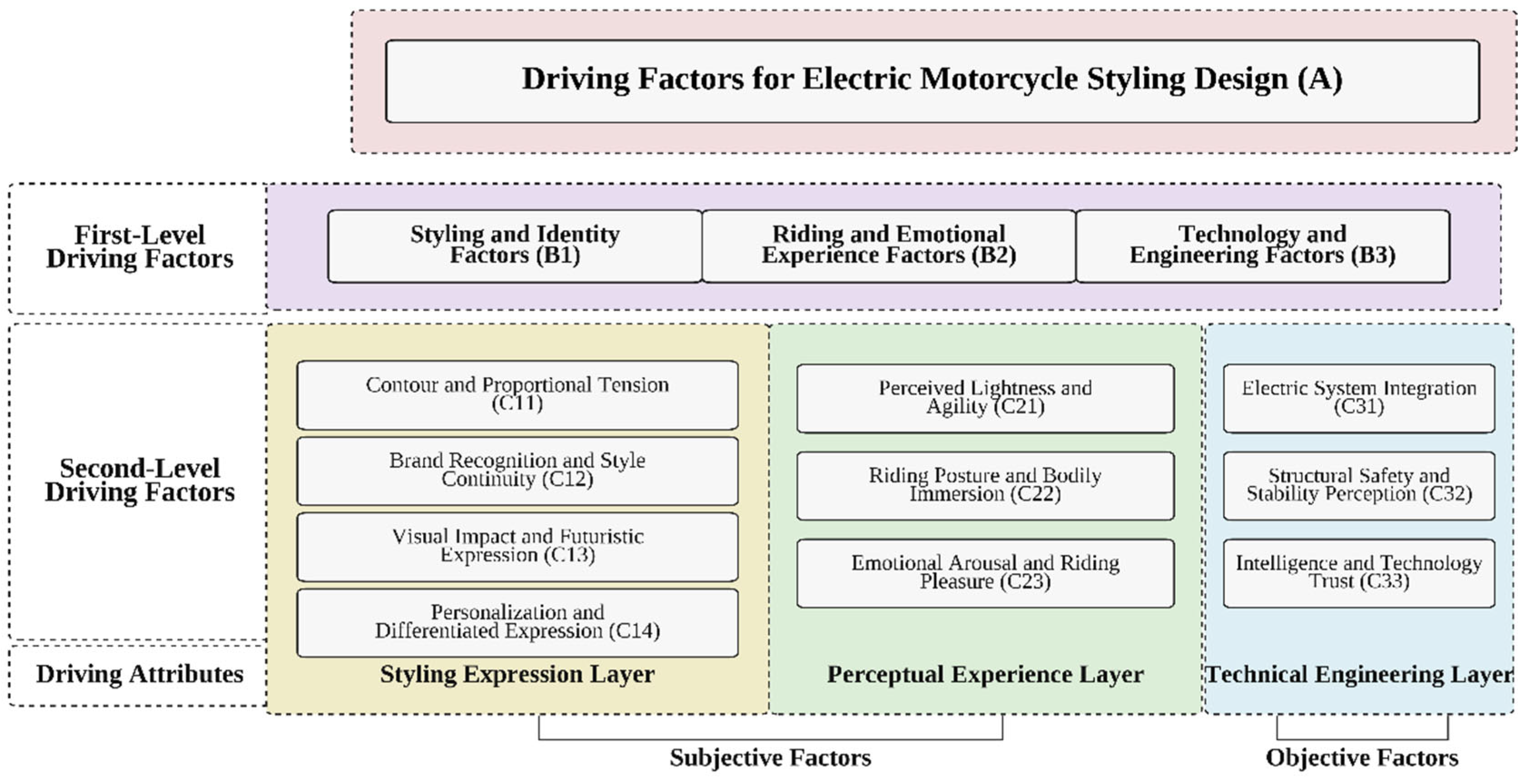
Figure 2.
Workflow of whole-vehicle sample retrieval, screening, normalization, and archetype classification for electric motorcycles.
Figure 2.
Workflow of whole-vehicle sample retrieval, screening, normalization, and archetype classification for electric motorcycles.
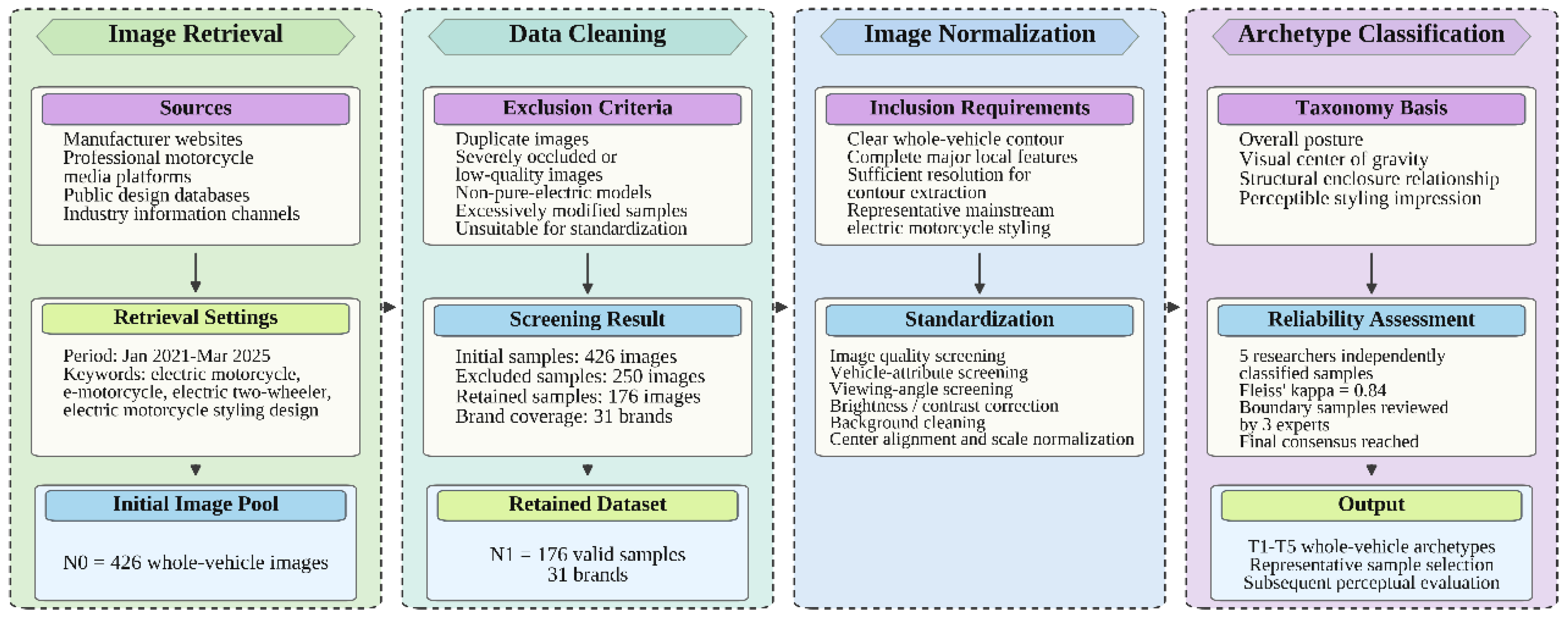
Figure 3.
Modular decomposition of local styling elements in electric motorcycle exterior design.
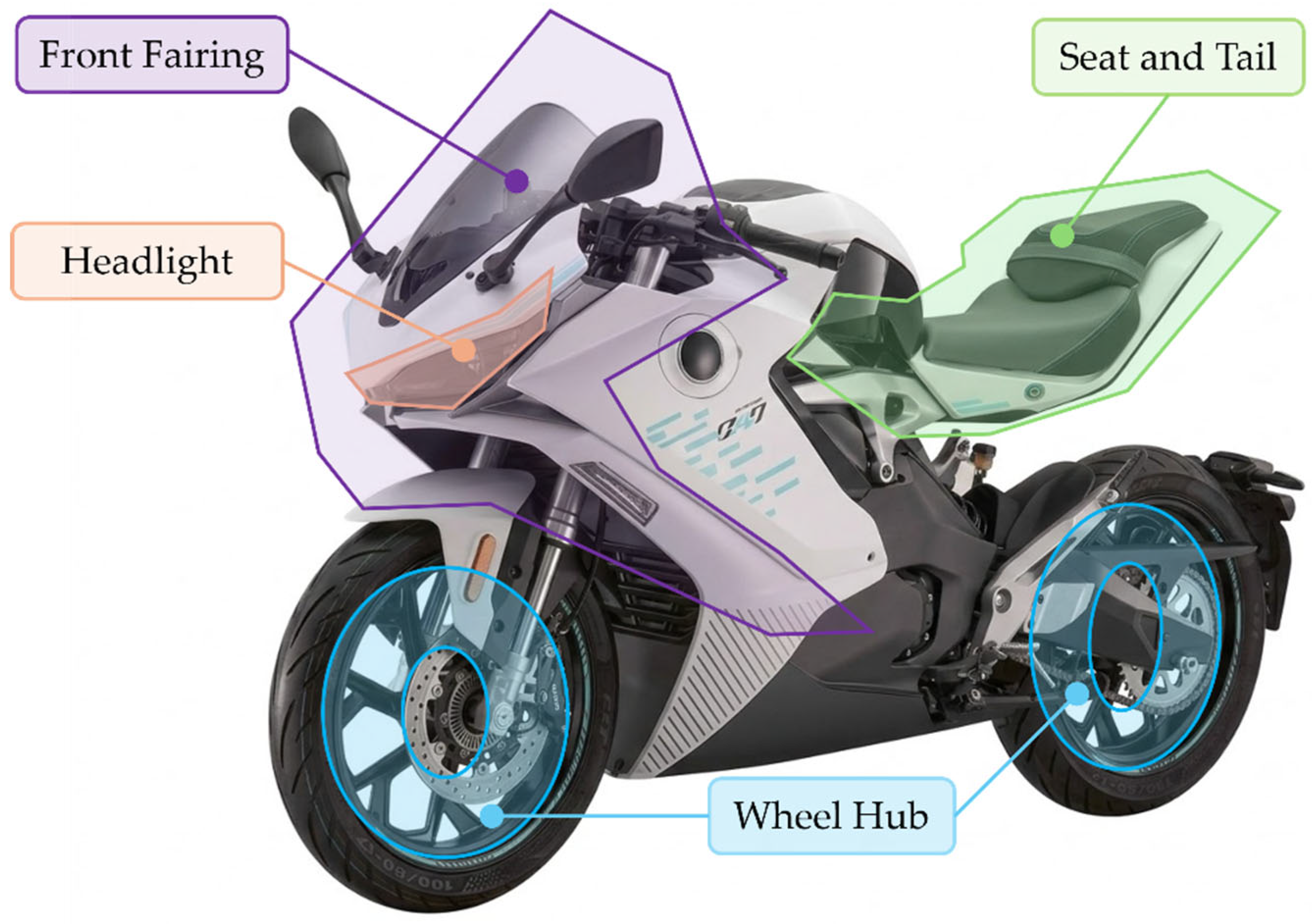
Figure 4.
Global weight ranking of electric motorcycle styling design factors.
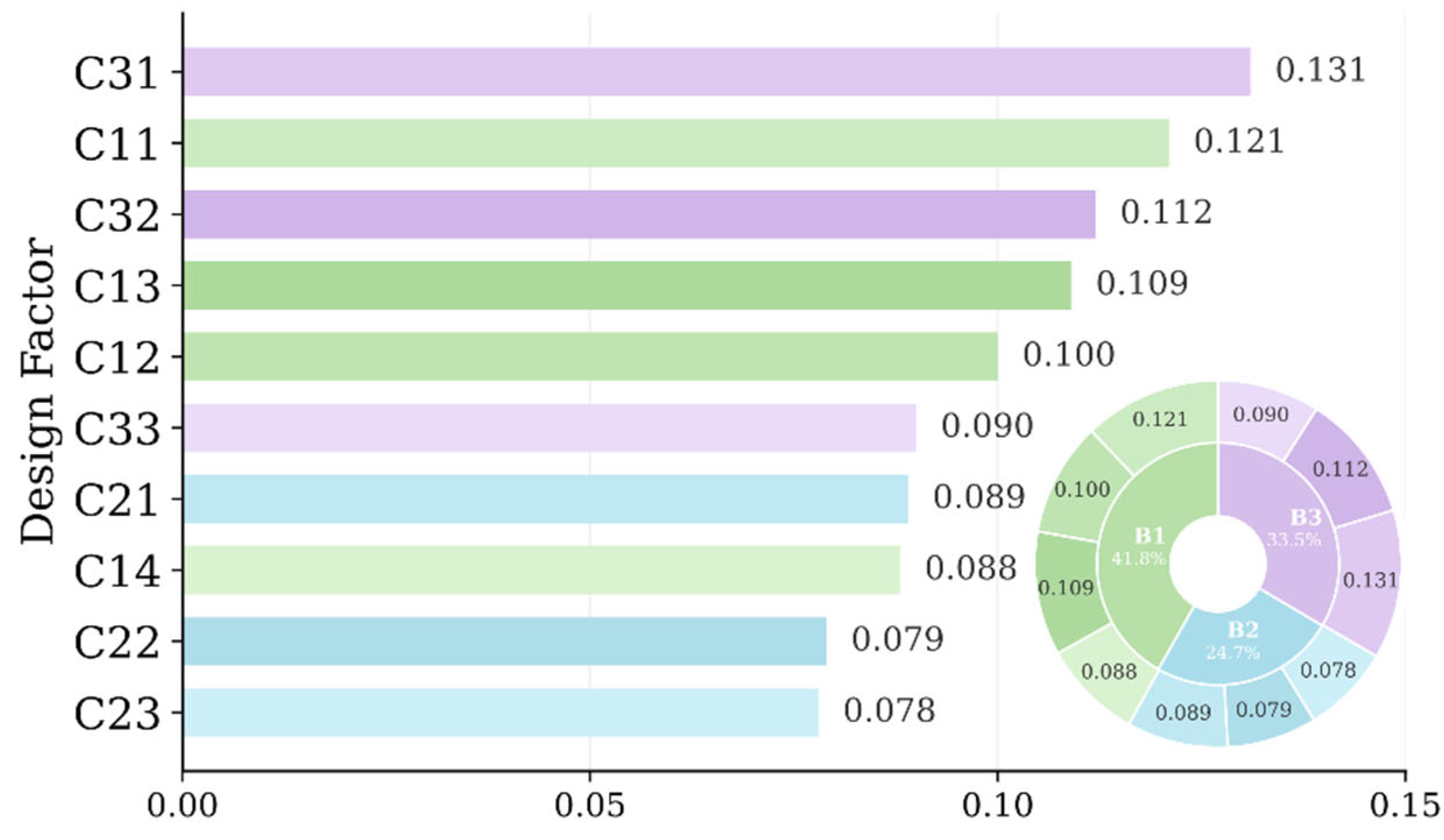
Figure 5.
Heatmap of mean semantic differential scores for whole-vehicle and local styling samples.
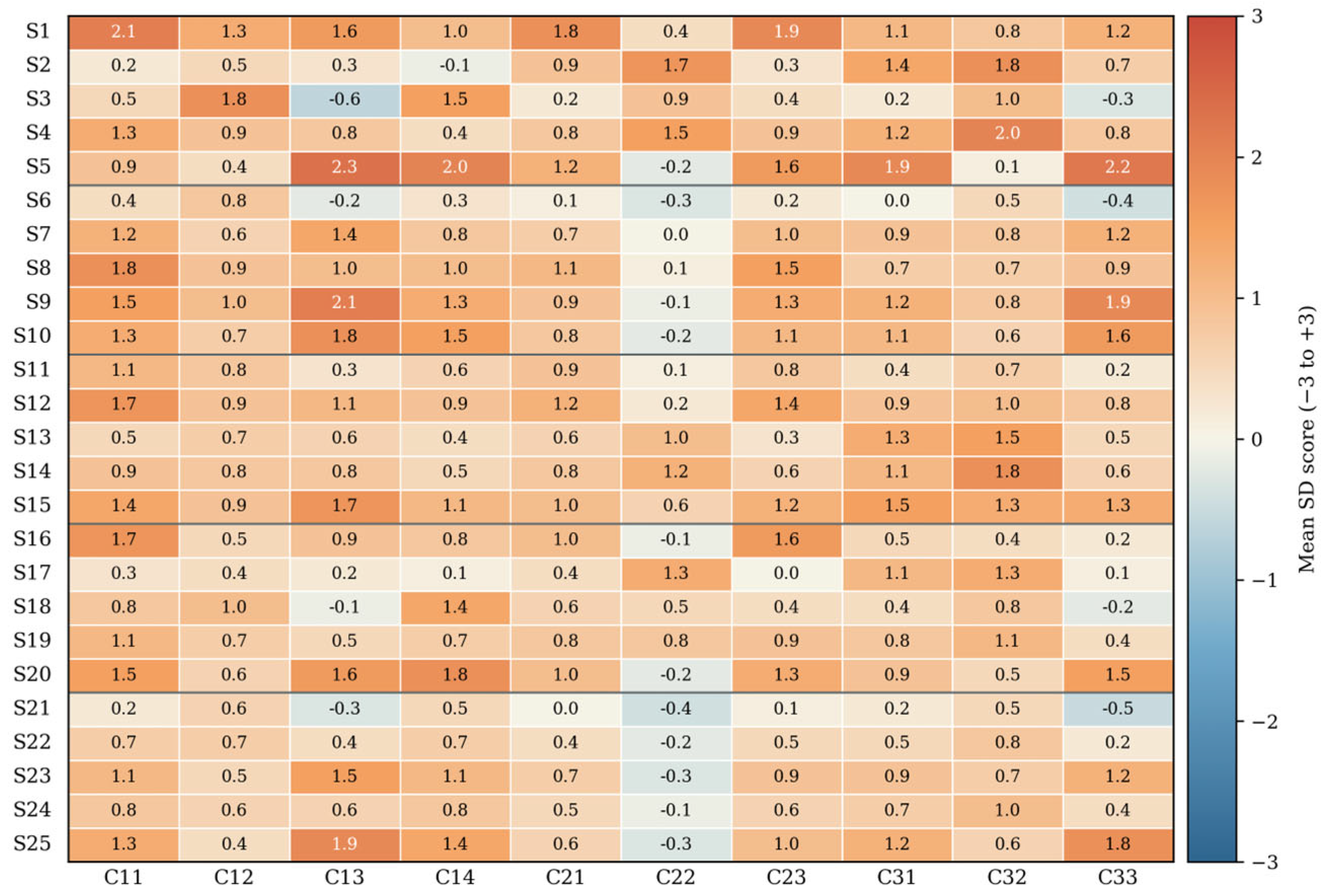
Figure 6.
TOPSIS relative closeness coefficients of whole-vehicle and preferred local styling features.
Figure 6.
TOPSIS relative closeness coefficients of whole-vehicle and preferred local styling features.
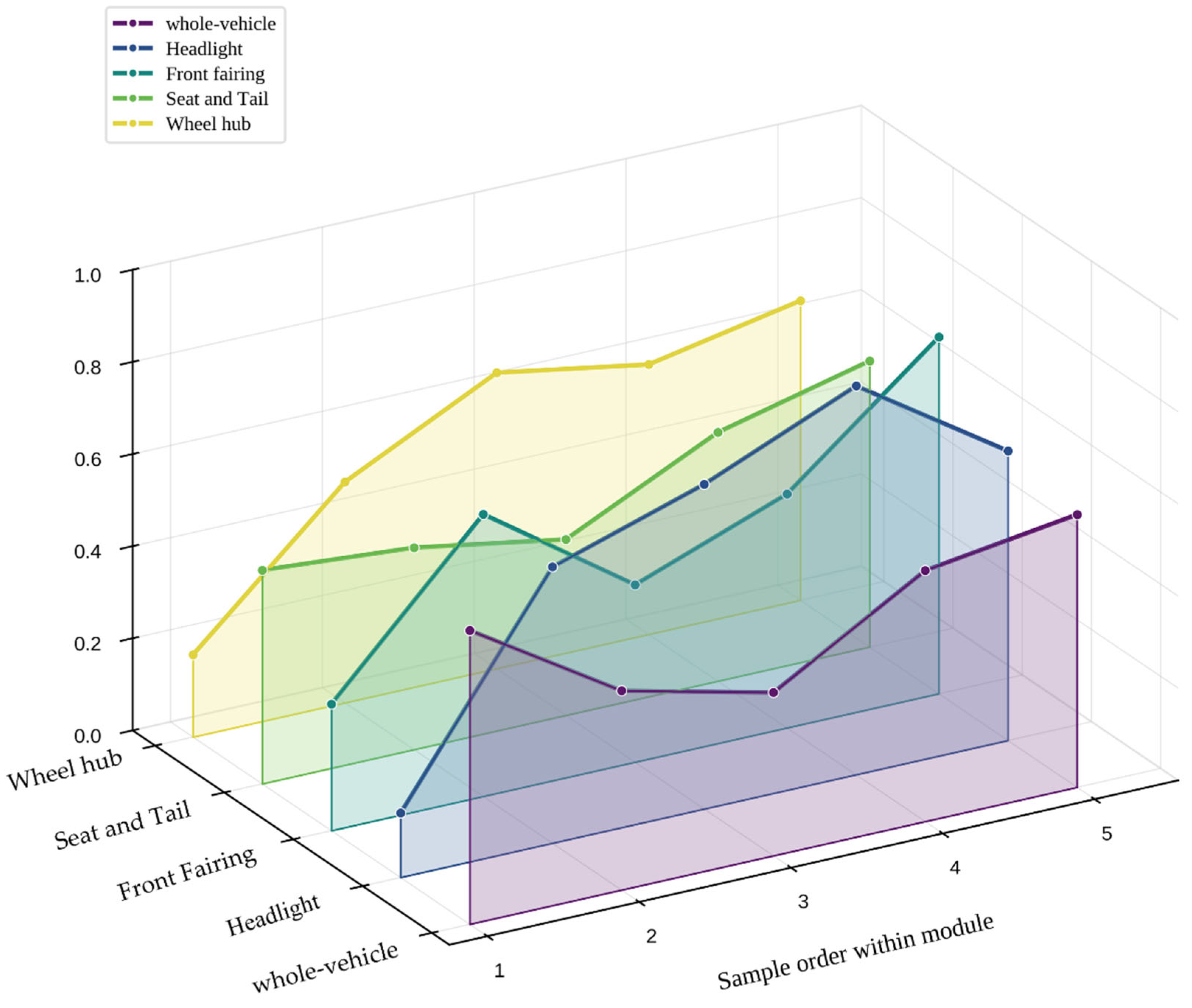
Figure 7.
Translation of graph-structured perceptual evidence into AIGC constraints and re-evaluation.
Figure 7.
Translation of graph-structured perceptual evidence into AIGC constraints and re-evaluation.
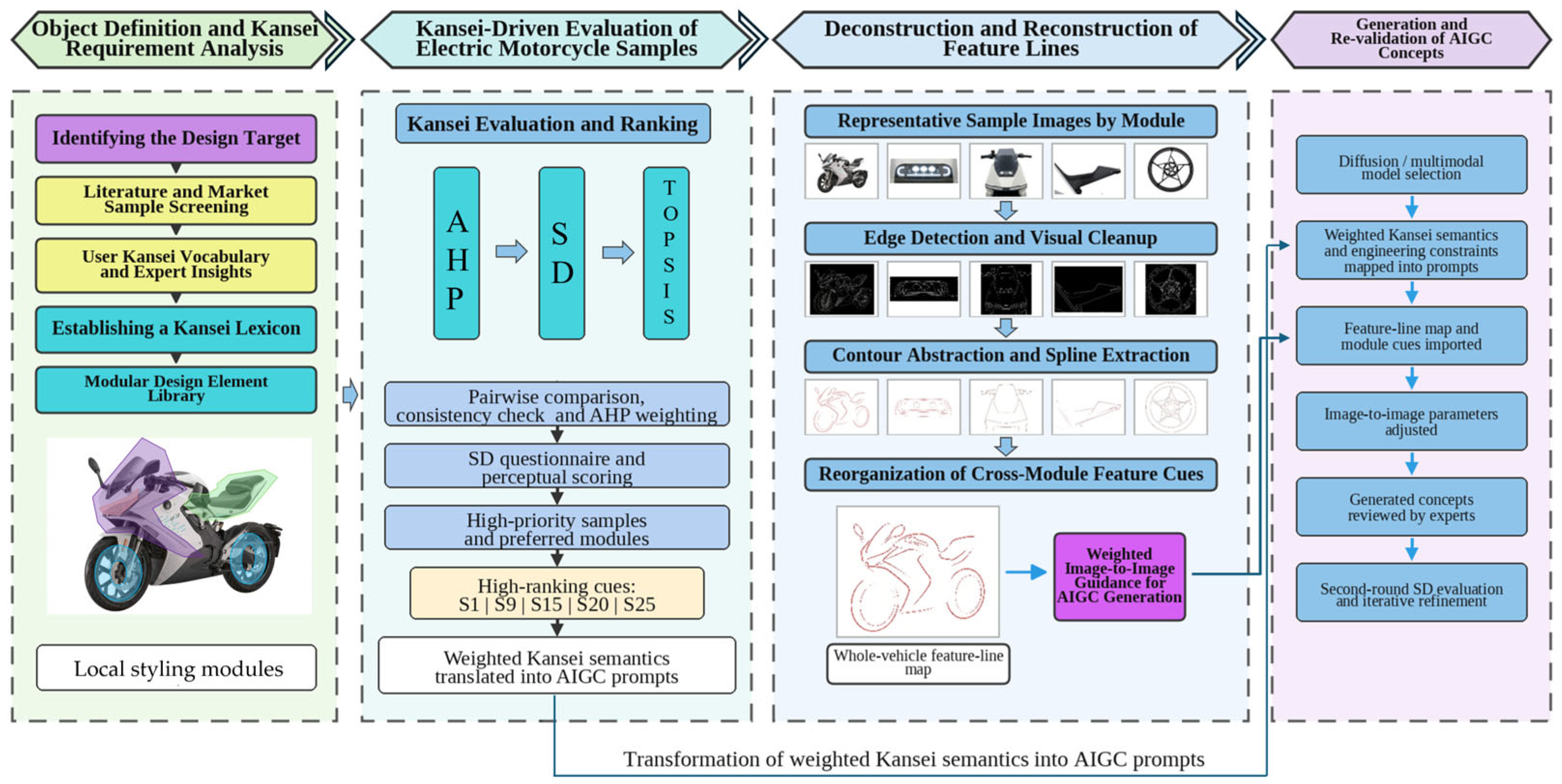
Figure 8.
Representative AIGC-generated electric motorcycle concepts based on graph-structured perceptual constraints: (a) G1; (b) G2; (c) G3; and (d) G4.
Figure 8.
Representative AIGC-generated electric motorcycle concepts based on graph-structured perceptual constraints: (a) G1; (b) G2; (c) G3; and (d) G4.
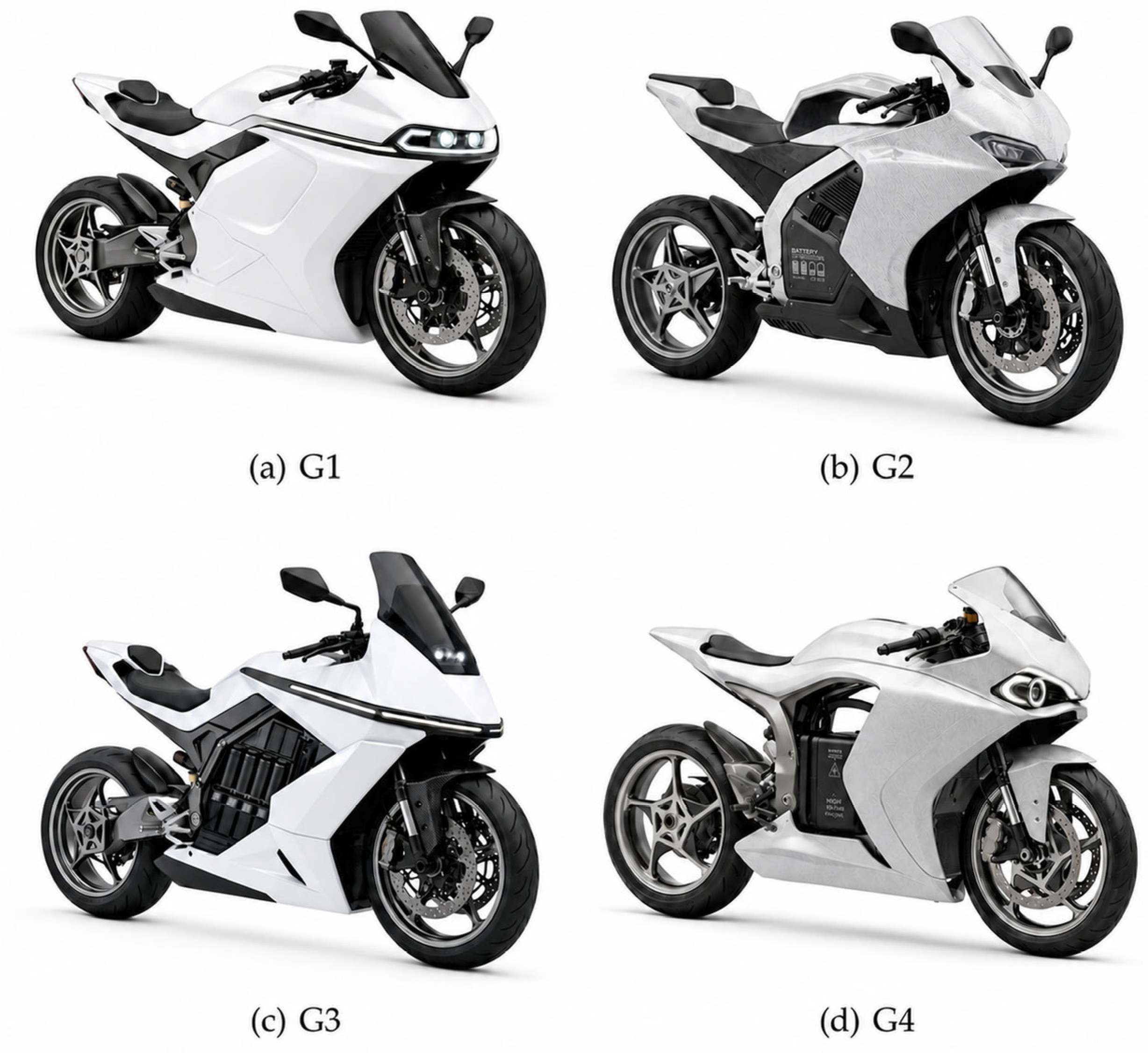
Table 1.
Semantic definitions and representative morphological characteristics of the five whole-vehicle archetypes.
Table 1.
Semantic definitions and representative morphological characteristics of the five whole-vehicle archetypes.
| Code | Archetype | Core semantic impression |
Representative morphological characteristics |
|---|---|---|---|
| T1 | Sport Street Type | Dynamic, aggressive, performance-oriented |
Forward-leaning stance, compact body proportion, sharp front-end treatment, strong visual tension, and dynamic side-profile balance |
| T2 | Scooter Type | Everyday, approachable, convenient | Enclosed body panels, open foot platform, rounded contour, stable user-friendly proportion, and high contour continuity |
| T3 | Retro Type | Classic, emotional, identity-bearing |
Simplified round lighting cues, familiar silhouette, nostalgic proportion, and restrained modern reinterpretation |
| T4 | Adventure Type | Rugged, functional, exploratory |
Tall stance, long-travel visual expression, protective elements, and stronger tool-like character |
| T5 | Futuristic Concept Type |
Advanced, visionary, experimental |
Highly simplified volume, unconventional proportion, continuous lighting signature, module–whole coherence, and strong futuristic symbolism |
Table 2.
Representative whole-vehicle archetypes and contour abstractions.
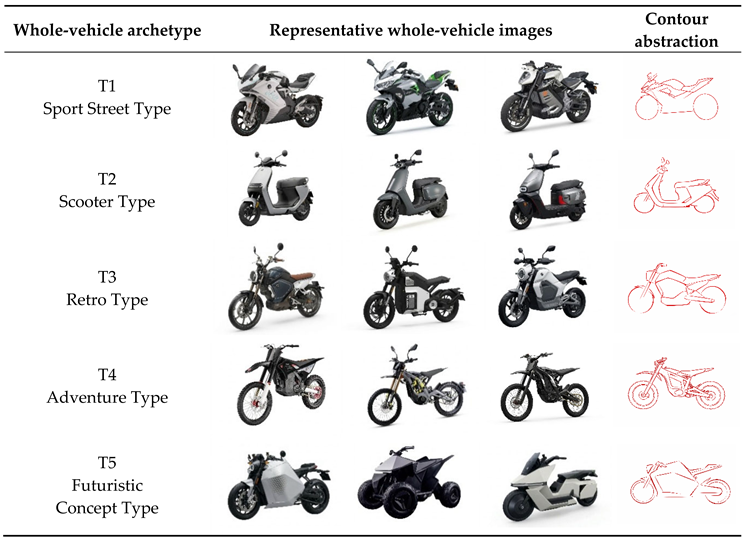 |
Table 3.
Morphological feature classification and coding system for electric motorcycles.
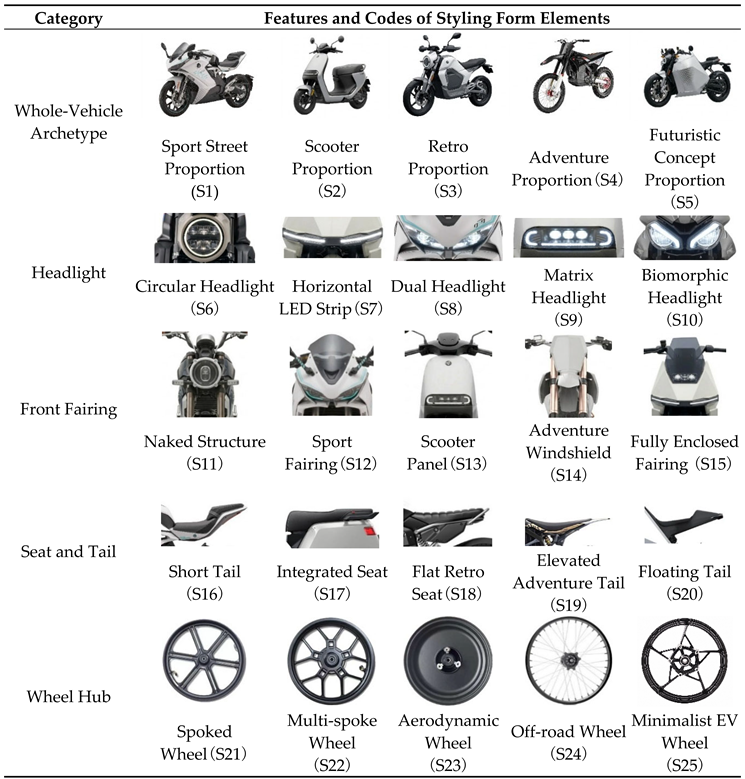 |
Table 4.
Mapping between driving factors and Kansei vocabulary for electric motorcycle styling.
| First-level Driving Factor |
Second-level Driving Factor |
Primary Kansei Vocabulary |
SD Kansei Word Pair | Representative Archetypes |
|---|---|---|---|---|
| Styling and Identity Factors (B1) |
Contour and Proportional Tension (C11) |
Dynamic, Sporty, Aggressive, Compact |
Dynamic–Static | T1/T5 |
| Brand Recognition and Family Identity (C12) | Recognizable, Iconic, Signature, Brand-identifiable |
Recognizable–Generic | T1/T3 | |
| Visual Advancement and Futuristic Expression (C13) |
Futuristic, High-tech, Advanced, Radical |
Futuristic–Conventional | T1/T5 | |
| Personalization and Distinctive Expression (C14) |
Unique, Customized, Expressive, Individualistic |
Unique– Ordinary |
T1/T5 | |
| Riding and Emotional Experience Factors (B2) |
Lightness and Agility Perception (C21) |
Agile, Light, Nimble, Flexible |
Agile– Clumsy |
T1/T2 |
| Enclosure and Immersive Experience (C22) |
Immersive, Enclosed, Cohesive, Connected |
Immersive–Detached | T2/T4 | |
| Pleasure and Excitement in Riding (C23) |
Exciting, Fun, Thrilling, Energetic |
Exciting– Boring |
T1/T5 | |
| Technology and Engineering Factors (B3) |
Structural Integration and Overall Coherence (C31) |
Integrated, Unified, Coherent, Seamless |
Integrated–Fragmented | T2/ T4/T5 |
| Safety and Stability Perception (C32) |
Safe, Stable, Reliable, Solid |
Safe–Risky | T2/ T4/ T3 | |
| Smart and Electric Identity Expression (C33) |
Intelligent, Smart, Understandable, High-tech |
Intelligent–Conventional | T5/T1 |
Table 5.
Graph components in the proposed design knowledge model.
| Graph component | Type | Graph expression | Weight source |
|---|---|---|---|
| Morphology sample | Node | Sᵢ, i = 1,…,25 | Sample coding |
| Styling module | Node | Mₖ, k = 1,…,4 | Module coding |
| Kansei dimension | Node | Cⱼ, j = 1,…,10 | Kansei vocabulary |
| Generation constraint | Node | Pⱼ | Prompt fragment |
| Generated concept | Node | Gₗ | AIGC output coding |
| Sample–Kansei association | Edge | e(Sᵢ, Cⱼ) | Mean SD score xᵢⱼ |
| Evaluation priority | Weight | w(Cⱼ) | AHP global weight |
| Preference ranking | Weighted output | R(Sᵢ) | TOPSIS closeness coefficient Cᵢ |
| Module–whole coordination | Edge | e(Sᵢ, Mₖ) | SD–AHP–TOPSIS evidence |
| Symmetry–asymmetry relation |
Edge | e(Sᵢ, Mₖ) | Profile continuity, module coordination, proportional tension |
| Evidence-to-generation mapping | Edge | e(Cⱼ, Pⱼ) | Prompt-emphasis coefficient αⱼ |
| Concept validation | Edge | e(Gₗ, Cⱼ) | Second-round SD score |
Table 6.
Consistency test results of the AHP judgment matrices.
| Matrix | λmax | CI | CR | Consistency Judgment |
|---|---|---|---|---|
| A | 3.043 | 0.0215 | 0.037 | Acceptable |
| B1 | 4.082 | 0.0270 | 0.030 | Acceptable |
| B2 | 3.036 | 0.0180 | 0.031 | Acceptable |
| B3 | 3.040 | 0.0200 | 0.034 | Acceptable |
Table 7.
Local and global weights of electric motorcycle styling design factors derived from AHP.
| First-Level Dimension |
First-Level Weight |
Second-Level Factor | Code | Representative Kansei Descriptor | Local Weight | Global Weight | Global Rank |
|---|---|---|---|---|---|---|---|
| Styling and Identity |
0.418 | Form Proportion and Tension |
C11 | Dynamic | 0.290 | 0.121 | 2 |
| Brand Identity | C12 | Recognizable | 0.240 | 0.100 | 5 | ||
| Visual Futurism | C13 | Futuristic | 0.260 | 0.109 | 4 | ||
| Customization | C14 | Unique | 0.210 | 0.088 | 8 | ||
| Riding Experience |
0.247 | Perceived Agility | C21 | Agile | 0.360 | 0.089 | 7 |
| Riding Immersion | C22 | Immersive | 0.320 | 0.079 | 9 | ||
| Emotional Pleasure | C23 | Exciting | 0.320 | 0.078 | 10 | ||
| Technology and Engineering |
0.335 | System Integration | C31 | Integrated | 0.390 | 0.131 | 1 |
| Safety Perception | C32 | Safe | 0.340 | 0.112 | 3 | ||
| Technology Trust | C33 | Intelligent | 0.270 | 0.090 | 6 |
Table 8.
Mean semantic differential scores of whole-vehicle electric motorcycle samples.
| Sample | Type | C11 | C12 | C13 | C14 | C21 | C22 | C23 | C31 | C32 | C33 |
|---|---|---|---|---|---|---|---|---|---|---|---|
| S1 | Sport Street Proportion |
2.10 | 1.30 | 1.60 | 1.00 | 1.80 | 0.40 | 1.90 | 1.10 | 0.80 | 1.20 |
| S2 | Scooter Proportion |
0.20 | 0.50 | 0.30 | -0.10 | 0.90 | 1.70 | 0.30 | 1.40 | 1.80 | 0.70 |
| S3 | Retro Proportion |
0.50 | 1.80 | -0.60 | 1.50 | 0.20 | 0.90 | 0.40 | 0.20 | 1.00 | -0.30 |
| S4 | Adventure Proportion |
1.30 | 0.90 | 0.80 | 0.40 | 0.80 | 1.50 | 0.90 | 1.20 | 2.00 | 0.80 |
| S5 | Futuristic Concept Proportion | 0.90 | 0.40 | 2.30 | 2.00 | 1.20 | -0.20 | 1.60 | 1.90 | 0.10 | 2.20 |
Table 9.
TOPSIS ranking results of whole-vehicle electric motorcycle samples.
| Sample | Distance from Positive Ideal Solution Di+ | Distance from Negative Ideal Solution Di− |
Relative Closeness Ci |
Rank |
|---|---|---|---|---|
| S1 | 0.1001 | 0.1760 | 0.6375 | 1 |
| S2 | 0.1718 | 0.1307 | 0.4322 | 4 |
| S3 | 0.1895 | 0.1041 | 0.3542 | 5 |
| S4 | 0.1360 | 0.1630 | 0.5449 | 3 |
| S5 | 0.1278 | 0.1857 | 0.5920 | 2 |
Table 10.
Visual extraction and side-profile reconstruction of preferred styling cues for constrained AIGC generation.
Table 10.
Visual extraction and side-profile reconstruction of preferred styling cues for constrained AIGC generation.
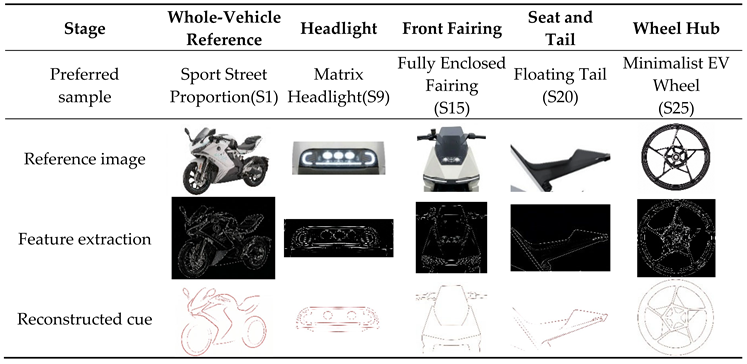 |
Table 11.
TOPSIS re-evaluation results of AIGC-generated electric motorcycle design schemes.
| Scheme | Distance from Positive Ideal Solution Di+ |
Distance from Negative Ideal Solution Di− | Relative Closeness Ci |
Rank |
|---|---|---|---|---|
| G1 | 0.158 | 0.231 | 0.594 | 2 |
| G2 | 0.204 | 0.214 | 0.512 | 4 |
| G3 | 0.137 | 0.268 | 0.662 | 1 |
| G4 | 0.176 | 0.223 | 0.559 | 3 |
Disclaimer/Publisher’s Note: The statements, opinions and data contained in all publications are solely those of the individual author(s) and contributor(s) and not of MDPI and/or the editor(s). MDPI and/or the editor(s) disclaim responsibility for any injury to people or property resulting from any ideas, methods, instructions or products referred to in the content. |
© 2026 by the authors. Licensee MDPI, Basel, Switzerland. This article is an open access article distributed under the terms and conditions of the Creative Commons Attribution (CC BY) license (http://creativecommons.org/licenses/by/4.0/).
Copyright: This open access article is published under a Creative Commons CC BY 4.0 license, which permit the free download, distribution, and reuse, provided that the author and preprint are cited in any reuse.


