

Submitted:
12 July 2026
Posted:
14 July 2026
You are already at the latest version
Abstract
The Siberian Traps has been a reference object for geologists for many years in understanding the origin of Large Igneous Provinces on Earth. Data from high-magnesium rocks in its northern region have traditionally been used to create genetic models. However, the central and southern parts, consisting of the basaltic rocks, remain significantly unexplored, despite their important role in volcanic evolution within the province. This article presents new structural, mineralogical, and geochemical data from the tuff-lava sequence in the central region of the Tunguska syneclise. The studied sections are located along the Lower Tunguska River Valley, near Tura, Babkino, and Vanavara, in the Podkamennaya Tunguska Valley. They consist of pyroclastic rocks belonging to the Korvunchansky Formation, which are overlain by basalts and tuffs of the Nidymsky and Kochechumsky Formations (Early Triassic, 251 Ma). Major and trace element analysis of 64 samples shows that basalts from all formations are relatively similar in composition, belonging to the tholeiite type with MgO concentrations ranging from 4.2% to 7.8%. Trace element patterns exhibit negative Ta-Nb anomalies and positive Pb anomalies, which are typical of the Siberian Platform basalts. Tuffs, on the other hand, differ from the basalts by having higher SiO₂ and K₂O contents and steeper rare earth element (REE) patterns. Isotopic analysis (Sr-Nd) confirms this difference and suggests that basalts and tuffs originated from two distinct magma sources. The Nidymsky basalts have positive εNd values (+2.21 to +3.10), similar to those of the Morongovsky and Mokulaevsky basalts in the Norilsk area. Tuffs, on the other hand, exhibit negative εNd (-1.33 to -4.5) and elevated 87Sr/86Sr (>0.706), in comparison with basalts (0.704-0.706). Geological observations reveal that pyroclastic rocks play a significant role in the initial stages of volcanic activity. The main result of this study is that tuffs from the Korvunchansky and Khakanchansky Formations (in the south and north of the region, respectively) are identical in their geochemical characteristics. This similarity suggests the existence of a single pyroclastic cover over the Siberian Platform. These tholeiitic pyroclastic rocks, which are similar in composition to the lower crust, mark the beginning of trap magmatism, rather than picrites, as suggested by the plume model.
Keywords:
Siberian traps
; volcanic rocks
; geochemistry
; rift
; platform
; tuffs
; basalts
1. Introduction
The Siberian Large Igneous Province, which includes rocks from western and eastern Siberia, is the largest continental province on Earth (251 Ma; Kamo et al., 2003). It is attracted the attention of many researchers as an etalon area for LIP modeling. Two types of basalt are distinguished in this province, i.e., rift-related and platform-related (Almukhamedov et al. 2004; Krivolutskaya et al. 2022, 2026). Rift-related rocks are found in western Siberia and northern Eastern Siberia, forming narrow zones along rifts. Their compositions range from picrites to dacites. Platform-related rocks, also known as typical traps or flood basalts, cover vast areas of eastern Siberia and have tholeiitic composition.
The rift and platform basalts have been reported in many other areas (Westerhold et al., 2025; Godang et al., 2025; et ctr.), including the north of Eastern Siberia, where these two types of basalt form thick sections of volcanic rock, reaching up to 3.5 kilometers in the Norilsk region. The stratigraphy of this sequence of tuff and lava was established during the geological mapping in 1960s and has been used in subsequent publications (Zolotukhin et al., 1986; Dyuzhikov et al., 1988; Lightfoot et al., 1990, 1993; Fedorenko et al., 1996; Ryabov et al., 2000; Radko, 2016, 2025). Rift basalts consist of subalkaline rocks, such as trachybasalt of the Ivakinsky and Syverminsky Formations, picritic and tholeiitic basalt of the Gudchikhinsky and Nadezhdinsky Formations. Platform rocks (typical traps) include tholeiitic basalts from the Hakanchansky, Tuklonsky, Morongovsky, Mokulaevsky, Kharaelahsky, Kumginsky, and Samoedsky Formations (Geological map of the Norilsk ore region on a scale of 1:200,000, 1994). The geochemistry of basalts, including their isotopic characteristics, in the Norilsk area has been studied in detail by various researchers (Wooden et al., 1993; Lightfoot et al., 1994; Krivolutskaya, 2016, etc.). This interest in these rocks is largely due to the occurrence of unique PGE-Cu-Ni deposits (Godlevsky, 1959; Dyuzhikov et al., 1992; Likhachev, 1994, 2006; Naldrett, 1992, 2004; Naldrett et al., 1996; Krivolutskaya, 2016; Radko, 2025).
Furthermore, high-magnesium rift rocks that were studied in the north of Siberian province, in the Norilsk area (Sobolev et al., 2009a), and in the Maymecha-Kotuy area were picrites and rare alkaline picrites and meimechites (Sobolev and Slutsky, 1984; Fedorenko et al., 2000; Sobolev et al., 2009 b; Ryabchikov et al., 2001; Vasiliev and Gora, 2014; Vasiliev et al., 2017; Ivanov et al., 2018; Panina et al., 2025). Sobolev et co-authors (2009a) estimated the depth of melting for the Gudchikhinsky magma was between 130 and 180 kilometers (4.5 to 6 GPa) with a mantle temperature of 1500 to 1580oC. According to Ryabchikov et al. (2001), the temperature of origin for the primary magma of alkaline picrites was 1650oC, and it formed at 6 to 7 GPa. These rocks are considered to be primary derivatives of traps that result from contamination of lithospheric mantle magma by crustal material (25 to 30 vol.%) (Lightfoot et al., 1993; Wooden et al., 1993). However, typical traps do not contain ultrabasic members, and their relationship with rift rocks is uncertain.
The indicated features of the northern part of the province, namely, the high thickness of volcanic rocks, the presence of PGE-Cu-Ni deposits, and the occurrence of high-magnesium rocks, led to the fact that this region was studied and described in more detail than other areas e.g., Dodin and Golubkov, 1971; Fedorenko, 1981; Sharma, 1996; Wooden et al., 1993; Howkesworth et al., 1995; Arndt et al. al., 1998; Ryabov et al., 2000. All existing models for the Siberian province are based on studies of the rift rocks. Different hypotheses have been proposed to explain the origin of large volumes of magma within a relatively short time period (less than 1 million years; Renne and Basu, 1991; Reichow et al. all., 2009) and for genesis of ore deposits (Radko, 1991, 2025; Naldrett, 1992) as well as mass extinctions at the Permian-Triassic boundary (Campbell et al., 1992; Ernst, 2014; Volcanism and global environmental change, 2015; Elkins-Tanton et al., 2020).
The most widely accepted theory suggests that all the Permian-Triassic igneous rocks in Siberia formed as a result of a plume, or superplume (Campbell, Griffiths 1990; Dobretsov, 1997; Sobolev et al., 2011). It is proposed that the Siberian Traps represent the head of this plume, which contains high-magnesium rocks formed at a significant depth (up to 120-150 kilometers) and at a high temperature.
According to the classic model (Campbell, Davis, 2006), the initial platform magmatism should have been replaced by rifting, leading to the splitting of the continent. However, this hypothesis has several significant drawbacks. Many researchers have pointed out the lack of evidence for the uplift of the region (Campbell, Davis, 2006; Sobolev et al., 2011), which is necessary for deep matter to reach the surface. Furthermore, Siberian Rift Zones appeared at the start of rock formation (Almukhamedov et al., 2004); and the rift magmatism existed simultaneously with the platform one (Krivolutskaya, 2016; Krivolutskaya et al., 2022a, 2026). High-Mg rocks were found only in rift zones, such as the Yenisei-Khatanga trough and its satellites, and not among platform basalts. While there are other hypotheses about of the formation of traps (Elkins-Tanton, Hager, 2000; Elkins-Tanton, 2005; Ivanov, 2007, 2015), the plume theory remains the most widely accepted.
In order to understand the history of magmatic evolution and create a comprehensive theory for the formation of the Siberian Province, it is essential to have information about its overall structure. The central and southern regions of the province are composed of typical traps, which have received less attention despite their vast exposure and large volume. This article is dedicated to the structure and geochemical characteristics of the tuff-lava* sequence in the central part of the Tunguska syneclise (Figure 1). The results allow us to compare these rocks with those from the northern part of Eastern Siberia, and based on this, draw conclusions about their origin.
2. Geological Background
The Siberian Platform, the largest part of the Siberian Large Igneous Province, is composed of a crystalline basement (AR-PR) and an overlying sedimentary cover (R-J) (Malich, 1975; Staroseltsev, 1989; Geology and Mineralization of Russia, 2002). Ancient rocks are exposed on the Anabar and Aldan Shields (Figure 1, Figure 2 and Figure 3). Cambrian-Permian sedimentary deposits of the cover are exposed along the edges of the Tunguska Syneclise, while in the central part, they are overlain by volcanic rocks. We use tuff-lava term for sequence of interlayers tuff and lavas, while tuffolava means a rock of intermediate composition.
Geological and geophysical data reveal the complex structure of both the basement (Figure 2) and the sedimentary deposits (Figure 3).
The crystalline basement, according to the geophysical data (Dolgal, 2012), is composed of Archean and Proterozoic gneisses and granulites. It comprises several large depressions – Kharaelakhsky, Khantaisky, Tungusky and Taseevsky (Figure 3), as well as several smaller ones.
Before the trap magmatism at the end of Permian period, the depths of the Khantaisky and Tunguska depressions ranged from 100 to 400 meters. Therefore, the thickness of volcanic, mainly pyroclastic, rocks varies significantly within the Tunguska syneclise (Bazhenova, 2019). The cover of the Siberian platform consists of the Cambrian – Devonian carbonate-terrigenous rocks and Middle Carboniferous – Middle Permian coal-bearing terrigenous deposits forming a thick section around 10,000 m (Geological map of the Russian Federation, 2018).
The sedimentary deposits in the Tunguska River Valley were penetrated by numerous but shallow boreholes. Only one them located near the village of Babkino (600 m deep, b1 in Figure 2) revealed almost the entire Paleozoic rocks that underlies the volcanic rocks, but it did not reach the basement. This borehole also found numerous dolerite sills. The structure of the Late Permian - Early Triassic igneous rock in Eastern Siberia has been zoned, largely determined by the subsequent erosion of elevated areas of the Tunguska syneclise. This erosion led to the appearance of tuffs and intrusions on the periphery of the syneclise (Figure 1). The studied area, dominated by exposed basalts, is located in the center of the Tunguska syneclise. According to V.S. Staroseltsev (1989), this syneclise formed in the Early Carboniferous, and its outer boundaries are defined by the outer ranges of trap sills (Figure 1 and Figure 2). At the base of the syneclise, there are numerous shafts and depressions formed during the first half of the Paleozoic era (Figure 3).
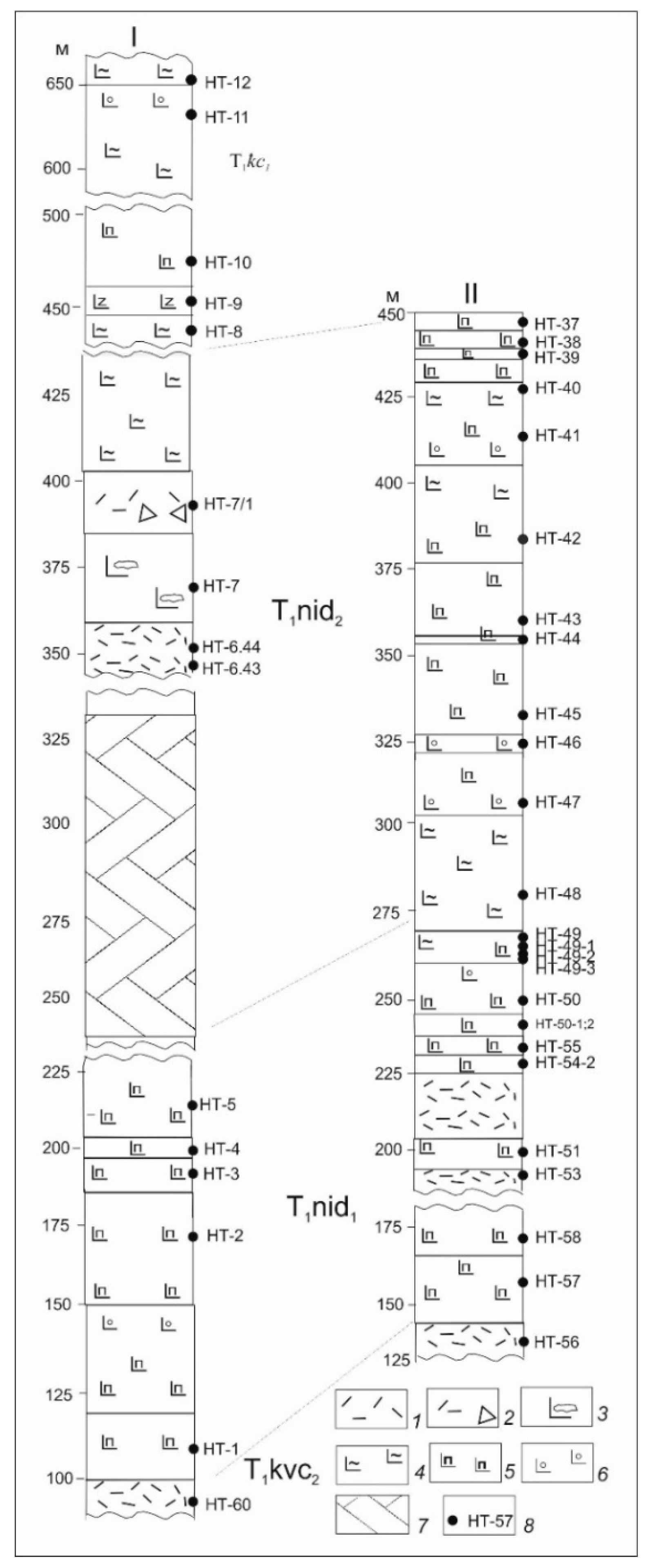
The rocks containing volcanic material were combined (Dyuzhikiv et al., 1988, 1992) into the following Formations (the summary section is shown in Figure 4), i.e., the Pelyatkinsky and Degalinsky Formation (P3), with a whole thickness of 230-240 meters; the overlapping Tutonchansky Formation (T1), ranging from 20 to 100 m; and the Korvunchansky Formation with thicknesses up to 500 m (Domyshev, 1974; Geological Map, 1985). The Degalinsky Formation is the abundance of Сordaites, which indicate its Late Paleozoic (Permian) age (Taylor et al., 2009). The first two Formations consist of sandstones with a few admixture of ash, while the third and fourth ones comprise only pyroclastic rocks. These Formations overlap sequentially by basalts and tuffs of the Nidymsky, Kochechumsky, and Yambukansky Formations, described below. The most complete sections, up to 600 meters in length, were studied from boreholes drilled in the Lower Tunguska Valley (Figure 5).
Figure 6.
Sections I and II of tuff-lava sequences in the Lower Tunguska River Valley. Positions of these sections are indicated in Figure 5a,c. 1-tuff, 2 – tuff breccia, 3 – pillow lava, 4-6 – basalts: 4 – aphyric, 5 – poikilophitic, 6 – amygdale; 7 – not exposed; 8 – position and number of sample. Formations: T1kv2 – Upper part of Korvunchansky, T1nid1 – Lower part of Nidymsky, T1nid2 – Upper part of Nidymsky, T1kč – Kochechumsky.
Figure 6.
Sections I and II of tuff-lava sequences in the Lower Tunguska River Valley. Positions of these sections are indicated in Figure 5a,c. 1-tuff, 2 – tuff breccia, 3 – pillow lava, 4-6 – basalts: 4 – aphyric, 5 – poikilophitic, 6 – amygdale; 7 – not exposed; 8 – position and number of sample. Formations: T1kv2 – Upper part of Korvunchansky, T1nid1 – Lower part of Nidymsky, T1nid2 – Upper part of Nidymsky, T1kč – Kochechumsky.
3. Materials and Methods
The subject of this study includes volcanic rocks exposed at three locations: (a) near the Tura village on the right bank of the Lower Tunguska River (see Table 1 in Electronic Supplementary Materials, ESM 1); (b) near the Babkino village located 70 kilometers south of Tura on the left bank of the river; where a number of flows and tuff horizons of the Korvunchansky and Nidymsky Formations were exposed, and the Krutoe deposit of Icelandic spar is located; and (c) near the Vanavara settlement in the Podkamennaya Tunguska River Valley (Figure 3). We took samples from the central parts of flows (2-20 meters) from the Nidymsky and Kochechumsky Formations that are less likely to have affected by secondary alteration. Thin sections and materials for analyses were prepared from 64 samples.
To study the textural characteristics and chemical composition of minerals, standard methods of optical and scanning electron microscopy were used. An Olympus microscope and a Field Emission Gun (FEG) scanning electron microscope (SEM) Tescan Mira 3 FEG SEM were employed at the Vernadsky Institute of Geochemistry and Analytical Chemistry of the Russian Academy of Sciences in Moscow, Russia (GEOKHI RAS). Quantitative analyses of mineral phases were performed using an Ultim Max 100 Oxford Instruments energy dispersive spectrometer operating at a voltage of 20 kV and a beam current of 0.9 nA. A working distance of 15 cm was used, and the analyses were assisted by S.I. Demidova. The detection limit for oxides was ≤ 0.05 wt %. Natural minerals and synthetic standards were used during the analyses, i.e., hypersthene for Mg, Fe, and Si; albite for Na; and albite for Al; wollastonite for Ca, and orthoclase for K. Ilmenite was used for Ti. The data (84 analyses) is provided in Table ESM 2.
Major elements in minerals were also determined in the polished thin sections using a Jeol JXA 8200 SuperProbe electron microprobe at the Institute of Geology of Ore Deposits, Petrography, Mineralogy and Geochemistry (IGEM RAS, Moscow, Russia) with the assistance of analysts V.I. Taskaev. These data are in ESM 3 (55 analyses). Well-characterized homogeneous natural and synthetic mineral standards were used for calibration of element sensitivities, i.e., almandine, apatite, jadeite, celestite, olivine, diopside, augite, plagioclase, rutile, orthoclase. All analyses used 20 kV accelerating voltage, 20 nA focused beam, 20 s on-peak counting time and 10 s for each background. For matrix correction, the PAP method was applied. Detection limits for silicate minerals were 0.01-0.02 (in wt.%) for all oxides.
The contents of the major and trace elements in the rocks were determined using X-ray fluorescence analysis (XRF) and Inductively Coupled Plasma Mass Spectrometry (ICP-MS) (ESM 4). XRF analyses were performed at the IGEM RAS by A.I. Yakushev using a AXIOS mAX vacuum spectrometer from PANalytical (Almelo, Netherlands), equipped with a 4 kW X-ray tube with Rh anode. The maximum voltage on the tube was 60 kV and the maximum current on the anode was 160 mA. For calibration of the device, standard industry samples of the chemical composition of rocks were used. The quality control of the results was carried out through the analysis of USGS rock standards. The relative standard deviations (RSDs) for the main oxides (wt. %) are following: SiO2: 0.12, TiO2: 0.05, Al2O3: 0.12, Fe2O3 total: 0.13, MnO: 0.005, MgO: 0.07, CaO: 0.08, Na2O: 0.08, K2O: 0.03, P2O5: 0.01.
Trace elements analyses in the rocks were carried out using ICP-MS at the Institute of Microelectronics and High Purity Materials, Russian Academy of Sciences, Chernogolovka, by V. K. Karandashev, according to the methodology (Karandashev et al., 2017). The detection limits for isotopes can be found in the ESM 4 document. Andesite (AGV-2) and basalt (BHVO-2) were used as standards (Table in ESM 4). A detailed description of the method is given in the ESM 5.
The isotope composition of the samples was analyzed using a Triton solid-phase multi-collector mass spectrometer (Thermo) at the VSEGEI in St. Petersburg (analyst B.V. Belyatsky). The values of 88Sr/86Sr = 8.375209 and 146Nd/144Nd = 0.7219 were used for normalization. The preliminary decomposition of silicate samples and isolation of elements were carried out using ion exchange chromatography according to standard procedures. The blank test value during the analysis was less than 0.1 ng for Sm, Nd, and Sr, and 0.05 ng for Pb and Rb. The isotopic composition of the JNdi-1 Nd standard was 143Nd/144Nd = 0.512106 ± 0.000005 and SRM987 87Sr/86Sr = 0.710256 ± 0.000006, with an error of the isotopic ratio given at the 95% confidence level in absolute (2s) or percentage (2s%) terms. To recalculate the isotopic composition of lead at the time of its formation 251 million years ago, we used the contents of lead, thorium, and uranium, which are given in Table 1.
4. Results
This Only volcanic and pyroclastic rocks of Upper Permian to Lower Triassic period are exposed in the studied areas (Figure 5, EMS 6) in the center of the Siberian Trap province. Boreholes have penetrated underlying sedimentary (Figure 5e). We have studied three Formations from six shown in Figure 4, i.e., Korvunchansky, Nidymsky, and Kochechumsky Formations. Below is a description of the rock Formations that we studied in the outcrops (Figure in ESM 6) according to their geological setting on the maps (lines I and II in Figure 5).
4.1. Structure of the Tuff-Lava Sequence in the Center of the Tunguska Syneclise
4.1.1. The Korvunchansky Formation
The lowest pyroclastic Formation, Tutongchansky (Figure 5e), has a very local distribution and do not expose on the surface in the studied areas, therefore, we do not regard it in the article. Although the overlapping Korvunchansky Formation also consists of pyroclastic rocks, but it covers almost the entire Tunguska syneclise. The thicknesses of this Formation vary between 100 and 300 meters. Rare interbeds of volcanogenic-sedimentary rocks within these formations only contain lake fauna and a continental spore-pollen complex of Earlier Triassic age.
The Korvunchansky Formation consists of tuff breccias, heterogeneous ash tuffs, and tuffites (i.e., tuff with >50 vol.% sedimentary material). These rocks form outcrops near ancient craters with tower-shaped weathering patterns (Figure 7). However, most of the pyroclastic rocks consists of ash and erupted material.
Currently, the Korvunchansky Formation is divided into two parts. The lower part belongs to the Ucham Formation and the upper part belongs to either the Bugariktinsky or Gagaryeostrovsky Formation, depending on the location in the area (Geological Map of the USSR 1:200,000 Scale, 1985).
We have retained the original name of this Formation because it accurately describes in many publication (Kutygin et al., 2020; Gusev et al., 2018).
The period of its accumulation and the flora that developed during this time are referred to as the "Korvunchansky" or conifer-fern post-cordaitic (Prinada, 1970; Geological Map of the Russian Federation at a scale of 1:1,000,000, 2018). As noted by Kutygin and colleagues (Kutygin et al., 2020), "the change of the cordaitic flora to the Korvunchansky flora is a significant event in the development of the Angara plant kingdom”. It is suggested that it was formed in Triassic period (Mogucheva, 2016; Sadovnikov, 2016).
The upper boundary of the Formation is drawn along the base of the basalts of the Nidymsky Formation (Figure 8a). The total thickness of its upper part ranges from 45 to 50 meters. These rocks were redeposited and are characterized by distinct layering (2-5 cm) of gray and green silty lithocrystalline andesite-basalt tuffs, with relatively good sorting. Sometimes, there is a shell-like structure in the tuffs (Figure 8). Upon close examination, the rocks exhibit a yellowish-brown color (Figure 9). Debris, which accounts for 60-80% of the volume, consist of angular shaped, or oval glass fragments of basalt or andesite-basalt composition, with an average size of 50 microns. Additionally, there are rare (5 vol. %) oval quartz-sericite fragments that are cemented together with the smallest glass particles and calcite, accounting for about 50% of the cement volume in some places.
The size of the crystal fragments is slightly larger than that of the glassy fragments, averaging 50 microns in diameter (Figure 10). They represent separate crystals (indicated by points in Figure 10 - Ab(1), Ab(2), Ab(16), and Ab(17), and substitute for plagioclase in the main basalt matrix. Most of the material consists of plagioclase, primarily Ab(10, 11), as well as larger crystals (Ab(33) and Ab(44)). Potassium feldspar is also present, such as Fsp(12) and Fsp(45), occasionally with a high concentration of barium (Ba 1.8 wt.%). Natrolite occurs in interstitial spaces, including Ntr(4), Ntr(15), Ntr(23), and Ntr(29). Iron hydroxide forms a thin rim around these crystals. Coarse quartz grains (>100 nm) are also present in the rocks, as is titanite (Ttn(14) in Figure 10c and Figure 10f), along with Ttn(41) in Figure 10e and Figure 10h). A particularly interesting finding is the presence of chromium spinel with an 8.1 wt.% Zn content. In Figure 9h, this spinel is located within a small, irregularly shaped fragment that is enclosed by a basalt matrix. This high-chromium spinel has not been found in any nearby rocks.
There are two types of glasses in the sample (e.g., sample 50). The first type has a tholeiitic composition with 6.6 wt.% FeO and the second type is "ferruginous" basalt, with a high content of magnetite (FeO content is 13.7 wt.%). The cementing material also contains increased concentrations of ore minerals (Figure 10e), although not as much as in the "ferruginous" glass. The composition of the samples varies slightly (Figure 10a) due to variations in SiO2 and FeO, and corresponds to an andesite composition.
Smectite group of minerals, especially ferrosaponite [Ca0.3(Fe2+,Mg,Fe3+) (Si,Al)4 *O10 *(OH)2·4H2O] or ferrisaponite where Fe3+ dominates, often occur in the tuffs. These minerals have a constant admixture of sodium, at 4-5 wt.% Na2O. This mineral has been described in basaltic lavas and tuffs of the Siberian Traps, on the left bank of the Lower Tunguska River (section C-D in Figure 5) (Chukanov et al., 2003). It forms spherulites, veined secretions, and radiant structures, with the central parts being more magnesian and the margins being more ferruginous. Radially radiant aggregates of chlorite from the iron-magnesia group, such as chamosite (Fe2+Mg,Al,Fe3+)6(Si,Al)4*O10*(OH,O)8 (Cl(27, 28) in Figure 10e, Cl(43,48,50) in Figure 10h), also present in the rocks. These minerals fix a green face of metamorphism.
The discovery of lithoclastic psammitic tuffs, consisting of fragments of pyroxenophyric and plagioclase- pyroxenophyric basalts (Figure 11) in the studied section is unusual, as they are not found in the tuff-lava stratum of the central part of the Tunguska syneclise. These fragments may be remnants of deeper volcanic rocks from the vent facies of volcanoes formed during the Korvunchansky period. The pieces of basalts are rounded and altered along the edges, that can indicate that they were carried by water streams in contrast to the other pyroclastic rocks of this area. The detailed pictures of clinopyroxene from these rocks are shown in Figure 12 and ESM 7, where zoned crystal textures are demonstrated.
4.1.2. The Nidymsky and Kochechumsky Formations
The Nidymsky Formation (500 m in thick) is divided into two parts, the Lower and Upper, which differ in the volume of pyroclastic rocks in their proportions, i.e., tuffs and tuffites predominate in the Lower part and are rare in the Upper one. Traditionally, the lower boundary of the Nidymsky Formation is drawn along the top of volcanogenic clastic rocks of the Korvunchansky Formation (Geological map of the Russian Federation 1:1,000,000 Scale, 2018). Usually, boundaries between Formations are drawn along marking horizons. Despite the literature data indicate that the Nadayansky (35-40 m), Delochinsky (25-30 m) and Yagtaliysky (25-60 m) marking covers composed of plagiophyre varieties of basalts take part in the structure of the Nidymsky Formation in the described area, they were not found in the bedrock outcrops. Maybe, they are covered by scree or vegetation.
The Lower part of this Formation is characterized by a combination of dense, light gray tuff, whose thickness can reach up to 10 meters. This tuff overlaps with pillow lava composed of basalt. The contact between these two rock types is very smooth and clear, as shown in Figure 13a. In contrast, the relationship between similar rocks in the Upper Nidymsky Formation is somewhat different. There is a very uneven contact surface between them (Figure 13b). This tuff has a mottled color that consists of a combination of different shades.
The tuffs of the Nidymsky Formation (Figure 13a) are characterized by good sorting and the presence of weakly crystallized glass (Figure 14). The fragments (0.5 mm on average) of this glass have undergone varying degrees of secondary alteration. There are two types of glass in the rocks: sideromelane and tachylyte. Sideromelane is a glass that forms when a weakly crystallized or non-crystallized basalt or andesite-basalt melt solidifies. In thin sections, it has a greenish or greenish-yellow color, and is sometimes almost colorless. Plagioclase inclusions are rare, and there may be pores in it. Iron Fe2+ dominates this glass (up to 10 wt.%), and it corresponds in composition to andesites (SiO2 >56 wt.%) or, less often, to basalts (for example, Mx = 62 in Figure 14d). The amygdales in glasses are filled with radially radiant aggregates of secondary minerals, chlorite, epidote (Mx 51, 55, 58 in Figure 14a-c).
The structure of sideromelane glasses ranges from hyaline, which is 95-100% glass with rare dendritic crystals of magnetite and titanomagnetite, to hyalopilitic, which has 70-95% glass and plagioclase and Fe-Ti oxides, and microlith, which has 40-70% glass. The lowest percentage of glass is in the intersertal structure, where it makes up only 40% of the total composition. The tuffs also contain numerous irregularly shaped fragments of basalt, often with a high iron content, up to 19% in anhydrous terms (FeO). These fragments are called tachylites (Naumov, 1989), and they are dominated by Fe3+ iron in the form of magnetite crystals. Tachylites are black when viewed under a microscope, but they have a bright color in back-scattered electrons (BSE images, Figure 14). These rocks contain natrolite (Ntr 59 and 67,73 in Figure 13c-e), feldspar Fsp (53), (5),(6) in Figure 14b, plagioclase Pl(70) in Figure 14e, and albite Ab(68), in Figure 14d. Quartz is also present. Clinopyroxene is rare, Cpx (71) in Figure 14e. Small fragments of coal sometimes occur in these rocks in the upper part of the Nidymsky Formation (C, Figure 14f).
The basalts of the Lower part of the Nidymsky Formation are often characterized by pillow separation and thick amygdaloids lower zones (Figure 15). According to some authors, this indicates the outpouring of the melt into the aquatic environment, such as swamps or lakes. The average flow thickness ranges from 2 to 10 m, in a rocky cliff they form outcrops with a height of 50 m. These basalts represent combination of oval and round massive fine-grained dense bodies (from 0.2 up to 8.0 m in diameter) enclosed in a vitreous hardening tube with a thickness of 1-3 cm. The distribution of balls within the amygdaloid basalts is highly irregular. Within these spaces, there is also evidence of Iceland spar, quartz, anthracite, apophyllite, prehnite, and datolite, among other minerals. The distribution of nests in the genus is uneven. They vary in size from 2-4 cm to 30 cm across these rocks (Figure 15). These extremely rich accumulations were discovered by S.V. Obruchev (Obruchev, 1932) and formed the basis for the extraction of Iceland spar in Russia for several decades (ESM 8).
The basalts of the Upper part of the Nidymsky Formation differ from those of the Lower one. As we move higher along the section, from the bottom to the top of the Formation, the thickness of basalt flows increases up to 20 meters, and they acquire a columnar structure (Figure 16, ESM 9). In addition to vertical fractures, horizontal fractures can also be observed in the basalts, which divide the flow into separate parts eroded unevenly (ESM 9c-f). The base of the Kochechumsky Formation lies along the lower boundary of the Agitkansky marking cover (30-35 meters), consisting of dark gray, fine-grained basalts with thin, fan-shaped columns. The top of the Formation extends along the upper boundary of a rock unit (8-50 meters), represented by tuffites, tuff-sandstones, tuff-aleurites, and tuff-argillites of brown, yellow and ash-gray colors. Compared to the Nidymsky Formation, the Kochechumsky Formation has a thicker strike length and fewer almond-shaped zones in its upper layers. The total thickness of the Kochechumsky Formation is 150 m.
The basalts of the Nidymsky and Kochechumsky Formations have similar structural and textural features. They are fine- to medium-crystalline aphyritic rocks with ophitic or poikilophitic structures (Figure 17). The main minerals include plagioclase, clinopyroxene, and magnetite, while olivine and orthopyroxene are less common (ESM 3). These rocks differ from those of the Norilsk region and
Putorana plateau in their texture of individual minerals, which indicates their very fast cooling. Magnetite skeletal and dendritic crystals in recrystallized glass are a clear example of this process (Figure 18). Zoned pyroxene and plagioclase crystals are also present (magnetite dendrites contain up to 20 wt.% TiO2, Figure 17a, ESM 2). Additionally, these rocks underwent a higher degree of alteration compared to the rocks in the northern part of the province. Secondary minerals first appear in the interstitial spaces and replace glass. Then, substitution of clinopyroxene begins at the margins and eventually covers the entire grain, leaving plagioclase unaffected by secondary changes (Figure 17b). The main secondary minerals in the rock are chlorite, epidote, and calcite (and possibly siderite). The calcination losses reach 5-6 wt.% (ESM 4), while in basalts of the Norilsk area 1-2 wt.%. Olivine is always replaced by serpentine (Figure 17b).
The Yambukansky Formation (T1jm) consists of the upper part of the volcanic section that bigins with a layer of volcanic sedimentary rocks, followed by the Yambukansky porphyritic basalt layer. This typical section of the Formation can be found in the middle river flow in the Yambukan River basin. The thickness of the Yambukansky Formation varies between 75 and 150-180 meters (in the central part of the Q-47 map, on the left bank of the Tembenchi River).
4.2. Geochemical Features of the Rocks from the Tuff-Lava Sequence
The basalts include tholeiitic varieties with a normative hypersthene. We have retained this name (tholeiitic basalt, not basalt) in our work, as it is commonly used in the literature.
4.2.1. Major Elements in the Rocks of the Tuff-Lava Sequence
A plot of the entire set of studied rock compositions in the TAS diagram (Figure 19) indicates that most of the rocks are basalts. Only a small number of compositions corresponds to andesites and trachybasalts (Le Meitre et al., 2005). The latter primarily include the tuffs from both the Nidymsky and Korvuchansky Formations. The tuff compositions also correspond to typical basalts.
The series of diagrams in Figure 19 illustrates the behavior of the major oxides in the rocks from the Korvunchansky, Nidymsky, and Kochechumsky Formations. Additionally, basalts and tuffs from the same Formations are shown separately. In general, the basalts of all Formations are very similar in chemical composition, as can be seen in Figure 19a-f. Their composition fields overlap on the diagrams, especially on the plots of MgO versus to SiO2 (Figure 19a) and CaO (Figure 19c). The concentrations of most elements do not depend significantly on the MgO content in the rocks, which varies between 4 and 8 wt.%. There are no correlations between MgO and FeO, and TiO2. The most notable exception is the Kochechumsky Formation, where the TiO2, Fe2O3, and Al2O3 contents increase with the MgO concentration decline (R2 = 0.72, 0.89, and 0.76, respectively). This correlation is less pronounced for the basalts of the Lower and Upper Nidymsky Formation (R2 = 0.2-0.5) (Figure 19b-d).
The tuffs from the studied Formations differ from the basalts in high SiO2 and K2O contents, and depleted in TiO2, Fe2O3, CaO, and MnO (Figure 19 b,d,e, h). The tuffs from the Nidymsky and Kochechumsky Formations have the same Na2O concentrations as basalts (Figure 19e), although they contain natrolite. In general, the tuffs of the last Formation differ in chemistry from the first ones.
Almost all studied rocks belong to the low- and moderate-potassium types. Low-potassium rocks (with less than 0.5 wt.% K2O), in particular, are mainly found in the upper Formations of the basalt section, i.e., Nidymsky, Kochechumsky and partially, in the lowest one – Korvunchansky Formations. This low potassium content is a distinguishing feature of the Trap Formations in the Siberian province, including all basalts of the Norilsk area.
4.2.2. Metals in the Rocks
The studied basalts have copper concentrations ranging from 100 to 200 parts per million (ppm). We did not find any rocks depleted in Cu in our samples (Figure 20), as observed in the Norilsk region. However, concentrations below 50 ppm in the Nidymsky Formation have been previously reported (Geological Map of the Russian Federation 1:1,000,000 Scale, 2018). The vanadium and chromium contents are typical of the platform basalts of the Siberian province and range from 231-322 and 116 to 232 ppm, respectively (Figure 20a,b). Nickel concentrations are lower than copper and vary between 80 and 150 ppm (Figure 20d).
The range of cobalt values is very narrow, Co content changes from 35 to 57 ppm (Figure 20e). Similarly, the range of zinc concentrations in rocks is also relatively small, varying from 95 to 115 ppm (R2 = 0.03-0.19), except for two samples where its concentration reaches 150 ppm (Figure 20f).
The correlation between metal contents and magnesium in the basalts from the three studied Formations is very low, with R2 values ranging from 0.03 to 0.19, and the highest correlation being for nickel, with an R2 value of 0.76.
Tuffs contain low concentrations of non-ferrous and ferrous metals compared to basalts. Only rare samples (ESM 4) contain non-ferrous metals at concentrations approaching those found in basalts. In contrast, the tuffs from the Korvunchansky Formation show high positive correlations between copper and zinc and MgO (R² up to 0.93), unlike all basalts.
4.2.3. Trace Elements in the Rocks of the Tuff-Lava Sequence
The distribution of trace elements in the rocks is also typical of the platform basalts of the Siberian igneous province, with negative Ta-Nb and positive Pb anomalies (Figure 21). The examination of the basalt spectra from both the Nidymsky Formation (the Lower and Upper parts), and the Kochechumsky Formation shows their surprising similarity. We combined the effusive rocks into individual groups according to their localities (Figure 21a-d). They demonstrate range of spectra, especially the rocks from the central part of the B-C section (Figure 21b, numbers HT-40th). The other rock groups show only minor variations in compositions. The concentrations of all elements are approximately 10 times higher than their contents in the primitive mantle, and their patterns are almost parallel to the X-axis with a slight inclination in the right side of the spectrum, which characterizes the behavior of HREE in magmas. These patterns significantly differ from those of E-MORB and N-MORB due to the presence of the Ta-Nb negative anomaly and a Pb positive anomaly, despite they are similar in trace element contents to E-MORB (Figure 21).
Figure 22 and Figure 23 show that the trace element chemistry of the basalts differs significantly from that of tuffs, as indicated by the ratio of reference elements, which characterizes the topology of their spectra and the magnitude of anomalies. Tuffs have a steeper slope for their spectra relative to the X-axis in the left part (Figure 23a), indicating an enrichment in large-ion elements such as Th, U, and Ba et ctr. (Figure 23b), and a general slope that reflects higher La/Sm and La/Yb ratios (Figure 24 and Figure 25). This trend is also seen to a lesser extent in the right side of the spectra, indicating depletion of HREEs (Figure 25a). Therefore, the Gd/Yb ratio is slightly higher in the tuffs compared to the basalts.
These changes in the Gd/Yb ratio (Figure 23a) cannot be explained by the presence of quartz and potassium silicate minerals in the rocks. As the main component of these rocks is glass, it is likely that they have slightly different origins of primary magma. The tantalum-neobium and lead anomalies are more pronounced in tuffs, as well as a negative titanium anomaly, which is not present in basalts. The tuffs, which have different positions in the section, also slightly differ from each other: those located in the Upper part of the Nidymsky Formation are close to basalts (Figure 23e), while the tuffs of the Korvunchansky Formation and those lying in the lower part of the Nidymsky Formation are very different (Figure 24).
4.2.4. Isotope Compositions of the Rocks
We have analyzed 9 samples (Table 1)(Figure 26), which can be divided into three groups based on their isotopic composition. These groups have more or less similar isotopic compositions within each group, but differ in their average elemental composition. The first group includes the basalts HT-13, HT-14, HT-16, NT-27, and NT-28, with an average content (ppm): Ru 8.08, Sr 185, Sm 3.59, Nd 12.6, Pb 2.22, U 0.52, and Th 1.24 ppm. The second group combines the two basalt samples HT-33 and HT-36 with a content: Rb is 3.42, Sr is 258, Sm is 3.42, Nd is 11.8, Pb is 1.92, U is 0.44, and Th is 1.14 ppm. The third group includes a single tuff sample, HT-6.44. Its isotopic composition differs significantly from the other samples. The Rb concentration in HT-6.44 sample is 109 ppm, Sr is 233 ppm, Sm is 4.17 ppm, Nd is 18.0 ppm, Pb is 4.89 ppm, U is 1.02 ppm, and Th is 3.90 ppm. The isotopic composition of the studied samples perfectly corresponds to the differences in elemental content. For the first group, the average Rb/Sr isotopic ratio is 0.12761, while for the second group it is 0.03798, and for tuff it is 1.35174. The Sm/Nd ratio for the first group is 0.17324, while for the second it is 0.17587 and for the tuff, it is 0.14007.
The main question concerns the influence of secondary mineral phases on the measured isotopic composition in certain varieties of tuff and basalt. We have not subjected ground samples to acid leaching to avoid introducing uncertainty into the true isotopic composition of the samples. Therefore, we can't completely rule out the influence of these secondary minerals. However, the presence of consistent elemental and isotopic compositions in these groups supports the idea that the influence is minimal. Moreover, the samples from the first group on the Rb-Sr isochron diagram (Figure 27a) form a range with ages between 260 and 290 million years ago and an initial isotopic composition of 0.7048. This indicates that they are close to their actual age and their isotopic systems have not undergone significant changes due to secondary alterations.
The only candidate for a sample with altered isotopic characteristics is HT-6.01 sample. It obviously has an increased isotopic strontium ratio (0.707659) compared to other basalts with similar Rb content and lower Sr content, which means that its Sr isotopic is not due to radiogenic accumulation. It can be explained or by the presence of secondary minerals, or by occurrence more ancient material in the composition of this tuff breccia than in the basalts (251 million years ago). The latter suggestion is clearly supported by the two—point model trend conducted through the tuff composition and the initial composition of the first group of basalts (0.7048), indicating a model age of 380 million years. As a result, when calculating the initial isotopic composition of the samples for an estimated age of formation of 251 million years, variations in the composition of the selected groups may reflect both the initial composition of the melt (for the first group, the average is 0.704773, and for the second group it is 0.705467) and the presence of older substances that were trapped within the host rock, such as tuff breccia, which has an initial isotopic composition of 0.707236.
At the same time, the isotopic composition of the Sm-Nd system (Figure 27b) fully confirms the correlations established in the Rb-Sr system. For example, a negative ƐNd (-1.33) for the tuff sample indicates the presence of ancient material (possibly host rocks of the crust) and less reflects the influence of secondary minerals. In general, the variations in the Sm-Nd system are less pronounced than in the Rb-Sr system, which reflects a relatively young age of formation for the long-lived isotopic system of rare earth elements. The isotopic composition variations within the U-Th-Pb system are relatively small, although there are differences in the elemental composition between the indicated groups of samples. The µ (mu) values range from 13.3 for tuff samples to 14.9 for the basalts in the first group. The κ (kappa) value (232Th/204Pb) ranges from 37 for the first group to 53 for the tuff, with the same ratio of thorium to uranium (2.7-3.4). This results in a difference of no more than 0.5% in the initial calculated isotopic composition. In addition, as it was shown in the chapter petrography (Figure 9,13), in all samples (basalts and tuffs) the changes correspond to the green shale stage of metamorphism. In this case, only sodium and potassium, as well as water and CO2, are mobile, as shown in Figure 19. Other elements, especially rare earths, do not change. The clear separation of the samples according to their patterns confirms this conclusion (Figure 24).

Table 1.
Isotope composition of the rocks in the Lower Tunguska River Valley.
| № п/п | Sample | Rock | Weight,g | Age, Ma | Rb, ppm | Sr, ppm | 87Rb/86Sr | ±2σ, % | 87Sr/86Sr | ±2σ | Sm, ppm | Nd, ppm | 147Sm/144Nd | ±2σ, % | 143Nd/144Nd | ±2σ | 206Pb/204Pb | ±2σ | 207Pb/204Pb | ±2σ | 208Pb/204Pb | ±2σ | Pb,ppm | Th, ppm | U,ppm | ꜪNd (T) | (87Sr/86Sr)i |
|---|---|---|---|---|---|---|---|---|---|---|---|---|---|---|---|---|---|---|---|---|---|---|---|---|---|---|---|
| 1 | НТ-6.44 | tuff | 0,10178 | 251 | 109 | 233 | 1,35174 | 0,194 | 0,712043 | 0,000006 | 4,17 | 18,0 | 0,14007 | 0,240 | 0,512477 | 0,000002 | 18,6141 | 0,0007 | 15,5552 | 0,0006 | 38,6110 | 0,0021 | 4,89 | 3,90 | 1,02 | -1,33 | 0,707236 |
| 2 | НТ-6.01 | tuff breccia | 0,10493 | 251 | 10,5 | 320 | 0,09517 | 0,121 | 0,707659 | 0,000014 | 3,71 | 13,8 | 0,16221 | 0,192 | 0,512695 | 0,000002 | 18,7707 | 0,0018 | 15,4637 | 0,0016 | 38,1350 | 0,0045 | 2,76 | 1,63 | 0,74 | 2,21 | 0,707320 |
| 3 | НТ-13 | basalt | 0,10651 | 251 | 4,90 | 191 | 0,07435 | 0,115 | 0,705168 | 0,000005 | 3,71 | 13,1 | 0,17104 | 0,188 | 0,512729 | 0,000004 | 18,6353 | 0,0024 | 15,5325 | 0,0028 | 38,5701 | 0,0043 | 2,31 | 1,31 | 0,58 | 2,60 | 0,704903 |
| 4 | НТ-14 | basalt | 0,10659 | 251 | 5,67 | 192 | 0,08540 | 0,115 | 0,705084 | 0,000003 | 3,65 | 12,7 | 0,17347 | 0,182 | 0,512747 | 0,000004 | 18,7875 | 0,0010 | 15,5076 | 0,0010 | 38,2128 | 0,0035 | 2,21 | 1,27 | 0,55 | 2,88 | 0,704780 |
| 5 | НТ-16 | basalt | 0,11930 | 251 | 10,3 | 186 | 0,16009 | 0,120 | 0,705194 | 0,000004 | 3,84 | 13,5 | 0,17263 | 0,456 | 0,512747 | 0,000002 | 18,7153 | 0,0010 | 15,5028 | 0,0008 | 38,1990 | 0,0021 | 2,35 | 1,34 | 0,59 | 2,90 | 0,704624 |
| 6 | НТ-27 | basalt | 0,10171 | 251 | 9,84 | 167 | 0,17005 | 0,118 | 0,705477 | 0,000004 | 3,06 | 10,4 | 0,17796 | 0,144 | 0,512744 | 0,000003 | 18,5353 | 0,0012 | 15,5082 | 0,0011 | 38,2643 | 0,0030 | 1,89 | 0,98 | 0,33 | 2,67 | 0,704872 |
| 7 | НТ-28 | basalt | 0,10161 | 251 | 9,66 | 189 | 0,14819 | 0,118 | 0,705213 | 0,000005 | 3,71 | 13,1 | 0,17110 | 0,179 | 0,512748 | 0,000004 | 18,8009 | 0,0004 | 15,5557 | 0,0003 | 38,3350 | 0,0008 | 2,32 | 1,29 | 0,57 | 2,98 | 0,704686 |
| 8 | НТ-33 | basalt | 0,11074 | 251 | 4,06 | 285 | 0,04121 | 0,116 | 0,705566 | 0,000005 | 3,67 | 12,9 | 0,17268 | 0,224 | 0,512757 | 0,000003 | 18,5706 | 0,0024 | 15,4196 | 0,0019 | 38,5943 | 0,0050 | 2,41 | 1,29 | 0,54 | 3,10 | 0,705419 |
| 9 | НТ-36 | basalt | 0,10228 | 251 | 2,78 | 232 | 0,03475 | 0,114 | 0,705639 | 0,000005 | 3,16 | 10,7 | 0,17906 | 0,151 | 0,512758 | 0,000003 | 18,6644 | 0,0016 | 15,4967 | 0,0021 | 38,3548 | 0,0045 | 1,43 | 0,98 | 0,35 | 2,91 | 0,705515 |
5. Discussion
The results of this research on the structure of the tuff-lava sequence and its mineral and chemical composition can be used to clarify several aspects of the formation of the Siberian magmatic province.
5.1. The Structure of the Volcanic Rocks
The studied sections (Figure 5) show that the sequence of rocks in the Lower Tunguska River Valley represent the alternation of pyroclastic rocks and lavas. The tuffs dominate in the lower part of the volcanic pile reaching up 700-900 m in thick. Two lowest Formations, i.e., Tutonchansky and Korvunchansky, consist of only tuffs and tuffits, while overlapping the Nidymsky and Kochechumsky Formations comprise tuffs and lavas, moreover, tuffs predominate in their lower parts. Therefore, pyroclastic rocks lying on the sedimentary rocks of the Tunguska series within the Tunguska syneclise mark the beginning of trap magmatism on the Siberian platform.
5.2. Rock Compositions
5.2.1. Tuff Compositions
The tuffs of the Korvunchansky Formation and the tuffs located within the Nidymsky one differ from the basalts of the Nidymsky and Kochechumsky Formations in term of trace elements (Figure 22 and Figure 23).
Furthermore, tuffs differ significantly from basalts in composition in the contents of radioactive isotopes (Table 1; Figure 28). This may be partly due to the admixture of the sedimentary component in the latter, but most likely from different magma sources. Since the glass is the main component in pyroclastic rocks, it mainly determines the isotopic characteristics of tuffs. First of all, tuffs have lower ꜪNd which varies from -1.33 to -4.5. This range of compositions comprises as tuffs of the Nidymsky Formation (sample HT-6.44, this study), so tuffs of the Khakanchansky Formation located in eastern part of the Norilsk area, in South Iken River Valley (samples 76/1, 76/2; Krivolutskaya et al., 2020), in the Sunduk Mount.
The points of tuff compositions form a field below line with value 0. These rocks are characterized by elevated 87Sr/86Sr ratios that are higher 0.706. Due to these characteristics tuffs are separated from basalts in the diagram 87Sr/86Sr - ꜪNd. Basalts of the Nidymsky Formation have ꜪNd close to this parameter of the main formations of the Siberian Traps, i.e. Morongovsky, Mokulaevsky, and Kharaelakhsky (Lightfoot et al., 1993; Wooden et al., 1993). It changes slightly from +2.21 to +3.10. The 87Sr/86Sr ratio in basalts varies more significantly than in tuffs (0.704620-0.707320; ESM 4). The highest values of ꜪNd for Nidymsky basalts lie near ones from the Kharaelakhsky Formation. According to our data there is no geographic variations in isotopic characteristics of the samples, which means evolution of the source
Thus, there are two principally different fields for basalts and tuffs in the Siberian province which evidence two different magma sources for these rocks. The different composition (Figure 24) of these tuffs and interlayered basalts (samples НТ-60, HT-2, HT-6.43, 6.44 and HT-56, NT-57, HT-58, HT-53 in Figure 6) means that they formed simultaneously from different magmatic sources.
The question arises as to how tuffs, especially those from areas of ancient volcanic activity, reflect the composition of parental magma, as they almost always contain a mixture of foreign material and, therefore, may differ from basalts. In fact, typical tuffs with small amounts of sedimentary material, such as quartz, are often very similar in terms of trace element contents to lavas. As proof of this position, we demonstrate the compositions of rocks from the areas of the Siberian platform. The compositions of tuffs and tholeiitic basalts from the Kharayelakhsky Formation are identical in the Norilsk area, as well as for the alkaline Delkansky formation in the Maymecha-Kotui region (Figure 29a,b). These diagrams confirm the origin of tuffs and basalts from single sources for both Formations.
For the first time we show that tuffs of the Korvunchansky Formation, which widespread in the south of the platform, are similar to the Khakanchansky one in the Norilsk area (Figure 30).
This means that the entire Siberian platform was completely covered with tuffs at the initial stage of magmatism, before the flood basalts erupted. Tuffs have the composition, similar to the composition of the Lower Crust in such elements as Nb, Ta, La,Ce, and Pb and even close to Bulk Crust in term of U, Th, Rb, and Ba contents (Figure 31).
5.2.2. Basalt Compositions
In many works (Geological Map of the Russian Federation1:1,000,000 Scale, 2018; Latyshev et al., 2019), there are doubts about the possibility of subdivision of volcanic rocks into Formations according to their geochemical characteristics. This opinion is based on the idea that the rock compositions indicate events that occurred in small individual structures. However, we have shown that the composition of platform basalts remains almost unchanged over vast areas. Therefore, the mapped Nadayansky cover with a distinct glomeroporphyric structure (at the base of the Khonnamakitsky Formation on Putorana Plateau, or equivalently, the Mokulaevsky Formation in the Norilsk area) is widespread on an area of 48,000 square kilometers (Staroseltsev, 1989). We have studied this cover on half of this area (Krivolutskaya and Kedrovskaya, 2020), and found that it has a remarkable consistency of composition (Figure 32), with the contents of both major oxides and trace elements varying only within the range of method errors. This homogeneity of composition is typical of all trap Formations. In contrary, rift Formations vary significantly in chemical composition (Krivolutskaya et al., 2022a,b), distinguishes them from platform basalts. The idea that rocks that are completely identical in geochemistry may appear at different times (Latyshev et al., 2019) seems untenable, since differences in their composition always occur.
The Nadayansky cover provides evidence of the homogeneity of its parental melt composition and the extent of the magmatic chamber. Therefore, a comparison of the geochemical features of the platform basalts from various sections located in different parts of the Siberian province is quite legitimate. Platform magmatism in the northwest of the Tunguska syneclise started from the Tuklonsky Formation which occurs very locally in the east of the Norilsk area (Lake Glubokoe).
The most complete section of platform basalts is preserved in the Kharayelakh syncline (Zolotukhin et al., 1986; Lightfoot et al., 1994; Almukhamedov et al., 2004; Krivolutskaya, 2026) and comprises basalts from the Morongovsky, Mokulayevsky, Kharayelakhsky, Kumginsky, and Samoyedsky Formations. On the Putorana Plateau only rocks from the Ayansky and Khonnamakitsky Formations, which correspond to the Morongovsky and Mokulaevsky Formations in the Norilsk area, have been preserved (Geological map of the deposits in the Krasnoyarsk area, scale 1:1,500,000, 1991)
We have compared the studied basalts in the central part of the Tunguska syneclise with these Formations.
As follows from Figure 33, the rocks from the central part of the Tunguska syneclise exhibit significant variations in magnesium compared to the basalts of the other Formations. Specifically, their magnesium oxide (MgO) varies from 4.2 to 7.8 wt.%, while other types of basalts fall within a narrower range between 6.2 wt. % and 8.0 wt. % MgO. With respect to other oxides, the Nidymsky and Kochechumsky rocks differ from the Morongovsky basalts but are similar to the Kharayelakhsky rocks for most elements (Figure 33a-g). However, there is an exception for K2O, which may be caused by secondary alteration of the rocks. The ratios of reference elements (La/Sm)n - (Gd/Yb)n and (La/Yb)n - (U/Nb)n, however, demonstrate the opposite trend – the rocks from the Nidymsky and Korvunchansky Formations are more homogeneous than the basalts from the other Formations (Figure 34). Nevertheless, they still show similarities to the rocks from the Kharaelakhsky Formation overall (Figure 35).
5.3. Reconstruction of the Volcanic Evolution in the Siberian Traps Province
So, the basalts of the central part of the Tunguska syncline, namely the Nidymsky and Kochechumsky Formations, correspond to the Kharayelakhsky Formation and were formed at a later stage of trap evolution. This conclusion differs from the findings of previous researchers. For instance, Almukhamedov et al. (1996) correlated the Nidymsky formation with the Morongovsky and Mokulaevsky formations, while the Kochechumsky formation compares with the Kharayelakhsky one. However, figures 33 and 34 show a little difference between the Nidymsky and Kochechumsky formations and they both resemble the Kharayelakhsky formation very well. Latyshev and his colleagues (Latyshev et al., 2019) compared the Nidymsky-Kochechumsky formations to the part of the Norilsk section, which includes three formations: Morongovsky, Mokulayevsky, and Kharayelakhsky. Despite their widespread distribution on the Putorana plateau and in the north of the Tunguska syneclise, the Morongovsky and Mokulayevsky basalts do not stretch out to the Lower Tunguska river (Figure 35). Furthermore, the authors of the last article settled that the basalts of the center Tunguska syneclise were formed at the initial stage of trap magmatism. This conclusion is based on the similarity of the paleomagnetic poles for the volcanic and intrusive rocks.
Indeed, the Korvunchansky tuffs, from one side, correlate with Khakaychansky rocks which are close to the magmatic start and, from another side, close to the Kharaelakhsky Formation, belonging to the end of volcanism. Maybe, this fact could by explained by the long period of pyroclasic volcanism in the Tunguska syneclise compared to the Norilsk area. While the tuffs in Tunguska Rivers valleys were accumulated the basalts of the Morongovsky-Mokulaevsky Formations were erupted in the Norilsk area. The different thickness of pyroclastic rocks in these regions (Figure 36) proves this suggestion, although more research is needed to confirm. We don’t take into account many data on U-Pb age of zircons from the intrusive bodies in this region (Burgess, Bowring, 2015; Gusev et al, 2018), as the problem is not in the accuracy of the analysis, but in the number of zircons with a large spread in each sample (Malich et al. , 2010, 2013; Isotope geology of the Norilsk deposits, 2019).
Based on our research and previously published data we have made a preliminary reconstruction of the spatial and temporal evolution of volcanic activity in the Siberian Traps Province. This reconstruction is not complete, as it does not include several formations located on the Taimyr Peninsula. Before the Khakanchansky tuffs in the north of Eastern Siberia, the rift rocks of three formations – Ivakinsky, Syverminsky and Gudchikhinsky – formed in a narrow zone along Yenisei-Khatangsky. strip. Later, during the formation of the Khakanchansky tuffs in the north of the Tunguska syneclise, Tuklonsky basalts were simultaneously erupted on the surface (Krivolutskaya, 2011). This situation is similar to that observed in the area of Lower and Podkamennaya Tunguska Rivers. Thus, three successive stages are indicated, i.e., I, II, and III. Figure 37 presents three paleogeographic maps (a, b,and c) with the boundary of the traps’ province.
Stage I (Figure 37a) represents the earliest phase of magmatism, corresponding to the Late Permian – Early Triassic period. This stage includes the Ivakinsky + Syradasaysky (P₃iv + P₃sr), Syverminsky (T₁sv), Gudchikhinsky (T₁gd) and Nadezhdinsky (T1nd) Formations. These Formations show that volcanic activity during this stage was concentrated almost exclusively in the northern part of the province, concentrated along the Yenisei–Khatangsky Trough and in the Norilsk area. Their origin link with the activity of this rift and their eruptions are controlled by Yenisey-Khatangsky and other deep faults. Subalkaly and high-Mg magmas were involved in the formation of these rocks. The latter formed at the 120 km depth and represent single example of mantle products in the Norilsk area (Sobolev et al., 2009a). The Tunguska syneclise and the vast platform interior to the south remained unaffected to magmatism.
Stage II (Figure 37b) marks the beginning of the platform, or trap, magmatism. During this stage the Tuklonsky, Khakanchansky, and Korvunchansky Formations (T₁tk + T₁hk + T₁kv), and the Tutonchansky (T₁tt) Formations appeared. Compared to the Stage I, the area of volcanic activity has expanded dramatically southward, covering a significant portion of the Tunguska syneclise. Importantly, this stage is dominated by pyroclastic volcanism — the Khakanchansky Formation in the north and the Korvunchansky Formation in the center and south - are both tuff-dominated. Thus, tuffs of the same composition covered the entire Siberian platform, suggesting far-traveled pyroclastic material from fissure-type eruptions. The Tuklonsky Formation, present only locally near Norilsk, marks the very beginning of the basalts volcanism, which appeared with the last tuff eruption.
Stage III (Figure 37c) represents the main phase of basalt volcanic activity on the platform. The Formations include the Morongovsky (T₁mr), equivalent to the Ayansky (T₁ay), the Mokulaevsky (T₁mk), equivalent to the Khonnamakitsky (T₁hk), the Kharaelakhsky (T₁khr), with equivalents the Nidymsky (T₁nid) + Kochechumsky (T₁kč), and the Betlingsky (T₁bt) in Taimyr. The basalts cover a large, encompassing the entire Tunguska syneclise, the Norilsk area, the Putorana Plateau, and extending throw the Yenisei–Khatangsky Trough to the Taimyr peninsula. This stage records the main period of trap magmatism — the eruption of voluminous tholeiitic basalts, also known as flood basalts, or the Siberian Traps. The geochemical uniformity of these basalts across the entire province, as demonstrated by the data presented in this article. Rift magmatism also operated during this period (not indicated in Figure 37), forming small volcanic areas such as Aynsky picrites, Ankaramites et ctr. (Krivolutskaya et al., 2026).
Many researchers accept the plume origin for the Siberian Igneous Province. Campbell and Davis (2006) describe plumes as follows: “Plums consist of a large head followed by a narrower tail. Picrites are expected to dominate the first eruptive products of a new plume and should be concentrated near the center of the volcanic province» (Figure 38). Later, the constant influx of mantle magmas through a channel leads to the reappearence of picrites, mantle derivations, at the final stage, followed by rift formation and the breakup of the continent. The authors conclude: «All of these predictions are confirmed by observations, and so provide strong support for the validity of the mantle plume hypothesis.”
Based on the previous data on the composition and distribution of P-T volcanic rocks in Eastern Siberia, which are described in this article, we want to show that the geological structure and magmatism evolution do not follow the proposed model. There are several points that are inconsistent with the plume hypothesis: 1) The absence of uplift prior to magmatic activity; 2) The lack of mantle characteristics of the rocks, such as high-Mg rocks and high-Mg olivine in them, and, and the Sr and Sm-Nd isotopic data, which are closer to those of Lower crust; 3) The development of the rift before the flood basalts and its continuation with platform magmatism. Therefore, we conclude that further research is necessary to create a new model for the Siberian igneous province.
4. Conclusions
The study of the tuff–lava sequence in the central part of the Tunguska syneclise has yielded the following principal results:
- The basalts of the Nidymsky and Kochechumsky formations are low- to moderate-potassium tholeiites with MgO concentrations ranging from 4.2 to 7.8 wt.%. They have remarkably uniform compositions throughout the study area, and their trace element patterns exhibit negative Ta–Nb and positive Pb anomalies, which are typical of the Siberian platform basalts.
- Geochemical comparison confirms that the Nidymsky and Kochechumsky basalts are correlated with the Kharaelakhsky Formation in the Norilsk area.
- The tuffs of the Korvunchansky Formation differ fundamentally from the basalts in term of chemical and isotopic compositions. They are enriched in SiO₂, K₂O, and large-ion lithophile elements. Their rare earth element (REE) patterns are steeper, and they have negative εNd values (-1.33 to -4.5), with elevated ⁸⁷Sr/⁸⁶Sr ratios (>0.706). In contrast, basalts have positive εNd values (+2.21 to +3.10) and are thus derived from a different magma source. These differences suggest that the pyroclastic and effusive rocks of the province have two distinct magma sources.
- The tuffs from the Korvunchansky Formation in the south of the province are similar to those from the Khakanchansky Formation in the north of the same province based on their trace element and isotopic characteristics. This suggests that the tuffs, similar in composition to Lower crust, covered the entire Tunguska syneclise, the Norilsk area, and Putorana plateau, i.e., the entire Siberian Platform. These data do not support the plume model, which suggests that mantle picrites were the primary rocks.
-
The volcanic evolution in the Siberian Traps Province occurred in three stages:
- -
- Initial rift-localized magmatism in the north of the province,
- -
- An explosive pyroclastic phase that spread across the platform,
- -
- Eruption of geochemically homogeneous basalts over the entire province.
Supplementary Materials
The following supporting information can be downloaded at the website of this paper posted on Preprints.org.
Author Contributions
Conceptualization, methodology, N.K.; formal analysis, S.D., B.B., field trips, A.K., All authors have read and agreed to the published version of the manuscript.
Funding
The work was carried out with the financial support of the Ministry of Sciences and High Education of Russian Federation (State program for GEOHI RAS "Processes controlling the formation and evolution of the Earth's lithosphere", FMMZ-2024-0042, 124060300020-6).
Acknowledgments
The authors would like to thank I.A. Matveev and A.S. Krasilnikov for their help in carrying out field trip, N.M. Svirskaya for sample preparation, V.A. Turkov for thin sections’ preparation, and V.I. Taskaev for carrying out analytical work.
Conflicts of Interest
The authors declare no conflicts of interest.
References
- Almukhamedov A, Medvedev A, Mitchell K, Zolotukhin V (1996) Cover basalts of the Tunguska syneclise center: comparative geochemistry. Geology and Geophysics Volume: 37(10), 3-16.
- Almukhamedov A, Medvedev A, Zolotukhin V. (2004) Material evolution of Permian-Triassic basalts of the Siberian platform in time and space. Petrology Volume: 12. No. 4, 339-353.
- Aristov D (2011) New and little-known Grylloblattida (Insecta) from intertrap sediments of the Tunguska basin of Siberia. Paleontological Journal (5), 61-68.
- Arndt N, Chauvel C, Czamanske J, Fedorenko V. (1998) Two mantle sources, two plumbing systems: tholeiitic and alkaline magmatism of the Maymacha River basin, Siberian flood volcanic province. Contrib Mineral Petrol Volume: 133, 279–313. [CrossRef]
- Arndt N, Czamamanske G, Walker R, et al. (2003) Geochemistry and origin of the intrusive hosts of the Noril’sk-Talnakh Cu-Ni-PGE sulfide deposits. Econ Geol Volume 98. 495–515.
- Bazhenova T (2019). The Lower Middle Cambrian hearth of oil and gas formation in the north of the Tunguska syneclise (Krasnoyarsk Territory). Oil and gas geology. Theory and Practice Volume: 14(4), 42.
- Burgess S, Bowring S (2015) High–precision geochronology confirms voluminous magmatism before, during, and after Earth’s most severe extinction Sci Adv 1, e1500470.
- Campbell I, Griffiths R (1990) Implications of mantle plume structure for the evolution of flood basalts. Earth and Planet Sci Lett Volum: 99, 79-93. [CrossRef]
- Campbell I, Czamanske G, Fedorenko V, et al (1992). Synchronism of the Siberian Traps and the Permian-Triassic boundary. Science Volume: 258(5089), 1760-1763. [CrossRef]
- Campbell I, Davies G (2006) Do mantle plumes exist? Episodes Volume 29 (3), 162–168. [CrossRef]
- Chukanov N, Pekov I, Zadov A et al. (2003) Ferrosaponite Ca0.3(Fe2+, Mg,Fe3+)3· (Si,Al)4O10(OH)2·4H2O, the new trioctahedral smectite. Zapiski Vserossiyskogo Mineralogicheskogo Obshchestv Volume: 132(2): 68-74 (in Russian with English abstract). https://rruff.info/rruff_1.0/uploads/ZVMO132N2_68.pdf.
- Dobretsov N. (1997) Permo-Triassic magmatism and sedimentation in Eurasia as a reflection of a superplume. Dokl RAS Volume: 354, № 2, 220-223.
- Dodin D, Golubkov V (1971) On the differentiated basalt cover in the northwest of the Siberian platform (Norilsk region). Dokl. USSR Academy of Sciences Volume: 198. No.2 pp.403–406.
- Dolgal A. (2012) The implementation of some ideas of Academician V.N. Strakhov in the practice of interpreting geopotential fields. In: Academician V.N. Strakhov, geophysicist and mathematician. Moscow: Nauka, 55-78. (in Russian).
- Domyshev V. (1974) Pyroclastic strata, trap volcanism and the tectonics of the southeast Tunguska syneclise. Novosibirsk, Nauka 119 p. (in Russian).
- Dyuzhikov O, Distler V, Strunin B, et al. (1988). Geology and metallogeny of sulfide deposits.
- in the Noril΄sk region. Nauka, Moscow, (in Russian).
- Dyuzhikov O, Distler V, Strunin B, et al. (1992). Geology and metallogeny of sulfide deposits in the Noril΄sk region USSR. Econ Geol Monograph. 242 p.
- Elkins-Tanton L, Hager B. (2000) Melt intrusion as a trigger for lithospheric foundering and eruption of the Siberian flood basalts. Geophysical Research Letters Volume: 27, 3937–3940. [CrossRef]
- Elkins-Tanton L. (2005) Continental magmatism caused by lithospheric delamination // Foulger G, Natland J, Presnall D, Anderson D (eds.). Boulder. Plates, Plumes and Paradigms. Special Paper. Colorado: Geological Society of America, 449–461.
- Frolov S, Karnyushina E, Korobova N et al. (2019). Structural features, sedimentary complexes and hydrocarbon systems of the Lena-Vilyui oil and gas basin. Georesources Volume 21(2), 13-30.
- Elkins-Tanton L, Grasby S, Black B, et al.(2020) Field evidence for coal combustion links the 252 Ma Siberian Traps with global carbon disruption. Geology Volume: 48, 986-991. [CrossRef]
- Ernst R, (2014) Large Igneous Provinces. Cambridge University Press. 653 p.
- Godang S, Saputro S, Li H, Satyana A, Srichan W (2025) Geochemistry of the Adang Volcanics in Western Sulawesi: Unveiling the tectonic evolution of the opening of the Makassar Strait. Solid Earth Sciences Volume 10(1), 100228. [CrossRef]
- Godlevsky M (1959) Traps and ore-bearing intrusions of the Norilsk region. Moscow: Gosgeoltekhizdat. 68 p. (in Russian).
- Gusev N, Sergeeva L, Stroev T, Savel’ev C, Sharipov A, Larionov A, Skublov S (2019) U-Pb age, geochemistry and Lu-Hf systematics of zircon from intrusive traps of the western Tunguska Syneclise, the Siberian Platform. Regional Geology and Metallogeny Volume 79, 49-67.
- Fedorenko V (1981) Petrochemical series of effusive rocks of the Norilsk region. Geology and Geophysics, No. 6, 77-88.
- Fedorenko V, Lightfoot P, Naldrett A, et al. (1996) Petrogenesis of the Siberian flood-basalt sequence at Noril'sk, north central Siberia. Int Geology Rev Volume: 38, 99–135. [CrossRef]
- Fedorenko V, Czamanske G, Zen'ko T, Budahn J, Siems D (2000). Field and geochemical studies of the melilite-bearing Arydzhangsky Suite, and an overall perspective on the Siberian alkaline-ultramafic flood-volcanic rocks. International Geology Review Volume: 42(9), 769-804. [CrossRef]
- Geological Map of the Russian Federation1:1000000 Scale (2018) The Third Generation. The Norilsk Series. Q-47 (Tura) Sheet. Gusev N, Legend Fsue Vsegei, 328 p. https://Www.Geokniga.Org/Maps/Additional/Q-47kzrppi1.
- Geological Map of the USSR 1:200000 Scale. Sheet Q-47. Levitan M.M. (1985) Mingeo Ussr. Legend, 23p.
- Geological map of the Norilsk ore region on a scale of 1:200,000 (explanatory note). Ed. Strunin B.M., Moscow, Geoinformmark, 1994.
- Geological map of the deposits in the Krasnoyarsk area, scale 1:1,500,000, 1991).
- Geology and Mineralizations of Russia. Vol. 3. Eastern Siberia (2002) St. Petersburg: VSEGEI, 391 p.
- Hawkesworth C, Lightfoot P, Fedorenko V, et al. (1995) Magma differentiation and mineralization in the Siberian continental flood basalts. Lithos Volume: 34, 61–81. [CrossRef]
- Hofmann A. (1988) Chemical differentiation of the Earth: the relationship between mantle, continental crust and oceanic crust. Earth Planet Sci Lett Volume: 90, 297–314. [CrossRef]
- Hofmann, A (2003) Sampling mantle heterogeneity through oceanic basalts: isotopes and trace elements. In: Carlson, R.W. (Ed.), The Mantle and Core. Treatise on Geochemistry, (vol. 2), Elsevier-Pergamon, Oxford, pp. 61–101.
- Isotope geology of the Norilsk deposits (Ed. O.V. Petrov) (2017) St Petersburg, VSEGEI, 242 p. (in Russian).
- Isotope geology of the Norilsk deposits (2019). Petrov O (Ed.). Berlin/Heidelberg: Springer. 306 p.
- Ivanov A (2007). Evaluation of different models for the origin of the Siberian Traps. In Foulger, G.R., and Jurdy, D.M., eds., Plates, plumes, and planetary processes: Geological Society of America Special Paper 430, p. XXX–XXX, doi: 10.1130/2007.2430(31).
- Ivanov A (2015) Why volatiles are required for cratonic flood basalt volcanism: Two examples from the Siberian craton. The Geological Society of America Special Paper 514 American Geophysical Union Special Publication 71: 325-338.
- Ivanov A, Mukasa S, Kamenetsky V, Ackerson M, Demonterova E, Pokrovsky B, Zedgenizov D (2018) Volatile concentrations in olivine-hosted melt inclusions from meimechite and melanephelinite lavas of the Siberian Traps Large Igneous Province: Evidence for flux-related high-Ti, high-Mg magmatism. Chemical Geology Volume: 483, 442-462. [CrossRef]
- Kamo S, Czamanske G, Amelin Y, et al. (2003) Rapid eruption of Siberian flood-volcanic rocks and evidence for coincidence with the Permian-Triassic boundary and mass extinction at 251 Ma. Earth Planet Sci Lett Volume: 214,75–91.
- Karandashev V, Khvostikov S, Nosenko V, Burmin Zh. (2017) Stable Highly Enriched Isotopes in Routine Analysis of Rocks, Soils, Grounds, and Sediments by ICP-MS. Inorganic Materials Volume: 53, No. 14, 1432–1441.
- Karpov G. (2020) Geology and volcanism of the trap formation of the Siberian Platform. Publishing solutions. LitRes.240 p. (in Russian).
- Krivolutskaya N. (2016) Siberian Traps and Pt-Cu-Ni Deposits in the Noril’sk Area. Springer – Cham, Heidelberg, New York, Dordrecht. London, 364 p. ISBN-10: 3319172042. https://www.springer.com/gp/book/9783319172040.
- Krivolutskaya N, Kedrovskaya T. (2020) Structure and Composition of the Nadayansky Lava Flow: an Example of the Homogeneity of Lava Flows of the Siberian Trap Province. Geochemistry International Volume: 58. 363-376. [CrossRef]
- Krivolutskaya N., Belyatsky B., Gongalsky B., Dolgal A., Lapkovsky A., Malitch K., Taskaev V.and Svirskaya N. Petrographical and Geochemical Characteristics of Magmatic Rocks in the Northwestern Siberian Traps Province, Kulyumber River Valley. Part I: Rocks of the Khalil and Kaya Sites. Minerals. 2020. V10. 409 https://www.mdpi.com/2075-163X/10/5/409. IF - 2.39 Q2. [CrossRef]
- Krivolutskaya N, Mikhailov V, Gongalsky B, et al. (2022a) The Permian-Triassic Rift Rocks in the Norilsk Area (NW Siberian Province): Geochemistry and Their Possible Link with PGE-Cu-Ni Mineralization. Minerals, 12-01203-1. 07-113 07-108 https://www.mdpi.com/2075-163X/12/10/1203/pdf. [CrossRef]
- Krivolutskaya N, Konyshev A, Kuzmin D, et al. (2022b) Is the Permian - Triassic mass extinction related to the Siberian Traps? Geochemistry International No 13, 1321-1349. [CrossRef]
- Krivolutskaya N, Rass I, Konyshev A, et al. (2026) Synchronism of Rift and Platform Magmatism in Eastern Siberia at the Permian–Triassic Boundary. Petrology Volume 34, No. 2, 110–135. [CrossRef]
- Kutygin R, Budnikov I, Sivchikov V. (2020) The main features of the Kasimovsko-Gzhel stratigraphy 1. and Permian sediments of the Siberian platform and its folded framing. Natural resources of the arctic and subarctic Volume: 25, No. 4. DOI 10.31242/2618-9712-2020-25-4-.
- Latyshev A, Veselovskiy R, Ivanov A (2017) Paleomagnetism of the Permian-Triassic intrusions from the Tunguska syncline and the Angara-Taseeva depression, Siberian Traps Large Igneous Province: evidence of contrasting styles of magmatism. Tectonophysics. [CrossRef]
- Lightfoot P, Naldrett A, Gorbachev N. (1990) Geochemistry of the Siberian trap of the Noril’sk area, USSR, with amplication for the relative contributions of crust and mantle to flood basalt magmatism. Contrib Mineral Petrol Volume: 104, 631-644. [CrossRef]
- Lightfoot P, Howkesworth C, Hergt J, et al. (1993) Remobilisation of the continental lithosphere by a mantle plume: major-, trace-element, and Sr-, Nd-, and Pb-isotopic evidence from picritic and tholeiitic lavas of the Noril'sk District, Siberian Trap, Russia. Contrib Mineral Petrol Volume: 114, 171–188. [CrossRef]
- Lightfoot et al., 1994; Sudbury-Norilsk.
- Likhachev A. (1994) Ore-bearing intrusions of the Noril’sk region. Proceed. of the Sudbury-Noril’sk Symp. Ontario: Geological Survey. Special Volume: 5. 185–201.
- Likhachev A (2006) Platinum-copper-nickel and platinum deposits. Moscow: Eslan. 496 p. (in Russian).
- Malich K (2010) Magmatic evolution of the ultramafic–mafic Kharaelakh intrusion (Siberian Craton, Russia): insights from trace-element, U–Pb and Hf-isotope data on zircon. Contrib Mineral Petrol No.159. P.753–768.
- Malitch K, Belousova E, Griffin W, Badanina I (2013) Hafnium-neodymium constraints on source heterogeneity of the economic ultramafic-mafic Noril’sk-1 intrusion (Russia). Lithos. 03164–167:36–46. [CrossRef]
- Malich N (1975) Tectonic development of the Siberian platform cover. Leningrad, Nedra.
- Mogucheva N. (2016) Flora from the Induan Stage (Lower Triassic) of Middle Siberia. Stratigraphy and Geological Correlation Volume: 24, No. 3, 252–266. [CrossRef]
- Naldrett A (1992) A model for the Ni-Cu-PGE ores of the Noril’sk region and its application to other areas of flood basalts. Econ Geol Volume: 87, 1945–1962. [CrossRef]
- Naldrett A (2004) Magmatic sulfide deposits: geology, geochemistry and exploration. Springer.
- Naldrett A, Fedorenko V, Asif M, et al. (1996) Controls on the composition of Ni-Cu sulfide deposits as illustrated by those at Noril’sk, Siberia. Econ Geol Volume: 91, 751–773. [CrossRef]
- Naldrett A. J. Magmatic sulfide deposits: geology, geochemistry and exploration. Springer Science & Business Media, 2013.
- Naumov V, Ankudimova, L. (1995) Palynocomplexes and the age of volcanogenic deposits of the Angara-Katanga region (Middle Angara region). Geology and Geophysics Volume: 36(1), 39-45.
- Obruchev S. (1932) Tunguska basin (southern and western part). Volume 1. Moscow, Leningrad. State Scientific and Technical Geological Exploration Publishing House. 237 p.
- Panina L, Rokosova E, Isakova T., Sharygin V., Tomilenko A, Bul’bak T. (2025). Volatiles During the Crystallization of Olivine from Meimechites of the Guli Pluton, Maimecha-Kotui Province: Pyrolysis-Free Gas Chromatography–Mass Spectrometry Data. Petrology Volume: 33(6), 618-629. [CrossRef]
- Prinada V (1970) Iskopaemaya flora Korvunchansky Formation in Lower Tunguska River Moscow: Nauka, 79 p. (in Russian).
- Radko V (1991) A model of dynamic differentiation of intrusive traps in the northwest of the Siberian Platform. Geology and Geophysics No. 11. 19-27. [CrossRef]
- Radko V (2016). Facies of intrusive and effusive magmatism in the Norilsk region. St Pet, VSEGEI, 218 p. (in Russian).
- Radko V (2025) Dynamic Differentiation Model and Facies of Basite Magmatism in Norilsk District. NY Book Publishes, 244 p.
- Renne P, Basu A (1991) Rapid eruption of the Siberian traps flood basalts at the Permo-Triassic boundary. Science Volume: 253. 176–179. [CrossRef]
- Reichow M, Saunders A, White R, et al. (2005) Geochemistry and petrogenesis of basalts from the West Siberian Bassin: an extention of Permo-Triassic Siberian Traps, Russia. Lithos Volume: 79, 425–452. [CrossRef]
- Reichow M, Pringle M, Al'Mukhamedov A, et al. (2009). The timing and extent of the eruption of the Siberian Traps large igneous province: Implications for the end-Permian environmental crisis. Earth and Planet Sci Lett Volume: 277. 9–20. [CrossRef]
- Rudnik R, Gao S (2003) Composition of the Continental Crust. Thesaurus in Geochemistry. Volume 3, pp. 1–64.
- Ryabchikov I, Solovova I, Ntaflos Th, et al. (2001) Subalkaline picrobasalts and plateau basalts from the Putorana plateau (Siberian Continental Flood Basalt Province): II. Melt Inclusion chemistry, composition of “Primary” magmas and P–T regime at the base of the superplume // Geochemistry International № 5, 484–497.
- Ryabov V, Shevko A, Gora M. (2000) Igneous rocks of the Norilsk region. Novosibirsk: Nonpareil, volumes 1, 2. (in Russian).
- Sadovnikov G (2016) Evolution of the biome of the Middle Siberian Trappean Plateau. Paleontological Journal Volume 50, No. 5. 518–532. [CrossRef]
- Sharma M (1996) Siberian traps. J.J. Mahoney, M.F. Coffin (eds.). Large Igneous Provinces. Continental, oceanic, and planetary flood volcanism. AGU Geophys Monogr Volume: 100. 273–295.
- Sobolev A, Slutsky A (1984) Composition and crystallization conditions of the initial melt of Siberian meimechites in connection with the general problem of ultrabasic magmas. Geology and Geophysics № 12. C.97–110.
- Sobolev A, Krivolutskaya N, Kuzmin D (2009a). Petrology of the parent melts and mantle sources of magmas of the Siberian Trap Province. Petrology Volume: 17. No. 3. 276-310.
- Sobolev A, Sobolev S, Kuzmin D, Malitch K, Petrunin A (2009b). Siberian meimechites: origin and relation to flood basalts and kimberlites. Russian Geology and Geophysics, 50(12), 999-1033. [CrossRef]
- Sobolev S, Sobolev A, Kuzmin D, Krivolutskaya N, Petrunin A, Arndt N, Radko V, Vasilev Yu (2011) Linking mantle plumes, large igneous provinces and environmental catastrophes // Nature Volume 477. 312–316. [CrossRef]
- Staroseltsev V (1989) Tectonics of lava plateaus. Moscow: Nedra. 258 p. (in Russian).
- Structural map of the Siberian platform on the surface of the crystalline basement, scale 2.500000. (1972) Ed. by A.A. Trofimuk. Moscow, Ministry of Geology.
- Taylor T, Taylor L, Krings M. (2009) Paleobotany: The Biology and Evolution of Fossil Plants. 2nd edition. Academic Press,. P. 281. 1252 p.
- Volcanism and global environmental change. Special volume. (2015) Ed. A.Schmidt. Cambridge University Press. 63-78.
- Zolotukhin V, Dyuzhikov O, Vilensky (1986) Basalts of the Siberian Platform. Nauka. (in Russian).
- Vasiliev Y, Gora M (2014) Meimechite-picrite associations of Siberia, Primorye and Kamchatka (comparative analysis, issues of petrogenesis). Geology and Geophysics Volume 55(8), 1211-1225.
- Vasiliev R, Gora M, Kuzmin D (2017). Petrology of foidite and meimechite volcanism in the Maimech-Kotui province (Polar Siberia). Russian Geology and Geophysics Volume 58(6), 817-833.
- Westerhold T, Dallanave E, Penman D, Schoene B, Röhl U, Gussone N, Kuroda J (2025). Earth orbital rhythms links timing of Deccan trap volcanism phases and global climate change. Science Advances Volume 11(10), eadr8584. [CrossRef]
- Wooden J, Czamanske G, Fedorenko Vet al. (1993) Isotopic and trace-element constraints on mantle and crustal contributions to Siberian continental flood basalts, Norilsk area, Siberia. Geochim et Cosmochim Acta Volume 57. 3677–3704. [CrossRef]
Figure 1.
Distribution of rift and platform basalts (a) and cross-section A-B (b) in Eastern Siberia, based on the (Geological map of the Norilsk region 1:200,000 scale, 1994; Geological map of the Russian Federation, 1:2,500,000 scale, 2018). Volcanic Formations: P3iv – Ivakinsky, T1sv – Syverminsky, T1gd-Gudchikhinsky, T1hk – Khakanchansky, T1nd – Nadezhdinsky, T1mr – Morongovsky, parts: T1mr1 – Lower, T1mr2 – Middle, T1mr3-Upper; T1ank – ankaramite, T1mk – Mokulaevsky, T1ay – Ayansky picrites,T1ar – Arydzhangsky, T1kh - Kharaelakhsky, T1km – Kumginsky, T1sm – Samoedsky, T1on – Onkuchaksky, T1del - Delcansky, T1m – Meimechinsky, T1nid – Nidymsky, T1kč – Kochechumsky, T1ym – Yambukansky. T1tt+kv –Tutonchansky+Korvunchansky. Sedimentary rocks: S – Silurian, D – Devonian, C2-P2 –Tunguska series.
Figure 1.
Distribution of rift and platform basalts (a) and cross-section A-B (b) in Eastern Siberia, based on the (Geological map of the Norilsk region 1:200,000 scale, 1994; Geological map of the Russian Federation, 1:2,500,000 scale, 2018). Volcanic Formations: P3iv – Ivakinsky, T1sv – Syverminsky, T1gd-Gudchikhinsky, T1hk – Khakanchansky, T1nd – Nadezhdinsky, T1mr – Morongovsky, parts: T1mr1 – Lower, T1mr2 – Middle, T1mr3-Upper; T1ank – ankaramite, T1mk – Mokulaevsky, T1ay – Ayansky picrites,T1ar – Arydzhangsky, T1kh - Kharaelakhsky, T1km – Kumginsky, T1sm – Samoedsky, T1on – Onkuchaksky, T1del - Delcansky, T1m – Meimechinsky, T1nid – Nidymsky, T1kč – Kochechumsky, T1ym – Yambukansky. T1tt+kv –Tutonchansky+Korvunchansky. Sedimentary rocks: S – Silurian, D – Devonian, C2-P2 –Tunguska series.
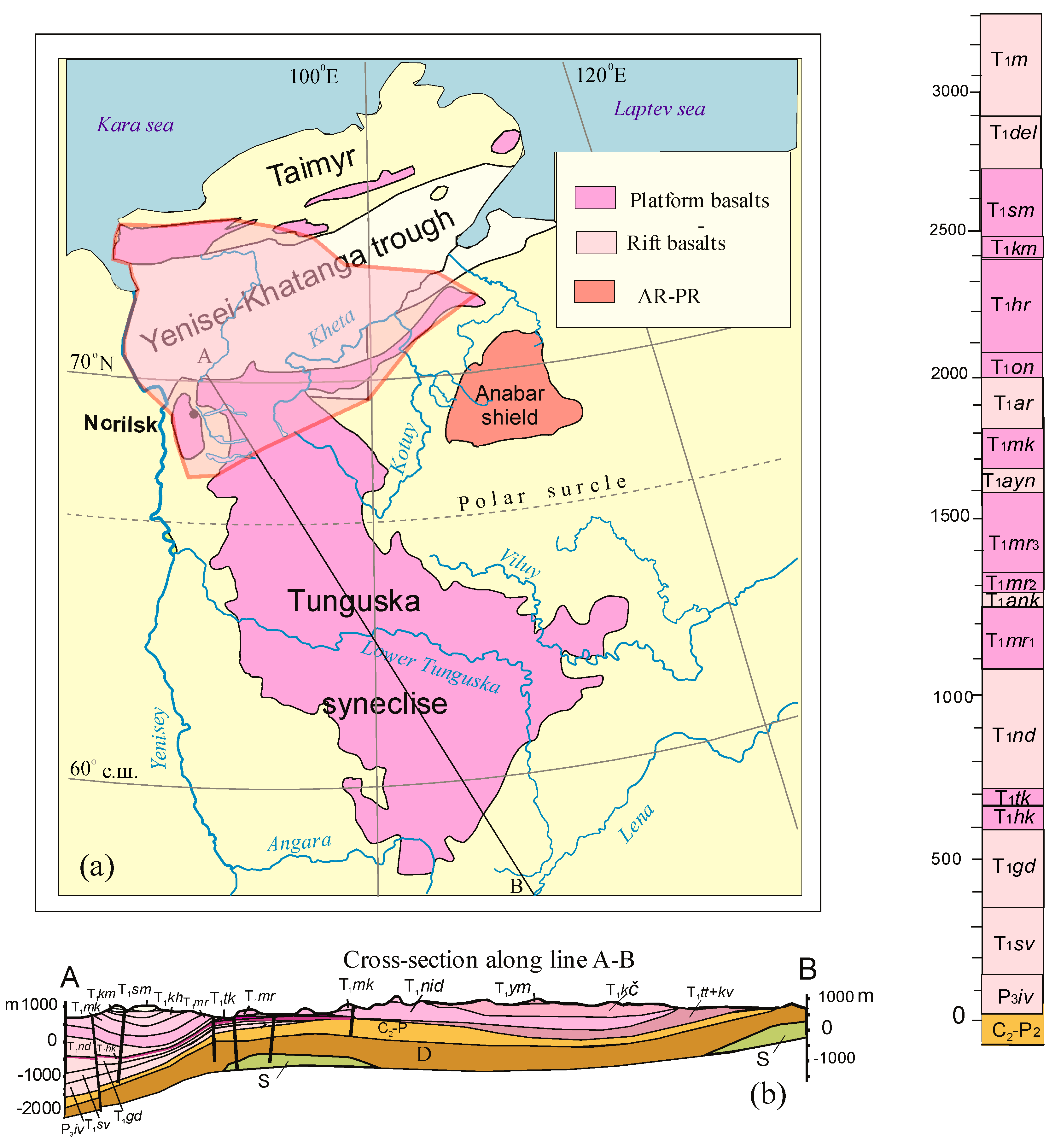
Figure 2.
The scheme of distribution of trap facies and the basement relief of the Siberian platform. The position of the scheme is shown in the inset. Here and in Figure 3, compiled by the author on the basis of (Structural map of the Siberian platform, 1972; Geology and Mineralization of Russia., 2002). Depressions: I - Kharaelakhsky, II - Khantaysky, III - Tungusky, IV – Taseevsky.
Figure 2.
The scheme of distribution of trap facies and the basement relief of the Siberian platform. The position of the scheme is shown in the inset. Here and in Figure 3, compiled by the author on the basis of (Structural map of the Siberian platform, 1972; Geology and Mineralization of Russia., 2002). Depressions: I - Kharaelakhsky, II - Khantaysky, III - Tungusky, IV – Taseevsky.
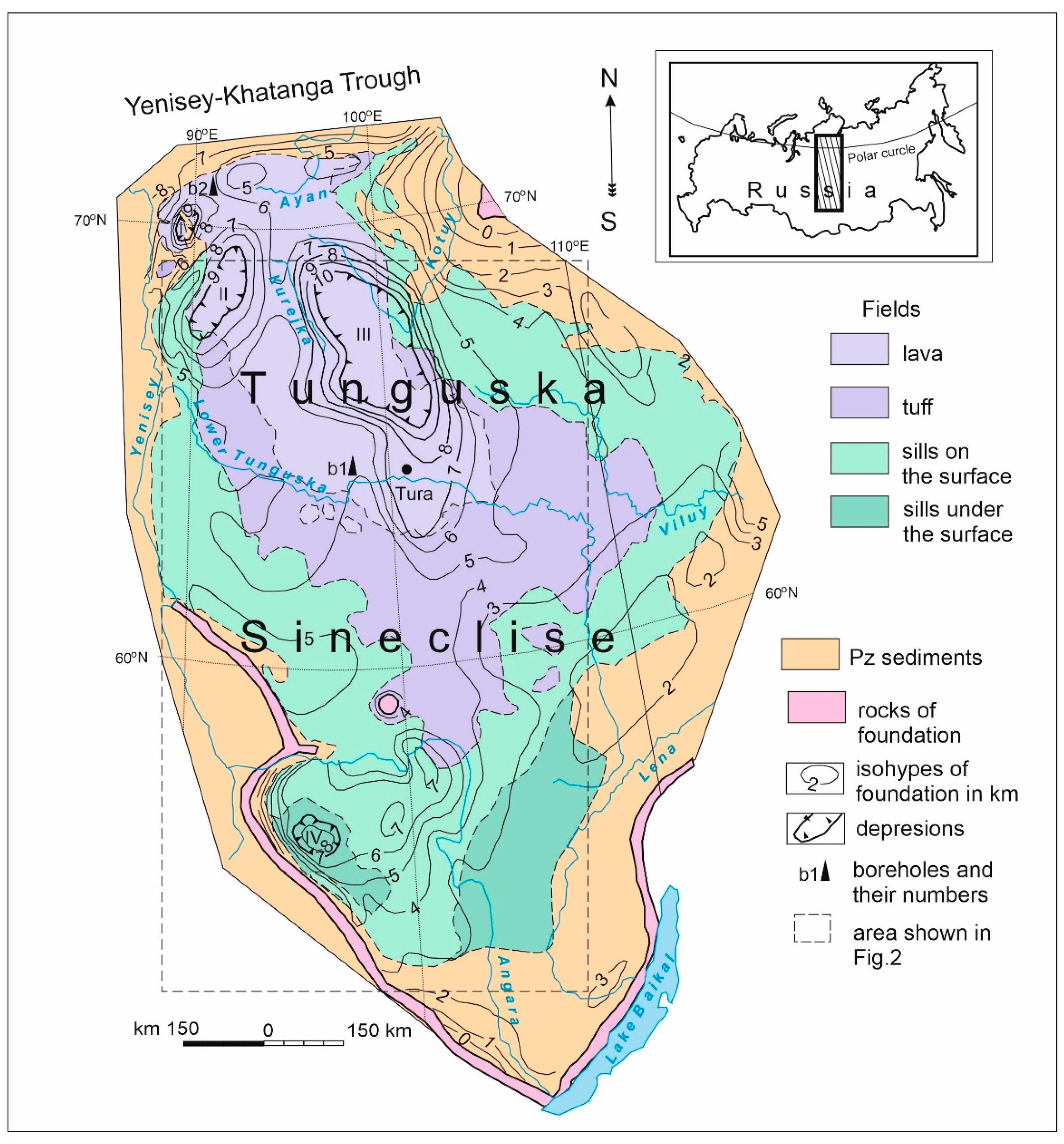
Figure 3.
Tectonic map of the sedimentary cover in the western part of the Siberian platform at the end of the Carboniferous period. Structures: IV - Turukhan-Norilsk ridge; V - Yenisei anticline (eastern slope); VI - Angarsk syncline; VII - Tunguska syneclise. Superimposed depressions: A - Aganyl depression, Mk - Muruktin depression; AV - Angaro-Vilyui depression; M - Murskaya depression, after (Bazhenova, 2019) with the author’s corrections.
Figure 3.
Tectonic map of the sedimentary cover in the western part of the Siberian platform at the end of the Carboniferous period. Structures: IV - Turukhan-Norilsk ridge; V - Yenisei anticline (eastern slope); VI - Angarsk syncline; VII - Tunguska syneclise. Superimposed depressions: A - Aganyl depression, Mk - Muruktin depression; AV - Angaro-Vilyui depression; M - Murskaya depression, after (Bazhenova, 2019) with the author’s corrections.
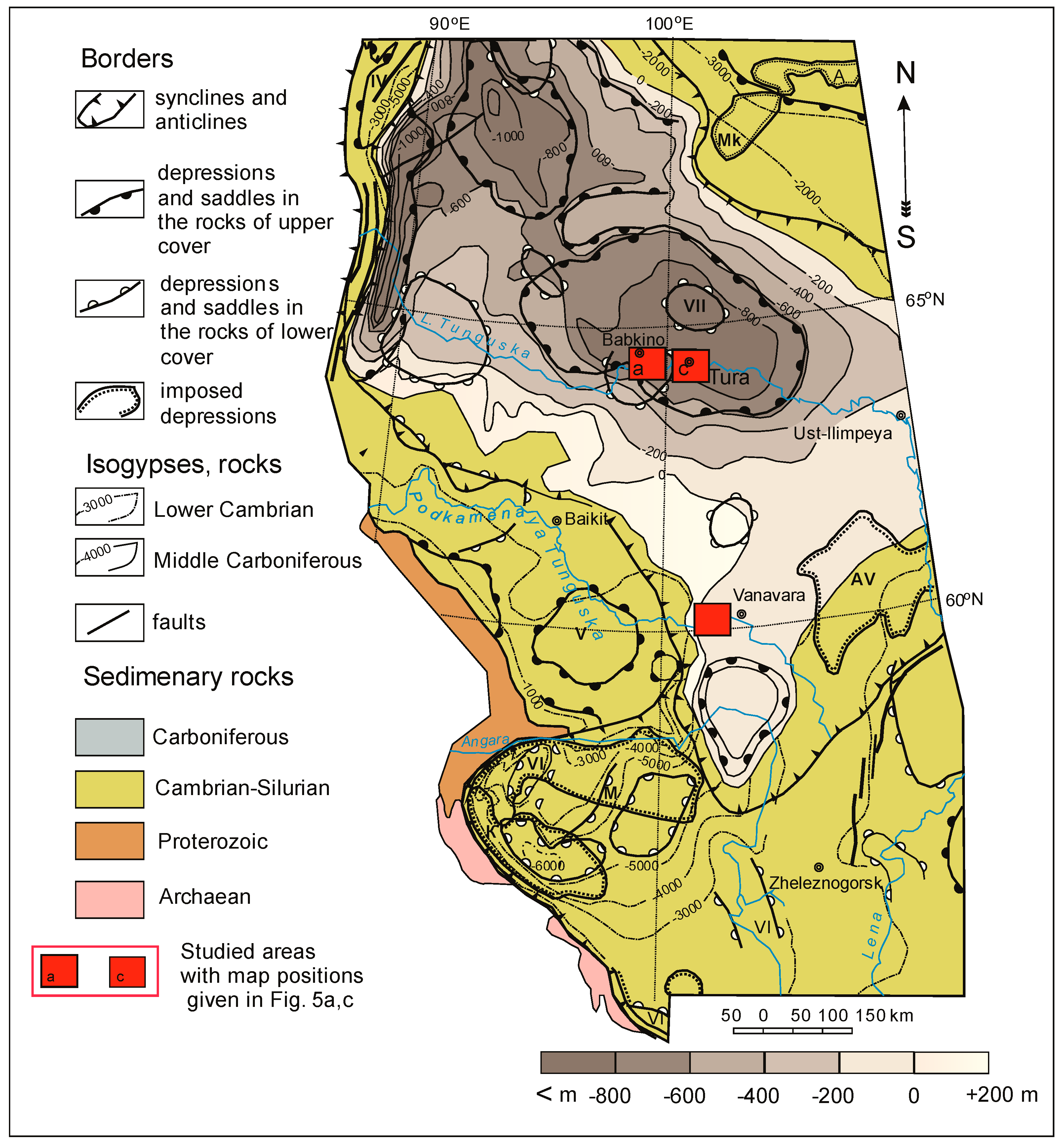
Figure 4.
Stratigraphic column for the rocks in the Tunguska Syneclise and symbols for the maps in Figure 5 (Geological Map of the USSR 1:200,000 Scale, 1985).
Figure 4.
Stratigraphic column for the rocks in the Tunguska Syneclise and symbols for the maps in Figure 5 (Geological Map of the USSR 1:200,000 Scale, 1985).
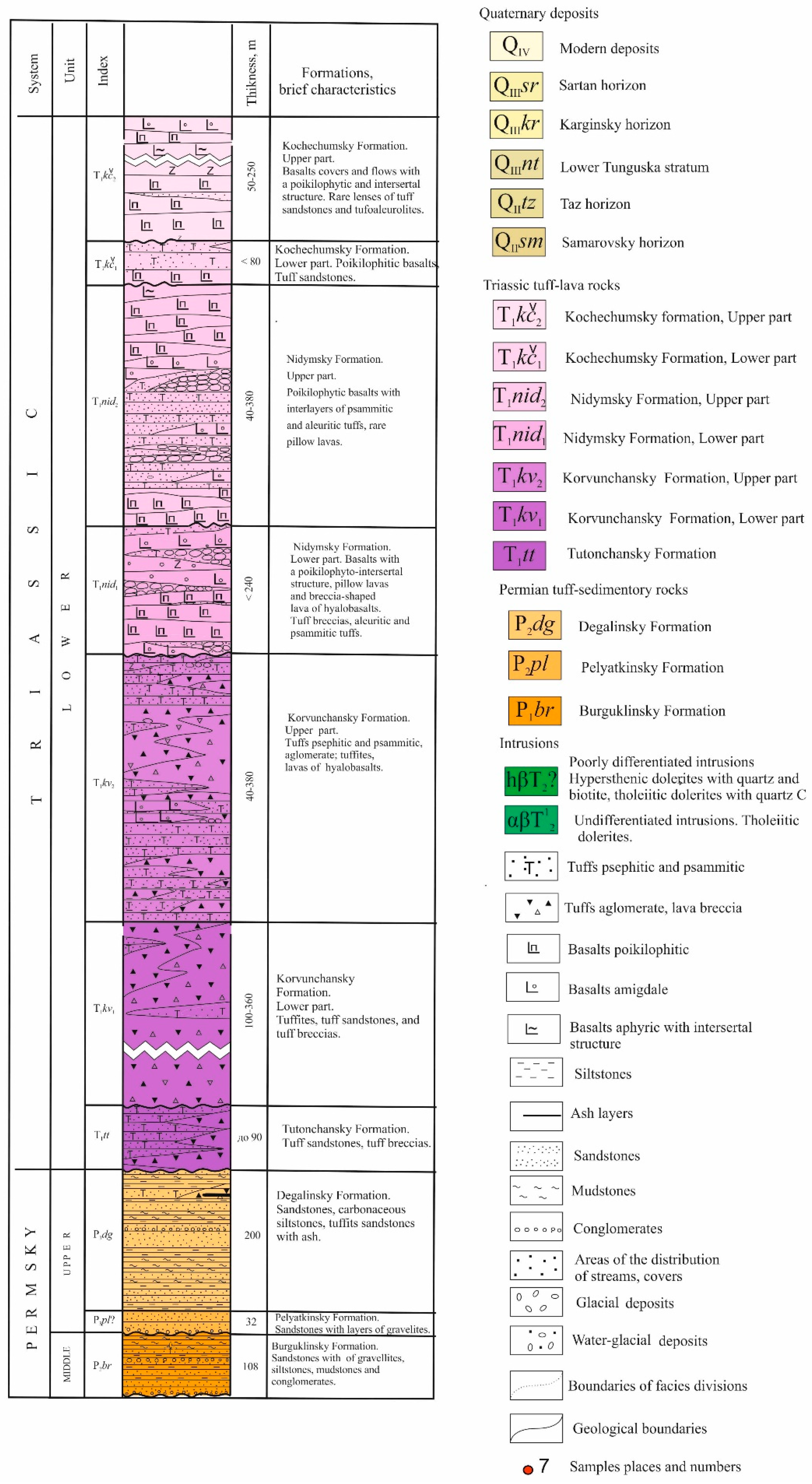
Figure 5.
Geological maps (a, c) and cross-sections (b,d,e) for the Lower Tunguska River Valley after (Geological Map of the USSR 1:200,000 Scale, 1985) with authors’ corrections. Blue lines in Figure 5a,c (I and II) correspond to the sections in Figure 6. Blue triangles in Figure 5c are boreholes Al13 and Al14.
Figure 5.
Geological maps (a, c) and cross-sections (b,d,e) for the Lower Tunguska River Valley after (Geological Map of the USSR 1:200,000 Scale, 1985) with authors’ corrections. Blue lines in Figure 5a,c (I and II) correspond to the sections in Figure 6. Blue triangles in Figure 5c are boreholes Al13 and Al14.
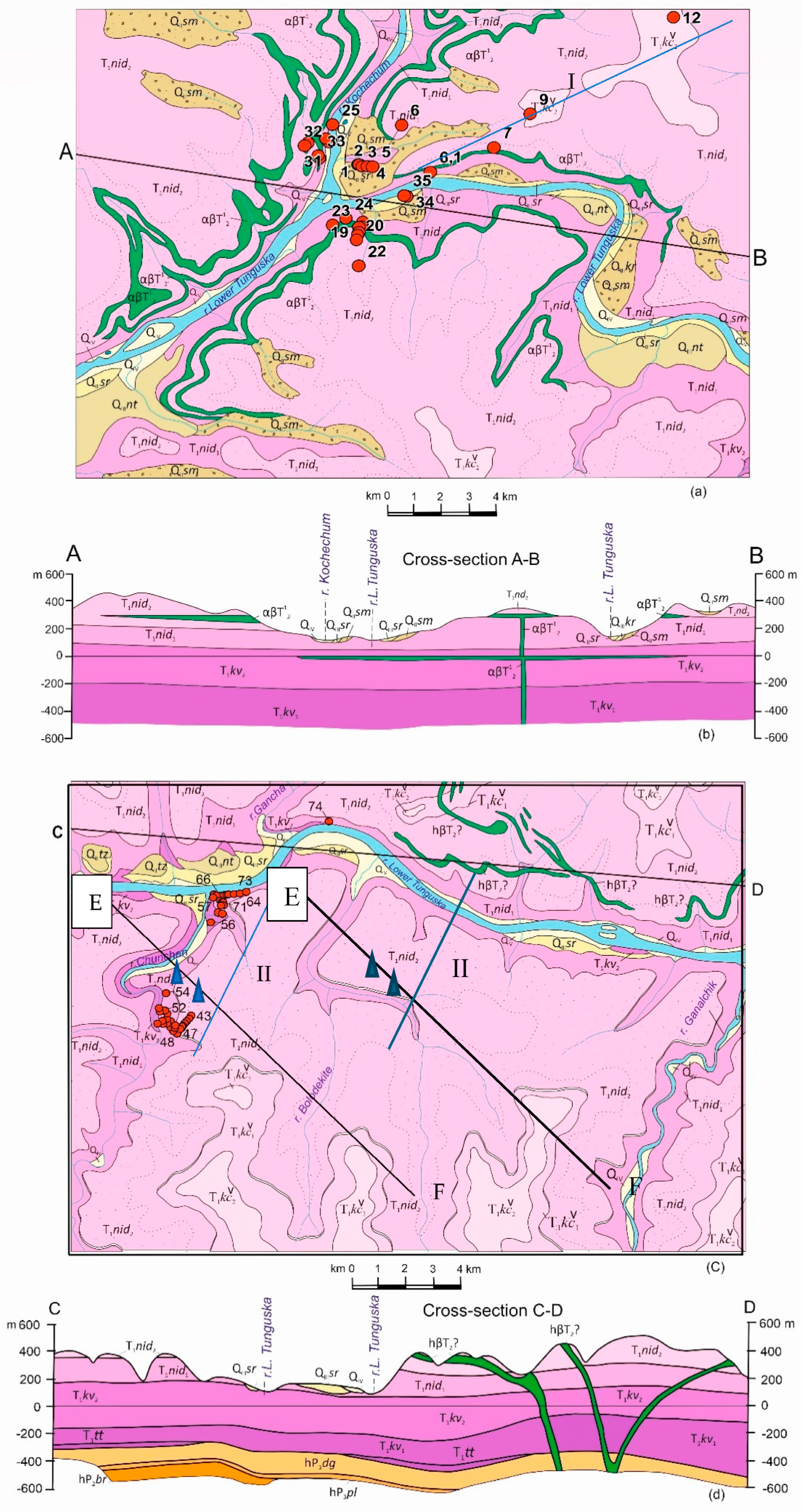
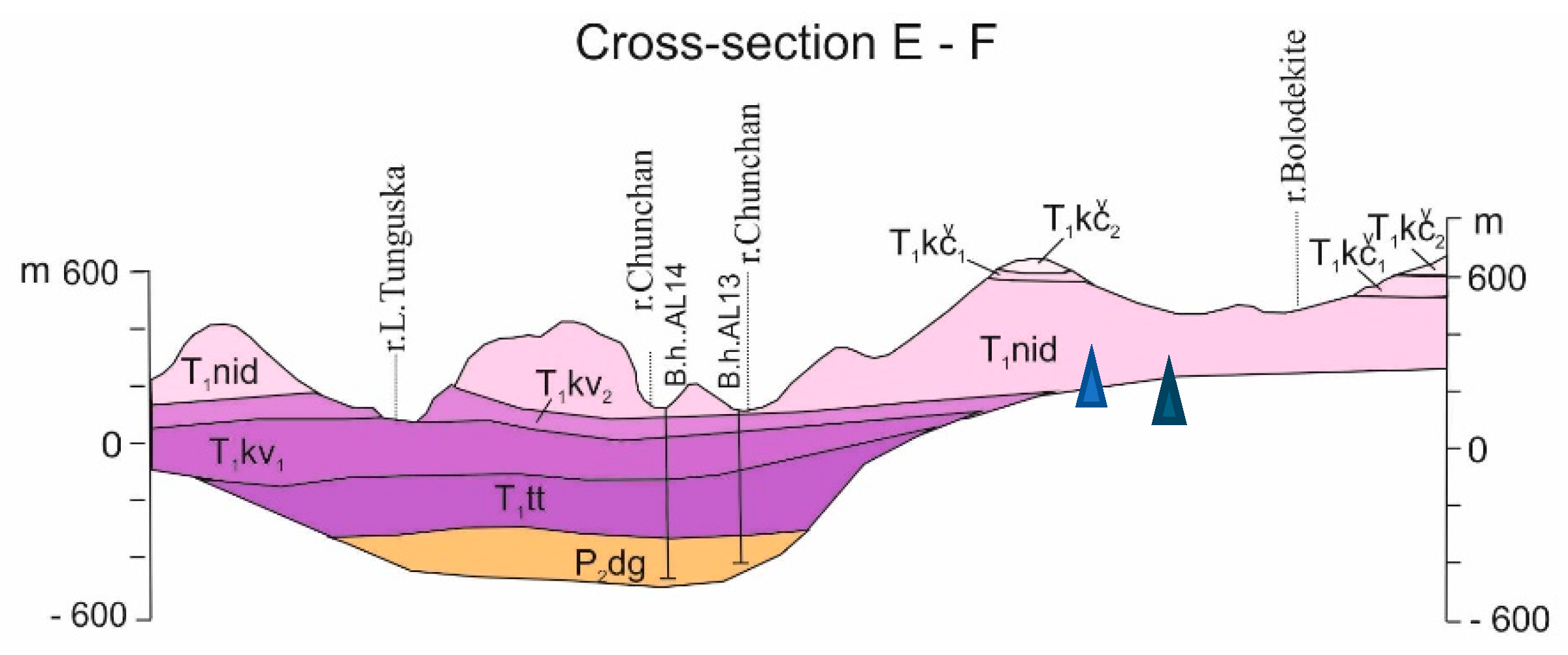
Figure 7.
Outcrops of agglomerate tuffs in the valley of the Podkamennaya Tunguska River near Vanavara settlement (see Figure 3): a-general view, b- rock fragments in matrix. Here and in Figure 8 and Figure 13, 15, 16 and ESM 6, 8, and 9 photo by N. Krivolutskaya.
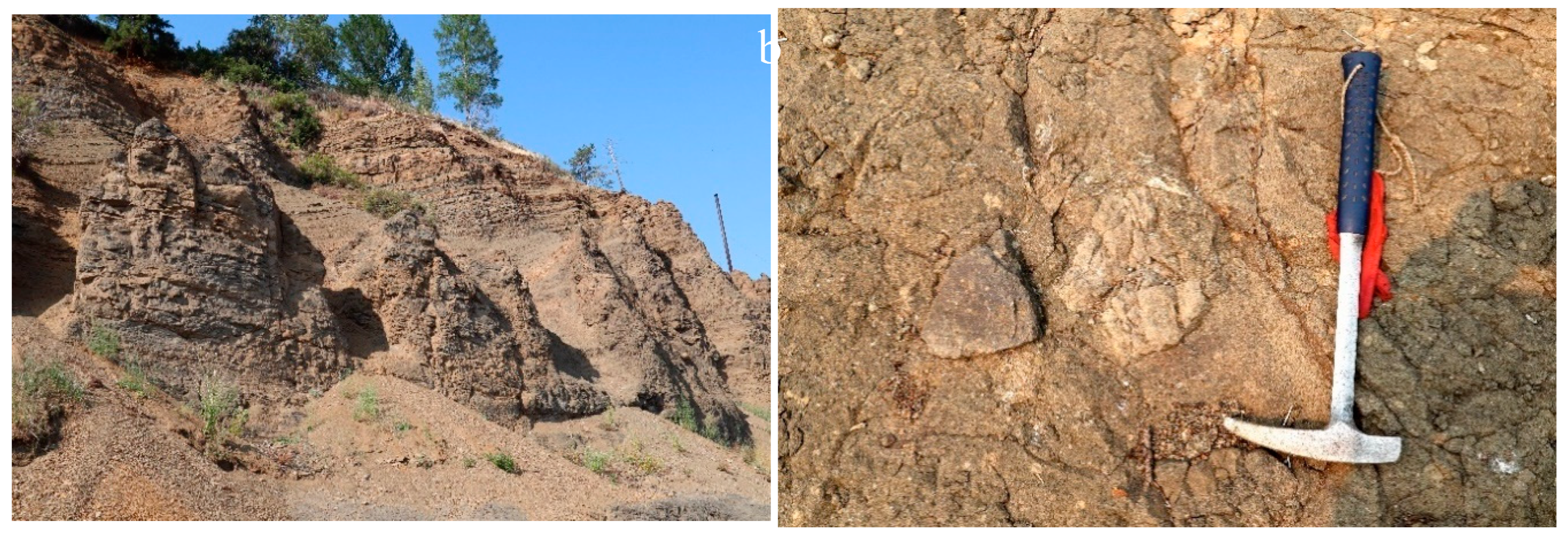
Figure 8.
Contact of the Korvunchansky (T1kv2) and Nidymsky Formations (T1nid1) (a), tuffs of the Korvunchansky Formation (b), tuffs with siltstones in outcrop (c), and shell-like structure of tuffs (d). Points: HT-60 (a, b), HT-51 (c,d).
Figure 8.
Contact of the Korvunchansky (T1kv2) and Nidymsky Formations (T1nid1) (a), tuffs of the Korvunchansky Formation (b), tuffs with siltstones in outcrop (c), and shell-like structure of tuffs (d). Points: HT-60 (a, b), HT-51 (c,d).
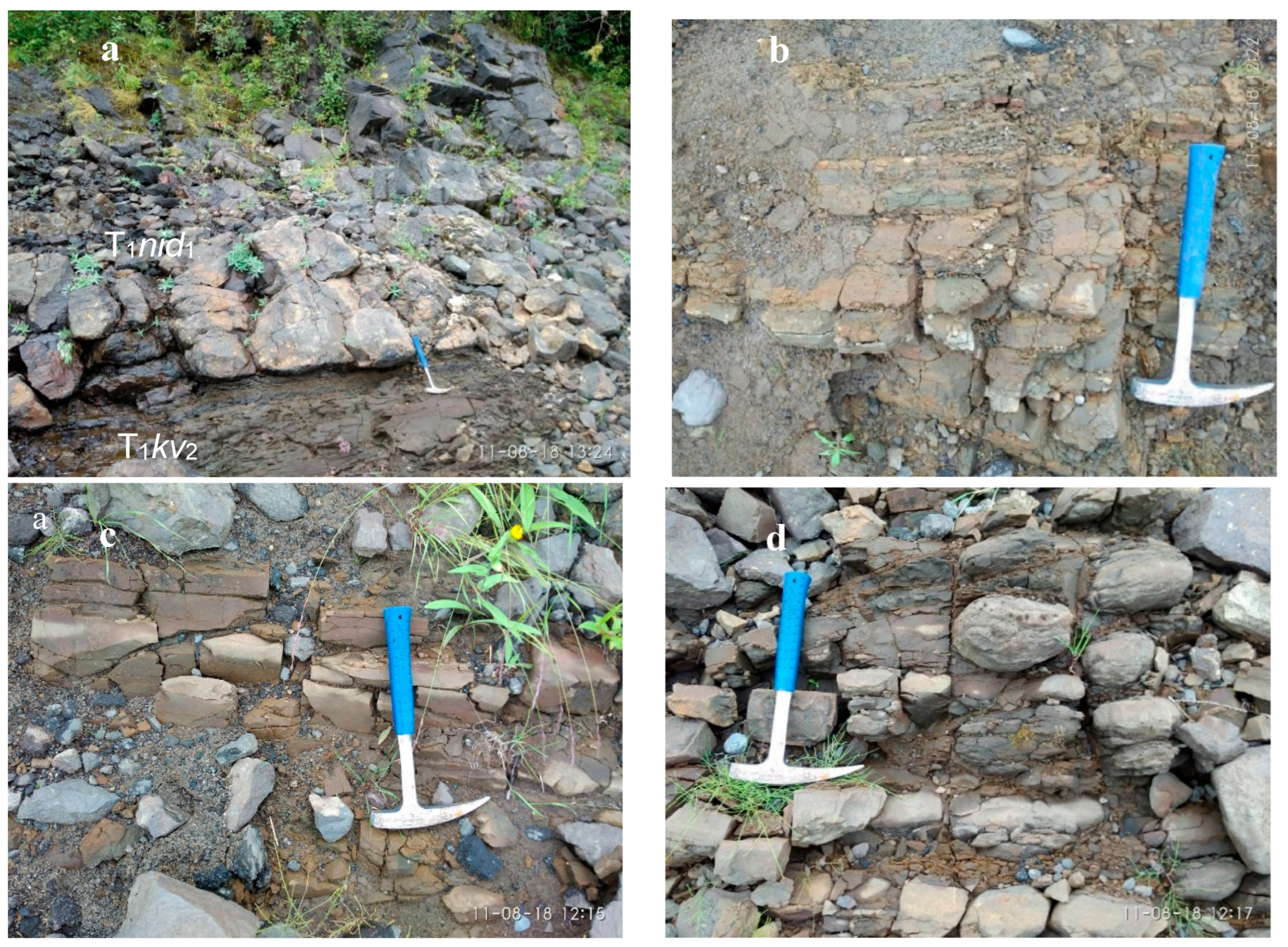
Figure 9.
Texture and structure of tuffites of the Korvunchansky formation. Samples: (a-d) – 50; (e-f) – HT-60.
Figure 9.
Texture and structure of tuffites of the Korvunchansky formation. Samples: (a-d) – 50; (e-f) – HT-60.
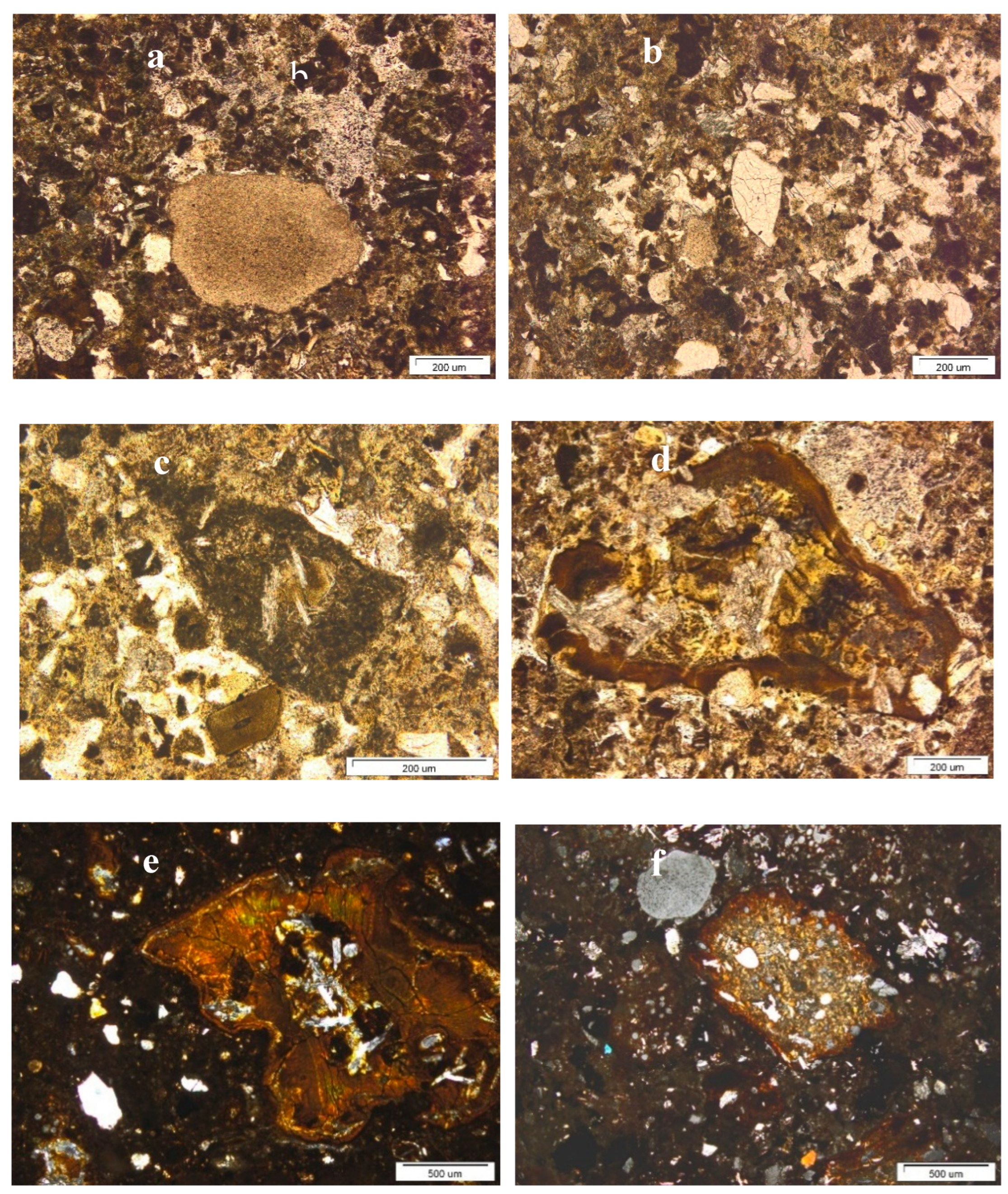
Figure 10.
Backscettered electron images of the tuffs from the Korvunchansky Formation. a,b, c, f - sample 318; d, e, g, h – sample 50. All photos are at the same scale shown in Figure 10 g. Here and in Figure 11 and Figure 13: Mx- matrix, Chr – chromite, Ab – albite, Chl – chlorite, Fsp – feldspar, Ttn -titanite, Ntr – natrolite, Sap – saponite.
Figure 10.
Backscettered electron images of the tuffs from the Korvunchansky Formation. a,b, c, f - sample 318; d, e, g, h – sample 50. All photos are at the same scale shown in Figure 10 g. Here and in Figure 11 and Figure 13: Mx- matrix, Chr – chromite, Ab – albite, Chl – chlorite, Fsp – feldspar, Ttn -titanite, Ntr – natrolite, Sap – saponite.
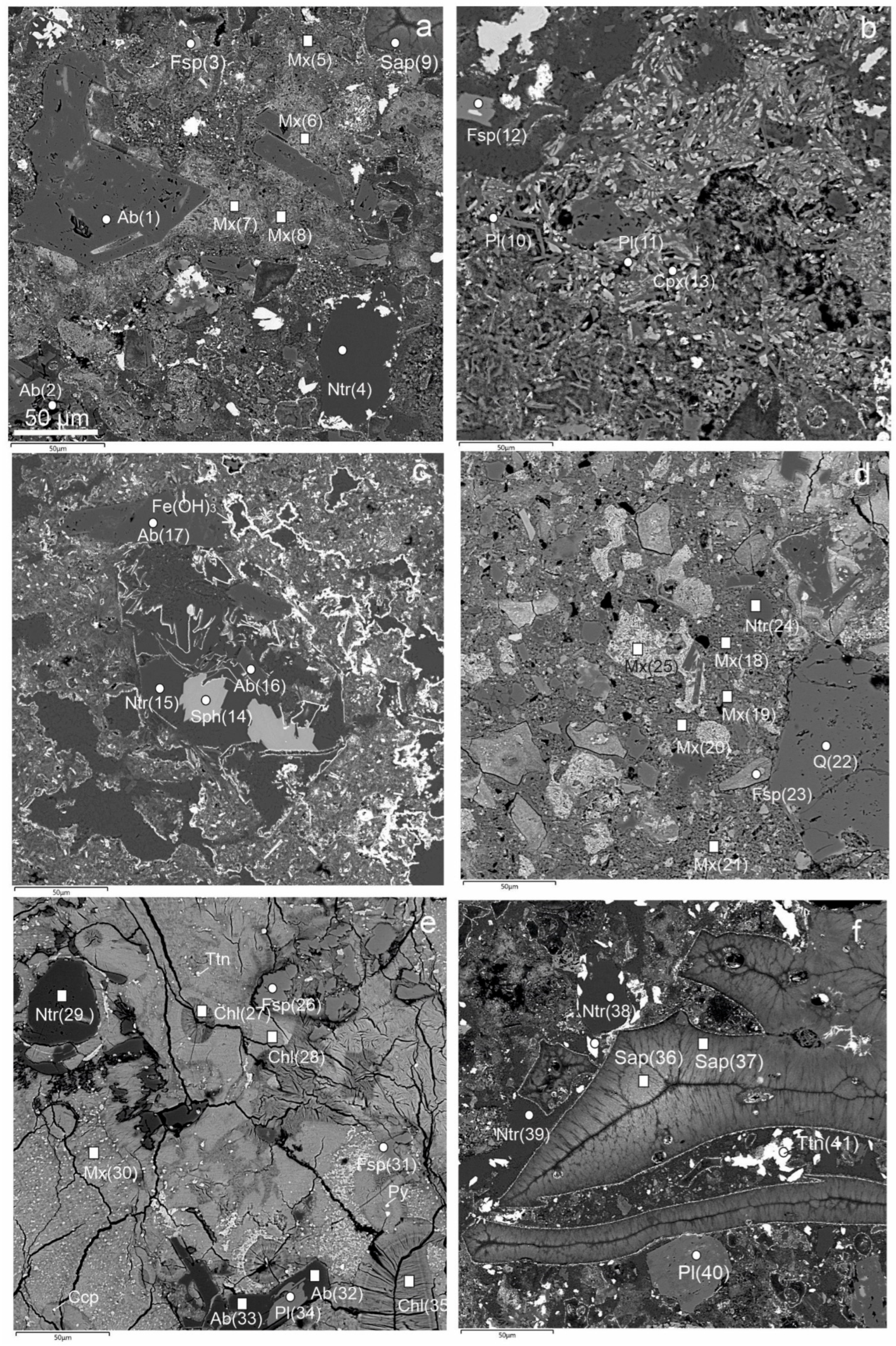
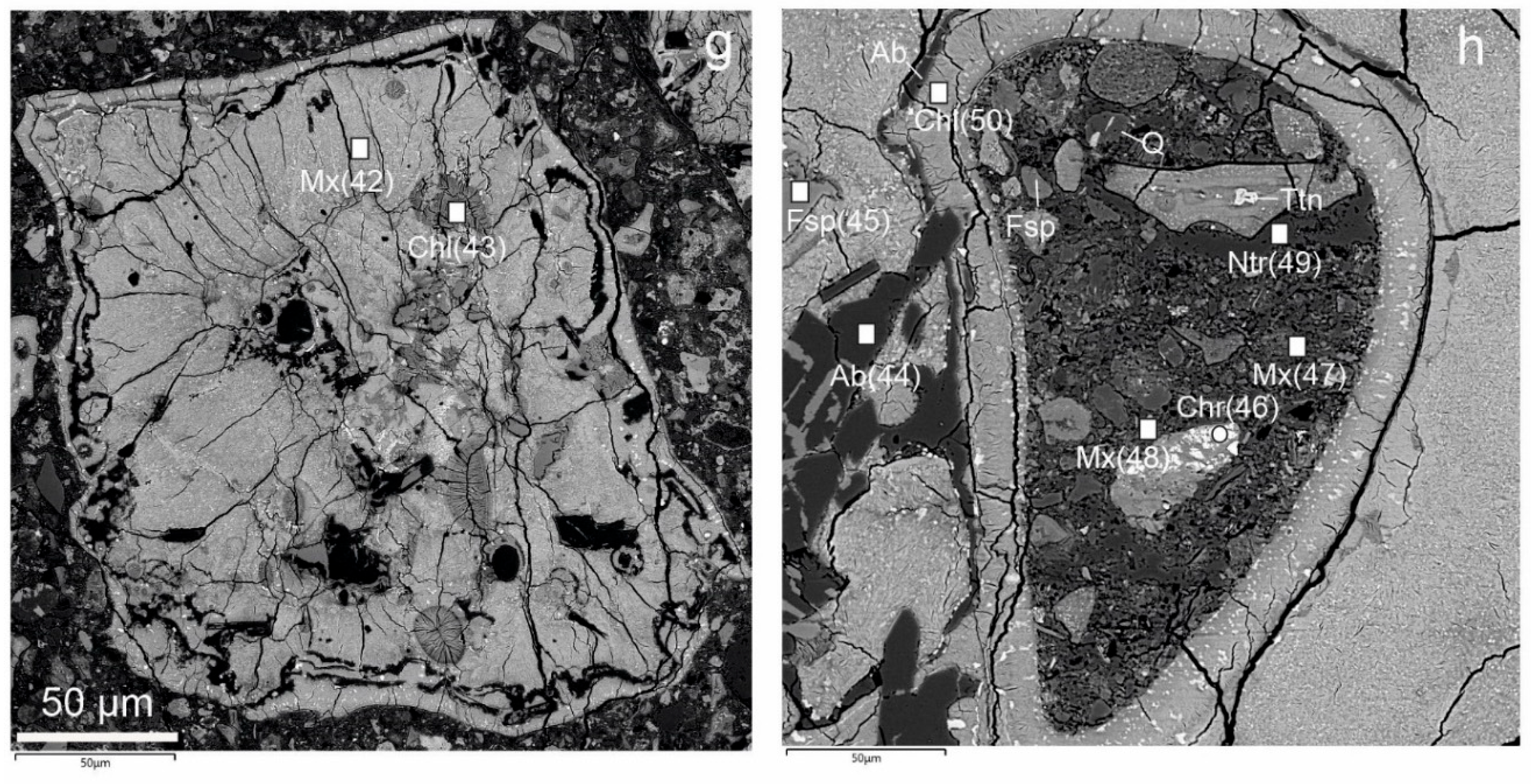
Figure 11.
Photomicrographs of the lithoclastic psammitic tuffs from the Korvumchansky Formation: a - oval fragments of the aphyric and rarely plagioclase porphyric basalts cemented by basaltic matrix; b - sharp-angled fragment of plagioclase-pyroxenophyric basalt with a distinct Fe-rich rim around the boundaries; c – altered sharp-angled fragment of plagioclase-pyroxenophyric basalt; d- pyroxene crystals in the interstitial space; e – large Px-Pl crystals in matrix; f – fragment of pyroxene-plagioclase basalt; g - fragment of plagioclase basalt with a distinct Fe-rich rim around the boundaries; h - oval fragments of aphyric and plagioclase porphyric basalts with Fe-rich rims cemented by crashed basalt.
Figure 11.
Photomicrographs of the lithoclastic psammitic tuffs from the Korvumchansky Formation: a - oval fragments of the aphyric and rarely plagioclase porphyric basalts cemented by basaltic matrix; b - sharp-angled fragment of plagioclase-pyroxenophyric basalt with a distinct Fe-rich rim around the boundaries; c – altered sharp-angled fragment of plagioclase-pyroxenophyric basalt; d- pyroxene crystals in the interstitial space; e – large Px-Pl crystals in matrix; f – fragment of pyroxene-plagioclase basalt; g - fragment of plagioclase basalt with a distinct Fe-rich rim around the boundaries; h - oval fragments of aphyric and plagioclase porphyric basalts with Fe-rich rims cemented by crashed basalt.
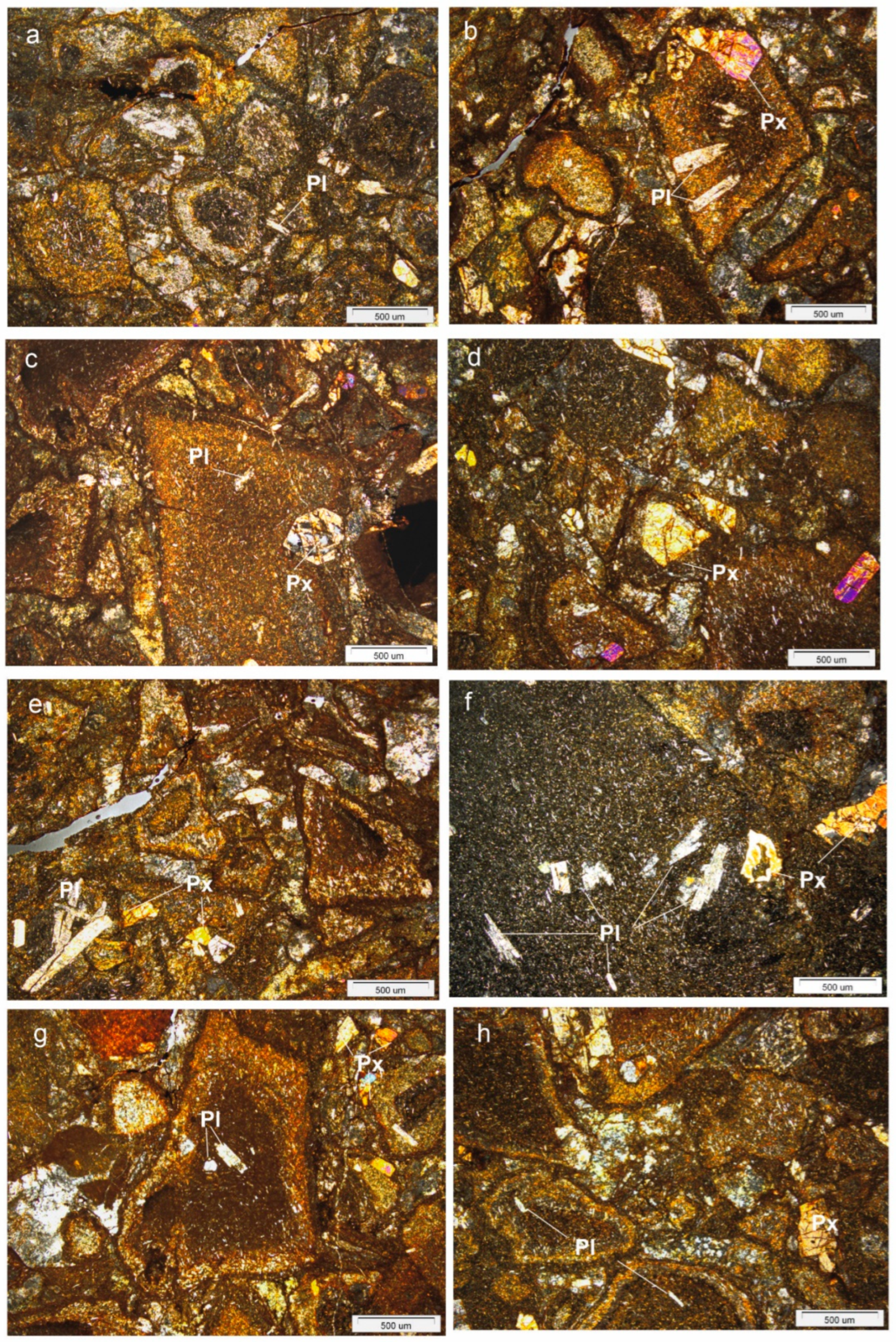
Figure 12.
Images of intergrowth of clinopyroxene crystals: a – in backscattered electrons, b-d -in characteristics X-ray: b -Allα, c – CaKα, d – SiKα. Zoned texture of crystals is in Figure ESM 7 (dark borders along crystal faces).
Figure 12.
Images of intergrowth of clinopyroxene crystals: a – in backscattered electrons, b-d -in characteristics X-ray: b -Allα, c – CaKα, d – SiKα. Zoned texture of crystals is in Figure ESM 7 (dark borders along crystal faces).
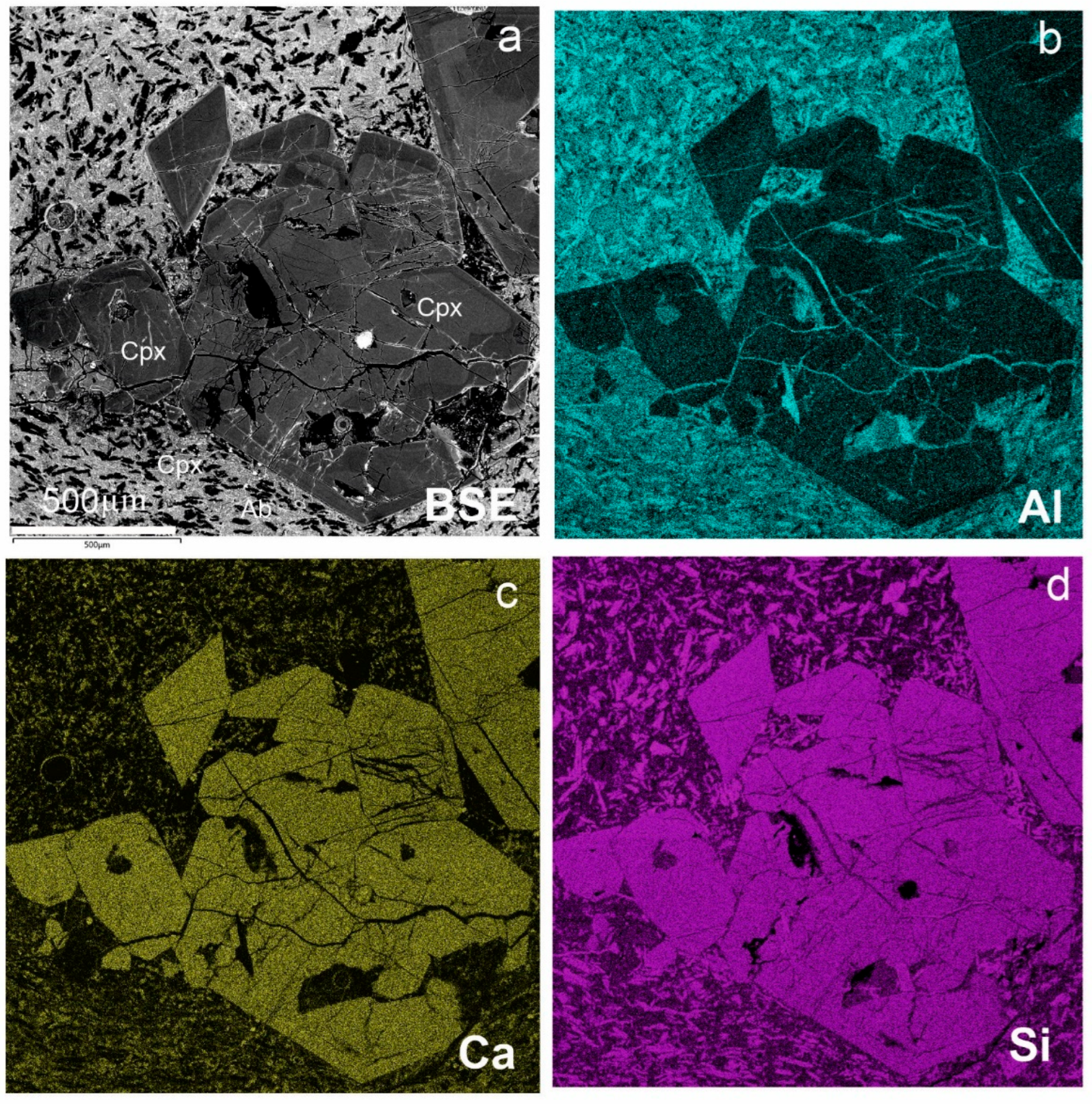
Figure 13.
Contacts of tuffs with basalts of the Nidymsky Formation, parts: a – Lower, b – Upper (circles show place of samples НТ-6 и НТ-7, demonstrated in Figure 6).
Figure 13.
Contacts of tuffs with basalts of the Nidymsky Formation, parts: a – Lower, b – Upper (circles show place of samples НТ-6 и НТ-7, demonstrated in Figure 6).
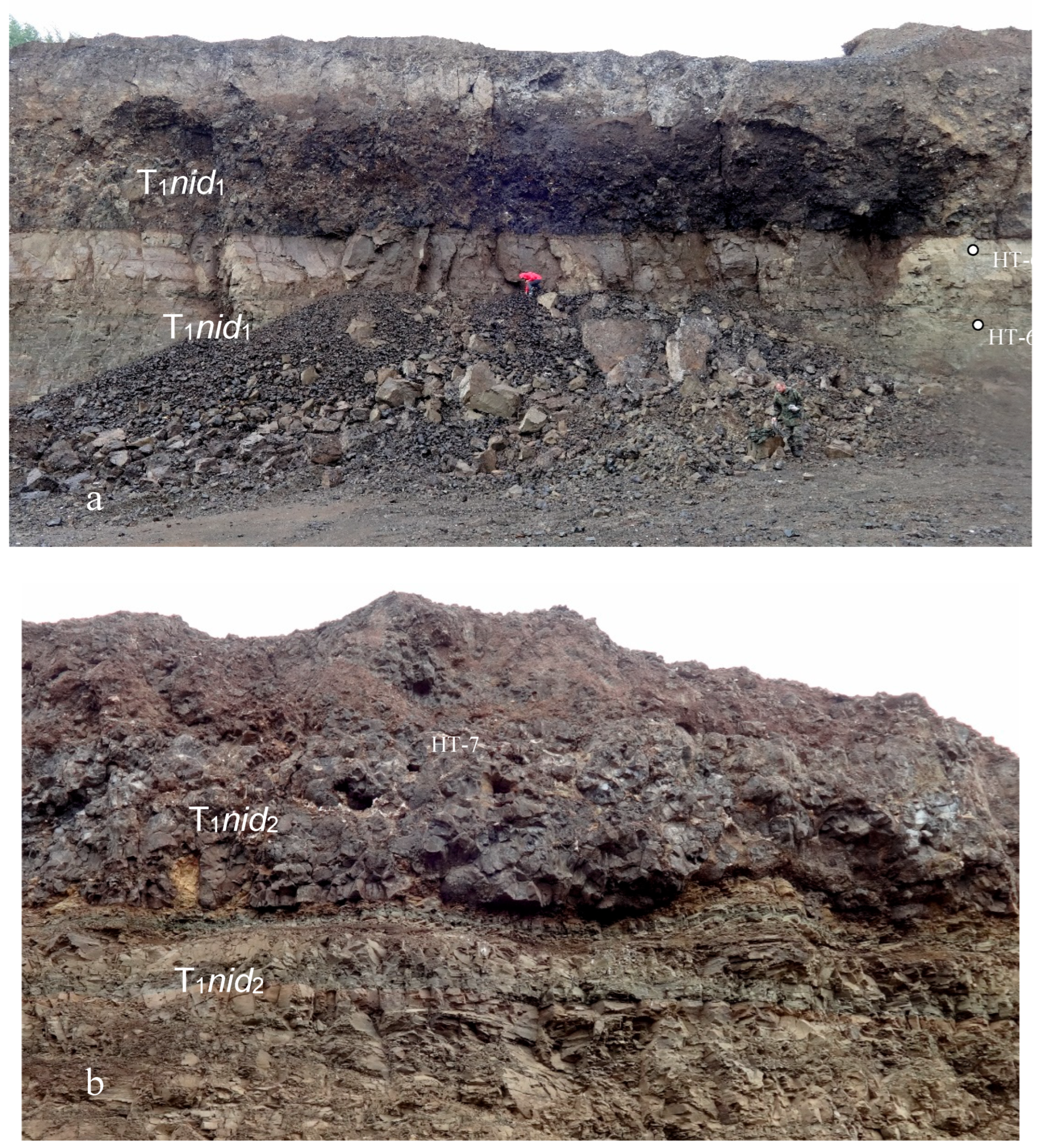
Figure 14.
BSE images of the tuffs from the Nidymsky Formation, samples: a, c, d – HT-6.43; b,e – HT-6.44; f – HT-51. Abbrivations are in Figure 9; Q – quartz, C – coal.
Figure 14.
BSE images of the tuffs from the Nidymsky Formation, samples: a, c, d – HT-6.43; b,e – HT-6.44; f – HT-51. Abbrivations are in Figure 9; Q – quartz, C – coal.
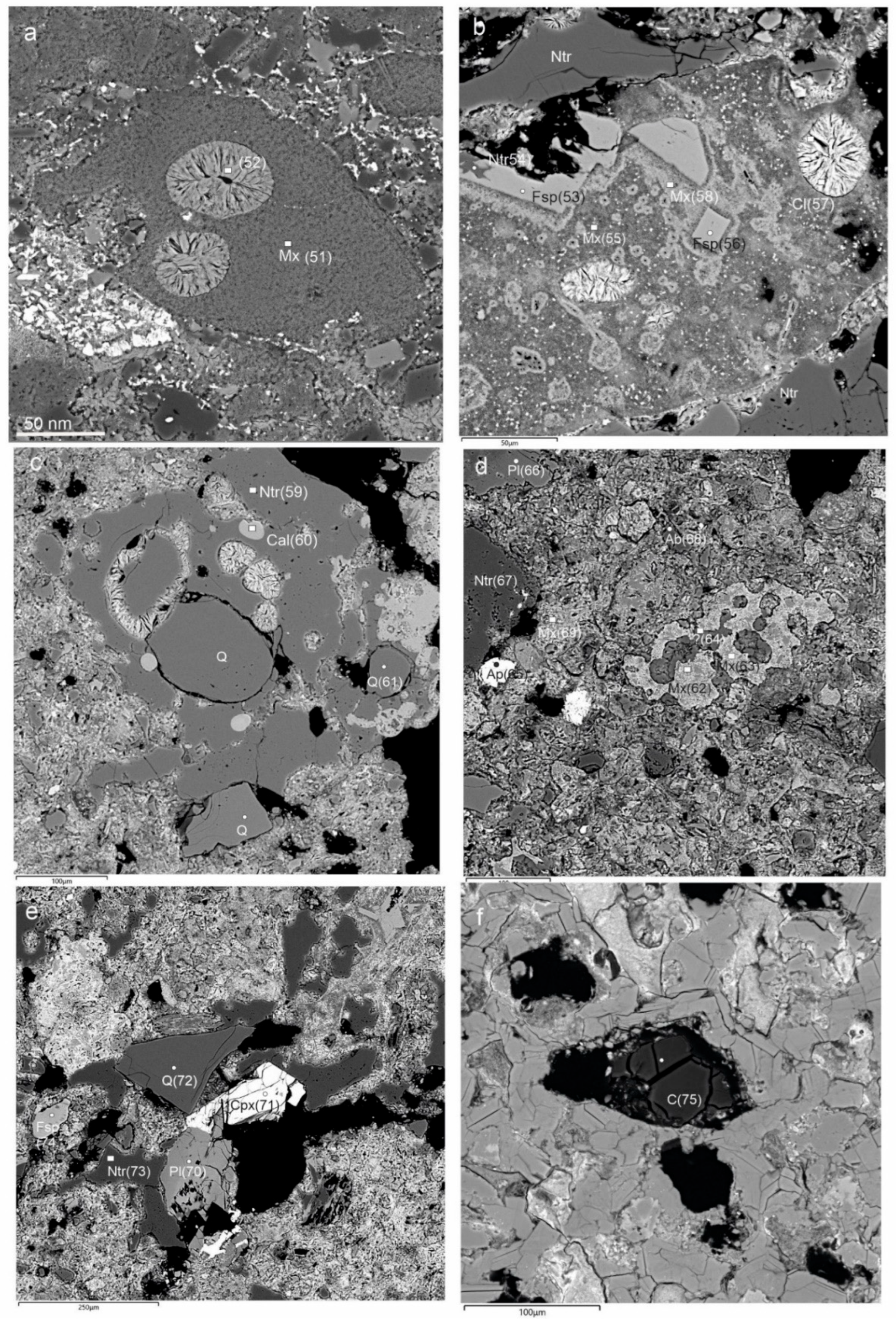
Figure 15.
Basalts of the Lower part of the Nidymsky Formation. a -pillow lava from the lowest horizon, b – texture of pillow lava and intersticial material between them, c – large calcite accomulations within pillow lavas and precipitation intersticial material by calcite, d – two massive pillows within porous fine-grained material.
Figure 15.
Basalts of the Lower part of the Nidymsky Formation. a -pillow lava from the lowest horizon, b – texture of pillow lava and intersticial material between them, c – large calcite accomulations within pillow lavas and precipitation intersticial material by calcite, d – two massive pillows within porous fine-grained material.
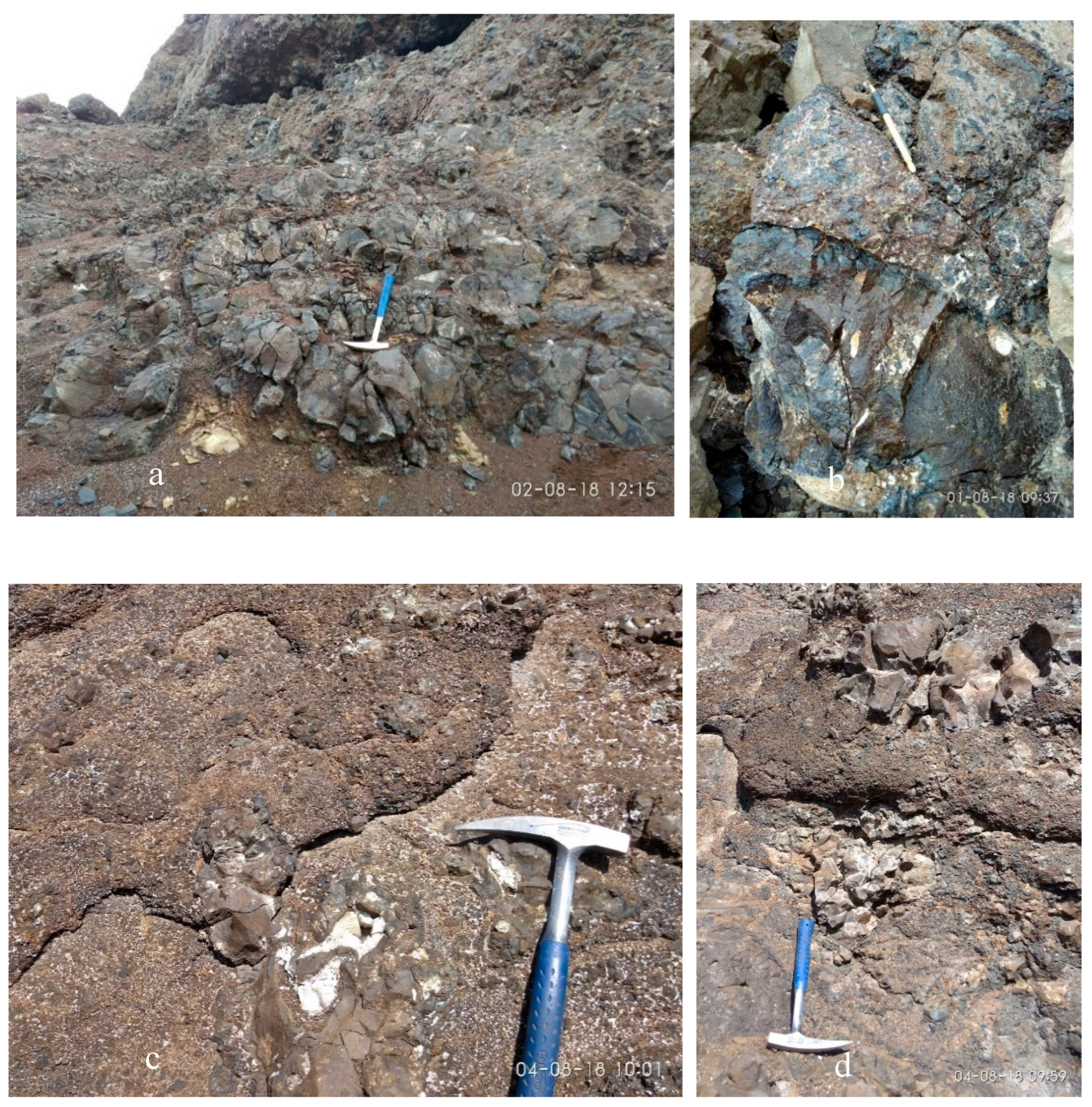
Figure 16.
Separateness in basalts in the Upper part of the Nidymsky Formation: a – columnar, b –combination of columnar and tiled.
Figure 16.
Separateness in basalts in the Upper part of the Nidymsky Formation: a – columnar, b –combination of columnar and tiled.
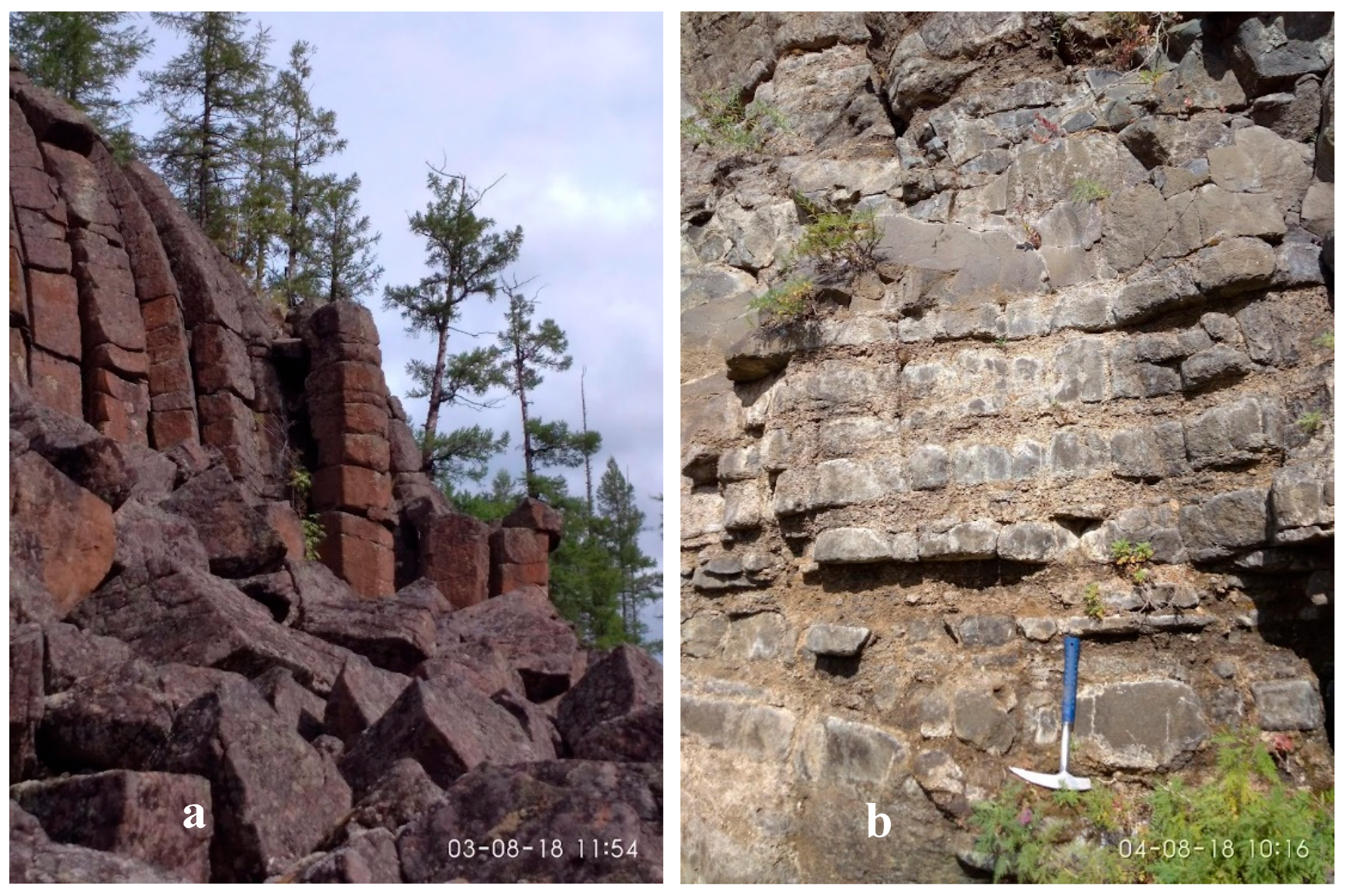
Figure 17.
Microphotographs of the Nidymsky basalts with different stage of alteration: a, b - minimum alteration in – ophitic (a) and poikilophitic (b) basalts; c, d – alteration of clinopyroxene in ophitic (c) and poikilophitic (d); e,f – alteration of basalt with plagioclase keeping; g- sharp boundary between altered and fresh zones in basalt, h – 80% secondary minerals in basalt (with a half part of calcite).
Figure 17.
Microphotographs of the Nidymsky basalts with different stage of alteration: a, b - minimum alteration in – ophitic (a) and poikilophitic (b) basalts; c, d – alteration of clinopyroxene in ophitic (c) and poikilophitic (d); e,f – alteration of basalt with plagioclase keeping; g- sharp boundary between altered and fresh zones in basalt, h – 80% secondary minerals in basalt (with a half part of calcite).
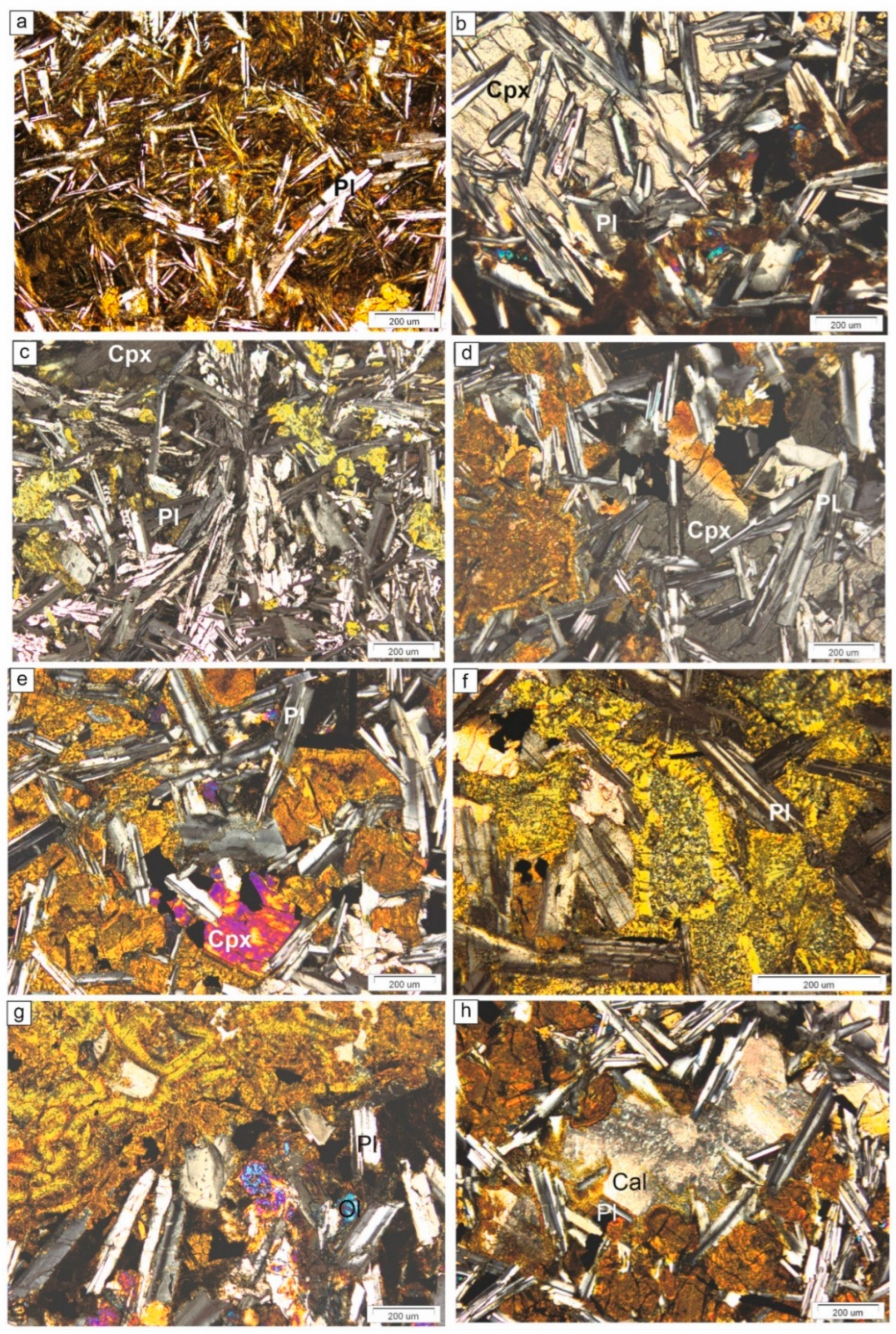
Figure 18.
Backscattered electron images of the basalts from the Nidymsky Formation (sample HT-46). Abbreviation of minerals in Figure 10. Point numbers corresponds to ESM 2.
Figure 18.
Backscattered electron images of the basalts from the Nidymsky Formation (sample HT-46). Abbreviation of minerals in Figure 10. Point numbers corresponds to ESM 2.
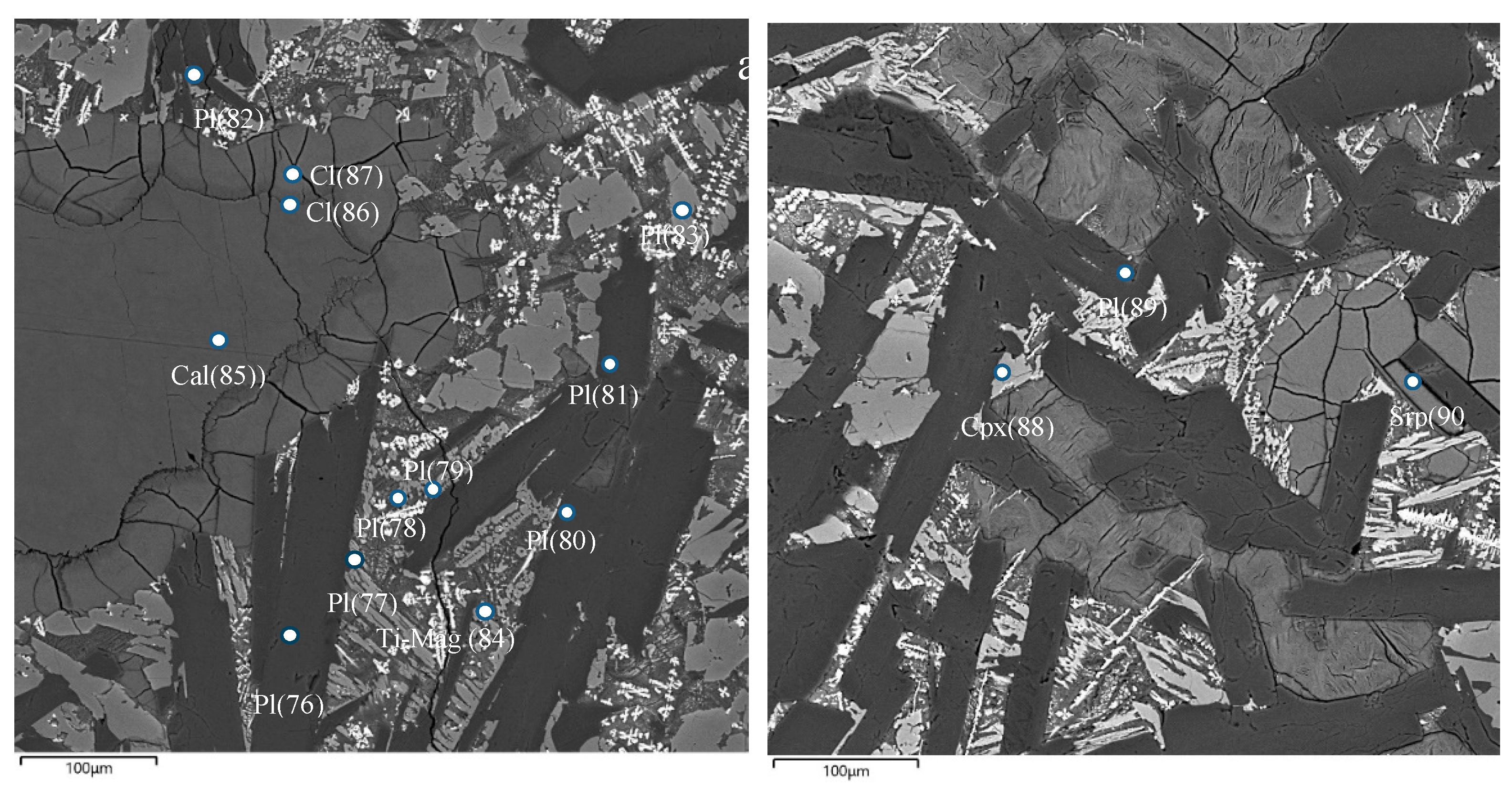
Figure 19.
Diagram SiO2 – Na2O+K2O for the studied rocks. Here and in Figure 20, Figure 21, Figure 25, Figure 32, and Figure 33 Formations: T1kč – Kochechumsky; T1nid2 – Nidymsky, Upper part; T1nid1 – Nidymsky, Lower part; T1Kv – Korvunchansky.
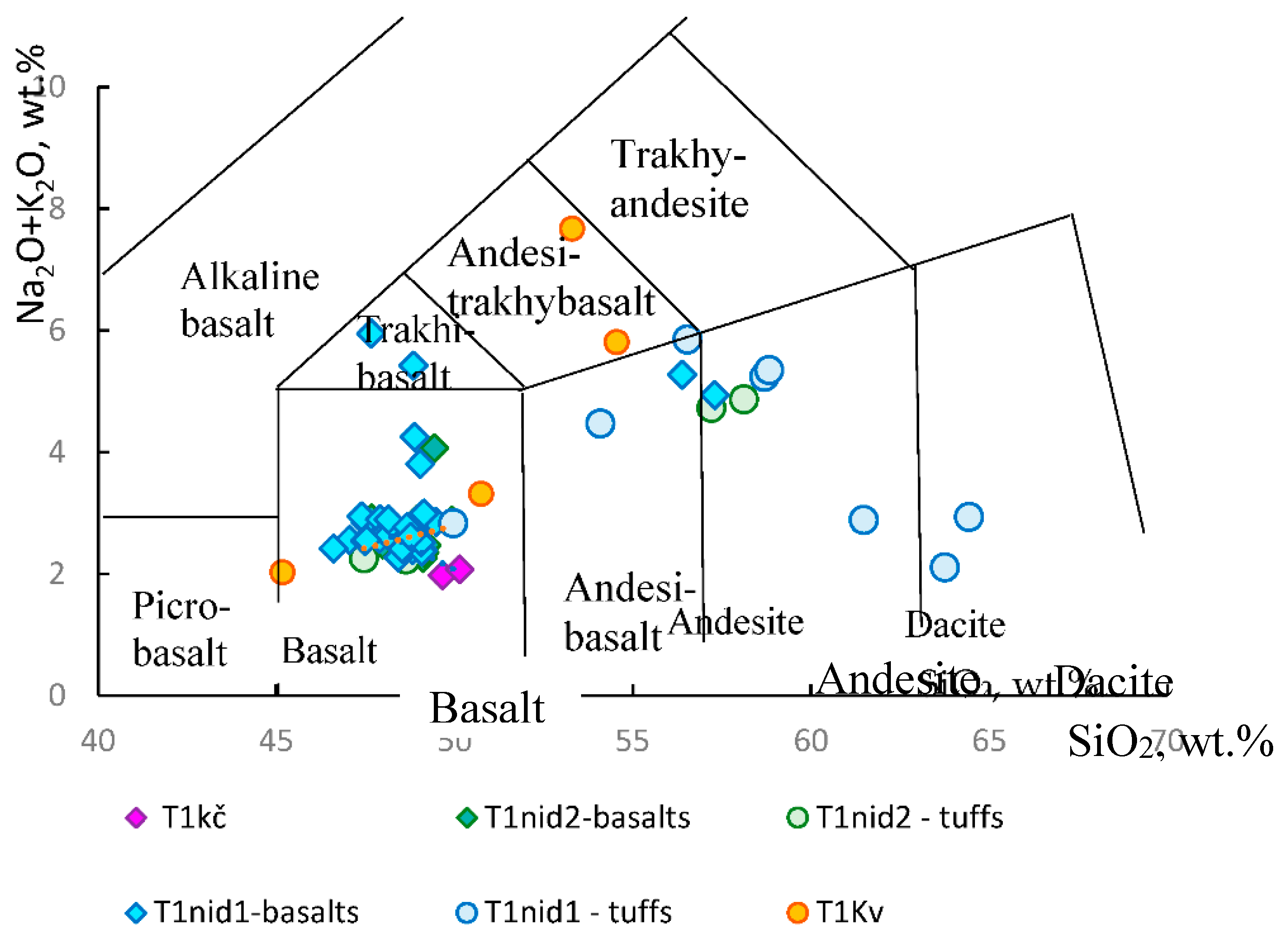
Figure 20.
Diagrams MgO - SiO2 (a), TiO2 (b), Al2O3 (c), Fe2O3 (d), CaO (e), K2O (f), Na2O (g), and MnO (h) for the rocks in the Tunguska syneclise.
Figure 20.
Diagrams MgO - SiO2 (a), TiO2 (b), Al2O3 (c), Fe2O3 (d), CaO (e), K2O (f), Na2O (g), and MnO (h) for the rocks in the Tunguska syneclise.
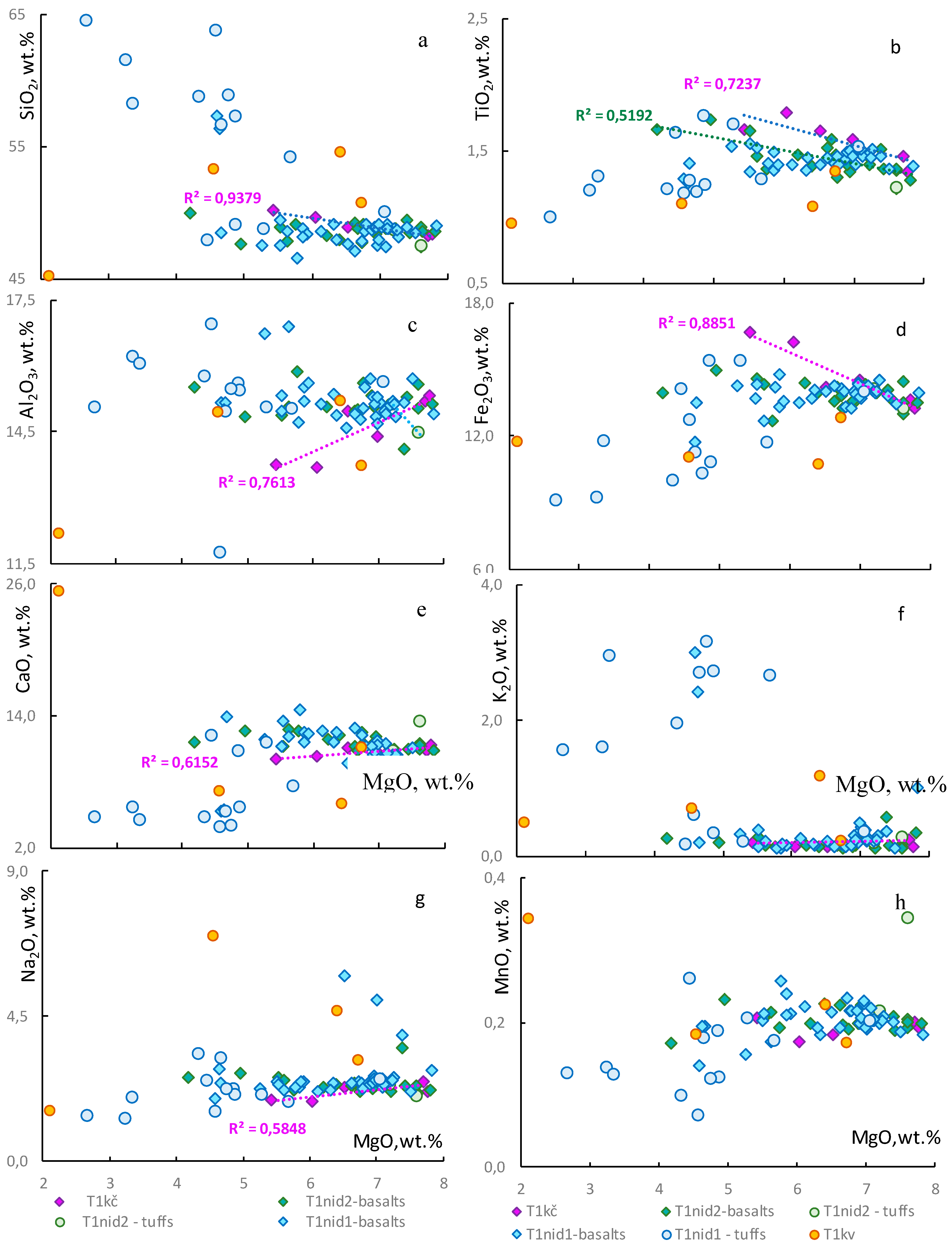
Figure 21.
Diagrams MgO versus V (a), Cr (b), Co (c), Ni (d), Cu (e), and Zn (f) for the rocks from the Tunguska syneclise.
Figure 21.
Diagrams MgO versus V (a), Cr (b), Co (c), Ni (d), Cu (e), and Zn (f) for the rocks from the Tunguska syneclise.
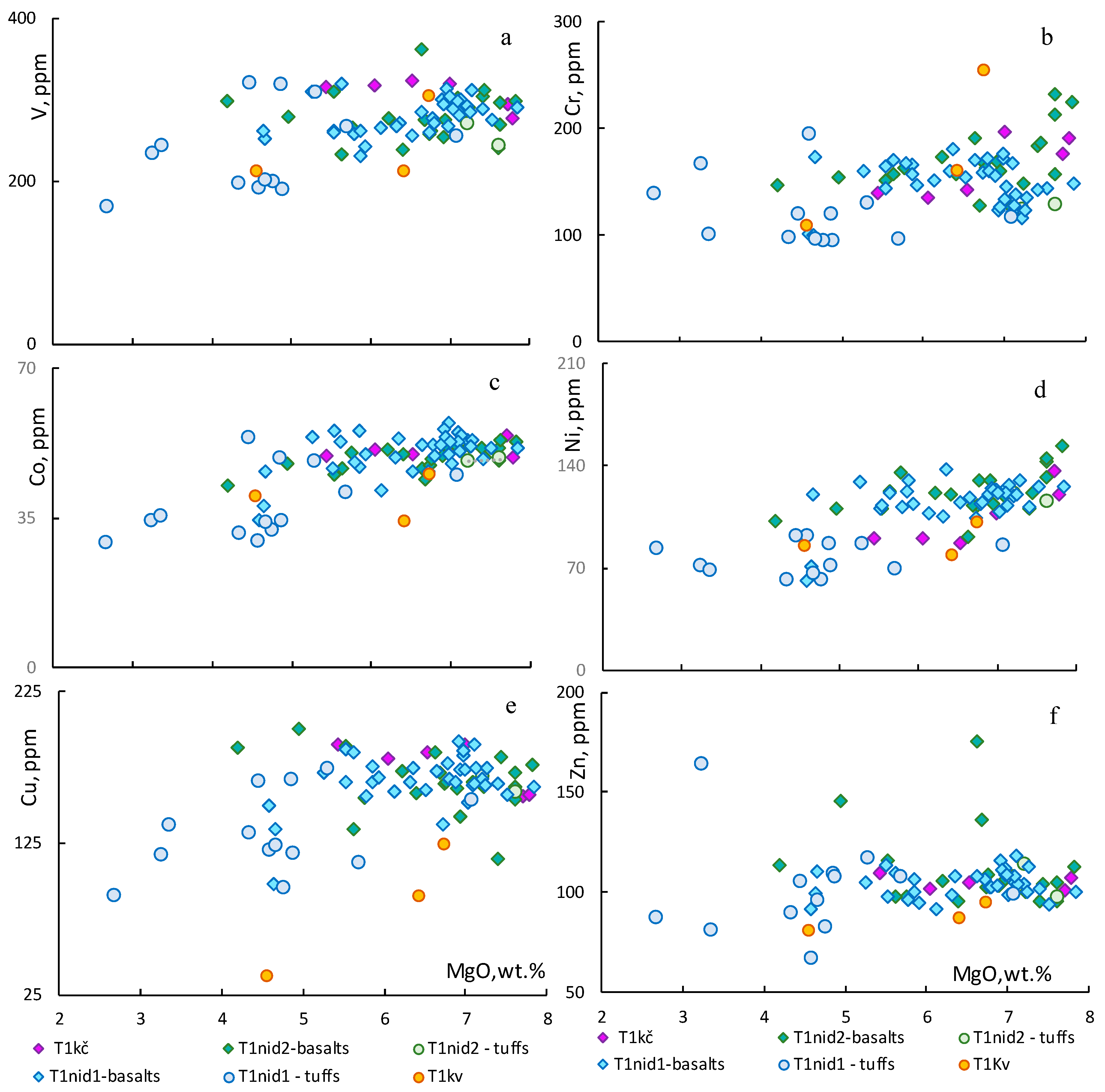
Figure 22.
Spider-diagrams for the rocks of the Nidymsky Formation, sample numbers: a- HT-13 - HT-24, b – HT-28 - HT-36, c - HT-38 – HT-50, d -HT-51 – HT-68. Here and in Figure 23, Figure 24, Figure 25, Figure 26, Figure 29, Figure 30, Figure 31, Figure 32, Figure 34 and Figure 35 rock concentrations normalized to primitive mantle after (Hofmann, 1988).
Figure 22.
Spider-diagrams for the rocks of the Nidymsky Formation, sample numbers: a- HT-13 - HT-24, b – HT-28 - HT-36, c - HT-38 – HT-50, d -HT-51 – HT-68. Here and in Figure 23, Figure 24, Figure 25, Figure 26, Figure 29, Figure 30, Figure 31, Figure 32, Figure 34 and Figure 35 rock concentrations normalized to primitive mantle after (Hofmann, 1988).
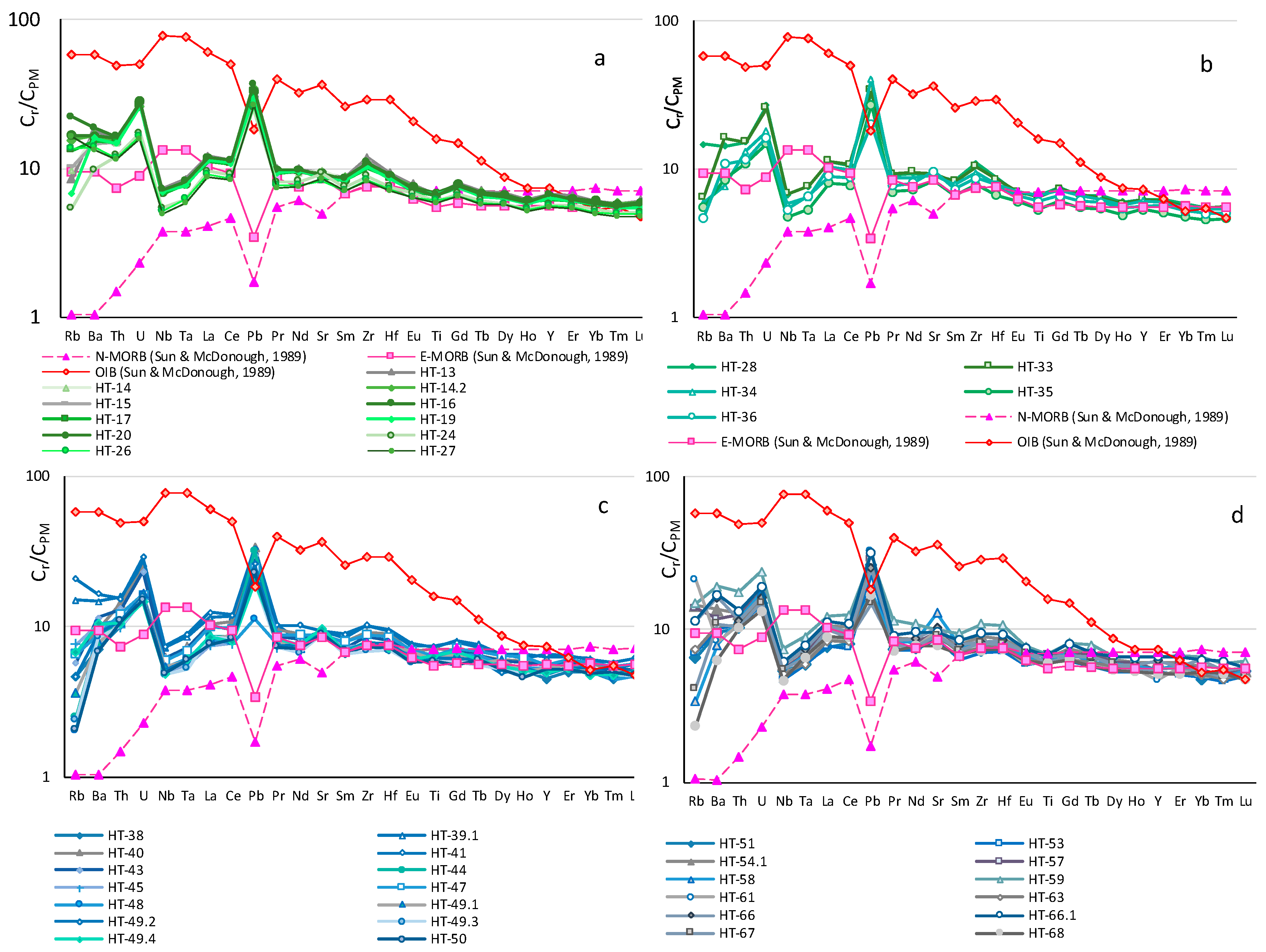
Figure 23.
Spider-diagrams for the tuffs from the Korvunchansky Formation, a, b: , Vanavara (a), L. Tunguska (b); Nidymsky Formation, c-e: Lower part, HT-7 (c), HT-6 (d); Upper part (e) HT-43, HT-36.1.
Figure 23.
Spider-diagrams for the tuffs from the Korvunchansky Formation, a, b: , Vanavara (a), L. Tunguska (b); Nidymsky Formation, c-e: Lower part, HT-7 (c), HT-6 (d); Upper part (e) HT-43, HT-36.1.
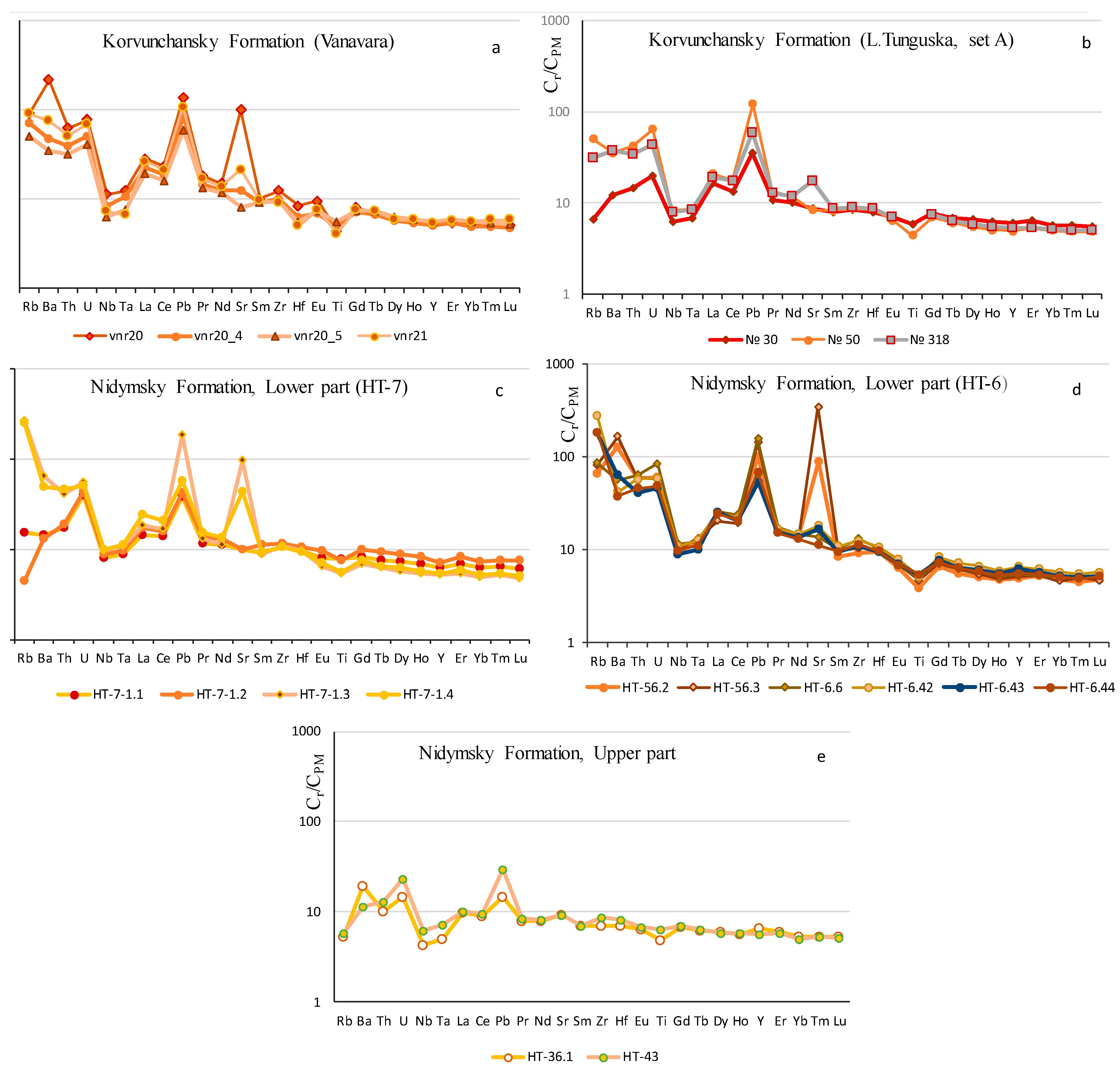
Figure 24.
Spider-diagrams for the tuffs (brown lines) and basalts (green lines) from the Nidymsky Formation (a); diagram (Ba/Lu)n – (Ta/Lu)n for the tuffs and basalts from different Formations in the Tunguska syneclise. Square marks are tuffs, rhombs are basalts.
Figure 24.
Spider-diagrams for the tuffs (brown lines) and basalts (green lines) from the Nidymsky Formation (a); diagram (Ba/Lu)n – (Ta/Lu)n for the tuffs and basalts from different Formations in the Tunguska syneclise. Square marks are tuffs, rhombs are basalts.
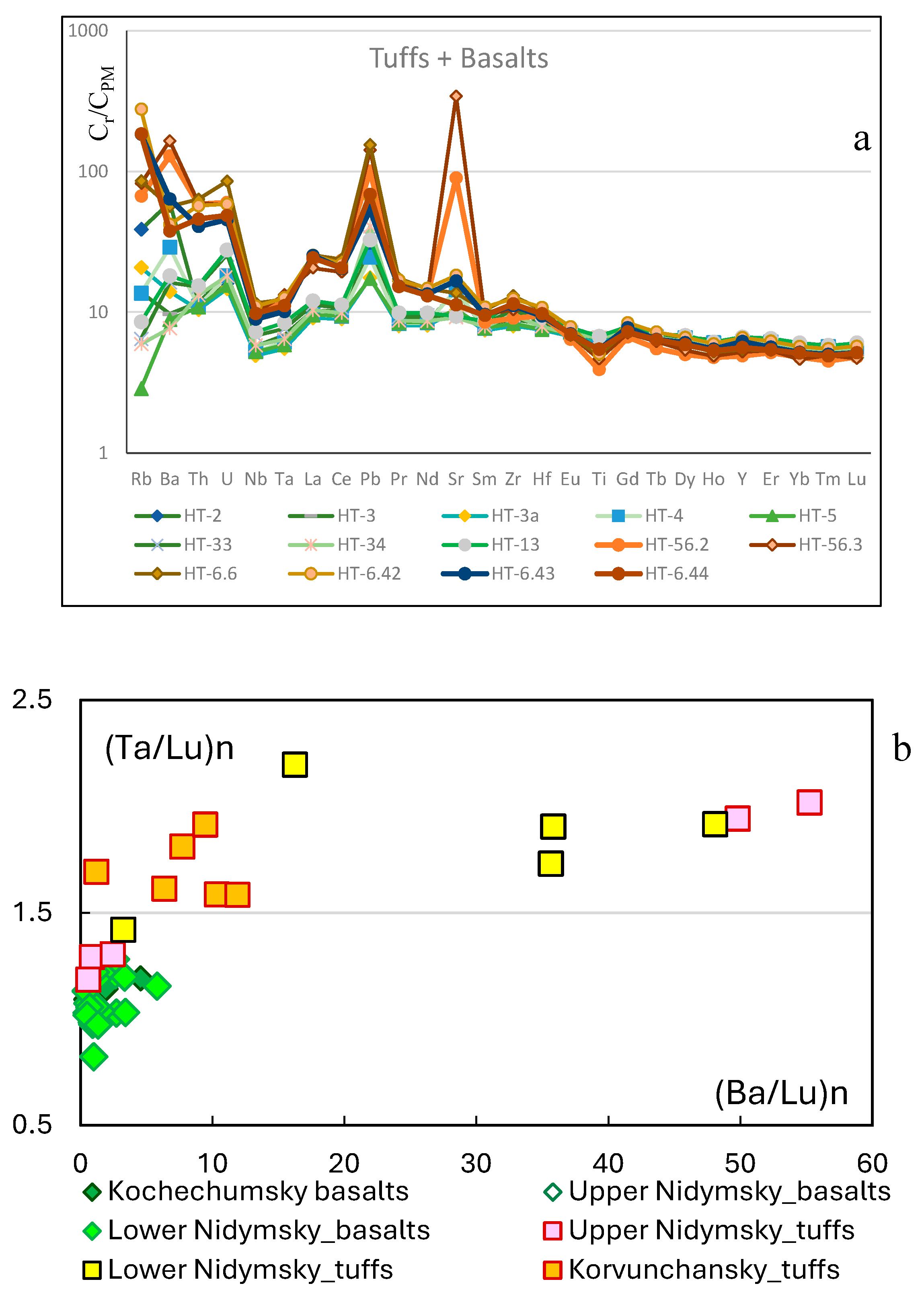
Figure 25.
Spider-diagrams for the tuffs (brown lines) and basalts (green lines) from the Nidymsky Formation (a); diagram (Ba/Lu)n – (Ta/Lu)n for the tuffs and basalts from different Formations in the Tunguska syneclise. Square marks are tuffs, rhombs are basalts.
Figure 25.
Spider-diagrams for the tuffs (brown lines) and basalts (green lines) from the Nidymsky Formation (a); diagram (Ba/Lu)n – (Ta/Lu)n for the tuffs and basalts from different Formations in the Tunguska syneclise. Square marks are tuffs, rhombs are basalts.
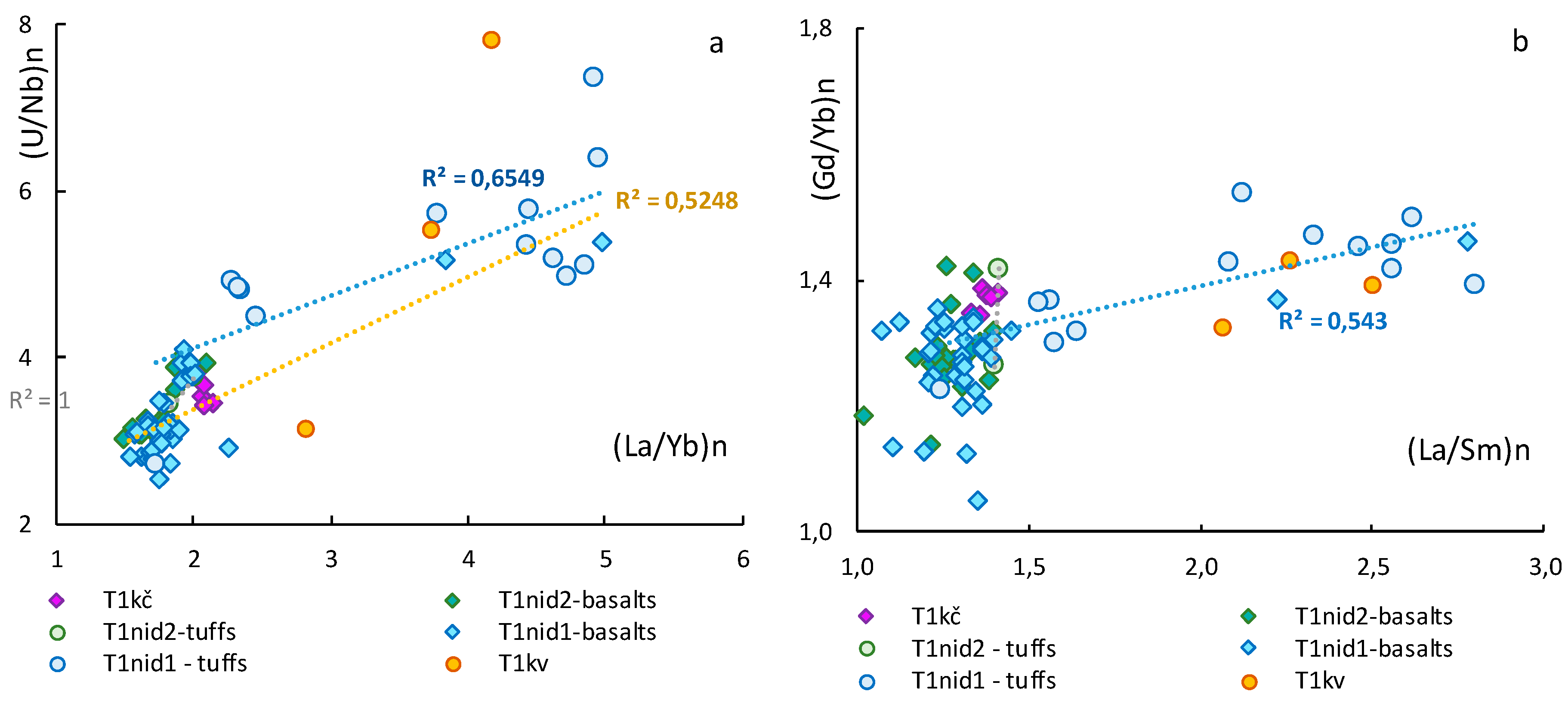
Figure 26.
Diagrams (La/Sm)n-(Gd/Yb)n (a) and (La/Yb)n-(U/Nb)n (b) for the fuffs of the Korvunchansky (samples VNR) and Nidymsky (samples HT) Formations.
Figure 26.
Diagrams (La/Sm)n-(Gd/Yb)n (a) and (La/Yb)n-(U/Nb)n (b) for the fuffs of the Korvunchansky (samples VNR) and Nidymsky (samples HT) Formations.
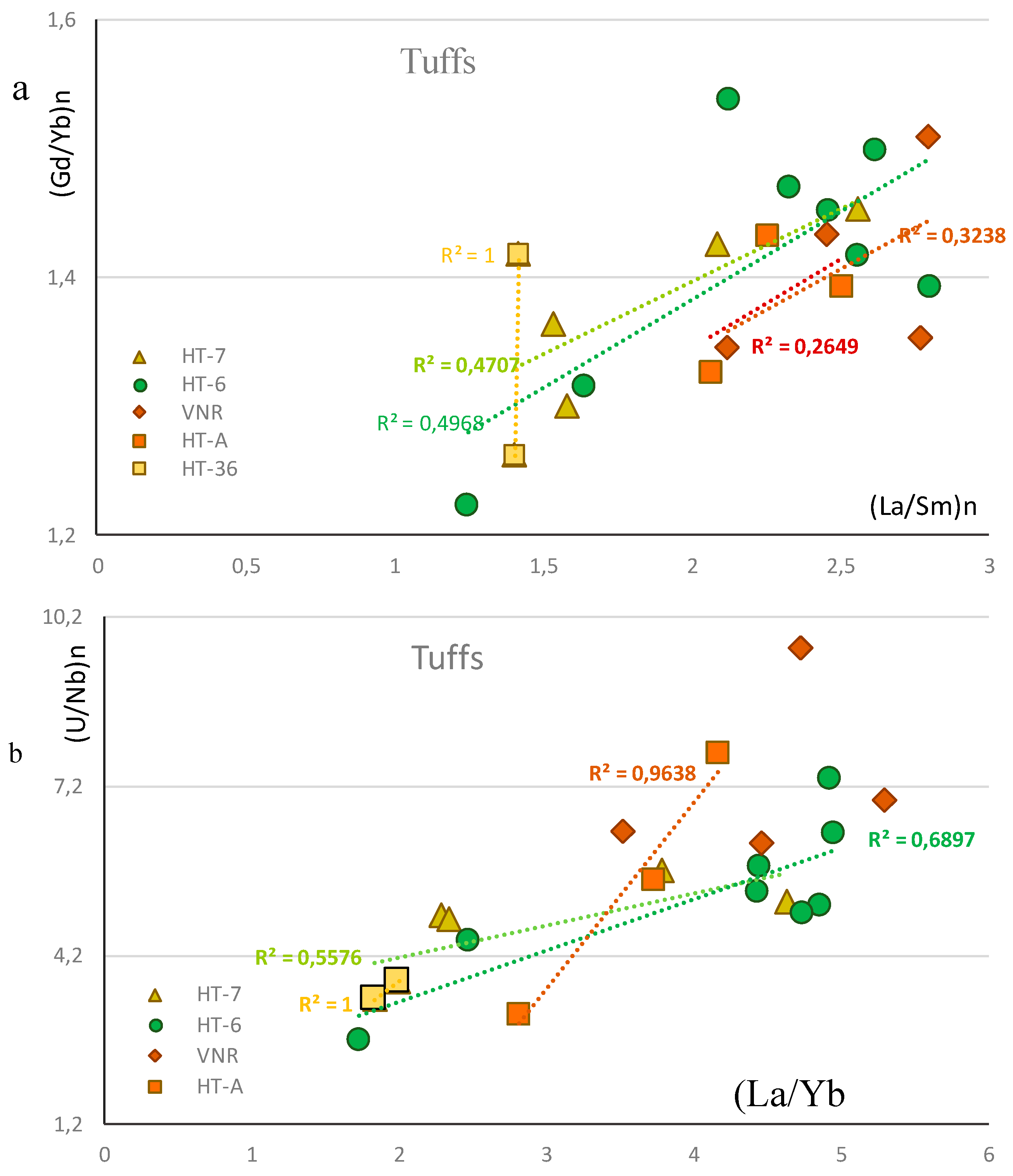
Figure 27.
Diagrams 87Rb/86Rb – 87Sr/86Sr (a), 143Nd/144Nd – 147Sm/144Nd (b), and Ma – 206Pb/204Pb (c) for the rocks in the Lower Tunguska River valley.
Figure 27.
Diagrams 87Rb/86Rb – 87Sr/86Sr (a), 143Nd/144Nd – 147Sm/144Nd (b), and Ma – 206Pb/204Pb (c) for the rocks in the Lower Tunguska River valley.
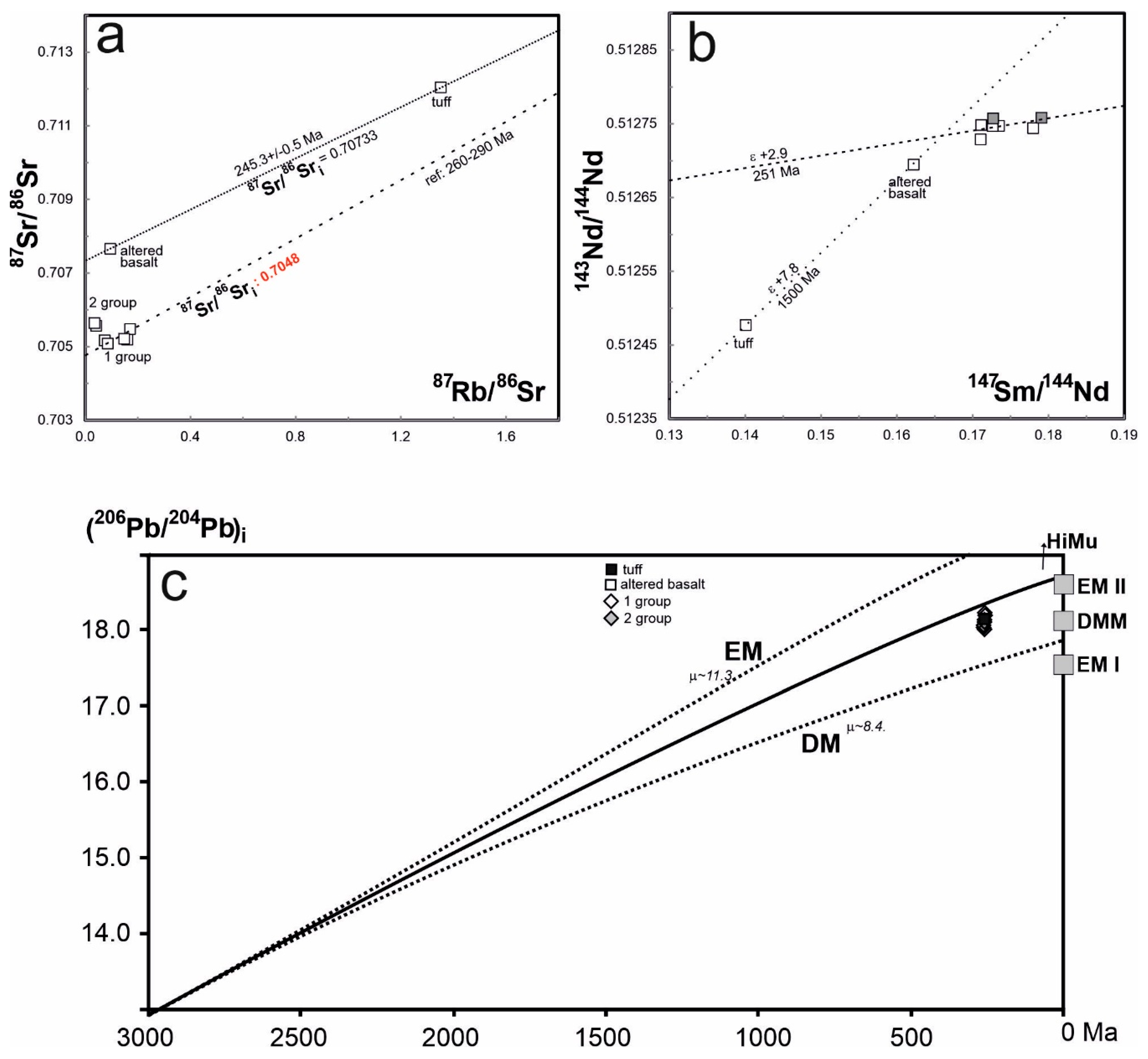
Figure 28.
Diagram 87Sr/86Sr - ꜪNd for tuffs and basalts of the Siberian Traps Province.Data in Table 2 and (Krivolutskaya et al., 2020, Lightfoot et al., 1993; Wooden et al., 1993). Formations, basalts (squares): Khr - Kharaelakhsky, Mk – Mokulaevsky, Nid – Nidymsky, Mr – Morongovsky. Formations, tuffs (circles): Khakanchansky – Tuff-Sunduk, Tuff-Khakancha, Khakancha-SG-22; HT-6.44 – Nidymsky.
Figure 28.
Diagram 87Sr/86Sr - ꜪNd for tuffs and basalts of the Siberian Traps Province.Data in Table 2 and (Krivolutskaya et al., 2020, Lightfoot et al., 1993; Wooden et al., 1993). Formations, basalts (squares): Khr - Kharaelakhsky, Mk – Mokulaevsky, Nid – Nidymsky, Mr – Morongovsky. Formations, tuffs (circles): Khakanchansky – Tuff-Sunduk, Tuff-Khakancha, Khakancha-SG-22; HT-6.44 – Nidymsky.
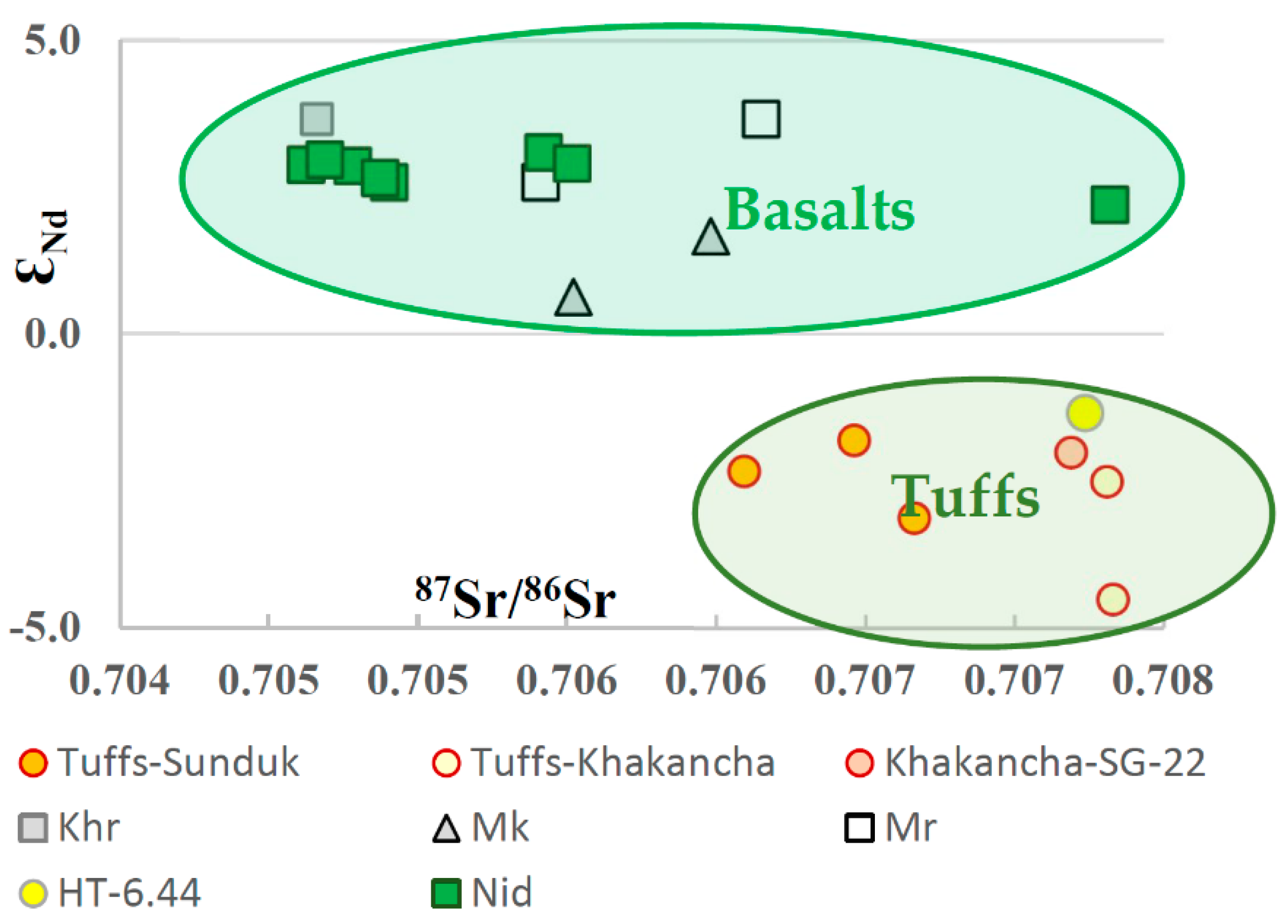
Figure 29.
Spider diagrams for basalts (blue lines) and tuffs (red lines), Formations: а-Kharaekakhsky, b-Delcansky. Data in (ESM 3; Sluzhenikin et al., 2014; Krivolutskaya, 2016).
Figure 29.
Spider diagrams for basalts (blue lines) and tuffs (red lines), Formations: а-Kharaekakhsky, b-Delcansky. Data in (ESM 3; Sluzhenikin et al., 2014; Krivolutskaya, 2016).
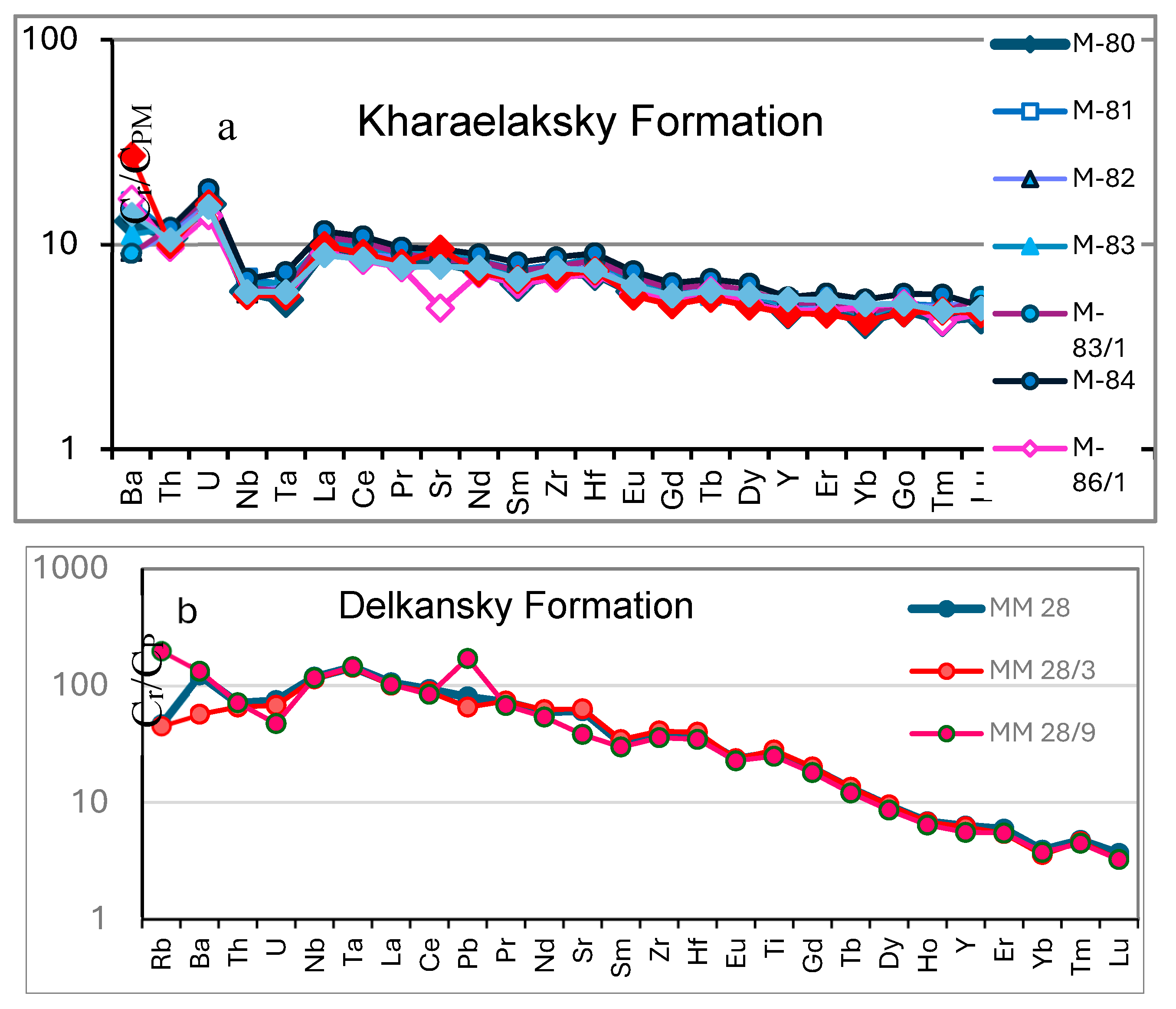
Figure 30.
Spider-diagrams for the tuffs of the Khakanchansky (samples 76/1, 76/2) and Korvunchansky (samples vnr20 and vnr20_4) Formations. Data in ESM 3 and (Krivolutskaya et al., 2020).
Figure 30.
Spider-diagrams for the tuffs of the Khakanchansky (samples 76/1, 76/2) and Korvunchansky (samples vnr20 and vnr20_4) Formations. Data in ESM 3 and (Krivolutskaya et al., 2020).
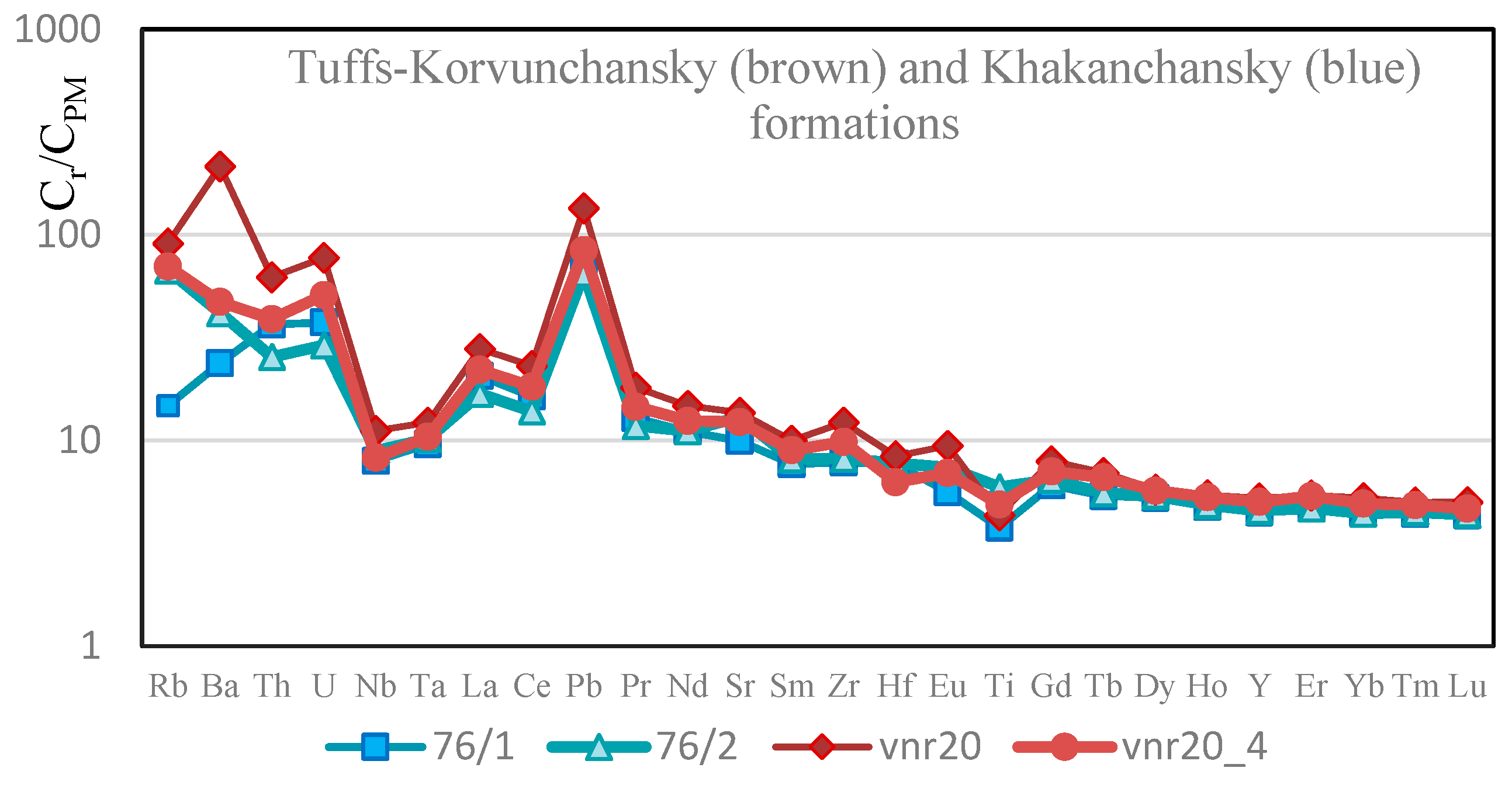
Figure 32.
Spider diagrams for the basalts of the Nadayansky flow. Data in (Krivolutskaya, Kedrovskaya, 2020).
Figure 32.
Spider diagrams for the basalts of the Nadayansky flow. Data in (Krivolutskaya, Kedrovskaya, 2020).
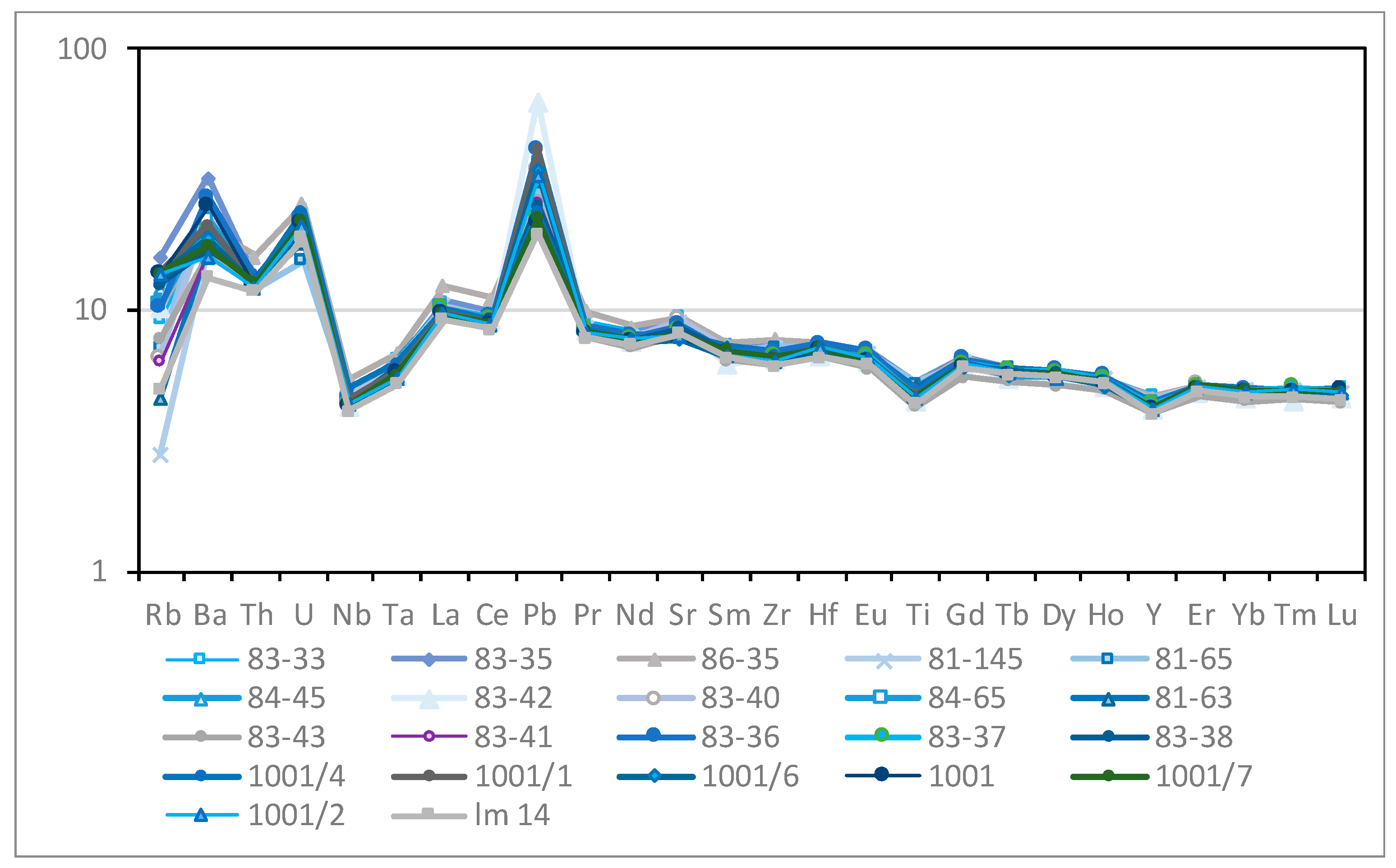
Figure 34.
Diagrams (La/Yb)n – (U/Nb)n (a) and (La/Sm)n – (Gd/Yb)n for the volcanic rocks of the Siberian Traps province. Abbravation in Figure 33.
Figure 34.
Diagrams (La/Yb)n – (U/Nb)n (a) and (La/Sm)n – (Gd/Yb)n for the volcanic rocks of the Siberian Traps province. Abbravation in Figure 33.
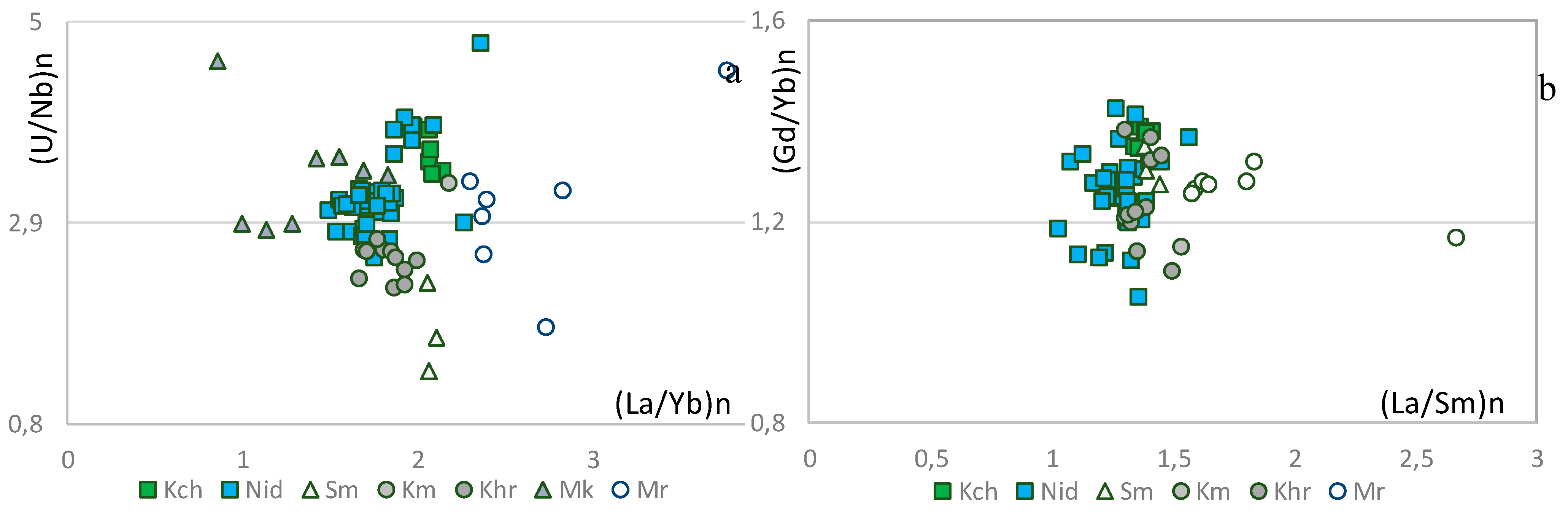
Figure 35.
Spider diagrams for the rocks of the Karaelakhsky and Kochechumsky Formations. Data in ESM 3 and (Lightfoot et al., 1993).
Figure 35.
Spider diagrams for the rocks of the Karaelakhsky and Kochechumsky Formations. Data in ESM 3 and (Lightfoot et al., 1993).
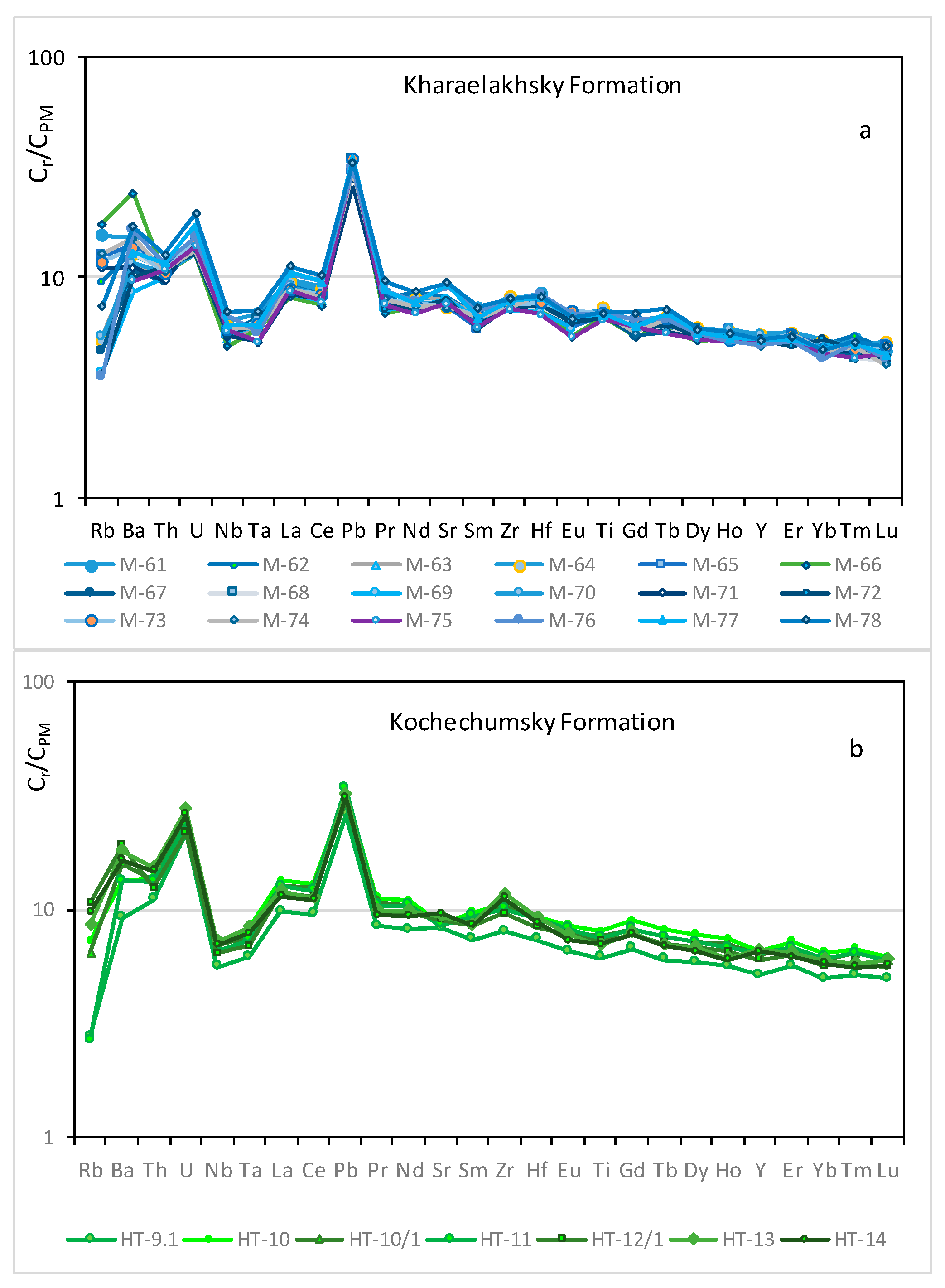
Figure 36.
Correlation of the volcanic cross-sections in the Norilsk area and Tunguska syneclise. Continuous lines demonstrate correlation of the Formations, dotted lines show schematically wedging out the Formation (abbreviation is in Figure 1) .
Figure 36.
Correlation of the volcanic cross-sections in the Norilsk area and Tunguska syneclise. Continuous lines demonstrate correlation of the Formations, dotted lines show schematically wedging out the Formation (abbreviation is in Figure 1) .
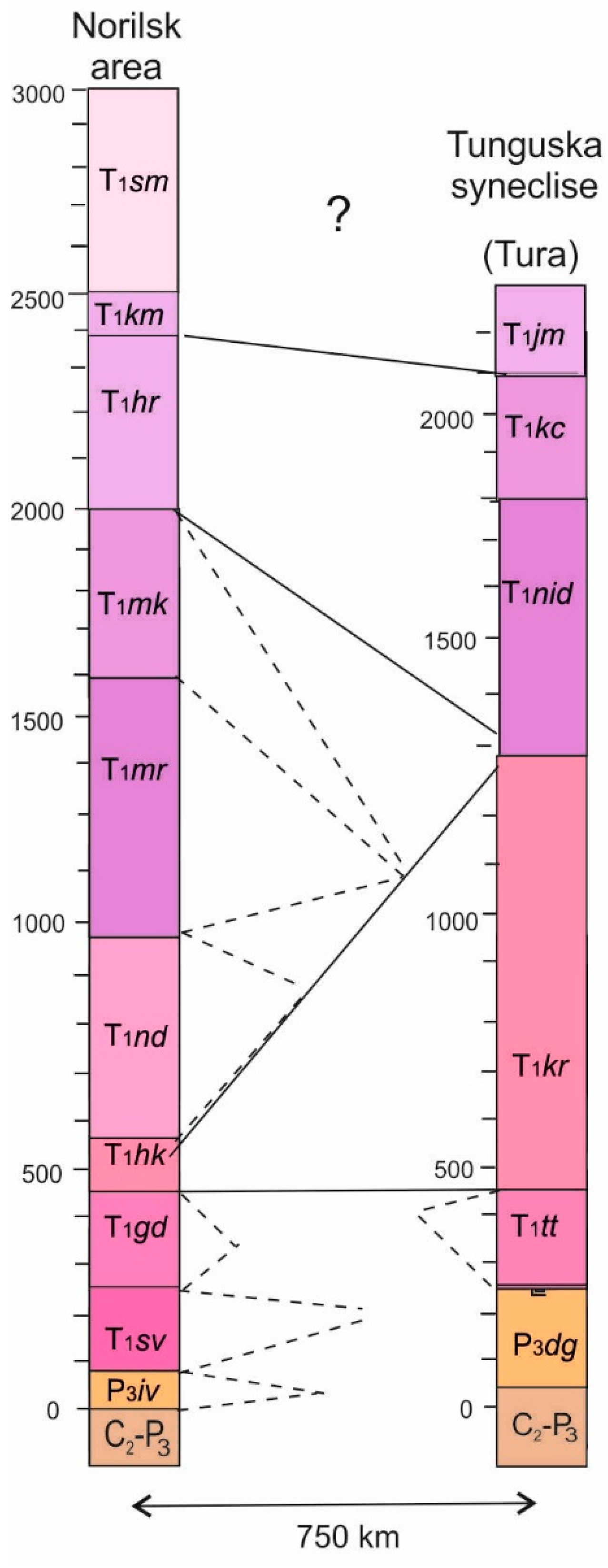
Figure 37.
Scheme of volcanic evolution in the Siberian Traps Province. Stages, Formations: I – Ivakinsky+Syradasaysky (P3iv+P3sr), Syverminsky T1sv, and Gudchikhinsky T1gd (a); II – Tuklonsky+Khakanchansky+Korvunchansky (T1tk+T1hk+T1kv) (+Tutonchansky T1tt) (b); III – Morongovsky T1mr (Ayansky T1ay), Mokulaevsky T1mk (Honnamakitsky T1hk), Kharaelakhsky T1khr (Nidymsky T1nid +Kochechumsky T1kč, Betlingsky T1bt).
Figure 37.
Scheme of volcanic evolution in the Siberian Traps Province. Stages, Formations: I – Ivakinsky+Syradasaysky (P3iv+P3sr), Syverminsky T1sv, and Gudchikhinsky T1gd (a); II – Tuklonsky+Khakanchansky+Korvunchansky (T1tk+T1hk+T1kv) (+Tutonchansky T1tt) (b); III – Morongovsky T1mr (Ayansky T1ay), Mokulaevsky T1mk (Honnamakitsky T1hk), Kharaelakhsky T1khr (Nidymsky T1nid +Kochechumsky T1kč, Betlingsky T1bt).
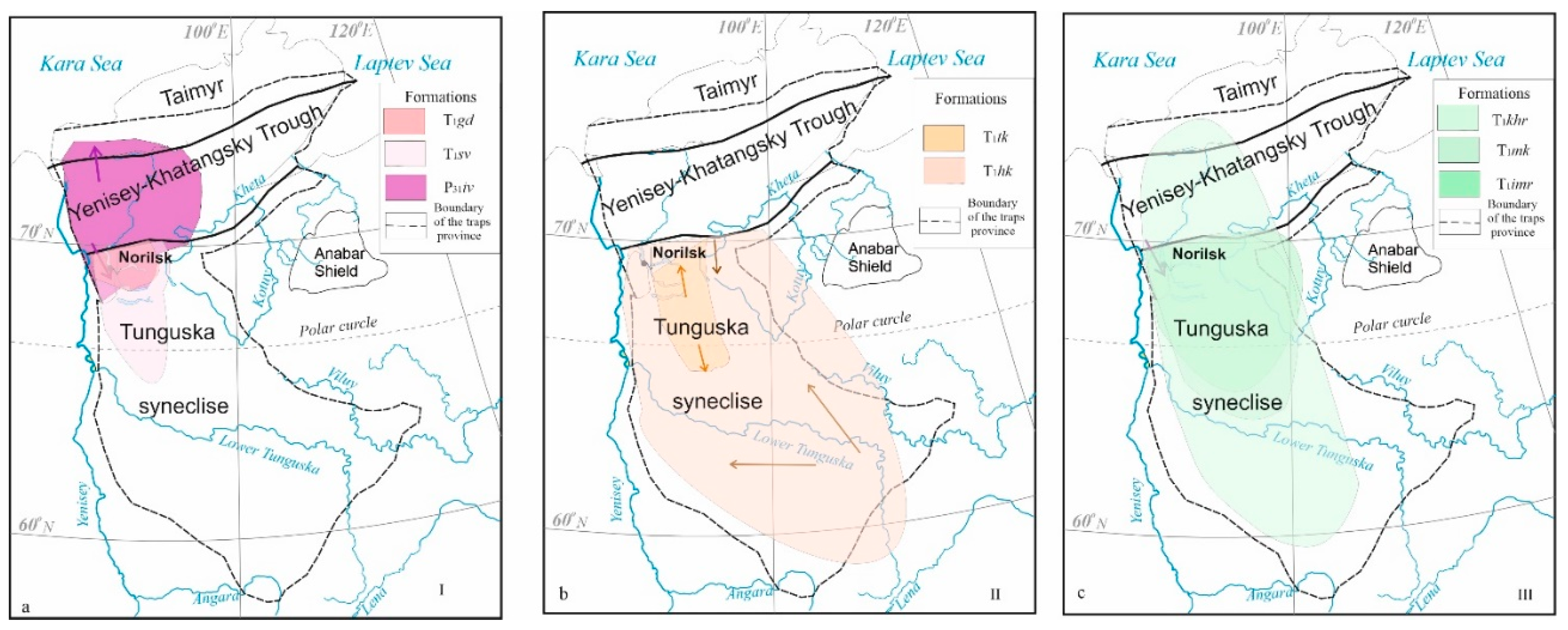
Figure 38.
Schema of plume according to experimental model (Campbell, Davis, 2006).
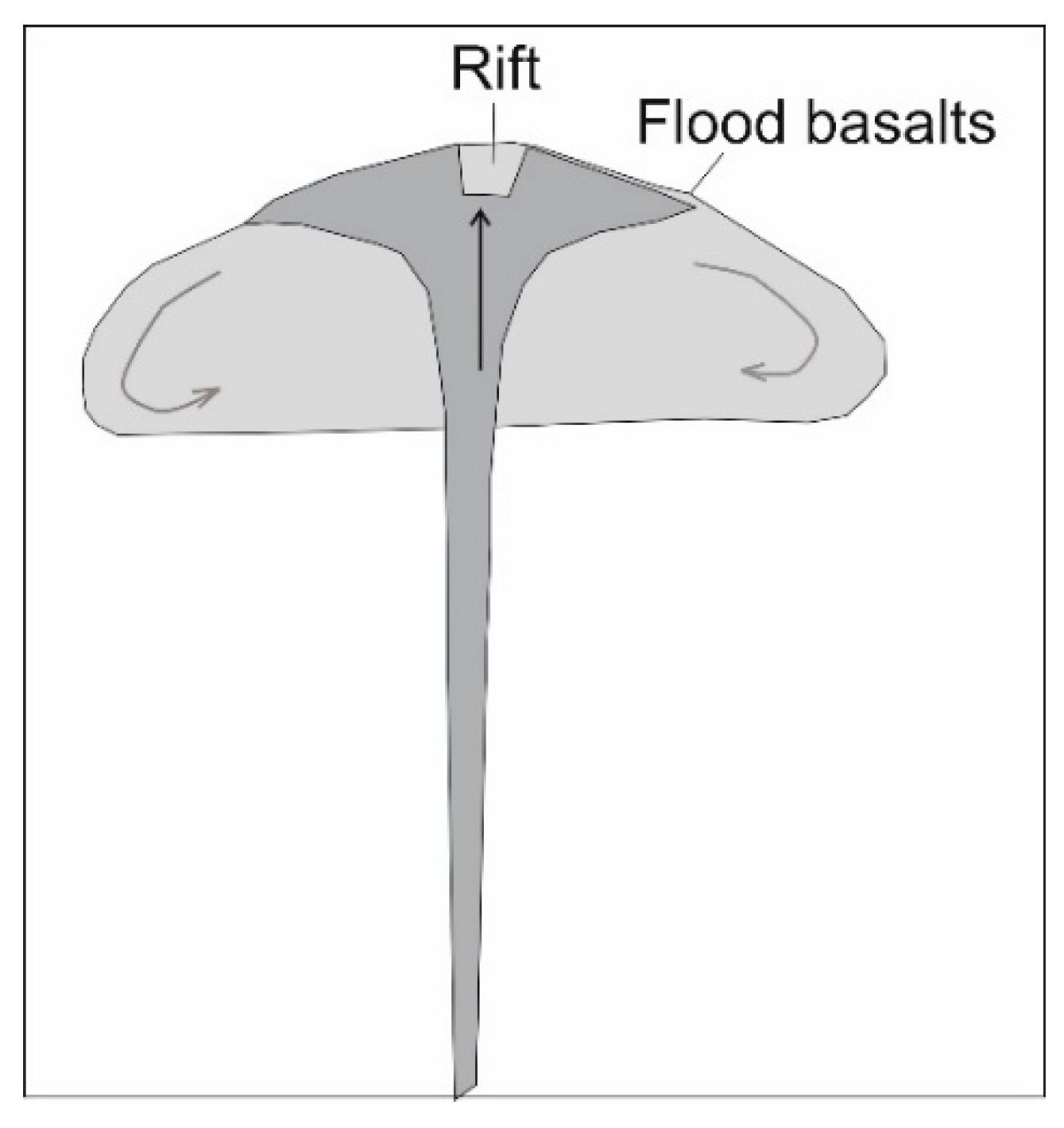
Disclaimer/Publisher’s Note: The statements, opinions and data contained in all publications are solely those of the individual author(s) and contributor(s) and not of MDPI and/or the editor(s). MDPI and/or the editor(s) disclaim responsibility for any injury to people or property resulting from any ideas, methods, instructions or products referred to in the content. |
© 2026 by the authors. Licensee MDPI, Basel, Switzerland. This article is an open access article distributed under the terms and conditions of the Creative Commons Attribution (CC BY) license (http://creativecommons.org/licenses/by/4.0/).
Copyright: This open access article is published under a Creative Commons CC BY 4.0 license, which permit the free download, distribution, and reuse, provided that the author and preprint are cited in any reuse.


