
Submitted:
11 July 2026
Posted:
13 July 2026
You are already at the latest version
Abstract
Compute-capacity contracts—forward claims on GPU time, now cleared as futures—are emerging as an asset class. Their delivery leg is hedgeable and their investment-grade issuers trade single-name CDS, but the cross-issuer cluster riskbetween them is not: a shared funding, datacenter, or regulatory shock defaults a tied group at once. We characterize this cluster correlation as the unhedgeable core of a multi-issuer book and design the instruments that would hedge it. Two design pieces generate it, kept closed-form by an affine intensity model. A single Marshall–Olkin common shock carries the discrete joint defaults across every trigger—datacenter, regulatory, and force-majeure shocks on a shared external cause, the funding cascade instead self-exciting, a first failure propagating to the survivors and over-dispersing the count. A slow, bistable cross-architecture substitution layer then depreciates the delivered good and arms that same cascade, with an endogenous fire-sale recovery that derives the wrong-way spot–credit sign. From a channel-by-channel decomposition we derive a suite of cluster contracts—a compute-CDS index, correlation tranches, a cluster-count swap, an architecture-share swap, and a proxy for the unspanned keystone counterparty—each spanning a distinct channel. Hedging effectiveness is the no-arbitrage band each instrument removes, measured by a cluster-basis good-deal bound; the same bound pins the irreducible floor—the loss carried by a node no contract references—so the market completes only up to its keystone. Two documented clusters—a 2022 mining-pivot cohort and the 2025–26 NVIDIA–OpenAI–Oracle “Stargate” loop—calibrate the suite. Portfolios of compute-capacity contracts—now marked across issuers by cleared futures indices, OTC spreads, and reservation books—carry a dominant risk that does not diversify: a shared trigger defaults a tied group of issuers at once. We characterize this cross-issuer cluster correlation as the systematic, unhedgeable core of such a book and bound its price. Two design pieces generate it, kept closed-form by an affine intensity model. A single Marshall–Olkin common shock carries the discrete joint defaults across every trigger—datacenter, regulatory, and force-majeure shocks on a shared external cause, the funding cascade instead self-exciting, a first failure propagating to the survivors and over-dispersing the count. A slow, bistable cross-architecture substitution layer then depreciates the delivered good and arms that same cascade, with an endogenous fire-sale recovery that derives the wrong-way spot–credit sign. The central result is a good-deal bound: credit instruments (single-name CDS, a CDS index, GPU-loan ABS tranches) augmenting a commodity-and-index tradeable set contract the unhedgeable Föllmer–Schweizer residual to a cluster-basis floor on the no-arbitrage band that we show is attained, hence sharp, closing only in a fully-spanned, architecture-diversified limit. Two documented clusters—a 2022 mining-pivot cohort and the 2025–26 NVIDIA–OpenAI–Oracle circular-financing loop—calibrate the construction. Compute contracts are the motivating instance; the bound applies to any basket of defaultable claims exposed to common shocks no traded index spans.
Keywords:
1. Introduction
2. The Joint Single-Period Setup
- The joint contract object.
- Segment classification by tradeability.
- (I) Arbitrage-enforced. Tradeability friction , the spot underlying is tradeable, and a replicating strategy exists. Cash-and-carry bounds bind with small frictions, and observed mispricings invite arbitrage.
- (II) Minimal-martingale-measure (MMM) pricing. The spot underlying is not freely tradeable (forwards without secondary-market depth, or bilateral OTC without standardized transferability), so cash-and-carry chains only partially close. The contract is priced under the MMM , with an unhedgeable residual borne by the holder that widens the no-arbitrage band (the Föllmer–Schweizer decomposition of §6.2).
- (III) Indicative pricing. (non-transferable reservations, account-locked AI-lab credits) and the cash-and-carry chain breaks at the holding step. The per-issuer pricing equation (1) delivers what the contract would trade at under counterfactual tradeability; the output is useful for opportunity-cost benchmarking, internal valuation, and bilateral negotiation but not arbitrage-enforced.
3. Architecture: Substitution and Lock-in
3.1. Substitution Dynamics
- Integration into the pricing equation.
- Systematic exposure and tenor scope.
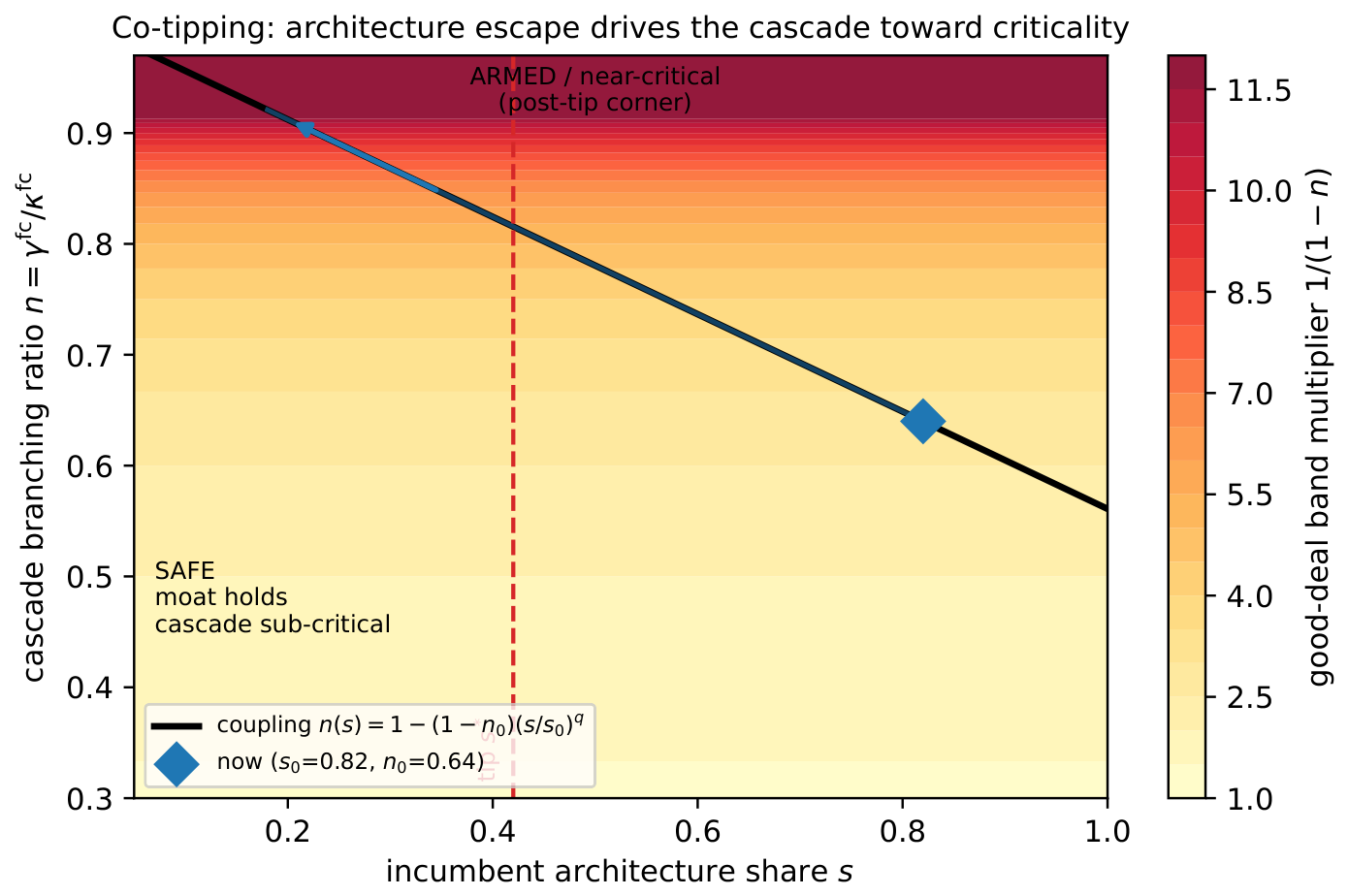
3.2. Lock-in: Bifurcation, First-Passage Tipping, and Co-Tipping
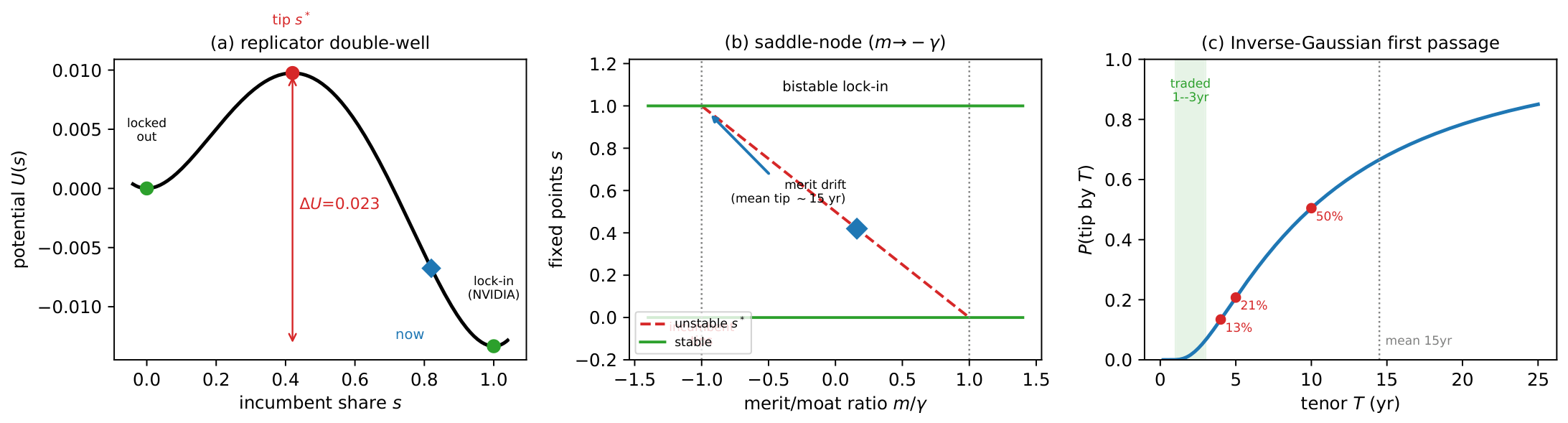
- The lock-in is a double-well.
- Two routes to a tip.
- Calibration.
4. Cross-Issuer Dependence: Continuous Factors, Common Shocks, and Funding-Cascade Contagion
- Continuous. A common-factor state vector —a four-dimensional affine diffusion whose CIR and Vasicek coordinates carry supply and capacity-glut, macro credit-and-funding, physical-infrastructure, and regulatory stress—on which every issuer’s intensity loads; cross-issuer co-movement enters entirely through these shared loadings, the multi-name credit standard.
- Discrete: Marshall–Olkin common shocks. Counting processes (-valued, unit jumps), , each defaulting a loaded group of issuers at a single firing. All four share this group-fatal delivery and differ only in what drives the firing rate : a shared external cause—-affine—for infrastructure, regulatory, and force majeure (§4.2); contagion for the funding cascade (), where a per-cluster self-exciting (Hawkes) state —a piecewise-deterministic process, at each member default, decay rate , gain , branching ratio —lifts as cluster members fail. In Table 1 both are sub-cases of the single Marshall–Olkin common shock—common-cause and contagion—not parallel dynamics.
4.1. Continuous Channel
4.2. Marshall–Olkin Common Shocks
- physical-infrastructure cascade indexed by E1 datacenter hub m, intensity affine in ;
- regulatory shock firing at announcement instants, intensity affine in ;
- force majeure , approximately Poisson-constant;
- financial-counterparty cluster (fc) , indexed by cluster , the AI-compute circular-financing loops cataloged in Appendix B (Table A12); its arrival intensity is instead self-exciting, developed below.
- Cluster-shock contribution to cause-conditional default.
- Contagion: the self-exciting funding cascade.
- Calibrating the contagion gain.
- Co-tipping: the architecture tip arms the cascade.
5. Joint Affine Intensity and Closed-Form Joint Survival
- The architecture channel and conditional affinity.
- Joint survival probability.
- Joint pricing.
- Spot–credit correlation across the basket.
- Endogenous fire-sale recovery.
6. Risk Decomposition and Hedging
6.1. The Three-Channel Variance Decomposition
- Decomposition.
- Factor channel.
- Spot–credit cross-channel.
- Cluster channel.
- Architecture channel.
- Cluster contribution as fraction of total.
- Hedging implication.
6.2. The Föllmer–Schweizer Decomposition
- The decomposition.
- Locally-risk-minimizing hedge strategy.
- Four classes of unhedgeable residual.
7. Hedgeability Under an Augmented Tradeable Set
- The augmented tradeable set.
- The contracted residual.
- (i)
- the unspanned cluster basis , collecting unspanned names, counterparty wrong-way, and recovery basis; and
- (ii)
- the tranche-correlation residual: the dependence of which tranche absorbs the loss on and the -geometry, which the level index does not span and the tranches price only off the unobservable correlation.
- (a)
-
(Band.) The good-deal price band of the joint claim H has half-widthto leading order: the replicable component of H is priced identically by every admissible measure, and only the unhedgeable residual moves the price.
- (b)
-
(Floor.) The residual variance obeys the cluster-basis lower boundwith the unit-jump price sensitivity of (24); hence .
- (c)
- (Sharpness.) The bound is tight in three senses. (i) The band of (a) is attained : the kernels that add orthogonal pricing-kernel volatility aligned with keep the Sharpe ratio at exactly h, so they are admissible and reach the two endpoints—(32) is the exact no-good-deal range, not an enclosure. (ii) The floor (33) holds with equality when the tranche-correlation residual of class (ii) is absent (redundant or no tranches) and at the leading order of (24); otherwise the gap is exactly that non-negative tranche term, strict whenever a tranche is non-redundant. (iii) is the cluster loss orthogonal to the traded span, so no position lowers it: the floor falls only as a new instrument raises some , and vanishes iff for every loaded shock—the fully-spanned, architecture-diversified limit. In particular the band stays open whenever any loaded shock has : whenever omits a loaded high-δ name, protection carries counterparty wrong-way risk , or the recovery basis is non-zero.
8. Hedging the Cluster: Instrument Design and Effectiveness
8.1. The Instrument Suite
- (H1) Compute-CDS index.
- (H2) Cluster-correlation tranches.
- (H3) Cluster-count swap.
- (H4) Architecture-share swap.
- (H5) Keystone proxy.
8.2. Hedging Effectiveness and the Irreducible Floor
8.3. Effectiveness on the Two Clusters
9. Worked Example: The 2022 Mining-Pivot Cluster
- Cohort.
- Heterogeneous cluster exposure.
- A structural reading of the loadings.

| Issuer | Documented 2022 structure (source) | |
|---|---|---|
| Compute North | 0.85 | Mining-host pure-play; revenue from hosting Bitcoin miners (clients including Marathon, Hive, Bit Digital), so mining-sector customer concentration; no energy-cost pass-through (CoinDesk [62]) |
| Core Scientific | 0.80 | Predominantly self-mining (most Bitcoin-price-exposed) plus mining-hosting; large Bitcoin treasury; no non-mining line in 2022 (Coinspeaker [63]) |
| Hut 8 | 0.45 | Mining-dominant but diversified: HPC/colocation via the Jan. 2022 TeraGo acquisition (∼400 commercial customers, ∼one-tenth of revenue) plus a held-Bitcoin treasury (Hut 8 Mining Corp. [64]) |
| Applied Digital | 0.30 | Crypto hosting (host, not self-miner) pivoting to HPC/AI: renamed from Applied Blockchain in Nov. 2022, first GPU/HPC facility under build (Applied Digital Corporation [65]) |
- Calibration anchors.
- Parametric cluster intensity.
- Self-excitation: attribution and band.
- The cluster-basis bound, end to end.
- Realized outcome.
- Spot–credit correction.
- Hedging effectiveness.
9.1. Robustness: A Continuous-Channel Reattribution
| Baseline (X det.) | Reattributed () | |
|---|---|---|
| Discrete cluster intensity | /yr | /yr |
| Mean basket value | ||
| Irreducible discrete-cluster variance share | ∼89% | ∼30% |
- Comparison.
9.2. Robustness: Sensitivity to the Exposure Loadings
- The spot–credit correlation.
10. Worked Example: The 2025–26 Circular-Financing Cluster
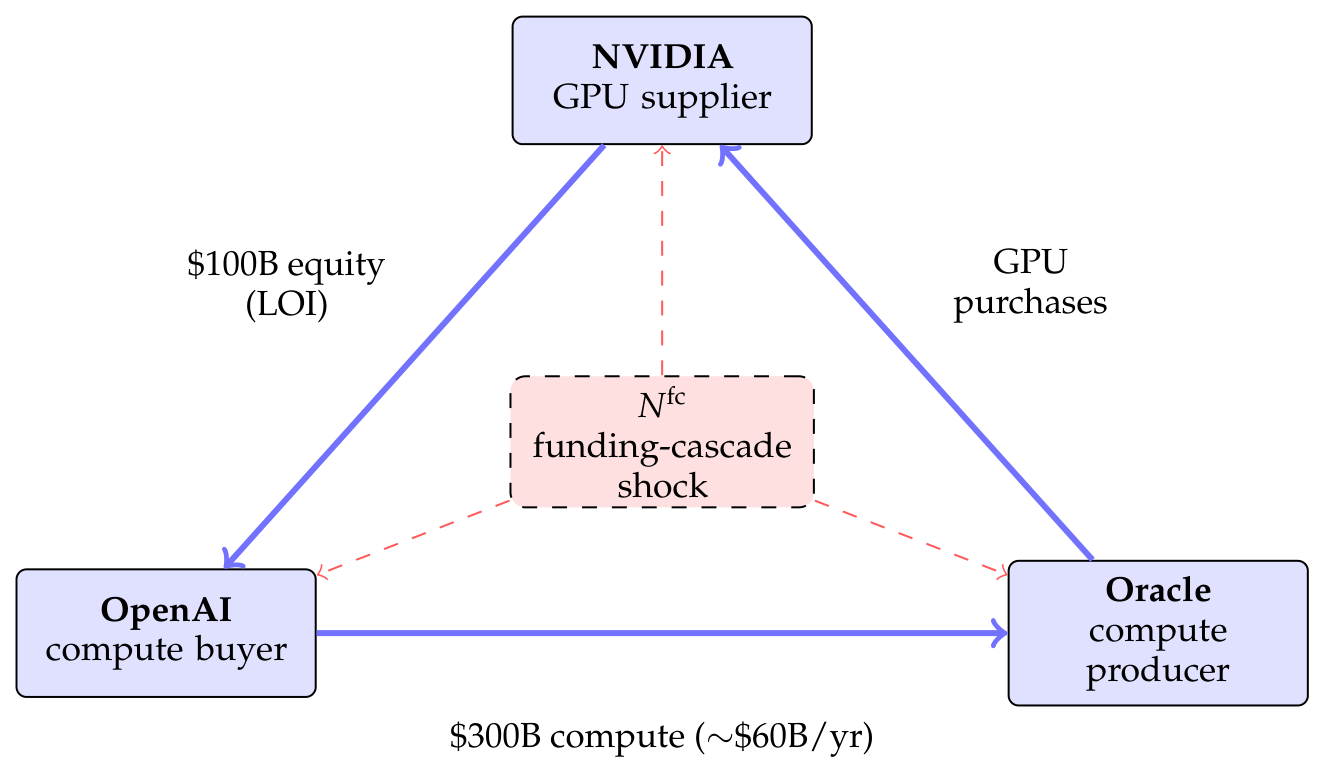
- The loop.
- Priced object and three concentrations.
- Counterparty and funding: the cluster channel.
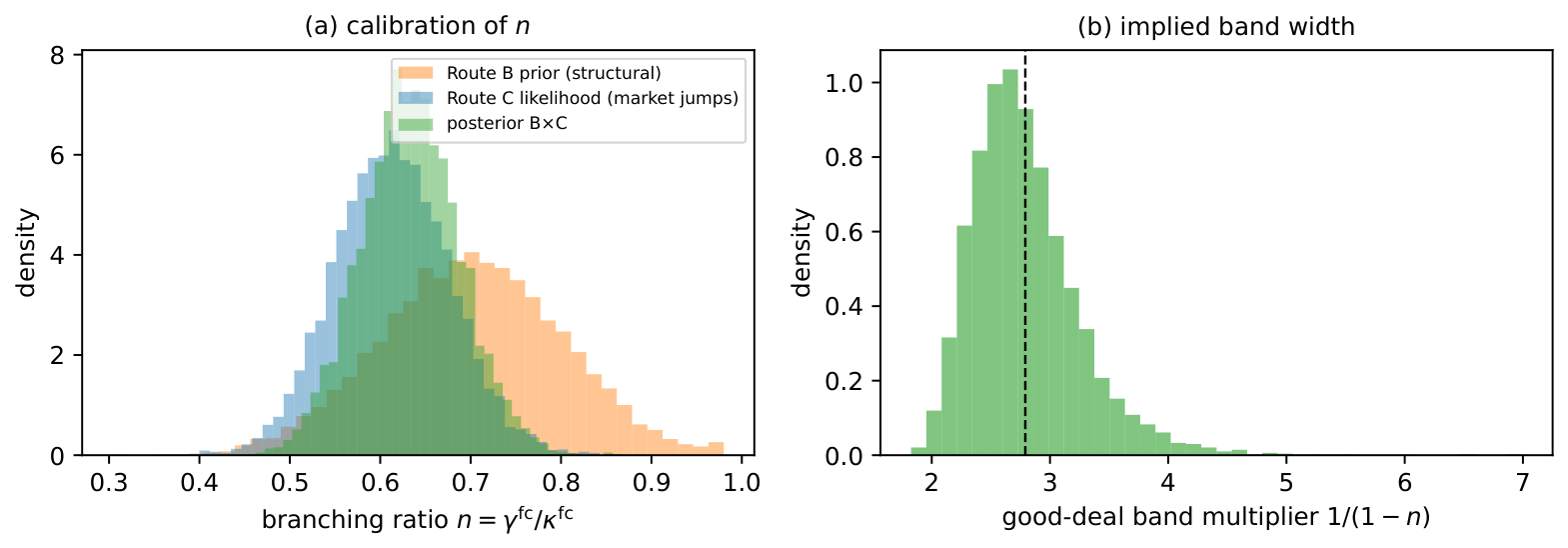
- Calibration.
- Architecture: the commodity channel (Oracle bears it, OpenAI drives it).
- Wrong-way coupling and valuation.
| /yr (regime) | Counterparty 5-yr survival | Backlog PV / face | Implied PV ($300B leg) |
|---|---|---|---|
| 0 (no cluster) | 0.86 | 0.92 | $275B |
| 0.02 (asset-class baseline) | 0.79 | 0.86 | $258B |
| 0.05 (AI-sector-concentrated) | 0.69 | 0.77 | $232B |
| 0.12 (capex-cycle reversal) | 0.50 | 0.59 | $177B |
| 0.25 (full circular cascade) | 0.28 | 0.35 | $105B |
- Self-excitation under the effective reading.
- The cluster-basis bound, end to end.
- A market-implied cross-check.
- Architecture channel, quantified.
- What to watch.
- Hedgeability and the observed signal.
- What the framework adds.
- Credit-market corroboration.
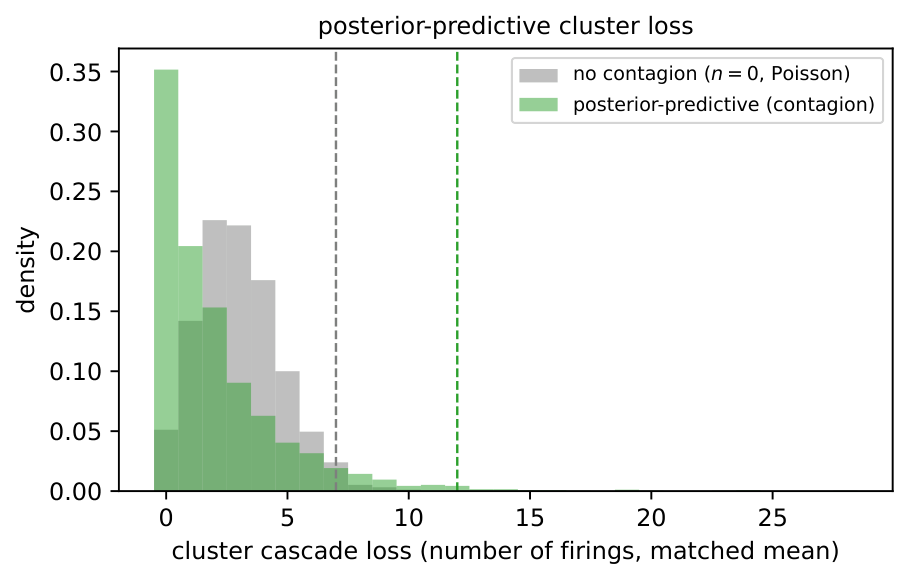
- Bayesian calibration and the posterior-predictive band.
11. Conclusions
- Scope and extensions.
Appendix A Segment Classification Map
| Issuer type | Representative segment | Tradeability | Pricing mode |
|---|---|---|---|
| A · DePIN protocols | Token-settled 24/7 spot; cleared GPU-rental futures referencing DePIN pools | Low ( near zero) | (I) Arbitrage-enforced |
| B · Specialized neoclouds | Compute Exchange listings; Compute Labs vaults; exchange-listed CoreWeave reservations | Medium | (II) MMM |
| B · Specialized neoclouds | Bilateral OTC reservations without secondary-market depth | Medium-to-high | (II) MMM with wider band |
| C · Hyperscaler reservations | AWS Capacity Blocks intra-Organization shareable since March 2026 | Medium | (II) MMM |
| C · Hyperscaler reservations | GCP CUDs, Azure Reservations, raw AWS Capacity Blocks across Organizations | Effectively infinite | (III) Indicative |
| D1 · AI-lab credit programs | Pre-purchased credits, account-locked and time-limited | Effectively infinite | (III) Indicative |
| D2 · AI-lab capacity wholesale | Bilateral frontier-lab capacity sales to other labs or enterprises | High; bespoke and contract-specific | (II) MMM with wider band |
| E1 · Colocation lease | Megawatt-year infrastructure leases (10–15 year tenor) | High; minimal lease-level secondary transfer | Real-estate finance (out of scope) |
| E2 · Direct-to-customer DC operators | Bilateral OTC GPU-hour contracts to end customers | High; non-standardized | (II) MMM with wider band |
| Cleared futures complex | CME–Silicon Data SDH100RT, ICE–Ornn OCPI | Low via clearinghouse | (I) Arbitrage-enforced |
Appendix B Circular-Financing Clusters: The Funding-Cascade Index Set
| # | Cluster | Core participants | Capital-rotation mechanism | Keystone | Committed |
|---|---|---|---|---|---|
| 1 | Nvidia–OpenAI–Oracle | Nvidia, OpenAI, Oracle | Nvidia invests up to $100B in OpenAI, paid as GPU deployments; OpenAI commits $300B to Oracle cloud; Oracle buys Nvidia chips—so the outlay returns as Oracle and Nvidia revenue | OpenAI | $400B+ |
| 2 | Microsoft–OpenAI–Azure | Microsoft, OpenAI | Microsoft holds ∼27% of OpenAI; OpenAI commits $250B of Azure spend; the Azure revenue funds further reinvestment | OpenAI | $250B |
| 3 | Amazon–Anthropic–AWS | Amazon, Anthropic | Amazon equity in Anthropic ($8B, plus up to $25B from Apr 2026); Anthropic commits $100B+ to AWS and Trainium (5 GW); the spend returns as AWS revenue | Anthropic | $100B+ |
| 4 | Google–Anthropic–GCP | Alphabet, Anthropic | Google commits $10B (up to $30B more); Anthropic takes 5 GW (∼1M TPUs) on Google Cloud; the compute spend returns as GCP revenue | Anthropic | $40B+ |
| 5 | Nvidia–xAI–Colossus | Nvidia, xAI, Valor SPV | Nvidia puts $2B into a GPU-collateralised SPV ($7.5B equity, $12.5B debt) that buys Nvidia GPUs for Colossus 2—Nvidia financing the purchase of its own hardware | xAI | $20B |
| 6 | SoftBank–Stargate–OpenAI | SoftBank, Stargate, OpenAI, Oracle, MGX | Japanese-bank credit funds SoftBank’s equity in Stargate (a $500B, 4-year JV); Stargate builds for OpenAI; OpenAI’s compute fees flow to Oracle and Nvidia | OpenAI | $400B+ |
| 7 | CoreWeave–OpenAI–Nvidia | Nvidia, CoreWeave, OpenAI | Nvidia holds ∼13% of CoreWeave and backstops $6.3B of unsold capacity to 2032; CoreWeave, on Blackstone private credit, sells $22.4B of compute to OpenAI, which holds CoreWeave equity | OpenAI | $30B+ |
| Total committed (estimated) | ∼$1.4T | ||||
Appendix C Proof of Theorem 1
- The good-deal band (part (a)).
- Attainment, minimality, strictness (part (c)).
Appendix D Cluster-Channel Ingredients: Loss Sensitivity and Over-Dispersion
- Loss-given-cluster-shock χ i (c) .
- Funding-cascade over-dispersion.
Appendix E Affine Specification and Invoked Single-Issuer Results
- State and dynamics.
- Per-issuer building block.
- Endogenous recovery stays in the transform.
Appendix F Empirical Protocol for the Market-Implied Fit
Appendix G Minimal-Martingale-Measure Construction and the FS Projection
References
- Xing, Y. AI Token Futures Market: Commoditization of Compute and Derivatives Contract Design. arXiv 2026, arXiv:2603.21690. [Google Scholar]
- CME Group.; Silicon Data. CME Group and Silicon Data Partner to Launch First Compute Futures. CME Group press release, 2026. SDH100RT cash-settled GPU compute futures. Accessed June 2026. 2026.
- Intercontinental Exchange. ICE and Ornn to Launch GPU Compute Futures Contracts. ICE Investor Relations press release, 2026. OCPI cleared-futures complex (H100, H200, B200, RTX 5090). Accessed June 2026.
- Architect Financial Technologies. Architect Financial Technologies Partners with Compute Index Provider Ornn to Launch Exchange-Traded Futures on GPU and RAM Prices. AX Exchange perpetual futures on the Ornn Computing Power Price Index. PR Newswire press release. 2026. Accessed June 2026.
- Exchange, Compute. Building the Foundation for GPU Markets. Compute Exchange platform overview. 2026. Accessed June 2026. [Google Scholar] [CrossRef]
- Compute Exchange. NVIDIA H100 GPU Price in 2026: New, Refurbished, and Used. Comput. Exch. Res. Note 2026. Accessed June 2026. [Google Scholar] [CrossRef]
- xAI. New Compute Partnership with Anthropic. xAI Press Release 2026. Accessed June 2026. [Google Scholar] [CrossRef]
- Core Scientific, Inc. Core Scientific and CoreWeave Announce $1.2 Billion Expansion at Denton, TX Site. Core Scientific Investor Relations press release. 2025; Accessed June 2026. [Google Scholar]
- Hut 8 Corp. Hut 8 Signs 15-Year, 245 MW AI Data Center Lease at River Bend Campus with Total Contract Value of $7.0 Billion. Hut 8 press release via PR Newswire; 2025. Accessed June 2026. [Google Scholar]
- Applied Digital Corporation. Applied Digital Announces New U.S.-Based High Investment-Grade Hyperscaler Tenant at Delta Forge 1, a 430 MW AI Factory Campus. Applied Digital Investor Relations press release, 2026; Accessed June 2026. [Google Scholar]
- CoreWeave; Inc. CoreWeave Closes $3.1 Billion Loan Facility, Expanding Access to Public Markets for GPU-Backed Financing. CoreWeave Investor Relations press release. DTL 5.0 facility. 2026. Accessed June 2026. [Google Scholar] [CrossRef] [PubMed]
- S; P Global Market Intelligence. Bitcoin Miners Pivot to AI and HPC as Cryptocurrency Market Slumps. S&P Global Market Intelligence research note. 2026; Accessed June 2026. [Google Scholar]
- Cao, Z.; Huang, S. A Defaultable-Commodity Framework for Compute Capacity Contracts. Working paper.
- Li, D.X. On Default Correlation: A Copula Function Approach. J. Fixed Income 2000, 9, 43–54. [Google Scholar] [CrossRef]
- Vasicek, O. The Distribution of Loan Portfolio Value. Risk 2002, 15, 160–162. [Google Scholar]
- Duffie, D.; Gârleanu, N. Risk and Valuation of Collateralized Debt Obligations. Financ. Anal. J. 2001, 57, 41–59. [Google Scholar] [CrossRef]
- Marshall, A.W.; Olkin, I. A multivariate exponential distribution. J. Am. Stat. Assoc. 1967, 62, 30–44. [Google Scholar] [CrossRef]
- Lindskog, F.; McNeil, A.J. Common Poisson shock models: applications to insurance and credit risk modelling. ASTIN Bull. 2003, 33, 209–238. [Google Scholar] [CrossRef]
- Errais, E.; Giesecke, K.; Goldberg, L.R. Affine Point Processes and Portfolio Credit Risk. SIAM J. Financ. Math. 2010, 1, 642–665. [Google Scholar] [CrossRef]
- Eisenberg, L.; Noe, T.H. Systemic risk in financial systems. Manag. Sci. 2001, 47, 236–249. [Google Scholar] [CrossRef]
- Glasserman, P.; Young, H.P. How likely is contagion in financial networks? J. Bank. Financ. 2015, 50, 383–399. [Google Scholar] [CrossRef]
- Cox, S.H.; Pedersen, H.W. Catastrophe risk bonds. North Am. Actuar. J. 2000, 4, 56–82. [Google Scholar] [CrossRef]
- Choe, G.H.; Jang, H.J.; Kwon, S.W. A factor contagion model for portfolio credit derivatives. Quant. Financ. 2015, 15, 1571–1582. [Google Scholar] [CrossRef]
- Karlis, A.K.; Galanis, G.; Terovitis, S.; Turner, M.S. Heterogeneity and clustering of defaults. Quant. Financ. 2021, 21, 1533–1549. [Google Scholar] [CrossRef]
- Smug, D.; Ashwin, J.; Ashwin, P.; Sornette, D. An Adaptive Dynamical Model of Default Contagion. Quant. Financ. 2022, 22, 1217–1227. [Google Scholar] [CrossRef]
- Biagini, F.; Cretarola, A. Local risk-minimization for defaultable claims with recovery process. Appl. Math. Optim. 2012, 65, 293–314. [Google Scholar]
- Augustyniak, M.; Godin, F.; Simard, C. Assessing the effectiveness of local and global quadratic hedging under GARCH models. Quant. Financ. 2017, 17, 1305–1318. [Google Scholar] [CrossRef]
- Halperin, I.; Itkin, A. Pricing options on illiquid assets with liquid proxies using utility indifference and dynamic-static hedging. Quant. Financ. 2014, 14, 427–442. [Google Scholar]
- Liu, F.; Packham, N.; Lu, M.J.; Härdle, W.K. Hedging cryptos with Bitcoin futures. Quant. Financ. 2023, 23, 819–841. [Google Scholar] [CrossRef]
- Kanamura, T.; Ōhashi, K. Pricing summer day options by good-deal bounds. Energy Econ. 2009, 31, 289–297. [Google Scholar] [CrossRef]
- Bayraktar, E.; Milevsky, M.A.; Promislow, S.D.; Young, V.R. Valuation of mortality risk via the instantaneous Sharpe ratio: Applications to life annuities. J. Econ. Dyn. Control 2009, 33, 676–691. [Google Scholar] [CrossRef]
- Sakuma, T. Environmental CVA with KL-Robust Wrong-Way Risk. Working paper. 2026. [Google Scholar]
- Cochrane, J.H.; Saá-Requejo, J. Beyond Arbitrage: Good-Deal Asset Price Bounds in Incomplete Markets. J. Political Econ. 2000, 108, 79–119. [Google Scholar] [CrossRef]
- Coval, J.D.; Jurek, J.W.; Stafford, E. The Economics of Structured Finance. J. Econ. Perspect. 2009, 23, 3–25. [Google Scholar] [CrossRef]
- Föllmer, H.; Schweizer, M. Hedging of contingent claims under incomplete information. In Applied Stochastic Analysis; Davis, M.H.A., Elliott, R.J., Eds.; Gordon and Breach, 1991; pp. 389–414. [Google Scholar]
- Fisher, J.C.; Pry, R.H. A simple substitution model of technological change. Technol. Forecast. Soc. Change 1971, 3, 75–88. [Google Scholar] [CrossRef]
- Hofbauer, J.; Sigmund, K. Evolutionary Games and Population Dynamics; Cambridge University Press: Cambridge, 1998. [Google Scholar]
- Katz, M.L.; Shapiro, C. Network Externalities, Competition, and Compatibility. Am. Econ. Rev. 1985, 75, 424–440. [Google Scholar]
- Arthur, W.B. Competing technologies, increasing returns, and lock-in by historical events. Econ. J. 1989, 99, 116–131. [Google Scholar] [CrossRef]
- Das, S.R.; Duffie, D.; Kapadia, N.; Saita, L. Common Failings: How Corporate Defaults Are Correlated. J. Financ. 2007, 62, 93–117. [Google Scholar] [CrossRef]
- Azizpour, S.; Giesecke, K.; Schwenkler, G. Exploring the Sources of Default Clustering. J. Financ. Econ. 2018, 129, 154–183. [Google Scholar] [CrossRef]
- Cox, J.C.; Ingersoll, J.E.; Ross, S.A. A theory of the term structure of interest rates. Econometrica 1985, 53, 385–407. [Google Scholar] [CrossRef]
- Vasicek, O. An equilibrium characterization of the term structure. J. Financ. Econ. 1977, 5, 177–188. [Google Scholar] [CrossRef]
- Jarrow, R.A.; Yu, F. Counterparty risk and the pricing of defaultable securities. J. Financ. 2001, 56, 1765–1799. [Google Scholar] [CrossRef]
- Aït-Sahalia, Y.; Cacho-Diaz, J.; Laeven, R.J.A. Modeling Financial Contagion Using Mutually Exciting Jump Processes. J. Financ. Econ. 2015, 117, 585–606. [Google Scholar] [CrossRef]
- Hawkes, A.G. Spectra of Some Self-Exciting and Mutually Exciting Point Processes. Biometrika 1971, 58, 83–90. [Google Scholar] [CrossRef]
- Hawkes, A.G.; Oakes, D. A Cluster Process Representation of a Self-Exciting Process. J. Appl. Probab. 1974, 11, 493–503. [Google Scholar] [CrossRef]
- Boissay, F.; Gropp, R. Payment Defaults and Interfirm Liquidity Provision. Rev. Financ. 2013, 17, 1853–1894. [Google Scholar] [CrossRef]
- Duffie, D.; Pan, J.; Singleton, K.J. Transform analysis and asset pricing for affine jump-diffusions. Econometrica 2000, 68, 1343–1376. [Google Scholar] [CrossRef]
- Kunita, H.; Watanabe, S. On Square Integrable Martingales. Nagoya Math. J. 1967, 30, 209–245. [Google Scholar] [CrossRef]
- Schweizer, M. On the minimal martingale measure and the Föllmer-Schweizer decomposition. Stoch. Anal. Appl. 1995, 13, 573–599. [Google Scholar] [CrossRef]
- Fitch Ratings. Fitch Awards First-Time BB- Rating to CoreWeave; Senior Unsecured Notes Rated BB-/RR4. Fitch Ratings press release, May 19, 2025. Issuer Default Rating BB- with positive outlook; $1.5B senior unsecured notes rated BB-/RR4 (31-50% expected recovery). 2025; Accessed June 2026. [Google Scholar]
- BondbloX. CoreWeave 9.25% Senior Unsecured Notes due 2030. BondbloX bond market data. Z-spread 454.1 bp, YTM 8.65% (secondary market). 2026. Accessed June 2026. [Google Scholar]
- Lando, D. On Cox processes and credit risky securities. Rev. Deriv. Res. 1998, 2, 99–120. [Google Scholar] [CrossRef]
- Björk, T.; Slinko, I. Towards a General Theory of Good-Deal Bounds. Rev. Financ. 2006, 10, 221–260. [Google Scholar] [CrossRef]
- Bloomberg. Oracle’s credit-risk measure hits record high on AI-debt fears. Bloomberg News (ICE Data Services), 27 March 2026. Oracle 5-year CDS ≈198 bp, an all-time high surpassing the December 2008 peak. 2026. Accessed June 2026.
- Compute North Holdings, Inc. Voluntary Petition for Relief Under Chapter 11 of the Bankruptcy Code. United States Bankruptcy Court, Southern District of Texas (Houston Division), Case No. 22-90273, filed 22 September 2022. 2022; Accessed June 2026. [Google Scholar]
- Core Scientific, Inc. Voluntary Petition for Relief Under Chapter 11 of the Bankruptcy Code. United States Bankruptcy Court, Southern District of Texas (Houston Division), Case No. 22-90341, filed 21 December 2022. 2022. Emerged January 2024. Accessed June 2026..
- Brennan, M.J.; Maksimovic, V.; Zechner, J. Vendor Financing. J. Financ. 1988, 43, 1127–1141. [Google Scholar] [CrossRef]
- Jacobson, T.; von Schedvin, E. Trade Credit and the Propagation of Corporate Failure: An Empirical Analysis. Econometrica 2015, 83, 1315–1371. [Google Scholar] [CrossRef]
- Jorion, P.; Zhang, G. Credit Contagion from Counterparty Risk. J. Financ. 2009, 64, 2053–2087. [Google Scholar] [CrossRef]
- CoinDesk. Compute North Files for Bankruptcy as Crypto-Mining Data Center Owes up to $500M. CoinDesk Accessed June 2026. Mining-host pure-play; revenue from hosting Bitcoin miners (clients include Marathon Digital, Hive, Bit Digital); no energy-cost pass-through. 2022. [Google Scholar]
- Coinspeaker. Leading Bitcoin Miner Core Scientific Beats Street Estimates on Q2 2022 Revenue. Coinspeaker. Accessed June 2026. Self-mining the dominant revenue driver, hosting secondary; large Bitcoin treasury. 2022.
- Hut 8 Mining Corp. Quarterly Results 2022 (Form 6-K, Exhibit 99.1). U.S. Securities and Exchange Commission, EDGAR High-performance-computing/colocation segment via the January 2022 TeraGo acquisition (∼400 commercial customers) alongside Bitcoin mining. Accessed June 2026. 2022. [Google Scholar] [CrossRef] [PubMed]
- Applied Digital Corporation. Applied Digital Reports Fiscal Fourth Quarter and Full Year 2023 Financial Results. Crypto datacenter hosting (host, not self-miner) renamed from Applied Blockchain in November 2022 and pivoting to HPC/AI. Appl. Digit. Invest. Relat. Press Release Accessed June 2026. 2023. [Google Scholar] [CrossRef]
- Moody’s Investors Service. Annual Default Study Senior-unsecured 5-year average recovery 35.6 cents/dollar (ending June 2025). Moody’s Default and Recovery Database. Accessed June 2026. 2025.
- HashrateIndex. Quantifying Compute North’s Section 363 Asset Sale. HashrateIndex bankruptcy case analysis, 2023. $14.7M cash sale proceeds + hardware against $130–150M unsecured claims; $101.4M secured to Generate Capital; broader 2022 public-miner ASIC-loan defaults aggregated $227-238M. Accessed June 2026.
- Core Scientific, Inc. Core Scientific Emerges from Chapter 11 with Strengthened Balance Sheet and Enhanced Competitive Position. Core Scientific Investor Relations press release, January 24, 2024. Reorganization plan reduced debt by $400M; general-unsecured recovery 100% in new common equity; secured noteholders option of 75% new secured debt. Accessed June 2026. 2024.
- Helwege, J.; Zhang, G. Financial Firm Bankruptcy and Contagion. Rev. Financ. 2016, 20, 1321–1362. [Google Scholar]
- CNBC. Nvidia Plans to Invest up to $100 Billion in OpenAI as Part of Data Center Buildout. Investment disbursed progressively as each of ten gigawatts of NVIDIA systems deploys. CNBC. Accessed June 2026. 2025.
- Fortune. Nvidia CFO Admits the $100 Billion OpenAI Megadeal Still Isn’t Definitive The NVIDIA–OpenAI commitment remained a letter of intent in December 2025. Fortune. Accessed June 2026. 2025.
- OpenAI. Stargate Advances with 4.5 Gigawatt Partnership with Oracle. 4.5 GW of additional Stargate capacity contracted with Oracle. OpenAI announcement Accessed June 2026. 2025. [Google Scholar] [CrossRef]
- SiliconANGLE. OpenAI and Oracle Strike $300B Cloud Computing Deal to Power AI. Five-year agreement exceeding $300B, roughly $60B per year over 2027–2031. SiliconANGLE Accessed June 2026. 2025. [Google Scholar] [CrossRef]
- Oracle Corporation. Oracle Announces Fiscal 2026 First Quarter Financial Results. Form 8-K. Remaining performance obligations of $455B reported for the first quarter of fiscal 2026; Accessed June 2026; U.S. Securities and Exchange Commission, 2025. [Google Scholar]
- Bloomberg. AI Circular Deals: How Microsoft, OpenAI and Nvidia Keep Paying Each Other. Round-tripping and vendor-financing concerns in the AI-infrastructure financing loop. Bloomberg. Accessed June 2026. 2026.
- S&P Global Ratings; Oracle Inc. ’BBB’ Ratings Affirmed; Outlook Negative. BBB/Baa2 with a negative outlook on the capital-spending trajectory and negative free cash flow. S&P Glob. Rat. Accessed June 2026. 2025. [Google Scholar] [CrossRef]
- AMD; OpenAI. AMD and OpenAI Announce Strategic Partnership to Deploy 6 Gigawatts of AMD GPUs. OpenAI announcement Six gigawatts of AMD Instinct GPUs (MI450 onward), with warrants for up to 10% of AMD; first gigawatt in H2 2026. Accessed June 2026. 2025. [Google Scholar]
- OpenAI; Broadcom. OpenAI and Broadcom Announce Strategic Collaboration to Deploy 10 Gigawatts of OpenAI-Designed AI Accelerators. OpenAI announcement. Ten gigawatts of OpenAI-designed custom accelerators co-developed with Broadcom; deployment from H2 2026. Accessed June 2026. 2025. [Google Scholar]
- Data Center Dynamics. OpenAI to Use Google’s TPUs. OpenAI’s first meaningful use of non-NVIDIA chips, running inference on Google TPUs to lower cost. Data Cent. Dyn. Accessed June 2026. 2025. [Google Scholar] [CrossRef]
- Solanki, R. The AI Circular Economy: Systemic Risk, Vendor Financing, and the Keystone Problem. SSRN working paper 6672478. Structural map of seven AI circular-financing loops (∼$1.4T committed); identifies OpenAI as the systemic “keystone” whose insolvency impairs every participant’s demand, revenue, and collateral, and argues the risk is not adequately priced. Qualitative, no pricing model. SSRN working paper 6672478Accessed June 2026. 2026. [Google Scholar]
- Campello, M.; Gao, J. Customer Concentration and Loan Contract Terms. J. Financ. Econ. 2017, 123, 108–136. [Google Scholar] [CrossRef]
- NVIDIA Corporation. Prospectus Supplement: $25,000,000,000 Senior Notes. Form 424B5, U.S. Securities and Exchange Commission Seven tranches, $25B total (coupons 4.250%–5.625%, maturities 2028–2056); two-year tranche priced at +5 bp over Treasuries; $85B order book. Proceeds General. Corp. Purp. Refinancing Accessed June 2026. 2026. [Google Scholar] [CrossRef]
- Oracle Corporation. Prospectus Supplement: Senior Notes. Form 424B2, U.S. Securities and Exchange Commission. Seven tranches, $24.5B total (coupons 4.550%–6.850%, maturities 2029–2066, including a 40-year tranche at 6.85%); short tranche +15 bp over Treasuries. Coupons run ∼20–110 bp above NVIDIA’s [82] at matched maturities, widening with tenor. Accessed June 2026. 2026. [Google Scholar]
- Moody’s Ratings. Oracle Corporation outlook revised to negative on customer-concentration risk. Moody’s Ratings rating action (reported by AInvest). Baa2 affirmed, outlook revised to negative, citing the single-counterparty concentration of the $300B OpenAI agreement and leverage forecast toward 4x. Accessed June 2026. 2026. [Google Scholar]
- Amazon Web Services. Amazon EC2 Capacity Blocks for ML can be shared across multiple accounts. AWS What’s New Announc. Accessed June 2026. 2026. [Google Scholar]
| 1 | A third read, default-timing—the Azizpour et al. [41] time-rescaling test on a panel of realized defaults—is cleanest in principle but idle until compute-sector defaults accumulate; it would then arbitrate the two. |
| Dynamic | How it enters the price | Direction |
|---|---|---|
| Credit-side dependence — inside the survival | ||
| Continuous factors (shared macro/supply; §4.1) | shared loadings on the common-factor state—the factor channel of the variance decomposition | systematic co-movement; the one channel hedgeable by a basket index |
| Marshall–Olkin common shock (§4.2) | a common-shock term in the joint survival —a firing defaults a loaded group—with the endogenous fire-sale recovery | lowers F, wrong-way: and fall together |
| ↪ common-cause (infra, reg, fm) | firing rate -affine—a shared external trigger | the band’s baseline |
| ↪ contagion (fc only) | firing rate self-exciting—amplified by and over-dispersed | widens the band by |
| Hardware competition — in the cost-of-carry and the hazard | ||
| Tech obsolescence (within-architecture aging; §3) | the technology-depreciation drift in the cost-of-carry , and the lifecycle term in the default hazard (lower ) | lowers F—delivered value and survival both |
| Architecture change (cross-family substitution and lock-in; §3) | a shared migration drift in , a supply-side hazard loading for single-stack issuers, and a coupling that lifts the funding-cascade arrival; bistable, so a tip is a discrete tail | lowers F; a tip also deepens the stranded-asset recovery floor |
| Primitive | Symbol | Value | Source / status |
|---|---|---|---|
| Incumbent share | NVIDIA ∼80–85% training compute (§3) [data] | ||
| Share erosion | pp/yr | compression from ∼95% (2020) [data] | |
| Cascade branching | posterior (§4) [data] | ||
| Tipping share | lock-in-flip threshold; sets [struct] | ||
| Lock-in strength | basin relaxation ∼ vs. slow erosion [struct] | ||
| Merit drift | ; perf/W catch-up, tracks [struct] | ||
| Merit volatility | ; perf/W generational dispersion [struct] | ||
| Cascade decay | refinancing cadence, half-life ∼4 mo [struct] | ||
| Buffer–share elasticity | q | [illus] |
| Shock family | Mechanism | Typical magnitude / exposure profile |
|---|---|---|
| Infrastructure | Hub-level power, cooling, or transit failure cascading to every tenant of E1 site m | High for concentrated single-hub sourcing; low under diversification; bindable in short term |
| Regulatory | Export-control round, sanctions, AI-Act enforcement, or agency-ordered service termination | High for jurisdictionally-concentrated issuers; near-zero recovery once fired |
| Force majeure | Natural disaster, cross-tenant cyber attack, civil-authority order, or region-wide grid collapse | Geographic-concentration driven ; zero recovery by SLA exclusion |
| Cluster (fc) | Funding-cascade contagion within tightly-funded counterparty networks (Stargate, Colossus, miner-pivot) | High within ; the most prominent dependence channel in 2026 |
| /yr (regime trigger) | Joint survival () | Mean basket value () | Cluster channel share |
|---|---|---|---|
| 0 (no cluster, baseline) | 0.67 | 0.94 | 0% |
| 0.04 (asset-class baseline) | 0.64 (−3pp) | 0.93 (−1%) | 23% |
| 0.10 (sector-concentrated) | 0.61 (−6pp) | 0.91 (−3%) | 50% |
| 0.30 (macro-stress regime) | 0.50 (−17pp) | 0.86 (−8%) | 75% |
| 1.18 (concentrated cohort × macro shock) | 0.21 (−46pp) | 0.68 (−26%) | 89% |
| Loadings | Joint survival | Mean basket value |
|---|---|---|
| Baseline | ||
| All | ||
| All |
| Node | Role in the loop and documented basis (source) | |
|---|---|---|
| OpenAI | 0.90 | Compute buyer (pays Oracle ∼$60B/yr) and center of the loop; commitments not yet covered by end-user revenue; funded by the NVIDIA $100B leg; private, no standalone credit (CNBC [70]; SiliconANGLE [73]) |
| Oracle | 0.55 | Compute producer; $455B RPO concentrated in OpenAI; debt above $108B and ∼$50B fiscal-2026 capex with negative free cash flow for the buildout; buffered by an enterprise-software base; BBB/Baa2, negative outlook (Oracle Corporation [74]; S&P Global Ratings [76]) |
| NVIDIA | 0.35 | GPU supplier and OpenAI financier; $100B recoverable only if the loop holds and GPU revenue is loop-dependent, but a broad customer base and large cash buffer limit solvency exposure (CNBC [70]; Fortune [71]) |
| Channel | Parameter | Observable indicator | 2026 reading |
|---|---|---|---|
| Counterparty credit | OpenAI revenue against ∼$60B/yr; LOI-to-definitive status of the funding leg | revenue far below commitment; NVIDIA leg an LOI | |
| Funding cluster | vendor-financed share of demand; cross-firm exposure | >$800B circular commitments | |
| Architecture, exposure | NVIDIA workload share and trend; secondary GPU resale prices | dominant, compressing ∼2.5 pp/yr | |
| Architecture, demand | OpenAI non-NVIDIA commitments (AMD, Broadcom, TPU) | 16 GW non-NVIDIA vs 10 GW NVIDIA | |
| Obsolescence | NVIDIA roadmap cadence; perf-per-watt jumps | rapid generational cadence | |
| Spot–credit | compute-price/AI-credit correlation in stress | strongly wrong-way | |
| Issuer (Oracle) | CDS/spread, rating outlook, leverage | ∼+95 bp, negative, >4× |
Disclaimer/Publisher’s Note: The statements, opinions and data contained in all publications are solely those of the individual author(s) and contributor(s) and not of MDPI and/or the editor(s). MDPI and/or the editor(s) disclaim responsibility for any injury to people or property resulting from any ideas, methods, instructions or products referred to in the content. |
© 2026 by the authors. Licensee MDPI, Basel, Switzerland. This article is an open access article distributed under the terms and conditions of the Creative Commons Attribution (CC BY) license (http://creativecommons.org/licenses/by/4.0/).


