

Submitted:
11 July 2026
Posted:
13 July 2026
You are already at the latest version
Abstract
Background: Current screening instruments for problematic gaming primarily identify Gaming Disorder after clinically significant functional impairment has developed. However, pediatric clinical practice requires practical frameworks that facilitate earlier recognition of maladaptive gaming behaviors before substantial functional impairment becomes established. Objective: To propose and describe GAME-F (Gaming Addiction Monitoring and Evaluation with Functional Impairment), a prevention-oriented conceptual framework designed to support the early identification and clinical assessment of problematic gaming in children and adolescents. Methods: This conceptual study integrates evidence from addiction medicine, developmental neuroscience, pediatric public health, and the behavioral recognition philosophy underlying the CAGE questionnaire. Existing screening instruments and theoretical models of behavioral addiction were critically reviewed to identify conceptual gaps between diagnostic assessment and early preventive intervention. Results: GAME-F comprises five domains: Give Up, Angry, More, Everywhere in the Mind, and Functional Impairment. Unlike existing diagnostic instruments, GAME-F conceptually distinguishes addiction-related behavioral changes from functional impairment, thereby emphasizing prevention and early clinical recognition rather than diagnosis alone. The framework is operationalized through complementary components consisting of practical scoring principles, a clinical decision matrix, and representative clinical cases, thereby supporting a stepwise process from structured assessment to clinical interpretation and practical application. Conclusions: GAME-F provides a practical clinical framework for pediatric practice, school health, family education, and community-based prevention. By promoting earlier recognition of problematic gaming behaviors before significant functional impairment develops, the framework may facilitate timely preventive intervention and resilience-oriented care. Future studies should evaluate its reliability, validity, and clinical utility in diverse pediatric populations.
Keywords:
gaming disorder
; early recognition
; functional impairment
; resilience
; children
1. Introduction
1.1. Digital Gaming in Modern Childhood
Digital gaming has become an integral part of contemporary childhood and adolescence [1]. For most children and adolescents, gaming represents a healthy form of recreation that provides enjoyment, social interaction, cognitive stimulation, and stress relief [1]. Under appropriate supervision, digital games may also promote visuospatial skills, problem-solving ability, creativity, and teamwork [2]. Consequently, gaming itself should not be regarded as inherently harmful.
However, alongside these positive aspects, a small but clinically important proportion of young people gradually develop maladaptive gaming behaviors that interfere with healthy development, academic achievement, family relationships, and psychosocial well-being [1,3]. Previous studies have therefore emphasized that the challenge is not gaming itself, but preventing excessive gaming while preserving the educational and recreational benefits that games provide [1].
1.2. Chronic Stress, Coping, and Resilience
During childhood and adolescence, gaming frequently functions as a coping strategy for academic pressure, interpersonal conflict, loneliness, anxiety, and other forms of chronic stress. For most individuals, gaming remains an adaptive recreational activity that temporarily relieves psychological stress [4].
However, maladaptive gaming may emerge when gaming becomes the dominant strategy for coping with chronic stress. Excessive reliance on gaming may gradually replace healthier coping behaviors, resulting in loss of adaptive resilience and increasing vulnerability to addiction-related behaviors [5,6]. Adolescence is particularly susceptible to this transition because executive function, emotional regulation, and reward processing continue to mature throughout this developmental period [7]. Neurobiological studies have suggested that prolonged excessive gaming is associated with alterations in reward processing, executive control, and emotional regulation involving the prefrontal cortex and reward-related neural networks [8]. These findings support the concept that problematic gaming should be viewed not only as a behavioral addiction but also as a developmental health issue requiring preventive intervention.
1.3. Problematic Gaming as a Public Health Concern
Recognition of gaming-related disorders has advanced considerably during the past decade. Internet Gaming Disorder (IGD) was included in Section III of the Diagnostic and Statistical Manual of Mental Disorders, Fifth Edition (DSM-5) as a condition requiring further investigation [9], and Gaming Disorder was subsequently incorporated into the International Classification of Diseases, 11th Revision (ICD-11) by the World Health Organization [10].
Growing evidence has demonstrated that problematic gaming is associated with sleep disturbance, depression, anxiety, impaired academic performance, school absenteeism, family conflict, social isolation, and reduced quality of life [3,6]. These consequences extend beyond the affected individual, influencing families, schools, and communities. Accordingly, problematic gaming should be regarded as an emerging public health concern that requires multidisciplinary collaboration among healthcare professionals, educators, families, and community stakeholders to promote early identification and prevention [1,8].
1.4. Need for Early Identification
Several screening instruments have been developed to assess problematic gaming and Gaming Disorder, including the Gaming Addiction Scale (GAS), the Internet Gaming Disorder Scale–Short Form (IGDS9-SF), and the Gaming Disorder Test (GDT) [11,12,13]. These instruments have substantially advanced both clinical research and epidemiological investigations by providing standardized methods for evaluating symptom severity and operationalizing diagnostic criteria. Consequently, they have become indispensable tools for identifying individuals with established or probable Gaming Disorder [11,12,13].
However, their principal purpose is diagnostic identification rather than preventive screening. By the time diagnostic criteria for Gaming Disorder are fulfilled, clinically significant functional impairment has often already developed, making therapeutic intervention more difficult and emphasizing the importance of prevention [6,10]. In pediatric practice, school health services, and community-based prevention programs, healthcare professionals frequently encounter children who do not yet satisfy diagnostic criteria but already exhibit concerning behavioral changes, such as increasing preoccupation with gaming, progressive prioritization of gaming over daily activities, emotional distress when gaming is interrupted, or progressively prolonged gaming time. These addiction-related tendencies often precede measurable deterioration in academic performance, family relationships, or psychosocial functioning [6]. Numerous psychometric instruments have been developed over the past decade; however, most were designed to improve diagnostic accuracy rather than facilitate preventive identification in community settings [14].
Therefore, an important gap remains between healthy recreational gaming and clinically established Gaming Disorder, where practical frameworks for recognizing children during this transitional stage remain limited. Rather than replacing existing diagnostic instruments, there is a need for a complementary framework that facilitates the identification of children at increased risk before substantial functional impairment becomes established.
One of the most influential screening instruments in addiction medicine is the CAGE questionnaire proposed by Mayfield and colleagues [15]. Despite consisting of only four questions, CAGE has remained widely used for more than five decades because of its brevity, mnemonic structure, and ability to identify clinically meaningful addictive behaviors without relying on detailed quantification of alcohol consumption. Inspired by this practical philosophy, rather than by the individual questionnaire items themselves, we sought to develop a similarly concise, memorable, and clinically applicable conceptual framework for identifying early addiction-related gaming behaviors in children and adolescents.
Accordingly, we propose GAME-F (Gaming Addiction Monitoring and Evaluation with Functional Impairment), a resilience-oriented conceptual framework designed to facilitate the early identification of problematic gaming before clinically significant functional impairment becomes established. Unlike existing screening instruments, GAME-F conceptually distinguishes addiction-related behavioral tendencies from functional impairment, thereby emphasizing opportunities for prevention rather than diagnosis alone.
In this article, we present the theoretical foundation of the proposed framework, compare it with existing screening instruments, and discuss its potential applications in pediatric healthcare, school health, family education, and community-based prevention. Future validation studies will determine whether GAME-F provides a reliable, valid, and clinically useful framework for the early identification of problematic gaming in children and adolescents across diverse healthcare and educational settings.
Figure 1.
Proposed conceptual pathway from chronic stress to problematic gaming and functional impairment in children and adolescents. Legend. Gaming often begins as an adaptive coping strategy for chronic stress. Persistent reliance on gaming may lead to addiction-related tendencies (GAME), followed by functional impairment (F), ultimately increasing the likelihood of Gaming Disorder. The proposed GAME-F framework emphasizes the early recognition of addiction-related behavioral changes before clinically significant functional impairment develops, supporting resilience-oriented prevention rather than diagnosis alone.
Figure 1.
Proposed conceptual pathway from chronic stress to problematic gaming and functional impairment in children and adolescents. Legend. Gaming often begins as an adaptive coping strategy for chronic stress. Persistent reliance on gaming may lead to addiction-related tendencies (GAME), followed by functional impairment (F), ultimately increasing the likelihood of Gaming Disorder. The proposed GAME-F framework emphasizes the early recognition of addiction-related behavioral changes before clinically significant functional impairment develops, supporting resilience-oriented prevention rather than diagnosis alone.

2. Existing Screening Instruments and Remaining Gaps
Over the past two decades, considerable progress has been made in the development of standardized instruments for assessing problematic gaming and Gaming Disorder [14,16]. These instruments have provided researchers and clinicians with reliable methods for measuring symptom severity, evaluating diagnostic criteria, and conducting epidemiological investigations across diverse populations. As a result, they have substantially advanced our understanding of gaming-related disorders and contributed to the recognition of Gaming Disorder as a clinically significant condition.
The evolution of these instruments has closely paralleled the development of diagnostic concepts. Earlier scales primarily focused on addiction-related behavioral characteristics, whereas more recent instruments have increasingly incorporated diagnostic criteria proposed by the Diagnostic and Statistical Manual of Mental Disorders, Fifth Edition (DSM-5) [12] and the International Classification of Diseases, 11th Revision (ICD-11) [13]. Consequently, currently available instruments demonstrate excellent psychometric properties and have become indispensable tools for clinical research and diagnostic assessment [11,12,13].
Nevertheless, most existing instruments were developed with the primary objective of identifying established or probable Gaming Disorder. Their principal role is therefore diagnostic evaluation rather than preventive screening. In school health, pediatric practice, and family-based support, however, healthcare professionals often encounter children who exhibit emerging addiction-related tendencies before clinically significant functional impairment becomes evident. Such individuals may not yet satisfy diagnostic criteria despite requiring timely guidance and preventive intervention.
The following sections review the representative screening instruments currently available, summarize their strengths and limitations, and identify the remaining gap between diagnostic assessment and early preventive identification. This gap provides the conceptual rationale for the development of the proposed GAME-F framework.
2.1. Evolution of Screening Instruments
The development of screening instruments for problematic gaming has closely paralleled the evolution of diagnostic concepts over the past two decades. As excessive gaming increasingly came to be recognized as a behavioral addiction and, subsequently, as a clinically significant mental health condition, considerable efforts were devoted to establishing standardized instruments capable of identifying affected individuals with greater reliability and diagnostic precision [14,16].
Early investigations into problematic gaming were largely inspired by theoretical models of behavioral addiction. Rather than relying on formal diagnostic criteria, these studies attempted to determine whether excessive gaming exhibited psychological and behavioral characteristics comparable to those observed in substance use disorders and pathological gambling. Consequently, the first generation of screening instruments primarily evaluated addiction-related behavioral symptoms, including salience, tolerance, withdrawal, relapse, and conflict. These early instruments enabled systematic assessment of problematic gaming and laid the methodological foundation for subsequent epidemiological and clinical research [11,14].
A major conceptual transition occurred following the publication of the Diagnostic and Statistical Manual of Mental Disorders, Fifth Edition (DSM-5), in which Internet Gaming Disorder (IGD) was introduced as a condition requiring further study [9]. This represented the first internationally recognized diagnostic framework specifically developed for problematic gaming. In response, new psychometric instruments were designed to operationalize the proposed DSM-5 criteria. Among these, the Internet Gaming Disorder Scale–Short Form (IGDS9-SF) became one of the most widely adopted instruments because of its direct correspondence with the nine DSM-5 diagnostic criteria and its excellent psychometric performance across multiple cultural settings [12].
Subsequently, the inclusion of Gaming Disorder in the International Classification of Diseases, 11th Revision (ICD-11) further refined the diagnostic concept by emphasizing impaired control over gaming, increasing priority given to gaming, continuation despite negative consequences, and the presence of clinically significant functional impairment [10]. The Gaming Disorder Test (GDT) was developed to operationalize this ICD-11 framework in a concise and practical format while maintaining strong psychometric validity for both clinical and epidemiological investigations [13].
Collectively, these developments demonstrate a continuous progression toward greater diagnostic standardization. From behavioral addiction models to internationally accepted diagnostic frameworks, screening instruments have evolved to improve diagnostic accuracy, reliability, and comparability across studies [14,16]. This progress has greatly strengthened clinical research and facilitated international epidemiological comparisons.
Importantly, however, the evolution of these instruments has primarily been driven by the goal of diagnostic identification. Their principal purpose is to determine whether an individual meets established or probable diagnostic criteria for Gaming Disorder. By contrast, considerably less attention has been directed toward identifying children who have begun to develop addiction-related behavioral tendencies but have not yet experienced clinically significant functional impairment. As a result, an important preventive window may remain insufficiently addressed. This distinction does not represent a limitation of existing instruments; rather, it reflects their original design purpose. Recognizing this conceptual difference provides the rationale for developing a complementary framework focused on early preventive identification rather than diagnosis alone—a concept that forms the foundation of the proposed GAME-F framework.

Table 1.
Comparison of GAME-F with Existing Screening Instruments for Gaming Disorder.
| Characteristic | GAS | IGDS9-SF | GDT | GAME-F (Proposed) |
| Original publication | Lemmens et al. (2009) [11] | Pontes & Griffiths (2015) [12] | Pontes et al. (2021) [13] | Imataka et al. (2026) |
| Primary purpose | Screening | Screening / Diagnosis | Screening | Early recognition and prevention |
| Conceptual basis | Behavioral addiction | DSM-5 criteria | ICD-11 criteria | Behavioral progression + Functional impairment |
| Target population | Adolescents | Adolescents / Adults | Adolescents / Adults | Children and adolescents |
| Number of domains | 7 | 9 | 4 | 5 (GAME + F) |
| Scoring | Likert scale | Likert scale | Likert scale | 0–2 per domain (0–10 total) |
| Behavioral tendencies assessed | Yes | Yes | Partly | Yes (G, A, M, E) |
| Functional impairment assessed independently | No | No (embedded) | No (embedded) | Yes (independent F domain) |
| Recognition before functional impairment develops | No | No | Limited | Yes |
| Primary output | Severity score | Diagnostic severity | Diagnostic severity | Behavioral profile + Functional status |
| Intended users | Researchers | Clinicians / Researchers | Clinicians / Researchers | Pediatricians, primary care physicians, school health professionals, teachers, parents, caregivers |
| Clinical setting | Research | Clinical / Research | Clinical / Research | Pediatric clinics, schools, families, community health |
| Main strength | Widely validated | DSM-5 compatibility | ICD-11 compatibility | Simple mnemonic; prevention-focused; resilience-oriented; communication tool |
| Current evidence | Validated | Validated | Validated | Conceptual framework (clinical validation in progress) |
Abbreviations: GAS, Game Addiction Scale; IGDS9-SF, Internet Gaming Disorder Scale–Short Form; GDT, Gaming Disorder Test. Key distinction: Unlike existing instruments that primarily quantify symptom severity or support diagnostic classification, GAME-F explicitly separates addiction-related behavioral tendencies (GAME) from functional impairment (F), facilitating early recognition before clinically significant functional impairment develops and promoting communication among healthcare professionals, schools, and families. Proposed GAME-F scoring: 0 = absent; 1 = occasional or mild; 2 = persistent or clinically concerning (total score: 0–10).
2.2. Gaming Addiction Scale (GAS)
The Gaming Addiction Scale (GAS), developed by Lemmens and colleagues in 2009, was one of the earliest standardized instruments specifically designed to assess problematic gaming in adolescents [11]. Drawing upon Griffiths' components model of behavioral addiction, GAS evaluates seven core addiction-related characteristics: salience, tolerance, mood modification, withdrawal, relapse, conflict, and problems. The original instrument was developed in both 21-item and 7-item versions, providing flexibility for epidemiological surveys as well as clinical and educational research.
At the time of its development, no internationally accepted diagnostic criteria for Gaming Disorder were available. Consequently, GAS represented an important methodological advance by applying established addiction theory to excessive gaming behavior. Rather than focusing solely on gaming duration or frequency, the instrument emphasized behavioral and psychological characteristics that distinguish problematic gaming from healthy recreational play. This conceptual approach enabled researchers to investigate gaming behavior within the broader framework of behavioral addictions and facilitated comparisons with other addictive disorders.
One of the major strengths of GAS is its strong theoretical foundation. The seven addiction components are well recognized in addiction medicine and have demonstrated good construct validity across multiple behavioral addictions. GAS has also shown satisfactory psychometric properties, including internal consistency, test–retest reliability, and cross-cultural applicability in adolescent populations. Consequently, the instrument has been widely adopted in epidemiological studies and has substantially contributed to understanding the prevalence, clinical characteristics, and developmental course of problematic gaming worldwide [14,16].
Another important contribution of GAS is its applicability to community-based research. Because the questionnaire is relatively brief and easy to administer, it has been used extensively in school-based surveys and population studies. These investigations have generated valuable evidence regarding age-related differences, sex differences, psychosocial correlates, and potential risk factors associated with problematic gaming. In many respects, GAS established the methodological foundation upon which later diagnostic instruments were developed.
Nevertheless, GAS was developed before the publication of DSM-5 and ICD-11 and therefore was not intended to operationalize internationally accepted diagnostic criteria for Gaming Disorder. Instead, its primary objective is the assessment of addiction-related behavioral symptoms derived from behavioral addiction theory. Functional impairment is represented only indirectly through individual symptom domains and is not evaluated as an independent construct. Consequently, while GAS remains an invaluable research instrument for assessing addiction-related gaming behaviors, its design primarily supports behavioral assessment rather than the early identification of children who exhibit emerging addiction-related tendencies before clinically significant functional impairment becomes apparent.
Importantly, this distinction should not be interpreted as a limitation of GAS itself but rather as a reflection of its original purpose. GAS was designed to advance the scientific assessment of behavioral addiction, whereas the proposed GAME-F framework addresses a different clinical objective: facilitating the recognition of children who may benefit from preventive intervention before the development of established Gaming Disorder.
2.3. Internet Gaming Disorder Scale–Short Form (IGDS9-SF)
The Internet Gaming Disorder Scale–Short Form (IGDS9-SF) was developed by Pontes and Griffiths in 2015 to operationalize the nine diagnostic criteria for Internet Gaming Disorder (IGD) proposed in the Diagnostic and Statistical Manual of Mental Disorders, Fifth Edition (DSM-5) [12]. Consisting of nine items corresponding directly to the DSM-5 criteria, the instrument was designed to provide a concise, standardized, and psychometrically robust method for identifying individuals with probable IGD in both clinical and research settings.
The introduction of the DSM-5 marked a major milestone in the recognition of problematic gaming as a potential psychiatric disorder. Unlike earlier instruments that were primarily based on behavioral addiction theory, the IGDS9-SF was explicitly developed to reflect internationally recognized diagnostic criteria. Each questionnaire item corresponds to one DSM-5 symptom, including preoccupation, withdrawal, tolerance, unsuccessful attempts to control gaming, loss of interest in previous activities, continued gaming despite psychosocial problems, deception, gaming to escape negative moods, and significant impairment in social, educational, or occupational functioning [9,12]. This direct correspondence substantially improved the consistency of research findings across studies and facilitated international comparisons.
One of the principal strengths of the IGDS9-SF is its excellent psychometric performance. Numerous validation studies conducted across different countries and cultural settings have demonstrated high internal consistency, construct validity, and criterion validity, supporting its widespread application in epidemiological investigations and clinical research [12,16]. Owing to its brevity and straightforward scoring system, the instrument has become one of the most frequently used questionnaires for assessing probable Internet Gaming Disorder worldwide.
Another important contribution of the IGDS9-SF is its close alignment with the DSM-5 framework. By providing a standardized operationalization of the proposed diagnostic criteria, the scale has enabled researchers to estimate prevalence, examine risk factors, and evaluate clinical severity using a common diagnostic language. Consequently, the IGDS9-SF has played a pivotal role in establishing a more consistent evidence base for Internet Gaming Disorder during the past decade.
Nevertheless, the primary purpose of the IGDS9-SF is to determine whether an individual fulfills the DSM-5 diagnostic framework for probable Internet Gaming Disorder. Although functional impairment is incorporated within the DSM-5 criteria, it is evaluated as part of the overall diagnostic construct rather than as an independent domain. Consequently, the instrument is primarily intended for diagnostic assessment after clinically meaningful symptoms have already emerged rather than for identifying children who exhibit early addiction-related behavioral tendencies before substantial functional impairment develops.
Importantly, this observation should not be interpreted as a criticism of the IGDS9-SF but rather as a reflection of its intended clinical purpose. The IGDS9-SF represents one of the most rigorously validated instruments for DSM-5-based diagnostic assessment. In contrast, the proposed GAME-F framework addresses a complementary objective by facilitating the early recognition of children at increased risk before diagnostic thresholds are reached, thereby supporting prevention-oriented intervention rather than diagnosis alone.
2.4. Gaming Disorder Test (GDT)
The Gaming Disorder Test (GDT) was developed by Pontes and colleagues in 2021 as one of the first standardized instruments specifically designed to operationalize the diagnostic criteria for Gaming Disorder defined in the International Classification of Diseases, 11th Revision (ICD-11) [13]. Consisting of only four items, the GDT directly reflects the four core diagnostic components proposed by the World Health Organization: impaired control over gaming, increasing priority given to gaming, continuation or escalation of gaming despite negative consequences, and clinically significant functional impairment. Owing to its brevity and conceptual clarity, the GDT has rapidly become an important instrument for both clinical assessment and international epidemiological research.
Compared with earlier screening instruments, the GDT represents a further refinement in the conceptualization of problematic gaming. Whereas previous questionnaires primarily reflected behavioral addiction theory or DSM-5 criteria, the GDT was developed to align directly with the ICD-11 diagnostic framework. This approach provides a standardized method for identifying individuals who satisfy internationally accepted diagnostic criteria and facilitates comparisons across countries and healthcare systems. Consequently, the GDT has contributed substantially to harmonizing research on Gaming Disorder following the official recognition of the condition by the World Health Organization [10,13].
A major strength of the GDT lies in its simplicity. By focusing exclusively on the four essential ICD-11 criteria, the questionnaire minimizes respondent burden while maintaining satisfactory psychometric performance. Its concise format makes it suitable for large-scale epidemiological surveys as well as routine clinical practice. Furthermore, because the instrument is directly linked to ICD-11, findings obtained using the GDT can be readily interpreted within an internationally standardized diagnostic framework, thereby enhancing consistency across clinical and research settings [16].
Nevertheless, the principal objective of the GDT remains the identification of individuals who fulfill the ICD-11 diagnostic criteria for Gaming Disorder. Functional impairment is incorporated as one of the four diagnostic domains and therefore serves as a requirement for diagnosis rather than as an independent construct for preventive assessment. Consequently, children who exhibit increasing addiction-related behavioral tendencies but have not yet developed clinically significant functional impairment may not be readily distinguished from those engaged in healthy recreational gaming.
Importantly, this observation does not diminish the value of the GDT as a diagnostic instrument. On the contrary, the GDT represents one of the most concise and internationally applicable measures currently available for diagnosing Gaming Disorder according to ICD-11 criteria. However, its intended purpose differs fundamentally from that of the proposed GAME-F framework. Rather than determining whether diagnostic criteria have already been fulfilled, GAME-F is designed to facilitate the early recognition of addiction-related behavioral changes before clinically significant functional impairment becomes established, thereby supporting resilience-oriented preventive intervention during childhood and adolescence.
2.5. Remaining Gap Between Diagnostic Assessment and Early Preventive Identification
The preceding sections indicate that existing instruments have made substantial contributions to the assessment of problematic gaming and Gaming Disorder. GAS, IGDS9-SF, and GDT each represent important milestones in the evolution of gaming-related assessment, progressing from behavioral addiction models to DSM-5- and ICD-11-based diagnostic frameworks [11,12,13,14,16]. These instruments have improved diagnostic accuracy, strengthened epidemiological research, and facilitated international comparisons. Therefore, the need for an additional framework should not be understood as a rejection of existing instruments, but rather as a response to a different clinical and public health objective.
A key remaining gap lies between diagnostic assessment and early preventive identification. Existing instruments are primarily designed to determine whether an individual has already developed clinically significant Gaming Disorder or fulfills criteria for probable disorder. In contrast, prevention requires recognition of earlier behavioral changes before substantial functional impairment becomes established. Diagnosis begins when clinically significant symptoms and impairment are already present; prevention should begin when addiction-related tendencies first become recognizable.
This distinction is becoming increasingly important in contemporary childhood and adolescence. Children are growing up in digital environments shaped by online gaming, social media, algorithm-driven content delivery, and continuous connectivity. Although digital technologies can support communication, learning, and recreation, excessive or poorly regulated use may be associated with adverse effects on sleep, emotional regulation, attention, social functioning, and mental health [17]. From a public health perspective, the increasing integration of digital platforms into daily life suggests that problematic gaming and related digital behaviors should be addressed not only through clinical diagnosis and treatment, but also through earlier health promotion and preventive strategies [18].
In everyday pediatric practice, school health, family support, and community settings, professionals and caregivers often encounter children who do not yet meet diagnostic criteria for Gaming Disorder but already show warning signs. These may include increasing preoccupation with gaming, irritability when gaming is interrupted, progressive prioritization of gaming over homework, sleep, exercise, or family interaction, and gradually increasing gaming time. Such children may remain outside the scope of diagnostic instruments while still requiring monitoring, guidance, and timely preventive intervention. Evidence from school-based prevention research also suggests that early interventions can reduce symptoms of gaming disorder and unspecified internet use disorder in at-risk adolescents, supporting the feasibility of preventive approaches before full disorder becomes established [19].
Another important gap concerns the role of functional impairment. Existing diagnostic frameworks appropriately include functional impairment as a key requirement for distinguishing Gaming Disorder from healthy recreational gaming. This is essential for avoiding overpathologization of normal gaming behavior [20]. However, from a preventive perspective, functional impairment should also be understood as a downstream clinical consequence of progressively maladaptive gaming behavior. If functional impairment is considered only at the point of diagnosis, opportunities for earlier intervention may be missed. A framework that conceptually separates addiction-related behavioral tendencies from functional impairment may therefore help identify children at a stage when resilience-oriented support is still feasible.
Accordingly, the remaining challenge is not to replace existing diagnostic instruments, but to complement them with a practical framework designed specifically for early preventive identification. Such a framework should be simple enough for use in school health, family education, pediatric practice, and community health programs, while remaining conceptually grounded in addiction medicine and child development. The proposed GAME-F framework was conceived to address this unmet need by distinguishing addiction-related behavioral tendencies (GAME) from functional impairment (F). This distinction provides the conceptual foundation for a prevention-oriented approach to problematic gaming in children and adolescents.
3. Theoretical Foundation of the Proposed GAME-F Framework
3.1. Theoretical Background
The preceding sections demonstrate that remarkable progress has been achieved in the assessment of problematic gaming through the development of standardized instruments based on behavioral addiction theory, DSM-5, and ICD-11 diagnostic frameworks [11,12,13,14,15,16]. These instruments have substantially improved diagnostic consistency, strengthened epidemiological research, and facilitated international comparisons. Consequently, contemporary diagnostic assessment of Gaming Disorder has reached a high level of methodological maturity.
However, the remaining challenge identified in the present review is not one of diagnostic precision, but of preventive timing. Existing instruments are primarily designed to determine whether clinically significant Gaming Disorder has already developed, whereas preventive intervention requires recognition of behavioral changes before substantial functional impairment becomes established. These represent complementary rather than competing clinical objectives.
The proposed GAME-F framework was developed in response to this unmet need. Rather than serving as another diagnostic instrument, GAME-F was conceived as a conceptual framework intended to facilitate the early recognition of addiction-related behavioral changes before clinically significant functional impairment develops. Its principal objective is therefore fundamentally different from that of existing screening instruments. Whereas diagnosis seeks to identify established disorder, prevention seeks to identify children who may benefit from timely guidance, monitoring, and resilience-oriented intervention.
The conceptual design of GAME-F was informed by four complementary perspectives. First, addiction medicine demonstrates that behavioral addictions share common psychological and behavioral mechanisms regardless of the specific object of addiction. Second, developmental neuroscience indicates that childhood and adolescence represent periods of heightened neuroplasticity during which behavioral trajectories remain particularly responsive to environmental influences and early intervention [7]. Third, pediatric public health emphasizes that reducing disease burden through prevention and early identification is often more effective than relying exclusively on treatment after disorder has become established [18]. Finally, recent discussions regarding Gaming Disorder have highlighted the importance of functional impairment as the defining feature that distinguishes pathological gaming from healthy recreational engagement [20]. Together, these perspectives suggest that problematic gaming should be understood not only as a diagnostic entity but also as a developmental process that offers opportunities for preventive intervention before clinically significant impairment emerges.
Accordingly, the GAME-F framework was not developed by simply selecting representative symptoms of Gaming Disorder. Instead, its conceptual structure was designed to reflect the progression from emerging addiction-related behavioral tendencies to functional impairment, thereby integrating principles from addiction medicine, developmental science, and preventive public health into a practical framework for early identification. The following sections describe the theoretical rationale underlying each component of the framework and explain why functional impairment was conceptualized as an independent domain within GAME-F.
3.2. Principles of the Addiction Medicine
For several decades, addiction medicine has provided a comprehensive theoretical framework for understanding the development and progression of addictive disorders. Although early research primarily focused on substance-related addictions such as alcohol, nicotine, opioids, and stimulants, the field has progressively expanded to include behavioral addictions, reflecting the recognition that addictive behaviors may occur even in the absence of psychoactive substances [21,22].
Despite differences in the object of addiction, substance-related and behavioral addictions share several fundamental clinical characteristics. Rather than arising abruptly, addictive disorders typically develop through gradual behavioral changes that evolve over time. Common features include increasing salience of the addictive behavior, impaired control over its use, tolerance requiring progressively greater engagement to achieve the desired psychological effect, withdrawal-like emotional responses when the behavior is interrupted, and continued engagement despite adverse consequences [21]. These characteristics are now widely recognized as representing core behavioral processes that underlie many forms of addiction, irrespective of whether the addictive object is a substance or a behavior.
Behavioral addictions have further broadened this perspective by demonstrating that the essential feature of addiction lies not in the pharmacological properties of a substance, but in the progressive alteration of motivation, decision-making, emotional regulation, and behavioral control [22,23]. From this viewpoint, Gaming Disorder can be understood as another manifestation of addictive behavior that shares common psychological and behavioral mechanisms with other addictive disorders while maintaining clinical features specific to digital gaming [16].
An important implication of addiction medicine is that addictive disorders rarely begin at the moment diagnostic criteria are fulfilled. Instead, they generally progress through recognizable stages during which behavioral changes gradually accumulate before clinically significant functional impairment becomes apparent. This progressive nature provides opportunities for earlier recognition and preventive intervention. Consequently, addiction medicine increasingly emphasizes not only accurate diagnosis but also timely identification of individuals at increased risk before addiction becomes fully established [23].
The conceptual design of GAME-F was informed by this progressive model of addiction. Rather than focusing exclusively on the diagnostic threshold for Gaming Disorder, GAME-F emphasizes observable behavioral changes that emerge during earlier stages of progression. Importantly, the framework does not attempt to redefine addiction or replace existing diagnostic criteria. Instead, it applies well-established principles from addiction medicine to pediatric preventive practice, where early recognition may facilitate guidance, resilience-oriented support, and family-based intervention before clinically significant functional impairment develops.
This perspective also explains why GAME-F emphasizes behavioral tendencies rather than gaming duration alone. Excessive gaming time may represent an important warning sign, but addiction medicine has consistently demonstrated that the defining characteristics of addiction are behavioral and psychological rather than quantitative. Consequently, the proposed framework focuses on changes in motivation, emotional responses, behavioral control, and daily functioning, thereby reflecting the multidimensional nature of addictive behavior.
The progressive behavioral model established in addiction medicine also provided the conceptual basis for the development of practical screening instruments. Among these, the CAGE questionnaire represents one of the most influential examples of concise early screening in clinical medicine. The practical philosophy underlying CAGE, rather than its individual questionnaire items, provided important conceptual inspiration for the development of the GAME-F framework, as discussed in the following section.
3.3. Lessons from the CAGE Questionnaire
One of the most influential advances in addiction medicine was the introduction of the CAGE questionnaire by Mayfield and colleagues in 1974 [15]. Despite consisting of only four questions, CAGE has remained one of the most widely used screening instruments for alcohol use disorders because of its simplicity, practicality, and ability to identify clinically meaningful addictive behaviors in routine medical practice [24]. Its enduring success illustrates that effective screening does not necessarily require lengthy questionnaires or detailed quantitative assessment.
The conceptual significance of CAGE lies not in its brevity alone, but in its underlying philosophy. Rather than measuring the amount or frequency of alcohol consumption, CAGE identifies behavioral and psychological manifestations associated with the progression of addiction. Questions addressing attempts to cut down drinking, criticism from others, feelings of guilt, and the need for an "eye-opener" drink capture changes in behavioral control and psychological dependence that often emerge before severe clinical consequences become evident [21,24]. This represented a fundamental shift from quantifying substance exposure to recognizing addiction-related behavioral characteristics.
A similar principle may be applicable to problematic gaming. Although gaming duration is commonly used as an indicator of excessive gaming, time spent gaming alone cannot adequately distinguish healthy recreational gaming from emerging addictive behavior [16]. Some children may spend many hours gaming without significant psychosocial impairment, whereas others may already exhibit progressive behavioral changes despite comparatively shorter gaming durations.
Consequently, early recognition should focus on observable addiction-related behavioral tendencies rather than on quantitative measures of gaming exposure alone [1,16].
The conceptual design of GAME-F was inspired by this philosophy of behavioral recognition rather than by the individual items of the CAGE questionnaire. Importantly, GAME-F is not intended to serve as a "CAGE for Gaming" or as a direct adaptation of an alcohol screening instrument. Instead, it was independently developed to address the unique developmental characteristics and preventive needs of children and adolescents experiencing emerging problematic gaming behaviors. Furthermore, whereas CAGE functions primarily as a screening questionnaire for alcohol dependence, GAME-F is proposed as a conceptual framework that facilitates the recognition and communication of addiction-related behavioral tendencies before clinically significant functional impairment becomes established [20].
Another important distinction is that GAME-F was specifically designed within a pediatric preventive framework. Unlike adult addiction medicine, pediatric practice emphasizes the early identification of behavioral changes that may still be reversible through family support, school-based intervention, resilience enhancement, and healthy lifestyle modification [1,7]. This preventive orientation reflects the central objective of GAME-F: to promote timely intervention before the diagnostic threshold for Gaming Disorder is reached and before persistent functional impairment develops.
Accordingly, the principal contribution of CAGE to the present framework lies not in its individual questions but in its demonstration that concise behavioral indicators can facilitate the early recognition of addictive disorders. Building upon this conceptual foundation while incorporating developmental perspectives unique to childhood and adolescence, GAME-F seeks to provide a practical framework for prevention rather than diagnosis. The developmental principles supporting this approach are discussed in the following section.
3.4. Developmental Perspective in Childhood and Adolescence
Childhood and adolescence represent unique developmental periods during which the brain, cognition, emotional regulation, and social functioning continue to mature. Consequently, problematic gaming in young people should not be interpreted simply as an earlier manifestation of adult addictive disorders but rather as a behavioral phenomenon occurring within an actively developing neuropsychological and social context [7]. This developmental perspective is fundamental to understanding why prevention and early recognition are particularly important during pediatric practice.
Neurodevelopmental studies have demonstrated that executive functions, including inhibitory control, decision-making, and long-term planning, continue to mature throughout adolescence as the prefrontal cortex gradually develops [7]. In contrast, neural systems involved in reward processing and emotional reactivity mature relatively earlier, creating a temporary developmental imbalance between reward seeking and cognitive control. This imbalance contributes to increased susceptibility to impulsive and reward-driven behaviors during adolescence and may increase vulnerability to excessive engagement in highly rewarding digital activities, including gaming [7,23].
Importantly, childhood is also a critical period for the acquisition of adaptive coping strategies and resilience. Healthy development depends upon repeated participation in diverse real-world experiences, including family interaction, peer relationships, school activities, physical exercise, sleep, and recreational play. These experiences collectively contribute to emotional regulation, social competence, and psychological resilience [4,5]. When gaming progressively becomes the predominant strategy for coping with stress, opportunities to acquire these adaptive developmental experiences may gradually diminish, potentially increasing vulnerability to persistent maladaptive behavioral patterns [1].
A further challenge in pediatric practice is that addiction-related behavioral changes often emerge before clinically significant functional impairment becomes apparent. Children may initially maintain satisfactory academic performance and social functioning despite increasing preoccupation with gaming, making early recognition difficult when assessment relies primarily on established functional impairment [20]. Parents, teachers, and healthcare professionals therefore require practical approaches that facilitate recognition of subtle behavioral changes occurring during this transitional stage rather than waiting until diagnostic thresholds are fulfilled.
These developmental considerations provide an important theoretical foundation for GAME-F. By emphasizing early behavioral tendencies within the developmental context of childhood and adolescence, the proposed framework seeks to facilitate preventive intervention at a stage when behavioral modification, family guidance, school support, and resilience-oriented approaches may still effectively alter the developmental trajectory. This developmental perspective also supports the conceptual distinction between addiction-related behavioral tendencies and functional impairment, which forms the basis of the GAME-F framework described in the following section.
3.5. Functional Impairment as a Distinct Developmental Construct
One of the defining characteristics of many existing screening instruments for Gaming Disorder is that addiction-related behavioral symptoms and functional impairment are evaluated within the same diagnostic framework [14,16]. This approach is appropriate for identifying individuals who already fulfill established diagnostic criteria. However, from a pediatric preventive perspective, behavioral changes and functional impairment do not necessarily emerge simultaneously. Instead, functional impairment often develops only after addiction-related behavioral tendencies have progressively intensified.
In children and adolescents, increasing preoccupation with gaming, loss of behavioral control, emotional distress when gaming is interrupted, and progressively greater prioritization of gaming may become evident before measurable deterioration in academic performance, family relationships, or psychosocial functioning occurs [1,20]. Consequently, reliance on functional impairment as the primary threshold for recognition may delay opportunities for preventive intervention during a period when behavioral modification remains achievable.
This distinction between behavioral tendencies and functional outcomes constitutes one of the central conceptual features of GAME-F. The first four components (G, A, M, and E) were designed to capture observable addiction-related behavioral tendencies that may emerge during the early stages of problematic gaming. In contrast, the fifth component (F: Functional Impairment) represents the consequences of persistent behavioral progression rather than an equivalent behavioral symptom. Conceptually separating these domains allows healthcare professionals, educators, and families to recognize children who may already be following an unfavorable developmental trajectory before substantial functional impairment becomes established.
Importantly, this distinction does not imply that functional impairment is less clinically important. On the contrary, functional impairment remains the defining outcome that ultimately determines the clinical significance of Gaming Disorder. However, within a prevention-oriented framework, delaying recognition until functional impairment becomes obvious may reduce opportunities for timely intervention. By distinguishing behavioral progression from functional consequences, GAME-F seeks to encourage earlier observation, communication, and supportive intervention while adaptive developmental capacities remain relatively preserved.
Accordingly, the conceptual separation of addiction-related behavioral tendencies and functional impairment provides the theoretical basis for the proposed GAME-F framework. The following section describes each component of GAME-F and explains how these five elements collectively facilitate the early recognition of problematic gaming in children and adolescents.
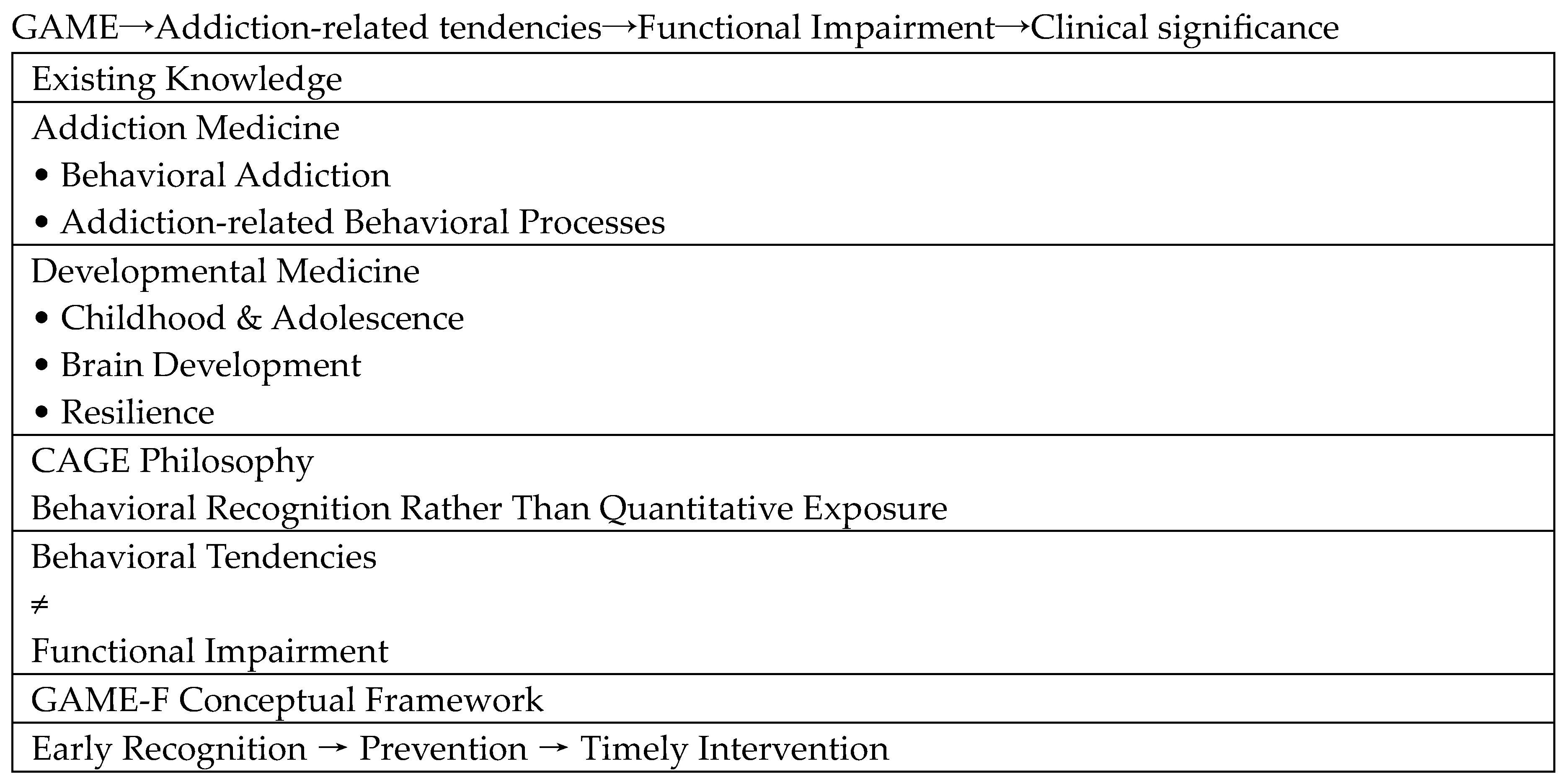
Figure 2.
Theoretical foundation of the GAME-F framework: conceptual distinction between addiction-related tendencies and functional impairment. Figure legend. The proposed GAME-F framework integrates principles from addiction medicine, the behavioral recognition philosophy of the CAGE questionnaire, and developmental perspectives in childhood and adolescence. GAME-F conceptually distinguishes addiction-related behavioral tendencies from functional impairment, thereby supporting early recognition and prevention before clinically significant impairment becomes established.
Figure 2.
Theoretical foundation of the GAME-F framework: conceptual distinction between addiction-related tendencies and functional impairment. Figure legend. The proposed GAME-F framework integrates principles from addiction medicine, the behavioral recognition philosophy of the CAGE questionnaire, and developmental perspectives in childhood and adolescence. GAME-F conceptually distinguishes addiction-related behavioral tendencies from functional impairment, thereby supporting early recognition and prevention before clinically significant impairment becomes established.
4. The GAME-F Framework
The preceding sections established the theoretical foundation of the proposed GAME-F framework by integrating principles from addiction medicine, developmental science, pediatric public health, and the behavioral recognition philosophy exemplified by the CAGE questionnaire [7,15,21,24]. Building upon these conceptual foundations, the present section describes how these principles are operationalized into five practical domains that together constitute the GAME-F framework for the early recognition of problematic gaming in children and adolescents.
The five domains were selected to represent observable behavioral tendencies that commonly emerge during the transition from healthy recreational gaming to progressively maladaptive gaming behaviors. Rather than functioning as diagnostic criteria, these domains are intended to facilitate structured observation, communication, and early intervention among healthcare professionals, educators, parents, and community stakeholders. Importantly, the framework emphasizes behavioral progression before clinically significant functional impairment becomes established, thereby complementing existing diagnostic approaches while maintaining a prevention-oriented perspective [1,14,20].
Although each component reflects a distinct aspect of problematic gaming behavior, the five domains should not be interpreted as independent phenomena. Instead, they represent interconnected behavioral processes that collectively describe the developmental progression of problematic gaming. The sequence from Give Up, Angry, More, and Everywhere in the Mind to Functional Impairment provides a conceptual framework for understanding how early behavioral changes may gradually evolve into clinically meaningful consequences if appropriate preventive interventions are not implemented.
The following subsections describe the theoretical rationale, behavioral characteristics, and clinical relevance of each GAME-F component, illustrating how the framework may support earlier recognition and preventive action across pediatric healthcare, school health, family education, and community-based settings.
The practical implementation of the GAME-F framework is supported by three complementary components. Practical scoring principles are presented (Table 2A), representative clinical decision profiles are summarized (Table 2B), and representative clinical cases illustrating each profile are provided (Table 2C). Together, these three components guide clinicians through a stepwise process from structured scoring to clinical interpretation and practical application.
4.1. G: Give Up
The first component of the GAME-F framework, Give Up, refers to the gradual abandonment of previously valued activities and responsibilities as gaming assumes an increasingly dominant role in daily life. Importantly, this concept does not simply describe spending more time playing games. Rather, it reflects a progressive shift in behavioral priorities, whereby gaming increasingly displaces activities that are essential for healthy physical, psychological, and social development.
In children and adolescents, this behavioral change may initially be subtle. A child who previously enjoyed outdoor play, sports, reading, music, or family activities may gradually lose interest in these experiences because gaming becomes the preferred or exclusive source of enjoyment. Similarly, schoolwork, household responsibilities, regular sleep routines, and face-to-face social interactions may be postponed, neglected, or avoided in favor of gaming. These behavioral changes often occur progressively and may precede clinically significant functional impairment.
From the perspective of addiction science, Give Up reflects the narrowing of behavioral repertoires that accompanies increasing behavioral salience. As gaming becomes increasingly prioritized, alternative sources of reward and resilience receive progressively less attention. Consequently, opportunities to develop adaptive coping strategies, social competence, physical activity, and emotional regulation may diminish during a critical period of neurodevelopment [7,21].
Importantly, Give Up should not be interpreted as evidence that children intentionally reject healthy activities. Rather, it represents a gradual behavioral transition in which gaming increasingly dominates everyday decision-making and daily routines. Because these changes often emerge before substantial academic decline or family dysfunction becomes apparent, they may provide one of the earliest observable indicators that preventive guidance and supportive intervention should be considered.
Within the GAME-F framework, Give Up therefore represents an early behavioral warning sign rather than a diagnostic criterion. Recognition of these subtle priority shifts may facilitate timely conversations among parents, educators, and healthcare professionals, thereby creating opportunities to restore balanced daily activities before more persistent addiction-related behavioral patterns and functional impairment become established.
4.2. A: Angry
Emotional reactions to interrupted gaming frequently represent one of the earliest concerns reported by parents and caregivers. Irritability, frustration, verbal aggression, or emotional outbursts when gaming is restricted often reflect more than ordinary disappointment. Within the GAME-F framework, Angry refers to heightened emotional reactivity that emerges when access to gaming is limited or interrupted, suggesting increasing psychological dependence on gaming as a primary source of emotional regulation.
Although frustration is a normal emotional response during childhood, the intensity, frequency, and context of these reactions are clinically important. Children with emerging problematic gaming may display disproportionate anger when asked to stop playing, postpone gaming, or participate in alternative daily activities. These emotional responses may appear inconsistent with the immediate situation and often create tension within families, classrooms, and peer relationships. Importantly, the concern is not the presence of anger itself but its increasing association with gaming-related situations.
From the perspective of addiction science, this behavioral pattern reflects diminished emotional flexibility and increasing reliance on gaming to maintain psychological equilibrium. As gaming progressively becomes the dominant strategy for reward seeking and stress reduction, interruption of gaming may evoke emotional distress that exceeds typical developmental frustration [21]. Neurodevelopmental immaturity of executive control during childhood and adolescence may further reduce the ability to regulate these emotional responses effectively [7,23].
For parents and teachers, Angry is often one of the most readily observable behavioral changes because it directly affects everyday interactions. Episodes of conflict surrounding gaming limits may therefore provide valuable opportunities for early recognition and constructive discussion rather than being regarded simply as disciplinary problems. At this stage, supportive communication, consistent family rules, and guidance toward alternative coping strategies may be more beneficial than punitive restriction alone.
Within the GAME-F framework, Angry represents a behavioral indicator of increasing emotional dependence on gaming rather than merely poor temperament or oppositional behavior. Recognition of this emotional change may facilitate timely preventive intervention before more pervasive behavioral progression and subsequent functional impairment become established.
4.3. M: More
Unlike the early behavioral changes reflected by Give Up and the emotional responses described by Angry, the third component of the GAME-F framework focuses on the progressive escalation of gaming itself. More refers to an increasing need for longer gaming sessions, greater engagement, or more intense gaming experiences in order to achieve the same level of enjoyment or psychological satisfaction. This behavioral progression resembles the gradual increase in reward-seeking observed across many forms of addictive behavior.
In everyday life, More may become apparent when children repeatedly extend gaming sessions beyond planned limits, request "just a few more minutes," or increasingly prioritize gaming over scheduled activities. Parents may notice that previously accepted time limits become difficult to maintain or that children rapidly return to gaming shortly after finishing a session. Such behavioral escalation often develops gradually and may therefore be overlooked as a normal increase in enthusiasm unless observed within the broader context of behavioral change.
From the perspective of addiction science, More reflects a progressive alteration in reward processing. Repeated exposure to highly rewarding gaming experiences may reduce subjective satisfaction from previous levels of stimulation, resulting in increasing motivation to continue gaming or to seek more stimulating experiences [21]. Although the neurobiological mechanisms underlying this process are complex, the behavioral consequence is relatively straightforward: children increasingly require greater gaming engagement to achieve a similar sense of reward or emotional satisfaction.
Importantly, More should not be interpreted solely as spending longer hours playing games. The essential feature is behavioral escalation rather than absolute gaming duration. Some children may extend gaming time, whereas others may seek increasingly competitive, immersive, or emotionally stimulating gaming experiences without substantial changes in total playing time. Accordingly, assessment should focus on the pattern of increasing engagement rather than on a predefined time threshold alone [16].
Within the GAME-F framework, More represents an observable indicator that gaming is assuming a progressively stronger motivational role in the child's daily life. Recognition of this gradual escalation may encourage timely guidance before persistent behavioral dependence becomes established and before functional impairment emerges.
4.4. E: Everywhere in the Mind (Preoccupation)
For many children with emerging problematic gaming, the influence of gaming gradually extends beyond the time spent playing. Even during school lessons, family conversations, meals, or bedtime, thoughts about gaming may repeatedly intrude into everyday life. Within the GAME-F framework, Everywhere in the Mind describes this growing cognitive preoccupation, in which gaming increasingly occupies attention, anticipation, and mental space even in the absence of active gameplay.
This behavioral characteristic corresponds closely to the addiction concept of salience, whereby a particular activity progressively becomes the dominant focus of thoughts, emotions, and daily planning [21]. Children may find themselves constantly thinking about the next opportunity to play, replaying previous gaming experiences, watching gaming videos, discussing game strategies, or mentally planning future achievements. As cognitive resources become increasingly directed toward gaming, attention devoted to schoolwork, hobbies, interpersonal relationships, and other developmental experiences may gradually diminish.
Unlike More, which reflects behavioral escalation and increasing engagement, Everywhere in the Mind represents a qualitative change in cognition. The defining feature is not the amount of time spent gaming but the extent to which gaming dominates mental life. This distinction is particularly important because cognitive preoccupation may become evident before marked increases in gaming duration or clinically significant functional impairment are observed. Consequently, children who appear to maintain relatively normal daily routines may nevertheless experience persistent gaming-related thoughts that subtly influence their motivation, attention, and decision-making.
Parents and teachers often recognize this phenomenon through seemingly minor behavioral changes.
Children may appear distracted during conversations, lose concentration during homework, frequently shift discussions toward gaming, or show diminished interest in previously enjoyable activities. Although these observations may initially seem nonspecific, their persistence and close association with gaming can provide valuable clues that problematic gaming is progressing beyond recreational use.
Within the GAME-F framework, Everywhere in the Mind represents the cognitive dimension of behavioral addiction. Recognition of persistent gaming-related preoccupation may facilitate early supportive intervention before pervasive behavioral dependence and subsequent functional impairment become firmly established.
4.5. F: Functional Impairment
The final component of the GAME-F framework, Functional Impairment, occupies a unique position within the proposed conceptual model. Unlike the preceding four components, which describe progressive behavioral tendencies associated with problematic gaming, Functional Impairment represents the measurable consequences of persistent behavioral progression on a child's daily functioning. This distinction reflects one of the central conceptual features of GAME-F and emphasizes that functional impairment should be understood as an outcome rather than simply another behavioral symptom [14,20].
Functional impairment may become evident across multiple developmental domains, including academic performance, family relationships, peer interactions, physical health, emotional well-being, and participation in age-appropriate daily activities. Children may experience declining school achievement, chronic sleep disruption, reduced physical activity, social withdrawal, family conflict, or diminished interest in previously meaningful experiences. Importantly, these impairments often emerge gradually and vary considerably among individuals, depending on developmental stage, family environment, resilience, and available psychosocial support.
Current diagnostic systems appropriately recognize functional impairment as an essential criterion for Gaming Disorder because clinically significant impairment distinguishes pathological behavior from intensive but non-pathological gaming [14]. Nevertheless, from a preventive pediatric perspective, waiting until functional impairment becomes clearly established may represent a missed opportunity for early intervention. Behavioral changes frequently precede measurable impairment, allowing a window during which supportive guidance, family education, school-based intervention, and behavioral modification may still alter the developmental trajectory [1].
Within the GAME-F framework, Functional Impairment therefore serves two complementary purposes. First, it acknowledges the clinical importance of functional decline as the defining consequence of persistent problematic gaming. Second, and equally importantly, it reminds healthcare professionals, educators, and families that recognition should ideally occur before functional impairment becomes irreversible or deeply entrenched. This conceptual separation reinforces the prevention-oriented philosophy underlying GAME-F while maintaining consistency with contemporary diagnostic concepts.
Viewed collectively, the five components of GAME-F describe a continuum rather than five independent symptoms. Progressive disengagement from healthy activities (Give Up), heightened emotional reactivity (Angry), escalating gaming involvement (More), increasing cognitive preoccupation (Everywhere in the Mind), and ultimately declining daily functioning (Functional Impairment) together illustrate a potential developmental pathway from recreational gaming toward clinically significant Gaming Disorder. By organizing these observable behavioral processes into a coherent conceptual framework, GAME-F aims to facilitate earlier recognition, improve communication among families, schools, and healthcare providers, and promote preventive intervention before long-term developmental consequences become established.
Table 2A and 2B Purpose: Working draft reflecting the current conceptual discussions. This version is intended for refinement before journal submission.
Interpretation should emphasize the overall behavioral profile rather than the total score alone.
Financial consequences (e.g., unauthorized in-game purchases) are considered functional impairment.
Representative patterns shown in Table 2B are illustrative rather than prescriptive and require future validation.
Representative GAME-F score profiles are illustrative examples and not diagnostic criteria. Clinical characteristics should be interpreted together with developmental, psychological, family, educational and social context.
Table 2.
B. Clinical Decision Matrix Based on the GAME-F Framework. Representative clinical phenotypes illustrating progression from healthy gaming to multisystem functional impairment.
Table 2.
B. Clinical Decision Matrix Based on the GAME-F Framework. Representative clinical phenotypes illustrating progression from healthy gaming to multisystem functional impairment.
| Profile | GAME-F Pattern | Representative GAME-F Score Profiles | Clinical Characteristics | Clinical Focus |
| Group 1. Healthy Adaptation | ||||
| 1 | Healthy Recreational Gaming | 00000 10000 01000 |
• Recreational gaming • Healthy sleep hygiene • School attendance maintained • Offline activities maintained • Healthy family interaction |
• Maintain healthy digital habits • Encourage balanced lifestyle |
| 2 | Highly Engaged Gaming | 11111 01111 11101 |
• Long gaming sessions • Active gaming-related activities • Sleep preserved • Academic performance maintained • Offline activities continue |
• Gaming time alone is not pathological • Continue healthy routines |
| Group 2. Progression Toward Functional Impairment | ||||
| 3 | Gaming-Centered Lifestyle Emerging | 12112 12212 11212 |
• Rankings/livestreams/SNS increase • Gaming becomes central hobby • Sleep largely preserved • School maintained • No significant functional impairment |
• Preventive counselling • Preserve sleep hygiene • Maintain offline activities |
| 4 | Early Functional Impairment | 22221 21221 22121 |
• Delayed bedtime • Daytime sleepiness • Tardiness • Early academic decline • Family disagreement increases |
• Restore sleep hygiene • Rebuild daily routines |
| Group 3. Clinical Phenotypes Requiring Targeted Intervention | ||||
| 5 | Functional Vulnerability | 11122 12122 10122 |
• Functional impairment disproportionate to gaming • ADHD/ASD traits • Anxiety/depression • Sleep disturbance • Family vulnerability |
• Assess underlying vulnerabilities • Individualized intervention |
| 6 | School and Lifestyle Collapse | 22222 21222 22122 |
• School refusal/non-attendance • Gaming-centered lifestyle • Anxiety increases • Lifestyle disruption • Physical inactivity |
• Lifestyle reconstruction • School reintegration • Family support |
| 7 | Family Crisis | 22222 22221 21222 |
• Emotional dysregulation • Verbal aggression • Property damage may occur • Family exhaustion • Assess psychiatric/developmental comorbidities |
• Family-centered intervention • Multidisciplinary assessment |
| 8 | Multisystem Functional Impairment | 22222 | • Severe functional impairment • Long-term school non-attendance • Social withdrawal • Unauthorized parental credit card use may occur • Financial/family consequences |
• Restore daily functioning • Restore social participation • Comprehensive multidisciplinary care |
Abbreviations: ADHD, attention-deficit/hyperactivity disorder; ASD, autism spectrum disorder; GAME-F, Gaming-related Activities and Multidimensional Evaluation of Functioning; OCD, obsessive-compulsive disorder; ODD, oppositional defiant disorder; SNS, social networking service.
5. Clinical and Public Health Applications of the GAME-F Framework
The primary objective of the GAME-F framework is not to establish a new diagnostic instrument but to provide a practical framework that facilitates earlier recognition of problematic gaming behaviors before clinically significant Gaming Disorder becomes established. By focusing on observable behavioral changes that precede functional impairment, GAME-F complements existing diagnostic approaches and supports a prevention-oriented strategy that is particularly relevant during childhood and adolescence.
Unlike conventional screening instruments that are primarily intended for clinical diagnosis or research, GAME-F was designed to promote communication among multiple stakeholders, including healthcare professionals, educators, parents, and community health workers. Because the framework relies on easily recognizable behavioral tendencies rather than specialized psychiatric assessment, it may facilitate shared understanding across settings in which children live, learn, and develop.
This broader perspective reflects the growing recognition that problematic gaming should be addressed not only as an individual clinical condition but also as an emerging public health challenge associated with digital lifestyles, child development, family functioning, and psychosocial well-being [1]. Early behavioral recognition may therefore provide opportunities for supportive intervention before persistent behavioral dependence and functional impairment become established. Such an approach is consistent with contemporary strategies emphasizing resilience, health promotion, and collaborative prevention across healthcare, educational, and community settings [25].
The following sections illustrate how the GAME-F framework may contribute to preventive practice in pediatric healthcare, school health, family education, and community-based child health programs.
5.1. Application in Pediatric Practice
For pediatricians, problematic gaming rarely presents as the child's chief complaint. Instead, consultations are more commonly prompted by concerns such as persistent sleep disturbance, declining academic performance, irritability, fatigue, headaches, reduced physical activity, or increasing family conflict. These nonspecific complaints often precede the diagnosis of Gaming Disorder but may already reflect early behavioral changes associated with problematic gaming [1].
Consequently, pediatricians occupy a unique position in recognizing children who may benefit from preventive intervention before clinically significant functional impairment becomes established.
Although validated diagnostic instruments remain essential for the assessment of Gaming Disorder, their primary purpose is diagnostic confirmation or research rather than rapid behavioral recognition during routine outpatient consultations [14,16]. In busy pediatric practice, clinicians frequently rely on focused history-taking and parental observations to determine whether further assessment is warranted. Under these circumstances, a concise framework emphasizing observable behavioral tendencies may be more practical than comprehensive symptom-based questionnaires.
The GAME-F framework was developed with this clinical reality in mind. Rather than replacing existing diagnostic approaches, it offers pediatricians a structured way to explore five key behavioral domains during routine interviews. Questions regarding whether the child has gradually abandoned previously enjoyed activities (Give Up), demonstrates marked irritability when gaming is interrupted (Angry), requires progressively greater gaming engagement (More), remains mentally preoccupied with gaming outside play (Everywhere in the Mind), or has begun to experience meaningful deterioration in daily functioning (Functional Impairment) can be integrated naturally into standard pediatric history-taking without substantially extending consultation time.
Equally important, GAME-F encourages conversations with both children and caregivers instead of relying exclusively on symptom checklists. Such dialogue may help families recognize subtle behavioral progression at an earlier stage and facilitate anticipatory guidance regarding sleep hygiene, physical activity, family routines, digital media habits, and balanced recreational activities. Early behavioral recognition is consistent with the preventive philosophy of pediatric medicine, which emphasizes timely intervention before health problems become firmly established [1].
Accordingly, GAME-F should be viewed as a practical communication framework that complements contemporary diagnostic concepts rather than as a stand-alone diagnostic instrument. By providing pediatricians with a common behavioral language that is readily understood by families, the framework may strengthen early recognition, improve clinical communication, and support prevention-oriented management of problematic gaming during childhood and adolescence.
5.2. Application in School Health
Unlike pediatricians, teachers observe children's behavior continuously within their natural social and learning environments. Changes in classroom participation, peer relationships, attention, emotional regulation, and academic engagement often become apparent long before children present to medical services. Consequently, schools represent an important setting for the early recognition of problematic gaming behaviors and provide valuable opportunities for preventive support.
In educational settings, however, the objective is not to diagnose Gaming Disorder but to identify behavioral changes that may warrant further observation or communication with families. Because teachers are not expected to perform psychiatric assessments, practical behavioral indicators are considerably more useful than diagnostic criteria during routine school activities [14,16]. A simple framework that translates addiction-related behaviors into observable classroom phenomena may therefore facilitate earlier recognition while avoiding inappropriate diagnostic labeling.
Several components of the GAME-F framework are particularly relevant in school health. Students who gradually withdraw from extracurricular activities or lose interest in previously enjoyable learning experiences may exhibit features of Give Up. Frequent irritability following restrictions on smartphone or gaming use may reflect Angry, whereas persistent conversations about games, difficulty maintaining attention during lessons, or excessive anticipation of gaming after school may suggest Everywhere in the Mind. Although each behavior is individually nonspecific, their accumulation over time may indicate progressive behavioral changes deserving further attention.
Importantly, the role of school personnel is not to determine whether Gaming Disorder is present but to initiate appropriate communication. Observations shared among teachers, school nurses, school counselors, parents, and healthcare professionals may provide a more comprehensive understanding of the child's behavioral pattern than isolated observations from any single setting. In this context, GAME-F may function as a common language that facilitates multidisciplinary collaboration while maintaining a prevention-oriented approach [1].
By encouraging timely recognition rather than diagnostic judgment, the GAME-F framework aligns closely with the educational mission of supporting healthy child development. Its practical behavioral focus may help schools identify children who would benefit from early guidance, family discussion, or referral for further evaluation before persistent behavioral dependence and clinically significant functional impairment become established.
5.3. Application in Family Education
Parents and caregivers are uniquely positioned to recognize gradual behavioral changes because they observe children's daily routines across multiple settings and over extended periods of time. Unlike healthcare professionals or educators, family members witness how children balance school responsibilities, sleep, physical activity, hobbies, social interactions, and recreational gaming within everyday life. This continuous observation provides valuable opportunities to recognize subtle behavioral progression before clinically significant impairment becomes apparent.
One of the strengths of the GAME-F framework is that its five domains are expressed as easily understandable behavioral observations rather than psychiatric terminology. Parents do not need specialized knowledge of Gaming Disorder to notice that a child has gradually abandoned previously enjoyed activities (Give Up), becomes unusually irritable when gaming is interrupted (Angry), increasingly requests additional gaming time (More), talks or thinks about gaming throughout the day (Everywhere in the Mind), or begins to experience meaningful difficulties in school, family life, or social functioning (Functional Impairment). By translating addiction-related behaviors into practical observations, GAME-F may facilitate earlier awareness without encouraging premature diagnostic labeling.
Importantly, the purpose of family observation is not to monitor or control children's behavior excessively but to promote constructive communication. Conversations initiated at the stage of early behavioral change are often more productive than interventions introduced after severe conflict or functional decline has already developed. Families may therefore use the GAME-F framework to encourage balanced digital habits, establish consistent daily routines, support healthy sleep, maintain physical activity, and preserve opportunities for face-to-face family interaction.
This family-centered perspective is consistent with growing recognition that problematic gaming should be addressed within the broader context of child development, resilience, and family well-being rather than solely as an individual psychiatric condition [25]. Preventive approaches that strengthen family communication and adaptive coping strategies may reduce the likelihood that gaming becomes the child's primary means of emotional regulation or stress management.
Accordingly, GAME-F may serve not only as a behavioral recognition framework but also as a practical educational tool that empowers families to recognize early warning signs and seek appropriate guidance before persistent behavioral dependence and functional impairment become established.
5.4. Public Health Implications
The rapid evolution of digital technologies has transformed gaming from an individual recreational activity into a broader child health issue with implications for families, schools, healthcare systems, and society. Consequently, problematic gaming should be viewed not only as a clinical concern but also as an emerging public health challenge requiring coordinated preventive strategies across multiple sectors [25].
One of the principal strengths of the GAME-F framework is its ability to provide a common behavioral language that can be shared by pediatricians, educators, parents, school personnel, psychologists, and community health professionals. Because the framework emphasizes observable behavioral changes rather than psychiatric terminology, it facilitates communication among stakeholders with different professional backgrounds while maintaining a child-centered and prevention-oriented perspective. Such shared understanding may promote earlier recognition, more consistent guidance, and timely supportive intervention before clinically significant Gaming Disorder becomes established.
From a public health perspective, prevention is generally more effective than intervention after persistent behavioral dependence and functional impairment have already developed. The conceptual distinction between early behavioral progression (G–E) and subsequent functional impairment (F) represents one of the central features of the GAME-F framework. Rather than encouraging early diagnostic labeling, GAME-F seeks to identify children during a stage when supportive guidance, healthy digital habits, family communication, and resilience-building strategies may still alter developmental trajectories [1,25].
Looking ahead, children's digital environments are likely to change even more rapidly through advances in artificial intelligence (AI), personalized recommendation algorithms, immersive virtual environments, and increasingly adaptive digital platforms. Although these technologies have substantial potential to enhance education and healthcare, they may also create more persuasive and rewarding digital experiences that compete for children's attention and emotional engagement. Recent reviews have emphasized both the opportunities and the challenges associated with AI in adolescent mental healthcare, underscoring the importance of maintaining human-centered, ethically responsible, and preventive approaches as digital technologies continue to evolve [26,27]. Within this rapidly changing landscape, a behavior-oriented framework such as GAME-F may remain applicable because it focuses on observable behavioral progression rather than on specific digital platforms or individual technologies.
Importantly, GAME-F is not intended to replace established diagnostic criteria or validated screening instruments. Instead, it complements current clinical and educational practice by extending early recognition into the environments where children spend most of their daily lives. Future studies should evaluate the reliability, construct validity, responsiveness, and cross-cultural applicability of the framework in diverse pediatric populations. If supported by empirical evidence, GAME-F may contribute to international efforts aimed at strengthening prevention, promoting healthier digital lifestyles, and protecting children's developmental well-being in the evolving AI era.
Figure 3.
Clinical and Public Health Implementation Model of the GAME-F Framework. Legend: The GAME-F framework is designed to identify behavioral progression before clinically significant functional impairment develops. It provides a common framework for pediatric healthcare professionals, schools, and families to facilitate shared communication, early intervention, and preventive support. By promoting healthy digital habits and multidisciplinary collaboration, the framework aims to prevent functional impairment and foster developmental resilience and healthy child development in the digital era.
Figure 3.
Clinical and Public Health Implementation Model of the GAME-F Framework. Legend: The GAME-F framework is designed to identify behavioral progression before clinically significant functional impairment develops. It provides a common framework for pediatric healthcare professionals, schools, and families to facilitate shared communication, early intervention, and preventive support. By promoting healthy digital habits and multidisciplinary collaboration, the framework aims to prevent functional impairment and foster developmental resilience and healthy child development in the digital era.
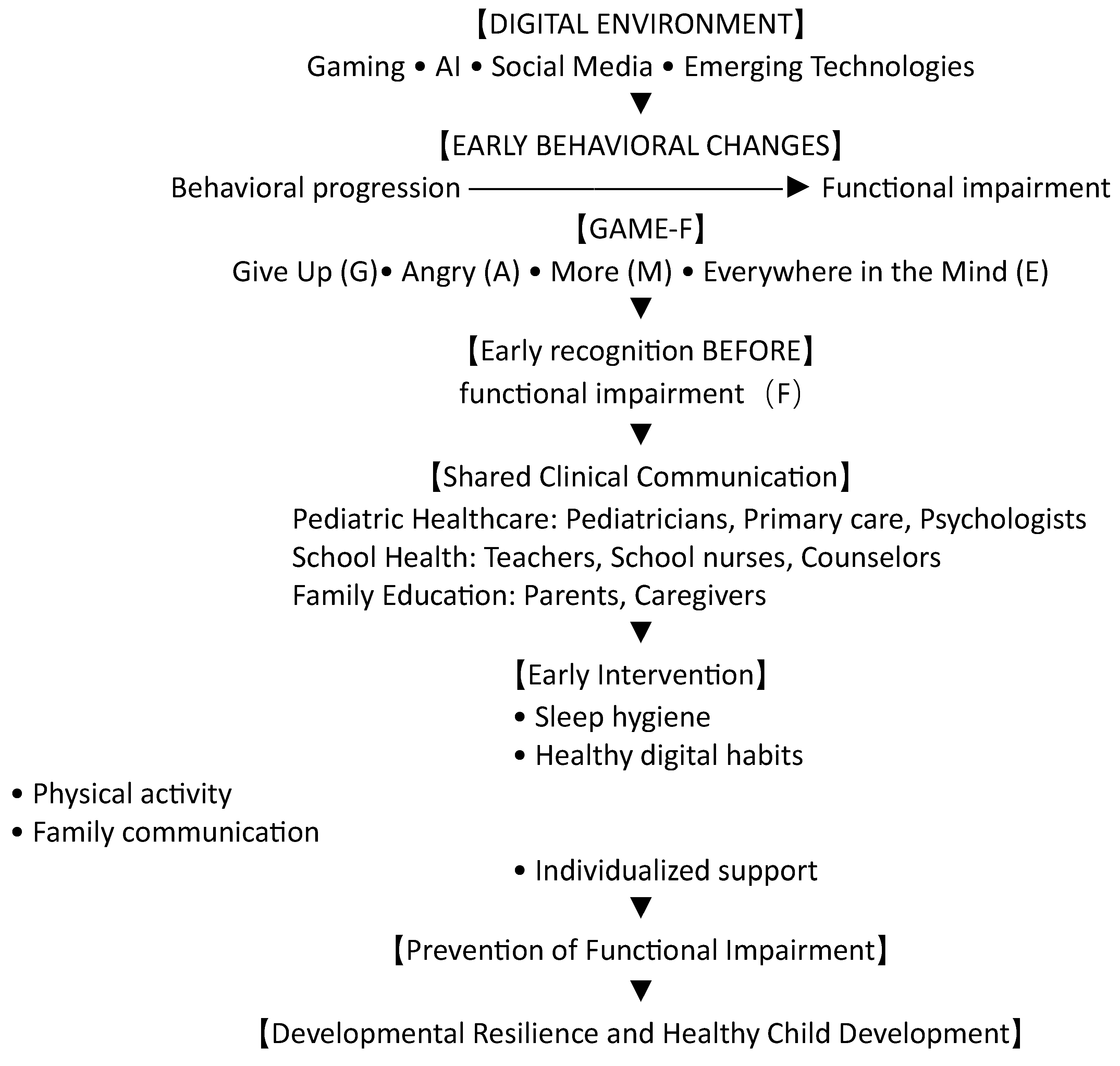
6. Future Perspectives and Limitations
The GAME-F framework is proposed as a conceptual behavioral framework designed to facilitate the early recognition of problematic gaming in children and adolescents. Rather than serving as a diagnostic instrument, its principal objective is to provide a practical and easily understandable behavioral language that supports communication among pediatricians, educators, parents, and public health professionals. By emphasizing behavioral progression before clinically significant functional impairment develops, GAME-F complements existing diagnostic concepts while promoting a preventive approach to digital health.
Several limitations should nevertheless be acknowledged. First, the present framework has been developed from existing theoretical concepts and clinical experience and has not yet undergone formal psychometric evaluation. Future investigations should therefore examine its reliability, construct validity, criterion validity, and responsiveness in accordance with established methodological standards. Prospective studies across pediatric outpatient clinics, school health programs, and community settings will be essential to determine whether early behavioral recognition using GAME-F contributes to improved preventive outcomes and earlier intervention.
Second, although GAME-F was primarily developed for children and adolescents, its applicability across different developmental stages, cultural backgrounds, healthcare systems, and educational environments remains to be established. Digital behaviors, family interactions, educational practices, and gaming cultures differ substantially among countries, underscoring the importance of cross-cultural validation. International collaborative studies will therefore be valuable for refining the framework while preserving its conceptual simplicity and clinical practicality.
Rapid advances in artificial intelligence (AI), personalized recommendation algorithms, immersive technologies, and increasingly adaptive digital platforms are expected to further reshape children's digital experiences. Although these innovations provide important opportunities for education, communication, and healthcare, they may also increase exposure to highly engaging digital environments that influence behavioral development in ways extending beyond conventional gaming. Recent reviews have emphasized both the opportunities and the challenges associated with AI in child and adolescent mental healthcare, highlighting the importance of maintaining human-centered, ethically responsible, and prevention-oriented approaches as digital technologies continue to evolve [26,27]. Likewise, growing evidence indicates that digital media use should be considered within the broader context of child health and development rather than as an isolated behavioral issue, reinforcing the importance of early recognition and preventive strategies across multiple environments [28].
Importantly, the conceptual principles underlying GAME-F are not restricted to current gaming platforms or individual technologies. Because the framework focuses on observable behavioral progression rather than specific digital applications, it may remain clinically relevant as children's digital environments continue to evolve. Future research should therefore evaluate not only the psychometric properties of GAME-F but also its implementation in routine pediatric practice, school health, family education, and public health initiatives.
Ultimately, the long-term value of GAME-F will depend on rigorous scientific validation, international collaboration, and practical implementation across diverse real-world settings. If supported by future empirical evidence, GAME-F may contribute to the establishment of a common preventive language that facilitates communication among healthcare professionals, educators, families, and communities, thereby promoting healthier digital development and protecting the well-being of children and adolescents in an increasingly digital society.
Rather than proposing another diagnostic instrument, GAME-F is intended to provide a practical clinical framework that bridges structured assessment, clinical interpretation, and early preventive intervention in children and adolescents with emerging problematic gaming behaviors.
7. Conclusions
Problematic gaming among children and adolescents has become an increasingly important global health concern in the digital era. Although existing diagnostic criteria and validated assessment instruments remain indispensable for identifying Gaming Disorder, opportunities for prevention often arise before children meet formal diagnostic thresholds. Recognizing these early behavioral changes is therefore essential for promoting timely guidance and preventing the progression to clinically significant functional impairment.
The GAME-F framework was developed as a simple, behavior-oriented conceptual framework that emphasizes five observable domains—Give Up, Angry, More, Everywhere in the Mind, and Functional Impairment. Rather than functioning as a diagnostic instrument, GAME-F is intended to complement existing clinical concepts by providing an intuitive behavioral language that can be shared among healthcare professionals, educators, parents, and public health practitioners. Its principal value lies in facilitating early recognition, improving communication across disciplines, and supporting preventive intervention within children's everyday environments.
As children's digital experiences continue to evolve through advances in gaming technologies, social media, and artificial intelligence, prevention-oriented frameworks that remain understandable, practical, and adaptable will become increasingly important. By focusing on behavioral progression rather than specific technologies or diagnostic labels, GAME-F offers a flexible conceptual approach that may remain relevant across changing digital environments.
Future validation studies will determine the clinical utility and international applicability of the framework. If supported by empirical evidence, GAME-F may contribute to the development of a shared preventive language that strengthens collaboration across pediatric healthcare, education, families, and public health, ultimately supporting healthier digital development and improving the well-being of children and adolescents.
Author Contributions
Conceptualization and methodology, G.I., T.I.; original draft writing, G.I.; review and editing, G.I., T.I., H.S., and G.K.; supervision, H.S., and G.K. All authors have read and agreed to the published version of the manuscript.
Funding
This research did not receive any specific grant from funding agencies in the public, commercial, or not-for-profit sectors.
Institutional Review Board Statement
Not applicable.
Informed Consent Statement
Not applicable.
Data Availability Statement
Not applicable.
Acknowledgments
The authors would like to t thank the staff of the Department of Pediatrics, Dokkyo Medical University, as well as many pediatric patients and their guardians, for their cooperation.
Conflicts of Interest
The authors declare no conflicts of interest.
Appendix
Table 2C.
Representative Clinical Cases Based on the GAME-F Framework.
| Group 1. Healthy Adaptation | |
| Profile | Profile 1 |
| GAME-F Pattern | Healthy Recreational Gaming |
| Representative Scores | G0/A0/M0/E0/F0 G1/A0/M0/E0/F0 G0/A1/M0/E0/F0 |
| Representative Clinical Profile | An elementary or junior high school student enjoys digital games primarily for recreation and relaxation. Gaming is limited to an appropriate duration and does not interfere with sleep, school attendance, academic performance, physical activity, fam-ily relationships, or other daily responsibilities. The child participates in a variety of offline activities, including sports, hobbies, and face-to-face interactions with family and friends. Gaming-related activities, such as watching gameplay videos or browsing gam-ing-related social media, are occasional and do not become a major part of daily life. The child is able to stop playing voluntarily without significant emotional distress and readily shifts attention to other activities. Sleep hygiene is well maintained, with a reg-ular bedtime and wake-up schedule, and gaming is generally avoided immediately be-fore bedtime. |
| Clinical Message | This profile represents healthy recreational gaming without functional impair-ment. Clinical assessment should focus on maintaining balanced digital media use and healthy lifestyle habits rather than restricting gaming unnecessarily. Education for children and caregivers should emphasize appropriate sleep hygiene, physical activity, and diverse recreational experiences while recognizing that recreational gaming itself is a normal component of modern childhood. |
| Profile 2 | |
| GAME-F Pattern | Highly Engaged Gaming |
| Representative Scores | G1/A1/M1/E1/F1 G0/A1/M1/E1/F1 G1/A1/M1/E0/F1 |
| Representative Clinical Profile | An adolescent enjoys gaming as a major leisure activity and may spend several hours gaming, particularly on weekends or during school vacations. The child actively participates in gaming-related activities, including watching gameplay videos, fol-lowing livestreams, communicating through gaming-related social media, and dis-cussing games with friends. Despite this high level of engagement, sleep hygiene remains generally appropri-ate, and regular school attendance, academic performance, physical activity, and fam-ily relationships are maintained. The adolescent is able to interrupt gaming when nec-essary and participates in offline hobbies, sports, or social activities. Gaming enhances enjoyment and social interaction but does not dominate daily life or interfere with healthy development. |
| Clinical Message | This profile represents high engagement without clinically significant functional impairment. Gaming duration alone should not be used to identify problematic gam-ing. Clinical assessment should focus on whether gaming-related activities interfere with sleep, education, physical health, family relationships, or psychosocial function-ing rather than on screen time alone. |
| Group 2. Progression Toward Functional Impairment | |
| Profile | Profile 3 |
| GAME-F Pattern | Gaming-Centered Lifestyle Emerging |
| Representative Scores | G1/A2/M1/E1/F2 G1/A2/M2/E1/F2 G1/A1/M2/E1/F2 |
| Representative Clinical Profile | An adolescent spends a substantial amount of free time gaming and increasingly organizes daily life around gaming-related activities. In addition to gameplay, the ad-olescent regularly watches gameplay videos and livestreams, follows gaming-related social media, monitors rankings and competitive statistics, and actively participates in online gaming communities. Gaming has become a major source of enjoyment, achievement, and social interaction. Weekend gaming commonly extends to 4–6 hours per day, while gaming-related activities occupy additional time even when the individual is not actively playing. Sleep hygiene remains generally preserved, although bedtime may gradually become later because of gaming or gaming-related activities. School attendance and academic performance are largely maintained, and the adolescent continues to participate in family life and extracurricular activities. The adolescent demonstrates increasing emotional investment in gaming, includ-ing strong interest in rankings, seasonal events, achievements, cosmetic in-game items (skins), and game-related discussions on social media. Nevertheless, healthy daily functioning remains largely intact. |
| Clinical Message | This profile represents the transition from recreational gaming to a gam-ing-centered lifestyle, while functional impairment remains minimal or absent. In-creasing engagement in gaming-related activities should be recognized as an early be-havioral change rather than evidence of gaming disorder. Preventive counseling fo-cusing on sleep hygiene, balanced daily routines, and maintenance of diverse offline activities may help prevent progression to functional impairment. |
| Profile | Profile 4 |
| GAME-F Pattern | Early Functional Impairment |
| Representative Scores | G2/A2/M2/E2/F1 G2/A1/M2/E2/F1 G2/A2/M1/E2/F1 |
| Representative Clinical Profile | A junior high school student spends most evenings gaming and engaging in gam-ing-related activities, including livestreams, gameplay videos, gaming-related social media, and online communities. Gaming increasingly occupies the center of daily life, although some offline activities are still maintained. Sleep hygiene begins to deteriorate. Bedtime is frequently delayed beyond mid-night because of gaming or gaming-related activities, resulting in insufficient sleep on school days. Morning awakening becomes difficult, and the adolescent often requires repeated prompting by caregivers to prepare for school. Breakfast is occasionally skipped, and weekends are characterized by prolonged sleep and extended gaming sessions. School attendance is generally maintained; however, tardiness, daytime sleepiness, reduced concentration, and declining academic performance begin to emerge. Physical activity decreases, and early weight gain or unhealthy lifestyle habits may become ev-ident. Family disagreements regarding gaming become more frequent, although severe aggression or family violence is not yet present. |
| Clinical Message | This profile represents the earliest stage of clinically significant functional im-pairment associated with gaming-related behaviors. Sleep disturbance is often the first observable manifestation of functional decline, preceding deterioration in school performance, physical health, and psychosocial functioning. Early intervention should prioritize restoration of healthy sleep hygiene, balanced daily routines, physical activity, and family-based guidance. Timely intervention at this stage may prevent progression to more severe functional impairment. |
| Group 3. Clinical Phenotypes Requiring Targeted Intervention | |
| Profile | Profile 5: |
| GAME-F Pattern | Functional Vulnerability |
| Representative Scores | G1/A1/M1/E2/F2 G1/A2/M1/E2/F2 G1/A0/M1/E2/F2 |
| Representative Clinical Profile | An upper elementary or junior high school student presents with functional difficulties that appear disproportionate to the amount of gaming. Gaming is an im-portant leisure activity but does not fully explain the child's academic, behavioral, or psychosocial problems. The child may exhibit irregular sleep patterns, poor concentration, declining aca-demic performance, difficulty organizing schoolwork, and reduced participation in physical or social activities. Gaming and gaming-related activities often serve as a preferred means of stress relief or emotional regulation rather than being the sole cause of impairment. Underlying conditions such as attention-deficit/hyperactivity disorder (ADHD), autism spectrum disorder (ASD), anxiety disorders, depressive symptoms, sleep disorders, or adverse family circumstances may contribute to functional impairment. Careful assessment frequently reveals that multiple developmental, psychological, and environmental factors coexist. |
| Clinical Message | This profile highlights the importance of identifying underlying vulnerabilities rather than attributing functional impairment solely to gaming. Functional impairment is not always proportional to gaming duration or gam-ing-related activities. Comprehensive assessment should include neurodevelopmental characteristics, emotional well-being, sleep hygiene, family functioning, and school environment before concluding that gaming is the primary cause of impairment. Early recognition of these underlying factors allows individualized intervention and may prevent unnecessary stigmatization of gaming itself. |
| Profile | Profile 6 |
| GAME-F Pattern | School and Lifestyle Collapse |
| Representative Scores | G2/A2/M2/E2/F2 G2/A1/ M2/E2/F2 G2/A2/M1/E2/ F2 |
| Representative Clinical Profile | (Draft Version 1) An adolescent's daily life has become increasingly organized around gaming and gaming-related activities. In addition to prolonged gameplay, substantial time is de-voted to livestreams, gameplay videos, gaming-related social media, online communi-ties, and competitive events. Gaming has evolved from a recreational activity into the central organizing principle of everyday life. Sleep hygiene is markedly disrupted, with delayed sleep onset, insufficient sleep, and irregular sleep–wake patterns. The adolescent frequently wakes late, skips break-fast, and spends most of the daytime engaged in gaming-related activities. Physical ac-tivity declines, unhealthy eating habits develop, and weight gain may become evident. School attendance becomes increasingly inconsistent, with frequent tardiness, ab-senteeism, school refusal, or prolonged school non-attendance. As school disengage-ment persists, anxiety, low self-esteem, and social withdrawal often become more prominent. Daily functioning is progressively replaced by gaming-centered activities. Parents commonly report that attempts to limit gaming are unsuccessful and fam-ily stress increases. However, severe aggression or destructive behavior is not yet the dominant clinical feature. |
| Clinical Message | This profile is characterized by substantial impairment in school participation and healthy daily routines. The primary clinical goal is restoration of healthy lifestyle habits and gradual re-engagement with education and society, rather than simply reducing gaming time. Comprehensive intervention should include sleep hygiene, nutritional support, physi-cal activity, psychological care, family guidance, and close collaboration with schools. When immediate return to regular school attendance is difficult, stepwise educa-tional support, including school health rooms, alternative classrooms, educational support centers, or accredited alternative educational settings, may facilitate gradual social reintegration according to the child's individual needs. |
| Profile | Profile 7 |
| GAME-F Pattern | Family Crisis |
| Representative Scores | G2/A2/M2/E2/F2 G2/A2/M2/E2/F1 G2/A1/M2/E2/F2 |
| Representative Clinical Profile | (Draft Version 1) An adolescent demonstrates severe functional impairment associated with a gaming-centered lifestyle. Daily routines are dominated by gaming and gam-ing-related activities, while sleep, nutrition, school participation, and physical activity have markedly deteriorated. Attempts by caregivers to interrupt gaming frequently trigger intense emotional reactions. The adolescent may exhibit irritability, verbal aggression, shouting, or threatening behavior. Episodes of slamming doors, punching walls, throwing control-lers or mobile devices, and damaging household objects may occur during conflicts re-garding gaming. Family relationships progressively deteriorate, and caregivers often report ex-haustion, helplessness, and increasing difficulty establishing consistent boundaries. Siblings may also be affected by ongoing family conflict. Despite these behavioral man-ifestations, underlying neurodevelopmental disorders, anxiety, depression, obses-sive-compulsive symptoms, or other psychiatric conditions may coexist and should be carefully assessed rather than attributing all behavioral problems solely to gaming. |
| Clinical Message | This profile represents a family-centered clinical crisis characterized by severe emotional dysregulation and progressive family dysfunction. Clinical management should extend beyond gaming behavior itself to include comprehensive assessment of neurodevelopmental and psychiatric comorbidities, caregiver burden, family functioning, and psychosocial stressors. Family-centered in-tervention, psychological support, and multidisciplinary collaboration are strongly recommended to prevent further escalation of functional impairment. |
| Profile | Profile 8 |
| GAME-F Pattern | Multisystem Functional Impairment |
| Representative Scores | G2/A2/M2/E2/F2 G2/A2/M2/E2/F2 G2/A2/M2/E2/F1 |
| Representative Clinical Profile | (Draft Version 1) An adolescent demonstrates severe and persistent functional impairment asso-ciated with a gaming-centered lifestyle. Gaming and gaming-related activities occupy most waking hours, while normal daily routines have largely disappeared. School attendance has ceased or become extremely limited, and prolonged school non-attendance is common. Social participation outside online gaming communities is markedly reduced. Sleep–wake rhythms are profoundly disrupted, with persistent daytime sleeping and overnight gaming. Nutritional habits become increasingly irregular, physical inac-tivity is pronounced, and weight gain or obesity may develop. Anxiety, depressive symptoms, social withdrawal, and reduced self-esteem frequently coexist, further re-inforcing dependence on gaming-related activities. Family relationships have become severely strained. Repeated conflicts regarding gaming may escalate to destruction of household property, physical intimidation, or violence toward family members in some individuals, resulting in significant care-giver distress and family dysfunction. Some adolescents develop financial consequences, including repeated unauthor-ized use of parents' credit cards or excessive in-game purchases despite family re-strictions. These behaviors further damage family trust and may require intensive family intervention. |
| Clinical Message | This profile reflects severe multisystem functional impairment requiring com-prehensive multidisciplinary intervention. The primary treatment goal is restoration of healthy daily functioning and social participation, rather than simply reducing gaming time. Clinical management should address sleep, nutrition, physical health, mental health, family functioning, education-al reintegration, and financial supervision as appropriate. Close collaboration among healthcare professionals, families, schools, psycholo-gists, and social welfare services is often necessary. In severe cases, coordination with child protection or other community support services may be required to ensure the safety and well-being of the child and family. |
References
- Imataka, G.; Izumi, S.; Miyamoto, Y.; Maehashi, A. Gaming Disorders: Navigating the Fine Line between Entertainment and Addiction—Gaming History, Health Risks, Social Consequences, and Pathways to Prevention. J. Clin. Med. 2024, 13, 5122. [Google Scholar] [CrossRef]
- Granic, I.; Lobel, A.; Engels, R.C.M.E. The Benefits of Playing Video Games. Am. Psychol. 2014, 69, 66–78. [Google Scholar] [CrossRef]
- Stevens, M.W.R.; Dorstyn, D.; Delfabbro, P.H.; King, D.L. Global Prevalence of Gaming Disorder: A Systematic Review and Meta-Analysis. Aust. N. Z. J. Psychiatry 2021, 55, 553–568. [Google Scholar] [CrossRef] [PubMed]
- Compas, B.E.; Jaser, S.S.; Bettis, A.H.; Watson, K.H.; Gruhn, M.A.; Dunbar, J.P.; Williams, E.; Thigpen, J.C. Coping, Emotion Regulation, and Psychopathology in Childhood and Adolescence: A Meta-Analysis and Narrative Review. Psychol. Bull. 2017, 143, 939–991. [Google Scholar] [CrossRef] [PubMed]
- Masten, A.S. Ordinary Magic: Resilience Processes in Development. Am. Psychol. 2001, 56, 227–238. [Google Scholar] [CrossRef] [PubMed]
- Paulus, F.W.; Ohmann, S.; von Gontard, A.; Popow, C. Internet Gaming Disorder in Children and Adolescents: A Systematic Review. Dev. Med. Child Neurol. 2018, 60, 645–659. [Google Scholar] [CrossRef] [PubMed]
- Casey, B.J.; Jones, R.M. Neurobiology of the Adolescent Brain and Behavior: Implications for Substance Use Disorders. J. Am. Acad. Child Adolesc. Psychiatry 2010, 49, 1189–1201. [Google Scholar] [CrossRef] [PubMed]
- Imataka, G.; Sakuta, R.; Maehashi, A.; Yoshihara, S. Current Status of Internet Gaming Disorder (IGD) in Japan: New Lifestyle-Related Disease in Children and Adolescents. J. Clin. Med. 2022, 11, 4566. [Google Scholar] [CrossRef] [PubMed]
- American Psychiatric Association. Diagnostic and Statistical Manual of Mental Disorders (DSM-5), 5th ed.; American Psychiatric Association: Arlington, VA, USA, 2013. [Google Scholar]
- World Health Organization. International Classification of Diseases 11th Revision (ICD-11): Gaming Disorder; World Health Organization: Geneva, Switzerland, 2019; Available online: https://icd.who.int/ (accessed on 27 June 2026).
- Lemmens, J.S.; Valkenburg, P.M.; Peter, J. Development and Validation of a Game Addiction Scale for Adolescents. Dev. Psychol. 2009, 45, 77–95. [Google Scholar] [CrossRef]
- Pontes, H.M.; Griffiths, M.D. Measuring DSM-5 Internet Gaming Disorder: Development and Validation of a Short Psychometric Scale. Comput. Hum. Behav. 2015, 45, 137–143. [Google Scholar] [CrossRef]
- Pontes, H.M.; Schivinski, B.; Sindermann, C.; Li, M.; Becker, B.; Zhou, M.; Montag, C. Measurement and Conceptualization of Gaming Disorder According to the World Health Organization Framework: The Gaming Disorder Test. Int. J. Ment. Health Addict. 2021, 19, 508–528. [Google Scholar] [CrossRef]
- King, D.L.; Haagsma, M.C.; Delfabbro, P.H.; Gradisar, M.; Griffiths, M.D. Toward a Consensus Definition of Pathological Video-Gaming: A Systematic Review of Psychometric Assessment Tools. Clin. Psychol. Rev. 2013, 33, 331–342. [Google Scholar] [CrossRef] [PubMed]
- Mayfield, D.; McLeod, G.; Hall, P. The CAGE Questionnaire: Validation of a New Alcoholism Screening Instrument. Am. J. Psychiatry 1974, 131, 1121–1123. [Google Scholar] [CrossRef] [PubMed]
- King, D.L.; Chamberlain, S.R.; Carragher, N.; Billieux, J.; Stein, D.J.; Müller, K.W.; Potenza, M.N.; Rumpf, H.J.; Saunders, J.B.; Starcevic, V.; Demetrovics, Z.; Brand, M.; Lee, H.K.; Spada, M.M.; Lindenberg, K.; Wu, A.M.S.; Lemenager, T.; Pallesen, S.; Achab, S.; Kyrios, M.; Higuchi, S.; Fineberg, N.A.; Delfabbro, P.H. Screening and assessment tools for gaming disorder: A comprehensive systematic review. Clin. Psychol. Rev. 2020, 77, 101831. [Google Scholar] [CrossRef] [PubMed]
- Bozzola, E.; Spina, G.; Agostiniani, R.; Barni, S.; Russo, R.; Scarpato, E.; Di Mauro, A.; Di Stefano, A.V.; Caruso, C.; Corsello, G.; Staiano, A. The Use of Social Media in Children and Adolescents: Scoping Review on the Potential Risks. Int. J. Environ. Res. Public Health 2022, 19, 9960. [Google Scholar] [CrossRef] [PubMed]
- Colder Carras, M.; Aljuboori, D.; Shi, J.; Date, M.; Karkoub, F.; García Ortiz, K.; Abreha, F.M.; Thrul, J. Prevention and Health Promotion Interventions for Young People in the Context of Digital Well-Being: Rapid Systematic Review. J. Med. Internet Res. 2024, 26, e59968. [Google Scholar] [CrossRef] [PubMed]
- Lindenberg, K.; Kindt, S.; Szász-Janocha, C. Effectiveness of Cognitive Behavioral Therapy–Based Intervention in Preventing Gaming Disorder and Unspecified Internet Use Disorder in Adolescents: A Cluster Randomized Clinical Trial. JAMA Netw. Open 2022, 5, e2148995. [Google Scholar] [CrossRef] [PubMed]
- Billieux, J.; King, D.L.; Higuchi, S.; Achab, S.; Bowden-Jones, H.; Hao, W.; Long, J.; Lee, H.K.; Potenza, M.N.; Saunders, J.B.; Poznyak, V. Functional Impairment Matters in the Screening and Diagnosis of Gaming Disorder. J. Behav. Addict. 2017, 6, 285–289. [Google Scholar] [CrossRef] [PubMed]
- Griffiths, M.D. A ‘Components’ Model of Addiction within a Biopsychosocial Framework. J. Subst. Use 2005, 10, 191–197. [Google Scholar] [CrossRef]
- Grant, J.E.; Potenza, M.N.; Weinstein, A.; Gorelick, D.A. Introduction to Behavioral Addictions. Am. J. Drug Alcohol Abus. 2010, 36, 233–241. [Google Scholar] [CrossRef] [PubMed]
- Volkow, N.D.; Koob, G.F.; McLellan, A.T. Neurobiologic Advances from the Brain Disease Model of Addiction. N. Engl. J. Med. 2016, 374, 363–371. [Google Scholar] [CrossRef] [PubMed]
- Ewing, J.A. Detecting Alcoholism: The CAGE Questionnaire. JAMA 1984, 252, 1905–1907. [Google Scholar] [CrossRef] [PubMed]
- Imataka, G.; Shiraishi, H. Youth Suicide in Japan: Exploring the Role of Subcultures, Internet Addiction, and Societal Pressures. Diseases 2025, 13, 2. [Google Scholar] [CrossRef] [PubMed]
- Sharma, G.; Yaffe, M.J.; Ghadiri, P.; Gandhi, R.; Pinkham, L.; Gore, G.; Abbasgholizadeh-Rahimi, S. Use of Artificial Intelligence in Adolescents' Mental Health Care: Systematic Scoping Review of Current Applications and Future Directions. JMIR Ment. Health 2025, 12, e70438. [Google Scholar] [CrossRef] [PubMed]
- Mansoor, M.; Hamide, A.; Tran, T. Conversational AI in Pediatric Mental Health: A Narrative Review. Children 2025, 12, 359. [Google Scholar] [CrossRef] [PubMed]
- Teague, S.; Somoray, K.; Shatte, A.; Miller, D.; Moss, K.; Crawford, A.; Wildman, H.; Kayal, D.; et al. Digital Media Use and Child Health and Development: A Systematic Review and Meta-Analysis. JAMA Pediatr. 2026, 180, 510–517. [Google Scholar] [CrossRef] [PubMed]
Table 2.
A. Practical Scoring Principles of the GAME-F Framework.
| Domain | Clinical concept | 0 | 1 | 2 | Clinical implication |
| G (Give Up) | Priority shift | Daily life unaffected | Occasionally postpones homework, hobbies or sports | Repeatedly sacrifices school, sleep, hobbies, sports or family activities for gaming | Behavioral priority shift |
| A (Angry) | Withdrawal-like reaction | Accepts interruption | Temporary irritability | Persistent anger, verbal abuse, physical aggression or property damage when gaming is interrupted | Emotional dysregulation |
| M (More) | Tolerance-like progression | Stable gaming pattern | Gradual increase in time or engagement | Marked increase in gaming time and/or spending to achieve the same satisfaction | Behavioral reinforcement |
| E (Everywhere in the Mind) | Preoccupation | Gaming is one of several interests | Frequently thinks or talks about gaming | Gaming dominates thoughts and interferes with daily concentration | Cognitive salience |
| F (Functional Impairment) | Daily functioning | No impairment | Mild impairment in one domain | Clinically significant impairment in academic, family, social, health and/or financial functioning | Clinical consequence |
Notes: Each domain is scored independently (0–2).
Disclaimer/Publisher’s Note: The statements, opinions and data contained in all publications are solely those of the individual author(s) and contributor(s) and not of MDPI and/or the editor(s). MDPI and/or the editor(s) disclaim responsibility for any injury to people or property resulting from any ideas, methods, instructions or products referred to in the content. |
© 2026 by the authors. Licensee MDPI, Basel, Switzerland. This article is an open access article distributed under the terms and conditions of the Creative Commons Attribution (CC BY) license (http://creativecommons.org/licenses/by/4.0/).
Copyright: This open access article is published under a Creative Commons CC BY 4.0 license, which permit the free download, distribution, and reuse, provided that the author and preprint are cited in any reuse.


