

Submitted:
12 July 2026
Posted:
13 July 2026
You are already at the latest version
Abstract
Background: Climate change and population aging are transforming health systems by increasing healthcare demand while challenging service capacity. Although both processes have been extensively studied, their combined implications for health system performance, especially in Latin America and the Caribbean, remain poorly understood. Aim: To examine how population aging and climate change jointly influence health systems in Latin America and the Caribbean by integrating evidence across demographic, environmental, and health system dimensions, and to develop the Dual Pressure Model (DPM) as an analytical framework for understanding their interacting effects. Methods: We conducted a mixed-methods evidence synthesis integrating a systematized literature search and review, bibliometric network analysis, and regional climate trend assessment in Latin America and the Caribbean. The integrated findings informed the development of the Dual Pressure Model (DPM), an analytical framework for operationalizing how population aging and climate change jointly shape health system demand, operational capacity, and performance. Results: Current evidence remains fragmented across demographic, environmental, and health system perspectives, with most studies focusing on disease-specific outcomes, environmental exposures, or healthy aging instead of health systems functioning. Integrating these findings, the DPM conceptualizes population aging and climate change as interacting structural pressures that jointly modify baseline healthcare demand, extraordinary climatic stress, operational capacity, and health system performance. Conclusion: The DPM provides an operational framework for analyzing the combined effects of population aging and climate change on health systems. Through the lens of system functioning under dual structural pressure, it offers a foundation for future empirical research, comparative assessment, and evidence-informed planning.
Keywords:
Global South
; environmental change
; older adults
; public health
; disaster preparedness
Introduction
Health systems worldwide are being shaped by two concurrent trends: climate change and population aging. Although each has often been studied as an independent public health challenge, their interaction is increasingly recognized as a key determinant of healthcare demand, service delivery, and health system resilience. Climate change modifies environmental conditions that influence disease patterns, healthcare utilization, and healthcare infrastructure, whereas population aging increases the demand for continuous, integrated, and resource-intensive care. These processes are generating simultaneous pressures on health systems across countries at different levels of income and institutional development, with considerable variation in their capacity to respond to demographic and climate-related transitions (1–5).
Although scientific understanding of the greenhouse effect and of the role of human activities in driving global warming developed gradually through research in physics, chemistry, meteorology, and related disciplines dating back to the nineteenth century (6), the political and institutional recognition of global warming as a consequence of human activities emerged primarily during the 1980s, particularly after the establishment of the IPCC in 1988 (7). By the 1990s, climate change had become a central issue in international environmental governance, and subsequent decades witnessed the consolidation of a broad scientific consensus regarding the anthropogenic origin of contemporary global warming. Climate change is now widely recognized as one of the greatest threats to global health in the twenty-first century. Rising temperatures, altered precipitation patterns, more frequent and intense heatwaves, floods, droughts, wildfires, and the expansion of climate-sensitive infectious diseases are already contributing to substantial increases in morbidity and mortality worldwide (4). Beyond their direct health consequences, these hazards disrupt healthcare delivery through damage to healthcare infrastructure, interruptions in transportation and supply chains, workforce shortages, increased demand for emergency services, and reduced continuity of care for patients with chronic conditions (1,2).
Consequently, international organizations have identified the development of climate-resilient health systems as an urgent global priority (2,8). Specifically, the World Health Organization (WHO) operational framework for climate-resilient and low-carbon health systems proposes that health systems are interconnected structures composed of multiple domains (or building blocks), including governance, financing, health workforce, service delivery, access to medicines and technologies, and health information systems, whose coordinated functioning is essential for responding to climate-related threats (2,8).
Simultaneously, Latin America and the Caribbean (LAC) is experiencing one of the fastest demographic transitions worldwide. Declining fertility rates, increasing life expectancy, and improvements in child survival have accelerated population aging throughout the region (9–11). According to the United Nations, the number of people aged 60 years and older in LAC is expected to more than double over the coming decades, fundamentally transforming healthcare needs and increasing demand for chronic disease management, rehabilitation, integrated care, and long-term care services (9). Population aging in Latin America and the Caribbean is occurring across diverse health systems (11) that vary substantially in their organization, financing, coverage, and service delivery (12,13), ranging from historically established public social security institutions and national health systems to more decentralized and mixed public–private arrangements.
Older people represent one of the populations most vulnerable to climate-related health risks (3). Age-related physiological changes—including impaired thermoregulation, reduced cardiovascular and renal reserve, altered immune function, and diminished thirst perception—reduce the capacity to respond to environmental stressors such as extreme heat (14,15). These biological changes frequently coexist with multimorbidity, frailty, disability, cognitive impairment, polypharmacy, and functional dependence, conditions that increase susceptibility to adverse health outcomes during climate-related events while simultaneously increasing reliance on healthcare services. Social determinants, including poverty, inadequate housing, social isolation, and limited access to transportation and healthcare, further amplify these vulnerabilities (3,5,16).
Growing evidence indicates that climate-related hazards disproportionately affect older populations across multiple health domains. Heatwaves have been associated with increased cardiovascular, respiratory, and renal morbidity and mortality (17–21), while floods and hurricanes disrupt access to medications, dialysis, rehabilitation services, and long-term care (22–28). Wildfire smoke contributes to exacerbations of chronic respiratory and cardiovascular diseases (29–31), whereas changing temperature and precipitation patterns facilitate the expansion of vector-borne diseases into previously unaffected areas (32–34). These environmental changes not only increase healthcare needs among older people but also challenge the ability of health systems to respond effectively.
Importantly, climate change does not simply increase disease burden; it also compromises the operational capacity of health systems. Extreme weather events can damage healthcare facilities, interrupt electricity and water supplies, disrupt pharmaceutical and medical supply chains, reduce workforce availability, and impair transportation networks that are essential for accessing healthcare services (35,36). Thus, climate-related hazards simultaneously increase demand for healthcare while reducing the capacity of health systems to provide timely, equitable, and continuous care (37,38). This interaction has profound implications for populations that depend heavily on ongoing medical management, particularly older adults living with chronic diseases and functional limitations.
These challenges are especially relevant in Latin America and the Caribbean. The region is highly exposed to climate-sensitive hazards, including increasing temperatures, recurrent droughts, floods, hurricanes, El Niño-Southern Oscillation variability, and accelerating urban heat island effects (5,36,37). At the same time, LAC exhibits substantial heterogeneity in health system organization, financing, preparedness, and adaptive capacity (9,10). Despite the growing recognition that climate change simultaneously increases healthcare demand and disrupts healthcare delivery, comparatively less attention has been devoted to understanding how these pressures interact with population aging to shape health system performance and resilience (5,39–42). While substantial evidence exists on the independent effects of climate change on health systems and on the vulnerability of older adults to climate-related hazards, studies integrating both processes within a health systems perspective remain limited.
The objective of this study was to examine how climate change and population aging jointly affect health systems in Latin America and the Caribbean through a mixed-methods evidence synthesis. By adopting a health systems perspective, this study moves beyond disease-specific outcomes to examine how demographic and environmental transitions jointly shape health system pressures, especially in the Global South. Based on this synthesis, we propose the Dual Pressure Model (DPM) as a conceptual framework for analysing the operational implications of these interacting processes for climate-resilient and age-responsive health systems.
Methods
Study Design
This study employed a mixed-methods evidence synthesis integrating three complementary analytical approaches to examine how climate change and population aging jointly influence health systems in Latin America and the Caribbean (LAC). The study combined (i) a systematized search and review of the scientific literature, (ii) a bibliometric network analysis, and (iii) secondary climate data analysis, and (iv) a conceptual framework development. We integrated these components into the Dual Pressure Model, where we conceptualized climate change and population aging as interacting drivers affecting healthcare demand, operational capacity, and health system performance.
Rather than evaluating disease-specific outcomes alone, the study adopted a health systems perspective to synthesize evidence across multiple interrelated dimensions of health system functioning.
Older people were defined as individuals aged 60 years and older, in accordance with recommendations of the World Health Organization and the Pan American Health Organization for Latin America and the Caribbean (3,9).
Systematic Literature Search
We performed a systematic literature search (43) in PubMed due to its extensive coverage of biomedical and public health literature. The search was conducted between April and May 2026. The final literature search was conducted in May 2026.
We developed the search strategy using Boolean operators across three conceptual domains: (1) aging, (2) public health and health systems, (3) climate change, and (4) Latin America. Each domain included a broad set of synonyms to maximize sensitivity and capture variability in terminology used in the literature.
Studies published in English or Spanish addressing climate-sensitive health outcomes, healthcare utilization, health service delivery, health system resilience, adaptation strategies, or impacts on older populations were considered eligible. Publications exclusively focused on laboratory or molecular mechanisms without implications for health systems were excluded.
Retrieved records were screened for relevance based on titles and abstracts to synthesize and examine how the included studies addressed the interactions between population aging, climate change, and health systems, with particular attention to healthcare demand, service delivery, operational capacity, and adaptation.
Bibliometric and Thematic Mapping
To visualize the current scientific knowledge and identify dominant research themes and relationships between climate change, aging, and health system-related concepts in Latin America, we performed a bibliometric analysis on the corpus of academic publications retrieved from PubMed with the systematic literature search.
To identify thematic clusters within the literature we conducted keyword co-occurrence analysis with the full counting of all keywords with a minimum threshold of five co-occurrences per keyword to ensure that only terms with sufficient frequency and relevance were included in the network analysis. We identified clusters through the association strength normalization algorithm implemented in VOSviewer v1.6.20.
Finally, we performed a qualitative analysis on the resulting co-occurrence network to identify dominant research topics, emerging research areas, and conceptual relationships among climate change, aging, and health systems.
Recent Regional Climatic Changes in Latin America
For the purposes of this study, we defined Latin America as the set of regional countries where Romance languages (Spanish, French, and Portuguese) predominate, including Argentina, Bolivia, Brazil, Chile, Colombia, Costa Rica, Cuba, Ecuador, El Salvador, Guatemala, Haiti, Honduras, Mexico, Nicaragua, Panama, Paraguay, Peru, Dominican Republic, Uruguay, and Venezuela. We also included Caribbean countries and territories without Romance languages as their primary official language but with strong historical, cultural, and academic links to Latin American sociopolitical processes, specifically Suriname, Guyana, Puerto Rico, and Belize.
We obtained climate data from the Climate Change Knowledge Portal (CCKP) of the World Bank Group, a publicly available platform providing historical and projected climate datasets. The CCKP provides harmonized historical climate datasets derived from the CRU TS v4.09 global climate reanalysis until 2024.
We accessed the data through the CCKP official application programming interface (API), following institutional usage guidelines and technical documentation.
We extracted two climate variables: Average Mean Surface Air Temperature (TAS; https://cckpapi.worldbank.org/api/v1/cru-x0.5_timeseries_tas_timeseries_annual_1901-2024_mean_historical_cru_ts4.09_mean/region_lac?_format=json) and Annual Accumulated Precipitation (PR; https://cckpapi.worldbank.org/api/v1/cru-x0.5_timeseries_pr_timeseries_annual_1901-2024_mean_historical_cru_ts4.09_mean/region_lac?_format=json).
For the period 1901-2024, we extracted TAS and PR data for 23 countries representing the region: Argentina (ARG), Belize (BLZ), Bolivia (BOL), Brazil (BRA), Chile (CHL), Colombia (COL), Ecuador (ECU), Guyana (GUY), Haiti (HTI), Paraguay (PRY), Peru (PER), Suriname (SUR), Uruguay (URY), Venezuela (VEN), Mexico (MEX), Guatemala (GTM), Honduras (HND), El Salvador (SLV), Nicaragua (NIC), Costa Rica (CRI), Panama (PAN), Cuba (CUB), and the Dominican Republic (DOM). To avoid spatial gaps in the regional representation, because no directly compatible climate records were available for Puerto Rico (PRI), we additionally included this territory by estimating proxy values using the arithmetic mean of Cuba and the Dominican Republic.
The analytical periods (2005–2009 and 2020–2024) were selected to provide a recent climatic context that broadly matched the temporal scope of the empirical evidence synthesized in this study. These periods are consistent with the timeframe covered by most studies identified through the systematized PubMed search examining climate-related health impacts in older adults in Latin America and the Caribbean. Accordingly, the climate analysis should be interpreted as a contextual characterization of recent regional climatic changes relevant to the evidence synthesis, rather than as a formal climatological trend analysis.
To reduce the influence of interannual variability associated with large-scale climate oscillations, particularly the El Niño–Southern Oscillation (ENSO), the analysis was based on quinquennial mean values for each analytical period. This temporal aggregation reduces the influence of short-term climatic anomalies and facilitates the identification of persistent regional shifts in temperature and precipitation. For each country and climate variable, temporal variation (ΔX) was calculated as the difference between the quinquennial mean of the recent period (2020-2024) and that of the baseline period (2005–2009):
ΔX = X̄2020–2024 − X̄2005–2009
where X̄ represents the quinquennial mean of each climate variable (TAS, mean surface air temperature; PR, annual precipitation).
Geographical boundaries for map projections were strictly bound between 118°W to 34°W longitude and 56°S to 33°N latitude. This specific coordinate clipping was mathematically optimized to preserve the entire continental extension of the study region, preventing clipping artifacts in peripheral landmasses such as the Baja California Peninsula.
Spatial variability was assessed using comparative mapping and country-level differences in continuous color scales to represent the absolute gradient changes (ΔX), allowing identification of heterogeneous warming and precipitation shifts across the region. These climatic changes were interpreted as structural environmental drivers of health system pressure rather than as standalone meteorological phenomena.
We complemented the cartographic analysis with two-point coordinate parallel charts (Dumbbell Plots), where countries were sorted parametrically on the vertical axis according to the magnitude of their temperature or precipitation variation (ΔX). For the thermal analysis, units were arranged in ascending order of warming acceleration. For the hydrological analysis, units were sorted sequentially from the most severe absolute rainfall reduction (aridization process) to the highest annual accumulated precipitation increase (intensification process).
We conducted all data processing and visualization in R (version 4.6.0). Spatial feature manipulation and coordinate transformations were performed using the ‘sf’ package. We managed data restructuring via ‘tidyverse’ core components (including ‘dplyr’, ‘tidyr’, and ‘purrr’), and geospatial layers using the ‘rnaturalearth’ library.
Results
Bibliometric and Thematic Mapping
To characterize the current status of scientific knowledge on aging, public health, climate change, and Latin America, we conducted a systematized search of PubMed and retrieved 265 records up to May 2026. A scientific mapping based on keyword co-occurrence analysis identified 1,197 keywords with 105 meeting the minimum occurrence threshold. For thematic interpretation and visualization purposes, the keyword humans was excluded from the final network. The resulting co-occurrence map comprised five thematic clusters representing the principal domains within the retrieved literature (Figure 1). The red cluster (n=27 keywords) captures research focused on direct environmental exposures, particularly air pollution and temperature-related stressors, and their association with respiratory and cardiovascular morbidity, highlighting the vulnerability of urban and aging populations. The green cluster (n=27 keywords) centers on public health, sustainability, and climate adaptation, reflecting research on governance frameworks, socio-environmental determinants, chronic diseases, and policy responses aimed at strengthening health system resilience to climate change. The blue cluster (n=21 keywords) encompasses climate-sensitive infectious diseases, particularly vector-borne infections such as dengue and chikungunya, emphasizing their epidemiology, transmission dynamics, and distribution across different population groups. The yellow cluster (n=16 keywords) focuses on demographic and epidemiological pressures that shape healthcare demand across the life course, integrating mortality, life expectancy, burden-of-disease assessment, population aging, and major global health crises, including the COVID-19 pandemic. The purple cluster (n=13 keywords) brings together biodiversity, environmental and occupational health, and economic considerations, reflecting a broader ecological perspective on how climate change influences population health while generating increasing healthcare and societal costs.
Overall, the co-occurrence network suggests that research on climate change and health in Latin America is structured around five interconnected domains spanning environmental exposures, health system adaptation, climate-sensitive infectious diseases, demographic and epidemiological pressures shaping healthcare demand, and broader ecological and economic determinants of health.
Among the retrieved studies, those reporting direct climate-related health outcomes (n=61) showed a marked geographical concentration of empirical evidence in Brazil (n = 30). This was followed by 8 multicountry studies based on national datasets or regional secondary sources; beyond these, no individual country contributed more than 7 studies, with Peru, Mexico, Argentina, and Colombia accounting for the largest shares and only isolated contributions from Puerto Rico, Nicaragua, Cuba, and Paraguay. Beyond this geographical concentration, the thematic focus of these studies revealed an important asymmetry in the regional literature. Although the co-occurrence network identified a prominent cluster around public health, adaptation, and health governance, relatively few studies directly examined the effects of climate change on healthcare systems, including service delivery, healthcare capacity, financing, or institutional preparedness. Most empirical studies instead focused on downstream health impacts, particularly mortality, hospitalizations, and infectious disease transmission.
At the same time, the prominence of age-related terms across the co-occurrence network suggests that demographic pressure cannot be understood solely in terms of increasing healthcare demand. Across the reviewed studies, climate-related health risks were consistently shown to be unevenly distributed, disproportionately affecting older adults and other socially marginalized populations, including Indigenous, racialized, and socioeconomically disadvantaged groups. This indicates that the burden associated with climate change is shaped not only by environmental exposure but also by pre-existing structural inequalities.
Taken together, these findings highlight a critical gap in the literature. While substantial evidence documents the unequal distribution of climate-related health risks across vulnerable populations, considerably less attention has been paid to how healthcare systems in Latin America and the Caribbean will absorb and respond to these growing and uneven demands. This gap is particularly relevant in a region where population aging and structural inequalities may intensify pressures on their heterogeneous healthcare systems.
Climate Changes Across Latin America and the Caribbean
To verify climate change across Latin America and the Caribbean and anticipate future consequences on regional health systems, we analyzed temporal changes in temperature and precipitation between the 2005–2009 and 2020–2024 periods that broadly matched the temporal scope of the empirical evidence synthesized in this study using annual data from the World Bank Climate Change Knowledge Portal (CCKP) (Figure 2). These results show a generalized warming pattern across the region, with positive shifts in annual near-surface air temperature observed in most countries during the recent comparative period (Figure 2, A and C). The largest increases in temperature were observed in Mexico, Cuba, Bolivia, and other South American countries.
In contrast, precipitation patterns displayed greater spatial heterogeneity, with both increases and reductions in annual accumulated precipitation identified across the region (Figure 2, B and D). While some countries showed higher precipitation accumulation during the recent period, others exhibited reductions or relatively stable patterns, suggesting differentiated regional expressions of recent hydrological variability.
The regional pattern of temperature change across all countries analyzed indicates a consistent increase in mean annual temperature (ΔTAS > 0), although with marked geographic asymmetry. The smallest temperature increases were observed in Venezuela (ΔTAS = +0.070 °C), Costa Rica (ΔT = +0.138 °C), Panama (ΔTAS = +0.262 °C), Colombia (ΔTAS = +0.274 °C), and Brazil (ΔTAS = +0.274 °C), forming a relatively contiguous region spanning the Amazon Basin and Central America, characterized by extensive tropical rainforest cover. At the opposite end of the gradient, exposed continental landmasses and the insular basins of the Caribbean emerged as hotspots of acute thermal stress. Cuba (ΔTAS = +0.778 °C) and Mexico (ΔTAS = +0.774 °C) exhibited the highest warming rates across the continent, followed closely by Bolivia (ΔTAS = +0.756 °C), Puerto Rico (ΔTAS = +0.727 °C), and Haiti (ΔTAS = +0.726 °C), all of which experienced temperature increases exceeding 0.7 °C.
At the regional level, the analysis of the inter-quinquennial shift in the precipitation regime (Δ precipitation) revealed a strongly polarized bimodal pattern across LAC, with two clearly distinguishable trends (Figure 2, B and D). In 18 of the 24 countries/territories analyzed (Peru, Brazil, Haiti, Chile, Uruguay, Colombia, Bolivia, Venezuela, Costa Rica, Paraguay, Cuba, Panama, Nicaragua, Salvador, Argentina, Puerto Rico, Mexico, Honduras) a general trend toward aridification was observed, characterized by negative delta values (ΔPR < 0). The most affected countries were Peru (ΔPR = −300.882 mm/year), Brazil (ΔPR = −171.726 mm/year), and Haiti (ΔPR = −150.648 mm/year). In contrast, the remaining six countries (Suriname, Guatemala, the Dominican Republic, Guyana, Ecuador, and Belize) exhibited the opposite trend, with an intensification of annual accumulated precipitation. This increase was exceptionally concentrated in two geographically restricted hotspots: Belize (ΔPR = +155.456 mm/year) and Ecuador (ΔPR = +148.578 mm/year), which recorded the largest precipitation increases.
The convergence of the bibliometric analysis, literature synthesis, and regional climate assessment indicates that current evidence remains fragmented across demographic, environmental, and health systems perspectives. Existing frameworks on climate-resilient health systems have primarily emphasized preparedness, governance, infrastructure, workforce, and service delivery (3,44), whereas healthy aging frameworks primarily focus on maintaining functional ability and person-centred care (4,45,46).
Although both perspectives are highly complementary, to the best of our knowledge they have rarely been integrated into a common analytical framework capable of explaining how demographic and environmental transitions jointly reshape health system demand, operational capacity, and resilience. This gap motivated the development of the Dual Pressure Model (DPM), an operational framework for health system analysis that translates these interacting demographic and environmental pressures into measurable dimensions that support empirical assessment across different health system contexts.
Dual Pressure Model (DPM)
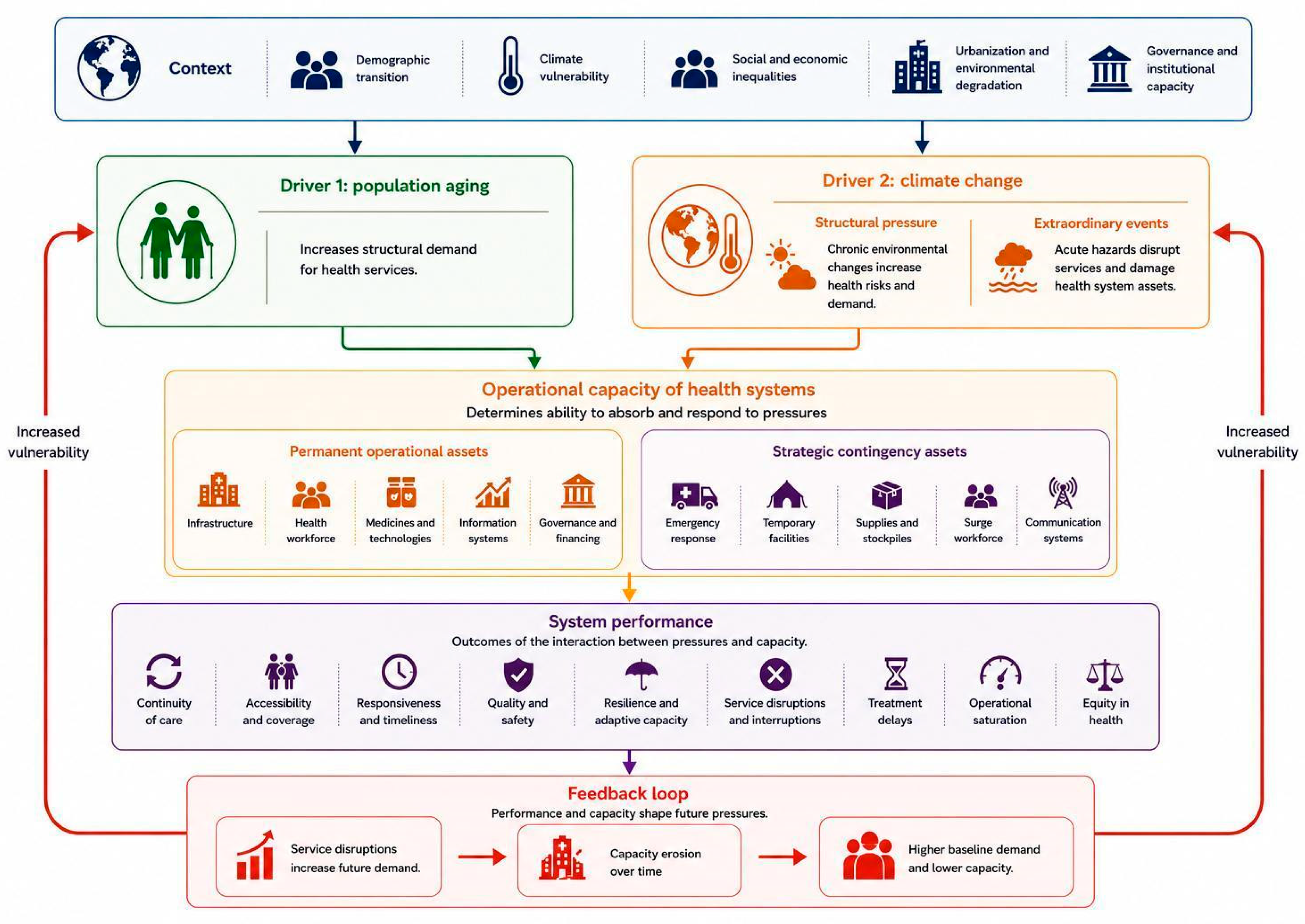
The Dual Pressure Model (DPM) conceptualizes climate change and population aging as historically produced and regionally differentiated macro-processes that jointly reshape the operational vulnerability of health systems. Rather than treating these processes as independent determinants of health outcomes or healthcare utilization alone, the DPM focuses on their combined effects on health system functioning through simultaneous modifications in operational demand, institutional capacity, and system performance. The model explicitly shifts the analytical unit from population health outcomes to the operational architecture of health systems, understood as the set of resources, infrastructures, and organizational arrangements required to ensure continuous, equitable, and resilient healthcare delivery (Figure 3).
Within the DPM, population aging is conceptualized not only as a linear or purely chronobiological process, but also as a socially and historically configured demographic transition shaped by fertility patterns, mortality regimes, migration flows, economic structures, welfare institutions, public health interventions, and macro-level shocks such as pandemics, wars, and economic crises. These forces determine both the speed and heterogeneity of demographic aging across countries and regions.
In operational terms, aging generates a structural transformation of health system requirements, expressed as a sustained and cumulative increase in baseline demand for services. This includes not only a higher volume of healthcare utilization, but a qualitative reconfiguration of service needs. Operationally, these transformations can be evaluated through measurable changes in the following domains: expansion of primary care systems oriented to multimorbidity management; increased demand for specialized geriatric and chronic disease services; long-term care systems (institutional and community-based); rehabilitation and functional recovery services; continuous pharmaceutical provision and polypharmacy management; increased demand for diagnostic, laboratory, and monitoring services; sustained demand for healthcare workforce specialization and redistribution; expansion of territorial coverage and geographic accessibility of services; integration across levels of care (primary–secondary–tertiary continuity).
Importantly, these transformations operate as structural constraints on system design, requiring long-term reconfiguration of infrastructure, workforce training, financing models, and service delivery networks. Unlike episodic increases in demand, these pressures are cumulative, path-dependent, and difficult to reverse in short temporal horizons, thereby altering the baseline operational load of health systems.
Climate change is conceptualized in the DPM as a dual-component driver that simultaneously generates (i) long-term structural environmental pressures and (ii) extraordinary episodic events that produce acute stress on health system operations (Figure 3). The structural component includes gradual and persistent environmental transformations: sustained increases in mean temperature; altered precipitation regimes; intensification of heat exposure baselines; expansion of climate-sensitive vector ecologies; progressive deterioration of air quality; water stress and hydrological instability; long-term degradation of environmental determinants of health, including air quality, water availability, and food security. These processes influence the baseline conditions under which health systems operate, progressively increasing background demand and modifying the epidemiological context in which care is delivered.
In parallel, climate change increases the frequency, intensity, and spatial variability of extreme events, including heatwaves, floods, hurricanes, wildfires, droughts, and complex compound events. While many of these phenomena exhibit partial predictability in terms of seasonality, geographic exposure, and long-term probabilistic risk, their systemic impact remains uncertain and highly variable, particularly regarding magnitude, duration, and cascading effects across health system infrastructure. The DPM conceptualizes these events as graded extraordinary pressures, meaning that they operate along a continuum rather than as binary shocks. Their severity depends on the interaction between hazard intensity, population exposure, and, critically, the pre-existing operational capacity of health systems. These events generate acute operational stress through direct damage to healthcare infrastructure (hospitals, clinics, laboratories); disruption of electricity, water, and communication systems; breakdown of pharmaceutical and medical supply chains; reduced availability of healthcare personnel; sudden surges in emergency care demand; interruption of chronic disease management and continuity of care; loss or degradation of medical and logistical resources. Importantly, extraordinary climatic events often produce second-order effects that persist beyond the acute phase, including prolonged service disruption, backlog accumulation, and deterioration of health conditions that subsequently feed back into increased baseline demand.
Health system capacity is composed of permanent operational assets and strategic contingency assets, both of which determine system resilience under dual pressure conditions. The permanent operational assets constitute the structural backbone of routine system functioning: healthcare infrastructure (hospitals, clinics, laboratories, primary care networks); healthcare workforce (generalists, specialists, nurses, community health workers); essential medicines and continuous pharmaceutical supply systems; vaccines and preventive care logistics; blood banks and biological resource systems; oxygen supply and critical medical gases; water and sanitation systems for healthcare delivery; energy systems supporting continuous operation; health information systems and digital infrastructure; routine logistics, procurement, and distribution networks; territorial coverage and geographic accessibility structures; integration mechanisms across levels of care. The strategic contingency assets are resources mobilized under extraordinary or crisis conditions: emergency transport systems (ambulances, air transport, evacuation units); mobile or temporary healthcare facilities; disaster response teams and rapid deployment units; reserve stocks of medicines, vaccines, and medical supplies; emergency blood reserves and surge capacity systems; backup energy systems (generators, independent grids); emergency water purification and supply systems; crisis communication and coordination infrastructures, and field logistics and humanitarian support systems.
The DPM assumes that health system performance under dual pressure is determined not only by the quantity of these assets, but by their distribution, redundancy, interoperability, and ability to be activated under stress conditions. Importantly, the interaction between aging-driven baseline demand and climate-induced pressure determines the extent to which these assets are sufficient to maintain functional continuity.
The interaction between structural demand pressures and reductions or disruptions in operational capacity produces measurable impacts on health system performance. These include continuity of care, accessibility, responsiveness, timeliness of service delivery, and overall system resilience.
In contexts where baseline demand is elevated due to demographic aging, the system operates closer to its functional threshold, reducing available operational margins. Under these conditions, even moderate extraordinary climatic events may generate disproportionate system-wide effects, including delays in medical and surgical treatments; interruption of chronic disease management; depletion of medical and logistical resources; degradation or loss of operational assets during disasters; fragmentation of care pathways; reduced service accessibility and territorial coverage.
Critically, these impacts do not remain confined to the acute phase. Post-event system recovery often coincides with increased long-term demand due to untreated conditions, delayed interventions, and worsening of chronic diseases. This generates a feedback loop, in which extraordinary climatic events contribute indirectly to future baseline demand, thereby reinforcing structural vulnerabilities within already stressed systems.
Discussion
The generalized warming pattern observed in our analysis across most countries in Latin America and the Caribbean is consistent with previous evidence documenting substantial climatic heterogeneity across the region, particularly in areas characterized by strong altitudinal and geographic contrasts such as the Andes and parts of Mexico. In this context, increasing temperatures may represent an important public health concern for aging populations, especially considering regional evidence linking extreme heat exposure with increased mortality risk among older adults living in Latin American urban settings (47). The marked regional variability identified in that study also suggests that climate-related health vulnerability is unevenly distributed across the region and may be shaped by differences in urbanization patterns, socioeconomic inequalities, and adaptive capacity.
Recognizing the need for healthcare systems to both respond to rising healthcare demands associated with population aging and climate-related health burdens, while simultaneously reducing their own environmental impact, international initiatives such as the COP26 Health Programme have called for the transformation of healthcare systems into entities that are both climate-resilient and low-carbon (48). This transformation requires the integration of adaptation and mitigation strategies into healthcare planning, governance, and service delivery.
However, in Latin America, the capacity to respond to these demands must be understood in light of the historical organization of healthcare systems across the region. Since the late twentieth century, health sector reforms across many countries have been shaped by broader neoliberal policy approaches emphasizing fiscal restraint, decentralization, and market-oriented mechanisms. In Latin America, these reforms unfolded within broader structural adjustment processes strongly influenced by international financial institutions, where fiscal adjustment and debt-management priorities frequently took precedence over broader investments in health system capacity and institutional development. As documented by previous studies (49–52), these reforms aimed to improve efficiency, expand coverage, and reduce pressures on public expenditure. Although decentralization was expected to increase responsiveness to local needs and improve service quality, its implementation often produced fragmented service delivery, uneven institutional capacity, and persistent inequalities in access.
These reforms also coincided with the growing international adoption of Universal Health Coverage (UHC) as the dominant policy framework. While UHC has contributed to expanding access to health services in many settings, several authors have argued that its implementation in Latin America frequently prioritized insurance-based schemes and defined benefit packages over the consolidation of comprehensive, publicly financed, and universal health systems. From this sense, expanding coverage does not necessarily address the structural fragmentation of healthcare systems, the unequal distribution of resources, or the social determinants of health that shape population vulnerability (53–57). Evidence from Colombia, for example, shows that despite substantial expansions in health insurance coverage among older adults, socioeconomic inequalities in healthcare utilization persist, particularly for preventive and outpatient services (58).
These institutional legacies are particularly relevant as Latin American health systems face the combined pressures of climate change and population aging. Responding to the growing healthcare needs of older adults while advancing adaptation and decarbonization efforts requires system-wide changes that extend beyond technological innovation and emergency preparedness (1). It also depends on health systems that are sufficiently integrated, adequately financed, and capable of ensuring continuity of care across different levels of service (2). In fragmented systems primarily focused on expanding service coverage, climate adaptation and mitigation measures may improve preparedness for specific events without addressing the structural factors that limit access to care and increase vulnerability among older adults (58).
Strengthening climate resilience should therefore be understood not only as improving the capacity to respond to climate-related emergencies, but also as reinforcing health systems that can provide equitable, continuous, and person-centered care for an aging population. This perspective is consistent with recent regional calls to strengthen climate-resilient health systems through governance, financing, workforce development, medical products and technologies, service delivery, and health information systems (59), while extending these efforts by explicitly incorporating the demographic pressures associated with population aging.
Studies addressing climate change and population aging in Latin America have largely developed through separate lines of inquiry. Research on climate change has primarily focused on policy and governance frameworks (60,61), as well as health outcomes, particularly climate-sensitive diseases (62), infectious disease dynamics (63), heat-related mortality (47,64,65), and other health impacts associated with extreme weather events. In contrast, among the studies identified in our literature search, research involving older adults has primarily examined inequities in access to care (66), environmental risk exposures (67), resilience, and adaptation to climate-related hazards (68,69). However, these bodies of work have rarely been integrated to explicitly examine how demographic and environmental transitions jointly shape the operational capacity of health systems and their ability to sustain continuous, equitable care provision. As a result, the combined effects of population aging and climate-related pressures on health system functioning remain insufficiently theorized and only partially operationalized in empirical analyses. The limited integration between these research areas is consistent with recent assessments of the climate change and health literature in South America, which have highlighted that evidence remains concentrated within specific thematic domains, with limited cross-cutting analyses of vulnerabilities, health impacts, and system-level implications (70).
While regional efforts in Latin America and the Caribbean have emphasized strengthening environmental public health governance and intersectoral coordination, these initiatives have largely focused on policy coordination and strategic agendas (71,72). Less attention has been given to the development of integrated analytical frameworks that explicitly connect demographic aging, climate change, and health system performance in a unified operational perspective.
Addressing this gap requires moving beyond analyses of isolated exposures or outcomes toward frameworks capable of representing how demographic transitions, environmental stressors, and institutional capacities interact over time. In this context, the DPM is proposed not only as a conceptual framework for interpreting the joint effects of population aging and climate change on health systems, but also as an operational framework that identifies measurable dimensions through which these effects can be empirically assessed.
The DPM is conceptually consistent with systems thinking approaches to health systems, which regard health systems as complex adaptive systems embedded within broader demographic, environmental, institutional, and socioeconomic contexts rather than as isolated service delivery structures (73). Considering this, health system performance emerges from the interaction among multiple interconnected components, such that pressures affecting one domain may propagate throughout the system through feedback processes, interdependencies, and nonlinear responses. This systems perspective challenges linear models of causality by emphasizing that system behaviour arises from interactions rather than from the isolated effects of individual components. This view is also reinforced by social-ecological systems theory, which situates health systems within broader ecological and societal transformations that simultaneously reshape disease patterns, population vulnerabilities, governance arrangements, and the institutional conditions under which healthcare is delivered (74). Rather than considering demographic aging and climate change as independent drivers of health outcomes, these theoretical approaches suggest that both processes are embedded within wider historical transformations whose effects emerge through dynamic interactions across multiple system levels.
These systems perspectives are complemented by the whole-of-systems policy approach, which translates systems thinking into a governance framework for climate adaptation. Rather than treating adaptation as a set of isolated technical interventions, it conceptualizes climate change as a systemic stressor requiring coordinated transformation across governance and organizational culture, service delivery, workforce development, material infrastructure, and financing (75). Within this framework, achieving health system resilience requires coordinated changes across interdependent domains capable of responding to evolving environmental and demographic pressures.
Building upon these complementary theoretical and policy perspectives, the DPM reframes health system analysis by shifting attention from disease-specific outcomes toward the operational vulnerability of health systems under conditions of dual structural pressure. By distinguishing between baseline structural demand, graded extraordinary climatic stress, and dual-layer operational capacity (permanent and contingency assets), the model provides a conceptual structure for analyzing how historically configured demographic and environmental processes interact with institutional structures to shape system performance. This approach enables comparative assessment across regions, as the magnitude and expression of dual pressure depend not only on exposure to demographic and climatic transitions, but also on the historical development of health system institutions, financing structures, territorial organization, and existing inequalities in access and infrastructure. Consequently, the DPM offers a basis for both analytical interpretation and future operationalization through measurable indicators of demand, operational capacity, and system performance.
Although our climate analyses characterize long-term environmental transformations across Latin America and the Caribbean, the present study does not operationalize indicators of acute climate-related events. Future applications of the DPM should incorporate regional and national indicators capable of capturing extraordinary pressures associated with heatwaves, floods, hurricanes, wildfires and other extreme events affecting health system operation. Additionally, although the DPM provides an operational framework for comparative assessment, its empirical implementation will require the development and validation of harmonized indicators capturing demographic demand, climate stress, and health system capacity across different contexts.
Conclusion
Our findings demonstrate a generalized warming pattern across Latin America and the Caribbean, highlighting the increasing relevance of climate-related pressures for health systems already facing the demands associated with population aging. However, our review of existing evidence indicates that research in the region has largely developed through separate approaches, focusing either on climate-related health outcomes and vulnerabilities or on the health needs of older populations, with limited attention to how these processes jointly influence health system functioning. The DPM addresses this gap by providing a conceptual and operational framework for analyzing how demographic and environmental transitions interact with health system structures to shape demand, operational capacity, and system performance. Future empirical applications of the model may support comparative assessments of health system vulnerability and resilience under conditions of simultaneous population aging and climate change.
Funding
This research did not receive any specific grant from funding agencies in the public, commercial, or not-for-profit sectors.
Institutional Review Board Statement
Not applicable.
Informed Consent Statement
Not applicable.
Use of Artificial Intelligence
During the preparation of this work SMRC and JDME used ChatGPT (GPT-5.5; July 2026) as an assistance tool for content refinement and visual modifications for Figure 3, which synthesizes the Dual Pressure Model (DPM). All authors reviewed and edited the resulting content as needed and assume full responsibility for the final version of the published article.
Conflicts of interest
The authors declare no conflicts of interest related to this work.
References
- Romanello, M.; Walawender, M.; Hsu, S.C.; et al. The 2024 report of the Lancet Countdown on health and climate change: facing record-breaking threats from delayed action. Lancet 2024, 404(10465), 1847–96. [Google Scholar] [CrossRef] [PubMed]
- WHO. Operational framework for building climate resilient and low carbon health systems [Internet]. World Health Organization, 2023 Nov [cited 2026 Jun 29. Available online: https://www.who.int/publications/i/item/9789240081888.
- WHO. World report on ageing and health [Internet]. World Health Organization, Sep 2015. Available online: https://www.who.int/publications/i/item/9789241565042/.
- Calvin, K.; Dasgupta, D.; Krinner, G.; et al. IPCC, 2023: Climate Change 2023: Synthesis Report. Contribution of Working Groups I, II and III to the Sixth Assessment Report of the Intergovernmental Panel on Climate Change [core writing team, H. Lee and J. Romero (eds.)]. IPCC, Geneva, Switzerland [Internet]. In Intergovernmental Panel on Climate Change; Arias, P., Bustamante, M., Elgizouli, I., et al., Eds.; Jul 2023; Available online: https://www.ipcc.ch/report/ar6/syr/.
- Tipaldo, J.; Balk, D.; Hunter, L. A framework for ageing and health vulnerabilities in a changing climate. Nat. Clim. Chang 2024, 14(11), 1125–35. [Google Scholar] [CrossRef] [PubMed]
- Weart, S.R. The Discovery of Global Warming: Revised and Expanded Edition; Harvard University Press, 2008. [Google Scholar]
- Agrawala, S. Explaining the Evolution of the IPCC Structure and Process; Sep 1997; p. 39. [Google Scholar]
- ECLAC. Ageing in Latin America and the Caribbean: inclusion and rights of older persons [Internet] LC/CRE.5/; Economic Commission for Latin America and the Caribbean (ECLAC), Dec 2022; Available online: https://www.cepal.org/en/publications/48568-ageing-latin-america-and-caribbean-inclusion-and-rights-older-persons.
- PAHO. The Decade of Healthy Aging in the Americas (2021-2030). Available online: https://www.paho.org/en/decade-healthy-aging-americas-2021-2030.
- PAHO. Health in the Americas [Internet]. Health in the Americas. 2022. Available online: https://hia.paho.org/en/covid-2022-cover.
- PAHO. Health in the Americas 2022: Overview of the Region of the Americas in the Context of the COVID-19 Pandemic [Internet]; Pan American Health Organization; p. PAHO/EIH/HA/22. Available online: https://iris.paho.org/handle/10665.2/56472.
- Atun, R.; de Andrade, L.O.M.; Almeida, G.; et al. Health-system reform and universal health coverage in Latin America. Lancet 2015, 385(9974), 1230–47. [Google Scholar] [CrossRef] [PubMed]
- Cotlear, D.; Gómez-Dantés, O.; Knaul, F.; et al. Overcoming social segregation in health care in Latin America. Lancet 2015, 385(9974), 1248–59. [Google Scholar] [CrossRef] [PubMed]
- Meade, R.D.; Akerman, A.P.; Notley, S.R.; et al. Physiological factors characterizing heat-vulnerable older adults: A narrative review. Env. Int. 2020, 144, 105909. [Google Scholar] [CrossRef]
- Millyard, A.; Layden, J.D.; Pyne, D.B.; et al. Impairments to Thermoregulation in the Elderly During Heat Exposure Events. Gerontol. Geriatr. Med. 2020, 6, 2333721420932432. [Google Scholar] [CrossRef] [PubMed]
- Intergovernmental Panel on Climate Change (IPCC). Climate change 2022 – impacts, adaptation and vulnerability: Working group II contribution to the sixth assessment report of the intergovernmental panel on climate change [Internet]; Available from; Cambridge University Press: Cambridge, England. [CrossRef]
- Cheng, J.; Xu, Z.; Bambrick, H.; et al. Cardiorespiratory effects of heatwaves: A systematic review and meta-analysis of global epidemiological evidence. Env. Res. 2019, 177, 108610. [Google Scholar] [CrossRef]
- Annesi-Maesano, I.; Bayram, H.; Cecchi, L.; et al. Natural disasters and respiratory health. Eur. Respir. J. [Internet] Available from. 2025, 66(4). [Google Scholar] [CrossRef] [PubMed]
- Liu, J.; Kim, H.; Hashizume, M.; et al. Nonlinear exposure-response associations of daytime, nighttime, and day-night compound heatwaves with mortality amid climate change. Nat. Commun. 2025, 16(1), 635. [Google Scholar] [CrossRef] [PubMed]
- Arsad, F.S.; Hod, R.; Ahmad, N.; et al. The Impact of Heatwaves on Mortality and Morbidity and the Associated Vulnerability Factors: A Systematic Review. Int. J. Env. Res. Public Health [Internet] Available from. 2022, 19(23). [Google Scholar] [CrossRef] [PubMed]
- Brennan, M.; O’Keeffe, S.T.; Mulkerrin, E.C. Dehydration and renal failure in older persons during heatwaves-predictable, hard to identify but preventable? Age Ageing 2019, 48(5), 615–8. [Google Scholar] [CrossRef] [PubMed]
- Yoo, K.D.; Hatim, H.; Abu-Alfa, A.K.; et al. Rising From the Storm: Applying Lessons From Disasters. Adv. Kidney Dis. Health 2025, 32(6), 522–8. [Google Scholar] [CrossRef] [PubMed]
- Melin, K.; Rodríguez-Díaz, C.E. Community Pharmacy Response in the Aftermath of Natural Disasters: Time-Sensitive Opportunity for Research and Evaluation. J. Prim. Care Community Health 2018, 9, 2150132718813494. [Google Scholar] [CrossRef] [PubMed]
- Melin, K.; Maldonado, W.T.; López-Candales, A. Lessons Learned From Hurricane Maria: Pharmacists’ Perspective. Ann. Pharmacother. 2018, 52(5), 493–4. [Google Scholar] [CrossRef] [PubMed]
- Althunayan, F.; Che, M.; Aldosari, N.; et al. Nephrology Care in Man-Made and Natural Disasters: Addressing the Unique Challenges for the Provision of Home Dialysis in Disasters. Adv. Kidney Dis. Health 2025, 32(6), 494–9. [Google Scholar] [CrossRef] [PubMed]
- Silva, D.R.; da Luz, L.G.; Moura-Neto, J.A. Lessons from the catastrophic floods in southern Brazil: geographic and environmental factors, vulnerabilities, and the resilience of nephrology services during natural disasters. Curr. Opin. Nephrol. Hypertens. 2025, 34(6), 514–20. [Google Scholar] [CrossRef] [PubMed]
- Carvalho, M.L.; Freitas, C.M.; Miranda, E.S. Physical rehabilitation in the context of a landslide that occurred in Brazil. BMC Public Health 2019, 19(1), 1615. [Google Scholar] [CrossRef] [PubMed]
- Silverman, M.A.; Weston, M.; Llorente, M.; et al. Lessons learned from Hurricane Andrew: recommendations for care of the elderly in long-term care facilities. South Med. J. 1995, 88(6), 603–8. [Google Scholar] [CrossRef] [PubMed]
- Reid, C.E.; Magzamen, S. Assessing the Evidence for Differential Health Effects of Wildfire Smoke Across Fires and Populations: A Critical Review of Recent Studies. Curr Environ Health Rep [Internet]. Available from. 30 Jun 2026, 13. [CrossRef]
- Tavella, R.A.; Sellera, F.P.; Debone, D.; et al. Wildfire smoke and antimicrobial resistance: A hidden link demanding global attention. Ambio [Internet]. Available from. 4 Apr 2026. [CrossRef]
- Nunes, A.R. The state of wildfire and health research: emerging trends, challenges and gaps. Int. Health 2025, 17(6), 922–33. [Google Scholar] [CrossRef] [PubMed]
- Boëte, C.; Perriat-Sanguinet, M.; Gosselin-Grenet, A.S.; et al. Stranger swings: Temperature-dependent upsides and downsides of a densovirus in Aedes albopictus. PLoS Negl. Trop. Dis. 2026, 20(6), e0014405. [Google Scholar] [CrossRef] [PubMed]
- Robertson, S.L.; de Jesús Crespo, R.; Beck, E.; et al. Modeling the effects of vector species composition and temperature on the risk of dengue virus. Bull. Math. Biol. [Internet] Available from. 2026, 88(6). [Google Scholar] [CrossRef] [PubMed]
- Bello-López, J.M.; Razo Blanco-Hernández, D.M.; Nolasco-Rojas, A.E.; et al. Dengue Epidemiology in Mexico: Temperature as a Contributing Factor to National Dengue Trends. Diseases [Internet] Available from. 2026, 14(4). [Google Scholar] [CrossRef] [PubMed]
- Paterson, J.; Berry, P.; Ebi, K.; et al. Health care facilities resilient to climate change impacts. Int. J. Env. Res. Public Health 2014, 11(12), 13097–116. [Google Scholar] [CrossRef]
- Watts, N.; Amann, M.; Arnell, N.; et al. The 2020 report of The Lancet Countdown on health and climate change: responding to converging crises. Lancet 2021, 397(10269), 129–70. [Google Scholar] [CrossRef] [PubMed]
- Ebi, K.L.; Berry, P.; Hayes, K.; et al. Stress Testing the Capacity of Health Systems to Manage Climate Change-Related Shocks and Stresses. Int. J. Env. Res. Public Health [Internet] Available from. 2018, 15(11). [Google Scholar] [CrossRef] [PubMed]
- Kruk, M.E.; Myers, M.; Varpilah, S.T.; et al. What is a resilient health system? Lessons from Ebola. Lancet 2015, 385(9980), 1910–2. [Google Scholar] [CrossRef] [PubMed]
- Sherman, J.D.; MacNeill, A.J.; Biddinger, P.D.; et al. Sustainable and Resilient Health Care in the Face of a Changing Climate. Annu Rev. Public Health 2023, 44, 255–77. [Google Scholar] [CrossRef] [PubMed]
- Martins, F.P.; Paschoalotto, M.A.C.; Closs, J.; et al. The Double Burden: Climate Change Challenges for Health Systems. Env. Health Insights 2024, 18, 11786302241298789. [Google Scholar] [CrossRef]
- Ebi, K.L.; Vanos, J.; Baldwin, J.W.; et al. Extreme Weather and Climate Change: Population Health and Health System Implications. Annu Rev. Public Health 2021, 42, 293–315. [Google Scholar] [CrossRef] [PubMed]
- Berry, H.L.; Bowen, K.; Kjellstrom, T. Climate change and mental health: a causal pathways framework. Int. J. Public Health 2010, 55(2), 123–32. [Google Scholar] [PubMed]
- Martínez-Ezquerro, J.D.; Rendón-Macías, M.E. Búsqueda y recuperación de la literatura científica. In Guía práctica para la elaboración de protocolos de investigación clínica; Available from; Villasís-Keever, M.A., Rendón-Macías, M.E., Eds.; Sociedad Mexicana de Pediatría: Ciudad de México, 2019; p. 24. [Google Scholar] [CrossRef]
- Tsakonas, K.; Badyal, S.; Takaro, T.; et al. Rapid review of the impacts of climate change on the health system workforce and implications for action. J. Clim. Chang Health 2024, 19, 100337. [Google Scholar] [CrossRef] [PubMed]
- Gianfredi, V.; Nucci, D.; Pennisi, F.; et al. Aging, longevity, and healthy aging: the public health approach. Aging Clin. Exp. Res. 2025, 37(1), 125. [Google Scholar] [CrossRef] [PubMed]
- Villalobos Dintrans, P.; Mathur, M.; González-Bautista, E.; et al. Implementing long-term care systems in the Americas: a regional strategy. Rev. Panam. Salud Publica 2021, 45, e86. [Google Scholar] [CrossRef] [PubMed]
- Kephart, J.L.; Sánchez, B.N.; Moore, J.; et al. City-level impact of extreme temperatures and mortality in Latin America. Nat. Med. 2022, 28(8), 1700–5. [Google Scholar] [CrossRef] [PubMed]
- COP26 Health Programme [Internet]. 23 Jun 2026. Available online: https://www.who.int/initiatives/alliance-for-transformative-action-on-climate-and-health/cop26-health-programme.
- Göttems, L.B.D.; Mollo, M.; de, L.R. Neoliberalism in Latin America: effects on health system reforms. Rev. Saude Publica 2020, 54, 74. [Google Scholar] [CrossRef] [PubMed]
- Rotarou, E.S.; Sakellariou, D. Neoliberal reforms in health systems and the construction of long-lasting inequalities in health care: A case study from Chile. Health Policy 2017, 121(5), 495–503. [Google Scholar] [CrossRef] [PubMed]
- Homedes, N.; Ugalde, A. Why neoliberal health reforms have failed in Latin America. Health Policy 2005, 71(1), 83–96. [Google Scholar] [CrossRef] [PubMed]
- Laurell, A.C. Crisis, neoliberal health policy, and political processes in Mexico. Int. J. Health Serv. 1991, 21(3), 457–70. [Google Scholar] [CrossRef] [PubMed]
- Birn, A.E.; Nervi, L. What matters in health (care) universes: delusions, dilutions, and ways towards universal health justice. Glob. Health 2019, 15 (Suppl 1), 0. [Google Scholar] [CrossRef]
- Garnelo, L.; Parente, R.C.P.; Puchiarelli, M.L.R.; et al. Barriers to access and organization of primary health care services for rural riverside populations in the Amazon. Int. J. Equity Health 2020, 19(1), 54. [Google Scholar] [CrossRef] [PubMed]
- Bernales-Baksai, P. Tackling segmentation to advance universal health coverage: analysis of policy architectures of health care in Chile and Uruguay. Int. J. Equity Health 2020, 19(1), 106. [Google Scholar] [CrossRef] [PubMed]
- Palacios, A.; Espinola, N.; Rojas-Roque, C. Need and inequality in the use of health care services in a fragmented and decentralized health system: evidence for Argentina. Int. J. Equity Health 2020, 19(1), 67. [Google Scholar] [CrossRef] [PubMed]
- González, C.; Triunfo, P. Horizontal inequity in the use and access to health care in Uruguay. Int. J. Equity Health 2020, 19(1), 127. [Google Scholar] [CrossRef] [PubMed]
- Garcia-Ramirez, J.; Nikoloski, Z.; Mossialos, E. Inequality in healthcare use among older people in Colombia. Int. J. Equity Health 2020, 19(1), 168. [Google Scholar] [CrossRef] [PubMed]
- Palmeiro, Y.; Plaza Reneses, T.; Velenyi, E.V.; et al. Climate change and health: Strengthening health systems to promote better health in Latin America and the Caribbean. In Health at a Glance: Latin America and the Caribbean OECD/The World Bank; 2023. [Google Scholar]
- Viveros-Uehara, T. Health Care in a Changing Climate: A Review of Climate Change Laws and National Adaptation Plans in Latin America. Health Hum. Rights 2021, 23(2), 139–51. [Google Scholar] [CrossRef] [PubMed]
- Blom, I.M.; Rasheed, F.N.; Singh, H.; et al. Evaluating progress and accountability for achieving COP26 Health Programme international ambitions for sustainable, low-carbon, resilient health-care systems. Lancet Planet Health 2024, 8(10), e778–89. [Google Scholar] [CrossRef]
- de Sousa, T.C.M.; Barcellos, C.; Barreto, M.L. The global burden of climate-sensitive diseases in Brazil: the national and subnational estimates and analysis, 1990-2017. Popul Health Metr. 2025, 23 (Suppl 1), 29. [Google Scholar] [CrossRef] [PubMed]
- Rufasto Goche, K.S.; Lizarbe Castro, M.V.; Lozano Zanelly, G.A.; et al. Epidemiological dynamics of dengue in Peru: Temporal and spatial drivers between 2000 and PLoS One. 2025, 20(3), e0319708. [Google Scholar] [CrossRef] [PubMed]
- Bakhtsiyarava, M.; Kephart, J.L.; Sánchez, B.N.; et al. Future temperature-related mortality in Latin American cities under climate change and population scenarios. Env. Int. 2025, 202, 109694. [Google Scholar] [CrossRef]
- de Almeida, R.A.C.D.S.; Santos, J da S; Amorim, L.; de, S.; et al. Influence of extreme heat waves as an aggravating factor in the cause of death from cardiovascular diseases in Southeast Brazil. Cad. Saude Publica 2026, 42, e00088725. [Google Scholar] [CrossRef]
- Gutiérrez-Murillo, R.S.; Grossi, P.K.; Wagner Leandro, G.C.; et al. Racialized Aging in the Context of Climate Extremes: Post-Flood Healthy Aging and Recovery Among Older Adults in Quilombola Communities of Southern Brazil. Int. J. Env. Res. Public Health [Internet] Available from. 2026, 23(3). [Google Scholar] [CrossRef] [PubMed]
- Hernández-Bonilla, D.; Cortez-Lugo, M.; Moreno-Macias, H.; et al. Arsenic, mercury, manganese, and lead exposure in Mexican adults aged 50 and older. Biometals 2025, 38(6), 1931–47. [Google Scholar] [CrossRef] [PubMed]
- Laura Torlaschi, A.; Carneglia, G.; Pereiro, N. Heatwave resilience in Buenos Aires: Translational research and co-created strategies for public policy benefiting older adults across diverse urban settings. J. Clim. Chang Health 2025, 26, 100572. [Google Scholar] [CrossRef] [PubMed]
- Navarrete-Valladares, C.; Sandoval-Díaz, J.; Sandoval-Obando, E. Experience and local memory of older people in the face of disasters: a systematic review. Front Public Health 2023, 11, 1163561. [Google Scholar] [CrossRef] [PubMed]
- Sarmiento, J.H.; Melo, O.; Ortiz-Alvarado, L.; et al. Economic impacts associated with the health effects of climate change in South America: a scoping review. Lancet Reg Health Am [Internet]. Available from. 2023. [CrossRef]
- Korc, M.; Hauchman, F. Advancing environmental public health in Latin America and the Caribbean. Rev. Panam. Salud Publica 2021, 45, e118. [Google Scholar] [CrossRef] [PubMed]
- Yeh, K.B.; Parekh, F.K.; Borgert, B.; et al. Global health security threats and related risks in Latin America. Glob. Secur Health Sci. Pol. 2021, 6(1), 18–25. [Google Scholar] [CrossRef]
- Systems Thinking for Health Systems Strengthening [Internet]. AHPSR. 6 Jul 2026. Available online: https://fctc.who.int/resources/publications/i/item/2009-11-13-systems-thinking-for-health-systems-strengthening.
- Zywert, K. Human health and social-ecological systems change: Rethinking health in the Anthropocene. Anthr. Rev. 2017, 4(3), 216–38. [Google Scholar] [CrossRef]
- Bell, E. Readying health services for climate change: a policy framework for regional development. Am. J. Public Health 2011, 101(5), 804–13. [Google Scholar] [CrossRef] [PubMed]
Figure 1.
Scientific mapping of research on aging, public health, climate change, and Latin America. Based on keyword co-occurrence analysis the retrieved literature (n=265) can be grouped into five thematic clusters: (red) air pollution, temperature, and cardiopulmonary health; (green) climate change, public health, and socioenvironmental determinants; (blue) vector-borne diseases and epidemiology; (yellow) disease burden, mortality, and demographic change; and (purple) biodiversity, environmental health, and health impact assessment. Node size is proportional to keyword frequency, while links represent the strength of co-occurrence between keywords.
Figure 1.
Scientific mapping of research on aging, public health, climate change, and Latin America. Based on keyword co-occurrence analysis the retrieved literature (n=265) can be grouped into five thematic clusters: (red) air pollution, temperature, and cardiopulmonary health; (green) climate change, public health, and socioenvironmental determinants; (blue) vector-borne diseases and epidemiology; (yellow) disease burden, mortality, and demographic change; and (purple) biodiversity, environmental health, and health impact assessment. Node size is proportional to keyword frequency, while links represent the strength of co-occurrence between keywords.
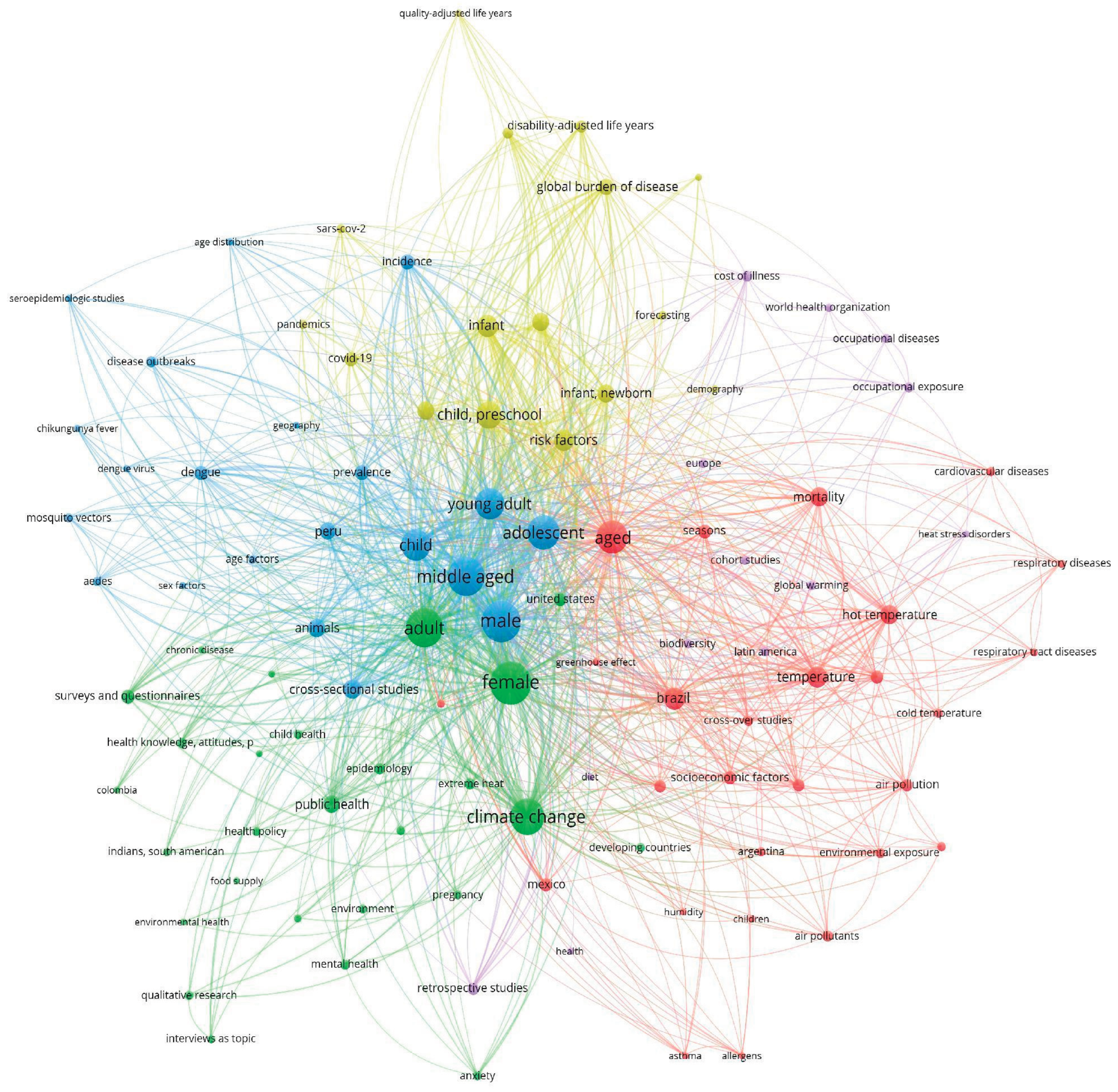
Figure 2.
Comparative changes in annual near-surface air temperature (TAS) and annual accumulated precipitation (PR) across Latin America and the Caribbean between the baseline (2005–2009) and recent (2020–2024) periods. A) Spatial distribution of changes in mean annual TAS. B) Spatial distribution of changes in annual accumulated PR. C) Country-level changes in quinquennial mean TAS. D) Country-level changes in quinquennial mean PR. Temporal variation (ΔX) was calculated as the difference between the quinquennial mean values of the recent and baseline periods (ΔX = X̄2020–2024 − X̄2005–2009).
Figure 2.
Comparative changes in annual near-surface air temperature (TAS) and annual accumulated precipitation (PR) across Latin America and the Caribbean between the baseline (2005–2009) and recent (2020–2024) periods. A) Spatial distribution of changes in mean annual TAS. B) Spatial distribution of changes in annual accumulated PR. C) Country-level changes in quinquennial mean TAS. D) Country-level changes in quinquennial mean PR. Temporal variation (ΔX) was calculated as the difference between the quinquennial mean values of the recent and baseline periods (ΔX = X̄2020–2024 − X̄2005–2009).
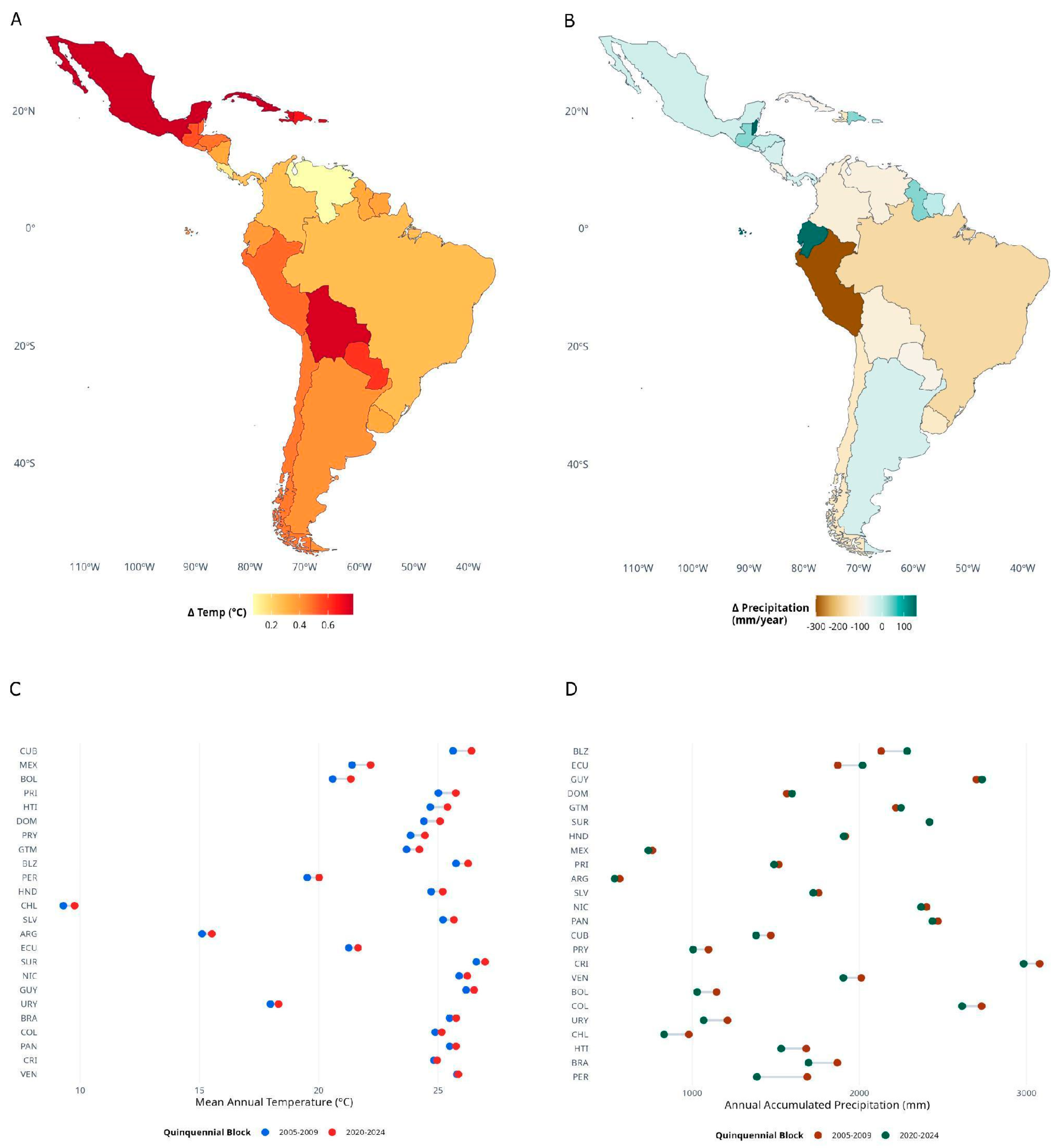
Figure 3.
The Dual Pressure Model (DPM): population aging and climate change jointly reshape health system functioning. Population aging generates sustained structural demand for healthcare services, whereas climate change exerts both chronic environmental pressures and extraordinary climatic events that increase healthcare demand while disrupting operational capacity. The interaction of these dual pressures with health system operational capacity is hypothesized to affect key dimensions of health system performance, including continuity of care, accessibility, responsiveness, equity, and resilience. Dynamic feedback processes further reinforce operational vulnerability through service disruption and the accumulation of unmet healthcare needs.
Figure 3.
The Dual Pressure Model (DPM): population aging and climate change jointly reshape health system functioning. Population aging generates sustained structural demand for healthcare services, whereas climate change exerts both chronic environmental pressures and extraordinary climatic events that increase healthcare demand while disrupting operational capacity. The interaction of these dual pressures with health system operational capacity is hypothesized to affect key dimensions of health system performance, including continuity of care, accessibility, responsiveness, equity, and resilience. Dynamic feedback processes further reinforce operational vulnerability through service disruption and the accumulation of unmet healthcare needs.
Disclaimer/Publisher’s Note: The statements, opinions and data contained in all publications are solely those of the individual author(s) and contributor(s) and not of MDPI and/or the editor(s). MDPI and/or the editor(s) disclaim responsibility for any injury to people or property resulting from any ideas, methods, instructions or products referred to in the content. |
© 2026 by the authors. Licensee MDPI, Basel, Switzerland. This article is an open access article distributed under the terms and conditions of the Creative Commons Attribution (CC BY) license (http://creativecommons.org/licenses/by/4.0/).
Copyright: This open access article is published under a Creative Commons CC BY 4.0 license, which permit the free download, distribution, and reuse, provided that the author and preprint are cited in any reuse.


