
Submitted:
10 July 2026
Posted:
13 July 2026
You are already at the latest version
Abstract
Virtual reality (VR) has moved from experimental classroom demonstrations to practical instructional platforms across K-12, higher education, and workforce training. Yet many VR learning environments still rely on static content, fixed difficulty, and limited feedback, which restricts personalization and scalability. Artificial intelligence (AI) offers complementary capabilities—generative content creation, adaptive sequencing, conversational tutoring, multimodal behavior analysis, and learning analytics—that can transform VR from immersive presentation into intelligent instruction. This paper reviews how AI is reshaping VR across the educational pipeline and proposes a conceptual AI-VR educational framework that links intelligent technologies, immersive environments, adaptive learning, real-time analytics, and measurable educational outcomes. The framework explains how AI supports content generation, virtual instructors, personalized learning paths, student behavior analysis, real-time feedback, performance assessment, learning analytics, and continuous improvement. Prior work by the authors on VR-centric behavioral sensing and adaptive thresholding is interpreted as an evolutionary pathway from physiological monitoring toward education-oriented intelligent VR systems. The discussion emphasizes that modern VR becomes substantially more effective when integrated with AI rather than deployed as standalone immersion. Challenges related to cost, teacher readiness, data governance, and equitable access are outlined together with future directions for lightweight analytics, explainable adaptation, and classroom-ready design. The manuscript is intended as a practical, publishable synthesis for educational technology researchers and practitioners seeking a clear roadmap for AI-enhanced immersive learning. Recent syntheses further confirm growing research interest at the intersection of immersive media, generative AI, and learning analytics, positioning AI-enhanced VR as a timely topic for educational technology review and framework development.
Keywords:
virtual reality
; artificial intelligence
; intelligent tutoring
; adaptive learning
; immersive learning
; learning analytics
; educational technology
; personalized education
; generative artificial intelligence
; metaverse
; intelligent learning environments
1. Introduction
Educational institutions increasingly adopt digital tools that combine immersion, interactivity, and data-informed instruction. Virtual reality places learners inside three-dimensional environments where they can manipulate objects, rehearse procedures, and explore scenarios that would be costly, risky, or impossible in physical classrooms [1,2,17]. Meta-analyses and systematic reviews report favorable learning outcomes for VR-supported instruction, particularly when activities are aligned with clear pedagogical goals and adequate learner support [2,3]. However, immersion alone does not guarantee learning. Static VR modules often provide the same sequence of tasks to every student, offer delayed feedback, and generate limited evidence about why learning succeeds or fails [16,25].
Artificial intelligence addresses these limitations by adding perception, reasoning, and adaptation to immersive systems. AI can generate instructional scenes, dialogue, and assessment items; model student progress; and adjust difficulty in real time [4,14,19]. Recent interest in generative models has accelerated experimentation with AI tutors, conversational agents, and automated content pipelines for education [10,24]. When AI is embedded within VR rather than attached as a separate dashboard, the learning experience can remain embodied and contextual while still benefiting from personalization [5,22]. The research trajectory of the present authors illustrates how intelligent sensing in VR can evolve toward broader educational applications. Rah and Chen [6] introduced VR as a lightweight stress-measurement platform that analyzes behavioral signals with minimal hardware, demonstrating that immersive environments can function as real-time data collection contexts. Their follow-up study [7] added dynamic baseline calibration to improve robustness under changing conditions, while a later adaptive-thresholding framework [8] showed how VR systems can tune decision rules from observed user behavior. Although these works targeted physiological and rehabilitation-oriented sensing, the underlying design principles context-aware measurement, adaptive analytics, and closed-loop response—map directly onto educational VR where engagement, confusion, and mastery must be inferred from interaction patterns. This paper contributes a practical synthesis and a conceptual framework for AI-enhanced VR in education. The objectives are: (1) to review how AI is transforming major stages of the VR educational pipeline; (2) to propose a layered framework connecting AI technologies, intelligent VR environments, adaptive learning, analytics, and outcomes; and (3) to discuss implementation challenges and future directions for classroom-ready systems. The scope is educational rather than clinical; the paper avoids human-subject experiments, clinical validation protocols, and complex mathematical modeling in favor of a clear architecture that researchers and practitioners can extend. Recent meta-analytic evidence indicates that immersive VR can produce meaningful learning gains when instructional design emphasizes interaction, feedback, and learner agency rather than passive observation [27,33]. At the same time, educators increasingly operate in hybrid and technology-mediated contexts where digital fluency, analytics literacy, and adaptive tooling are expected competencies [4,36]. Positioning AI as an embedded layer within VR—not as an optional add-on—therefore aligns with broader trends in smart learning environments and data-informed teaching [28,38].
2. Background
2.1. Virtual Reality in Education
VR in education spans virtual laboratories, historical reconstructions, language immersion, STEM simulations, and professional skills training [1,16,18]. Design quality depends on interaction fidelity, presence, instructor integration, and alignment with curriculum standards [12,21]. The Cognitive Affective Model of Immersive Learning (CAMIL) emphasizes that presence and agency mediate learning only when instructional design activates appropriate cognitive and affective processes [5]. Empirical work on 360° and head-mounted VR further suggests that presence and usability influence both satisfaction and learning performance, reinforcing the need for careful scenario design [26,37]. Virtual laboratories extend these principles to STEM domains where learners practice experiments in safe, repeatable simulations [9,34]. Affordance-based frameworks clarify why spatial manipulation, contextual embedding, and visualization support conceptual understanding in three-dimensional learning spaces [32].
2.2. Artificial Intelligence in Education
AI in education includes intelligent tutoring systems, recommender engines, automated grading, learning analytics dashboards, and conversational agents [4,14,19]. These tools support diagnosis of misconceptions, adaptive sequencing, and timely feedback at scale. Generative AI expands the design space by enabling rapid creation of explanations, scenarios, and assessment prompts, although educators remain concerned about accuracy, bias, and pedagogical alignment [10,24]. Educational chatbots and conversational agents represent an adjacent body of work that informs intelligent virtual instructors in VR. Systematic reviews document rapid growth in chatbot deployments for tutoring, FAQ support, and formative questioning, while also noting limitations in domain accuracy and long-dialogue coherence [20,30,35]. Generative AI literature similarly reports expanding experimentation alongside calls for guardrails, human oversight, and assessment of learning impact rather than novelty alone [10,31].
2.3. Convergence of AI and VR
The convergence of AI and VR is visible in metaverse-oriented education research, immersive serious games, and adaptive simulation trainers [13,15,22]. Rather than treating AI as an external grading service, emerging systems embed inference directly inside the virtual environment so that characters, objects, and narratives respond to learner state. The authors' prior VR sensing research [6,7,8] provides a concrete example of this shift: from passive immersion toward environments that observe behavior, update internal models, and adapt responses—capabilities that educational VR requires for personalized instruction.
2.4. Learning Analytics and Intelligent Learning Environments
Learning analytics provides the evidentiary backbone for adaptive VR. By collecting traces of interaction, timing, errors, and help requests, analytics systems enable instructors and algorithms to detect risk early and tailor support [14,28]. Immersive environments generate rich process data that traditional LMS logs often miss—spatial navigation, object manipulation sequences, and repeated attempts within three-dimensional tasks [11]. When combined with AI inference, these data streams support the continuous improvement loop emphasized throughout this paper [4,38]. Scoping reviews at the AI–VR–education intersection highlight recurring themes: intelligent content delivery, learner modeling, automated feedback, and ethical deployment [13,38]. Augmented and mixed reality studies additionally note deployment constraints—device management, teacher training, and curriculum integration—that remain relevant when schools adopt AI-enhanced VR at scale [12,29].
3. AI in VR-Based Education
AI can enhance each stage of the VR educational pipeline. Table 1 summarizes representative roles and expected benefits. The following subsections expand these roles in practical terms.
3.1. Content Generation
Generative AI reduces the time required to produce 3D scenarios, dialogues, quizzes, and multilingual variants. Instructors can specify learning objectives and receive draft immersive storyboards that are subsequently refined for accuracy and age appropriateness [10,14]. This capability is especially valuable for STEM and vocational programs where scenario diversity improves transfer. Procedural and scenario-based learning benefits especially from generative pipelines that produce variant cases, distractors, and contextual narratives while preserving learning objectives [15,31]. Authoring tools integrated with game engines can combine human review with AI-assisted scripting to maintain factual accuracy in history, science, and vocational modules [1,16].
3.2. Intelligent Virtual Instructors
Embodied virtual instructors combine speech, gesture, and spatial context to guide learners inside VR. Large language models enable open-ended questioning and explanation, while rule-based or retrieval-augmented components constrain responses to curriculum boundaries [19,20]. Intelligent instructors can model expert strategies, demonstrate procedures, and prompt reflection without removing learner agency. Pedagogical agents in immersive settings can adapt tone, hint level, and spatial positioning based on detected confusion or disengagement [5,30,35]. Embodied design principles suggest that gesture-enabled interfaces and hand-based manipulation strengthen encoding and retention when tasks require procedural knowledge [27]. In classroom deployments, virtual instructors should complement—not replace—human teachers by summarizing analytics for instructor dashboards [12,36].
3.3. Adaptive Learning and Personalized Paths
Adaptive VR systems adjust task order, hint frequency, and environmental complexity based on inferred skill level [5,22]. Personalization may use performance traces, response latency, error patterns, or optional affective cues. The goal is to maintain flow by keeping tasks challenging but achievable, a design principle supported by immersive learning research [2,3]. Personalized paths may group learners by prerequisite mastery, language preference, or accessibility needs while preserving common learning objectives [4,14]. Meta-analytic findings suggest that immersive media effects depend on how well tasks exploit spatial and interactive affordances rather than on immersion alone [17,33]. Adaptive policies should therefore adjust not only difficulty but also representation modality—for example, offering extra visual scaffolding or simplified navigation when analytics indicate overload [5,32].
3.4. Student Behavior Analysis and Real-Time Feedback
Head movement, controller trajectories, gaze proxies, voice features, and interaction logs provide evidence about attention and strategy. Rah and Chen [6,7] demonstrated that VR platforms can extract behavioral indicators with lightweight sensing, while adaptive thresholding [8] showed how decision rules can be tuned online. Translated to education, similar methods can trigger hints when hesitation patterns appear or escalate difficulty when mastery is detected. Engagement-oriented indicators such as head orientation, task persistence, and help-seeking frequency can be captured without specialized biometric devices, echoing the minimal-hardware philosophy in Rah and Chen [6,11]. Dynamic calibration of behavioral baselines—originally introduced to stabilize stress-detection models [7]—also applies when students enter VR with different prior experience or comfort levels. Real-time feedback should be explanatory and actionable, linking observed behavior to next-step strategies rather than issuing opaque scores [25,28].
3.5. Performance Assessment, Learning Analytics, and Continuous Improvement
AI-supported assessment combines process data with product data (final answers, completed tasks, time-on-task) to produce richer portraits of learning [9,14]. Learning analytics dashboards help instructors compare cohorts, identify struggling topics, and revise modules between semesters. Continuous improvement closes the loop from analytics back to content generation and adaptive policies.
3.6. Collaborative, Social, and Metaverse-Oriented Learning
AI-enhanced VR also supports collaborative learning in shared virtual spaces where intelligent agents mediate group discussion, allocate roles, and summarize team performance [13,22]. Metaverse-oriented education research emphasizes persistent worlds, digital identity, and cross-session continuity—features that pair naturally with learning analytics and adaptive recommender systems [13,38]. Social presence and shared embodiment can increase motivation in project-based learning, provided that platforms manage moderation, accessibility, and equitable participation [12,21].
4. Proposed AI-VR Educational Framework
Figure 4 presents the proposed conceptual framework. The framework is intentionally simple so that institutions can map existing components and identify gaps. It consists of five vertically linked layers and a continuous improvement loop.
Layer 1—AI Technologies: foundational models and algorithms including generative AI, machine learning, natural language processing, and computer vision. Layer 2—Intelligent VR Environment: immersive worlds, embodied agents, interactive manipulables, and spatialized instruction. Layer 3—Adaptive Learning: policies that personalize paths, scaffolding, and difficulty. Layer 4—Real-Time Analytics: pipelines that convert interaction data into actionable indicators during sessions. Layer 5—Educational Outcomes: mastery, retention, motivation, transfer, and equity indicators. The side modules in Figure 4 correspond to the functional blocks named in Section 3. Content generation feeds the environment layer; virtual instructors and personalized paths shape adaptive learning; behavior analysis and performance assessment inform analytics; real-time feedback connects analytics to learner experience. Learning analytics aggregates session-level evidence to update content, adaptation rules, and instructor dashboards—completing the improvement loop. Interpreting the authors' prior publications within this framework clarifies their educational relevance. The stress-measurement platform [6] aligns with Layer 4 because it treats VR as a behavioral observatory. Dynamic baseline calibration [7] strengthens Layer 3–4 boundary functions by stabilizing inference under changing student states. Adaptive thresholding [8] exemplifies Layer 3 policy updating from observed data—a direct analogue to adaptive difficulty control in intelligent tutoring. Together, these works show a progression from measurement to adaptation that educational VR systems can reuse without requiring specialized biomedical instrumentation.
4.1. Framework Implementation Stages
Table 2 maps each framework layer to literature streams that inform practical deployment. Institutions may implement the framework incrementally. Stage 1 deploys curated VR modules with manual instructor facilitation [1,2]. Stage 2 adds learning analytics exports to existing LMS workflows [28,36]. Stage 3 introduces rule-based adaptation—for example, branching scenarios triggered by quiz performance [15,22]. Stage 4 integrates generative content tools, conversational tutors, and calibrated behavioral analytics, including design patterns demonstrated in adaptive VR sensing research [8,31,35]. The framework is intentionally modular: a school may begin with intelligent analytics layered onto existing VR labs before investing in full generative authoring pipelines. This staged adoption reduces cost and aligns with implementation lessons from regional and metropolitan classroom studies [12,29].
5. Discussion
The framework highlights a central claim of this paper: VR becomes significantly more educationally effective when paired with AI across the full pipeline rather than at a single point such as grading or chat support. Immersion captures attention, but AI sustains instruction by personalizing paths, detecting struggle early, and generating timely feedback [5,19,22]. For K-12 contexts, AI-VR can provide safe rehearsal spaces for laboratory skills, civic scenarios, and collaborative problem solving [17,21]. For higher education, intelligent VR supports complex simulations in engineering, health professions education (non-clinical training scenarios), architecture, and business negotiation [1,2]. Workforce training benefits from repeatable, instrumented practice with automated performance summaries. Implementation should remain guided by pedagogy rather than technology novelty. CAMIL and related models remind designers to ask how each AI feature affects cognitive load, agency, and affective engagement [5]. The authors' sensing-oriented VR research reinforces a related lesson: adaptive systems are only as useful as the educational actions they trigger. Detecting stress or hesitation matters when the environment responds with better scaffolding—not merely when it records another data point [6,7]. Institutions can adopt the framework as a maturity checklist. Level A deployments use VR primarily for visualization. Level B adds basic analytics such as completion time and score. Level C introduces adaptive sequencing. Level D integrates generative content, virtual instructors, and closed-loop analytics, the target architecture proposed here. Comparative reviews of AI in education and immersive media suggest that the greatest educational value emerges when analytics inform immediate in-world adaptations rather than post-hoc reporting alone [4,33,38]. For policy and leadership audiences, AI-enhanced VR should be framed as infrastructure for competency-based progression: credentials linked to demonstrated performance within authentic simulations [21,34].
From a research standpoint, the framework invites falsifiable questions: Does embedded adaptation improve time-to-mastery relative to static VR? Do generative tutors increase transfer when constrained by retrieval from vetted knowledge bases [30,31]? Do lightweight behavioral analytics approximate instructor judgments of confusion with sufficient reliability for classroom use [6,37]? Answering these questions does not require clinical trials; classroom quasi-experiments and design-based research suffice for educational technology venues.
6. Challenges
Several barriers limit immediate adoption. Hardware cost and maintenance remain concerns for schools with unequal resources [12,13]. Teacher professional development is essential because instructors must interpret analytics, critique AI-generated content, and orchestrate classroom workflows [10,14]. Data governance raises questions about privacy, consent, retention, and algorithmic transparency when student behavior is logged inside immersive environments [4,24]. Technical challenges include integration between game engines, learning management systems, and analytics platforms; latency constraints for real-time adaptation; and the need for explainable recommendations so educators trust automated decisions [19,22]. Content quality control is especially important for generative AI, which may produce plausible but incorrect material if unchecked [10]. Finally, evidence standards must evolve. Many published VR studies report short-term knowledge gains but fewer longitudinal or transfer outcomes [2,3]. AI-VR research should report not only test scores but also engagement trajectories, time-to-mastery, instructor workload, and equity impacts. Additional challenges include simulator discomfort for a subset of learners, which can affect access and performance if not monitored [26,37]. Intellectual property and licensing for AI-generated assets remain unsettled in many institutions [10,31]. Scaling also requires IT support for device hygiene, content versioning, and secure storage of analytics logs [12,36].
7. Future Directions
Future work should prioritize lightweight, classroom-ready analytics inspired by minimal-hardware VR sensing [6] and robust calibration methods [7]. Edge inference on standalone headsets can reduce privacy risks by processing behavioral features locally before uploading aggregated indicators. Multimodal tutors that combine speech, gaze, and manipulation patterns may support richer formative feedback than score-only systems [9,20]. Cross-institutional datasets, shared interoperability standards, and open educational VR objects would accelerate reproducible research [1,13]. Long-term directions include teacher-in-the-loop co-design tools, explainable adaptation policies, and equity audits that examine whether AI-VR benefits learners with diverse language backgrounds and disabilities. Connecting immersive training to employment outcomes and lifelong learning portfolios represents another promising extension beyond single-course evaluations. Industry-academic partnerships may accelerate shared benchmarks for AI-VR literacy, interoperability between engines and analytics platforms, and reusable content libraries [1,13]. Finally, bridging author expertise in adaptive sensing [6,7,8] with learning sciences methodologies [5,27] offers a concrete agenda for prototypes that are technically robust and pedagogically grounded.
8. Conclusion
Artificial intelligence is transforming virtual reality from a compelling display technology into an intelligent instructional ecosystem. This paper reviewed AI roles across the VR educational pipeline—content generation, virtual instructors, adaptive learning, behavior analysis, feedback, assessment, analytics, and continuous improvement—and proposed a five-layer conceptual framework linking technologies to outcomes. Prior research by the authors on VR-centric behavioral sensing and adaptive thresholding illustrates an evolutionary path toward education-oriented intelligent environments. Realizing the full benefit of AI-enhanced VR will require pedagogy-first design, transparent analytics, and sustainable implementation models, but the integration is practical, timely, and increasingly accessible to educational institutions worldwide. As immersive platforms become more affordable and AI tooling becomes embedded in everyday authoring workflows, the barrier to intelligent VR is shifting from raw technology access toward design capability, ethical governance, and evidence of learning impact [24,36,38]. The framework and literature synthesis presented here are offered as a practical reference for teams building the next generation of intelligent learning systems.
References
- Radianti, J.; Majchrzak, T.A.; Hosseini, M.; et al. A Systematic Review of Immersive Virtual Reality Applications in Higher Education: Design Elements, Lessons Learned, and Research Agenda. Comput. Educ. 2020, 147, 103778. [Google Scholar] [CrossRef]
- Hamilton, D.; McKechnie, J.; Edgerton, E.; Wilson, C. Immersive Virtual Reality as a Pedagogical Tool in Education: A Systematic Literature Review of Quantitative Learning Outcomes and Experimental Design. J. Comput. Educ. 2021, 8, 1–32. [Google Scholar] [CrossRef]
- Kaplan-Rakowski, R.; Wojdynski, T. Immersive Media and Student Learning: A Systematic Literature Review. Educ. Res. Rev. 2021, 34, 100394. [Google Scholar] [CrossRef]
- Zawacki-Richter, O.; Marín, V.I.; Bond, M.; et al. Systematic Review of Research on Artificial Intelligence Applications in Higher Education. Int. J. Educ. Technol. High. Educ. 2019, 16, 39. [Google Scholar] [CrossRef]
- Makransky, G.; Petersen, G.B. The Cognitive Affective Model of Immersive Learning (CAMIL): A Theoretical Research-Based Model of Learning in Immersive Virtual Reality. Educ. Psychol. Rev. 2021, 33, 937–958. [Google Scholar] [CrossRef]
- Rah, A.; Chen, Y. Virtual Reality as a Stress Measurement Platform: Real-Time Behavioral Analysis with Minimal Hardware. Sensors 2025, 25, 5323. [Google Scholar] [CrossRef] [PubMed]
- Rah, A.; Chen, Y. Virtual Reality-Centric Stress Detection Using Dynamic Baseline Calibration. Electronics 2025, 14, 4501. [Google Scholar] [CrossRef]
- Rah, A.; Chen, Y. Stroke Rehabilitation in Virtual Reality Through Enhanced Plantar Pressure Detection Using Sensor Resolution and Adaptive Thresholding. Algorithms 2026, 19, 368. [Google Scholar] [CrossRef]
- Ibáñez, M.-B.; Delgado-Kloos, C. Augmented Reality for STEM Learning: A Systematic Review. Comput. Educ. 2018, 123, 109–123. [Google Scholar] [CrossRef]
- Parmar, N.; Ranjani, S.S.; Ramesh, A.; et al. The Impact of Generative AI on Higher Education Learning and Teaching: A Study of Educators' Perspectives. Comput. Educ. Artif. Intell. 2024, 6, 100221. [Google Scholar] [CrossRef]
- Allcoat, D.; von Mühlenen, A. Learning in Virtual Reality: Effects on Performance, Emotion and Engagement. Res. Learn. Technol. 2018, 26, 2140. [Google Scholar] [CrossRef]
- Southgate, E.; Smith, S.P.; Cividino, J.; et al. Embedding Immersive Virtual Reality in Classrooms: Ethical, Organizational and Educational Lessons in Remote, Regional and Metropolitan Sites. Educ. Inf. Technol. 2019, 24, 2047–2063. [Google Scholar] [CrossRef]
- Liu, H.; Yu, D.; Li, Q.; et al. From Metaverse to Education: A Systematic Review. Smart Learn.> Environ. 2023, 10, 36. [Google Scholar] [CrossRef]
- Huang, X.; Zou, D.; Cheng, H.; et al. Trends, Research Issues and Applications of Artificial Intelligence in Education. Educ. Inf. Technol. 2023, 28, 16637–16663. [Google Scholar] [CrossRef]
- Laamarti, F.; Eid, M.; El Saddik, A. An Overview of Serious Games. Int. J. Comput. Games Technol. 2014, 2014, 358152. [Google Scholar] [CrossRef]
- Freina, L.; Ott, M. A Literature Review on Immersive Virtual Reality in Education: State of the Art and Perspectives. eLearning Pap. 2015, 44, 1–13. [Google Scholar]
- Merchant, Z.; Goetz, E.T.; Cifuentes, L.; et al. Effectiveness of Virtual Reality-Based Instruction on Students' Learning Outcomes in K-12 and Higher Education: A Meta-Analysis. Comput. Educ. 2014, 70, 29–40. [Google Scholar] [CrossRef]
- Bailenson, J. Experience on Demand: What Virtual Reality Is, How It Works, and What It Can Do; W. W. Norton & Company: New York, NY, USA, 2018. [Google Scholar]
- Chen, L.; Chen, P.; Lin, Z. Artificial Intelligence in Education: A Review. IEEE Access 2020, 8, 75264–75278. [Google Scholar] [CrossRef]
- Li, Y.; Wong, T.-W. Chatbots for Learning: A Review of Educational Chatbots for the Facebook Messenger. Comput. Educ. 2020, 151, 103856. [Google Scholar] [CrossRef]
- Papanastasiou, G.; Drigas, A.; Skianis, C.; et al. Virtual and Augmented Reality Effects on K-12, Higher and Tertiary Education Students' Twenty-First Century Skills. Virtual Real. 2019, 23, 425–436. [Google Scholar] [CrossRef]
- Mystakidis, S. Metaverse. Encyclopedia 2022, 2, 486–497. [Google Scholar] [CrossRef]
- Dede, C. Immersive Virtual Reality and the Affordances of Educational Simulations. Educ. Technol. 2023, 63, 4–11. [Google Scholar]
- Wu, X.; Chen, K.; Zheng, L.; et al. Artificial Intelligence in Education: A Systematic Review. Sustainability 2023, 15, 12451. [Google Scholar] [CrossRef]
- Fowler, C. Virtual Reality and Learning: Where Is the Pedagogy? Br. J. Educ. Technol. 2015, 46, 412–422. [Google Scholar] [CrossRef]
- Slater, M.; Sanchez-Vives, M.V. Enhancing Our Lives with Immersive Virtual Reality. Front. Robot. AI 2016, 3, 74. [Google Scholar] [CrossRef]
- Johnson-Glenberg, M.C. Immersive VR and Education: Embodied Design Principles That Include Gesture and Hand Controls. Front. Robot. AI 2018, 5, 81. [Google Scholar] [CrossRef] [PubMed]
- Siemens, G. Learning Analytics: The Emergence of a Discipline. Am. Behav. Sci. 2013, 57, 1380–1400. [Google Scholar] [CrossRef]
- Akçayır, M.; Akçayır, G. Advantages and Challenges Associated with Augmented Reality for Education: A Systematic Review of the Literature. Educ. Rev. 2017, 69, 721–738. [Google Scholar] [CrossRef]
- Kuhail, M.A.; Alturki, N.; Alramlawi, S.; et al. Interacting with Educational Chatbots: A Systematic Review. Educ. Inf. Technol. 2023, 28, 973–1018. [Google Scholar] [CrossRef]
- Cooper, G.; et al. Generative Artificial Intelligence in Education: A Review of the Empirical Literature. Comput. Educ. Artif. Intell. 2024, 7, 100274. [Google Scholar] [CrossRef]
- Dalgarno, B.; Lee, M.J.W. What Are the Learning Affordances of 3-D Virtual Environments? Br. J. Educ. Technol. 2010, 41, 10–32. [Google Scholar] [CrossRef]
- Wu, B.; Yu, X.; Gu, X. Effectiveness of Immersive Virtual Reality Using Head-Mounted Displays on Learning Performance: A Meta-Analysis. Br. J. Educ. Technol. 2020, 51, 1991–2005. [Google Scholar] [CrossRef]
- Potkonjak, V.; Gardner, M.; Callaghan, V.; et al. Virtual Laboratories: A Review of the Literature. Int. J. Eng. Educ. 2016, 32, 285–292. [Google Scholar]
- Smutny, P.; Schreiberova, P. Chatbots for Learning: A Review of Educational Chatbots. Smart Learn. Environ. 2020, 7, 22. [Google Scholar] [CrossRef]
- Bond, M.; Bedenlier, S.; Zawacki-Richter, O.; et al. Emergency Remote Teaching in Higher Education: Mapping the First Global Online Semester. Int. J. Educ. Technol. High. Educ. 2021, 18, 50. [Google Scholar] [CrossRef] [PubMed]
- Rupp, M.A.; Odette, K.L.; Kozachuk, J.; et al. Investigating Learning Outcomes and Perceived Gains in a 360° Virtual Reality Simulation. Comput. Educ. 2019, 128, 256–268. [Google Scholar] [CrossRef]
- Castillo-Estrada, E.; González-González, C.S.; García-Holgado, A.; et al. Effects of Virtual Reality on Learning Outcomes in K-6 Education: A Meta-Analysis. Educ. Res. Rev. 2022, 37, 100434. [Google Scholar] [CrossRef]
Figure 4.
Conceptual AI-VR educational framework linking intelligent technologies, immersive environments, adaptive learning, real-time analytics, and educational outcomes. Side modules represent supporting AI functions; the bottom loop indicates learning analytics driving continuous improvement.
Figure 4.
Conceptual AI-VR educational framework linking intelligent technologies, immersive environments, adaptive learning, real-time analytics, and educational outcomes. Side modules represent supporting AI functions; the bottom loop indicates learning analytics driving continuous improvement.
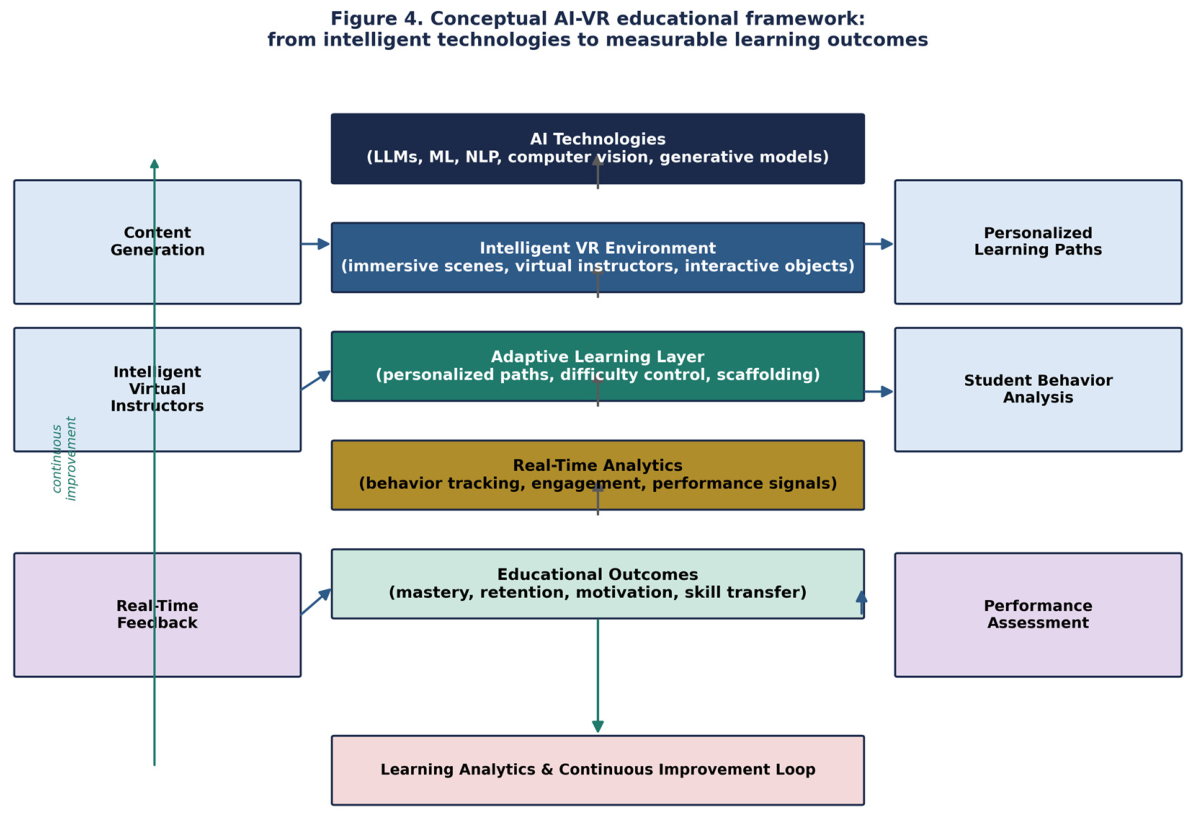

Table 1.
Roles of AI across the VR educational pipeline.
| Pipeline stage | AI capability | Educational function | Example outcome |
|---|---|---|---|
| Design | Generative content creation | Build scenes, scripts, and assessments | Faster course authoring |
| Delivery | Virtual instructors/agents | Dialogue, hints, Socratic questioning | On-demand tutoring in VR |
| Instruction | Adaptive learning control | Adjust difficulty and scaffolding | Reduced frustration |
| Monitoring | Behavior and gaze analysis | Detect confusion, disengagement, mastery | Timely intervention |
| Feedback | Real-time analytics | Immediate formative feedback | Shorter correction cycles |
| Evaluation | Performance assessment | Rubric-based or multimodal scoring | Consistent measurement |
| Improvement | Learning analytics | Aggregate trends across cohorts | Continuous course refinement |
Table 2.
Mapping AI-VR framework layers to representative literature themes.
| Framework layer | Primary educational function | Representative literature streams |
|---|---|---|
| AI technologies | Models, inference, generative tools | AIEd reviews; generative AI education; chatbot surveys |
| Intelligent VR environment | Immersion, presence, embodied activity | VR meta-analyses; CAMIL; 360° simulation studies |
| Adaptive learning | Personalization, scaffolding, path control | Adaptive media; immersive design principles; author adaptive VR work |
| Real-time analytics | Behavior traces, dashboards, alerts | Learning analytics; VR behavioral sensing; educational data mining |
| Educational outcomes | Mastery, transfer, engagement, equity | K-12/higher-ed VR outcomes; 21st-century skills; implementation studies |
Disclaimer/Publisher’s Note: The statements, opinions and data contained in all publications are solely those of the individual author(s) and contributor(s) and not of MDPI and/or the editor(s). MDPI and/or the editor(s) disclaim responsibility for any injury to people or property resulting from any ideas, methods, instructions or products referred to in the content. |
© 2026 by the authors. Licensee MDPI, Basel, Switzerland. This article is an open access article distributed under the terms and conditions of the Creative Commons Attribution (CC BY) license (http://creativecommons.org/licenses/by/4.0/).
Copyright: This open access article is published under a Creative Commons CC BY 4.0 license, which permit the free download, distribution, and reuse, provided that the author and preprint are cited in any reuse.


