
Submitted:
10 July 2026
Posted:
13 July 2026
You are already at the latest version
Abstract
This study evaluates the performance of the native Mediterranean species Pallenis maritima (L.) Greuter on an extensive green roof with the aim of introducing the cultivation of new sustainable species in the urban environment. Growth performance, physiological responses, and anatomical adaptations were assessed under reduced-input conditions, including deficit irrigation and shallow (10 cm) substrate with or without soil. Plants were cultivated under controlled rooftop conditions, and growth traits, flowering performance, stomatal resistance, chlorophyll fluorescence parameters (maximum PSII photochemical efficiency; ΦPSIIo), relative water content, and leaf anatomical characteristics were monitored over a 17-month period. P. maritima maintained satisfactory vegetative growth, ground cover, and flowering across all treatments, with only moderate reductions under sparse irrigation. As expected, plants exhibited increased stomatal resistance under water deficit but rapid recovery after irrigation, along with stable and reversible reductions in ΦPSIIo. Anatomical analyses revealed xeromorphic traits, including increased leaf thickness, dense pubescence, trichomes, and crystalline inclusions, particularly under water deficit. Substrate composition influenced growth, with soil-containing substrate enhancing vegetative development, although the soilless, lightweight substrate also supported acceptable performance. Overall, the species demonstrated strong adaptation to cyclic drought–irrigation conditions through integrated physiological and structural mechanisms. These findings support the potential of P. maritima for low-input green roof systems and sustainable urban landscaping in Mediterranean and semi-arid environments.
Keywords:
deficit irrigation
; soil substrate
; grape marc compost
; stomatal resistance
; PSII photochemical efficiency
; medicinal plant
1. Introduction
Rapid urbanization and climate change have increased the demand for sustainable urban horticulture and green infrastructure capable of improving environmental quality and enhancing climate resilience in cities [1,2]. Among these nature-based solutions, green roofs are increasingly recognized for their multiple environmental and social benefits, although their wider implementation still faces technical, economic, and policy barriers, particularly in Mediterranean cities [3]. Their importance is especially evident in Mediterranean and other semi-arid regions, where water scarcity, soil degradation, salinity, and high temperatures constrain plant establishment [4,5].
In this context, the use of native or Mediterranean-adapted plant species with low resource requirements and high tolerance to abiotic stress is essential for enhancing urban ecosystem services, supporting biodiversity [6], and promoting resilient, low-input urban landscapes. Recent studies have emphasized the importance of selecting resilient ornamental species adapted to Mediterranean climatic conditions for sustainable urban horticulture and green infrastructure [Leotta et al., 2023]. Particular attention has been given to Mediterranean aromatic, medicinal, and phrygana species because of their ecological adaptability and suitability for extensive green roof systems [7,8,9].
Pallenis maritima (L.) Greuter (syn. Asteriscus maritimus), commonly known as “gold coin” or “golden aster,” is a Mediterranean species with potential for sustainable urban landscaping applications. The species is distributed across the Mediterranean Basin, including Morocco, Algeria, Portugal, Spain, the Canary Islands, France, Italy, and Greece [10]. It typically grows on calcareous and clayey soils, such as marls and sandstones, and is mainly found in coastal environments [12], although it has also been recorded at elevations exceeding 800 m on Mount Tessala in western Algeria [13]. P. maritima is a perennial dwarf shrub with a compact growth habit, grey-green foliage, and conspicuous yellow flower heads. Its occurrence in dry and exposed habitats suggests adaptation to environmental conditions characteristic of Mediterranean ecosystems. Detailed descriptions of its morphology, ecology, distribution, and taxonomic variability are available elsewhere [10,11] (p. 439), [12,14].
From an urban sustainability perspective, P. maritima is a heliophilous species characterized by low water requirements and high salinity tolerance [15,16,17], making it well-suited for sustainable and low-input landscaping. Phytochemical studies have identified sulfur-containing metabolites (asterosulfoxide, asterosulfonium), as well as phenolic and thymol derivatives in the roots, which excibit in vitro antibacterial and antifungal activities [18], and antioxidant and anti-inflammatory compounds in the aerial organs and flowers [19]. Furthermore, GC–MS analysis of the stem essential oil revealed a complex volatile profile, with γ-eudesmol as the predominant constituent, followed by naphthaleneacetaldehyde derivatives, humulane-1,6-dien-3-ol, and 7,8-dehydro-8α-hydroxyisolongifolene [20]. Taken together, these functional traits, combined with its ornamental appeal, bioactive profile, and adaptability to drought- and salinity-prone environments, make P. maritima a promising multifunctional species for sustainable urban horticulture. Its resilience, low maintenance requirements, and potential to provide aesthetic, ecological, and pharmaceutical value are well aligned with the objectives of contemporary low-input urban landscapes.
Its compact growth habit, prolonged flowering period, and ground-covering potential make P. maritima attractive for ornamental and urban landscape applications [17] without invasive threats [21]. In addition, the species has been evaluated as a candidate plant for extensive green roofs in Mediterranean environments. Previous studies showed that P. maritima (Asteriscus maritimus) can establish and grow in artificial green roof substrates and maintain acceptable performance under water-limited conditions, although its response depends on substrate characteristics and irrigation regime [22,23]. These findings highlight its potential for use in extensive green roof systems in Mediterranean and semi-arid regions.
The development of green structures in the modern world and the implementation of green roofs have become an imperative necessity in densely built urban areas, particularly in regions with a hot and dry climate [24]. The benefits of planted roofs are multiple, encompassing environmental, social, and economic dimensions [25]. Consequently, extensive research has focused on identifying suitable materials for green roof construction, including the selection of substrates that must be as lightweight as possible, while ensuring adequate nutrients and structural support for plant growth [26]. Parallel research efforts have also examined plant species suitable for planting on extensive green roofs [27].
In the present study, the growth performance and anatomical and physiological parameters of P. maritima were evaluated under two substrate compositions (one soil-based and one lighter, soil-free substrate), at a shallow substrate depth (10 cm), and under two irrigation regimes (regular and deficit), on an urban green roof system. The objective was to assess the suitability of this Mediterranean species for sustainable urban horticulture by determining its capacity to maintain satisfactory growth and functionality under lightweight substrates and reduced irrigation, conditions representative of low-input green roof systems in Mediterranean climates.
2. Materials and Methods
2.1. Experimental Setup, Plant Material and Substrate Type
The experiment was conducted on a fully exposed flat roof located on the second floor of the Agricultural University of Athens (37°59′ N, 23°42′ E) from middle November 2012 until middle March 2014. Rooted cuttings of P. maritima, one-month old, propagated in a substrate consisting of perlite and peat in a 1:3 ratio (Marigold Plants S.A., Marathonas, Greece), were planted for growth in rectangular plastic containers (60 cm in length × 40 cm in width × 22 cm in depth, weight: 1.9 kg and capacity: 40 L), equipped with a green roof system, which included a substrate-moisture retaining layer SF, insulation protection mat TSM32 and a drainage layer FD25 (Zinco, Egreen, Athens, Greece), following the specifications described by Tassoula et al. [28].
Two substrate mixtures, each 10 cm deep, were tested: (i) a soil-containing substrate composed of grape marc compost, perlite, soil, and pumice in a volumetric ratio of 3:3:2:2, and (ii) a soilless substrate composed of grape marc compost, perlite, and pumice in a volumetric ratio of 3:3:4. The physicochemical properties and moisture retention curves of the substrates are detailed in [28].
A factorial experiment with two factors, i.e., substrate type (soil, soilless) and irrigation frequency (normal, sparse), was utilized. Therefore, four treatments were applied (2 substrate types × 2 irrigation frequencies), and six containers were used in each treatment, with two plants per container. In each data table, the number of repetitions (n) is shown.
2.2. Irrigation Scheduling
Irrigation was applied during the hot and dry period from early May to late September 2013, before sunrise, using a surface drip system. Two drippers (4 L h⁻¹ each) were positioned equidistant from the center of each container and the two plants. Each irrigation event lasted 60 minutes to ensure thorough percolation and run-off. During the first week after transplanting, irrigation was applied every four days to help plants overcome transplant shock. In the middle of May 2013, plants underwent a preliminary drought trial to determine the maximum interval they could tolerate between irrigation events. Substrate volumetric water content (%) was monitored daily as described by Tassoula et al. [28] and plant wilting symptoms guided adjustments to irrigation frequency.
Two irrigation regimes were implemented during the dry period: normal (substrate moisture 17–20%) and sparse (5–11%). Normal and sparse irrigation was applied every three and five days, irrespectively. Substrate water content was measured regularly until irrigation ceased at the end of September with a handheld moisture meter (HH2 Moisture Meter, Delta-T Devices Ltd., Cambridge, UK) equipped with a WET-2 dielectric soil moisture sensor (Delta-T Devices Ltd., Cambridge, UK).
2.3. Meteorological Data
Meteorological data, including average monthly air temperature, total monthly rainfall, and mean relative humidity during the water deficit periods, were obtained from a weather station near the experimental site, provided by the Laboratory of General and Agricultural Meteorology of the Agricultural University of Athens (Figure 1).
2.4. Evaluation of Plant Growth and Physiological Parameters
Plant growth was monitored by calculating the increase in plant diameter, determined as the average of the largest diameter and its perpendicular. The first flower measurements were conducted in April 2013, marking the onset of flowering, which continued until August of the same year. Flower counts were performed weekly, considering only fully opened flowers [12].
Total chlorophyll concentration was measured photometrically, with optical densities of 80% acetone leaf extracts recorded at 663, 647, and 720 nm using a UV-160A dual-beam spectrophotometer (Shimadzu Co., Tokyo, Japan) according to Lichtenthaler [29]. Leaf thickness was measured on cross-sections of fresh leaves from the middle lamina under an optical microscope (Zeiss Axiolab, Carl Zeiss, Jena, Germany). Five fully sun-exposed leaves were sampled per plant from four plants per treatment [30].
Leaf stomatal resistance (Rleaf) was measured on two fully expanded young leaves per plant during the summer months (June–August) of 2013 and 2014, and once during winter (January) using an AP4 Porometer (Delta-T Devices) between 11:00 and 13:00 h, based on the diurnal variation in Rleaf. Maximum quantum yield of PSII photochemistry (ΦPSIIo) was assessed with a MINI-PAM portable fluorometer (Walz, Effeltrich, Germany) after a 30 min dark adaptation period and the day before and after irrigation events, with 8–12 measurements per treatment [28].
For structural observations of leaf blades, fully developed leaves of uniform orientation were collected in mid-July. Samples were embedded in tissue freezing medium (Jung, Leica, Germany) and sectioned at −20 °C using a Leica CM1850 cryostat (Leica Microsystems (Schweiz) AG, Heerbrugg, Switzerland) to obtain fresh cross sections 40–50 μm thick. Sections were examined under an optical microscope (Olympus BX40, Olympus Corporation, Tokyo, Japan) using CellA software (Soft Imaging Systems, Olympus), and digital photomicrographs were captured with an Olympus DP71 digital camera (12.5 MP) to study the anatomical structure of P. maritima leaves.
2.5. Statistical Analysis
Treatments were arranged in a completely randomized design, and data were analyzed using two-way ANOVA. Means were compared using Fisher’s Least Significant Difference (LSD) or Student’s t-test at p ≤ 0.05. Analyses were performed using JMP version 11 (SAS Institute Inc., Cary, NC).
3. Results
In this section, results on plant growth measurements, which were taken in the middle of each month, from November 2012 until March 2014, are presented, as well as those on physiological measurements, which were taken during the dry season, from June until August 2013, when two irrigation frequencies were applied.
3.1. Plant Growth Measurements
3.1.1. Plant Height
Plant height of A. maritimus, before the application of irrigation, from November 2012 to April 2013, was not affected by substrate type. It increased from 1.4 to 3.6 cm in the substrate that contained soil and from 1.3 to 3.2 cm in the soilless one.
After the application of irrigation (May to September 2013), plant height was affected by substrate type in May and June, being higher in the substrate that contained soil, but then neither substrate type nor irrigation frequency affected this parameter (Table 1). In July and August, although there was no effect of the main factors, the plants that were irrigated normally developed a greater height in the soil substrate than in the soilless one. In September, no differences were observed among treatments (Figure 2A).
Plant height was also measured in January 2014 and at the end of the experiment in March 2014, because the changes in height were visually imperceptible during autumn and winter period. In January 2014, plant height was affected by the irrigation frequency that was applied in plants during the summer period, being higher in plants that had received sparse irrigation (Table 1, Figure 2A). In March 2014, there was no effect of the main factors (Table 1) and no difference among the treatments (Figure 2A).
3.1.2. Plant Diameter
The measurement of the average diameter of plants was considered an important indicator of their growth, since P. maritima forms a uniform foliage, like a circular disk that slowly expands.
The type of substrate did not affect the average diameter of A. maritimus during the first months (November 2012 to April 2013) of its cultivation. It increased from 10.2 to 17.0 cm in the substrate that contained soil and from 9.8 to 16.1 cm in the soilless one.
After the beginning of irrigation, in May 2013, and until the end of the experiment, in March 2014, there was an interaction between the main factors, excepting October and November 2013, when there was no significant effect of either substrate type nor irrigation frequency (Table 2). During the whole period from May 2013 to March 2014, plants cultivated in the soil substrate under regular irrigation during the summer period developed greater diameter, and the difference was greatest compared to plants cultivated in the soilless substrate under regular irrigation (Figure 2B).
As shown in Figure 3, at the end of the experiment, after 17 months of cultivation, the plants developed a uniform ground cover in all treatments. Despite the greatest diameter of plants cultivated in soil substrate under regular irrigation (Figure 3A), ground coverage was satisfactory in all treatments, even from plants cultivated in soilless substrate under sparse irrigation (Figure 3A).
3.1.3. Lateral Shoots
Two measurements of the number of lateral shoots in A. maritimus plants were made, at the end of the irrigation period, in September 2013, along with their average length, as well as at the end of the experiment, in March 2014.
In September 2013, the number of lateral shoots was affected by the substrate type, being greater in the soil substrate (Table 3, Figure 4A), while lateral shoot length was affected by the irrigation frequency, being greater under normal irrigation (Table 3). The longest lateral shoots were produced by plants cultivated in the soil substrate under normal irrigation (Figure 4B).
3.1.4. Flowering
Flowering of A. maritimus plants began and peaked in April (Figure 5) and gradually declined until August 2013 (Figure 6). Its ground cover of bright yellow flowers resembles a vibrant green-yellow carpet (Figure 5), being particularly popular with insect fauna.
In April, before the starting of the irrigation, as well as in July and August 2013, when flowering had almost been completed, there were no difference in the number of flowers among the treatments (Figure 5 & Figure 6). In May 2013, there was an effect of the irrigation factor, with normal irrigation favoring the number of flowers. In July 2013, there was an effect of the substrate factor, as the substrate that contained soil was favorable for flowering. (Figure 6).
3.2. Physiological Measurements
One day before an irrigation event, during the water deficit period, in June and July 2013, leaf stomatal resistance (Rleaf) was affected by irrigation frequency as lower values of Rleaf were recorded in plants irrigated regularly, whereas in August 2013, none of the main factors had a significant effect (Table 4). Rleaf was higher in treatments of sparse irrigation, irrespectively of substrate type, especially compared to Rleaf of plants cultivated in the soilless substrate and irrigated normally. In July 2013, Rleaf of plants cultivated in the soil substrate under normal irrigation was also lower than those of plants under sparse irrigation (Figure 7A).
One day after an irrigation event, in June and August 2013, there was no effect of any of the main factors on Rleaf (Table 4) and no significant difference between the experimental treatments (Figure 7B). In July 2013, the irrigation factor had an effect and Rleaf was higher in the treatments that included sparse irrigation (Table 4, Figure 7B).
In January 2014, when the plants were not irrigated, both main factors of the experiment had a significant effect, as plants cultivated in the soil substrate and those that had received regular irrigation during summer presented higher Rleaf values (Table 4), while the treatment with the highest Rleaf was the one that combined cultivation in the soil substrate and regular irrigation (Figure 7A).
Maximum Quantum Yield of PSII Phytochemistry (ΦPSIIο)
One day before an irrigation event, in June 2013, regarding maximum quantum yield of PSII phytochemistry (ΦPSIIο), there was an interaction of the main factors (Table 5) and the highest value of ΦPSIIο was induced in the plants cultivated in the soil substrate under normal irrigation (Figure 8A). In July and August 2013, the ΦPSIIο was affected by the irrigation frequency, being higher under normal irrigation (Table 5), a fact that was also seen in the statistical analysis of the treatments (Figure 8A). In January 2014, none of the main factors of the experiment had an effect (Table 5), while the treatment of soilless substrate in combination with sparse irrigation showed almost the same ΦPSIIο as the soil substrate in combination with regular irrigation (Figure 8A).
One day after an irrigation event, in June and July 2013, there was an effect of the irrigation factor on the ΦPSIIο, with the normal irrigation maintaining a higher ΦPSIIο in the plants (Table 5), a fact that was also seen in the statistical analysis of the treatments (Figure 8B). In August 2013, there was an interaction of the main factors of the experiment (Table 5), while the soilless substrate in combination with sparse irrigation resulted in the lowest ΦPSIIο in the plants (Figure 8B).
3.3. Other Measurements
At the end of the experiment, in March 2014:
The total chlorophyll concentration (Chltot) was affected by the irrigation frequency and plants that were irrigated normally during the water deficit period presented higher total chlorophyll in March (Table 6). The treatment that showed the highest total chlorophyll was the cultivation in the soil substrate combined with normal irrigation (Figure 9A).
Regarding the relative water content (RWC), there was an interaction of the main experimental factors (Table 6). The treatment that gave the greatest RWC to the plants was the soil substrate combined with normal irrigation (Figure 9B).
The thickness of the lamina was influenced by both main factors of the experiment, with sparse irrigation and soil substrate being favorable for the thickness of the leaf lamina (Table 6). The soil substrate treatment under sparse irrigation presented the greatest lamina thickness compared to the other treatments (Figure 9C).
3.4. Morphological and Anatomical Observations of the Leaf Lamina Structure
In Figure 10A, a non-typical anatomical structure of a dicot with an intermediate character of a bilateral to homogenous mesophyll, showing limited palisade parenchyma in both adaxial and abaxial side and a middle spongy parenchyma, is visible. Leaf lamina is typical of xeromorphic species in certain anatomical traits such as thick mesophyll, epidermis, cell walls and cuticle. In Figure 10A-B, scattered calcium oxalate crystals are visible, which are widely recognized as multifunctional intracellular structures involved in calcium regulation and plant defense, contributing to structural protection and stress tolerance mechanisms of plant tissues [31,32,33,34]. In Figure 10B-D, multicellular hairs of various shapes and anatomies are visible. Large intercellular spaces are observed in the area of the spongy parenchyma.
4. Discussion
4.1. Growth Performance and Ornamental Response Under Reduced-Input Conditions
The present study demonstrated that P. maritima exhibited satisfactory establishment and vegetative growth under all experimental treatments, including cultivation in shallow and lightweight soilless substrate and limited irrigation during summer. Although plants grown in the soil-containing substrate exhibited greater height, diameter, and lateral shoot development during specific growth stages, these differences remained relatively limited and did not compromise overall establishment or ornamental performance. After 17 months, all treatments achieved full and uniform ground coverage, indicating a high degree of adaptability of the species to shallow, extensive green roof systems.
Plant diameter was a particularly representative indicator of vegetative performance, reflecting the compact and spreading growth habit of the species. The greater diameter observed under soil-containing substrate and regular irrigation suggests that enhanced water availability and improved substrate water retention promoted lateral canopy expansion. Nevertheless, the maintenance of satisfactory canopy development under sparse irrigation confirms that moderate reductions in growth under water deficit do not impair suitability for green roof applications. Similar responses have been reported for Mediterranean species cultivated on extensive green roofs, where moderate reductions in vegetative growth under limited irrigation were accompanied by satisfactory plant establishment, ground cover, and ornamental performance, reflecting improved water-use efficiency and adaptation to water-limited environments [7,22,35,36].
Flowering performance further supported the ornamental value of P. maritima. The species produced abundant bright yellow inflorescences during spring and early summer, forming a dense and highly decorative flowering canopy. Although regular irrigation enhanced flower production during peak flowering, flowering remained generally stable across treatments. The persistence of flowering under sparse irrigation is particularly relevant for extensive green roofs, where irrigation inputs are inherently limited. These results indicate that P. maritima can maintain both vegetative cover and ornamental quality under low-input rooftop conditions.
As a member of the Asteraceae family, P. maritima may contribute to urban biodiversity by providing floral resources for pollinators. Species of this family are widely recognized as important sources of nectar and pollen for a broad range of insect visitors (Figure 11). The capitulum-type inflorescences typical of Asteraceae are known to attract diverse insect visitors by offering readily accessible nectar and pollen resources [37]. Consistent with this, during the flowering season, the flowers of P. maritima attracted numerous insect visitors, including pollinators, highlighting its potential role in supporting urban pollinator communities.
Overall, the relatively small differences among irrigation treatments suggest that P. maritima possesses effective drought-adaptation mechanisms that buffer growth responses under restricted water availability. Similar responses have been reported for Mediterranean xerophytic species cultivated on extensive green roofs. Papafotiou et al. [36] found that the growth of Artemisia absinthium, Helichrysum italicum, and H. orientale was only moderately affected by reduced irrigation, particularly when plants were established in compost-amended substrates, indicating efficient adaptation to water-limited conditions. Likewise, Tassoula et al. [28] reported that Convolvulus cneorum maintained satisfactory growth under sparse irrigation regimes, demonstrating the capacity of Mediterranean xerophytes to sustain growth and ornamental performance despite reduced water availability. More generally, drought-tolerant species often exhibit only moderate reductions in growth under water deficit as part of a conservative strategy that limits water loss while maintaining physiological function and survival under xerothermic conditions [38]. Collectively, these findings support the suitability of drought-adapted Mediterranean species for extensive green roofs with reduced irrigation inputs.
4.2. Physiological and Anatomical Mechanisms Associated with Drought Tolerance
The physiological responses observed indicate that P. maritima possesses efficient mechanisms for coping with recurrent and seasonal drought conditions typical of Mediterranean rooftop environments. Sparse irrigation increased leaf stomatal resistance prior to irrigation events, particularly during summer, reflecting stomatal closure as a water-conservation strategy. However, stomatal resistance decreased rapidly after irrigation, demonstrating rapid recovery of gas exchange capacity and highlighting strong physiological plasticity under fluctuating water availability.
Similarly, the maintenance of relatively high ΦPSII values under water deficit supports the drought tolerance of the species. Although transient reductions in PSII efficiency occurred before irrigation events, particularly during peak summer stress, values remained within functional ranges and recovered rapidly after re-watering. Such reversible reductions in photochemical efficiency are commonly reported in Mediterranean xerophytes and are considered protective responses that minimize photoinhibition and oxidative damage while preserving photosynthetic functionality under drought conditions [22,39,40,41]. The rapid recovery of PSII efficiency after irrigation reflects dynamic regulation of photosynthetic activity in response to transitions from water deficit to favorable conditions [42]. Collectively, these responses indicate strong physiological acclimation to recurrent drought–rewatering cycles.
Photosynthetic stability under water deficit is consistent with the highly species-specific nature of drought responses, which are influenced by drought severity and duration, environmental conditions, developmental stage, and repeated stress exposure [39,43,44,45,46,47]. The observed stability and rapid recovery of ΦPSIIo therefore reflect considerable physiological acclimatization to cyclical Mediterranean drought regimes.
Beyond physiological responses, anatomical traits further enhance drought tolerance. Increased leaf thickness under sparse irrigation represents a typical xeromorphic adaptation that improves water retention and structural protection. Microscopic observations revealed dense foliar pubescence, multicellular trichomes, crystalline inclusions, and extensive intercellular spaces. These traits are widely associated with drought avoidance strategies in Mediterranean species. In P. maritima, leaf pubescence is a characteristic feature, and trichome density has been reported to vary according to climatic conditions and the habitats in which the species naturally occurs or is cultivated (Wiklund, 1985). Trichomes reduce transpiration by increasing boundary layer resistance and reflecting solar radiation, while thicker leaves enhance tissue hydration and mechanical stability under stress [48]. The xeromorphic anatomical features observed in P. maritima are consistent with those reported for other Mediterranean drought-adapted species. Increased leaf thickness, dense pubescence, extensive intercellular spaces, and calcium oxalate crystals have been associated with improved water conservation, calcium regulation, and enhanced tolerance to xerothermic conditions in Mediterranean plants [49,50] These common structural adaptations suggest convergent mechanisms that enable Mediterranean species to maintain functionality under prolonged water deficit.
The presence of crystalline inclusions suggests an additional functional dimension linked to calcium oxalate (CaOx) metabolism. CaOx crystals are widespread intracellular structures involved in calcium regulation and stress physiology, and their formation may be influenced by nutritional status, including nitrogen availability, which affects both photosynthesis and oxalate metabolism in hydroponic systems [50,51]. Under stress conditions, CaOx crystals may function as reservoirs of calcium and potentially carbon, contributing to metabolic flexibility [50].
More recently, CaOx degradation has been hypothesized to release CO₂ that can be re-assimilated via the Calvin cycle, potentially sustaining photosynthesis under stomatal limitation. This mechanism, referred to as “alarm photosynthesis”, has been proposed as an additional drought-adaptation strategy in xerophytic species [32,52,53]. Although not directly tested here, the co-occurrence of crystalline inclusions, sustained ΦPSIIo, and rapid physiological recovery suggests that internal metabolic buffering mechanisms may contribute to drought resilience. The term “alarm photosynthesis” is used here descriptively, indicating a potential internal CO₂ recycling pathway rather than a fully established physiological mechanism.
The maintenance of chlorophyll content and relative water content (RWC) under reduced irrigation indicates the ability of the species to preserve its metabolic integrity under water limitation. RWC is a reliable indicator of plant water status and drought stress (Barrs & Weatherley, 1962), while chlorophyll stability reflects the maintenance of photosynthetic function under abiotic stress [29,54]. Together, these traits are widely recognized as key physiological responses associated with drought tolerance in plants [55,56].
Importantly, the present study provides an integrated assessment of leaf anatomy, chlorophyll dynamics, and high-resolution physiological responses under green roof conditions, extending previous work that focused mainly on growth and basic physiological parameters [57].
4.3. Effects of Substrate Composition on Plant Performance
Substrate composition significantly influenced plant performance, particularly during active growth and water stress periods. Plants grown in the soil-containing substrate generally exhibited greater vegetative development, including height, diameter, and lateral shoot production, indicating improved water and nutrient availability. Soil-based substrates enhance water retention and cation exchange capacity, thereby supporting plant growth under drought conditions [58,59].
Nevertheless, plants cultivated in the lightweight soilless substrate achieved satisfactory performance throughout the experiment, in verification to what has been reported about other Mediterranean species grown under the same experimental conditions [30]. Despite slightly reduced vegetative growth, they achieved adequate ground coverage, flowering, and physiological stability even under sparse irrigation. This is particularly relevant for extensive green roof systems, where substrate weight is a major constraint in existing buildings with limited load-bearing capacity.
The satisfactory performance of the soilless substrate is attributed to the combined effects of grape marc compost, perlite, and pumice. Organic amendments improve fertility, moisture retention, and microbial activity while maintaining low bulk density [60]. Compost incorporation at 30% (v/v), in line with FLL guidelines, has been associated with improved plant establishment and stress tolerance in green roof systems [36,61].
Pumice is widely used in green roof substrates due to its favorable physical and hydrological properties and ability to support plant growth at high proportions [60,62]. It enhances drainage, reduces irrigation demand, and improves structural stability under Mediterranean and temperate conditions [59,63]. Consequently, the successful establishment of P. maritima in the soilless substrate highlights the importance of substrate optimization in balancing plant performance with structural constraints in extensive green roofs.
4.4. Ecological Significance and Implications for Mediterranean Green Roofs
The present study highlights the strong potential of P. maritima as a multifunctional species for extensive green roofs in Mediterranean and semi-arid urban environments. The species preserved satisfactory vegetative growth, flowering performance, and physiological stability under shallow substrates, deficit irrigation, and lightweight growing media, demonstrating its adaptability to resource-limited rooftop conditions.
Beyond its ornamental value, P. maritima may contribute to multiple ecosystem services, including biodiversity enhancement, reduced irrigation requirements, improved rooftop vegetation cover, and increased resilience of urban green infrastructure under climate change. The abundant flowering canopy attracted diverse insect fauna, including pollinators and wild bee species, emphasizing the ecological significance of the species. Similar observations have been reported for Mediterranean plants used in green roof systems, where they support habitat availability and pollinator diversity [64].
The observed drought tolerance is particularly relevant under projected climate change scenarios for the Eastern Mediterranean, where increasing temperatures and prolonged dry periods are expected to intensify water scarcity [65]. Consequently, species capable of maintaining satisfactory performance under limited water availability are expected to play an increasingly important role in sustainable urban greening strategies.
In addition to its ecological and horticultural benefits, P. maritima may possess value beyond green roof applications. Phytochemical investigations have identified sulfur-containing metabolites, phenolic compounds, and thymol derivatives with reported antibacterial, antifungal, antioxidant, and anti-inflammatory activities [18,19]. Although these properties were not examined in the present study, they suggest potential future pharmaceutical and nutraceutical applications, further increasing the overall value of the species within urban horticulture and sustainable green infrastructure. The successful cultivation of this species on extensive green roofs may therefore contribute not only to urban ecosystem services but also to the diversification of multifunctional urban plantings with added economic and phytochemical value.
Nevertheless, the experiment was conducted under controlled rooftop conditions using a single substrate depth and predefined irrigation regimes. Further long-term studies addressing seasonal performance, root system development, thermal regulation capacity, and ecosystem service delivery are needed to fully assess its large-scale applicability.
Overall, the combination of drought tolerance, sustained flowering, pollinator attractiveness, and adaptability to lightweight substrates identifies P. maritima as a promising candidate for sustainable, low-input extensive green roof systems in Mediterranean and other water-limited urban environments.
5. Conclusions
P. maritima exhibited a strong suitability for extensive green roof systems under Mediterranean urban conditions, maintaining satisfactory growth, flowering, and physiological performance under reduced irrigation and shallow, lightweight substrate constraints. The species showed a high capacity for acclimatization to cyclic drought–rewatering events, as evidenced by the rapid recovery of PSII efficiency and stomatal function following irrigation, indicating pronounced physiological plasticity.
Anatomical adaptations, including increased leaf thickness, dense foliar pubescence, trichomes, and crystalline inclusions, further contributed to drought tolerance by enhancing water conservation and structural protection. The occurrence of calcium oxalate crystals suggests a potential supplementary role in stress physiology, possibly associated with internal CO₂ recycling mechanisms under drought conditions, although this hypothesis requires further experimental validation.
Substrate composition affected growth performance, with soil-containing substrates promoting greater vegetative development. Nevertheless, the lightweight soilless substrate supported satisfactory plant performance, confirming its applicability for structurally constrained green roof installations.
Overall, the integrated physiological stability, xeromorphic leaf traits, and substrate adaptability support the potential of P. maritima as a functional species for low-input urban horticulture and green roof systems in Mediterranean and semi-arid environments.
Author Contributions
Conceptualization, M.P. and L.T.; methodology, L.T., G.L. and M.P.; validation, L.T. and A.N.M.; formal analysis, L.T. and A.N.M.; investigation, L.T..; resources, M.P. and G.L.; data curation, L.T. and A.N.M.; writing—original draft preparation, L.T. and A.N.M.; writing—review and editing, L.T., A.N.M. G.L. and M.P.; visualization, L.T., G.L. and A.N.M.; supervision, M.P.; project administration, M.P. All authors have read and agreed to the published version of the manuscript.
Data Availability Statement
The data presented in this study are included in this article.
Conflicts of Interest
The authors declare no conflict of interest.
References
- Evans, D.L.; Falagán, N.; Hardman, C.A.; Kourmpetli, S.; Liu, L.; Mead, B.R.; Davies, J.A.C. Ecosystem service delivery by urban agriculture and green infrastructure—A systematic review. Ecosyst. Serv. 2022, 54, 101405. [Google Scholar] [CrossRef]
- Ljubojević, M. Integrating Horticulture into 21st-Century Urban Landscapes. Horticulturae 2024, 10, 1366. [Google Scholar] [CrossRef]
- Zambrano-Prado, P.; Pons-Gumí, D.; Toboso-Chavero, S.; Parada Molina, F.A.; Josa, A.; Gabarrell Durany, X.; Rieradevall, J. Perceptions on barriers and opportunities for integrating urban agri-green roofs: A European Mediterranean compact city case. Cities 2021, 114, 103196. [Google Scholar] [CrossRef]
- Ferreira, C. S. S.; Seifollahi-Aghmiuni, S.; Destouni, G.; Ghajarnia, N.; Kalantari, Z. Soil degradation in the European Mediterranean region: Processes, status and consequences. Sci. Total Environ. 2022, 805, 150106. [Google Scholar] [CrossRef] [PubMed]
- Noto, L. V.; Cipolla, G.; Pumo, D.; Francipane, A. Climate change in the Mediterranean Basin (Part II): A review of challenges and uncertainties in climate change modeling and impact analyses. Water Resour. Manag. 2023, 37, 2307–2323. [Google Scholar] [CrossRef] [PubMed]
- Bellini, A.; Bartoli, F.; D’Amato, L.; Casalini, R.; Caneva, G. Enhancing biodiversity and functionality of extensive green roof: A comparative study of five native Mediterranean perennial species in Rome. Build. Environ. 2025, 282, 113285. [Google Scholar] [CrossRef]
- Varela-Stasinopoulou, D.S.; Nektarios, P.A.; Ntoulas, N.; Trigas, P.; Roukounakis, G.I. Sustainable Growth of Medicinal and Aromatic Mediterranean Plants Growing as Communities in Shallow Substrate Urban Green Roof Systems. Sustainability 2023, 15, 5940. [Google Scholar] [CrossRef]
- Martini, A.N.; Tassoula, L.; Papafotiou, M. Adaptation of Salvia fruticosa, S. officinalis, S. ringens and interspecific hybrids in an extensive green roof under two irrigation frequencies. Not. Bot. Horti Agrobot. Cluj-Napoca 2022, 50, 12767. [Google Scholar] [CrossRef]
- Trenta, M.; Quadri, A.; Sambuco, B.; Perez Garcia, C.A.; Torreggiani, D.; Tassinari, P.; Mercolini, L.; Protti, M.; Zambonelli, A.; Puliga, F.; Barbaresi, A. Green roofs: Performance of native plant species in a multifunctional perspective for the mitigation of impacts in urban environments. Sci. Total Environ. 2025, 1008, 181045. [Google Scholar] [CrossRef] [PubMed]
- Riefner, R.E., Jr.; Greuter, W. Pallenis maritima (Asteraceae) new to California, with notes on recent introductions of salt-tolerant ornamental plants. J. Bot. Res. Inst. Texas 2012, 6, 621–629. Available online: http://www.jstor.org/stable/41972452.
- Blamey, M.; Grey-Wilson, C. Wild Flowers of the Mediterranean; Domino Books: London, UK, 1988; p. 439. [Google Scholar]
- Wiklund, A. The genus Asteriscus (Asteraceae-Inuleae). Nord. J. Bot. 1985, 5, 299–314. [Google Scholar] [CrossRef]
- Ouici, H.; Mehdadi, Z.; Cherifi, K. Inventory and analysis of phytodiversity along an altitudinal gradient in the southern slope of the Mount of Tessala (Western Algeria). Open J. Ecol. 2015, 5, 552–562. [Google Scholar] [CrossRef]
- Polunin, O. Flowers of Greece and the Balkans. A Field Guide; Oxford University Press: Oxford, New York, 1987; p. 451. [Google Scholar]
- Toscano, S.; Scuderi, D.; Giuffrida, F.; Romano, D. Responses of Mediterranean ornamental shrubs to drought stress and recovery. Sci. Hortic. 2014, 178, 145–153. [Google Scholar] [CrossRef]
- Cassaniti, C.; Romano, D.; Flowers, T.J. The response of ornamental plants to saline irrigation water. In Irrigation, Water Management, Pollution and Alternative Strategies; Garcia-Garizabal, I., Ed.; Publisher: InTech: Rijeka, Croatia, 2012; Volume 131, p. 158. ISBN 978-953-51-0421-6. [Google Scholar]
- Rodriguez, M.E.; Torrecillas, A.; Morales, M.A.; Ortuno, M.F.; Sanchez-Blanco, M.J. Effects of NaCl salinity and water stress on growth and leaf water relations of Asteriscus maritimus plants. Environ. Exp. Bot. 2005, 53, 113–123. [Google Scholar] [CrossRef]
- Medimagh-Saidana, S.; Daami-Remadi, M.; Abreu, P.; Harzallah-Skhiri, F.; Ben Jannet, H.; Hamza, M.A. Asterisulphoxide and asterisulphone: two new antibacterial and antifungal metabolites from the Tunisian Asteriscus maritimus (L.) Less. Nat. Prod. Res. 2014, 28, 1418–1426. [Google Scholar] [CrossRef] [PubMed]
- Ezzat, M.I.; Ezzat, S.M.; El Deeb, K.S.; El Fishawy, A.M.; El-Toumy, S.A. A new acylated flavonol from the aerial parts of Asteriscus maritimus (L.) Less (Asteraceae). Nat. Prod. Res. 2016, 30, 1753–1761. [Google Scholar] [CrossRef] [PubMed]
- Maarfia, S.; Zellagui, A.; Alma, M.H.; Göçeri, A.; Karaoğul, E.; Gherraf, N. Essential Oils of Bellis sylvestris, Asteriscus maritimus and Artemisia campestris Stems Growing in Different Areas in Algeria. Int. J. Innov. Sci. Res. 2018, 7, 1–8. Available online: https://environmentaljournals.org/article/essential-oils-of-bellis-sylvestris-asteriscus-maritimus-and-artemisia-campestris-stems-growing-in-different-areas-in-algeria (accessed on 27 June 2026). [CrossRef]
- Mircea, D.-M.; Boscaiu, M.; Sestras, R. E.; Sestras, A. F.; Vicente, O. Abiotic Stress Tolerance and Invasive Potential of Ornamental Plants in the Mediterranean Area: Implications for Sustainable Landscaping. Agronomy 2025, 15, 52. [Google Scholar] [CrossRef]
- Azeñas, V.; Janner, I.; Medrano, H.; Gulías, J. Evaluating the establishment performance of six native perennial Mediterranean species for use in extensive green roofs under water-limiting conditions. Urban For. Urban Green. 2019, 41, 158–169. [Google Scholar] [CrossRef]
- Ondoño, S.; Martínez-Sánchez, J. J.; Moreno, J. L. Evaluating the growth of several Mediterranean endemic species in artificial substrates: Are these species suitable for their future use in green roofs? Ecol. Eng. 2015, 81, 405–417. [Google Scholar] [CrossRef]
- Wu, Y.; Furuya, K.; Xiao, B.; Ma, R. Optimizing urban green roofs: An integrated framework for suitability, economic viability, and microclimate regulation. Land 2025, 14, 1742. [Google Scholar] [CrossRef]
- de Oliveira, T.D.; Inácio, L.M.; Lassen, Â.; Enderle, T.P.; Bianchi, V.; da Silva, J.A.G. Rev. De Gestão Soc. E Ambiental 2025, 19, 1–15. [CrossRef]
- Chabada, M.; Juras, P. Numerical Study: Substrate thickness and type of roof structure and their impact on the thermal behavior of green roofs. Buildings 2025, 15, 3240. [Google Scholar] [CrossRef]
- Todeschini, C.C.; Fett-Neto, A.G. Life at the top: extensive green roof plant species and their traits for urban use. Plants 2025, 14, 735. [Google Scholar] [CrossRef] [PubMed]
- Tassoula, L.; Papafotiou, M.; Liakopoulos, G.; Kargas, G. Growth of the native xerophyte Convolvulus cneorum L. on an extensive Mediterranean green roof under different substrate types and irrigation regimens. HortScience 2015, 50, 1118–1124. [Google Scholar] [CrossRef]
- Lichtenthaler, H.K. Chlorophylls and carotenoids: pigments of photosynthetic biomembranes. In Methods in Enzymology; Academic Press: New York, NY, USA, 1987; Volume 148, pp. 350–382. [Google Scholar] [CrossRef]
- Tassoula, L.; Papafotiou, M.; Liakopoulos, G.; Kargas, G. Water use efficiency, growth and anatomic-physiological parameters of Mediterranean xerophytes as affected by substrate and irrigation on a green roof. Not. Bot. Horti Agrobot. Cluj.-Napoca 2021, 49, 12283. [Google Scholar] [CrossRef]
- Karabourniotis, G.; Horner, H.T.; Bresta, P.; Nikolopoulos, D.; Liakopoulos, G. New insights into the functions of carbon–calcium inclusions in plants. New Phytol. 2020, 228, 845–854. [Google Scholar] [CrossRef] [PubMed]
- Tooulakou, G.; Giannopoulos, A.; Nikolopoulos, D.; Bresta, P.; Dotsika, E.; Orkoula, M. G.; Kontoyannis, C.G.; Fasseas, C.; Liakopoulos, G.; Klapa, M.I.; Karabourniotis, G. Alarm photosynthesis: calcium oxalate crystals as an internal CO2 source in plants. Plant Physiol. 2016, 171, 2577–2585. [Google Scholar] [CrossRef] [PubMed]
- Karabourniotis, G. Reevaluation of the plant “gemstones”: Calcium oxalate crystals sustain photosynthesis under drought conditions. Plant Signal. Behav. 2016, 11. [Google Scholar] [CrossRef] [PubMed]
- Franceschi, V.R.; Nakata, P.A. Calcium oxalate in plants: formation and function. Annu. Rev. Plant Biol. 2005, 56, 41–71. [Google Scholar] [CrossRef] [PubMed]
- Nektarios, P.A.; Nydrioti, E.; Kapsali, T.; Ntoulas, N. Substrate type, depth and irrigation regime effects on Ebenus cretica growth in extensive green roof. Acta Hortic. 2016, 1108, 297–302. [Google Scholar] [CrossRef]
- Papafotiou, M.; Pergialioti, N.; Tassoula, L.; Massas, I.; Kargas, G. Growth of Native Aromatic Xerophytes in an Extensive Mediterranean Green Roof as Affected by Substrate Type and Depth and Irrigation Frequency. Hortscience 2013, 48, 1327–1333. [Google Scholar] [CrossRef]
- Torres, C.; Galetto, L. Are nectar sugar composition and corolla tube length related to the diversity of insects that visit Asteraceae flowers? Plant Biol. 2002, 4, 360–366. [Google Scholar] [CrossRef]
- Singh, M.; Saini, R. K.; Singh, S.; Sharma, S. P. Potential of Integrating Biochar and Deficit Irrigation Strategies for Sustaining Vegetable Production in Water-limited Regions: A Review. HortScience 2019, 54, 1872–1878. [Google Scholar] [CrossRef]
- Flexas, J.; Barón, M.; Bota, J.; et al. Photosynthesis limitations during water stress acclimation and recovery in the drought-adapted Vitis hybrid Richter-110 (V. berlandieri×V. rupestris). J. Exp. Bot. 2009, 60, 2361–2377. [Google Scholar] [CrossRef] [PubMed]
- Chaves, M. M.; Flexas, J.; Pinheiro, C. Photosynthesis under drought and salt stress: regulation mechanisms from whole plant to cell. Ann. Bot. 2009, 103, 551–560. [Google Scholar] [CrossRef] [PubMed]
- Demmig-Adams, B.; Adams, W. W., III. Photoprotection in an ecological context: the remarkable complexity of thermal energy dissipation. New Phytol. 2006, 172, 11–21. [Google Scholar] [CrossRef] [PubMed]
- Townsend, H.; Imes, A.; Wang, X. How Does Photosynthesis Wake up in the Morning? Front. Young Minds 2022, 10, 785172. [Google Scholar] [CrossRef]
- Galmés, J.; Medrano, H.; Flexas, J. Photosynthetic limitations in response to water stress and recovery in Mediterranean plants with different growth forms. New Phytol. 2007, 175, 81–93. [Google Scholar] [CrossRef] [PubMed]
- Galle, A.; Florez-Sarasa, I.; Aououad, H.; Flexas, J. The Mediterranean evergreen Quercus ilex and the semi-deciduous Cistus albidus differ in their leaf gas exchange regulation and acclimation to repeated drought and re-watering cycles. J. Exp. Bot. 2011, 62, 5207–5216. [Google Scholar] [CrossRef] [PubMed]
- Galle, A.; Florez-Sarasa, I.; Tomas, M.; Pou, A.; Medrano, H.; Ribas-Carbo, M.; Flexas, J. Mesophyll conductance during water stress. J. Exp. Bot. 2009, 60, 2379–2390. [Google Scholar] [CrossRef] [PubMed]
- Perez-Martin, A.; Michelazzo, C.; Torres-Ruiz, J.M.; Flexas, J.; Fernández, J.E.; Sebastiani, L.; Diaz-Espejo, A. Regulation of photosynthesis and stomatal and mesophyll conductance under water stress and recovery in olive trees: correlation with gene expression of carbonic anhydrase and aquaporins. J. Exp. Bot. 2014, 65, 3143–3156. [Google Scholar] [CrossRef] [PubMed]
- Varone, L.; Ribas-Carbo, F.M.; Cardona, C.; Gallé, A.; Medrano, H.; Gratani, L.; Flexas, J. Stomatal and non-stomatal limitations to photosynthesis in seedlings and saplings of Mediterranean species pre-conditioned and aged in nurseries: Different response to water stress. Env. Exp. Bot. 2012, 75, 235–247. [Google Scholar] [CrossRef]
- Karabourniotis, G.; Liakopoulos, G.; Nikolopoulos, D.; Bresta, P. Protective and defensive roles of non-glandular trichomes against multiple stresses: structure–function coordination. J. For. Res. 2020, 31, 1–12. [Google Scholar] [CrossRef]
- Al-Tardeh, S.; Sawidis, T.; Diannelidis, B.E.; et al. Morpho-anatomical features of the leaves of the mediterranean geophyte Urginea maritima (L) Baker (Liliaceae). J. Plant Biol. 2008, 51, 150–158. [Google Scholar] [CrossRef]
- Franceschi, V. R.; Nakata, P. A. Calcium oxalate in plants: formation and function. Annu. Rev. Plant Biol. 2005, 56, 41–71. [Google Scholar] [CrossRef] [PubMed]
- Dubey, R.S.; Srivastava, R.K.; Pessarakli, M. Physiological mechanisms of nitrogen absorption and assimilation in plants under stressful conditions. In Handbook of plant and crop physiology, 4th ed.; Pessarakli, M., Ed.; CRC Press: Publisher; Boca Raton, 2021; pp. 579–616. [Google Scholar] [CrossRef]
- Karabourniotis, G.; Liakopoulos, G.; Bresta, P.; Nikolopoulos, D. The optical properties of leaf structural elements and their contribution to photosynthetic performance and photoprotection. Plants 2021, 10, 1455. [Google Scholar] [CrossRef] [PubMed]
- Kolyva, F.; Nikolopoulos, D.; Bresta, P.; Liakopoulos, G.; Karabourniotis, G.; Rhizopoulou, S. Acclimation of the Grapevine Vitis vinifera L. cv. Assyrtiko to water deficit: coordination of structural and functional leaf traits and the dynamic of calcium oxalate crystals. Plants 2023, 12, 3992. [Google Scholar] [CrossRef] [PubMed]
- Baker, N. R. Chlorophyll fluorescence: a probe of photosynthesis in vivo. Annu. Rev. Plant Biol. 2008, 59, 89–113. [Google Scholar] [CrossRef] [PubMed]
- Chaves, M. M.; Maroco, J. P.; Pereira, J. S. Understanding plant responses to drought—from genes to the whole plant. Funct. Plant Biol. 2003, 30, 239–264. [Google Scholar] [CrossRef] [PubMed]
- Blum, A. Plant Breeding for Water-Limited Environments; Springer: New York, NY, USA, 2011; p. 128. [Google Scholar] [CrossRef]
- Papafotiou, M.; Tassoula, L.; Kefalopoulou, R. Effect of substrate type and irrigation frequency on growth of Pallenis maritima on an urban extensive green roof at the semi-arid Mediterranean region. Acta Hortic. 2017, 1189, 275–278. [Google Scholar] [CrossRef]
- Martini, A.N.; Papafotiou, M. Comparative evaluation of Crithmum maritimum and Origanum dictamnus cultivation on an extensive urban green roof. Land 2025, 14, 195. [Google Scholar] [CrossRef]
- Nektarios, P.A.; Amountzias, I.; Kokkinou, I.; Ntoulas, N. Green roof substrate type and depth affect the growth of the native species Dianthus fruticosus under reduced irrigation regimens. HortScience 2011, 46, 1208–1216. [Google Scholar] [CrossRef]
- Ntoulas, N.; Nektarios, P.A.; Kapsali, T.E.; Kaltsidi, M.P.; Han, L.; Yin, S. Determination of the physical, chemical, and hydraulic characteristics of locally available materials for formulating extensive green roof substrates. HortTechnology 2015, 25, 774–784. [Google Scholar] [CrossRef]
- Dunnett, N.; Nagase, A. The relationship between percentage of organic matter in substrate and plant growth in extensive green roofs. Landsc. Urban Plan. 2010, 103, 230–236. [Google Scholar] [CrossRef]
- Eksi, M.; Rowe, D.B. Effect of substrate depth and type on plant growth for extensive green roofs in a Mediterranean climate. J. Green Build. 2019, 14, 29–44. [Google Scholar] [CrossRef]
- Fassman, E.; Simcock, A. Moisture measurements as performance criteria for extensive living roof substrates. J. Environ. Eng. 2012, 138, 841–851. [Google Scholar] [CrossRef]
- Ksiazek, K.; Tonietto, R.; Ascher, J.S. Ten bee species new to green roofs in the Chicago area. Gt. Lakes Entomol. 2014, 47, 13. [Google Scholar] [CrossRef]
- Nila, M.U.S.; Beierkuhnlein, C.; Jaeschke, A.; Hoffmann, S.; Hossain, M.L. Predicting the effectiveness of protected areas of Natura 2000 under climate change. Ecol. Process. 2019, 8, 13. [Google Scholar] [CrossRef]
Figure 1.
Meteorological data during the experimental period (November 2012 to March 2014): (A) average monthly relative humidity; (B) mean maximum, minimum, and average monthly air temperature; (C) total monthly rainfall and (D) total monthly radiation.
Figure 1.
Meteorological data during the experimental period (November 2012 to March 2014): (A) average monthly relative humidity; (B) mean maximum, minimum, and average monthly air temperature; (C) total monthly rainfall and (D) total monthly radiation.
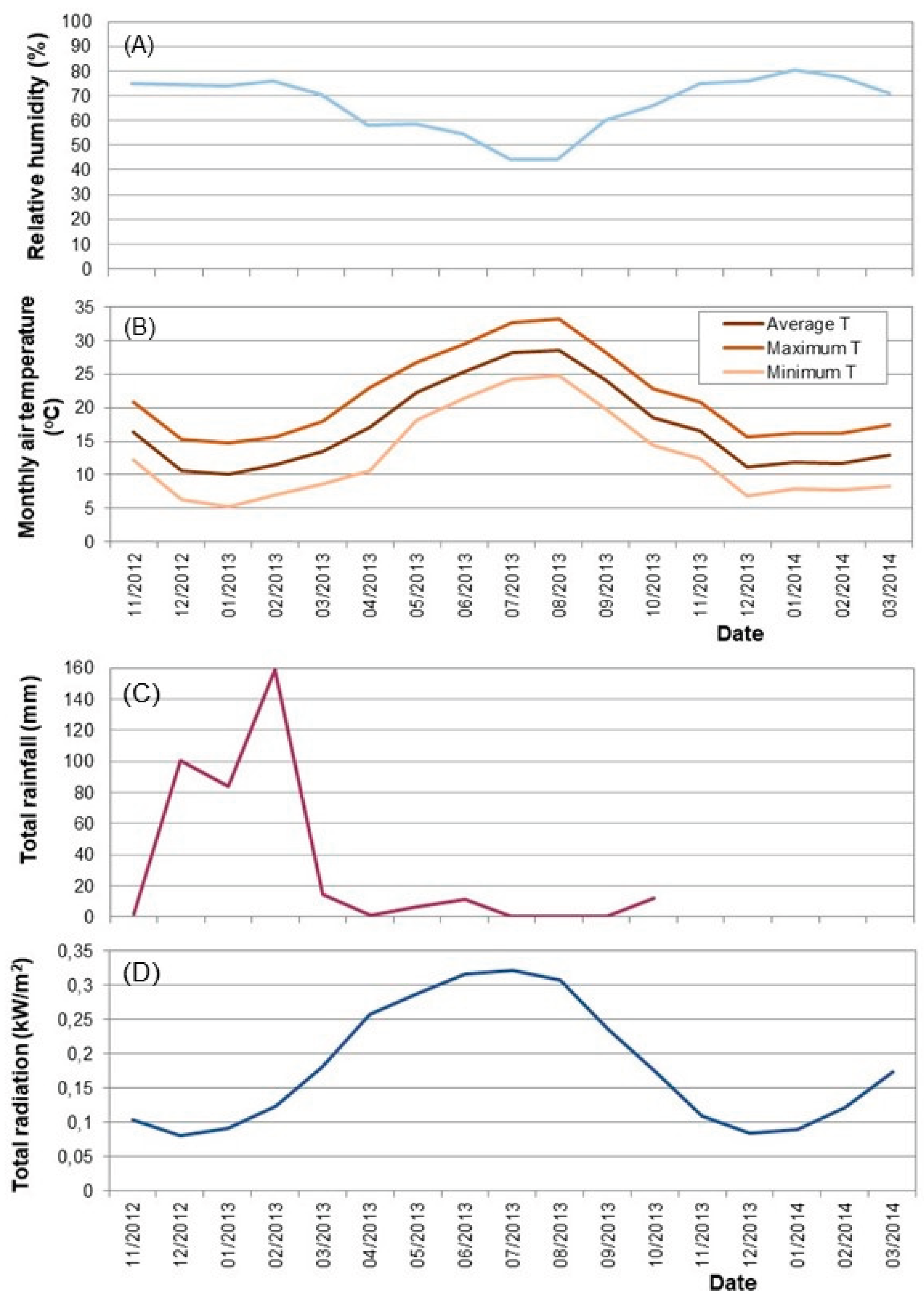
Figure 2.
Effect of the treatments, substrate type combined with irrigation frequency, on plant height (cm) (A) and diameter (B) of P. maritima, during May 2013 to March 2014 period. Substrate: soil (grape marc compost: perlite: soil: pumice, 3:3:2:2, v/v) and soilless (grape marc compost: perlite: pumice, 3:3:4, v/v); Irrigation: normal (substrate moisture 17–20%) and sparse (5–11%). ɫ Mean values in each figure and date followed by the same lowercase letter did not differ significantly at p≤ 0.05 by Student’s t-test; § NS or *, non-significant or significant at p≤ 0.05, respectively; n=12.
Figure 2.
Effect of the treatments, substrate type combined with irrigation frequency, on plant height (cm) (A) and diameter (B) of P. maritima, during May 2013 to March 2014 period. Substrate: soil (grape marc compost: perlite: soil: pumice, 3:3:2:2, v/v) and soilless (grape marc compost: perlite: pumice, 3:3:4, v/v); Irrigation: normal (substrate moisture 17–20%) and sparse (5–11%). ɫ Mean values in each figure and date followed by the same lowercase letter did not differ significantly at p≤ 0.05 by Student’s t-test; § NS or *, non-significant or significant at p≤ 0.05, respectively; n=12.
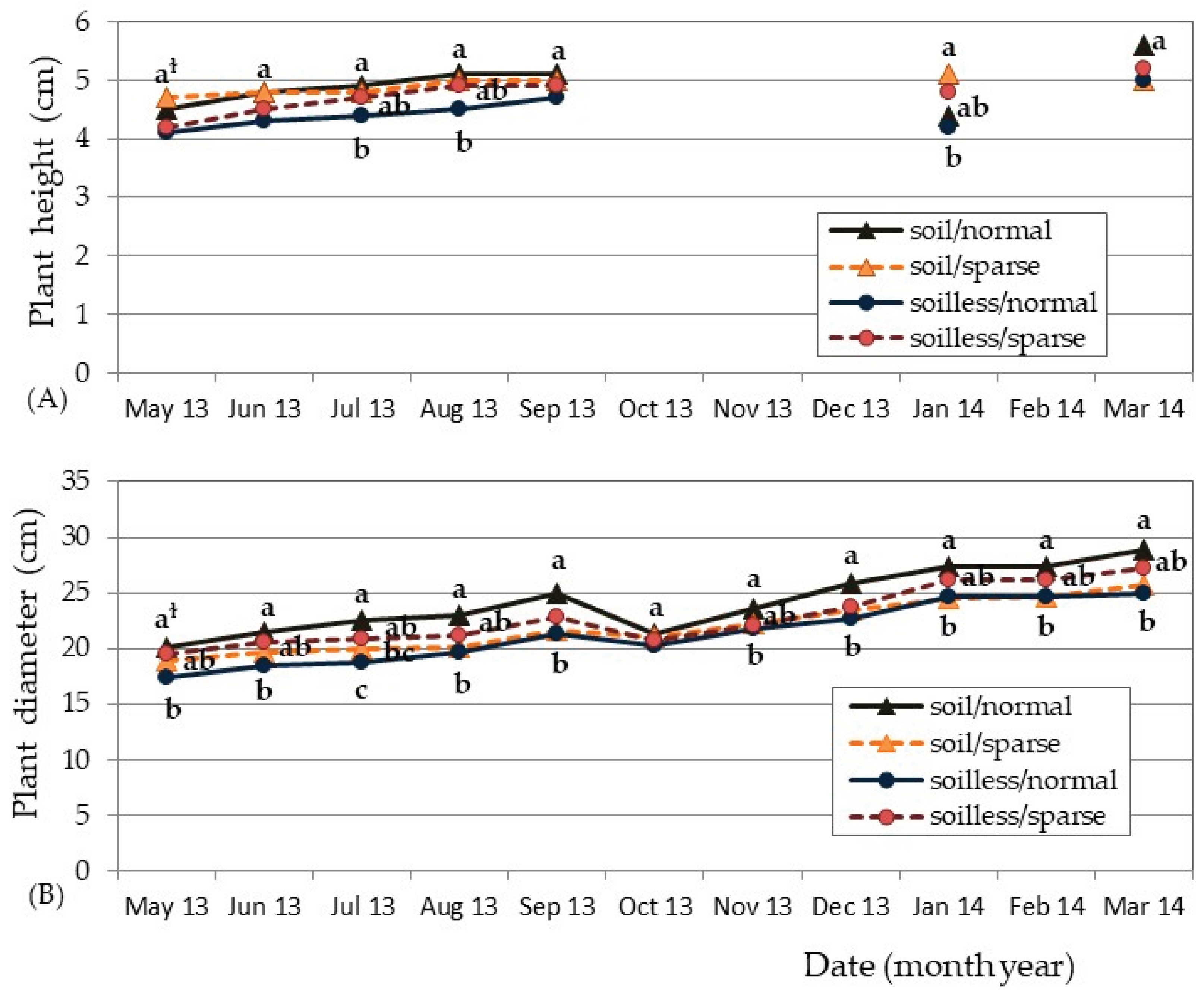
Figure 3.
Typical growth of P. maritima in the soil-containing substrate under normal (A) and sparse (B) irrigation, and in the soilless substrate under normal (C) and sparse (D) irrigation, after 17 months of cultivation (March 2014). Substrate: soil (grape marc compost: perlite: soil: pumice, 3:3:2:2, v/v) and soilless (grape marc compost: perlite: pumice, 3:3:4, v/v); Irrigation: normal (substrate moisture 17–20%) and sparse (5–11%).
Figure 3.
Typical growth of P. maritima in the soil-containing substrate under normal (A) and sparse (B) irrigation, and in the soilless substrate under normal (C) and sparse (D) irrigation, after 17 months of cultivation (March 2014). Substrate: soil (grape marc compost: perlite: soil: pumice, 3:3:2:2, v/v) and soilless (grape marc compost: perlite: pumice, 3:3:4, v/v); Irrigation: normal (substrate moisture 17–20%) and sparse (5–11%).
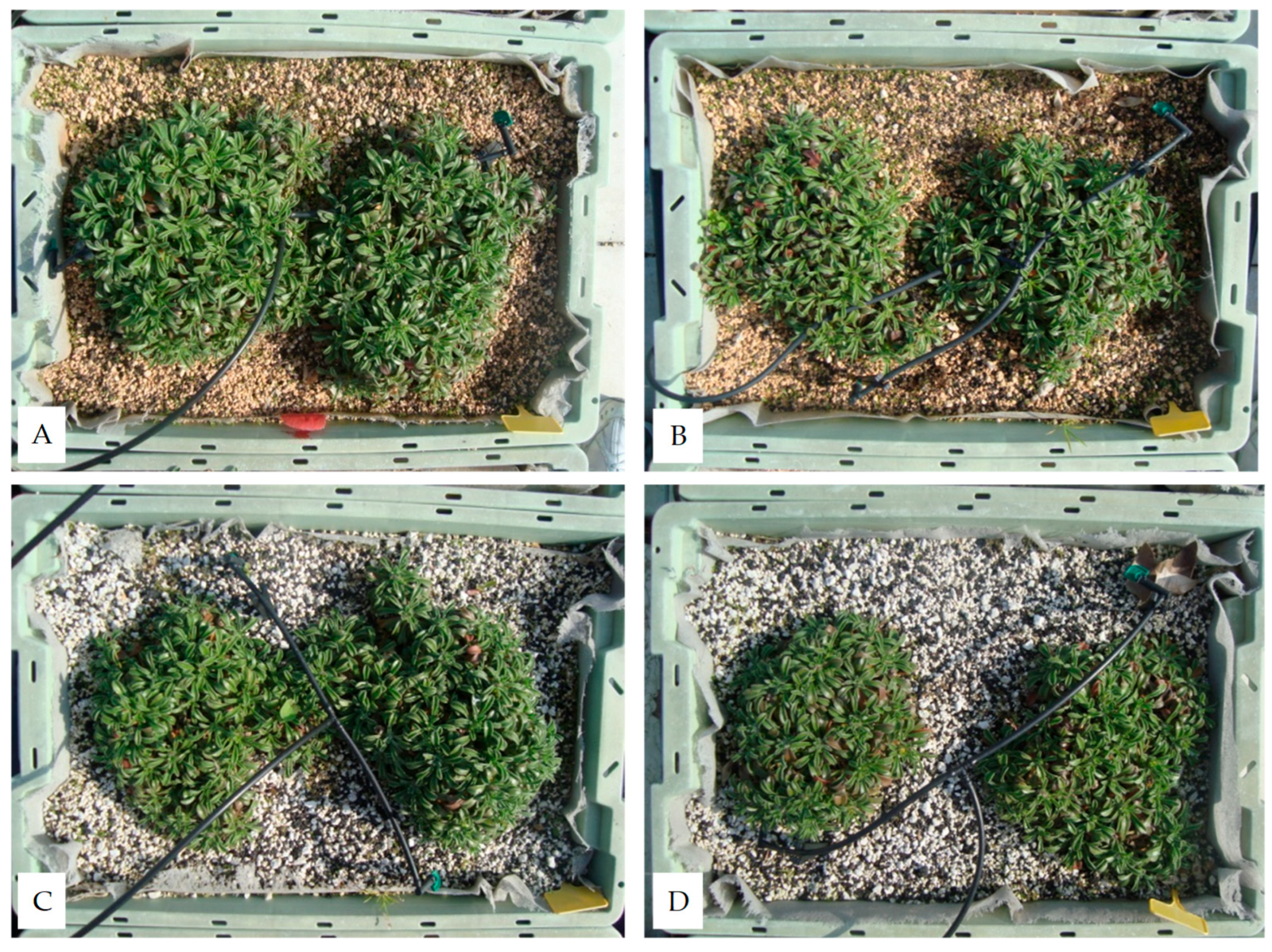
Figure 4.
Effect of the treatments, substrate type combined with irrigation frequency, on lateral shoot number (A) and length (B) of P. maritima in September 2013, as well as on lateral shoot number in March 2014 (C). Substrate: soil (grape marc compost: perlite: soil: pumice, 3:3:2:2, v/v) and soilless (grape marc compost: perlite: pumice, 3:3:4, v/v); Irrigation: normal (substrate moisture 17–20%) and sparse (5–11%). ɫ Mean values in each figure followed by the same lowercase letter did not differ significantly at p≤ 0.05 by Student’s t-test; § NS or *, non-significant or significant at p≤ 0.05, respectively; n=12.
Figure 4.
Effect of the treatments, substrate type combined with irrigation frequency, on lateral shoot number (A) and length (B) of P. maritima in September 2013, as well as on lateral shoot number in March 2014 (C). Substrate: soil (grape marc compost: perlite: soil: pumice, 3:3:2:2, v/v) and soilless (grape marc compost: perlite: pumice, 3:3:4, v/v); Irrigation: normal (substrate moisture 17–20%) and sparse (5–11%). ɫ Mean values in each figure followed by the same lowercase letter did not differ significantly at p≤ 0.05 by Student’s t-test; § NS or *, non-significant or significant at p≤ 0.05, respectively; n=12.
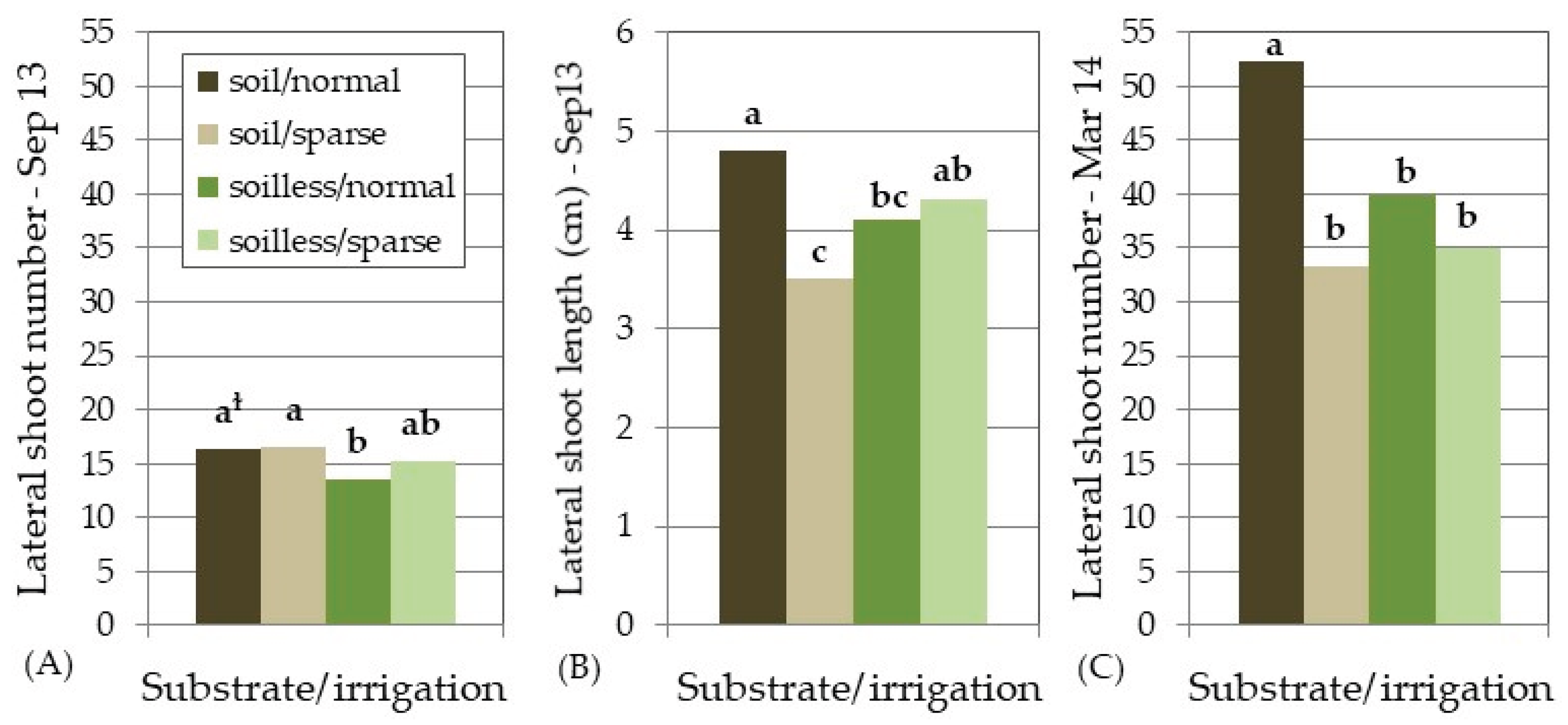
Figure 5.
Typical growth and flowering of P. maritima in the soil-containing substrate, under normal (A) and sparse (B) irrigation, and in the soilless substrate, under normal (C) and sparse (D) irrigation, after 5 months of cultivation (April 2013). Substrate: soil (grape marc compost: perlite: soil: pumice, 3:3:2:2, v/v) and soilless (grape marc compost: perlite: pumice, 3:3:4, v/v); Irrigation: normal (substrate moisture 17–20%) and sparse (5–11%).
Figure 5.
Typical growth and flowering of P. maritima in the soil-containing substrate, under normal (A) and sparse (B) irrigation, and in the soilless substrate, under normal (C) and sparse (D) irrigation, after 5 months of cultivation (April 2013). Substrate: soil (grape marc compost: perlite: soil: pumice, 3:3:2:2, v/v) and soilless (grape marc compost: perlite: pumice, 3:3:4, v/v); Irrigation: normal (substrate moisture 17–20%) and sparse (5–11%).
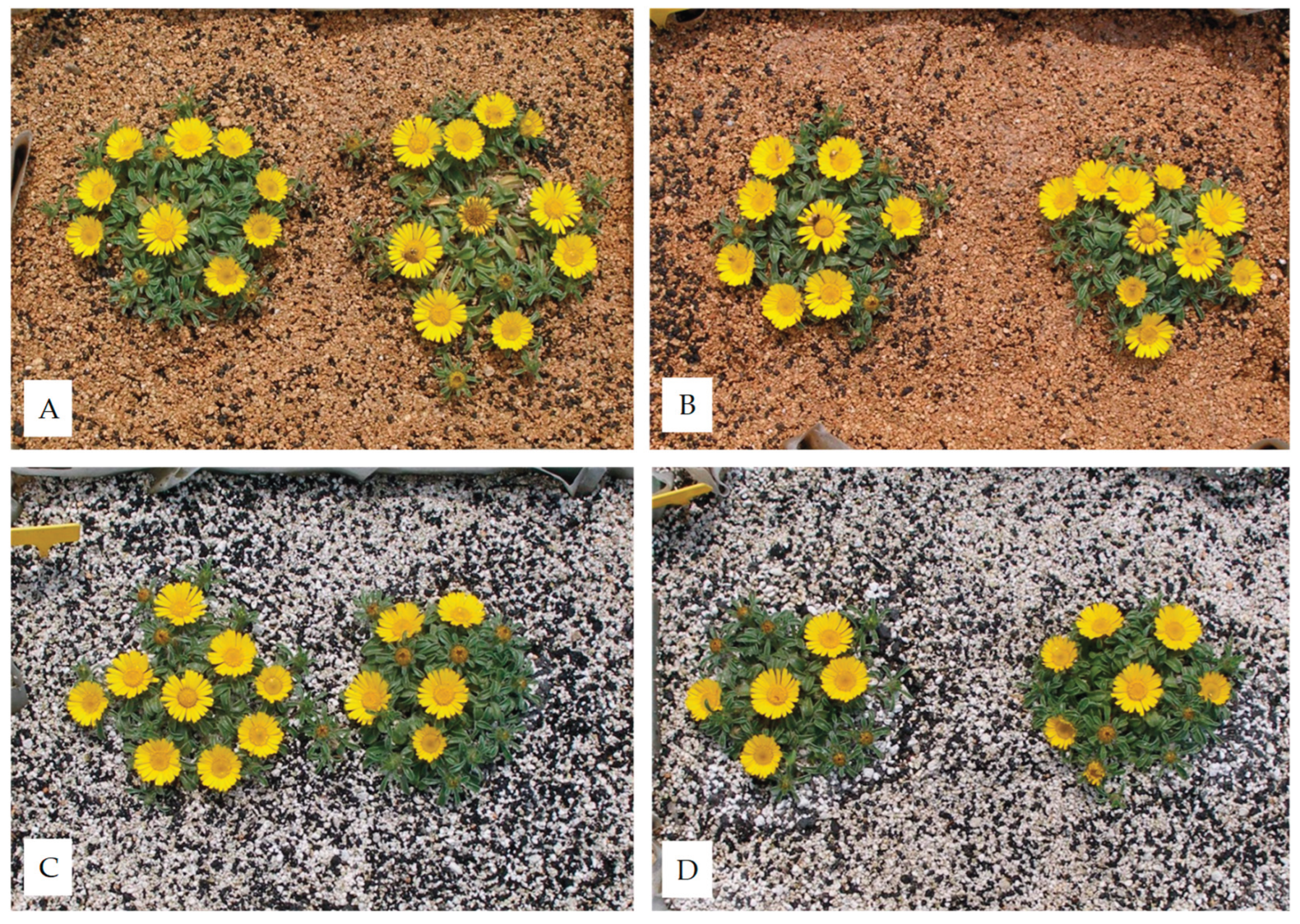
Figure 6.
Effect of the treatments, substrate type combined with irrigation frequency, on number of flowers per plant of P. maritima, during April to August 2013 period. Substrate: soil (grape marc compost: perlite: soil: pumice, 3:3:2:2, v/v) and soilless (grape marc compost: perlite: pumice, 3:3:4, v/v); Irrigation: normal (substrate moisture 17–20%) and sparse (5–11%). ɫ Mean values in each date followed by the same lowercase letter did not differ significantly at p≤ 0.05 by Student’s t-test; § NS or *, non-significant or significant at p≤ 0.05, respectively; n=12.
Figure 6.
Effect of the treatments, substrate type combined with irrigation frequency, on number of flowers per plant of P. maritima, during April to August 2013 period. Substrate: soil (grape marc compost: perlite: soil: pumice, 3:3:2:2, v/v) and soilless (grape marc compost: perlite: pumice, 3:3:4, v/v); Irrigation: normal (substrate moisture 17–20%) and sparse (5–11%). ɫ Mean values in each date followed by the same lowercase letter did not differ significantly at p≤ 0.05 by Student’s t-test; § NS or *, non-significant or significant at p≤ 0.05, respectively; n=12.
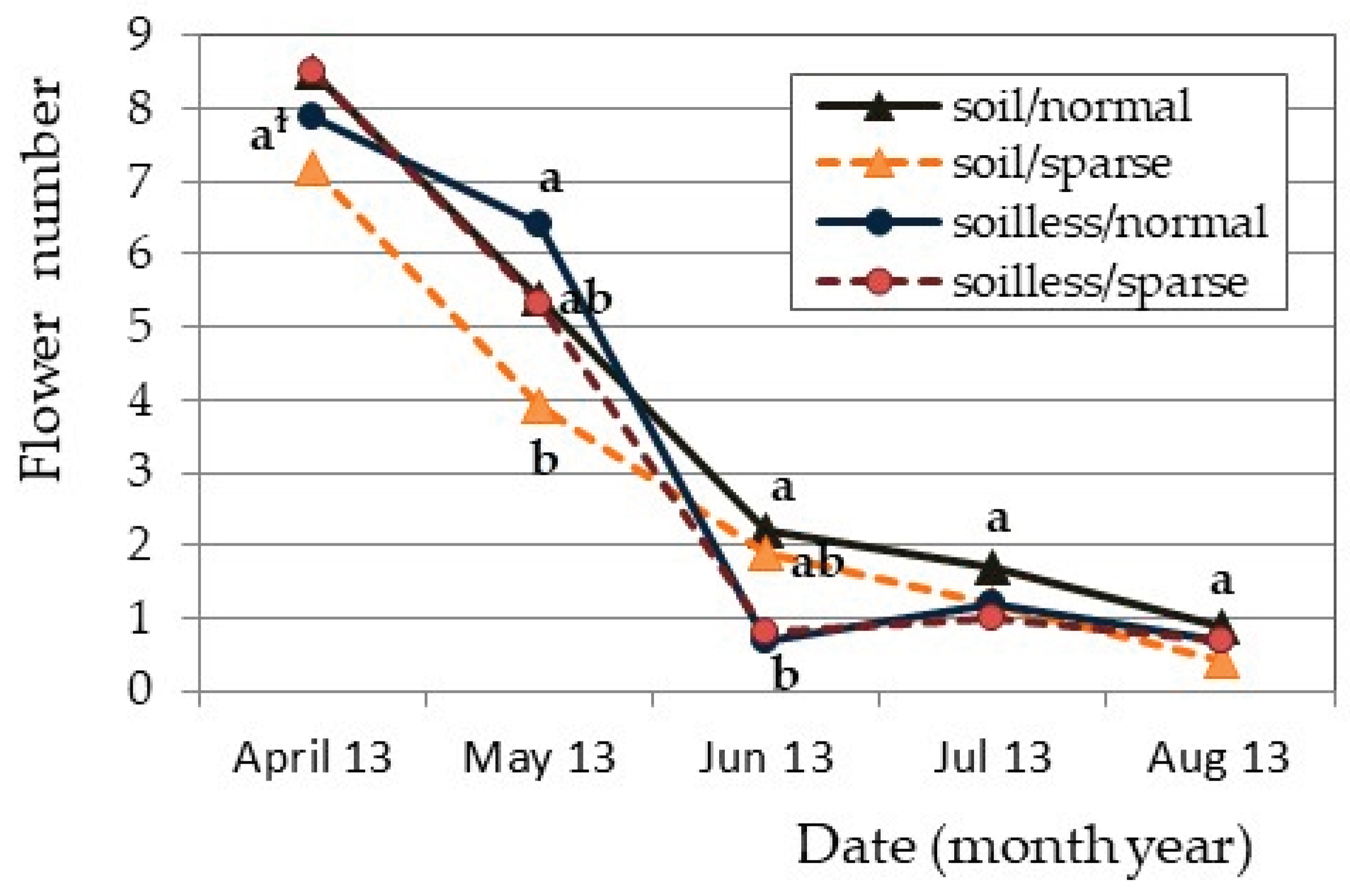
Figure 7.
Effect of the treatments, substrate type combined with irrigation frequency, on leaf stomatal resistance (Rleaf, s cm-1) of P. maritima, one day before (A) and one day after (B) an irrigation event, on marked dates. Substrate: soil (grape marc compost: perlite: soil: pumice, 3:3:2:2, v/v) and soilless (grape marc compost: perlite: pumice, 3:3:4, v/v); Irrigation: normal (substrate moisture 17–20%) and sparse (5–11%). ɫ Mean values in each figure and date followed by the same lowercase letter did not differ significantly at p≤ 0.05 by Student’s t-test; § NS or *, non-significant or significant at p≤ 0.05, respectively; n=12.
Figure 7.
Effect of the treatments, substrate type combined with irrigation frequency, on leaf stomatal resistance (Rleaf, s cm-1) of P. maritima, one day before (A) and one day after (B) an irrigation event, on marked dates. Substrate: soil (grape marc compost: perlite: soil: pumice, 3:3:2:2, v/v) and soilless (grape marc compost: perlite: pumice, 3:3:4, v/v); Irrigation: normal (substrate moisture 17–20%) and sparse (5–11%). ɫ Mean values in each figure and date followed by the same lowercase letter did not differ significantly at p≤ 0.05 by Student’s t-test; § NS or *, non-significant or significant at p≤ 0.05, respectively; n=12.
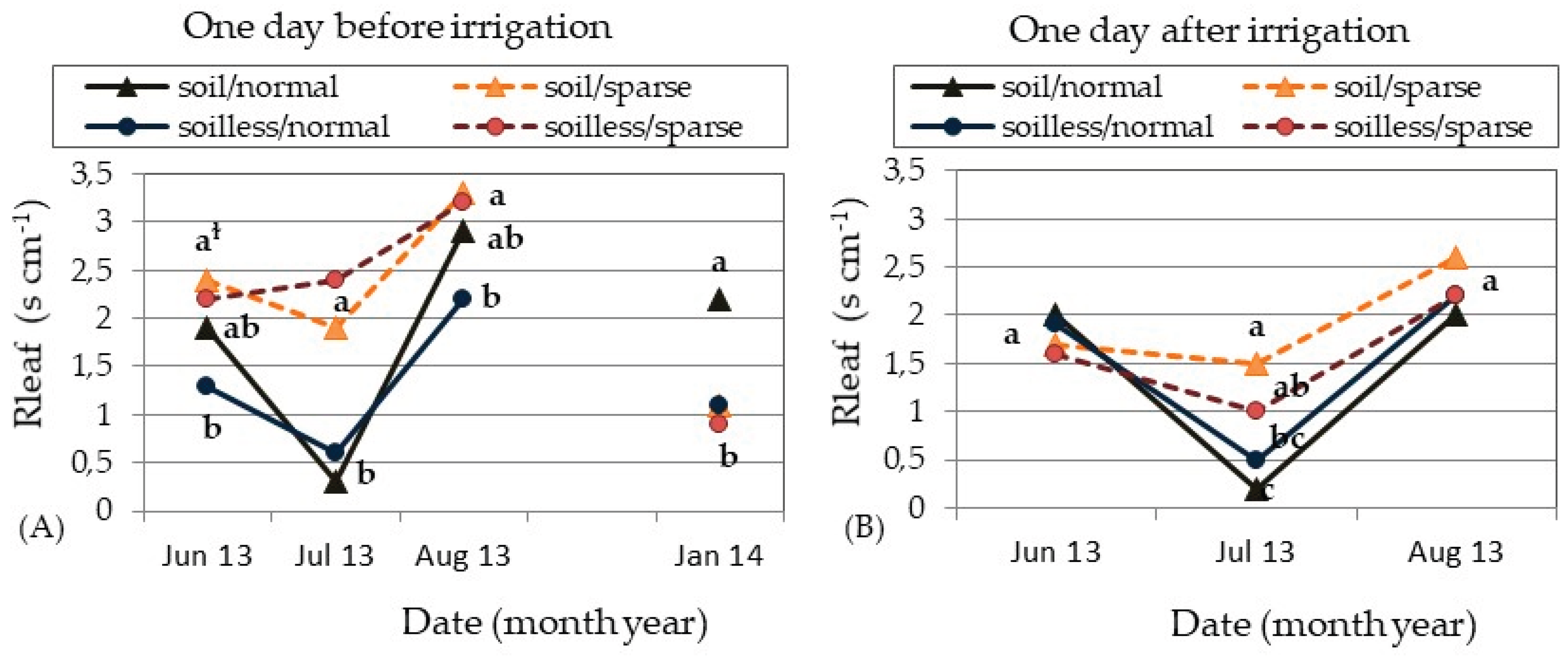
Figure 8.
Effect of the treatments, substrate type combined with irrigation frequency, on maximum quantum yield of PSII phytochemistry (ΦPSIIo) of P. maritima, one day before (A) and one day after (B) an irrigation event, on marked dates. Substrate: soil (grape marc compost: perlite: soil: pumice, 3:3:2:2, v/v) and soilless (grape marc compost: perlite: pumice, 3:3:4, v/v); Irrigation: normal (substrate moisture 17–20%) and sparse (5–11%). ɫ Mean values in each figure and date followed by the same lowercase letter did not differ significantly at p≤ 0.05 by Student’s t-test; § NS or *, non-significant or significant at p≤ 0.05, respectively; n=12.
Figure 8.
Effect of the treatments, substrate type combined with irrigation frequency, on maximum quantum yield of PSII phytochemistry (ΦPSIIo) of P. maritima, one day before (A) and one day after (B) an irrigation event, on marked dates. Substrate: soil (grape marc compost: perlite: soil: pumice, 3:3:2:2, v/v) and soilless (grape marc compost: perlite: pumice, 3:3:4, v/v); Irrigation: normal (substrate moisture 17–20%) and sparse (5–11%). ɫ Mean values in each figure and date followed by the same lowercase letter did not differ significantly at p≤ 0.05 by Student’s t-test; § NS or *, non-significant or significant at p≤ 0.05, respectively; n=12.
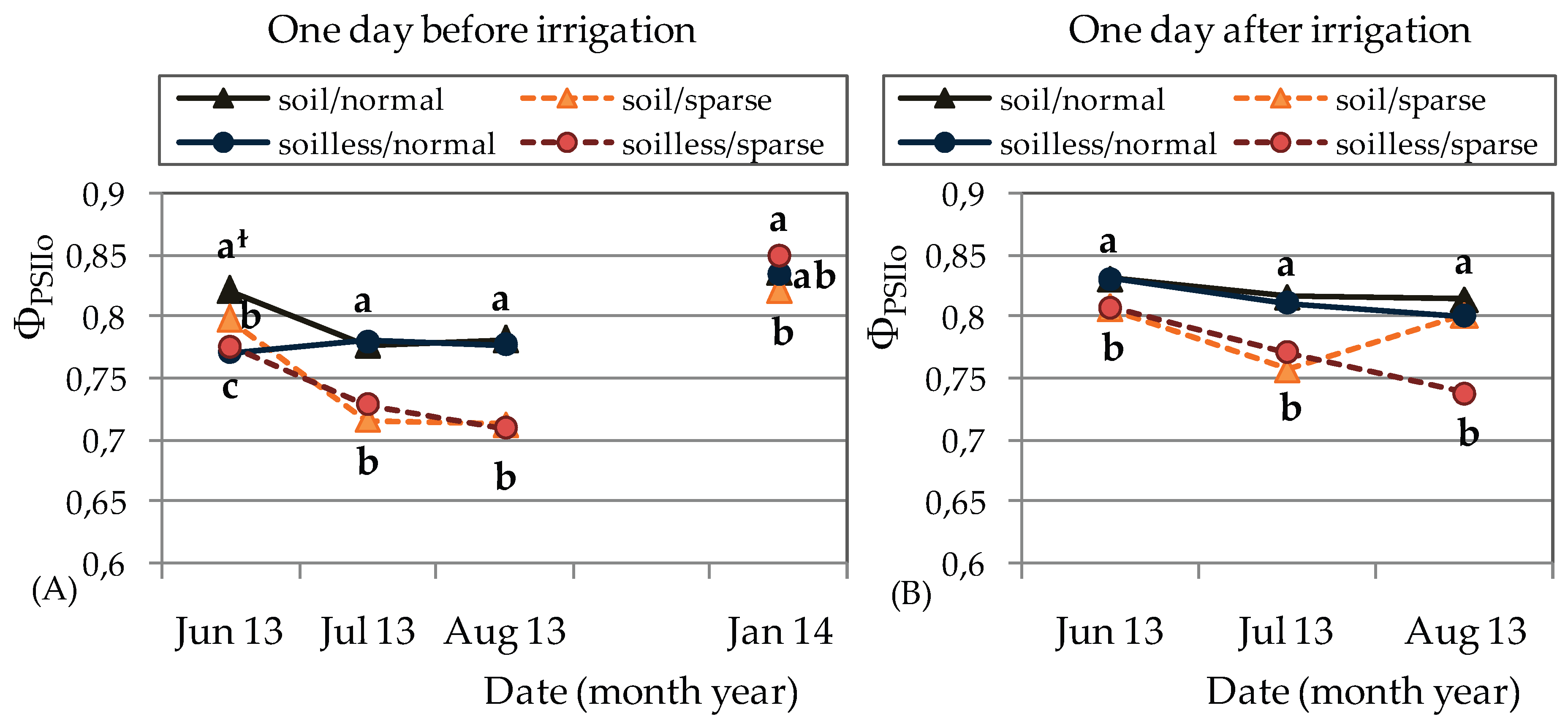
Figure 9.
Effect of the treatments, substrate type combined with irrigation frequency, on total chlorophyll (A), relative water content (RWC) (B) and leaf thickness (μm) (C) of P. maritima, in March 2014. Substrate: soil (grape marc compost: perlite: soil: pumice, 3:3:2:2, v/v) and soilless (grape marc compost: perlite: pumice, 3:3:4, v/v); Irrigation: normal (substrate moisture 17–20%) and sparse (5–11%). ɫ Mean values in each figure followed by the same lowercase letter did not differ significantly at p≤ 0.05 by Student’s t-test; § NS or *, non-significant or significant at p≤ 0.05, respectively; n=12.
Figure 9.
Effect of the treatments, substrate type combined with irrigation frequency, on total chlorophyll (A), relative water content (RWC) (B) and leaf thickness (μm) (C) of P. maritima, in March 2014. Substrate: soil (grape marc compost: perlite: soil: pumice, 3:3:2:2, v/v) and soilless (grape marc compost: perlite: pumice, 3:3:4, v/v); Irrigation: normal (substrate moisture 17–20%) and sparse (5–11%). ɫ Mean values in each figure followed by the same lowercase letter did not differ significantly at p≤ 0.05 by Student’s t-test; § NS or *, non-significant or significant at p≤ 0.05, respectively; n=12.
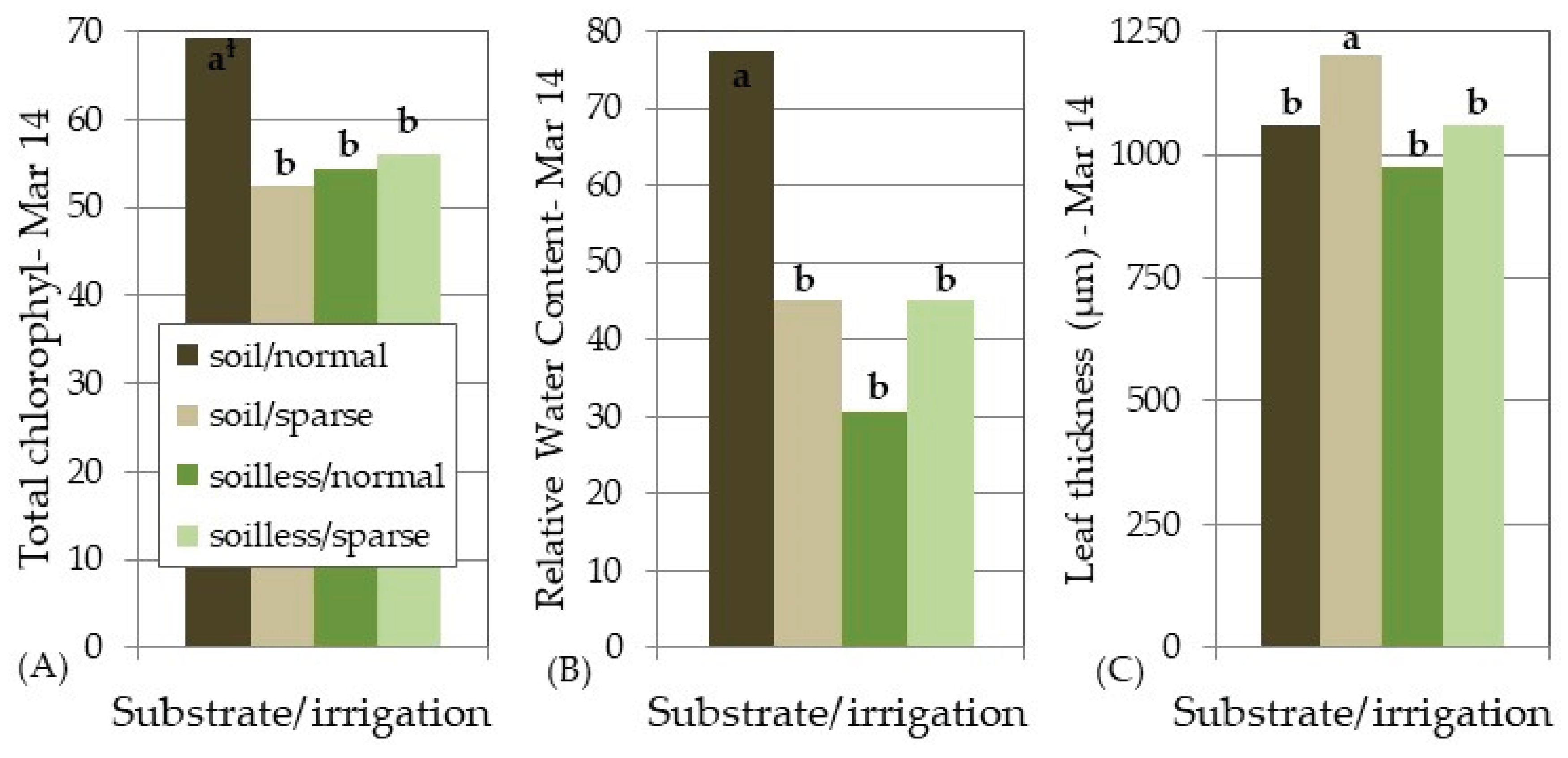
Figure 10.
Cross-sections of an P. maritima leaf lamina show mesophyll anatomy, calcium oxalate crystals (c) and mechanical multicellular hairs (h) are visible. Scale bar 200 μm.
Figure 10.
Cross-sections of an P. maritima leaf lamina show mesophyll anatomy, calcium oxalate crystals (c) and mechanical multicellular hairs (h) are visible. Scale bar 200 μm.
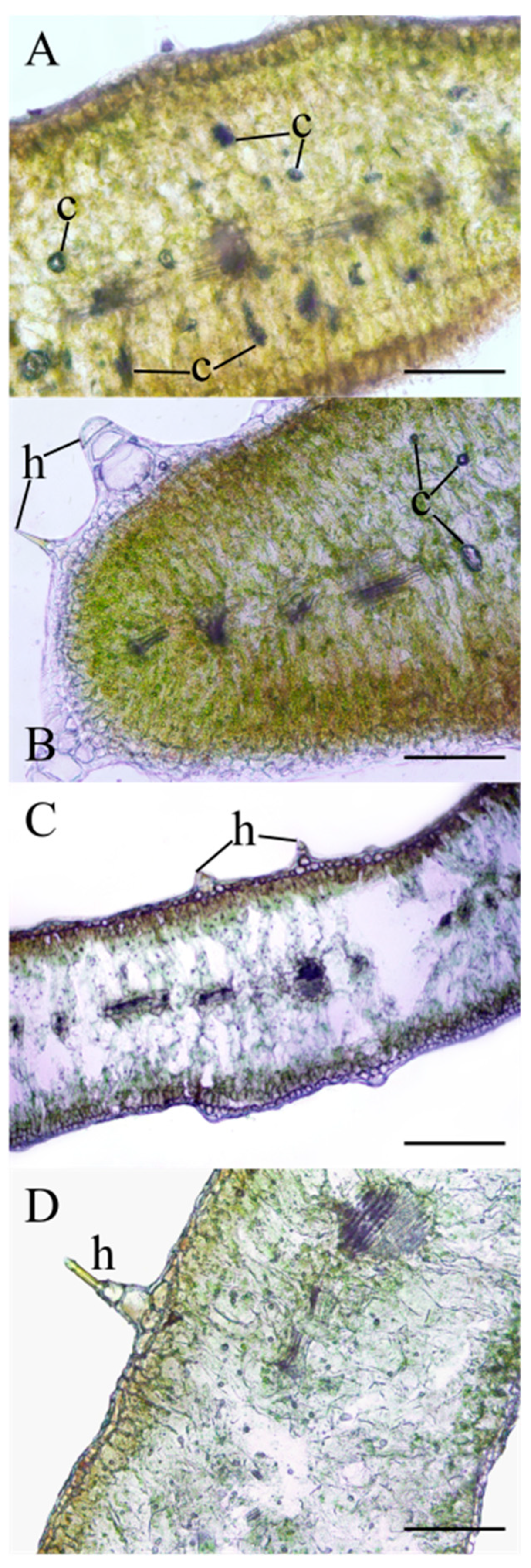
Figure 11.
April 2013. Adult hoverfly (Diptera: Syrphidae), visiting a flower of P. maritima in the experimental plot.
Figure 11.
April 2013. Adult hoverfly (Diptera: Syrphidae), visiting a flower of P. maritima in the experimental plot.
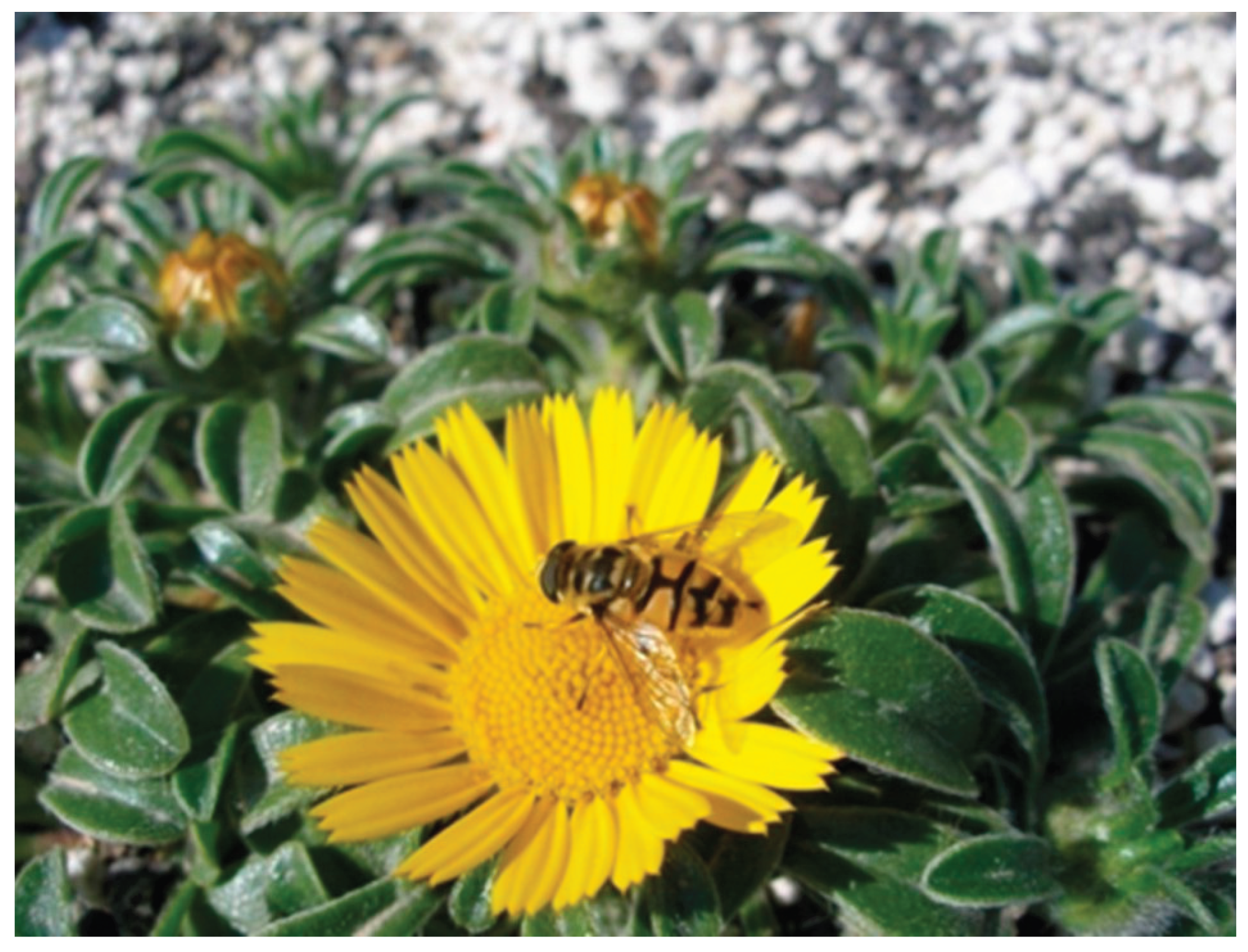

Table 1.
Effect of the main factors (substrate type and irrigation frequency) on plant height (cm) of P. maritima, during May 2013 to March 2014 period.
Table 1.
Effect of the main factors (substrate type and irrigation frequency) on plant height (cm) of P. maritima, during May 2013 to March 2014 period.
| Experimental factors | May 13 |
Jun 13 |
Jul 13 |
Aug 13 |
Sept 13 |
Jan 14 |
Mar 14 |
|
| Substrate | Soil | 4.7 aɫ | 4.8 a | 4.9 a | 5.0 a | 5.1 a | 4.7 a | 5.3 a |
| Soilless | 4.2 b | 4.4 b | 4.5 a | 4.7 a | 4.8 a | 4.5 a | 5.1 a | |
| Irrigation | Normal | 4.3 a | 4.6 a | 4.7 a | 4.8 a | 4.9 a | 4.3 b | 5.3 a |
| Sparse | 4.5 a | 4.6 a | 4.8 a | 4.9 a | 5.0 a | 4.9 a | 5.1 a | |
| Significance§ | Fsubstrate | * | * | NS | NS | NS | NS | NS |
| Firrigation | NS | NS | NS | NS | NS | * | NS | |
| Fsub.×irrig. | NS | NS | NS | NS | NS | NS | NS | |
ɫ Mean values in each column and experimental factor followed by the same lowercase letter did not differ significantly at p≤ 0.05 by Student’s t-test; § NS or *, non-significant or significant at p≤ 0.05, respectively; n=12.
Table 2.
Effect of the main factors (substrate type and irrigation frequency) on plant diameter (cm) of P. maritima, during May 2013 to March 2014 period.
Table 2.
Effect of the main factors (substrate type and irrigation frequency) on plant diameter (cm) of P. maritima, during May 2013 to March 2014 period.
| Experimental factors | May 13 |
Jun 13 |
Jul 13 |
Aug 13 |
Sept 13 |
Oct 13 |
Nov 13 |
Dec 13 |
Jan 14 |
Feb 14 |
Mar 14 | |
| Substrate | Soil | 19.5 aɫ | 20.5 a | 21.2 a | 21.5 a | 23.3 a | 21.2 a | 22.9 a | 24.7 a | 25.0 a | 26.0 a | 27.3 a |
| Soilless | 18.5 a | 19.6 a | 19.8 a | 20.4 a | 22.1 a | 20.5 a | 21.8 a | 23.2 a | 25.4 a | 25.4 a | 26.1 a | |
| Irrigation | Normal | 18.7 a | 20.0 a | 20.7 a | 21.3 a | 23.2 a | 20.8 a | 22.6 a | 24.3 a | 25.9 a | 25.9 a | 27.0 a |
| Sparse | 19.2 a | 20.1 a | 20.3 a | 20.6 a | 22.2 a | 20.9 a | 22.1 a | 23.6 a | 25.3 a | 25.4 a | 26.4 a | |
| Significance§ | Fsubstrate | - | - | - | - | - | NS | NS | - | - | - | - |
| Firrigation | - | - | - | - | - | NS | NS | - | - | - | - | |
| Fsub.×irrig. | * | * | * | * | * | NS | NS | * | * | * | * | |
ɫ Mean values in each column and experimental factor followed by the same lowercase letter did not differ significantly at p≤ 0.05 by Student’s t-test; § *, significant at p≤ 0.05; n=12.
Table 3.
Effect of the main factors (substrate type and irrigation frequency) on lateral shoot number and length (cm) of P. maritima, on marked dates.
Table 3.
Effect of the main factors (substrate type and irrigation frequency) on lateral shoot number and length (cm) of P. maritima, on marked dates.
| Experimental factors | Lateral shoot number-Sep 13 | Lateral shoot length (cm)-Sep 13 | Lateral shoot number-Mar 14 | |
| Substrate | Soil | 16.4 aɫ | 4.2 a | 42.9 a |
| Soilless | 14.3 b | 4.2 a | 37.4 a | |
| Irrigation | Normal | 14.9 a | 4.5 a | 46.1 a |
| Sparse | 15.8 a | 3.9 b | 34.2 b | |
| Significance§ | Fsubstrate | * | NS | NS |
| Firrigation | NS | * | * | |
| Fsub.×irrig. | NS | NS | NS | |
ɫ Mean values in each column and experimental factor followed by the same lowercase letter did not differ significantly at p≤ 0.05 by Student’s t-test; § NS or *, non-significant or significant at p≤ 0.05, respectively; n=12.
Table 4.
Effect of the main factors (substrate type and irrigation frequency) on leaf stomatal resistance (Rleaf, s cm-1) of P. maritima, one day before and one day after an irrigation event, on marked dates.
Table 4.
Effect of the main factors (substrate type and irrigation frequency) on leaf stomatal resistance (Rleaf, s cm-1) of P. maritima, one day before and one day after an irrigation event, on marked dates.
|
Rleaf Experimental factors |
Jun 13 before/after |
Jul 13 before/after |
Aug 13 before/after |
Jan 14 before |
|
| Substrate | Soil | 2.2 aɫ/ 1.9 a | 1.1 a/ 0.8 a | 3.1 a/ 2.3 a | 1.7 a |
| Soilless | 1.7a/ 1.7 a | 1.5 a/ 0.7 a | 2.7 a/ 2.2 a | 1.0 b | |
| Irrigation | Normal | 1.6b/ 1.9 a | 0.4b/ 0.3 b | 2.5 a/ 2.1 a | 1.6 a |
| Sparse | 2.3 a/ 1.6 a | 2.2a/ 1.2 a | 3.2a/ 2.4 a | 1.0 b | |
| Significance§ | Fsubstrate | NS/ NS | NS/ NS | NS/ NS | * |
| Firrigation | */ NS | */ * | NS/ NS | * | |
| Fsub.×irrig. | NS/ NS | NS/ NS | NS/ NS | NS | |
ɫ Mean values in each column and experimental factor followed by the same lowercase letter did not differ significantly at p≤ 0.05 by Student’s t-test; § NS or *, non-significant or significant at p≤ 0.05, respectively; n=12.
Table 5.
Effect of the main factors (substrate type and irrigation frequency) on maximum quantum yield of PSII phytochemistry (ΦPSIIo) of P. maritima, one day before and one day after an irrigation event, on marked dates.
Table 5.
Effect of the main factors (substrate type and irrigation frequency) on maximum quantum yield of PSII phytochemistry (ΦPSIIo) of P. maritima, one day before and one day after an irrigation event, on marked dates.
|
ΦPSIIo Experimental factors |
Jun 13 before/after |
Jul 13 before/after |
Aug 13 before/after |
Jan 14 before |
|
| Substrate | Soil | 0.810 aɫ/ 0.819 a | 0.747 a/ 0.787 a | 0.748 a/ 0.809 a | 0.830 a |
| Soilless | 0.774b/ 0.820 a | 0.755 a/ 0.792 a | 0.744 a/ 0.770 b | 0.843 a | |
| Irrigation | Normal | 0.797 a/ 0.832 a | 0.779 a/ 0.814 a | 0.780 a/ 0.808 a | 0.836 a |
| Sparse | 0.787 b/ 0.807 b | 0.723 b/ 765 b | 0.712b/ 0.771 b | 0.836 a | |
| Significance§ | Fsubstrate | -/ NS | NS/ NS | NS/ - | NS |
| Firrigation | -/ * | */ * | */ - | NS | |
| Fsub.×irrig. | */ NS | NS/ NS | NS/ * | NS | |
ɫ Mean values in each column and experimental factor followed by the same lowercase letter did not differ significantly at p≤ 0.05 by Student’s t-test; § NS or *, non-significant or significant at p≤ 0.05, respectively; n=12.
Table 6.
Effect of the main factors (substrate type and irrigation frequency) on total chlorophyll concentration (Chltot), Relative Water Content (RWC) (%) and Leaf Thickness (LT) (μm) of P. maritima, in March 2014.
Table 6.
Effect of the main factors (substrate type and irrigation frequency) on total chlorophyll concentration (Chltot), Relative Water Content (RWC) (%) and Leaf Thickness (LT) (μm) of P. maritima, in March 2014.
| Experimental factors | Chltot (μg/cm2) | RWC (%) | LT (μm) | |
| Substrate | Soil | 60.8 aɫ | 61.2 a | 1130.0 a |
| Soilless | 55.1a | 37.7 b | 1017.5 b | |
| Irrigation | Normal | 61.8 a | 54.0 a | 1017.5 b |
| Sparse | 54.2 b | 45.0 a | 1130.0 a | |
| Significance§ | Fsubstrate | NS | - | * |
| Firrigation | * | - | * | |
| Fsub.×irrig. | NS | * | NS | |
ɫ Mean values in each column and experimental factor followed by the same lowercase letter did not differ significantly at p≤ 0.05 by Student’s t-test; § NS or *, non-significant or significant at p≤ 0.05, respectively; n=12.
Disclaimer/Publisher’s Note: The statements, opinions and data contained in all publications are solely those of the individual author(s) and contributor(s) and not of MDPI and/or the editor(s). MDPI and/or the editor(s) disclaim responsibility for any injury to people or property resulting from any ideas, methods, instructions or products referred to in the content. |
© 2026 by the authors. Licensee MDPI, Basel, Switzerland. This article is an open access article distributed under the terms and conditions of the Creative Commons Attribution (CC BY) license (http://creativecommons.org/licenses/by/4.0/).
Copyright: This open access article is published under a Creative Commons CC BY 4.0 license, which permit the free download, distribution, and reuse, provided that the author and preprint are cited in any reuse.


